Here s my (eighteenth) monthly update about the activities I ve done in the F/L/OSS world.
Debian
This was my 27th month of active contributing to Debian.
I became a DM in late March 2019 and a DD on Christmas 19! \o/
This month was a bit exhausting; lots of moving parts. With the financial year ending, it was even more crazy, with me running around to banks, CA, et al.
Anyway, with now working on Ubuntu full-time, I did little of Debian this month. Here are the following things I worked on:
Filed bug #985314 against asterisk (systemd misconfiguration) and added a patch as well.
Filed bug #985421 against at (add DEP8 tests) and added a patch as well.
Other $things:
Attended the Debian LTS team meeting.
Mentoring for newcomers.
Moderation of -project mailing list.
Debian (E)LTS
Debian Long Term Support (LTS) is a project to extend the lifetime of all Debian stable releases to (at least) 5 years. Debian LTS is not handled by the Debian security team, but by a separate group of volunteers and companies interested in making it a success.
And Debian Extended LTS (ELTS) is its sister project, extending support to the Jessie release (+2 years after LTS support).
This was my eighteenth month as a Debian LTS and ninth month as a Debian ELTS paid contributor.
I was assigned 60.00 hours for LTS and 39.00 hours for ELTS and worked on the following things:
LTS CVE Fixes and Announcements:
Issued DLA 2580-1, fixing CVE-2021-21311, for adminer.
For Debian 9 stretch, these problems have been fixed in version 4.2.5-3+deb9u2.
Issued DLA 2581-1, fixing CVE-2021-27803, for wpa.
For Debian 9 stretch, these problems have been fixed in version 2:2.4-1+deb9u9.
Issued DLA 2585-1, fixing CVE-2020-13848, for libupnp.
For Debian 9 stretch, these problems have been fixed in version 1:1.6.19+git20160116-1.2+deb9u1.
Issued DLA 2589-2, fixing regression caused by DLA 2589-1, for mupdf.
For Debian 9 stretch, these problems have been fixed in version 1.9a+ds1-4+deb9u7.
Issued DLA 2598-1, fixing CVE-2020-25097, for squid3.
For Debian 9 stretch, these problems have been fixed in version 3.5.23-5+deb9u6.
Marked CVE-2021-21330/python-aiohttp as not-affected for stretch.
Marked CVE-2021-20233, CVE-2021-20225, CVE-2020-27779, CVE-2020-27778, CVE-2020-27749, CVE-2020-27748, CVE-2020-25647, CVE-2020-25632, CVE-2020-25631, and CVE-2020-14372, affecting grub2, as ignored for stretch and jessie.
Marked CVE-2020-27842/openjpeg2 as no-dsa for jessie.
Marked CVE-2020-27843/openjpeg2 as no-dsa for jessie.
Marked CVE-2021-28041/openssh as not-affect for jessie.
Marked CVE-2020-3552 3,4 /tiff as no-dsa for jessie.
Marked CVE-2021-20201/spice as no-dsa for jessie.
Marked CVE-2020-11988/xmlgraphics-commons as postponed for jessie.
Marked CVE-2020-11987/batik as postponed for jessie.
Marked CVE-2020-12695/libupnp as no-dsa for stretch.
Marked CVE-2021-25122/tomcat7 as not-affected for stretch.
Marked CVE-2021-25329/tomcat7 as ignored for stretch.
Marked CVE-2021-28116/squid3 as postponed for stretch and jessie.
Marked CVE-2021-3449/openssl as not-affected for stretch.
Document extra notes for grub2 for LTS and co-ordinate with the sec-team.
Document extra notes for pillow about piled-up issues in jessie.
Issued DLA-2593-1 for ca-certificates on Microsoft s request; co-ordinating w/ them.
Co-ordinating w/ maintainer of courier-authlib for stretch and jessie update.
Fixing build failures of ELTS security tracker and re-ordering entries in data/CVE-EXTENDED-LTS/list file.
Answer queries of dupondje and mikap about openssl on IRC; and it being not-affected for stretch.
Help review the status of CVE-2021-3121/golang-github-gogo-protobuf-dev for Ola.
Co-ordinating w/ Noah for cloud-init and setuptools.
Auto EOL ed mongodb, linux, guacamole-client, node-xmlhttprequest, newlib, neutron, privoxy, glpi, and zabbix for jessie.
Attended monthly meeting for Debian LTS.
Answered questions (& discussions) on IRC (#debian-lts and #debian-elts).
As of today, Rcpp stands at 2255 reverse-dependencies on CRAN. The graph on the left depicts the growth of Rcpp usage (as measured by Depends, Imports and LinkingTo, but excluding Suggests) over time. We actually crossed 2250 once a week ago, but what CRAN giveth, CRAN also taketh and counts can fluctuate. It had dropped back to 2248 a few days later.
Rcpp was first released in November 2008. It probably cleared 50 packages around three years later in December 2011, 100 packages in January 2013, 200 packages in April 2014, and 300 packages in November 2014. It passed 400 packages in June 2015 (when I tweeted about it), 500 packages in late October 2015, 600 packages in March 2016, 700 packages last July 2016, 800 packages last October 2016, 900 packages early January 2017, 1000 packages in April 2017, 1250 packages in November 2017, 1500 packages in November 2018, 1750 packages in August 2019, and then the big 2000 packages (as well as one in eight) in July 2020. The chart extends to the very beginning via manually compiled data from CRANberries and checked with crandb. The next part uses manually saved entries. The core (and by far largest) part of the data set was generated semi-automatically via a short script appending updates to a small file-based backend. A list of packages using Rcpp is available too.
Also displayed in the graph is the relative proportion of CRAN packages using Rcpp. The four per-cent hurdle was cleared just before useR! 2014 where I showed a similar graph (as two distinct graphs) in my invited keynote. We passed five percent in December of 2014, six percent July of 2015, seven percent just before Christmas 2015, eight percent in the summer of 2016, nine percent mid-December 2016, cracked ten percent in the summer of 2017 and eleven percent in 2018. Last year, along with passing 2000 package, we also passed 12.5 percent so one more than in every eight CRAN packages depends on Rcpp. Stunning. There is more detail in the chart: how CRAN seems to be pushing back more and removing more aggressively (which my CRANberries tracks but not in as much detail as it could), how the growth of Rcpp seems to be slowing somewhat outright and even more so as a proportion of CRAN as one would expect a growth curve to.
2250 user packages, and the continued growth, is truly mind-boggling. We can use the progression of CRAN itself compiled by Henrik in a series of posts and emails to the main development mailing list. Not that long ago CRAN itself did have only 1000 packages, then 5000, 10000, and here we are at over 17300 with Rcpp now at nearly 13.0% and still growing. Amazeballs.
The Rcpp team, recently grown in strength with the addition of I aki, continues to aim for keeping Rcpp as performant and reliable as it has been. A really big shoutout and Thank You! to all users and contributors of Rcpp for help, suggestions, bug reports, documentation or, of course, code.
If you like this or other open-source work I do, you can now sponsor me at GitHub.
Here is my monthly update covering what I have been doing in the free software world during March 2021 (previous month):
Reviewed and merged a number of contributions from Dan Palmer for my django-autologin library aimed at applications that use the Django web-development framework that wish to include automatic "login" links in emails (etc.). Changes made include allowing callers to override max-age [...], ensuring we always retrieve the same user account [...] and to improve the usability of the public API [...].
Opened a pull request to make the build process for Scrapy (a framework for extracting data from websites) reproducible. [...]
As part of my role of being the assistant Secretary of the Open Source Initiative and a board director of Software in the Public Interest, I attended their respective monthly meetings and other miscellaneous discussions occurring on the internet as well as the usual internal discussions, etc. As it happens, my term on the OSI board has been temporarily extended due to the discovery of a vulnerability in OSI's recent election as a result, the 2021 election will be re-run to ensure complete transparency of process.
Reproducible Builds
One of the original promises of open source software is that distributed peer review and transparency of process results in enhanced end-user security. However, whilst anyone may inspect the source code of free and open source software for malicious flaws, almost all software today is distributed as pre-compiled binaries. This allows nefarious third-parties to compromise systems by injecting malicious code into ostensibly secure software during the various compilation and distribution processes.
The motivation behind the Reproducible Builds effort is to ensure no flaws have been introduced during this compilation process by promising identical results are always generated from a given source, thus allowing multiple third-parties to come to a consensus on whether a build was compromised.
The project is proud to be a member project of the Software Freedom Conservancy. Conservancy acts as a corporate umbrella allowing projects to operate as non-profit initiatives without managing their own corporate structure. If you like the work of the Conservancy or the Reproducible Builds project, please consider becoming an official supporter.
This month, I:
Categorised a huge number of packages and issues in the Reproducible Builds "notes" repository.
Whilst looking into reproducible builds issues, I noticed that the heudiconv package could not be built reproducibly. This was because the call to help2man fails, so the manual page includes a Python traceback instead of the actual manpage. I filed a bug with a patch as Debian bug #984778.
I uploaded flask-peewee (0.6.7-3) to Debian to make the build reproducible (#885326) and did the same for pyvows (3.0.0-3) (#977487) too, refreshing the packaging at the same time.
I also made the following changes to diffoscope, including uploading versions 169, 170 and 171 to Debian:
New features:
If zipinfo(1) shows a difference but we cannot uncover a difference within the underlying .zip or .apk file, add a comment to the output and actually show the binary comparison. (#246)
Ensure all our temporary directories have useful names. [...]
Ignore --debug and similar arguments when creating a (hopefully-useful) temporary directory suffix. [...]
Optimisations:
Avoid frequent long lines in RPM header outputs that cause extremely slow HTML output generation. (#245)
Use larger read buffer block sizes when extracting files from archives. [...]
Use a much-shorter HTML class name instead of diffponct to optimise HTML output. [...]
Output improvements:
Make error extracting X, falling back to binary comparison 'Y' error message in diffoscope's output nicer. [...]
Don't emit "Unable to stat file" debug messages at all. We have entirely-artificial directory "entries" such as ELF sections which, of course, will never exist as files. [...]
Logging improvements:
Add the target directory when logging which directory we are extracting containers to. [...]
Format report size messages when generating HTML reports. [...]
Don't emit a Returning a FooContainer logging message too, as we already emit Instantiating a FooContainer log message. [...]
Reduce "Unable to stat file" warnings to debug messages as these are sometimes by design. [...]
Misc improvements:
Clarify a comment regarding not extracting excluded files. [...]
Remove trailing newline from updated test file (re: #243). [...]
Fix test_libmix_differences failure on openSUSE Tumbleweed. (#244)
Move test_rpm to use the assert_diff utility helper.
Frontdesk duties, responding to user/developer questions, attending monthly meeting, reviewing others' packages, participating in internal mailing list discussions, etc.
Proposed an stable update for python-django in buster. (#983526)
Prepared and uploaded a stable update for redis in buster. (#983527)
Issued DLA 2595-1 and ELA 380-1 for velocity, a Java-based template engine for writing web applications. Velocity could be exploited to run arbitrary code by applications that allowed untrusted users to upload/modify templates.
Issued DLA 2597-1 and ELA 381-1 to address a cross-site scripting (XSS) vulnerability in velocity-tools, a collection of useful tools for the Velocity template engine. The default error page could be exploited to steal session cookies, perform requests in the name of the victim, used for phishing attacks and many other similar attacks.
Issued DLA 2600-1 and ELA 384-1 for pygments as it was discovered that there was a series of denial of service vulnerabilities in this syntax highlighting library for Python. A number of regular expressions had cubic (or even exponential) worst-case complexity which could cause a remote denial of service (DoS) when provided with malicious input.
Issued DLA 2603-1 to address a number of vulnerabilities in libmediainfo, a library reading metadata such as track names, lengths, etc. from media files.
You can find out more about the Debian LTS via the following video:
Last weekend Debian Quebec held a Bug Squashing Party to try to fix some
bugs in the upcoming Debian Bullseye.
I wasn't convinced at first, but Tassia's contagious energy and willingness to
help organise the event eventually won me over. And shockers! it was
really fun.
We fixed a couple of RC bugs, held lightning talks and had a
virtual pizza party!
My lightning talk on autopkgtests was well received and a few people decided to
migrate to sbuild and enable autopkgtests by default.
Sergio's talk on debuginfod was incredibly interesting. I'm not a C
programmer and the live demo made me understand how this service can help
making debugging C easier.
Jerome's talk on using Yubikeys to unlock LUKS encrypted drives was also very
good! It also served as a reminder that Yubico's product are much more
featureful and convenient to use than other Open Hardware/ Free Software
hardware tokens. Hopefully that will change as enterprises like Nitrokey and
Solokey mature.
This was my third BSP, crazy how time flies... With the Bullseye release closing
in, you should try to join or organise one!
Have you heard of Vagrant ? It is a command line tool to get ready to use, disposable Virtual Machines (VM) from an online catalog. Vagrant works on Linux, FreeBSD, Windows and Mac and you only need three commands to get a shell prompt in a VM (see the Debian wiki). The online catalog has images for the majority of the OSes you can think of.
We've been building the Debian disk images for Vagrant (available on https://app.vagrantup.com/debian/) with a number of tools over the years:
then packer, which is wrapping qemu and the Debian installer CD with automated bootparams and preseed file.
and then fai-diskimage, again a wrapper over debootstrap using loopback mounts
Basically there are two category of tools for building a disk image:- those using an emulator and the OS installer in a automated way- those using debootstrap/pacstrap/rpmstrap on a loopback mounted filesystemPersonally I prefer the first approach, as you can run the build process as non root, and you benefit from all the quality work of the official installer. However this requires virtualization, and nested virtualization if your build process run insides a VM. Unfortunately nested virtualization is not that common, for instance my cloud provider, and the VMs used for Debian Continuous Integration, are not supporting nested virtualization. As the maintainer of fai-diskimage is a Debian Developer (hey MrFAI ! :) and as the debian-cloud folks are it using for Amazon, Azure and Google Cloud Debian images, it made sense to switch to fai-diskimage for now. The fai-diskimage learning curve is a bit steep as you have to learn many internal concepts before using it, but once you get the bits connected it works quite well.
All the time I've worked with software and computers, the lack of
diversity in the contributors has irked me. I started my career in
pharmaceutical sciences where the mix of people, at university, would
appear to be genuinely diverse. It was in the workplace that the
problems started, especially in the retail portion of community
pharmacy with a particular gender imbalance between management and
counter staff. Then I started to pick up programming. I gravitated to
free software for the simple reason that I could tinker with the source
code. To do a career change and learn how to program with a background
in a completely alien branch of science, the only realistic route into
the field is to have access to the raw material - source code. Without
that, I would have been seeking a sponsor, in much the same way as
other branches of science need grants or sponsors to purchase the
equipment and facilities to get a foot in the door. All it took from me
was some time, a willingness to learn and a means to work alongside
those already involved. That's it. No complex titration equipment,
flasks, centrifuges, pipettes, spectrographs, or petri dishes. It's
hard to do pharmaceutical science from home. Software is so much more
accessible - but only if the software itself is free.
Software freedom removes the main barrier to entry. Software freedom
enables the removal of other barriers too. Once the software is free,
it becomes obvious that the compiler (indeed the entire toolchain)
needs to be free, to turn the software into something other people can
use. The same applies to interpreters, editors, kernels and the entire
stack. I was in a different branch of science whilst all that was being
created and I am very glad that Debian Woody was available as a free
cover disc on a software magazine just at the time I was looking to
pick up software programming.
That should be that. The only next step to be good enough to write free
software was the "means to work alongside those already involved".
That, it turns out, is much more than just a machine running Debian.
It's more than just having an ISP account and working email (not
commonplace in 2003). It's working alongside the people - all the
people. It was my first real exposure to the toxicity of some parts of
many scientific and technical arenas. Where was the diversity? OK,
maybe it was just early days and the other barriers (like an account
with an ISP) were prohibitive for many parts of the world outside
Europe & USA in 2003, so there were few people from other countries but
the software world was massively dominated by the white Caucasian male.
I'd been insulated by my degree course, and to a large extent by my
university which also had courses which already had much more diverse
intakes - optics and pharmacy, business and human resources. Relocating
from the insular world of a little town in Wales to Birmingham was also
key. Maybe things would improve as the technical barriers to internet
connectivity were lowered.
Sadly, no. The echo chamber of white Caucasian input has become more
and more diluted as other countries have built the infrastructure to
get the populace online. Debian has helped in this area, principally
via DebConf. Yet only the ethnicity seemed to change, not the
diversity. Recently, more is being done to at least make Debian more
welcoming to those who are brave enough to increase the mix. Progress
is much slower than the gains seen in the ethnicity mix, probably
because that was a benefit of a technological change, not a societal
change.
The attitudes so prevalent in the late 20th century are becoming less
prevalent amongst, and increasingly abhorrent to, the next generation of
potential community members. Diversity must come or the pool of
contributors will shrink to nil. Community members who cling to these
attitudes are already dinosaurs and increasingly unwelcome. This is a
necessary step to retain access to new contributors as existing
contributors age. To be able to increase the number of contributors,
the community cannot afford to be dragged backwards by anyone, no
matter how important or (previously) respected.
Debian, or even free software overall, cannot change all the problems
with diversity in STEM but we must not perpetuate the problems either.
Those people involved in free software need to be open to change, to
input from all portions of society and welcoming. Puerile jokes and
disrespectful attitudes must be a thing of the past. The technical
contributions do not excuse behaviours that act to prevent new people
joining the community. Debian is getting older, the community and the
people. The presence of spouses at Debian social events does not fix
the problem of the lack of diversity at Debian technical events. As
contributors age, Debian must welcome new, younger, people to continue
the work. All the technical contributions from the people during the
20th century will not sustain Debian in the 21st century. Bit rot
affects us all. If the people who provided those contributions are not
encouraging a more diverse mix to sustain free software into the future
then all their contributions will be for nought and free software will
die.
So it comes to the FSF and RMS. I did hear Richard speak at an event in
Bristol many years ago. I haven't personally witnessed the behavioural
patterns that have been described by others but my memories of that
event only add to the reality of those accounts. No attempts to be
inclusive, jokes that focused on division and perpetuating the white
male echo chamber.
I'm not perfect, I struggle with some of this at times. Personally, I
find the FSFE
and Red Hat
statements much more in line with my feelings on the matter than the
open letter
which is the basis of the GR. I deplore the preliminary FSF statement
on governance as closed-minded, opaque and archaic. It only adds to my
concerns that the FSF is not fit for the 21st century. The open letter
has the advantage that it is a common text which has the backing of
many in the community, individuals and groups, who are fit for purpose
and whom I have respected for a long time.
Free software must be open to contributions from all who are
technically capable of doing the technical work required. Free software
must equally require respect for all contributors and technical
excellence is not an excuse for disrespect. Diversity is the life blood
of all social groups and without social cohesion, technical
contributions alone do not support a community. People can change and
apologies are welcome when accompanied by modified behaviour.
The issues causing a lack of diversity in Debian are complex and mostly
reflective of a wider problem with STEM. Debian can only survive by
working to change those parts of the wider problem which come within
our influence. Influence is key here, this is a soft issue, replete
with unreliable emotions, unhelpful polemic and complexity. Reputations
are hard won and easily blemished. The problems are all about how
Debian looks to those who are thinking about where to focus in the
years to come.
It looks like the FSFE should be the ones to take the baton from the
FSF - unless the FSF can adopt a truly inclusive and open governance.
My problem is not with RMS himself, what he has or has not done, which
apologies are deemed sincere and whether behaviour has changed. He is
one man and his contributions can be respected even as his behaviour is
criticised. My problem is with the FSF for behaving in a closed, opaque
and divisive manner and then making a governance statement that makes
things worse, whilst purporting to be transparent. Institutions lay the
foundations for the future of the community and must be expected to
hold individuals to account. Free and open have been contentious
concepts for the FSF, with all the arguments about Open Source which is
not Free Software. It is clear that the FSF do understand the
implications of freedom and openness. It is absurd to then adopt a
closed and archaic governance. A valid governance model for the FSF
would never have allowed RMS back onto the board, instead the FSF
should be the primary institution to hold him, and others like him, to
account for their actions. The FSF needs to be front and centre in
promoting diversity and openness. The FSF could learn from the FSFE.
The calls for the FSF to adopt a more diverse, inclusive, board
membership are not new. I can only echo the Red Hat statement:
in order to regain the confidence of the broader free software
community, the FSF should make fundamental and lasting changes to its
governance.
...
[There is]
no reason to believe that the most recent FSF board statement signals
any meaningful commitment to positive change.
And the FSFE statement:
The goal of the software freedom movement is to empower all people to
control technology and thereby create a better society for everyone.
Free Software is meant to serve everyone regardless of their age,
ability or disability, gender identity, sex, ethnicity, nationality,
religion or sexual orientation. This requires an inclusive and diverse
environment that welcomes all contributors equally.
The FSF has not demonstrated the behaviour I expect from a free
software institution and I cannot respect an institution which
proclaims a mantra of freedom and openness that is not reflected in the
governance of that institution.
The preliminary statement by the FSF board is abhorrent. The FSF must
now take up the offers from those institutions within the community who
retain the respect of that community. I'm only one voice, but I would
implore the FSF to make substantive, positive and permanent change to
the governance, practices and future of the FSF or face irrelevance.
In 14 years since starting this blog, I changed the software several times,
with each iteration simplifying requirements and setup.
Wordpress
In 2007, I started blogging. Back then I used a self-hosted
Wordpress instance, running on my server. I was never really comfortable
with the technology stack involved: a programming language I didn't
speak, a DB I had little experience with, a relatively heavy setup
and of course, the occasional security issues related to that setup. All that
just to have a somewhat dynamic website with pingbacks and
comments generated by your visitors... totally worth it and exciting
times! You wrote something to the "lazyweb" department and people would
actually comment with useful advice!
Then came the spammers. First, it was just a little, and you could easily
fight it off with the askimet plugin. Over the years, however the
spam-to-useful-comments-ratio shifted to ridiculous levels and the comment
section itself became a burden. Hosting the comments on a separate platform
like disqus was not an option for me, so I finally turned the comments
off.
Without the need for a comment section, the whole idea of storing mostly
textual content in a DB just to have it served as a website, suddenly seemed
like overkill and an unnecessary security risk. So I started looking for
alternatives.
I wanted to maintain my content as plain text files. Text files are cool
because they are future proof, portable and can be managed in git.
Consequently, I was searching for a static site generator.
Pelican
Around 2016 I finally migrated away from Wordpress to Pelican. Pelican met
all my requirements. I could store my content as plain Markdown files in a git
repository. Pelican is written in Python, a language with which I'm very
comfortable with. Pelican deals with blog posts and "pages" (i.e. non blog
articles) and most importantly: Pelican just generates static HTML. So all
that's required on the server side is a simple web server.
Conveniently, it also comes with an importer that allowed me to export the
content of my old Wordpress instance straight into Markdown files.
Migrating to Pelican was a huge relieve: I finally had a all my content as
plain text in a git repository, my server was a lot more secure without the
Wordpress instance running and removing MySQL freed up a lot of resources on
that machine.
blag
Fast forward to 2021. While I was quite happy with Pelican, it still had too
many features I don't need. My blogging experience can be stripped down to a
bunch of Markdown files that serve either as articles or pages, some static
files, some templating for a decent design and an Atom feed. Particularly, I
do not need pages/articles in multiple languages, a plugin system, support for
multiple authors and tons of settings.
So I did what every self-respecting nerd would do: I wrote my own site
generator. Not to write something better than Pelican, but rather something
lesser. Something that does less while still being functionally adequate.
I called the result "blag", named after the blag of the webcomic
xkcd. blag is a blog-aware, static site generator written in
Python. It supports the basic features you'd expect from a blog, like an
archive, tags and an Atom feed. It converts Markdown (with fenced code
blocks) and supports Jinja2 templating.
With this setup I'm quite happy for now. Maybe sometime there will be a
simpler RSS/Atom-successor that does not require site-specific metadata
(i.e. only stuff that can be generated from the articles themselves), so I
could get rid of blag's only required configuration.
TL:DR; lost half my mail (150,000 messages, ~6GB) last night. Cause
uncertain, but possibly a combination of a dead CMOS battery, systemd
OnCalendar=daily, a (locking?) bug in syncmaildir, and generally, a
system too exotic and complicated.
The crash
So I somehow lost half my mail:
anarcat@angela:~(main)$ du -sh Maildir/
7,9G    Maildir/
anarcat@curie:~(main)$ du -sh Maildir
14G     Maildir
anarcat@marcos:~$ du -sh Maildir
8,0G    Maildir
-- Reboot --
mar 22 16:13:00 curie systemd[3199]: Starting pull emails with syncmaildir...
mar 22 16:13:00 curie smd-pull[4801]: rm: impossible de supprimer '/home/anarcat/.smd/workarea/Maildir': Le dossier n'est pas vide
mar 22 16:13:00 curie systemd[3199]: smd-pull.service: Main process exited, code=exited, status=1/FAILURE
mar 22 16:13:00 curie systemd[3199]: smd-pull.service: Failed with result 'exit-code'.
mar 22 16:13:00 curie systemd[3199]: Failed to start pull emails with syncmaildir.
mar 22 16:14:00 curie systemd[3199]: Starting pull emails with syncmaildir...
mar 22 16:14:00 curie smd-pull[7025]:  4091 ?        00:00:00 smd-push
mar 22 16:14:00 curie smd-pull[7025]: Already running.
mar 22 16:14:00 curie smd-pull[7025]: If this is not the case, remove /home/anarcat/.smd/lock by hand.
mar 22 16:14:00 curie smd-pull[7025]: any: smd-pushpull@localhost: TAGS: error::context(locking) probable-cause(another-instance-is-running) human-intervention(necessary) suggested-actions(run(kill 4091) run(rm /home/anarcat/.smd/lock))
mar 22 16:14:00 curie systemd[3199]: smd-pull.service: Main process exited, code=exited, status=1/FAILURE
mar 22 16:14:00 curie systemd[3199]: smd-pull.service: Failed with result 'exit-code'.
mar 22 16:14:00 curie systemd[3199]: Failed to start pull emails with syncmaildir.
Then it seems like smd-push (from curie) started destroying the
universe for some reason:
mar 22 16:20:00 curie systemd[3199]: Starting pull emails with syncmaildir...
mar 22 16:20:00 curie smd-pull[9319]:  4091 ?        00:00:00 smd-push
mar 22 16:20:00 curie smd-pull[9319]: Already running.
mar 22 16:20:00 curie smd-pull[9319]: If this is not the case, remove /home/anarcat/.smd/lock by hand.
mar 22 16:20:00 curie smd-pull[9319]: any: smd-pushpull@localhost: TAGS: error::context(locking) probable-cause(another-instance-is-running) human-intervention(necessary) suggested-actions(ru
mar 22 16:20:00 curie systemd[3199]: smd-pull.service: Main process exited, code=exited, status=1/FAILURE
mar 22 16:20:00 curie systemd[3199]: smd-pull.service: Failed with result 'exit-code'.
mar 22 16:20:00 curie systemd[3199]: Failed to start pull emails with syncmaildir.
mar 22 16:21:34 curie smd-push[4091]: default: smd-client@smd-server-anarcat: TAGS: stats::new-mails(0), del-mails(293920), bytes-received(0), xdelta-received(26995)
mar 22 16:21:35 curie smd-push[9374]: register: smd-client@smd-server-register: TAGS: stats::new-mails(0), del-mails(0), bytes-received(0), xdelta-received(215)
mar 22 16:21:35 curie systemd[3199]: smd-push.service: Succeeded.
Notice the del-mails(293920) there: it is actively trying to destroy
basically every email in my mail spool.
Then somehow push and pull started both at once:
mar 22 16:21:35 curie systemd[3199]: Started push emails with syncmaildir.
mar 22 16:21:35 curie systemd[3199]: Starting push emails with syncmaildir...
mar 22 16:22:00 curie systemd[3199]: Starting pull emails with syncmaildir...
mar 22 16:22:00 curie smd-pull[10333]:  9455 ?        00:00:00 smd-push
mar 22 16:22:00 curie smd-pull[10333]: Already running.
mar 22 16:22:00 curie smd-pull[10333]: If this is not the case, remove /home/anarcat/.smd/lock by hand.
mar 22 16:22:00 curie smd-pull[10333]: any: smd-pushpull@localhost: TAGS: error::context(locking) probable-cause(another-instance-is-running) human-intervention(necessary) suggested-actions(r
mar 22 16:22:00 curie systemd[3199]: smd-pull.service: Main process exited, code=exited, status=1/FAILURE
mar 22 16:22:00 curie systemd[3199]: smd-pull.service: Failed with result 'exit-code'.
mar 22 16:22:00 curie systemd[3199]: Failed to start pull emails with syncmaildir.
mar 22 16:22:00 curie smd-push[9455]: smd-client: ERROR: Data transmission failed.
mar 22 16:22:00 curie smd-push[9455]: smd-client: ERROR: This problem is transient, please retry.
mar 22 16:22:00 curie smd-push[9455]: smd-client: ERROR: server sent ABORT or connection died
mar 22 16:22:00 curie smd-push[9455]: smd-server: ERROR: Unable to open Maildir/.kobo/cur/1498563708.M122624P22121.marcos,S=32234,W=32792:2,S: Maildir/.kobo/cur/1498563708.M122624P22121.marco
mar 22 16:22:00 curie smd-push[9455]: smd-server: ERROR: The problem should be transient, please retry.
mar 22 16:22:00 curie smd-push[9455]: smd-server: ERROR: Unable to open requested file.
mar 22 16:22:00 curie smd-push[9455]: default: smd-client@smd-server-anarcat: TAGS: stats::new-mails(0), del-mails(293920), bytes-received(0), xdelta-received(26995)
mar 22 16:22:00 curie smd-push[9455]: default: smd-client@smd-server-anarcat: TAGS: error::context(receive) probable-cause(network) human-intervention(avoidable) suggested-actions(retry)
mar 22 16:22:00 curie smd-push[9455]: default: smd-server@localhost: TAGS: error::context(transmit) probable-cause(simultaneous-mailbox-edit) human-intervention(avoidable) suggested-actions(r
mar 22 16:22:00 curie systemd[3199]: smd-push.service: Main process exited, code=exited, status=1/FAILURE
mar 22 16:22:00 curie systemd[3199]: smd-push.service: Failed with result 'exit-code'.
mar 22 16:22:00 curie systemd[3199]: Failed to start push emails with syncmaildir.
There it seems push tried to destroy the universe again:
del-mails(293920).
Interestingly, the push started again in parallel with the pull, right
that minute:
mar 22 16:22:00 curie systemd[3199]: Starting push emails with syncmaildir...
... but didn't complete for a while, here's pull trying to start
again:
mar 22 16:24:00 curie systemd[3199]: Starting pull emails with syncmaildir...
mar 22 16:24:00 curie smd-pull[12051]: 10466 ?        00:00:00 smd-push
mar 22 16:24:00 curie smd-pull[12051]: Already running.
mar 22 16:24:00 curie smd-pull[12051]: If this is not the case, remove /home/anarcat/.smd/lock by hand.
mar 22 16:24:00 curie smd-pull[12051]: any: smd-pushpull@localhost: TAGS: error::context(locking) probable-cause(another-instance-is-running) human-intervention(necessary) suggested-actions(run(kill 10466) run(rm /home/anarcat/.smd/lock))
mar 22 16:24:00 curie systemd[3199]: smd-pull.service: Main process exited, code=exited, status=1/FAILURE
mar 22 16:24:00 curie systemd[3199]: smd-pull.service: Failed with result 'exit-code'.
mar 22 16:24:00 curie systemd[3199]: Failed to start pull emails with syncmaildir.
... and the long push finally resolving:
mar 22 16:24:00 curie smd-push[10466]: smd-client: ERROR: Data transmission failed.
mar 22 16:24:00 curie smd-push[10466]: smd-client: ERROR: This problem is transient, please retry.
mar 22 16:24:00 curie smd-push[10466]: smd-client: ERROR: server sent ABORT or connection died
mar 22 16:24:00 curie smd-push[10466]: smd-client: ERROR: Data transmission failed.
mar 22 16:24:00 curie smd-push[10466]: smd-client: ERROR: This problem is transient, please retry.
mar 22 16:24:00 curie smd-push[10466]: smd-client: ERROR: server sent ABORT or connection died
mar 22 16:24:00 curie smd-push[10466]: smd-server: ERROR: Unable to open Maildir/.kobo/cur/1498563708.M122624P22121.marcos,S=32234,W=32792:2,S: Maildir/.kobo/cur/1498563708.M122624P22121.marcos,S=32234,W=32792:2,S: No such file or directory
mar 22 16:24:00 curie smd-push[10466]: smd-server: ERROR: The problem should be transient, please retry.
mar 22 16:24:00 curie smd-push[10466]: smd-server: ERROR: Unable to open requested file.
mar 22 16:24:00 curie smd-push[10466]: default: smd-client@smd-server-anarcat: TAGS: stats::new-mails(0), del-mails(293920), bytes-received(0), xdelta-received(26995)
mar 22 16:24:00 curie smd-push[10466]: default: smd-client@smd-server-anarcat: TAGS: error::context(receive) probable-cause(network) human-intervention(avoidable) suggested-actions(retry)
mar 22 16:24:00 curie smd-push[10466]: default: smd-server@localhost: TAGS: error::context(transmit) probable-cause(simultaneous-mailbox-edit) human-intervention(avoidable) suggested-actions(retry)
mar 22 16:24:00 curie systemd[3199]: smd-push.service: Main process exited, code=exited, status=1/FAILURE
mar 22 16:24:00 curie systemd[3199]: smd-push.service: Failed with result 'exit-code'.
mar 22 16:24:00 curie systemd[3199]: Failed to start push emails with syncmaildir.
mar 22 16:24:00 curie systemd[3199]: Starting push emails with syncmaildir...
This pattern repeats until 16:35, when that locking issue silently recovered somehow:
mar 22 16:35:03 curie systemd[3199]: Starting pull emails with syncmaildir...
mar 22 16:35:41 curie smd-pull[20788]: default: smd-client@localhost: TAGS: stats::new-mails(5), del-mails(1), bytes-received(21885), xdelta-received(6863398)
mar 22 16:35:42 curie smd-pull[21373]: register: smd-client@localhost: TAGS: stats::new-mails(0), del-mails(0), bytes-received(0), xdelta-received(215)
mar 22 16:35:42 curie systemd[3199]: smd-pull.service: Succeeded.
mar 22 16:35:42 curie systemd[3199]: Started pull emails with syncmaildir.
mar 22 16:36:35 curie systemd[3199]: Starting pull emails with syncmaildir...
mar 22 16:36:36 curie smd-pull[21738]: default: smd-client@localhost: TAGS: stats::new-mails(0), del-mails(0), bytes-received(0), xdelta-received(214)
mar 22 16:36:37 curie smd-pull[21816]: register: smd-client@localhost: TAGS: stats::new-mails(0), del-mails(0), bytes-received(0), xdelta-received(215)
mar 22 16:36:37 curie systemd[3199]: smd-pull.service: Succeeded.
mar 22 16:36:37 curie systemd[3199]: Started pull emails with syncmaildir.
... notice that huge xdelta-received there, that's 7GB right
there. Mysteriously, the curie mail spool survived this, possibly
because smd-pull started failing again:
mar 22 16:38:00 curie systemd[3199]: Starting pull emails with syncmaildir...
mar 22 16:38:00 curie smd-pull[23556]: 21887 ?        00:00:00 smd-push
mar 22 16:38:00 curie smd-pull[23556]: Already running.
mar 22 16:38:00 curie smd-pull[23556]: If this is not the case, remove /home/anarcat/.smd/lock by hand.
mar 22 16:38:00 curie smd-pull[23556]: any: smd-pushpull@localhost: TAGS: error::context(locking) probable-cause(another-instance-is-running) human-intervention(necessary) suggested-actions(run(kill 21887) run(rm /home/anarcat/.smd/lock))
mar 22 16:38:00 curie systemd[3199]: smd-pull.service: Main process exited, code=exited, status=1/FAILURE
mar 22 16:38:00 curie systemd[3199]: smd-pull.service: Failed with result 'exit-code'.
mar 22 16:38:00 curie systemd[3199]: Failed to start pull emails with syncmaildir.
That could have been when i got on angela to check my mail, and it was
busy doing the nasty removal stuff... although the times don't
match. Here is when angela came back online:
anarcat@angela:~(main)$ last
anarcat  :0           :0               Mon Mar 22 19:57   still logged in
reboot   system boot  5.10.0-0.bpo.3-a Mon Mar 22 19:57   still running
anarcat  :0           :0               Mon Mar 22 17:43 - 18:47  (01:03)
reboot   system boot  5.10.0-0.bpo.3-a Mon Mar 22 17:39   still running
Then finally the sync on curie started failing with:
mar 22 16:46:35 curie systemd[3199]: Starting pull emails with syncmaildir...
mar 22 16:46:42 curie smd-pull[27455]: smd-server: ERROR: Client aborted, removing /home/anarcat/.smd/curie-anarcat__Maildir.db.txt.new and /home/anarcat/.smd/curie-anarcat__Maildir.db.txt.mtime.new
mar 22 16:46:42 curie smd-pull[27455]: smd-client: ERROR: Failed to copy Maildir/.debian/cur/1613401668.M901837P27073.marcos,S=3740,W=3815:2,S to Maildir/.koumbit/cur/1613401640.M415457P27063.marcos,S=3790,W=3865:2,S
mar 22 16:46:42 curie smd-pull[27455]: smd-client: ERROR: The destination already exists but its content differs.
mar 22 16:46:42 curie smd-pull[27455]: smd-client: ERROR: To fix this problem you have two options:
mar 22 16:46:42 curie smd-pull[27455]: smd-client: ERROR: - rename Maildir/.koumbit/cur/1613401640.M415457P27063.marcos,S=3790,W=3865:2,S by hand so that Maildir/.debian/cur/1613401668.M901837P27073.marcos,S=3740,W=3815:2,S
mar 22 16:46:42 curie smd-pull[27455]: smd-client: ERROR:   can be copied without replacing it.
mar 22 16:46:42 curie smd-pull[27455]: smd-client: ERROR:   Executing  cd; mv -n "Maildir/.koumbit/cur/1613401640.M415457P27063.marcos,S=3790,W=3865:2,S" "Maildir/.koumbit/cur/1616446002.1.localhost"  should work.
mar 22 16:46:42 curie smd-pull[27455]: smd-client: ERROR: - run smd-push so that your changes to Maildir/.koumbit/cur/1613401640.M415457P27063.marcos,S=3790,W=3865:2,S
mar 22 16:46:42 curie smd-pull[27455]: smd-client: ERROR:   are propagated to the other mailbox
mar 22 16:46:42 curie smd-pull[27455]: default: smd-client@localhost: TAGS: error::context(copy-message) probable-cause(concurrent-mailbox-edit) human-intervention(necessary) suggested-actions(run(mv -n "/home/anarcat/.smd/workarea/Maildir/.koumbit/cur/1613401640.M415457P27063.marcos,S=3790,W=3865:2,S" "/home/anarcat/.smd/workarea/Maildir/.koumbit/tmp/1613401640.M415457P27063.marcos,S=3790,W=3865:2,S") run(smd-push default))
mar 22 16:46:42 curie systemd[3199]: smd-pull.service: Main process exited, code=exited, status=1/FAILURE
mar 22 16:46:42 curie systemd[3199]: smd-pull.service: Failed with result 'exit-code'.
mar 22 16:46:42 curie systemd[3199]: Failed to start pull emails with syncmaildir.
It went on like this until I found the problem. This is, presumably, a
good thing because those emails were not being destroyed.
On angela, things looked like this:
-- Reboot --
mar 22 17:39:29 angela systemd[1677]: Started run notmuch new at least once a day.
mar 22 17:39:29 angela systemd[1677]: Started run smd-pull regularly.
mar 22 17:40:46 angela systemd[1677]: Starting pull emails with syncmaildir...
mar 22 17:43:18 angela smd-pull[3916]: smd-server: ERROR: Unable to open Maildir/.tor/new/1616446842.M285912P26118.marcos,S=8860,W=8996: Maildir/.tor/new/1616446842.M285912P26118.marcos,S=886
0,W=8996: No such file or directory
mar 22 17:43:18 angela smd-pull[3916]: smd-server: ERROR: The problem should be transient, please retry.
mar 22 17:43:18 angela smd-pull[3916]: smd-server: ERROR: Unable to open requested file.
mar 22 17:43:18 angela smd-pull[3916]: smd-client: ERROR: Data transmission failed.
mar 22 17:43:18 angela smd-pull[3916]: smd-client: ERROR: This problem is transient, please retry.
mar 22 17:43:18 angela smd-pull[3916]: smd-client: ERROR: server sent ABORT or connection died
mar 22 17:43:18 angela smd-pull[3916]: default: smd-server@smd-server-anarcat: TAGS: error::context(transmit) probable-cause(simultaneous-mailbox-edit) human-intervention(avoidable) suggested
-actions(retry)
mar 22 17:43:18 angela smd-pull[3916]: default: smd-client@localhost: TAGS: error::context(receive) probable-cause(network) human-intervention(avoidable) suggested-actions(retry)
mar 22 17:43:18 angela systemd[1677]: smd-pull.service: Main process exited, code=exited, status=1/FAILURE
mar 22 17:43:18 angela systemd[1677]: smd-pull.service: Failed with result 'exit-code'.
mar 22 17:43:18 angela systemd[1677]: Failed to start pull emails with syncmaildir.
mar 22 17:43:18 angela systemd[1677]: Starting pull emails with syncmaildir...
mar 22 17:43:29 angela smd-pull[4847]: default: smd-client@localhost: TAGS: stats::new-mails(29), del-mails(0), bytes-received(401519), xdelta-received(38914)
mar 22 17:43:29 angela smd-pull[5600]: register: smd-client@localhost: TAGS: stats::new-mails(2), del-mails(0), bytes-received(92150), xdelta-received(471)
mar 22 17:43:29 angela systemd[1677]: smd-pull.service: Succeeded.
mar 22 17:43:29 angela systemd[1677]: Started pull emails with syncmaildir.
mar 22 17:43:29 angela systemd[1677]: Starting push emails with syncmaildir...
mar 22 17:43:32 angela smd-push[5693]: default: smd-client@smd-server-anarcat: TAGS: stats::new-mails(0), del-mails(0), bytes-received(0), xdelta-received(217)
mar 22 17:43:33 angela smd-push[6575]: register: smd-client@smd-server-register: TAGS: stats::new-mails(0), del-mails(0), bytes-received(0), xdelta-received(219)
mar 22 17:43:33 angela systemd[1677]: smd-push.service: Succeeded.
mar 22 17:43:33 angela systemd[1677]: Started push emails with syncmaildir.
Notice how long it took to get the first error, in that first failure:
it failed after 3 minutes! Presumably that's when it started deleting
all that mail. And this is during pull, not push, so the error
didn't come from angela.
Affected data
It seems 2GB of mail from my main INBOX was destroyed. Another 2.4GB
of spam (kept for training purposes) was also destroyed, along with
700MB of Sent mail. The rest is hard to figure out, because the
folders are actually still there, just smaller. So I relied on ncdu
to figure out the size changes.
(Note that I don't really archive (or delete much of) my mail since I
use notmuch, which is why the INBOX is so
large...)
Concretely, according to the notmuch-new.service which still runs
periodically on marcos, here are the changes that happened on the
server:
mar 22 16:17:12 marcos notmuch[10729]: Added 7 new messages to the database. Removed 57985 messages. Detected 1372 file renames.
mar 22 16:22:43 marcos notmuch[12826]: No new mail. Removed 143842 messages. Detected 6072 file renames.
mar 22 16:27:02 marcos notmuch[13969]: No new mail. Removed 82071 messages. Detected 1783 file renames.
mar 22 16:29:45 marcos notmuch[15079]: Added 22743 new messages to the database. Detected 1 file rename.
mar 22 16:31:48 marcos notmuch[16196]: Added 22779 new messages to the database. Removed 5 messages.
mar 22 16:33:11 marcos notmuch[17192]: Added 3711 new messages to the database.
mar 22 16:40:41 marcos notmuch[19122]: Added 74558 new messages to the database. Detected 1 file rename.
mar 22 16:43:21 marcos notmuch[20325]: Added 9061 new messages to the database. Detected 4 file renames.
mar 22 17:43:08 marcos notmuch[7420]: Added 1793 new messages to the database. Detected 6 file renames.
That is basically the entire mail spool destroyed at first (283 898
messages), and then bits and pieces of it progressively re-added (134
645 messages), somehow, so 149 253 mails were lost, presumably.
Recovery
I disabled the services all over the place:
(Well, technically, I did that only on angela, as I thought the
problem was there. Luckily, curie kept going but it seems like it was
harmless.)
I made a backup of the mail spool on curie:
tar cf - Maildir/ pv -s 14G gzip -c > Maildir.tgz
Then I crossed my fingers and ran smd-push -v -s, as that was
suggested by smd error codes themselves. That thankfully started
restoring mail. It failed a few times on weird cases of files being
duplicates, but I resolved this by following the instructions. Or
mostly: I actually deleted the files instead of moving them, which
made smd even unhappier (if there ever was such a thing). I had to
recreate some of those files, so, lesson learned: do follow the advice
smd gives you, even if it seems useless or strange.
But then smd-push was humming along, uploading tens of thousands of
messages, saturating the upload in the office, refilling the mail
spool on the server... yaay!... ?
Except... well, of course that didn't quite work: the mail spool in
the office eventually started to grow beyond the size of the mail
spool on the workstation. That is what smd-push eventually settled
on:
Interestingly, there are more files, but less disk usage. It's
possible the notmuch database there is more efficient. So maybe
there's nothing to worry about.
Last night's marcos backup has:
Some extra files should show up in the Maildir, and very few should
actually be missing, because I shouldn't have deleted mail from the
previous day the next day, or at least very few. The actual summary
hashdeep gave me was:
hashdeep: Audit failed
   Input files examined: 0
  Known files expecting: 0
          Files matched: 339080
Files partially matched: 0
            Files moved: 782
        New files found: 107
  Known files not found: 106
So 106 files added, 107 deleted. Seems good enough for me...
Postfix was stopped at Mar 22 21:12:59 to try and stop external
events from confusing things even further. I reviewed the delivery log
to see if mail that came in during the problem window disappeared:
grep 'dovecot:.*stored mail into mailbox' /var/log/mail.log
  tail -20
  sed 's/.*msgid=<//;s/>.*//'
  while read msgid; do
    notmuch count --exclude=false id:$msgid
      grep 0 && echo $msgid missing;
  done
And things looked okay. Now of course if we go further back, we find
mail I actually deleted (because I do do that sometimes), so it's hard
to use this log as an audit trail. We can only hope that the curie
spool is sufficiently coherent to be relied on.
Worst case, we'll have to restore from last night's backup, but that's
getting far away now: I get hundreds of mails a day in that mail
spool, and reseting back to last night does not seem like a good idea.
A dry run of smd-pull on angela seems to agree that it's missing
some files:
Strange that it sync'd three less emails, but that's still better than
nothing, and we have a mail spool on angela again:
anarcat@angela:~(main)$ notmuch new
purging with prefix '.': spam moved (0), ham moved (0), deleted (0), done
Note: Ignoring non-mail file: /home/anarcat/Maildir//.uidvalidity
Processed 1779 total files in 26s (66 files/sec.).
Added 1190 new messages to the database. Removed 3 messages. Detected 593 file renames.
tagging with prefix '.': spam, sent, feeds, koumbit, tor, lists, rapports, folders, done.
Notice how only 1190 messages were re-added, that is because I killed
notmuch before it had time to remove all those mails from its
database.
Possible causes
I am totally at a loss as to why smd started destroying everything
like it did. But a few things come to mind:
I rewired my office on that day.
This meant unplugging curie, the workstation.
It has a bad CMOS battery (known problem), so it jumped around the
time continuum a few times, sometimes by years.
The smd services are ran from a systemd unit with
OnCalendar=*:0/2. I have heard that it's possible that major
time jumps "pile up" execution of jobs, and it seems this happened
in this case.
It's possible that locking in smd is not as great as it could
be, and that it corrupted its internal data structures on curie,
which led it to command a destruction of the remote mail spool.
It's also possible that there was a disk failure on the server,
marcos. But since it's running on a (software) RAID-1 array, and no
errors have been found (according to dmesg), I don't think that's a
plausible hypothesis.
Lessons learned
follow what smd says, even if it seems useless or strange.
trust but verify: just backup everything before you do anything,
especially the largest data set.
daily backups are not great for email, unless you're ready to lose
a day of email (which I'm not).
hashdeep is great. I keep finding new use cases for it. Last time
it was to audit my camera SD card to make sure I didn't
forget anything, and now this. it's fast and powerful.
borg is great too. the FUSE mount was especially useful, and it
was pretty fast to explore the backup, even through that overhead:
checksumming 15GB of mail took about 35 minutes, which gives a
respectable 8MB/s, probably bottlenecked by the crap external USB
drive I use for backups (!).
I really need to finish my backup system so that I have
automated offsite backups, although in this case that would
actually have been much slower (certainly not 8MB/s!).
Workarounds and solutions
I setupfake-hwclock on curie, so that the next power
failure will not upset my clock that badly.
I am thinking of switching to ZFS or BTRFS for most of my filesystems,
so that I can use filesystem snapshots (including remotely!) as a
backup strategy. This seems so much more powerful than crawling the
filesystem for changes, and allows for truly offsite backups protected
from an attacker (hopefully). But it's a long way there.
I'm also thinking of rebuilding my mail setup without smd. It's not
the first time something like this happens with smd. It's the first
time I am more confident it's the root cause of the problem, however,
and it makes me really nervous for the future.
I have used offlineimap in the past and it seems it was finally
ported to Python 3 so that could be an option
again. isync/mbsync is another option, which I tried before but
do not remember why I didn't switch. A complete redesign with
something like getmail and/or nncp could also be an
option. But alas, I lack the time to go crazy with those experiments.
Somehow, doing like everyone else and just going with Google still
doesn't seem to be an option for me. Screw big tech. But I am afraid
they will win, eventually.
In any case, I'm just happy I got mail again, strangely.
Ten years ago, I reflected on the
fact that --
by that time -- I had been in Debian for just over ten years. This year,
in early February, I've passed the twenty year milestone. As I'm
turning 43 this year, I will have been in Debian for half my life in
about three years. Scary thought, that.
In the past ten years, not much has changed, and yet at the same time,
much has. I became involved in the Debian video team; I stepped down
from the m68k port; and my organizing of the Debian devroom at
FOSDEM resulted in me eventually joining the
FOSDEM orga team, where I eventually ended up also doing video. As part
of my video work, I wrote
SReview, for
which in these COVID-19 times in much of my spare time I have had to
write new code and/or fix bugs.
I was a candidate for the position of DPL one more time, without being
elected. I was also a candidate for the technical
committee a few times, also
without success.
I also added a few packages to the list of packages that I maintain for
Debian; most obviously this includes SReview, but there's also things
like extrepo and
policy-rcd-declarative,
both fairly recent packages that I hope will improve Debian as a whole
in the longer term.
On a more personal level, at one
debconf I met a wonderful girl that I
now have just celebrated my first wedding anniversary with. Before that
could happen, I have had to move to South Africa two years ago. Moving
is an involved process at any one time; moving to a different continent
altogether is even more so. As it would have been complicated and
involved to remain a business owner of a Belgian business while living
9500km away from the country, I sold my shares to my (now ex) business
partner; it turned the page of a 15-year chapter of my life, something I
could not do without feelings one way or the other.
The things I do in Debian has changed over the past twenty years. I've
been the maintainer of the second-highest number of packages in the
project when I maintained the Linux Gazette packages; I've been an m68k
porter; I've been an AM, and briefly even an NM frontdesk member; I've
been a DPL candidate three times, and a TC candidate twice.
At the turn of my first decade of being a Debian Developer, I noted that
people started to recognize my name, and that I started to be one of the
Debian Developers who had been with the project longer than most. This
has, obviously, not changed. New in the "I'm getting old" department is
the fact that during the last Debconf, I noticed for the first time that
there was a speaker who had been alive for less long than I had been a
Debian Developer. I'm assuming these types of things will continue
happening in the next decade, and that the future will bring more of
these kinds of changes that will make me feel older as I and the project
mature more.
I'm looking forward to it. Here's to you, Debian; may you continue to
influence my life, in good ways and in bad (but hopefully mostly good),
as well as continue to inspire me to improve the world, as you have over
the past twenty years!
A few days ago, a friend and I were riffing about the wonderful stability of R and (subsets of) R packages. The rigorous ASAN/UBSAN/Valgrind/ checks, while at times frustrating for us package maintainers when we do not have easily replicable setups [1], really help in ensuring code quality. As do of course all other layers of quality control at CRAN, and for R. In passing, I mentioned there was an older blog post demonstrating a little power-law-alike behaviour between the most frequent R Core committer and everybody else.
So I was intrigued. Could we just pick up a blog post I had written in August of 2007, or almost fourteen years ago, and run it as is? [2]
Yes, we can.
Which is truly, truly awesome.
Back then I must have taken a minor shortcut and analysed just one calendar year of SVN that was pre-extracted (and a few more still exists here if one scrolls down). Maybe then I might not have had the r-devel SVN repo checkout. But these days (and for probably a decade now) I do, and just a few lines of bash get us a full log:
#!/bin/bash## adjust as neededsvn=$ HOME /svn/r-develrev=$(cd$ svn &&svn info --show-item revision)today=$(date +%Y-%m-%d)echo-n"Extracting $ rev revisions at $ today ... "(cd$ svn &&svn log --limit$ rev )gzip-9> svn-log-$ today .txt.gzecho"done"
So that leads to one code adjustments given the different input source. But otherwise the first paragraph runs as is (and now gives us 49.2% for the amazing Prof Ripley):
That is what one gets by trusting stable interfaces: code untouched for fourteen years runs unchanged.
R itself has had well over sixty releases since then, including two major and eighteen minor releases. Yet the code just runs, including the code for two graphs one can reproduce with the exact same code as we show next.
tod <-unlist(sapply(rx,function(x)strsplit(x,split=" ")[[1]][6]))tod <- tod[who=="ripley"]tz <-sub(pattern=".*(-[0-9] 4 ).*",replacement="\\1",x=rx)tz <- tz[who=="ripley"]tz <-as.numeric(tz)/100offset <-3600*tzz <-strptime(tod,format="%H:%M:%S")hist(z,"hours",main="Ripley Commit Times in SVN TZ")h <- z - offseth <-format(h,format="%H")h <-factor(as.numeric(h), levels=0:23)## added as.vector() here to suppress a warningdotchart(as.vector(table(h)), main="Ripley Commit Times, By Hour in GMT",labels=paste(0:23,1:24,sep=":"))
The code reproduces the chart from 2008, but this time uses the full twenty plus years of SVN history. I added just one as.vector() to suppress one new warning which appears under current R and which was presumably added in the fourteen years since (at the chart is produces without it too).
The remainder of the code also runs. I just added one library(zoo) my blog post had omitted. No other changes.
## rather extract both date and timedat <-unlist(sapply(rx, function(x) txt <-strsplit(x,split=" ")[[1]]paste(txt[5], txt[6]) ))## subset on Prof Ripleydat <- dat[who =="ripley"]## and convert to POSIXct, correcting by tz as welldatpt <-as.POSIXct(strptime(dat,format="%Y-%m-%d %H:%M:%S")) - offset## turn into zoo -- we use a constant series of ones as each## committ is taken as a timestamped eventlibrary(zoo)datzoo <-zoo(1, order.by=datpt)## and use zoo to aggregate into commits per datedaily <-aggregate(datzoo, as.Date(index(datzoo)), sum)## now plot as grey barsplot(daily, col='darkgrey', type='h', lwd=2,ylab="Nb of SVN commits, three-week median",xlab="R release dates 2.5.0 and 2.5.1 shown in orange",main="The amazing Prof. Ripley")## mark the two R releases of 2007abline(v=c(as.Date("2007-04-24"),as.Date("2007-06-28")),col='orange',lwd=1.5)## and do a quick centered rolling medianlines(rollmedian(daily, 21, align="center"), lwd=3)
It produces this chart spanning two decades of commits. [3]
The subtitle highlighting the then-most-recent releases is a little quaint now given that R has had eighten major.minor releases, and over sixty total releases, since then.
Stable and rigourously maintained interfaces are a fantastic resource that is dramatically under-appreciated. Efforts such as the ten-year reproduction challenge demonstrate that this really is not a given. Maybe instead of celebrating band aides ( look, I reproduce via code I have frozen in a virtual environment / container / machine / ) we should celebrate languages, ecosystems, packages, that allow us to rely on just the code itself.
Because we can.
And we should strengthen and reinforce that ability. And discourage rapid changes just for changes sake. Code running for a decade, or even longer, is a huge boon to everybody relying on it.
Three cheers to R Core.
[1] Docker containers would be really good, and a step above the specs in the README. Winston s nice r-debug sumo container comes closest and helps a lot, and is updated regularly (which my earlier r-devel-san container is not).
[2] The post owes some of its code ideas to Ben Bolker and Simon Jackman, but links to now-stale prior affiliations of theirs.
[3] And the singularly impressive contributions charted remain unparalled, but were already the focus of the previous post. Yet over three times as a long period, they remain even more stunning.
Edit 2021-03-21: Two minor fixes for grammar and typing.
I've decided to post regular summaries of all the articles written here about QSoas; this is the first post of this kind. All the articles related to QSoas can be found here also.
The articles written here can be separated into several categories.
Tutorials to analyze real data
These are posts about how to reproduce the data analysis of published articles, including links to the original data so you can fully reproduce our results.
These posts all have the label tutorial.
All about fits
QSoas has a particularly powerful interface for non-linear least square minimisations (fits):
See here to learn how you can take advantage of the fit interface to explore easily how a parameter influences the shape of a function.
See here how you can produce smooth curves for a fit on jaggy data.
Meta-data
Meta data describe the conditions in which experiments were performed.
You can see here how to use them in data analysis, to plot for instance peak position as a function of meta-data;
You can see here how to permanently store meta-data for files.
Quiz and their solutions
Quiz are small problems that take some skill to solve; they can teach you a lot about how to work with QSoas.
Quiz #1: computing the standard deviation of spectra, along with the solution. This quiz can teach you a lot about combining data from different datasets and manipulating data row-by-row.
See here how one can save just the selected points in a baseline, and reuse them.
See here to learn how to generate many datasets in one go from a mathematical formula.
See here how to define a custom mathematical function using Ruby.
See here how one can take advantage of Ruby, the underlying programming language to sum columns, extend the values of columns with lots of missing values and rename datasets using a pattern.
See here how you can use QSoas without starting the graphical interface !
Release annoucements
These have generally lot of general information about the possibilities in QSoas:
About QSoas
QSoas is a powerful open source data analysis program that focuses on flexibility and powerful fitting capacities. It is released under the GNU General Public License. It is described in Fourmond, Anal. Chem., 2016, 88 (10), pp 5050 5052. Current version is 3.0. You can download its source code there (or clone from the GitHub repository) and compile it yourself, or buy precompiled versions for MacOS and Windows there.
Freedom house puts India in partly free
Just couple of days ago, freedom house published its 2020 rankings for all countries including India. While freedom house shared how democracy in the world has weakened, India chose to take offense about it being called partly free .
India, leader in Internet shutdowns Access Now (copyright)
The above illustration is shared by accessnow . The next big ones who have Internet shutdowns are Yemen 6 and Ethiopia 4. Such internet shutdowns have and will have sad repercussions as would share in another story as well.
Color-coding journalists
A story was broken by caravan magazine yesterday and which was followed by newslaundry which shows how the Govt. is looking to just drive some narrative, does not matter whether it s true or false, it should just show that the Govt. is right and others are all wrong. As can be seen, almost all reporters barring a few have kept silent rather than refuting statements attributed to them or happenings which didn t happen. And this goes to a much larger narrative and disinformation route taken by the Govt. which doesn t have any semblance to the truth or reality as people know it. I would illustrate couple of examples below which shares that. In all my young and even adult-life I hadn t seen a Govt. this much against its own people.
Omega Seiki puts a manufacturing plant in Bangladesh
Now Omega Seiki is an Indian vendor who chose or had to go to manufacture their electric vehicles in Bangladesh. Now while this is a slightly old story this was broken on social media recently. Everybody starting blaming both the vendor and saying we should break FTA (Free Trade Agreement) with Bangladesh, not knowing that despite the FTA, India has put tariff barriers between India and Bangladesh. I had to share research from Brookings to show where India has been losing. Of course, those who don t want to see, wouldn t see anything wrong in the picture.
Teen raped, asked to marry the accused when she turns 18
Now you may see the above headlines and feel it is ridiculous, but the fact is that these orders were put or given by Madras High Court couple of months back. This was then reported by both Livelaw and BarandBench respectively. Now to be truthful, this news didn t make much noise as it should have, probably as I had shared previously that the Govt. wants to lower the marriageable age to 15 or even less. And this is despite all the medical evidence on the contrary, because it assuages this Govt s masculinity. There is also the very recent case where the SC CJI asked the rapist if he is willing to marry a girl who was underage when she reaches maturity. Another one in which it seems martial rape is not a crime according to the CJI. So it seems these are the state of things in which India finds itself today. There are judges like Vrinda Grover who do question CJI but they are few and there are costs to them who ask questions.
Although, as shared this news was overtaken by other news and would have remained so, if not one of the leaders of the present Govt. , a Ramesh Jarkiholi, who hails from Belagavi region of north Karnataka was caught in a sex CD scandal basically asking sexual favors for a permanent Govt. job. He had made statements after the Madras High Court case applauding the judgement given by the judge. While, due to public pressure he had to resign, but not before stating that he had everybody blue films including the Chief Minister of the State. And sad to report that six Karnataka Ministers rushed today or rather yesterday to put a petition in the civil court to restrain media from airing/printing/publishing any defamatory content against them. The court has granted a media gag against 68 media houses for the same. Sadly, the recent happening only reinforce what has been happening in Karnataka since a decade.
Update 07/03/2021 Seems yesterday another 10 odd ministers rushed to get the same order.
Seems different laws apply to politicians vis-a-vis others. A recent example of Rhea Chakravarthy, an actress and girlfriend of Sushant Singh who was hounded in his suicide case and many accusations made on TV but no evidence till date. From what we know as facts, Sushant committed suicide as he was not getting work due to cronyism in Bollywood. In fact, those who were behind it have white-washed themselves, deleted their tweets etc. and while the public knows, no accountability on them. In fact, there is and was so much that I wanted to share as to what has been happening to women, sadly and thankfully arre did the needful for me. They wrote an entire article which tells what the situation for women in India today is. And if you are wondering why I said, that is because when a site which was made exclusively for people to laugh and have a good time and get relief, when they start writing serious articles, you can be sure that things have gone horribly wrong
Asking Tesla to come to India and at the same time ambivalent on battery
Recently, Mr. Nitin Gadkari, a prominent minister of the present Govt. invited Tesla and gave all sorts of incentives to start a manufacturing plant here in India. And while it seems that Tesla has accepted, looking at the Vodafone case, hopefully Tesla does make such contracts where if something goes wrong and they need to sue the Govt. they can do it in States or elsewhere. The way the Govt. acted in the Vodafone case had been a dampener to any MNC investments so far. Although to be fair to both Tesla and GOI, the basic models even if they are manufactured in India will go to less than 1% of the population. The cheapest Tesla Model Y which retails in the U.S. for USD 40k would be around INR 30 lakh. And this is their cheapest car to date. I do know there are rumors of the 25k but that is probably 2-3 years away as shared by Tesla China President Tom Zhu in an interview shared on YT.
https://www.youtube.com/watch?v=aH5leMWFBxI
There are couple of interesting comments being made. The fact that China is going to fully open its automobile market to western companies shows how confident China feels about their own vendors. And I m not much impressed about Tesla as I am about the tiny car revolution happening in China. India, if it wanted to, could learn many lessons from China. Even the electric buses they had started in 2010 itself where people in our auto industry thought it was all a fad. Sadly, we are missing most of the technology and if and by the time Tesla starts a production line, dunno where we could get our lithium. India hasn t been as aggressive as other countries when it comes to securing raw natural resources in other countries, as some other countries have.
Even besides that, it has been tough when you have so many people who still believe that ICE vehicles (Internal Combustion Engines) are better than EV s and even if they know they choose to believe the propaganda. Couple of months ago a young UK girl who had died due to asthma, an inquest found that air pollution was a factor. The girl s name was Ella Adoo-Kissi-Debrah. This is the first case where the doctor ruled air pollution as a chief factor in a person s death. Probably first of its kind of ruling anywhere in the world. I also shared TCO studies between BEV and ICE vehicles done by people who are considering an electric vehicle but those studies seem to fall on deaf ears.
Starlink
This is another of Elon Musk s ventures and would be a money spinner for sure in around the globe. While Starlink has asked TRAI for permission, I don t think they will get it. There is also Bharti Global s Oneweb which probably has a better chance of getting permissions. The reason is censorship. As shared above, India is now a leader in Internet shutdowns and do see this trend only accelerate rather than go the other way around. For people who don t remember, remember how satellite phones were made illegal even though only businessmen could afford it. And this was just 5 years ago.
As shared Oneweb would have better shot as they would accept all Government directives without a second thought. Unless Starlink gives a binding to the Govt. to be a willing partner when it wants to have internet shutdowns, it will not work. Now how Elon approaches that is to be seen and known. FWIW, you can t access Starlink webpage on BSNL broadband. My broadband provider gives at the most 300 kbps and sometimes, at late nights or early mornings, around 500 kbps.
Farmer Protests
Lastly, farmer protests have entered 100 days. In the interim, Vivek Kaul, an economist took stock of the Bihar APMC to see if things have really worked as the Govt. supporters were telling. The investigation and the results didn t inspire the confidence as the Govt. said. The sad part is though, that nowadays nobody, at least those in power as well as those who are supporters are keen to read, understand and even argue otherwise. They are all happy with whatsapp knowledge. Till date 200+ people have died in the farmer protests. All mainstream media houses have stopped talking about farmers in the hope that they will disappear. At the end of the day the Govt. wants that the corporates should win at whatever the cost.
I am quite happy with the Raspberry tower I bought for keeping my
Raspberries organized. Clustering them? No, not by a long shot. I just
want to quickly know where they all are, and at a glance, be able to
know which one I will work with. Bottom drawer has a RPi1B, second one
has a RPi2, next comes a 3B+, and the top two ones are RPi4 (4 and
8GB). That allows me for quick testing of stuff. Yes, I am tempted to
get the top one out of the array and use it in production but as
it stands, that s the layout.
My only quip with this? Serial console access.
Connecting and releasing the three tiny cables (no, the red one is not
required it provides +5V power, but it s not enough to power over
USB more than the earliest RPis) with my big, fat and numb
fingers Always takes a minute or three. Until I thought of the
obvious: Why not connect the RPi headers to an old EIDE cable? They
are of the same dimensions, and much more practical to connect and
yank!
with that interface expansion in place, I will be able to easily
connect my console cables
Or even more, I can put on a serious electronic look on my face, take
out my soldering iro ehem my very small breadboard for those with
limited abilities, and look more interesting!
In fact, I am almost sure I can get these two little buggers to blink
interestingly when bytes come and go to my RPis! I will finally gain a
bit of self-respect as an electronic tinkerer!
(yes, yes, I enjoy playing with RPis, but I treat them
as Well Computers. I don t do interfacing to the real world,
although I m sure it can be fun)
What stopped me from doing so? Pin 20 of the EIDE specification.
As a service to clumsy computer repairers such as myself, the
standard specifies pin 20 is not to carry any signals, and the drive
headers are to ship it cut (Key, pin
missing), so that together with the notch on the outer part of
the bracket inserting the cable upside down is physically impossible.
So no, I m not able to finish the project with pieces at hand. I even
went to two nearby electronic shops yesterday when I took my dog out
for a walk, and could not find it there either So I ended up buying
what appears to be a
sweet, cheap product covering my needs from our corporate capitalist
overlords.
Here s my (seventeenth) monthly update about the activities I ve done in the F/L/OSS world.
Debian
This was my 26th month of active contributing to Debian.
I became a DM in late March 2019 and a DD on Christmas 19! \o/
This month was a nice mix of amusement, excitement, nervousness, and craziness. More on it below.
Anyway, whilst I was super-insanely busy this month, I still did some Debian stuff here and there. Here are the following things I worked on:
Sponsored ruby-rspec-stubbed-env for C dric Boutillier, heh :P
Interesting Bits!
Last month, I wrote:
Besides, there s something more that is in the pipelines. Can t talk about it now, shh. But
hopefully very sooooooon!
And now I can talk about it! So here it is..
I ve joined Canonical as a SDE to work on Ubuntu, full time!!! \o/
Fully remote + dream job/work + most of the work is in the open-source domain + the beessstttt co-workers one could ever ask for!
It s been an amazing time so far and I ll talk more about it later this month.
But for now, here s our team monitor selfie (with Rick missing because of his secret plan ! ) We ll soon e-meet them in a more detailed manner in the next blog post, that is, later this month!
In another exciting news, I got 2 more CVEs assigned!!! \o/
No, it is not something that I found, it was discovered by Tavis Ormandy. I just assigned
them a CVE ID, CVE-2021-26937
for screen and CVE-2021-27135 for xterm.
This is my 2nd and 3rd, so I am (still) very excited about this! ^_^
Debian (E)LTS
Debian Long Term Support (LTS) is a project to extend the lifetime of all Debian stable releases to (at least) 5 years. Debian LTS is not handled by the Debian security team, but by a separate group of volunteers and companies interested in making it a success.
And Debian Extended LTS (ELTS) is its sister project, extending support to the Jessie release (+2 years after LTS support).
This was my sixteenth month as a Debian LTS and seventh month as a Debian ELTS paid contributor.
I was assigned 60.00 hours for LTS and 60.00 hours for ELTS and worked on the following things:
(however, I had overworked for 9 hours for both, LTS and ELTS, last month so I had to work for 51 hours for both this month!)
I've been running the Openbox window
manager since 2005. That's longer then I've
lived in any one apartment in my entire life!
However, over the years I've been bracing for a change.
It seems clear the Wayland is the future, although when that future is supposed
to begin is much more hazy.
Really, I've felt a bit like a ping pong ball, from panicking over whether
Xorg is
abandoned (with a follow up from a X server maintainer)
to anxiously wondering if literally everything will break the moment I switch
to
Wayland.
In fact, I started this blog post over a year ago when I first decided to
switch from the Openbox to Sway.
This is my third major attempt to make the change and I think it will finally
stick this time.
In retrospect, it would have been more sensible to first switch from openbox to
i3 (which is a huge transition) and then from i3 to sway,
but I decided to dive into the deep end with both changes.
So... I'm on debian bullseye so I installed sway and friends (from sid).
Then I copied /etc/sway/config to ~/.config/sway/config.
I start openbox after logging in with exec startx so after rebooting, I ran
exec sway and to my astonishment sway started. Hooray!
However, I found that ssh-agent wasn't running so I couldn't ssh into
any servers. That's kinda a problem.
Launching ssh-agent under openbox was buried deep in
/etc/X11/Xsession.d/90x11-common_ssh-agent and clearly was not going to
happen via wayland.
Since programs using ssh-agent depend on the environment variables
SSH_AUTH_SOCK and SSH_AGENT_PID being globally available I thought I could
simply run $(eval ssh-agent) via my tty terminal before running exec sway.
And, that would have worked. Except... I like to add my keys via ssh-add -c
so that everytime my key is being used I get a ssh-askpass prompt to confirm
the use.
It seems that since ssh-add is started before a window manager is running, it
can't run the prompt.
Ok, we can fix this. After searching the web, I came upon a solution of running
ssh-agent via systemctl --user:
# This service myst be started manually after sway
# starts.
[Unit]
Description=OpenSSH private key agent
IgnoreOnIsolate=true
[Service]
Type=forking
Environment=SSH_AUTH_SOCK=%t/ssh-agent.socket
ExecStart=/usr/bin/ssh-agent -a $SSH_AUTH_SOCK
Then, in my ~/.bashrc file I have:
if [ -n WAYLAND_DISPLAY ]; then
  export SSH_AUTH_SOCK=/run/user/1000/ssh-agent.socket
fi
I think $SSH_AGENT_PID is only used by ssh-agent to kill itself. Now that
is running via systemd - killing it should be do-able without a global
environment variable.
Done? Hardly.
I've been using impass (nee assword) happily for years but alas it is
tightly integrated with xdo and xclip.
So... I've switched to keepassxc which works out of the box with wayland.
My next challenge was the status bar. Farewell faithful
tint2. One of the reasons I failed on my
first two attempts to switch to Sway was the difficulty of getting the swaybar
to work how I wanted, particularly with nm-applet. Two things allowed me to move forward:
waybar was added to Debian.
Thank you Debian waybar maintainers!
I gave up on having nm-applet work the way I'm used to working and resigned
myself to using nmtui. Sigh.
Next up: the waybar clock module doesn't work, but that is easy enough to work
around.
Replacing my uses of xclip with
wl-clipboard was a little tedious
but really not that difficult.
Getting my screen shot and screen recorder functionality was a bit harder. I
did a lot of searching before I finally found and compiled both swappy, screen
shot and
wf-recorder.
In the course of all my adventures, I came across the following helpful tips:
Speaking of screen sharing - when using Firefox, I can only share Xwayland screens. Firefox is running under wayland so I can't share it. Chromium is running under xwayland, so I have to use Chromium when screen sharing.
Wait, scratch that about screen sharing in Firefox. I've installed xdg-desktop-portal-wlr, added export XDG_CURRENT_DESKTOP=sway and export XDG_SESSION_TYPE=wayland to my .bashrc, and after hours of frustration, realize that I needed to configured firejail to allow it so that I can share my entire screen in Firefox. It doesn't yet support sharing a specific window, so I still have to keep chromium around for that (and Chromium can only share xwayland windows). Sigh. Oh, one more thing about Firefox: the option to choose what to share doesn't have "Entire Screen" as an option, you are just supposed to know that you should choose "Use operating system settings".
I still am getting weekly crashes. Some of them I've fixed by switching to wayland friendly versions (e.g. Libre Office and Gimp) but others I haven't yet tracked down.
My keyboard does not have an altgr key, so even though I have selected the "English (US) - English (intl., with AltGr dead keys)" I can't get accent marks. I went down a rabbit hole of trying to re-map the Alt key to the right of my space bar but it all seemed too complicated. So - I found a way easier approach. In my ~/.config/sway/config file I have: bindsym Mod4+e exec wtype " ". I have repeated that line for the main accent marks I need.
Due to a Firefox Bug, when I share my desktop or mic or camera, the sharing indicator expands like a normal tiling window instead of remaining a tiny little box on each desktop reminding me that I'm sharing something. I'd prefer to have it be a tiny little box, but since I can't figure that out, I've disabled it by typing about:config in the Firefox location window, searching for privacy.webrtc.legacyGlobalIndicator and setting it to False. The reddit thread also suggested finding privacy.webrtc.hideGlobalIndicator and setting it to True, but that setting doesn't seem to be available and setting the first one alone seems to do the trick.
Oh, one more environment variable to set: GDK_BACKEND=wayland,x11. First I just set it to wayland to get gtk3 apps to use wayland (like gajim). But that broke electron apps (like signal) which notice that variable but don't have a way to display via wayland (at least not yet). Setting it to "wayland,x11" shows the priority. Thank you ubuntu community.
I've also finally consolidated where my environment variables go. I've added them all to ~/.config/sway/env. That seems like an official sway place to put them, but sway doesn't pay any attention to them. So I start sway via my own bash script which sources that file via [ -f "$HOME/.config/sway/env" ] && . "$HOME/.config/sway/env" before exec'ing sway.
Here is my monthly update covering what I have been doing in the free software world during February 2021 (previous month):
Reviewed and merged a number of contribution from Peter Law to my django-cache-toolbox library for Django-based web applications, including: support always fetching some relations when loading a model (#27), allow use of custom auth.User model. (#29), avoid some more database calls (#30), wrap some collections in tuples for compatibility (#32) and cope with only some of our related models actually being loaded (#33).
As part of my role of being the assistant Secretary of the Open Source Initiative and a board director of Software in the Public Interest, I attended their respective monthly meetings and participated in various licensing and other discussions occurring on the internet, as well as the usual internal discussions, etc.
Opened a pull request to fix the relative target of manpage links in Roger Wesson's mocassin library. [...]
Reproducible Builds
The motivation behind the Reproducible Builds effort is to ensure no flaws have been introduced during compilation process by promising identical results are always generated from a given source, therefore allowing multiple third-parties to come to a consensus on whether a build was compromised.
The project is proud to be a member project of the Software Freedom Conservancy. Conservancy acts as a corporate umbrella allowing projects to operate as non-profit initiatives without managing their own corporate structure. If you like the work of the Conservancy or the Reproducible Builds project, please consider becoming an official supporter.
This month, I:
Filed an upstream pull request to fix relative symlink targets of manpage links in mocassin. [...]
Submitted a patch to fix reproducibility-related toolchain issue in kjs: Please make the opcodes.h file reproducible. (#983046)
Categorised a large number of packages and issues in the Reproducible Builds notes.git repository as well as wrote a script to automatically-classify a number of issues [...].
6.0.10-4 New upstream release, fixing cluster access to unaligned memory on ARM architectures with hard alignment requirements (such as armhf and arm64). (#982504)
6.0.11-1 New upstream release, incorporating security fixes. (#983446)
6.2~rc3-1 New upstream release candidate.
6.2.0-1 New upstream stable release, incorporating security fixes. (#983446)
Frontdesk duties, responding to user/developer questions, reviewing others' packages, participating in mailing list discussions, and attending our monthly development meeting. etc.
Updated the lts-cve-triage.py tool to configure Python paths early due to transitive imports in an included library. [...]
Issued DLA 2555-1 for netty as it was discovered that there was an insecure temporary file issue that could have lead to disclosure of arbitrary local files.
Issued DLA 2562-1 to address a remote code execution vulnerability in mumble, a VoIP client commonly used for group chats. The exploit could have been been triggered by a maliciously crafted URL on the server list.
Issued DLA 2563-1, DLA 2565-1 and ELA-366-1 for openssl to prevent an issue where "Digital EnVeloPe" EVP-related calls could cause applications to behave incorrectly or even crash (CVE-2021-23840) and address to an issue in the X.509 certificate parsing caused by the lack of error handling while ingesting the 'issuer' field.
Issued DLA 2568-1 and ELA-369-1 as it was discovered that there was a buffer overflow attack in the bind9 DNS server, caused by an issue in the GSSAPI ("Generic Security Services") security policy negotiation.
It's been quite a long time since I last posted anything on this blog and I
can say that one of the reasons for that I don't feel comfortable using
ikiwiki anymore.
I am actively looking for alternatives to ikiwiki that allow me, mainly,
to write blog posts with the following characteristics (not necessarily in
order of importance):
Write in a lightweight markup language (e.g., markdown), with some
features, like creating tables, having footnotes etc. I may be open to
using something else (like restructured text or, perhaps, asciidoc, about
which I know next to nothing), if necessary.
Store what I do in a git repository, to be future-proof.
Create a static site from a version of what I wrote in the lightweight
markup language, which is especially useful for hosting the site with,
say, GitHub pages, until I find where I can host my site. (My old email
and account of more than 25 years is being closed and I will be
"homeless", which is unfortunate).
Use mathematics, extensively, mostly copying and pasting from LaTeX
documents.
This, is one major pain point with ikiwiki. Apparently almost nobody
cares about supporting MathJax/KaTex out-of-the-box. To add insult
to injury, the templates are very general to the point of being very hard
to read (read: feature bloat) and it doesn't help that my editor (emacs)
doesn't know (at least in its current configuration) how to display its
structure.
I have tried to use hugo (which we happily have packaged in Debian), but
configuring it is totally crazy: first, you have to decide on a theme and,
then, (almost?) everything that you do is tied to that theme. This is
(almost) the opposite to the philosophy of LaTeX: first, write your text
and, only then, worry about the style/looks. Separation of content and
form doesn't seem to be the priority, from a few days looking a it.1
I have more to say about hugo and I failed, but I would still like to give
it a try, if I don't find anything else that has the features that I'm
looking for.
Enable syntax-highlighting for code samples. I like to post my
discoveries regarding programs and programming languages and, of course,
having readable code in my blog would be a very good thing.2
Be packaged in Debian. We all love the convenience that this brings,
of course.
Connected to the fact that I only can have static sites (no CGI, no forms,
nothing else), I am, at this time, using Disqus to host the comments of
my blog. I am also thinking of alternatives to this, like sending people to
Twitter (or mastodon or email) or some site similar to Disqus, but with more
of a Free Software inclination.
Anyway, I am almost ready for any kind of transition, since I have already
converted most posts (of course, not yet this one ) with some Python
scripts to a format that I feel is a bit more format-agnostic than what
ikiwiki uses.
That's not to mention the myriad of hugo themes and theme authors that
try to bribe you into using their hosted solutions (despite branding
everything as "open source! OMG!"), like "wowchemy" you will have a
hard time untangling the instructions of their so bloated themes to be
usable on your local computer; so much so to the point that you give up
with their convoluted configuration (which, potentially, doesn't
"transfer" to other themes, if you are worried about possibly changing
themes in the future).
I like the style of fenced blocks that GitHub used, where you prefix
the code with the name of the language to give a hint of how to
highlight the code snipped.
A new release 0.2.1 of pkgKitten hit CRAN earlier today, and has been uploaded to Debian as well. pkgKitten makes it simple to create new R packages via a simple function invocation. A wrapper kitten.r exists in the littler package to make it even easier.
This release builds on the support for tinytest we added in release 0.2.0 by adding more optional support, this time for roxygen2. It also corrects a minor documentation snafu, and updates the CI use.
Changes in version 0.2.1 (2021-02-22)
A small documentation error was corrected (David Dalpiaz in #15).
I have written my first Rust crate: kmedoids.
Python users can use the wrapper package kmedoids.
It implements k-medoids clustering, and includes our new FasterPAM algorithm that drastically
reduces the computational overhead. As long as you can afford to compute the distance matrix of your data set,
clustering it with k-medoids is now feasible even for large k. (If your data is continuous and you
are interested in minimizing squared errors, k-means surely remains the better choice!)
My take on Rust so far:
Pedantic. Which is good if you want quality code. Which is bad if you want others to contribute.
Run time was very fast, I liked that. The pedanticness gives the compiler additional information to optimize better, of course.
Tooling is okay, but can be improved. Compilers give good error messages, but the color scheme assumes a black background terminal.
I d prefer to have it properly integrated in my OS, rather than having yet-another-package-manager in the form of rustup. This is the road to madness that everything now brings its own package manager, this should be part of the operating system.
The python module generation with PyO3 is crazy shit, but cool to have.
I like the exception handling and optionals so far. And with Rust you know that it will be optimize out very well. With Java you know pretty well that it wont when you d most need it
It is a pity that there seems to be a secret Rust convention to never documentation internal functions or code, only APIs. Java overdid it the other direction with the convention of documenting stupid getters and setters, but there ought to be a middle ground.
They overdid it with making everything as few characters as possible. Code does not get better if its shorter. I have never been a fan of omitting return statements (just 6 chars)! But Rust is not the worst here because at least it has strong typing. Implicit returns are error-prone.
A simple for i in 0..n already causes a clippy warning; the clippy rule clearly is overshooting its own description. It fails to detect if the index i is actually needed. So the alternative would be a for (i, item) in list.iter().enumerate() . And apparently there is some weird reason why iterators are even faster than a range for loop?!?
My first interactions with the Rust community were not particularly welcoming.
Will I use it more?
I don t know. Probably if I need extreme performance, but I likely would not
want to do everything my self in a pedantic language. So community is key, and
I do not see Rust shine there.


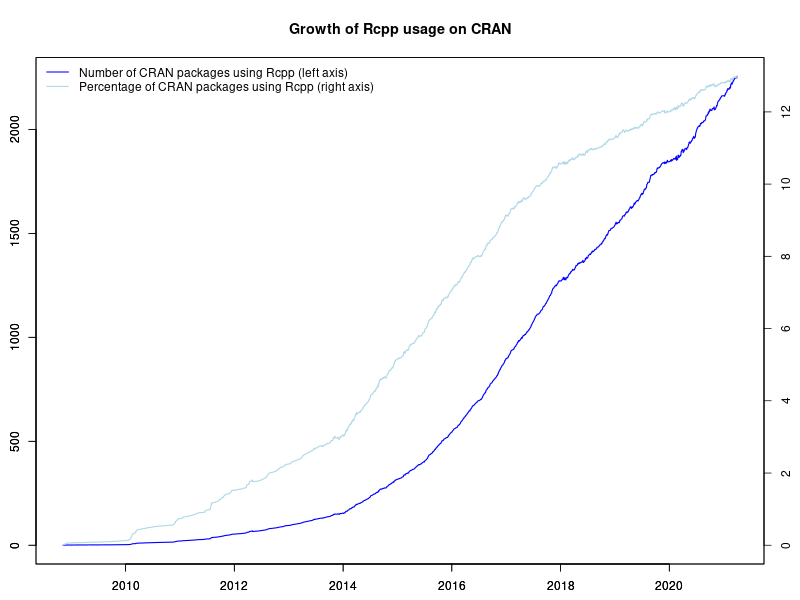 As of today,
 Here is my monthly update covering what I have been doing in the free software world during March 2021 (

 Last weekend Debian Quebec
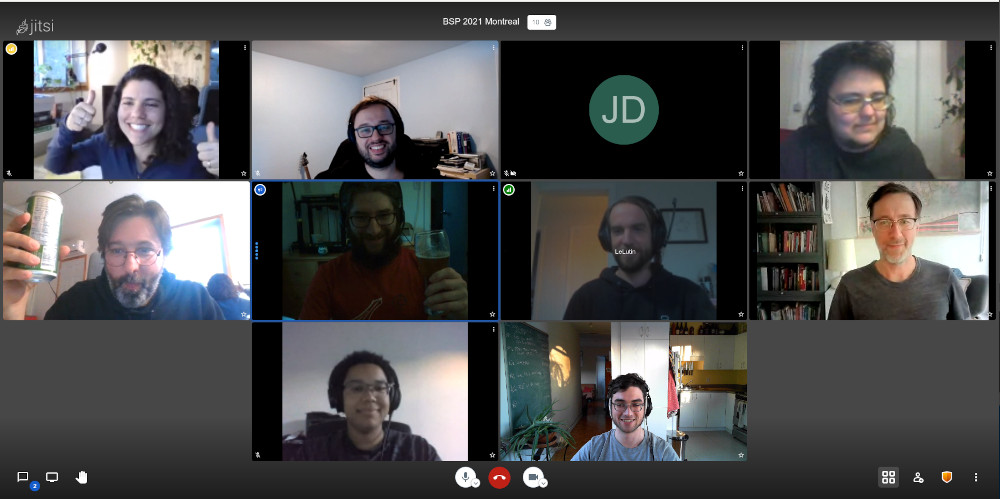 We fixed a couple of
 Have you heard of
 A long time, no blog entries. What's prompted a new missive?
Two things:
 In 14 years since starting this blog, I changed the software several times,
with each iteration simplifying requirements and setup.
Wordpress
In 2007, I
 Ten years ago, I
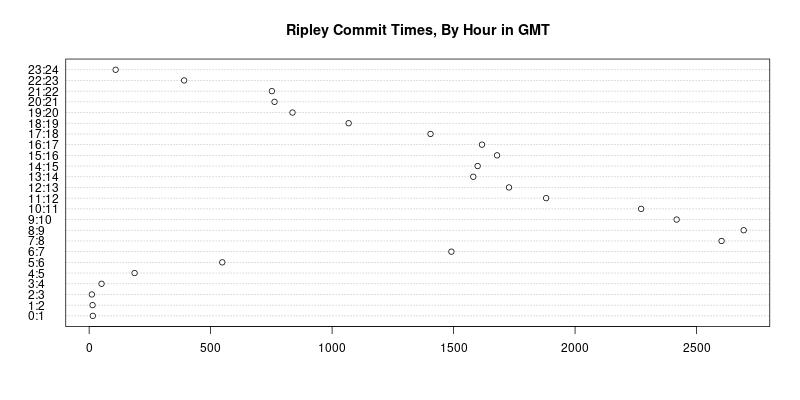 The remainder of the code also runs. I just added one
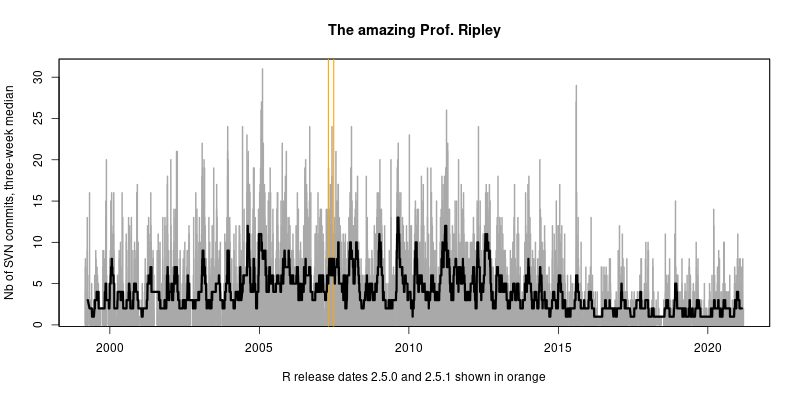 The subtitle highlighting the then-most-recent releases is a little quaint now given that R has had eighten major.minor releases, and over sixty total releases, since then.
Stable and rigourously maintained interfaces are a fantastic resource that is dramatically under-appreciated. Efforts such as the



 I am quite happy with the Raspberry tower I bought for keeping my
Raspberries organized. Clustering them? No, not by a long shot. I just
want to quickly know where they all are, and at a glance, be able to
know which one I will work with. Bottom drawer has a RPi1B, second one
has a RPi2, next comes a 3B+, and the top two ones are RPi4 (4 and
8GB). That allows me for quick testing of stuff. Yes, I am tempted to
get the top one out of the array and use it in production but as
it stands, that s the layout.
My only quip with this? Serial console access.


 It's been quite a long time since I last posted anything on this blog and I
can say that one of the reasons for that I don't feel comfortable using
 A new release 0.2.1 of
 I have written my first Rust crate: