Search Results: "ag"

13 October 2025

Russell Coker: WordPress Spam Users

Just over a year ago I configured my blog to only allow signed in users to comment to reduce spam [1]. This has stopped all spam comments, it was even more successful than expected but spammers keep registering accounts. I ve now got almost 5000 spam accounts, an average of more than 10 per day. I don t know why they keep creating them without trying to enter comments. At first I thought that they were trying to assemble a lot of accounts for a deluge of comment spam but that hasn t happened. There are some WordPress plugins for bulk deletion of users but I couldn t find one with support for delete all users who haven t submitted a comment . So I do it a page at a time, but of course I don t want to do it 100 at a time so I used the below SQL to change it to 400 at a time. I initially tried larger numbers like 2000 but got Chrome timeouts when trying to click the check-box to select all users. From experimenting it seems that the time taken to check that is worse than linear. Doing it for 2000 users is obviously much more than 5* the duration of doing it for 400. 800 users was one attempt which resulted in it being possible to select them all but then it gave an error about the URL being too long when it came to actually delete them. After a binary search I found that 450 was too many but 400 worked. So now it s 12 operations to delete all the spam accounts. Each bulk delete operation is 5 GUI operations so it s 60 operations to delete 15 months of spam users. This is annoying, but less than the other problems of spam.
UPDATE  wp_usermeta  SET  meta_value  = 400 WHERE  user_id  = 2 AND  meta_key  = 'users_per_page';
Deleting the spam users reduced the size of the backup (zstd -9 of a mysql dump) for my blog by 6.5%. Then changing from zstd -9 to -19 reduced it by another 13%. After realising this difference I configured all my mysql backups to be compressed with zstd -19, this will make a difference on the system with over 30G of zstd compressed mysql backups.

Freexian Collaborators: Monthly report about Debian Long Term Support, September 2025 (by Roberto C. S nchez)

Like each month, have a look at the work funded by Freexian s Debian LTS offering.

Debian LTS contributors In September, 20 contributors have been paid to work on Debian LTS, their reports are available:
  • Abhijith PA did 10.0h (out of 10.0h assigned and 4.0h from previous period), thus carrying over 4.0h to the next month.
  • Andreas Henriksson did 1.0h (out of 0.0h assigned and 20.0h from previous period), thus carrying over 19.0h to the next month.
  • Bastien Roucari s did 20.0h (out of 20.0h assigned).
  • Ben Hutchings did 20.0h (out of 21.0h assigned), thus carrying over 1.0h to the next month.
  • Carlos Henrique Lima Melara did 10.0h (out of 12.0h assigned), thus carrying over 2.0h to the next month.
  • Chris Lamb did 18.0h (out of 18.0h assigned).
  • Daniel Leidert did 21.0h (out of 21.0h assigned).
  • Emilio Pozuelo Monfort did 39.75h (out of 40.0h assigned), thus carrying over 0.25h to the next month.
  • Guilhem Moulin did 15.0h (out of 15.0h assigned).
  • Jochen Sprickerhof did 12.0h (out of 9.25h assigned and 11.75h from previous period), thus carrying over 9.0h to the next month.
  • Lee Garrett did 13.5h (out of 21.0h assigned), thus carrying over 7.5h to the next month.
  • Lucas Kanashiro did 8.0h (out of 20.0h assigned), thus carrying over 12.0h to the next month.
  • Markus Koschany did 15.0h (out of 3.25h assigned and 17.75h from previous period), thus carrying over 6.0h to the next month.
  • Paride Legovini did 6.0h (out of 8.0h assigned), thus carrying over 2.0h to the next month.
  • Roberto C. S nchez did 7.25h (out of 7.75h assigned and 13.25h from previous period), thus carrying over 13.75h to the next month.
  • Santiago Ruano Rinc n did 13.25h (out of 13.5h assigned and 1.5h from previous period), thus carrying over 1.75h to the next month.
  • Sylvain Beucler did 17.0h (out of 7.75h assigned and 13.25h from previous period), thus carrying over 4.0h to the next month.
  • Thorsten Alteholz did 21.0h (out of 21.0h assigned).
  • Tobias Frost did 5.0h (out of 0.0h assigned and 8.0h from previous period), thus carrying over 3.0h to the next month.
  • Utkarsh Gupta did 16.5h (out of 14.25h assigned and 6.75h from previous period), thus carrying over 4.5h to the next month.

Evolution of the situation In September, we released 38 DLAs.
  • Notable security updates:
    • modsecurity-apache prepared by Adrian Bunk, fixes a cross-site scripting vulnerability
    • cups, prepared by Thorsten Alteholz, fixes authentication bypass and denial of service vulnerabilities
    • jetty9, prepared by Adrian Bunk, fixes the MadeYouReset vulnerability (a recent, well-known denial of service vulnerability)
    • python-django, prepared by Chris Lamb, fixes a SQL injection vulnerability
    • firefox-esr and thunderbird, prepared by Emilio Pozuelo Monfort, were updated from the 128.x ESR series to the 140.x ESR series, fixing a number of vulnerabilities as well
  • Notable non-security updates:
    • wireless-regdb prepared by Ben Hutchings, updates information reflecting changes to radio regulations in many countries
There was one package update contributed by a Debian Developer outside of the LTS Team: an update of node-tar-fs, prepared by Xavier Guimard (a member of the Node packaging team). Finally, LTS Team members also contributed updates of the following packages:
  • libxslt (to stable and oldstable), prepared by Guilhem Moulin, to address a regression introduced in a previous security update
  • libphp-adodb (to stable and oldstable), prepared by Abhijith PA
  • cups (to stable and oldstable), prepared by Thorsten Alteholz
  • u-boot (to oldstable), prepared by Daniel Leidert and Jochen Sprickerhof
  • libcommongs-lang3-java (to stable and oldstable), prepared by Daniel Leidert
  • python-internetarchive (to oldstable), prepared by Daniel Leidert
One other notable contribution by a member of the LTS Team is that Sylvain Beucler proposed a fix upstream for CVE-2025-2760 in gimp2. Upstream no longer supports gimp2, but it is still present in Debian LTS, and so proposing this fix upstream is of benefit to other distros which may still be supporting the older gimp2 packages.

Thanks to our sponsors Sponsors that joined recently are in bold.

12 October 2025

Dirk Eddelbuettel: RcppSpdlog 0.0.23 on CRAN: New Upstream

Version 0.0.23 of RcppSpdlog arrived on CRAN today (after a slight delay) and has been uploaded to Debian. RcppSpdlog bundles spdlog, a wonderful header-only C++ logging library with all the bells and whistles you would want that was written by Gabi Melman, and also includes fmt by Victor Zverovich. You can learn more at the nice package documention site. This release updates the code to the version 1.16.0 of spdlog which was released yesterday morning, and includes version 1.12.0 of fmt. We also converted the documentation site to now using mkdocs-material to altdoc (plus local style and production tweaks) rather than directly. I updated the package yesterday morning when spdlog was updated. But the passage was delayed for a day at CRAN as their machines still times out hitting the GPL-2 URL from the README.md badge, leading to a human to manually check the log assert the nothingburgerness of it. This timeout does not happen to me locally using the corresponding URL checker package. I pondered this in a r-package-devel thread and may just have to switch to using the R Project URL for the GPL-2 as this is in fact recurrning. The NEWS entry for this release follows.

Changes in RcppSpdlog version 0.0.23 (2025-10-11)
  • Upgraded to upstream release spdlog 1.16.0 (including fmt 12.0)
  • The mkdocs-material documentation site is now generated via altdoc

Courtesy of my CRANberries, there is also a diffstat report detailing changes. More detailed information is on the RcppSpdlog page, or the package documention site.

This post by Dirk Eddelbuettel originated on his Thinking inside the box blog. If you like this or other open-source work I do, you can sponsor me at GitHub.

11 October 2025

John Goerzen: A Mail Delivery Mystery: Exim, systemd, setuid, and Docker, oh my!

On mail.quux, a node of NNCPNET (the NNCP-based peer-to-peer email network), I started noticing emails not being delivered. They were all in the queue, frozen, and Exim s log had entries like:
unable to set gid=5001 or uid=5001 (euid=100): local delivery to [redacted] transport=nncp
Weird. Stranger still, when I manually ran the queue with sendmail -qff -v, they all delivered fine. Huh. Well, I thought, it was a one-off weird thing. But then it happened again. Upon investigating, I observed that this issue was happening only on messages submitted by SMTP. Which, on these systems, aren t that many. While trying different things, I tried submitting a message to myself using SMTP. Nothing to do with NNCP at all. But look at this:
 jgoerzen@[redacted] R=userforward defer (-1): require_files: error for /home/jgoerzen/.forward: Permission denied
Strraaannnge . All the information I could find about this, even a FAQ entry, said that the problem is that Exim isn t setuid root. But it is:
-rwsr-xr-x 1 root root 1533496 Mar 29  2025 /usr/sbin/exim4
This problem started when I upgraded to Debian Trixie. So what changed there? There are a lot of possibilities; this is running in Docker using my docker-debian-base system, which runs a regular Debian in Docker, including systemd. I eventually tracked it down to Exim migrating from init.d to systemd in trixie, and putting a bunch of lockdowns in its service file. After a bunch of trial and error, I determined that I needed to override this set of lockdowns to make it work. These overrides did the trick:
ProtectClock=false
PrivateDevices=false
RestrictRealtime=false
ProtectKernelModules=false
ProtectKernelTunables=false
ProtectKernelLogs=false
ProtectHostname=false
I don t know for sure if the issue is related to setuid. But if it is, there s nothing that immediately jumps out at me about any of these that would indicate a problem with setuid. I also don t know if running in Docker makes any difference. Anyhow, problem fixed, but mystery not solved!

10 October 2025

Louis-Philippe V ronneau: Montreal's Debian & Stuff - September 2025

Our Debian User Group met on September 27th for our first meeting since our summer hiatus. As always, it was fun and productive! Here's what we did: pollo: sergiodj: LeLutin: tvaz: viashimo: tassia: Pictures This time again, we were hosted at La Balise (formely ATS ). It's nice to see this community project continuing to improve: the social housing apartments on the top floors should be opening this month! Lots of construction work was also ongoing to make the Espace des Possibles more accessible from the street level. Group photo Some of us ended up grabbing a drink after the event at l'Isle de Garde, a pub right next to the venue, but I didn't take any pictures.

Reproducible Builds: Reproducible Builds in September 2025

Welcome to the September 2025 report from the Reproducible Builds project! Welcome to the very latest report from the Reproducible Builds project. Our monthly reports outline what we ve been up to over the past month, and highlight items of news from elsewhere in the increasingly-important area of software supply-chain security. As ever, if you are interested in contributing to the Reproducible Builds project, please see the Contribute page on our website. In this report:

  1. Reproducible Builds Summit 2025
  2. Can t we have nice things?
  3. Distribution work
  4. Tool development
  5. Reproducibility testing framework
  6. Upstream patches

Reproducible Builds Summit 2025 Please join us at the upcoming Reproducible Builds Summit, set to take place from October 28th 30th 2025 in Vienna, Austria! We are thrilled to host the eighth edition of this exciting event, following the success of previous summits in various iconic locations around the world, including Venice, Marrakesh, Paris, Berlin, Hamburg and Athens. Our summits are a unique gathering that brings together attendees from diverse projects, united by a shared vision of advancing the Reproducible Builds effort. During this enriching event, participants will have the opportunity to engage in discussions, establish connections and exchange ideas to drive progress in this vital field. Our aim is to create an inclusive space that fosters collaboration, innovation and problem-solving. If you re interesting in joining us this year, please make sure to read the event page which has more details about the event and location. Registration is open until 20th September 2025, and we are very much looking forward to seeing many readers of these reports there!

Can t we have nice things? Debian Developer Gunnar Wolf blogged that George V. Neville-Neil s Kode Vicious column in Communications of the ACM in which reproducible builds is mentioned without needing to introduce it (assuming familiarity across the computing industry and academia) . Titled, Can t we have nice things?, the article mentions:
Once the proper measurement points are known, we want to constrain the system such that what it does is simple enough to understand and easy to repeat. It is quite telling that the push for software that enables reproducible builds only really took off after an embarrassing widespread security issue ended up affecting the entire Internet. That there had already been 50 years of software development before anyone thought that introducing a few constraints might be a good idea is, well, let s just say it generates many emotions, none of them happy, fuzzy ones. [ ]

Distribution work In Debian this month, Johannes Starosta filed a bug against the debian-repro-status package, reporting that it does not work on Debian trixie. (An upstream bug report was also filed.) Furthermore, 17 reviews of Debian packages were added, 10 were updated and 14 were removed this month adding to our knowledge about identified issues. In March s report, we included the news that Fedora would aim for 99% package reproducibility. This change has now been deferred to Fedora 44 according to Phoronix. Lastly, Bernhard M. Wiedemann posted another openSUSE monthly update for their work there.

Tool development diffoscope version 306 was uploaded to Debian unstable by Chris Lamb. It included contributions already covered in previous months as well as some changes by Zbigniew J drzejewski-Szmek to address issues with the fdtump support [ ] and to move away from the deprecated codes.open method. [ ][ ] strip-nondeterminism version 1.15.0-1 was uploaded to Debian unstable by Chris Lamb. It included a contribution by Matwey Kornilov to add support for inline archive files for Erlang s escript [ ]. kpcyrd has released a new version of rebuilderd. As a quick recap, rebuilderd is an automatic build scheduler that tracks binary packages available in a Linux distribution and attempts to compile the official binary packages from their (purported) source code and dependencies. The code for in-toto attestations has been reworked, and the instances now feature a new endpoint that can be queried to fetch the list of public-keys an instance currently identifies itself by. [ ] Lastly, Holger Levsen bumped the Standards-Version field of disorderfs, with no changes needed. [ ][ ]

Reproducibility testing framework The Reproducible Builds project operates a comprehensive testing framework running primarily at tests.reproducible-builds.org in order to check packages and other artifacts for reproducibility. In August, however, a number of changes were made by Holger Levsen, including:
  • Setting up six new rebuilderd workers with 16 cores and 16 GB RAM each.
  • reproduce.debian.net-related:
    • Do not expose pending jobs; they are confusing without explaination. [ ]
    • Add a link to v1 API specification. [ ]
    • Drop rebuilderd-worker.conf on a node. [ ]
    • Allow manual scheduling for any architectures. [ ]
    • Update path to trixie graphs. [ ]
    • Use the same rebuilder-debian.sh script for all hosts. [ ]
    • Add all other suites to all other archs. [ ][ ][ ][ ]
    • Update SSH host keys for new hosts. [ ]
    • Move to the pull184 branch. [ ][ ][ ][ ][ ]
    • Only allow 20 GB cache for workers. [ ]
  • OpenWrt-related:
    • Grant developer aparcar full sudo control on the ionos30 node. [ ][ ]
  • Jenkins nodes:
    • Add a number of new nodes. [ ][ ][ ][ ][ ]
    • Dont expect /srv/workspace to exist on OSUOSL nodes. [ ]
    • Stop hardcoding IP addresses in munin.conf. [ ]
    • Add maintenance and health check jobs for new nodes. [ ]
    • Document slight changes in IONOS resources usage. [ ]
  • Misc:
    • Drop disabled Alpine Linux tests for good. [ ]
    • Move Debian live builds and some other Debian builds to the ionos10 node. [ ]
    • Cleanup some legacy support from releases before Debian trixie. [ ]
In addition, Jochen Sprickerhof made the following changes relating to reproduce.debian.net:
  • Do not expose pending jobs on the main site. [ ]
  • Switch the frontpage to reference Debian forky [ ], but do not attempt to build Debian forky on the armel architecture [ ].
  • Use consistent and up to date rebuilder-debian.sh script. [ ]
  • Fix supported worker architectures. [ ]
  • Add a basic excuses page. [ ]
  • Move to the pull184 branch. [ ][ ][ ][ ]
  • Fix a typo in the JavaScript. [ ]
  • Update front page for the new v1 API. [ ][ ]
Lastly, Roland Clobus did some maintenance relating to the reproducibility testing of the Debian Live images. [ ][ ][ ][ ]

Upstream patches The Reproducible Builds project detects, dissects and attempts to fix as many currently-unreproducible packages as possible. We endeavour to send all of our patches upstream where appropriate. This month, we wrote a large number of such patches, including:

Finally, if you are interested in contributing to the Reproducible Builds project, please visit our Contribute page on our website. However, you can get in touch with us via:

Sergio Cipriano: Avoiding 5XX errors by adjusting Load Balancer Idle Timeout

Avoiding 5XX errors by adjusting Load Balancer Idle Timeout Recently I faced a problem in production where a client was running a RabbitMQ server behind the Load Balancers we provisioned and the TCP connections were closed every minute. My team is responsible for the LBaaS (Load Balancer as a Service) product and this Load Balancer was an Envoy proxy provisioned by our control plane. The error was similar to this:
[2025-10-03 12:37:17,525 - pika.adapters.utils.connection_workflow - ERROR] AMQPConnector - reporting failure: AMQPConnectorSocketConnectError: timeout("TCP connection attempt timed out: ''/(<AddressFamily.AF_INET: 2>, <SocketKind.SOCK_STREAM: 1>, 6, '', ('<IP>', 5672))")
[2025-10-03 12:37:17,526 - pika.adapters.utils.connection_workflow - ERROR] AMQP connection workflow failed: AMQPConnectionWorkflowFailed: 1 exceptions in all; last exception - AMQPConnectorSocketConnectError: timeout("TCP connection attempt timed out: ''/(<AddressFamily.AF_INET: 2>, <SocketKind.SOCK_STREAM: 1>, 6, '', ('<IP>', 5672))"); first exception - None.
[2025-10-03 12:37:17,526 - pika.adapters.utils.connection_workflow - ERROR] AMQPConnectionWorkflow - reporting failure: AMQPConnectionWorkflowFailed: 1 exceptions in all; last exception - AMQPConnectorSocketConnectError: timeout("TCP connection attempt timed out: ''/(<AddressFamily.AF_INET: 2>, <SocketKind.SOCK_STREAM: 1>, 6, '', ('<IP>', 5672))"); first exception - None
At first glance, the issue is simple: the Load Balancer's idle timeout is shorter than the RabbitMQ heartbeat interval. The idle timeout is the time at which a downstream or upstream connection will be terminated if there are no active streams. Heartbeats generate periodic network traffic to prevent idle TCP connections from closing prematurely. Adjusting these timeout settings to align properly solved the issue. However, what I want to explore in this post are other similar scenarios where it's not so obvious that the idle timeout is the problem. Introducing an extra network layer, such as an Envoy proxy, can introduce unpredictable behavior across your services, like intermittent 5XX errors. To make this issue more concrete, let's look at a minimal, reproducible setup that demonstrates how adding an Envoy proxy can lead to sporadic errors.

Reproducible setup I'll be using the following tools: This setup is based on what Kai Burjack presented in his article. Setting up Envoy with Docker is straightforward:
$ docker run \
    --name envoy --rm \
    --network host \
    -v $(pwd)/envoy.yaml:/etc/envoy/envoy.yaml \
    envoyproxy/envoy:v1.33-latest
I'll be running experiments with two different envoy.yaml configurations: one that uses Envoy's TCP proxy, and another that uses Envoy's HTTP connection manager. Here's the simplest Envoy TCP proxy setup: a listener on port 8000 forwarding traffic to a backend running on port 8080.
static_resources:
  listeners:
  - name: go_server_listener
    address:
      socket_address:
        address: 0.0.0.0
        port_value: 8000
    filter_chains:
    - filters:
      - name: envoy.filters.network.tcp_proxy
        typed_config:
          "@type": type.googleapis.com/envoy.extensions.filters.network.tcp_proxy.v3.TcpProxy
          stat_prefix: go_server_tcp
          cluster: go_server_cluster
  clusters:
  - name: go_server_cluster
    connect_timeout: 1s
    type: static
    load_assignment:
      cluster_name: go_server_cluster
      endpoints:
      - lb_endpoints:
        - endpoint:
            address:
              socket_address:
                address: 127.0.0.1
                port_value: 8080
The default idle timeout if not otherwise specified is 1 hour, which is the case here. The backend setup is simple as well:
package main

import (
    "fmt"
    "net/http"
    "time"
)

func helloHandler(w http.ResponseWriter, r *http.Request)  
  w.Write([]byte("Hello from Go!"))
 

func main()  
    http.HandleFunc("/", helloHandler)

    server := http.Server 
        Addr:        ":8080",
        IdleTimeout: 3 * time.Second,
     

    fmt.Println("Starting server on :8080")
    panic(server.ListenAndServe())
 
The IdleTimeout is set to 3 seconds to make it easier to test. Now, oha is the perfect tool to generate the HTTP requests for this test. The Load test is not meant to stress this setup, the idea is to wait long enough so that some requests are closed. The burst-delay feature will help with that:
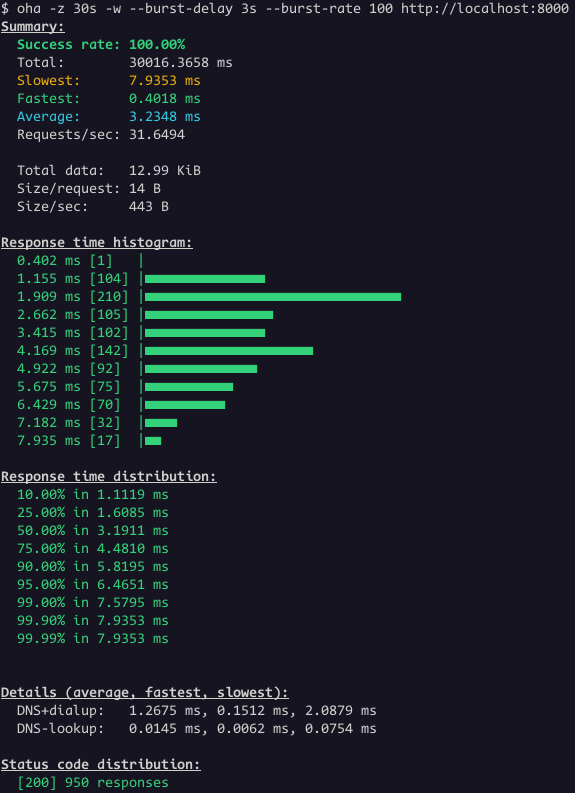
$ oha -z 30s -w --burst-delay 3s --burst-rate 100 http://localhost:8000
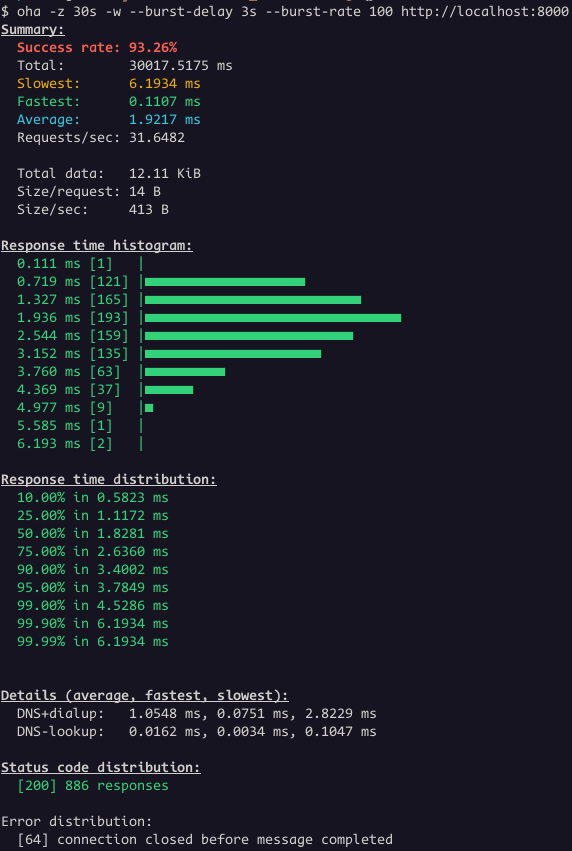
I'm running the Load test for 30 seconds, sending 100 requests at three-second intervals. I also use the -w option to wait for ongoing requests when the duration is reached. The result looks like this: oha test report tcp fail We had 886 responses with status code 200 and 64 connections closed. The backend terminated 64 connections while the load balancer still had active requests directed to it. Let's change the Load Balancer idle_timeout to two seconds.
filter_chains:
- filters:
  - name: envoy.filters.network.tcp_proxy
    typed_config:
      "@type": type.googleapis.com/envoy.extensions.filters.network.tcp_proxy.v3.TcpProxy
      stat_prefix: go_server_tcp
      cluster: go_server_cluster
      idle_timeout: 2s # <--- NEW LINE
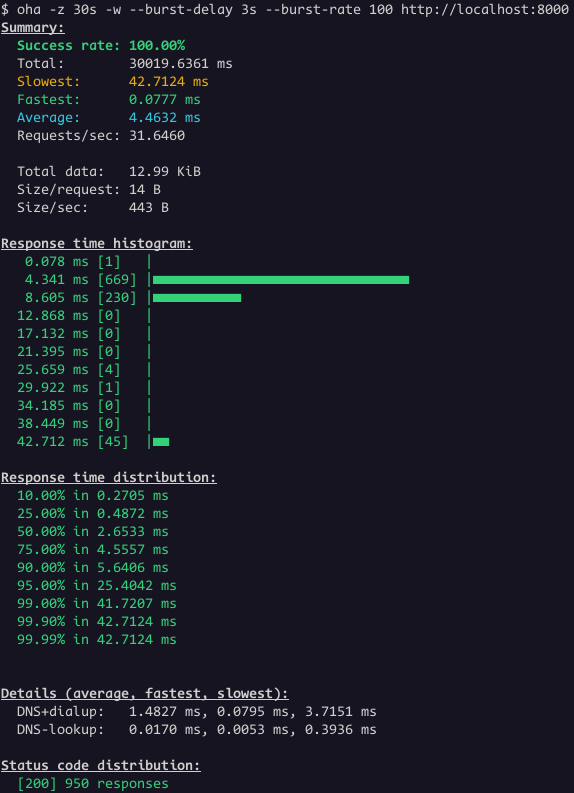
Run the same test again. oha test report tcp success Great! Now all the requests worked. This is a common issue, not specific to Envoy Proxy or the setup shown earlier. Major cloud providers have all documented it. AWS troubleshoot guide for Application Load Balancers says this: The target closed the connection with a TCP RST or a TCP FIN while the load balancer had an outstanding request to the target. Check whether the keep-alive duration of the target is shorter than the idle timeout value of the load balancer. Google troubleshoot guide for Application Load Balancers mention this as well: Verify that the keepalive configuration parameter for the HTTP server software running on the backend instance is not less than the keepalive timeout of the load balancer, whose value is fixed at 10 minutes (600 seconds) and is not configurable. The load balancer generates an HTTP 5XX response code when the connection to the backend has unexpectedly closed while sending the HTTP request or before the complete HTTP response has been received. This can happen because the keepalive configuration parameter for the web server software running on the backend instance is less than the fixed keepalive timeout of the load balancer. Ensure that the keepalive timeout configuration for HTTP server software on each backend is set to slightly greater than 10 minutes (the recommended value is 620 seconds). RabbitMQ docs also warn about this: Certain networking tools (HAproxy, AWS ELB) and equipment (hardware load balancers) may terminate "idle" TCP connections when there is no activity on them for a certain period of time. Most of the time it is not desirable. Most of them are talking about Application Load Balancers and the test I did was using a Network Load Balancer. For the sake of completeness, I will do the same test but using Envoy's HTTP connection manager. The updated envoy.yaml:
static_resources:
  listeners:
  - name: listener
    address:
      socket_address:
        address: 0.0.0.0
        port_value: 8000
    filter_chains:
    - filters:
      - name: envoy.filters.network.http_connection_manager
        typed_config:
          "@type": type.googleapis.com/envoy.extensions.filters.network.http_connection_manager.v3.HttpConnectionManager
          stat_prefix: go_server_http
          access_log:
          - name: envoy.access_loggers.stdout
            typed_config:
              "@type": type.googleapis.com/envoy.extensions.access_loggers.stream.v3.StdoutAccessLog
          http_filters:
          - name: envoy.filters.http.router
            typed_config:
              "@type": type.googleapis.com/envoy.extensions.filters.http.router.v3.Router
          route_config:
            name: http_route
            virtual_hosts:
            - name: local_service
              domains: ["*"]
              routes:
              - match:
                  prefix: "/"
                route:
                  cluster: go_server_cluster
  clusters:
  - name: go_server_cluster
    type: STATIC
    load_assignment:
      cluster_name: go_server_cluster
      endpoints:
      - lb_endpoints:
        - endpoint:
            address:
              socket_address:
                address: 0.0.0.0
                port_value: 8080
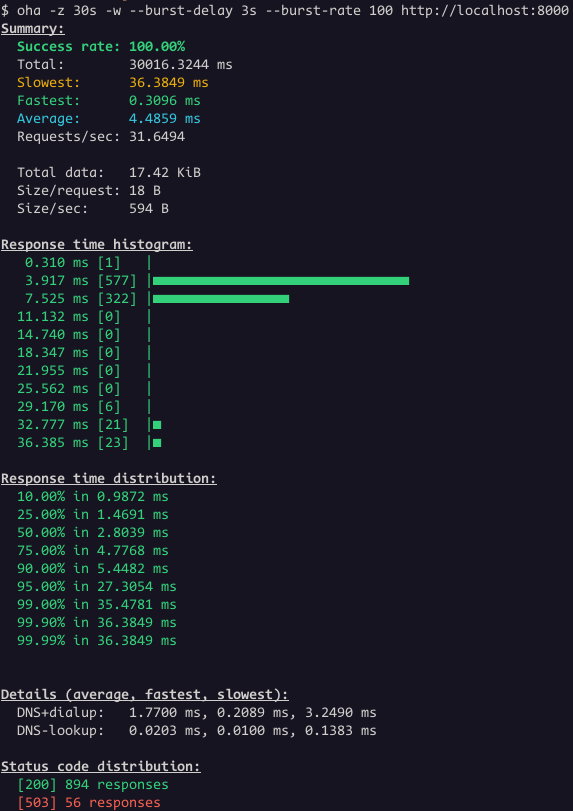
The yaml above is an example of a service proxying HTTP from 0.0.0.0:8000 to 0.0.0.0:8080. The only difference from a minimal configuration is that I enabled access logs. Let's run the same tests with oha. oha test report http fail Even thought the success rate is 100%, the status code distribution show some responses with status code 503. This is the case where is not that obvious that the problem is related to idle timeout. However, it's clear when we look the Envoy access logs:
[2025-10-10T13:32:26.617Z] "GET / HTTP/1.1" 503 UC 0 95 0 - "-" "oha/1.10.0" "9b1cb963-449b-41d7-b614-f851ced92c3b" "localhost:8000" "0.0.0.0:8080"
UC is the short name for UpstreamConnectionTermination. This means the upstream, which is the golang server, terminated the connection. To fix this once again, the Load Balancer idle timeout needs to change:
  clusters:
  - name: go_server_cluster
    type: STATIC
    typed_extension_protocol_options: # <--- NEW BLOCK
      envoy.extensions.upstreams.http.v3.HttpProtocolOptions:
        "@type": type.googleapis.com/envoy.extensions.upstreams.http.v3.HttpProtocolOptions
        common_http_protocol_options:
          idle_timeout: 2s # <--- NEW VALUE
        explicit_http_config:
          http_protocol_options:  
Finally, the sporadic 503 errors are over: oha test report http success

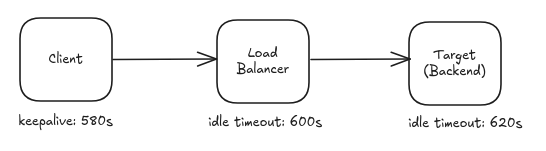
To Sum Up Here's an example of the values my team recommends to our clients: recap drawing Key Takeaways:
  1. The Load Balancer idle timeout should be less than the backend (upstream) idle/keepalive timeout.
  2. When we are working with long lived connections, the client (downstream) should use a keepalive smaller than the LB idle timeout.

Dirk Eddelbuettel: RcppArmadillo 15 CRAN Transition: Offering Office Hours

armadillo image Armadillo is a powerful and expressive C++ template library for linear algebra and scientific computing. It aims towards a good balance between speed and ease of use, has a syntax deliberately close to Matlab, and is useful for algorithm development directly in C++, or quick conversion of research code into production environments. RcppArmadillo integrates this library with the R environment and language and is widely used by (currently) 1273 other packages on CRAN, downloaded 41.8 million times (per the partial logs from the cloud mirrors of CRAN), and the CSDA paper (preprint / vignette) by Conrad and myself has been cited 651 times according to Google Scholar. Armadillo 15 brought changes. We mentioned these in the 15.0.2-1 and 15.0.2-1 release blog posts: (The second point is a consequence of the first. Prior to C++14, deprecation notes were issue via a macro, and the macro was set up by Conrad in the common way of allowing an override, which we took advantage of in RcppArmadillo effectively shielding downstream package. In C++14 this is now an attribute, and those cannot be suppressed.) We tested this then-upcoming change extensively: Thirteen reverse dependency runs expoloring different settings and leading to the current package setup where an automatic fallback to the last Armadillo 14 release offers fallback for hardwired C++11 use and Armadillo 15 others. Given the 1200+ reverse deoendencies, this took considerable time. All this was also quite extensively discussed with CRAN (especially Kurt Hornik) and documented / controlled via a series of issue tickets starting with overall issue #475 covering the subissues: The sixty pull requests (or emailed patches) followed a suggestion by CRAN to rank-order packages affected by their reverse dependencies sorted in descending package count. Now, while this change from Armadillo 14 to 15 was happening, CRAN also tightened the C++11 requirement for packages and imposed a deadline for changes. In discussion, CRAN also convinced me that a deadline for the deprecation warning, now unmasked, was viable (and is in fairness commensurate with similar, earlier changes triggered by changes in the behaviour of either gcc/g++ or clang/clang++). So we now have two larger deadline campaigns affecting the package (and as always there are some others). These deadlines are coming close: October 17 for the C++11 transition, and October 23 for the deprecation warning. Now, as became clear preparing the sixty pull requests and patches, these changes are often relatively straightforward. For the former, remove the C++11 enforcement and the package will likely build without changes. For the latter, make the often simple (e.g. swith from arma::is_finite to std::isfinite) change. I did not encounter anything much more complicated yet. The number of affected packages approximated by looking at all packages with a reverse dependency on RcppArmadillo and having a deadline can be computed as
suppressMessages(library(data.table))
D <- setDT(tools::CRAN_package_db())
P <- data.table(Package=tools::package_dependencies("RcppArmadillo", reverse=TRUE, db=D)[[1]])
W <- merge(P, D, all.x=TRUE)[is.na(Deadline)==FALSE,c(1:2,38,68)]
W

W[, nrevdep := length(tools::package_dependencies(Package, reverse=TRUE, recursive=TRUE, db=D)[[1]]), by=Package]
W[order(-nrevdep)]
and has been declining steadily from over 350 to now under 200. For that a big and heartfelt Thank You! to all the maintainers who already addressed their package and uploaded updated packages to CRAN. That rocks, and is truly appreciated. Yet the number is still large. And while issues #489 and #491 show a number of pending packages that have merged but not uploaded (yet?) there are also all the other packages I have not been able to look at in detail. While preparing sixty PRs / patches was viable over a period of a good week, I cannot create these for all packages. So with that said, here is a different suggestion for help: All of next week, I will be holding open door open source office hours online two times each day (11:00h to 13:00h Central, 16:00h to 18:00h Central) which can be booked via this booking link for Monday to Friday next week in either fifteen or thirty minutes slots you can book. This should offer Google Meet video conferencing (with jitsi as an alternate, you should be able to control that) which should allow for screen sharing. (I cannot hookup Zoom as my default account has organization settings with a different calendar integration.) If you are reading this and have a package that still needs helps, I hope to see you in the Open Source Office Hours to aid in the RcppArmadillo package updates for your package. Please book a slot!

This post by Dirk Eddelbuettel originated on his Thinking inside the box blog. If you like this or other open-source work I do, you can sponsor me at GitHub.

John Goerzen: I m Not Very Popular, Thankfully. That Makes The Internet Fun Again

Like and subscribe! Help us get our next thousand (or million) followers! I was using Linux before it was popular. Back in the day where you had to write Modelines for your XF86Config file and do it properly, or else you might ruin your monitor. Back when there wasn t a word processor (thankfully; that forced me to learn LaTeX, which I used to write my papers in college). I then ran Linux on an Alpha, a difficult proposition in an era when web browsers were either closed-source or too old to be useful; all sorts of workarounds, including emulating Digital UNIX. Recently I wrote a deep dive into the DOS VGA text mode and how to achieve it on a modern UEFI Linux system. Nobody can monetize things like this. I am one of maybe a dozen or two people globally that care about that sort of thing. That s fine. Today, I m interested in things like asynchronous communication, NNCP, and Gopher. Heck, I m posting these words on a blog. Social media displaced those, right? Some of the things I write about here have maybe a few dozen people on the planet interested in them. That s fine. I have no idea how many people read my blog. I have no idea where people hear about my posts from. I guess I can check my Mastodon profile to see how many followers I have, but it s not something I tend to do. I don t know if the number is going up or down, or if it is all that much in Mastodon terms (probably not). Thank goodness. Since I don t have to care about what s popular, or spend hours editing video, or thousands of dollars on video equipment, I can just sit down and write about what interests me. If that also interests you, then great. If not, you can find what interests you also fine. I once had a colleague that was one of these plugged into Silicon Valley types. He would periodically tell me, with a mixture of excitement and awe, that one of my posts had made Hacker News. This was always news to me, because I never paid a lot of attention over there. Occasionally that would bring in some excellent discussion, but more often than not, it was comments from people that hadn t read or understood the article trying to appear smart by arguing with what it or rather, what they imagined it said, I guess. The thing I value isn t subscriber count. It s discussion. A little discussion in the comments or on Mastodon that s perfect, even if only 10 people read the article. I have the most fun in a community. And I ll go on writing about NNCP and Gopher and non-square DOS pixels, with audiences of dozens globally. I have no advertisers to keep happy, and I enjoy it, so why not?

9 October 2025

Thorsten Alteholz: My Debian Activities in September 2025

Debian LTS This was my hundred-thirty-fifth month that I did some work for the Debian LTS initiative, started by Raphael Hertzog at Freexian. During my allocated time I uploaded or worked on: An upload of spim was not needed, as the corresponding CVE could be marked as ignored. I also started to work on an open-vm-tools and attended the monthly LTS/ELTS meeting. Debian ELTS This month was the eighty-sixth ELTS month. During my allocated time I uploaded or worked on: The CVEs for open-vm-tools could be marked as not-affeceted as the corresponding plugin was not yet available. I also attended the monthly LTS/ELTS meeting. Debian Printing This month I uploaded a new upstream version or a bugfix version of: This work is generously funded by Freexian! Debian Astro This month I uploaded a new upstream version or a bugfix version of: Debian IoT This month I uploaded a new upstream version or a bugfix version of: Debian Mobcom This month I uploaded a new upstream version or a bugfix version of: misc The main topic of this month has been gcc15 and cmake4, so my upload rate was extra high. This month I uploaded a new upstream version or a bugfix version of: I wonder what MBF will happen next, I guess the /var/lock-issue will be a good candidate. On my fight against outdated RFPs, I closed 30 of them in September. Meanwhile only 3397 are still open, so don t hesitate to help closing one or another. FTP master This month I accepted 294 and rejected 28 packages. The overall number of packages that got accepted was 294.

Dirk Eddelbuettel: xptr 1.2.0 on CRAN: New(ly Adopted) Package!

Excited to share that xptr is back on CRAN! The xptr package helps to create, check, modify, use, share, external pointer objects. External pointers are used quite extensively throughout R to manage external resources such as datanbase connection objects and alike, and can be very useful to pass pointers to just about any C / C++ data structure around. While described in Writing R Extensions (notably Section 5.13), they can be a little bare-bones and so this package can be useful. It had been created by Randy Lai and maintained by him during 2017 to 2020, but then fell off CRAN. In work with nanoarrow and its clean and minimal Arrow interface xptr came in handy so I adopted it. Several extensions and updates have been added: (compiled) function registration, continuous integration, tests, refreshed and extended documentation as well as a print format extension useful for PyCapsule objects when passing via reticulate. The package documentation site was switched to altdoc driving the most excellent Material for MkDocs framework (providing my first test case of altdoc replacing my older local scripts; I should post some more about that ). The first NEWS entry follow.

Changes in version 1.2.0 (2025-10-03)
  • New maintainer
  • Compiled functions are now registered, .Call() adjusted
  • README.md and DESCRIPTION edited and update
  • Simple unit tests and continunous integration have been added
  • The package documentation site has been recreated using altdoc
  • All manual pages for functions now contain \value sections

For more, see the package page, the git repo or the documentation site.

This post by Dirk Eddelbuettel originated on his Thinking inside the box blog. If you like this or other open-source work I do, you can sponsor me at GitHub.

Charles: How to Build an Incus Buster Image

It s always nice to have container images of Debian releases to test things, run applications or explore a bit without polluting your host machine. From some Brazilian friends (you know who you are ;-), I ve learned the best way to debug a problem or test a fix is spinning up an incus container, getting to it and finding the minimum reproducer. So the combination incus + Debian is something that I m very used to, but the problem is there are no images for Debian ELTS and testing security fixes to see if they actually fix the vulnerability and don t break anything else is very important. Well, the regular images don t materialize out of thin air, right? So we can learn how they are made and try to generate ELTS images in the same way - shouldn t be that difficult, right? Well, kinda ;-) The images available by default in incus come from images.linuxcontainers.org and are built by Jenkins using distrobuilder. If you follow the links, you will find the repository containing the yaml image definitions used by distrobuilder at github.com/lxc/lxc-ci. With a bit of investigation work, a fork, an incus VM with distrobuilder installed and some magic (also called trial and error) I was able to build a buster image! Whooray, but VM and stretch images are still work in progress. Anyway, I wanted to share how you can build your images and document this process so I don t forget, so here we are

Building Instructions We will use an incus trixie VM to perform the build so we don t clutter our own machine.
incus launch images:debian/trixie <instance-name> --vm
Then let s hop into the machine and install the dependencies.
incus shell <instance-name>
And
apt install git distrobuilder
Let s clone the repository with the yaml definition to build a buster container.
git clone --branch support-debian-buster https://github.com/charles2910/lxc-ci.git
# and cd into it
cd lxc-ci
Then all we need is to pass the correct arguments to distrobuilder so it can build the image. It can output the image in the current directory or in a pre-defined place, so let s create an easy place for the images.
mkdir -p /tmp/images/buster/container
# and perform the build
distrobuilder build-incus images/debian.yaml /tmp/images/buster/container/ \
            -o image.architecture=amd64 \
            -o image.release=buster \
            -o image.variant=default  \
            -o source.url="http://archive.debian.org/debian"
It requires a build definition written in yaml format to perform the build. If you are curious, check the images/ subdir. If all worked correctly, you should have two files in your pre-defined target directory. In our case, /tmp/images/buster/container/ contains:
incus.tar.xz  rootfs.squashfs
Let s copy it to our host so we can add the image to our incus server.
incus file pull <instance-name>/tmp/images/buster/container/incus.tar.xz .
incus file pull <instance-name>/tmp/images/buster/container/rootfs.squashfs .
# and import it as debian/10
incus image import incus.tar.xz rootfs.squashfs --alias debian/10
If we are lucky, we can run our Debian buster container now!
incus launch local:debian/10 <debian-buster-instance>
incus shell <debian-buster-instance>
Well, now all that is left is to install Freexian s ELTS package repository and update the image to get a lot of CVE fixes.
apt install --assume-yes wget
wget https://deb.freexian.com/extended-lts/archive-key.gpg -O /etc/apt/trusted.gpg.d/freexian-archive-extended-lts.gpg
cat <<EOF >/etc/apt/sources.list.d/extended-lts.list
deb http://deb.freexian.com/extended-lts buster-lts main contrib non-free
EOF
apt update
apt --assume-yes upgrade

8 October 2025

Colin Watson: Free software activity in September 2025

About 90% of my Debian contributions this month were sponsored by Freexian. You can also support my work directly via Liberapay or GitHub Sponsors. Some months I feel like I m pedalling furiously just to keep everything in a roughly working state. This was one of those months. Python team I upgraded these packages to new upstream versions: I had to spend a fair bit of time this month chasing down build/test regressions in various packages due to some other upgrades, particularly to pydantic, python-pytest-asyncio, and rust-pyo3: After some upstream discussion I requested removal of pydantic-compat, since it was more trouble than it was worth to keep it working with the latest pydantic version. I filed dh-python: pybuild-plugin-pyproject doesn t know about headers and added it to Python/PybuildPluginPyproject, and converted some packages to pybuild-plugin-pyproject: I updated dh-python to suppress generated dependencies that would be satisfied by python3 >= 3.11. pkg_resources is deprecated. In most cases replacing it is a relatively simple matter of porting to importlib.resources, but packages that used its old namespace package support need more complicated work to port them to implicit namespace packages. We had quite a few bugs about this on zope.* packages, but fortunately upstream did the hard part of this recently. I went round and cleaned up most of the remaining loose ends, with some help from Alexandre Detiste. Some of these aren t completely done yet as they re awaiting new upstream releases: This work also caused a couple of build regressions, which I fixed: I fixed jupyter-client so that its autopkgtests would work in Debusine. I fixed waitress to build with the nocheck profile. I fixed several other build/test failures: I fixed some other bugs: Code reviews Other bits and pieces I fixed several CMake 4 build failures: I got CI for debbugs passing (!22, !23). I fixed a build failure with GCC 15 in trn4. I filed a release-notes bug about the tzdata reorganization in the trixie cycle. I filed and fixed a git-dpm regression with bash 5.3. I upgraded libfilter-perl to a new upstream version. I optimized some code in ubuntu-dev-tools that made O(1) HTTP requests when it could instead make O(n).

Dirk Eddelbuettel: RPushbullet 0.3.5: Mostly Maintenance

RPpushbullet demo A new version 0.3.5 of the RPushbullet package arrived on CRAN. It marks the first release in 4 1/2 years for this mature and feature-stable package. RPushbullet interfaces the neat Pushbullet service for inter-device messaging, communication, and more. It lets you easily send (programmatic) alerts like the one to the left to your browser, phone, tablet, or all at once. This releases reflects mostly internal maintenance and updates to the documentation site, to continuous integration, to package metadata, and one code robustitication. See below for more details.

Changes in version 0.3.5 (2025-10-08)
  • URL and BugReports fields have been added to DESCRIPTION
  • The pbPost function deals more robustly with the case of multiple target emails
  • The continuous integration and the README badge have been updated
  • The DESCRIPTION file now use Authors@R
  • The (encrypted) unit test configuration has been adjusted to reflect the current set of active devices
  • The mkdocs-material documentation site is now generated via altdoc

Courtesy of my CRANberries, there is a diffstat report relative to previous release. More detailed information is on the repo where comments and suggestions are welcome.

This post by Dirk Eddelbuettel originated on his Thinking inside the box blog. If you like this or other open-source work I do, you can sponsor me at GitHub.

Sven Hoexter: Backstage Render Markdown in a Collapsible Block

Brief note to maybe spare someone else the trouble. If you want to hide e.g. a huge table in Backstage (techdocs/mkdocs) behind a collapsible element you need the md_in_html extension and use the markdown attribute for it to kick in on the <details> html tag. Add the extension to your mkdocs.yaml:
markdown_extensions:
  - md_in_html
Hide the table in your markdown document in a collapsible element like this:
<details markdown>
<summary>Long Table</summary>
  Foo   Bar  
 - - 
  Fizz   Buzz  
</details>
It's also required to have an empty line between the html tag and starting the markdown part. Rendered for me that way in VSCode, GitHub and Backstage.

3 October 2025

Dirk Eddelbuettel: #053: Adding llvm Snapshots for R Package Testing

Welcome to post 53 in the R4 series. Continuing with posts #51 from Tuesday and #52 from Wednesday and their stated intent of posting some more here is another quick one. Earlier today I helped another package developer who came to the r-package-devel list asking for help with a build error on the Fedora machine at CRAN running recent / development clang. In such situations, the best first step is often to replicate the issue. As I pointed out on the list, the LLVM team behind clang maintains an apt repo at apt.llvm.org/ making it a good resource to add to Debian-based container such as Rocker r-base or the offical r-base (the two are in fact interchangeable, and I take care of both). A small pothole, however, is that the documentation at the top of apt.llvm.org site is a bit stale and behind two aspects that changed on current Debian systems (i.e. unstable/testing as used for r-base). First, apt now prefers files ending in .sources (in a nicer format) and second, it now really requires a key (which is good practice). As it took me a few minutes to regather how to meet both requirements, I reckoned I might as well script this. Et voil the following script does that:
#!/bin/sh

## Update does not hurt but is not strictly needed
#apt update --quiet --quiet
#apt upgrade --yes

## wget -qO- https://apt.llvm.org/llvm-snapshot.gpg.key   sudo tee /etc/apt/trusted.gpg.d/apt.llvm.org.asc
## or as we are root in container
wget -qO- https://apt.llvm.org/llvm-snapshot.gpg.key > /etc/apt/trusted.gpg.d/apt.llvm.org.asc

cat <<EOF >/etc/apt/sources.list.d/llvm-dev.sources
Types: deb
URIs: http://apt.llvm.org/unstable/
# for clang-21 
#   Suites: llvm-toolchain-21
# for current clang
Suites: llvm-toolchain
Components: main
Signed-By: /etc/apt/trusted.gpg.d/apt.llvm.org.asc
EOF

test -d ~/.R   mkdir ~/.R
cat <<EOF >~/.R/Makevars
CLANGVER=-22
# CLANGLIB=-stdlib=libc++
CXX=clang++\$(CLANGVER) \$(CLANGLIB)
CXX11=clang++\$(CLANGVER) \$(CLANGLIB)
CXX14=clang++\$(CLANGVER) \$(CLANGLIB)
CXX17=clang++\$(CLANGVER) \$(CLANGLIB)
CXX20=clang++\$(CLANGVER) \$(CLANGLIB)
CC=clang\$(CLANGVER)
SHLIB_CXXLD=clang++\$(CLANGVER) \$(CLANGLIB)
EOF

apt update
apt install --yes clang-22
Once the script is run, one can test a package (or set of packages) against clang-22 and clang++-22. This may help R package developers. The script is also generic enough for other development communities who can ignore (or comment-out / delete) the bit about ~/.R/Makevars and deploy the compiler differently. Updating the softlink as apt-preferences does is one way and done in many GitHub Actions recipes. As we only need wget here a basic Debian container should work, possibly with the addition of wget. For R users r-base hits a decent sweet spot.

This post by Dirk Eddelbuettel originated on his Thinking inside the box blog. If you like this or other open-source work I do, you can now sponsor me at GitHub.

Jonathan Dowland: Tron: Ares (soundtrack)

photo of Tron: Ares vinyl record on my turntable, next to packaging
There's a new Nine Inch Nails album! That doesn't happen very often. There's a new Trent Reznor & Atticus Ross soundtrack! That happens all the time! For the first time, they're the same thing. The new one, Tron: Ares, is very deliberately presented as a Nine Inch Nails album, and not a TR&AR soundtrack. But is it neither fish nor fowl? 24 tracks, four with lyrics. Singing is not unheard of on TR&AR soundtracks, but it's rare (A Minute to Breathe from the excellent Before the Flood is another). Instrumentals are not rare on NIN albums, either, but this ratio is very unusual, and has disappointed some fans who were hoping for a more traditional NIN album. What does it mean to label something a NIN album anyway? For me, the lines are now further blurred. One thing for sure is it means a lot of media attention, and this release, as well as the film it's promoting, are all over the media at the moment. Posters, trailers, promotional tie-in items, Disney logos everywhere. The album is hitched to the Disney marketing and promotion machine. It's a bit weird seeing the NIN logo all over the place advertising the movie. On to the music. I love TR&AR soundtracks, and some of my favourite NIN tracks are instrumentals. Despite that, three highlights for me are songs: As Alive As You Need Me To Be, I Know You Can Feel It and closer Shadow Over Me. The other stand-out is Building Better Worlds, a short instrumental and clear nod to Wendy Carlos. My main complaint here applies to some of the more recent soundtracks as well: the tracks are too short. They're scored to scenes in the movie, which makes a lot of sense in that presentation, but less so for independent listening. It's not a problem that their earlier, lauded soundtracks suffered (The Social Network, Before the Flood, Bird Box Extended). Perhaps a future remix album will address that.

Guido G nther: Free Software Activities September 2025

Another short status update of what happened on my side last month. Nothing stands out too much, I enjoyed doing the OSK changes the most as that helped to improve the typing experience further. Also doing a small bit of kernel work again was fun (still need to figure out the 6mq's touch controller repsonsiveness though). See below for details on the above and more: phosh phoc phosh-mobile-settings stevia (formerly phosh-osk-stub) xdg-desktop-portal-phosh pfs libphosh-rs Phrog feedbackd feedbackd-device-themes Debian gnome-settings-daemon git-buildpackage govarnam Sessions twenty-twenty-hugo tuwunnel Linux mutter Phosh debs phosh-site Reviews This is not code by me but reviews I did on other peoples code. The list is (as usual) slightly incomplete. Thanks for the contributions! Help Development If you want to support my work see donations. Comments? Join the Fediverse thread
2 October 2025

Dirk Eddelbuettel: tinythemes 0.0.4 at CRAN: Micro Maintenance

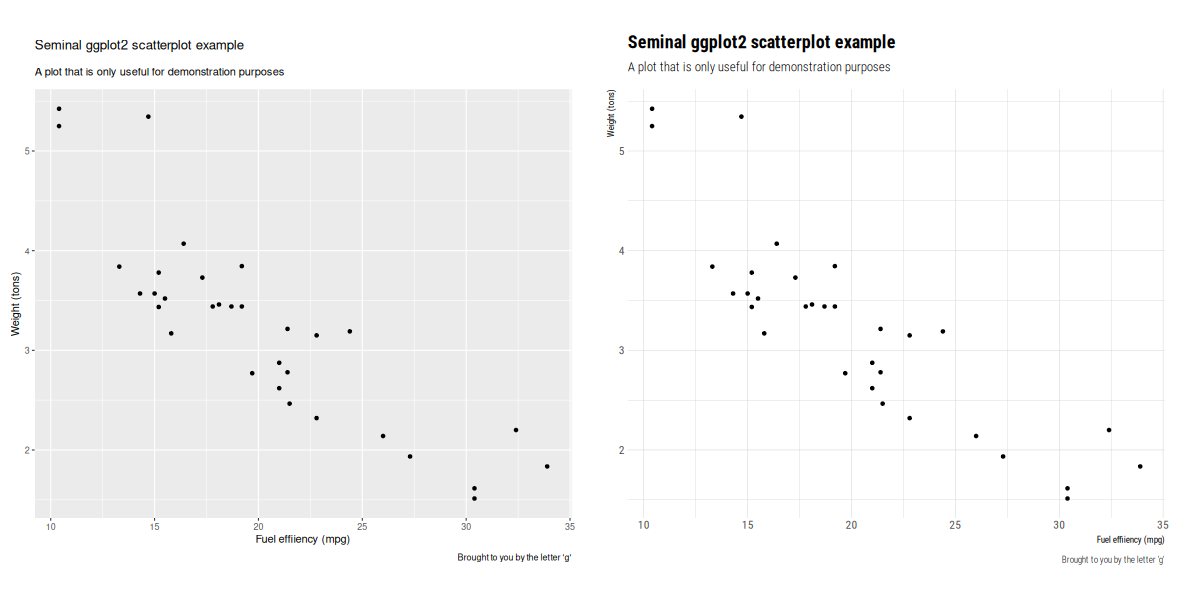
tinythemes demo A tiniest of tiny violins micro maintenance release 0.0.4 of our tinythemes arrived on CRAN today. tinythemes provides the theme_ipsum_rc() function from hrbrthemes by Bob Rudis in a zero (added) dependency way. A simple example is (also available as a demo inside the package) contrasts the default style (on the left) with the one added by this package (on the right): This version adjusts to the fact that hrbrthemes is no longer on CRAN so the help page cannot link to its documentation. No other changes were made. The set of changes since the last release follows.

Changes in tinythemes version 0.0.4 (2025-10-02)
  • No longer \link to now-archived hrbrthemes

Courtesy of my CRANberries, there is a diffstat report relative to previous release. More detailed information is on the repo where comments and suggestions are welcome.

This post by Dirk Eddelbuettel originated on his Thinking inside the box blog. If you like this or other open-source work I do, you can sponsor me at GitHub.

John Goerzen: A Twisty Maze of Ill-Behaved Bots

Like many, bot traffic has been causing significant issues for my hosted server recently. I ve been noticing a dramatic increase in bots that do not respect robots.txt, especially the crawl-delay I have set there. Not only that, but many of them are sending user-agent strings that are quite precisely matching what desktop browsers send. That is, they don t identify themselves. They posed a particular problem on two sites: my blog, and the lists.complete.org archives. The list archives is a completely static site, but it has many pages, so the bots that are ill-behaved absolutely hammer it following links. My blog runs WordPress. It has fewer pages, but by using PHP, doesn t need as many hits to start to bog down. Also, there is a Mastodon thundering herd problem, and since I participate on Mastodon, this hits my server. The solution was one of layers. I had already added a crawl-delay line to robots.txt. It helped a bit, but many bots these days aren t well-behaved. Next, I added WP Super Cache to my WordPress installation. I also enabled APCu in PHP and installed APCu Manager. Again, each step helped. Again, not quite enough. Finally, I added Anubis. Installing it (especially if using the Docker container) was under-documented, but I figured it out. By default, it is designed to block AI bots and try to challenge everything with Mozilla in its user-agent (which is most things) with a Javascript challenge. That s not quite what I want. If a bot is well-behaved, AI or otherwise, it will respect my robots.txt and I can more precisely control it there. Also, I intentionally support non-Javascript browsers on many of the sites I host, so I wanted to be judicious. Eventually I configured Anubis to only challenge things that present a user-agent that looks fully like a real browser. In other words, real browsers should pass right through, and bad bots pretending to be real browsers will fail. That was quite effective. It reduced load further to the point where things are ordinarily fairly snappy. I had previously been using mod_security to block some bots, but it seemed to be getting in the way of the Fediverse at times. When I disabled it, I observed another increase in speed. Anubis was likely going to get rid of those annoying bots itself anyhow. As a final step, I migrated to a faster hosting option. This post will show me how well it survives the Mastodon thundering herd! Update: Yes, it handled it quite nicely now.

Next.

Previous.