Search Results: "tin"

18 February 2016

Enrico Zini: Debugging output of GUI apps

I have been hit by #643726 again. I was happily working on a terminal while an apt upgrade was running on another, and suddenly kbuildsycoca4 started vomiting on my command line because I had run okular once on that terminal last tuesday. Among the possible workarounds, one can run kdebugdialog from package kde-runtime and check the "Disable all debug output" button. This is the output of kdebugdialog when run on a terminal after enabling "Disable all debug output":
$ kdebugdialog
QDBusConnection: session D-Bus connection created before QCoreApplication. Application may misbehave.
I see it as debugging output turned into an art performance, and I have an appreciation for this kind of things. kdebugdialog, my hat's off to you.

Stein Magnus Jodal: A guide to poor API management

This is the story of libspotify, as experienced by a Spotify customer and libspotify developer for six years.

Step 1: Support your API for years Since April 2009, libspotify has been a mostly nice although proprietary C library for integrating with the Spotify music streaming service, providing both music metadata and full playback capabilities. Language wrappers have been written for a plenitude of programming languages (including my own pyspotify). libspotify is integrated into numerous open source projects (including my own Mopidy), networked AV receivers, and rumour has it: even cars. In addition to being closed source, there was another catch: in order to use it, you need the Spotify premium subscription. Speaking from my own experience supporting a project integrating with Spotify for the last six years: lots of end users upgraded to premium in order to use the projects built on top of libspotify.

Step 2: Stop accepting bug reports and stop releasing updates In May 2012, Spotify released libspotify 12.1.51 for all supported architectures, which now even included Android. After months of endless requests from the quickly growing hoards of Raspberry Pi users, Spotify released libspotify 12.1.103 for hardfloat armv6 on January 22 2013. The release included minor API additions, like the addition of explicit lyrics and means for accepting Spotify s Terms of Service. The additions in 12.1.103 never reached the other supported architectures and 12.1.51 remains the last release for those. There was no clear communication about this being the end of libspotify, releases have just ceased. libspotify has not been mentioned in a single developer blog post or developer email newsletter since. That s now more than three years ago.

Step 3: Create new APIs Over the next couple of years Spotify released a new Web API and iOS and Android SDKs. Through their developer blog, they communicated quite a bit both about these and about the deprecation of the apps inside the Spotify desktop client. Here are some pieces from their developer blog to illustrate: The Web API grew steadily, as documented by the Web APIs changelog. Over time, its feature list improved, supporting anonymous endpoints for generic music metadata as well as OAuth protected endpoints for managing your own music collection and playlists. The only major part missing that prevented developers replacing libspotify was music playback, as the Web API only provides 30 second previews. From what I recall of 2014 IRC discussions with Spotify employees, they had built a new much smaller library for streaming music. The iOS and Android SDKs were simply platform specific wrappers around this new playback library and the new Web API. My impression is that, after a number of beta releases, the iOS and Android SDKs seamlessly replaced libspotify on those platforms. The plan was apparently to release the new playback library for desktop too, so that it, in combination with the Web API, could replace libspotify there as well. That was all back in 2014.

Step 4: Deprecate old APIs At some point, Spotify deprecated their old web API, the Metadata API. There was no blog post about it and it was not mentioned in any Spotify Developer News email I ve received in recent years. I guess they only published this fact as a note on the Metadata API web page; it is therefore hard to track down exactly when it was deprecated and how the deprecation was communicated. Anyway, it was deprecated, and the natural upgrade path was to the new Web API. Spotify even has a migration guide mapping the concepts of the Metadata API to the new Web API. All good. In May 2015, after 28 months without a single release or any news, libspotify is officially deprecated. The communication channel of choice? A note on the libspotify web page. No post on the developer blog. No Spotify Developer News email. To be able to use libspotify, all developers have registered and requested a personal application key. To my knowledge, none of these registered library users were notified directly.

Step 5: Shut down an old API On January 20 2016 Spotify end-of-lifed their Metadata API. I don t know if this date was communicated on the Metadata API web page well in advance of this shutdown. There s no blog post on the topic. There s no news email. There s no tweet from @SpotifyPlatform or @SpotifyStatus. I can t find anything except users commenting on various Spotify documentation pages that the text is outdated because the API is no longer merely deprecated, but entirely shut down. Hopefully they did publish the shutdown date ahead of time. It had a full replacement API and a migration guide. Fair and square. Nothing much to complain about here. It s time to get porting your code to the Web API! But frankly, I don t really care about this Metadata API because I don t use the Metadata API, do I?

Step 6: Break your API without warning February 3 2016, Mopidy users start reporting General transient error when searching Spotify. This is a libspotify error message known as SP_ERROR_OTHER_TRANSIENT with error code 16. This error usually means that there is some unspecified issue with the Spotify service. We ve actually seen it before and like its name suggests, it is indeed transient and soon goes away. According to a series of tweets between my fellow Mopidy developer Nick Steel and @SpotifyCares it appears that the libspotify search functionality was backed by the Metadata API s search functionality. Who knew? I m not aware of any relation between these APIs ever being mentioned publicly. No libspotify user could possibly have known that the Metadata API shutdown would affect them. Let s summarize: libspotify hasn t had any releases for three years and it was officially deprecated in May last year. But, there have been no warnings about any shutdown. The libspotify project is likely no longer staffed at all. Did someone just forget that libspotify depended on the Metadata API they were shutting down? Many newer networked AV receivers use the Spotify Connect libraries that are exclusive to Spotify s commercial partners. But some receivers probably still use libspotify. If so, did Spotify just break hardware sold with Spotify support as a major feature? Something that people are paying a monthly fee to use? It seems they did! In the Spotify Community forums there are numerous reports of broken devices and software that all have two things in common: the date the problem started occurring, and that search is the only feature that is broken. Surely, Spotify will quickly explain themselves and fix this?

Step 7: Stay quiet Since the API shutdown, Spotify has been very quiet. No posts on the developer blog. No email newsletter. No tweets from @SpotifyPlatform since December 1 last year. Some users at The Spotify Community forum are quoting responses from Spotify. Most responses seem to link to the Metadata API migration docs and state that application developers must migrate. In other cases the responses point the finger at the commercial partner which only adds to the confusion. Some of these devices may use the Metadata API directly, and in those cases the application maintainers are probably to blame. However, I m quite certain that the libspotify search issue is responsible for a fair share of these complaints. libspotify, in contrast to the Metadata API, has never been officially shut down. The responsibility for any breakage caused by libspotify is Spotify s alone.

What I want from Spotify
  1. Apologize to your paying customers and supporters.
  2. Get substantially better at communicating deprecations and shutdowns. We want all news, not just good news.
  3. Give us a new supported C library for audio playback. Now! Not later this year. I ve heard that promise for three consecutive years now. We can live with pre-release software quality initially. Getting the library out sooner rather than later shows us that there is a road ahead for all the projects that stream music from Spotify. Let us get started making new language wrappers.
  4. Release Spotify Connect specifications and libraries. We want to make music players that can be controlled by the Spotify mobile app. We want to make music controllers that can play music on all the Spotify Connect software and hardware players we ve invested in. You ve created this technology, now let us use it.
Thanks to Nick Steel for reviewing this blog post.

17 February 2016

Riku Voipio: Ancient Linux swag

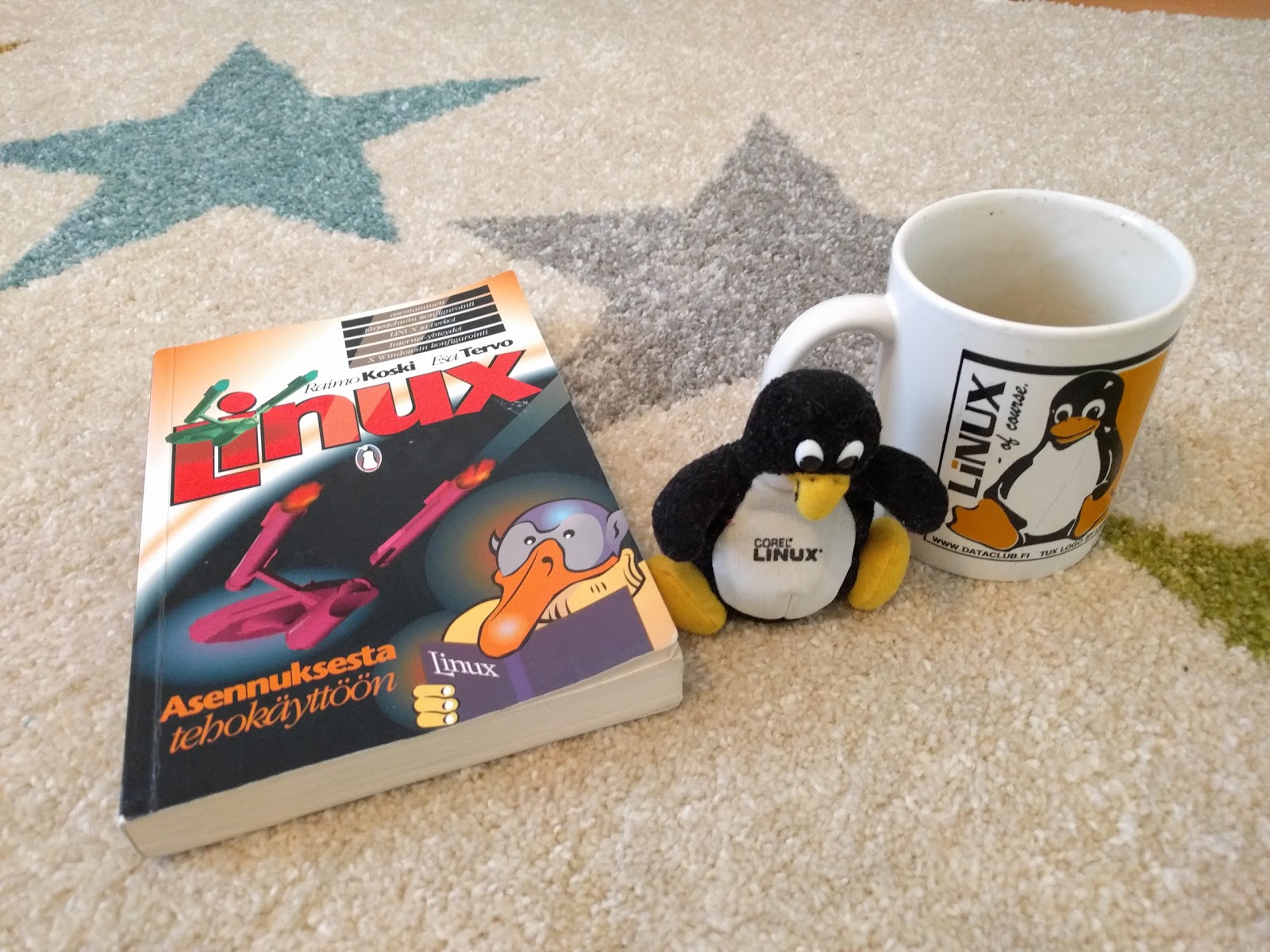
Since I've now been using Linux for 20 years, I've dug up some artifacts from the early journey.
  1. First the book, from late 1995. This from before Tux, so the penguin in the cover is just a co-incidence. The book came with a slackware 3.0 CD, which was my entrance to Linux. Today, almost all of the book is outdated - slackware and lilo install? printing with lpr? mtools and dosemu? ftp, telnet with SLIP dialup? Manually configuring XFree86 and fvwm? How I miss those times!* The only parts of the book are still valid are: shell and vi guides. I didn't read latter, and instead imported my favorite editor from dos FTE.
  2. Fast forward some years, into my first programming job. Ready to advertise the Linux revolution, I bought the mug on right. Nobody else would have a Tux mug, so nobody would accidentally take my mug from the office dishwasher. That only worked for my first work place (a huge and nationally hated IT consultant house). The next workplace, a mobile gaming startup (in 2001, I was there before it was trendy!) - and there was already plenty of Linux mugs when I joined...
  3. While today it may be hard to imagine, those days using Microsoft office tools was mandatory. That leads to the third memorabilia in the picture. Wordperfect for Linux existed for a brief while, and in the box (can you imagine, software came in physical boxes?) came a Tux plush.
* Wait no, I don't miss those times at all

Arturo Borrero Gonz lez: An update about the HA stack on Debian


Great news! The HA stack has been finally updated and you can find now both pacemaker & corosync in Debian stretch.

This is thanks to the hard work of some people, specially Christoph Berg, Ferenc W gner, Martin Loschwitz and others.

By the time of this blogpost, in testing (stretch) you have:

Additionally, unstable contains:
which is great news. However, pcs just joined Debian and there seem to be some rough edges to be worked out.
what to do now
Now that the people mentioned above did the hard work developing the packages, please do test them and report bugs.
Having a great stretch stable release (including the HA stack) is in your hands as well.

best regards!

Antoine Beaupr : My free software activities, february 2016

Debian Long Term Support (LTS) This is my third month working on Debian LTS, started by Raphael Hertzog at Freexian. This month was my first month working on the frontdesk duty and did a good bunch of triage. I also performed one upload and reviewed a few security issues.

Frontdesk duties I spent some time trying to get familiar with the frontdesk duty. I still need to document a bit of what I learned, which did involve asking around for parts of the process. The following issues were triaged:
  • roundcube in squeeze was happily not vulnerable to CVE-2015-8794 and CVE-2015-8793, as the code affected was not present. roundcube is also not shipped with jessie but the backport is vulnerable
  • the php-openid vulnerability was actually just a code sample, a bug report comment clarified all of CVE-2016-2049
  • ffmpeg issues were closed, as it is not supported in squeeze
  • libxml2 was marked as needing work (CVE-2016-2073)
  • asterisk was triaged for all distros before i found out it is also unsupported in squeeze (CVEs coming up, AST-2016-001, AST-2016-001, AST-2016-001)
  • libebml and libmatroska were marked as unsupported, although an upload of debian-security-support will be necessary to complete that work (bug #814557 filed)

Uploads and reviews I only ended up doing one upload, of the chrony package (CVE-2016-1567), thanks to the maintainer which provided the patch. I tried my best trying to sort through the issues with tiff (CVE-2015-8668 and CVE-2015-7554), which didn't have obvious fixes available. OpenSUSE seem to have patches, but it is really hard to find them through their issue trackers, which were timing out on me. Hopefully someone else can pick that one up. I also tried and failed to reproduce the cpio issue (CVE-2016-2037), which, at the time, didn't have a patch for a fix. This ended up being solved and Santiago took up the upload. I finally spent some time trying to untangle the mess that is libraw, or more precisely, all the packages that embed dcraw code instead of linking against libraw. Now I really feel even more strongly for the Debian policy section 4.13 which states that Debian packages should not ship with copies of other packages code. It made it really hard to figure out which packages were vulnerable, especially because it was hard to figure out which versions of libraw/dcraw were actually vulnerable to the bug, but also just plain figure out which packages were copying code from libraw. I wish I had found out about secure-testing/data/embedded-code-copies earlier... Still, it was interesting to get familiar with codesearch.debian.net to try to find copies of the vulnerable code, which was not working so well. Kudos to darktable 2.0 for getting rid of their embedded copy of libraw, by the way - it made it completely not vulnerable to the issue, the versions in stretch and sid not having the code at all and older versions having non-vulnerable copies of the code.

Issues with VMs again I still had problems running a squeeze VM - not wanting to use virtualbox because of the overhead, I got lost for a bit trying to use libvirt and KVM. A bunch of issues crept up: using virt-manager would just fail on startup with an error saying interface mtu value is improper, which is a very unhelpful error message (what is a proper value??) - and, for the record, the MTU on eth0 and wlan0 is the fairly standard 1500, while lo is at 65536 bytes, nothing unusual there as far as I know. Then the next problem was actually running a VM - I still somewhat expected to be able to boot off a chroot, something I should definitely forget about it seems like (boot loader missing? not sure). I ended up calling virt-install with the live ISO image I was previously using:
virt-install --virt-type kvm --name squeeze-amd64 --memory 512 --cdrom ~/iso/Debian/cdimage.debian.org_mirror_cdimage_archive_6.0.10_live_amd64_iso_hybrid_debian_live_6.0.10_amd64_gnome_desktop.iso --disk size=4 --os-variant debiansqueeze
At least now I have an installed squeeze VM, something I didn't get to do in Virtualbox (mostly because I didn't want to wait through the install, because it was so slow). Finally, I still have trouble getting a commandline console on the VM: somehow, running virtsh console squeeze-amd64 doesn't give me a login terminal, and worse, it actually freezes the terminal that I can actually get on virt-viewer squeeze-amd64, which definitely sounds like a bug. I documented a bit more of that setup in the Debian wiki KVM page so hopefully this will be useful for others.

Other free software work I continued my work on improving timetracking with ledger in my ledger-timetracking git repository, which now got a place on the new plaintextaccounting.org website, which acts as a portal for ledger-like software projects and documentation.

Darktable 2.0 I had the pleasure of trying the new Darktable 2.0 release, which only recently entered Debian. I built a backport for jessie, which works beautifully: much faster thumbnail rendering, no dropping of history when switching views... The new features are great, but I also appreciate how they are being very conservative in their approach. Darktable is great software: I may have trouble approaching the results other are having with lightroom and snapseed, but those are proprietary software that I can't use anyways. I also suspect that I just don't have enough of a clue of what I'm doing to get the results I need in Darktable. Maybe with hand-holding, one day, I will surpass the results I get with the JPEGs from my Canon camera. Until then, I turned off RAW exports in my camera to try and control the explosion of disk use I saw since I got that camera:
41M     2004
363M    2005
937M    2006
2,2G    2007
894M    2008
800M    2009
1,8G    2010
1,4G    2011
9,8G    2012
31G     2013
26G     2014
9,8G    2015
The drop in 2015 is mostly due to me taking less pictures in the last year, for some reason...

Markdown mode hacks I ended up writing some elisp for the markdown mode. It seems I am always writing links like [text](link) which seems more natural at first, but then the formatting looks messier, as paragraph wrapping is all off because of the long URLs. So I always ended up converting those links, which was a painful series of keystrokes. So I made a macro, and while I'm a it, why not rewrite it as a lisp function. Twice. Then I was told by the markdown-mode.el developers that they had already fixed that (in the 2.1 version, not in Debian jessie) and that the C-c C-a r key binding actually recognized existing links and conveniently converted them. I documented my adventures in bug #94, but it seems I wrote this code for nothing else than re-learning Emacs lisp, which was actually quite fun.

More emacs hacking Another thing I always wasted time doing by and is "rename file and buffer". Often, you visit a file but it's named wrong. My most common case is a .txt file that i rename to .mdwn. I would then have to do:
M-x rename-file <ret> newfile
M-x rename-buffer <ret> newfile
C-x C-s <ret> newfile
Really annoying. Turns out that set-visited-file-name actually does most of the job, but doesn't actually rename the file, which is really silly. So I wrote this small function instead:
(defun rename-file-and-buffer (newfname)
  "combine rename-file and rename-buffer
set-visited-file-name does most of the job, but unfortunately
doesn't actually rename the file. rename-file does that, but
doesn't rename the buffer. rename-buffer only renames the buffer,
which is pretty pointless.
only operates on current buffer because set-visited-file-name
also does so and we don't bother doing excursions around.
"
  (interactive "GRename file and bufer: ")
  (let ((oldfname (buffer-file-name)))
    (set-visited-file-name newfname nil t)
    (rename-file oldfname newfname)
    )
  )
Not bound to any key, really trivial, but doing this without that function is really non-trivial, especially since set-visited-file-name needs special arguments to not mark the file as modified.

IRC packages updates I updated the Sopel IRC bot package to the latest release, 6.3.0. They have finally switched to Requests, but apart from that, no change was necessary. I am glad to finally see SNI support working everywhere in the bot! I also update the Charydbis IRC server package to the latest 3.5.0 stable release. This release is great news, as I was able to remove 5 of the 7 patches I was dragging along the Debian package. The previous Charybdis stable release was over 3 years old, as 3.4.2 was released in (December) 2012! I spend a good chunk of time making the package reproducible. I filed a bug upstream and eventually made a patch to make it possible to hardcode a build timestamp, which seems to have been the only detectable change in the reproducible build infrastructure. Charybdis had been FTBS for a while in sid now, and the upload should fix that as well. Unfortunately, Charybdis still doesn't build with hardening flags - but hopefully a future update of the package should fix that. It is probably because CFLAGS are not passed around properly. There's really interesting stuff going on in the IRC world. Even though IRC is one of the oldest protocols still in operation (1988, even before the Web, but after SMTP and the even more venerable FTP), it is still being actively developed, with a working group drafting multiple extensions to the IRCv3 protocol defined in RFC 1459. For example, IRCv3.3 includes a Strict Transport Security extension, which tries to ensure users use encrypted channels as much as possible, through warnings and STARTTLS support. Charybdis goes even further by proposing a reversal of the +S ("secure channel" flag) where all channels are secure by default, and you need to deliberately mark a channel as insecure with the +U flag if you actually want to allow users on an clear-text connection to join the channel. A transition mechanism is also proposed.

Miscellaneous bug reports En vrac... I fell face-first in this amazing game that is endless-sky. I made a small pull request on the documentation, a bug report and a feature request. I forwarded a bug report, originally filed against monkeysign, to the pyqrencode maintainers. I filed a usability bug against tails-installer, which just entered Debian, mostly usability issues. I discovered the fim image viewer, which re-entered Debian recently. It seemed perfect to adjust my photos-import workflow, so I added it to my script, to be able to review photos prior to importing them into Darktable and git-annex.

16 February 2016

Daniel Pocock: FOSSASIA 2016, pgDay Asia 2016 and MiniDebConf Singapore

The FOSSASIA 2016 conference is taking place next month, 18-20 March at the Science Centre Singapore. The FOSSASIA community has also offered to host a MiniDebConf Singapore 2016 and pgDay Asia 2016. With sufficient interest from volunteers and participants, these events could do a lot to raise the profile of free software in the region. Applications from speakers and exhibition tables are still possible using the form. Real-time communications technology at FOSSASIA 2016 We are currently discussing a Real-time lounge and demo area for FOSSASIA, hopefully with a live linkup to the FSF's LibrePlanet 2016 in Boston. FOSSASIA have invited a number of developers to speak about SIP, XMPP, WebRTC and peer-to-peer communications solutions. Hopefully exact attendance and scheduling can be publicised soon. Sponsors needed Bringing leading free software developers to Singapore is not easy and further sponsorship is needed to ensure all the speakers who would like to participate can get there. If you or your organization can help with funding or accommodation please make contact. Google Summer of Code If you want to be selected for Google Summer of Code 2016 and you live in Singapore or a neighbouring country, FOSSASIA could be a great opportunity to meet potential mentors, hack on things together and talk about project ideas. Free software development is a community activity and the more you engage with the community, the more confident mentors are likely to be about selecting you. Questions and contact For general questions about FOSSASIA 2016 and Singapore, please ask the FOSSASIA mailing list. For questions about the MiniDebConf, see debconf-discuss and for pgDay Asia, please join the pgday-asia mailing list or otherwise try pgsql-general or the seasiapug regional list.

Vincent Fourmond: QSoas tips and tricks: better baselines using the "save points" feature

During data processing in our team, we often subtract plain polynomial baselines to our data, drawn by hand using the b command. Note that this is legitimate because we know that the signal we are looking for quickly drops to 0 outside a given range. The usual workflow is to just load the data, use b to draw a baseline and subtract it, and then have further fun with the baseline-subtracted data. This was the only possibility in the old SOAS. However, I don't like so much this kind of workflow, because such a baseline is arbitrary, and once it's subtracted, it's hard to reassess the baseline afterwards.
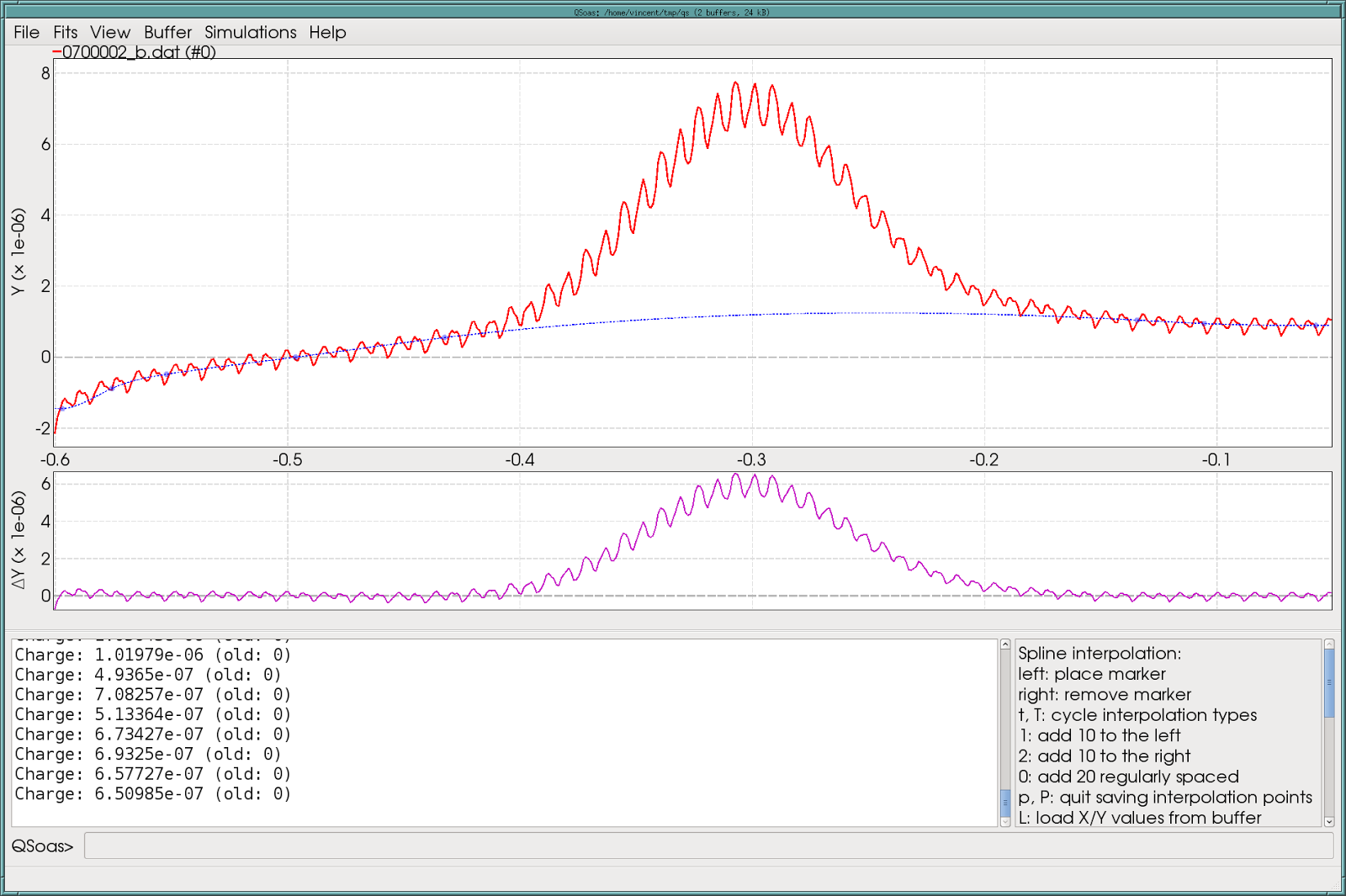
This is why I've designed a better way in QSoas: when you are done creating a baseline, push p: this exits pushing only the interpolation nodes:
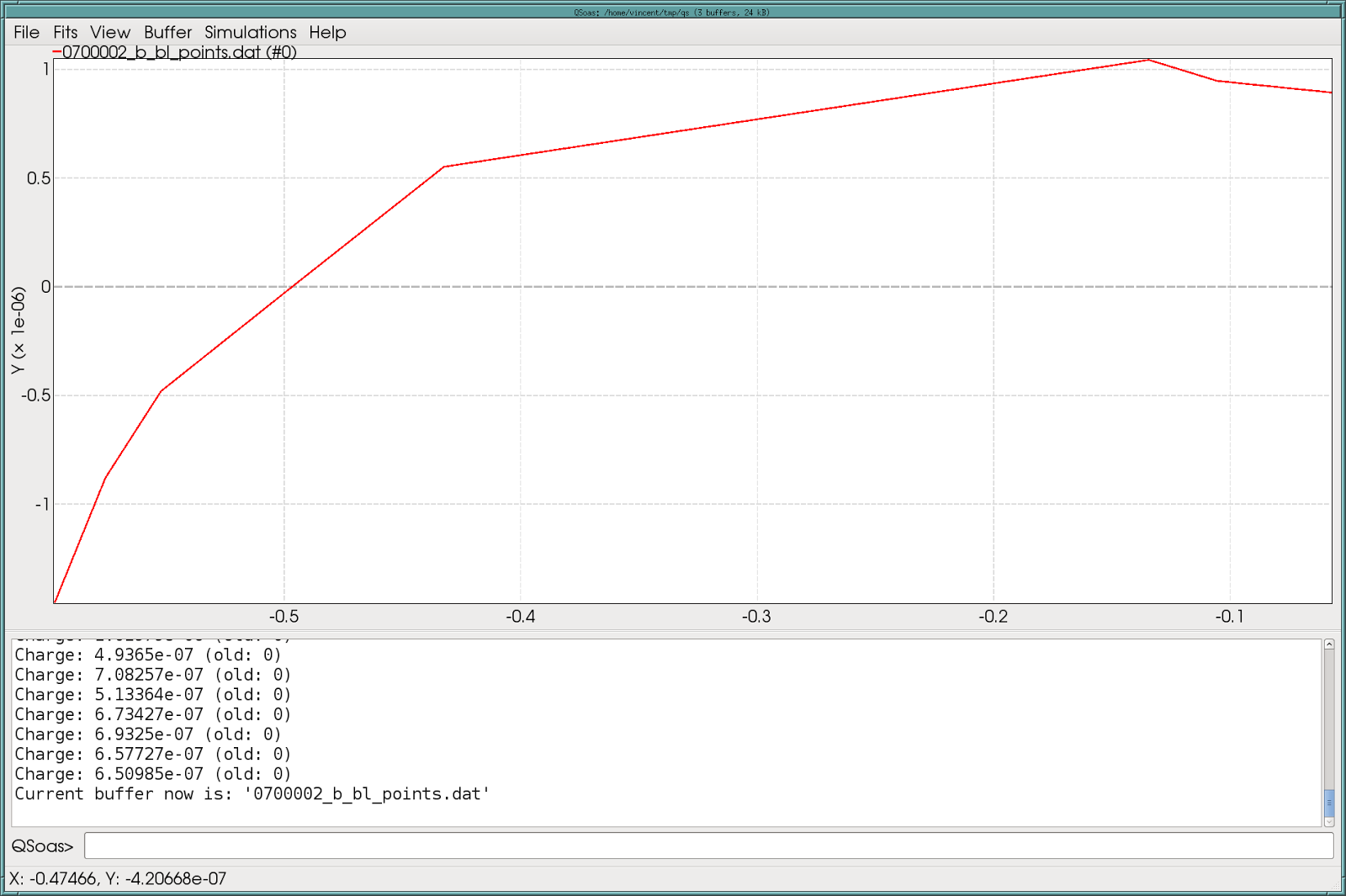
Above, the baseline subtraction interface, and below, the resulting nodes:
The nodes can be reloaded by hitting uppercase L from within b and giving a buffer number (admittedly, the interface as of now isn't that good, I'll have to work on it). Alternatively, you can greenerate the baseline by using interpolate, and then further subtract it using S:
QSoas> interpolate 1 0
where 1 is the original buffer (in fact, only its X values will be used, so you don't have to use the same buffer) and 0 is the buffer containing the interpolation nodes. Saving only the interpolation nodes makes it possible to reedit the baseline easily, and regenerate the baseline-subtracted data using a script. This is my favorite approach, because I like to be able to trace every single step from the raw data to processed data. Another neat feature is that, from within b, you can reload only the X values of nodes using lowercase l (and giving buffer number): the Y values are computed as if you had clicked at the corresponding positions. This is very useful is you have a whole series of similar baselines to make: most often, you won't even need manual adjustment to get a good baseline. I hope you'll find this tip useful !

Michal &#268;iha&#345;: Weekly phpMyAdmin contributions 2016-W06

As we're getting closer to release of new major release (4.6.0), the focus moves to the bug fixing. Most of the fixed issues came from our error reporting server, which collects error reports from the installations. Vast majority if bugs were affecting older releases as well, so these were fixed for upcoming 4.5.5 as well. Besides bugfixing there was also some cleanups in the master branch - shared code for processing sprites and covering it by tests and removed caching of MySQL server information as that didn't bring any speed improvements and lead to cache consistency issues. All handled issues:

Filed under: English phpMyAdmin 0 comments

Norbert Preining: Debian/TeX Live 2015.20160215-1

About one month has passed and here is the usual updated of TeX Live packages for Debian. While I am not really calling for testers at the moment, building of preliminary packages for TeX Live 2016 has begone. The binaries are already uploaded to experimental, and arch=all packages for experimental will follow soon. Debian - TeX Live 2015 As with the last time, here is the list of new and updated pacakges with (auto-generated) links to the package pages on CTAN. New packages adtrees, babel-occitan, crimson, emisa, glossaries-extra, gloss-occitan, libertinus, luatex-def, mynsfc, nihbiosketch, signchart, smartunits, tikz-feynman, uhrzeit, xduthesis. Updated packages achemso, acro, animate, apnum, archaeologie, babel, babel-french, babel-greek, babel-macedonian, bangorcsthesis, biblatex-bookinarticle, biblatex-gost, biblatex-manuscripts-philology, br-lex, caption, chemgreek, chemmacros, chemnum, cmtiup, csplain, csquotes, ctanify, ctex, cweb, datatool, datetime2, datetime2-english, delimseasy, droit-fr, dvips, erewhon, exsheets, fibeamer, fira, fontspec, forest, geschichtsfrkl, glossaries, graphics, greek-fontenc, greektonoi, hyph-utf8, inconsolata, isodoc, l2tabu, l3build, l3experimental, l3kernel, l3packages, latex, latex-bin, latex-make, leadsheets, leaflet, luaotfload, luatexja, mathastext, mcf2graph, mcmthesis, media9, metrix, mhchem, ndsu-thesis, newpx, newtx, ocgx2, pas-tableur, pdftex, pdfx, pict2e, pst-perspective, pstricks, pstricks-add, ptex, quran, ran_toks, realscripts, schemata, showhyphens, siunitx, sr-vorl, sttools, tempora, tetex, tex4ht, texfot, texlive-scripts, thinsp, thuthesis, tkz-orm, tools, uantwerpendocs, ulthese, unicode-data, uptex, xassoccnt, xcjk2uni, xebaposter, xecjk, xetex, xetexko, xltxtra, xpinyin, zhnumber, zhspacing. Enjoy.

15 February 2016

Michal &#268;iha&#345;: Weblate supports Python 3

During the last days I've completed quite long time challenge - make Weblate compatible with Python 3. It's probably still not in shape you would use it on production server, but it runs fine and the testsuite completes without errors. As usual, the major obstacle are dependencies. The translate-toolkit doesn't support Python 3 in any released version, so you need latest Git snapshot. Another problematic bit is Mercurial, which will not support Python 3 in near future. But in case you need it, you can still install Python 2 version and use it from Weblate (it uses command line interface). The porting was mostly dealing with encoding mess - in Python 2 you really didn't have to distinguish between binary and text data, while Python 3 quite enforces that. This turned out to be especially tricky with CSV files where csv module expects text streams in Python 3, while translate-toolkit CSV parser expects binary ones. All this has one downside as well - the test matrix got bigger again, what makes the testsuite run longer with 5 workers available. While doing these changes, I've also decided to drop support for Django 1.7, this will allow us to get rid of lot of deprecation warnings in Django 1.9 and prepare codebase for Django 1.10.

Filed under: English Weblate 0 comments

Julien Danjou: Timeseries storage and data compression

The first major version of the scalable timeserie database I work on, Gnocchi was a released a few months ago. In this first iteration, it took a rather naive approach to data storage. We had little ideas about if and how our distributed back-ends were going to be heavily used, so we stuck to the code of the first proof-of-concept written a couple of years ago. Recently we got more feedbacks from our users, ran a few benchmarks. That gave us enough feedback to start investigating in improving our storage strategy. Data split Up to Gnocchi 1.3, all data for a single metric are stored in a single gigantic file per aggregation method (min, max, average ). This means that the file can grow to several megabytes in size, which make it slow to manipulate. For the next version of Gnocchi, our first work has been to rework that storage and split the data into smaller parts. Gnocchi Carbonara archives split The diagram above shows how data are organized inside Gnocchi. Until version 1.3, there would have been only one file for each aggregation methods. In the upcoming 2.0 version, Gnocchi will split all these data into smaller parts, where each data split is stored in a file/object. This allows to manipulate smaller pieces of data and to increase the parallelism of the CRUD operations on the back-end leading to large speed improvement. In order to split timeseries into several chunks, Gnocchi defines a maximum number of N points to keep per chunk, to limit their maximum size. It then defines a hash function that produces a non-unique key for any timestamp. It makes it easy to find in which chunk any timestamp should be stored or retrieved. Data compression Up to Gnocchi 1.3, the data stored for each metric is simply serialized using msgpack, a fast and small serialization format. Though, this format does not provide any compression. That means that storing data points needs 8 bytes for a timestamp (64 bits timestamp with nanosecond precision) and 8 bytes for a value (64 bits double-precision floating-point), plus some overhead (extra information and msgpack itself). After looking around on how to compress all these measures, I stumbled upon a paper from some Facebook engineers called about Gorilla, their in-memory timeserie database, entitled "Gorilla: A Fast, Scalable, In-Memory Time Series Database". For reference, part of this encoding is also used by InfluxDB in its new storage engine. The first technique I implemented is easy enough, and it's inspired from delta-of-delta encoding. Instead of storing each timestamp for each data point, and since all the data points are aggregated on a regular interval, we transpose points to be the time difference divided by the interval. For example, the suite of timestamps timestamps = [41230, 41235, 41240, 41250, 41255] is encoded into timestamps = [41230, 1, 1, 2, 1], interval = 5. This allows regular compression algorithms to reduce the size of the integer list using run-length encoding. To actually compress the values, I tried two different algorithms: I then benchmarked these solutions: Gnocchi Carbonara compression speed The XOR algorithm implemented in Python is pretty slow, compared to LZ4. Truth is that python-lz4 is fully implemented in C, which makes it fast. I've profiled my XOR implementation in Python, to discover that one operation took 20 % of the time: count_lead_and_trail_zeroes, which is in charge of counting the number of leading and trailing zeroes in a binary number. Gnocchi Carbonara compression XOR profiling I tried 2 Python implementations of the same algorithm (and submitted them to my friend and Python developer Victor Stinner by the way). The first version using string search with .index() is 10 faster than the second one that only do integer computation. Ah, Python As Victor explained, each Python operation is slow and there's a lot in the second version, whereas .index() is implemented in C and really well optimized and only needs 2 Python operations. Finally, I ended up optimizing that code by leveraging cffi to use directly ffsll() and flsll(). That decreased the run-time of count_lead_and_trail_zeroes by 45 %, making the entire XOR compression code speed increased by a small 7 %. This is not enough to catch up with LZ4 speed. At this stage, the only solution to achieve a high-speed would probably to go with a full C implementation. Gnocchi Carbonara compression size Considering the compression ratio of the different algorithms, they are pretty much identical. The worst case scenario (random values) for LZ4 compress down to 9 bytes per data point, whereas XOR can go down to 7.38 bytes per data point. In general XOR encoding beats LZ4 by 15 %, except for cases where all values are 0 or 1. However, LZ4 is faster than XOR by a factor of 4 -70 depending on cases. That means that we'll use LZ4 for data compression in Gnocchi 2.0. It's possible that we could achieve as fast compression/decompression algorithm, but I don't think it's worth the effort right now it'd represent a lot of code to write and to maintain.

14 February 2016

Lunar: Reproducible builds: week 42 in Stretch cycle

What happened in the reproducible builds effort between February 7th and February 13th 2016:

Toolchain fixes
  • James McCoy uploaded devscripts/2.16.1 which makes dcmd supports .buildinfo files. Original patch by josch.
  • Lisandro Dami n Nicanor P rez Meyer uploaded qt4-x11/4:4.8.7+dfsg-6 which make files created by qch reproducible by using a fixed date instead of the current time. Original patch by Dhole.
Norbert Preining rejected the patch submitted by Reiner Herrmann to make the CreationDate not appear in comments of DVI / PS files produced by TeX. He also mentioned that some timestamps can be replaced by using the -output-comment option and that the next version of pdftex will have patches inspired by reproducible build to mitigate the effects (see SOURCE_DATE_EPOCH patches) .

Packages fixed The following packages have become reproducible due to changes in their build dependencies: abntex, apt-dpkg-ref, arduino, c++-annotations, cfi, chaksem, clif, cppreference-doc, dejagnu, derivations, ecasound, fdutils, gnash, gnu-standards, gnuift, gsequencer, gss, gstreamer0.10, gstreamer1.0, harden-doc, haskell98-report, iproute2, java-policy, libbluray, libmodbus, lizardfs, mclibs, moon-buggy, nurpawiki, php-sasl, shishi, stealth, xmltex, xsom. The following packages became reproducible after getting fixed: Some uploads fixed some reproducibility issues, but not all of them: Patches submitted which have not made their way to the archive yet:
  • #813944 on cvm by Reiner Herrmann: remove gzip headers, fix permissions of some directories and the order of the md5sums.
  • #814019 on latexdiff by Reiner Herrmann: remove the current build date from documentation.
  • #814214 on rocksdb by Chris Lamb: add support for SOURCE_DATE_EPOCH.

reproducible.debian.net A new armhf build node has been added (thanks to Vagrant Cascadian) and integrated into the Jenkins setup for 4 new armhf builder jobs. (h01ger) All packages for Debian testing (Stretch) have been tested on armhf in just 42 days. It took 114 days to get the same point for unstable back when the armhf test infrastructure was much smaller. Package sets have been enabled for testing on armhf. (h01ger) Packages producing architecture-independent ( Arch:all ) binary packages together with architecture dependent packages targeted for specific architectures will now only be tested on matching architectures. (Steven Chamberlain, h01ger) As the Jenkins setup is now made of 252 different jobs, the overview has been split into 11 different smalller views. (h01ger)

Package reviews 222 reviews have been removed, 110 added and 50 updated in the previous week. 35 FTBFS reports were made by Chris Lamb, Danny Edel, and Niko Tyni.

Misc. The recordings of Ludovic Court s' talk at FOSDEM 16 about reproducible builds and GNU Guix is now available. One can also have a look at slides from Fabian Keil's talk about ElecrtroBSD and Baptiste Daroussin's talk about FreeBSD packages.

Sean Whitton: East 5th Street tech

There are three of us living here, and the plan is to switch all three of us from wireless to wired ethernet Internet connections by transporting cabling through the ventilation system using this remote-controlled car. Here s an action shot we took. My housemate put on his Gaming playlist and it reached a very suitable crescendo as we guided the car through its final journey, pulling the last piece of cotton which we would then use to pull the final cabal through. The timing of the music couldn t have been better. It reflected the risk of losing control of the car as we moved the controller around to enable the car to pick up the radio signals. A further risk was caused by the car only being able to turn right, not left, and there not being enough room in the air duct for it to make a full-circle rotation. Our backup plan was to try tossing a ball tied to a piece of string down the duct. Unfortunately I m still on a wireless connection because to reach my room we d have had to send the cable via the furnace/air conditioning unit which we decided against. Does a SATA-to-USB converter, for moving data off my old laptop hard drive which I had to replace this week, need to be this complicated?

Rapha&#235;l Hertzog: Freexian s report about Debian Long Term Support, January 2016

A Debian LTS logoLike each month, here comes a report about the work of paid contributors to Debian LTS. Individual reports In December, 113.50 work hours have been dispatched among 9 paid contributors. Their reports are available: Evolution of the situation As expected, we had a small drop in the amount of hours sponsored. New sponsors (re-)joined but others stopped too (Gree this time) mostly balancing the result. We only lost 2 hours of sponsored work. It would be nice if we could invert that curve and actually start again to get closer to our objective of funding the equivalent of a full time position. Let s hope that the switch to wheezy as the version supported by the LTS team will motivate many companies relying on Debian 7 in their IT system. In terms of security updates waiting to be handled, the situation is close to last month(17 packages in dla-needed.txt, 27 in the list of CVE). It looks like that having about 20 packages needing an update is the normal situation and that we can t really get further down given the time required to process some updates (sometimes we wait until the upstream authors provides a patch, and so on). Thanks to our sponsors New sponsors are in bold.

No comment Liked this article? Click here. My blog is Flattr-enabled.

Elena 'valhalla' Grandi: Happy #ilovefs

Happy #ilovefs

Happy I love Free Software Day https://fsfe.org/campaigns/ilovefs/2016/!

Immagine/fotohttp://ilovefs.org

My life has been full of Free Software for more than 15 years and listing all the software and projects I've used or interacted with would take a long post (and I would be sure to forget someone), so if you are reading this and are involved in Free Software: thank you! I may have used your work in the past, I may be using it some time in the future, or I may never use it personally, but you are making the world I live in a better place anyway.

Special thanks go to the local LUGs, where I've met my SO and to the @Debian project, where I've met a few people I can call friends.

@LIFO @Gruppo Linux Como #ilovefs

Bits from Debian: I love Free Software Day 2016: Show your love for Free Software

ILoveFS banner Today February 14th, the Free Software Foundation Europe (FSFE) celebrates the "I Love Free Software" day. I Love Free Software day is a day for Free Software users to appreciate and thank the contributors of their favourite software applications, projects and organisations. We take this opportunity to say "thank you" to all the Debian upstreams and downstreams, and all the Debian developers and contributors. Thanks for your work and dedication to free software! There are many ways to participate in this ILoveFS day and we encourage everybody to join in and celebrate. Show your love to Debian developers, contributors and teams virtually on social networks using the #ilovefs hashtag and spreading the word in your own social media circles, or by visiting the ILoveFS campaign website to find and use some of the promotional materials available such as postcards and banners. To learn more about the FSFE, you can read their announcement of this campaign or visit their general website.

13 February 2016

Mart n Ferrari: Why I am not touching node.js

Dear node.js/node-webkit people, what's the matter with you? I wanted to try out some stuff that requires node-webkit. So I try to use npm to download, build and install it, like CPAN would do. But then I see that the nodewebkit package is just a stub that downloads a 37MB file (using HTTP without TLS) containing pre-compiled binaries. Are you guys out of your minds? This is enough for me to never again get close to node.js and friends. I had already heard some awful stories, but this is just insane. Update: This was a rage post, and not really saying anything substantial, but I want to quote here the first comment reply from Christian as I think it is much more interesting:
I see a recurring pattern here: developers create something that they think is going to simplify distributing things by quite a bit, because what other people have been doing is way too complicated[tm]. In the initial iteration it usually turns out to have three significant problems:
  • a nightmare from a security perspective
  • there's no concern for stability, because the people working on it are devs and not people who have certain reliability requirements
  • bundling other software is often considered a good idea, because it makes life so much easier[tm]
Given a couple of years they start to catch up where the rest of the world (e.g. GNU/Linux distributions) is - at least to some extent. And then their solution is actually of a similar complexity compared to what is in use by other people, because they slowly realize that what they're trying to do is actually not that simple and that other people who have done things before were not stupid and the complexity is actually necessary... Just give node.js 4 or 5 more years or so, then you won't be so disappointed. ;-) I've seen this pattern over and over again:

  • the Ruby ecosystem was a catastrophe for quite some time (just ask e.g. the packages of Ruby software in distributions 4 or 5 years ago), and only now would I actually consider using things written in Ruby for anything productive
  • docker and vagrant were initially not designed with security in mind when it came to downloading images - only in the last one or two years have there actually been solutions available that even do the most basic cryptographic verification
  • the entire node.js ecosystem mess you're currently describing
Then the next new fad comes along in the development world and everything starts over again. The only thing that's unclear is what the next hype following this pattern is going to be.
And I also want to quote myself with what I think are some things you could do to improve this situation:
  1. You want to make sure your build is reproducible (in the most basic sense of being re-buildable from scratch), that you are not building upon scraps of code that nobody knows where they came from, or which version they are. If possible, at the package level don't vendor dependencies, depend on the user having the other dependencies pre-installed. Building should be a mainly automatic task. Automation tools then can take care of that (cpan, pip, npm).
  2. By doing this you are playing well with distributions, your software becomes available to people that can not live on the bleeding edge, and need to trust the traceability of the source code, stability, patching of security issues, etc.
  3. If you must download a binary blob, for example what Debian non-free does for Adobe Flashplayer, then for the love of all that is sacred, use TLS and verify checksums!
8 comments

Scott Kitterman: Debian LTS Work January 2016

This was my ninth month as a Freexian sponsored LTS contributor. I was assigned 8 hours for the month of January. My time this month was spent preparing updates for clamav and the associated libclamunrar for squeeze and wheezy. For wheezy, I ve only helped a little, mostly I worked on squeeze. This update is more complex than usual because with clamav 0.99 upstream bumped soname and so in addition to the normal case of transitions in unstable, we ve needed transitions for stable, oldstable, and squeeze-lts. We also try to be careful and maintain higher versions in newer releases, so stable needed to wait for 0.99 in testing, oldstable needed to wait for stable, etc. Currently 0.99 is in stable proposed updates and I ve requested that the update for wheezy (oldstable) go forward. Once that s done, I ve got squeeze-lts ready to go.

Norbert Preining: OpenPHT 1.5.1 for Debian/sid

I have updated the openpht repository with builds of OpenPHT 1.5.1 for Debian/sid for both amd64 and i386 architecture. For those who have forgotten it, OpenPHT is the open source fork of Plex Home Theater that is used on RasPlex, see my last post concerning OpenPHT for details. plex-debian-new sid and testing For sid use the following lines:
deb http://www.preining.info/debian/ openpht-sid main
deb-src http://www.preining.info/debian/ openpht-sid main
You can also grab the binary for amd64 directly here for amd64 and i386, you can get the source package with
dget http://www.preining.info/debian/pool/main/o/openpht/openpht_1.5.1.508-1.dsc
jessie Builds for Debian stable release jessie are not done by now. The release file and changes file are signed with my official Debian key 0x860CDC13. Now be ready for enjoying the next movie!

Mark Brown: Performance problems

Just over a year ago I implemented an optimization to the SPI core code in Linux that avoids some needless context switches to a worker thread in the main data path that most clients use. This was really nice, it was simple to do but saved a bunch of work for most drivers using SPI and made things noticeably faster. The code got merged in v4.0 and that was that, I kept on kicking a few more ideas for optimizations in this area around but that was that until the past month. What happened then was that for whatever reason people started picking up v4.0 and using it in production more. On some systems people started seeing problems when there was heavy SPI flash usage, often during things like distribution installation. In some cases the lockup detector fired, but the most entertaining error was that on Marvell Orion systems (which are single core) when the flash was being heavily used the SATA controller started having trouble handling interrupts. These problems all bisected down to the key commit in that series, 0461a4149836c79 (spi: Pump transfers inside calling context for spi_sync()). The problem is that there are a number of widely deployed SPI controllers out there that don t support DMA and instead require the CPU to explicitly read and write everything sent to and from registers in the controller. To make matters worse these accesses to the controller will usually take many CPU cycles to complete, each one stalling the CPU while they happen. This is fine for short transfers or if the CPU has nothing else to do but on a busy multitasking system it s an issue. Before the optimization the switches between the worker thread interacting with the hardware and the thread initiating the SPI operations provided breaks in this activity which allowed other things to switch in. Unfortunately when we optimize those away then if there s a lot of work for the controller being done from one thread then that thread can run for a long time without pause. The fix for affected drivers if there are no less CPU intensive ways of driving the hardware is to add some explicit sleeps into the driver itself, either at the end of the transfer_one() or perhaps in an unprepare_message() function. In a way I was quite pleased to see this, it was a clear demonstration that the optimization was having the intended effect though obviously users of affected systems will not find that so comforting. It s not the first time that making things faster or fixing a bug has revealed an underlying problem, I m sure it won t be the last.

Next.

Previous.