Search Results: "reg"

22 November 2007

Raphael Geissert: freshmeat.php: a watch helper

Yesterday I posted to -qa about a watch helper script I wrote so freshmeat projects can be used in watch files.


By the time of writing this post there hasn't been any reply yet, which actually disappoints me.
So abusing a little on the fact that my posts are visible on planet.d.o I'd like to know what is everybody's opinion (replying to my message on -qa is preferred to seeing some blog post comments :)).

Freshmeat by providing an XML file with the project's information seems to be addressing the common problems caused when trying to keep track of upstream in a more-or-less automated way.

I really hope this script is put together with sf.php at qa.debian.org/watch/ to make it possible for even more packages to use watch files to keep up with upstream versions :).
And about the xml-fetching *problem* I'm open to suggestions and preferred ways of doing it.

Next thing to do is write some similar script for the kde,maemo,gnome,xfce,debian,qt,etc - apps,look,art,themes,etc .org websites (this will require some collaboration on the site's side unless I play with some regexes, again, to extract the information and generate some listings like with freshmeat.php).

21 November 2007

MJ Ray: National Issues / Privacy, Lies and Government

On the same day that the government apologised for losing discs containing names, addresses, bank accounts and other details for nearly half the UK population, it was also revealed that another government agency has started demanding hand-over of encryption keys, like what seems to have happened to Hushmail but worse.

So, only the government really has security and privacy now in the UK, but it has failed to keep things private and secure!

What a great day that shows why we must support the Data Protection Act, repeal the RIPA at long last and campaign for a no2id.

Oh and privacy laws must apply to private companies like facebook (under investigation) and be understandable by the general public because leaving it to current user agreements isn't working.

20 November 2007

Russell Coker: RAID and Bus Bandwidth

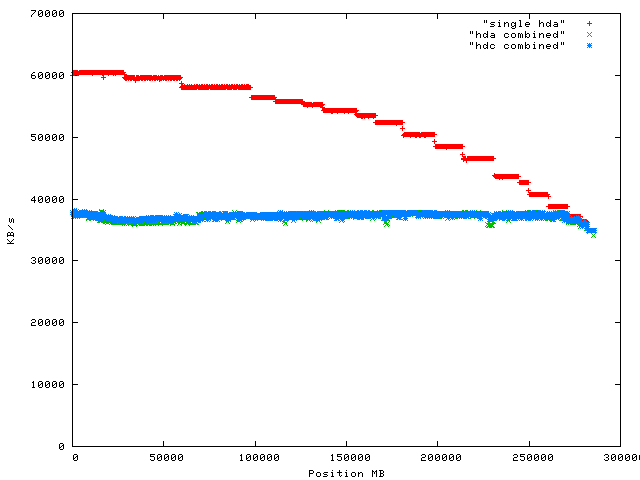
As correctly pointed out by cmot [1] my previous post about software RAID [2] made no mention of bus bandwidth. I have measured the bus bottlenecks of a couple of desktop machines running IDE disks with my ZCAV [3] benchmark (part of the Bonnie++ suite). The results show that two typical desktop machines had significant bottlenecks when running two disks for contiguous read operations [4]. Here is one of the graphs which shows that when two disks were active (on different IDE cables) the aggregate throughput was just under 80MB/s on a P4 1.5GHz while the disks were capable of delivering up to 120MB/s:
On a system such as the above P4 using software RAID will give a performance hit when compared to a hardware RAID device which is capable of driving both disks at full speed. I did not benchmark the relative speeds of read and write operations (writing is often slightly slower), but if for the sake of discussion we assume that read and write give the same performance then software RAID would only give 2/3 the performance of a theoretical perfect hardware RAID-1 implementation for large contiguous writes. On a RAID-5 array the bandwidth for large contiguous writes is the data size multiplied by N/(N-1) (where N is the number of disks), and on a RAID-6 array it is N/(N-2). For the case of a four disk RAID-6 array that would give the same overhead as writing to a RAID-1 and for the case of a minimal RAID-5 array it would be 50% more writes. So from the perspective of “I need X bandwidth, can my hardware deliver it” if I needed 40MB/s of bandwidth for contiguous writes then a 3 disk RAID-5 might work but a RAID-1 definitely would hit a bottleneck. Given that large contiguous writes to a RAID-1 is a corner case and that minimal sized RAID-5 and RAID-6 arrays are rare in most cases there should not be a significant overhead. As the number of seeks increases the actual amount of data transferred gets quite small. A few years ago I was running some mail servers which had a very intense IO load, four U320 SCSI disks in a hardware RAID-5 array was a system bottleneck - yet the IO was only 600KB/s of reads and 3MB/s of writes. In that case seeks were the bottleneck and write-back caching (which is another problem area for Linux software RAID) was necessary for good performance. For the example of my P4 system, it is quite obvious that with a four disk software RAID array consisting of disks that are reasonably new (anything slightly newer than the machine) there would be some bottlenecks. Another problem with Linux software RAID is that traditionally it has had to check the consistency of the entire RAID array in the case of an unexpected power failure. Such checks are the best way to get all disks in a RAID array fully utilised (Linux software RAID does not support reading from all disks in a mirror and checking that they are consistent for regular reads), so of course the issue of a bus bottleneck becomes an issue. Of course the solution to these problems is to use a server for server tasks and then you will not run out of bus bandwidth so easily. In the days before PCI-X and PCIe there were people running Linux software RAID-0 across multiple 3ware hardware controllers to get better bandwidth. A good server will have multiple PCI buses so getting an aggregate throughput greater than PCI bus bandwidth is possible. Reports of 400MB/s transfer rates using two 64bit PCI buses (each limited to ~266MB/s) were not uncommon. Of course then you run into the same problem, but instead of being limited to the performance of IDE controllers on the motherboard in a desktop system (as in my test machine) you would be limited to the number of PCI buses and the speed of each bus. If you were to install enough disks to even come close to the performance limits of PCIe then I expect that you would find that the CPU utilisation for the XOR operations is something that you want to off-load. But then on such a system you would probably want the other benefits of hardware RAID (dynamic growth, having one RAID that has a number of LUNs exported to different machines, redundant RAID controllers in the same RAID box, etc). I think that probably 12 disks is about the practical limit of Linux software RAID due to these issues and the RAID check speed. But it should be noted that the vast majority of RAID installations have significantly less than 12 disks. One thing that cmot mentioned was a RAID controller that runs on the system bus and takes data from other devices on that bus. Does anyone know of such a device?

Benjamin Mako Hill: Free Culture Distilled for Free Software Folks

I've posted an an article on my website called Free Culture Advanced which I wrote for the last edition of the Free Software Foundation Members' Bulletin which went out several months ago. The bulletin is one of things you get when you become an associate member of the FSF. The article makes the case for free culture and a freedom definition in terms that are directed to and I hope will resonate with folks from the free software community. I've posted versions of the article in HTML, PDF, and LaTeX.

19 November 2007

Benjamin Mako Hill: Affero General Public License Version 3

The Free Software Foundation sent out a press release today announcing a new addition to the FSF stable of licenses: the Affero General Public License or AGPL. The FSF has also published a set of answers to anticipated questions in the GPL FAQ. The first paragraph of the release explains what the AGPL is:
This is a new license; it is based on version 3 of the GNU General Public License (GNU GPLv3), but has an additional term to ensure that users who interact with the licensed software over a network can receive the source for that program. By publishing this license, the FSF aims to begin fostering user and development communities around free software web services and other network-oriented software.
The GPL is designed to ensure that users of software have access to the source code -- source is prerequisite to freedom and to the type of collaboration that has made free software successful. However, the GPL doesn't say "users" when it talks about who gets freedom; instead, it references people to whom the software is distributed. It doesn't say users for two reasons. The first is that, under copyright, "distribution" is a much more meaningful term and a powerful hook than "use" which is not, in most cases, one of the copyright holder's exclusive rights. The second is that, until very recently, having a copy of software was prerequisite to using it; possession was prerequisite to use. Things have changed. A large part of many people's computing experience involves running web applications. These include email clients (e.g., GMail or other webmails), office applications (e.g., Google Docs), social network systems, and others. These applications all run on servers -- i.e., on other people's computers. The providers of these services, the Googles and the FaceBooks, build upon, modify and improve GPL software without giving back to their users or the community that they took their software from. The AGPL was created several years ago by FSF board member Henri Poole as a way to address this issue. The license took the form of the GPLv2 with one extra clause. It was a first stab at a license and was imperfect. The language and methods were clunky and, most problematically, the license was incompatible with software under the GPL. The new AGPL is based on the GPLv3 and the extra clause has been rethought and rewritten. It has been vetted using the GPLv3 comment process and dozens of insightful comments from dozens of lawyers, hackers, and users of free software have been incorporated. The new license fixes the issues that many folks -- including myself -- had with the first version of the license. More importantly it can now be linked to GPLv3 code which makes the license a whole lot more practical. I am quoted in the release being excited about the license and I really am. I've got 2-3 major development projects (including Selectricity) which I've been waiting to distribute so that I could do so under the AGPLv3. The AGPL isn't a complete answer to the problem faced by disempowered users of web services. Without data or the capacity (in terms of servers, money, and expertise) to run web applications, the state and quality of these users' freedom remains far from clear. Thankfully, there are a whole bunch of folks thinking about what freedom for users of services might be -- it's a conversation that I'm going to push the FSF to participate in and pursue moving forward. The AGPLv3 marks a first solid contribution to the process of answering that question. If you'd like to help supporting or assisting the FSF in this effort, please consider becoming an associate member or donating.

Russell Coker: WTF - Let s write all the code twice

There is an interesting web site WorseThanFailure.com (with the slogan “Curious Perversions in Information Technology”) that documents amusingly failed projects. The name used to be TheDailyWTF.com but changed due to the idea that for some projects success (interpreted to mean limping along in production) is worse than failure (being scrapped and re-written). I’ve created a new category WTF [1] on my blog to document such projects, both ones that I have personally witnessed and ones that friends and colleagues have seen. In the 90’s I spent some time working on an OS/2 GUI program to be the front-end for a mainframe backed system used by call-center workers. The first thing that they did was to develop a file naming scheme, they decided that all source files should be in the same directory (not unreasonable), but that 8.3 should be the limit of file name lengths in case there was a need to port the system to Windows 95. The fact that porting a program which did little other than display a GUI and talk to a S/390 server to a different OS was difficult (given the large amount of platform specific GUI code) was lost on them. Then they decided that the first two letters would be “FE” in case the source was merged with another bank project (of course the bank had many “Front End” systems talking to mainframes - so even this didn’t guarantee that they would be free of name clashes). Characters 3 and 4 were to represent the section of the program, and as the 3 character extension was one of “.h” or “.cpp” that left exactly 4 characters to name the file - we may as well have numbered the source files. Eventually one of the guys started making jokes about the file names by trying to pronounce them as words and that convinced a majority of the developers that the files should have long human-readable names. As the NMAKE expert (they insisted on not using unsupported software such as GNU make) it was my job to fix all the file names. The bank had an internal users’ group for the C++ development environment, but the contractors were not invited to attend. You might think that it would make sense to have the most skillful C++ programmers attend the meetings and share their knowledge, but apparently attending such meetings was a perk of being a permanent employee. What do you do when you have a C++ development project running behind schedule and a permanent employee who has had no prior exposure to C++ and wants to learn? One manager believed that assigning the junior programmer to the project is a solution to both problems - it was good for teaching the programmer C++ in a hurry but not so good for the deadline. There was a lot of excitement related to the back-end development. The mainframe guys assured me that CICS could never handle bad data and it totally wasn’t their fault if my program sent bad data to them and the region crashed. The first CICS region crash occurred when the mainframe guys told me to make the unused space in text fields “empty” - to a C programmer this means filling them with the 0 character but it killed the CICS region (apparently “empty” means filled with spaces to CICS programmers). A later region crash came when they told me to change the field length for the account name everywhere that it occurred - they told me that they wanted the change immediately - so I changed a macro definition, ran “make”, and sent a transaction with the changed size. Apparently “immediately” really meant “after we have spent an hour of software development changing magic numbers throughout our system”. I’m assuming that COBOL has some facility that roughly compares to C macros for defining field lengths and that it was the programmers not the language that was at fault. When the project became seriously behind schedule they hired some expert programmers from another country to help with the development. The experts decided that we needed to redesign the system (not that it had been designed in the first place) to use a “model view controller” architecture. When the real business logic is all on a S/390 and the only logic in the front end is to combine the contents of some screen-scrapes from a virtual 3270 terminal into a single GUI dialogue (with the first screen occasionally getting data from the IVR system) the benefits of MVC seem rather small. The new MVC version of the system was dubbed “phase 2″ and there were a series of deadlines for changing over from “phase 1″ which were missed. So the original team of developers continued on their project without any help from the “experts”. The last report I heard (some time after leaving the project) was that Phase 1 had gone live in production while Phase 2 was still being developed (at that time Phase 2 had a year of development and Phase 1 had about 15 months). The lesson to be learned from this is that management should only hire people that they can control. If you hire a consulting company and then let them do whatever they want (as opposed to solving the problem that they were hired to solve) then at best they will do no good and they may just slow things down. One of the more memorable incidents was when the project manager was talking to his 2IC, he said “I think we’re really breaking ground, [pause] I’m breaking wind and we’re breaking ground”. My desk was a few meters from where the wind (and ground) were being broken, I unfortunately was able to verify that wind was being broken but was not as certain about the ground. I did learn some useful things during this project, one was the fact that sample code from library vendors should not be trusted and ideally should be read from a print-out not pasted into the project source tree. The CTI library vendor had buffer overflows in their sample code. Another useful thing was the coin-tossing method of dispute resolution. If two good programmers have a disagreement about how to implement something tossing a coin is a quick way of resolving the dispute - this only works with two good programmers (in which case either idea will work). The project in question was messed up in many ways. I may write another post in the WTF category about it.

Adam Rosi-Kessel: Smooth Velouria Espresso

I just discovered the recently-opened Velouria Espresso in Jamaica Plain via this subscribers-only article in the Atlantic. Velouria marks the latest arrival in the single-origin coffee movement pioneered by George Howell. In a nutshell, the idea of single-origin coffee beans is that if beans are identified with a particular region (or even particular grower), the farmers will have more incentive to distinguish themselves. Ultimately, coffee beans will be known like fine wines, and the best growers will earn premium prices (thus bringing even more money to underdeveloped areas than coffee sold as fair-trade). Flatblack Coffee Company, near my office, operates under similar principles. More details in this episode of On Point with George Howell. Velouria distinguishes itself with its focus on brewed coffee rather than espresso (although they have plenty of that as well). The shop features the “Clover” coffee machine (”Bring out the subtle nuances of all of your coffees through complete, independent control of all of the important brew parameters: grind size, dose, water temperature, and contact time.”) I got a cappucino and a single-origin Kenyan coffee made with the Clover Machine. (Actually, two distinct single-origin Kenyan coffees, which Steve surreptitiously swapped on me while I wasn’t looking). They were all excellent. My cappucino started with a little foam heart in the crema:
P1040782
Amazingly, even when it was finished, the heart was still faintly visible:
P1040784
Steve enjoyed his espresso as well:
P1040783
Velouria has no website that I could find. it’s at 389 Centre Street, Jamaica Plain, MA 02131. Beware the Yelp page as it has inaccurate hours information — just call them at (617) 522-2400 if you’re wondering if they’re open. Now if we could only get a place like this in one of the vacant storefronts in Roslindale… Technorati Tags: , , , , ,

18 November 2007

Russell Coker: Everyone Should Blog

At this month’s meeting of the Linux Users of Victoria [1] I gave a talk titled Everyone Should Blog (unfortunately the title was missed in the meeting announcement). I’ve been meaning to write about this but was finally prodded into writing by a ProBlogger post about overcrowding in the blog market [2]. Darren (the ProBlogger) suggests that the blog space is overcrowded, blogs are being sold for unreasonably high prices, and a bust similar to the dot-com bust may occur. I agree that there is some over-commercialisation, and that for Darren’s core market (people who want to make money directly from blogging) this is a serious issue to consider. However I believe that there is a lot of scope for more blogs. Firstly all of the services in the social networking space seem to have some feature that resembles a blog in some way (the online diary if not the RSS feed part of the definition). I have previously blogged about some ideas for an open social networking system [3]. A reform of the social networking scene should have the possibility of adding even more users and having them all be bloggers. While not everyone is capable of writing a blog that is of interest to a large audience, everyone who is capable of writing is capable of writing (or contributing to) a blog that is of interest to some people. The next potential area for expansion is in sales/marketting blogs. An example of this is car sales, it seems that every web site run by a car manufacturer only has information on the current model and at best only has information on prices of second-hand cars. There is a real need for authoritative information on older cars, it helps customers and it helps the car companies. If Ford was to provide good information on the cars they manufactured a few years ago it would increase the chance that I would buy a second-hand Ford and if enough people made similar decisions then it would increase the prices of such cars (basic rules of supply and demand). Increasing the second-hand price increases the price that people are prepared to pay for new cars and also allows them to buy a new car sooner - both of which are benefits to the manufacturer. It wouldn’t be difficult to use a blog server for all the information on new cars, you could have a front page that lists the available marques and links to the posts announcing the latest models of those marques. With a small amount of work writing a theme you could have Wordpress giving an appearance that’s almost indistinguishable from any of the major car companies web sites - apart from the fact that every car’s technical data would have a permanent URL of the form www.carcompany.com.au/2007/MARQUE/CODE which would be obviously a permanent link (unlike the Java servlet and ASP URLs you currently see) and therefore would encourage deep links by enthusiasts. This would also give RSS feeds for free (I would be interested in adding RSS feeds for several of the Australian car companies to my Planet installation if possible). A final benefit is the issue of ethics. When car companies remove data about cars they sold the previous year you have to wonder whether they have unreasonable price increases or whether the new cars have some specs that are lesser than the current cars. The general trend is slow and steady increases in features and performance at each price point, the number of people who are more likely to buy from an ethical (trustworthy) company is probably greater than the number of people who will look for details to nit-pick (and such people will find out anyway). Another use for blogs is for public events. It’s not uncommon for people to want to get some background information on an event that they attended years ago. If all the information was archived in the blog of the organisation that hosted the event then it would be easy for everyone to access. This would give additional promotion opportunities for the hosting organisation at almost no cost. Anyone who is announcing a future event should have an RSS feed for new information related to it, then as information is released all the interested people can see it in their favourite feed reader. Many people refuse to subscribe to announcement lists due to fear of spam and the fact that it is often inconvenient or impossible to unsubscribe (sometimes a list server regards unsubscribe requests as spam). Corporations have many potential uses of blogs, Google announces news about all their products via blogs and Microsoft has a good recruiting blog. Smaller companies can still achieve some of the same benefits via blogging. Also it’s well known that a blog which provides useful information about products in a field (not just the products being sold) can really attract potential customers who then react to the adverts in the blog. The same technique can be used by job seekers. Blog well and mention that you are looking for work and you will get offers of interviews. There is also no shortage of political and lobbying blogs as well, they don’t tend to convince the opposition but they are good for converting people who are ambivalent about an issue. As the people who read blogs get older (and therefore richer and more influential) such blogs will become increasingly important. I think that I have demonstrated the potential for a significant number of new blogs, some of which would have large subscriber bases and a lot of influence (which means a lot of potential profit for the Problogger crowd). Have I missed any major areas for developing new blogs?

Russell Coker: Better Social Networking

When advogato.org was still cool I signed up to it. It was an interesting research project in skill metrics (determining the rating of people’s coding skills by the votes of others and weighting the votes by the rating of each person), and it was nice to be rated Master soon after I joined. I still use it on occasion for the blog syndication feature (when I find a good blog on Advogato I add it to my Planet installation). When orkut.com was really cool (when every time I had dinner with a group of people someone would ask if they could be an “orkut friend”) I signed up to it. It was interesting for a while but then most people got bored with it. Now there is Facebook and MySpace for social networking for social purposes and LinkedIn.com for business related social networking. I periodically get invited to join those services but have not been interested in any other than LinkedIn. I can’t join LinkedIn because their mail server is regarded as a SPAM source by my mail server but their web server refuses to provide any information on why this is (the rejection was apparently long enough ago that it’s rolled off my logs). The problem with all these services is that I am expected to sign up with each of them and go to a moderate amount of effort in writing up all the data in the various web pages. Writing it is a pain, keeping it up to date is more pain, and dealing with spam in “scrap-book” entries in Orkut is still an annoyance which I don’t want to multiply by four! So far the only step I’ve seen towards addressing this issue is the XFN - XHTML Friends Network [1] project. But that seems to be of fairly limited scope (just referring to the friendship status of people in a <A HREF link). I believe that the requirements for social networking are:

  1. Personal data about each person, some of which may only be available to friends or friends of friends.

  2. The user owns their own data, has full control over where it’s sent and the ability to request people who receive it to keep some parts of it secret.

  3. Ability to send email to friends of friends (determined by the wishes of each friend and FOAF).

  4. Ability to get a list of friends of friends.

  5. Incorporation of a standard format for CVs (for business social networking).

I think that the only way to go is to have a standard XML format for storing all personal data (including financial, career, and CV data) that can be used on any web site. Then someone who wants to be involved in social networking could create an XML file for a static web server (or multiple files with different content and password protected access), or they could have a server-side script generate an XML file on the fly with a set of data that is appropriate for the reader. The resulting social network would be entirely distributed and anyone could write software to join in. This covers item 1 and part of item 2. For sending email to friends of friends it would be good to avoid spam as much as possible. One way of doing would be requesting that friends publish a forwarding address on their own mail server in a manner similar to SRS [2]. SRS include the ability for such addresses to expire after a certain period of time (which would be convenient for this). In fact publishing SRS versions of friends email addresses would be a good option if you already use SPF [3] and SRS in your mail server. This covers item 3. The XML format could include information on how far the recipient could transfer it. For example if my server sent an XML file to a recruiting agency with my CV it could state that they could distribute it without restriction (so that they can give it to hiring managers) with the possibility of some fields being restricted (EG not tell the hiring manager what I used to get paid). For my mobile phone number I could send it to my friends with a request that they not send it on. This covers part of item 2. The URL for the friends file would of course be in the main XML file, and therefore you could have different friends lists published from different versions of your profile (EG the profile you send to recruiting agencies wouldn’t include drinking buddies etc). This completes the coverage of item 2. Then to have a friends list you have a single XML file on a web server that has the public parts of the XML files from all your friends. This means that getting a list of friends of friends would involve getting a single XML file for each friend (if you have 100 friends and each friend has 50 unique friends on average then you do 100 HTTP operations instead of 5,000). Minimising the number of web transfer operations is essential for performance and for reliability in the face of unreliable web servers (there is no chance of having 5,000 random web servers for individuals all up and accessible at the same time). This covers item 4. Item 5 is merely a nice thing to have which allows more easily replacing some of the recruiting infrastructure. As any such XML format will have several sections for arbitrary plain text (or maybe HTML) for describing various things the CV could of course be in HTML, but it would be good to have the data in XML. I posted this in the “blog” category because blogs are the only commonly used systems where end users do anything related to XML files (the RSS and ATOM feeds are XML). A blog server could easily be extended to do these social networking systems. As with a blog users could run their own social networking server (publishing their XML files) or they could use a service that is similar in concept to blogger which does it all for them (for the less technical users). Then an analogy to Planet, Technorati, etc in the blog space would be public aggregation services that compare people based on the number of friends they have etc, and attempts to map paths between people based on friends. This could also include GPG [4] data such that signing someone’s GPG key would cause your server to automatically list them in some friend category. The XML format should also have a field for a GPG signature (one option would be to use a GPG sub-key to sign the files and have the sub-key owned by the server). I don’t have any serious time to spend on implementing this at the moment. But if someone else starts coding such a project then I would certainly help test it, debug it, and contribute towards the XML design.

Theodore Ts'o: Does perfect code exist? (Abstractions, Part 1)

Bryan Cantrill recently wrote a blog entry, where among other things, he philosophized on the concept of “perfect code”. He compares software to math, arguing that Euclid’s greatest common denominator algorithm shows no sign of wearing out, and that when code achieves perfection (or gets close to perfection), “it sediments into the information infrastructure” and the abstractions defined by that code becomes “the bedrock that future generations may build upon”. Later, in the comments of his blogs, when pressed to give some examples of such perfection, he cites a clever algorithm coded by his mentor to divide a high resolution timestamp by a billion extremely efficiently, and Solaris’s “cyclic subsystem”, a timer dispatch function. Watching his talk at Google where his introduction and sidebar book review on Scott Rosenberg’s “On Dreaming in Code”, it’s clear that he very passionately believes that it is possible to write perfect code, and that one should strive for that at all times. Perhaps that’s because he mostly writes code for operating systems, where the requirements change slowly, and for one OS in particular, Solaris, which tries far harder than most software projects to keep published interfaces stable for as long as possible. In contrast, the OS I’ve spent a lot of time hacking around, Linux, quite proudly states that at least inside the kernel, interfaces can not and should not be stable. Greg Kroah-Hart’s “Stable API Nonsense” is perhaps one of the strongly and most passionate expositions of that philosophy. I can see both sides of the argument, and in their place, both have something to offer. To Bryan’s first point, it is absolutely true that interfaces can become “bedrock” upon which entire ecosystems are built. Perhaps one of the most enduring and impactful example would be the Unix programming interface, which has since become enshrined by POSIX.2 and successor standards. I would argue, though, that it is the interface that is important, and not the code which initially implemented it. If the interface is powerful enough, and if it appears at the right time, and the initial implementation is good enough (not perfect!), then it can establish itself by virtue of the software which uses it becoming large enough that it assumes an important all out of scale with its original intention. Of course, sometimes such an interface is not perfect. There is an apocryphal story that when S. Feldman at AT&T labs first wrote the ‘make’ utility, that he did so rather quickly, and then put it available for his fellow lab members to use, and then went home to sleep. In some versions of the story he had stayed up late and/or pulled an all-nighter to write it, so he slept a long time. When he came back to work, he had come up with a number of ways to improve the syntax of the Makefile. Unfortunately, (so goes the story) that too many teams were already using the ‘make’ utility, so he didn’t feel he could change the Makefile syntax. I have no evidence that this ever took place, and I suspect it is an urban myth that was invented to explain why Makefiles have a rather ugly and unfortunate syntax that many would call defects, including the use of syntactically significant tab characters which are indistinguishable from other forms of leading whitespace. Another example which is the bane of filesystem designers everywhere are the Unix readdir(2), telldir(2), and seekdir(2) interfaces. These interfaces fundamentally assume that directories are stored in linear linked lists, and filesystems that wish to use more sophisticated data structures, such as b-trees, have to go to extraordinary lengths in order support these interfaces. Very few programs use telldir(2) and seekdir(2), but some filesystems such as JFS maintain two b-trees instead of one just to cater to telldir/seekdir. And yet, it is absolutely true that interfaces can be the bedrock for an entire industry. Certainly no matter what its warts, the Unix/Posix interface has proven the test of time, and it has been responsible for the success of many a company and many billions of dollars of market capitalization. But is this the same as perfect code? No, but if billions of dollars of user applications are going to be depending on that code, it’s best if code which implement such an interface be high quality, and should attempt to achieve perfection. But what does it mean for code to be perfect? For a particular environment, if the requirements can be articulated clearly, I can accept that code can reach perfection, in that it becomes as fast as possible (for the given computer platform), and it handles all exception cases, etc., etc. Unfortunately, in the real world, the environment and the requirements inevitably change over time. For example, Bryan’s cyclic subsystem, which he proudly touts as being if not perfect, almost so, and which executes at least 100 times a second on every Solaris system in the world. I haven’t looked at the cyclic system in any detail, since I don’t want to get myself contaminated (the CDDL and GPLv2 licenses are intentionally incompatible, and given that companies — including Sun — have sued over IPR issues, well, one can’t be too careful), but waking up the CPU from its low-power state 100 times a second isn’t a good thing at all if you are worried about energy conservation in data centers — or in laptops. For example, on my laptop, it is possible to keep wakeups down to no more than 30-35 times a second and it would be possible to do more but for an abstraction limitation. Suppose for example an process wants to be sleep and then receive a wakeup 1 milliseconds later, and so requests this via usleep(). At the same time, another application wants to sleep until some file descriptor activity takes place, or after 1.2 milliseconds takes place. 0.3 milliseconds later, a third process requests a sleep, this time for 0.8 milliseconds. Now, it could be that in all of the above cases, the applications don’t actually need exact timing; if they all get their wakeups plus or minus some fraction of a millisecond, they would be quite cool with that. Unfortunately, the standard timer interfaces have no way of expressing this, and so the OS can’t combine the three wakeups at T+1.0, T+1.1, and T+1.2 milliseconds into one wakeup at T+1.1ms. So this is where Greg K-H’s “Stable API Nonsense” comes into play. We may not be able to solve this problem at the userspace level, but we darn well can solve this problem inside the kernel. Inside the kernel, we can change the timer abstraction to allow device drivers and kernel routines to provide a timer delta plus a notion of how much accuracy is required for a particular timer request. Doing so might change a timer structure that previously external device drivers had depended upon — but too bad, that’s why stable ABI/API’s are not supported for internal kernel interfaces. Is this that the interface could have been extended? Well, perhaps, and perhaps not; if an interface is well designed, it is possible it can be extended in an API and/or ABI compatible way. There usually is a performance cost to doing so, and sometimes it may make sense to pay that that cost, and sometimes it may not. I’ll talk more about that in a future essay. Yet note what happened to the timer implementation. We have a pretty sophisticated timer implementation inside Linux, that uses heap data structures and buckets of timers for efficiency. So while I might not call it perfect, it is pretty good. But, oops! Thanks to this new requirement of energy efficiency, it will likely need to get changed to support variable levels of accuracy and the ability to fire multiple timers that are (more or less) coming due in a single CPU wakeup cycle. Does that make it no longer perfect, or no longer pretty good? Well, it just had a new requirement impact the code, and if criteria for perfection is for the abstraction defined by the code to be “bedrock” and never-changing, and no need to make any changes in said code over multiple years, I would argue that little to no code, even OS code, can ever achieve perfection by that definition — unless that code is no longer being used. (This is the first of a multi-part series of essays on abstractions that I have planned. The next essay which I plan to write will be entitled “Layer surfing, or jumping between layers”, and will be coming soon to a blog near you….)

Evan Prodromou: 26 Brumaire CCXVI

So, I've been off blogging for almost three months now -- from about mid-August to now. It's been kind of guilt-ridden, and it's also been kind of a relief. Being a B-list blogebrity is a direful burden, and having some time away was restful and relaxing and energizing. But now I'm ready to come back! One of the reasons that I haven't been blogging is that once you fall behind, it's really hard to catch up. So I've decided to not do the entire task at once. Instead, I'm just going to start a page on my 2007 Hiatus and fill that up as time permits. For those of you who care greatly about exactly what I did each and every day for the last three months, you've got a spot to read it. And, truthfully, I dropped out of the B-list ranks on Technorati during my time away. I'm back to my natural position as a C-list blogger, and baby, it feels good. Get ready for some photos of my cats, coming up soon! tags:

Feelings of loss One of the other main reasons I haven't been blogging in the last few months is that I've been losing weight. A lot of weight. I've dropped from a high body mass index (BMI) of about 43 -- dangerously high -- to my current sane but still high 33.6. I'd like to get down to a more reasonable BMI of 30 ("overweight") by the end of the year, and be somewhere around 25 ("normal") by next summer. I can lose weight pretty easily when I put my mind to it. Well, actually, it's still insanely hard, but I'm so damn stubborn and obsessive about things, when I actually sink my teeth into them, that it seems easy to the casual observer. My recipe is simple: reduce the amount of food I eat, do low-intensity exercise about an hour a day, and measure everything as well as possible. I eat 3 good meals a day -- about 50% fruits and vegetables, 25% complex carbs like rice or bread, and 25% protein like beans, tofu, fish or cheese. I steer clear of sweets and I drink alcohol only on occasion, and seldom more than a glass or two of wine. For exercise, I've been running around Parc Lafontaine or on a treadmill three days in a row, then on the fourth day lifting weights at a local gym on rue Gilford. I still have a ways to go, but the results have been good so far, and I'm feeling like I'm getting close to the neighbourhood of what I "should" weigh. I've been getting a lot of compliments from friends and family, which is a great motivator. Most of all, I feel good running, jumping, and playing with my daughter, which is the biggest reward of all. All that said, the exercise is taking an extra 1-2 hours out of my day, and blogging has been the main thing cut out to make room. But I think I can work around that now. tags:

Road trip We're leaving Tuesday for a trip to New Jersey to visit my dad's family for American Thanksgiving. (Yeah, they're my family, too.) We're all looking forward to seeing aunts and uncles and cousins and other extended family, but we're also looking forward to spending our powerful Canadian loonies in the US. The Canadian dollar's gone up and up this last few months, and though it's no longer trading at its ridiculous high of US$1.10 (!), it's still above parity, which means our money stretches pretty well. Coupled with this is the fact that most products here in Canada are still priced as if the loonie were still worth US$0.62. It's not atypical to see a book priced for $7.99 US, $10.99 Canadian. So we're going to do some shopping for clothes, books, music and other goods while we're stateside. I plan on bringing an empty suitcase with me and bringing it back full. (The fact that I've lost a lot of weight makes shopping for clothes particularly enticing.) All within our legal limits for customs returning to Canada, of course! Not to worry, random customs official who's reading this blog for who knows what reason. I'm also looking forward to this trip because we haven't done a driving trip together in a while. Going to Thanksgiving in 2005 was Amita June's second long trip (our overnighter to Ottawa for our anniversary in Oct 2005 was her first), and I think she's going to enjoy it again this time. tags:

Painful upgrade I just upgraded my main server, Antipater, from Debian "sarge" to Ubuntu "gutsy". I was getting pretty frustrated by being 3+ versions back from a lot of the important software running on the system. I wanted to get on Ubuntu for my server platform to have more frequent upgrades (about every 6 months). The upgrade went well, mostly. I updated /etc/apt/sources.list to use the Ubuntu archives, then got all the packages. The installation was pretty quick, even for something like 700 packages. However, when I rebooted to use the new 2.6.22 kernel (up from 2.6.8 or so), the server's responsiveness went way down. My guess is that somewhere in the 2.6.x series, one of the new schedulers is causing my particular configuration some grief. I've trimmed my cron jobs and background processes down to a minimum, but the server is still running a little too loaded. The great folks at iWeb have been really helpful, but they don't support Ubuntu, so I've got to brainstorm for myself. I'm going to have to go in over the next few days to reboot the server and experiment with other kernels -- not fun. tags:

One-liners Some other odds and ends:
  • It's getting cold! We had our first snow flurries a few days ago, and it's been regularly under freezing around here. Time to get winter coats out of the closet -- or, better, buy new ones in the US.
  • My friends at Kokoromi are organizing an excellent games+art event called GAMMA 256 on November 28 at the SAT. Should be a lot of fun.
  • One such friend, Heather Kelley is going to be talking at the Montreal Geek Girl Dinner on Tuesday. Good for her!
tags:

17 November 2007

Russell Coker: The Price of Food

If you live in a hotel for an extended period of time (which can provide significant career benefits - click on this link for details [1]) the issue of food price and availability is going to concern you. If you are in a decent hotel you will have a fridge in your room that you can use for your own food. A recent trend downwards in hotel quality has been to use fridges that are stocked with over-priced drinks that have sensors and automatically bill you if you move any of the drinks. A good hotel will have a fridge that either has space for your own food/drink or which allows you to temporarily move their stuff out. If you are staying in a hotel for any period of time and the hotel is not run by robots then you should have the option to negotiate the removal of all the over-priced drinks to provide you space for your own food. If you have such fridge space then you have good options for making sandwiches - which are cheap and healthy. In UK hotels (which incidentally tend to not have a fridge in the room if they are affordable) the standard practice is to have breakfast included as part of the hotel fee. If you are flexible about your eating then you can eat a large breakfast and have a minimal lunch to reduce expenses. Finally you have to consider how much you earn as an hourly rate (after tax) and compare it to the cost of food. For example if dinner at a cheap restaurant costs $10 and you earn $30 per hour after tax then you only need to save 20 minutes of your time by eating at the restaurant (as opposed to making a meal and washing the dishes) to make it economically viable. I have previously written about the efficiency of work [2]. I think it’s reasonable to assume (in the absence of any formal studies on the topic) that when your efficiency of working decreases due to over-work your enjoyment of your leisure time is also reduced on a per-hour basis (in addition to having less leisure time). I know that some people enjoy cooking and consider it a leisure activity (my sister seems to be one of them [3]). But if cooking isn’t something you enjoy then you will probably feel that eating out is reducing the amount of “work” time and therefore increases the quality of your life and the quality of your work. Finally for the time spent living in a hotel while searching for work (if you travel to another country without arranging employment first) the main financial factor is not how much you can save money on a per-day basis, but how quickly you can find work. The ability to accept a job offer from any region has the potential to significantly reduce the amount of time taken to find work and thus put you in a better financial position in the long-term. This benefit of living in hotels should significantly outweigh the extra expenses of eating out etc.

Gregor Herrmann: aptitude & recommends

due to the latest changes in apt (which installs packages marked as Recommends: by default since 0.7.7) aptitude — even if "Install recommended packages automatically" is not checked in aptitude's options dialog — pulls in recommended packages just like apt-get, whether called from the command line or interactively; cf. also #448561.

the fix to keep both apt-get & aptitude from installing recommended packages is something like:
$ cat /etc/apt/apt.conf.d/15recommends
APT  
        Install-Recommends "false";
 ;
(also very useful for (p cow)builder where installing recommended packages in the chroot is just wrong & takes a long time; cf. also #448562.)

16 November 2007

Mario Iseli: Good times, bad times Tempora mutantur

What’s up with myself? I ask me this question myself after many of you asked me about what’s going on with me. I have a quite difficult time right now - ok - more precisely: Already for about a month or so. Several people who were very important for me let me hang. I have a lot of personal troubles at my workplace, different troubles in my circle of friends and also have worries about my girlfriend who considers to move to Germany in January. I do even miss my personal energy and motivation. I look forward to solve my situation at work, look forward to the QA meeting in ~2 weeks and hope to have some real holidays in december to relax a little bit. In that case… Regards,

Russell Coker: Safe Banking by SMS?

Is it possible to secure Internet banking with SMS? As secure tokens are too expensive ($10 or more in bulk) and considered to be too difficult to use by many (most?) customers banks have sought out other options. One option that has been implemented by the National Australia Bank and will soon be available from the Commonwealth Bank is SMS authentication of transfers. The idea is that when you issue an online banking request you receive an SMS with a password and then have to enter that password to authenticate it. If you receive an unexpected password then you know you have been attacked. I wonder how much information is in the SMS, does it include the amount and where the money is to be transferred (in the case of a funds transfer - the operation most likely to be used by attackers)? If the full details are not included then an attacker could hijack an active session, get the user to enter the password, and then act as if the user entered the password incorrectly. The user would then request a new SMS and complete their desired transfer without realising that they just authorised a transfer to Russia… If the full details are recorded will the user look at them? Online banking fraud often involves transferring the funds to an idiot in the same country as the victim. Then the idiot sends the money to the attacker in some other manner which is more difficult to track. I wonder whether an attacker could divert the funds transfer to one of the idiots in question and have the victim not realise that the wrong account number was used. Another issue is that of SMS interception. Anyone who can hack the network of a phone company could steal money from any bank account in the country! For wealthy people there is also the possibility of stealing their mobile phone and making funds transfers before they report the theft. Another possibility is to register for a new phone company. Last time I changed phone companies it took about an hour for the new company to have the phone number and I don’t recall the phone company doing anything to verify that I owned the number in question. If an attacker had a credit card with the same name as the victim (names are not unique so this is not impossible or even inherently illegal) they could open a new phone service and steal the number. Someone who’s mobile phone stops working probably wouldn’t assume that it was part of a bank fraud scheme and act accordingly, in fact if they don’t use their mobile phone later it might be several days before someone contacts them in some other manner and mentions that they weren’t answering their mobile phone. A final possibility is the situation where a mobile phone is connected to a computer. Devices that combine mobile phone and PDA functionality are becoming common. A trojan horse program that offered to do something useful when a mobile phone was connected to the PC via a USB cable might fool some users. All that would be required is a few minutes of the phone being connected if the attacker already has the password for online banking. Maybe they could even make it appear that the bank was demanding that the phone be connected to the PC - that should fool users who don’t understand how SMS authentication works. It seems to me that SMS authentication is an improvement (it adds an external device which usually can’t be directly manipulated by the attacker) but is far from perfect security. I previously wrote about the bad idea that you can bank with an infected computer [1]. SMS authentication is a good step towards making things more difficult for attackers (which is always a good idea) but doesn’t really secure the system. Also it costs 5 cents for each SMS, I expect that the banks will want their customers to pay for this - I would rather pay for a $10 token up-front.

Kartik Mistry: Interesting stats

* We love stats. Foss.in Delegate Stat is really interesting!

Russell Coker: Software vs Hardware RAID

Should you use software or hardware RAID? Many people claim that Hardware RAID is needed for performance (which can be true) but then claim that it’s because of the CPU use of the RAID calculations. Here is the data logged by the Linux kernel then the RAID-5 and RAID-6 drivers are loaded on a 1GHz Pentium-3 system: raid5: automatically using best checksumming function: pIII_sse
  pIII_sse  :  2044.000 MB/sec
raid5: using function: pIII_sse (2044.000 MB/sec)
raid6: int32×1    269 MB/s
raid6: int32×2    316 MB/s
raid6: int32×4    308 MB/s
raid6: int32×8    281 MB/s
raid6: mmxx1      914 MB/s
raid6: mmxx2    1000 MB/s
raid6: sse1×1    800 MB/s
raid6: sse1×2    1046 MB/s
raid6: using algorithm sse1×2 (1046 MB/s) There are few P3 systems that have enough IO capacity to support anywhere near 2000MB/s of disk IO and modern systems give even better CPU performance. The fastest disks available can sustain about 80MB/s when performing contiguous disk IO (which incidentally is a fairly rare operation). So if you had ten fast disks performing contiguous IO then you might be using 800MB/s of disk IO bandwidth, but that would hardly stretch your CPU performance. It’s obvious that CPU performance of the XOR calculations for RAID-5 (and the slightly more complex calculations for RAID-6) is not a bottleneck. Hardware RAID-5 often significantly outperforms software RAID-5 (in fact it should always outperform software RAID-5) even though in almost every case the RAID processor has significantly less CPU power than the main CPU. The benefit for hardware RAID-5 is in caching. A standard feature in a hardware RAID controller is a write-back disk cache in non-volatile RAM (RAM that has a battery backup and can typically keep it’s data for more than 24 hours without power). All RAID levels benefit from this but RAID-5 and RAID-6 gain particular benefits. In RAID-5 a small write (less than the stripe size) requires either that all the blocks other than the ones to be written are read or that the original content of the block to be written and the parity block are read - in either case writing less than a full stripe to a RAID-5 requires some reads. If the write-back cache can store the data for long enough that a second write is performed to the same stripe (EG to files being created in the same Inode block) then performance may double. There is one situation where software RAID will give better performance (often significantly better performance), that is for low-end hardware RAID devices. I suspect that some hardware RAID vendors deliberately cripple the performance of low-end RAID devices (by using an extremely under-powered CPU among other things) to drive sales of the more expensive devices. In 2001 I benchmarked one hardware RAID controller as being able to only sustain 10MB/s for contiguous read and write operations (software RAID on lesser hardware would deliver 100MB/s or more). But for random synchronous writes the performance was great and that’s what mattered for the application in question. Also there are reliability issues related to write-back caching. In a well designed system an update of an entire RAID-5 stripe (one block to each disk including the parity block) will first be performed to the cache and then the cache will be written back. If the power fails while the write is in progress then it will be attempted again when power is restored thus ensuring that all disks have the same data. With any RAID implementation without such a NVRAM cache a write to the entire stripe could be partially successful. This means that the parity block would not match the data! In such a situation the machine would probably work well (fsck would ensure that the filesystem state was consistent) until a disk failed. When the RAID-5 recovery procedure is used after a disk is failed it uses the parity block to re-generate the missing data, but if the parity doesn’t match then the re-generated data will be different. A disk failure may happen while the machine is online and this could potentially result in filesystem and/or database meta-data changing on a running system - this is a bad situation that most filesystems and databases will not handle well. A further benefit of a well designed NVRAM cache is that it can be used on multiple systems. For their servers HP makes some guarantees about which replacement machines will accept the NVRAM module. So if you have a HP server running RAID-5 with an NVRAM cache then you could have the entire motherboard die, have HP support provide a replacement server, then when the replacement machine is booted with the old hard drives and NVRAM module installed the data in the write-back cache will be written! This is a significant feature for improving reliability in bad corner cases. NB I’m not saying that HP is better than all other RAID vendors in this regard, merely that I know what HP equipment will do and don’t know about the rest. It would be good if there was a commodity standard for NVRAM on a PC motherboard. Perhaps a standard socket design that Intel could specify and that every motherboard manufacturer would eventually support. Then to implement such things on a typical PC all that would be required would be the NVRAM module, which while still being expensive would be significantly cheaper than current prices due to the increase in volume. If there was a significant quantity of PCs with such NVRAM (or which could be upgraded to it without excessive cost) then there would be an incentive for people to modify the Linux sotware RAID code to use it and thus give benefits for performance and reliability. Then it could be possible to install a NVRAM module and drives in a replacement server with Linux software RAID and have the data integrity preserved. But unless/until such things happen write-back caching that preserves the data integrity requires hardware RAID. Another limitation of Linux software RAID is expanding RAID groups. A HP server that I work on had two disks in a RAID-1 array, one of my colleagues added an extra disk and made it a RAID-5, the hardware RAID device moved the data around as appropriate while the machine was running and the disk space was expanded without any down-time. Some similar things can be done with Linux, for example here is documentation on converting RAID-1 to RAID-5 with Linux software RAID [1]. But that conversion operation requires some down-time and is not something that’s officially supported, while converting RAID-1 to RAID-5 with HP hardware RAID is a standard supported feature.

15 November 2007

Adeodato Sim : A copy-cat strike?

So, uhm, somebody around here must have felt inspired by the French, because this very morning I noticed in the bus a note announcing a strike starting tomorrow. It will last a week. The disagreement seems to come from a difference in salaries between the workers of the company that connects Alicante with nearby towns, La Alcoyana, and the company that runs buses within the city, Masatusa. Accoring to this article (in Spanish), in La Alcoyana they earn up to a 40% less. This seems to happen because Alicante’s Town Council is responsible for transports within town, but it’s the Regional Government that regulates how La Alcoyana should operate. They say they will keep a 60% of the buses, which sounds like a lot to me (how much is it in France, Christian?). We’ll see how it goes.

14 November 2007

Anthony Towns: Managing Debian Installs

For a while I’ve been trying to find some easy way to keep a few machines I admin behaving the way I want them too with minimal effort. They don’t really need much maintenance – but I would like something to help keep them all in sync. Basically, something like FAI, but much, much simpler – ideally something that takes five minutes to understand, and another five minutes to deploy; and leave the more complicated and powerful tools for when they’re actually needed. I figured what I really want was just a simple way to make a meta-package – one that doesn’t really provide any functionality, just tells apt/dpkg what I want installed (via Depends), and what I don’t want installed (via Conflicts) and adds any extra configuration stuff or local scripts that I decide I want. But doing that with a real Debian package is harder than I’m really comfortable with – I don’t want to have to worry about potential lintian errors, or rules files and debhelper commands, or writing a Makefile to get my files installed or whatever, I want something more trivial than that. Looking for meta-package creators, the only one I spotted that I thought looked likely was cdd-dev, described as “Custom Debian Distributions common files for developing meta packages”. Unfortunately it seems to just provide templates, which makes things quicker, but no less complex. Fortunately equivs (“Circumvent Debian package dependencies”) is actually used for metapackages these days, according to its maintainer on IRC and its long description:
This package provides a tool to create Debian packages that only contain dependency information. One use for this is to create a metapackage: a package whose sole purpose is to declare dependencies and conflicts on other packages so that these will be automatically installed, upgraded, or removed. Another use is to circumvent dependency checking. […]
That turned out to work much better than I remembered (from whenever I last tried it – back in ‘99 I guess?), with the only drawback being that I couldn’t add files easily. But that’s just a matter of creating a patch to equivs, which I then won’t have to worry about again. So having done that, I can now create a metapackage to do whatever I want by creating a file like:
Suite: client
Section: misc
Priority: standard
Package: ajs-client-stuff
Version: 20071114.1
Maintainer: Anthony Towns <aj@erisian.com.au>
Description: Metapackage for aj's client computers
 Depends on necessary packages, etc.
File: /etc/apt/sources.list.d/client.list
 deb http://mirror.localnet/debian etch main contrib non-free
 deb http://mirror.localnet/debian etch-proposed-updates main contrib non-free
 .
 deb http://security.debian.org/ etch/updates main contrib non-free
File: postinst
 #!/bin/sh -e
 .
 apt-key add - <<EOF
 [output of gpg --armour --export $KEY]
 EOF
 .
 ##DEBHELPER##
debhelper kindly takes care of getting the permissions right for me, and equivs will generate a full source package if I tell it to, which I can just upload to mini-dinstall and have a regular Debian repository just by writing a text file and running equivs-build. And my metapackage can add dependencies, conflicts, apt sources, cronjobs, scripts, configuration files, documentation, or whatever I happen to want – which means I can make it automatically update itself, and thus install any dependencies or remove any conflicts, which then means that modifying the config on all the machines is just a matter of updating the metapackage. And new installs is (hopefully) just a matter of doing a standard install and then adding the metapackage. Perfect. …even if it is really little more than a reinvention of rpm’s .spec files. :)

13 November 2007

Sune Vuorela: Debianized splashscreens #2 - brave testers wanted

I have created a couple of packages trying to implement a way to have debian themed splash screens and other images for a group of applications. I have tested it a couple of times in different computers, trying to make it break and such - and I think it is more or less working now. So - I am looking for brave test persons wanting to test it/screw up their systems. Requirements: As the average reader probably have guessed it involves dpkg-diverts and alternatives. To be a bit more detailed, I have a list of splash screens, divert them, set up alternatives and register the new images. Comments? Testers? feel free to speak up.

Next.

Previous.