 Quodlibet
is a GTK+ audio library
manager / player. In Debian, it makes up four binary packages: quodlibet,
quodlibet-ext, exfalso, and quodlibet-plugins. It's big/popular enough to get a
few bugs filed against it and for people to yell when things break, but not so
big as to be overwhelming.
Since the previous comaintainer has been inactive for some time, I've been
thinking that it might be nice to have a comaintainer again. During my academic
term at MIT or if I'm on vacation, I don't get to things as quickly as I
should. The package has also gone through a period of inactive Debian
maintainers and a period of inactive upstream maintainers, so it's accumulated
a fair number of ignored bugs in the BTS. And in general, having others to fall
back on is a good thing, as long as it doesn't lead to no one taking
responsibility.
So, here's a deal: I want a comaintainer. There's a catch, though: this person
doesn't need to be already involved in Debian. In fact, I'd prefer it if she
weren't. If you have a good grasp on the English language, enthusiasm for
Debian, and a willingness to learn some technical skills,
contact me, preferably via email, and let me know
who you are. Quodlibet is written in python, but I'm explicitly not saying that
you need to know python in order to help out. You'll gain the benefit of having
someone willing to answer your questions and direct your efforts and an
automatic sponsor for uploads you prepare.
I can't say I have a ton of time to put into mentoring someone, but I'm willing
to put in
some, so hopefully such an arrangement will turn out well for all
parties involved: you, me, upstream, and Debian.

In a comment on my post about
(relatively) Cheap Net Access in Australia [1] sin from Romania said Somebody needs to whack the aussie ISP in the head with a cluebat. The prices that you pay are insane .
In Eastern Europe you have optic fibers from Germany and other western European countries that carry vast amounts of data. As the demand for capacity increases it s not THAT difficult to lay more fibers. You also have competition between different companies that lay fiber. To get data to Australia you must lay cables under the sea, this is expensive and can t be done quickly. Therefore all international data transfers are expensive to cover the expense of laying the cables. I don t think that we have any real competition in the market for International connectivity from Australia either.
Now the links between Europe and the US aren t cheap either, but I believe that there are economies of scale (as well as shorter distances) that make them significantly cheaper than the links to Australia.
Also a good portion of the traffic that you generate as a customer of a European ISP will stay within Europe as there are heaps of good sites in Europe. The number of people living in Europe who speak English as their first language is more than twice that of Australia. The number of Europeans who communicate in English almost as fluently as the native speakers (such as about half the population of the Netherlands) is also quite significant. I expect that the amount of English-language material on the net that is published from the EU is more than three times greater than the quantity published from Australia. People who speak languages that have a more limited geographic spread (IE anything other than English, Spanish, French, and Portuguese) will have a higher portion of local traffic which is therefore cheaper for their ISP. So based on the relative population sizes we should expect to have Australians making a higher portion of their Internet bandwidth be expensive international data transfers than that of Europeans.
Then of course there is the issue of server costs. Running servers in Australia is horribly expensive, while user access to the net is merely annoyingly expensive, the costs of hosting servers are significant and usually the offers have slower hardware and slower transfers (particularly to the important US and EU markets). My blog is hosted in Germany because the company that was offering me free hosting in Australia encouraged me to host it elsewhere due to the price. Also hosting in Germany gives me slightly lower ping times to the US and significantly lower ping times to Europe. As about half the readers of my blog are based in the US, a significant quantity of the readers are based in the EU, and Australia only contains a small portion of the readers the overall experience for readers of my blog is improved by having it hosted outside Australia. It would be better to have it hosted in the US (where most of my readers are located) but I was offered free hosting in the EU.
It would be nice if there was a cheap and easy way of getting a mirror of my blog running in Australia with Geo-DNS so that people using Australian IP addresses would get a local server. Putting the static images on an Australian server would be trivial, setting up Geo-DNs would be painful and probably increase reliability issues later on but isn t insurmountable (I have root on both DNS servers).
The Debian blog gives some basic information on how to setup GeoDNS [2]. Then I would need to set up a MySQL slave for Wordpress data and modify Wordpress to send it s writes to the master server which is probably impossible for me unless someone else has already written a Wordpress plugin for this, I m really not good at PHP programming. Another possibility would be one of the Wordpress cache plugins that maintain static files to avoid needless database lookups.
Until/unless I do such things, every Australian reader of my web site (and those of my friends who do similar things to me regarding hosting) will slightly tilt the balance of Internet transfers in favor of expensive data from foreign servers instead of cheap content from local servers.
Sometimes it just sucks to live on an island.

Did I mention I hate flash? I do. It crashes a lot, and is overall a bad thing for the web, in my opinion. But I do enjoy watching videos on the web, and unfortunately, up to this day, flash is what most sites use to show videos. Months ago I read a couple of blog posts with nice hacks to make Firefox able to play youtube videos without using the flash player. Some recent discussions with colleagues at work got me itching to try my hand at something similar for Epiphany.

So I went ahead, and wrote
a new extension that does just that - in youtube video pages, it finds the flash player element, and replaces it with an HTML5 video tag pointing to the actual movie file. This causes the internal HTML5 media player built into WebKitGTK+, that is based on GStreamer, to play the movie. That means you only need to have the necessary GStreamer magic, and the extension enabled, to enjoy the movie.
There are some caveats - in-video text messages are gone (though I m pretty sure we could get them added somehow), playlists, and other places which display videos other than the normal video watching page are not handled, youtube needs to think you have the flash plugin installed, at least, so the only way to make it work right now is to actually have a flash plugin installed. I think we could probably get away with the last problem somehow, by looking at what the totem youtube plugin code does, for instance, and replicating it.

I've been using an iphone since late 2007 as my primary phone and so
I've gotten quite a few contacts and SMS conversations stored on it.
Now that Collabora has given me a nice and shiny N900, I wanted to
move my contacts and conversations over, but this proved to be a bit
more work than expected. Please note that the following procedure
worked for me, I have tried to take reasonable steps to prevent
anything breaking, but if something breaks, you get to keep both
pieces. I am not responsible and this comes with absolutely no
warranty. Take backups.
What you need
- the addressbook and SMS SQLite databases. On my phone, they live
in
/var/mobile/Library/AddressBook and /var/mobile/Library/SMS.
- A copy of my iphone-contacts-convert script. It's
written in Perl and should be reasonably easy to understand. Put
it in the same directory as
AddressBook.sqlitedb.
- A copy of my iphone-export-sms script. It's also written
in Perl and should also be reasonably easy to understand. Put it
in the same directory as
sms.db.
- The smstools program you can get from this thread on
talk.maemo.org.
The address book conversion script takes the SQLite database structure
and converts that into a VCF file. It should be completely safe to
run multiple times (it only does
SELECT from the different tables in
the contacts database, and you have made backups, haven't you?).
If it dies with an "Unknown property", "Unknown label" or other error,
you can poke it and see if you can work out what's wrong or drop me an
email and I'll see if I can help you. Assuming it doesn't fall over,
it will spit out a series of VCards, which you should store in a file,
which you then to the N900 and open in the address book. Assuming
you have less than 1000 contacts, they should now all be in your
address book. If you have more, you need to split the file.
A couple of known limitations:
- It doesn't handle some of the attributes, like job title, notes,
department, display names, prefix and suffix. None of my contacts
used those, so I just didn't care. Patches to change this
accepted. Also, it doesn't handle custom attributes and
birthdays. I intended to handle birthdays, but forgot and I have
few enough contacts with birthdays that I just did it by hand.
- When it hits something it doesn't know how to handle, it stops and
you need to add the relevant handle to the code. I think it is
mostly clear, how to, but again, feel free to contact me with any
problems.
- Only tested on firmware version 2.2. Yes, ancient, but it's what
my iphone is running.
- If you have contacts that are organisations, they will come up with
a blank full name. Just edit them on the N900 (pressing edit and
then save immediately works fine) and they'll be automatically
fixed.
- No picture support. This looked a bit involved, so I didn't do
this bit. Should be possible with a bit of effort.
The procedure for exporting and importing SMS-es is a bit more
involved. First, export the sms-es by running the perl script. It
spits out a tab-separated file which you should copy to the N900 along
with the
smsimporter program from the smstools thread. Run
./smsimporter foo.csv and you should get all your SMS-es put into
the conversation app. I ended up compiling my own smsimporter based
on the 0.2.1 from the thread with the UUID patch too. Read the whole
thread and it should be fairly clear.

Merry Christmas! Happy New Year! Yeah, it's that time of year again, I am writing a blog post

. As some of you have probably already noticed I managed to get
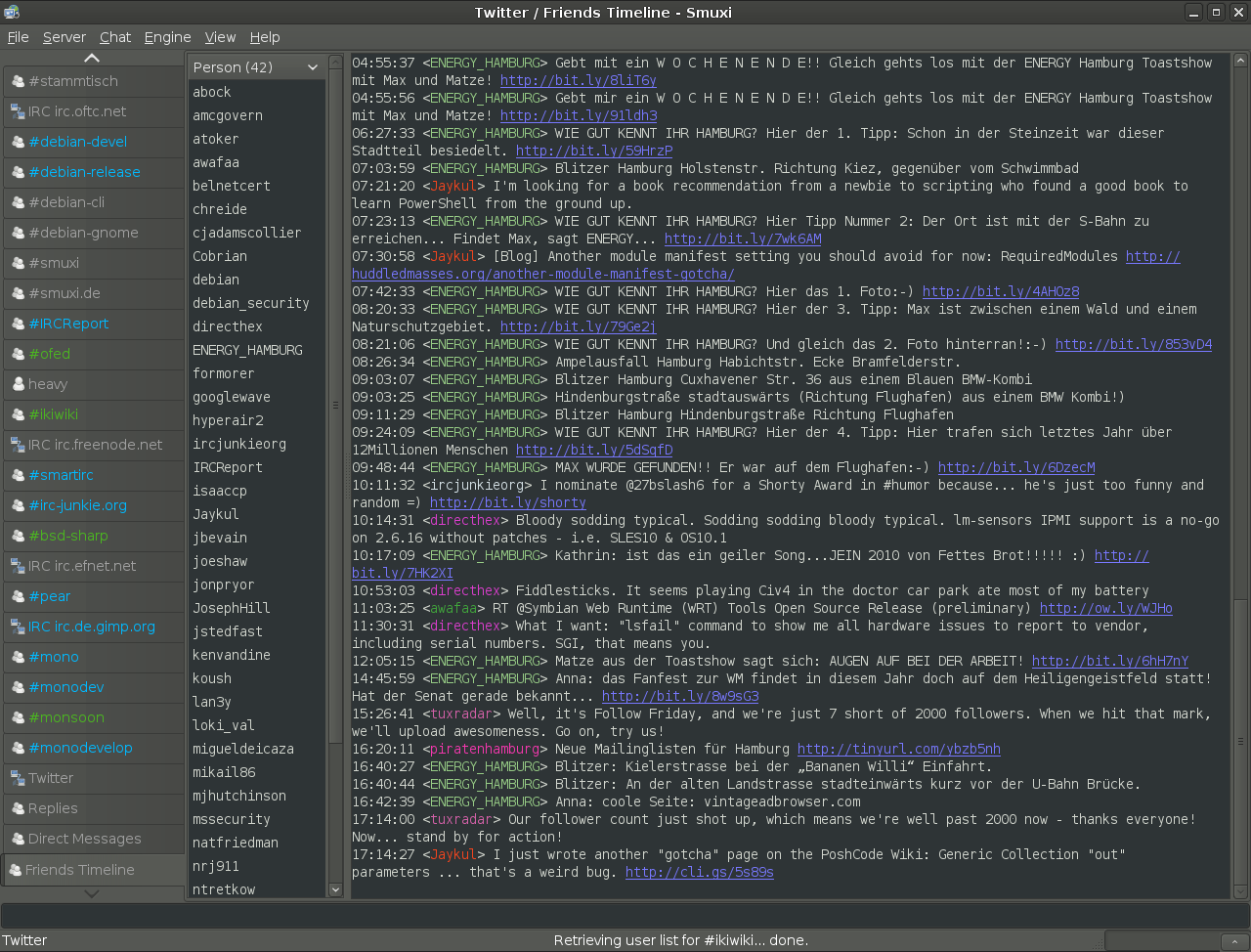
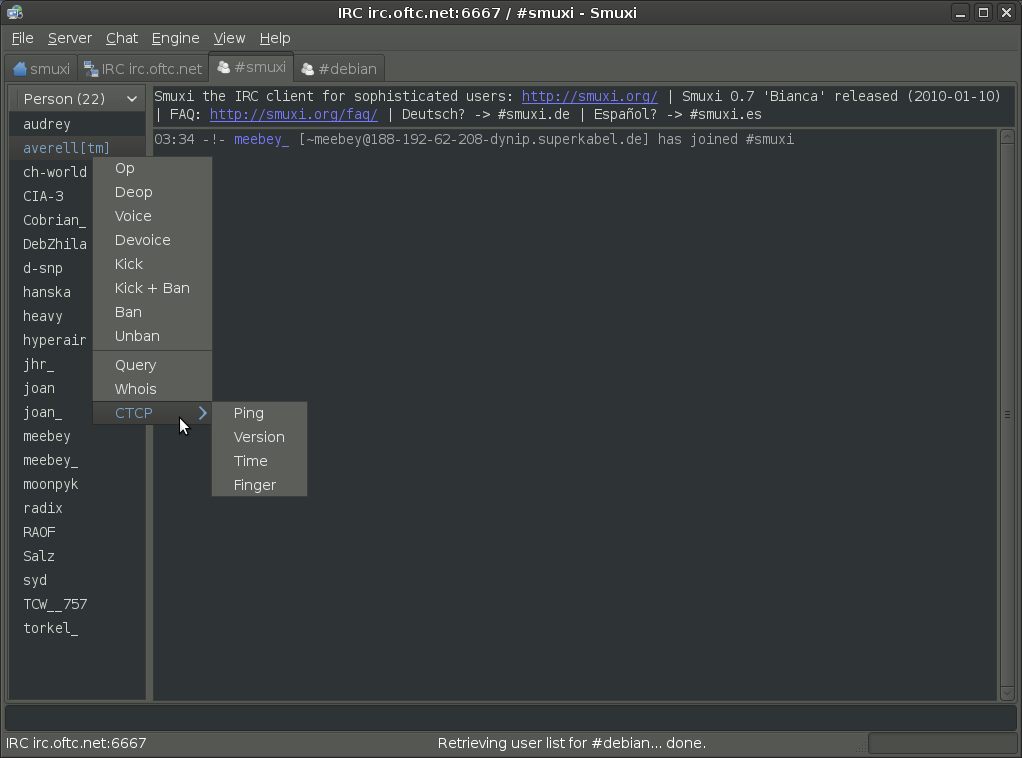
Smuxi 0.7 released a few days ago. Almost all of my Xmas vacation I was hacking on Smuxi. This is the best Smuxi release ever (guaranteed!). The most notable features I implemented in the 0.7 release are: Twitter support, handling for high latency networks (UTMS, WLAN, busy DSL) and an improved IRC experience through tweaks such as splitting oversized messages and new context menus. This release also contains very nice contributions from
David Paleino [2] and
Cl ment Bourgeois. Both joined the hackfest during my Xmas vacation and made the hacking sessions on Smuxi even more fun. Thanks for that guys!
Here you can find a full list of changes.
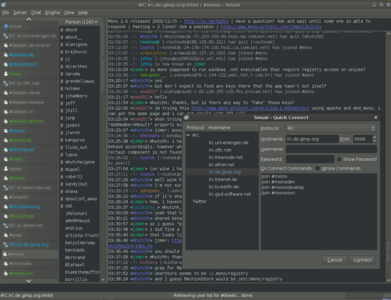
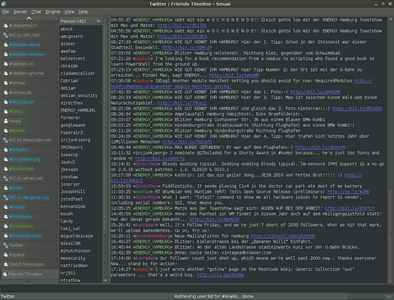
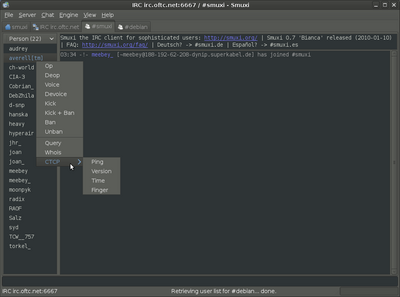
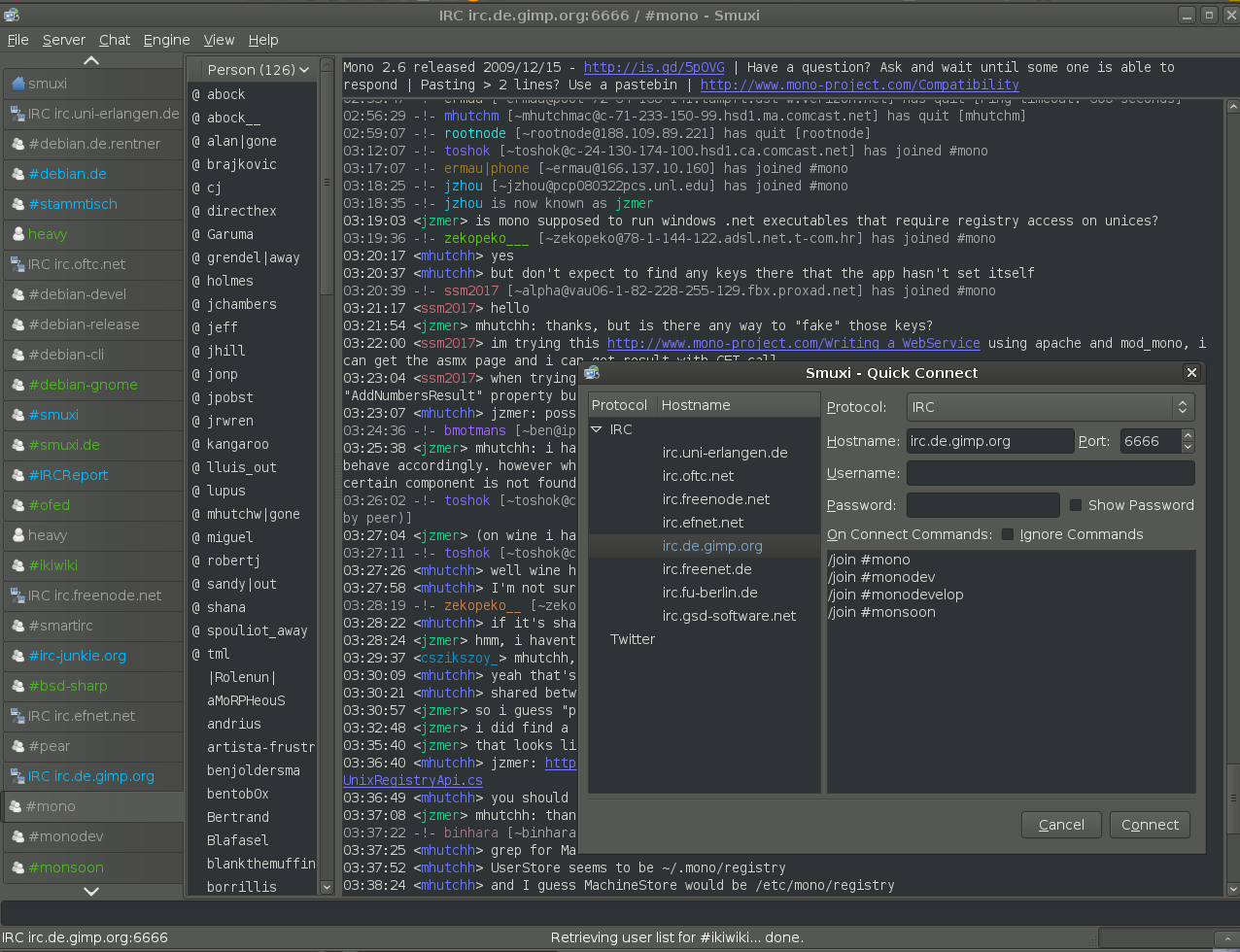
As everbody likes screenshots and as screenshots say a thousand words, here they are:
Quick Connect
Twitter
User Menu
Which direction will Smuxi head in after the 0.7 release? For the
0.8 release, I plan to focus on making the IRC support feature complete. That means we will get DCC, SSL, IPv6 and logging support. Nothing of that sounds very special but I am already investigating how Smuxi can be integrated with the promising new
Zeitgeist project. I interviewed one of the developers for potential communication between Smuxi and Zeitgeist.
Last but not least, I want to announce that I will be attending
FOSDEM 2010 in Brussels. I also will give a
talk about Smuxi there, scheduled on 2010-02-07 at 16:30. If you want to have a chat, a beer, do some GPG keysigning, or ask me any questions, I am available
PS: If you want more updates than once per year, just
follow me on Twitter

For the first time in a long while I took a vacation in New Zealand where I am for
LCA. I decided to also take a break (mostly) from the Internet but I decided to it was worth to come back to write a brief response to Clay Shirky s
rant about women, which I find pretty unsettling. So the basic upshot of his entry is that for women to get ahead in this world, they need to not only behave more like men but in specific, like all the effing blow-hard jerky self-promoting men like, well Clay Shirky (I guess, right? and he in fact might be proud, I a woman, made this accusation).
What I appreciate about the post is the fact that he does not pigeon hole women as caring, maternal, and meek. I have always resented the idea that women can t be assertive and confident. However, confidence and self-esteem, which I agree are vital for getting noted, does not inherently entail jerky behavior.I think Shirky s perspective might be skewed because of his home field, which is filled with just the type of guys he is describing. I call them pundit-entrepreneurs (though to be sure some are pretty darn nice).
If you take the field of anthropology, for example, it has traditionally and for a long time been known for grand slam female scholars from Ruth Benedict and Margaret Mead in the past to the ones of the present like Nancy Scheper Hughes and Jean Comaroff. During grad school, I was surrounded by strong, smart, witty, confident ladies and always felt I had role models to follow and emulate. They were not, however, low-life jerks clawing their way to the top of the academic mountain leaving a trail of destruction behind their path.
Then when I started to go to the tech and media academic conferences, I was soon swimming in a sea of mostly white men and the vibe was different. I was ignored and talked over a handful of times, which had never happened to me before. There was a lot more self-promotion than I had seen in other fields, in part, it seemed because the media pays more attention to this field so folks are trying to get the media light focused on them.
While I don t disagree that many fields from medicine to law promote and reward blow-hards and massive unrestrained arrogance, I would rather not create a false binary between meek/low self-esteem/female and total-jerky/arrogance/confidence. Why not instead promote and highlight behavior that rewards confidence
sans the arrogance?
Here are some thoughtful
related posts.

As Dries
Buytaert, the creator and head of development of Drupal,
announced on Twitter, the new major
(pre-)version of Drupal, namely
Drupal 7 alpha
1 has been released! This was on the
9th birthday of Drupal.
This is great news and the release notes are mentioning some aspects why this is so:
Revamped User Interface
An incredible amount of work has gone into improving the user experience and administration interface. The new
administration theme "Seven", the overlay module, the dashboard and the configurable shortcut bar, all lead to a much
more user-friendly interface. In-place editing is enabled for blocks and nodes by default, so modifying the content of a
site becomes much simpler.
Custom Fields
Drupal 7 bundles in the ability to add custom fields, similar in functionality to the Content Construction Kit
(CCK) module. However, fields are no longer limited only to content types; they can be added to users, taxonomy terms,
and other entities. Fields also have support for translations.
Image Handling
Drupal 7 brings native image handling to core. Image fields may be added to content, and have image styles applied
to them, such as scaling, cropping, and other effects.
Update Manager
Building on Drupal 6's Update module, which keeps site administrators informed when new module and theme releases
are available, the new Update Manger module can also install and upgrade modules and themes.
Front-end "under-the-hood" improvements
A new render API allows for highly granular theming, core template files have been revamped to provide more
semantic markup, Drupal 7 now has built-in RDFa support, includes jQuery UI and a new AJAX framework, and a new core
theme "Stark" which exposes Drupal's markup directly for those who want to dive in and start theming.
In addition, Drupal 7 has several major accessibility enhancements, making it the most accessible release of Drupal
to date!
Back-end "under-the-hood" improvements
A revamped database layer resolving nearly all limitations in the Drupal 6 database layer, automated testing
framework, new PHP stream-based file API that supports private and public files simultaneously, revamped node access
system, new hooks for more flexible system interaction, an Entity API, a job queue API, and many, many, many more
improvements.
Drupal 7 is also the most scalable release to date, with features such as built-in proxy server support, advanced
caching techniques, and Content Delivery Network support for static files.
Alone the inclusion of CCK and Views are great news, whereas all PostgreSQL users will benefit from the new database
layer under the hood. I've tested a pre-alpha development version some weeks ago and that Drupal 7 experience was
already great. So, it would be nice to see Drupal 7 in Debian soon as well, but I guess a alpha 1 version might be too
early to be packaged.

News is slow this month on the FusionForge development front. We're
all busy gathering all the things that we want to go into the next
release, but there's no big news from the code. However, there is
something of interest.
You may have heard about the Coclico project, which is an initiative
aiming at collaboration and convergence between several forge engines,
most notably FusionForge, Codendi and Novaforge. That project was
started last October, and it holds regular meetings with its members.
The next meeting is scheduled for the 2nd of February in Paris, and we
thought we could host an open meeting on the 3rd for non-Coclico
members, a bit like the forge meeting we had last year (which is when
FusionForge was officially born), but with an emphasis on what Coclico
did so far. Since most of the FusionForge hackers are in Western
Europe, and several are in Paris (especially if we add those who go to
Paris for the Coclico meeting), we thought it would also be a good
opportunity to gather for a technical and social meeting.
It seems the Coclico open session didn't generate much interest this
time (at least, it hasn't so far), so I proposed to hijack the room
for this FusionForge meeting, and I didn't hear any objections. I
have several themes I'd like to discuss with people, and possibly
start implementing during that day:
- database maintenance and schema: unification of the upgrade scripts
(including for plugins), cleanup of obsolete stuff, addition of
missing constraints, and so on;
- configuration system: my initial prototype didn't raise many
objections (at least in its scope), now what to do with the next
steps?
- packaging and installation system: what needs to be done to keep the
three ways of installation (manual, *.deb, *.rpm) in sync with as
little work as possible?
- permissions system: clarification of what happens currently, ideas
for evolution;
- plugins and interaction with external software: do we lack stuff
that would make this easier?
- roadmap, long-term plans, this sort of things;
- other things that users may want to discuss with hackers?
- possibly drink a beer or two;
and so on. These are in no way specific to FusionForge, and in fact
I think it would be great if hackers/users of other forges were
present, because we could benefit a great deal from their experience
and plans. But if we find ourselves amongst FF people only, I think
these would be good to discuss, possibly write some code for, and go
home with a clearer picture of where our efforts should focus in the
near future.
I'd therefore like to invite interested people to mark the 3rd of
February on their agendas. The meeting will take place in
Issy-les-Moulineaux (near Paris, within reach of the tube). If you're
interested, please get in touch with us (#FusionForge on the FreeNode
IRC network, or the fusionforge-general mailing-list), so we can have
a rough estimate of how many people to expect. The meeting room is
provided by France T l com, and they're probably going to need numbers
if not names. Further details will be announced when known.
This is a
book on a graphic library, so when they first told me it will be printed in black&white I was quite surprised and puzzled. The editor explained it was to reduce paper copy cost, and that the PDF version will still be in full color, but I would be quite upset if I bought the book and then discover it's black&white without knowing it upfront.
Thus I've asked to at least let the images be downloadable from the book website, so that any reader (either for the paper or electronic copy) can see the pictures as if they're running the programs.
The first request went ignored, but keep pushing got results: now images can be downloaded!! To get them, got the book
webpage, then in the "Code Download" section, and request the zip file: in it you'll find either the source code and the images.
The pictures are quite big, because they are the same used for book production (so with specific dimensions and DPI) but you got colors now :)
Some days are passed, but I'm still pleased to announce that
It was a really nice experience, it offered me the possibility to work on Matplotlib, do some really interesting stuff, and I'm quite proud of it :)
On the other hand, it was not a "straight" way: the effort I put in this was huge, practically I had to stop all other stuffs and projects I was working on (Debian included) and I was getting more and more tired as time passed. Also, sometimes Packt employees and actions were somehow problematic. but anyhow, the important thing is that THE BOOK IS OUT!!
Now I got also a nice box about the book on the sidebar of this blog!
Enjoy it!!
On Tuesday, I released version 0.02 of
Net::NationalRail::LiveDepartureBoards
to CPAN. So far, no one has complained. This module is probably of
interest only to people in the UK; it looks up which trains are next
to arrive/depart from a particular station.
This release was prompted by a patch sent to me by Ian Dash,
implementing a filtering feature I was too lazy to write myself. If
someone wants to put a fancy GNOME applet around it, I'd be
grateful. ;) I think the next step is to add a nicer OO interface.
My original reason for writing the module was to advertise
this SOAP API
that ATOC publishes - it could easily be wrapped in languages other
than Perl. That particular URL was found by inspecting the official
widget for Windows Vista.
Recently, I've been working on a file transfer app for the N900.
It's called
monorail and
I uploaded it to extras-devel last night, so you can
try it out right
now.

I implemented an
OssoABookContactView with support for filtering on
Contact Capabilities (or a draft of it, at least) as
old-style caps aren't great. This gives a nice list of address
book contacts who have at least one account that should support
receiving file transfers. It would be nice if these extra caps
could go into the address book which is where they belong, but it
won't.
If someone would find this widget useful, I'll clean up the code
and maybe throw it in its own library.

Choose one of the accounts which support file transfer.
I also started to implement a
sharing plugin, but it turns out it's poorly documented and
appears to be impossible to do anything useful for my use-case,
like popping up a dialog when the user taps "Share". The
example isn't very exemplary, but does contain some
amusing code.
This sharing plugin is only half-written and impossible to
debug. If anyone has any pointers on writing these plugins, I would
appreciate them.

It's a shame that although Hildon widgets can look really good
on the device, it can often take some fiddling to make them look
consistent with the rest of the UI. Additionally,
oddities in some widgets can leave you baffled, or amused.
The most annoying thing I have come across regarding this app is
just how little I can get it integrated. The file manager is all
hard-coded so there's no way to add a
Send to Contact menu
item, and no buttons can be added to the libsharing dialog (which
appears when the user shares a photo) which is annoying as it
looks
like it's missing this feature.

Oh, and Telepathy is pretty sweet.
There s a lot of responsibility on the shoulders of system administrators. Unless you re one, it s probably hard to grasp the full weight of it. This week has been full of reminders for me.
This afternoon, shortly after lunch, I got word that people were having trouble with phones. A few minutes of testing showed that calls within our city were working fine, but it was completely impossible to place or receive long-distance calls. A little while later, a local newspaper s website indicated that numerous cities over a multi-county region, all served by the CenturyLink local telephone company, were out of service in this manner. I figure that represents hundreds of square miles, or a patch of rural Kansas roughly the size of Los Angeles.
Adding to the problem was the fact that emergency 911 services are accessed via these long-distance lines that were down. For roughly three hours, 911 was completely down across this entire area. What s more, many cellphone towers and Internet access options were also taken down, since they feed from these same lines.
This adds up to a situation that could very easily cost lives due to delayed response of emergency medical, fire, or police services.
In the end, the problem was traced to a bad controller card on a Titan 5500 owned by AT&T.
Now, here s the system administration angle: If you worked for the phone company and had to troubleshoot a problem that you knew had taken down emergency services for thousands of people, what kind of pressure would you be feeling? Would you be able to keep your cool? I m glad that I don t have that kind of job.
I also wouldn t like to be the engineer (or, more likely, accountant) that decided that they didn t need any more redundancy to provide good service to the area. Especially considering this is the second time in the last year or two this has happened.
But, ironically, yesterday I signed a purchase order for a new Asterisk PBX (corporate phone) server. When selecting a machine for that task, I am always completely conscious of the responsibility on my shoulders: several hundred employees rely on the machine that is ultimately my responsibility to select. Our own access to 911 would be cut if the machine were to go down. I never forget that the correct operation of the systems that our team sets up and deploys could help save someone s life, and that a malfunction could cost the company dearly in terms of revenue, productivity, image or worse.
Nearly four years ago, we switched from an analog PBX, with outsourced support, to a digital VOIP system running Asterisk. Note that we use VOIP in-house, but do not use it externally. Anyhow, I can not say that the Asterisk PBX has been 100% perfect; I doubt that this could be honestly said of any PBX of any complexity.
I can say, though, that it saved us well over $100,000 AND has proven far more reliable than the system it replaced. Outages are exceptionally rare and brief now. Plus we have internal expertise to fix it, rather than having to wait for a technician to be dispatched from a city 2 hours away to fix anything. I know I don t have the resources to build a perfect PBX that will never go down (if such a thing is even possible), but I take my responsibility regarding a reliable PBX extremely seriously.
We used to have a frequent problem: someone would call 911, then hang up. We suspected this was often on accident maybe people hit 9 for an outside line, then misdialed their number. In any case, 911 dispatch would then call our main office, saying they got a hangup. A person or team would then go across our entire campus making sure nobody was in distress that nobody had managed to dial, then passed out, for instance.
With Asterisk, I was able to help this situation. Whenever somebody calls 911 now, two emails are generated: the first contains details about the call, such as the extension number that called and the duration of the call. This goes to all people that are likely to receive a callback from 911. It may not always pinpoint the source (as with somebody using a wireless phone), but almost every time will give us a very good idea where the call came from. The second email is a recording of the call, and serves as an additional clue, but goes to fewer people.
I am aware that email isn t a perfect medium, but: it let us make a dramatic (albeit imperfect) solution to a problem that very few institutions our size are able to address nearly so well.
There s a lot of weight on our shoulders: keeping the accounting system up, the Internet links up, the web store or the sales phone lines, the shipping systems or the document archives up. These things going down can spell deep trouble in many ways.
And sometimes the systems we maintain might save a life. Such as this morning, when someone was feeling symptoms of a heart attack, used our phones to call a colleague for help, that person called 911, and an ambulance was dispatched. I know the system worked exactly as it should, because I had two familiar emails from Asterisk in my mailbox this morning when I got to work.
Magnus Larsson gave an interesting TED talk about using bacteria to transform dunes into architecture [1]. The concept of making a wall across Africa to stop sand dunes from overtaking farm land is obviously a good one, the idea of using bacteria to convert sand into sandstone to do so cheaply is also good. But making that into houses seems a little risky. I wouldn t want to live under shifting sand with only bacteria generated sandstone to protect me.
Cory Doctorow gave an interesting speech titled How to Destroy the Book , here is the transcript [2]. He talks about how much he loves books and described his opposition to the DRM people who want to destroy the book culture.
Sendmail has a DKIM Wizard for generating ADSP (Domain Signing Policy) records [3]. If I knew that ADSP records were so easy to implement then I would have used them a year ago!
Loretta Napoleoni gave an insightful TED talk about the economics of terrorism [4]. Apparently the US dollar used to be THE currency for international crime, when the PATRIOT act was passed it s anti-money-laundering provisions encouraged many shady people to invest in Euros instead and thus led to the devaluation of the US currency. It s also interesting to note that terrorist organisations are driven by economics, if only we could prevent them from making money
Ryan Lobo gave an interesting TED talk about his photographic work [5]. The effectiveness of the all-women peace-keeping force is noteworthy. The part about the Liberian war criminal who has become an evangelical Christian and who now tours Liberia begging forgiveness from his victims (and their relatives in the case of the people he murdered). Should someone like that be permitted to remain free if his victims forgive him?
Charles Stross has an appealing vision for how Apple and Google can destroy the current mobile telephony market [6]. I can t wait for the mobile phone market to be entirely replaced by mobile VOIP devices!
James Geary gave an interesting TED talk about metaphors [7]. The benefits of metaphors in poetry are well known (particularly in lyrics), but the impact of metaphors in influencing stock market predictions surprised me.
Shaffi Mather gave an interesting TED talk about his company that makes money from fighting corruption [8]. Instead of paying a bribe you can pay his company to force the official(s) in question to do the right thing. Apparently the cost of doing so tends to be less than 10% the cost of the bribe if you know what you are doing. His previous company was an ambulance service that charges what the patient can afford is also interesting.
John Robb wrote an interesting article about lottery winners and griefers [9]. He suggests that publishing the names, addresses, etc of rich people will be a new trend in
Griefing. One thing I ve been wondering about is the value of the HR database at a typical corporation. A single database typically contains the home addresses, phone numbers, and salaries of all the employees. It would be very easy to do an SQL dump and store it on a USB flash device to carry out of the office. Then it could be sold to the highest bidder. They could probably make a market in the private data about rich people in the same way that there is currently a market for credit card data maybe they have already done this but it s kept quiet to stop others from implementing the same idea.
Michael Smith wrote an interesting article for the Washington Times about home schooling and socialisation [10]. It seems that people who were home schooled as children tend to be more academically successful and involved in civic life as well as being happier and having career success.
Richard Seager wrote an interesting article for American Scientist about ocean currents and heat transfer from the tropics [11]. It seems that when the ocean currents shut down the UK and other parts of northern Europe won t be getting a mini ice-age.
Ian Lance Taylor (most known for the gold linker) has written a good summary of the situation in regard to climate change and what must be done about it [12].
The Wrath of the Killdozer article about how one angry man converted a bulldozer into a tank [13]. This wasn t a big bulldozer (every mining company has bigger ones) and he didn t have any serious weapons (only rifles). Imagine what terrorists could do if they started with a mining vehicle and serious weapons
Simon Singh has written about being sued for libel by the British Chiropractic Association [14]. The BCA didn t like his article criticising chiropractors for claiming to be able to treat many conditions unrelated to the spine. Remember, chiropractors are not doctors all they can do is alleviate some back problems. See a GP if you have any medical condition that doesn t involve a sore back or neck. Avoid uppity chiropracters who claim to be able to cure all ills.
Nicholas D. Kristof wrote an interesting article for the New York times about how happy the people in Costa Rica are [15]. He claims that the Costa Rican government s decision in 1949 to dissolve it s armed forces and invest the money in education is the root cause of the happy population. Maybe if the US government would scale back military spending the US population could be as happy as the Costa Ricans. While there are good arguments for having some sort of military, there are no good arguments for spending more money on the military than the rest of the world combined (as the US does).
 NZZ Folio
, the monthly that comes with my newspaper, had this topic in its January edition, sparking a few thoughts about capital punishment.
Why am I against capital punishment? Primarily, because no justice system will ever be safe (make no mistakes, know no abuse.) Then there is the fact that life is something special and isn't ours to take away, but on the other hand, we assume that it's ok for us to judge that somebody should be locked in the rest of his life, and I'm not quite sure how big that difference is.
Ok, I one thought. Everything else I was going to write was just technical stuff on the execution of death penalty, which I have established I'm against. This engineer's brain can't stop thinking yes but what if ...
I have direct knowledge (through observation or first-hand reports) of the following use cases for Netbooks:
- System administrator s emergency workstation something light to carry when you might get an SMS about a problem.
- A really small laptop for a serious technical user, can be used for programming and other serious tasks. Only someone who is really dedicated to the hobby of computing would choose a system with a tiny screen for their main computer so that they can take it everywhere.
- A computer for a child. Children are less demanding about some aspects of their computer experience, no-one wants to buy a really expensive toy for a young child, and children find it difficult to carry full size laptops.
1 and 2 are the options that interest me. But it would be good if the extensive children s toy market could drive economies of scale and reduce the expenses of my hobby and profession. I have found my EeePC 701 to provide adequate CPU performance (Celeron-M 630MHz) for light compiling tasks and I have used it for some Debian development work. The SSD that is built in is very fast and OpenOffice load times compare well to my Thinkpad T41p because of it.
The main problems I have with my EeePC for sysadmin and coding tasks are the small keyboard (which can t be fixed the overall size of the machine needs to remain small), the small screen (which could be expanded without changing the case size), the low resolution screen (which has been fixed in newer netbooks), and the fact that my 3G dongle sticks out and is likely to get broken. More recent Netbooks address these issues while having the trade-off of being heavier and larger.
There are also some tasks which are generally not performed on a Netbook but that could be if it was properly designed. Here are some examples of things that I think should be done on a Netbook:
- Basic image editing and blogging something that a lot of people do on smart-phones nowadays. It can be done more effectively and with less effort on a general purpose computer I can t imagine the GIMP or Inkscape running on a smart-phone.
- Reading electronic books. The number of people who want a Netbook but don t want to read electronic books would be quite small as would the number of people who only want to read electronic books and never want to use a general purpose computer while travelling. No-one really wants to carry both a Netbook and an ebook reader at the same time.
- Watching movies.
- Everything that you might want to do on a terminal in an Internet cafe those machines are always 0wned, just say no for security reasons.
- Games. The Nintendo DS has two ARM CPUs running at 66MHz and 33MHz and a combined screen resolution of 256*384*18bpp [1] and the Sony PSP has a 333MHz MIPS R4000 CPU and a screen resolution of 480*272*24bpp [2]. The original EeePC had more CPU power and more screen resolution than the DS and the PSP so it IS suitable for games even though it won t run the latest 3D games. There are lots of great games like Wesnoth that don t require much video performance.
- Educational Software. Portable educational devices include the awful V.smile system for young children [3] and the educational software for the DS (I ve seen a demonstration of a training program in rapid completion of basic maths problems for elderly people and presume it s not the only educational software on that platform).
Image editing requires a color screen of high resolution. Effective blogging requires a platform with a resolution that compares to the typical web user
according to Hitslink 1024*768 is the most popular resolution of web browsing systems at 28.34% and the most popular resolution that is less than 1024*768 is 800*600 at 3.28% [4]. So even the most casual blogger will have an incentive to get a screen that is of higher resolution than all but the latest Netbooks.
The recently released EeePC 1201 has a screen resolution of 1366*768 which should be barely adequate for those tasks.
Reading electronic books requires a reasonable resolution. Based on my experience with the 1400*1050 display in my Thinkpad it seems that a resolution of 1366*768 would be barely adequate for reading an academic paper that has two columns in a small font. But as the original Kindle had a resolution of 600*800 and the latest Kindle has a resolution of 824*1200 [5] it seems that perhaps the epaper displays are good enough to allow reading the text at a lower resolution. A display that can draw little or no power when idling (as epaper does) is simply required for an ebook.
The Pixel-Qi hybrid displays are claimed to offer the best features of TFT and epaper displays [6] but they haven t been released yet. I think it s reasonable to assume that someone will achieve that Pixel-Qi is attempting and that it will become the standard display for a Netbook.
Watching movies and playing games (even games like Wesnoth) requires better video performance than epaper can deliver, we just have to hope that Pixel-Qi release something soon.
Watching movies and reading ebooks are both things that are best done without a keyboard in the way.
The Always Innovating Touch Book [7] seems like a good solution to this problem. It s a tablet PC that can be connected to a keyboard base if/when you desire. It should also be good for web browsing and reading email while on the move, I find that my EeePC is unreasonably heavy and awkward for typing email while walking.
Intel CPUs are not particularly energy efficient. As there are ARM CPUs with clock speeds as high as 2GHz and with as many as four CPU cores it seems that the ARM architecture can provide as much CPU power as is required. Debian currently supports two versions of the ARM CPU, if another one became commonly used it wouldn t be that difficult to run Debian build servers for it.
Given a screen resolution equal to the latest Kindle, CPU power greater than the early Netbooks, and the ability to run a free software OS the range of educational and gaming software should be adequate.
So it seems that the ideal netbook would have a detachable keyboard and base and a touch-screen in the computer part. It would have a Pixel-Qi display (or equivalent) with a resolution of 1400*1050 or better. It would have USB, Gig-E, Wifi, and Bluetooth connectivity and the ability to have an internally mounted USB dongle (as the Always Innovating Touch Book does). I think that this is not overly difficult to achieve it is basically an Always Innovating system with a better display.
Update: Another criteria is the ability to start operating quickly when requested. Even mobile phones are often limited in their utility by the time that is taken to activate them (I can t get my mobile phone to take a photo in much less than 7 seconds after removing it from my pocket). The Always Innovating system is apparently always in suspend to RAM mode when it s not being used so that it can start quickly. That combined with fast application load times and a good menu system could allow turning the system on and launching an application in less than 2 seconds.
If I was buying a Netbook right now the only thing that would stop me from buying an Always Innovating device is the shipping delay. But as my EeePC is working quite well I m not going to buy another system unless I am going to get significant benefits such as a high resolution PixelQi display.
I've had
alias net-pf-10 off and
alias ipv6 off in my configuration for ages, but with recent kernels, IPv6 is apparently compiled in, so my eth0 now has a (link local) IPv6 address.
... which means that I now had Java apps suddenly fail to connect to the database. Since stuff like sqlplus (Bah!) works, I didn't immediately think about a network problem and started testing various JVM versions and hunting missing libraries etc. Only, it turned out that running java with
-Djava.net.preferIPv4Stack=true is the magic bullet.
Is there a proper fix? I know IPv6 is (supposed to be) the nice and shiny future, but currently I just don't have any IPv6 connection so it just creates problems for me right now. (Ok, let's add here that I dislike Java anyway because its philosophy, or the philosophy of most software I have to deal with, is to define its own world instead of integrating nicely with the host platform. If you look at it from another direction you may think I should have titled this I suck )



 It s nice to see that Emacs isn t being outdone since


