Search Results: "reg"

28 November 2007

Russell Coker: Creepy Social Networking

Cory Doctorow wrote an interesting article about social networking [1]. One of his points is “Imagine how creepy it would be to wander into a co-worker’s cubicle and discover the wall covered with tiny photos of everyone in the office, ranked by “friend” and “foe,” with the top eight friends elevated to a small shrine decorated with Post-It roses and hearts“, another concerns the issue of forced “friends” where colleagues and casual acquaintances demand to be added to a friends list. He speculates that the reason for social networking systems to be a fad is that once too many people you don’t really like force themselves into your friends list then you will feel compelled to join a different service. I believe that the practice of ranking friends is simply a bad idea and wonder whether anyone who has completed high-school has ever used it seriously. If you publicly rank your friends then you will alienate other friends (particularly any who might have ranked you more highly than you ranked them). Everyone who has used social networking systems has discovered the pressure to avoid alienating people that you don’t actually like. It seems obvious that alienating people who you do like is even more of a problem. In my previous post about Better Social Networking [2] I suggested having multiple lists on your social networking server that are published to different people. That would allow segregating the lists as a way of dealing with some demands to be listed. People who are associated with work (colleagues, managers, and in an example Cory used students at a school where a teacher worked) would be on a work list. The work list would point to the work profiles of other people which would match whatever the standards are for the industry in question (which would still allow quite a range, the standards for sys-admins of ISPs differ significantly from those for primary school teachers). I’m sure that someone who worked for an ISP in Amsterdam would understand that a work-based friend request made to someone who teaches primary school in a part of the world that is religiously conservative would understand why that request would be declined (but the same person might add them to a personal friends list). Another way of alleviating such problems is to not require that listing be bi-directional. Current social networking systems involve one party making a friend request to another which is listed as pending in the GUI for both parties. The options are to either leave it in that state (which is an annoyance) or reject it (which may cause offence). With a uni-directional listing one party would add the other and hope for the best. If they aren’t obsessive about such things they may not even notice that the other party didn’t reciprocate. Also it would allow for famous people receiving links from many people to their public profile without any expectation of reciprocation. Of course a distributed social networking system such as I suggest would inherently have uni-directional links as there would be no central repository to force them to be all bi-directional.

Andrew Pollock: [tech] Two years of Python

As last Wednesday was the second anniversary of me joining Google, I thought it an opportune time to reflect on how I've found learning Python. It's no big secret that Google is a Python shop. I'd been meaning to learn it a for a while prior to joining Google, but never found enough reason to other than because it seemed to be the cool new language. If I had a task that required me to write a script, I could do it in Perl in 30 minutes, or spend a day trying to wrap my head around how to do it Python. I think I'd known and been writing Perl in some form or other for about 9 years. I've hardly written any in the last two, which is a bit sad. I even bought Perl Best Practices shortly after moving over here, and haven't gotten around to reading it. The only Perl I write these days is for personal tasks to try and stop myself from going totally rusty. Anyway, I thought I'd write down some of my observations of Python, from a "veteran" Perl programmer's perspective. Not that I consider myself to be a shit-hot Perl coder by any stretch of the imagination... No punctuation I really like the lack of punctuation. It makes the code look a lot cleaner. I go back to Perl and my eyes bleed after trying to dereference a reference to a scalar, or something like that. It's just ugly in Perl. No curly braces/indentation for blocks The indentation thing isn't so bad. If you're using vi, you really need something along the lines of

set shiftwidth=2
set smarttab
set autoindent
set expandtab
in your ~/.vimrc What I do miss is being able to bounce on the % key to find the beginning and ending of a block. I've heard rumours of a way to configure vi to do something similar for Python code, but I haven't gotten around to finding out. There seems to a general opinion that if you're writing a block that is so big you can't find the beginning and end of it, you're probably doing something wrong. String concatenation It's always struck me as bizarre how the most obvious way to concatenate a string in Python is also one of the least efficient. In fact, there's whole studies been done into different methods of string concatenation and their efficiencies. Prototyping is easy Now I may just be ignorant of some Perl shell here, but the number of times I've written a quick Perl script in /tmp to do some proof-of-concept thing is immeasurable. The fact that you can just fire up a Python interpreter and try something quick and dirty to see if it's syntactically sane, or does what you expect is fantastic time saver. ipython makes it an even more pleasant an experience. No CPAN I was initially a bit disappointed that there wasn't something like CPAN for Python modules. In practice, using Debian, I haven't found this to be that big a problem though. List joining is wacky I still find it weird that you don't join a list by a method of the list, you do it by a method of the string you want to use to join the list together with, that is, I think it should be mylist.join(" ") when it's really " ".join(mylist). That's just always struck me as unintuitive. urllib2 doesn't hold a candle to libwww-perl I think even last time I checked with Python 2.5, it's impossible to make a HEAD request. The mind boggles. No setuid support I can't complain too much, I think I heard somewhere it's going away in Perl as well, but it was certainly very convenient to be able to write setuid Perl scripts. I miss that convenience in Python. Not that one has to write setuid scripts all that often. Regular expression handling is painful It's about on a par with Java. You just can't beat Perl's =~ operator. "There's more than one way to do it" versus only one way to do it Perl's always had the adage of there being more than one way to do things. I think that has been its downfall in terms of readability. Heck, I've written some monstrosities that I've looked back on in a month's time and wondered what on earth I was thinking at the time. I think it's far easier to write readable Python than it is to write readable Perl. I think that's about everything. I never did any real object-oriented programming in Perl, and so I tend to take a procedural approach to things in Python as well. I haven't written any massive bodies of code in Python (although I did help maintain one for about 18 months). I like Python. It's become my first choice for writing random scripts now. Now I look at Ruby like I used to look at Python when I knew Perl quite well. Ruby has some nice things (like Perlish regular expression handling), but it brings back all that punctuation noise again. I'm not in a huge rush to learn it, even though there's a lot of hype around Ruby on Rails. I think I'd rather investigate Django or Pylons

27 November 2007

Christian Perrier: Update your sarge and etch samba servers with care

Information is currently not completely tripled checked but I would advice all readers of this blog entry to think twice before upgrading their Etch-based samba file servers to 3.0.24-etch6 (and maybe also 3.0.24-etch7). Same for 3.0.14a-sarge8 (and -sarge9). According to bug #453050, a quite major regression was introduced in these versions and may affect most file servers with Windows clients (which is most often the purpose of samba...). So, unless you want to screw out tons of Windows users, you really should consider upgrading to 3.0.24-etch5 or 3.0.14a-sarge7 (to fix recently unveiled security issues) which do not experience that regression. Or, if your servers are less security-challenged, stick with -etch4 and -sarge7. There might me some delay sorting this out as finding the cause of the regression requires expertise I don't have and Steve Langasek (who did most of the very hard work on last updates) may not be available immediately to work on this with upstream. It is not really clear to me whether the issue is coming from upstream or bad regression fixes in Debian packages, but you've been warned. Of course, we need to find a better way to dispatch that information than a simple blog entry. I don't have it right now so better this than nothing. Again, I'm not 150% sure of all that information but heavy users of samba servers should really be careful. Update: Steve (who never sleeps) found out that one upstream commit may have been ommitted while merging their changes. More investigation is still needed, though, as that patch does not cleanly apply on -etch7.

Michal Čihař: Binary packages for Gammu, Wammu and python-gammu

When Ubuntu announced public availability of Personal Package Archives, I thought it might be good to use it to provide up to date Gammu related packages. After successful registration I uploaded Gammu package and no reaction so far, so I'll wait. However this memorised me that I wanted to use OpenSUSE Build Service for same purpose some time ago. I filled in registration and as I didn't receive any email about being accepted, I absolutely forgot about that. Now just tried to log in and it works. So you can now have access to latest Gammu, python-gammu and Wammu packages for most recent RPM distributions (Fedora 7, Fedora 8, Mandriva 2006, Mandriva 2007, openSUSE 10.2, openSUSE 10.3, openSUSE Factory, SLES 9 and SLE 10). I could not test them so any feedback is welcome :-). You can find all packages on overview page or directly in download folders. Playing with spec files after long time was quite painful, but I got to it after I managed the hardest thing - how to make build dependencies which will work on all these distros. I hope I will be able to announce similar service for Ubuntu users using PPA, but now I have to wait for some reaction on my source uploads.

26 November 2007

Maximilian Attems: Sony VGC Ubuntu Install

This Sony 22' display is fun to watch movies or tv. Installed Ubuntu on such a all in one desktop for a friend. As much as Debian improved visually thanks to newer Gnome and good upstream tango icons. I'm much less impressed by the visual appearance of Ubuntu 7.10. The compiz stuff is fun of course, but the replaced icon sets seem like a regression nowadays.
The logout buttons seem uglier and more misplaced then the usual Gnome ones, same story with the orange openoffice.org or the gnome menu icons. Restricted-manager failed in strange loops due to no initial network availability. Network-manager seemed to write settings to the correct file for static ip setup, but didn't actually set up the network. Also the "play Dvd" usecase seemed not much easier then in Debian. Only bonus is the python apt sugar "Add Remove Applications".

Matt Brubeck: 26 Nov 2007

PDF on Kindle I've seen plenty of good commentary on the Amazon Kindle. Robert Love's hands-on review and follow-up cover both Linux-hacker and regular customer views. But there's one question that I haven't seen answered elsewhere: Why doesn't the Kindle support PDF natively? I think the answer is simple: The Kindle's 800×600 e-ink screen has too few pixels to render a typical PDF file readably, and its refresh rate is too slow for comfortable scrolling. The only practical solution for most PDFs is to extract the text and convert it to a reflowable format like HTML (which Kindle users can do with Amazon's $0.10 wireless service or free PC-based service). The US$700 iLiad (with 64% more pixels) is much better for PDF reading, but will still run into trouble with some files. It seems that the current generation of ebook readers comes with a decision—cheap, e-ink, or PDF: choose any two. The refresh problem is one reason I'm not sold on e-ink. I'm curious to compare the Kindle screen to my XO laptop, which seems like an interesting compromise between normal LCD and e-ink displays. Disclaimer: I work for Amazon, but I don't know anything about the Kindle except what I learned from the user's guide and from playing with one at the office.

25 November 2007

Manoj Srivastava: Manoj: Filtering Accuracy: Brown paper bag time

After posting about filtering accuracy I got to thinking about the test I was using. It appeared to me that there should be no errors in the mails that crm114 had already been trained upon but here I was, coming up with errors when I trained the css files until there were no errors, and then used a reg exp that tried to find the accuracy of classification for all the files, not just new ones. This did not make sense. The only explanation was that my css files were not properly created and I thought to try an experiment where isntead of trying to throw my whole corpus as one chunk at a blank css file, I would feed the corpus in chunks. I cam up with an initialization script to feed my corpus to a blank css file in 200 mail chunks; and, while it was at it, renumber the corpus mails (over the years, as I cleaned the corpus, gaps had appeared in the numbering). I have also updated the retraining script Voila. I am getting a new set of css files which do not appear to show any errors for mails crm114 has already learned about in other words, for mails it has seen, the accuracy is now 100%, not 99.5% as it was a couple of days ago. While it is good news in that my classification accuracy is better than it was last week; the bad news is that I no longer have concrete number on accuracy for crm114 anymore the mechanism used now gives 100% accuracy all the time. The funny thing is, I recall going through this analysis a couple of years ago, where I predicted that one could only check for accuracy with a test corpus that had the same characteristics as real mail inflow, and which had not been used for learning. That wold mean I would have classified testing corpus that could improve the efficiency of my filter, but was not being used to provide accuracy numbers I have gone for improving the filter, at the cost of knowing how accurate they actually are.

Ingo Juergensmann: Another one bites the dust...

In reply to a blog post by Russell Coker about air filters for server environments, I just confirm how important it is to take care of a dust free machine.
In most cases the users won't have air conditioning with filters, but are just using plain desktop machines that are collecting dust. In some cases one might argue that a computer with all of its fans is some sort of air filter by itself, but well... ;)

So, keep your machine and yourself happy and remove regularily the dust from the inside of your machines. For example, I just removed the dust from one of the Debian m68k buildds last week. It was running for about a whole year now without any problem or downtime, so removing the dust was necessary.

I removed the case, the expansion cards and other stuff to get most direct access to the machine. I bought some canned air (spray duster) and blew the dust out of the case. Take care to remove the dust from inside of the power supply as well (of course remove the power plug before opening the case anyway for your own security!). After dusting off with the spray cleaner, I'm always using an old tooth brush to clean the dust from the fans itself. All in all, it's some dirty work and maybe you should do it outside of your house whenever possible. ;)

But in the long run, cleaning your machines once or twice a year prolongs the life of your machines. Some of my machines are now running since 1991 in 24/7 mode. Alas, maybe the reason for some people not cleaning their machines is to raise a nice dust puppy. :-)


P.S.: If you can afford it, choose a compressor instead of compressed air in cans.

Christian Perrier: News from D-I i18n

It's quite some time since I didn't blog about D-I i18n and the number of new languages we'll support in the next Debian version, lalala... A few works are on their way, indeed:

Gunnar Wolf: Goran Bregovi sends me northwards

What does this topic mean? Hmh... Maybe you don't know Goran Bregovi , a magical Bosnian musician, one of my all-time favorite artists. I have long loved Eastern European music (but I was mostly familiar with the Klezmer style, linked to Ashkenazi Jews but not necessarily performed by them anymore (i.e. Kroke), but it is thanks to Goran that I got familiar with the Balkan style... What can I say about it? It has an addictive rythm, and it has the folk sound of (even very similar instruments to) the Mexican tambora. It is a must-hear genre, in short. There are many magical Balkan music groups, I cannot just recommend one - But if I could, it would be Goran's :)

Now, why is he sending me northwards? Because Goran Bregovi is coming to Mexico - To the Northern city of Monterrey, some 1000Km north from Mexico City - He will be performing at the Forum Universal de las Culturas Monterrey 2007, on September 22, at the Explanada Plaza 400 a os.
I know already of a couple of friends who are definitively going, who are searching for the best airfare... This will be something to remember!

24 November 2007

Romain Francoise: emacs-snapshot 20071124-1

It's been a while since I last posted about emacs-snapshot, so here's a summary of the latest changes:

Steve Kemp: All the time anywhere

Thanks for the comments/mails on my previous post. I've now started the migration properly. All code currently held upon cvsrepository.org will be moved to http://repository.steve.org.uk/ - a nice system-agnostic name. So far I've only setup the pages for two project (my dotfiles and ~/bin) but I'm happy with the process, and the naming scheme appears sane to me now. Using sub-domains I need only install one CGI which is a big win, and using a simple set of templates + mod_rewrite all projects get the same look and feel. I've still got to tweak the stylesheet a little, but otherwise I'm happy with things. I can host both public and private repositories, and that all works magically. Of course the huge win is no longer needing to run a pserver for CVS! All future checkouts will be via HTTP, and the rare few people with commit access will be able to do so over SSH. Once things have been migrated I'll cause the cvsrepository names to redirect to the new locations, and keep that up until the domain expires as a transition period. (I think +1 year :)) The other job for the weekend is releasing a fixed security update for Samba, to fix the regressions.... That is in hand, but the buildds are being slow. If they're not all done I'll release it anyway today/tomorrow. I'm annoyed that I handled the timing so badly, but I hope that people don't hate me for it.

Zak B. Elep: Off to OSDC

Tomorrow I’ll be off to Brisbane, Australia to attend the Open Source Developers’ Conference. My thanks to the UNDP-APDIP International Open Source Network and the OSDC organizers for selecting me to participate in their Exchange Grants! I thought I wasn’t going to make it, though, as the notice from IOSN came rather late, and I had to get my (first ever) visa at the last minute. (Now, if only I can find a good place to stay for the nights. Can anyone suggest a few? :) I hope to see some fellow Perl mongers, Debian users, and Ubunteros and learn a lot from this experience. OSDC here I come! :D

Julien Valroff: OOoCalc limitations

I have brought some work with me to be able to catch up during the week-end. Usually, I take a laptop running Windows which allows to connect to our network through a VPN the credentials of which I am not in possession of. This time, I just want to make some analyzes on spreadsheets (created on MS Excel). I have tried to use OOoCalc for the first time in “work conditions” - ie. I expect a little bit more than the basic features, which was source of disappointment. Autofiltering feature does not allow wilcards in the conditions. Even advanced filters do not seem to allow them. I want to select columns which contents end with ‘00?’ (ie ‘00′ followed by any unique character), and I can’t. I have read some posts talking about regular expressions in filters in the old 1.x series, but can’t find anything related in the documentation of the current series - regular expressions seem to be used only for the ‘find & replace’ feature. Moreover, you cannot set more than 3 conditions in autofilter, which is not a lot (I am not sure that previous releases of MS Excel were better). I am fully aware of the advanced filters which do allow up to 8 conditions, but I must say they are not easy to use on a day to day basis. Filters are mostly considered as visibility filters, which means if you apply a filter and use the ‘Fill down’ feature, hidden cells are also filled in. At least it is not the case with copying & pasting: only visible cells are copied. These limitations (bugs?) as well as the old existing bug regarding the decimal separator make it impossible for me to use OOoCalc for my work. I guess I could easily achieve to do my work thanks to OOoBase, but the data I want to extract need to be used and amended by collaboarators who exclusively use MS Excel. Are there any advanced users able to work around these issues?

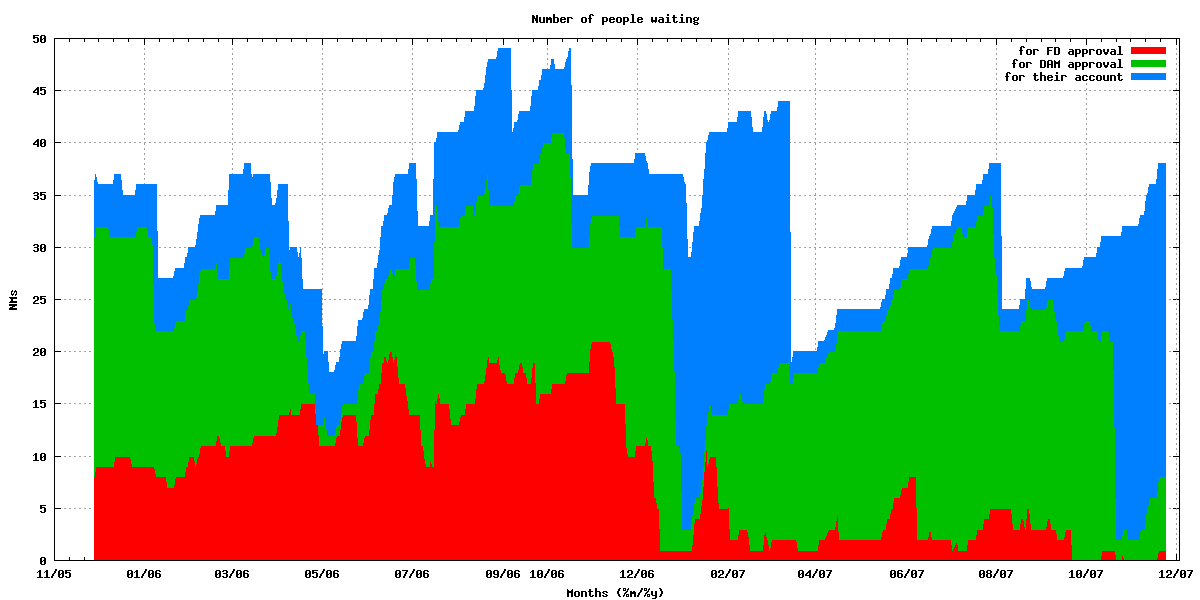
Lucas Nussbaum: Where is the NM bottleneck?

The current status of the NM process, with 1 NM awaiting FD approval, 7 awaiting DAM approval, and 30 waiting for their accounts to be created, leads people to thinking that the big bottleneck is the account creation stage. However, when you look at what happened since december 2005, it’s not that simple. NM queues status See the graph linked above, which shows where people are waiting. While it seems that the FD stage hasn’t been blocking people for nearly a year, it’s the DAM stage which has been the biggest blocker. Indeed, on average, 8.3 NMs have been blocked by FD, 16.2 by DAM, and 9.0 by account creation. I understand that processing NM reports in batch mode makes it more efficient. However, I’m wondering if processing them 20 per 20, is really that more efficient than processing them 5 per 5, which would justify such long queues. The NEW queue, which used to be a problem, is now being processed on a very regular basis, and hasn’t grown widely recently, except after Debconf when the ftpmaster processing NEW was on VAC. Couldn’t we have the same thing for DAM, account creations, and while we are at it, removals from unstable? Having clearly defined human-crontab-jobs would certainly make working on Debian less frustrating.
Christian Perrier: Thou Shalt Not Use Smbfs

A one may see with the regression recently introduced by the lastest security updates of the samba package, using smbfs is currently not possible with etch Samba servers if they're up-to-date. I'm afraid that people who experience this bug just deserve what they got. Smbfs is bloody deprecated for years in favor of the cifs filesystem (samba upstream QA work never includes checks for smbfs stuff). CIFS Userland utilities are provided in the smbfs Debian package so the switch is mostly a matter of a few minutes work and manpage reading (some options might differ). We should have told this earlier, probably, sorry for this. But it is now time to say it and even shoult it: if you're using smbfs, you're shooting in your own foot. So, check you machines and if you use "smbmount", consider switching (sams for positive output of "grep smbfs /etc/fstab"): it's quite likely that it is removed in next versions of samba as Steve Langasek, myself and other samba package maintainers are really fed up with bugs related to that obsolete thing.

23 November 2007

Steve Kemp: No, I don't want your number

I'm still in the middle of a quandry with regards to revision control. 90% of my open code is hosted via CVS at a central site. I wish to migrate away from CVS in the very near future, and having ummed and ahhed for a while I've picked murcurial as my system of choice. There is extensive documentation, and it does everything I believe I need. The close-runner was git, but on balance I've decided to choose mercurial as it wins in a few respects. Now the plan. I have two options: e.g. My xen-tools could be hosted at mercurial.xen-tools.org, my blog compiler could live at mercurial.steve.org.uk. Alternatively I could just leave the one site in place, ignoring the fact that the domain name is now inappropriate. The problem? I can't decide which approach to go for. Both have plusses and minuses. Suggestions or rationales welcome - but no holy wars on why any particular revision control system is best... I guess ultimately it matters little, and short of mass-editing links its 50/50.

Joerg Jaspert: Todays work

Work. No, not at my workplace, for Debian. I decided to modify the ftp-master webpage a little bit, just adding some css magic (and the ability to conform with that xhtml1.0 strict thing out there). (And to be honest - about 95% of the “work” needed for this was done by Mark Hymers…) But that only happened after something else, which took away most of my time today (and yesterday and the day before). Namely - a nice overview of pending removals. The main purpose of that overview is of course “ftpteam members doing removals can take it for their work”, but i think it may also be nice for users to look there, instead of wading through all the bugreports against ftp.debian.org, which include bugs about totally different topics than removals. (And then I am lazy and want a commandline to paste… :) ) The design for that page was done by Martin Ferrari AKA Tincho, you don’t want to see how my design did look like… :), the idea for it is from Jeroen van Wolffelaar who wrote the first version of it in Perl (it is now implemented in Ruby). The removals html page is regenerated every hour, using the SOAP interface to the BTS, so at least the bugs information should be recent. The other information might have errors in them, don’t trust them too far. It should be right, but then - its only informational.. :) And now: Lets do some of those removals!

22 November 2007

Russell Coker: Drugs and an Election

As mentioned in my previous post [1] the government is using our money to advertise its policies. I previously covered the “Internet as a threat to children” issue, the other big one is drugs. The first significant message in the “Talking with your kids about drugs” document concerns the criminal penalties for drug use. That could largely be removed if the penalties were dramatically decreased and if hard drugs were administered to registered addicts for a nominal fee. Forcing addicts to commit crimes or work as prostitutes to pay for their addiction just doesn’t work, economically or socially. The next message is that parents should be involved in their children’s lives and be trusted enough that their children will accept advice. A large part of this would be related to the amount of time spent with children which is determined to a large degree by the amount of time not spent working. As I mentioned in my previous post it seems that the actions of the Howard government over the last 10 years has made things significantly worse in this regard by forcing more parents to spend large amounts of their time working (including situations where both parents work full-time) just to pay for a home. One notable omission from the document was any mention of alcohol problems (apart from when mixed with illegal drugs). By many metrics alcohol causes more harm than all the illegal drugs combined. The US attempted to prohibit alcohol and failed dismally, and alcohol is legal in most countries. The government doesn’t want to adopt a harm-minimisation approach to drugs (which bears some similarities to the approach taken to alcohol) and therefore is stuck trying to claim that one somewhat addictive mind-altering substance is somehow inherently different to all other mind-altering substances. The document provided no information at all on harm minimisation. The idea seems to be that it’s better for some children to die of overdoses than for other children to potentially be less scared of the consequences of drug use. The problem is that children are very bad at assessing personal risk so they simply won’t be scared off. It’s best to provide equipment for testing drug purity etc to reduce the harm. The list of reasons for young people to try drugs starts with “availability and acceptability of the drug“, Parmesan cheese is more available and acceptable than any drug but I’ve been avoiding it at every opportunity since I was very young. :-# More serious reasons in the list include “rebellion“, “depression“, “as a way to relax or cope with stress, boredom or pain“, and “to feel OK, at least temporarily (self-medication)“. But predictably there was nothing in the document about why children might consider that their life sucks to badly that they want to rebel in that way, be depressed, stressed, bored, or in pain to a degree that drugs seem like the solution. It seems unreasonable to believe that the school system isn’t a significant part of the cause of teenage problems. Flag poles for flying the Australian Flag [2] seems to be John Howard’s idea of a solution to school problems. I believe that the solution to school problems (both in terms of education and protection of children) is smaller classes, better supervision, an active program to eradicate bullying, and better salaries for teachers. I’ve written about related issues in my school category. I believe that the best thing for individual families to do is to home-school their children from the age of 12 instead of sending them to a high-school (which is much more damaging than a primary school). Another significant issue is drug pushers. They are usually drug users who try to finance their own drug use by selling to others. As most drug users get the same idea there is a lot of competition for sales and therefore they try to encourage more people to use drugs to get more customers. In the Netherlands, Coffee Shops sell a range of the milder drugs at reasonable prices which removes the street market and therefore the pushers. When drugs are produced commercially the quality is standardised which dramatically reduces the risk of infection and overdoses. When drugs are sold by legal companies they are not sold to children (a typical pusher can be expected to sell to anyone). The document has 3.5 pages of information about some of the illegal drugs (out of 23 pages total). They include all the most severe symptoms that most users don’t encounter. If someone reads that information and then talks to a drug user they will be laughed at. They also group drugs in an unreasonable way, for example listing “marijuana” and “hashish” as synonyms and list problems that are caused indirectly. If alcohol was included in that list it would include beer and methylated spirits (ethanol mixed with methanol to supposedly make it undrinkable - rumoured to be consumed by homeless people) in the same section and imply that blindness and other bad results of drinking “metho” apply to beer. It would also say that alcohol kills many people through drunk-driving and is responsible for rapes, wife-beating, and any other crime which can statistically shown to be more likely to be committed by a drunk person. A final issue with the document is that it advises parents to be “informed, up-front and honest” when talking to their children about drugs. Unfortunately the document itself doesn’t demonstrate such qualities. By omitting all information on harm minimisation it is not being up-front at all, and by not mentioning alcohol it’s simply being dishonest. Anyone who tries to convince someone else to not use illegal drugs can expect to hear “but you drink alcohol” as the immediate response from the drug user, it’s necessary to have sensible answers to that issue if you want to be effective in discouraging drug use.

Russell Coker: Internet and an Election

Before the election was called the Howard government (being unethical in every way) started using public money to campaign. Part of this election campaign was two documents sent out to every home (AFAIK) coupled with a media campaign, one was about children and drugs, the other was about children and the Internet. I have to wonder how many people were fooled by this, including a picture of John Howard on the first page after the index made it pretty clear what the purpose was. Before I analyse the content of the documents one thing to keep in mind is the cost of the Iraq war, which the Sydney Morning Herald [1] estimates at $3,000,000,000. Note that this doesn’t include the life-long medical and psychiatric care that some veterans will require or the cost to the economy of such people not being productive tax-payers. It does note that 121 employees of the Australian military have been discharged on medical grounds. If each of those 121 people was disabled in a way that significantly impacted their life then the cost could be as much as $242,000,000. Let’s not assume that everyone who is currently serving and regarded as completely fit will be fine in 10 years time either. The Prime Minister gives a personal introduction to each document, the “NetAlert” document states that $189,000,000 is being spent to protect children on the Internet. The “Talking with your kids about drugs” document states that “more than $1.4 billion” has been spent to combat illicit drug use, I’m not sure what time period that covers - it seems to be his entire 10 years as PM so that would be $140,000,000 per annum. Obviously declaring a war of aggression against Saddam Hussein is something that he considers to be more important than protecting Australian children. Now the content of the NetAlert document. It starts with $84,800,000 to provide access to “the best available internet filtering technology“. I have to wonder, how much would it cost to develop some new Internet filtering software from scratch, or what the opportunity cost might be to re-assign resources from organisations such as CSIRO to the task. I expect that in either case the total would be a lot less than $84,800,000. Developing free software for the task would be a much better use of resources and would also allow cooperation with similar programs in other countries. In the unlikely event that $40,000,000 was required to develop such free software it probably wouldn’t be difficult to get a few other governments to kick in some money and make it $10,000,000 per country. Of course saving $70,000,000 doesn’t sound like much (a mere $3 per person in the country), but it is significantly more than the Free Trade Agreement with the US [2] was supposed to bring in (from memory it was promoted as improving the economic position of the country by $50,000,000 but the best available information is that it made our balance of trade worse). $43,500,000 in additional funding for the police to combat online child sex exploitation is small but OK (it would be better if some of that $84,800,000 had been saved on filtering software and allowed greater expenditure in this area). But it should be noted how child rape in Aboriginal communities is used as a political issue and nothing constructive is done about the problem [3]. I believe that protecting children against rape is far more important than controlling illegal porn (which is where the majority of that $43,500,000 will go). Another possible avenue of research would be on more secure computer systems for Australian homes. It’s all very well to install some filtering software, but if the PC running the software in question is hacked then it’s immediately turned off. Attacks that involve turning web cameras on without the knowledge or consent of the owner are not uncommon either, it’s not unreasonable for a child to get out of bed and then do some homework on their computer before getting dressed - with an insecure computer and a web-cam connected this could be a bad thing… If the Australian government was to mandate that all government data be stored in open formats and that all communication with government computer systems can be done with free software (as a matter of principle you should not have to buy expensive software to communicate with your government) then the incidence of insecure desktop OSs would decrease. The document does recommend some basic OS security mechanisms, but if you use an OS that is insecure by design it’s not going to work. The core message of NetAlert is that children should be supervised when using the net. There is one significant problem with this, full supervision of children requires that at least one parent is not working full-time. In a previous post I compared median house prices and median incomes [4] with the conclusion that even with both parents working it’s difficult to afford a house. It would be difficult for a single income that is below the median to be used to pay the rent on a decent house. So it seems that a significant portion (maybe the vast majority) of Australian families will be forced to do what the government would consider to be a compromise of the Internet safety of their children by having both parents working full-time jobs to pay off a large mortgage (or in some cases merely to pay rent). I believe that making houses more affordable would improve the protection of children and provide other significant benefits for society. If you look at chart 1 and chart 2 on the House Prices research note from the Australian Parliamentary Library [5] you can see a significant increase in the difference between CPI increases and house prices increases since 1996 (when John Howard became Prime Minister) and a significant increase in the ratio of house prices to average income. The charts only include data up to 2006 so don’t show the effects of the Howard government’s “workplace reform” which lowers wages for many people who are below the median income. John Howard is responsible for houses being less affordable and parents being forced to spend more time working and less time supervising their children, I find it offensive that he now tells people to spend more time supervising their children. The document does have some good basic advice about how to supervise children and what level of supervision is necessary. The problem is that children from an early age know more than the typical parents. I doubt the ability of typical Australian parents to implement some of the supervision suggestions on 12yo children. I have been considering writing my own documents on how to filter and monitor child Internet access but the main problem is determining ways of doing so that can be implemented by someone who is not a computer expert. In summary, the Howard government is responsible for reducing the supervision of children and therefore exacerbating the problems that they are claiming to solve. Their NetAlert program provides some information that can’t be implemented by the majority of Australians and entirely skips some of the most sensible steps such as using only secure OSs on machines that will be used on the Internet. I believe that Fedora and CentOS should be recommended by the government in this regard because of the combination of good security by default (of which SE Linux is only one component) and the ease of use. Computers are cheap enough that most families with good Internet connections (the ones at risk in this regard) have multiple computers so no extra cost would be incurred.

Next.

Previous.