Search Results: "spa"

17 January 2009

Joerg Jaspert: Debian package count / archive size

Julien and Kushal are using a pretty complicated way to count packages in Debian. Take it easy, look at pkg-nums for the current count of packages in Debian, output directly by the archive software dak. And there is also arch-space showing the size of the various architectures. Those stats are updated whenever dinstall did run.

Julien Valroff: IPv6: Miredo link to HE Tunnel endpoint

As announced a few weeks ago, my website should now be accessible through IPv6. The connectivity is made thanks to Hurricane Electric IPv6 tunnel service as recommended on Linode wiki. At home, I use Miredo, an open-source Teredo IPv6 tunneling software for GNU/Linux and BSD. This works great with many websites. I can ping6 servers I know, like ipv6.google.com or www.debian-administration.org.
However, I cannot ping6 my Linode server until I have established a link from the linode to home. But after a while (a quarter or so), the link is dead, and I have to ping my home address again from the linode to make it alive.

Here are some results which might help: From home to linode when not working:
$ traceroute6 2001:470:1f06:ccf::2
traceroute to 2001:470:1f06:ccf::2 (2001:470:1f06:ccf::2), 30 hops max, 80 byte packets
 1  2001:0:53aa:64c:2c29:6807:a37d:37e2 (2001:0:53aa:64c:2c29:6807:a37d:37e2)  0.066 ms !H  0.060 ms !H  0.059 ms !H
From Linode to home:
$ traceroute6 2001:0:53aa:64c:2c29:6807:a37d:37e2
traceroute to 2001:0:53aa:64c:2c29:6807:a37d:37e2 (2001:0:53aa:64c:2c29:6807:a37d:37e2), 30 hops max, 40 byte packets
 1  JulienV-1.tunnel.tserv4.nyc4.ipv6.he.net (2001:470:1f06:ccf::1)  17.205 ms  19.652 ms  22.253 ms
 2  gige-g3-8.core1.nyc4.he.net (2001:470:0:5d::1)  23.290 ms  23.270 ms  23.272 ms
 3  10gigabitethernet1-2.core1.lon1.he.net (2001:470:0:3e::2)  91.743 ms  91.868 ms  91.846 ms
 4  10gigabitethernet1-1.core1.ams1.he.net (2001:470:0:3f::2)  99.611 ms  99.681 ms  99.659 ms
 5  amsix-501.xe-0-0-0.jun1.kelvin.network.bit.nl (2001:7f8:1::a501:2859:2)  100.223 ms  100.351 ms  100.330 ms
 6  teredo.bit.nl (2001:7b8:3:27:87:251:43:68)  100.347 ms  80.329 ms  95.304 ms
 7  2001:0:53aa:64c:2c29:6807:a37d:37e2 (2001:0:53aa:64c:2c29:6807:a37d:37e2)  375.204 ms  379.675 ms  382.140 ms
And then from home to Linode when working (ie just after the previous traceroute6):
$ traceroute6 2001:470:1f06:ccf::2
traceroute to 2001:470:1f06:ccf::2 (2001:470:1f06:ccf::2), 30 hops max, 80 byte packets
 1  teredo.bit.nl (2001:7b8:3:27:87:251:43:68)  298.818 ms  298.804 ms  298.789 ms
 2  teredo-gw.jun1.kelvin.network.bit.nl (2001:7b8:3:27::2)  349.530 ms  349.522 ms  349.510 ms
 3  linx.he.net (2001:7f8:4::1b1b:1)  371.854 ms  371.847 ms  371.835 ms
 4  10gigabitethernet2-3.core1.nyc4.he.net (2001:470:0:3e::1)  491.051 ms  491.041 ms  491.029 ms
 5  1g-bge0.tserv4.nyc4.ipv6.he.net (2001:470:0:5d::2)  349.111 ms  346.930 ms  344.158 ms
 6  nix.kirya.net (2001:470:1f06:ccf::2)  351.527 ms  140.178 ms  142.217 ms
Is there anything else I could try to understand which is the faulty side (before I contact both Linode s and tunnelbroker s supports or report a bug against Miredo)?

Julien Valroff: Counting Debian source packages

Following to Kushal s post about counting total number of Debian packages, he concluded that sid currently has more than 30,000 binary packages (free, contrib & non-free). IMHO it is more relevant to count source packages. I couldn t find any existing way of doing it, I have hence written a short bash script. Script updated thanks to Thomas advice - now checking source packages directly from the mirror s Sources.gz file
#/bin/bash
 
if [ $# -lt 1 ]; then
  echo "Please add at least one distribution as argument"
  echo "Exiting"
  exit 1
fi
 
for arg in $*
do
 
  echo "Number of source packages in $arg: "
  for dist in main contrib non-free; do
    echo -n "  $dist: "
    wget -q -O - ftp://ftp.debian.org/debian/dists/$arg/$dist/source/Sources.gz   zgrep -c '^Package: '
  done
 
done
The results as of today:
Number of source packages in etch:
  main: 10221
  contrib: 126
  non-free: 211
Number of source packages in lenny:
  main: 12176
  contrib: 180
  non-free: 241
Number of source packages in sid:
  main: 13032
  contrib: 158
  non-free: 275
Which means we are quite far from the 18,733+ available packages, proudly announced on Debian homepage. Update: I had misread the figure advertised on Debian homepage which is a count of the binary packages available (which is currently much higher that what is stated there)

Gunnar Wolf: M talo, luego virig as (roughly: Kill him, ask questions later)

The phrase on this title is often attributed to Pancho Villa (1878-1923), Mexican Revolution leader. He had a fame of cruelty, killing suspects before even questioning them.
Today, it started as a very nice day. I had even time in the morning to find, fix, upload and send upstream a trivial bug in libgruff-ruby... At 11:00, I left the Institute as my father came to the city to do some paperwork... We sat having a cup of coffee in a restaurant near the office we had went to at around 12:00, and my phone rang.
And it was from work. That's never a good sign. My boss told me he was facing a massive virus infection, and decided to disconnect the firewall. I corrected him - that will do no good once the virus is in our system, if you want to disconnect anything, disconnect all of our switches.
Came back, and found him and my coworker stunned and not knowing what to do. He says, the antivirus alarm went off almost simultaneously on the two computers he had on his desk, and in few minutes over 15 computers all over the Institute were ill. The symptoms? Programs not showing up in the taskbar, copy/paste functionality b0rken, many programs misbehaved or just didn't open... They were grimly facing a complete recovery operation they have grown used to: The whole OS has become corrupted or destroyed, we will have to open the computer, extract the HD, install it elsewhere, back it up, reinstall OS and applications, restore the backup. Yes, I know too many extra steps are included here, but I have come to accept their ways of dealing with Windows. Nobody says dealing with Windows is fun. I like my work to be fun, so I stay clear of theirs.
I insisted on turning back one one of the switches, the one for the servers and my machine (and some more in the same physical area). OK'd. But they didn't want to switch on any other switch, so a traffic capture (tcpdump / wireshark) led nowhere - but at least it gave my my Google back.
They have configured the antivirus software we deploy to all of the Windows machines in such a way that it deletes upon sight any malware - And when they manually scan, they blindly hit Delete whenever anything is found as well. Of course, no infected binary was left alive for me to inspect, and the machines were dead. But I was able to glimpse at the name of the deleted file: rpcss.dll.
After googling a bit - Bliss! Joy! I found the answer. So here is the set of interactions, and how they led to this killing spree. Please remember I am a Windows newbie and speak just out of guesswork.
  1. This is a fast-spreading virus. My friend Rub n at DGSCA suggest it might be related to this report submitted today; at Barrapunto there is a thread about another virus that appeared four days ago, infected 1.1 million Windows machines on its first day, and so far is around the ninth million. Update: Equivalent thread at Slashdot, for the Spanish-impaired.
  2. The virus infects at least two copies of a system binary: %system32%\rpcss.dll and \Windows\ServicePackFiles\i386\rpcss.dll. Windows uses the second one to restore the first one in case it is damaged, if I understood correctly.
  3. The antivirus does not detect the infection when the library files are written, but when they are linked, so it only spots it the next time %system32%\rpcss.dll is brought into memory.
  4. This is a very common library - It takes care of, well, RPC. So, quite probably, this file will be linked again on the next program launch - or accessed when a running program requires anything not currently in RAM? Dunno. The thing is, the library gets linked.
  5. The antivirus will happily tell you it has killed a threat! Your nice RPC library is now defunct. M talo, luego virig as!
  6. So, of course, notifying the taskbar of a new window appearing, or clipboard actions, or whatnot will refuse to work.
  7. Machine restart, full system scan requested. The antivirus finds de second copy of this library in the master directory (\Windows\ServicePackFiles\i386). The virus used this location so that Windows won't restore a clean version over it. But yes, it will fall again under the claws of the antivirus... I guess. Anyway, the antivirus offers to delete this file as well, and does so.
  8. User is desperate. My coworkers are desperate. I am... mildly annoyed?
Once I found this line of thought... I went to a working machine, inserted my flash memory, and copied %system32%\rpcss.dll to it. Went back to a sick machine, and ran cmd. Then, it was just matter of copy f:\rpcss.dll c:\windows\system32, a simple reboot (it never hurts to reboot in Windows!), and problem solved!
Oh, as a side rant: I find it extremely annoying and sad that many people I know, sometimes with more experience as a computer operator/supporter than what I have of experience as a living human being, are so scared of using a command-line interface. They were dismayed at seeing no drag-and-drop and no copy/paste functionality were available! copy is not an option.
Anyway... Today was an experience on how a simple, mostly-harmless and quite-fertile virus is able to be terribly magnified by the presence of a trigger-happy antivirus.
Why won't they give themselves a chance to try something else? Say, GNU/Linux? :-/

16 January 2009

Wouter Verhelst: Re: On filesystem layouts

Someone posted a comment to my previous post on ACLs; and now Andrew blogs about the same question: Why don't I believe in multiple filesystems for a laptop? Andrew's arguments don't really convince me. A filesystem eating itself? That's never happened to me yet. A hard disk dying on me, however, I've had that. Since I first owned a computer with a hard disk, I think there've been 5 of them. There's only one thing you can do against that -- have a proper backup strategy. That not only protects you against losing your data due to the somewhat likely event of a hard disk dying, it also protects you against losing your data due to the somewhat unlikely event of a filesystem eating itself. On the other hand, however, a laptop hard disk is usually slow, small, and painfully so. Partitioning already-small hard disks into even-smaller partitions therefore doesn't sound like a particularly bright idea to me. Losing half a gig on unused space for /, then 400M for /usr, and 600M for /home, and another 2G for /var, or some such, is pretty stupid if you want to store a 3G file that you want to burn to disk; you have the available space, but you don't have it in one partition, so you get to do the cleanup dance. And nobody likes to do that, right? Oh, and don't try to fool me I have yet to see a laptop that's been in use for more than a few months and whose disk is not filled to all but a few gigabytes. Nobody removes files until they're out of space, and then you only remove just as much as you need to be able to do the job at hand... Occasionally, I do install server systems with multiple filesystems, and with LVM. On a server, the inability of a run-away system process (or user) to 'accidentally' fill up the root filesystem with junk is definately a life-saver. But once you have lost data, you need to recover anyway, and having partitions doesn't particularly help you in doing that. Also, servers tend to have multiple huge disks in a RAID array, so loss is less likely, and disk space is plenty; as such, the loss of 10% on the LVM overhead isn't something I care about, which it is on my laptop. But, hey, to each their own preference. I won't look at you funny for preferring multiple partitions on your laptop. Promise!

15 January 2009

Amaya Rodrigo: Basko by holgi


Basko by holgi
Originally uploaded by Amayita.

Alastair McKinstry: More exoplanets: super-Earths or Neptunes ?

From Today's Astronomy & Astrophysics there were two papers from the Geneva Observatory / Grenoble team on The HARPS search for southern extra-solar planets: These are probably part of the 45 super-Earths tentively announced by M. Mayor last June at the Nantes conference on super-Earths. He showed radial-velocity diagrams for 45 or so planets in an impressive display, but only gave details of three at the time, while the rest were being peer-reviewed, etc. Now they're drip-feeding out. Interestingly, this now makes 3 out of 7 super-Earths do far discovered as being around M dwarf stars, and another multiple planetary system. It looks more like the "metallicity" relation (larger and more frequent planets around more metallic stars) seems to be more true for gas giants than terrestrial planets. Super-Earths (potentially rocky planets, though heavier than Earth) look more abundant around low mass and less-metal stars. Now, down to work examining the characteristics of these planets. Rory Barnes and colleagues at LLPL, U. of Arizona have also been looking at these three planets around HD 40307, to determine if they are super-Earths or mini-Neptunes. They have an interesting technique of modelling the tidal circularisation of the planet backwards in time, based on its current measured or estimated eccentiricity. Tidal circularisation makes the orbit of close-in planets more circular (decreasing the eccentricity, e, to zero), dumping the energy into tidal heating of the planet (and the star). Doing this for Gl 437, for example, they showed that it would be hotter than Io, with a volcanic surface and couldn't be habitable. For HD 403007b, Hence they believe the planets are not terrestrial-like, but may be more Neptune-like. So, could these planets have oceans ? Tags , , ,

Julien Blache: Antec PSU suck

How not to start your day, from the all-hardware-sucks department. For years, I ve been struggling to keep my machines quiet. I ve miserably failed for years, and pretty much gave up once I realised that the quiet parts I was looking for just did not exist. Last year, I finally found what I was looking for: I ve been very happy with this hardware for both my workstation and my filer. Well, until today. No need to mention that this hardware is not exactly cheap, but the price is right for the quality. So, wake up today, do random things, grab my TomTom, unplug it from the workstation it s sucking its power from, do things, plug it back in the USB port so it won t draw its battery. This is how it went: Check machine temp, PSU temp, attempt to restart PSU, check UPS, check cables, replace power cable and bypass UPS. Admit defeat for this round and accept the PSU as dead. Pull out the machine, rip out the fscking damn PSU. Grab the tools, crack the PSU open. Notice bulging and leaking capacitors. Yes, this PSU is anything but cheap, yet it uses el-cheapo chinese capacitors. Antec, you suck, big time. For the past decade everybody in the industry has known that el-cheapo chinese capacitors manufactured after 1999 are total crap, using an electrolyte that isn t actually one because its formula was stolen by industrial spies who got totally PWNED and ended up stealing a bad formula. (If you need a reference, google for singing capacitors . Note that singing capacitors can also happen with good parts used in a crappy electronic design. Like that 100 Mbps D-Link switch over there, or that Sony-Ericsson mobile phone charger. Hmm. Not everybody can hear it, I do.) A healthy, young capacitor should not bulge nor leak. A capacitor that leaks, bulges or sings is a crappy capacitor and needs to be replaced with a quality part ASAP. I ve been routinely replacing such capacitors on my older motherboards (manufactured between 1999 and 2001) in the past years. I ve not had the problem in ANY of my el-cheapo PSU, and did not replace any capacitor in any of them to date. Fortunately, the machine did not suffer any further damage, nor did the TomTom. Everything is up and running again with a spare PSU. I m now going to replace the fscking capacitors on this PSU, replace the fuse, probably R&R a couple of high-voltage transistors too (they have a tendency to fry before the fuse blows out) and get it back up and running. Then I ll do the same with the other PSU in the filer, because that machine has 8 disks attached, so draws more power and hence is much more vulnerable. Fuck you Antec.
Russell Coker: Old PDA vs New Mobile Phone for PDA use

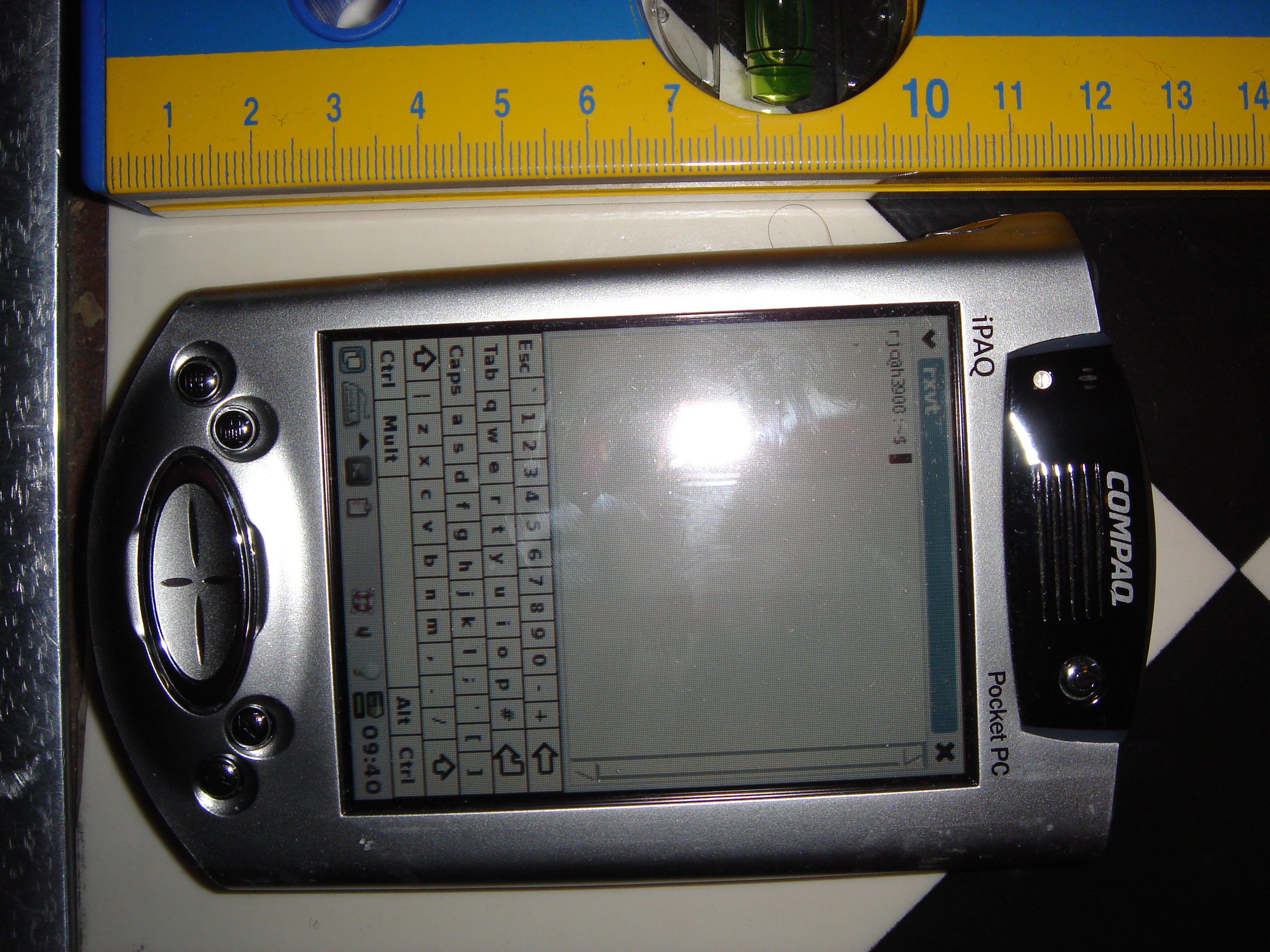
Since about 2002 I have been using a iPaQ [1] for taking notes while on the move. I have a pair of H3950 iPaQs that were given to me for the purpose of some software development work. As modern mobile phones have telephony as a small part of their feature set I think it s worth comparing a 2002 iPaQ with a 2009 mobile phone in terms of the note taking functionality. I have just got myself an LG U990 Viewty mobile phone [2]. It has a screen resolution of 240*320 which is the highest resolution that is remotely common for a mobile phone - and the same resolution as my 2002 model iPaQ. The LG KC910 Renoir has a resolution of 240*400 and seems to be the only phone that my carrier provides which has a higher resolution. The iPhone [3] has a resolution of 480*320. So it seems that the most expensive modern mobile phone that is available in Australia has a screen resolution that is only twice that of a 2002 PDA. I believe that in Japan you could buy a PDA with a higher resolution than 240*320 in 2002. My iPaQ is running Linux, so I can do whatever I want with it. I have a bar at the bottom of the screen with icons to launch, I configure it with the programs that I need most often and they are always one click away. While with my mobile phone I always have two large icons for paid services from my telco and I can t add icons for the things that I want. My iPaQ has a virtual keyboard that can be displayed in portrait or landscape mode. The above pictures show it in the portrait mode which allows the greatest area of screen space for text. The landscape mode is good for entering long lines of text even though the total number of words that can be displayed on screen is smaller. The size of my iPaQ is 134mm in height, between 77 and 84mm in width (it tapers) and 15.9mm thick without it s protective sleeve. The protective sleeve (shown in the second picture) adds about another 5mm to the width and thickness. My iPaQ is 1.76* the volume of my Viewty phone and at 184g vs 112g is 1.64* the mass. With it s sleeve on it is about 2.4* the volume. It s larger but with the sleeve it s a lot more solid, a touch-screen is very fragile so putting a touch-screen device in your back pocket without a sleeve is not a viable option. So I now own a mobile phone that has more storage, RAM, and CPU power than my iPaQ, but is less useful for the basic task of writing small documents and seems to have no facility for drawing diagrams. Most recent mobile phones have the ability to record voice (my Viewty can store 34 hours on it s internal storage and supports mini-SD cards for extra storage). But my Viewty lacks the ability to pause voice recording so if I wanted a series of notes during a meeting I would get a series of short voice recordings rather than a single file with many items. The todo list is also fairly poor in the Viewty, so even disregarding the poor keyboard on the touch-screen it would compare badly to the iPaQ. So it seems that an iPaQ that is almost seven years old when running Linux and the GPE Palmtop Environment [4] with with default configuration handily beats one of the latest and greatest mobile phones for all areas of common functionality. If the Viewty had it s source code available I would be tempted to contribute some patches (even if it was not free software). Finally, before someone suggests an Android [5], Greenphone [6] or other phone that s relatively open and programmable, I wanted a phone that had a good camera (by phone standards) and came essentially for free on an affordable contract. Maybe in two years time (when my current contract ends) there will be such a phone on offer. Mobile phones aren t THAT important to me, so while I would like to encourage the development of open telephony platforms it s a much lower priority than about a dozen free software projects. I expect that in the future something like an Android will become a great mobile phone with great PDA functionality. But for the moment I ll use an iPaQ and a Viewty.

Romain Beauxis: Discriminations

I recently stumbled upon a document asking for one s ethnic orgin: My initial reaction was not really constructive, so I though it worth some toughs.. Indeed, after discussing with friends about this, I happened to an interesting conclusion.

14 January 2009

Aurelien Jarno: QEMU PowerPC

For a few weeks Laurent Vivier, Blue Swirl and myself have been working on getting QEMU PowerPC working correctly with recent distributions. QEMU used to rely on OpenHackWare for the OpenFirmware implementation on PowerPC. It is a very limited implementation (for example it as no Forth support), which is unable to boot most 2.6.x kernels with the OldWorld emulation. It is able to boot recent kernels with the PReP emulation, but things like the PCI bus emulation are not working correctly. Moreover the PReP kernels are gone with the removal of the arch/ppc tree. OpenBIOS was already used for the OpenFirmware implementation of Sparc 32 and Sparc 64 targets. It now supports PowerPC for the OldWorld emulation. As a result it is now possible to use Debian PowerPC under QEMU emulating an OldWorld machine. What works? What doesn t work / has to be done? For those who want to test, an Etch image is available. You will need to compile QEMU by manually given that the version in Debian is too old and that openbios-ppc is still in the NEW queue.

Gunnar Wolf: Hyperdimensional strings

I am stunned no more people have been bitten by this. Or at least, the Intarweb has not heard about it. Censorship perhaps? I haven't researched more into the causes, but anyway...
I was pushing a project I have had lingering for some time from Rails 2.0.x to 2.1.x (yes, 2.2 is already out there, but 2.1 is the version that will ship with Lenny) - The changes should not be too invasive, as it is a minor release, but there are some quite noticeable changes.
Anyway... What was the problem? Take this very simple migration:
  1. class CreatePeople < ActiveRecord::Migration
  2. def self.up
  3. create_table :people do t
  4. t.column :login, :string, :null => false
  5. t.column :passwd, :string, :null => false
  6. t.column :firstname, :string, :null => false
  7. t.column :famname, :string, :null => false
  8. t.column :email, :string
  9. t.column :pw_salt, :string
  10. t.column :created_at, :timestamp
  11. t.column :last_login_at, :timestamp
  12. end
  13. end
  14. def self.down
  15. drop_table :people
  16. end
  17. end

The problem is that PostgreSQL refuses to create a hyperdimensional string field. I offer this here to you, line-wrapped by me for your convenience.
  1. PGError: ERROR: syntax error at OR near "("
  2. LINE 1: ...serial PRIMARY KEY, "login" character varying(255)(255) NOT ...
  3. ^
  4. : CREATE TABLE "people" ("id" serial PRIMARY KEY,
  5. "login" character varying(255)(255) NOT NULL,
  6. "passwd" character varying(255)(255)(255) NOT NULL,
  7. "firstname" character varying(255)(255)(255)(255) NOT NULL,
  8. "famname" character varying(255)(255)(255)(255)(255) NOT NULL,
  9. "email" character varying(255)(255)(255)(255)(255)(255) DEFAULT NULL NULL,
  10. "pw_salt" character varying(255)(255)(255)(255)(255)(255)(255) DEFAULT NULL NULL,
  11. "created_at" timestamp DEFAULT NULL NULL, "last_login_at" timestamp DEFAULT NULL NULL)

Beautiful. Now I can store strings not only as character vectors, but as planes, cubes, hypercubes, and any other hyperdimensional construct! Are we approaching quantum computers?
What is really striking is that... I found only one occurrence on tha net of this bug - one and a half years ago, in Ola Bini's blog. No stunned users looking for the culprit, no further reports... Strange.
Still, the bug was fixed in Rails 2.2 about half a year ago, although not in revisions of earlier versions. I will request the patch to be applied to earlier versions as well. Sigh.

David Welton: Hosting, Commodities, and "The Cloud"

Anyone connected to the world of IT has been bludgeoned over the head with "cloud" news lately, to the point where the term has become vague and mostly a buzzword. There is, however, something behind the phenomenon, described in Nick Carr's book The Big Switch, with more computing power being centralized at large data centers where economies of scale come into play. I had an interesting chat with Marco D'Itri a while back, about hosting and commodities. It's clear that there is some commoditization going on, but he maintains that hosting is not a commodity. I've been thinking about it and the conclusion I've come to is that some parts of the business are certainly commodities: disk space, memory, bandwidth, and processor cycles. Those things, are, ultimately, what we want to buy when we buy 'hosting'. However, the bits and pieces between that, and people who build on top of those services (i.e. someone who runs a web site) are not really a commodity, yet. Customer service, for instance, might vary a great deal between providers. What will happen in that space, will we see a baseline price for the commodities, and hosting resellers built on top of that that offer different levels of service? I do think that the "mom and pop" hosting type of situations will gradually disappear in favor of larger data centers that can take advantage of economics of scale, though. Also, as I've written about in the past, in Web Hosting - A Market for Lemons, there are some serious information asymmetry issues - how do you know the people providing your service are serious? How do you know they're using good components that wont' break often, rather than cheap junk that will lead to frequent outages? If you have the resources, you can build a system like Google's, where it doesn't matter what fails, it just works around it, but the basic tools that most of us are working with right now aren't that high level. I was reminded of the information asymmetry issue by this article, written by the Dreamhost folks, Web Hosting's Dirty Laundry, which describes how they caught a 'review' site trying to get money from Dreamhost for positive reviews, which is interesting in light of the lemon problem. Wikipedia has some criteria for a lemon market here: http://en.wikipedia.org/wiki/The_Market_for_Lemons#Criteria, which include the following:
Deficiency of effective public quality assurances (by reputation or regulation and/or of effective guarantees / warranties
If it's difficult to get real, honest, impartial reviews of hosting services, that is a push in the direction of 'lemons'. Of course, it's not impossible to get this information, but it seems that a lot of us still go by "hearsay" - what others we know use and report to be ok. To compare it with another product, I'd probably ask around to friends prior to purchasing a new car, but whatever I get is likely to work ok, even if it's not the absolute best. On the other hand, the wrong hosting provider might be very much a "fly by night" operation that leads to a lot of downtime, so I'm far more likely to listen to what other people have to say, and be far more cautious about buying "any old thing". Opinions? Comments? Thoughts? Where do you see this industry going?

David Welton: Hosting, Commodities, and "The Cloud"

Anyone connected to the world of IT has been bludgeoned over the head with "cloud" news lately, to the point where the term has become vague and mostly a buzzword. There is, however, something behind the phenomenon, described in Nick Carr's book The Big Switch, with more computing power being centralized at large data centers where economies of scale come into play. I had an interesting chat with Marco D'Itri a while back, about hosting and commodities. It's clear that there is some commoditization going on, but he maintains that hosting is not a commodity. I've been thinking about it and the conclusion I've come to is that some parts of the business are certainly commodities: disk space, memory, bandwidth, and processor cycles. Those things, are, ultimately, what we want to buy when we buy 'hosting'. However, the bits and pieces between that, and people who build on top of those services (i.e. someone who runs a web site) are not really a commodity, yet. Customer service, for instance, might vary a great deal between providers. What will happen in that space, will we see a baseline price for the commodities, and hosting resellers built on top of that that offer different levels of service? I do think that the "mom and pop" hosting type of situations will gradually disappear in favor of larger data centers that can take advantage of economics of scale, though. Also, as I've written about in the past, in Web Hosting - A Market for Lemons, there are some serious information asymmetry issues - how do you know the people providing your service are serious? How do you know they're using good components that wont' break often, rather than cheap junk that will lead to frequent outages? If you have the resources, you can build a system like Google's, where it doesn't matter what fails, it just works around it, but the basic tools that most of us are working with right now aren't that high level. I was reminded of the information asymmetry issue by this article, written by the Dreamhost folks, Web Hosting's Dirty Laundry, which describes how they caught a 'review' site trying to get money from Dreamhost for positive reviews, which is interesting in light of the lemon problem. Wikipedia has some criteria for a lemon market here: http://en.wikipedia.org/wiki/The_Market_for_Lemons#Criteria, which include the following:
Deficiency of effective public quality assurances (by reputation or regulation and/or of effective guarantees / warranties
If it's difficult to get real, honest, impartial reviews of hosting services, that is a push in the direction of 'lemons'. Of course, it's not impossible to get this information, but it seems that a lot of us still go by "hearsay" - what others we know use and report to be ok. To compare it with another product, I'd probably ask around to friends prior to purchasing a new car, but whatever I get is likely to work ok, even if it's not the absolute best. On the other hand, the wrong hosting provider might be very much a "fly by night" operation that leads to a lot of downtime, so I'm far more likely to listen to what other people have to say, and be far more cautious about buying "any old thing". Opinions? Comments? Thoughts? Where do you see this industry going?

13 January 2009

Romain Beauxis: (not) Being tolerant.

I usually like to discover other cultural usages and try understand what I feel chocking from my cultural point. Not for THIS. I strongly believe this kind of stupidity should be removed as soon as possible. It is an insult to humanity. And the better way to put bareers between people. White British, White Irish or Mixed Black African and White and Mixed Black Caribbean and White. What a bullshit !!!!

12 January 2009

Pablo Lorenzzoni: Quick and Dirty VPN with pppd and ssh

This is just to keep a reference (so I don t have to google it again :-) ): One can create a quick and dirty VPN using pppd and ssh:

bash$ /usr/sbin/pppd noauth 10.0.0.1:10.0.0.2 pty 'ssh -x -t -e none remote_user@remote_server /usr/sbin/pppd passive noauth'
This assumes both users (local and remote) have permissions to run pppd (some sudo trickery may become very handy) and that no password is asked by ssh (password-less key authentication). Quite handy, ain t it?

11 January 2009

Wouter Verhelst: FOSDEM 2009: Debian talk schedule almost ready

Lessons learned: using the phrase third, final, and slightly desperate is an excellent way to motivate people into reacting to your Call for Talks. I've even had to reject some people now, unfortunately. Maybe next year, I'll use that phrase in my first call for talks. Then again, maybe not. Anyway, of course that does mean that there are no slots available anymore. If you wanted to hold a talk in the Debian devroom, you've had plenty of opportunity and will now have to wait until next year. There are still some minor loose ends that need to be filled in (of course there are always people who will wait until the very last moment to send mails they need to send... including me), but once that's done, I'll announce the schedule on the -events-eu mailinglist, and probably here too. And if you're worried that the word 'desperate' perhaps got us some boring talks in the end, don't be; the talks that are on the schedule are, I hope, all very interesting. Watch this space! So, things left to do, in no particular order: That's it for now, I guess. Back to your regularly-scheduled flamewar.

Julian Andres Klode: What have you done this week?


Well, I wrote 2599 lines of documentation. More detailed I wrote 2599 lines of documentation from Thursday to Sunday. In total, the jak branch of python-apt now has a diffstat (compared to debian-sid) of: Changes: 113 files changed, 5845 insertions (+), 2763 deletions(-) Partly responsible is Ben Finney, whose patches I merged. I also closed 7 bugs not relevant anymore in current versions of python-apt. This is the changelog to from debian-sid to jak:
python-apt (0.7.9~exp2) experimental; urgency=low
  * apt/*.py:
    - Almost complete cleanup of the code
    - Remove inconsistent use of tabs and spaces (Closes: #505443)
    - Improved documentation
  * apt/debfile.py:
    - Drop get*() methods, as they are deprecated and were
      never in a stable release
    - Make DscSrcPackage working
  * apt/gtk/widgets.py:
    - Fix the code and document the signals
  * Introduce new documentation build with Sphinx
    - Contains style Guide (Closes: #481562)
    - debian/rules: Build the documentation here
    - setup.py: Remove pydoc building and add new docs.
    - debian/examples: Include examples from documentation
    - debian/python-apt.docs:
      + Change html/ to build/doc/html.
      + Add build/doc/text for the text-only documentation
  * setup.py:
    - Only create build/data when building, not all the time
    - Remove build/mo and build/data on clean -a
  * debian/control:
    - Remove the Conflicts on python2.3-apt, python2.4-apt, as
      they are only needed for oldstable (sarge)
    - Build-Depend on python-sphinx (>= 0.5)
  * aptsources/distinfo.py:
    - Allow @ in mirror urls (Closes: #478171) (LP: #223097)
  * Merge Ben Finney's whitespace changes (Closes: #481563)
  * Merge Ben Finney's do not use has_key() (Closes: #481878 )
  * Do not use deprecated form of raise statement (Closes: #494259)
  * Add support for PkgRecords.SHA256Hash (Closes: #456113)
 -- Julian Andres Klode   Sun, 11 Jan 2009 20:01:59 +0100
This will again close 7 bugs. But the most important part is to actually have the complete documentation (OK, some descriptions are missing, but all classes,functions,methods,attributes,data should be there now). I still need to rearrange parts of the documentation and add some descriptions to some pieces, but all in all I am satisfied with what I have done this week. Take a look at the documentation: http://people.debian.org/~jak/python-apt-doc/apt/, it received documentation for 9 new classes today. I also added an entry to the DeveloperNews page on wiki.debian.org. Posted in Debian

Patrick Schoenfeld: Syncing mails

Okay, so I had a simple job to be done. I have two mail accounts: A private mail account and a company mail account, which has two folders containing private mails. I want to synchronize these folders to my private account. Which is the right tool to choose? I thought that one way would be to fire up a graphical mail user agent, like lets say Thunderbird, setup the accounts and simply move the mails between them. But this has some implications, like:

So I decided that I needed some small tool, that UN*X admins are used to have. After a small apt-cache search, I found two tools:
I installed both and looked at them. For the impatient, a spoiler: I decided to use imapsync.
I had a quick look at imapcopy and it did not have a proper manpage.
Instead it refers to the built-in help (imapcopy -h) which is not useful either and to examples in /usr/share/doc.
After that I had look at imapsync. It comes with a pretty good manpage and a pretty good built-in usage information. Appearently I rate it very important that either the manpage or the built-in help are good enough to get started with a tool. Certainly I know that tools exist where a manpage is simply not enough, but I guess a tool to sync imap folders is not one of them.

After studying the manpage for about 2 minutes I was ready to construct a command line and give it a --dry try. This parameter lets me see what the tool would do if I would ommit it. That one looked good and so I gave it a shot. It then started to work. It has two flaws.
  1. Unfortunately it does not indicate its progress and the normal messages are not a good help either, because they contain numbers that actually do not refer to mails in one of the mailboxes (they are soon literally higher as the number of mails in both mailboxes) and I do understand what it is referring to.
  2. It sometimes crashed at random locations with random messages. I didn't look deeper into it, because restarting the script helped and therefore I cannot speak of a easy reproducible problem. In 3000 mails it happened about 1-2 times, so not a great deal but still annoying.
Anyway, it did the job, which took some time, because of my bandwith.

10 January 2009

Julian Andres Klode: News from the python-apt front: NEW and COOL DOCUMENTATION


I have been working the whole week on python-apt and the result is the jak branch. This implements some of the proposals I made in my last post, but has one very interesting feature: REAL COOL DOCUMENTATION. After Sandro Tosi told me in a comment in my last post that the real big problem with python-apt is a lack of documentation, I immediately started writing it. UsingreStructuredText and Sphinx, we now have a really cool and much more detailed documentation. (Although it is not really finished yet [it contains everything, but there is still room to improve]). The whole documentation is available at http://people.debian.org/~jak/python-apt-doc/, and the source is in my branch at http://bzr.debian.org/users/jak/python-apt/jak , which can be browsed via Loggerhead at: http://bzr.debian.org/loggerhead/users/jak/python-apt/jak/changes It also contains a lot of cleanup, whitespace removal (bundled in one commit), and improved docstrings. And apt.debfile and apt.gtk.widgets should work completely now. Oh, and apt.cdrom now supports sources.list.d. Posted in Debian, Python

Next.

Previous.