Search Results: "nic"

29 January 2010

Joey Hess: xmonad layouts for netbooks

How a window manager with tiling layouts makes a 1024x600 resolution livable. I spend a lot of time in front of a screen, and for the past year I have used only my netbook. No desktops, no laptops. Just a cheap $200 computer that is nearly a kid's toy. The most challenging thing about this is dealing with the 1024x600 screen resolution. When I moved to this screen from something with many more pixels, it at first seemed very cramped. After a year, I think that the most important part of coping with the small screen is the flexability and customizability of layouts provided by the Xmonad window manager. In this post I will explain a few layouts I have developed for fitting specific tasks onto the netbook screen. (I assume that you know maybe 0.1% of Haskell (about what I do), and can read Haskell code without having a brain aneurysm.) web browsing
It's important that the web browser have as few toolbars and other cruft as possible, as horizontal space is especially at a premium. I've configured both Epiphany and Firefox to put everything in one tool bar. But now I use Chromium, which comes pre-configured that way.
What the netbook is designed for. You just want a web browser, taking up the full screen, and with its own tabs. So far, so easy: that's Xmonad's Full layout. But, you sometimes want to see two websites side-by-side. This layout accomplishes that, allowing the sizes to be adjusted as needed. It also uses Xmonad's Magnifier to zoom the smaller window when it's focused, which is useful if you briefly need to see more of a web site.
mySplit = magnifiercz' 1.4 $ Tall nmaster delta ratio
    where
        -- The default number of windows in the master pane
        nmaster = 1
        -- Percent of screen to increment by when resizing panes
        delta   = 3/100
        -- Default proportion of screen occupied by master pane
        ratio   = 60/100
screenshot screenshot web development If you're doing web development, you'll want probably one big web browser window, but also with a nice wide terminal on the same screen, in order to see web server logs. A simple way to do this is to mirror Xmonad's Tall layout by 90 degrees.
myWide = Mirror $ Tall nmaster delta ratio
    where
        -- The default number of windows in the master pane
        nmaster = 1
        -- Percent of screen to increment by when resizing panes
        delta   = 3/100
        -- Default proportion of screen occupied by master pane
        ratio   = 80/100
The myWide layout uses the full screen width for a single terminal, and splits the width when there are more. This is sufficient for viewing logs and doing minor things at the shell prompt, in between testing the result in the web browser. Of course a terminal can be temporarily moved to the master area by pressing mod-return, if you need it to be larger. screenshot screenshot chat
Tips on configuring Pidgin for a netbook: Set it up to use vertical tabs to save horizontal space. Configure the input area to only 1 line tall, and turn off as much other cruft as you can. The menu bars, sadly, cannot be disabled, nor can the excessively large borders. In my screenshots, you can see that stuff wasting space that could be used to show four more lines of text.
For chat, you want to put the buddy list on the side of the screen, and use the rest for conversation windows. Xmonad's IM module takes care of allocating a sidebar on the screen for the buddy window. The rest of the screen can be occupied by any layout you choose. I like to have the conversation windows be as wide as possible, and typically only want to see two conversations at a time. But sometimes I might have a dozen visible. A good layout to cope with those needs is Grid.
myChat' l = withIM size roster l
    where
        -- Ratio of screen roster will occupy
        size = 1%5
        -- Match roster window
        roster = Title "Buddy List"
myChat = myChat' Grid
The withIM layout puts the buddy list on the left; I prefer it on the right for some reason, so I tweaked my layout to do that. All it took was using the reflectHoriz layout modifier to get a mirror image of the layout. Then I reflect the inner layout back to its normal orientation. Being able to throw in a few function calls and mutate a layout like that is where Xmonad shines.
myChat' l = reflectHoriz $ withIM size roster $
            reflectHoriz $ l
screenshot screenshot logs
Ever notice that tail -f wastes the last line of the terminal? On a netbook this matters. shorttail lets the last line be used.
I have a dedidated workspace that I use to tail logs, and as a place to send long-running tasks (such as compiles). The layout for this needs to keep windows wide, to see whole logged lines, but they need only be five or so lines tall. And it's convenient to have one bigger window with the small ones below. Xmonad has a perfect layout for this, called Dishes, because it's sorta like a stack of plates.
myDish = limitWindows 5 $ Dishes nmaster ratio
    where
        -- The default number of windows in the master pane
        nmaster = 1
        -- Default proportion of screen occupied by other panes
        ratio = 1/5
screenshot screenshot
In the second screenshot above, I have 6 windows open, but only 5 are visible. The limitWindows 5 accomplishes this. It's handy mostly because gnome-terminal has a bad habit of crashing when resized to 0x0. (That's gotta be a bug in something!)
Notice that the screenshots above also have Procmeter in a sidebar on the right. I (ab)used the withIM layout to do that:
myLogs' l = reflectHoriz $ withIM procmeterSize procmeter $
              reflectHoriz $ l
    where
        -- Ratio of screen procmeter will occupy
        procmeterSize = 1%7
        -- Match procmeter
        procmeter = ClassName "ProcMeter3"
myLogs = myLogs' myDish
coding Everything above was easy. Doing coding (or writing) on a small screen is where it gets hard. When I'm coding I want to have one window that is exactly 80 columns wide, and as tall as possible, where I do the main development. Then I need a minimum of two other windows also visible: one action window for running tests and the like, and one to view references (emails, man pages, other files, etc). I may need to view any of these windows fullscreen at any time, of course.
As an example of the three window rule: While I'm writing this post, I have a reference window open with my .xmonad/xmonad.hs, and an action window open where I am managing screenshots.
Often, deep into something, I will accumulate many other reference and action windows. But three seems to be the magic, minimum number for me; use of screen or anything else doesn't reduce it; if I can't see all three at once, I will waste time and concentration flipping back and forth. The Xmonad layout I've developed to handle this is based on the handy FixedColumn layout, which automatically keeps the master window 80 columns wide. I modify this by adding the Magnifier, so that my action and reference windows "pop out" over the master window when focused.
myCode = limitWindows 3 $ magnifiercz' 1.4 $ FixedColumn 1 20 80 10
The 1.4 was carefully tuned, to magnify a window to be big enough to be usable for editing, reading, or command-line, while not obscuring too much of the other two windows. And again I use limitWindows, to only show three windows, in order to keep them all as big as possible. Other windows are hidden offscreen, but I can rotate to them with alt-tab as needed. screenshot screenshot reading ebooks When I'm reading an ebook, I want to have the reader in the middle of the screen. But a widescreen netbook like mine is too wide to comfortably read text all the way across, so it's nice to have margins. (In the margins, I put terminals, or notes.) The ThreeColumns module has a layout that does just that.
myBook = ThreeColMid nmaster delta ratio
    where
        nmaster = 1
        -- Percent of screen to increment by when resizing panes
        delta   = 3/100
        -- Default proportion of screen occupied by master pane
        ratio   = 2/3
screenshot putting it all together I join all my layouts together, so Xmonad will allow switching between them. These three combinations all have the same layouts, only ordered differently, so that different workspaces can have different default layouts.
codeFirst  = myCode    myWide    myGrid    myDish
dishFirst  = myDish    myCode    myWide    myGrid
gridFirst  = myGrid    myDish    myCode    myWide
Xmonad layouts can be decorated with things like title bars. To save horizontal space, I leave off the title bars on layouts where they are not needed to disambiguate windows. Two helper functions can be applied to add or remove titles (and also cause the layout to avoid the Gnome panel.)
withTitles l = noFrillsDeco shrinkText myTheme (desktopLayoutModifiers l)
noTitles l = desktopLayoutModifiers l
I have semi-dedicated workspaces; one for each of the above activities. To assign a layout to a workspace, I use the PerWorkspace module.
Notice that the "web" workspace has only two available layouts. Meanwhile, the "book" workspace always uses the specialized myBook layout; I don't use that layout elsewhere.
perWS = onWorkspace "logs" (withTitles $ myLogs' dishFirst) $
        onWorkspace "web"  (noTitles   $ (mySplit   myWide)) $
        onWorkspace "chat" (noTitles   $ myChat' gridFirst) $
        onWorkspace "book" (noTitles   $ myBook) $
                           (withTitles $ codeFirst)
Finally, I allow toggling between the currently selected layout and fullscreen mode, and use smartBorders to avoid displaying borders when there is only one window onscreen.
myLayout = smartBorders $ toggleLayouts Full perWS
Xmonad layout optimised for the small screen of a netbook: Done! (For now...)
screenshots screenshots screenshots screenshots screenshots
PS: Thanks to #xmonad regulars for always having the answer I need up their sleeves.

Craig Small: The Great Australian Internet Firewall

Some what belatedly (hey I'm travelling!) I've changed the layout of my main website http://www.enc.com.au/ so it now has black panels and a little pop-up. It's all in the name of T he Great Australian Internet Blackout which is a protest about the upcoming Australian Governments Internet Filtering.

As per usual with this sort of thing, the proposed solution will not even meet its rather vague goals, unless you count filtering a 1000 or so websites a "goal". While the numbers vary, the best estimates is its way over 100 to 200 million websites. So that 1000 is 0.0005, or 1 in 200,000.

The filter is alternatively going to filter reported refused classification material or perhaps "other stuff"; they'll get back to you on the second one. For the first it works that somone finds a website of sufficient level of classification, reports it to the government and it gets filtered. And how many times have you come across RC websites, just by wandering around? That's not R rated websites, its not porn, its not even reasonably exotic porn, but stuff that's downright nasty.

The government, as per usual, has come out with the tired old protect the children rant. The filter doesn't stop spam, it doesn't stop weirdos on facebook or MSN chatting up your teenage daughter or son, it filters websites that, unless you or your child is REAL unlucky you will never see; ever.

So why am I against it? Surely filtering RC level websites is great right? And to be honest if that is all this ever was going to be, it's still a complete waste of my (and if you are an Australian Internet user) your money, but once the filtering is in, there is going to be a line outside the relevant ministers door to filter anything else anyone wants to filter, for example:
This sort of filtering while initially seeming ok, will get worse, much much worse. There is not a real strong push from the general public about filtering RC websites, most people see and hate spam much more. If you are an Australian citizen I ask you to visit the The Great Australian Internet Firewall website and write to your local member of parliament.

<script defer="defer" src="http://static.zemanta.com/readside/loader.js" type="text/javascript"></script>

28 January 2010

Martin F. Krafft: Adopted passwdqc

Tollef forced me to take over libpam-passwdqc after I had reported bug #517967. passwdqc is a toolset that can be used to enforce password strength policies at exactly the right place: there s a PAM module, and with the next version, you can also use a library and command-line tools read on below. The toolset gives administrators flexibility in defining the minimum password length based on the number of character classes a user tries to use. It also includes libpam-cracklib functionality and prevents the use of trivial passwords. I appreciate this functionality, so I had little choice but to make the best out of it: Debhelper 7 is really nice. Thanks, Joey.

John Goerzen: Greek Mythology and the Old Testament

I have lately been reading Homer s epic poems: first The Iliad, and now I am nearly done with The Odyssey. I figure there isn t anyone alive today that believes that Zeus literally caused thunder in answer to a prayer, or that Athene really transformed Ulysses between having a youthful and an aged physical appearance at a whim. Despite our understanding that these poems don t reflect a literal truth, we still find meaning and truth in them. It is for this reason that they are read by high school and college students all over the world. This same reason drives our reading of more modern plays and novels everything from King Lear to Catcher in the Rye. We learn something of the author s world, something about our world, and if we are truly lucky, a deeper understanding of the universal truths of human life. And it is with that preface that I suggest that the Old Testament or parts of it, at least ought to be read in the same manner. Modern Christianity speaks of a loving, caring God, one who is deeply concerned for the wellbeing of all. Under this understanding, forgiveness is more desired than retribution, and helping the week is better than enslaving them. How then can one square that with a literal reading of the Old Testament? This was a key question I asked over a span of perhaps 15 years. I was perplexed that the God of Love ought to turn someone into a pillar of salt for turning her head the right way, that almost all life on earth might be extinguished by a flood, that slavery is condoned and regulated, and all sorts of people being stoned to death, animals killed for no reason. In short, the God of the Torah, at least, didn t seem to me to be even the same person as the God the Church talks about. I raised this question with many people, and there was even a seminar on it at a convention I went to in 2001. The answers I got usually were of one of two types: 1) God is beyond our comprehension, and this is one of the mysteries we will never understand because that s just the way it is; or 2) the arrival of Jesus changed things, and it s impossible for a modern person to fully appreciate the laws as they existed prior to that. These are really two sides of the same stick: they re both saying, Yep, that s odd. But we have to believe that the Bible is inerrant and literally true, so we just have to accept the mystery and move on. Except I m not so good at accepting mysteries and moving on. It strikes me as odd that nobody even mentioned the third option: that some of the stuff in the Old Testament is, to be blunt, made up. This even though I have come to learn later that some of those people probably believed this to be the most correct explanation. Now, that doesn t mean it has no value or that is doesn t show us truth. Romeo & Juliet was made up, but we learn from it. A typical example of this is the creation myth. There are some that are very defensive about it, perhaps thinking that it weakens their religion to admit it might not be literally true. To me, I find that insisting upon its literal truth weakens the religion; can we not see how a piece of literature speaks to us today and leave it at that? Need we say that Shakespeare s Julius Caesar is an inferior play because it is a work of historical fiction? The position I suggest here is not some crazy nutjob position. Wikipedia has a concise overview of some of the scholarship surrounding these ideas. I now count myself as somewhat inspired by Homer to read the Old Testament in the same way that I read Homer: as a story that can speak to us today, one that inspired a nation in captivity and after, and launched perhaps the most amazing religious movement in history. I only wish that more people would admit the possibility of a non-literal reading of the Bible. This return to an earlier era of Christianity is, in my mind, the only way that Christianity can maintain its relevance in this age. Update: A note I received suggests I ought to make a bit of a clarification. I am not bothered by the fact that people have differing opinions about the historicity of Genesis. I m all for putting all the opinions out there for sure. I think that really the concern over whether Genesis is literally true or not is mostly irrelevant. I have no problem with Christians that find Genesis to be literally true. What I m lamenting is the attitude that you re not Christian if you re not sure that Genesis is literally true or saying anything else about Genesis undermines Christianity. I believe neither of those statements, and would really rather that we collectively got past the creationism vs. evolution debate already. Update 2: It appears that my use of a bit of technical language has caused some confusion. A creation myth can be defined as a supernatural story or explanation that describes the beginnings of humanity, earth, life, and the universe (cosmogony), often as a deliberate act by one or more deities. It is a category of explanations. Simply calling the Genesis story a creation myth is an act of categorization only, and doesn t imply anything about its accuracy or value.

Biella Coleman: New Zealand, a photo-round up

kiwiwiwiwiw Kiwis have to be one of the cutest birds of all time. A bit chubby and clumsy looking, they are (to me, at least), walking, breathing icon of furry cuteness. Truth be told, I did not see one live in action during my recent trip to New Zealand, but I did see a Weka bird which is pretty similar. (Micah and I just consulted the Internets and agreed that we did in fact see cherubic Kiwi not a Weka. In fact, Micah almost ran one over on the west coast of the southern island but his quick reflexes born from years of saving servers while typing saved the bird. So as you can tell by now I finally got to go to New Zealand for a few weeks, even able to travel the south island before attending THE Linux conference of the region, LCA where I gave a talk (video to be posted when available). I jumped at the opportunity and was thrilled to find out that I could actually spend some time traveling around before the intense week long conference. So on January 5th I headed down with Micah to what I have found out is one of the windiest cities on earth ( Windy Wellington ) for a few days before heading to the south island to do a loop on the northern half of the island. I wanted to conquer the mountains made famous by a certain set of movies, but last semester was all about sitting in front of the computer, a sort of agonizing life of the mind, which did not prepare me physically for mountain trekking or as it call it there, tramping. So we decided to stick close to the coast (with one transalpine train that serenaded us through some awesome mountain passes) and hike along the coast, snorkel and swim, and kayak. After Andrew showed us around Wellington, we headed to the sea town of Kaikoura brimming with sea life, such as seals, dolphins, and birds. The two highlights there were our snorkeling trip and a hike along the peninsula. Originally we were going to go diving but I arrived to NZ with a head cold so we opted for the sinus friendlier version and snorkeled in the massive kelp forest, which was strikingly beautiful (I am used to tropical reefs and waters). There happened to be a lot of seals and given their curious nature, they would dart over right next to you and play. One seal I called him the twirler was chubby and mellow and twirled next to me for a long while. The lady seals were sleeker and faster and liked to dive deep down and the zoom up and surprise you. As someone who has spent a lot of time underwater, I found it fun and weird to be with animals that pay attention to you given that most of the sea life ignores you. The hike in Kaikoura was fantastic as well. You go high on a bluff and stare down at this water sparkling with the most beautiful blue hues brought out even more majestically by the white rocks. If I were to go back I would hike along the water and up above on the bluff. After a brief stopover in Christchurch to visit a friend, we took the transalpine train (across Arthur s pass) which was superbly beautiful and arrived on the west coast whose seas are far more rough, rocky, andtemperamental than on the east coast. The vegetation is lush as lush can be and you get the feeling that dinosaurs would have been a happy lot in these parts. The cool part about this area are the many rivers that feed into the ocean (we spent an afternoon swimming and exploring the caves in one) and then what are called the pancake rocks, which are odd geological creatures that really amaze. We then made our way to the Marlborough Sounds area, which includes the city of Nelson (apparently the sunniest in New Zealand) as well as many olive and grape vineyards in outlying areas. We spent some time in the Alpine lakes region hiking but more of the time on the coast. The highlight for me and it is a place I would love to go back to is the Abel Tasman National Park. We spent time hiking and kayaking there and you can even hike down the coast for 5-6 days (there are excellent camping facilities along the way). The coast is simply majestic with alpine like forest conditions (unfortunately a cool old tree whose name I can t remember is no longer common). This forest is situated along the most stunning waters, an electric but totally clear turquoise blue deceivingly inviting because the water was quite cold (but not as cold as the Oregon coast over the summer, which I went swimming in only once after weeks of bike travel). Along with the blue, parts of the coastal waters were a stunning clear green that I have never seen despite my many sea travels. If you ever plan on going to the South Island, I would not miss this area and might even try to spend a few days or more hiking the coastal trails and listening to the cool-as/sweet as birds, one of which has double vocal cords so it sings what sounds to be like totally electronic bird calls. We returned via the same ferry a massive 7 story ship from Picton to Wellington but the conditions were far far worse during our return trip. When we got out of the sounds, we hit the Cook Straight, notorious for being rough and tumble. And indeed, once we hit the waves, I felt like I was no longer in a boat but amusement park ride, the bow of the ship thrown high only to fall hard on upon the waves. It was sort of fun or fun for about 10 minutes until people, most especially kids, started yaking all over the place. It was really the most flagrant yakfest I have ever experienced (I mean it is a 7 story ferry, you can fit a lot of people on that boat) and that made the sail particularly difficult. I have pretty strong sea legs, never once getting sick sick during the year I spent at sea but massive yaking will bring out the sea sick feeling in even the hardiest of sea souls and I was thrilled to arrive in Wellington. Wellington is the only large city I spent any considerable time in and it is a pretty awesome one. The city center area is flat and by the water, with a magnificent area filled with museums, the national library, parks, breweries, and piers where kids like to jump off high things. The botanical gardens were the most beautiful I have been to and since I am a flower nut, I was in high heaven. In this area there are a ridiculous number of great coffee shops (NYC has a thing or two to learn as we don t have enough, I suspect it has something to do with insane real estate prices). The city is surrounded by hills populated by houses, some of the precipitously perched on cliffs that require lifts to get to! It was a wonderful home base for what was a sweet as conference (as they would say down there). And I hope to write about it sometime soon.

27 January 2010

Joerg Jaspert: HP Mini 5101, gobi_loader problem

A short while ago I bought a new device, a HP Mini 5101. Basically a slightly oversized pocket calculator, but exactly what I wanted: It is painful to do anything real on it, but it can be used if there is really no better way. And this is exactly what I want to take with me on the vacation starting soon. A device that ensures I will not use it for more than the emergency case and as backup storage for pictures I take. This little thing has a tiny 10.1 (non-glare, I want it painful but even there is a limit. Idiot mirrors, brrr) TFT (1366x768), an Atom N280 with 1.66GHz, 2G RAM, a 160Gb disc, 3 usb ports, wifi, gigabit lan, bluetooth and a 3G module. It ships with one of those pain adventures with which the seller shows you how much they hate you (Windows XP), but that did only boot twice yet. Once to check everything works, for the second read on. It weights 1.3kg and HP imagines some 8 and a half hour runtime with the 6-cell battery. ACPI and powertop predict between 7 and 14hours, depending on my workload and probably the phase of the moon. But 7 will do nicely. Of course I put a Debian on this device. It runs all well. As it has no optical drive its either usbboot or netboot and off it goes. Easy install, only need to remember installing the broadcom-sta packages and building the module for the kernel to get wifi. Otherwise its a simple install and the stuff works out of the box. Except for one thing. I can not get this goddamn 3G module to work. It works fine in Windows, confirming this was the second time I did boot this abomination of a bad joke. When using that HP manager thingie for 3G, its all fine and works. When you then reboot into Linux - it also works. Annoying. It is one of those Qualcomm Gobi USB chipsets and to function it needs it firmware transferred over. Fine. Using google one can easily find gobiloader, which is meant to do that. Just get the firmware from Windows and let gobiloader do the rest. Except - it does not work. Everything I can find tells me it should, ie. various posts on various places on the net, the usbids the device has when without firmware and after this windows crap put firmware into it, everything looks exactly like it should. Yet, gobi_loader simply hangs itself right in the first while (1) loop, where it wants to send the first real data after the set of 3 magics it send before. The write never times out, the firmware never gets into the device, its not usable. Argh. Dear lazyweb, anyone out there with an idea? I tested various firmwares (the one I found in Windows, the one you can find at vendors download page, various of the 10 different you find in each), even let it run for some while before interrupting. Unfortunately I do not have enough clue in this area to debug what is happening here, nor to fix this up myself.

Aurelien Jarno: Working on the eglibc package

In the last weeks, I stopped being motivated to work on the eglibc package, it s not fun as it was before. Maintaining this package is taking a lot of my (free) time, and I am not anymore able to follow the bug rate, especially for RC bugs or bugs that I consider high priority. In turn it does not give me time to integrate eglibc 2.11 or other wishlist features I would have liked to see (rework of the locales* packages, using multiarch paths, etc.). I hope it s only a bad moment and that things will change soon, so I can find time to work on GNU/kFreeBSD, QEMU or to do electronics. In any case you can help by handling bug reports or writing patches. Everything is in the BTS!

Christian Perrier: Translations: LOL, but after?

Of course, one would expect me to react to this post. Apparently, from my cumulated experience, joking about funny translations is a very widespread game among german-speaking developers (of course, as everybody knows, us French do translate everissing and no single Frainche DiDi will make such fun abaouttel10n wouhorke, aha). I'd say: more generally widespread among people .who jargonize about computing so often in their daily work that they often forget that not everybody, even in a country where people are as clever about English as German/Austrian/Swiss folks are (we all know that 100% population in these places speak a very perfect English) do understand what "downgrade" means. Seriously, "funny" translations are our (translators) daily nightmare. We hate them because we know people hate us (or make jokes about our work) when they face them. The example taken by Patrick is a nice case as "downgrade" is tricky for all of us. For instance, French translators have chosen "revenir la version pr c dente" as "bring back to former version". This is about the only "right" way to say what's being done ("d grader" is another option but that has a negative connotation). Of course, I often *hear* people (incl. me) say "downgrader" which is an horrible neologism....and of course doesn't say anything to people who are clueless in English. English is, unfortunately, often a very compact language. This is our daily pain. So, as German translation of "to downgrade", what do *you* propose, Patrick? "Downgradieren"? Tricky, eh? Taken from APT for "downgrade": Hint: you can see this with "apt-get source aptitude" and look in po/ for you favorite language. That sounds funny to you? Fine. But as usual in free software, please report.....and patches welcome...

Jonathan McDowell: Sinful admission

Knowing full well that it will cause many of my readers to tut and roll their eyes at me I derive slight pleasure from confessing that I have now eaten at McDonalds on 6 continents. To make it worse I only did so in Asia and Australia so I could say I had.

It does lead me into a slightly more valid ramble. I'm not particularly bothered about eating on my own. I like food (even if I'm picky about what I like), but I prefer it with company. This means I'm not particularly great about being organised to cook complicated things when I'm on my own; largely the whole thing just turns into dealing with hunger. It also mean I'm bad at finding nice places to eat out while travelling. Which, when you're travelling for a month to some interesting places, is a bit of a bugger. I've got a bit better at actually going to nice places, and trying not to bolt my food into me so I can get out ASAP but instead enjoy it. A book helps. Also places that aren't quite as busy (which if you have no agenda is nicely achieved by letting your body clock desync from the world around you). Unfortunately I didn't really do so until after Hong Kong. Guess I'll just have to go back at some point...

(More on my travels at some point, maybe. I've started the tortuous journey home now.)

Russell Coker: Costs and Benefits of Search Engines

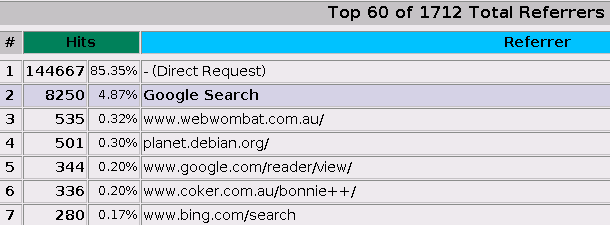
Chris Smart writes about the latest money making schemes for OS distributors, Canonical is getting paid by Yahoo to make them stop using Google as the default Firefox search engine [1]. I think this is OK, the user can easily change it back if desired and it allows them to pay the salaries of more employees who contribute code back to upstream projects. MSN uses 455M, Google uses 189M, and Yahoo uses 109MGoogle referrs 8250 hits, but Bing only refers 280 Above are sections of my Webalizer output related to my blog which show the data transfer use of search.msn.com (Bing presumably) which is 50% greater than that of Google and Yahoo combined. Why does MSN need to do 455MB of transfer so far this month to scan my blog when Google gets the job done with 189M and Yahoo only takes 109M? Also judging by the referrals Bing is only 3% as much use to me as Google. MSN uses 525M, Yahoo uses 132M, and Google only uses 35M Above is a sample of the Webalizer output from www.coker.com.au, MSN is using 525MB of data to scan the site which contains about 1.2G of static files that change very rarely. A Russian malware site seems to be downloading it three times a month, and Google only takes 35MB of data transfer to scan the site (which is probably still excessive). If Bing was a quality search engine that returned appropriate results then this could be forgiven. But however it is a very poor search engine that returns bad results. For example if you query Google or Yahoo for bonnie++ you will get an entire page of search results concerning my Bonnie++ benchmark, and those results are ordered in a sensible way. If you ask Bing then the first four results concern Bonnie (three women and a plant) and most of the first page don t concern my benchmark. Some time ago I had blocked MSN from scanning a server that I ran. The server in question had all the web servers for my domain plus quite a few other small domains. The total MSN data transfer was 3G per month which was almost half the data allowance for the server in question (data plans in Australia suck that s why my web servers are hosted in Germany now), so it was a question of whether to allow normal operation of the business or MSN searches. With Microsoft not running a popular search engine (then or now) it was an easy decision. I think that anyone who accepts money from Microsoft/Bing is doing their users a mis-service. Bing is simply an inferior search engine, it gets bad results and imposes excessive costs on service providers. Yahoo however seems to be a reasonable service, not as good as Google for the web hosters but not too bad. I wonder what would happen if Yahoo offered some sponsorship money to the Debian project in exchange for being the default search engine. I m sure it would be dramatic.

C.J. Adams-Collier: Font for composing Lushootseed

At the recommendation of David Beck, I have installed a TTF font from http://www.languagegeek.com/. It took a few minutes for me to figure out how to get it going, but it was pretty straightforward after that. Here are some quick instructions for those of you running Debian variants such as Ubuntu.
  1. Fetch the zip files from languagegeek.com and unpack:
    $ sudo mkdir -m777 -p /usr/local/share/fonts/truetype/languagegeek/
    $ cd /usr/local/share/fonts/truetype/languagegeek/
    $ for zip in AboriginalSerif.zip AboriginalSans.zip
    do
      wget http://www.languagegeek.com/font/$zip &&
      unzip $zip &&
      rm $zip
    done
    $ sudo chmod -R 755 .
    
  2. Register these fonts with the system using defoma (the debian font manager):
    $ for font in *.ttf
    do
      sudo defoma-font register truetype $PWD/$font
    done
    
While performing the defoma registration, I was presented with a number of warning-ish-looking messages for each file processed. For better or worse, I am ignoring them:
No CIDSupplement specified for Dotum-Bold, defaulting to 0.
No CIDSupplement specified for Batang-Regular, defaulting to 0.
No CIDSupplement specified for ZenHei-CNS, defaulting to 0.
No CIDSupplement specified for Batang-Bold, defaulting to 0.
No CIDSupplement specified for ZenHei, defaulting to 0.
No CIDSupplement specified for Dotum-Regular, defaulting to 0.
I used gnome-appearance-properties (System Preferences Appearance) to set my document font to Aboriginal Sans:
After telling Chromium that it should use these fonts, it renders all of the Lushootseed characters quite nicely.
<script>//<script language="javascript" src="http://reddit.com/button.js?t=1"></script>

26 January 2010

Joey Hess: issues with openmicroblogging

I tried switching from identi.ca to brainbird today, when my always present frustration with 140 character limit in microblogging boiled over. Again. In the process, I've found some warts in the OpenMicroblogging system, beyond its obsession with fitting into an obsolete sideband communication medium that I will never actually use. Rant mode on. Let's assume that OpenMicroblogging catches on, in a big way, and we're all using it in 10 years. So, it will be something like email. And its federated design allows for that; there can be multiple servers that communicate, and so on. (Which is a very good thing, compared to the twitter monoloth.) But: How many times have you changed your email address? When you did, you probably set up a .forward for the old email address, and emailed some people from the new address to let them update their address book, and it was not a big deal. But the experience when changing an OpenMicroblogging site is not the same. You have to go out and re-follow everyone. For each person, you have to go through a multiple screen (OAUTH) process. This process may not even be automatible. Second problem is that OpenMicroblogging does not use addresses. So to talk to me, one uses @joey'. It's not clear to me how sites determine whether to direct that to joey@identica or to joey@brainbird. Seemed like, if I switched to brainbird, I would need to pick a new username, to avoid having to check both places. Finally, the OpenMicroblogging spec, while really quite a neat approach to piggyback on OAUTH, has some absurd limits. 140 characters for a biography. Even the limit for one's full name is longer than that. Absurd. Suprisingly, no 140 character limit on messages actually exists, that's just a recommendation. But it's unclear how a system that sends a longer message interoperates with systems that use shorter messages. Probably the message will be truncated. And there is no way in the protocol to discover the message limit of a remote system. All in all, I think I prefer RSS, or Google Wave, or even IRC from a protocol perspective. And from a usability perspective, Facebook does not have absurd message limits, and most people read my messages there anyway. Meh.

Uwe Hermann: Roda RK886EX (Rocky III+) first laptop/notebook being supported by coreboot

coreboot logo Only few days ago a long-standing bug in coreboot, the Free Software x86 BIOS/fimware project, has been fixed: Adding support for a laptop/notebook. The code was developed by coresystems GmbH (thanks a lot!). Quoting from the announcement:
coreboot is running on a multitude of different computers, ranging from tiny embedded systems as small as the palm of your hand over desktop and server systems to super computers with thousands of nodes. However, one might say that in the area of mobile computers coreboot has to catch up, compared to its support of other devices. Thus, I am especially glad to announce that coresystems GmbH is releasing coreboot for the Roda RK886EX a.k.a Rocky III+ notebook today. It's a rugged notebook, protected against shock, vibration, dust and humidity:
http://www.roda-computer.com/en/products/notebooks/rocky-iii-rk886ex.html We have been testing various Linux distributions as well as Windows XP and Windows 7 booting on this nice notebook. I want to sincerely thank those who made this project possible with their funding:
  • secunet Security Networks AG
  • Bundesamt f r Sicherheit in der Informationstechnologie (Federal Office for Information Security, BSI)
A big thank you also goes to everyone who worked with coresystems on this project.
The committed patch series includes improved support for the Intel i945 / ICH7 chipset (which was also written by coresystems), the SMSC LPC47N227 Super I/O, the Texas Instruments Cardbus+Firewire bridge TI PCI7420, and finally the Renesas M3885x Embedded Controller (EC). Btw, the latter, the so-called embedded controller (sometimes integrated in the Super I/O, sometimes it's an extra chip) is one of the major problems for coreboot support on laptops. They are almost always undocumented (i.e., no public datasheets are available), but they have low-level control over power/battery management, early power-up sequence, and often include keyboard controller functionality and other important stuff. Luckily, for this notebook an EC datasheet is available. Checkout the coreboot EC support code for the Renesas M3885x for an impression of what this stuff is all about. Anyway, there is hope that this laptop will only be the first in a row of multiple supported ones in the future. Interested developers and contributors are of course always welcome on the coreboot mailing list :-)

25 January 2010

Peter Eisentraut: PostgreSQL: The Universal Database Management System

I'm glad you asked, since I've been pondering this for a while. $subject is my new project slogan. Now I'm not sure whether we can actually use it, because a) it's stolen from Debian, and b) another (commercial, proprietary) database product already uses the "universal database" line.

I have come to appreciate that the "universality" of a software proposition can be a killer feature. For example, Debian GNU/Linux, the "universal operating system", might not be the operating system that is the easiest to approach or use, but once you get to know it, the fact that it works well and the same way on server, desktop, and embedded ensures that you never have to worry about what operating system to use for a particular task. Or Python, it's perhaps not the most geeky nor the most enterprisy programming language, but you can use it for servers, GUIs, scripting, system administration, like few other languages. It might as well be the "universal programming language". A lot of other software is not nearly universal, which means that whenever you move into a new area, you have to learn a lot of things from scratch and cannot easily apply and extend past experiences. And often the results are then poor and expensive.

The nice thing about PostgreSQL is that you never have to worry about whether to use it, because you can be pretty sure that it will fit the job. Even if you don't care whether something is "open source" or "most advanced". But it will fit the job. The only well-known exception is embedded databases, and frankly I think we should try to address that.

Tollef Fog Heen: How free is the N900?

Lucas asks about how free the N900 is, whether he can download and recompile and reflash. I'll try to answer some of those questions. No, you can't download all the source. Part of it is just not open. I am not privy to Nokia's decisions on why or why not to open up, but it seems like the user interface bits are only partially open. Hildon itself is open so you can poke at widgets and see how those work. The address book is not open. The telepathy component that talks to the cellular modem is not open. As for having to accept EULAs, I honestly don't remember accepting one of those, but I'm not going to say there are none. There's at least one which is every time you install a package where you have to check a box saying "Yes, I know this package is third party and will not sue Nokia if it causes my house to burn down, my wife to divorce me or causes somebody to steal the car". It's annoying, but I'm willing to live with it. The contents of apt's sources.list is:
deb https://downloads.maemo.nokia.com/fremantle/ssu/apps/ ./ 
deb https://downloads.maemo.nokia.com/fremantle/ssu/mr0 ./ 
deb https://downloads.maemo.nokia.com/fremantle/ovi/ ./ 
deb http://repository.maemo.org/extras/ fremantle free non-free
deb http://repository.maemo.org/extras-devel/ fremantle free non-free
(technically, it comes from /etc/apt/sources.list.d/hildon-application-manager.list, not sources.list.) I believe the built-in applications are generally not free, so rebuilding everything that is free will for instance leave you without any address book UI, the built-in map application or camera. Sadly, the X driver is also proprietary, so you won't be able to see anything either. I don't think you can usefully install another free distro on the N900. You might be able to, at some point, assuming somebody goes to the effort. The last question is "- Besides the non-free telephony stack, are there any other antifeatures I should be aware of?". The telephony stack is implemented around Telepathy, which is LGPL-ed free software. While it's correct that telepathy-ring (which talks to the cellular modem), the call UI and most of the address book are proprietary, the rest of Telepathy is free. There are SIP and XMPP connection managers that are free, and you can install more connection managers for MSN, IRC and so on. Also, I think it's important to emphasise that the telephony stack does not contain any antifeatures. The closest thing you would be able to find is probably the restriction to one active and one held call at the same time, but as one of the developers said: "That's to prevent the UI from going mad". While I like to tout the N900 as a free phone, it is in no way completely free. Large parts of it are free, and almost as importantly: most of the programming interfaces are free and at least somewhat documented, so if somebody wants to replace the built-in camera application with a free one, they can replace the DBus interface that the camera app provides. Ditto for maps applications, the address book and so on.

MJ Ray: Critical Eye: Google, China, DNS and an Event

My Google Bugs page started off as a blog post back in 2006, but I ve moved it to a more permanent home and started to bring it up to date. Recent additions include the China Controversy updated, a recent search bug added andDNS service added. In just over a month, BathLitFest will be holding a debate on Is Google Good For You? Sunday 28 Feb, 1pm 2pm. The key questions are:
In the data-sharing and database age, how much information are we prepared to give away about ourselves and who, ultimately, controls that information? Is the price of convenient, high-speed communication an almost total loss of privacy? And is it right that one company knows more about us than our government, or even than we know ourselves?
Tickets are on sale, priced 7. That s pretty much what I was pointing out back in 2006. I don t hate Google or anything, but we should be realistic: it is a for-profit company, so probably won t be doing anything truly for free. There s always a payback and we should recognise it as part of making an informed choice about whether to trade with them. It s nice to see these questions getting a more mainstream airing. If you ve got any updates for the Google Bugs page, please let me have them.

24 January 2010

Gregor Herrmann: BRU revisited

I'm going to FOSDEM, the Free and Open Source Software Developers' European Meeting

I enjoyed being at FOSDEM last year, so I'll be going there again in two weeks' time. & I'm really looking forward to meeting some nice people again!

Steve Kemp: What the hell are you laughing at?

Slaughter
I received my first patch to slaughter today, which made me happy. (I've made a new release including it, and updated the list of primitives to actually document the file-deletion facilities which previously I'd omitted to avoid encouraging mass-breakage.)
Signing Binaries
Andrew Pollock mentions that the days of elfsign might be numbered. This is a shame because I've always liked the idea of signing binaries. Once upon a time, in the 2.4.x days, I wrote a kernel patch which would refuse to execute non-signed binaries. (This was mostly a waste of time; since it denied the execution of shell scripts. Which meant that the system init scripts mostly failed. My solution in the end was to only modprobe my module once the system was up and running, and hope for the best ...) Right now, having performed only a quick search, I don't see anything like that at the moment.
  • elfsign will let you store a binaries MD5 hash.
  • bsign will let you sign a binary with a GPG key.
But where is the kernel patch to only execute such hashed/signed binaries, preventing the execution of random shell scripts and potentially trojaned binaries? Without that I think signing binaries is a crazyish thing to do. Sure you can test that a file hasn't been modified, but even without those tools you can do the same thing via md5sums. (ObRandom: Clearly if you mass-modify all your binaries the system md5sums database will be trashed.)
Perl UTF
I've received a bug report against chronicle, my blog compiler. It seems that some versions of perl fail to run this:
     #
     #  Run the command, reading stdout.
     #
    open( FILTER, "$cmd ;utf8" ) or
       die "Failed to run filter: $!";
Removing the ;utf8 filter allows things to work, but will trash any UTF-8 characters from the output - so that's a nasty solution. I'm not sure what the sane solution is here, so I'm going to sit on it for a few days and continue to write test scripts.
ObSubject: 300

Russell Coker: Preventing Children from Accessing Porn

The following was written by Stefano Cosentino in regard to the ongoing efforts of the Australian government to censor the Internet with protecting the children as an excuse. All these Internet filtering ideas that have been in the news lately has made me voice my own opinion on the matter as a non-expert. I m an IT advisor. I take someone s problem and help them fix it. I have a few clients who provide laptops to their students, everything is done with these laptops. The students have no books. The school provides laptops to their primary school students as well as their high school students. They have done this long before the public system started to hand out laptops to a select number of high school students. When you provide a child with anything, there are always areas where a child will find that you may have overlooked. In fact, a young kid will probably find a host of things that you might have totally missed or didn t ever know about. One of these things is the inappropriate nature of information you may find that are associated with computers. This can be anything. But specifically, what the filtering argument has been about has been leaning towards Internet pornography and I would imagine, more specifically content of a pedophiliac nature. I m not against child pornography being banned or filtered. I personally think this is one of the most cruel, inconsiderate, disrespectful and self centered behaviors a person could display. Their psychological makeup isn t the scope of this article. However these ideas must be conveyed when discussing the Internet as a modern technological device that can be used for both good and bad. The primary school students that I attend to aren t very interested in this stuff and as it has been mentioned long ago by others who have joined this argument, are more interested in online flash games that include characters such as Ben 10, Pokemon and Yu-Gi-Oh. When I m called in to scan these computers during the school holidays and hand the laptops back to the kids or when they get handed back after 3 years for new ones, I find that the older primary school kids computers are usually more prone to the adult orientated content. To me this is the first sign of a filter s failure. This customer of mine spends more money on the filtering devices they use on campus than I charge them for a few days of work. Does it work? Sadly, I hate to report that no, it does not. It s completely useless. The kids still have files and traces of files on their computers that isn t suitable for young children. Not only pornography but also content of a violent or morbid nature. As young and impressionable people, everything they read, see and hear is absorbed. This shapes the way society will become in years to come. Since no one can realistically tell the future, wouldn t it be nice if we could make sure that the people looking after us and our lives forty or fifty years from now have a sane mind free of blemish? It s a different story for the high school children. While scanning their laptops I have to contact the police on a daily basis because of the nature of the content I find during my day. Some things you can let slip, today s version of a pinup girl, or a provocative pic of whatever skimpy clad girl the record companies are flogging off these days as musicians. But sadly that s rare. I won t go into detail of what I find on these laptops of 14 year old boys, but it ranges from some innocent growing up curiosity right to perverted, sick and most if not all of the time, illegal content. The filters fail again. The kids find a way around it. And they find it easily. I ve seen filters work and not work at all with young kids right through to young adults. All the filters do is either hinder the poor kids actually trying to do research of scholastic nature or prolong the inevitable and temporarily block a determined child s interest in the search for some adult related material. The filter might prevent accidental viewing but it doesn t stop the deliberate finding of pornography and other illegal content. How does a filter stop this from happening? How does a filter stop a child taking their parents adult videos and copying them to their laptop or finding dad s stash of Penthouse? How does it stop a school mate bringing this stuff to school to show everyone at lunch time or to trade for other content they found by other means. Remember back to when you were their age and caught a glimpse of your big brother s room wall. How many times did you try and catch a peak at that Samantha Fox poster hanging off the wall? Where s the filter now? Here s some thing to think about. The filter shouldn t be a thing, it should be a person. They re called responsible . They re called parents. What priorities do parents have if their child feels that what they look at online that is of an adult nature is acceptable? Or maybe the kid knows better, knows it isn t acceptable but still goes out of their way to get the stuff on their computer? Sneaker Net still exists, USB memory sticks are cheap and can now have two or three straight DVD rips on them, or perhaps five or six encoded films on there. Hundreds and thousands of images and so on. Filter failure again. When the kids go online, they know of the technology used to block them from gaining access to what they want to see. Chances are, they ll know what a proxy server is and does. Then they ll figure out what they need to do to get around the filter. I, myself did this back in high school and TAFE when I couldn t find photographs of a particular device I was researching. Turns out the name is also a form of sexual activity, in another language, but still. The filter stopped me from not only looking the offending content but also to look at the legitimate data that I needed to complete an assignment. I got around the problem by researching some more information and the following day I was breaking through firewalls and proxy servers with easy. Filter failure. How do I get around this issue when speaking to younger kids that need guidance and knowledge on how to deal with this situation? I hold talks at the school I provide my services to. I talk to the parents, no kids. The talk costs less than a broken filter they keep throwing money at keep up-to-date. The school puts these filters in place to appear responsible, because while the kids are attending their school, the school is in fact responsible. In fact, there is nothing more the school can do. They could educate the children, but you can tell someone what to do, and the chances of them doing it are pretty dismal. Music is not allowed on their computers either. Yet we constantly find iTunes on there and a host of music that traces to certain peer to peer applications where they acquired the stolen music. If a kid can learn how to do that, imagine what sort of influence can be placed on them from a more positive angle. Like maybe parents providing an explanation for starters of what it is they re looking at. What it is they ll find online. What material is inappropriate. What material should you tell an adult about. Why do I get stupid emails with Russian girls wanting to marry me. Kids absorb everything. Parents have relegated responsibility but not delegated it. This filter idea might help slow down a child s enthusiasm to learn about everything, both good and bad. But educating the kids from an early stage in life about morals and the modern world where lets think about it, we have absolutely everything we need and want at our finger tips will be more valuable than any filter. But the fact that we have so much available makes it difficult to say what is and isn t appropriate for a child to see. It is up to us to inform the children of what s out there is the world. It may or may not stop them from seeing the adult related content, but it will help them respond to it in a mature and adult manner. We all know, kids aren t stupid. So, if the filters worked, why am I called in once a year, every year to give my talk to parents?

Next.

Previous.