Search Results: "ms"

23 October 2013

Russell Coker: LUV Hardware Library after 20 Months

20 months ago I started the LUV Hardware Library [1]. The aim of the project is to provide a repository of free spare parts for computers for the use of club members. People who have parts that are good but which they can t use can donate them and others who need such parts can take them. Some people have criticised my choice of the name Hardware Library because the word is associated with borrowing while with my Hardware Library it is expected that noone will return the item that they take. The Wikipedia page about libraries is worth reading, my interpretation of that is that the essential aspect of a library is that it is a public collection of items that are useful for study and that borrowing is just one thing that can be done. A book library could consist of a service of printing free books on demand (anyone could do this with access to The Gutenberg Project [2] and a printer) or of just making them available to download. Many libraries don t allow books to be borrowed, they just allow them to be studied and copied in the library. Also every general public library has reference items that can t be borrowed, it s typical for a library to have a full encyclopedia which is not available to be borrowed. Also with the Hardware Library people feel obliged to give something if they take something (as happens with a geocache), so there is an issue of returning something. My main aims with the Hardware Library were to save people money on parts and to help the environment by reducing the need to buy new computers when old ones can be upgraded and remain in service. My next aim was to help people learn about hardware by providing free parts, when a mistake has no financial cost people are more willing to experiment and will learn more. I believe that those aims have been achieved. More Successful Than Expected One thing that surprised me is the social aspect that developed. I had expected that most people would just find some parts that they need and not look at it again for some months. I had also anticipated that some people would poll the Hardware Library every month in the hope that a part they needed might appear. I didn t expect that people would look through it every month because they just like looking at old hardware. I also didn t expect groups of people to hang out by the Hardware Library to discuss various issues related to PC hardware and Linux. During the breaks in the main meeting the location of the Hardware Library often becomes a focus for discussions of various issues related to Linux and hardware. I think that this is really advancing the aims of LUV [3] and I think that members of other LUGs should experiment with similar projects. Starting this didn t require any special skill or authority. I just started bringing a briefcase full of parts to meetings and offering them to whoever was interested. Any member of any LUG can do the same. To start something like this you wouldn t even need a collection of parts, you could just bring a box and ask for donations.

Russ Allbery: Review: Lean In

Review: Lean In, by Sheryl Sandberg & Nell Scovell
Publisher: Alfred A. Knopf
Copyright: March 2013
ISBN: 0-385-34994-7
Format: Hardcover
Pages: 217
Lean In is normally listed as written only by Sheryl Sandberg, which is also what's on the dust jacket, but the inside cover says "with Nell Scovell." Given what that normally means for celebrity books, supported by comments in the acknowledgments, I'm listing it as co-written by Scovell. However, much of the book is written in the first person and is clearly meant to be Sandberg's voice, so I will mostly refer to Sandberg as the author for the rest of the review. I was unfair to this book. Lean In made quite a splash when it first came out, since the named author is the Chief Operating Officer of Facebook, a former vice president of Google, and one of the most prominent female executives in the business world. The subtitle is Women, Work, and the Will to Lead, and the normal Internet summary was that it focused on how women could change their behavior to be more effective and successful in the business world. Throw in some ridiculous review hyperbole (one New York Times writer compared it to The Feminine Mystique, which is a bit like the comparison of every extruded fantasy product with The Lord of the Rings) and I was ready to hate this book. It's work advice from someone in a very privileged position, and it seemed to have a distinct whiff of victim-blaming. It's obvious, however, from the first few pages that Sandberg was very aware of this trap and had no intent of falling into it. This is hard: giving practical advice to women on how to navigate a sexist culture runs a severe risk of victim-blaming even with the best of intentions, particularly since part of the sexism of the culture is a pervasive impression that women aren't doing enough. But I think Lean In handles that about as well as one could while still writing a book focused on practical advice rather than revolutionary change. Sandberg is clear that many things women can do to help their careers shouldn't be necessary, and she takes some time, in each section, to talk about the shape of any structural unfairness that she's seen. What advice she offers here is clearly in the spirit of how to navigate a system that is unfair and unequal, but which can be navigated and can be made more fair by more women participating. This is a very practical book, with more in common with business self-help books than with feminist critiques. It's also a narrowly targeted book, not that you'd guess this from the number of copies it's sold and the sort of publicity it got. Lean In is advice to female executives about how to navigate the top levels of US business culture, with a strong eye for issues of feminism, gender-based double standards, and potential traps of self-sabotage. It offers a blend of encouragement, practical tips, and some forthright analysis that tries to bring to the surface internalized sexism and perceived barriers and limitations for female executives so that they can be addressed and hopefully overcome. It's not in any way a revolutionary book, either with respect to business culture or with respect to gender roles; rather, it's an open acknowledgment of a whole bunch of problems combined with practical advice for how to work around those problems until they can be solved. For the most part, it doesn't attempt to address how to solve the problems. There is nothing wrong with that as a focus for a book. Lean In has attracted a fair bit of criticism in some circles, but, after reading the book, I think a lot of that criticism is predicated on assuming different goals than this book actually has. Contrary to various glowing reviews, Lean In is not a book that's going to change the world; rather, it's a book that might help a narrow band of the population in a specific job and career path navigate problems of sexism and gender expectations and be more effective. Read in that light, it struck me as honest, open, considered, and well aware of its own limitations. Sandberg says repeatedly that many of the options she discusses simply aren't available to most women, and that women may not be in a position to be able to make the decisions she made. She's quite forthright about the limitations of her own experience and the limitations of the advice that she offers, and I think deserves full points for honesty. Similarly, when it comes to business culture, Lean In is not about changing that culture for the better. It's about navigating that culture as it exists. Here, I think Sandberg is less aware of the limitations of this perspective; there is far less acknowledgment in Lean In that executive culture may be inherently toxic as there is of the limitations that women face in business. But while Sandberg has an obvious blind spot, this is not a paean to overwork. It has some excellent advice about work-life balance, including the need to put strict limits on the amount of time one spends in the office and the necessity for someone to pick up substantial burdens in the home if one of the members of a household is going to pursue a business executive job. I was worried, going in, that Lean In would excuse, justify, or idealize the culture of exploitation so common with salaried jobs in the United States, but it really doesn't. As with feminism, it doesn't pick any deep fights, and those with a "kill it with fire" gut reaction towards US executive culture (such as myself) will find the bland acceptance of it irritating, but this is more of an issue with reader expectations than with the book. One should not expect a highway map to point out that trains are more efficient. So, I'm willing to stand up for Lean In to a degree. This is not a bad book. It's very readable, parts are quite interesting, and some of Sandberg's observations about the intersection of gender expectations and executive culture were worth hearing. I learned some things from it. But I think one should read it in full awareness of its limitations. This is a book of practical advice that will only be of direct use to 10% of the population, and which could be generalized with some effort to maybe 25%. It has little to say to women who are not in white-collar, professional jobs, and its applicability to women who aren't aiming for executive careers is a bit hazy. It's the kind of book that's full of anecdotes about how Sandberg got parking spots reserved for pregnant women at Google by talking to the founders about it, or about how to negotiate salary when offered an executive position, which are vaguely interesting but of dubious practical benefit to people who aren't offered jobs where salary and benefit negotiation is available. This isn't the fault of the book, but at times it is rather stunning how different (and how much more tractable) the world looks to someone with the wealth and personal connections that Sandberg has. (To her credit, Sandberg does seem to be aware of this and does acknowledge it.) If you are a female executive, or a male executive interested in developing your empathy and understanding of how institutional sexism affects your colleagues, I suspect Lean In would be quite helpful. If you're not, I think it's mostly a curiosity. But it's also well-written, well-organized, probably available in most libraries in the United States, and provides anecdotal data to help build a more complete picture of the concerns and experiences of female executives. Unless you're in the specific target audience, I'm not sure I'd recommend going out of your way to find it, but it's probably worth reading if it falls into your lap. Rating: 7 out of 10

22 October 2013

Francesca Ciceri: Improving collaboration skills

[...] this is a great example of overcoming something that we call "problem A, problem B" paradox.
So you've got a group of people coming together, and they're all trying to solve the same problem (problem A) and they're really passionate about it. And then, you've got this problem B thing, which is that you got a bunch of people with different views.
And they may seem to be conflicting, and it seems like a paradox: the same differences that we need to solve the problem are getting in our way. But if you think about it as a paradox, you can get through it.
You think: OK, we've got all these differences. You have to identify the differences that actually are going to move us forward and those that are getting in our way.
And the differences that are getting in your way, set them aside. Push them off to the side and focus on the ones that are helping you move forward.
Kathryn Jablokow Well, I noticed that at first everybody was saying "Yes, but this is my idea".
And as we got closer and closer together, it became "Yes, and".
Jack Matson
(Quotes from a lecture about "Collaboration skills", part of the Creativity, Innovation and Change course on Coursera) IMO this is an important lesson to learn if you want to work effectively in a community project like Debian.
We talk much about diversity, and the added value of diversity in our project.
But diversity also means that to converge towards consensus is difficult and requires a specific set of best practices. A little thing like saying "Yes and" instead of "Yes but" could be of help. Words definitely matter.

21 October 2013

Aigars Mahinovs: Moved to Mezzanine

After my server that has hosted my blog for some years had given out its last breath (second motherboard failure), I decited it was time for a change. And not just server change, but also change in the blog engine itself. As I now focus on Python and Django almost exclusively at work, it felt logical to use some kind of Django-based blog or CMS. I tried django-cms and mezzanine and ... Mezzanine is so fast and simple, that I simply stopped looking. After simply following the tutorial and creating a skeleton project, I had a ready-to go site with all the CMS features, incuding a blog. I just had to change a few settings to have the blog module be the home page of the site, change site settings for the title and Google Analytics settings and such and tweak the theme a bit to my liking. This was my first real exposure to a Bootstrap design. I must say - it is very simple to understand and modify if your needs fit within its limits. For example, I wanted to remove the left sidebar and expand the main content block to fill that. All I had to do was to remove the div element with class "left-sidebar span-2" and change the class of the main content part from "span-7" to "span-9". To do that I simply copied the templates/base.html file from mezzanine default templates and modified it. The information from django-debug-toolbar showed me what files were used in rendering the page. But the feature that really got me hooked was the Wordpress import. Using a simple management command I was able to feed into Mezzanine instance the XML export file from Wordpress. It created blog posts, categories, comments, static pages and even redirects from Wordpress permalinks to Mezzanine permalinks. It was not flawless - there were a few issues: After that was done it was a relatively straightforward process of picking up the code and data and deploying it to a Django-friendly hosting service. There is a plenty of good competition out there, most now offer a simple one-click Django installation, so I just created a simple Django skeleton via their web interface and then replace what they generated with my app while keeping their settings as local_settings.py . I should probably write a bit more details about the process. After I create a custom fabric file for this. It is quite a strange feeling to have a Mezzanine blog that responds faster from a shared server half a continent away, compared to a Wordpress on dedicated server in the same room There are a few features that I am still missing - most notably draft post autosave. That has bitten me hard while writing this post :P Also a Twitter digest post feature. But on the bright side - that is a great motivation to write such features, preferably in a portable way that other people can use too :)

Daniel Pocock: Debian team at GSoC summit 2013

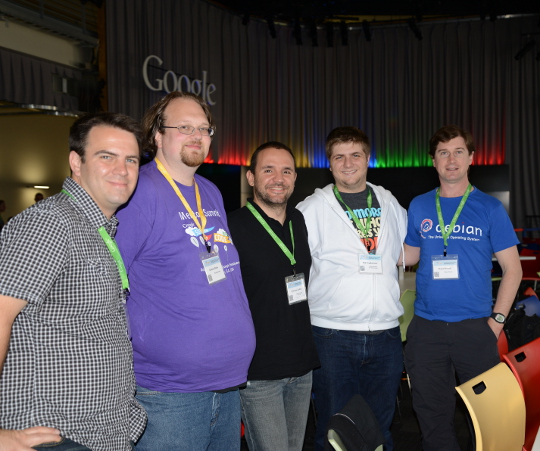
One of the most exciting things about the GSoC mentor summit 2013 has been the large number of participants who are Debian Developers, Debian Maintainers or other members of the wider Debian family Debian team members at GSoC mentor summit 2013
AttachmentSize
debian-gsoc-summit-group.jpg175.13 KB

20 October 2013

Ricardo Mones: Forced to 3.11

No, not to this 3.11, but to Linux kernel 3.11.

I was aware of the #718533 bug, which happens when you have a software RAID with anything higher than 3.2.0 (mine is RAID 1 with 2 disks). At least that has been my case since I tried to upgrade, hence I was delaying upgrades again and again.

Unfortunately today things went worse when I tried to plug my USB 3.0 device on the system:
Oct 20 17:52:51 busgosu kernel: [20799.672127] xhci_hcd 0000:02:00.0: Timeout while waiting for address device command
Oct 20 17:52:51 busgosu kernel: [20799.876136] xhci_hcd 0000:02:00.0: ERROR no room on ep ring
Oct 20 17:52:51 busgosu kernel: [20799.876148] xhci_hcd 0000:02:00.0: ERR: No room for command on command ring
Oct 20 17:52:51 busgosu kernel: [20800.080148] usb 2-2: device not accepting address 2, error -12
Oct 20 17:52:51 busgosu kernel: [20800.080202] xhci_hcd 0000:02:00.0: ERROR no room on ep ring
Oct 20 17:52:51 busgosu kernel: [20800.080209] xhci_hcd 0000:02:00.0: ERR: No room for command on command ring
Oct 20 17:52:51 busgosu kernel: [20800.080221] xhci_hcd 0000:02:00.0: ERROR no room on ep ring
Oct 20 17:52:51 busgosu kernel: [20800.080227] xhci_hcd 0000:02:00.0: ERR: No room for command on command ring
Oct 20 17:52:51 busgosu kernel: [20800.080235] hub 2-0:1.0: couldn't allocate port 2 usb_device
Oct 20 17:52:53 busgosu kernel: [20801.568169] xhci_hcd 0000:02:00.0: ERROR no room on ep ring
Oct 20 17:52:53 busgosu kernel: [20801.568181] xhci_hcd 0000:02:00.0: ERR: No room for command on command ring
Oct 20 17:52:53 busgosu kernel: [20801.568190] hub 2-0:1.0: couldn't allocate port 2 usb_device


And of course the device didn't show up. As there's not much relevant stuff about this issue on the googlesphere, thought it may have been solved. And turned out that I was right: upgrading fixes this, and now the device works again.

But, hit by the above bug now I have to add a rootdelay=1 to my kernel boot parameters (started testing with 5 but finally seems one second is enough). Fortunately the Ubuntu folks have detailed how to do it ;-)

19 October 2013

Daniel Pocock: Debian at GSoC mentor summit 2013

We're having so much fun that I'm just posting a couple of pictures... a full report will come later Sylvestre and Daniel
Paul

Dirk Eddelbuettel: New BH release 1.51.1-3

A new release of the BH package is now on CRAN and its mirrors. BH provides (a subset of) the Boost library for C++, particularly the (large) parts delivered as pure template headers not requiring linking. When this package is installed, an R package developer can deploy it at build-time via a simple LinkingTo: BH declaration (which, despite the title affects only compilation, not linking; don't ask...). This frees developers from having to include the (sizeable) Boost headers in their packages, and provides (parts of) Boost as part of the R build system. A short example of using this BH package with Rcpp is provided in this Rcpp Gallery post; a number of other Boost-related posts are also available. This release expands the scope of the package by a quite bit as shown in the NEWS entry:
Changes in version 1.51.0-3 (2013-10-19)
The other change is that I am now acting as maintainer taking over from Jay who has headed the initial creation and first releases after he, Mike and I had talked about this for way too long without actually doing anything about it. Thanks for getting everything rolling, Jay! Comments and suggestions are welcome via the mailing list or issue tracker available via the package page at R-Forge.

Dirk Eddelbuettel: Yes another Herbie Hancock concert

Hadn't mentioned yet that I saw Herbie Hancock last Friday at the CSO / Symphony Center. That's about the fourth time I have him according to this blog (September 2007,March 2005, April 2004) and I think I saw him two more times when I lived in France, and maybe once while I was in Canada. This time, the format was a horn-free quintet with Lionel Loueke on guitar, James Genus on bass, Vinnie Colaiuta on drums and Zakir Hussain on tabla. Hancock himself played mostly keyboards / synthesizer, even when he used the full piano as input. Overall the concert was little uneven--Hancock himself alluded to the fact that the five hadn't really practised together. At times they were rolling: the opening was a very rhythmic version of his very old standard Watermelon Man; the encore was a very rocking version of his best-selling pop-fusion hit Rockit. In between, it was sometimes wanting. Still, all five are tremendous artists and I also had a fabulous seat as shown in this Google+ post with a picture of Hancock's setup, including multiple screens. But they did not really connect with audience as a whole, and by the time the encore rolled around, the house was pretty empty.

18 October 2013

Olly Betts: INT(PI)

Slide 5 from my nostalgia-fest "The Art of Writing Small Programs" from just under two years ago: The Art of Writing Small Programs - Slide 5 XKCD 1275 from last week: xkcd 1275 - INT(PI) (Of course that should be INT SQR EXP PI/INT PI * PI * R ** INT PI).

17 October 2013

Stefano Zacchiroli: org-mutt ported to org-capture

org-mutt with org-mode >= 8 Thanks to Don I just remembered that I haven't yet announced org-mutt support for org-mode >= 8. Let's catch up! Since a few weeks I've been aware of the fact that my mutt/org-mode glue, AKA org-mutt, was no longer working with org-mode >= 8, due to the ditching of org-remember in favor of org-capture. Allegedly, org-capture should have been backward compatible, but it clearly is not. Before I had time to fix it myself, Mako came to my rescue and submitted a patch (now accepted) that does the needed porting. Free Software is truly amazing, isn't it? I've just updated the canonical org-mutt blog post, so that the documentation in there is up to date again. If you're using org-mutt, I suggest to refer to the Git repository as the canonical location for future updates, if any. Thanks Don, thanks Mako!

Don Armstrong: Using Mutt with Org Mode (with refile)

I use org mode extensively, and had added Zack's workflow for integrating mutt with org mode to my ~/.emacs some time ago. However, I've been annoyed that refiling closes the org-capture frame before refiling finishes. The following trivial modification to Zack's code (which I previously modified to work with org-mode >= 0.8) waits to close the frame until you've finished refiling.
 (require 'org-protocol)
 (add-hook 'org-capture-mode-hook 'delete-other-windows)
 (setq my-org-protocol-flag nil)
 (defadvice org-capture-finalize (after delete-frame-at-end activate)
   "Delete frame at remember finalization"
   (progn (if my-org-protocol-flag (delete-frame))
          (setq my-org-protocol-flag nil)))
 (defadvice org-capture-refile (around delete-frame-after-refile activate)
   "Delete frame at remember refile"
   (if my-org-protocol-flag
       (progn
         (setq my-org-protocol-flag nil)
         ad-do-it
         (delete-frame))
     ad-do-it)
   )
 (defadvice org-capture-kill (after delete-frame-at-end activate)
   "Delete frame at remember abort"
   (progn (if my-org-protocol-flag (delete-frame))
          (setq my-org-protocol-flag nil)))
 (defadvice org-protocol-capture (before set-org-protocol-flag activate)
   (setq my-org-protocol-flag t))
Now, the frame automatically disappears after you refile it, keeping my refile.org clean.

16 October 2013

Matthew Garrett: Standing for the Linux Foundation Technical Advisory Board

According to its charter, the Linux Foundation Technical Advisory Board exists "to advise The Linux Foundation Board of Directors (Board) and the management of The Linux Foundation (Management) on matters related to supporting the technical agenda of The Linux Foundation". It consists of 10 members, with 5 seats up for election each year. Elections take place at an event at Kernel Summit, but are also open to attendees of whichever conference is colocated with the Kernel Summit that year. The election announcement is emailed to the Linux kernel list and tech-board-discuss, a mostly moribund list that springs into life once a year for election announcements.

This arrangement seemed odd to me even back in 2007. Back then the Linux Foundation was already sponsoring development of certain non-kernel components, and now that list is even larger. While nominally open to all, nominations for the TAB tend to end up being people actively involved in the kernel community. That's probably better than people limited to any other single technical community (kernel developers tend to end up dealing with bugs from a fairly wide range of projects, so they're not entirely unaware of what other people have to deal with), but it still seems suboptimal. The current membership is mostly limited to people who spend little to no time working with userspace developers, let alone anyone active in other Linux Foundation projects. I don't think this is a good thing

So, after several years of considering it, I'm finally standing for the TAB. I've been an active developer at most levels of the Linux stack, from the kernel through to desktop environments. I've worked closely with distributions. I've even worked closely with firmware developers. I'm not intimately involved in any of the other Linux Foundation projects, but I have experience that allows me to better understand their needs and motivations than I'd have from having spent my entire life living in the kernel. Being on the TAB would make it easier to ensure that these projects are represented in a meaningful way.

Of the other people who I know are standing (and this list may well grow longer), I'm inclined to vote for:
The election is currently scheduled to be National Museum in Edinburgh on the evening of the 23rd of October. If you're attending Linuxcon or one of the colocated events, please do come along and vote.

(Updated to correct a typo)

comment count unavailable comments

Carl Chenet: Brebis 0.7, the fully automated backup checker

Follow me on Identi.ca or Twitter The new version of Brebis Chevillette 0.7 was published two days ago. Brebis is a fully automated backup checker. Brebis does not create backups. It only performs controls on them. Brebis is able to detect a corrupted archive compressed with different formats, automatically checking the integrity of your archives and lots of parameters of the files inside these archives or inside a tree of files and provide detailed reports if unexpected states are detected. Check out the list of the supported features. What s new? The main features of this new version are: Complete example of installing, configuring and running Brebis How to install from your package manager Brebis is available in Debian, FreeBSD, Archlinux and Frugalware. Use your favorite package manager to install it. How to install from the sources
# wget http://brebisproject.org/attachments/download/8/brebis-0.7.tar.gz
# tar zxvf brebis-0.7.tar.gz && cd brebis-0.7
# python3.3 setup.py install --install-scripts=/usr/bin
# mkdir /etc/brebis
What you need before running brebis Our goal is to check on a regular basis the archive /backups/monthly-backup.tar.gz. Brebis needs two files in order to correctly run: a configuration file with general parameters and the list of files with all their parameters. Don t be afraid, both of theses files will be generated by Brebis with the following command:
# brebis -G /backups/monthly-backup.tar.gz
# ls /backups/
monthly-backup.tar.gz monthly-backup.conf monthly-backup.list
All the files inside your archives have been detected and their names and parameters (uid, gid, mode, md5, ) have been written in the file monthly-backup.list. More information about those files. How to configure Brebis Lets save /backups/monthly-backup.list in /etc/brebis: # mv /backups/monthly-backup.list /etc/brebis For /backups/monthly-backup.conf, we just modify the files_list parameters:
[main]
name=monthly-backup
type=archive
path=/backups/monthly-backup.tar.gz
files_list=/etc/brebis/monthly-backup.list
We also save monthly-backup.conf in /etc/brebis: # mv /backups/monthly-backup.conf /etc/brebis Use Brebis Using Brebis is as simple as: # brebis -c /etc/brebis/ -l /var/log/brebis.log If there is not any difference between the current state of your backup and your list of file, the logfile /var/log/brebis.log will be empty. If any difference happens, they will be reported in /var/log/brebis.log. Show time. I m modifying the md5 hash sum of a file in /etc/brebis/monthly-backup.list, during the next run of brebis, I get the following content in brebis.log:
WARNING:root:1 file with unexpected hash while checking
/backups/monthly-backup.tar.gz:
WARNING:root:toto/titi hash is ce4f8cacd8fc702bdd03531b9447818b.
Should have been ce4f8cacd8fc702bdd03531b94478184.
As you can read, Brebis reports a difference between what was expected and what it checks. Now it s easy to do the same for any backup you want to check on a regular basis. Just add something like the next line in /etc/crontab: 01 00 * * * root brebis -c /etc/brebis/ -l /var/log/brebis.log A brebis run will happen every day at midnight to check your backup. Every configuration files in the directory /etc/brebis/ will be inspected. Feedback about Brebis We at the Brebis Project welcome any feedback about Brebis. Feel free to subscribe to the Brebis-users mailing list, by Twitter or email me directly at carl.chenet@brebisproject.org
Official website: http://www.brebisproject.org
Mailing-list: http://lists.sourceforge.net/lists/listinfo/brebis-users

15 October 2013

Craig Small: Damn you, unworking r8168

I really don t know why ethernet device makers insist on making it hard for to use their products. Ethernet has been around for many, many years; surely its not too much to ask for drivers that just work . And so that s the problem I currently have with my new computer. It has an onboard Ethernet interface which uses a Realtek chip and that s where the problems have been (with the exception of a power button that wriggled free, but that is also easy to fix). The device comes up as:
03:00.0 Ethernet controller: Realtek Semiconductor Co., Ltd. RTL8111/8168B PCI Express Gigabit Ethernet controller (rev 06)

I ve used:

and all of them don t work.  It seems that the receive side works fine (I sometimes get a valid IPv6 address) but no packets are sent, even ifconfig eth0 shows zero transmitted packets.
ethtool shows some of the setup, this is with the r8168 driver:
driver: r8168
version: 8.037.00-NAPI
firmware-version: 
bus-info: 0000:03:00.0
supports-statistics: yes
supports-test: no
supports-eeprom-access: no
supports-register-dump: yes
supports-priv-flags: no
Interestingly, if I use the r8169 driver in the kernel and try ifup etho then I do get an entry in the firmware-version spot. dmesg also shows that it finds the device.
[  0.916487] r8168 Gigabit Ethernet driver 8.037.00-NAPI loaded
[  0.916667] r8168 0000:03:00.0: irq 72 for MSI/MSI-X
[  0.939129] r8168: This product is covered by one or more of the following patents: US6,570,884, US6,115,776, and US6,327,625.
[  0.939136] r8168  Copyright (C) 2013  Realtek NIC software team <nicfae@realtek.com>
[  10.807066] r8168: eth0: link up
So it all looks good, except it won t send any packets. Anyone got one of these devices and if so (and more importantly) how did you get it to work?

Francois Marier: The Perils of RAID and Full Disk Encryption on Ubuntu 12.04

I've been using disk encryption (via LUKS and cryptsetup) on Debian and Ubuntu for quite some time and it has worked well for me. However, while setting up full disk encryption for a new computer on a RAID1 partition, I discovered that there are a few major problems with RAID on Ubuntu.

My Setup: RAID and LUKS Since I was setting up a new machine on Ubuntu 12.04 LTS (Precise Pangolin), I used the alternate CD (I burned ubuntu-12.04.3-alternate-amd64+mac.iso to a blank DVD) to get access to the full disk encryption options. First, I created a RAID1 array to mirror the data on the two hard disks. Then, I used the partition manager built into the installer to setup an unencrypted boot partition (/dev/md0 mounted as /boot) and an encrypted root partition (/dev/md1 mounted as /) on the RAID1 array. While I had done full disk encryption and mirrored drives before, I had never done them at the same time on Ubuntu or Debian.

The problem: cannot boot an encrypted degraded RAID After setting up the RAID, I decided to test it by booting from each drive with the other one unplugged. The first step was to ensure that the system is configured (via dpkg-reconfigure mdadm) to boot in "degraded mode". When I rebooted with a single disk though, I received a evms_activate is not available error message instead of the usual cryptsetup password prompt. The exact problem I ran into is best described in this comment (see this bug for context). It turns out that booting degraded RAID arrays has been plagued with several problems.

My solution: an extra initramfs boot script to start the RAID array The underlying problem is that the RAID1 array is not started automatically when it's missing a disk and so cryptsetup cannot find the UUID of the drive to decrypt (as configured in /etc/crypttab). My fix, based on a script I was lucky enough to stumble on, lives in /etc/initramfs-tools/scripts/local-top/cryptraid:
#!/bin/sh
PREREQ="mdadm"
prereqs()
 
     echo "$PREREQ"
 
case $1 in
prereqs)
     prereqs
     exit 0
     ;;
esac
cat /proc/mdstat
mdadm --run /dev/md1
cat /proc/mdstat
After creating that file, remember to:
  1. make the script executable (using chmod a+x) and
  2. regenerate the initramfs (using dpkg-reconfigure linux-image-KERNELVERSION).
To make sure that the script is doing the right thing:
  1. press "Shift" while booting to bring up the Grub menu
  2. then press "e" to edit the default boot line
  3. remove the "quiet" and "splash" options from the kernel arguments
  4. press F10 to boot with maximum console output
You should see the RAID array stopped (look for the output of the first cat /proc/mdstat call) and then you should see output from a running degraded RAID array.

Backing up the old initramfs If you want to be extra safe while testing this new initramfs, make sure you only reconfigure one kernel at a time (no update-initramfs -u -k all) and make a copy of the initramfs before you reconfigure the kernel:
cp /boot/initrd.img-KERNELVERSION-generic /boot/initrd.img-KERNELVERSION-generic.original
Then if you run into problems, you can go into the Grub menu, edit the default boot option and make it load the .original initramfs.

Daniel Pocock: Debian Outreach Program for Women 2013

Debian's Outreach Program for Women (OPW) is underway. This is a huge thing and not just something that female developers need to be concerned with. Untapped potential Many computer science schools see about twenty percent of places occupied by female students. In the Debian community, however, about one percent of developers are female. As there are about one thousand male developers, this suggests there are another one hundred potential female developers and contributors out there who are not aware of the fact that they could be part of Debian. Finding these people and helping them fulfil their potential makes the project better for everybody. Women are heavy lifters People should not assume that these women are going to need their hands held. When the Jitsi project recently moved to Github, the Github repository reports made the surprise revelation that Yana is the top contributor - by a fifty percent margin. Will women save the world this week? It is not just in software engineering that women have significant potential. As the men running the US bumble around with their high-stakes game of chicken, it is notable that last week the US Federal Reserve appointed their first female chairman, Janet Yellen. It is unlikely that her first meeting with female IMF boss Christine Lagarde would have satisfied stereotypes about casual gossip or shopping; more likely, they would be contemplating how to save the world economy if rogue congressmen push the US into default - a possibility that is no longer just an outlier. Integrating financial software in Debian With that in mind, one of the projects I've offered to mentor under OPW involves creating further integration between free software for finance and accounting on Debian. Several applicants have already contact me about this. Fundraising to support OPW 2013 Debian is currently raising funds to support this program. The project administrators are hopefully going to provide more details soon about how funding will be allocated and how many projects will proceed.

Matthew Garrett: Hacker News is a social echo chamber

Hacker News is a fairly influential link aggregation site, with stories submitted and voted on by users. As explained in the FAQ, the ranking of stories is roughly determined by the number of votes divided by a function of the time since submission. It's not a huge traffic driver (my personal experience of stories on the front page is on the order of 30,000 hits), but it's notable because the demographic tends to include a more technically literate and influential set of readers than most other sites. The discussion that ensues from technical posts often includes meaningful feedback from domain experts. Stories that appear there are likely to be noted by technology workers, especially in the Silicon Valley startup field[1].

That rather specific demographic appears to correlate with other traits. There's a rather more techno-libertarian bias on Hacker News than on most general discussion forums, which is consistent with the startup-oriented culture that it springs from - the desire to provide disruptive solutions to real world problems tends to collide with existing regulatory frameworks, so it's unsurprising that a belief in individual rights and small government would overlap with US startup culture. There's a leaning towards the use of web technologies rather than traditional client applications, which matches what people are doing in the rest of the world. And there's more enthusiasm for liberal open-source licenses over Copyleft licenses, which makes sense in a web-focused environment (as I wrote about here).

Now, personally I'm a big-government, client-app, Copyleft kind of person, but for the most part I don't think the above is actively dangerous. It's inevitable that political views will vary, we'll probably continue to cycle between thick and thin clients for generations and nobody's ever going to demonstrably prove that one licensing model deserves to win over another. But what is important is that the ongoing debates between these opinions be driven by facts, and that it remain obvious that these disagreements exist. As far as technical (and even political) discussion goes, Hacker News doesn't seem to
have a problem with that. Disagreeing with the orthodoxy is tolerated.


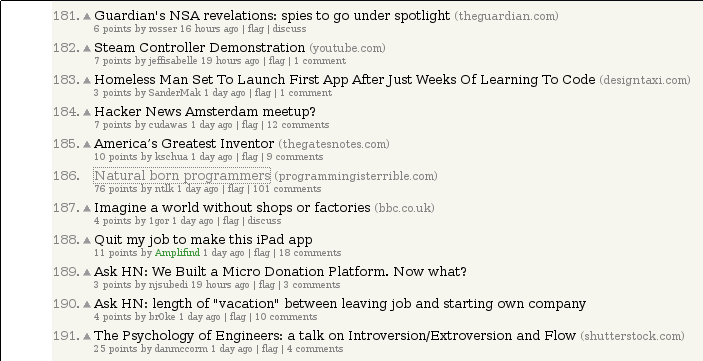
This seems less true when it comes to social issues. When a posting discussing the myth of the natural born programmer[2] hit the front page, the top rated comment is Paul Graham[3] off-handedly discounting the conclusions drawn. The original story linked to a review of peer-reviewed scientific research. Graham simply discounts it on the basis of his preconceptions. Shortly afterwards, the story plummeted off the front page, now surrounded by stories posted around the same time but with much lower scores.

How does this happen? There's two publicised methods which can result in stories dropping down the order. Users with high karma scores (either via submitting popular stories or writing popular comments) are able to flag submissions, and if enough do so then a negative weighting is applied to the story. There's also a flamewar detector, a heuristic that attempts to detect contentious subjects and pushes them off the front page.

The effect of both is to enforce the status quo of social beliefs. Stories that appear to challenge the narrative that good programmers are just naturally talented tend to vanish. Stories that discuss the difficulties faced by minorities in our field are summarily disappeared. There are no social problems in the technology industry. We have always been at war with Eastasia.

This isn't healthy. We don't improve the state of the software industry by hiding stories that expose conflicts. Flamewars don't solve problems, but without them we'd be entirely unaware of how much of a victim blaming mentality exists amongst our peers. It's true that conflict may reinforce preconceptions, causing people to dig in as they defend their beliefs. However, the absence of conflict does nothing to counteract that. If you're never exposed to opinions you disagree with, you'll never question your existing beliefs.

Hacker News is a privately run site and nobody's under any obligation to change how they choose to run it. But the focus on avoiding conflict to such an extent that controversial stories receive less exposure than ones that fit people's existing beliefs doesn't enhance our community. If we want to be able to use technology as an instrument of beneficial change to society as a whole, we benefit from building a diverse and welcoming community and questioning our preconceptions. Building a social echo chamber risks marginalising us from the rest of society, gradually becoming ignored and irrelevant as our self-reinforcing opinions drift ever further away from the mainstream. It doesn't help anybody.

[1] During the batch of interviews I did last year, two separate interviewers both mentioned a story they'd read on Hacker News that turned out to have been written by me. I'm not saying that that's what determined a hire/don't hire decision, but it seems likely that it helped.
[2] The article in question discusses the pervasive idea that some people are inherently good programmers. It turns out that perpetuating the idea that some people are just born good at a particular skill actually discourages others from even trying to learn it, even those who are just as capable.
[3] One of the co-founders of Y-Combinator and creator of Hacker News.

(Edited to fix a footnote reference)

comment count unavailable comments

14 October 2013

Bits from Debian: Ada Lovelace Day: meet some of the "women behind Debian"!

Today is Ada Lovelace Day:
"Ada Lovelace Day is about sharing stories of women - whether engineers, scientist, technologists or mathematicians - who have inspired you to become who you are today. The aim is to create new role models for girls and women in these male-dominated fields by raising the profile of other women in STEM". source
To celebrate, we asked to some of the "women behind Debian" to share their stories with us. Enjoy! Alt Ada Lovelace portrait Ana Guerrero Lopez (ana) Who are you? I'm a 30-something years old geek. I'm from Andalusia, Spain but live in France. What do you do in Debian? I work mostly on my packages, in sponsoring new people's packages and in this very blog you're reading now. I also maintain an unofficial Google+ page about Debian. At $PAID job, I work in an internal Debian distribution so from time to time, I get the opportunity to contribute back some of the stuff we do there. How and why did you start contributing to Debian? I started using Debian around 2003 switching from Mandrake. I was a happy Debian user when the Debian Women project started in the summer 2004. When I saw the project announced, I asked myself why I wasn't contributing to Debian and the rest is history... in a couple of weeks it'll be my 7 years DD-versary! If for some reason you want a longer reply to this question, read here. Beatrice Who are you? I am a PhD student with a degree in Biology. I am a computer fan since my first C64 and I am a self-taught computer geek wanna-be. And I am a bug fan - not software bugs, real bugs :) What do you do in Debian? I work on translations - doing the translation work itself, but also reviewing other translators' work and helping in coordinating the translation effort. How and why did you start contributing to Debian? I started using Linux because I liked the idea of an open source operative system based on collaboration and I began reviewing open source software translations. Since my first Linux system was Debian Potato and I sticked to Debian ever since, it only seemed natural to focus my translation work on Debian. Christine Caulfield Who are you? My name is Christine Caulfield. My day job is principal software engineer at Red Hat working on the cluster infrastructure components corosync & pacemaker. Outside computing I'm a musician and sound engineer. I play violin with lots of technology attached, and love avant garde music. What do you do in Debian? I'm not that active on Debian any more due to pressure of time, and maturity of the packages I work on. I currently maintain the, little-used, DECnet userspace packages and the, even less used I suspect, mopd bootloader. I used to maintain lvm2 for a while but dropped that a few years ago. How and why did you start contributing to Debian? My initial reasons for joining Debian were slightly selfish, to find a home for the DECnet project that I was heavily involved in at the time. I was a keep Debian user and people wanted a distribution where the software was easy to set up. DECnet is quite complicated for users to configure, being a totally independant networking stack to IP and so OS support is needed. Debian seemed like the logical place to make this happen. As mentioned above I got quite involved for a time and maintained other packages too. I picked up lvm2 because I was on the lvm2 dev team at work in Red Hat and as it was a new package at that time I seemed a logical choice. Elena Grandi (valhalla) Who are you? I'm a 30-something years old geek and Free Software enthusiast from Italy. What do you do in Debian? I'm currently maintaining a few packages (2 python modules and a python program) as a sponsored uploader; I'm also slowly looking around for other things to do (by preference technical, but not limited to packaging), with the aim to spend more time contributing to Debian. How and why did you start contributing to Debian? For a while I had being distro-hopping between "fun" distributions (the ones that break now and then) on the desktop while using Debian stable on the home server and in chroots. I was already doing marginal contributions to those distributions, where finding stuff that was missing was easy, but my perception as a stable user was that Debian was already working fine and probably didn't really need any help. Then I started to socialize on IRC with some DDs and DMs, and realized that my perception was superficial and that in reality there were dark holes in the depths of the archive where Evil festered and prospered and... ok, sorry, I got carried away :) Anyway, since I was actually using Debian more and more I decided to start contributing: I read documentation, I attended the useful IRC sessions on #debian-women and decided that it was probably best not to add new stuff, but look for things that I used and that needed help. Then nothing happened for a while, because finding stuff that doesn't work is hard (at least on my mostly textual systems). Then one day I was trying to write a python script that needed to verify gpg signed messages; it had to run on my Debian server, so I was trying to use python-pyme and its documentation was painful to use, while I remembered an earlier attempt using python-gnupg that was much more pythonic, but not available in Debian. In a fit of anger I decided to forgo all of my good intentions and actually add a new package: I checked the sources for problems, packaged, sent it to mentors@d-o, got reviews, fixed problems, resent and finally got sponsored and well, everything started. Francesca Ciceri (madamezou) Who are you? I'm Francesca, a 30-something Italian graduated in Social Sciences. What do you do in Debian? I'm a (non uploading) Debian Developer since 2011 and have been DPN editor, press officer, webmaster for www.debian.org and translator for the Italian l10n team. Recently, due to time constraints, I had to reduce my involvement and now only work on two things: writing/editing articles for bits.debian.org together with Ana Guerrero, and creating subtitles for the DebConf talks, in the DebConf Subs team. How and why did you start contributing to Debian? Basically thanks to the sudden abundance of free time - due to an health problem - and the desire to give something back to this wonderful operating system. After that, I found out that Debian is not only a great OS but also a very special community. Today, some of my dearest friends are people I met through Debian. :) Laura Arjona Who are you? I live in Madrid (Spain), and work as IT Assistant in the Technical University of Madrid (UPM). I'm married and I have a 4-years-old son. What do you do in Debian? In 2012 I started to clean spam and to translate Debian web pages into Spanish. I also follow the work of the web and publicity team, I hope I'll get more involved there too. And of course, I'm in Debian Women :) How and why did you start contributing to Debian? I'm using Debian at work since 2007 (servers), and in my desktops since 2010. I like very much that it is a community distro and I wanted to participate. I was already doing translations in other (small) free software projects, so I began here too. The Debian-Women list, the planet, and people in identi.ca helped me to learn a lot and feel part of the community even when I was not contributing yet. M nica Ram rez Arceda (monica) Who are you? My name is M nica Ram rez Arceda and I am an enthusiast of free software and sharing knowledge cultures: for me it's a kind of philosophy of life. I studied Maths a long time ago but ended up working as a developer for some years. Now I'm working as an IT teacher. What do you do in Debian? Debian is a huge project, so you can help in various scopes. Mainly, I work on packaging, fixing wnpp bug inconsistencies in BTS and helping in spam cleaning of the mailing lists. But I also enjoy doing some non-technical work from time to time: the project I am just now involved is organizing, with the rest of Debian Catalan community, a local team to propose Barcelona as the venue for a minidebconf where all the speakers will be women. How and why did you start contributing to Debian? In 2000 I discovered Free Software world and I fell deeply in love with its philosophy. Since then, I've been trying to do my best in different activities, like spreading the word, giving free courses, helping collectives and friends in technical stuff (from installing Debian to developing some helping apps for them)... but two years ago I was looking forward to join a free software project and I decided to try Debian, since it has been my first and only distro in my day-to-day life for about ten years. So, I wanted to give back Debian all what it had offered to me, but.... I thought I couldn't (hey, Debian is for real hackers, not for you little ant!), but I started to adopt some orphaned packages, do some QA uploads, fix some RC bugs, talk with some Debian Developers that helped me and encouraged me more than I expected, I traveled to my first Debconf... And one thing takes you to the other, and on March 2012 I became a DD. Now, I'm glad to see that everything that frightened me is not so scary :-)

Next.

Previous.