Search Results: "sto"

1 August 2011

Diego Escalante Urrelo: Yes, I almost forget

I ll be there since Friday 5th night until Saturday 13th. I m stoping at Sevilla for VIII GUADEC-ES, the Kung Fu Edition. I m leaving in a few hours, so see you there! PS: I already packed the ceremonial vuvuzela, I hope we make a tradition of it

Iustin Pop: New harddrives WD RE4

I've recently exchanged my old RE3 harddrives (500GB) with new RE4 (non-green power) 2TB harddrives. Here is some data gathered if anyone is interested (I usually look for this kind of information before buying). Smart information:
smartctl 5.41 2011-06-09 r3365 [x86_64-linux-3.0.0-ruru0] (local build)
Copyright (C) 2002-11 by Bruce Allen, http://smartmontools.sourceforge.net
=== START OF INFORMATION SECTION ===
Model Family:     Western Digital RE4 Serial ATA
Device Model:     WDC WD2003FYYS-02W0B0
Serial Number:    WD-XXXXXXXXXXXX
LU WWN Device Id: X XXXXXX XXXXXXXXX
Firmware Version: 01.01D01
User Capacity:    2,000,398,934,016 bytes [2.00 TB]
Sector Size:      512 bytes logical/physical
Device is:        In smartctl database [for details use: -P show]
ATA Version is:   8
ATA Standard is:  Exact ATA specification draft version not indicated
Local Time is:    Thu Jul 28 20:31:24 2011 CEST
SMART support is: Available - device has SMART capability.
SMART support is: Enabled
=== START OF READ SMART DATA SECTION ===
SMART overall-health self-assessment test result: PASSED
General SMART Values:
Offline data collection status:  (0x80) Offline data collection activity
                                        was never started.
                                        Auto Offline Data Collection: Enabled.
Self-test execution status:      (   0) The previous self-test routine completed
                                        without error or no self-test has ever
                                        been run.
Total time to complete Offline
data collection:                (28860) seconds.
Offline data collection
capabilities:                    (0x7b) SMART execute Offline immediate.
                                        Auto Offline data collection on/off support.
                                        Suspend Offline collection upon new
                                        command.
                                        Offline surface scan supported.
                                        Self-test supported.
                                        Conveyance Self-test supported.
                                        Selective Self-test supported.
SMART capabilities:            (0x0003) Saves SMART data before entering
                                        power-saving mode.
                                        Supports SMART auto save timer.
Error logging capability:        (0x01) Error logging supported.
                                        General Purpose Logging supported.
Short self-test routine
recommended polling time:        (   2) minutes.
Extended self-test routine
recommended polling time:        ( 255) minutes.
Conveyance self-test routine
recommended polling time:        (   5) minutes.
SCT capabilities:              (0x303f) SCT Status supported.
                                        SCT Error Recovery Control supported.
                                        SCT Feature Control supported.
                                        SCT Data Table supported.
SMART Attributes Data Structure revision number: 16
Vendor Specific SMART Attributes with Thresholds:
ID# ATTRIBUTE_NAME          FLAG     VALUE WORST THRESH TYPE      UPDATED  WHEN_FAILED RAW_VALUE
  1 Raw_Read_Error_Rate     0x002f   100   253   051    Pre-fail  Always       -       0
  3 Spin_Up_Time            0x0027   100   253   021    Pre-fail  Always       -       0
  4 Start_Stop_Count        0x0032   100   100   000    Old_age   Always       -       4
  5 Reallocated_Sector_Ct   0x0033   200   200   140    Pre-fail  Always       -       0
  7 Seek_Error_Rate         0x002e   100   253   000    Old_age   Always       -       0
  9 Power_On_Hours          0x0032   100   100   000    Old_age   Always       -       0
 10 Spin_Retry_Count        0x0032   100   253   000    Old_age   Always       -       0
 11 Calibration_Retry_Count 0x0032   100   253   000    Old_age   Always       -       0
 12 Power_Cycle_Count       0x0032   100   100   000    Old_age   Always       -       3
192 Power-Off_Retract_Count 0x0032   200   200   000    Old_age   Always       -       2
193 Load_Cycle_Count        0x0032   200   200   000    Old_age   Always       -       1
194 Temperature_Celsius     0x0022   120   116   000    Old_age   Always       -       32
196 Reallocated_Event_Count 0x0032   200   200   000    Old_age   Always       -       0
197 Current_Pending_Sector  0x0032   200   200   000    Old_age   Always       -       0
198 Offline_Uncorrectable   0x0030   100   253   000    Old_age   Offline      -       0
199 UDMA_CRC_Error_Count    0x0032   200   253   000    Old_age   Always       -       0
200 Multi_Zone_Error_Rate   0x0008   100   253   000    Old_age   Offline      -       0
SMART Error Log Version: 1
No Errors Logged
SMART Self-test log structure revision number 1
No self-tests have been logged.  [To run self-tests, use: smartctl -t]
SMART Selective self-test log data structure revision number 1
     SPAN  MIN_LBA  MAX_LBA  CURRENT_TEST_STATUS
        1        0        0  Not_testing
        2        0        0  Not_testing
        3        0        0  Not_testing
        4        0        0  Not_testing
        5        0        0  Not_testing
Selective self-test flags (0x0):
      After scanning selected spans, do NOT read-scan remainder of disk.
If Selective self-test is pending on power-up, resume after 0 minute delay.
hdparm information:
ATA device, with non-removable media
powers-up in standby; SET FEATURES subcmd spins-up.
        Model Number:       WDC WD2003FYYS-02W0B0
        Serial Number:      WD-XXXXXXXXXXXX
        Firmware Revision:  01.01D01
        Transport:          Serial, SATA 1.0a, SATA II Extensions, SATA Rev 2.5, SATA Rev 2.6
Standards:
        Supported: 8 7 6 5
        Likely used: 8
Configuration:
    Logical         max     current
    cylinders       16383   16383
    heads           16      16
    sectors/track   63      63
    --
    CHS current addressable sectors:   16514064
    LBA    user addressable sectors:  268435455
    LBA48  user addressable sectors: 3907029168
    Logical/Physical Sector size:           512 bytes
    device size with M = 1024*1024:     1907729 MBytes
    device size with M = 1000*1000:     2000398 MBytes (2000 GB)
    cache/buffer size  = unknown
    Nominal Media Rotation Rate: 7200
Capabilities:
    LBA, IORDY(can be disabled)
    Queue depth: 32
    Standby timer values: spec'd by Standard, with device specific minimum
    R/W multiple sector transfer: Max = 16  Current = 0
    Advanced power management level: 128
    Recommended acoustic management value: 128, current value: 254
    DMA: mdma0 mdma1 mdma2 udma0 udma1 udma2 udma3 udma4 udma5 *udma6
                 Cycle time: min=120ns recommended=120ns
    PIO: pio0 pio1 pio2 pio3 pio4
                 Cycle time: no flow control=120ns  IORDY flow control=120ns
Commands/features:
        Enabled Supported:
           *    SMART feature set
                Security Mode feature set
           *    Power Management feature set
           *    Write cache
           *    Look-ahead
           *    Host Protected Area feature set
           *    WRITE_BUFFER command
           *    READ_BUFFER command
           *    NOP cmd
           *    DOWNLOAD_MICROCODE
           *    Advanced Power Management feature set
           *    Power-Up In Standby feature set
           *    SET_FEATURES required to spinup after power up
                SET_MAX security extension
           *    Automatic Acoustic Management feature set
           *    48-bit Address feature set
           *    Device Configuration Overlay feature set
           *    Mandatory FLUSH_CACHE
           *    FLUSH_CACHE_EXT
           *    SMART error logging
           *    SMART self-test
           *    General Purpose Logging feature set
           *    WRITE_ DMA MULTIPLE _FUA_EXT
           *    64-bit World wide name
           *    IDLE_IMMEDIATE with UNLOAD
           *    WRITE_UNCORRECTABLE_EXT command
           *     READ,WRITE _DMA_EXT_GPL commands
           *    Segmented DOWNLOAD_MICROCODE
           *    Gen1 signaling speed (1.5Gb/s)
           *    Gen2 signaling speed (3.0Gb/s)
           *    Native Command Queueing (NCQ)
           *    Phy event counters
           *    Idle-Unload when NCQ is active
           *    NCQ priority information
           *    DMA Setup Auto-Activate optimization
           *    Software settings preservation
           *    SMART Command Transport (SCT) feature set
           *    SCT Long Sector Access (AC1)
           *    SCT LBA Segment Access (AC2)
           *    SCT Error Recovery Control (AC3)
           *    SCT Features Control (AC4)
           *    SCT Data Tables (AC5)
                unknown 206[12] (vendor specific)
                unknown 206[13] (vendor specific)
Security:
    Master password revision code = 65534
            supported
    not     enabled
    not     locked
    not     frozen
    not     expired: security count
            supported: enhanced erase
    294min for SECURITY ERASE UNIT. 294min for ENHANCED SECURITY ERASE UNIT.
Logical Unit WWN Device Identifier: XXXXXXXXXXXXXXXX
    NAA             : X
    IEEE OUI        : XXXXXX
    Unique ID       : XXXXXXXXX
Checksum: correct
Using fio running on all three drives in read mode results in a nice ~420 MiB/s average throughput at the start of the disk, not bad. This is the zone bandwidth graph: Bandwidth graph and the IOPS graph: IOPS graph The IOPS doesn't compare with either a 10K drive nor any SSD, but the bandwidth is not that bad for a mechanical harddrive.

Bernhard R. Link: About feature branches for patch handling and reverting to old states.

Now that the debconf videos are available (big THANKS to the video team), I was able to watch the talk about packages in git at Debconf11 and wanted to share some insights:

31 July 2011

Stefano Zacchiroli: DebCevapciConf

During Debconf11, I've tried a couple of times to eat Cevapi, but for one reason or another I didn't manage to. On my way from Banja Luka to Split, I've stopped my motorbike in the proverbial middle of nowhere for lunch (the fact it was raining cats & dogs helped in not having much of a choice). As a consequence, the waiter I ended up facing didn't speak a single word of any language I know. The only three words of Bosnian I managed to say were luckily the right ones: evapi, pivo, and voda. The only missing ingredient for a perfect DebConf in the Balkans evapi has hence been acquired before leaving the country. Everything else was already there: intense hacking, truckload of emotions, tiny teeny bit of stress, feeling of family, and physical exhaustion. No sign of DebConf flu (yet). In case you missed a specific event or the conference all together, hail the Videoteam for having already made available the videos on video.d.n. They can provide useful entertaining for the forthcoming weeks. For what is worth, I plan to spend the next two weeks elsewhere in the Balkans with very little Internet (as in: none at all). Talk to you later.

Russell Coker: Links July 2011

The Reid Report has an article about the marriage pledge that Michelle Bachmann signed which implies that slavery wasn t so bad [1]. Greg Carey has written an interesting article for the Huffington Post about marriage and the bible [2], I always knew that the so-called conservatives weren t basing their stuff on the Bible, but the truth surprised me. Geoff Lemon has written an interesting blog post about the carbon tax debate in Australia [3]. He focuses on how small it is and how petty the arguments against it are. Lord Bacon wrote an interesting list of the top 100 items to disappear first in a national emergency [4]. Some of them are specific to region and climate but it is still a good source of ideas for things to stockpile. Markus Fischer gave an interesting TED talk about the SmartBird that he and his team built [5]. A flying machine that flaps it s wings isn t that exciting (my local department store sells toys that implement that concept), but having one closely match the way a bird s wings work is interesting.

Chris Lamb: Sysadmin-friendly deployment of Gunicorn in Debian

Over the last 18 months Gunicorn has replaced mod_wsgi as the de facto container for deploying Django projects. However, whilst it was first uploaded to Debian in April 2010, it was not particularly sysadmin friendly. In particular, it required custom initscripts (or some other mechanism) to manage each Gunicorn instance. To improve that, you can now place multiple configuration files inside /etc/gunicorn.d:
# /etc/gunicorn.d/django.example: defaults are commented out
CONFIG =  
    'mode': 'django',
    'environment':  
        'PYTHONPATH': '/path/to/custom/python/packages',
     ,
    # 'working_dir': '/',
    # 'user': 'www-data',
    # 'group': 'www-data',
    'args': (
        # '--bind=127.0.0.1:8000',
        '--workers=4',
        # '--worker-class=egg:gunicorn#sync',
        # '--timeout=30',
       'settings',
    ),
 
All instances can then be restarted using:
$ /etc/init.d/gunicorn restart
Stopping Gunicorn workers: [example] [site_a] [site_b].
Starting Gunicorn workers: [example] [site_a] [site_b].
Sites using plain WSGI can use the wsgi mode - see /etc/gunicorn.d/wsgi.example.

30 July 2011

Mike Hommey: -feliminate-dwarf2-dups FAIL

DWARF-2 is a format to store debugging information. It is used on many ELF systems such as GNU/Linux. With the way things are compiled, there is a lot of redundant information in the DWARF-2 sections of an ELF binary. Fortunately, there is an option to gcc that helps dealing with the redundant information and downsizes the DWARF-2 sections of ELF binaries. This option is -feliminate-dwarf2-dups. Unfortunately, it doesn t work with C++. With -g alone, libxul.so is 468 MB. With -g -feliminate-dwarf2-dups, it is 1.5 GB. FAIL. The good news is that as stated in the message linked above, -gdwarf-4 does indeed help reducing debugging information size. libxul.so, built with -gdwarf-4 is 339 MB. This however requires gcc 4.6 and a pretty recent gdb.

29 July 2011

Jaldhar Vyas: hello_minix-i386.deb

NEW YORK, Jul 29, 2011 PreventaConf The crowd of thousands gathered here to attend PreventaConf 2011 were abuzz over the unveiling of the culmination of 3 years of aimless arsing about^ww^w concentrated development which has led to the porting of dpkg to the MINIX 3 operating system. dselect on Minix Women fainted, men wept openly, medical personnel were kept busy dealing with the many instances of heart seizure, multisensory hallucination and spontaneous combustion which accompanied this momentous event. Much remains to be done. Still this is a major milestone of which the Debian Minix developers are justifiably proud.

Michal Čihař: DOF Calc closer to being usable

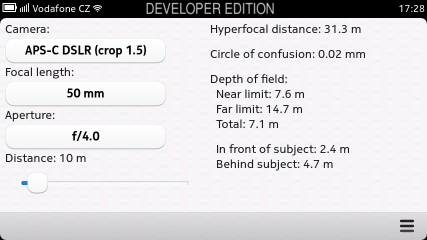
My first MeeGo application called DOF Calc today got in much better shape and actually is closer to being really usable. First I've implemented landscape view, so it now looks correct when you rotate the device: Screenshot Another missing bit was configuration handling. I have not found something for simple configuration storing and everybody seems to suggest using Database API for that, so that's what I did as well. For now only camera selection is persistent, for the others I have to consider whether it is really expected. Besides selection persistence, the database should allow to configure list of cameras/lenses/apertures, because I'm sure not everybody will like my predefined set :-). For now only camera definitions are stored in database and there is no interface yet for changing that.

Filed under: English Meego 0 comments Flattr this!

28 July 2011

Tanguy Ortolo: Using a gamepad under GNU/Linux

Saitek PS2700 gamepad I have just bought a gamepad, the Saitek V.3 Cyborg Rumble Pad (also marketed as PS2700), mainly to play at SuperTuxKart under Debian GNU/Linux. It works perfectly, except for one minor feature, and it can be used for playing and as an X11 input device.System support This device uses USB HID so it is directly supported by the Linux kernel, with its module joydev, I guess: it appears as /dev/input/eventX and /dev/input/jsY. It can be tested with jstest-gtk from the package jstest-gtk: it has 7 axes (two sticks, one directional pad and two triggers that count as one single axis) and 13 buttons (4 regular, 2 rear, the 2 triggers that also send button events, 3 specials and the 2 sticks that can be clicked). They are presented in an order that is rather logical, except the trigger axis is inserted between the two axis of the second stick. It also features two strange buttons: Game support I only tested SuperTuxKart, but I think any game able to use a gamepad or a joystick should support it: after all, they all use the same protocol. The default mapping is rather logical but I find it more convenient to use the triggers rather than the main stick to accelerate and brake. I do not know if the vibration feature can be used at all, because I do not know how it is exposed and I do not think I have any game that would be able to take advantage of it. X.Org support This is an interesting feature: X.Org has a joystick(4) driver, available in the package xserver-xorg-input-joystick that allows you to use a joystick or a gamepad as an input device, both for pointing and typing. So, just for fun, I installed the joystick driver. It installs a default configuration file as /usr/share/X11/xorg.conf.d/50-joystick.conf, that is enough to provide features equivalent to a regular mouse. But given the number of axes and buttons of my pad, it deserved a special configuration in /etc/X11/xorg.conf.d/rumblepad.conf:
Section "InputClass"
    Identifier  "Rumble Pad"
    Option      "MatchIsJoystick"   "on"
    Option      "MatchProduct"      "Cyborg V.3 Rumble Pad"
    # Main stick axes: point
    Option      "MapAxis1"          "mode=relative axis=+1x deadzone=5000"
    Option      "MapAxis2"          "mode=relative axis=+1y deadzone=5000"
    # Second stick axes: scroll
    Option      "MapAxis3"          "mode=relative axis=+1zx deadzone=5000"
    Option      "MapAxis5"          "mode=relative axis=+1zy deadzone=5000"
    # Triggers: scroll vertically
    Option      "MapAxis4"          "mode=relative axis=+1zy deadzone=5000"
    # Directional pad: point
    Option      "MapAxis6"          "mode=accelerated axis=+1x deadzone=5000"
    Option      "MapAxis7"          "mode=accelerated axis=+1y deadzone=5000"
    # Buttons 1, 2 and 3 : click (no use for button 4)
    Option      "MapButton1"        "button=1"
    Option      "MapButton2"        "button=2"
    Option      "MapButton3"        "button=3"
    Option      "MapButton4"        "none"
    # Rear buttons: back and forward
    Option      "MapButton5"        "key=166"   # XF86Back
    Option      "MapButton6"        "key=167"   # XF86Forward
    # Triggers: no use
    Option      "MapButton7"        "none"
    Option      "MapButton8"        "none"
    # Special buttons
    Option      "MapButton9"        "key=135"   # select : Menu
    Option      "MapButton10"       "key=172"   # start : XF86AudioPlay
    Option      "MapButton13"       "key=180"   # home : XF86HomePage
    # Sticks click: click
    Option      "MapButton11"       "button=1"  # clic left stick
    Option      "MapButton12"       "button=3"  # clic right stick
EndSection
It is commented, but here is what it does: It is worth noting that joysticks have one feature that mice do not have: they allow to scroll at a variable speed, proportional to the shift of an analogue stick. This is the meaning of these zx and zy axes I mapped to the second stick, and it provides a scrolling experience that is far superior from that of a mouse wheel.

26 July 2011

Joachim Breitner: SAT-solving the testing transition problem

It is half-time for me at DebCamp/DebConf11 in Banja Luka, Bosnia-Herzegovina, and that is a good time to write about my work so far. I started with some finger exercises, such as the HTML copying for gnome-terminal (as blogged previously) and cosmetic changes to the buildd.debian.org/status website. After that, I began my main project: A SAT-based solver for the testing transition problem. In Debian, new software first enters a repository called unstable, where it is tested. Once some requirements are fulfilled (package has been in unstable for usually at least 10 days and has no new release critical bugs), it is entitled to enter the repository called testing, which will eventually form a new stable Debian release. But some packages need to migrate together, usually because either requires the new version of the other. Also, no packages in testing ought to become uninstallable by some seemingly unrelated change. The software that decides these things is called britney. It is sufficiently good in making sure nothing bad happens, but not smart enough to figure out what to do in case more than two packages need to migrate simultaneously. My goal is to improve this. Now, the the various requirements can all be expressed as predicative formulas, and a lot of research has been going into writing good solvers for such problems, called SAT-solvers. Hence my plan was to only specify what we expect from a testing migration, but leave the search for a solution to such a general purpose and highly optimized program. My initial progress was good and I had some result after two days of hacking, and the approach is promising. Because the data sets are pretty large (1.5GB of input data, the final SAT problem has 1.8 million clauses with 250.000 variables), so I learned quite a bit about profiling and optimizing Haskell programs, and that parsec is slower than working with BS.lines and BS.split to parse simple input. I also used the FFI to use dpkg code directly to compare Debian version numbers. At some point I noticed that I actually want to solve PMAX-SAT problems: Given two set of clauses, hard clauses and soft clauses, find a variable assignment that fulfills the hard clauses and as many of the soft clauses as possible. Unfortunately, there are no fast Free PMAX-SAT solvers around. The ones that I found and that were fast enough that I could use them, msuncore by Joao Marques-Silva at the University College Dublin and MiniMaxSat by Federico Heras at the Universitat Polit cnica de Catalunya, are only available as statically linked binaries. It is a shame that this is acceptable by the academic community; imagine mathematicians would stop including the proofs in their papers, and only share their theorems. So if you happen to have written a PMAX-SAT solver and can solve this instance (in weighted DIMACS format) in less than five minutes, and want to brag that the Debian project is using your code, then please release it under a Free license (e.g. GPL or BSD) and tell me about it! The code of my SAT-based solver is, of course, available, though slightly unpolished. Parts of it (notably the interface to picosat and the PMAX-SAT solvers) might be of general interest and I plan to put them on Hackage as a separate license. Update: I have contacted the authors of the SAT solvers mentioned above, and they have reconfirmed that they have no intention of releasing the source. Now I put my hope in maxsatz2009 by Chumin LI, which is GPL but was not able to cope with my large instance directly; I think I need to change the memory management.

Flattr this post

John Goerzen: Jacob and the Amazing Technicolor Adding Machine

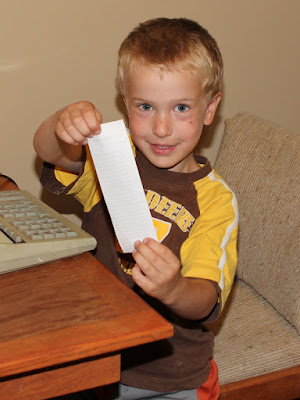
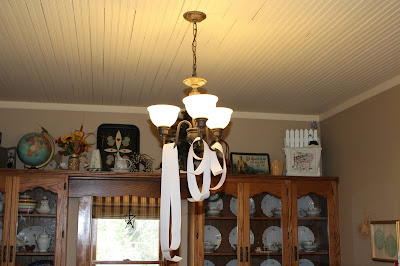
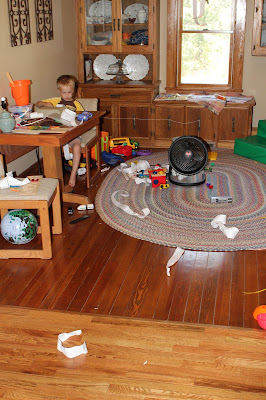
Jacob has been eagerly awaiting this day for at least, well, 2 days now. This morning he started asking questions. All day long he has been wondering how long until the big event. And that event is the arrival of the UPS truck carrying a special $8 package for him. And in that $8 package is not a DVD, or a book, or a toy, but rather 12 rolls of adding machine tape (totaling 1/3 of a mile). Oh yes, our four-year-old can hardly contain his excitement over office supplies. Let me back up a bit to explain. I am always on the lookout for a certain kind of toy. The sort of thing that you don t find in the toy section of a store. The sort of thing that is interesting and engages the curiosity of our boys, that most people would consider would toss, and that usually costs less than $5. Along those lines, Jacob has an old manual typewriter he can use, he and I built a switchbox full of switches and light bulbs that the boys love to play with, we built him a command-line-only PC out of spare parts, the boys have some radios they can use, and one day I salvaged a decades-old adding machine that was going to be thrown out. Jacob liked it he enjoys number and letter games and had some fun, but didn t zealously engage with it until just a few days ago. He sat down at his table and started making cards . He will print out a bunch of numbers, making a strip a couple of feet long, and then say, Dad, I made another card for you! We will then happily accept the card and he will continue making more. Here he is, holding up one of his cards: Jacob had a ton of fun making them, and Oliver wanted in on the action too. Oliver was somewhat interested in the adding machine, but not as much as Jacob, and Jacob didn t want to share. So somehow they decided that Oliver would run and get cards from Jacob and then take them to whatever parent Jacob said. Today Jacob said, Dad, the Oliver delivery service will bring you a card! Saturday morning we had some time to hang around and play, so we played some adding machine tape games. I tucked some long cards under my waistband, and the boys happily chased me all over the house trying to get them back. We also decorated: And here is what the room looked like after some cleanup: That orange bucket on the desk is my card bucket where I can put all the cards he gives me. He even helpfully empties it out into the recycle bin when there are too many old cards in it! But then tragedy struck it was out of paper! I ordered a 12-roll pack off Amazon, and boy was it a long couple of days until it arrived. Today before the UPS truck got here, I showed him how we could feed old paper through and print on the back side an incredible innovation, it seemed! Terah had a conversation with him earlier that went like this: Terah: Jacob, we need to clean up the house. Jacob: Why? Terah: Because some people are coming over. Jacob: Who is OH YES! The UPS delivery man! Yes, let s clean! Terah: Ah, well yes he will be here too, but your great uncle and aunt are coming. Jacob: Oh yay! And the UPS man! It is hard to describe Jacob s excitement when the package arrived. I quickly opened it up, and at his great uncle s prompting, he counted to see if he really did get 12 rolls of paper. IT IS TWELVE ROLLS! YAY! And then we quickly installed it in the machine and off he went. At his great uncle s prompting, he started writing a J on each card . This meant Jacob , or maybe he d put two J s, meaning To John From Jacob , or perhaps the two J s meant To Terah From Jacob he d always have to clue us in. Anyhow, for an $8 investment in paper this has brought hours of joy to our boys. Even though Jacob isn t yet really using it to perform arithmetic, it is setting him up to enjoy that sort of thing and encouraging his curiosity. Both good things.

25 July 2011

Michal Čihař: Linux hardware support

Remembering not so far away history, I'm always a bit afraid when I'm about to use new hardware with Linux. It used to be troublesome to make some devices work. After getting Linux based phone last week, I've also received new notebook, where I want to run Debian as well. I expected various troubles, but surprisingly everything works like a charm without single line of configuration. Wireless networking, docking station, card reader, webcam, fingerprint reader and so on. All I had to do is to pull SSD out of old X60 notebook and put it into new X220. The only (though unnecessary) change was installation of 64-bit kernel (I currently see no big benefit in migrating to 64-bit userspace) and everything is working. Can your operating system do this? Thanks to all people who have helped in this.

Filed under: Debian English Linux 2 comments Flattr this!

Michal Čihař: Confused with N950 development options

As the main reason why I got Nokia N950 is that I promised to write some applications for that, I started to look deeply at available options how to write them. Unfortunately there are too many options and all documentation I've found is pretty confusing. The short story is that you should use Qt for user interface. However it is not that easy as it looks, you can use regular Qt, which can be run on the phone, but looks ugly in the end (maybe I did something wrong, but it did look completely different to anything else running in the phone). You can use Qt Quick, which is easy to write (simple UI definition and JavaScript variant for code), but it does not seem to support much of the widgets. And then there is Meego Touch library, which seems like a best option, however not mentioned at all on Nokia developer website. Looks like I need to learn few more things before actually starting to code.

Filed under: English Meego 7 comments Flattr this!

Wouter Verhelst: m68k revival

If you thought Debian/m68k was dead and buried and where happy about it, I'm sorry to disappoint you. The reason m68k had died out slightly was not that we'd lost interest, or that we'd been kicked out of the archive, or anything of the sorts, as I've seen people believe. Instead, the reasons were fully technical: glibc past some particular version needs TLS (thread-local storage) support, which hadn't been implemented for m68k yet, and nobody within the Debian/m68k team had the expertise to work on this. That was all. Not so long ago, some people within RedHat had started doing a TLS implementation for m68k, however. This was paid for by one of their customers who needed the ColdFire to work, and therefore it was focused mostly on ColdFire. However, ColdFire is close enough to plain old m68k that it was possible to port this TLS support to plain old without too much effort. Unfortunately, most of our machines were pretty much nonfunctional by that time; so in order to get things to work, we'd have to Not quite impossible, but still a lot of work that would need someone to put in quite an amount of time. This wasn't something that people in the m68k port could invest; and I'm also not sure we had the necessary skills amongst the team to do the necessary porting. So the work lay there, and it wasn't being done. Until one Thorsten Glaser, author of a shell called 'mksh' that I hadn't heard of until then, came along, and noted that his mksh package wasn't being built for m68k. Upon investigating, he discovered, as expected, that the port was almost dead. Now most people would leave it at that and decide that they couldn't build for an architecture that wasn't being maintained anymore and that would be perfectly fine but not Thorsten. On the brink of death, he almost single-handedly revived the m68k port, and got stuff to work to such an extent that it is now again possible to build a working and fairly up-to-date Linux/m68k ARAnyM virtual machine. As I'm typing this, my ARAnyM instance is checking out the d-i repository (so I can start building d-i), and building sudo at the same time. Let's see what comes from this.

Craig Small: Scary Functions: rawmemchr

Recently I received a bug report for psmisc that basically supplied a patch so psmisc works in a cygwin environment. Nothing terribly exciting in that and the changes are pretty uncontroversial. One of the changes is in that instead of using rawmemchr to find the end of the string, cygwin doesn t have that function and so it is replaced by strchr. I ve not seen the function rawmemchr before so I had a closer look. Initially I was a little worried, rawmemchr tries to find the given byte starting at a given pointer but unlike strchr it doesn t stop unless it finds the character. I think the only time this function is safe, or is no more evil than anything else, is when you are searching for the NUL character which is what fuser in psmisc does. Still, the string being checked is coming from getcwd which requires a string or buffer length so perhaps it would be better to use memchr which is a little slower but has a maximum length parameter. If you have code that uses this function, you may just want to check how it is being used because it seems like an old bad gets function that plagued a lot of programs.

24 July 2011

Tore S. Bekkedal: Ut ya: English version

If a single man can display so much hatred
think only of how much love we all can display together.

Stine Renate H heim

I wrote a Norwegian post explaining my experience at Ut ya. I had taken this blog for dead, and had entirely forgotten that it was syndicated on Planet Debian. I don t want to let Google Translate make this disaster any worse than it is the translation of bullets into balls being particularly bad so the international attention the massacre has garnered in consideration, I am writing an English translation of my experiences. I feel somehow duty-bound to make people aware of what happened, but I don t want to get into anything else but a sober description of the events and some very brief reflections. There are many details I have chosen to omit. Others have written their experiences of the events at Ut ya. I wanted to write mine down as well, and get it out there . Partly, I want to write this down because I m unsure if I will remember all the details at a later point in time, although I think I d prefer it if I couldn t. I m also writing this because people are asking about my experiences and it s much better to have an URL to give them, lest I have to keep going through the same spiel over and over again. Our former Prime Minister and current labour movement demigod Gro Harlem Brundtland had recently left the island. I had been the cameraman for a video interview of her talking about Ut ya, and I was in the media group room encoding the video into a file suitable for YouTube, when someone else in the room startled and said that Twitter was full of messages about a loud explosion in Oslo. As the newspapers brought us information about the extent of the damages, a consensus arose that an informational meeting was in order. As soon as the current round of talks finished, we were gathered into the main hall. The meeting was duly held, and after the statement was made that a TV feed would be made available, I took it upon myself as the local alpha geek to make it happen. Of course, the situation caused both the wireless network and the GPRS networks to become totally unusable. As I was waiting for someone to set up a password, I took the opportunity to face the consequences of having eaten two bits of a microwavable dish called Hold-It the local equivalent of a Hot Pocket and went to the toilet. As I was in there, I first heard agitated shouting, then screams, then gunshots coming from just outside the toilets. More than anything else, it sounded like a toy gun. I was convinced that someone was making a joke in incredibly bad taste and I stormed out of the booth with the intent of halting it. As I tore the door open, I saw two of my comrades hiding in a recessed corner. Their facial expressions left absolutely no doubt that this was no toy. They signalled for me to get back in the booth. I closed the door, did a mental double-take in utter, complete confusion, and opened it again. They were still signalling. Had they not stood there, I would have run straight into the gunman; they saved my life. I looked out into the hallway, and I made eye contact with a young boy lying in a pool of blood. He was motioning for me to help him. I heard more gunshots from inside the building and retreated back inside. As I was trying to think through my next move, I realized that the decidedly insubstantial wood-fiber door would not resist any kind of bullets. I made my way out into the hallway, with the intent of escaping outside. At that point, I was of course not aware that there was an intention to kill as many as possible, so I thought that the open spaces outside would be a place of relative safety. Of course, this proved to be wrong and my life was probably saved a second time by one of the caf volunteers taking me into a hard-to-spot employee s bathroom. We sat there for ninety minutes. Always ready to make a run for it, ready for just about anything. A peculiar group dynamic arose with these two people with whom I had barely previously spoken. We came to share a strange sense of common destiny and gallows humour. One of them had seen the shooter and described the police uniform. I perceived it to be realistic that we were the only ones aware of the wounded outside the toilet. I tried to reach the emergency services, but all their lines were busy; the terror attack in Oslo had probably clogged their lines. I finally got through to the fire services, who could inform me that the police did know about the situation and were on their way. This was to take 90 minutes and by the time we evacuated, the young boy outside my door had perished. The despair I first saw in his eyes as I passed him, fleeing from one room to the other and the empty, blank stare as we left, are burned into me and they are images I will never in my life forget. Finally, the real police arrived. We walked out. I chose the path through the minor conference hall something I now regret. The sight was simply beyond my capacity to describe fully, and so terrifying that I barely remember the sight only the terror it struck in me. There were several people bunched up in a corner, a big amorphous heap of bodies. Some were conscious and yelled at me not to do anything that could startle the police, others lay still. Their bodies were all covered in blood, and a thick pool of blood extended at least a half-metre in all directions around them. The policeman across the hall was screaming orders at me, but he was screaming so loudly that I couldn t make out his words at first. We were first moved into the camp newspaper s offices. There were about eight of us there, I think, in addition to one girl who lay wounded. Towards the end she was drifting in and out of consciousness. We covered her with sweaters to keep her warm and one of us tried to at least temper her bleeding. The bullet had missed her heart, but by the entry wound it was clear that it was not by far. I do not know who this girl was or how she is now. I sat behind and never saw her face. The wounded were evacuated first. I don t remember how long we remained; I had lost all concept of time. In spite of protests from the group who knew him, one kid was put in handcuffs. At the time I didn t understand why, and the policeman seemed to say something almost to the effect that there was no reason for it at all. I didn t see when they undid his cuffs, but I remember thinking that this treatment made a terrible experience even worse for him. I tried my best to comfort him but knew it would be little help. Later, when things stabilised a little, we were told that he was handcuffed because he had come from an unsecured area. The police was extremely good at carefully explaining what was happening and why; this was a big help and I am grateful for it. Eventually we were moved out into the main corridor of the building, where we joined up into a group of about fifty. Only when I saw the two people who saved my life did any emotion other than mild confusion arise. I broke down shivering in tears in one of their arms. After a few seconds, I came back to my senses and realised that this was not the time. I quickly gathered myself, got the shaking under control, and sat down. We were given some chocolate and soda from the kiosk. I remember making an offhand remark that an inability to find joy in free candy was a sure sign of a bad situation. We all laughed out loud. Gallows humour is a coping mechanism, but in retrospect one almost feels guilty for it. We were shown out in a single file with hands above our heads. I remember an intense concern that someone would slip in the steep, muddy slope and create a misunderstanding. Outside, there were more bodies. Some under improvised covers a tarpaulin from the waffle stand, the deflated bouncy castle but some simply lay there. Everyone I met displayed a courage, a mental discipline and unity of purpose far beyond anything one would ever wish to expect from people this young. Everyone conducted themselves with an attitude that could almost be described as stiff upper lip . Safely across the fjord we were offered blankets. I was asked if I was aware of any injuries, and asked to lift my shirt and show my abdominal region. We were shown into the bus which took us to the hotel used by the survivors and their family. I simply cannot describe in any words the relief I felt when I was able to embrace my living comrades. It was completely unlike anything I had ever felt before in my life. The euphoric feeling was tempered only by the realisation that there would be many I could never see again, comrades whom I had taken great pride in calling my friends, with futures in the service of all mankind, futures I had previously found such great joy in pondering and guessing about. The feeling which continues to upset me the most, is the feeling that so many of my comrades left behind grieving families and friends. Torn away senselessly. I do not know how much more than this relatively sober account of the events on Ut ya I can muster. I would, however, like to offer some reflections. First of all, from the bottom of my heart, I want to thank the police who saved the lives of so many still on the island, the holidaymakers who took aboard swimmers into their boats and the rescue services staffed primarily by volunteers who have spared no effort in trying to soften the blow as much as they can. The opportunity to spend time with those comrades who underwent the same experience as myself has also been an immeasurable aid. I was also so relieved to find my very closest friend among the survivors, which has also been an indescribable help. If I can name a single positive in this tragedy: Had he arrived with his automatic weapon fifteen or twenty minutes prior, he would have arrived during the informational meeting, at a time when the major hall was absolutely jam-packed the death toll would be many times what it ended up being. I am agonisingly aware of the meager comfort this provides to those who have been bereft of their closest, but I do find some solace in this. We cannot sweep under a rug that this was without question! a political attack on the labour movement. But it is thankfully also an attack which has been perceived by everyone as an attack on the Norwegian society, and on a symbol of the wide recruitment to the participatory democracy which lies at our very national soul. I cannot thank the Norwegian people, and indeed the people in other nations who have offered their condolences, enough for their shows of support and shared grief. It really has been a tremendous help to me knowing that so many people feel with us. I also want to thank from the bottom of my heart the rock-steadiness of everyone in both the national and local wings of the Labour Party and Labour Youth in supporting us, and the political milieu in general for their resolute steadfastness saving me from losing yet more that I cherish; our freedoms in a participatory democracy. Our Party has lost many of its very brightest youngsters. Personally I feel an angry spite, a deep restless urge to get the wheels of society going again. I want to show his kind that we will not be broken. We re stronger than that. I will not be frightened into silence and passivity. I want to remember the dead, and honor them by carrying on our common work. I want to end this with a request to everyone who reads this, echoing a statement I read by one of my good friends and comrades: Please, don t let me see any messages of hatred, wishes for the death penalty, anything like that. If anyone should be of the belief that anything will improve by murdering this sad little person, they would be profoundly wrong. All attention now should be plowed into caring for those victims and their relatives who did not share my luck, and not giving an audience to a perpetrator who wants one. Tore Sinding Bekkedal

Lars Wirzenius: Obnam version 0.18

I have released version 0.18 of Obnam, my backup application. From the NEWS file: I alse made releases of some dependencies of Obnam. They're all in my code.liw.fi repository, and some of them are also now in Debian unstable.

Lars Wirzenius: Obnam version 0.18

I have released version 0.18 of Obnam, my backup application. From the NEWS file: I alse made releases of some dependencies of Obnam. They're all in my code.liw.fi repository, and some of them are also now in Debian unstable.

Russell Coker: SE Linux File Context Precedence

In my previous post I expressed a desire to use regular expressions for files that may appear in multiple places in the tree due to bind mounts for /run and /var/run etc [1]. However there is a problem with this idea. The SE Linux file labeling program restorecon reads the file /etc/selinux/$SELINUXTYPE/contexts/files/file_contexts which contains a set of regular expressions to assign labels to files. That file is ordered and the last entry which matches is the one that counts. When the file_contexts file is created the order is based on how many characters at the start of the file specification aren t regular expression meta-characters. For example the entry /.* is at the top of the file (and therefore has the lowest precedence), which makes it the catch-all entry for files that have no other match. So an entry for /var/run/REGEX will have a higher precedence than one for /var/REGEX , this means however that when I replaced the /var/run part with a regular expression then it had a lower precedence and it didn t work properly. I should have remembered this as I did a lot of work on setfiles (which became restorecon) in the early days. I have now developed a new way of solving this and this time I m testing it before blogging about it. I have written the following PERL program to fix the file contexts, this adds multiple lines and uses a distro_debian conditional on them so that they don t slip into upstream use and so that if I lose track of where each patch came from I ll know that I can delete them in future because it only matters to Debian. #!/usr/bin/perl
use warnings;
use strict; open(LIST, "find . -name \"*.fc\" xargs egrep \"^/(var.*run) (var/lock) (dev/shm)\" cut -f1 -d: uniq ") or die "Can't get file list\n";
while(<LIST>)

my $filename = $_;
chomp $filename;
open(my $infile, "<", $filename) or die "Can't open file $filename";
open(my $outfile, ">", $filename . ".new") or die "Can't open file ". $filename . ".new";
while(<$infile>)

print $outfile $_;
my $newline;
if($_ =~ /^\/var\/run/)

print $outfile "ifdef( distro_debian', \n";
$newline = $_;
$newline =~ s/^\/var//;
print $outfile $newline;
print $outfile "')\n";

if($_ =~ /^\/var\/lock/)

print $outfile "ifdef( distro_debian', \n";
$newline = $_;
$newline =~ s/^\/var/\/var\/run/;
print $outfile $newline;
$newline =~ s/^\/var//;
print $outfile $newline;
print $outfile "')\n";

if($_ =~ /^\/dev\/shm/)

print $outfile "ifdef( distro_debian', \n";
$newline = $_;
$newline =~ s/^\/dev/\/run/;
print $outfile $newline;
print $outfile "/var" . $newline;
print $outfile "')\n";


close($infile);
close($outfile);
rename $filename . ".new", $filename or die "Can't rename " . $filename . ".new to " . $filename;
The next policy thing that I have to work on is systemd. From a quick test it seems that systemd policy changes will be more invasive than is suitable for Squeeze. This means that someone who wants to upgrade from Squeeze to Wheezy+systemd will have to upgrade to Wheeze policy before installing systemd. I think that I will make 0.2.20100524-10 the last version in Unstable based on the 2010 release, I will now start work on packaging the latest upstream policy for Unstable. PS I m not much of a PERL programmer, so if anyone has suggestions for how to improve the above PERL code then please let me know. Please note however that I m not interested in making my code look like line-noise.

Next.

Previous.