Search Results: "tim"

25 March 2014

Richard Hartmann: Train them to submit

And today from our ever-growing collection of what the fuck is wrong with you people?!... This is wrong on so many levels, I can't even begin to describe it. Sadly, it seems that this will get funded. And if it does not, technology will only become cheaper over time...

Petter Reinholdtsen: Public Trusted Timestamping services for everyone

Did you ever need to store logs or other files in a way that would allow it to be used as evidence in court, and needed a way to demonstrate without reasonable doubt that the file had not been changed since it was created? Or, did you ever need to document that a given document was received at some point in time, like some archived document or the answer to an exam, and not changed after it was received? The problem in these settings is to remove the need to trust yourself and your computers, while still being able to prove that a file is the same as it was at some given time in the past. A solution to these problems is to have a trusted third party "stamp" the document and verify that at some given time the document looked a given way. Such notarius service have been around for thousands of years, and its digital equivalent is called a trusted timestamping service. The Internet Engineering Task Force standardised how such service could work a few years ago as RFC 3161. The mechanism is simple. Create a hash of the file in question, send it to a trusted third party which add a time stamp to the hash and sign the result with its private key, and send back the signed hash + timestamp. Both email, FTP and HTTP can be used to request such signature, depending on what is provided by the service used. Anyone with the document and the signature can then verify that the document matches the signature by creating their own hash and checking the signature using the trusted third party public key. There are several commercial services around providing such timestamping. A quick search for "rfc 3161 service" pointed me to at least DigiStamp, Quo Vadis, Global Sign and Global Trust Finder. The system work as long as the private key of the trusted third party is not compromised. But as far as I can tell, there are very few public trusted timestamp services available for everyone. I've been looking for one for a while now. But yesterday I found one over at Deutches Forschungsnetz mentioned in a blog by David M ller. I then found a good recipe on how to use the service over at the University of Greifswald. The OpenSSL library contain both server and tools to use and set up your own signing service. See the ts(1SSL), tsget(1SSL) manual pages for more details. The following shell script demonstrate how to extract a signed timestamp for any file on the disk in a Debian environment:
#!/bin/sh
set -e
url="http://zeitstempel.dfn.de"
caurl="https://pki.pca.dfn.de/global-services-ca/pub/cacert/chain.txt"
reqfile=$(mktemp -t tmp.XXXXXXXXXX.tsq)
resfile=$(mktemp -t tmp.XXXXXXXXXX.tsr)
cafile=chain.txt
if [ ! -f $cafile ] ; then
    wget -O $cafile "$caurl"
fi
openssl ts -query -data "$1" -cert   tee "$reqfile" \
      /usr/lib/ssl/misc/tsget -h "$url" -o "$resfile"
openssl ts -reply -in "$resfile" -text 1>&2
openssl ts -verify -data "$1" -in "$resfile" -CAfile "$cafile" 1>&2
base64 < "$resfile"
rm "$reqfile" "$resfile"
The argument to the script is the file to timestamp, and the output is a base64 encoded version of the signature to STDOUT and details about the signature to STDERR. Note that due to a bug in the tsget script, you might need to modify the included script and remove the last line. Or just write your own HTTP uploader using curl. :) Now you too can prove and verify that files have not been changed. But the Internet need more public trusted timestamp services. Perhaps something for Uninett or my work place the University of Oslo to set up?

Andrew Pollock: [life] Day 56, Kindergarten, rain, taxes

There was quite the torrential downpour overnight. It woke me up, and it woke Zoe up too, and at about 1:45am she ended up in bed with me. I think she managed to invent a new baby sleep position, where she was on my pillow, perpendicular to me along the bed head, and had somehow ejected the pillow that was on her side of the bed. We got up, with a slow start, and the weather was still looking a bit dicey, so Zoe wanted to go to Kindergarten by car. That actually meant we were the first ones there, because I'd been working to a timetable of leaving home by bike. One of the chickens was starting to hatch (and subsequently hatched around noon) so that was exciting. Funnily enough, Zoe had spent all morning telling me how she didn't want to go to Kindergarten, but by the time we got there, she didn't seem to mind being there all that much. After I got home from Kindergarten, I biked down to Bulimba to go to the bank to finalise opening my business bank accounts. I've since discovered that one can't do much without an ABN, I can't even get a cheque book, so I've sicked my accountant on that one for me. I got stuck into my US taxes some more today, and made a very satisfactory amount of progress on them. I think I should be able to finish them off in the next session I get to work on them. I felt like getting out of the house after that. It was looking quite like rain again, making picking up Zoe by bike out, so I ran a few errands in the car before getting to Kindergarten quite early. Zoe was fast asleep, but I let her have a long, slow wake up, and that made our departure much easier. She got to have a little hold of one of the baby chicks before we left. Today I learned that baby chicks smell absolutely divine. We got home, and Zoe did some self-directed craft for a bit, and then wanted to play hide and seek, so we did that and finally got around to looking at all of the Woolworths DreamWorks Heroes cards she's been collecting. I was disappointed to discover there's only a single card per pack, so that's going to mean I have to spend at least $840 on groceries, excluding duplicates, before we get all of them. I'm glad the checkout operators aren't sticking to the rules and are handing them out a little more generously than that. After that, we did a bit more rough and tumble play, and then it was time to start making dinner, so Zoe watched a DVD. We got dinner out of the way relatively early, so I practiced plaiting her hair (I've surprised myself with the half-decent job I can do) and then did bath time and bed time. Bed time was a little protracted (she didn't like her bedroom and wanted to sleep in my bed) but otherwise seems to have gone smoothly.

Sylvain Le Gall: Release of OASIS 0.4.3

I am happy to announce the release of OASIS v0.4.3. Logo OASIS small OASIS is a tool to help OCaml developers to integrate configure, build and install systems in their projects. It should help to create standard entry points in the source code build system, allowing external tools to analyse projects easily. This tool is freely inspired by Cabal which is the same kind of tool for Haskell. You can find the new release here and the changelog here. More information about OASIS in general on the OASIS website. Here is a quick summary of the important changes: Features: This new version closes 4 bugs, mostly related to parsing of _oasis. It also includes a lot of refactoring to improve the overall quality of OASIS code base. The big project for the next release will be to setup a Windows host for regular build and test on this platform. I plan to use WODI for this setup. I would like to thanks again the contributor for this release: David Allsopp, Martin Keegan and Jacques-Pascal Deplaix. Their help is greatly appreciated.

24 March 2014

Michael Prokop: Building Debian+Ubuntu packages on EC2

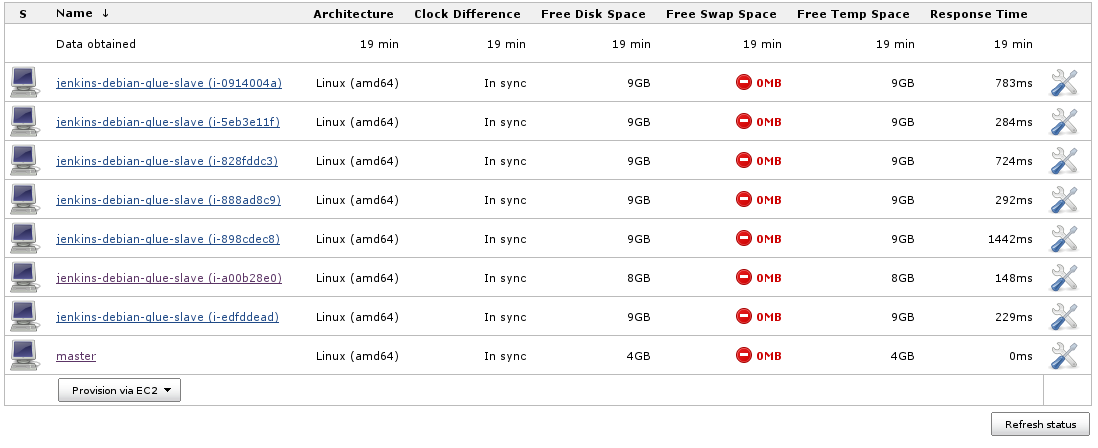
In a project I recently worked on we wanted to provide a jenkins-debian-glue based setup on Amazon s EC2 for building Debian and Ubuntu packages. The idea is to keep a not-so-strong powered Jenkins master up and running 24 7, while stronger machines serving as Jenkins slaves should be launched only as needed. The project setup in question is fully open sourced (more on that in a separate blog post), hereby I am documenting the EC2 setup in usage. Jenkins master vs. slave Debian source packages are generated on Jenkins master where a checkout of the Git repository resides. The Jenkins slaves do the actual workload by building the binary packages and executing piuparts (.deb package installation, upgrading, and removal testing tool) on the resulting binary packages. The Debian packages (source+binaries) are then provided back to Jenkins master and put into a reprepro powered Debian repository for public usage. Preparation The starting point was one of the official Debian AMIs (x86_64, paravirtual on EBS). We automatically deployed jenkins-debian-glue on the system which is used as Jenkins master (we chose a m1.small instance for our needs). We started another instance, slightly adjusted it to already include jenkins-debian-glue related stuff out-of-the-box (more details in section Reduce build time below) and created an AMI out of it. This new AMI ID can be configured for usage inside Jenkins by using the Amazon EC2 Plugin (see screenshot below). IAM policy Before configuring EC2 in Jenkins though start by adding a new user (or group) in AWS s IAM (Identity and Access Management) with a custom policy. This ensures that your EC2 user in Jenkins doesn t have more permissions than really needed. The following policy should give you a starting point (we restrict the account to allow actions only in the EC2 region eu-west-1, YMMV):
 
  "Version": "2012-10-17",
  "Statement": [
     
      "Action": [
        "ec2:CreateTags",
        "ec2:DescribeInstances",
        "ec2:DescribeImages",
        "ec2:DescribeKeyPairs",
        "ec2:GetConsoleOutput",
        "ec2:RunInstances",
        "ec2:StartInstances",
        "ec2:StopInstances",
        "ec2:TerminateInstances"
      ],
      "Effect": "Allow",
      "Resource": "*",
            "Condition":  
                "StringEquals":  
                    "ec2:Region": "eu-west-1"


  ]
 
Jenkins configuration Configure EC2 access with Access Key ID , Secret Access Key , Region and EC2 Key Pair s Private Key (for SSH login) inside Jenkins in the Cloud section on $YOUR_JENKINS_SERVER/configure. Finally add an AMI in the AMIs Amazon EC2 configuration section (adjust security-group as needed, SSH access is enough): As you can see the configuration also includes a launch script. This script ensures that slaves are set up as needed (provide all the packages and scripts that are required for building) and always get the latest configuration and scripts before starting to serve as Jenkins slave. Now your setup should be ready for launching Jenkins slaves as needed: NOTE: you can use the Instance Cap configuration inside the advanced Amazon EC2 Jenkins configuration section to place an upward limit to the number of EC2 instances that Jenkins may launch. This can be useful for avoiding surprises in your AWS invoices. :) Notice though that the cap numbers are calculated for all your running EC2 instances, so be aware if you have further machines running under your account, you might want to e.g. further restrict your IAM policy then. Reduce build time Using a plain Debian AMI and automatically installing jenkins-debian-glue and further jenkins-debian-glue-buildenv* packages on each slave startup would work but it takes time. That s why we created our own AMI which is nothing else than an official Debian AMI with the bootstrap.sh script (which is referred to in the screenshot above) already executed. All the necessary packages are pre-installed and also all the cowbuilder environments are already present then. From time to time we start the instance again to apply (security) updates and execute the bootstrap script with its &dash&dashupdate option to also have all the cowbuilder systems up2date. Creating a new AMI is a no-brainer and we can then use the up2date system for our Jenkins slaves, if something should break for whatever reason we can still fall back to an older known-to-be-good AMI. Final words How to set up your Jenkins jobs for optimal master/slave usage, multi-distribution support (Debian/Ubuntu) and further details about this setup are part of another blog post. Thanks to Andreas Granig, Victor Seva and Bernhard Miklautz for reading drafts of this.

Elena 'valhalla' Grandi: Moving away from google services, step N out of M

For years, I've used a gmail account to subscribe to public mailing lists because it was convenient, it had excellent spam filtering and since the lists were already available on google-indexed public archive I felt that there was no real privacy issue.
I already have a local copy of every message in the account, in case I lose access to it for some random reason, and my real contacts already know and use my other email address(es), so I'm not really worried about continuing to use gmail for this kind of traffic.

When I started contributing to Debian I also used that email address, because I was already subscribed to a few mailing lists under it, and it was going to end up being used on the BTS and other spam-attracting public places like that, but I was less happy with the choice.

Lately, however, gmail's spam filters have started to behave oddly, with lots of false positives including a number of messages from @debian.org addresses, and this basically removes the main reason why I was using gmail in the first place, so I'm seriously considering dropping it also for publicly indicized communications.

My first step, right before leaving for Barcelona was to create a couple other email addresses, one for mailing lists and the other for debian-related work, and add them to my gpg/OpenPGP key, so that any new signature on them from the conf would also include the new UIDs.

If you've received a badly signed message (thanks heirloom mailix for mangling stuff :) ) followed by an hopefully correctly signed one where I was asking you to sign new UIDs, and you were wondering, this is the reason.

Now that the new UIDs have been signed by a few DDs I'm going to start using the new address in Debian: I believe I have changed it everywhere I needed to, except for the maintainer/uploader field for my packages, where it will change on their next uploads.

As for mailing lists, I still don't know how to proceed: I could proceed in a systematic way, but I'm lazy and I will probably just change a few main subscriptions, use the new address for new subscriptions and then migrate the rest a few at a time, unless some other event happens and I'll have to hurriedly migrate everything or risk losing important messages. Even in the latter case, I don't need any information that is only stored on google's servers, so I won't will panic just a bit :)

Now, where did I put that documentation about xmpp servers?

Michal &#268;iha&#345;: GSoC 2014 applications for phpMyAdmin

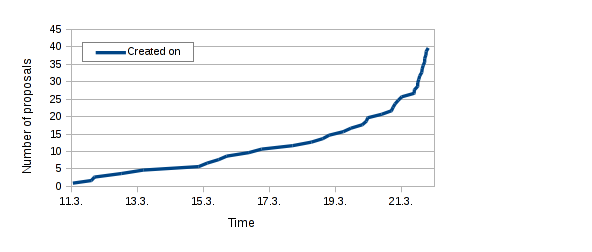
As usual, I look at the application stats for phpMyAdmin just after student application period of Google Summer of Code is over. First of all we got more proposals than in last years, this time there is way more students from India and discussions on mentors lists shows this is quite similar for other projects. Maybe it's just different timing which works better for students there, but there might be different reasons as well. There is also quite low number of spam or bogus proposals. Same as in past years, people leave the submission to the last moment, even though we encourage them to submit early so that they can adjust the application based on our feedback. Number of applications over time Anyway we're just working on evaluation and will finalize it in upcoming days. Of course you will know the results from Google on April 21st.

Filed under: English phpMyAdmin 0 comments Flattr this!

Steve Kemp: So I failed at writing some clustered code in Perl

Until this time next month I'll be posting code-based discussions only. Recently I've been wanting to explore creating clustered services, because clusters are definitely things I use professionally. My initial attempt was to write an auto-clustering version of memcached, because that's a useful tool. Writing the core of the service took an hour or so: At the point I was done the following code worked:
use KeyVal;
# Create an object, and set some values
my $obj = KeyVal->new( logfile => "/tmp/foo.log" );
$obj->incr( "steve" );
print $obj->get( "steve" ) # prints 2.
# Now replay the append-only log
my $replay = KeyVal->new( logfile => "/tmp/foo.log" );
$replay->replay();
print $replay->get( "steve" ) # prints 2.
In the first case we used the primitives to increment a value twice, and then fetch it. In the second case we used the logfile the first object created to replay all prior transactions, then output the value. Neat. The next step was to make it work over a network. Trivial. Finally I wanted to autodetect peers, and deploy replication. Each host would send out regular messages along the lines of "Do you have updates made since $time?". Any that did would replay the logfile from the given unixtime offset. However here I ran into problems. Peer discovery was supposed to be basic, and I figured I'd write something that did leader election by magic. Unfortunately Perls threading code is .. unpleasant: This failed. Majorly. Because you cannot launch the implementation of a class-method as a thread. Equally you cannot make a variable which is "complex" shared across threads. I wrote some demo code which works without packages and a shared singleton: The Ruby version, by contrast, is much more OO and neater. Meh. I've now shelved the project. My next, big, task was to make the network service utterly memcached compatible. That would have been fiddly, but not impossible. Right now I just use a simple line-based network protocol. I suspect I could have got what I wanted using EventMachine, or similar, but that's a path I've not yet explored, and I'm happy enough with that decision.

Andrew Pollock: [life] Day 55, Kindergarten, run, Debian

I got up this morning with the intent of knocking out a 10km run. I managed to last 8km today, so it's an improvement, but I don't know what's up with my running fitness at the moment. After that, I pretty much did Debian stuff all day. I managed an upload of dstat and found a potential security bug in another of my packages when I was trying to update it, so I raised that issue with the package's upstream. I also mostly sorted out opening a bank account for my company. I just have to visit the branch in person tomorrow. Sarah had indicated to me that Zoe had slept poorly last night, on top of a big weekend, and that I should probably pick her up in the car, so I drove to Kindergarten expecting to find her fast asleep and not take too kindly to being woken. Instead, she was wide awake, not having napped at all. The highlight of her day was they had some baby chickens at Kindergarten. They had four day-old hatchlings, with more eggs in an incubator. Megan wanted Zoe to have a coffee with her, so we stopped at the local coffee shop, with her Dad and little sister, for a babyccino on the way home. I had a pretty big weekend away, and didn't feel up to doing the grocery shopping yesterday afternoon when I got home, so we went to the supermarket on the way home to do the weekly grocery shop. After we got home, I got stuck into making dinner while Zoe watched TV. My girlfriend came around after work and joined us for dinner, and the three of us had a nice dinner together. Zoe started showing signs of being particularly tired during dinner, and was a bit uncooperative around bath time, but we got through it all, and I managed to get her down to bed a little bit early, and she fell asleep without too much trouble. It's a fairly warm night. Hopefully she'll sleep well.

Matthew Garrett: What free software means to me

I was awarded the Free Software Foundation Award for the Advancement of Free Software this weekend[1]. I'd been given some forewarning, and I spent a bunch of that time thinking about how free software had influenced my life. It turns out that it's a lot.

I spent most of the 90s growing up in an environment that was rather more interested in cattle than in computers, and had very little internet access during that time. My entire knowledge of the wider free software community came from a couple of CDs that contained a copy of the jargon file, the source code to the entire GNU project and an early copy of the m68k Linux kernel.

But that was enough. Before I'd even got to university, I knew what free software was. I'd had the opportunity to teach myself how an operating system actually worked. I'd seen the benefits of being able to modify software and share those modifications with others. I met other people with the same interests. I ended up with a job writing free software and collaborating with others on integrating it with upstream code. And, from there, I became more and more involved with a wider range of free software communities, finding an increasing number of opportunities to help make changes that benefited both me and others.

Without free software I'd have started years later. I'd have lost the opportunity to collaborate with people spread over the entire world. My first job would have looked very different, as would my entire career since then. Without free software, almost everything I've achieved in my adult life would have been impossible.

To me, free software means I've lived a significantly better life than would otherwise have been the case. But more than that, it means doing what I can to make sure that other people have the same opportunities. I am here because of the work of others. The most rewarding part of my continued involvement is the knowledge that I am part of a countless number of people working to make sure that others can tell the same story in future.

[1] I'd link to the actual press release, but it contains possibly the worst photograph of me in the entire history of the universe

comment count unavailable comments

23 March 2014

Gregor Herrmann: RC bugs 2013/49 - 2014/12

since people keep talking to me about my RC bug fixing activities, I thought it might be time again for a short report. to be honest, I mostly stopped my almost daily work at some point in december, partly because the overall number of RC bugs affecting both testing & unstable is quite low (& therefore the number of easy-to-fix bugs), due to the auto-removal policy of the release team (kudos!). but I still kept track about RC bugs I worked on, & here's the list; as you can see, mostly pkg-perl bugs ps: the how-can-i-help package is a nice tool for finding RC bugs in packages you care about. install it if you haven't so far!

Dominique Dumont: Easier Lcdproc package upgrade with automatic configuration merge

Hello This blog explains how next lcdproc package provide easier upgrader with automatic configuration merge. Here s the current situation: lcdproc is shipped with several configuration files, including /etc/LCDd.conf. This file is modified upstream at every lcdproc release to bring configuration for new lcdproc drivers. On the other hand, this file is always customized to suit the specific hardware of the user s system. So upgrading a package will always lead to a conflict during upgrade. User will always be required to choose whether to use current version or upstream version. Next version of libconfig-model-lcdproc-perl will propose user whether to perform automatic merge of the configuration: upstream change are taken into account while preserving user change. The configuration upgrade shown is based on Config::Model can be applied to other package. Current lcdproc situation To function properly, lcdproc configuration must always be adapted to suit the user s hardware. On the following upgrade, upstream configuration is often updated so user will often be shown this question:
Configuration file '/etc/LCDd.conf'
 ==> Modified (by you or by a script) since installation.
 ==> Package distributor has shipped an updated version.
   What would you like to do about it ?  Your options are:
    Y or I  : install the package maintainer's version
    N or O  : keep your currently-installed version
      D     : show the differences between the versions
      Z     : start a shell to examine the situation
 The default action is to keep your current version.
*** LCDd.conf (Y/I/N/O/D/Z) [default=N] ?
This question is asked in the middle of an upgrade and can be puzzling for an average user. Next package with automatic merge Starting from lcdproc 0.5.6, the configuration merge is handled automatically by the packaging script with the help of Config::Model::Lcdproc. When lcdproc is upgraded to 0.5.6, the following changes are visible:
* lcdproc depends on libconfig-model-lcdproc-perl
* user is asked once by debconf whether to use automatic configuration upgrades or not.
* no further question are asked (no ucf style questions). For instance, here s an upgrade from lcdproc_0.5.5 to lcdproc_0.5.6:
$ sudo dpkg -i lcdproc_0.5.6-1_amd64.deb 
(Reading database ... 322757 files and directories currently installed.)
Preparing to unpack lcdproc_0.5.6-1_amd64.deb ...
Stopping LCDd: LCDd.
Unpacking lcdproc (0.5.6-1) over (0.5.5-3) ...
Setting up lcdproc (0.5.6-1) ...
Changes applied to lcdproc configuration:
- server ReportToSyslog: '' -> '1' # use standard value
update-rc.d: warning: start and stop actions are no longer supported; falling back to defaults
Starting LCDd: LCDd.
Processing triggers for man-db (2.6.6-1) ...
Note: the automatic upgrade currently applies only to LCDd.conf. The other configuration files of lcdproc are handled the usual way. Other benefits User will also be able to:
* check lcdproc configuration with sudo cme check lcdproc
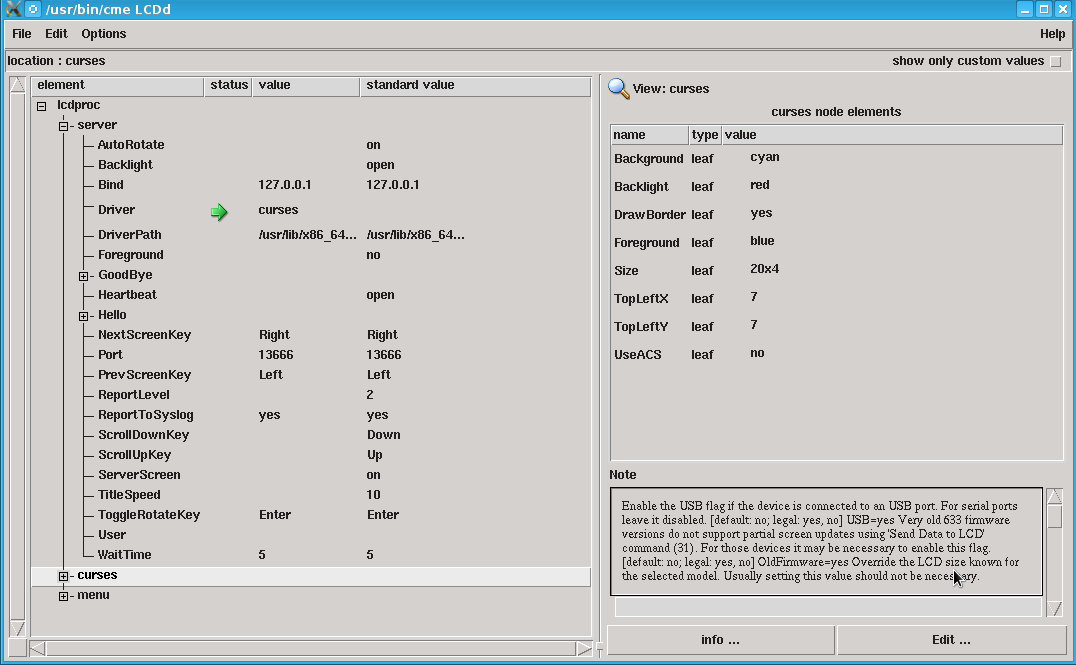
* edit the configuration with a GUI (see Managing Lcdproc configuration with cme for more details) Here s a screenshot of the GUI: GUI to edit lcdproc configuration More information * libconfig-model-lcdproc-perl package page. This package provides a configuration model for lcdproc.
* This blog explains how this model is generated from upstream LCDd.conf.
* How to adapt a package to perform configuration upgrade with Config::Model Next steps Automatic configuration merge can be applied to other packages. But my free time is already taken by the maintenance of Config::Model and the existing models, there s no room for me to take over another package. On the other hand, I will definitely help people who want to provide automatic configuration merge on their packages. Feel free to contact me on:
* config-model-user mailing list
* debian-perl mailing list (where Config::Model is often used to maintain debian package file with cme)
* #debian-perl IRC channel All the best
Tagged: config-model, configuration, debian, Perl, upgrade

Andrew Shadura: ifupdown and command status handling

In 2011, I first tried to fix a Debian bug #547587. The bug was about hook script result codes not being checked, so if a script fails, this isn t detected. Unfortunately, just checking the return code wasn t enough, as lots of scripts didn t care about their return code at all, so I had to unapply the patch. Now, after 2.5 years, I think it s time to try again, as most of the scripts have been fixed since then. At the same time, I ve changed error handling a little bit further: errors in any commands or scripts during interface configuration are considered fatal, but when interface is deconfigured, errors are ignored. However, this may change break configurations which depend on previous behaviour. Please report bugs if you find any.

Niels Thykier: Upcoming changes to Lintian (in 2.5.22)

The next version of Lintian, 2.5.22, is long overdue mostly because 2.5.21 FTBFS in sid. Besides fixing test failures, 2.5.22 also fixes: Besides bug fixes, we also added a couple of new features/nice changes: We just need to do some final tweaks and get the tag descriptions reviewed before we are ready to release the next version.

Russell Coker: Aldi Deserves an Award for Misleading Email

Aldi Mobile has made a significant change to their offerings. They previously had an offer of $35 for unlimited calls and 2.5G of data in a month for which they had to publicly apologise for misleading customers as 2500 minutes of calls a month (83 minutes per day) is no-where near unlimited [1]. They also had an offer of $15 for 2G of data. In an email about this Aldi said Many of our customers are using a lot less than what is included in our current $35 plan. So we will soon be introducing new Value Packs with more flexible options; meaning you only pay for what you really need and they start from just $10. . That is grossly misleading, if they offered new plans in addition to the old ones and allowed customers to choose the plan that is the best match then it would be useful to some customers. But removing the supposedly unlimited plan and the $15 for 2G of data option is removing affordable options for people who want to use their phones for lots of calls or very few calls but moderate amounts of data use. New Plans The base rate for calls on Aldi pre-paid is $0.12 per minute and $0.12 per SMS, consider every mention of minute in this section to be minute or SMS . The Aldi Newplans page [2] starts with a $10 per month plan which offers 100 minutes of calls which would be $12 at the previous rate of $0.12 per minute. That is OK value when compared to just using the pre-paid calls if you consistently use more than 83 minutes of calls per month. However if you don t use 84 minutes of calls (EG you don t speak much on the phone and use Google Hangouts instead of SMS) then it s not good value. Also the advertised data use is $5 per 100MB, which is way below what is needed for a typical user with an Android phone. My mother in law was barely able to stick within a limit of 300MB/month when that was her limit, but while using the Aldo 2G/month bolt-on she s increased her data usage. The smallest of the new plans costs $20 per month, it provides 300 minutes of calls and includes 300MB of data. For an extra $7 you can get another 300MB of data. For my mother in law it seems that the cheapest option on the new plans would be $27 per month, that would cover the 60 minutes of calls she might make and the 450MB of data she s probably using. That s significantly more expensive than her previous cost of $15 for 2G of data and $7.20 for calls and has the additional difficulty that I would have to be more involved in helping her avoid excessive data use. The 2G data bolt-on was really good for some of my relatives, when they use that and configure their phones not to update software over 3G they never had to ask me about any problems related to excess data use. So my mother in law is facing an extra $5 per month (or maybe more depending on data use) and more time spent calling me for tech support. The data bolt on that Aldi is going to offer in future is $30 for 3G of data to replace the previous offer of $15 for 2G of data. The cost will be unchanged for anyone who uses between 2G and 3G a month, for everyone who uses less than 2G or more than 3G the data bolt-on will cost more. There is simply no possibility for any Aldi data-only customer to save on data use. The only way someone who uses a moderate amount of data could save money is if they use more than 160 minutes of calls and less than 1G of data. Disclaimer My analysis above is based on interpreting the Aldi web site. As with most telcos they aren t trying to make things easy in this regard, it seems that the consensus of opinion among telcos is to use complex pricing to make it difficult to compare and reduce competitive pressure. I blame any inaccuracies in my analysis on the Aldi web site. Why Aldi Shouldn t Mislead Customers Aldi isn t primarily a mobile phone company, their main business is running a supermarket. The trust of customers is important to them, raising prices when competition goes away is one thing, but misleading customers about it is another. If Aldi were to honestly say now that Kogan Mobile no longer exists there is nothing forcing us to have low prices then I d have a lot more respect for their company and be more inclined to shop at their supermarket. It s a sad indictment of our society that I need to include a why lying is wrong section in such a blog post.

David Moreno: New Debian mailing list: debian-astro

I will try to report my Debian activities here. I am trying to retake them and as I'm usually busy at work, I have limited amount of time to do so, they stand small for now. A new mailing list, debian-astro, has been created. This was requested to create a space to allow a discussion space around astronomy for Debian, both for professionals and amateurs, to potentially look into a blend, and in general to talk about packaging and development of astronomy-related tools into Debian. Thanks to those interested on making this happen. Go subscribe today!

22 March 2014

Keith Packard: glamor-core

Core Rendering with Glamor I ve hacked up the intel driver to bypass all of the UXA paths when Glamor is enabled so I m currently running an X server that uses only Glamor for all rendering. There are still too many fall backs, and performance for some operations is not what I d like, but it s entirely usable. It supports DRI3, so I even have GL applications running. Core Rendering Status I ve continued to focus on getting the core X protocol rendering operations complete and correct; those remain a critical part of many X applications and are a poor match for GL. At this point, I ve got accelerated versions of the basic spans functions, filled rectangles, text and copies. GL and Scrolling OpenGL has been on a many-year vendetta against one of the most common 2D accelerated operations copying data within the same object, even when that operation overlaps itself. This used to be the most performance-critical operation in X; it was used for scrolling your terminal windows and when moving windows around on the screen. Reviewing the OpenGL 3.x spec, Eric and I both read the glCopyPixels specification as clearly requiring correct semantics for overlapping copy operations it says that the operation must be equivalent to reading the pixels and then writing the pixels. My CopyArea acceleration thus uses this path for the self-copy case. However, the ARB decided that having a well defined blt operation was too nice to the users, so the current 4.4 specification adds explicit language to assert that this is not well defined anymore (even in the face of the existing language which is pretty darn unambiguous). I suspect we ll end up creating an extension that offers what we need here; applications are unlikely to stop scrolling stuff around, and GPUs (at least Intel) will continue to do what we want. This is the kind of thing that makes GL maddening for 2D graphics the GPU does what we want, and the GL doesn t let us get at it. For implementations not capable of supporting the required semantic, someone will presumably need to write code that creates a temporary copy of the data. PBOs for fall backs For operations which Glamor can t manage, we need to fall back to using a software solution. Direct-to-hardware acceleration architectures do this by simply mapping the underlying GPU object to the CPU. GL doesn t provide this access, and it s probably a good thing as such access needs to be carefully synchronized with GPU access, and attempting to access tiled GPU objects with the CPU require either piles of CPU code to de-tile accesses (ala wfb), or special hardware detilers (like the Intel GTT). However, GL does provide a fairly nice abstraction called pixel buffer objects (PBOs) which work to speed access to GPU data from the CPU. The fallback code allocates a PBO for each relevant X drawable, asks GL to copy pixels in, and then calls fb, with the drawable now referencing the temporary buffer. On the way back out, any potentially modified pixels are copied back through GL and the PBOs are freed. This turns out to be dramatically faster than malloc ing temporary buffers as it allows the GL to allocate memory that it likes, and for it to manage the data upload and buffer destruction asynchronously. Because X pixmaps can contain many X windows (the root pixmap being the most obvious example), they are often significantly larger than the actual rendering target area. As an optimization, the code only copies data from the relevant area of the pixmap, saving considerable time as a result. There s even an interface which further restricts that to a subset of the target drawable which the Composite function uses. Using Scissoring for Clipping The GL scissor operation provides a single clipping rectangle. X provides a list of rectangles to clip to. There are two obvious ways to perform clipping here either perform all clipping in software, or hand each X clipping rectangle in turn to GL and re-execute the entire rendering operation for each rectangle. You d think that the former plan would be the obvious choice; clearly re-executing the entire rendering operation potentially many times is going to take a lot of time in the GPU. However, the reality is that most X drawing occurs under a single clipping rectangle. Accelerating this common case by using the hardware clipper provides enough benefit that we definitely want to use it when it works. We could duplicate all of the rendering paths and perform CPU-based clipping when the number of rectangles was above some threshold, but the additional code complexity isn t obviously worth the effort, given how infrequently it will be used. So I haven t bothered. Most operations look like this:
Allocate VBO space for data
Fill VBO with X primitives
loop over clip rects  
    glScissor()
    glDrawArrays()
 
This obviously out-sources as much of the problem as possible to the GL library, reducing the CPU time spent in glamor to a minimum. A Peek at Some Code With all of these changes in place, drawing something like a list of rectangles becomes a fairly simple piece of code: First, make sure the program we want to use is available and can be used with our GC configuration:
prog = glamor_use_program_fill(pixmap, gc,
                               &glamor_priv->poly_fill_rect_program,
                               &glamor_facet_polyfillrect);
if (!prog)
    goto bail_ctx;
Next, allocate the VBO space and copy all of the X data into it. Note that the data transfer is simply memcpy here that s because we break the X objects apart in the vertex shader using instancing, avoiding the CPU overhead of computing four corner coordinates.
/* Set up the vertex buffers for the points */
v = glamor_get_vbo_space(drawable->pScreen, nrect * (4 * sizeof (GLshort)), &vbo_offset);
glEnableVertexAttribArray(GLAMOR_VERTEX_POS);
glVertexAttribDivisor(GLAMOR_VERTEX_POS, 1);
glVertexAttribPointer(GLAMOR_VERTEX_POS, 4, GL_SHORT, GL_FALSE,
                      4 * sizeof (GLshort), vbo_offset);
memcpy(v, prect, nrect * sizeof (xRectangle));
glamor_put_vbo_space(screen);
Finally, loop over the pixmap tile fragments, and then over the clip list, selecting the drawing target and painting the rectangles:
glEnable(GL_SCISSOR_TEST);
glamor_pixmap_loop(pixmap_priv, box_x, box_y)  
    int nbox = RegionNumRects(gc->pCompositeClip);
    BoxPtr box = RegionRects(gc->pCompositeClip);
    glamor_set_destination_drawable(drawable, box_x, box_y, TRUE, FALSE, prog->matrix_uniform, &off_x, &off_y);
    while (nbox--)  
        glScissor(box->x1 + off_x,
                  box->y1 + off_y,
                  box->x2 - box->x1,
                  box->y2 - box->y1);
        box++;
        glDrawArraysInstanced(GL_TRIANGLE_STRIP, 0, 4, nrect);
     
 
GL texture size limits X pixmaps use 16 bit dimensions for width and height, allowing them to be up to 65536 x 65536 pixels. Because the X coordinate space is signed, only a quarter of this space is actually useful, which makes the useful size of X pixmaps only 32767 x 32767. This is still larger than most GL implementations offer as a maximum texture size though, and while it would be nice to just say we don t allow pixmaps larger than GL textures , the reality is that many applications expect to be able to allocate such pixmaps today, largely to hold the ever increasing size of digital photographs. Glamor has always supported large X pixmaps; it does this by splitting them up into tiles, each of which is no larger than the largest texture supported by the driver. What I ve added to Glamor is some simple macros that walk over the array of tiles, making it easy for the rendering code to support large pixmaps without needing any special case code. Glamor also had some simple testing support you can compile the code to ignore the system-provided maximum texture size and supply your own value. This code had gone stale, and couldn t work as there were parts of the code for which tiling support just doesn t make sense, like the glyph cache, or the X scanout buffer. I fixed things so that you could leave those special cases as solitary large tiles while breaking up all other pixmaps into tiles no larger than 32 pixels square. I hope to remove the single-tile case and leave the code supporting only the multiple-tile case; we have to have the latter code, and so having the single-tile code around simply increases our code size for not obvious benefit. Getting accelerated copies between tiled pixmaps added a new coordinate system to the mix and took a few hours of fussing until it was working. Rebasing Many (many) Times I m sure most of us remember the days before git; changes were often monolithic, and the notion of changing how the changes were made for the sake of clarity never occurred to anyone. It used to be that the final code was the only interesting artifact; how you got there didn t matter to anyone. Things are different today; I probably spend a third of my development time communicating how the code should change with other developers by changing the sequence of patches that are to be applied. In the case of Glamor, I ve now got a set of 28 patches. The first few are fixes outside of the glamor tree that make the rest of the server work better. Then there are a few general glamor infrastructure additions. After that, each core operation is replaced, one a at a time. Finally, a bit of stale code is removed. By sequencing things in a logical fashion, I hope to make review of the code easier, which should mean that people will spend less time trying to figure out what I did and be able to spend more time figuring out if what I did is reasonable and correct. Supporting Older Versions of GL All of the new code uses vertex instancing to move coordinate computation from the CPU to the GPU. I m also pulling textures apart using integer operations. Right now, we should correctly fall back to software for older hardware, but it would probably be nicer to just fall back to simpler GL instead. Unless everyone decides to go buy hardware with new enough GL driver support, someone is going to need to write simplified code paths for glamor. If you ve got such hardware, and are interested in making it work well, please take this as an opportunity to help yourself and others. Near-term Glamor Goals I m pretty sure we ll have the code in good enough shape to merge before the window closes for X server 1.16. Eric is in charge of the glamor tree, so it s up to him when stuff is pulled in. He and Markus Wick have also been generating code and reviewing stuff, but we could always use additional testing and review to make the code as good as possible before the merge window closes. Markus has expressed an interest in working on Glamor as a part of the X.org summer of code this year; there s clearly plenty of work to do here, Eric and I haven t touched the render acceleration stuff at all, and that code could definitely use some updating to use more modern GL features. If that works as well as the core rendering code changes, then we can look forward to a Glamor which offers GPU-limited performance for classic X applications, without requiring GPU-specific drivers for every generation of every chip.

Nicolas Dandrimont: Debian proposals in GSoC 2014

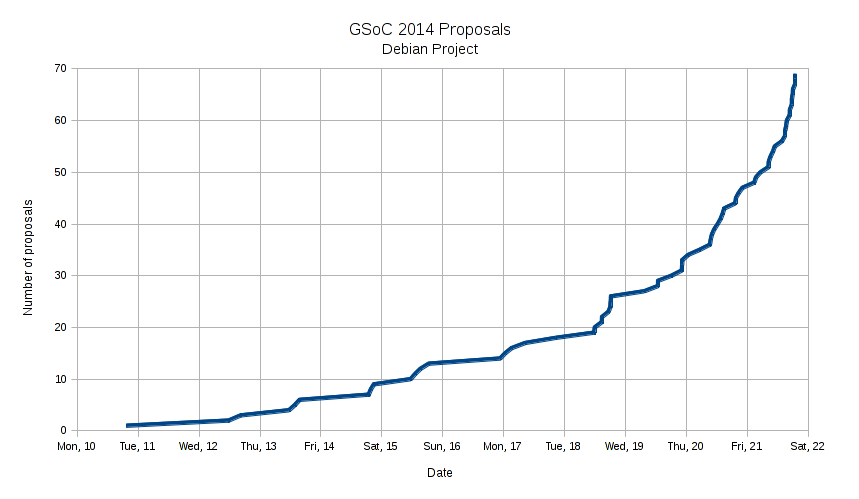
The GSoC student application period is over, and the last two days were pretty interesting. For a few years now, Olly Betts has provided us with a spreadsheet to graph the number of applicants to an organization over time. Here s the graph for Debian this year: Debian GSoC proposals, 2014 edition (Historical graphs: 2013, 2012. Spreadsheet available from Olly s blog) On Wednesday, I was thinking hmm, 30 applicants, this is a slow year . Well, the number of proposals more than doubled in the last two days, to conclude on a whooping 68 applications! The last one was submitted just three seconds before the deadline If you want to take a look at the proposals, head over to the Debian wiki. Time to get on reviewing! The final student acceptances will be published in just less than a month, on April 21st.
Richard Hartmann: Lenovo X1 Carbon

Christine's accidential blog spam on planet.d.o just now gave me the chance to re-read the comments in her post. The state from back then is still the current state on up-to-date Debian unstable: The last item has the most impact on me. The need to tether when you have a dedicated SIM card, built-in modem, and good antennas in your laptop is... infuriating. Especially as it's working as intended on Windows. As an added benefit, even though I saved the PIN in network manager, it asks me for the PIN every time I log in and every time after hibernating. For a device which I can't use in the first place. Argh!

21 March 2014

Sylvestre Ledru: Rebuild of Debian using Clang 3.4

Using the AWS donation, David Suarez and myself have been able to rebuild the whole archive with Clang 3.4.
The rebuild has been done January 10th but, with my new job, I did not find the time to publish the result.
Releases after releases, the results are getting better and better. Currently, 2193 packages in the archive are failing to build from source.
That is roughly the same number of build failures as with the precedent rebuild with Clang 3.3.
However, this is good news for two reasons:
* the number of new packages in Debian increased (18854 at time of the 3.3 release, 21204 for the 3.4)
* clang 3.4 has more checks and error detections. I also started to update clang to make it closer to gcc. For example, I transformed wrong usage of -O (> 6) error to be treated as regular warning. However, a critical bug has emerged during this release. When using -D_FORTIFY_SOURCE=2 (which is the case of many Debian packages), the binaries produced freeze (infinity loop in the ASM). This has been reported upstream as bug 16821 and concerns about 150 packages (including Firefox, gcc, LLVM, etc). Hopefully, this will be fixed in 3.5 (this is unlikely for 3.4.1). About the new build failures, now, Clang triggers an error (or warning + -Werror) on: * Wrong usage of the default argument (should be done in the definition)
16 occurrences * Usage of C++11 feature without the appropriate argument
7 occurrences * Unused static const declaration
5 occurrences * Recursive template instantiation exceeded
4 occurrences * Defitinion of a builtin function
3 occurrences * Read-only variable is not assignable
2 occurrences By the way, I proposed a Google Summer of Code Project to work faster on a support of Debian built by Clang. As requirements, I asked students to fix some bugs, they already did a great job.

Next.

Previous.