Search Results: "ana"

19 January 2009

Gunnar Wolf: About the recent events and possible outcomes in Israel and Palestine

Several friends, from different groups and backgrounds and with different points of view regarding the current war in Israel (and regarding the Arab-Israeli conflict in general) have asked me for an explanation on what is happening there, what is (my view of) the real conflict, its causes... and any possible answers. And yet I am quite far from being an authority, I do want to write something about it. Be prepared, as this post is quite long.
And yet, after writing frankly a lot more than what I expected... It is by far not enough. I have still much more to add, but I have to say "stop" at some point. So, here you have it: My points of view, as well as some explanation on why are we standing where we currently are.
I am writing this based just on my personal experiencie and, of course, my personal point of view. Furthermore, I wrote a good part of this text while riding a bus, with no network access, so I am offering very few references - In any case, it will allow me to make much more progress. References always take as much time as the text itself! About me Why am I writing this? Why do people ask for my opinion? I must start by explaining who I am, so the rest of this makes sense. I am a Mexican Jew. That means, I was born in a Jewish (albeit secular) family, and grew up in an environment with general Jewish culture. My direct family (say, my parents and brother, and to a lesser degree my closest cousins) are not at all religious, I'd even venture to say most of us are complete atheists. Yet, besides the cultural belonging (which is a mixture of a Eastern European culture with lots of Idish words and dishes and general humor), my family has a strong national identification - In other words, I grew up in a fully Zionist environment, which traces back to Poland.
My grandmother was member of Hashomer Hatzair in Poland, since the early years of its existence, late 1910s and early 1920s. What is it? To make it short, a Zionist Socialist, Kibbutzian youth movement. It has many similarities (and somewhat stems indirectly from) the Scouts many of you will be familiar with, but -obviously- has a way lengthier agenda. And, yes, nowadays I feel it is somewhat out of reach with the current state of the world - It was founded in 1913, and only slightly adjusted its principles since then.
I will talk more about Hashomer later on.
My grandmother arrived in the late 1920s to Mexico, for familiar and economic reasons, but still dreamt about living in Israel for a long time. As they grew up, first my uncle joined Hashomer in Mexico in the late 1940s, when it still pursued a very much Soviet-style ideals for Israel (one of the core points that changed during the 1950s); both my father and my mother joined in the late 1950s (in fact, that's where they met). My cousins and myself were very active in the 1980s and 1990s.
The Iszaevich family has something very unusual, I'd say, engraved in our genes. We live very deeply our ideologies. That's the only explanation I can find to the way we all have led our lives. I won't go into the other family members' details, but just into mine: I was fully convinced of all we taught to our younger members and what we discussed among ourselves. I am among the very few people who really learnt Hebrew at my school, and that was only because I really cared - I know some people that just after 12 years of pseudo-learning could maybe utter a few phrases.
After finishing high school I went with my Hashomer group, together with people my age from other similar-minded Mexican Zionist youth groups, to live and learn for a year in Israel, on what is usually known as shnat hajshar - A year to get ready. To get ready to what? But of course, to come and give back go the younger groups of the movement, and finally go back to Israel and settle there definitively. I came back to Mexico, and after one year I did the only thing that was logical: I became an Israeli and went to live to a kibutz - Zikim, a beautiful place just between Ashkelon and Gaza, very near the sea shore. It was a beautiful period in my life, and I really enjoyed it - But it didn't last for very long - I quickly grew to hate the Israeli society at large. A society full of rage, of hatred. Not just between Arabs and Israelis, as many would think from the outside, but between religious and seculars. And between immigrants and locals. And between leftists and rightists (in several dimensions, as it is one of the countries where you can most easily be a economic leftist while being a political rightist - a complex society it is). A society full of disrespect and intolerance. A very hypocritical society. And one of the things that most shocked me: I wanted to live in a society of proud of its existence, that's what I had learnt Israel was - But Israelis aspire and dream of being anything else (and mostly US-Americans) in a way that made me sick, more than anything I had previously seen in Mexico.
I loved the life at the Kibutz, and I loved being an agricultor, doing hard work every day and literally getting the fruit of it. However, I cannot live isolated to a 300-people universe - At least once a week you have to go to the city if you don't want to become insane. And I could not stand the sick Israeli society.
Anyway, to make things short: After six months as an Israeli, I came back to Mexico. I went through a long period of finding myself, as I could not uphold anymore my Hashomer ideology (if I am not going to live by it, how can I continue teaching it?). Many people do anyway, but for the first months, where my Hashomer work was basically all of my life, I felt really uncomfortable. So, in short, I severed all of my relations to the Jewish community, and even denied for a long time my Jewishness until I found a (I think) better balance.
Today I am at peace. But anyway, I wanted to talk about myself in the critical period that marked me in this regard: The 1990s. Enough, lets get down to business. Zionism 1870-1920 Many people argue that the Jews invaded the Palestinians homeland - And yes, nowadays I cannot counter this. But we cannot judge what happened then based on what we see now.
Modern Zionism started around the 1870s. The Jewish history is full of pogroms and persecution, in different countries all over Europe - And a group of young people decided the only solution was to build a place to call their own. And yes, this was full of idealism and in no small part the foolishness of youth. For several centuries and up to 1920, all of current Middle East were provinces of the Ottoman Empire. Before Zionism began, the population of today-Israel was very sparse, not more than 400,000 people - up to 5% of them Jewish, around 10% Christian Arabs, and the remainder, Muslim Arabs. Of course, the low population was mostly because the country was mostly hostile - A desert in the South, mostly swamps in the North, and some minor towns mostly in the hills. It was a mostly forgotten province, away from the central Turkish rule, and there had been no frictions with the local population. It was a nice place to go, thinking -again- as a fool youngster, or as an idealist. They said, lets take a folk without a land to a land without a folk.
The number of accomplishing Zionists (this is, people who actually went to Israel instead of just talking about doing so) was not high during the first decades. But towards the 1890s, it gained critical mass. The political Zionist movement was born, with Theodor Herzl as a leader, and they started pushing -politically- for different governments to concede a territory to Jews. They went to the Turks, and didn't really get much echo. Went to other colonial powers of the time, and got unfeasible promises with no real backing (i.e. Birobidjan in Eastern Russia, Uganda in Africa)... And, as it happens in strongly ideologized movements, the movement started splitting into different groups with slightly different positions.
And no, I am not talking about the People Front for the Liberation of Judea and the People Judean Liberation Front, but I very well could. Sometimes the differences are as ridiculous as that. But hey, I take that most of my readers are acquinted with the Free Software issues, right? Think BSD vs. GPL vs. OpenSource. To give a broad idea - Only in Mexico City, with a very small Jewish community (~30,000 people), in the mid-1990s we had over 10 such movements, with 50-150 youngsters attending each. And even though some were local, and even though some very important ideologies are not represented in this country, they are all different enough to exist as separate entities. British Mandate The Ottoman empire was divided after the first World War. Its possesions in Europe became independent states, while in Asia (and Africa, if you take the semi-independent Egypt and part of Sudan into account) they were taken over as colonies or protectorates by France and the UK - Evidently, attempting to secure a long-term dominion over the area. In some aspects, they failed. In some aspects, they were (and still are) tremendously successful. The division of people by setting arbitrary boundaries has led to countries sustainable only by force and a harsh rule (such as Iraq, Lebanon and Syria), or doomed to poverty (and thus submission) due to lack of natural resources (as Jordan). Focusing on Israel/Palestine, the UK entered the area by making mutually incompatible promises to arabs and Jews - i.e. the Hussein-McMahon letters and the Balfour declaration, both ambiguous enough to lead to... Well, today. The UK rule was disastrous to the region, both in giving (and taking away) power from all sorts of puppet regimes, and swiftly going away as soon as things started looking too complicated. Yes, typical colonialism.
So, while up to the 1920s there was no real animosity between Arabs and Jews (as i.e. the Faisal-Weizmann agreement shows), during the next decades the seeds of hatred started growing, from both sides.
Many people still quote the 1947 partition plan as the direct antecedent towards Israel's real existence - That was not the first partition plan that existed. Ten years earlier, the Peel commision suggested a similar partition involving forceful population transfer. And many people see the separation of Transjordan (now Jordan) from Palestine in 1922 as a first partition. It is understandable that both partition plans (much more the 1947 than the 1937 one) were accepted by Zionists: Going from having nothing to having something (and against all odds in the environment they lived) is acceptable.
From the Zionist side, two main groups rejected the partitions: The right-wing and religious groups, insisting that the whole of the Mandate should become Israel, and the left-wing groups, which advocated for a single, bi-national state, with equal rights for all of its population. Go over and read this last link, as it was quite interesting (to me at least) to see how this solution has kept existing and regarded by (relatively) many people, and has many interesting links. 1948 onwards: Where did the refugees come from? The November 1947 partition didn't exactly translate to a planned, smooth Israeli independence - It led to six months of revolts (basically, a civil war). By mid May, the UK government and troops abandoned the territory, and one day later, Israel declared its independence. And, of course, all neighbouring countries (and Iraq) sent their troops to invade Israel. The war lasted for over six months (cease-fire was signed in January 1949). There was an intense Arab campaign indicating the armies would enter Israel and devastate it, leaving no stone in place, indicating Arab population to temporarily leave the Jewish-destined areas. The war, they said, would not take more than a couple of months, and they would be able to go back home.
Only that... When the war ended, the results were far from what the Arab governments expected. Not only Israel continued to exist, but it conquered important territories.
Of course, the Israelis were not innocent from said exodus: During the 1947-1948 civil war, and the independence war, some of the existing so-called self-defense forces (some of them were really defensive, while some were quite aggressive, even terrorist) attacked Arab villages in strategic or predominantly Jewish areas to prompt them to leave - yes, what we today call ethnic cleansing.
I had (in my head) the number of 650,000 Arabs (from a total of slightly over a million) fleeing to neighbouring countries. Wikipedia states that it is somewhere between 367,000 and 950,000. A similar number of Jews were expelled from Arab countries, many of which arrived to settle at Israel (and many others went elsewhere - For instance, a good part of the Mexican Jewish community is from Syrian origins - Many of them fleed in those years). Israel didn't accept back the (relatively few) Arabs that requested to resettle, as they were seen as hostile population - but neither did the countries that "temporarily" accepted the Palestinians accepted them as citizens. The Palestinian refugee camps today, mainly in in Lebanon, Syria, and the occupied territories held by Israel have terrible living conditions, and its population -despite living there for over 60 years- have no civil rights at all. Note that I'm omitting Jordan here, although it has several camps as well, as their situation is way better.
The Arab population that didn't leave did receive full Israeli citizenship. No, their living standards are not up to level with the average Israeli. The country and the society do have a sensible degree of racism and segregation. But the situation is nowhere as terrible as it is in the camps.
The areas which were originally to become Palestinian and were not conquered by Israel -this is, current-day West Bank and Gaza- bacame respectively Jordan and Egyptian territory. While Jordan did fully extend its soverignty covering the West Bank, Egypt didn't - Gaza is, since 1949, occupied military territory. Gaza, among the most densely populated areas in the world, has had their inhabitants under military rule ever since. When Israel returned the Sinai after signing the peace treaty with President Sadat, Egypt didn't accept Gaza back - And that's where today's greatest problem is born.
Now, Israel conquered those territories in 1967, along with the very sparsely populated Sinai and Golan. For the first ten years, the territories were basically only administered (yes, under a military rule). In 1977, with the first right-wing Israeli government, an extensive settlement policy began (and led partly to today's seemingly unsolvable situation). In 1980-1982, Israel withdrew from the Sinai. In 1981, Israel claimed full soverignty over the whole of Jerusalem and the Golan. In 1993, the "Oslo Agreement" was signed between Israel and the PLO, and it seemed we were heading towards a bright future. I lived in Israel between 1994 and 1996 - Yes, the most hope-filled period in the country's life.
Since 1996, I have tried to keep up to date with the country's evolution. All in all, even if I won't live there again, it is a country I learnt to love, a society I have long studied (even if in the end I did include many references, I wrote most of this text just off the top of my head, with the data I remember - so it might have several big errata). And yes, I keep the political stand I had 12 years ago: The only solution is to dialogue, to treat the current enemies -and not only their governments- with respect, recognizing their dignity and right to life, to self-determination. Only then we will change the status quo. How not to fight hatred Since 1993, the dream of peaceful coexistence seems to have faded. What we saw during the past three weeks, along to what we saw in Lebanon in 2006, is plainly a gross mistake if the goal is to achieve good, lasting peace.
Try to imagine how could life in Gaza be, even in the total absence of Israeli attacks. Just to set some numbers first: The Gaza strip hosts almost 1.5 million people on 360 km . When I lived in Israel, I was constantly surprised at how small a country it is - Israel tops at 550Km North to South, 150Km east to West (it is amazing, almost wherever you stand, except in the middle of the Negev, you can see the country's borders. Yes, I recognize as the border the so-called Green Line); over half of the territory is a desert, and it hosts seven million inhabitants. And it is hard to imagine how that country can be economically viable.
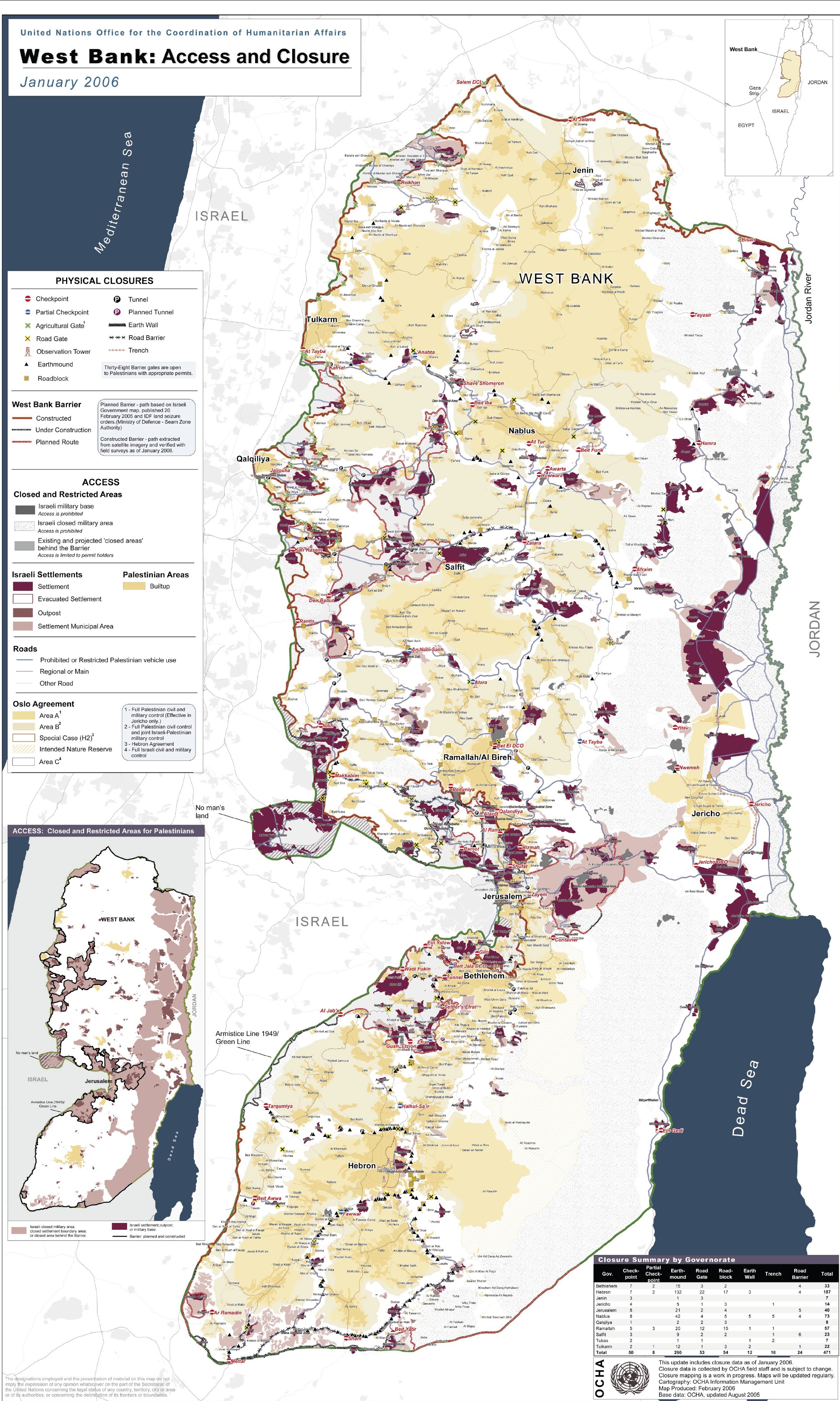
I do not find it feasible to imagine Gaza and the West Bank integrating a single country, and not only because they are separated by ~40Km, but because they are so sociologically different. People in the West Bank, yes, live opressed under military rule and subject to a much more constant, more visible apartheid-like state (as the territory is truly sprinkled with Jewish outposts which many Israelis refuse to recognize as their own, but still, which have incredibly higher living standards). The best land has been taken away from them, yes, but they have some space between cities to have some farming, to communicate, to... Breathe. Besides, West Bank inhabitants -even those in refugee camps- have much better living standards than anybody in Gaza. It is still an overpopulated area, but not nearly as much as Gaza.
Gazan population have been driven towards extremism. And yes, there was a civil war between Palestinian factions, as the world views between both populations are completely different - However hostile a Jenin inhabitant can be towards Israel, he does not lead the life -if it can so be called- you see at Khan Yunis.
But back to Gaza... What Israel is doing (and not only during this military operation terror campaign is wrong, from any rational point of view. Israel wants Hamas to become weaker? Then don't drive the population into supporting them!
Palestinians started giving over 50% of their support to Fatah (ex-PLO), and under 20% to Hamas. That was less than 15 years ago. However, Fatah has shown to be corrupt and inefficient at building infrastructure and improving life conditions, ineffective at negotiating a permanent agreement which secures dignity and sustainability to their people. Hamas stands as a religious, righteous organization. There are no serious corruption charges against any Hamas leaders. Hamas is clearly still at war - They didn't subscribe any peace agreement so far, and their stated #1 goal is to build a Muslim State in the whole of Israel. And the Hamas movement -like Hizbollah in Lebanon- has built quite a bit of infrastructure in the areas they control - Mainly housing. Yes, housing where they mix their own offices, many will accuse, getting human shields for free. But still, they are benefactors to a dehumanized, pauperized population.
I find it obvious that, if living conditions were at a basic level in the region, support of Hamas would decrease. Even more, of course, if they improved due to Israeli support. Israel controls this territory, so it is responsible for the well-being of its population, like it or not. And Gaza is simply too small and low on resources to survive by itself.
I was a bit surprised to find mention -although very brief- of a three state solution - And yes, this is close to what I would expect as a viable outcome. It is clear that Israel will not ever grant full citizenship to the Palestinians, as they would -euphemistically speaking- challenge the Jewish character of the State. Dropping the euphemism, Israel relies on apartheid in order not to become an Arab majority country. I might have some numbers wrong, but AFAIK, there are ~7 million Israelis, 20% of which are Arab citizens (which means, 1.4 million Arabs and probably 5 million Jews, with many other minor denominations for the difference), and ~4 million Palestinians live in the territories. Today, the country is already predominantly Arab, or at least is close to being so. So, Israel should permanently, formally disengage from all of the occupied territories. And in order to ensure violence stops, start a comprehensive, unconditional, long-term aid program. Start with giving them autonomy to regain their sea, as the Gaza port has long been closed. Allow the airport to operate again. Instead of bombing tunnels in the Egypt-Gaza borders, allow Gaza to trade with Egypt - Perhaps even to integrate territorialy, if the conditions are met. Treat their people with respect, and help them ease the terrible situation they have lived for so many decades - and then, undoubtely, terror will stop.
The West Bank? Possibly it could become a Palestinian state by itself. Possibly, it could integrate back to Jordan. That would be up to Jordans and Palestinians to decide. Of course, Jordan has already a large segment of its population defining itself as Palestinians, which counts both for and against. So, I won't venture into this supposition.
But anyway - Back to what prompted me to write this text -yes, a very or maybe even too long text - I hope somebody even takes the time to read it!- is to explain what is my point of view on the current situation, and why.
Today, a cease-fire was announced, after 23 days of murder and destruction. I sadly do not hold very high hopes for it to be lasting, much the less to be enough, to lead to what they call a de-escalation of the conflict. The most I can currently do is to voice my opinion, and hope that mine is just one more voice pointing to a sane solution, to a permanent, dignifying way out, for all people involved. Every people has the right for survival and for safety. We cannot deny this to any others. And certainly, we cannot expect anybody not to fight for their right to live.

Fabio Tranchitella: Distributed application-level filesystem for web applications

While developing web applications using Zope3, my Python web framework of choice, I always have the same issue: where should I store the UGC data? I usually used an NFS filesystem, using a Zope utility to manage the storage and retrieval of the files.

The most obvious disadvantage of this technique is that the NFS server is a single point of failure: if it disappears, there is no way to access the files from the application servers.

Another problem with this implementation is that all the UGC data files have to be served by the application servers, using resources which could be used to serve more clients instead of transmitting a static file over the network.

MogileFS is an application-level distributed filesystem which solves these problems, ensuring data integrity and redundancy, written by Danga. The only problem is that it is written in Perl, it works only with MySQL and requires WebDAV servers for the storage.

To solve my problem, I decided to borrow some of the ideas behind MogileFS and to develop my own distributed application-level filesystem. KoboldFS is written in Python, uses a PostgreSQL database to store the filesystem status and it is released under the GPL license.

I deployed it a few days ago on one of our production clusters, and it reduced the load of the application servers allowing us to serve the UGC files directly from nginx. You can find the source code along with a rough description here.

Axel Beckert: First experiences with Debian on the OpenMoko FreeRunner

I ogled with an OpenMoko FreeRunner since Harald K nig (of X.org fame) s OpenMoko talk at LinuxDay.at last year. I knew that a team around Luca Capello and Joachim Breitner managed to get Debian running on it. So when Venty told me that harzi wants to sell his nearly unused FreeRunner, I couldn t resist and bought it just a few days later. I played around a little bit with the two distributions which were already installed, AFAIK the original 2007.2 and a version of Qtopia. Called Venty with the Qtopia to prove him that you indeed can make phone calls with this phone, but he wasn t pleased by the echo he heard of his own voice. Since the included 512 MB microSD card surely is too small for a large Debian installation, I bought an additional 8 GB microSDHC card at digitec and then installed Debian on it. The installation mostly went smooth: Partitioning threw a timeout error which didn t cause any further harm than aborting once. A bigger problem was that the hint that you need to update the U-Boot bootloader itself and not only its configuration (called environement) to get it booting from ext2 partitions. lindi (Timo Lindfors) on #openmoko-debian (on Freenode) was of great help spotting the small details hidden in continuous text. After having Debian booting I installed all software I wanted to play around on a mobile phone including a bunch of web browsers. But since I ran into a bug which occurs after a non-deterministic amount of data is written to a big microSD card, I quickly got annoyed by the fact that I had to wait for the 8 GB fsck each time this bug was triggered. So I converted the root file system to ext3 by adding a journal. But whatever I did (reinstalling U-Boot, the U-Boot environement, regenerating the U-Boot environement from scratch, trying to load it as ext2 again, etc.) I didn t get it to work anymore. On #openmoko on Freenode, PaulFertser was trying to convince me that Qi is the better choice of a bootloader. Although its description didn t appeal to me at all, I understand that U-Boot seems a maintainability hell and that a more simplicistic approach can have its advantages. But there was feature listed on the Qi wiki page which made me try it: explicit ext3 support. After creating the appropriate configuration files and symbolic links in /boot/boot and flashing Qi over the U-Boot in the NAND flash, Debian booted again without problems and with a journaling file system. :-) In the meanwhile I found a setup which suites my tastes: Next step will be to move daily usage from root to an unprivileged user. As soon as that s done, I ll try to get Tablet Amora aka Tamora working on the OpenMoko, too. Currently it only runs on Nokia s Linux based internet tablets (N800, N810, etc.). Update, 17:54 To answer Joachim s question in the comment: I don t plan to use it as daily phone, but it may replace my old Nokia 6310i where currently my German mobile phone SIM card resides in. Use it mainly to have a cheap way to make phone calls inside Germany.

Axel Beckert: How I use my virtual desktops

Many months ago I stumbled upon this German written meme about how users use their virtual desktops. I use virtual desktops since my very early Unix times (tvtwm on Sun Sparc SLC/ELC/IPX with greyscale screens running SunOS 4.x), so in the meanwhile I use them nearly everywhere the same way. Short Summary 3x5, no overlapping windows, either tiling or fullscreen, keyboard navigation, xterms, yeahconsole, FVWM, panel for systray. Window Manager of Choice My window manager of choice is FVWM since more than a decade. I tried others like Sawfish, Metacity and Compiz, but I couldn t get them behave like the FVWM I got used to, so I always came back. Since I hate overlapping windows, I use FVWM a lot like a tiling window manager. FVWM has this nice function to maximize windows so that they occupy as much space as available, but do not overlap other windows. This function was also often missing when I tried other window managers. I though do not want to use real tiling window managers since I have a few sticky windows around (e.g. the panner with the virtual desktops and xosview) and they shouldn t be overlapped either. Virtual Desktops Switching between virtual desktops is done with the keyboard only with Ctrl-Shift as modifier and the cursor keys. The cursor keys are usually pressed with thumb, ring and small finger of the right hand. Which hand presses Ctrl and Shift depend on the situation and keyboard layout, but it s usually either ring and small finger of the left hand, or pointer and middle finger of the right hand. So I m able to switch the virtual desktop with only one hand. I have always three rows of virtual desktops and usually four or five columns. The top row is usually occupied with xterms. It s my work space. The top left workspace usually contains at least one xterms with a shell and one with mutt, my favourite e-mail client since nearly a decade. At home the second left virtual desktop in the top row usually contains a full-screen Liferea (my preferred feed reader) while at work it contains the GNU Emacs main window besides two xterms. Emacs and the emacs server are automatically started at login. This also means that I switch the virtual desktops when I switch between mutt and Emacs for typing the content of an e-mail. Did this already during my studies. (At home mutt runs inside a screen, so there I just switch the virtual terminal with Ctrl-A Ctrl-A instead of the virtual desktop. Not that big difference ;-) The other virtual desktops of the the top row get filled with xterms as needed. Usually one virtual desktop per task. The middle row is for web browsers. One full screen browser (usually Conkeror or Opera) per virtual desktop, often opened with many tabs (tabs in Opera, buffers in Conkeror) related to the task I m accomplishing in the xterms in the virtual deskop directly above. The third row usually contains root shells for maintenance tasks, either permanently open ones on machines I need an administrate often (e.g. daily updates of Debian testing or Debian unstable machines), or for temporary mass administration (Linux workstations on the job, all Xen DomUs of one Xen server, etc.) using pconsole. yeahconsole Additionally I have a sticky yeahconsole running, an xterm which slides down from the top like the console in Quake. (It s the only overlapping thing I use. :-) My yeahconsole can be activated on every virtual desktop by pressing Ctrl-Alt-Z (with QWERTY layout, Ctrl-Alt-Y with QWERTZ layout). It s the terminal for those one-line jobs then and when, e.g. calling ccal, translate, wget or clive. Changes over time Of course the desktop usage changes from time to time: At work I have more than one monitor, so in the meanwhile the second row with the web browsers moved to the second screen with independent virtual desktops (multiple X servers, no Xinerama). The second row on the main screen at work is now used the same way as the third row with a slight preference for the permanently open shells while the third row is more used for mass administration with pconsole. At home I used XMMS respective Audacious for a long time (my FVWM panner and xosview are exactly as wide as WinAmp2/XMMS/Audacious, guess why:-) which usually was sticky the same way as the panner and xosview are. But when I started using last.fm recently, I moved to Rhythmbox (after testing some other music players like e.g. Amarok) which I use in fullscreen as I do with web browsers and the feed reader. So it occupies a complete virtual desktop, usually the second one in the middle row below the feed reader because I don t need a corresponding web browser for the feed reader. (Just found out that there is a last.fm player for text-mode, so maybe that will change again. :-) Another thing which changed my virtual desktop usage was the switch from a classical tabbed web browser (Galeon, Kazehakase, Opera) to the buffer oriented Conkeror. With a tabbed web browser I have either no overview over all open tabs (one row tab bar or truncated tab menu) or they occupy too much space of the browser window. That was another reason for more than one browser window and therefore more than one virtual desktop with fullscreen web browser windows. With Conkeror tabs are optional (and not even enabled by default), Conkeror uses buffer like Emacs and if you want to switch to another buffer, you press C-x b and then start typing parts of the buffer s name (e.g. parts of the URL or the web page title) to narrow down the list of buffers until only one is left or until you have spotted the wanted buffer in the list and choose it with the cursor keys. So the need for more than one browser window is gone. For a long time I didn t need any task/menu/start/whatever bar on my desktop. But since neither NetworkManager nor wicd have a comand-line interface (yet) and bluetooth seems also easier handled from the system tray my laptops also use either gnome-panel (big screen, long sessions with FVWM) or lxpanel (formerly used trayer; use it on small screen, short sessions with ratpoison or matchbox) on my laptops. It s sticky and always visible. (No overlapping, remember? ;-) The panel is usually at the bottom on the screen as by default with Windows or KDE, not at top as with GNOME and MacOS. Only on the OpenMoko, I have the panel at the top to be close to what I m used from Nokia mobile phones. Things I tried but didn t survive in my setup: Systems without Virtual Desktops Anyway, there are systems where I don t use virtual desktops at all. On systems with a screen resolution so small that there s not enough space for two non-overlapping, fixed font 80x25 xterms on the screen (e.g. on my MicroClient with 8 touch screen, the 7 EeePC or the OpenMoko) I do not use virtual desktops at all. On such systems I use all applications in fullscreen, so switching between applications is like switching virtual desktops anyway. My window managers of choice for such systems are ratpoison for systems with keyboard and matchbox for system without keyboard. With ratpoison you treat windows like terminals in GNU screen, so there are no new keybindings to learn if you re already used to screen (which I use nearly daily since more than a decade).

Marco d'Itri: automatic backups on a removable device

These scripts allow automatically running rsnapshot when the right USB hard disk is plugged in. If you do not want so much automation then just let gnome-volume-manager do its work and then run the last script from the command line. /etc/udev/rules.d/68-automount.rules:
ACTION=="add", SUBSYSTEM=="block", \
        ENV ID_FS_USAGE =="filesystem", ENV ID_FS_LABEL =="red", \
        RUN+="backup.agent $env ID_FS_LABEL "
/lib/udev/backup.agent:
#!/bin/sh -e
##############################################################################
wait_for_fs()  
  local fs_path="$1"
  local count="$2"
  if [ -z "$count" ]; then count=60; fi
  while ! mountpoint -q $fs_path; do
    sleep 1
    count=$(($count - 1))
    if [ $count -eq 0 ]; then
      echo "$fs_path has not been mounted after $count seconds!" 1>&2
      return 1
    fi
  done
  return 0
 
##############################################################################
do_stuff()  
  if [ -e /tmp/nobackup ]; then exit 0; fi
  wait_for_fs $FSPATH   exit 1
  nice -n 19 ionice -c 3 sh $FSPATH/doit
  rsnapshot -v diff daily.0 daily.1   mail -s "rsnapshot diff" md
  if [ -e /tmp/noumount ]; then exit 0; fi
  pumount $FSPATH
 
##############################################################################
if [ ! -t 0 ]; then
  exec >> /var/log/backup.log 2>&1
fi
if [ "$1" ]; then
  FSNAME="$1"
else
  echo "Usage: $0 name"
  exit 1
fi
FSPATH="/media/$FSNAME"
# the script may be called multiple times due to multiple change events
# being fired by the kernel
if mountpoint -q $FSPATH; then exit 0; fi
# daemonize
do_stuff &
A while loop which waits for the file system to appear is not elegant, but you cannot do this the right way with only a shell script because it requires watching /proc/mounts using inotify(3). /media/red/doit:
#!/bin/sh -e
##############################################################################
file_older_than_days()  
  local filename="$1"
  local days="$2"
  # consider a day passed if it will end in at most 6 hours
  local more=$((60 * 60 * 6))
  local now=$(date +%s)
  local filetime=$(stat --format=%Y "$filename" 2> /dev/null   echo 0)
  local age=$(($now - $filetime))
  if [ "$age" -gt $((60 * 60 * 24 * $days - $more)) ]; then
    return 0
  else
    return 1
  fi
 
##############################################################################
RSNAPSHOT_ROOT=$(awk '/^snapshot_root[\t ]/   print $2  ' /etc/rsnapshot.conf)
if [ -z "$RSNAPSHOT_ROOT" ]; then
  echo "Cannot determine snapshot_root!"
  exit 1
elif [ ! -d "$RSNAPSHOT_ROOT" ]; then
  echo "snapshot_root is not a directory: $RSNAPSHOT_ROOT"
  exit 1
fi
if file_older_than_days "$RSNAPSHOT_ROOT/daily.0/" 1; then
  if file_older_than_days "$RSNAPSHOT_ROOT/weekly.0/" 14; then
    if file_older_than_days "$RSNAPSHOT_ROOT/monthly.0/" 60; then
      /usr/bin/rsnapshot monthly
    fi
    /usr/bin/rsnapshot weekly
  fi
  /usr/bin/rsnapshot daily
fi

18 January 2009

Wouter Verhelst: FOSDEM Debian Devroom: annotated schedule

FOSDEM is a 2-day weekend of insanity. 218 talks this year; if you want to understand exactly how insane that is, have a look at the schedule grid. There are 19 rooms where events are held; possibly more, since I understand not every devroom has sent in its schedule yet. Might be hard for people to make a choice that way, I guess. Now there're supposed to be abstracts of each talk on the FOSDEM website, but reading them all can be quite tedius. In an effort to help, at least for the Debian devroom, here's the schedule for our devroom with a bit of explanation of what it's about. Note that this is mainly aimed at people not familiar with Debian; those who are should probably understand it enough by looking at the titles. Saturday: 13:00 - 14:00: 'Outside broadcast on a budget - the DebConf video team and DVswitch'. DVswitch is the software used to create those excellent Debian videos. The best ones yet, IMO, are the ones of Debconf8. Check them out. There's nothing Debian-specific about DVswitch, except that it was written by Debian people. It's a great way to do live Internet .ogg streaming by using nothing more than DV cams, Firewire, and plain old Ethernet. 14:00 - 15:00: 'Ultimate Debian Database: datamining Debian made easy!'. UDD is a SQL database containing a shitload of data related to Debian, and which should allow easy datamining. Hence the title. This probably won't be of any interest to people who are not either a Debian Developer or a statistician, but I might be mistaken. 15:00 - 16:00: 'Introducing DDE, Debian Data Export'. This is a new project Enrico came up with, and which is related to the same subject as the previous talk. I don't know much more beyond what's in the abstract. However, given the fact that Enrico is going to be doing this talk, it can't be bad. Seriously. 16:00 - 17:00: 'The Debian status quo on the Openmoko Neo Freerunner'. Yup, Debian runs on the OpenMoko, and has done so since Debconf8, last august. This talk should give some more insight; if you have an OpenMoko, this definately is for you. 17:00 - 17:30: 'Running Debian on Inexpensive Network Storage Devices'. I've been running Debian on a Thecus N2100 for a few years now, and it's great. There are more options, however, and Martin does most of the hard work related to these devices. He's done a similar talk on the two previous FOSDEMs (go check out the videos), and this one will mainly be an update on what's going to be new in Lenny. 17:30 - 18:15: 'Grid Computing with Debian, Globus and ARC'. These guys are a group of academics from three different universities who've been doing grid computing (i.e., something like 'SETI@Home', but then somewhat different) with Debian and some other technologies. They'll be explaining how, exactly. I don't know much about this talk; it could be great, or it could fail miserably. I guess we'll see. 18:15 - 19:00: 'What does the DPL do?'. This is really firmly targetted at Debian people. If you're not in the least interested in how Debian does things, you'll be bored. Sunday 09:15 - 10:00: 'The state of Virtualization in Debian'. If you're a Debian user interested in virtualization, this talk is for you. Henning will explain what virtualization options exist in the upcoming 'Lenny' release, and how to use them. 10:00 - 11:00: 'TDebs'. This might not be too interesting to you unless you happen to be involved in Debian infrastructure. TDebs don't exist yet, but will sometime soon; Neil will be explaining how, why, and what. 11:00 - 12:00: 'Internationalization in Debian: How to improve further?' If you're interested in i18n, this is probably for you. 12:00 - 13:00: 'The Common Debian Build System (CDBS)'. CDBS is one way to build a Debian package. This is probably only of interest to Debian people. 13:00 - 14:00: 'Release management in Debian - can we do better?'. Frans isn't a member of the release team, but has some criticism on how they function. He intends to present his arguments in order to start a discussion. This is Debian internal kitchery, really. 14:00 - 15:00: 'Lenny - the road to release'. Neil is a member of the release team, and is going to explain how we got to the current state. I hope he'll also explain why we still haven't released. I guess we'll see :-) 15:00 - 16:00: 'The long road to KDE4 in Debian'. Um, yeah. I'm not a KDE guy, but I understand some other people are. In any case, might be an interesting talk even if you don't use Debian, since I understand it will look at some of the new features in KDE (and how they relate to packaging). 16:00 - 17:00: 'Debian and Google Summer of Code 2008: wrap-up and insights'. I guess Leslie will be there. The speaker was a student working on Debian during this year's SoC, and he will present what's been accomplished. There, that's it. Now my only hope is that there'll be many people attending. If previous editions are any indication, however, that won't be a problem.

Russ Allbery: Lintian 2.1.6

I'm managing to do enough work on Lintian each week that it's still making sense to stick with a weekly release cycle. So a new Saturday, a new Lintian release. This one was mostly a set of random bug fixes and a few new, easy tests, cleaning up some false positives and lowering the bug count. We're now firmly under 100 bugs, which always makes me happy. The new test suite is also taking further shape, although I didn't do quite as much work on it this week. I expect the next release to be 2.2.0 and incorporate support for a --pedantic option, contributed by Raphael Geissert. This will be a new tag severity less even than wishlist. It's for style checks, checks that are highly likely to have false positives, things that might be cleaner but are unimportant, etc. People should only use --pendantic if they're willing to see tags that are inaccurate or don't fit their personal style and take them with a grain of salt. There are a bunch of long-standing bugs requesting checks of that sort that are often easy to implement, just not things we've implemented in the past because even at the info level they'd annoy too many people. I'm hoping to do a few more infrastructure changes and library changes for the next release as well, but I'll see how much time I have.

17 January 2009

Rodrigo Gallardo: Liferea 1.4.23 in experimental

It appears that, unless someone could manage to find a non-invasive fix to #503907 and other bugs, we won t have a working webkit for lenny. Thus I agreed to having the webkit plugin for liferea removed from sid, in preparation for its likely removal from testing. Now, liferea 1.4.18 has a couple important bugs, including the elusive #487927. Some of them might be solved by the newer releases, but I cannot simply upload 1.4.23, as the changes from 1.4.18 are much too big. However, if some of those changes are relevant to those important bugs, I could try to cherry pick them back into 1.4.18. Thus, to try to get some feedback about those changes, and to satisfy those of you that want to keep using webkit, I have uploaded 1.4.23 to experimental. It is currently waiting in the new queue, meanwhile I prepared binary packages for amd64 and i386. (Thanks for the tip, Julien!). If these packages help with some bug you have been hit with, please send your feedback to the BTS.

Joey Hess: investigation of an inelegant installer

Various people have been taken in by a pretend Debian installer/bootloader for the android G1 phone. What is it, really? Well, it's a 200+ mb zip file, containing a filesystem image of a Debian installation. About 100 mb of that is cached .debs in /var. A few minor changes have been made, and /root/.bash_history helpfully shows what was done. None of it seems to be malicious, but I did not check every file. Also included is a hilarious "boot loader" script that contains literally the following code:

echo "Custom Linux Pseudo Bootstrapper V1.0 - by Mark Walker"
echo "WEB: http://www.androidfanatic.com/"
echo "EML: admin@androidfanatic.com"
echo " "
sleep 1
echo "Starting init process"
sleep 1
echo "INIT: Debian booting....."
sleep 1
echo "Running Linux Kernel"
sysctl -w net.ipv4.ip_forward=1
sleep 1
echo "AutoMounter started"
sleep 1
echo "Type EXIT to end session"
echo "Make sure you do a proper EXIT for a clean kill of Debian!"
echo " "
chroot $mnt /bin/bash
That's worth the price of admission right there! I especially like how "init" is "started" before the "kernel". You can't make stuff like this up. So, in summary, this is a way to get a prebuilt Debian chroot at the expends of wasting bandwidth and space on your phone with unncessary bits. Running debootstrap on the phone is the correct way to accomplish the same thing. It's sad that there's such interest for Debian on the G1, and general lack of clue, that people will actually probably use this. And, like it or not, this "is" the Debian install for the G1 -- no further efforts are likely to get this kind of press. Sorta like that badly pressed CD back in the day stole the thunder of Debian 1.0. More generally, it's a pity that when people want to get Debian on a new device, be it the G1 phone or the EEE or OpenMoko or what have you; only about half of them seem to do it right, by modifying d-i and sending the modifications back to the installer team. For this rest, this kind of hand-built, unverifyable chroot gimmeckery is the de facto standard. This also shows you the kind of fact checking that slashdot and random blogs tend to do -- ie, none. (My own blog, of course, is rigorously fact-checked and edited by armies of lolcats.) (Sorry, this seems to be my week for posting corrections to other people's posts to Planet Debian. I don't mean to pick on you guys.)

Andrew Pollock: [tech] USB power switch, part 2

Continuing with my mission to control the power to some dumb USB-powered lights... Dann Frazier confirmed my theory that a USB hub would indeed do the job. I'd already found the hub-ctrl.c program he mentioned, but couldn't get it to work with my built-in USB ports of my laptop. It seems it all depends on whether the hub will support per-port power switching or not. (lsusb -v will tell you). So off to the mighty institution that is Fry's Electronics I went. The first two attempts failed, as did a borrowed hub. It seems most (at least the cheap one) use a Genesys Logic chipset, which does not support per-port power control. Fortunately I chose products that weren't in blister packs, so I was able to return them to Fry's in as-new condition and try again. Now that I knew USB hubs would do the trick, I did some more targeted searching, and found this thread where someone had been messing around with hubs to do what sounded like what I wanted. (Incidentally, this email in the thread also provided a nice looking Python program. I'm going to look at refitting it to use the "real" Python USB module.) I emailed the poster to ask him what brand of hub he was using. The answer was the Linksys 4-port hub So I managed to track down one of them last night. Yes, it works, but the downside is the hub itself requires external power, which is a bit unfortunate. Not only do I need to use a hub to make these lights software controllable, I have to plug the hub into a power outlet. Bleh.

Jose Carlos Garcia Sogo: Debian on Android phone

A Debian installer and boot loader for Android based phones has been released. It uses Debian ARM packages from standard repositories, so it makes available t you the full plethora of Debian packages. Also, as a bonus, you can still your phone as it was, an Android based device, with all its functionality.

Clint Adams: The most beautiful French accent ever

A year ago, I received the following communiqu :

rrrrrrrrrrrrrrr...... brraaaiiinnnnssss............. (oui! c'est moi. ^_^)

16 January 2009

Eddy Petrișor: Symbian develoment on Linux (almost native) (Part 1)

After my previous failed attempt at installing Carbide C++[1] to allow me to develop stuff for Nokia E71 (i.e. Symbian), recently I have been digging up the internet on information on how to develop directly in Linux.

After much digging and lots and lots of confusion, I actually managed to find some useful information which allowed me to install a cross compiler and the C++ SDK for my phone (S60 3rd Edition Feature Pack 1) on my MSI PR200 laptop which runs Debian Lenny (amd64). The compiler was built from source and its build arch is x86_64 linux, so it should be able to be a little bit faster than the precompiled binaries for i686.


The key of the solution was the GnuPoc project and the fork that offers support for platforms newer than S60 v2 which is avilable at:

http://www.martin.st/symbian/


Besides the GnuPoc download, you'll need to install the appropriate toolchain and compiler:

EKA1 + a modfied gcc release - for S60 v1 and v2
EKA2 + CodeSourcery's GCC (I chose the source variant) - for S60 v3 or newer and UIQ


The instruction on Martin's page are really good, so I won't repeat them here.


After this, there's the non-free part, the SDK installation which needs to be downloaded from forum.nokia.com (you need an account on forum nokia, but the download is free of charge). The installation procedure is also explained on Matrin's page and they work properly (at least they worked for me).

By the way, there are two variants of the SDKs: a full SDK (Java, C++) and one only for C++. The instructions refer to the C++ version, but I don't know if they'd work with the full version.


I did everything until this point and I haven't completed and/or tested if things work, but I'll do it and update the information.


[1] actually I needed a tool chain, but having a graphical IDE was looking really good

15 January 2009

Ross Burton: 3G Woes

Has anyone out there used a recent Nokia phone (E65 to be precise) as a modem with Network Manager 0.7? I can't seem to get the magic right, and get one of two failures:
NetworkManager: <info>  (ttyACM0): powering up... 
NetworkManager: <info>  Registered on Home network 
an 15 10:50:04 blackadder NetworkManager: <info>  Associated with network: +COPS: 0,2,"23415" 
  NetworkManager: <WARN>  dial_done(): Dialing timed out </WARN>
Or:
NetworkManager: <info>  Activation (ttyACM0) Stage 1 of 5 (Device Prepare) complete. 
NetworkManager: <info>  (ttyACM0): powering up... 
NetworkManager: <info>  Registered on Home network 
NetworkManager: <info>  Associated with network: +COPS: 0,2,"23415" 
NetworkManager: <info>  Connected, Woo! 
NetworkManager: <info>  Activation (ttyACM0) Stage 2 of 5 (Device Configure) scheduled..
. 
NetworkManager: <info>  Activation (ttyACM0) Stage 2 of 5 (Device Configure) starting...
 
NetworkManager: <info>  (ttyACM0): device state change: 4 -> 5 
NetworkManager: <info>  Starting pppd connection 
NetworkManager: <debug> [1232015456.962700] nm_ppp_manager_start(): Command line: /usr/s
bin/pppd nodetach lock nodefaultroute user web ttyACM0 noipdefault usepeerdns lcp-echo-failure 0 lcp-echo-interval 
0 ipparam /org/freedesktop/NetworkManager/PPP/4 plugin /usr/lib/pppd/2.4.4/nm-pppd-plugin.so 
NetworkManager: <debug> [1232015456.964964] nm_ppp_manager_start(): ppp started with pid
 29590 
NetworkManager: <info>  Activation (ttyACM0) Stage 2 of 5 (Device Configure) complete. 
pppd[29590]: Plugin /usr/lib/pppd/2.4.4/nm-pppd-plugin.so loaded.
pppd[29590]: pppd 2.4.4 started by root, uid 0
NetworkManager: <WARN>  pppd_timed_out(): Looks like pppd didn't initialize our dbus mod
ule
Anyone know what the problem could be?

MJ Ray: FS-4400 Satellite PVR

You may remember that I m quite a satellite TV fan, having installed it in 2004 and compiled a FAQ. Over the holidays, I replaced my 4-year-old Digiquest receiver (terrible website) with a FortecStar FS-4400 PVR from Maplin. I d love to build a MythTV but how am I ever going to build such a small, quiet receiver for anything like that price? The FS-4400 s decoder gives a dribblingly clear picture and (one firmware upgrade later) the recorder works flawlessly. I can even watch other channels on the same transponder while recording. It has a couple of small niggles (the file manager that appears every damn power-on, the pidgin English on-screen displays and it s too easy to activate the motor), but it seems pretty good value on the whole. Now I ve a dilemma. I put a 4Gb USB stick into it, just to see how I got on with the recording. I like it, but 4Gb is enough for only 2 or 3 hours and I don t want to get into swapping sticks around like video casettes. I still don t know what s where on half my tapes. I ve seen a few places report things like Solid State Drives Getting Ready to Take Over (by Jaymi Heimbuch) with much larger capacity just around the corner, but the best rate I found today is around 1 Gb/pound for SSDs up to about 32Gb, compared to nearly 10 Gb/pound for USB-powered hard disks from around 300Gb. On the flip side, SSDs are silent and I don t know how noisy or power-hungry the HDDs are. How would you play this? By the way, if you care about UK TV, BERR.gov.uk is consulting about reducing Sky s control of itv - what s to consult about? Sky s doing all they can through the courts to drag their feet, but we need to put the independent back into independent television! Tell them by Friday 23 January 2009, please.

Antti-Juhani Kaijanaho: Randomness, or not

Rules of the game:
Link to the person who tagged you.
Post the rules on your blog.
Write six random things about yourself.
Tag six people at the end of your post and link to them.
Let each person know they ve been tagged and leave a comment on their blog.
Let the tagger know when your entry is up. I have no idea how to select random things about myself, but I can select some non-randomly, by my own whim:
  1. I m 31 years old and I m only now in the process of getting my driving license (as my Finnish readers well know).
  2. I eat too much canned fish.
  3. I think I found perfection when I bought my current winter shoes they have extra-friction soles and they have saved me from many falls due to bad walking weather.
  4. I tend to get bored when I don t have way too much to do and when I do, I tend to get stressed.
  5. I could do better in my apartment cleaning.
  6. I was a teenager when the Finnish banking system (almost) collapsed in the early 1990 s. The current difficulties seem a bit ho-hum after that.
Via Niobe. I don t feel like tagging anybody just now feel free to consider yourself tagged if you feel like it.

Kapil Paranjape: Securing Synchronisation with unison (Mostly Wrong)

There are a number of documents about how to permit ssh access to run rsync or unison for remote synchronisation by an appropriate configuration of the authorized_keys file. Of these the best two are probably those by St phane Kattoor and Christian 'Greek0' Aichinger. Joey Hess also explains some of the pitfalls. The problem is the familiar one: to limit the file-system hierarchy accessible. The humble chroot is a natural way to implement such restrictions which is probably what led "Greek0" to suggest the use of dchroot. This is indeed a fine solution ... except, how does one implement it if one is not root on the server machine? WARNING: The rest of this entry is wrong as was pointed out by Joey Hess. See the update at the bottom. The package fakechroot by Piotr Roszatycki provides a way out. The problem I had was as follows: A recent enough version of fakechroot (version 2.8 worked) allows one to do make use of environment variables as follows:
LD_PRELOAD=libfakechroot.so
LD_LIBRARY_PATH=/usr/lib/fakechroot:/usr/lib64/fakechroot:/usr/lib32/fakechroot:/usr/lib:/lib
FAKECHROOT=true
FAKECHROOT_VERSION=2.8
FAKECHROOT_EXCLUDE_PATH=/bin:/lib:/usr
export LD_LIBRARY_PATH LD_PRELOAD
export FAKECHROOT_EXCLUDE_PATH FAKECHROOT FAKECHROOT_VERSION

After this setup one can run
HOME=/ chroot $HOME/some/dir /usr/bin/unison -server

and the unison server1 will only be able to view /bin, /lib, /usr and $HOME/some/dir; the latter will be mapped to /. (One needs to set the $HOME variable to something sensible for unison to function.) One should not be tempted to create subdirectories of $HOME/some/dir containing only the "relevant" portions of the system directories for unison. The reason is that those files will be created as me and so could be overwritten by unison. The creation of a suitable entry in authorized_keys to use this is an easy exercise! UPDATE: As Joey Hess has noted:
Taking a program, be it fakechroot or unison, that was never designed with security in mind, and trying to use it as a security barrier, is an open invitation to pain.
I had thought about the problem of uploading static-linked binaries and had imagined that it had been overcome. However, the basic facts in this case are:

  1. For those trying this out at $HOME with some terminal command like /bin/sh instead of /usr/bin/unison a suggestion is to add /dev to the FAKEROOT_EXCLUDE_PATH variable so that you have access to your terminal. Be aware that giving remote access to /dev may have unintended consequences!

14 January 2009

Jonathan McDowell: Yet another missed FOSDEM

I managed to go to FOSDEM in 2005. I enjoyed myself. I'd like to go again. No, really, I would.

In 2006 I drew the short straw while working for Black Cat; Simon and Dom went, I remained the person on the same landmass as the servers.

In 2007 I had a wedding to go to.

Last year I was too disorganised to sort out suitable transport from Northern Ireland.

I'd resigned myself to having to take off the Friday and Monday this year and fly. Except it's been moved to near the start of February, which thus conflicts with an annual dinner that gets to have higher priority. Bah.

Maybe I'll manage 2010, but I'll not be holding my breath.

David Welton: The "Gig" Economy?

This article talks about the rise of people working part-time, doing various 'gigs': http://www.thedailybeast.com/blogs-and-stories/2009-01-12/the-gig-economy/full/ Perhaps her intended audience is not interested in "dull" things like economics, but even someone like me with just a smattering of reading in economics can't help but think of Coase and his Theory of the Firm when reading it. The question is: why do firms exist? Why isn't the economy composed of a huge network of independent contractors? If markets and prices and such work so well, why do these big, monolithic companies, which internally, are not 'free markets' exist? His answer is, greatly simplified, "transaction costs". From the article:
Every time the boss turns around asking for a key member of staff to join today s frantically convened cost-cutting strategy meeting the reply comes back, It s not Sam s day to come in and he s the one working on it. Julia can come, though. Julia? What she got to do with it? Yeah, well, we ll have to bring her up to speed.
In other words, while there is a savings from not having Sam present every day, there is also a cost associated with it, which includes having had to look for and interview Sam to do some work, and bargaining over a price for Sam's services, and then "bring him up to speed". You have to do those things with regular employees too, but you have to do them less often with people who stick around for years. So if one wanted to look, in a less anecdotal way and slightly more scientific way, about whether the US, or other countries, are turning into "gig economies", one could do worse than look at the transaction costs associated with utilizing contractors as opposed to permanent employees. If those costs have fallen (it may be easier to find people, thanks to the internet, for example), perhaps it is more efficient to have more contractors and fewer full time employees and so the equilibrium will tilt in that direction. Of course, another explanation might simply be that the economy is bad, and companies don't have the budget to take on more people, so they get by with what they can in the short term. In terms of the social costs and benefits to a "gig economy"... well, that discussion is best left for other sites, as it's a big, long, complex one with lots of politics and economics and eventually boils down to everyone's own view of how the society they live in ought to look, which is very much outside the scope of this journal.

David Welton: The "Gig" Economy?

This article talks about the rise of people working part-time, doing various 'gigs': http://www.thedailybeast.com/blogs-and-stories/2009-01-12/the-gig-economy/full/ Perhaps her intended audience is not interested in "dull" things like economics, but even someone like me with just a smattering of reading in economics can't help but think of Coase and his Theory of the Firm when reading it. The question is: why do firms exist? Why isn't the economy composed of a huge network of independent contractors? If markets and prices and such work so well, why do these big, monolithic companies, which internally, are not 'free markets' exist? His answer is, greatly simplified, "transaction costs". From the article:
Every time the boss turns around asking for a key member of staff to join today???s frantically convened cost-cutting strategy meeting the reply comes back, ???It???s not Sam???s day to come in and he???s the one working on it. Julia can come, though.??? ???Julia? What she got to do with it???? ???Yeah, well, we???ll have to bring her up to speed.???
In other words, while there is a savings from not having Sam present every day, there is also a cost associated with it, which includes having had to look for and interview Sam to do some work, and bargaining over a price for Sam's services, and then "bring him up to speed". You have to do those things with regular employees too, but you have to do them less often with people who stick around for years. So if one wanted to look, in a less anecdotal way and slightly more scientific way, about whether the US, or other countries, are turning into "gig economies", one could do worse than look at the transaction costs associated with utilizing contractors as opposed to permanent employees. If those costs have fallen (it may be easier to find people, thanks to the internet, for example), perhaps it is more efficient to have more contractors and fewer full time employees and so the equilibrium will tilt in that direction. Of course, another explanation might simply be that the economy is bad, and companies don't have the budget to take on more people, so they get by with what they can in the short term. In terms of the social costs and benefits to a "gig economy"... well, that discussion is best left for other sites, as it's a big, long, complex one with lots of politics and economics and eventually boils down to everyone's own view of how the society they live in ought to look, which is very much outside the scope of this journal.

Next.

Previous.