Search Results: "will"

10 January 2013

Michal Čihař: Improvements in Weblate master

As there is still some development ongoing in Weblate, it's time to share information about some of the features you can expect in upcoming release. Recently, Weblate gained ability to display changes which caused string to be fuzzy. This currently only works with Gettext PO files as no other format provides this information. If this is available Weblate shows differences between current and previous string, what allows translator to easily spot what has been changed. Example can be seen on Uzbek translation of phpMyAdmin (until somebody translates that). While working on this feature, I've realized, that Django does not include this information in PO files. Fortunately it was pretty easy to fix and I've created a pull request to implement this. Looking at this file made me fix another thing which annoyed me since I've used translations in Django for first time - it generates POT file for every language, making the updates really slow. Fortunately it was also easy to fix and pull request is here. So if you feel makemessages is too slow, this is patch for you. But back to Weblate as there are more changes. For example automatic locking now works more fine grained and uses AJAX to update lock period. This means translation will be unlocked much faster if you close browser with Weblate. Also searching for messages has been updated to include substring search as well as it is sometimes more useful than fulltext search.

Filed under: Django English Weblate 0 comments Flattr this!

Debian Med: Bits from Debian Med team (Posted by Andreas Tille)

This are the new years bits from Debian Med team. We try to make the wishes for a healthy new year becoming true with Free Software. :-)
Debian Med Bug Squashing Advent Calendar 2012 As last year the Debian Med team did some advent calendar bug squashing. The summary states 15 bugs from Debian Med scope which is less than last year but Debian Med team members also did some general bug squashing to help the Wheezy release. Finally this makes a lot of sense also for Debian Med if we can speed up the release. When counting the additional 12 RC bugs fixed in the advent calendar effort we again managed to fix more than one bug per day. Please keep on squashing RC bugs for Wheezy!
Mentoring of Month Last year Andreas Tille started the Mentoring of Month effort to lower the entrance barrier for newcomers. There was no student for every month and not each package was uploaded at end of month but expecting such a high number of newcomers would be unrealistic anyway. So I'd like to draw some positive conclusion that we now have some newcomers friendly invited to the project and some packages uploaded or at least prepared which would not be there without the MoM project. Finally all MoM students liked the project and we will continue it in the future and would like to recommend other teams to do something similar.
Planed Debian Med sprint in Kiel The next Debian Med sprint for real life meeting of Debian Med developers and users will happen in Kiel 23rd/24th of February. All interested people are invited to join to continue the success of the past two sprints. We are currently in the planing phase but there are just some hot topics which are workflows, licensing (specifically bug #694908), cooperation with Ubuntu and BioLinux and other things.
Metapackages targeting at Wheezy Currently Debian Med metapackages version 1.13.2 are in unstable and once the unblock request is accepted by Debian release team this version will target at Wheezy. This means your very last chance to influence the metapackage content regarding some missing dependencies is defacto over now. Please closely observe our web sentinel in case you are interested in the work of Debian Med and tell us if packages are missing from our focus.

Kind regards and see you at Debian Med sprint
Andreas.

9 January 2013

Raphael Geissert: A bashism a week: brace expansion

Brace expansion is well known and handy, but sadly it is not required by POSIX:2001. Shells that don't support it will simply and silently leave it as is.

If you use it to shorten commands, as in "echo Debian GNU/ Linux,kFreeBSD ", you have to spell it out or use some sort of loop.

When using brace expansion for sequences you will usually have to fall back to using the seq command or using loops. " 1..9 " can be replaced with "seq -s ' ' 1 9", " 1..9..2 " to "seq -s ' ' 1 2 9", and so on.
If you use brace expansion for sequences of characters then seq won't be of much help.

I must note that the seq command is not required by POSIX:2001, however.

Remember, if you rely on any non-standard behaviour or feature make sure you document it and, if feasible, check for it at run-time.

Russ Allbery: postfaq 1.17

I promise that the software releases will decrease in velocity soon! Work is starting up again and will involve longer projects, so I won't be able to keep releasing something daily. I'm still finishing up some fallout from my personal revision control migrations. postfaq is my script for posting Usenet FAQs, inspired by the venerable auto-faq. This release adds support for generating the Last-Modified subheader from the modification timestamp of the FAQ file. Previously, information for that subheader was only taken from an embedded RCS/CVS Id string. It also adds a new -d command-line option that changes the default directory for storing status files. You can get the latest version from the postfaq distribution page.

Dirk Eddelbuettel: Annoucing the Rcpp Gallery

Earlier this morning, JJ announced what we had been working on for the last few weeks: the Rcpp Gallery. Now, as our luck will have it, the Rcpp-devel list received his message but did not transmit it for an apparent mail system outage at WU Vienna: no sign at the Gmane archive of rcpp-devel or in the personal mailboxen of myself or anybody I spoke to. Hence, so far, and preceding this blog announcement, the only way word got out was via this earlier tweet of mine from about 12 hours ago. The Rcpp Gallery is really the brainchild of JJ. It builds on what he contributed over the last few months in not one but two implementations: Rcpp Attributes. These are described in a vignette of their own. They provide very powerful new functions like sourceCpp which allow the easiest-yet way to get compiled code into R---see for example these posts from my blog about simulating pi in essentially five lines of R or five lines of C++, or this post about using the GSL with ease from R. The Rcpp Gallery also builds on Yihui's excellent knitr package which gained the ability to process C++ code just like R code, as well as some Ruby / Jekyll magic to build a website on the github infrastructure. I helped a little on the side by (at long last) learning how to do prettier websites thanks to Boostrap and its theming extensions. So what does it do, and what is it for? Have a look around the Rcpp Gallery site. Each post is based on a single C++ (or Markdown) file which gets digested by knitr and Rcpp, with the actual output shown alongside the marked up code and explanatory text. Raw sources are available, just pass them into the sourceCpp() function from a current Rcpp release and you should have the same output. Our idea is to have this as a repository for useful code: from simple and introductory to fancy and featureful. We already seeded it with several dozen posts covered anything from lesser known but powerful STL idioms, to Rcpp sugar, to tieing in Armadillo or GSL, random number generation and of course benchmarking---as we do love performance. The entire content is in this github repository, and our page on how to contribute details how you can get involved. We are looking forward to what is to come. In many ways, we are only just getting started.

Daniel Kahn Gillmor: universally accessible storage for the wary user

A friend wrote me a simple question today. My response turned out to be longer than i expected, but i hope it's useful (and maybe other people will have better suggestions) so i thought i'd share it here too: Angela Starita wrote:
I'd like to save my work in a location where I can access it from any computer. I'm wary of using the mechanisms provided by Google and Apple. Can you suggest another service?
Here's my reply: I think you're right to be wary of the big cloud providers, who have a tendency to inspect your data to profile you, to participate in arbitrary surveillance regimes, and to try to sell your eyeballs to advertisers. Caveat: You have to trust the client machine too But it's also worth remembering that the network service provider is not the only source of risk. If you really mean "accessing your data from any computer", that means the computer you're using to access the data can do whatever it wants with it. That is, you need to trust both the operator of these "cloud" services, *and* the administrator/operating system of the client computer you're using to access your data. For example, if you log into any "secure" account from a terminal in a web caf , that leaves you vulnerable to the admins of the web caf (and, in the rather-common case of sloppily-administered web terminals, vulnerable to the previous user(s) of the terminal as well). Option 0: Portable physical storage One way to have your data so that you can access it from "any computer" is to not rely on the network at all, but rather to carry a high-capacity MicroSD card (and USB adapter) around with you (you'll probably want to format the card with a widely-understood filesystem like FAT32 instead of NTFS or HFS+ or ext4, which are only understood by some of the major operating systems, but not all). Here is some example hardware: Almost every computer these days has either a microSD slot or a USB port, while some computers are not connected to the network. This also means that you don't have to rely on someone else to manage servers that keep your data available all the time. Note that going the microSD route doesn't remove the caveat about needing to trust the client workstation you're using, and it has another consideration: You'd be responsible for your own backup in the case of hardware failure. You're responsible for your own backup in the case of online storage too, of course -- but the better online companies are probably better equipped than most of us to deal with hardware failure. OTOH, they're also susceptible to some data loss scenarios that we aren't as individual humans (e.g. the company might go bankrupt, or get bought by a competitor who wants to terminate the service, or have a malicious employee who decides to take revenge). Backup of a MicroSD card isn't particularly hard, though: just get a USB stick that's the same size, and regularly duplicate the contents of the MicroSD card to the USB stick. One last consideration is storage size -- MicroSD cards are currently limited to 32GB or 64GB. If you have significantly more data than that, this approach might not be possible, or you might need to switch to a USB hard disk, which would limit your ability to use the data on computers that don't have a USB port (such as some smartphones). Option 1: Proprietary service providers If you don't think this portable physical storage option is the right choice for you, here are a couple proprietary service providers who offer some flavor of "cloud" storage while claiming to not look at the contents of your data: I'm not particularly happy with either of those, though, in part because the local client software they want you to run is proprietary, so there's no way to verify that they are actually unable to access the contents of your data. But i'd be a lot happier with either wuala or spideroak than i would be with google drive, dropbox, or iCloud. Option 2: What i really want I'm much more excited about the network-accessible, free-software, privacy-sensitive network-based storage tool known as git-annex assistant. The project is spearheaded by Joey Hess, who is one of the most skilled and thoughtful software developers i know of. "assistant" (and git-annex, from which it derives) has the advantage of being pretty agnostic about the backend service (many plugins for many different cloud providers) and allows you to encrypt your data locally before sending it to the remote provider. This also means you can put your encrypted data in more than one provider, so that if one of the providers fails for some reason, you can be relatively sure that you have another copy available. But "assistant" won't be ready for Windows or Android for several months (builds are available for Linux and Mac OS X now), so i don't know if it meets the criterion for "accessible from any computer". And, of course, even with the encryption capabilities, the old caveat about needing to trust the local client machine still applies.

8 January 2013

Bastian Venthur: Shiny new iPod Nano 6G fffffffuuuuuuuuuuuu

So I got an iPod Nano (6th generation) for Christmas this year, just in time since my trusty old iPod Mini started beg for retirement after almost 8 years of usage. Since my old iPod was working like a charm all those years I expected a smooth sailing when I plugged in my new iPod Nano. Gnome recognized it correctly and mounted the device. The iPod showed up in Rhythmbox as I was used to and I started to fill it with some music. Everything worked as expected: Rhythmbox copied the music to the iPod without complaining and after unmounting the iPod and starting it it was emtpy. Whait, what? Why is it empty? Didn t I just So I tried again, and again with the same result. Half an hour later I found out that libgpod (the iPod driver for Linux) supports all iPods except the iPod Nano 6G. Bummer. Apparently Apple changed the algorithm to calculate the checksums of the files on the device and since that algorithm is unknown you cannot successfully write on it with free software. That means technically this device is unusable for Linux users since iTunes doesn t run on Linux. However, there seems to be a way to use the iPod Nano with libgpod if you are trusting this guy and willing to use his binary (only!) file with libgpod (which I am not). And somehow the guys over at Spotify managed to get the iPod Nano running in their Linux client but they don t provide the code either. Being already more than two years old, I don t have much hope that the iPod Nano will work on Linux with libgpod in the foreseeable future. On the bright side I can say the device is not totally useless as it comes with FM radio

7 January 2013

Niels Thykier: Introducing Das Lintian-overrider 2000

Have you ever tried to add a Lintian override only to get it wrong? Fret not, with the Lintian-overrider 2000 such are problems of the past! Simply feed the tag emitted by Lintian to the Lintian-overrider 2000 and it will show you the correct format for the override plus the file to put said overide in. Furthermore, it will show you variants that you may (or may not) want to use instead.
$ echo "W: login: setuid-binary bin/su 4755 root/root"   \
     lintian-overrider --alternative-forms
  --8<-- debian/login.lintian-overrides --8<--
# If you want to override all (present and future) variants
# of this tag, use:
#  setuid-binary
setuid-binary bin/su 4755 root/root
# Alternative forms...
#   login: setuid-binary bin/su 4755 root/root
#   login binary: setuid-binary bin/su 4755 root/root
# For architecture specific overrides, use one of:
#   login [i386-any amd64-any other-archs] binary: setuid-binary bin/su 4755 root/root
#   login [!i386-any !amd64-any !other-archs] binary: setuid-binary bin/su 4755 root/root
  --8<-- End of debian/login.lintian-overrides --8<--
No more fiddling with that stupid syntax. Just feed it to the Lintian-overrider 2000 and instantly you will get the overrides you want! If you sometimes make a copy-waste mistake or just feel life is too short manually update those files, the Lintian-overrider 2000 is the tool for you! With its --source-dir command line option, your lintian overrrides are updated automatically! The Lintian-overrider 2000 can also automatically maintain your Lintian overrides for you! It is simple, just do:
$ lintian -o <path/to/your/changes-file.changes>   \
      lintian-overrider --there-are-no-issues --source-dir <path/to/unpacked/source-tree>
Alioth is ready to take your git clone (or HTTP GET) request, so go order your copy now! </tv-shop-ad>

Michal &#268;iha&#345;: Going to FOSDEM 2013

I've just confirmed my flight and hotel bookings for FOSDEM 2013, so I'm looking to meet all great people there again. This year my schedule is not that packed as I have no talks (Weblate lightning talk was not accepted) and also there will be no big phpMyAdmin team meeting, so get in touch if you want to discuss anything with me. As most of the rooms still don't have a schedule, I can't give you hint where I will be present, but I definitely won't miss Friday beer event and Dieter's talk about phpMyAdmin in MySQL room. The rest pretty much depends on who I will meet :-).

Filed under: Debian English Phpmyadmin Suse Weblate 0 comments Flattr this!

Russ Allbery: faq2html 1.31 and VCS migrations

faq2html is my version of that script that so many different people have written: a tool to convert text files into HTML for the web. This script is specifically tuned to the way that I format text files and has a lot of special logic to deal with my eccentricities, so I have no idea how well it would work for anyone else. This release adds a new -l option, which says to add a subheading to the HTML output giving the last modified date based on the file modification timestamp. Previously, these subheadings were only added in some situations and based on RCS/CVS-style Id keywords in the file. Since I'm converting my personal repositories to Git, that was going to stop working. You can get the current version of faq2html from my web tools distribution page. With this update, I was able to convert my FAQs repository from Subversion to Git, which means that I only have one personal repository left in Subversion (PGP::Sign, which I will probably convert to Git shortly). That leaves a few CVS repositories, and therein lies a problem. There are a few places where I'm still using CVS for a conventional package or for some random files, and those can move to Git without much trouble whenever I get around to it. But most of my remaining use of CVS is for storing individual scripts that, if I distribute them at all, I distribute individually. And, for that, CVS seems to have a lot of advantages that are hard to implement with Git: I'm not at all sure what I'm going to do about this. Some of my scripts currently maintained in CVS, such as all the AFS tools, should move into larger packages that are more conventionally distributed, with a separate README file and similar machinery, and I'm slowly in the process of doing that. But many of my scripts are small programs that don't fit into any larger whole and don't warrant that sort of treatment. Honestly, I'm moderately tempted to just keep using CVS for scripts, since everything newer goes to repository-wide instead of per-file version numbers (for exceptionally good reasons when working on a unified piece of software, rather than a conglomeration of individual scripts), and I'm unenthused about writing my own machinery using Git hooks and smart Git log and diff parsing. But the CVS command-line interface is awful and the CVS repository format is even worse. If there are any brilliant ideas that I'm missing, I'd be interested in hearing about them in email (or other blog posts on Planet Debian or somewhere else I read). If I come up with some solution or get any great advice, I'll post a follow-up.

6 January 2013

Neil Williams: bootstrapping arm64

I'm still working on perl-cross-debian (just uploaded 0.0.2) and there's more to do on that with upstream but part of the reason to work on perl cross-building is to do what I can to help with the ARM64 port.

So, I went back to Wookey's talk at DebConf12 which leads to the current list of cross-build results for arm64 and started through the list.

coreutils is listed as failing but that was an archive error (MD5sum hash mismatch), so that just needs a retry. I don't have access to that buildd, yet, so nothing I can do there.

Next on the list (excluding those just waiting for build-deps) was klibc.

aarch64-linux-gnu-gcc -Wp,-MD,usr/klibc/.__static_init.o.d -nostdinc -iwithprefix
include -I/ PKGBUILDDIR /usr/include/arch/x86_64 -Iusr/include/arch/x86_64
-I/ PKGBUILDDIR /usr/include/bits64
-Iusr/include/bits64 -I/ PKGBUILDDIR /usr/klibc/../include
-Iusr/klibc/../include -I/ PKGBUILDDIR /usr/include -Iusr/include
-I/ PKGBUILDDIR /linux/include -Ilinux/include
-I/ PKGBUILDDIR /linux/arch/x86/include -Ilinux/arch/x86/include
-D__KLIBC__=2 -D__KLIBC_MINOR__=0 -D_BITSIZE=64 -fno-stack-protector -fwrapv -m64 -Os
-fno-asynchronous-unwind-tables -fomit-frame-pointer -falign-functions=1 -falign-jumps=1 -falign-loops=1
-W -Wall -Wno-sign-compare -Wno-unused-parameter -c -o usr/klibc/__static_init.o usr/klibc/__static_init.c
aarch64-linux-gnu-gcc: error: unrecognized command line option '-m64'
make[4]: *** [usr/klibc/__static_init.o] Error 1


Turns out that this is a build failure I understood, at least initially. A little digging and a trivial patch was begun:

--- a/usr/klibc/arch/arm/MCONFIG
+++ b/usr/klibc/arch/arm/MCONFIG
@@ -30,6 +30,13 @@
ifeq ($(CONFIG_AEABI),y)
KLIBCREQFLAGS += -mabi=aapcs-linux -mno-thumb-interwork
else
+# aarch64
+ifeq ($(CONFIG_AARCH64),y)
+KLIBCREQFLAGS +=
+KLIBCOPTFLAGS += -mgeneral-regs-only
+else
KLIBCREQFLAGS += -mabi=apcs-gnu -mno-thumb-interwork
endif
endif
+endif
+

Alongside a trivial change to debian/rules

ifeq ($(DEB_HOST_ARCH),arm64)
DEB_MAKE_ENVVARS := ARCH=arm CONFIG_AARCH64=y CPU_ARCH=armv8-a CPU_TUNE=generic
endif

OK, then things get a bit more awkward,

....
code/debian/cross/klibc/klibc-2.0.1/linux/arch/arm/include -Ilinux/arch/arm/include -D__KLIBC__=2
-D__KLIBC_MINOR__=0 -D_BITSIZE=32 -fno-stack-protector -fwrapv -fno-exceptions -Os
-march=armv8-a -mtune=generic -mgeneral-regs-only -W -Wall -Wno-sign-compare -Wno-unused-parameter
-c -o ../foo.o usr/klibc/arch/arm/crt0.S
usr/klibc/arch/arm/crt0.S: Assembler messages:
usr/klibc/arch/arm/crt0.S:19: Error: operand 1 should be an integer register -- mov r0,sp'
usr/klibc/arch/arm/crt0.S:20: Error: operand 1 should be an integer register -- mov r1,#0'

Hmm. Assembly, well, yes, I've done assembly before, I know what mov should normally do, sp is likely to be the stack pointer .... where's my AARCH64 assembly PDF again... PRD03-GENC-010197 ...

OK, so maybe the r0 and r1 should be x0 and x1, hmm, that at least doesn't raise assembly errors. So a tentative change:

--- a/usr/klibc/arch/arm/crt0.S
+++ b/usr/klibc/arch/arm/crt0.S
@@ -15,9 +15,13 @@
#ifdef __thumb__
.thumb_func
#endif
-
+#ifdef __aarch64__
+_start: mov x0, sp
+ mov x1, #0
+ bl __libc_init
+#else
_start: mov r0, sp
mov r1, #0
bl __libc_init
-
+#endif
.size _start,.-_start

Next stage, however, leaves me quite a bit more lost:

....
klibc-2.0.1/linux/arch/arm/include -Ilinux/arch/arm/include
-D__KLIBC__=2 -D__KLIBC_MINOR__=0 -D_BITSIZE=32 -fno-stack-protector -fwrapv -fno-exceptions -Os
-march=armv8-a -mtune=generic -mgeneral-regs-only -W -Wall -Wno-sign-compare -Wno-unused-parameter
-c -o usr/klibc/arch/arm/setjmp.o usr/klibc/arch/arm/setjmp.S
usr/klibc/arch/arm/setjmp.S: Assembler messages:
usr/klibc/arch/arm/setjmp.S:32: Error: unknown mnemonic stmia' -- stmia r0, r4,r5,r6,r7,r8,r9,r10,fp,sp,lr '
usr/klibc/arch/arm/setjmp.S:33: Error: operand 1 should be an integer register -- mov r0,#0'
usr/klibc/arch/arm/setjmp.S:34: Error: operand 1 should be an integer register -- mov pc,lr'
usr/klibc/arch/arm/setjmp.S:42: Error: unknown mnemonic ldmia' -- ldmia r0, r4,r5,r6,r7,r8,r9,r10,fp,sp,lr '
usr/klibc/arch/arm/setjmp.S:43: Error: unknown mnemonic movs' -- movs r0,r1'
usr/klibc/arch/arm/setjmp.S:44: Error: unknown mnemonic moveq' -- moveq r0,#1'
usr/klibc/arch/arm/setjmp.S:45: Error: operand 1 should be an integer register -- mov pc,lr'
make[5]: *** [usr/klibc/arch/arm/setjmp.o] Error 1


So now I'm out of my depth of AARCH64 assembly (apart from the recurrence of mov r0 vs mov x0 etc.). If the above is useful then maybe someone can work out what is wrong with setjmp.S or whether AARCH64 just means that klibc needs to gain a arch/arm64/ directory and not try to duplicate each entire assembly block within #ifdef clauses.

I don't really know where else to put an incomplete investigation like this, so it's here for anyone to find.

(Oh, and if you're reading those arm64 cross-build logs, then a few hundred occurrences of ldconfig: /usr/lib/aarch64-linux-gnu/*.so is for unknown machine 183. in every build log (success or fail) is apparently entirely normal until more packages get fixed. Really slows down scanning the build log. :-(

I may try busybox or libusb next. libusb looks like a classic "you might have told me to cross-compile but I'm going to use g++ anyway because I know best" cross-building problem, indicative of yet another BDBS. sigh.

Resources:
Getting started with 64-bit ARM development
ARMv8 images for developers
AArch64 for everyone, Marcin Juszkiewicz
Howto/HelloAarch64 - Linaro wiki
AArch64 gcc options

5 January 2013

Ian Wienand: Position Independent Code and x86-64 libraries

A comment pointed out that the original article from 2008 made a few simplifications that were a bit misleading, so I have taken some time to update this. Thanks for the feedback. If you've ever tried to link non-position independent code into a shared library on x86-64, you should have seen a fairly cryptic error about invalid relocations and missing symbols. Hopefully this will clear it up a little. Let's start with a small program to illustrate.
int global = 100;
int function(int i)  
    return i + global;
 
Firstly, inspect the disassembley of this function:
$gcc -c function.c
$objdump --disassemble function.o
0000000000000000 <function>:
   0:   55                      push   %rbp
   1:   48 89 e5                mov    %rsp,%rbp
   4:   89 7d fc                mov    %edi,-0x4(%rbp)
   7:   8b 05 00 00 00 00       mov    0x0(%rip),%eax        # d <function+0xd>
   d:   03 45 fc                add    -0x4(%rbp),%eax
  10:   c9                      leaveq
  11:   c3                      retq
Lets just go through that for clarity: The IP relative move is really the trick here. We know from the code that it has to move the value of the global variable here. The zero value is simply a place holder - the compiler currently does not determine the required address (i.e. how far away from the instruction pointer the memory holding the global variable is). It leaves behind a relocation -- a note that says to the linker "you should determine the correct address of foo (global in our case), and then patch this bit of the code to point to that addresss". Relocations with addend The top portion of the image above gives some idea of how it works. We can examine relocations in binaries with the readelf tool.
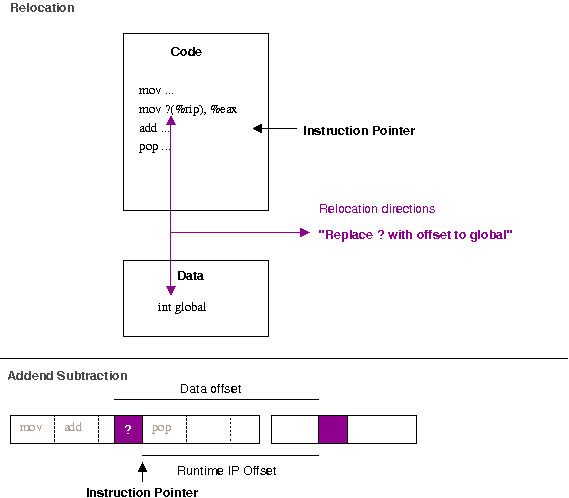
$ readelf --relocs ./function.o
Relocation section '.rela.text' at offset 0x518 contains 1 entries:
  Offset          Info           Type           Sym. Value    Sym. Name + Addend
000000000009  000800000002 R_X86_64_PC32     0000000000000000 global + fffffffffffffffc
There are many different types of relocations for different situations; the exact rules for different relocation types are described in the ABI documentation for the architecture. The R_X86_64_PC32 relocation is defined as "the base of the section the symbol is within, plus the symbol value, plus the addend". The addend makes it look more tricky than it is; remember that when an instruction is executing the instruction pointer points to the next instruction to be executed. Therefore, to correctly find the data relative to the instruction pointer, we need to subtract the extra. This can be seen more clearly when layed out in a linear fashion (as in the bottom of the above diagram). If you try and build a shared object (dynamic library) with an object file with this type of relocation, you should get something like:
$ gcc -shared function.c
/usr/bin/ld: /tmp/ccQ2ttcT.o: relocation R_X86_64_32 against  a local symbol' can not be used when making a shared object; recompile with -fPIC
/tmp/ccQ2ttcT.o: could not read symbols: Bad value
collect2: ld returned 1 exit status
If you look back at the disassembly, we notice that the R_X86_64_32 relocation has left only 4-bytes (32-bits) of space left for the relocation entry (the zeros in 7: 8b 15 00 00 00 00). So why does this matter when you're creating a shared library? The first thing to remember is that in a shared library situation, we can not depend on the local value of global actually being the one we want. Consider the following example, where we override the value of global with a LD_PRELOAD library.
$ cat function.c
int global = 100;
int function(int i)  
    return i + global;
 
$ gcc -fPIC -shared -o libfunction.so function.c
$ cat preload.c
int global = 200;
$ gcc -shared preload.c -o libpreload.so
$ cat program.c
#include <stdio.h>
int function(int i);
int main(void)  
   printf("%d\n", function(10));
 
$ gcc -L. -lfunction program.c -o program
$ LD_LIBRARY_PATH=. ./program
110
$ LD_PRELOAD=libpreload.so LD_LIBRARY_PATH=. ./program
210
If the code in libfunction.so were to have a fixed offset into its own data section, it will not be able to be overridden at run-time by the value provided by libpreload.so. Additionally, there are only 4-bytes available to patch in for the address of global -- since a shared library could conceivably be loaded anywhere in the 64-bit (8-byte) address space we therefore need 8-bytes of space to cover ourselves for all possible addresses global might turn up at. The two basic possibilities for an object file are to be either linked into an executable or linked into a shared-library. In the executable case, the value of global will be in the exectuable's data section, which should definitely be reachable with a 32-bit offset of the current instruction-pointer. The instruction-pointer relative address can simply be patched in and the executable is finalised. But what about the shared-library case, where we know the value of global could essentially be anywhere within the 64-bit address space? It is possible to leave 8-bytes of space for the address of global, by telling gcc to use the large-code model. e.g.
$ gcc -c -mcmodel=large function.c
$ objdump --disassemble ./function.o
./function.o:     file format elf64-x86-64
Disassembly of section .text:
0000000000000000 <function>:
   0:  55                      push   %rbp
   1:  48 89 e5                mov    %rsp,%rbp
   4:  89 7d fc                mov    %edi,-0x4(%rbp)
   7:  48 b8 00 00 00 00 00    movabs $0x0,%rax
   e:  00 00 00
  11:  8b 10                   mov    (%rax),%edx
  13:  8b 45 fc                mov    -0x4(%rbp),%eax
  16:  01 d0                   add    %edx,%eax
  18:  5d                      pop    %rbp
  19:  c3                      retq
However, this creates a problem if you really want to share this code. By having to patch in an address of global directly, this means the run-time code above does not remain unchanged. Two separate processes therefore can't share this code -- they each need separate copies that are identical but for their own addresses of global patched into it. By enabling Position Independent Code (PIC, with the flag -fPIC) you can ensure the code remains share-able. PIC means that the output binary does not expect to be loaded at a particular base address, but is happy being put anywhere in memory (compare the output of readelf --segments on a binary such as /bin/ls to that of any shared library). This is obviously critical for implementing lazy-loading (i.e. only loaded when required) shared-libraries, where you may have many libraries loaded in essentially any order at any location. Of course, any problem in computer science can be solved with a layer of abstraction and that is essentially what is done when compiling with -fPIC. To examine this case, let's see what happens with PIC turned on.
$ gcc -fPIC -shared -c  function.c
$ objdump --disassemble ./function.o
./function.o:     file format elf64-x86-64
Disassembly of section .text:
0000000000000000 <function>:
   0:   55                      push   %rbp
   1:   48 89 e5                mov    %rsp,%rbp
   4:   89 7d fc                mov    %edi,-0x4(%rbp)
   7:   48 8b 05 00 00 00 00    mov    0x0(%rip),%rax        # e <function+0xe>
   e:   8b 00                   mov    (%rax),%eax
  10:   03 45 fc                add    -0x4(%rbp),%eax
  13:   c9                      leaveq
  14:   c3                      retq
It's almost the same! We setup the frame pointer with the first two instructions as before. We push the first argument into memory in the pre-allocated "red-zone" as before. Then, however, we do an IP relative load of an address into rax. Next we de-reference this into eax (e.g. eax = *rax in C) before adding the incoming argument to it and returning.
$ readelf --relocs ./function.o
Relocation section '.rela.text' at offset 0x550 contains 1 entries:
  Offset          Info           Type           Sym. Value    Sym. Name + Addend
00000000000a  000800000009 R_X86_64_GOTPCREL 0000000000000000 global + fffffffffffffffc
The magic here is again in the relocations. Notice this time we have a P_X86_64_GOTPCREL relocation. This says "replace the data at offset 0xa with the global offset table (GOT) entry of global. Global Offset Table operation with data variables As shown above, the GOT ensures the abstraction required so symbols can be diverted as expected. Each entry is essentially a pointer to the real data (hence the extra dereference in the code above). Since we can assume the GOT is at a fixed offset from the program code within plus or minus 2Gib, the code can use a 32-bit IP relative address to gain access to the table entries. So, taking a look a the final shared-library binary we see a final offset hard-coded
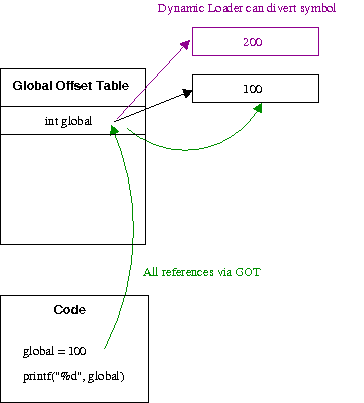
$ gcc -shared -fPIC -o libfunction.so function.c
$ objdump --disassemble ./libfunction.so
00000000000006b0 <function>:
 6b0:  55                      push   %rbp
 6b1:  48 89 e5                mov    %rsp,%rbp
 6b4:  89 7d fc                mov    %edi,-0x4(%rbp)
 6b7:  48 8b 05 8a 02 20 00    mov    0x20028a(%rip),%rax        # 200948 <_DYNAMIC+0x1d8>
 6be:  8b 10                   mov    (%rax),%edx
 6c0:  8b 45 fc                mov    -0x4(%rbp),%eax
 6c3:  01 d0                   add    %edx,%eax
 6c5:  5d                      pop    %rbp
 6c6:  c3                      retq
 6c7:  90                      nop
Every process who wants to share this code just needs to make sure they have their unique address of global at 0x20028a(%rip). Since each process has a separate address-space, this means they can all have different values for global but share the same code! Thus the default of the small-code model is sensible. It is exceedingly rare for an executable to need more than 4-byte offsets for a relative access to a variable in it's data region, so using a full 8-byte value would just be a waste of space. Although leaving 8-bytes would allow access to the variable anywhere in the 64-bit address space; when building a shared library, you really want to use -fPIC to ensure the library can actually be shared, which introduces a different relocation and access to data via the GOT. This should explain why gcc -shared function.c works on x86-32, but does not work on x86-64. Inspecting the code reveals why:
$ objdump --disassemble ./function.o
00000000 <function>:
   0:   55                      push   %ebp
   1:   89 e5                   mov    %esp,%ebp
   3:   a1 00 00 00 00          mov    0x0,%eax
   8:   03 45 08                add    0x8(%ebp),%eax
   b:   5d                      pop    %ebp
   c:   c3                      ret
$ readelf --relocs ./function.o
Relocation section '.rel.text' at offset 0x2ec contains 1 entries:
 Offset     Info    Type            Sym.Value  Sym. Name
00000004  00000701 R_386_32          00000000   global
We start out the same, with the first two instructions setting up the frame pointer. However, next we load a memory value into eax -- as we can see from the relocation information, the address of global. Next we add the incoming argument from the stack (0x8(%ebp)) to the value in this memory location; implicitly dereferencing it. But since we only have a 32-bit address-space, the 4-bytes allocated is enough to access any possible address. So while this can work, you're not creating position-independent code and hence not enabling code-sharing. The disadvantage of PIC code is that you require "bouncing" through the GOT, which requires more loads and reads to find an address than directly referencing it. However, if your program is at the point that this is becoming a performance issue you're probably not reading this blog! Hopefully, this helps clear up that possibly cryptic error message. Further searches around position-independent code, global-offset tables and code-sharing should also yield you more information if it remains unclear.

Olly Betts: Empty Strings in C++

Gaurav (one of Xapian's GSoC students this year) queried my advice that it's better not to explicitly initialise a std::string in C++ like this:
std::string s = "";
but instead to write:
std::string s;
It could be argued that the former makes it clearer that the string is initialised (since C++ does inherit C's behaviour of not implicitly initialising variables of fundamental types, such as int and double). But objects aren't left uninitialised - the default constructor gets called (or if there isn't one, the code won't compile). The downside is that you get quite a lot more code from the first version than the second. Perhaps compilers will grow smarter and in future both the above will compile to the same code, but that's not true today. Here's a simple bit of test code:
#include <string>
std::string f()  
#ifdef EXPLICIT_INIT
    std::string s = "";
#else
    std::string s;
#endif
    return s;
 
And I'll compile it with GCC (g++ (Debian 4.7.2-4) 4.7.2) on x86-64 to produce assembler output:
$ g++ -O2 -S s.cc -o s1.s
$ g++ -DEXPLICIT_INIT -O2 -S s.cc -o s2.s
$ diff s1.s s2.s
1a2,4
>   .section        .rodata.str1.1,"aMS",@progbits,1
> .LC0:
>   .string ""
9,10c12,25
<   movq    %rdi, %rax
<   movq    $_ZNSs4_Rep20_S_empty_rep_storageE+24, (%rdi)
---
>   pushq   %rbx
>   .cfi_def_cfa_offset 16
>   .cfi_offset 3, -16
>   movl    $.LC0, %esi
>   movq    %rdi, %rbx
>   subq    $16, %rsp
>   .cfi_def_cfa_offset 32
>   leaq    15(%rsp), %rdx
>   call    _ZNSsC1EPKcRKSaIcE
>   addq    $16, %rsp
>   .cfi_def_cfa_offset 16
>   movq    %rbx, %rax
>   popq    %rbx
>   .cfi_def_cfa_offset 8
(As an aside, I wouldn't recommend spending a lot of time digging into the assembler your compiler produces, but if there's more than one equivalent way to write code for a common case (as here) and you want to know which is most efficient, it can be informative to see what code is produced for each). You don't really need to know x86-64 assembler to grasp what's happening above, which is lucky, since I don't really know x86-64 assembler. In the first hunk, we get an empty literal string being added to the rodata (read-only data) section; and in the second, instead of two instructions which copy a standard empty string representation, we get much more elaborate code, including a function call to _ZNSsC1EPKcRKSaIcE - the C++ mangled name for the std::string from const char * constructor:
$ c++filt _ZNSsC1EPKcRKSaIcE
std::basic_string<char, std::char_traits<char>, std::allocator<char> >::basic_string(char const*, std::allocator<char> const&)
I also tested the example above with clang (Debian clang version 3.0-6 (tags/RELEASE_30/final) (based on LLVM 3.0)) and the resultant code is fairly similar for each case. The overhead for doing this once isn't going to matter, but if it happens every time you declare a std::string variable, the cumulative effects may be measurable. And as well as taking longer to execute, the larger code will cause greater CPU cache pressure.

Russ Allbery: Automated Perl testing

I started several coding projects today, but none of them reached an announcable conclusion, so this seems like a good day to write up my current discoveries in automated Perl testing modules. This post isn't about test frameworks like Test::More and friends, or even about helper modules (although I do recommend Test::Warn if you want to test warning code in your modules). It's not about writing functionality tests. Rather, it's about various CPAN modules that can be used almost identically in just about every Perl module distribution (and in some other places, like Perl scripts inside a larger package written in another language). You can drop a small driver script into your t directory and (mostly) run make test with no further customization. If you want to see the driver scripts for all of the below that I'm currently using, see the t directory of the Term::ANSIColor distribution. They'll slowly make their way into my other modules, and probably, despite the name of the package, rra-c-util, since that's my equivalent of gnulib and I have tools to synchronize shared code from that package. The driver script generally tests whether the module is installed, skips the test if not, and otherwise dispatches to the "test everything" routine in the module. Test::MinimumVersion: This tests that you're not accidentally using a newer Perl feature than you were expecting. It's very handy if you want to support backward compatibility to a particular version of Perl. It knows about features as far back as 5.004_05. It won't be able to catch everything, but it will catch some of the most obvious things. Test::Perl::Critic: This is sort of the thousand-pound gorilla. Test::Perl::Critic runs all of your code through perlcritic and reports any errors. You will probably need to combine this with a perlcriticrc file in your distribution that you configure it to use, since otherwise the person running the tests may have customized perlcritic. If you let it run perltidy to check for formatting problems, you'll also want a perltidyrc. See the driver script mentioned above for how I set that up. I usually configure this test to only run for me (by checking an environment variable) since the results vary a lot depending on what version of perlcritic is installed, and it's likely new versions will cause the test to start failing. If you use this, expect to need to add ## no critic annotations to your code. Test::Pod: Checks for syntax errors in your POD documentation so that you won't have those embarassing POD ERRORS sections. Note that the latest version of podlators turns syntax errors into fatal errors, so soon you won't have to worry as much about this. But if you'd been using this module all along, you wouldn't have to worry about the fact that pod2man may start faliing due to syntax errors you never fixed! Test::Pod::Coverage: Only of interest to module distributions, not ramdom scripts, this checks that every sub provided by your module has POD documentation. It understands various subs that don't need to be documented (such as the ones you provide to implement a tied class) and lets you mark some subs as not requiring documentation. Test::Pod::Spelling: Checks your POD documentation for spelling mistakes with a spell checker. (Note that perlcritic, and hence Test::Perl::Critic, can also do this, but I use this module separately since I think the output is more readable.) You will almost certainly want to make this test maintainer-only, since spell checkers and spelling dictionaries vary a lot. But it prevents a lot of embarassment when you read your documentation on search.cpan.org and find that obvious spelling error you never saw before. Test::Strict: Checks all Perl code to ensure that it compiles, checks whether it has use strict, and optionally checks whether it has use warnings. This is great; I use this even with packages that just have a few Perl utility scripts in a package otherwise written in C, since I previously kept releasing packages with helper scripts with obvious syntax errors since I didn't run them much. Another place it's useful is if you have internal Debian packages that wrap up Perl utility scripts; just create a small test suite with this module and run it from override_dh_auto_check and you won't ever release a package with scripts that won't run. You can also do test suite coverage testing with this module (and Devel::Cover), but that you'll want to mark maintainer-only since it takes a while. Test::Synopsis: Checks the code in the SYNOPSIS section of any POD documentation to ensure that it compiles. No more syntax errors in your example code in the documentation! All of these modules are, of course, packaged for Debian (thanks largely to the wonderful Perl packaging team!), and otherwise available on CPAN. There are a variety of others, of course; these are just the main ones that I've found personally useful. One final whine, however: all this wonderful Perl testing infrastructure desperately needs a common module and a common interface for providing a list of files to check. Every one of these modules reinvents that wheel, and most of them do it a slightly different way than all the others. Most of them check in either blib or lib (or sometimes both). Most of them also add t. Most of them don't include Makefile.PL, but some of them do. Almost none of them look in examples. Some have a simple way to add more files or directories; some don't. Some can be run from the t directory and still find things, but most of them can't. And of course the syntax is different in every case! Most of the work in my driver scripts is finding the right way to add a few additional directories to the scope of the testing, and in one annoying case (Test::Synopsis), I actually had to use Perl::Critic::Utils (for lack of a better module) to build a list of files to check instead of using the build-in file list, since the build-in file list required all module code be in lib. A module to abstract out all of this and provide a common interface would be easy to write. Most of the work would involve talking to all the authors of all these different modules and asking them to use it. If someone in the Perl community felt like doing that, it would make life so much easier for everyone.

4 January 2013

Jan Wagner: New blogging engine

You may have noticed that I recently started posting more updates again. The reason is, I switched over from Wordpress to Octopress as blogging engine. The idea was driven, cause my used theme K2 got stuck and with the upcoming release of Debian wheezy I'm forced to switch to a more recent Wordpress release, which is likely incompatible.
Another reason is, that I got bored by wordpress itself (and it's software dependencies). With octopress these dependencies are lowered to a webserver which can server static files and rsync on the server side. Maybe I will post some parts of the story, what I did when migrating the content and what components (plugins, theme ...) I'm using, later.

Thorsten Glaser: on the linguistic gender of hosts, with an xz reminder

Let s start a convention: bare-metal machines have the linguistic male gender ( der Computer , he needs to be rebooted), whereas VMs have the linguistic female gender ( die virtuelle Maschine , she runs better since the last upgrade of Linux-KVM), and neutral linguistic gender is used when you cannot or do not want or need to make such distinction.
This is, of course, entirely unrelated to human gender, but not unrelated to #debian-68k (on OFTC) discussions ;-) ObRant: DO NOT USE xz COMPRESSION LEVELS ABOVE 6! (For -7 we can make exceptions, for example in Debian *-dbg or *-source packages.) You may use -e if you absolutely need the better compression, but please think of the poor sods who have to create the archives. You must not use the highest compression levels -8 or -9 since they have absolutely insane memory requirements on compression and will still hinder machines with less RAM on decompression. (Using -e only affects CPU usage at compression time; decompression is exactly as fast and memory-consuming as without.) Furthermore, DO NOT CHOOSE A COMPRESSION LEVEL WITH A DICTIONARY SIZE MUCH LARGER THAN THE DATA TO COMPRESS, as that makes absolutely no sense and will rather worsen than improve compression. As a reminder, xz uses the following dictionary sizes: Decompression uses less than 1 MiB more than the dictionary size, but the dictionary must always be allocated wholly. (You re fine to use custom presets, but mind the RAM usage!) As a general rule, if you have something of up to 20 MiB to compress, -4 is fine, and -5 will only be better if you have similar data spread across the whole of the file instead of close to each other. When I make mksh distfiles, I instead put files close to each other that have related content, which improves compression much more nicely without penalising low-memory systems; for example, you could put documentation, Makefiles, scripts, m4(1) files, and C source code into groups before archiving, instead of doing it alphabetically. Another note on bzip2: its decompression is slow. I see no reason to use it any more, at all. Use gzip(1) if you care for compatibility or have an issue with xz not having a free copyright licence, and xz otherwise.

Stefano Zacchiroli: bits from the DPL for December 2012

Happy new year, Debian! To celebrate, here are some freshly posted, bits from the DPL for December 2012.
Dear Project Members, happy new year! Here goes another report of DPL activities, this time for December 2012. This issue of the DPL-monthly is skinnier than usual: during the past month I've been struck by the catastrophe also known as "family holiday season", enjoying a solid 10 day break from computer-related activities. Talks Assets DPL helpers Collaboration with the outer world That's all for last year, enjoy the new one, which will soon see a new Debian release out of the door. And to make it happen sooner, let's go back fix RC bugs! Cheers.
PS the day-to-day activity log for December 2012 is available at the usual place master:/srv/leader/news/bits-from-the-DPL.txt.201212

Julien Danjou: Integrating cl-irc and cl-async

Recently, I've started programming in Common Lisp. My idea here is to use cl-irc, an IRC library into an event loop. This can be really useful, for example to trigger action based on time, using timers. Creating a connection The first step is to create a basic cl-irc:connection object on our own. This can be achieved easily with this:
(require :cl-irc)

(defun connect (server)
(cl-irc:make-connection :connection-type 'cl-irc:connection
:client-stream t
:network-stream ?
:server-name server))

This will return a cl-irc:connection object, logging to stdout (:client-stream t) and having the server name server. Note that the server name could be any string. You probably noticed the ? I used as :network-stream value. This is not a real and working value: this should be a stream established to the IRC server you want to chat with. This is where we'll need to use cl-async:tcp-connect to establish a TCP connection. As you can read in this function's documentation, all we need to pass is the server address, two callbacks for read and general events, and the :stream option to get a stream rather than a socket. So you would do something like:
(require :cl-irc)
(require :cl-async)

(defun connection-socket-read (socket stream)
(format t "We should read the IRC message from ~a ~%" stream))

(defun connection-socket-event (ev)
(format t "Socket event: ~a~%" ev))

(defun connect (server &optional (port 6667))
(cl-irc:make-connection :connection-type 'cl-irc:connection
:client-stream t
:network-stream (as:tcp-connect server port
#'connection-socket-read
#'connection-socket-event
:stream t)
:server-name server))

(as:start-event-loop (lambda () (connect "irc.oftc.net")))

If you run this program, it will connect to the OFTC IRC server, and then notice you each time the server is sending you a message. Therefore our problem here is how we you treat the message read from the stream in connection-socket-read and handle them in the name of our connection object you used? We can't link both together at this point. We can't build a closure, because as the time we use as:tcp-connect we don't have the cl-irc:connection instance. Also we can't change easily the read-cb parameter of our network-stream established by as:tcp-connect, simply because cl-async doesn't use to do allow that. Building a closure So one solution here is to hack cl-irc:make-connection so we can build an cl-irc:connection instance without providing in advance the network-stream, allowing us to build a closure including the cl-irc:connection to read event for. This is what we're going to do in the connect function.
(require :cl-irc)
(require :cl-async)
(require :flexi-streams)

(defun connection-socket-read (connection)
(loop for message = (cl-irc::read-irc-message connection)
while message
do (cl-irc:irc-message-event connection message)))

(defun connection-socket-event (ev)
(format t "Socket event: ~a~%" ev))

(defun connect (server port nickname
&key
(username nil)
(realname nil)
(password nil))
;; Build an instance of cl-irc:connection, without any network/output stream
(let* ((connection (make-instance 'cl-irc:connection
:user username
:password password
:server-name server
:server-port port
:client-stream t))
;; Use as:tcp-connect to build our network stream, and build a
;; closure calling connection-socket-read' with our connection'
;; as arguments
(network-stream (as:tcp-connect server port
(lambda (socket stream)
(declare (ignore socket stream))
(connection-socket-read connection))
#'connection-socket-event
:stream t)))
;; Set the network stream on the connection
(setf (cl-irc:network-stream connection) network-stream)
;; Set the output stream on the connection
(setf (cl-irc:output-stream connection)
;; This is grabbed from cl-irc:make-connection
(flexi-streams:make-flexi-stream
network-stream
:element-type 'character
:external-format '(:utf8 :eol-style :crlf)))

;; Now handle the IRC protocol authentication pass
(unless (null password)
(cl-irc:pass connection password))
(cl-irc:nick connection nickname)
(cl-irc:user- connection (or username nickname) 0 (or realname nickname))
connection))

(as:start-event-loop (lambda () (connect "irc.oftc.net" 6667 "jd-blog")))

And here we are! If we run this, we're now using an event loop to run cl-irc. Each time the socket has something to read, the function connection-socket-read will be called on the non-blocking mode socket. If there's no message to be read, then the function will exit and the loop will continue to run. Using timers You can now modify the last line with this:
(defun say-hello (connection)
(cl-irc:privmsg connection "#jd-blog" "Hey I read your blog!")
(as:delay (lambda () (say-hello connection)) :time 60))

(as:start-event-loop (lambda ()
(let ((connection (connect "irc.oftc.net" 6667 "jd-blog")))
(cl-irc:join connection "#jd-blog")
(say-hello connection))))

This will connect to the IRC server, join a channel and then say the same sentence every minute. Challenge accomplished! And I'd like to thank Andrew Lyon, the author of cl-async, who has been incredibly helpful with my recent experimentations in this area.

Ian Wienand: Tagging handbrake output for iTunes

If you rip your DVD's with a unix-y name like longish-show-name-season-01-01.m4v then the iPad and iPhone video player only shows the prefix of the file-name to it's string limit, so you only ever see longish-show-na and can never tell what episode is what in the overview list. You can edit the files in iTunes to add meta-data information, but that's annoying and non-unix-y. It is of course easy, but I went down several dead-ends with tools that didn't recognise file-extensions, corrupted files and plain didn't work. The package I had most success with is mp4v2-utils and the mp4tags utility. The help is fairly self-explanatory, but something like
mp4tags -show "Show Name" -season <season> -episode <episode> -type "tvshow"  file.m4v
will mean that when you import your file into iTunes it displays correctly as a TV show (and not a movie), is grouped correctly into series and has a name you can see. Unfortunately, it doesn't seem my Nexus 7 tablet picks up these tags. And both players interfaces remain terrible at indicating which episodes have been watched and which have not. But this has allowed me to re-visit my old box-set of Yes Minister which, despite a few odd references to Quango's still seems as relevant as ever!

3 January 2013

Tim Retout: New Year

Another year. 2012 was busy - I got moved house twice, changed jobs, and got married. In 2013, I should become a father, fingers crossed (due mid-April). Change is a familiar friend now. I just listened to Tom Armitage speaking about coding on Radio 4 - I /think/ the podcast mp3 link will work for people outside the UK, but the iPlayer probably won't. If you can get hold of it, it's worth the 20 minutes of your time. If I had to make a New Year's resolution, it would be to listen to more Radio 4 - there's such a lot of it, though. I'm going to try subscribing to some of their podcasts and listening to them on my commute - timeshifting some of the best bits. Might work.

Next.

Previous.

