Search Results: "nic"

8 March 2010

Nicolas Valc rcel: Ubuntu awesome tools

Last week I was having a conversation with a friend, and while we were discussing some things I mentioned some Ubuntu tools that were completely natural for me since I use them every day in Ubuntu development and for my work, but he was completely amazed by them, so I decided to blog on the subject so more people can know about them. I m going to start with the one that impressed him the most: qa-regression-testing branch The QA and security team maintain a test suite to check for regressions in packages they are updating. These tests are written with python unittest. Most of this test suite can be a little harmful for a production system, so it s recommended to run it using a chroot environment or a virtual machine and to help with that there is a make-test-tarball script. From the script:
export HOSTS= sec-intrepid-amd64 sec-hardy-amd64 sec-dapper-amd64
export TEST=test-glibc-security
./make-test-tarball $TEST.py
for i in $HOSTS; do
scp /tmp/qrt-$TEST.tar.gz $i.local:
done
for i in $HOSTS; do
ssh -t $i.local hostname; rm -rf qrt-$TEST; tar zxf qrt-$TEST.tar.gz; cd qrt-$TEST && ./$TEST.py -v
done
As you can imagine HOSTS are the hostnames of the virtual machines where the tests are going to run. Writing those test isn t rocket science, you just need a little knowledge of the package and the functionality you want to test and python unittesting, there is even a skeleton script that can help you start writing your test. Hope this information is useful for you! And as usual, patches are welcome!

Craig Small: dh-make updated to 0.52 and its remaining bugs

I've made a quick release of dh-make, now up to 0.52. Besides a minor dh_make.1 manual page fix this release will put the right value in the debian/source/format file. 0.51 will make it a native source package no matter what flags you use.

If you get weird lintian errors about native source formats and version numbers wrong on your brand-new Debian package you just made, you might of been bitten by this bug.

That leaves a few bugs left, there are two I need help with:
<script defer="defer" src="http://static.zemanta.com/readside/loader.js" type="text/javascript"></script>

Marco T&uacute;lio Gontijo e Silva: Micro BSP

I and Rafael Cunha de Almeida got together today with the purpose of closing as much RC-bugs in Debian as we could. I must say it was better than what I d expect. We started with #570348 . This bug was introduce with an upload that tried to fix #569586 which, in turn, was related to a change in libc6. It would be easy to introduce an ifdef in the code but, as we tried to read and understand the code, we didn t see the need of the function that was causing the problem. It seems to make the same thing as alphasort from dirent.h, with the disadavantage that it was not locale-sensitive. So we removed the customized alphasort and made it use the library one. Then we headed to the strange #504947. As the maintainer didn t seem satisfied with the new patch system introduced by the last NMU, we simply made a patch that removes the patch system and applies the patch directly in .diff.gz. Hope it helps. Searching for another thing to work, we noticed that #571791 was not happening in my box, and asked if anyone could reproduce it. So we found #571748. The first thing about this bug we noticed is that its package causes a division by 0 error in popcon, which made us report a bug about it. We thought that this was a sign that the package was not widely used. Anyway, we decided to fix this bug, which was very fun indeed! After a lot of trials, some succesful, some not, we got to a very simple and nice patch, which was submitted. We also submited other bugs to the same package, that we found while using it. It s a cool package, you should try it out to avoid that division by 0 in popcon.

6 March 2010

Christian Perrier: [life] Paris half-marathon

Tomorrow is the day for Paris half-marathon, the mass half-marathon that is traditionnally run 4-5 weeks before Paris marathon. This year, I'll run both, so tomorrow, I'll be running in Paris (and Bois de Vincennes) streets...along with 27,000 other people..., attempting to beat my 1h43'55" record set in my last (and as of now) only half-marathon, one month ago, in Bullion. That might be hard as running at one's own pace is easier in a run with 1,000 runners..:-) Ralf Treinen told me he might show up around km 7 (place de l'H tel de Ville). I should be around there around 11h50 as the start is at 10h and I should probably cross the start line at about 10h15, then run 5mins/km. So, if you're around eastern Paris and wake up "early" on Sundays, feel free to come and show me a nice Debian swirl so that I can run even faster (or less slow). I'll be wearing a black top with short sleeves and short running pants (not the easies to spot, I admit). Then try spotting Ralf and have a beer..:-).

5 March 2010

Sandro Tosi: Code syntax highlighting on Blogger

Blogger has no feature to highlight code syntax in blog posts. But google-code-prettify comes to rescue.

The information in their README are quite generic, and treat the situation where you're directly managing the website files, which is not the case for Blogger.

Luka Marinko wrote a very nice blog post describing how to use google-code-prettify on Blogger; I'm going to follow his advices right away!

David Welton: Books vs "e-books" ?

I've been thinking about something for a while, and to be honest, still haven't reached any firm conclusions: what to think about self-published "e-books"? I'm curious to hear your opinions. For instance: These are all: electronic, in that they aren't distributed as real, paper books, have no ISBN number, and are generally only available via the author's web site (you won't find them on Amazon.com). They aren't simply on-line, PDF versions of real books. They're certainly a departure from the traditional model of having a publisher, editor, and real, physical books that could be purchased from book stores. They don't appear to have been through any kind of formal editing or quality control process. The prices seem to differ quite a bit; the first one is $19, the second one is $12, and the last one is $30.77. For the authors, the appeal is obvious: they get to keep all of the money, and don't have to fool around with a lot of "process". Consumers, on the other hand, have to consider different aspects: with a "real book", the bureacracy and process exist to guarantee some minimum standards of quality. If you buy an O'Reilly book, you know that it's probably like many of the other books they sell: perhaps it won't stand the test of time like something written by Knuth, but it'll be a pretty good guide to the technology it describes, most likely be someone who is indeed an expert in that area. If I buy some random PDF on the internet, it may come from someone who really knows their stuff, or it may be junk. On the other hand, were this market to grow, theoretically prices could come down. Since the people who are authoring the book don't have to fool around with editing, printing, and so on, and get to keep all the money themselves, they could in theory keep their prices significantly lower than someone creating a more 'traditional' book with a lot of overhead. That is, of course, if the book is one where there is competition in its niche. Right now a lot of these books that pop up on my radar are written by domain experts. However, what's to prevent a lot of people from jumping in and attempting to make a quick buck with a flashy looking web site? Buying books based only on reputation? That might lead to people who are really good authors, but perhaps not well known as "doers" (they didn't invent the technology in question) being left out in the cold. Also, there is something of an unknown quantity about "pdf books". For instance, after raking in a bunch of cash with theirs, 37signals put it on their web site, completely for free. That had to leave the guy who bought it the day before it went free feeling like a bit of a chump. At least with a 'real book', even if the contents are posted on the internet, you have a physical object that belongs to you. I wonder how bad piracy is, and how bad it might be were these to become more popular? Another thing worth noting is that, via services like Lulu.com, it *is* possible to print these out. In any case, I think things are likely to change with time, as we aren't dealing with a static situation, but rather one where a changing landscape maylead to different outcomes, as the key variables... vary. I am honestly unsure of what to make of this development. How do you see the market for "home brewed" pdf ebooks evolving?

Junichi Uekawa: Forgot how to view DVD on Linux.

Forgot how to view DVD on Linux. mencoder doesn't seem to work today for me.

4 March 2010

Russell Coker: Opera and Trusting Applications vs Trusting Servers

The Opera-Mini Dispute I have just read an interesting article about the Opera browser [1]. The article is very critical of Opera-Mini on the iPhone for many reasons most of which don t interest me greatly. There are lots of technical trade-offs that you can make when designing an application for a constrained environment (EG a phone with low resolution and low bandwidth). What does interest me is the criticism of the Opera Mini browser for proxying all Internet access (including HTTPS) through their own servers, this has been getting some traction around the Internet. Now it is obvious that if you have one server sitting on the net that proxies connections to lots of banks then there will be potential for abuse. What apparently isn t obvious to as many people is the fact that you have to trust the application. Causes of Software Security Problems When people think about computer security they usually think about worms and viruses that exploit existing bugs in software and about Trojan horse software that the user has to be tricked into running. These are both significant problems. But another problem is that of malicious software releases. I think that this is significantly different from Trojan horses because instead of having an application which was written for the sole purpose of tricking people (as is most similar to Greek history) you have an application that was written by many people who genuinely want to make a good product but you have a single person or small group that hijacks it. Rumor has it that rates well in excess of $10,000 are sometimes paid for previously unknown security vulnerabilities in widely used software. It seems likely that a programmer who was in a desperate financial situation could bolster their salary by deliberately putting bugs in software and then selling the exploits, this would not be a trivial task (making such bugs appear to be genuine mistakes would take some skill) but there are lots of people who could do it and plausibly deny any accusation other than carelessness. There have been many examples of gambling addicts who have done more foolish things to fund their habit. I don t think it s plausible to believe that every security flaw which has been discovered in widely used software was there purely as the result of a mistake. Given the huge number of programmers who have the skill needed to deliberately introduce a security flaw into the source of a program and conceal it from their colleagues I think it s quite likely that someone has done so and attempted to profit from it. Note that even if it could be proven that it was impossible to profit from creating a security flaw in a program that would not be sufficient to prove that it never happened. There is plenty of evidence of people committing crimes in the mistaken belief that it would be profitable for them. Should We Trust a Proprietary Application or an Internet Server? I agree with the people who don t like the Opera proxy idea, I would rather run a web browser on my phone that directly accesses the Internet. But I don t think that the web browser that is built in to my current smart-phone is particularly secure. It seems usual for a PC to need a security update for the base OS or the web browser at least once a year while mobile phones have a standard service life of two years without any updates. I suspect that there is a lot of flawed code running on smart phones that never get updated. It seems to me that the risks with Opera are the single point of failure of the proxy server in addition to the issues of code quality while the risks with the browser that is on my smart-phone is just the quality of the code. I suspect that Opera may do a better job of updating their software to fix security issues so this may mitigate the risk from using their proxy. At the moment China is producing a significant portion of the world s smart-phones. Some brands like LG are designed and manufactured in China, others are manufactured in China for marketing/engineering companies based in Europe and the US. A casual browse of information regarding Falun Gong makes the character of the Chinese leadership quite clear [2], I think that everything that comes out of China should be considered to be less trustworthy than equivalent products from Europe and the US. So I think that anyone who owns a Chinese mobile phone and rails against the Opera Mini hasn t considered the issue enough. I don t think it s possible to prove that an Opera Mini with it s proxy is more or less of a risk than a Chinese smart-phone. I m quite happy with my LG Viewty [3] but I wouldn t use it for Internet banking or checking my main email account. Also we have to keep in mind that mobile phones are really owned by telephone companies. You might pay for your phone or even get it unlocked so you can run it on a different network, but you won t get the custom menus of your telco removed. Most phones are designed to meet the needs of telcos not users and I doubt that secure Internet banking is a priority for a telco. Update: You can buy unlocked mobile phones. But AFAIK the Android is the only phone which might be described as not being designed for the needs of the telcos over the needs of the users. So while you can get a phone without custom menus for a telco, you probably can t get a phone that was specifically designed for what you want to do. The Scope of the Problem Mobile phones are not the extent of the problem, I think that anyone who buys a PC from a Chinese manufacturer and doesn t immediately wipe the hard drive and do a fresh OS install is taking an unreasonable risk. The same thing goes for anyone who buys a PC from a store where it s handled by low wage employees, I can imagine someone on a minimum income accepting a cash payment to run some special software on every PC before it goes out the door that wouldn t be any more difficult or risky than the employees who copy customer credit card numbers (a reasonably common crime). It s also quite conceivable that any major commercial software company could have a rogue employee who is deliberately introducing bugs into it s software. That includes Apple. If the iPhone OS was compromised before it shipped then the issue of browser security wouldn t matter much. I agree that having the minimum possible number of potential security weak points is a good idea. They should allow Opera Mini users to select that HTTPS traffic should not be proxied. But I don t think that merely not using a proxy would create a safe platform for Internet banking. In terms of mobile phones most things are done in the wrong way to try and get more money out of the users. Choose whichever phone or browser you want and it will probably still be a huge security risk. Harald Welte is doing some really good work on developing free software for running a GSM network [4]. But until that project gets to the stage of being widely usable I think that we just have to accept a certain level of security risk when using mobile phones.

3 March 2010

Alexander Reichle-Schmehl: [CeBIT] Something I like to share with the Debian community

I'm really delighted, thet you are here! You know, I started quite late with that whole IT business, and Debian was my first distribution. It all worked perfectly and took all my fears of it away!

Christian Perrier: I'm going to DC10

Or should I say *we* are going to Debconf 10? Last week-end, I booked the whole set of plane tickets for the Perrier family to fly to USA next summer: Nice.

David Welton: Nickles, dimes, pennies, and Italian regulations

I have recently gone about opening a "Partita IVA" ( http://it.wikipedia.org/wiki/Partita_IVA ) so I can act as an independant consultant here. Like everything here, it's a pain in the neck, but opening it wasn't all that bad, compared to other close encounters of the bureaucratic kind that I've had. When it came time to send out my first bill, of course I had to get the accountant to help me put it together (simply sending a bill with the amount to be paid would be way too easy). The crowning touch, though, was that I had to go to the "tabaccheria" and purchase a 1.81 (one Euro, eight-one cents) "marca da bollo" ( http://en.wikipedia.org/wiki/Italian_revenue_stamp ) to affix to the aforementioned bill. This is only necessary, however, in cases where the bill exceeds 77.47 (seventy-seven Euro, fourty-seven cents). The end result was that between asking the accountant for help, going over to the store to get the stamp, and so on, I probably wasted in excess of a half an hour of my life for something that really isn't that complicated. Who dreams this bullshit up, anyway?

2 March 2010

Matt Brubeck: The network is the human being

Nathanael Boehm wrote a nice essay last month called The Future of Employment?, about a disconnect between workers' and employers' views of social networks. (This post is based partly on my comment in the ensuing Hacker News thread.) Boehm wrote:
When I need help with a challenge at work or need to run some ideas past people I don t turn to my co-workers, I look to my network of colleagues beyond the walls of my workplace. Whilst my co-workers might be competent at their job they can t hope to compete with the hundreds of people I have access to through my social networks...
The late Sun Microsystems taught us that the network is the computer. It's true: we still use non-networked computers for specialized tasks, but nobody wants one on their desk it's just so useless compared to one that talks to the entire world. Boehm could have titled his essay The Network is the Employee. There are still tasks that people do in isolation, but the ability to contact a network of peers and experts makes the difference in my job, and many others. Alone together The lone computer programmer in a small business has thousands of colleagues on Stack Overflow, Reddit, and so on. It's a chaotic and messy way to find answers, but it's better than the days when your only choice was to call tech support or smack the box with your fist, whichever seemed more useful. I can't begin to list all the problems I've solved and things I've learned by Googling for others with relevant experiences, and getting help from a different expert for every problem. Decades before the web, computer geeks had virtual communities for on mailing lists, Usenet, and IRC. Now any job in the world has an online forum. Even the night clerk at the gas station has Not Always Right. Teaching has long been a solitary profession. Despite working in a crowded classroom, teachers are isolated; they rarely have colleagues observing or participating directly in their work. This has such an impact that teacher education sometimes includes training in meditation or reflection, to compensate for lack of external feedback. So I'm really curious what happens when teachers start to work together remotely the way programmers do. You will be assimilated Boehm's essay reminded me of a vague sci-fi-like idea I've been kicking around: the first group minds will evolve from the intersection of Mechanical Turk, virtual assistants, social networking, and augmented reality. Starting around the 1990s, it was possible to instantly "know" any fact that was published online. Since then, we've increased the amount of content online, our tools for searching it, and ways of connecting to the network. Today we have instant access to almost any published knowledge, anywhere. The number of people on the net has grown too, and the number of ways to find and talk to them. Most of us can contact dozens of friends at any given moment, plus friends-of-friends, co-workers, fellow members of communites like Hacker News or MetaFilter, and also complete strangers. Along with raw facts, we now have access to vast amounts of human judgement, experience, and skill. One result of this is the "virtual assistant," who provides a service that was once available only to high-powered executives. The new personal assistant can work remotely (often overseas), spread costs by serving many masters, and leverage the internet superpowers listed above. Today their services are targeted at small business owners and the Tim Ferriss crowd, but I'm sure someone soon will start marketing virtual personal assistance to all sorts of other creative workers, teachers, even stay-at-home parents. So, how long before I can simply touch a button to let a remote assistant see what I'm seeing in real-time and help me make transportation plans, translate foreign signs and speech, look up emails related to whatever I'm doing or thinking, or even advise me on what to say? Some of these queries will go to my circle of friends, others to the general public, and some to a personal assistant who is paid well to keep up with my specific needs. And that assistant of course will sub-contract out portions of each job as needed to computer programs, legions of cheap anonymous Turkers, or to his or her own network of assistants. At that point, I'm augmenting my own perception, memory, and judgement with a whole network of brains that I carry around ready to engage with any situation I meet. If nothing else, I hope someone writes a good sci-fi thriller story in which a rogue virtual assistant subtly manipulates the actions of unknowing clients, leading them to some unseen end.

1 March 2010

Erich Schubert: Database streaming API

For my research at the university, I've become a lead developer for ELKI, a framework for developing data mining algorithms along with index structures, to be able to one one hand quickly implement new algorithms (by being able to reuse a lot of code, in particular index structures, parsers, ...), but also on the other hand to evaluate the interaction of index structures with different algorithms, distance functions, and so on. The new version 0.3 which adds a lot of new outlier detection methods will be published beginning of April at DASFAA 2010. (Note that this is designed for research and teaching use; code extensibility, readability etc. instead of maximized performance. You might want to do a rewrite in C for maximum performance, since Java does give you quite a memory and performance overhead in these setups.)After this release, we will be doing a major redesign of the database and index layer, to allow better comparison of different index structures in parallel; right now it's hard to use more than one at a time, and building e.g. a combined index structure is a larger effort than we'd like it to be. During the process of redesigning the database layer, I'll also be improving the database update or "streaming" API.If you know of a nice API for streaming databases, please send me an Email to erich -at- debian -dot- org.Note that I'm looking for a programming API, i.e. "interfaces". Not for random data sources such as Twitter. Also I really need an API able to model data changes, not just "events" aka "instances". So please don't point me to what Twitter calls a "streaming API". What I'm looking for is a nicely-designed API to allow programmers to react to Database changes, such as insertions, deletions, updates, bulk operations etc. and update their index structures and algorithm results accordingly. An example would be the "oracle streams" API I believe; MySQL probably has a logging (used in their replication hacks) which can also be seen as a database stream. But these are designed around a RDBMS view, and not so much for data mining. Weka/MOA Streams seems to be just event/instance streams, where there is no such thing as a bulk insert or even a deletion. Of course there are many use cases where you will be happy with working on just the previous n instances. The more general case however handles arbitrary inserts and deletes, instead of having just inserts (and implicit delitions by an expiry strategy). And yes, of course you can in turn wrap database events as instances into an event stream (with "insert", "update", "delete" events) ...Yes, I'm aware that this kind of setup was abandoned for what is called a "stream processing engine" (SPE) in many use cases, that do not care about "old" data or deletions in general. We'd like to be able to support both approaches, also to be able to do fair comparisons.Of course you can also point me to badly done APIs, and explain me where they fall short for you. We're not so much interested in copying some API, but we'd just like to design a good API for people to do research on stream processing in a database context (e.g. index support for streaming data, online algorithms, ...) Or you can write me a mock-up API that you would deem useful.

Steve McIntyre: It's been a while

Apologies for not posting in a while. I've been a little busy of late, but I promise to fill in some of the details in the next few days. Number 1: Jo and I are engaged. We went to a nice restaurant on Saturday for her birthday. I totally surprised her by asking the question in her birthday card: "P.S. Will you marry me" at the bottom. The look on her face as she said "yes" was awesome. *grin* I had already surprised her a couple of weekends back by taking her to Paris for Valentine's weekend. She didn't know we were going until we got to the checkin desk for the Eurotunnel. Now I've got a problem, though: what do I do for a surprise two weekends from now? :-)

Gregor Herrmann: RC bugs 2010/07, 2010/08

not many closed RC bugs in the last two weeks. it seems we're running out of easy-enough-for-me bugs does this mean the freeze is near? :)
28 February 2010

Russell Coker: Carpal Tunnel Syndrome

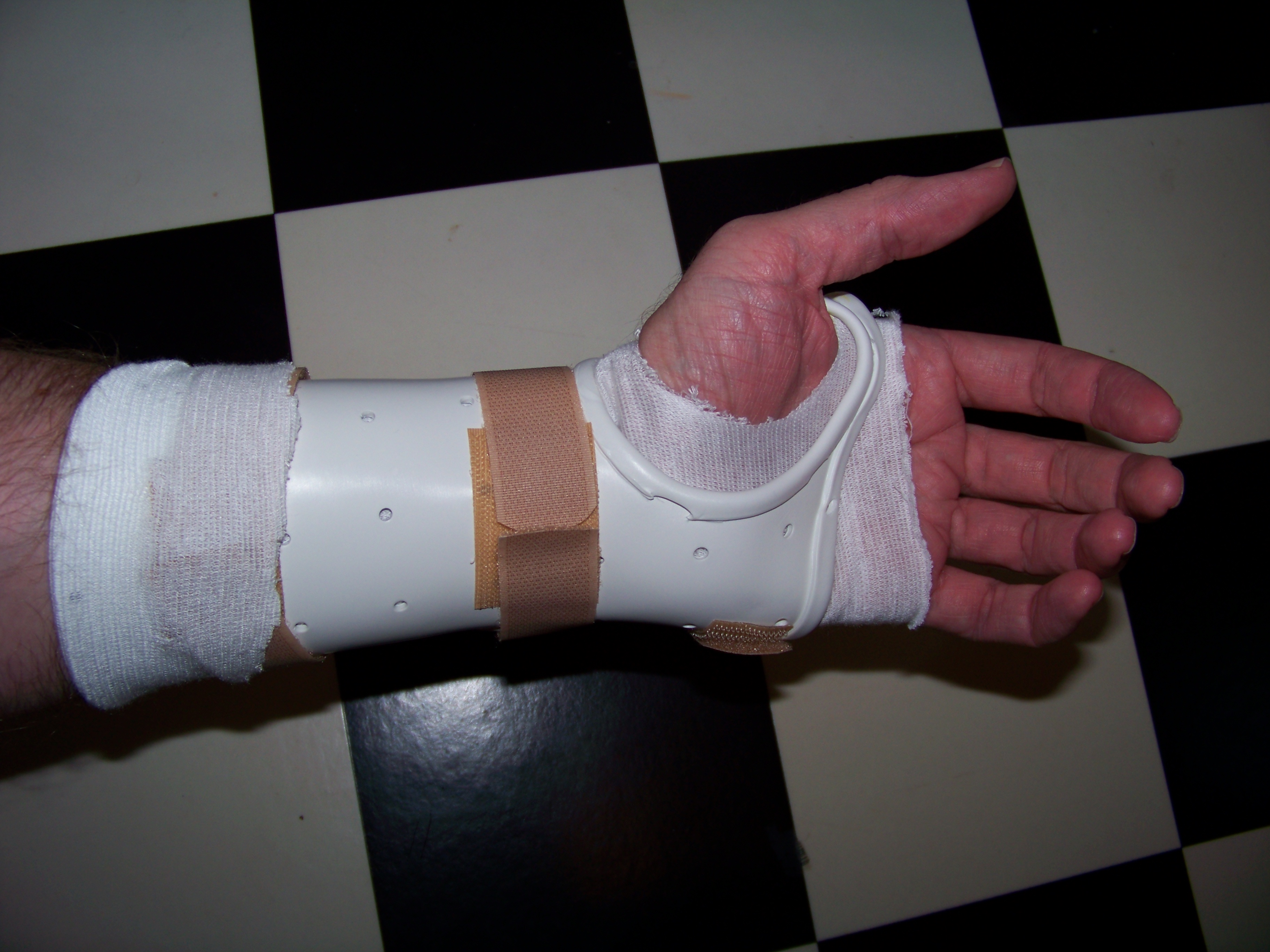
Wrist brace for Carpal Tunnel Syndrome Diagnosis A few weeks ago I was referred to a specialist for the treatment of Carpal Tunnel Syndrome. I first noticed the symptoms in early January, it started happening at night with a partial numbness in the fingers of my left hand. I didn t think much of it at first as it s the expected symptom of sleeping in a position that reduces the blood flow. But when it kept happening with my left hand and never happening with my right and then started getting worse (including happening during the day) I sought medical advice. The doctor asked me to bend my hand down (as if trying to touch my left elbow with the fingers of my left hand). Within about 10 seconds this caused numbness this result from bending one s wrist is a major symptom of CTS. Treatment On Thursday I saw a specialist about this, she agreed with the GP s diagnosis and made a wrist brace for me. She started by cutting off a length of a tube of elastic woven material (similar to a sock) and then cutting a thumb hole, that became the lining. Then to make the hard part she put a sheet of plastic in an electric saucepan (which had water simmering) until it started to melt and then used a spatula to fish it out. The melting temperature of the plastic wasn t that high (it was soft at about 50C when she put it on my arm), it wasn t at all sticky when it was partially melted, and it didn t seem to conduct heat well. After wearing the wrist brace non-stop for a few days I have noticed an improvement already. Hopefully I will make a full recovery in a matter of a month or so, I will probably have to wear a wrist brace when sleeping for the rest of my life, but that s no big deal it s more comfortable to sleep with a wrist brace than a partially numb hand. I ve also been prescribed a set of exercises to help remove scar tissue from the nerves. I haven t done them much yet. In terms of being annoying, the wrist-brace has 3mm diameter holes in a square grid pattern with a 25mm spacing. This doesn t let much air through and in warm weather my arm gets sweaty and starts to itch. I m thinking of drilling some extra holes to alleviate this the part which makes my arm itch doesn t need much mechanical strength. The only task which has been really impeded has been making peanut butter sandwiches, maybe it was making sandwiches not typing that caused CTS? ;) In any case I m not giving up typing but I would consider giving up peanut butter sandwiches. I really hope to avoid the surgical option, it doesn t seem pleasant at all. Other One final thing to note is that Repetitive Strain Injury (RSI) is entirely different. RSI is a non-specific pain associated with repetitive tasks while CTS is a specific problem in one or two nerves where they go through the wrist. RSI apparently tends to reduce the effective strength of the afflicted limb, while milder cases of CTS (such as mine) cause no decrease in strength of course a severe case of CTS results in muscle atrophy due to reduced nerve signals, but I shouldn t ever get that. Many people think that RSI and CTS are essentially the same thing I used to think that until a few weeks ago when I read the Wikipedia pages in preparation to seeing a doctor about it. I want to obtain some of the plastic that was used to make my wrist brace, it could be really handy to have something that convenient for making boxes, containers, and supports for various things among other things it doesn t appear to generate static. The low melting temperature will prevent certain computer uses (the hot air that comes out of a cooling system for a high-end CPU would probably melt it), but it could probably be used to make the case for an Opteron system with careful design. I m guessing that the cost of the plastic is a very small portion of the $150 I paid to the specialist so it shouldn t be that expensive and I m sure it would be even cheaper if it wasn t bought from a medical supply store. If I ever get time to do some work on an Arduino system or something similar then I will definitely try to get some of this plastic for the case. Also the Wikipedia page has a picture of what appears to be a mass-produced wrist brace. I think that it might be improved by having the picture of the custom one that I wear added to the page. I unconditionally license the picture for free use by Wikipedia and others under the CC by attribution license. So if anyone thinks that a picture of my hand would improve Wikipedia then they can make the change.

Steve Kemp: Fire and wind come from the sky, from the gods of the sky.

Recently I was flirting with the idea of creating an online game, but I got distracted by wondering how to make the back-end more flexible. To communicate the state of the game to N connected clients I figured I needed some kind of server which would accept "join"/"quit" requests and then make changes available. To that end I came up with the idea that a client would make requests via HTTP such as:
http://example.com/server/game/chess/join
This would regard the originating client as part of a new chess game, for example, and return a UID identifying the "game channel".
http://example.com/server/changes/1-2-3-4
This will retrieve a list of all events which had occurred in the game which had not already been sent. (Here 1-2-3-4 is obviously the UID previously allocated.)
http://example.com/server/submit/1-2-3-4/move
This would submit the move "move" to the server.
After mulling this over for a while it seemed like a great reusable solution, I'd make an initial "join" request, then repeated polling with the allocated UID would allow game moves to be observed. All using JSON over HTTP as the transport. It was only this morning that I realised I'd have saved a lot of time if I'd just proxied requests to a private IRC server, as the functionality is essentially the same. Still I'm sure this pattern of "join"/"poll"/"quit" could be useful for a lot of dynamic websites, even in the non-gaming world. So although the idea was mostly shelved it was an interesting thing to have experimented with. D'oh. ObFilm: Conan The Barbarian

Ingo Juergensmann: Buildd.Net - to be shutdown soon

For over 6 years now I've been running Buildd.Net as a service for additional information about Debian autobuilder network. The reason for running Buildd.Net was simple: until then there was a web interface running on kullervo.debian.org, but generating the webpage took more and more time on that m68k box as Debian was growing in number of packages. That webpage was always a nice plus for m68k over other architectures and it was often asked for having such a page for those other archs as well. With taking over the webpage from kullervo the other archs were added as well and Buildd.Net was born.

Buildd.Net was open for other archs and flavours, as I called the different dists like unstable, non-free or even volatile or skolelinux. Buildd.Net was always buildd centric, contrary to buildd.debian.org, which is more package centric. Yes: was - as I'm shutting down Buildd.Net soon.

The reason for this is a change of interest after m68k has been removed from Debian because of the Vancouver proposal. Vancouver caused the death of m68k. Well, anyway. Without being an official Debian arch, the development on m68k came to an end. There was no progress anymore and on the other hand there were changes in the backend of the Debian autobuilder network, which made changes on Buildd.Net necessary. Requests for help in maintaining to adopt the changes were fruitless. The changes that Buildd.Net is needing are beyond my capability of programming.

And as a consequence I'm going to shutdown Buildd.Net in the near future. Not entirely, but significantly. It will return to its origins: being a m68k (and m32r) autobuilder informational page instead of trying to follow up the whole Debian autobuilder network. Just for the chance that m68k will be revived again somewhen.
Andreas Barth told me that most of the functions of Buildd.Net is available on buildd.debian.org as well, although not yet visible. I offered cooperation and help when he wants to implement Buildd.Net functionality into buildd.debian.org. I still believe that Buildd.Net is offering a worthwhile alternative view of the autobuilder network. But, as I already said, I can't maintain Buildd.Net code source any longer on my own. So I better shut the service down instead of delivering a broken service any longer, if there's noone interested in helping.

Anyway, I hope that you all enjoyed the service in the past!

Siegfried Gevatter: Zeitgeist Data-Source Registry

This post is about an upcoming feature in Zeitgeist 0.3.3 and is so far only available in checkouts from trunk or our PPA. It is expected to be released within the next weeks. Some weeks ago I implemented a new feature in Zeitgeist and I figured I d drop some lines about it. I m talking about a data-source registry. You may be wondering, what the hell is that even, a data-source? . So Zeitgeist is a database, a global event log, but it doesn t do any magic indexing or monitoring by itself; the information it logs needs to come from somewhere be it applications sending it to Zeitgeist themselves, daemons, plugins for applications, etc. Any such entity is called a data-source . Having a register of all data-sources interacting with Zeitgeist provides some benefits, like for example:
Screenshot of tools/gtk/zeitgeist-data-sources-gtk.py

Prototype of a data-source management user-interface

More details When they register, data-sources will need to provide the following information: an unique ID, a name (may be localized), a description (may be localized) and optionally a template specifying what sort of events it logs. Additionally, the last timestamp the data-source was seen by Zeitgeist, whether it is running right now and whether it is enabled will also be available. It is important to note that registration is not compulsory; while it is highly encouraged for data-sources to use it, is it still possible to anonymously insert information into Zeitgeist (for example from a shell script). The event template is also only informational, and will not be enforced by Zeitgeist at this time. Avoiding duplicates from GTK Recently Used You may know that zeitgeist-datahub provides basic support for applications which have no direct Zeitgeist support but do use GTK s RecentManager, which is not as detailed as we would like, but it is better than nothing. However, until now we had a problem: when applications had support for both, GTK s Recently Used and Zeitgeist (be it native or as an extension), it was possible for duplicate events to be inserted or other sorts of conflicts between both data-sources. Now that we have the information from the registry available, we ve been able to solve this modifying our Recently Used data-source to ignore any events concerning applications which already have another data-source logging the same types of events.

In case you don t care at all about what I m talking here and you just want to see fancy interfaces, go check this out. Related posts:
  1. Zeitgeist is out!
  2. Introduction to Zeitgeist 0.2 s API
  3. Zeitgeist Hackfest (II)

No comments
Siegfried-Angel Gevatter Pujals, 2010. Permalink License Post tags: , ,

Russ Allbery: A note on book reviews

For those who follow my journal through Planet Debian, you don't normally see my book reviews since they're quite long (and I don't like cuts in feeds) and usually not very relevant to Debian. I added my Coders at Work review to the Planet Debian feed since it did seem relevant, and I plan on adding further reviews of technical books to that feed. There probably won't be more than a handful a year. Most of my journal isn't in the Planet Debian feed, since I tend to post largish photographs and a lot of software release announcements that aren't directly Debian-relevant. If you want to follow all of my posts, or my book reviews in general (mostly fiction, mostly SF), see the various other RSS feeds available from my main journal page.

Next.

Previous.


