Search Results: "pa"

19 August 2016

Zlatan Todori : Defcon24

I went to Defcon24 as Purism representative. It was (as usual) held in Las Vegas, the city of sin. In the same module as with DebConf, here we go with good, bad and ugly. Good Badges are really cool. You can find good hackers here and there (but very small number compared to total number). Some talks are good and workshop + village idea looks good (although I didn't manage to attend any workshop as there was place for 1100 and there were 22000 attendees). The movie night idea is cool and Arcade space (where you can play old arcade games, relax and hack and also listen to some cool music) is really lovely. Also you have a camp/village for kids learning things such as electronics, soldering etc but you need to pay attention that they don't see too much of twisted folks that also gather on this con. And that's it. Oh, yea, Dark Tangent appears actually to be cool dude. Bad One does not simply hold a so-called hacker conference in Las Vegas. Having a conference inside hotel/casino where you mix with gamblers and casino workes (for good or for bad) is simply not in hacker spirit and certainly brings all kind of people to the same place. Also, there were simply not enough space for 22000 Defcon attendees, and you don't get proud of having on average ONLY 40min lines. You get proud if you don't have lines! Organization is not the strongest part of Defcon. Huge majority of attendees are not hackers. They are script kiddies, hacker wannabes, comic con people, few totally lost souls etc etc. That simply brings the quality of a conference down. Yes it is cool to have mix of many diverse people but not for the sake of just having people. Ugly They lack Code of Conduct (everyone knows I am not in favor of any writens rules how people should behave but after Defcon I clearly see need for it). Actually, tbh, they do have it but no one gives a damn about it. And you should report to Goons, more about them below. Sexism is huge here. I remember and hear about stories of sexual harassment in IT industry, but Debian somehow mitigated that before me entering its domains, so I never experienced it. The sheer number of sexist behavior on Defcon is tremendous. It appears to me that those people had lonely childhood and now they act as a spoiled 6 year old: they're spoiled, they need to yell to show their point, they have low and stupid sexist jokes and they simply think that is cool. Majority of Goons (their coordinators or whatever) are simply idiots. I don't know do they feel they have some superpowers, or are drunk or just stupid but yelling on people, throwing low jokes on people, more yelling, cursing all the time, more yelling - simply doesn't work for me. So now you can see the irony of CoC on Defcon. They even like to say, hey we are old farts, let us our con be as we want it to be. So no real diversity there. Either it is their way, and god forsaken if you try to change something for better and make them stop cursing or throwing sexist jokes ("squeeze, people. together, touch each other, trust me it will feel good"), or highway. Also it appears that to huge number of vocal people, word "fuck" has some fetish meaning. Either it needs to show how "fucking awesome this con or they are" or to "fucking tell few things about random fucking stuff". Thank you, but no thank you. So what did I do during con. I attended few talks, had some discussion with people, went to one party (great DJs, again people doing stupid things, like breaking invertory to name just one of them) and had so much time (read "I was bored") that I bought domain, brough up server on which I configured nginx and cp'ed this blog to blog.zlatan.tech (yes, recently I added letsencrypt because it is, let me be in Defcon mood, FUCKING AWESOME GRRR UGH) and now I even made .onion domain for it. What can boredom do to people, right? So the ultimate question is - would I go again to Defcon. I am strongly leaning to no, but in my nature is to give second chance and now I have more experience (and I also have thick skin so I guess I can play calm for one more round).

18 August 2016

Simon D saulniers: [GSOC] Week 10&11&12 Report

Week 10 & 11 During these two weeks, I ve worked hard on paginating values on the DHT.

Value pagination As explained on my post on data persistence, we ve had network traffic issues. The solution we have found for this is to use the queries (see also this) to filter data on the remote peer we re communicating with. The queries let us select fields of a value instead of fetching whole values. This way, we can fetch values with unique ids. The pagination is the process of first selecting all value ids for a given hash, then making a separate get request packet for each of the values.
This feature makes the DHT more friendly with UDP. In fact, UDP packets can be dropped when of size greater than the UDP MTU. Paginating values will help this as all UDP packets will now contain only one value.

Week 12 I ve been working on making the put request lighter, again using queries. This is a key feature which will make it possible to enable data persistence. In fact, it enables us to send values to a peer only if it doesn t already have the value we re announcing. This will substantially reduce the overall traffic. This feature is still being tested. The last thing I have to do is to demonstrate the reduction of network traffic.

Zlatan Todori : DebConf16 - new age in Debian community gathering

DebConf16 Finally got some time to write this blog post. DebConf for me is always something special, a family gathering of weird combination of geeks (or is weird a default geek state?). To be honest, I finally can compare Debian as hacker conference to other so-called hacker conferences. With that hat on, I can say that Debian is by far the most organized and highest quality conference. Maybe I am biased, but I don't care too much about that. I simply love Debian and that is no secret. So lets dive into my view on DebConf16 which was held in Cape Town, South Africa. Cape Town This was the first time we had conference on African continent (and I now see for the first time DebConf bid for Asia, which leaves only Australia and beautiful Pacific islands to start a bid). Cape Town by itself, is pretty much Europe-like city. That was kinda a bum for me on first day, especially as we were hosted at University of Cape Town (which is quite beautiful uni) and the surrounding neighborhood was very European. Almost right after the first day I was fine because I started exploring the huge city. Cape Town is really huge, it has by stats ~4mil people, and unofficially it has ~6mil. Certainly a lot to explore and I hope one day to be back there (I actually hope as soon as possible). The good, bad and ugly I will start with bad and ugly as I want to finish with good notes. Racism down there is still HUGE. You don't have signs on the road saying that, but there is clearly separation between white and black people. The houses near uni all had fences on walls (most of them even electrical ones with sharp blades on it) with bars on windows. That just bring tensions and certainly doesn't improve anything. To be honest, if someone wants to break in they still can do easily so the fences maybe need to bring intimidation but they actually only bring tension (my personal view). Also many houses have sign of Armed Force Response (something in those lines) where in case someone would start breaking in, armed forces would come to protect the home. Also compared to workforce, white appear to hold most of profit/big business positions and fields, while black are street workers, bar workers etc etc. On the street you can feel from time to time the tension between people. Going out to bars also showed the separation - they were either almost exclusively white or exclusively black. Very sad state to see. Sharing love and mixing is something that pushes us forward and here I saw clear blockades for such things. The bad part of Cape Town is, and this is not only special to Cape Town but to almost all major cities, is that small crime is on wide scale. Pickpocketing here is something you must pay attention to it. To me, personally, nothing happened but I heard a lot of stories from my friends on whom were such activities attempted (although I am not sure did the criminals succeed). Enough of bad as my blog post will not change this and it is a topic for debate and active involvement which I can't unfortunately do at this moment. THE GOOD! There are so many great local people I met! As I mentioned, I want to visit that city again and again and again. If you don't fear of those bad things, this city has great local cuisine, a lot of great people, awesome art soul and they dance with heart (I guess when you live in rough times, you try to use free time at your best). There were difference between white and black bars/clubs - white were almost like standard European, a lot of drinking and not much dancing, and black were a lot of dancing and not much drinking (maybe the economical power has something to do with it but I certainly felt more love in black bars). Cape Town has awesome mountain, the Table Mountain. I went on hiking with my friends, and I must say (again to myself) - do the damn hiking as much as possible. After every hike I feel so inspired, that I will start thinking that I hate myself for not doing it more often! The view from Table mountain is just majestic (you can even see the Cape of Good Hope). The WOW moments are just firing up in you. Now lets transfer to DebConf itself. As always, organization was on quite high level. I loved the badge design, it had a map and nice amount of information on it. The place we stayed was kinda not that good but if you take it into account that those a old student dorms (in we all were in female student dorm :D ) it is pretty fancy by its own account. Talks were near which is always good. The general layout of talks and front desk position was perfect in my opinion. All in one place basically. Wine and Cheese this year was kinda funny story because of the cheese restrictions but Cheese cabal managed to pull out things. It was actually very well organized. Met some new people during the party/ceremony which always makes me grow as a person. Cultural mix on DebConf is just fantastic. Not only you learn a lot about Debian, hacking on it, but sheer cultural diversity makes this small con such a vibrant place and home to a lot. Debian Dinner happened in Aquarium were I had nice dinner and chat with my old friends. Aquarium by itself is a thing where you can visit and see a lot of strange creatures that live on this third rock from Sun. Speaking of old friends - I love that I Apollo again rejoined us (by missing the DebConf15), seeing Joel again (and he finally visited Banja Luka as aftermath!), mbiebl, ah, moray, Milan, santiago and tons of others. Of course we always miss a few such as zack and vorlon this year (but they had pretty okay-ish reasons I would say). Speaking of new friends, I made few local friends which makes me happy and at least one Indian/Hindu friend. Why did I mention this separately - well we had an accident during Group Photo (btw, where is our Lithuanian, German based nowdays, photographer?!) where 3 laptops of our GSoC students were stolen :( . I was luckily enough to, on behalf of Purism, donate Librem11 prototype to one of them, which ended up being the Indian friend. She is working on real time communications which is of interest also to Purism for our future projects. Regarding Debian Day Trip, Joel and me opted out and we went on our own adventure through Cape Town in pursue of meeting and talking to local people, finding out interesting things which proved to be a great decision. We found about their first Thursday of month festival and we found about Mama Africa restaurant. That restaurant is going into special memories (me playing drums with local band must always be a special memory, right?!). Huh, to be honest writing about DebConf would probably need a book by itself and I always try to keep my posts as short as possible so I will try to stop here (maybe I write few bits in future more about it but hardly). Now the notes. Although I saw the racial segregation, I also saw the hope. These things need time. I come from country that is torn apart in nationalism and religious hate so I understand this issues is hard and deep on so many levels. While the tensions are high, I see people try to talk about it, try to find solution and I feel it is slowly transforming into open society, where we will realize that there is only one race on this planet and it is called - HUMAN RACE. We are all earthlings, and as sooner we realize that, sooner we will be on path to really build society up and not fake things that actually are enslaving our minds. I just want in the end to say thank you DebConf, thank you Debian and everyone could learn from this community as a model (which can be improved!) for future societies.

Norbert Tretkowski: No MariaDB MaxScale in Debian

Last weekend I started working on a MariaDB MaxScale package for Debian, of course with the intention to upload it into the official Debian repository. Today I got pointed to an article by Michael "Monty" Widenius he published two days ago. It explains the recent license change of MaxScale from GPL so BSL with the release of MaxScale 2.0 beta. Justin Swanhart summarized the situation, and I could not agree more. Looks like we will not see MaxScale 2.0 in Debian any time soon...

17 August 2016

Raphaël Hertzog: Freexian s report about Debian Long Term Support, July 2016

A Debian LTS logoLike each month, here comes a report about the work of paid contributors to Debian LTS. Individual reports In July, 136.6 work hours have been dispatched among 11 paid contributors. Their reports are available: Evolution of the situation The number of sponsored hours jumped to 159 hours per month thanks to GitHub joining as our second platinum sponsor (funding 3 days of work per month)! Our funding goal is getting closer but it s not there yet. The security tracker currently lists 22 packages with a known CVE and the dla-needed.txt file likewise. That s a sharp decline compared to last month. Thanks to our sponsors New sponsors are in bold.

2 comments Liked this article? Click here. My blog is Flattr-enabled.

Jamie McClelland: Nice Work Apertium

For the last few years I have been periodically testing out apertium and today I did again and was pleasantly surprised with the quality of the english-spanish and spanish-english translations (and also their nifty web site translator). So, I dusted off some of my geeky code to make it easier to use and continue testing. For starters...
    sudo apt-get install apertium-en-es xclip coreutils
Then, I added the following to my .muttrc file:
    macro pager <F2> "<enter-command>set pipe_decode<enter><pipe-entry> sed '1,/^$/d'   apertium es-en   less<enter><enter-command>unset pipe_decode<enter>" "translate from spanish"
If you press F2 while reading a message in spanish it will print out the English translation. If you use vim, you can create ~/.vim/plugins/apertium.vim with:
    function s:Translate()
        silent !clear
        execute "! apertium en-es " . bufname("%") . "   tee >(xclip)"
    endfunction
    command Translate :call <SID>Translate()
Then, you can type the command: :Translate And it will display the English to Spanish translation of the file you are editing and copy the translation into your clip board so you can paste it into your document.

Rapha&#235;l Hertzog: My Free Software Activities in July 2016

My monthly report covers a large part of what I have been doing in the free software world. I write it for my donators (thanks to them!) but also for the wider Debian community because it can give ideas to newcomers and it s one of the best ways to find volunteers to work with me on projects that matter to me. DebConf 16 I was in South Africa for the whole week of DebConf 16 and gave 3 talks/BoF. You can find the slides and the videos in the links of their corresponding page: I was a bit nervous about the third BoF (on using Debian money to fund Debian projects) but discussed with many persons during the week and it looks like the project evolved quite a bit in the last 10 years and while it s still a sensitive topic (and rightfully so given the possible impacts) people are willing to discuss the issues and to experiment. You can have a look at the gobby notes that resulted from the live discussion. I spent most of the time discussing with people and I did not do much technical work besides trying (and failing) to fix accessibility issues with tracker.debian.org (help from knowledgeable people is welcome, see #830213). Debian Packaging I uploaded a new version of zim to fix a reproducibility issue (and forwarded the patch upstream). I uploaded Django 1.8.14 to jessie-backports and had to fix a failing test (pull request). I uploaded python-django-jsonfield 1.0.1 a new upstream version integrating the patches I prepared in June. I managed the (small) ftplib library transition. I prepared the new version in experimental, ensured reverse build dependencies do still build and coordinated the transition with the release team. This was all triggered by a reproducible build bug that I got and that made me look at the package last time upstream had disappeared (upstream URL was even gone) but it looks like he became active again and he pushed a new release. I filed wishlist bug #832053 to request a new deblog command in devscripts. It should make it easier to display current and former build logs. Kali related Debian work I worked on many issues that were affecting Kali (and Debian Testing) users: Thanks See you next month for a new summary of my activities.

3 comments Liked this article? Click here. My blog is Flattr-enabled.

Michal &#268;iha&#345;: Weekly phpMyAdmin contributions 2016-W32

Tonight phpMyAdmin 4.0.10.17, 4.4.15.8, and 4.6.4 were released and you can probably see that there are quite some security issues fixed. Most of them are not really exploitable unless your PHP and webserver are poorly configured, but still it's good idea to upgrade. If you are running Debian unstable, use our phpMyAdmin PPA for Ubuntu or use phpMyAdmin Docker image upgrading should be as simple as pulling new version. Besides fixing security issues, we're generally hardening our infrastructure. I'm really grateful that Emanuel Bronshtein (@e3amn2l) is doing great review of all of our code and helps us in this area. This will really make our code and infrastructure much better. Handled issues:

Filed under: Debian English phpMyAdmin 0 comments

Charles Plessy: Who finished DEP 5?

Many people worked on finishing DEP 5. I think that the blog of Lars does not show enough how collective the effort was. Looking in the specification's text, one finds:
The following alphabetical list is incomplete; please suggest missing people:
Russ Allbery, Ben Finney, Sam Hocevar, Steve Langasek, Charles Plessy, Noah
Slater, Jonas Smedegaard, Lars Wirzenius.
The Policy's changelog mentions:
  * Include the new (optional) copyright format that was drafted as
    DEP-5.  This is not yet a final version; that's expected to come in
    the 3.9.3.0 release.  Thanks to all the DEP-5 contributors and to
    Lars Wirzenius and Charles Plessy for the integration into the
    Policy package.  (Closes: #609160)
 -- Russ Allbery <rra@debian.org>  Wed, 06 Apr 2011 22:48:55 -0700
and
debian-policy (3.9.3.0) unstable; urgency=low
  [ Russ Allbery ]
  * Update the copyright format document to the version of DEP-5 from the
    DEP web site and apply additional changes from subsequent discussion
    in debian-devel and debian-project.  Revise for clarity, to add more
    examples, and to update the GFDL license versions.  Thanks, Steve
    Langasek, Charles Plessy, Justin B Rye, and Jonathan Nieder.
    (Closes: #658209, #648387)
On my side, I am very grateful to Bill Alombert for having committed the document in the Git repository, which ended the debates.

Sean Whitton: Tucson monsoon rains

When it rains in Tucson, people are able to take an unusually carefree attitude towards it. Although the storm is dramatic, and the amount of water means that the streets turn to rivers, everyone knows that it will be over in a few hours and the heat will return (and indeed, that s why drain provision is so paltry). In other words, despite the arresting thunderclaps, the weather is not threatening. By contrast, when there is a storm in Britain, one feels a faint primordial fear that one won t be able to find shelter after the storm, in the cold and sodden woods and fields. Here, that threat just isn t present. I think that s what makes us feel so free to move around in the rain. I rode my bike back from the gym in my $5 plastic shoes. The rain hitting my body was cold, but the water splashing up my legs and feet was warm thanks of the surface of the road except for one area where the road was steep enough that the running water had already taken away all lingering heat.

16 August 2016

Lars Wirzenius: 20 years ago I became a Debian developer

Today it is 23 years ago since Ian Murdock published his intention to develop a new Linux distribution, Debian. It also about 20 years since I became a Debian developer and made my first package upload. In the time since: It's been a good twenty years. And the fun ain't over yet.

Bits from Debian: Debian turns 23!

Today is Debian's 23rd anniversary. If you are close to any of the cities celebrating Debian Day 2016, you're very welcome to join the party! If not, there's still time for you to organize a little celebration or contribution to Debian. For example, you can have a look at the Debian timeline and learn about the history of the project. If you notice that some piece of information is still missing, feel free to add it to the timeline. Or you can scratch your creative itch and suggest a wallpaper to be part of the artwork for the next release. Our favorite operating system is the result of all the work we have done together. Thanks to everybody who has contributed in these 23 years, and happy birthday Debian!

Keith Packard: udevwrap

Wrapping libudev using LD_PRELOAD Peter Hutterer and I were chasing down an X server bug which was exposed when running the libinput test suite against the X server with a separate thread for input. This was crashing deep inside libudev, which led us to suspect that libudev was getting run from multiple threads at the same time. I figured I'd be able to tell by wrapping all of the libudev calls from the server and checking to make sure we weren't ever calling it from both threads at the same time. My first attempt was a simple set of cpp macros, but that failed when I discovered that libwacom was calling libgudev, which was calling libudev. Instead of recompiling the world with my magic macros, I created a new library which exposes all of the (public) symbols in libudev. Each of these functions does a bit of checking and then simply calls down to the 'real' function. Finding the real symbols Here's the snippet which finds the real symbols:
static void *udev_symbol(const char *symbol)
 
    static void *libudev;
    static pthread_mutex_t  find_lock = PTHREAD_MUTEX_INITIALIZER;
    void *sym;
    pthread_mutex_lock(&find_lock);
    if (!libudev)  
        libudev = dlopen("libudev.so.1.6.4", RTLD_LOCAL   RTLD_NOW);
     
    sym = dlsym(libudev, symbol);
    pthread_mutex_unlock(&find_lock);
    return sym;
 
Yeah, the libudev version is hard-coded into the source; I didn't want to accidentally load the wrong one. This could probably be improved... Checking for re-entrancy As mentioned above, we suspected that the bug was caused when libudev got called from two threads at the same time. So, our checks are pretty simple; we just count the number of calls into any udev function (to handle udev calling itself). If there are other calls in process, we make sure the thread ID for those is the same as the current thread.
static void udev_enter(const char *func)  
    pthread_mutex_lock(&check_lock);
    assert (udev_running == 0   udev_thread == pthread_self());
    udev_thread = pthread_self();
    udev_func[udev_running] = func;
    udev_running++;
    pthread_mutex_unlock(&check_lock);
 
static void udev_exit(void)  
    pthread_mutex_lock(&check_lock);
    udev_running--;
    if (udev_running == 0)
    udev_thread = 0;
    udev_func[udev_running] = 0;
    pthread_mutex_unlock(&check_lock);
 
Wrapping functions Now, the ugly part -- libudev exposes 93 different functions, with a wide variety of parameters and return types. I constructed a hacky macro, calls for which could be constructed pretty easily from the prototypes found in libudev.h, and which would construct our stub function:
#define make_func(type, name, formals, actuals)         \
    type name formals                       \
    type ret;                       \
    static void *f;                     \
    if (!f)                         \
        f = udev_symbol(__func__);              \
    udev_enter(__func__);                   \
    ret = ((typeof (&name)) f) actuals;         \
    udev_exit();                        \
    return ret;                     \
     
There are 93 invocations of this macro (or a variant for void functions) which look much like:
make_func(struct udev *,
      udev_ref,
      (struct udev *udev),
      (udev))
Using udevwrap To use udevwrap, simply stick the filename of the .so in LD_PRELOAD and run your program normally:
# LD_PRELOAD=/usr/local/lib/libudevwrap.so Xorg 
Source code I stuck udevwrap in my git repository: http://keithp.com/cgi-bin/gitweb.cgi?p=udevwrap;a=summary You can clone it using
$ git git://keithp.com/git/udevwrap

15 August 2016

Shirish Agarwal: The road to TOR

Happy Independence Day to all. I had been looking forward to this day so I can use to share with my brothers and sisters what little I know about TOR . Independence means so many things to many people. For me, it means having freedom, valuing it and using it to benefit not just to ourselves but to people at large. And for that to happen, at least on the web, it has to rise above censorship if we are to get there at all. I am 40 years old, and if I can t read whatever I want to read without asking the state-military-Corporate trinity than be damned with that. Debconf was instrumental as I was able to understand and share many of the privacy concerns that we all have. This blog post is partly a tribute to being part of a community and being part of Debconf16. So, in that search for privacy couple of years ago, I came across TOR . TOR stands for The Onion Router project. Explaining tor is simple. Let us take the standard way in which we approach the website using a browser or any other means. a. We type out a site name, say debian.org in the URL/URI bar .
b. Now the first thing the browser would do is look into its DNS Cache to see if the name/URL has been used before. If it is something like debian.org which has been used before and is *fresh* and there is content already it would serve the content from the cache there itself.
c. In case, if it s not or the content is stale or something, it would generate a DNS lookup through the various routing tables till the DNS IP Address is found and information relayed to the browser.
d. The browser takes the IP Address and opens a TCP connection to the server, you have the handshake happen and after that it s business as usual.
e. In case if it doesn t work, you could get errors like Could not connect to server xyz or some special errors with error codes. This is a much simplified version of what happens or goes through normally with most/all of the browsers. One good way to see how the whole thing happens is to use traceroute and use the whois service. For e.g. [$] traceroute debian.org and then [$] whois 5.153.231.4 grep inetnum
inetnum: 5.153.231.0 - 5.153.231.255
Just using whois IP Address gives much more. I just shared a short version because I find it interesting that Debian has booked all 255 possible IP Addresses but speculating on that would be probably be a job for a different day. Now the difference when using TOR are two things a. The conversation is encrypted (somewhat like using https but encrypted through the relays)
b. The conversation is relayed over 2-3 relays and it will give a somewhat different identification to the DNS server at the other end.
c. It is only at the end-points that the conversation will be in plain text. For e.g. the TOR connection I m using atm is from me France (relay) Switzerland (relay) Germany (relay) WordPress.com . So wordpress thinks that all the connection is happening via Germany while I m here in India. It would also tells that I m running MS-Windows some version and a different browser while I m from somewhere in India, on Debian, using another browser altogether There are various motivations for doing that. For myself, I m just a private person and do not need or want that any other person/s or even the State should be looking over my shoulder as to what I m doing. And the argument that we need to spy on citizens because Terrorists are there doesn t hold water over me. There are many ways in which they can pass messages even without tor or web. The Government-Corporate-Military just get more powerful if and when they know what common people think, do, eat etc. So the question is how does you install tor if you a private sort of person . If you are on a Debian machine, you are one step closer to doing that. So the first thing that you need to do is install the following $ sudo aptitude install ooniprobe python-certifi tor tor-geoipdb torsocks torbrowser-launcher Once the above is done, then run torbrowser-launcher. This is how it would work out the first time it is run [$] torbrowser-launcher Tor Browser Launcher
By Micah Lee, licensed under MIT
version 0.2.6
https://github.com/micahflee/torbrowser-launcher
Creating GnuPG homedir /home/shirish/.local/share/torbrowser/gnupg_homedir
Downloading and installing Tor Browser for the first time.
Downloading https://dist.torproject.org/torbrowser/update_2/release/Linux_x86_64-gcc3/x/en-US
Latest version: 6.0.3
Downloading https://dist.torproject.org/torbrowser/6.0.3/tor-browser-linux64-6.0.3_en-US.tar.xz.asc
Downloading https://dist.torproject.org/torbrowser/6.0.3/tor-browser-linux64-6.0.3_en-US.tar.xz
Verifying signature
Extracting tor-browser-linux64-6.0.3_en-US.tar.xz
Running /home/shirish/.local/share/torbrowser/tbb/x86_64/tor-browser_en-US/start-tor-browser.desktop
Launching './Browser/start-tor-browser --detach'...
As can be seen above, you basically download the tor browser remotely from the website. Obviously, for this port 80 needs to be opened. One of the more interesting things is that it tells you where it installs the browser. /home/shirish/.local/share/torbrowser/tbb/x86_64/tor-browser_en-US/Browser/start-tor-browser and then detaches. The first time the TOR browser actually runs it looks something similar to this
Torbrowser picture

Torbrowser picture

Additionally it would give you 4 choices. Depending on your need for safety, security and convenience you make a choice and live with it. Now the only thing remaining to do is have an alias for your torbrowser. So I made [$] alias tor tor=/home/shirish/.local/share/torbrowser/tbb/x86_64/tor-browser_en-US/Browser/start-tor-browser It is suggested that you do not use the same usernames on the onion network. Also apart from the regular URL addresses such as flossexperiences.wordpress.com you will also see sites such as https://www.abc12defgh3ijkl.onion.to (fictional address) Now there would be others who would want to use the same/similar settings say as there are in their Mozilla Firefox installation. To do that do the following steps a. First close down both Torbrowser and Mozilla Firefox .
b. Open your file browser and go to where your mozilla profile details are. In typical Debian installations it is at ~/.mozilla/firefox/5r7t1r92.default In the next tab, navigate to ~/.local/share/torbrowser/tbb/x86_64/tor-browser_en-US/Browser/TorBrowser/Data/Browser/profile.default c. Now copy the following files over from your mozilla profile to your tor browser profile and you can resume where you left off.
    cert8.db
    chromeappsstore.sqlite
    content-prefs.sqlite
    cookies.sqlite
    formhistory.sqlite
    key3.db
    logins.json (Firefox 32 and above)
    mimeTypes.rdf
    permissions.sqlite
    persdict.dat
    places.sqlite
    signons3.txt (if exists)
    webappsstore.sqlite
and the following folders/directories
    bookmarkbackups
    chrome (if it exists)
    searchplugins (if it exists)
Once the above is done, fire up your torbrowser with the alias shared. This is usually put it in your .bashrc file or depending on whatever terminal interpreter you use, wherever the config file will be. Welcome to the world of TOR. Now, after a time if you benefit from tor and would like to give back to the tor community, you should look up tor bridges and relay. As the blog post has become long enough, I would end it now and hopefully we can talk about tor bridges and relay some other day.
Filed under: Miscellenous Tagged: #anonymity, #Debconf16, #debian, #tor, #torbrowser, GNU, Linux, Privacy

Russ Allbery: Review: Winds of Fate

Review: Winds of Fate, by Mercedes Lackey
Series: Mage Winds #1
Publisher: DAW
Copyright: 1991
Printing: July 1992
ISBN: 0-88677-516-7
Format: Mass market
Pages: 460
As a kid working my way through nearly everything in the children's section of the library, I always loved book series, since it meant I could find a lot more of something I liked. But children's book series tended to be linear, with a well-defined order. When I moved into the adult SF section, I encountered a new type of series: one that moves backwards and forwards in time to fill in a broader story. I mention that here because Winds of Fate, although well into the linked series that make up Valdemar, was one of the first Valdemar books I read. (I think it was the first, but my memory is hazy.) Therefore, in my brain, this is where the story of Valdemar "begins": with Elspeth, a country that has other abilities but has forgotten about magic, a rich world full of various approaches to magic, and very pushy magic horses. Talia's story, and particularly Vanyel's, were always backstory, the events that laid the groundwork for Elspeth's story. (I didn't encounter Tarma and Kethry until somewhat later.) Read now in context, this is obviously not the case. The Mage Winds trilogy, of which this is the first book, are clearly sequels to the Arrows of the Queen trilogy. Valdemar was victorious in the first round of war with Ancar, but the Heralds have slowly (and with great difficulty) become aware of their weakness against magic and their surprising lack of it. Elspeth has grown into the role of heir, but she's also one of the few who find it easy to talk about and think about magic (perhaps due to her long association with Kerowyn, who came into Valdemar from the outside world in By the Sword). She therefore takes on the mission of finding an Adept who can return to Valdemar, solve the mystery of whatever is keeping magic out of the kingdom, and start training mages for the kingdom again. Meanwhile, we get the first viewpoint character from the Tayledras: the elf-inspired mages who work to cleanse the Pelagiris forests from magic left over from a long-ago war. They appeared briefly in Vanyel's story, since his aunt was friends with a farther-north tribe of them and Valdemar of the time had contact with mages. Darkwind and his people are far to the south, up against the rim of the Dhorisha crater. Something has gone horribly wrong with Heartstone of the k'Sheyna, his tribe: it cracked when being drained, killing most of the experienced mages including Darkwind's mother, and now it is subtly wrong, twisting and undermining the normal flow of magic inside their Vale. In the aftermath of that catastrophe, Darkwind has forsworn magic and become a scout, putting him sharply at odds with his father. And it's a matter of time before less savory magic users in the area realize how vulnerable k'Sheyna is. Up to this point in the Valdemar series, Lackey primarily did localized world-building to support the stories and characters she was writing about. Valdemar and its Heralds and Companions have been one of the few shared elements, and only rarely did the external magic-using world encounter them. Here, we get the first extended contact between the fairly naive Heralds and experienced mages who understand how they and their Companions fit into the broader system of magic. We also finally get the origin of the Dhorisha Plains and the Tayledras and Shin'a'in, and a much better sense of the broader history of this world. And Need, which started as Kethry's soul-bonded sword and then became Kerowyn's, joins the story in a much more active way. The world-building is a definite feature if you like this sort of thing. It doesn't withstand too much thinking about the typical sword and sorcery lack of technology, but for retroactive coherence constructed from originally scattered stories, it's pretty fun. (I suspect part of why I like the Valdemar world-building is that it feels a lot like large shared universe world-building in comics.) And Need is the high point of the story: she brings a much-needed cynical stubbornness to the cast and is my favorite character in this book. What is not a feature, unfortunately, is the characterization. Darkwind is okay but a largely unremarkable here, more another instance of the troubled but ethical Tayledras type than a clearly defined character. But Elspeth is just infuriating, repeatedly making decisions and taking hard positions that seem entirely unwarranted by the recorded events of the book. This is made worse by how frequently she's shown to be correct in ways that seem like authorial cheating. At times, it feels like she's the heroine by authorial fiat, not because she's doing a particularly good job. I can muster some sympathy for not wanting to follow the plan of the Companions when it became clear they were acting entirely out of character and actively intervening, but she expresses that with petulant, childish insistence rather than reasoned argument. And she suddenly decides Skif is in love with her and treating her like a fragile princess on the basis of absolutely no action that occurs on camera in this book so far as I can tell, and proceeds to treat him like dirt for large sections of the book. That Skif then lives down to this suddenly negative impression doesn't help. This book also has quite a lot of the U-shaped story arc in which everything gets worse and more horrific and more hopeless for the heroes over the course of the book until it turns into torture, and only then do they manage to claw their way back out. I've come to dislike this way of building tension. It's undeniably effective, but the parts of the story near the bottom of the U are difficult and painful reading. I prefer a bit more evenly-spread hurt/comfort storytelling in my popcorn fantasy reading. Winds of Fate is, sadly, not a very good book. Most of the characterization is intensely irritating, the writing is a bit uneven, and the middle section of the book is rather painful to read. For me, though, that's balanced by the world-building and the sense of broadened scope, by Need's abrasive decisiveness, and by some really entertaining reactions to the combination of Elspeth, Need, and her Companion walking naive into the broader world. I still have a fond spot in my heart for it, but I'm hoping the remaining books of the trilogy are better. Rating: 6 out of 10

Paul Tagliamonte: Minica - lightweight TLS for everyone!

A while back, I found myself in need of some TLS certificates set up and issued for a testing environment. I remembered there was some code for issuing TLS certs in Docker, so I yanked some of that code and made a sensable CLI API over it. Thus was born minica! Something as simple as minica tag@domain.tls domain.tld will issue two TLS certs (one with a Client EKU, and one server) issued from a single CA. Next time you re in need of a few TLS keys (without having to worry about stuff like revocation or anything), this might be the quickest way out!

14 August 2016

Reproducible builds folks: Reproducible Builds: week 68 in Stretch cycle

What happened in the Reproducible Builds effort between Sunday August 7 and Saturday August 13 2016: GSoC and Outreachy updates Reproducible work in other projects Thomas Schmitt scdbackup@gmx.net implemented a new -as mkisofs option:
--set_all_file_dates timestring
Set mtime, atime, and ctime of all files and directories to  the
given time.
Valid  timestring  formats  are:  'Nov  8  14:51:13  CET  2007',
110814512007.13, 2007110814511300. See also --modification-date=
and man xorriso, Examples of input timestrings.
This  action  stays  delayed until mkisofs emulation ends. Up to
then it  can  be  revoked  by  --set_all_file_dates  with  empty
timestring.   In  any  case  files  which get into the ISO after
mkisofs emulation ended will not  be  affected,  unless  another
mkisofs emulation applies --set_all_file_date again.
LEDE developer Jonas Gorski submitted a patch to fix build times in their kernel:
kernel: allow reproducable builds
Similar how we fix the file times in the filesystems, fix the build time
of the kernel, and make the build number static. This should allow the
kernel build to be reproducable when combined with setting the
KERNEL\_BUILD\_USER and \_DOMAIN in case of different machines.
The reproducability only applies to non-initramfs kernels, those still
require additional changes.
Signed-off-by: Jonas Gorski <jonas.gorski@gmail.com>
Packages reviewed and fixed, and bugs filed Patches have been submitted by: Package reviews 28 reviews have been added, 4 have been updated and 7 have been removed in this week, adding to our knowledge about identified issues. Issue types have been added/updated: Weekly QA work FTBFS bugs have been reported by: diffoscope development strip-nondeterminism development tests.reproducible-builds.org Misc. Chris started to ping old bugs with patches and no maintainer reaction so far. This week's edition was written by Chris Lamb and Holger Levsen and reviewed by a bunch of Reproducible Builds folks on IRC.

Steinar H. Gunderson: Linear interpolation, source alignment, and Debian's embedding policy

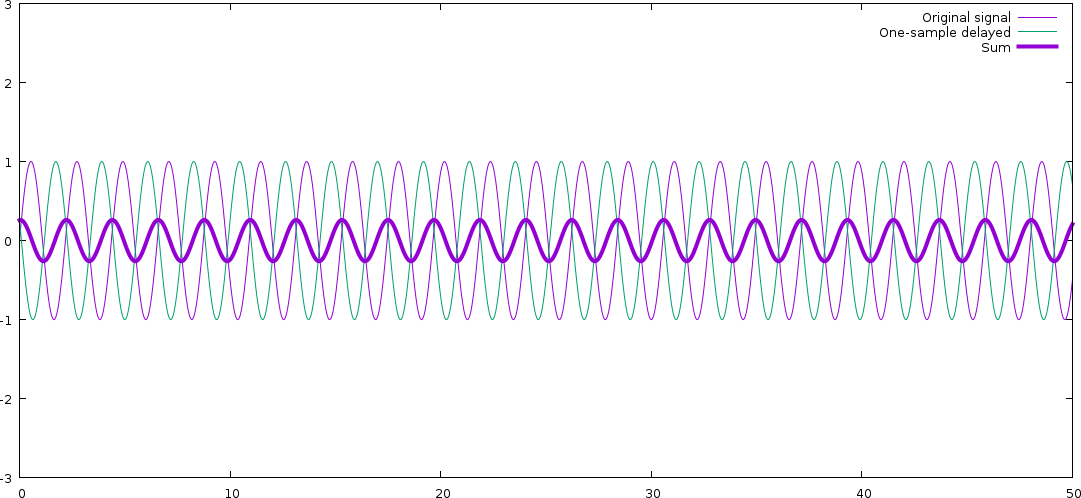
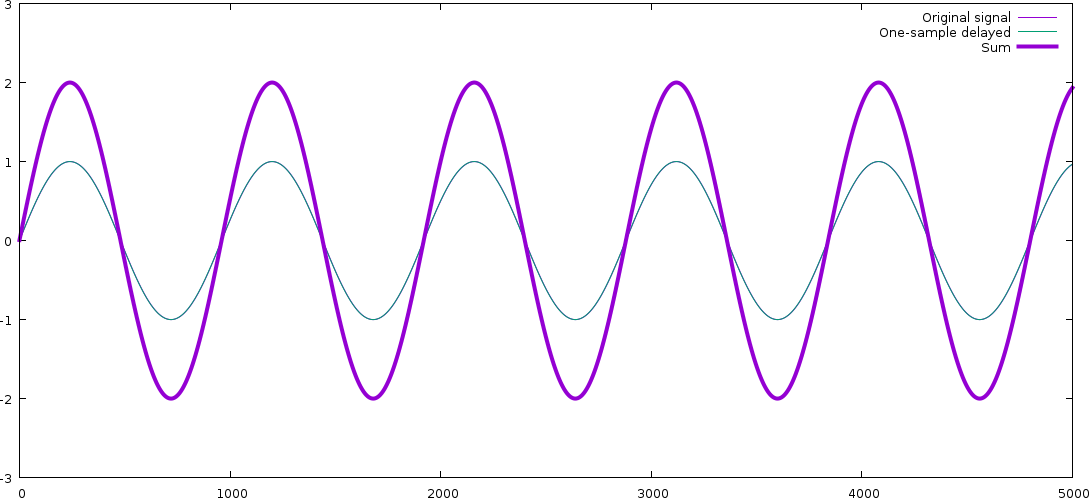
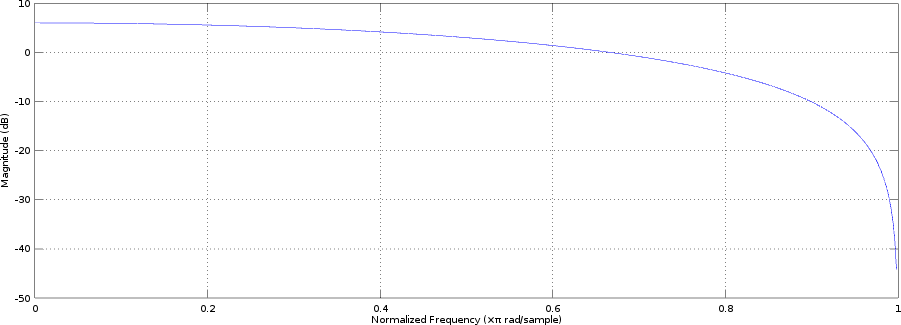
At some point back when the dinosaurs roamed the Earth and I was in high school, I borrowed my first digital signal processing book from a friend. I later went on to an engineering education and master's thesis about DSP, but the very basics of DSP never stop to fascinate me. Today, I wanted to write something about one of them and how it affects audio processing in Nageru (and finally, how Debian's policies put me in a bit of a bind on this issue). DSP texts tend to obscure profound truths with large amounts of maths, so I'll try to present a somewhat less general result that doesn't require going into the mathematical details. That rule is: Adding a signal to weighted, delayed copies of itself is a filtering operation. (It's simple, but ignoring it will have sinister effects, as we'll see later.) Let's see exactly what that means with a motivating example. Let's say that I have a signal where I want to get rid of (or rather, reduce) high frequencies. The simplest way I can think of is to add every neighboring sample; that is, set yn = xn + xn-1. For each sample, we add the previous sample, ie., the signal as it was one sample ago. (We ignore what happens at the edges; the common convention is to assume signals extend out to infinity with zeros.) What effect will this have? We can figure it out with some trigonometry, but let's just demonstrate it by plotting instead: We assume 48 kHz sample rate (which means that our one-sample delay is 20.83 s) and a 22 kHz note (definitely treble!), and plot the signal with one-sample delay (the x axis is sample number): Filtered 22 kHz As you can see, the resulting signal is a new signal of the same frequency (which is always true; linear filtering can never create new frequencies, just boost or dampen existing ones), but with much lower amplitude. The signal and the delayed version of it end up cancelling each other mostly out. Also note that there signal has changed phase; the resulting signal has been a bit delayed compared to the original. Now let's look at a 50 Hz signal (turn on your bass face). We need to zoom out a bit to see full 50 Hz cycles: Filtered 50 Hz The original signal and the delayed one overlap almost exactly! For a lower frequency, the one-sample delay means almost nothing (since the waveform is varying so slowly), and thus, in this case, the resulting signal is amplified, not dampened. (The signal has changed phase here, too actually exactly as much in terms of real time but we don't really see it, because we've zoomed out.) Real signals are not pure sines, but they can be seen as sums of many sines (another fundamental DSP result), and since filtering is a linear operation, it affects those sines independently. In other words, we now have a very simple filter that will amplify low frequencies and dampen high frequencies (and delay the entire signal a little bit). We can do this for all frequencies from 0 to 24000 Hz; let's ask Octave to do it for us: Frequency plot for simple filter (Of course, in a real filter, we'd probably multiply the result with 0.5 to leave the bass untouched instead of boosting it, but it doesn't really change anything. A real filter would have a lot more coefficients, though, and they wouldn't all be the same!) Let's now turn to a problem that will at first seem different: Combining audio from multiple different time sources. For instance, when mixing video, you could have input from two different cameras or sounds card and would want to combine them (say, a source playing music and then some audience sound from a camera). However, unless you are lucky enough to have a professional-grade setup where everything runs off the same clock (and separate clock source cables run to every device), they won't be in sync; sample clocks are good, but they are not perfect, and they have e.g. some temperature variance. Say we have really good clocks and they only differ by 0.01%; this means that after an hour of streaming, we have 360 ms delay, completely ruining lip sync! This means we'll need to resample at least one of the sources to match the other; that is, play one of them faster or slower than it came in originally. There are two problems here: How do you determine how much to resample the signals, and how do we resample them? The former is a difficult problem in its own right; about every algorithm not backed in solid control theory is doomed to fail in one way or another, and when they fail, it's extremely annoying to listen to. Nageru follows a 2012 paper by Fons Adriaensen; GStreamer does well, something else. It fails pretty badly in a number of cases; see e.g. this 2015 master's thesis that tries to patch it up. However, let's ignore this part of the problem for now and focus on the resampling. So let's look at the case where we've determined we have a signal and need to play it 0.01% faster (or slower); in a real situation, this number would vary a bit (clocks are not even consistently wrong). This means that at some point, we want to output sample number 3000 and that corresponds to input sample number 3000.3, ie., we need to figure out what's between two input samples. As with so many other things, there's a way to do this that's simple, obvious and wrong, namely linear interpolation. The basis of linear interpolation is to look at the two neighboring samples and weigh them according to the position we want. If we need sample 3000.3, we calculate y = 0.7 x3000 + 0.3 x3001 (don't switch the two coefficients!), or, if we want to save one multiplication and get better numerical behavior, we can use the equivalent y = x3000 + 0.3 (x3001 - x3000). And if we need sample 5000.5, we take y = 0.5 x5000 + 0.5 x5001. And after a while, we'll be back on integer samples; output sample 10001 corresponds to x10000 exactly. By now, I guess it should be obvious what's going on: We're creating a filter! Linear interpolation will inevitably result in high frequencies being dampened; and even worse, we are creating a time-varying filter, which means that the amount of dampening will vary over time. This manifests itself as a kind of high-frequency flutter , where the amount of flutter depends on the relative resampling frequencies. There's also cubic resampling (which can mean any of several different algorithms), but it only really reduces the problem, it doesn't really solve it. The proper way of interpolating depends a lot on exactly what you want (e.g., whether you intend to change the rate quickly or not); this paper lays out a bunch of them, and was the paper that originally made me understand why linear interpolation is so bad. Nageru outsources this problem to zita-resampler, again by Fons Adriaensen; it yields extremely high-quality resampling under controlled delay, through a relatively common technique known as polyphase filters. Unfortunately, doing this kind of calculations takes CPU. Not a lot of CPU, but Nageru runs in rather CPU-challenged environments (ultraportable laptops where the GPU wants most of the TDP, and the CPU has to go down to the lowest frequency), and it is moving in a direction where it needs to resample many more channels (more on the later), so every bit of CPU helps. So I coded up an SSE optimization of the inner loop for a particular common case (stereo signals) and sent it in for upstream inclusion. (It made the code 2.7 times as fast without any structural changes or reducing precision, which is pretty much what you can expect from SSE.) Unfortunately, after a productive discussion, suddenly upstream went silent. I tried pinging, pinging again, and after half a year pinging again, but to no avail. I filed the patch in Debian's BTS, but the maintainer understandably is reluctant to carry a delta against upstream. I also can't embed a copy; Debian policy would dictate that I build against the system's zita-resampler. I could work around it by rewriting zita-resampler until it looks nothing like the original, which might be a good idea anyway if I wanted to squeeze out the last drops of speed; there are AVX optimizations to be had in addition to SSE, and the structure as-is isn't ideal for SSE optimizations (although some of the changes I have in mind would have to be offset against increased L1 cache footprint, so careful benchmarking would be needed). But in a sense, it feels like just working around a policy that's there for good reason. So like I said, I'm in a bit of a bind. Maybe I should just buy a faster laptop. Oh, and how does GStreamer solve this? Well, it doesn't use linear interpolation. It does something even worse it uses nearest neighbor. Gah. Update: I was asked to clarify that this is about the audio resampling done by the GStreamer audio sink to sync signals, not in the audioresample element, which solves a related but different problem (static sample rate conversion). The audioresample element supports a number of different resampling methods; I haven't evaluated them.
Chris Lamb: try.diffoscope.org CLI client

One criminally-unknown new UNIX tool is diffoscope, a diff "on steroids" that will not only recursively unpack archives but will transform binary formats into human-readable forms in order to compare them instead of simply showing the raw difference in hexadecimal. In an attempt to remedy its underuse, in December 2015 I created the try.diffoscope.org service so that I and hopefully others could use diffoscope without necessarily installing the multitude of third-party tools that using it can require. It also enables trivial sharing of the HTML reports in bugs or on IRC. To make this even easier, I've now introduced a command-line client to the web service:
 $ apt-get install trydiffoscope
 [..]
 Setting up trydiffoscope (57) ...
 $ trydiffoscope /etc/hosts.allow /etc/hosts.deny
 --- a/hosts.allow
 +++ b/hosts.deny
  @@ -1,10 +1,17 @@
  -# /etc/hosts.allow: list of hosts that are allowed to access the system.
  -#                   See the manual pages hosts_access(5) and hosts_options(5).
  +# /etc/hosts.deny: list of hosts that are _not_ allowed to access the system.
  +#                  See the manual pages hosts_access(5) and hosts_options(5).
You can also install it from PyPI with:
$ pip install trydiffoscope

Mirroring the original diffoscope command, you can save the output locally in an even more-readable HTML report format by appending "--html output.html". In addition, if you specify the --webbrowser (or -w) argument:
$ trydiffoscope -w /etc/hosts.allow /etc/hosts.deny
https://try.diffoscope.org/gaauupyapzkb
... this will automatically open your default browser to view the results.

Dirk Eddelbuettel: rfoaas 1.0.0

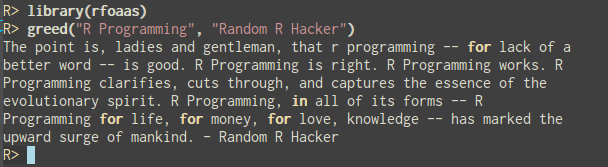
rfoaas greed example The big 1.0.0 is here! Following the unsurpassed lead of the FOAAS project, we have arrived at a milestone: Release 1.0.0 is now on CRAN. The rfoaas package provides an interface for R to the most excellent FOAAS service--which itself provides a modern, scalable and RESTful web service for the frequent need to tell someone to f$#@ off. Release 1.0.0 brings fourteen (!!) new access points: back(), bm(), gfy(), think(), keep(), single_(), look(), looking(), no(), give(), zero(), pulp(), sake(), and anyway(). All with documentation and testing. Even more neatly, thanks to a very pull request by Tyler Hunt, we can now issue random FOs via the getRandomFO() function! As usual, CRANberries provides a diff to the previous CRAN release. Questions, comments etc should go to the GitHub issue tracker. More background information is on the project page as well as on the github repo

This post by Dirk Eddelbuettel originated on his Thinking inside the box blog. Please report excessive re-aggregation in third-party for-profit settings.

Next.

Previous.