Search Results: "mak"

4 July 2012

Dirk Eddelbuettel: RcppBDT 0.2.0

A new release of the RcppBDT package appeared on CRAN earlier today. RcppBDT uses Rcpp, and in particular the nifty Rcpp modules feature of wrapping C++ code for R just by declaring the (class or function) interfaces. It uses this to bring in some useful functions from Boost Date.Time to R so that one can do things like
R> library(RcppBDT)
R> sapply(2012:2016, function(year)
+         format(getNthDayOfWeek(first, Mon, Sep, year)))
[1] "2012-09-03" "2013-09-02" "2014-09-01" "2015-09-07" "2016-09-05"
R> 
to compute the next five Labor Day dates in the US, given the year and the first Monday of September requirement. More examples are e.g. on the earlier blog post announcing version 0.1.0. Changes are mostly internal. R 2.15.1 brough a better / easier way to load such 'modules' into R, and Rcpp 0.9.13 allows us to use this. So RcppBDT continues to be useful as an example package for Rcpp modules. I also streamlines the interface a little: identifiers are now directly accessible in the package's NAMESPACE rather than just via the an instantiated object. I also added a NEWS file, using the .Rd format so that we can import the marked-up text:
News for Package RcppBDT Changes in version 0.2.0 (2012-07-02)
  • The core module, which wraps what in C++ is boost::gregorian::date, is now exposed as an Rcpp module bdtDate. As all example and demos operated off a (package-global) variable 'bdt', no user visible change was needed outside of the code instantiating at package load.
  • Updated package instantiation to the new facilities offered by the current versions R 2.15.1 and Rcpp 0.9.13 which make Rcpp module initialization easier and more streamlined.
Changes in version 0.1.0 (2011-01-17)
  • First CRAN upload (and see ChangeLog for more granular details) bug fix in svm cross validation
Courtesy of CRANberries, there is also a diffstat report for 0.2.0 relative to 0.1.0. As always, feedback is welcome and the rcpp-devel mailing list off the R-Forge page for Rcpp is the best place to start a discussion.

3 July 2012

Miriam Ruiz: Scratch in Debian

Scratch has finally reached Debian repositories. Scratch is a programming learning environment created by the Lifelong Kindergarten Group at the MIT Media Lab designed to be accessible by young learners (over 8 years old). Scratch makes it easy to create your own interactive stories, animations, games, music, and art through a visual interface based on blocks. Thus, beginners can get results without having to learn to write syntactically correct code first. It is powerful enough to have even been adopted as an entry-level computer language in computer science programs at different universities. Scratch makes use of pieces of code embedded in different blocks that are shaped like puzzle pieces. That way, programming consists on putting different blocks together, which gives immediate visual feedback to the programmer about the correctness of the syntax: If the pieces fit together, then the expression is valid. Scratch programming system is so nice and easy that has been the inspiration of other systems such as MIT App Inventor or Google Blocky.

Scratch animations consist of sprites that are animated by dragging the corresponent blocks into the Scripts area of the Scratch interface. Multiple sprites can be created and interact with one another. Each of the sprites can have different looks (called costumes in Scratch). You can use built-in sprites, load them from files, or draw your own using a drawing tool integrated in the environment. Scratch itself is coded in Squeak, a Smalltalk implementation derived from Smalltalk-80. The Scratch 1.4 source went GPLv2 on March, but there were some incompatibilites with the Squeak Virtual Machine currently in Wheezy that had to be resolved first. Luckily we were able to solve them, with the help of the Scratch and the Squeak guys, so I m happy to say that Scrach is finally available from Debian repositories. Note: If any Scratch derivatives (such as BYOB or Panther) also need to be ported to the current version of Squeak, they should have a look at the comments in the Scratch ITP, and especially to the script uploaded by Bert Freudenberg, that replaces 90 indexed primitive declarations (removed in later versions of Squeak VM) with their named counterpart. Note 2: This wouldn t have been possible without all the great work and effort made by Amos Blanton and many others. Lots of thanks!

Petter Reinholdtsen: Can Zimbra be told to send autoreplies to the From: address?

In the NUUG FiksGataMi project (Norwegian version of FixMyStreet from mySociety), we have discovered a problem with the municipalities using Zimbra. When FiksGataMi send a problem report to the government, the email From: address is set to the address of the person reporting the problem, while envelope sender is set to the FiksGataMi contact address. The intention is to make sure the municipality send any replies to the person reporting the problem, while any email delivery problems are sent to us in NUUG. This work well in most cases, but not for Karm y municipality using Zimbra. Karm y is using the vacation message function in Zimbra to send an automatic reply to report that the message has been received, and this message is sent to the envelope sender and not the address in the From: header. This causes the automatic message from Karm y to go to NUUGs request-tracker instance instead of to the person reporting the problem. We can not really change the envelope sender address, as this would make it impossible for us to discover when there are problems with the MTAs receiving problem reports. We have been in contact with the people at Karm y municipality, and they are willing to adjust Zimbra if something can be changed there to get a better behaviour. The default behaviour of Zimbra is as far as I can tell according to the specification in RFC 3834, which recommend that vacation messages are sent to the envelope sender and not to the From: address. But I wonder if it is possible to adjust or configure Zimbra to behave differently. Anyone know? Please let us know at fiksgatami (at) nuug.no.

2 July 2012

Craig Small: Dejagnu tips

Both the procps and psmisc projects use Dejagnu for their testing. It s interesting to try to understand how it all works and learning a new language TCL. One of the big problems with Dejagnu is its documentation which is very sparse. So here are two things I ve picked up along the way for a reference for myself and others. Locale We recently had a bug report on the procps list where tests for w failed for someone when the headers were shown. After a some further debugging it was a locale problem, where the testsuite was looking for a number like 3.14 but the tester was seeing 3,14. There are many ways around this but for us it was to set the locale, with the following line in config/unix.exp after suggestions by Mike Frysinger should fix it.
set env(LC_ALL) "C"
Cleaning Up
The documentation on this function is awesome! A title Cleanup Procedure and one line cleanup() .
That s all you get. The cleanup proc or function is called at the end of the testing. I use it
to remove temporary files and things like that.
proc cleanup      
  global test_file
  exec rm $test_file
 

Johannes Schauer: port bootstrap build-ordering tool report 3

A copy of this post is sent to soc-coordination@lists.alioth.debian.org as well as to debian-bootstrap@lists.mister-muffin.de.

Diary

June 18 Pietro suggests a faster way to generate installation sets for a list of packages. In my case, I need an installation set for every source package in the archive to find out how often a binary package is needed to build a source package. As a result, the speed is doubled in contrast to the original approach.

June 19
  • adapt code to work with new dose release 3.0
  • remove unneeded parts of code
  • add different possibilities to find amount of source packages that need a binary package
  • add code to get multiple installation sets using Depsolver_int.solve

June 20
  • add ~global_constraints:false to Depsolver.listcheck, Depsolver.trim and Depsolver.edos_install calls
  • adapt output graph to limited xdot capabilities

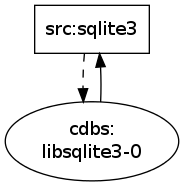
June 21 I formulate an email to the list, reporting of dependency graphs of debhelper, cdbs, pkg-config and libgtk2.0-dev. My current technique gets an installation set for a source package, removes all those that are already installable and adds the others as a dependency of that source package. This dependency will include an installation set of that binary as well minus all packages that are already available. The problem with that approach are dependency cycles created by long dependency chains. Example: src:A needs B needs C needs A. B and C would both be added as a dependency of src:A. B as well as C would also include their installation set which in both cases includes A. So now there are two cycles: src:A->B->A and src:A->C->A. For a real life example, look at the following situation of cdbs and src:sqlite3. cdbs old situation It is created because src:sqlite3 needs cdbs needs python-scour needs python needs python2.7 needs libsqlite3-0. Therfor libsqlite3-0 is in the installation set of cdbs, python-scour, python and python2.7. This creates five cycles in the graph even though there is only one. It would be better to reduce the dependencies added to src:sqlite3 to its direct dependency which is cdbs. Package dependencies are disjunctions from which the solver chooses one or the other to build an installation set. To solve the problem above I would need to know which disjunction the solver chose and then only add the direct dependency of a package to the dependency graph.
  • improve build_compile_rounds performance
  • big overhaul of menu structure
  • fix subgraph extraction code

June 22
  • do not create a universe if not needed - use hashtables instead
  • for sorting packages, generating difference of package sets and otherwise comparing packages, always use CudfAdd.compare
  • as a custom list membership function, use List.exists instead of trying List.find
  • more speedup for build_compile_rounds
  • the number of source packages that can be built does NOT include the cross built packages
  • print closure members in graph
  • refactor code and move common functions to bootstrapCommon.ml
  • add breakcycles.ml for future code to break cycles using staged build dependencies
  • use more extlib functionality
  • extended package list input format

June 23 After several emails with Pietro I learn about syntactic dependency graphs. To document my progress and prove my efforts I committed the code as commit 6684c13. But this code was soon found out to be unecessary so it will be removed later and just serves as documentation.

June 24 I came up with another (better?) solution to get the chosen disjunctions. It simply uses the calculated installation set to decide for each disjunction which one was taken by the solver. I reported that important step and the open questions involved with it in an email to the list. The problem always was, that an installation set can easily contain more than one package of a disjunction. In this case it is not clear which branch was chosen by the solver. I found, that in Ubuntu Natty there are only 6 such packages and for each of them the situation can be solved. It can be solved because in all of those cases it is that either one package of a disjunction provides the other or that both packages depend upon each other, which means that both have to be included.

June 27
  • use installation set to flatten build dependencies of source packages
  • refactor code and move common functions to bootstrapCommon.ml

June 25 I have to have an algorithm that finds all circuits in a given graph. This is necessary so that:
  1. cycles can be enumerated for huge dependency graphs where cycles are hard to see
  2. cycles can be enumerated to find a cycle that can be broken using staged build dependencies
It seems that Johnson's algorithm is the best way to do this complexity wise and Pietro already blogged about the problem together with an implementation of the algorithm in ocaml. Unfortunately it turns out that his code doesnt implement the algorithm correctly and hence misses out on some cycles. The fix seems not to be too trivial so I'm still investigating it.

June 28
  • add crosseverything.ml to obtain a list of source packages that, if cross compiled, would make the whole archive available

Results While the first week was productive as usual, I had to work some time on a University project during the second week as well as attend a family meeting. I will catch up with the lost time over the course of the next week.

dose3 Using dose 3.0 (which fixes a bug about essential packages) the output of the algorithms is now likely less wrong then before.

performance Performance was improved in the generation of installation sets as well as in the code that tries out how many packages can be built in multiple rounds. This was achieved by more caching, less unnecessary operations in looping constructs, replacing lists with hashtables, not creating universes where not necessary.

user interface The main program, basenocycles.ml now has a much better menu structure.

input format The programs take two package file inputs. The list of source packages that has to be cross built for a minimal build system and the list of source packages that was chosen to be cross compiled in addition to that. Both files list one source package per line and now allow comments.

refactoring As more and more scripts are added, more and more functionality is moved to bootstrapCommon.ml which makes each script much cleaner.

what to test for cross building As discussed in the "Future" section of the last report, I now automated the process of finding out which packages, if they were cross compiled, would make the whole archive available because they break all cycles and allow native compilation of the rest. The outcome: to build 3333 out of 3339 packages in natty natively, at most 186 source packages must be cross compiled. The other six cannot be compiled because of version mismatches in the Natty Sources.bz2 and Packages.bz2. The code can be run from crosseverything.ml.

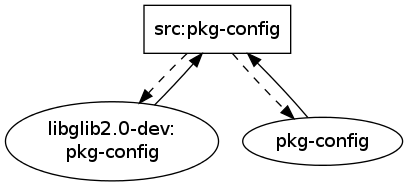
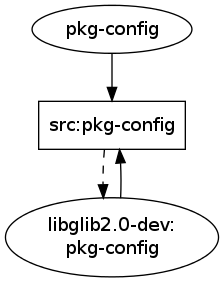
limit source dependencies to direct dependencies Reducing the dependencies of source packages from their full installation set to their direct dependencies by finding out which disjunction of their dependency list were taken, greatly simplifies the dependency graphs. The dependency graph created for libgtk2.0-dev could be reduced from 491 to 247 vertices for a depth of three. For cdbs it is now clearly visible that cdbs depends on libsqlite3-0 which builds from src:sqlite3 which depends on cdbs. Before: cdbs old situation After: cdbs new situation For pkg-config the graph also has been reduced to the one single cycle that matters: src:pkg-config needs libglib2.0-dev which depends on pkg-config which builds from src:pkg-config. Before: pkg-config old situation After: pkg-config old situation

Future I will prepare content for wookey's debconf talk on crossbuilding and bootstrapping. As this will include directions how to use the current code, I will kill two birds with one stone and write some proper documentation for my current source. The following two lists will be displayed after a dependency graph is calculated and reduced to its scc:
  • those source packages that have the least build dependencies not fulfilled. Those might be candidates for easy staged build dependencies. Since the source package is part of the scc, it will definitely be involved in some cycle somewhere.
  • those binary packages that most source packages depend upon. Those could be candidates for cross compilation as it might be easier to cross compile the source package than using staged build dependencies.
Patrick managed to cross build packages with sbuild now. So the list of packages that crosseverything.ml produces can now be checked efficiently for cross buildability. With this list, potentially more cycles can be broken out of the box. A feature will be added that allows the user to remove all packages from a dependency graph that can be cross compiled without any additional effort. Version mismatches between source and binary packages in Sources.bz2 and Packages.bz2 respectively in Ubuntu make the scripts fail and/or produce wrong results. Debian (even Sid) doesnt have this problem so I should find out where to report this problem to Ubuntu. I need to write a working version of Johnson's algorithm because much functionality depends upon it. I have the option to improve Pietro's version or write one from scratch. Writing one from scratch might be easier as I have Pietro's code as template as well as a Java implementation of Johnson's algorithm which seems to work. The following functionalities need working cycle enumeration:
  • given source packages with staged build dependencies, an enumeration of cycles is needed to find out which cycles can be broken by building packages staged. It makes less sense to blindly build a package stage and then check if this makes more packages available.
  • display cycles of a dependency graph to the user. After obtaining all cycles in the graph it makes sense to sort them by their length. The user would then investigate the situation of the smallest cycles first. This makes sense because breaking small cycles can potentially break bigger cycles. Since in the end, all cycles have to be eliminated anyway, it makes sense for the user to first tackle the small ones.
  • display the feedback arc set to the user. The packages in the feedback arc set might be very good candidates for reduced build dependencies or cross compilation.

Julien Danjou: Making the jump: working freelance

For the last 10 years, I've been working on many Free Software projects. From Debian to OpenStack, through awesome, Emacs, XCB and many more. This obviously allowed me to enhance my technical skills, but it also taught me about Free Software and Open Source development processes, and how to work with and close to the community. Working for almost 6 years at Easter-eggs taught me how to work in an autonomous manner, how to lead and manage a project. And how to run a company, thanks to the cooperative status of this great one. These are the reasons why I decided to leave my latest job and run my own company to work as a freelance consultant & developer specialized in Free Software, starting today. Therefore, I am now able and available to provide expertise and development on Free Software, including upstream contribution. Especially on projects I already worked on recently, like OpenStack.

Benjamin Mako Hill: Wiki Conferencing

I am in Berlin for the Wikipedia Academy, a very cool hybrid free culture community plus refereed academic conference organized, in part, by Wikimedia Deutschland. On Friday, I was very excited to have been invited to give the conference's opening keynote based on my own hybrid take on learning from failures in peer production and incorporating a bunch of my own research. Today, I was on a panel at the conference about free culture and sharing practices. I'll post talks materials and videos when the conference puts them online. I will be in Berlin for the next week or so before I head to directly to Washington, DC for Wikimania between the 11th and 15th. I'll be giving three talks there: Between then and now, I'm taking the next week in Berlin to catch up on work, and with friends. If you're in either place and want to meet up, please get in touch and lets try to arrange something.

Joey Hess: notes for a caretaker

I recently had the sort of weird experience of a recent blog post being on the top of Hacker News and there being a fair amount of interest in the details of my wacky living situation. I could write a detailed post explaining everything, but that'd be boring .. instead I'll tease the stalkers with more oblique references to it. So here's my notes for a caretaker who will be here while I'm away at DebConf.
Please make yourself at home!

1 July 2012

Niels Thykier: Performance bottlenecks in Lintian

Thanks to a heads up from Bastian Blank, I learned that Lintian 2.5.7 and 2.5.8 were horribly slow on the Linux binaries. Bastian had already identified the issue and 2.5.9 fixed the performance regression. But in light of that, I decided to have a look at a couple of other bottlenecks. First, I added a simple benchmark support to Lintian 2.5.10 (enabled with -dd) that prints the approximate run time of a given collection. As an example, when running lintian -dd on lintian 2.5.10, you can see something like:
N: Collecting info: unpacked for source:lintian/2.5.10 ...
[...]
N: Collection script unpacked for source:lintian/2.5.10 done (0.699s)
When done on linux-image, the slowest 3 things with 2.5.10 are (in order of appearance):
[...]
N: Collection script strings for binary:linux-image-3.2.0-2-amd64/3.2.20-1/amd64 done (12.333s)
N: Collection script objdump-info for binary:linux-image-3.2.0-2-amd64/3.2.20-1/amd64 done (15.915s)
[...]
N: Finished check: binaries (5.911s)
[...]
(The mileage (and order) probably will vary a bit.) These 3 things makes up about 22 seconds of a total running time on approximately 28-30s on my machine. Now if you wondering how 12, 16 and 6 becomes 22 the answer is parallelization . strings and objdump-info are run in parallel so only the most
expensive of the two counts in practise (with multiple processing units). The version of linux-image I have been testing (3.2.20-1, amd64) has over 2800 ELF binaries (kernel modules). That makes the runtime of strings and objdump-info much more dominating than in your average package . For the fun of it I have done a small informal benchmark of various Lintian versions on the binary. I have used the command line:
# time is the bash shell built-in and not /usr/bin/time
$ time lintian -EvIL +pedantic linux-image-3.2.0-2-amd64_3.2.20-1_amd64.deb >/dev/null
# This was used with only versions that did not accept -L +pedantic
$ time lintian -EvI --pedantic linux-image-3.2.0-2-amd64_3.2.20-1_amd64.deb >/dev/null
With older versions of Lintian (<= 2.5.3) Perl starts to emit warnings; these have been manually filtered out. I used lintian from the git repository (i.e. I didn t install the packages, but checked out the relevant git tags). I had libperlio-gzip-perl installed (affects the 2.5.10 run). Most results are only from a single run, though I ran it twice on the first version (hoping my kernel would cache the deb for the next run). The results are:
2.5.10
real  0m28.836s
user  0m36.982s
sys  0m3.280s
2.5.9
real  1m9.378s
user  0m33.702s
sys  0m11.177s
2.5.8
real  4m54.492s
user  4m0.631s
sys  0m30.466s
2.5.7 (not tested, but probably about same as 2.5.8)
2.5. 0..6 
real  1m20s  - 1m22s
user  0m19.0s - 0m20.7s
sys  0m5.1s  - 0m5.6s
I think Bastian s complaint was warranted for 2.5. 7,8 . :) While it would have been easy to attribute the performance gain in 2.5.10 on the new parallelization improvements, it is simply not the case. These improvements only apply to running collections when checking multiple packages. On my machine, the parallelization limit for a package is effectively determined by the dependencies between the collections on my machine. Instead the improvements comes from reducing the number of system(3) (or fork+exec) calls Lintian does. Mostly through using xargs more, even if it meant slightly more complex code. But also, libperlio-gzip-perl shaved off a couple of seconds on binaries check. But as I said, linux-image is not your average package . Most of the improvements mentioned here are hardly visible on other packages. So let s have a look at some more other bottlenecks. In my experience the following are the worst offenders : But enough Lintian for now time to fix some RC bugs!

30 June 2012

Timo Jyrinki: Where computing takes you...

Do you ever have those afternoons you get a great idea and you've all the evening time for that task. The task is a relaxing one and won't need much attention, and you can watch a movie or something. But then, it happens that the evening turns into night as you realize a couple of little details adding complexity to the idea, and the task turns out to be much more invasive to your evening than you thought?

In this example, I got the great idea to upgrade my Debian running NAS device (thanks Martin for everything!) to use ext4 instead of ext3. The kind of idea that takes a long time for relatively little practical benefit, but it just feels like a nice thing do when you've the extra amounts of nerd time available. It's basically just opening the NAS device up, mounting its hard disk to a laptop via external case, running the tune2fs and fsck then putting the disk back. It just takes a long time for the initial fsck (to make sure everything's intact) and then the required fsck run to get ext4 mountable.

Only in this situation, it would have been beneficial to have the ext4 support in the flashed initramfs before the migration. So... before the photo below, I've already:
  1. done the ext4 migration and fsck:s
  2. screwed the disk back to the NAS case, attached cables and found that it doesn't boot
  3. (on the laptop with the hard disk attached again tried manually unpacking initramfs and adding ext4 module... also had time to bind mount everything and chroot into the ARM system to run update-initramfs manually... also tried booting with those... until remembered the simple fact that the /boot partition is only for show and also the initramfs is loaded directly from flash)
  4. copied the main root filesystem content from the original disk to another external disk with ext3 partition
  5. attached the another disk (with same UUID:s) to the QNAP NAS device, booted, double-checked that I have now ext4 specified under /etc/initramfs-tools/modules, reconfigured the linux image that also regenerates initramfs and flashes it
And in the photo, what's happening is that:
  1. I've again the original disk reattached and system booted with the initramfs generated and flashed from the ext3 disk
  2. the NAS device is hanging in the air, cover open, from the closet where I've things stuffed in (normally secured with cable ties), and I need to support it with a knee or one hand since the 2TB disk is much heavier than the small SSD I used as the ext3 disk so the power cable and RJ-45 cable would have pretty heavy load
  3. Since I've only one hand in use and can't use a laptop, I'm logging in via my Nokia N9 and then reflashing the kernel + initramfs from this original disk, just to make sure everything is now alright and also after that flashing it still boots (it does!). Note that I feel like the setup is secure enough for non-interrupted flashing so that I can indeed support the NAS with a knee, use one hand to keep N9 and another hand to take a photo with a camera.

And so we have had a productive and educating afternoon/evening/night once again. Does this ever happen to you?

29 June 2012

Jo Shields: How to build a bungalow begin with the chimney

Whilst nobody was looking, Mono became the most important framework in the world of games. And I mean that with only a smidge more than my usual levels of hyperbole. It really is fantastically important, as far as game development goes. I blogged a long time ago about its use inside EA s multi-million-selling The Sims 3. And the massive performance gains in Second Life when they switched from their in-house scripting language to Mono are well documented. But I m not talking about those, I m talking about the now, the recent stuff. First up is Unity 3D. Not to be confused with the Ubuntu user interface, Unity 3D is a proprietary game development tool which began life for Mac, and has now managed to become the single most popular game engine amongst smartphone developers. It targets a bunch of new platforms not just Android and Windows and iOS, but in the new 4.0 release, Linux too for the first time. And every Unity 3D game is a Mono game the core of Unity is a fork of Mono, which enables it to have the performance and ease of development which it does. A reasonably large percentage of the cross-platform games on Kickstarter, such as Wasteland 2 and Super Retro Squad, are cross-platform because Unity 3D makes it easy and each of those games is powered by Mono. However, I have better things to do today than gush about a proprietary tool. No, far more important are the Free ways to develop games. So today I m going to talk about MonoGame. MonoGame is an implementation of Microsoft XNA a high level framework for developing in .NET languages, originally designed to allow indie developers access to the Xbox 360. XNA covers many of the bases covered by SDL sound, graphics, input, and so on, but can go onto platforms where SDL isn t an option, such as the aforementioned Xbox 360. And with MonoGame, any game written for XNA is a game which can not only run on Microsoft s approved platforms Windows, Xbox 360, Windows Phone but also on other platforms such as Mac OS X, iPhone, iPad, Android, and Linux. Cross-platform is good. More games are good. And MonoGame enables every Xbox 360 indie developer to throw a Linux port out of the door with a relative minimum of fuss. There are 2,521 games on the Xbox Live Indie Games store (games by individuals or small groups, with no major publisher) and each of those can become a game for Debian and Ubuntu with very little work. Not to mention the games with actual publishers (some portion of the 492 games on XBLA), not to mention the mobile games written for Windows Phone, Android and iOS. All of these developers have an easy route to Linux releases, as long as the effort remains low. And with today s publishing in the Debian archive of MonoGame 2.5.1, the effort is as low as can be. Anyone who purchased the recent Humble Indie Bundle 5, and played Bastion, has seen MonoGame in action Bastion began life as an XNA game for Xbox 360, and the Linux port was made possible only by MonoGame. Bastion s 100+ industry awards should indicate the possibilities open to a creative mind with decent developer tools. MonoGame is Free Software, built on top of other Free Software, with an active upstream development team genuinely responsive to the needs of Linux distributions. It s well worth a look not just for porting, but for new projects too. And I m delighted that it will be available to all users of Debian 7.0, as well as Ubuntu 12.10.

Julien Danjou: How to make Twitter's Bootstrap tabs bookmarkable

I've been using Twitter's bootstrap library recently to build this Web site, and wondered how to be able to use the bootstrap-tab Javascript plugin in a bookmark friendly manner. I ended up with a simple solution. These are my first steps in Javascript and front-end manipulation, and it's really not my area of expertise, so don't be harsh. <figure>
function bootstrap_tab_bookmark (selector)   if (selector == undefined)  
    selector = "";  
    /* Automagically jump on good tab based on anchor */
    $(document).ready(function()  
        url = document.location.href.split('#');
        if(url[1] != undefined)  
            $(selector + '[href=#'+url[1]+']').tab('show');
         
     );
    var update_location = function (event)  
        document.location.hash = this.getAttribute("href");
     
    /* Update hash based on tab */
    $(selector + "[data-toggle=pill]").click(update_location);
    $(selector + "[data-toggle=tab]").click(update_location);
 
</figure> All you need is to use and call this function with a selector (only useful if you have several tabs/pills divisions) when the document is ready. The first part takes care of showing the good tab based on the hash contained in the URL. The second part takes care of changing the document location to add the current tab to it when the user clicks.

28 June 2012

Sylvain Le Gall: OASIS 0.3.0 release

Logo OASIS small OASIS is a tool to integrate a configure, build and install system in your OCaml project. It helps to create standard entry points in your build system and allows external tools to analyse your project easily. It is the building brick of OASIS-DB, a CPAN for OCaml. This release takes almost 18 months to complete. This is too long and I will talk in another blog post on the way I am trying to improve this right now (esp. using continuous integration). This new release fixes a small bug (1 line) that prevents setup.ml to run with OCaml 4.00. If you have projects that was generated with a former release consider upgrading to OASIS 0.3.0. There are several big new stuff that comes with this release. It now supports Pack: field for libraries which allows to pack your library using -for-pack and so on. We are also compiling .cmxs (dynlink object for native) by default and we publish them in the META file. This feature was implemented in order to get more libraries to provide .cmxs and to help project like Ocsigen to take advantage of this. If you want to get rid of this at configure time, you can use ./configure --override native_dynlink false. We introduce two new default flags: --enable-tests and --disable-docs for configure. These are implicit flags that define if we will run Test sections or compile Document sections. They are especially useful to reduce the number of dependencies, because dependencies of Test will be excluded by default. We recommend to set Build$: flag(tests) to any Library or Executable sections that are only useful for tests. This allows you to really cut down the number of dependencies. The last change I want to introduce is about the old setup-dev subcommand which is now deprecated. It has been replaced by 2 different update schemes. I am pretty excited by this feature which in fact comes from OASIS user (esp. Lwt project). The former scheme was to have a big 'setup.ml' that always call the command oasis to update. This was complex and not very useful. We now have 2 mode: dynamic and weak. dynamic allow you to have a small setup.ml and to keep your VCS history clean but you need to install OASIS. weak need a big setup.ml but only need to call the command oasis if someone change something in _oasis. This mode is targeted to project that wants to be able to checkout from VCS an OCaml project without installing OASIS. The difference generated by weak mode doesn't pollute too much the VCS history because most the time they make sense. For example, you upgrade your package version number in _oasis and it produces a change with 6 lines where the version number changes in every META, setup.ml files and so on. This version has been tested on: You can download it here or use your favorite package manager: Debian (UPDATE: pending upload)
$ apt-get install -t experimental oasis
GODI
$ godi_console perform -build apps-oasis
odb.ml
$ ocaml odb.ml oasis
Here is the complete changelog: EXTREMLY IMPORTANT changes (read this) PACKAGES uploaded to oasis-db will be automatically "derived" before OCaml 4.00 release (i.e. oUnit v1.1.1 will be regenerated with this new version as oUnit v1.1.1~oasis1). PACKAGES not uploaded to oasis-db need to be regenerated. In order not to break 3rd party tools that consider a tarball constant, I recommend to create a new version. Thanks to INRIA OCaml team for synchronizing with us on this point. Major changes: You can now have the following example:
     ...
     Executable test_exec
       Install: false
       Build$: flag(tests)
       MainIs: testExec.ml
       BuildDepends: oUnit
     
     Test main
       Command: $test_exec
       TestTools: test_exec
     ...
The Run$: flag(tests) is implicit for the section Test main. The default value is false for tests. If all the executable for test are flagged correctly (Build$: flag(tests)), you'll get rid of the dependency on oUnit. It works the same for documentation, however the default is true. (Closes: #866) In order to allow interdependent flags, we transform back lazy values into unit -> string functions. This allows to change a flag value on the command line and to update all the dependent values. (Closes: #827, #938) It defines different ways to manage the auto-update of setup.ml: The choice between weak and dynamic depends on your need with regard to VCS and to the presence of oasis. The weak allow to checkout the project from VCS and be able to work on it, without the need of installing 'oasis' as long as you don't change the file _oasis. But it clutter your VCS history with changes to the build system each time you change something in _oasis. The 'dynamic' mode gives you no VCS history pollution but makes mandatory to have installed oasis libraries. Avoid copying executable to their real name. It helps to call ocamlbuild a single time for the whole build rather than calling it n time (n = number of executable sections) and copying resulting exec. This speeds up the build process because ocamlbuild doesn't have to compute/scan dependencies each time. The drawback is that you have to use $foo when you want to call Executable foo, because $foo will be '_build/.../main.byte'. For example:
CCOpt: -DEXTERNAL_EXP10 -L/sw/lib "-framework vecLib"
Will be parsed correctly and outputed according to target OS. In order to ease building oasis, we have minimize the number of dependencies. You only need to install ocamlmod, ocamlify and ocaml-data-notation for a standard build without tests. Dependencies on pcre, extlib and ocamlgraph has been dropped. The remaining dependencies are hidden behind a flag tests. OASIS now produces .cmxs file by default and add them to META. Now a META looks like:
     ...
     archive(byte) = "oasis.cma"
     archive(byte, plugin) = "oasis.cma"
     archive(native) = "oasis.cmxa"
     archive(native, plugin) = "oasis.cmxs"
     ...
This will ultimately help to generate automatically .cmxs for all oasis enabled projects. We hope that this new feature will improve dynamic linking use in OCaml (esp. for project like Ocsigen). Other changes Thanks to Anil Madhavapeddy, Pierre Chambart, Christophe Troestler, Jeremie Dimino, Ronan Le Hy, Yaron Minsky and Till Varoquaux for their help with this release. Also thanks to all the testers of the numerous release candidates. This was a long work and each time a tester has downloaded oasis has helped me to know that I was working for someone.

Sylvain Le Gall: Installing a new SSD on my laptop

3 years ago I bought a OCZ Core v2 SSD... I was very disappointed by write freeze, price and capacity. Recently a friend of mine, told me that I should try the new ones that has much improved in the meantime. So I decided to give another try to SSD on my laptop. I bought a Crucial M4 128GB SSD, because they seems to be of better quality than OCZ (and probably because of my first failed attempt). The price is correct (~130 ) and after some tests it seems quite good at write and read speed. So from this point of view, I am more convinced than my first attempt. Now, the real problem of the SSD is how to migrate your old data to your new drive. I have always upgraded my HD to a larger one and so a simple dd if=/dev/sda of=/dev/sdb bs=32M was enough... In the case of SSD you have to migrate to a smaller capacity. This includes to juggle a little bit with your partition to get something that fits. In order to improve a little bit the lifetime of my SSD, I have tried to follow various advice you can found on the Internet. One of this advice that seems to make sense, is to align your partition to a number modulo 2048 (rather than the default which is to start at 63). I followed this forum to do that. I end up with all partitions aligned to 2048. The GOOD news: doing data migration for Linux is a breeze. As a matter of fact, Linux support pretty well being move around, ending up on a different partition and so on... It just took me the time to transfer data, update grub and disk UUID and reboot. The BAD news: doing data migration for Windows is a hell. I always keep a Windows partition to test various OCaml software. But Windows doesn't like you like to be moved around. It especially doesn't like that the first sector of its partition get moved (i.e. from sector 63 to sector 2048). I spend a week trying to 'repair windows' but it was a pure waste of time. Thinkpad comes with a special ways to store passwords which is not compatible with the rescue mode of Windows, so you cannot access the repair mode -- because you need the Administrator password -- which is not readable... I decided to get back to the standard first sector on 63... Now Windows complained about 'hal.dll' missing. You know why ! Because the partition number has changed (from /dev/sda1 to /dev/sda3). Boot in Linux, run fdisk, enter expert mode, fix order -- after having remounted read-only the root partition and unmount everything else. Grub complains a little bit, fall into rescue mode. I fix that following these instructions and running 'grub-install --recheck /dev/sda'. So after 2 weeks of fights, I end up with a working windows (honestly, this is a pain, don't try to play with Windows partition, this OS is a lot more sensible sensitive than Linux).

Sorina Sandu: Status update

Hello!

First of all: I'm going to DebConf :D and I really want to say a big "Thank you!" to every one who made this possible.


So, here's what I've done recently:

I spent some time putting everything in order for the departure to Nicaragua, things like finding a plane ticket through a route that does not require a Visa, making a new Passport, now all is in order.

I've integrated the changes for listing available ESSIDs, in order to close #637128 [0] into a separate branch , which can be found here [1].

The plan is to have only one new template which lists the available networks and which has a option for entering the ESSID manualy. In order to do so, a simple scan is performed on the wireless interface, and the configuration for a particular network resulted after the scan is kept if that one is chosen. The enter manually situation is treated exactly as it was before.

Furthermore, last week (or the week before) I've done some coding style fixes again in a separate branch [2], nothing very fancy, just trimming trailing white spaces and changing some tabs to spaces, where spaces were mostly used. I've also noticed some inconsistencies, regarding white spaces between functions names and the parenthesis. However I think I'm overreacting a little, those matters are not really that relevant, but when I'll have some free time I'll get to this as well.


Next in line: Issues

Testing is still giving me some troubles, the show essids part is not yet fully tested, so I couldn't say for sure if everything works as planned.

Apart from the classical: write the image to an USB and reboot method, I'm using Virtual Box for testing. I've managed to create a passthrough for the wireless interface, but now I have troubles with some firmware. Hopefully I'll solve this as soon as possible since it would really make my life easier.


Future plans:

I've realized that I've underestimated a little what the project implies and the amount of information that is new to me. I feel that I have learned a lot and that there is still a lot to learn and I'm very happy that it is so. I've now started documenting regarding IPv6, beginning with this [3]. We haven't decided yet what the next task will be exactly.


[0] http://bugs.debian.org/cgi-bin/bugreport.cgi?bug=637128
[1] http://anonscm.debian.org/gitweb/?p=d-i/netcfg.git;a=shortlog;h=refs/heads/people/sorina/show_essids
[2] http://anonscm.debian.org/gitweb/?p=d-i/netcfg.git;a=shortlog;h=refs/heads/people/sorina/coding_style
[3] http://tldp.org/HOWTO/Linux+IPv6-HOWTO/

Michal &#268;iha&#345;: Preview of Weblate 1.1

Upcoming Weblate 1.1 is now installed on both http://demo.weblate.org and http://l10n.cihar.com. There release is almost ready (I plan to add only one minor feature) and this setup was done to get more testing in real life setup before making actual release. As you can see from list of changes, there are no big changes from user point of view. In case indexing offloading is enabled (what is the case for l10n.cihar.com), the interface should respond more quickly while translating (and not produce errors in some setups). The rest of changes are even more hidden, like smarter handling of merges and commits (still there is place for improvements here) or better validation of admin forms. Anyway I hope to complete missing features and do possible bug fixes in first two week of July and you can expect 1.1 to be released around Friday 13th.

Filed under: English Phpmyadmin Weblate 0 comments Flattr this!

26 June 2012

Bastian Venthur: .inputrc

A few days ago I found this blog explaining how to improve the tab completion by tinkering with your .inputrc. The magic lines are:

set show-all-if-ambiguous on
set completion-ignore-case on
set completion-map-case on
Last two lines make tab-completion ignore case, hyphens, underscores, the first one spares you one tab when more than one match was found. Very neat! I would have never found out, since there wasn t even an .inputrc in my home directory. Do you know any other cool .inputrc-tricks?

Neil McGovern: Digital Economy Act And so it begins

Today, OFCOM issued a press release entitled "New measures to protect online copyright and inform consumers". According to the announcement, internet users will be encouraged to download music and films through legal channels under the measures. Ofcom has published a draft code for consultation that would require large internet service providers (ISPs) to inform customers of allegations that their internet connection has been used to infringe copyright. There does seem to have been a number of concessions made, which is welcome, but I do still have a number of concerns. The code 'only' covers ISPs with more than 400k fixed lines - BT, Everything Everywhere, O2, Sky, TalkTalk Group and Virgin Media. This covers about 93% of the UK retail market. If an allegation of copyright infringement is made, the ISP would need to write to the customer with notice that an infringement has occurred, and in a new change, the number of copyright infringement reports connected to their account. If more than three letters are received in a year, anonymous information may be provided on request to copyright owners showing them which infringement reports are linked to that customer s account. The copyright owner may then seek a court order requiring the ISP to reveal the identity of the customer. Two more changes have been implemented: Obviously the former of these will require further scrutiny, but I'm happier that this is not with the vested interest themselves. As for the latter, this gets a bit interesting. The Act states that
an appeal on any grounds must be determined in favour of the subscriber unless the copyright owner or internet service provider shows that a) the apparent infringement was an infringement of copyright, and b) the report relates to the subscriber s IP address at the time of that infringement.
This is good as it puts the burden of proof on the copyright owner, although it still uses IP addresses which is problematic. For example, New York Judge Gary Brown has ruled IP addresses are insufficient evidence to identify pirates, and has provided a lengthy and thoughtful explanation in his ruling. There has also been a consultation published on the how to share costs costs. The suggestion is fairly simple:
"Copyright Owners should bear all of the costs incurred by Ofcom, the majority of costs incurred by the appeals body, and 75% of the costs efficiently and reasonably incurred by Qualifying ISPs in carrying out their obligations."
This has the risk of driving up internet access prices as ISPs have to recover the costs of these notifications. Additionally:
"Under the Order, subscribers will have to pay a 20 fee to make an appeal against a report of infringement, which will be refunded in the event the appeal succeeds; the remaining costs of determining an appeal will be met by the Copyright Owner who submitted the CIR which has been appealed."
I disagree with the concept of having to pay for an appeal in this way. If accused, someone should be able to refute the argument without cost. This will introduce a barrier to entry, and even if it is refundable is something I believe should be avoided. Finally, the exact costs of implementing this have been set out. It looks like the Copyright Owners would have to pay 60p per letter (with the ISPs shouldering the remaining 20p), a similar split around capital costs - which are the ones that are actually significant. Taking the above, it seems that in total that content owners will have to shell out 15M to use the DEA scheme. The cost seems to be more or less fixed which could encourage content owners to send out frivolous accusations. There's an iterative process which will run to determine the estimated number of notifications, and if eventually the Content Owners don't agree with the pricing, they will have elected not to take advantage of the provisions of the Initial Obligations Code, as they have not been able to make binding commitments to fund CIR processing. So, in summary, this is something to keep an eye on. It certainly hasn't gone away, it's due to start in March 2014. The revised draft code and consultation, which closes on 26 July 2012, can be found here, and the sharing of costs consultation runs until 18th September 2012, found here.

Russ Allbery: Review: Quiet

Review: Quiet, by Susan Cain
Publisher: Crown
Copyright: 2012
ISBN: 0-307-45220-4
Format: Kindle
Pages: 263
I've always been an introvert. This is something that surprises some people when they first meet me since they equate introversion with shyness, and I'm not at all shy. It surprises others because I'm quite vocal and outspoken in meetings, but introversion also doesn't imply a lack of self-confidence. I can run meetings, give presentations, and argue my perspective in front of just about anyone, but I don't like parties, I crave time by myself, and I could happily go for weeks without seeing another human being. I'm an introvert because I find people draining rather than invigorating, written communication far easier and more comfortable than spoken, and superficial social contact more irritating and frustrating than enjoyable. If you think think that means there may be something wrong with me, or that I would be happier if "drawn out of my shell," I wish you would read this book. But I suspect its core audience will be people like me: those who are tired of being pushed to conform with extrovert beliefs about social interaction, those who are deeply disgusted by the word "antisocial" or feel pangs of irrational guilt when hearing it, or those who just want to read an examination of interpersonal interactions that, for once, is written by and about people who like quiet and solitude just like they do. I first encountered Susan Cain via her TED talk, which I think is both the best possible summary of this book and the best advertisement for it. If you've not already seen it, watch it; it's one of the best TED talks I've seen, good enough that I've watched it three times. If you then want more of the same, buy Quiet. Quiet has, I think, three messages. First, it's a tour of the science: what is introversion and extroversion? Is there evidence that these are real physiological differences? (Spoiler: yes.) What do we know about introversion? How do we know those things what experiments have been done and what methods have been used? Here, it's a good general introduction, although Cain is careful to point out that it only scratches the surface and there's much more scientific depth. For example, she touches on the connections between introversion and sensitivity to stimulus and points out that they're two separate, if related, categorizations, but doesn't have the space here to clarify the distinctions and tease them apart. But she lays a reasonable foundation, particularly in defense of introversion as a natural, physiologically grounded, scientifically analyzable, common, and healthy way of interacting with the world. (For those who are curious about the distinctions between introversion and sensitivity, and the argument that most of what Cain says here about introversion is actually about sensitivity, see the blog post by Elaine Aron.) The second message, the one that resonated with me the most, was Cain's passionate defense of introversion. Business culture (at least in the United States, which is what both Cain and I know) is strongly biased towards extroversion; at least faking extroversion seems to be required for some career advancement. Extrovert culture dominates politics and most public discourse. It's common to find people who consider introversion, particularly in children, to be a sign of unhappiness, poor social adjustment, psychological problems, or other issues that should be "cured" or changed. Cain's gentle but firm passion in defense of introversion is a breath of fresh air. She attacks open plan offices, the current obsession with group learning and social school settings, and the modern group-think bias towards collaboration over solitude and concentration, and she does that with a combination of polite frustration and the conclusions of multiple studies. Introverts will be cheering as she constructs solid arguments and musters evidence against things that we've always found miserable and then been told we were wrong, short-sighted, or socially inept for finding miserable. I am so utterly on her side in this argument that I have no way of knowing how persuasive it will be, but it's lovely just to hear someone put into words what I feel. This defense does skew the book. Quiet is not, and does not purport to be, an even-handed presentation of introversion and extroversion. It's written proudly and unabashedly from the introvert's point of view. I'm fine with that: I, like Cain, think the US is saturated in extrovert perspectives and extrovert advice, particularly in the business world, and could use some balancing by activism from the other perspective. But be aware that this is not the book to look to for an objective study of all angles of the introvert/extrovert dichotomy, and I'm not sure her descriptions of extroversion are entirely fair or analogous to those of introversion. The extroversion described here seems somewhat extreme to me. I'm dubious how many extroverts would recognize themselves in it, which partly undermines the argument. The third message of the book, once Cain has won the introvert's heart, is some advice on how to be a proud introvert, to make the space and find the quiet that one desires, and to balance that against places where one may want and need to act like an extrovert for a while. Cain thankfully does not try to make this too much of the book, nor does she hold up any particular approach as The Answer. All the answers are going to be individual. But she does offer some food for thought, particularly around how to be conscious of and make delibrate choices about one's energy expenditures and one's recharge space. She also captures beautifully something that I've not seen explained this well before: the relief that an introvert can feel in the company of an extrovert who helps navigate social situations, make conversation, and keep discussions going until they can reach the depth and comfort level where the introvert can engage. I wish anyone in a position of authority over social situations would read this book, or at least watch the TED talk and be aware of the issues. Particularly managers, since (at least in my relatively limited experience) workplace culture is so far skewed towards extroversion that it can be toxic to introverts. Many of the techniques used by extrovert managers, and the goals and advice they give their employees, are simply wrong for introverts, and even damaging. Cain speaks well to the difficulties of empathy between people with very different interaction preferences, such as the problems with extroverts trying to "draw out" introverts who have hit social overload (or sensitive people who have hit stimulus overload). She also discusses something that I'd previously not thought about, namely how the pressure towards extroversion leads people to act extroverted even when naturally introverted, and how it's therefore very difficult to tell from behavior (and sometimes even to tell internally!) what one's natural interaction style is. But mostly I recommend this book if you're an introvert, if the TED talk linked above speaks to you. Even if we can't convince the world to respect introversion more, or at least stop treating it as abnormal, it's a lovely feeling to read a book from someone who gets it. Who understands. Who fills a book with great stories about introverts and how they construct their worlds and create quiet space in which to be themselves. Rating: 9 out of 10

Christian Perrier: 2012 update 28 for Debian Installer localization

D-I beta 1 is in preparation. Commits to level 1 are still allowed but no guarantee they'll make it to beta1 and therefore wheezy. Status for D-I level 1 (core D-I files): Status for D-I level 2 (packages that have localized material that may appear during default installs, such as iso-codes, tasksel, etc.): Status for D-I level 3 (packages that have localized material that may appear during non-default installs, such as win32-loader) Full 100% completeness (hall of fame) for 32 languages: Asturian, Belarusian, Bulgarian, Catalan, Czech, Welsh, Danish, German, Esperanto, Spanish, Persian, French, Galician, Hebrew, Indonesian, Italian, Japanese, Kazakh, Khmer, Latvian, Norwegian Bokm l, Dutch, Polish, Portuguese, Russian, Slovak, Slovenian, Swedish, Thai, Turkish, Simplified Chinese, Traditional Chinese

Next.

Previous.