Russ Allbery: Review: Enchanters' End Game
| Series: | The Belgariad #5 |
| Publisher: | Del Rey |
| Copyright: | December 1984 |
| Printing: | February 1990 |
| ISBN: | 0-345-33871-5 |
| Format: | Mass market |
| Pages: | 372 |
| Series: | The Belgariad #5 |
| Publisher: | Del Rey |
| Copyright: | December 1984 |
| Printing: | February 1990 |
| ISBN: | 0-345-33871-5 |
| Format: | Mass market |
| Pages: | 372 |
A month or so ago I got involved in a discussion on IRC about notification methods for a headless NAS. One of the options considered was some sort of USB attached LED. DealExtreme had a cheap Webmail notifier , which was already supported by mainline kernels as a Riso Kagaku device but it had been sold out for some time.
This seemed like a fun problem to solve with a tinyAVR and V-USB. I had my USB relay board so I figured I could use that to at least get some code to the point that the kernel detected it as the right device, and the relay output could be configured as one of the colours to ensure it was being driven in roughly the right manner. The lack of a full lsusb dump (at least when I started out) made things a bit harder, plus the fact that the Riso uses an output report unlike the relay code, which uses a control message. However I had the kernel source for the driver and with a little bit of experimentation had something which would cause the driver to be loaded and the appropriate files in /sys/class/leds/ to be created. The relay was then successfully activated when the red LED was supposed to be on.
hid-led 0003:1294:1320.0001: hidraw0: USB HID v1.01 Device [MAIL MAIL ] on usb-0000:00:14.0-6.2/input0
hid-led 0003:1294:1320.0001: Riso Kagaku Webmail Notifier initialized
I now have an XMPP setup which has all the features of the recent fancy chat systems, and on top of that it runs, client and server, on Free Software, which can be audited, it is federated and I can self-host my own server in my own VPS if I want to, with packages supported in Debian.
prosodyctl adduser alice@example.orgc2s_require_encryption = true
s2s_secure_auth = trues2s_insecure_domains = "gmail.com" VirtualHost "chat.example.org"
enabled = true
ssl =
key = "/etc/ssl/private/example.org-key.pem";
certificate = "/etc/ssl/public/example.org.pem";
Component "conference.chat.example.org" "muc"
restrict_room_creation = "local"Component "upload.chat.trueelena.org" "http_upload""something";
There are a fair number of outstanding security issues in the Linux
kernel for Debian 8 "jessie", but none of them were considered
serious enough to issue a security update and DSA. Instead, most of
them are being fixed through the point release (8.7) which will be
released this weekend. Don't forget that you need to reboot to
complete a kernel upgrade.
This update to linux (version 3.16.39-1) also adds the perf security
mitigation feature from Grsecurity. You can disable unprivileged
use of perf entirely by setting sysctl
kernel.perf_event_paranoid=3. (This is the default for
Debian "stretch".)
I was assigned 13.5 hours of work by Freexian's Debian LTS
initiative and carried over 2 from November. I worked only 10
hours, so I carry over 5.5 hours.
As for the last few months, I spent all of this time working on the
linux (kernel) package. I backported several security fixes and did
some testing of the more invasive changes.
I also added the option to mitigate security issues in the
performance events (perf) subsystem by disabling use by unprivileged
users. This feature comes from Grsecurity and has been included in
Debian unstable and Android kernels for a while. However, for
Debian 7 LTS it has to be explicitly enabled by setting sysctl
kernel.perf_event_paranoid=3.
I uploaded these changes as linux 3.2.84-1 and then (on 1st January)
issued
DLA
722-1.
1.71 - Thu Jan 12 13:30:50 IST 2017
* Fix incorrect import of os.putenv
* Merge pull request #74 from Coucouf/fix-os-putenv
* Fix documentation on where we read battery capacity from
* cpuhotplug: allow disabling specific cpus
* Merge pull request #78 from aartamonau/cpuhotplug
* runtime-pm: refactor listed_by_id()
* wireless-power: Use iw and fallback to iwconfig if it not available
* Prefer available AC supply information over battery state to determine ON_AC
* On startup, we want to force the full execution of LMT.
* Device hotplugs need a forced execution for LMT to apply the proper settings
* runtime-pm: Refactor list_by_type()
* kbd-backlight: New module to control keyboard backlight brightness
* Include Transmit power saving in wireless cards
* Don't run in a subshell
* Try harder to check battery charge
* New module: vgaswitcheroo
* Revive bluetooth module. Use rfkill primarily. Also don't unload (incomplete list of) kernel modules
What is Laptop Mode Tools
Description: Tools for Power Savings based on battery/AC status Laptop mode is a Linux kernel feature that allows your laptop to save considerable power, by allowing the hard drive to spin down for longer periods of time. This package contains the userland scripts that are needed to enable laptop mode. . It includes support for automatically enabling laptop mode when the computer is working on batteries. It also supports various other power management features, such as starting and stopping daemons depending on power mode, automatically hibernating if battery levels are too low, and adjusting terminal blanking and X11 screen blanking . laptop-mode-tools uses the Linux kernel's Laptop Mode feature and thus is also used on Desktops and Servers to conserve power
I had to figure out what kinds of signal you can run over 3G-SDI today,
and it's pretty confusing, so I thought I'd share it.
For the reference, 3G-SDI is the same as 3G HD-SDI, an extension of HD-SDI,
which is an extension of the venerable SDI standard (well, duh). They're
all used for running uncompressed audio/video data of regular BNC coaxial
cable, possibly hundreds of meters, and are in wide use in professional
and semiprofessional setups.
So here's the rundown on 3G-SDI capabilities:
[ Chris Lamb ]
* Optimisations:
- Avoid multiple iterations over archive by unpacking once for an ~8X
runtime optimisation.
- Avoid unnecessary splitting and interpolating for a ~20X optimisation
when writing --text output.
- Avoid expensive diff regex parsing until we need it, speeding up diff
parsing by 2X.
- Alias expensive Config() in diff parsing lookup for a 10% optimisation.
* Progress bar:
- Show filenames, ELF sections, etc. in progress bar.
- Emit JSON on the the status file descriptor output instead of a custom
format.
* Logging:
- Use more-Pythonic logging functions and output based on __name__, etc.
- Use Debian-style "I:", "D:" log level format modifier.
- Only print milliseconds in output, not microseconds.
- Print version in debug output so that saved debug outputs can standalone
as bug reports.
* Profiling:
- Also report the total number of method calls, not just the total time.
- Report on the total wall clock taken to execute diffoscope, including
cleanup.
* Tidying:
- Rename "NonExisting" -> "Missing".
- Entirely rework diffoscope.comparators module, splitting as many separate
concerns into a different utility package, tidying imports, etc.
- Split diffoscope.difference into diffoscope.diff, etc.
- Update file references in debian/copyright post module reorganisation.
- Many other cleanups, etc.
* Misc:
- Clarify comment regarding why we call python3(1) directly. Thanks to J r my
Bobbio <lunar@debian.org>.
- Raise a clearer error if trying to use --html-dir on a file.
- Fix --output-empty when files are identical and no outputs specified.
[ Reiner Herrmann ]
* Extend .apk recognition regex to also match zip archives (Closes: #849638)
[ Mattia Rizzolo ]
* Follow the rename of the Debian package "python-jsbeautifier" to
"jsbeautifier".
[ siamezzze ]
* Fixed no newline being classified as order-like difference.
reprotest development
reprotest 0.5 was uploaded to unstable by Chris Lamb. It included contributions from:
[ Ximin Luo ]
* Stop advertising variations that we're not actually varying.
That is: domain_host, shell, user_group.
* Fix auto-presets in the case of a file in the current directory.
* Allow disabling build-path variations. (Closes: #833284)
* Add a faketime variation, with NO_FAKE_STAT=1 to avoid messing with
various buildsystems. This is on by default; if it causes your builds
to mess up please do file a bug report.
* Add a --store-dir option to save artifacts.
Other contributions (not yet uploaded):
website.git notifications now go to#reproducible-builds. Thanks todanielsh and the KGB bot maintainers.arm64 architecture was fully tested in all three suites in just 15 days. Thanks again to Codethink.co.uk for their support!pg_dump with -O --column-inserts to make easier to import our main database dump into a non-PostgreSQL database. (mapreri)armhf network: CPU frequency scaling was enabled for three
Firefly boards, enabling the CPUs to run at full speed. (vagrant)
Last week, Josh sent the call for papers to the R-SIG-Finance list making everyone aware that we will have our nineth annual R/Finance conference in Chicago in May. Please see the call for paper (at the link, below, or at the website) and consider submitting a paper.
We are once again very excited about our conference, thrilled about upcoming keynotes and hope that many R / Finance users will not only join us in Chicago in May 2017 -- but also submit an exciting proposal.
We also overhauled the website, so please see R/Finance. It should render well and fast on devices of all sizes: phones, tablets, desktops with browsers in different resolutions. The program and registration details still correspond to last year's conference and will be updated in due course.
So read on below, and see you in Chicago in May!
Gib Bassett, Peter Carl, Dirk Eddelbuettel, Brian Peterson,
Dale Rosenthal, Jeffrey Ryan, Joshua Ulrich
Some days ago, me and Valhalla
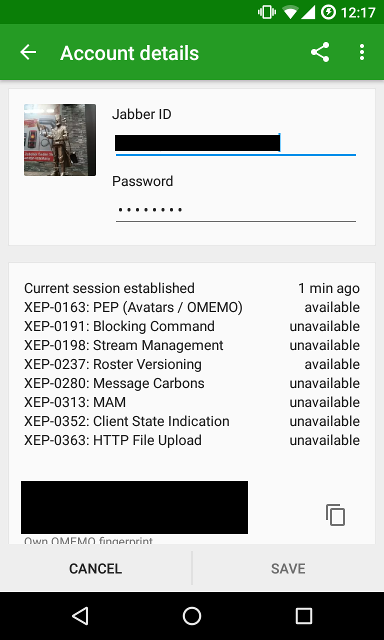
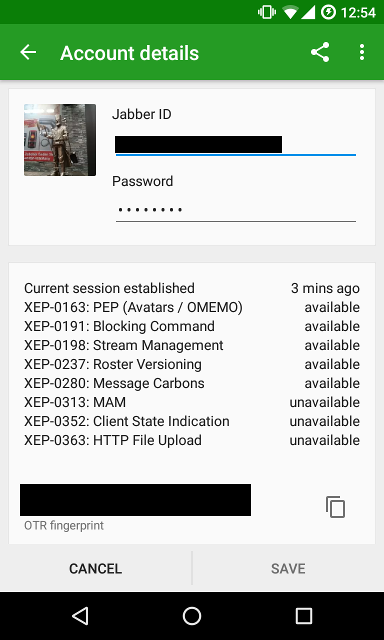
played the game of trying to see what happens when one turns them all on: I
would send her screenshots from my Conversations, and she would poke at her
Prosody to try and turn things on:
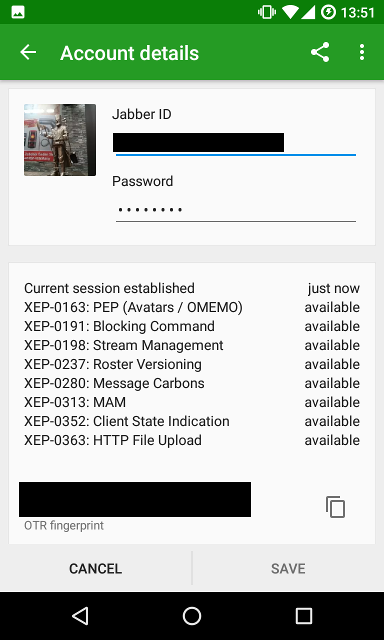
Valhalla eventually managed to get all features activated, purely using
packages from Jessie+Backports:
The result was a chat system in which I could see the same conversation history
on my phone and on my laptop (with gajim)(https://gajim.org/), and have it
synced even after a device has been offline,
We could send each other rich media like photos,
and could do OMEMO encryption (same as
Signal) in
group chats.
I now have an XMPP setup which has all the features of the recent fancy chat
systems, and on top of that it runs, client and server, on Free Software, which
can be audited, it is federated and I can self-host my own server in my own VPS
if I want to, with packages supported in Debian.
Valhalla has documented the whole procedure.
If you make a client for a protocol with lots of extension, do like
Conversations and implement a status page with the features you'd like to have
on the server, and little green indicators showing which are available: it
is quite a good motivator for getting them all supported.
Last month, we released nanotime, a package to work with nanosecond timestamps. See the initial release announcement for some background material and a few first examples.
nanotime relies on the RcppCCTZ package for high(er) resolution time parsing and formatting: R itself stops a little short of a microsecond. And it uses the bit64 package for the actual arithmetic: time at this granularity is commonly represented at (integer) increments (at nanosecond resolution) relative to an offset, for which the standard epoch of Januar 1, 1970 is used. int64 types are a perfect match here, and bit64 gives us an integer64. Naysayers will point out some technical limitations with R's S3 classes, but it works pretty much as needed here.
The one thing we did not have was Windows support. RcppCCTZ and the CCTZ library it uses need real C++11 support, and the g++-4.9 compiler used on Windows falls a little short lacking inter alia a suitable std::get_time() implementation. Enter Dan Dillon who ported this from LLVM's libc++ which lead to Sunday's RcppCCTZ 0.2.0 release.
And now we have all our ducks in a row: everything works on Windows too. The next paragraph summarizes the changes for both this release as well as the initial one last month:
We also have a diff to the previous version thanks to CRANberries. More details and examples are at the nanotime page; code, issue tickets etc at the GitHub repository.Changes in version 0.1.0 (2017-01-10)
- Added Windows support thanks to expanded RcppCCTZ (closes #6)
- Added "mocked up" demo with nanosecond delay networking analysis
- Added 'fmt' and 'tz' options to output functions, expanded
format.nanotime(closing #2 and #3)- Added data.frame support
- Expanded tests
Changes in version 0.0.1 (2016-12-15)
- Initial CRAN upload.
- Package is functional and provides examples.
This post by Dirk Eddelbuettel originated on his Thinking inside the box blog. Please report excessive re-aggregation in third-party for-profit settings.
I have just finished level one, fixing all RC bugs in packages under my name, even in team-maintained ones.
Next level is no unclassified bug reports, which gonna be harder since I have just adopted shadow with 70+ open bugs. :-\
Luckily I can still go on bonus tracks which is fixing (RC) bugs in others packages, but one should not spend all the time on those track before finishing level 1!
PS: Last time I tried playing a conventional game I ended up fixing it in a few minutes instead.
.cmds) using the following snippet in $HOME/.emacs:(autoload 'qsoas-mode "$HOME/Prog/QSoas/misc/qsoas-mode.el" nil t)
(add-to-list 'auto-mode-alist '("\\.cmds$" . qsoas-mode))
$HOME/Prog/QSoas/misc/qsoas-mode.el to the actual location of qsoas-mode.el.As before, you can download the source code from our website, and purchase the pre-built binaries following the links from that page too. Enjoy !
There have been a two long threads on the debian-devel mailing list
about the representation of the changes to upstream source code made
by Debian maintainers. Here are a few notes for my own reference.
I spent a lot of time defending the workflow I described in
dgit-maint-merge(7) (which was inspired by this blog post).
However, I came to be convinced that there is a case for a manually
curated series of patches for certain classes of package. It will
depend on how upstream uses git (rebasing or merging) and on whether
the Debian delta from upstream is significant and/or long-standing. I
still think that we should be using dgit-maint-merge(7) for leaf or
near-leaf packages, because it saves so much volunteer time that can
be better spent on other things.
When upstream does use a merging workflow, one advantage of the
dgit-maint-merge(7) workflow is that Debian s packaging is just
another branch of development.
Now consider packages where we do want a manually curated patch
series. It is very hard to represent such a series in git. The only
natural way to do it is to continually rebase the patch series against
an upstream branch, but public branches that get rebased are not a
good idea. The solution that many people have adopted is to represent
their patch series as a folder full of .diff files, and then use
gbp pq to convert this into a rebasing branch. This branch is not
shared. It is edited, rebased, and then converted back to the folder
of .diff files, the changes to which are then committed to git.
One of the advantages of dgit is that there now exists an official,
non-rebasing git history of uploads to the archive.
It would be nice if we could represent curated patch series as
branches in the dgit repos, rather than as folders full of .diff
files. But as I just described, this is very hard. However, Ian
Jackson has the beginnings of a workflow that just might
fit the bill.
IRCTC s e-mail id care@irctc.co.in
Now in detail
This is my first e-mail sent to IRCTC in June 2016
Dear Customer care, I had applied and got username and password sometime back . TheThere was lot of back and forth with various individuals on IRCTC and after a lot of back and forth, this is the final e-mail I got from them somewhere in August 2016, he writes
number I had used to register with IRCTC was xxxxxxxxxx (BSNL mobile number not used anymore) . My mobile was lost and along with that the number was also lost. I had filed a complaint with the police and stopped that number as well. Now I have an another mobile number but have forgotten both the password and the security answer that I had given when I had registered . I do have all the conversations I had both with the ticketadmn@irctc.co.in as well as care@irctc.co.in if needed to prove my identity. The new number I want to tie it with is xxxxxxxxxx (IDEA number in-use for last 10 years) I see two options :- a. Tie the other number with my e-mail address b. Take out the e-mail address from the database so that I can fill in
as a new applicant. Looking forward to hear from you.
Dear Customer, We request you to send mobile bill of your mobile number if it is post paid or if it is prepaid then contact to your service provider and they will give you valid proof of your mobile number or they will give you in written on company head letter so that we may update your mobile number to update so that you may reset your password through mobile OTP.IRCTC s response seemed responsible, valid and thought it would be a cake-walk as private providers are supposed to be much more efficient than public ones. The experience proved how wrong was I trust them with doing the right thing 1. First I tried the twitter handle to see how IDEA uses their twitter handle. 2. The idea customer care twitter handle was mild in its response. 3. After sometime I realized that the only way out of this quagmire would perhaps be to go to a brick-mortar shop and get it resolved face-to-face. I went twice or thrice but each time something or the other would happen. On the fourth and final time, I was able to get to the big Official shop only to be told they can t do anything about this and I would have to the appellate body to get the reply. The e-mail address which they shared (and I found it later) was wrong. I sent a somewhat longish e-mail sharing all the details and got bounce-backs. The correct e-mail address for the IDEA Maharashtra appellate body is appellette.mh@idea.aditybirla.com I searched online and after a bit of hit and miss finally got the relevant address. Then finally on 30th December, 2016 wrote a short email to the service provider as follows
and Kindly inform you that you can update your profile by yourself also. 1.login on IRCTC website
2.after login successfully move courser on my profile tab.
3.then click on update profile
4.re-enter your password then you can update your profile
5.click on user-profile then email id.
6. click on update. Still you face any problem related to update profile please revert to us with the screen shots of error message which you will get at the time of update profile . Thanks & Regards Parivesh Patel
Executive, Customer Care
care@irctc.co.in
http://www.irctc.co.in
[#3730034]
Dear Sir,Few days later I got this short e-mail from them
I have been using prepaid mobile connection number xxxxxxx taken from IDEA for last 10 odd years. I want to register myself with IRCTC for online railway booking using
my IDEA mobile number. Earlier, I was having a BSNL connection which I discontinued 4 years back, For re-registering myself with IRCTC, I have to fulfill their latest
requirements as shown in the email below . It is requested that I please be issued a letter confirming my
credentials with your esteemed firm. I contacted your local office at corner of Law College Road and
Bhandarkar Road, Pune (reference number Q1 84786060793) who
refused to provide me any letter and have advised me to contact on the
above e-mail address, hence this request is being forwarded to you. Please do the needful at your earliest.
Dear Customer, Greetings for the day! This is with reference to your email regarding services. Please accept our apologies for the inconvenience caused to you and delay in response. We regret to inform you that we are unable to provide demographic details from our end as provision for same is not available with us. Should you need any further assistance, please call our Customer Service help line number 9822012345 or email us at customercare@idea.adityabirla.com by mentioning ten digit Idea mobile number in subject line. Thanks & Regards, Javed Khan Customer Service Team IDEA Cellular Limited- Maharashtra & Goa Circle.Now I was at almost my wit s end. Few days before, I had re-affirmed my e-mail address to IDEA . I went to the IDEA care site, registered with my credentials. While the https connection to the page is weak, but let s not dwell on that atm. I logged into the site, I went through all the drop-down menus and came across My Account > Raise a request link which I clicked on . This came to a page where I could raise requests for various things. One of the options given there was Bill Delivery. As I wasn t a postpaid user but a prepaid user didn t know if that would work or not I still clicked on it. It said it would take 4 days for that to happen. I absently filed it away as I was somewhat sure that nothing would happen from my previous experience with IDEA. But this time the IDEA support staff came through and shared a toll-free SMS number and message format that I could use to generate call details from the last 6 months. The toll-free number from IDEA is 12345 and the message format is EBILL MON (short-form for month so if it s January would be jan, so on and so forth). After gathering all the required credentials, sent my last mail to IRCTC about a week, 10 days back
Dear Mr. Parivesh Patel, I was out-of-town and couldn t do the needful so sorry for the delay.Haven t heard anything them from them, apart from a generated token number, each time you send a reply happens. This time it was #4763548 The whole sequence of events throws a lot of troubling questions a. Could IRCTC done a better job of articulating their need to me instead of the run-around I was given ? b. Shouldn t there be a time limit to accounts from which no transactions have been done ? I hadn t done a single transaction since registering. When cell service providers including BSNL takes number out after a year of not using a number, why is that account active for so long ? c. As that account didn t have OTP at registration, dunno if it s being used for illegal activities or something. Update This doesn t seem to be a unique thing at all. Just sampling some of the tweets by people at @IRCTC_LTD https://twitter.com/praveen4al/status/775614978258718721 https://twitter.com/vis_nov25/status/786062572390932480 https://twitter.com/ShubhamDevadiya/status/794241443950948352 https://twitter.com/rajeshhindustan/status/798028633759584256 https://twitter.com/ameetsangita/status/810081624343908352 https://twitter.com/grkisback/status/813733835213078528 https://twitter.com/gbalaji_/status/804230235625394177 https://twitter.com/chandhu_nr/status/800675627384721409 , all of this just goes to show how un-unique the situation really is.
Now that I m back in town, I have been able to put together my prepaid
bills of last 6 months which should make it easy to establish my
identity. As had shared before, I don t remember my old password and the old
mobile number (BSNL number) is no longer accessible so can t go
through that route. Please let me know the next steps in correcting the existing IRCTC
account (which I haven t operated ever) so I can start using it to
book my tickets. Look forward to hearing from you.
traceroute to www.stortinget.no (85.88.67.10), 30 hops max, 60 byte packets 1 uio-gw10.uio.no (129.240.202.1) 0.447 ms 0.486 ms 0.621 ms 2 uio-gw8.uio.no (129.240.24.229) 0.467 ms 0.578 ms 0.675 ms 3 oslo-gw1.uninett.no (128.39.65.17) 0.385 ms 0.373 ms 0.358 ms 4 te3-1-2.br1.fn3.as2116.net (193.156.90.3) 1.174 ms 1.172 ms 1.153 ms 5 he16-1-1.cr1.san110.as2116.net (195.0.244.234) 2.627 ms he16-1-1.cr2.oslosda310.as2116.net (195.0.244.48) 3.172 ms he16-1-1.cr1.san110.as2116.net (195.0.244.234) 2.857 ms 6 ae1.ar8.oslosda310.as2116.net (195.0.242.39) 0.662 ms 0.637 ms ae0.ar8.oslosda310.as2116.net (195.0.242.23) 0.622 ms 7 89.191.10.146 (89.191.10.146) 0.931 ms 0.917 ms 0.955 ms 8 * * * 9 * * * [...]This show the DNS names and IP addresses of (at least some of the) network equipment involved in getting the data traffic from me to the www.stortinget.no server, and how long it took in milliseconds for a package to reach the equipment and return to me. Three packages are sent, and some times the packages do not follow the same path. This is shown for hop 5, where three different IP addresses replied to the traceroute request. There are many ways to measure trace routes. Other good traceroute implementations I use are traceroute (using ICMP packages) mtr (can do both ICMP, UDP and TCP) and scapy (python library with ICMP, UDP, TCP traceroute and a lot of other capabilities). All of them are easily available in Debian. This time around, I wanted to know the geographic location of different route points, to visualize how visiting a web page spread information about the visit to a lot of servers around the globe. The background is that a web site today often will ask the browser to get from many servers the parts (for example HTML, JSON, fonts, JavaScript, CSS, video) required to display the content. This will leak information about the visit to those controlling these servers and anyone able to peek at the data traffic passing by (like your ISP, the ISPs backbone provider, FRA, GCHQ, NSA and others). Lets pick an example, the Norwegian parliament web site www.stortinget.no. It is read daily by all members of parliament and their staff, as well as political journalists, activits and many other citizens of Norway. A visit to the www.stortinget.no web site will ask your browser to contact 8 other servers: ajax.googleapis.com, insights.hotjar.com, script.hotjar.com, static.hotjar.com, stats.g.doubleclick.net, www.google-analytics.com, www.googletagmanager.com and www.netigate.se. I extracted this by asking PhantomJS to visit the Stortinget web page and tell me all the URLs PhantomJS downloaded to render the page (in HAR format using their netsniff example. I am very grateful to Gorm for showing me how to do this). My goal is to visualize network traces to all IP addresses behind these DNS names, do show where visitors personal information is spread when visiting the page.
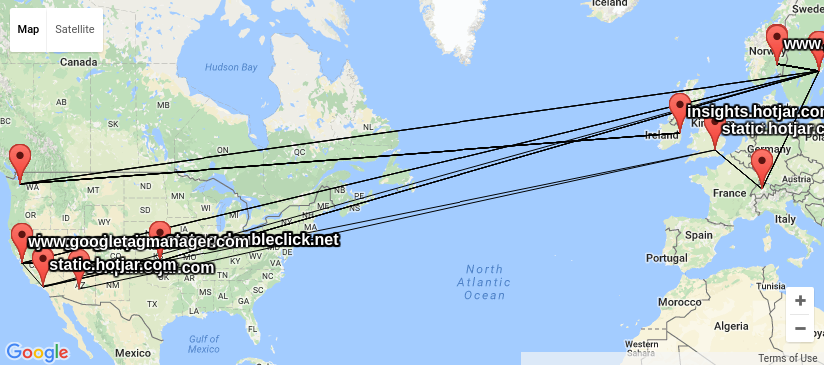
When I had a look around for options, I could not find any good
free software tools to do this, and decided I needed my own traceroute
wrapper outputting KML based on locations looked up using GeoIP. KML
is easy to work with and easy to generate, and understood by several
of the GIS tools I have available. I got good help from by NUUG
colleague Anders Einar with this, and the result can be seen in
my
kmltraceroute git repository. Unfortunately, the quality of the
free GeoIP databases I could find (and the for-pay databases my
friends had access to) is not up to the task. The IP addresses of
central Internet infrastructure would typically be placed near the
controlling companies main office, and not where the router is really
located, as you can see from the
KML file I created using the GeoLite City dataset from MaxMind.
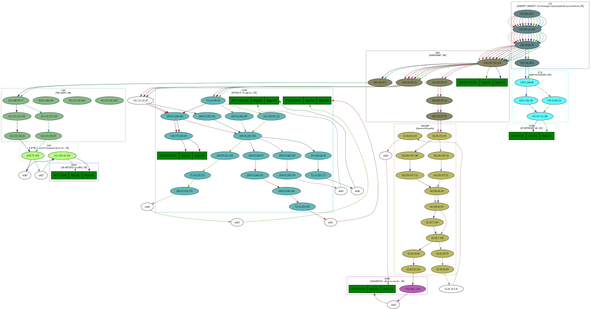
I also had a look at the visual traceroute graph created by
the scrapy project,
showing IP network ownership (aka AS owner) for the IP address in
question.
The
graph display a lot of useful information about the traceroute in SVG
format, and give a good indication on who control the network
equipment involved, but it do not include geolocation. This graph
make it possible to see the information is made available at least for
UNINETT, Catchcom, Stortinget, Nordunet, Google, Amazon, Telia, Level
3 Communications and NetDNA.
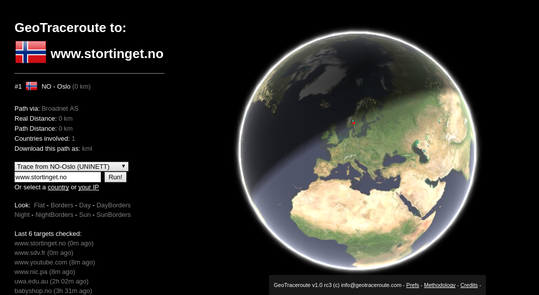
In the process, I came across the
web service GeoTraceroute by
Salim Gasmi. Its methology of combining guesses based on DNS names,
various location databases and finally use latecy times to rule out
candidate locations seemed to do a very good job of guessing correct
geolocation. But it could only do one trace at the time, did not have
a sensor in Norway and did not make the geolocations easily available
for postprocessing. So I contacted the developer and asked if he
would be willing to share the code (he refused until he had time to
clean it up), but he was interested in providing the geolocations in a
machine readable format, and willing to set up a sensor in Norway. So
since yesterday, it is possible to run traces from Norway in this
service thanks to a sensor node set up by
the NUUG assosiation, and get the
trace in KML format for further processing.
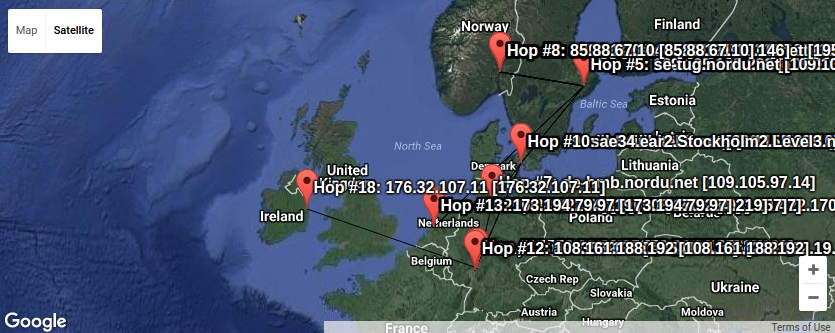
Here we can see a lot of trafic passes Sweden on its way to
Denmark, Germany, Holland and Ireland. Plenty of places where the
Snowden confirmations verified the traffic is read by various actors
without your best interest as their top priority.
Combining KML files is trivial using a text editor, so I could loop
over all the hosts behind the urls imported by www.stortinget.no and
ask for the KML file from GeoTraceroute, and create a combined KML
file with all the traces (unfortunately only one of the IP addresses
behind the DNS name is traced this time. To get them all, one would
have to request traces using IP number instead of DNS names from
GeoTraceroute). That might be the next step in this project.
Armed with these tools, I find it a lot easier to figure out where
the IP traffic moves and who control the boxes involved in moving it.
And every time the link crosses for example the Swedish border, we can
be sure Swedish Signal Intelligence (FRA) is listening, as GCHQ do in
Britain and NSA in USA and cables around the globe. (Hm, what should
we tell them? :) Keep that in mind if you ever send anything
unencrypted over the Internet.
PS: KML files are drawn using
the KML viewer from Ivan
Rublev, as it was less cluttered than the local Linux application
Marble. There are heaps of other options too.
As usual, if you use Bitcoin and want to show your support of my
activities, please send Bitcoin donations to my address
15oWEoG9dUPovwmUL9KWAnYRtNJEkP1u1b.

Debian LTS
November marked the 20th month I contributed to Debian LTS
under the Freexian umbrella. I had 8 hours allocated which I used
by:
Next.