Search Results: "uli"

1 June 2013

Daniel Pocock: Democracy down-under is not democracy

This weekend we have the AGM of a local community organisation. Like many organisations I am involved in, there will be a democratic process of decision making, board election and a low-budget social activity afterwards. We take it for granted that democracy is a good thing. In my own country, Australia, people are supposedly happier than they've ever been, no doubt people will suggest that our democracy is part of the recipe for success. While this example is from Australia, it could well happen anywhere. While everybody was slapping themselves on the back about our officially confirmed contentment, the politicians tried to slip something under the radar. With elections expected in September, the press exposed a secret deal between the two biggest political parties, raiding the public piggy bank for $60 million to prop up their campaign accounts. There is even a leaked copy of a letter confirming the deal. It was to be voted through parliament in a stitch-up within 48 hours after the happiness' announcement. Why would these two big political parties engage in a such a gross conspiracy? Weren't they already content with their whopping big pay increases that put our Prime Minister on a bigger salary than the US president or the UK Prime Minister? Well, you don't have to look hard to find out what this special funding was all about: Not long ago, the post office at the University of Melbourne where Wikileaks operates a post-office box was mysteriously shut down. While that may seem like it could just be a co-incidence on it's own, it's worth considering in the wider context: the Wikileaks party is one of the most widely recognised names in Australian politics right now. The party's leader, like the new pope, is seen as somebody who puts his principles ahead of his own comfort, living a humble life in exile while our politicians romp around with prostitutes paid for with stolen money. Whatever you think of Wikileaks or Mr Assange's private life, they are not the only example here. There are other democratic movements in our country that are equally frightening for those who are currently drunk on power. One of the independent MPs holding the balance of power is a former Lieutenant Colonel in Australia's spy agency who was ridiculed by a prior Government and forced out of his job when he exposed the sham of the Iraq war. Neither of the major political parties wants to continue being held accountable by someone who has shown such strong principles against their campaign of death and deception. That $60 million welfare payment to big political parties was intended to be something akin to a weapon of mass destruction, obliterating independent representatives out of the parliament. More recently, the same independent MP has been equally vigorous in his campagin to break the scourge of our mafia-style gambling industry with it's cosy links to Australian politicians. Now it is starting to become obvious just how scary democracy can be. Motivated by the spectacle of a few independents holding our incumbent politicians to account, other Australians have also volunteered to get in on the act and try their hand at running the country. One of Australia's richest men, Clive Palmer has found that even with his enormous wealth (and having started planning more than a year before the election), his plans to form a political party are dampened by the fact that it can't be registered with a proper name to be listed on the ballot paper and all the candidates have to be listed under his name, Palmer, or their own names, barely distinguishable from the independent candidates. This discriminatory approach to the creation of political parties clearly favours the two big incumbent groups. Now it is a lot clearer why existing politicians needed an extra $60 million war chest: like Lance Armstrong's illegal doping program, it was intended to keep themselves ahead of the pack. It all goes to show that people should not take democracy for granted: constant vigilence and involvement is needed to hold leaders to account or replace them when they deviate.
AttachmentSize
piggy-bank.jpg32.83 KB

31 May 2013

Julien Danjou: OpenStack Ceilometer Havana-1 milestone released

Yesterday, the first milestone of the Havana developement branch of Ceilometer has been released and is now available for testing and download. This means the first quarter of the OpenStack Havana development has passed! New features Ten blueprints have been implemented as you can see on the release page. I'm going to talk through some of them here, that are the most interesting for users. Ceilometer can now counts the scheduling attempt of instances done by nova-scheduler. This can be useful to eventually bill such information or for audit (implemented by me for eNovance).
People using the HBase backend can now do requests filtering on any of the counter fields, something we call metadata queries, and which was missing for this backend driver. Thanks to Shengjie Min (Dell) for the implementation. Counters can now be sent over UDP instead of the Oslo RPC mechanism (AMQP based by default). This allows counter transmission to be done in a much faster way, though less reliable. The primary use case being not audit or billing, but the alarming features that we are working on (implemented by me for eNovance).
The initial alarm API has been designed and implemented, thanks to Mehdi Abaakouk (eNovance) and Angus Salkled (RedHat) who tackled this. We're now able to do CRUD actions on these. Posting of meters via the HTTP API is now possible. This is now another conduct that can be used to publish and collector meter. Thanks to Angus Salkled (RedHat) for implementing this. I've been working on an somewhat experimental notifier driver for Oslo notification that publishes Ceilometer counters instead of the standard notification, using the Ceilometer pipeline setup. Sandy Walsh (Rackspace) has put in place the base needed to store raw notifications (events), with the final goal of bringing more functionnalities around these into Ceilometer. Obviously, all of this blueprint and bugfixes wouldn't be implemented or fixed without the harden eyes of our entire team, reviewing code and advising restlessly the developers. Thanks to them! Bug fixes Thirty-one bugs were fixed, though most of them might not interest you so I won't elaborate too much on that. Go read the list if you are curious. Toward Havana 2 We now have 21 blueprints targetting the Ceilometer's second Havana milestone, with some of them are already started. I'll try to make sure we'll get there without too much trouble for the 18th July 2013. Stay tuned!

26 May 2013

Andrew Pollock: [life] Maker Fair 2013 virtual trip report

The Maker Faire is one of the Bay Area things that I'll really miss. Zoe had a ball last year (for weeks afterwards every outing was "Maker Faire!" regardless of what or where it was) Last year I didn't really get to cover it very well, so I ended up doing a bit of a virtual tour via the exhibitor list on their website, and so this year I thought I'd be there in spirit by doing the same thing again. Here's my picks:

10 May 2013

Julien Danjou: Rant about Github pull-request workflow implementation

One of my recent innocent tweet about Gerrit vs Github triggered much more reponses and debate that I expected it to. I realize that it might be worth explaining a bit what I meant, in a text longer than 140 characters. <script async="async" charset="utf-8" src="http://platform.twitter.com/widgets.js"></script> The problems with Github pull-requests I always looked at Github from a distant eye, mainly because I always disliked their pull-request handling, and saw no value in the social hype it brings. Why? One click away isn't one click effort The pull-request system looks like an incredible easy way to contribute to any project hosted on Github. You're a click away to send your contribution to any software. But the problem is that any worthy contribution isn't an effort of a single click. Doing any proper and useful contribution to a software is never done right the first time. There's a dance you will have to play. A slowly rhythmed back and forth between you and the software maintainer or team. You'll have to dance it until your contribution is correct and can be merged. But as a software maintainer, not everybody is going to follow you on this choregraphy, and you'll end up with pull-request you'll never get finished unless you wrap things up yourself. So the gain in pull-requests here, isn't really bigger than a good bug report in most cases. This is where the social argument of Github isn't anymore. As soon as you're talking about projects bigger than a color theme for your favorite text editor, this feature is overrated. Contribution rework If you're lucky enough, your contributor will play along and follow you on this pull-request review process. You'll make suggestions, he will listen and will modify his pull-request to follow your advice. At this point, there's two technics he can use to please you. Technic #1: the Topping Github's pull-requests invite you to send an entire branch, eclipsing the fact that it is composed of several commits. The problem is that a lot of one-click-away contributors do not masterize Git and/or do not make efforts to build a logical patchset, and nothing warns them that their branch history is wrong. So they tend to change stuff around, commit, make a mistake, commit, fix this mistake, commit, etc. This kind of branch is composed of the whole brain's construction process of your contributor, and is a real pain to review. To the point I quite often give up. <figure> <figcaption> A typical case: 3 commits to build a 4 lines long file. </figcaption> </figure> Without Github, the old method that all software used, and that many software still use (e.g. Linux), is to send a patch set over e-mail (or any other medium like Gerrit). This method has one positive effect, that it forces the contributor to acknowledge the list of commits he is going to publish. So, if the contributor he has fixup commits in his history, they are going to be seen as first class citizen. And nobody is going to want to see that, neither your contributor, nor the software maintainers. Therefore, such a system tend to push contributors to write atomic, logical and self-contained patchset that can be more easily reviewed. Technic #2: the History Rewriter This is actually the good way to build a working and logical patchset using Git. Rewriting history and amending problematic patches using the famous git rebase --interactive trick. The problem is that if your contributor does this and then repush the branch composing your pull-request to Github, you will both lose the previous review done, each time. There's no history on the different versions of the branch that has been pushed. In the old alternative system like e-mail, no information is lost when reworked patches are resent, obviously. This is far better because it eases the following of the iterative discussions that the patch triggered. Of course, it would be possible for Github to enhance this and fix it, but currently it doesn't handle this use case correctly.. <figure> <figcaption> Exercise for the doubtful readers: good luck finding all revisions of my patch in the pull-request #157 of Hy.</figcaption> </figure> A quick look at OpenStack workflow It's not a secret for anyone that I've been contributing to OpenStack as a daily routine for the last 18 months. The more I contribute, the more I like the contribution workflow and process. It's already well and longly described on the wiki, so I'll summarize here my view and what I like about it. Gerrit To send a contribution to any OpenStack project, you need to pass via Gerrit. This is way simpler than doing a pull-request on Github actually, all you have to do is do your commit(s), and type git review. That's it. Your patch will be pushed to Gerrit and available for review. Gerrit allows other developers to review your patch, add comments anywhere on it, and score your patch up or down. You can build any rule you want for the score needed for a patch to be merged; OpenStack requires one positive scoring from two core developers before the patch is merged. Until a patch is validated, it can be reworked and amended locally using Git, and then resent using git review again. That simple. The historic and the different version of the patches are available, with the whole comments. Gerrit doesn't lose any historic information on your workflow. Finally, you'll notice that this is actually the same kind of workflow projects use when they work by patch sent over e-mail. Gerrit just build a single place to regroup and keep track of patchsets, which is really handy. It's also much easier for people to actually send patch using a command line tool than their MUA or git send-email. Gate testing Testing is mandatory for any patch sent to OpenStack. Unit tests and functionnals test are run for each version of each patch of the patchset sent. And until your patch passes all tests, it will be impossible to merge it. Yes, this implies that all patches in a patchset must be working commits and can be merged on their own, without the entire patchset going in! With such a restricution, it's impossible to have "fixup commits" merged in your project and pollute the history and the testability of the project. Once your patch is validated by core developers, the system checks that there is not any merge conflicts. If there's not, tests are re-run, since the branch you are pushing to might have changed, and if everything's fine, the patch is merged. This is an uncredible force for the quality of the project. This implies that no broken patchset can ever sneak in, and that the project pass always all tests. Conclusion: accessibility vs code review In the end, I think that one of the key of any development process, which is code review, is not well covered by Github pull-request system. It is, along with history integrity, damaged by the goal of making contributions easier. Choosing between these features is probably a trade-off that each project should do carefully, considering what are its core goals and the quality of code it want to reach. I tend to find that OpenStack found one of the best trade-off available using Gerrit and plugging testing automation via Jenkins on it, and I would probably recommend it for any project taking seriously code reviews and testing.

9 May 2013

Niels Thykier: Wheezy was brought to you by

During the Wheezy freeze, the Debian release team deployed 3254 hints[1]. This number may include some duplicates (i.e. where two members of the team hinted the same package), it certainly does not include a lot of rejected requests <insert more disclaimers here>. The top hinter was *drum roll* Adam, who did 1799 hints(That is 55% of all hints during the freeze). For comparison, the second and third runner ups added together did 1023 hints (or 31.4%). Put in a different way, on average Julien Cristau and I would both add about 1.5 hints each day and Adam would on his own add 5.6 hints a day. Of course, this is not intended to diminish the work other the rest of the team. Reviewing and unblocking packages is not all there is to a release. Particularly, a great thanks to Cyril Brulebois for his hard work on the Debian Installer (without which Debian Wheezy could not be released at all). Enjoy! [1] Determined by:
  egrep -c 'done 201(3 2-?(07 08 09 10 11 12)) $HINT_FILE
It does not count hints, but the little header we add above our hints. One header can apply to multiple hints (which is good, because udeb unblocks are usually paired with a regular unblock and we don t want to count them as two separate hints).

8 May 2013

Lior Kaplan: Debian in space

One more step at being the universal operating system: getting Debian to space:
Specifically, the International Space Station astronauts will be using computers running Debian 6.

Filed under: Debian GNU/Linux

7 May 2013

Matthew Garrett: A short introduction to TPMs

I've been working on TPMs lately. It turns out that they're moderately awful, but what's significantly more awful is basically all the existing documentation. So here's some of what I've learned, presented in the hope that it saves someone else some amount of misery.
What is a TPM?TPMs are devices that adhere to the Trusted Computing Group's Trusted Platform Module specification. They're typically microcontrollers[1] with a small amount of flash, and attached via either i2c (on embedded devices) or LPC[2] (on PCs). While designed for performing cryptographic tasks, TPMs are not cryptographic accelerators - in almost all situations, carrying out any TPM operations on the CPU instead would be massively faster[3]. So why use a TPM at all?
Keeping secrets with a TPMTPMs can encrypt and decrypt things. They're not terribly fast at doing so, but they have one significant benefit over doing it on the CPU - they can do it with keys that are tied to the TPM. All TPMs have something called a Storage Root Key (or SRK) that's generated when the TPM is initially configured. You can ask the TPM to generate a new keypair, and it'll do so, encrypt them with the SRK (or another key descended from the SRK) and hand it back to you. Other than the SRK (and another key called the Endorsement Key, which we'll get back to later), these keys aren't actually kept on the TPM - the running OS stores them on disk. If the OS wants to encrypt or decrypt something, it loads the key into the TPM and asks it to perform the desired operation. The TPM decrypts the key and then goes to work on the data. For small quantities of data, the secret can even be stored in the TPM's nvram rather than on disk.

All of this means that the keys are tied to a system, which is great for security. An attacker can't obtain the decrypted keys, even if they have a keylogger and full access to your filesystem. If I encrypt my laptop's drive and then encrypt the decryption key with the TPM, stealing my drive won't help even if you have my passphrase - any other TPM simply doesn't have the keys necessary to give you access.

That's fine for keys which are system specific, but what about keys that I might want to use on multiple systems, or keys that I want to carry on using when I need to replace my hardware? Keys can optionally be flagged as migratable, which makes it possible to export them from the TPM and import them to another TPM. This seems like it defeats most of the benefits, but there's a couple of features that improve security here. The first is that you need the TPM ownership password, which is something that's set during initial TPM setup and then not usually used afterwards. An attacker would need to obtain this somehow. The other is that you can set limits on migration when you initially import the key. In this scenario the TPM will only be willing to export the key by encrypting it with a pre-configured public key. If the private half is kept offline, an attacker is still unable to obtain a decrypted copy of the key.
So I just replace the OS with one that steals the secret, right?Say my root filesystem is encrypted with a secret that's stored on the TPM. An attacker can replace my kernel with one that grabs that secret once the TPM's released it. How can I avoid that?

TPMs have a series of Platform Configuration Registers (PCRs) that are used to record system state. These all start off programmed to zero, but applications can extend them at runtime by writing a sha1 hash into them. The new hash is concatenated to the existing PCR value and another sha1 calculated, and then this value is stored in the PCR. The firmware hashes itself and various option ROMs and adds those values to some PCRs, and then grabs the bootloader and hashes that. The bootloader then hashes its configuration and the files it reads before executing them.

This chain of trust means that you can verify that no prior system component has been modified. If an attacker modifies the bootloader then the firmware will calculate a different hash value, and there's no way for the attacker to force that back to the original value. Changing the kernel or the initrd will result in the same problem. Other than replacing the very low level firmware code that controls the root of trust, there's no way an attacker can replace any fundamental system components without changing the hash values.

TPMs support using these hash values to decide whether or not to perform a decryption operation. If an attacker replaces the initrd, the PCRs won't match and the TPM will simply refuse to hand over the secret. You can actually see this in use on Windows devices using Bitlocker - if you do anything that would change the PCR state (like booting into recovery mode), the TPM won't hand over the key and Bitlocker has to prompt for a recovery key. Choosing which PCRs to care about is something of a balancing act. Firmware configuration is typically hashed into PCR 1, so changing any firmware configuration options will change it. If PCR 1 is listed as one of the values that must match in order to release the secret, changing any firmware options will prevent the secret from being released. That's probably overkill. On the other hand, PCR 0 will normally contain the firmware hash itself. Including this means that the user will need to recover after updating their firmware, but failing to include it means that an attacker can subvert the system by replacing the firmware.
What about using TPMs for DRM?In theory you could populate TPMs with DRM keys for media playback, and seal them such that the hardware wouldn't hand them over. In practice this is probably too easily subverted or too user-hostile - changing default boot order in your firmware would result in validation failing, and permitting that would allow fairly straightforward subverted boot processes. You really need a finer grained policy management approach, and that's something that the TPM itself can't support.

This is where Remote Attestation comes in. Rather than keep any secrets on the local TPM, the TPM can assert to a remote site that the system is in a specific state. The remote site can then make a policy determination based on multiple factors and decide whether or not to hand over session decryption keys. The idea here is fairly straightforward. The remote site sends a nonce and a list of PCRs. The TPM generates a blob with the requested PCR values, sticks the nonce on, encrypts it and sends it back to the remote site. The remote site verifies that the reply was encrypted with an actual TPM key, makes sure that the nonce matches and then makes a policy determination based on the PCR state.

But hold on. How does the remote site know that the reply was encrypted with an actual TPM? When TPMs are built, they have something called an Endorsement Key (EK) flashed into them. The idea is that the only way to have a valid EK is to have a TPM, and that the TPM will never release this key to anything else. There's a couple of problems here. The first is that proving you have a valid EK to a remote site involves having a chain of trust between the EK and some globally trusted third party. Most TPMs don't have this - the only ones I know of that do are recent Infineon and STMicro parts. The second is that TPMs only have a single EK, and so any site performing remote attestation can cross-correlate you with any other site. That's a pretty significant privacy concern.

There's a theoretical solution to the privacy issue. TPMs never actually sign PCR quotes with the EK. Instead, TPMs can generate something called an Attestation Identity Key (AIK) and sign it with the EK. The OS can then provide this to a site called a PrivacyCA, which verifies that the AIK is signed by a real EK (and hence a real TPM). When a third party site requests remote attestation, the TPM signs the PCRs with the AIK and the third party site asks the PrivacyCA whether the AIK is real. You can have as many AIKs as you want, so you can provide each service with a different AIK.

As long as the PrivacyCA only keeps track of whether an AIK is valid and not which EK it was signed with, this avoids the privacy concerns - nobody would be able to tell that multiple AIKs came from the same TPM. On the other hand, it makes any PrivacyCA a pretty attractive target. Compromising one would not only allow you to fake up any remote attestation requests, it would let you violate user privacy expectations by seeing that (say) the TPM being used to attest to HolyScriptureVideos.com was also being used to attest to DegradingPornographyInvolvingAnimals.com.

Perhaps unsurprisingly (given the associated liability concerns), there's no public and trusted PrivacyCAs yet, and even if they were (a) many computers are still being sold without TPMs and (b) even those with TPMs often don't have the EK certificate that would be required to make remote attestation possible. So while remote attestation could theoretically be used to impose DRM in a way that would require you to be running a specific OS, practical concerns make it pretty difficult for anyone to deploy that at any point in the near future.
Is this just limited to early OS components?Nope. The Linux kernel has support for measuring each binary run or each module loaded and extending PCRs accordingly. This makes it possible to ensure that the running binaries haven't been modified on disk. There's not a lot of distribution infrastructure for setting this up, but in theory a distribution could deploy an entirely signed userspace and allow the user to opt into only executing correctly signed binaries. Things get more interesting when you add interpreted scripts to the mix, so there's still plenty of work to do there.
So what can I actually use a TPM for?Drive encryption is probably the best example (Bitlocker does it on Windows, and there's a LUKS-based implementation for Linux here) - while in theory you could do things like use your TPM as a factor in two-factor authentication or tie your GPG key to it, there's not a lot of existing infrastructure for handling all of that. For the majority of people, the most useful feature of the TPM is probably the random number generator. rngd has support for pulling numbers out of it and stashing them in /dev/random, and it's probably worth doing that unless you have an Ivy Bridge or other CPU with an RNG.

Things get more interesting in more niche cases. Corporations can bind VPN keys to corporate machines, making it possible to impose varying security policies. Intel use the TPM as part of their anti-theft technology on education-oriented devices like the Classmate. And in the cloud, projects like Trusted Computing Pools use remote attestation to verify that compute nodes are in a known good state before scheduling jobs on them.
Is there a threat to freedom?At the moment, probably not. The lack of any workable general purpose remote attestation makes it difficult for anyone to impose TPM-based restrictions on users, and any local code is obviously under the user's control - got a program that wants to read the PCR state before letting you do something? LD_PRELOAD something that gives it the desired response, or hack it so it ignores failure. It's just far too easy to circumvent.
Summary?TPMs are useful for some very domain-specific applications, drive encryption and random number generation. The current state of technology doesn't make them useful for practical limitations of end-user freedom.

[1] Ranging from 8-bit things that are better suited to driving washing machines, up to full ARM cores
[2] "Low Pin Count", basically ISA without the slots.
[3] Loading a key and decrypting a 5 byte payload takes 1.5 seconds on my laptop's TPM.

comment count unavailable comments

25 April 2013

Julien Danjou: OpenStack Design Summit Havana, from a Ceilometer point of view

Last week was the OpenStack Design Summit in Portland, OR where we, developers, discussed and designed the new OpenStack release (Havana) coming up. The summit has been wonderful. It was my first OpenStack design summit -- even more as a PTL -- and bumping into various people I've never met so far and worked with online only was a real pleasure! <figure> <figcaption>Me and Nick ready to talk about Ceilometer new features.</figcaption> </figure> Nick Barcet from eNovance, our dear previous Ceilometer PTL, and myself, talked about Ceilometer and presented the work that bas been done for Grizzly, with some previews of what we'll like to see done for its Havana release. You can take a look at the slides if you're curious. Design sessions Ceilometer had his design sessions during the last days of the summit. We noted a lot of things and commented during the sessions in our Etherpads instances. The first session was a description of Ceilometer core architecture for interested people, and was a wonderful success considering that the room was packed. Our Doug Hellmann did a wonderful job introducing people to Ceilometer and answering question. <figure> <figcaption>Doug explaining Ceilometer architecture.</figcaption> </figure> The next session was about getting feedbacks from our users. We had a lot of surprise to discover wonderful real use-cases and deployments, like the CERN using Ceilometer and generating 2 GB of data per day! The following sessions ran on Thursday and were much more about new features discussion. A lot ot already existing blueprints were discussed and quickly validated during the first morning session. Then, Sandy Walsh introduced the architecture they use inside StackTach, so we can start thinking about getting things from it into Ceilometer. API improvements were discussed without surprises and with a good consensus on what needs to be done. The four following sessions that occupied a lot of the days were related to alarming. All were lead by Eoghan Glynn, from RedHat, who did an amazing job presenting the possible architectures with theirs pros and cons. Actually, all we had to do was to nod to his designs and acknowledge the plan on how to build this. That last two sessions were about discussing advanced models for billing where we got some interesting feedback from Daniel Dyer from HP, and then were a quick follow-up of the StackTach presentation from the morning session. Havana roadmap The list of blueprints targetting Havana is available and should be finished by next week. If you want to propose blueprints, you're free to do so and inform us about it so we can validate it. The same applies if you wish to implement one of them! API extension I do think the API version 2 is going to be heavily extended during this release cycle. We need more feature, like the group-by functionnality. Healthnmon In parallel of the design sessions, discussions took place in the unconference room with the Healthnmon developers to figure out a plan in order to merge some of their efforts into Ceilometer. They should provide a component to help Ceilometer supports more hypervisors than it currently does. Alarming Alarming is definitely going to be the next big project for Ceilometer. Today, Eoghan and I started building blueprints on alarming, centralized in a general blueprint. We know this is going to happen for real and very soon, thanks to the engagements of eNovance and RedHat who are commiting resources to this amazing project!
20 April 2013

Ulrich Dangel: Analyzing rc bug messages

Michael Stapelberg recently posted a blog post about looking into the number of Debian Developers actively working on RC bugs for the upcoming wheezy release. In this blog post I analyze the data shared by Michael and provide the R commands used to generate the plots & findings. If you are interested into looking into the data yourself, but don t like R, I suggest using ipython notebook + numpy instead.

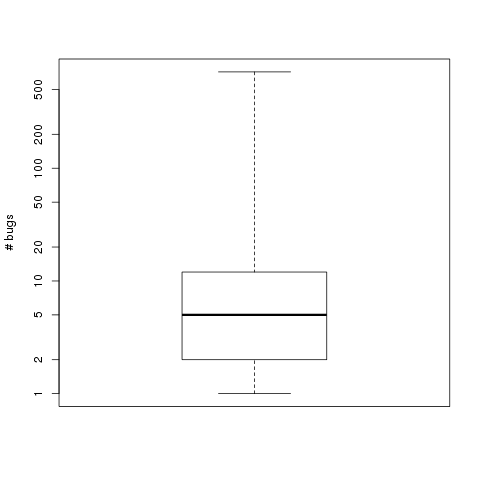
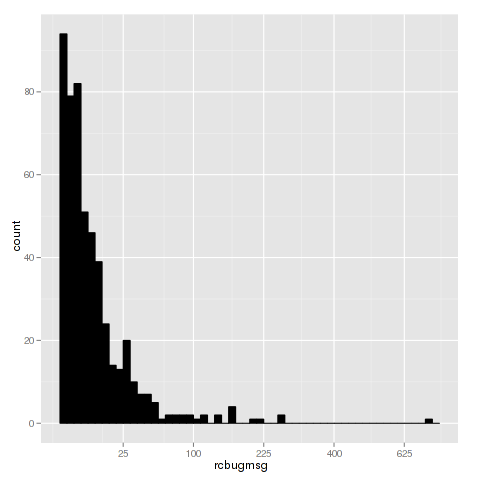
Analysis After parsing the data file we typically want to get an understanding of the data, by using summary(bugs) we get the minimum(1), median(5), mean(15.4), max(716) and quantiles of the data. This shows that the number of messages is wide-spread and a few people contribute a lot. To visualize the dispersion of the data we can create a box plot showing the range of messages: boxplot As the first and third quantile are close together we can assume that the majority of the work is done by a few, especially since the second quantile is 5. This is supported by the histogram below, where the x axis is the number of recorded messages and y is the number of developers. histogram
Top 10 contributors The TOP 10 contributors, according to the dataset, are:
  1. Lucas Nussbaum - 716 messages
  2. Gregor Herrmann - 270 messages
  3. Jakub Wilk - 270 messages
  4. Andreas Beckmann - 225 messages
  5. Julien Cristau - 205 messages
  6. Cyril Brulebois - 169 messages
  7. Moritz Muehlenhoff - 162 messages
  8. Michael Biebl - 159 messages
  9. Salvatore Bonaccorso - 158 messages
  10. Christoph Egger - 142 messages

r commands These are the commands used to generate the plots and information in this plot:
bugs <- read.csv("by-msg.csv")
summary(bugs)
boxplot(bugs$rcbugmsg, log='y', range=0, ylab="# bugs")
quantile(bugs$rcbugmsg)
0%  25%  50%  75% 100%
1    2    5   12  716
# create histogram
llibrary('ggplot2')
ggplot(bugs, aes(x=rcbugmsg)) + geom_histogram(binwidth=.5, colour="black", fill="black") + scale_x_sqrt()
top10 <- tail(bugs[order(bugs$rcbugmsg),], 10)
top10

Ulrich Dangel: Analyzing rc bug messages

Michael Stapelberg recently posted a blog post about looking into the number of Debian Developers actively working on RC bugs for the upcoming wheezy release. In this blog post I analyze the data shared by Michael and provide the R commands used to generate the plots & findings. If you are interested into looking into the data yourself, but don t like R, I suggest using ipython notebook + numpy instead.

Analysis After parsing the data file we typically want to get an understanding of the data, by using summary(bugs) we get the minimum(1), median(5), mean(15.4), max(716) and quantiles of the data. This shows that the number of messages is wide-spread and a few people contribute a lot. To visualize the dispersion of the data we can create a box plot showing the range of messages: boxplot As the first and third quantile are close together we can assume that the majority of the work is done by a few, especially since the second quantile is 5. This is supported by the histogram below, where the x axis is the number of recorded messages and y is the number of developers. histogram

Top 10 contributors The TOP 10 contributors, according to the dataset, are:
  1. Lucas Nussbaum - 716 messages
  2. Gregor Herrmann - 270 messages
  3. Jakub Wilk - 270 messages
  4. Andreas Beckmann - 225 messages
  5. Julien Cristau - 205 messages
  6. Cyril Brulebois - 169 messages
  7. Moritz Muehlenhoff - 162 messages
  8. Michael Biebl - 159 messages
  9. Salvatore Bonaccorso - 158 messages
  10. Christoph Egger - 142 messages

r commands These are the commands used to generate the plots and information in this plot:
bugs <- read.csv("by-msg.csv")
summary(bugs)
boxplot(bugs$rcbugmsg, log='y', range=0, ylab="# bugs")
quantile(bugs$rcbugmsg)
0%  25%  50%  75% 100%
1    2    5   12  716
# create histogram
llibrary('ggplot2')
ggplot(bugs, aes(x=rcbugmsg)) + geom_histogram(binwidth=.5, colour="black", fill="black") + scale_x_sqrt()
top10 <- tail(bugs[order(bugs$rcbugmsg),], 10)
top10

10 April 2013

Julian Andres Klode: apt-show-versions rewrite in C++ (more than 10 times faster)

The script apt-show-versions is developed by another Debian Developer called Christoph Martin in Perl. Recently, it turned out that apt-show-versions is too slow for some users; so I decided to rewrite his program using APT s C++ API. I expect this to be part of a future APT release, rendering the original apt-show-versions obsolete. The rewrite is sadly not 100% backwards compatible to the original version; as some option names had to be renamed due to our command-line parser not supporting option names like -nh, and some other options were dropped because they are hard to support (like status-file and lists-dir) with our command-line parsing. I also decided not to keep the the -p and -r options, but use the standard APT command-line conventions insteads. For now, it also cannot show you the distribution names you have specified in your sources.list file, but will always display codenames instead; if available. I hope to fix this in Jessie by extending APT s cache format a bit. On the performance side, this program now takes about 0.09s compared to the 1.40 seconds needed by apt-show-versions. The times are taken with all data in caches. The current version can be found in a git repository, a link to gitweb is: http://anonscm.debian.org/gitweb/?p=users/jak/apt-show-versions.git
Please also note that support for allversions is not 100% implemented yet, but it should work for most uses. Now, go testing and report back!
Filed under: Debian

7 April 2013

Bits from Debian: DebConf14 to be held in Portland, Oregon, USA

We are pleased to announce the 15th annual Debian Conference (DebConf14) is to be held in Portland, Oregon, USA in August 2014, with specific dates yet to be announced. Portland is an open source hotspot in the Pacific Northwest of the US. It is a technologically savvy community, home to Intel and the adopted home of Linus Torvalds. The city plays host to many Free Software conferences including OSCON, and is where Linux Plumbers originated. The local team has been involved in mulitple DebConfs in the past, and is excited to bring their experience and ideas to fruition in a city well-positioned to host such a prestigious event.

3 April 2013

Julien Danjou: Hy, Lisp in Python

I've meant to look at Hy since Paul Tagliamonte started to talk to me about it, but never took a chance until now. Yesterday, Paul indicated it was a good time for me to start looking at it, so I spent a few hours playing. But what's Hy? Python is very nice: it has a great community and a wide range of useful libraries. But let's face it, it misses a great language. Hy is an implementation of a Lisp on top of Python. Technically, Hy is built directly with a custom made parser (for now) which then translates expressions using the Python AST module to generate code, which is then run by Python. Therefore, it shares the same properties as Python, and is a Lisp-1 (i.e. with a single namespace for symbols and functions). If you're interested to listen Paul talking about Hy during last PyCon US, I recommend watching his lightning talk. As the name implies, it's only a few minutes long. <iframe allowfullscreen="allowfullscreen" class="shadow" frameborder="0" height="374" src="http://www.youtube.com/embed/1vui-LupKJI?wmode=transparent&amp;autohide=1&amp;egm=0&amp;hd=1&amp;iv_load_policy=3&amp;modestbranding=1&amp;rel=0&amp;showinfo=0&amp;showsearch=0#t=16m14s" width="500"></iframe> Does it work? I've been cloning the code and played around a bit with Hy. And to my greatest surprise and pleasure, it works quite well. You can imagine writing Python from there easily. Part of the syntax smells like Clojure's, which looks like a good thing since they're playing in the same area. You can try a Hy REPL in your Web browser if you want. Here's what some code look like:
(import requests)

(setv req (requests.get "http://hy.pault.ag"))
(if (= req.status_code 200)
(for (kv (.iteritems req.headers))
(print kv))
(throw (Exception "Wrong status code")))

This code would ouput:
('date', 'Wed, 03 Apr 2013 12:09:23 GMT')
('connection', 'keep-alive')
('content-encoding', 'gzip')
('transfer-encoding', 'chunked')
('content-type', 'text/html; charset=utf-8')
('server', 'nginx/1.2.6')
As you can see, it's really simple to write Lispy code that really uses Python idioms. There's obviously still a lots of missing features in Hy. The language if far from complete and many parts are moving, but it's really promising, and Paul's doing a great job implementing every idea. I actually started to hack a bit on Hy, and will try to continue to do so, since I'm really eager to learn a bit more about both Lisp and Python internals in the process. I've already send a few patches on small bugs I've encountered, and proposed a few ideas. It's really exciting to be able to influence early a language design that I'll love to use! Being a recent fan of Common Lisp, I tend to grab the good stuff from it to add them into Hy.
Daniel Pocock: The multiple repository conundrum in Linux packaging

I'm involved with a number of free software projects as both a developer and as the maintainer of packages for various distributions such as Debian (which also feeds packages to Ubuntu) and OpenCSW. I regularly come across the following situations:
  • Developers of great software who would like to see it packaged, distributed and promoted conveniently through platforms like Debian
  • Users of Linux distributions who are keen to use free software if it is presented in a convenient and accessible manner they are familiar with.
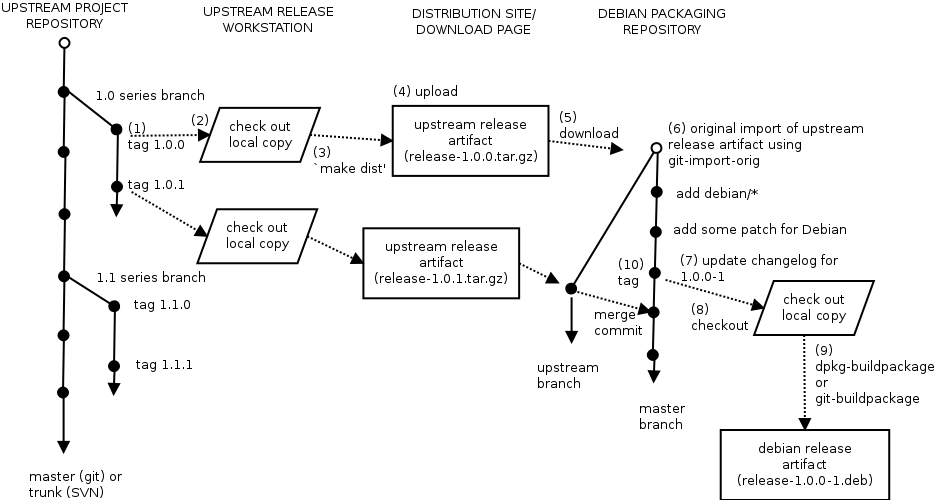
Sadly, despite everybody having the best intentions, there is sometimes a chasm separating these two groups of people. Upstream developers are often busy developing new features and don't have time to work on the intricacies of packaging. I hope that by sharing a few of my own experiences I can help more developers get their software packaged more easily. Fortunately, a number of great tools like git-buildpackage have emerged for streamlining the packaging process, but this has also created more confusion for developers who have their own git repositories and don't quite understand how the Debian git repository and patching process relates to their own repository. The autotools world Here, I focus on autotools based software, because this type of software has it's own peculiar issues when packaging. In particular, these issues appear when using a version control system to track upstream releases. Some of the concepts can be applied to the study of regular Makefile or cmake projects as well. Here is a diagram giving an overview: Let's work through each of the steps in the diagram: The upstream release
  1. The developer/release manager updates the version number in
    configure.ac
    (sometimes called configure.in) and tags the code. (Usually this tag is on a dedicated release branch.)
  2. The developer checks out a copy of the code from the tag into a fresh working directory
  3. The developer runs the autoreconf/automake tools, usually from a bootstrap script. These tools create a number of new files that don't exist in the project repository. Finally, the developer runs
    make dist
    , which puts all the files,
    including the generated files, into a distribution tarball. It is worth emphasizing this point: the tarball is not just an archive of the files from the repository/tag, it also contains a number of
    files generated by autotools.
  4. The developer uploads the tarball to a web site such as the Sourceforge download page. Usually a release announcement is made now containing checksums for the tarball.
At this point, the upstream developer's work is done and packaging teams from various projects such as Debian will take over. Sometimes, the upstream developer is also building the packages and continues
onto the next steps himself: Packaging
  1. The package is downloaded by the package maintainer
  2. If it is the first download, the maintainer creates a new git repository. If it has been packaged before, he clones the repository. The important point here is that this is not the upstream repository, it is an independent repository for Debian packaging. The maintainer uses the git-import-orig tool to import the upstream tarball into the packaging repository. The git-import-orig tool captures an exact snapshot of the upstream release tarball contents in a branch called upstream. One point where the Debian repository differs fundamentally from the upstream repository is that all files from the tarball will be tracked in the Debian git repository, even those automatically generated files that were created by autotools and don't exist in the upstream repository.
  3. The maintainer creates or updates the various artifacts for packaging. These files are kept on the master branch, and the tarball contents from the upstream branch are merged into master to create packages.
  4. When the maintainer feels the code is ready, he will check out a clean copy of the repository to build the package from.
  5. The maintainer executes a tool such as git-buildpackage or regular dpkg-buildpackage, which creates the *.deb files.
  6. The files are checked with a tool like lintian and some manual testing/installation. If all is OK, a tag is made in the packaging repository, with a suffix appended to the upstream version number to indicate which iteration of the package it applies to.
AttachmentSize
release-packaging-workflow.dia3.97 KB

29 March 2013

Raphael Geissert: Chocolate quote

Kinda appropriate for some recent events:
Il y a autant de g n rosit recevoir qu' donner
- Julien Green

Roughly translated to
There is only as much generosity to receive as there is to give.

25 March 2013

Julien Danjou: Announcing Climate, the OpenStack capacity leasing project

While working on the XLcloud project (HPC on cloud) it appeared clear to us that OpenStack was missing a critical component towards resource reservations.
A capacity leasing service is something really needed by service providers, especially in the context of cloud platforms dedicated to HPC style workload. Instead of building something really specific, the decision has been made to build a new standalone OpenStack components aiming to provide this kind of functionnality to OpenStack. In the spirit of others OpenStack components, it will be extensible to fullfil a large panel of needs around this problematic.
The project is named Climate, and is hosted on StackForge. It will follow the standard OpenStack development modal. This service will be able to handle a calendar of reservations for various resources, based on various criteria. The project is still at its early design stage, and we plan to have a unconference session during the next OpenStack summit in Portland to present our plans and ideas for the future!

20 March 2013

DebConf team: DebConf13 matching fund (Posted by Didier Raboud)

As part of the DebConf13 fundraising effort, a generous sponsor, Brandorr Group, has proposed to start a matching fund in USD for DebConf13; in place through the end of April 30th. The rules are quite simple: For details, please see our Monetary support from individuals page, which also has a short url, for convenience: http://deb.li/dc13donate. Help welcome As always, the DebConf team is looking for volunteers. Some jobs need technical skills, but many DebConf tasks are about working to deadlines on non-technical issues (e.g. fundraising, budgeting, talk scheduling). You can see more information about some of the jobs to be done on the DebConf wiki. Please do think about getting involved and sharing your ideas with us, to help us make DebConf an even more useful event for Debian in the future. We look forward to welcoming you to Vaumarcus!

16 March 2013

Russ Allbery: rra-c-util 4.8

This package is my collection of random utility functions, sort of like my version of Gnulib. (At some point, I do want to retire the bits that just duplicate Gnulib, which is less and less of it, and figure out how to properly use Gnulib for my packages as well.) The big changes in this package put the name somewhat to lie: I finally took the time to write some comprehensive infrastructure for integrating Perl tests. This is primarily in the form of three new modules and a bunch of tests that use them. The modules are Test::RRA, which provides some general facilities for handling maintainer-only tests and skipping tests when prerequisites are missing; Test::RRA::Config, which reads configuration from a separate file and allows me to use the same code verbatim in multiple packges; and Test::RRA::Automake, which provides a bunch of useful functions for intergrating tests written in Perl into packages that use Automake. Some of the test scripts were in the previous version, but they've now been overhauled to use the new modules, which makes them much simpler and more robust. But I also added a new perl/t directory, which holds all the test scripts that I use for Perl module testing, either standalone or embedded in a larger package. There are a variety of other changes, but they're minor or internal. It is worth noting, though, that all the code in rra-c-util now passes clang --analyze with clang 3.0. You can get the latest version from the rra-c-util distribution page.

13 March 2013

Rapha&#235;l Hertzog: Kali Linux 1.0, a new Debian derivative

Today, during Blackhat Europe, Offensive Security announced the availability of Kali Linux 1.0, which aims to be the most advanced, robust, and stable penetration testing distribution to date. It is the successor of Backtrack Linux. kali Kali s choice of Debian Kali s release is a significant event in the security auditing and penetration testing field, and I m proud to see that Debian was retained as the best distribution to create this new product. Here s what Mati Aharoni of Offensive Security told me:
Debian provides a reliable base to build a new distribution and yet can easily be customized to add bleeding edge features, thanks to the unstable and experimental distributions.
Kali s development policies Even though Kali was prepared in secret, from now on Kali s development happens in the open in public git repositories. There are repositories for all the packages that have been created (or forked) as well as for the ISO images creation script. Debian packages are maintained with git-buildpackage, pristine-tar and the associated helper tools, making it easy to integrate the latest changes of Debian. Kali packaged several hundreds tools that relate to their field and they intend to contribute those which are DFSG-free back to Debian. Kali s technical infrastructure In the last year, I have been working within the Kali team to setup large parts of their infrastructure as a proper Debian derivative. Kali s main ISO images are built with live-build. All the bugfixes that I contributed to Debian Live were the direct result of my work for Kali. The git repositories are managed with gitolite. The package repositories are built with reprepro. The build daemons use rebuildd and sbuild. The (push) mirrors are synchronized with the same tools than Debian (based on rsync), but there s also a central server which redirects to a mirror close to you (and which is used by default everywhere). This one runs mirrorbrain (and not Rapha l Geissert s redirector). The ARM build daemons (armel/armhf) run on machines powered by Calxeda s Highbank (4 cores, 4 GB RAM) that work pretty well. Even better, Offensive Security is willing to dedicate one node of this cluster for Debian s own usage. The future This first release is not an end. It s only the start of a journey. Not all applications have been packaged yet and there s lot of work left to integrate everything in Debian. I m really looking forward to continue my collaboration with the Kali team as this has been one of the most interesting project I ever had as a Debian consultant. And also one of the few where I could really contribute something back to Debian.

9 comments Liked this article? Click here. My blog is Flattr-enabled.

12 March 2013

Richard Hartmann: Gitify your life

These Open Source Days were kind of a mixed experience. The social part Things started off quite nicely; the speaker dinner was very pleasant and the people at my table interesting to talk with. The way back to the hotel and breakfast on Saturday were even more interesting; talking with Amelia Andersdotter, a member of the European Parliament for the Swedish Pirate Party, about anti-trust measures, privacy protection, lobbyists, and creating the right incentives for companies to actually protect user data was fun and engaging. My own claim to fame is that I told her that while Microsoft is willing to sign UEFI payloads for x86, they refuse to do so for ARM which she didn't know. From my understanding, their interpretation is that any anti-trust rulings apply to PCs only, and not general computing devices like tablets. It will be interesting to see how that plays out in the long run, especially once ARM processors start appearing in laptops and desktops as main CPUs where Microsoft clearly still has a near monopoly. It was fascinating to discuss all those issues with someone who's actively involved with legislation, mainly because her style of talking was markedly different from what I am used to. One point which she stressed repeatedly is that the most important skill within the context of political work in the EU is to be able to track down, read, and then reference all the content that's being produced in Brussels and Strasbourg. Maybe that tidbit is useful to people who want to try themselves at political activism. She nicely, and maybe unknowingly, emphasized that point by always referring to specific papers, directives, and studies after making any point. Statement of opinion, reference to supporting document. Statement of opinion, reference to supporting document. Statement of opinion, reference to supporting document. Rinse, repeat. It's no secret that I'm continuously disappointed by the political process in general and politicians in particular. Yet, I have to say that this encounter had a lasting and positive impression on me. Amelia has an incredible amount of energy and genuinely cares about the issues which too many other politicians ignore completely. It's good to know someone like this is on our side. If you're Swedish, please inform yourself about her and consider voting in her favour. Other than that, I met several other people, new and old. This year's OSD felt a lot more relaxed and there were more informal and spontaneous conversations going on in hallways and at tables. Even though I failed to have any intense discussion of Mercurial vs git this year, all those conversation were still really interesting. The "workshop" I already knew that the room assignment for my workshop on Saturday afternoon would be a last-minute thing. What I didn't expect was that the final confirmation by Copenhagen Business School would be given on Friday evening. Mixed with a very cumbersome process to update the slides of the CBS-owned and -operated information beamer in the lobby, this resulted in the official schedule showing my room as "Workshop" instead of "SP 214". The official schedule repeatedly stated that people had to pre-register for the workshop which was a left-over from last year where they actually had to plan the amount of hardware kits needed; the registration itself was was very well hidden behind a rather generic link you saw exactly once after purchasing your ticket. Add to this that my room was literally in the farthest corner of the building and on the top floor and things start to turn sour real quick. All other rooms were either close to the main entrance or on the ground floor. Helpers at the front desk had a lot of people asking where my room was and gave out directions, yet... ...the grand total of six people who arrived were all telling me how they couldn't find the room and almost gave up on finding it. As more people asked for directions than turned up at the workshop, this means that even with directions, the room was really hard to find. Myself, it took me two attempts to find the room after which I was led there by one of the helpers who wasn't completely sure we were going in the right direction, himself. Still, I managed to get everyone who had a laptop and access to a UNIX-based system set up with working mr and vcsh repositories they can work from as well as a demo git-annex repository to play with. Sadly, not everyone had a laptop, or access to UNIX, or the tools installed, or even an idea where to install them from, even though I had noted these "requirements" in the description. Next time I do this workshop, I will need to make sure to include information on what distributions have the relevant packages and how to find and install the software on Max OS X in the workshop description. Feedback from the very few people who actually managed to find me was very good and one of the attendants asked if I would be willing to hold the workshop again at another conference in Denmark. I am still awaiting details on this, but I would obviously enjoy having the chance to reach more people. At least I fared better than the guys who did the workshop on "Binary exploitation 101" in yet another room. Two guys held a workshop with a total attendance of... one... I know the organizers of OSD were really unhappy with how this turned out and I believe them when they say that something like this will never happen again. It's the second year that this team is running the conference, running conferences is an incredible amount of work, and things were smoother this year than last year. Iterate and improve, etc. The talk Saturday evening, Alex offered me the chance to hold a reparation talk on Sunday morning to compensate for the botched workshop. Said talk was scheduled for the first slot and not really announced (but the schedule on both www and the beamer was changed over night). Additionally, this was merely an updated and extended version of the talk which I already held at OSD 2012 so at least part of the visitors knew most of what I had to say, already. To be honest I didn't expect too much, but more than twenty people turned up which is a very decent turnout, all things considered. Same as with the workshop, feedback was extremely positive and I was told afterwards by Bryan that several people mentioned my talk as one of the highlights, or even the highlight, of OSD when he was talking to them. To make things even better this talk has, finally, been videotaped; I will update this blog with a link as soon as the video is online.

Next.

Previous.