Search Results: "tim"

20 June 2025

Matthew Garrett: My a11y journey

23 years ago I was in a bad place. I'd quit my first attempt at a PhD for various reasons that were, with hindsight, bad, and I was suddenly entirely aimless. I lucked into picking up a sysadmin role back at TCM where I'd spent a summer a year before, but that's not really what I wanted in my life. And then Hanna mentioned that her PhD supervisor was looking for someone familiar with Linux to work on making Dasher, one of the group's research projects, more usable on Linux. I jumped.

The timing was fortuitous. Sun were pumping money and developer effort into accessibility support, and the Inference Group had just received a grant from the Gatsy Foundation that involved working with the ACE Centre to provide additional accessibility support. And I was suddenly hacking on code that was largely ignored by most developers, supporting use cases that were irrelevant to most developers. Being in a relatively green field space sounds refreshing, until you realise that you're catering to actual humans who are potentially going to rely on your software to be able to communicate. That's somewhat focusing.

This was, uh, something of an on the job learning experience. I had to catch up with a lot of new technologies very quickly, but that wasn't the hard bit - what was difficult was realising I had to cater to people who were dealing with use cases that I had no experience of whatsoever. Dasher was extended to allow text entry into applications without needing to cut and paste. We added support for introspection of the current applications UI so menus could be exposed via the Dasher interface, allowing people to fly through menu hierarchies and pop open file dialogs. Text-to-speech was incorporated so people could rapidly enter sentences and have them spoke out loud.

But what sticks with me isn't the tech, or even the opportunities it gave me to meet other people working on the Linux desktop and forge friendships that still exist. It was the cases where I had the opportunity to work with people who could use Dasher as a tool to increase their ability to communicate with the outside world, whose lives were transformed for the better because of what we'd produced. Watching someone use your code and realising that you could write a three line patch that had a significant impact on the speed they could talk to other people is an incomparable experience. It's been decades and in many ways that was the most impact I've ever had as a developer.

I left after a year to work on fruitflies and get my PhD, and my career since then hasn't involved a lot of accessibility work. But it's stuck with me - every improvement in that space is something that has a direct impact on the quality of life of more people than you expect, but is also something that goes almost unrecognised. The people working on accessibility are heroes. They're making all the technology everyone else produces available to people who would otherwise be blocked from it. They deserve recognition, and they deserve a lot more support than they have.

But when we deal with technology, we deal with transitions. A lot of the Linux accessibility support depended on X11 behaviour that is now widely regarded as a set of misfeatures. It's not actually good to be able to inject arbitrary input into an arbitrary window, and it's not good to be able to arbitrarily scrape out its contents. X11 never had a model to permit this for accessibility tooling while blocking it for other code. Wayland does, but suffers from the surrounding infrastructure not being well developed yet. We're seeing that happen now, though - Gnome has been performing a great deal of work in this respect, and KDE is picking that up as well. There isn't a full correspondence between X11-based Linux accessibility support and Wayland, but for many users the Wayland accessibility infrastructure is already better than with X11.

That's going to continue improving, and it'll improve faster with broader support. We've somehow ended up with the bizarre politicisation of Wayland as being some sort of woke thing while X11 represents the Roman Empire or some such bullshit, but the reality is that there is no story for improving accessibility support under X11 and sticking to X11 is going to end up reducing the accessibility of a platform.

When you read anything about Linux accessibility, ask yourself whether you're reading something written by either a user of the accessibility features, or a developer of them. If they're neither, ask yourself why they actually care and what they're doing to make the future better.

comment count unavailable comments

Russell Coker: The Intel Arc B580 and PCIe Slot Size

A few months ago I bought a Intel Arc B580 for the main purpose of getting 8K video going [1]. I had briefly got it working in a test PC but then I wanted to deploy it on my HP z840 that I use as a build server and for playing with ML stuff [2]. I only did brief tests of it previously and this was my first attempt at installing it in a system I use. My plan was to keep the NVidia RTX A2000 in place and run 2 GPUs, that s not an uncommon desire among people who want to do ML stuff and it s the type of thing that the z840 is designed for, the machine has slots 2, 4, and 6 being PCIe*16 so it should be able to fit 3 cards that each take 2 slots. So having one full size GPU, the half-height A2000, and a NVMe controller that uses *16 to run four NVMe devices should be easy. Intel designed the B580 to use every millimeter of space possible while still being able to claim to be a 2 slot card. On the circuit board side there is a plastic cover over the board that takes all the space before the next slot so a 2 slot card can t go on that side without having it s airflow blocked. On the other side it takes all the available space so that any card that wants to blow air through can t fit and also such that a medium size card (such as the card for 4 NVMe devices) would block it s air flow. So it s impossible to have a computer with 6 PCIe slots run the B580 as well as 2 other full size *16 cards. Support for this type of GPU is something vendors like HP should consider when designing workstation class systems. For HP there is no issue of people installing motherboards in random cases (the HP motherboard in question uses proprietary power connectors and won t even boot with an ATX PSU without significant work). So they could easily design a motherboard and case with a few extra mm of space between pairs of PCIe slots. The cards that are double width are almost always *16 so you could pair up a *16 slot and another slot and have extra space on each side of the pair. I think for most people a system with 6 PCIe slots with a bit of extra space for GPU cooling would be more useful than having 7 PCIe slots. But as HP have full design control they don t even need to reduce the number of PCIe slots, they could just make the case taller. If they added another 4 slots and increased the case size accordingly it still wouldn t be particularly tall by the standards of tower cases from the 90s! The z8 series of workstations are the biggest workstations that HP sells so they should design them to do these things. At the time that the z840 was new there was a lot of ML work being done and HP was selling them as ML workstations, they should have known how people would use them and design them accordingly. So I removed the NVidia card and decided to run the system with just the Arc card, things should have been fine but Intel designed the card to be as high as possible and put the power connector on top. This prevented installing the baffle for directing air flow over the PCIe slots and due to the design of the z840 (which is either ingenious or stupid depending on your point of view) the baffle is needed to secure the PCIe cards in place. So now all the PCIe cards are just secured by friction in the slots, this isn t an unusual situation for machines I assemble but it s not something I desired. This is the first time I ve felt compelled to write a blog post reviewing a product before even getting it working. But the physical design of the B580 is outrageously impractical unless you are designing your entire computer around the GPU. As an aside the B580 does look very nice. The plastic surround is very fancy, it s a pity that it interferes with the operation of the rest of the system.

19 June 2025

Jonathan Carter: My first tag2upload upload

Tag2upload? The tag2upload service has finally gone live for Debian Developers in an open beta. If you ve never heard of tag2upload before, here is a great primer presented by Ian Jackson and prepared by Ian Jackson and Sean Whitton. In short, the world has moved on to hosting and working with source code in Git repositories. In Debian, we work with source packages that are used to generated the binary artifacts that users know as .deb files. In Debian, there is so much tooling and culture built around this. For example, our workflow passes what we call the island test you could take every source package in Debian along with you to an island with no Internet, and you ll still be able to rebuild or modify every package. When changing the workflows, you risk losing benefits like this, and over the years there has been a number of different ideas on how to move to a purely or partially git flow for Debian, none that really managed to gain enough momentum or project-wide support. Tag2upload makes a lot of sense. It doesn t take away any of the benefits of the current way of working (whether technical or social), but it does make some aspects of Debian packages significantly simpler and faster. Even so, if you re a Debian Developer and more familiar with how the sausage have made, you ll have noticed that this has been a very long road for the tag2upload maintainers, they ve hit multiple speed bumps since 2019, but with a lot of patience and communication and persistence from all involved (and almost even a GR), it is finally materializing.

Performing my first tag2upload So, first, I needed to choose which package I want to upload. We re currently in hard freeze for the trixie release, so I ll look for something simple that I can upload to experimental.
I chose bundlewrap, it s quote a straightforward python package, and updates are usually just as straightforward, so it s probably a good package to work on without having to deal with extra complexities in learning how to use tag2upload. So, I do the usual uscan and dch -i to update my package
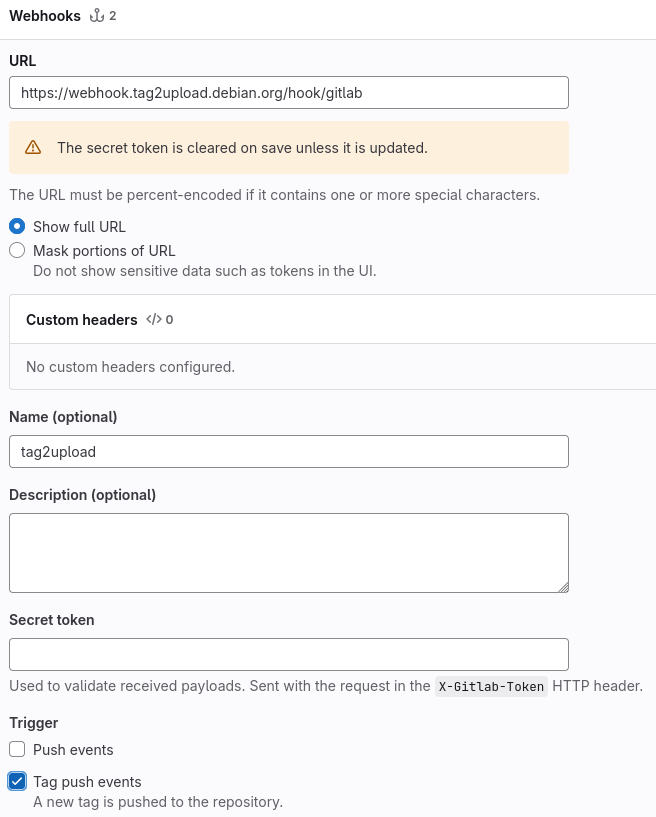
And then I realise that I still want to build a source package to test it in cowbuilder. Hmm, I remember that Helmut showed me that building a source package isn t necessary in sbuild, but I have a habit of breaking my sbuild configs somehow, but I guess I should revisit that. So, I do a dpkg-buildpackage -S -sa and test it out with cowbuilder, because that s just how I roll (at least for now, fixing my local sbuild setup is yak shaving for another day, let s focus!). I end up with a binary that looks good, so I m satisfied that I can upload this package to the Debian archives. So, time to configure tag2upload. The first step is to set up the webhook in Salsa. I was surprised two find two webhooks already configured:
I know of KGB that posts to IRC, didn t know that this was the mechanism it does that by before. Nice! Also don t know what the tagpending one does, I ll go look into that some other time. Configuring a tag2upload webhook is quite simple, add a URL, call the name tag2upload, and select only tag push events:
I run the test webhook, and it returned a code 400 message about a missing message header, which the documentation says is normal. Next, I install git-debpush from experimental. The wiki page simply states that you can use the git-debpush command to upload, but doesn t give any examples on how to use it, and its manpage doesn t either. And when I run just git-debpush I get:
jonathan@lapcloud:~/devel/debian/python-team/bundlewrap/bundlewrap-4.23.1$ git-debpush
git-debpush: check failed: upstream tag upstream/4.22.0 is not an ancestor of refs/heads/debian/master; probably a mistake ('upstream-nonancestor' check)
pristine-tar is /usr/bin/pristine-tar
git-debpush: some check(s) failed; you can pass --force to ignore them
I have no idea what that s supposed to mean. I was also not sure whether I should tag anything to begin with, or if some part of the tag2upload machinery automatically does it. I think I might have tagged debian/4.23-1 before tagging upstream/4.23 and perhaps it didn t like it, I reverted and did it the other way around and got a new error message. Progress!
jonathan@lapcloud:~/devel/debian/python-team/bundlewrap/bundlewrap-4.23.1$ git-debpush
git-debpush: could not determine the git branch layout
git-debpush: please supply a --quilt= argument
Looking at the manpage, it looks like quilt=baredebian matches my package the best, so I try that:
jonathan@lapcloud:~/devel/debian/python-team/bundlewrap/bundlewrap-4.23.1$ git-debpush --quilt=baredebian
Enumerating objects: 70, done.
Counting objects: 100% (70/70), done.
Delta compression using up to 12 threads
Compressing objects: 100% (37/37), done.
Writing objects: 100% (37/37), 8.97 KiB   2.99 MiB/s, done.
Total 37 (delta 30), reused 0 (delta 0), pack-reused 0 (from 0)
To salsa.debian.org:python-team/packages/bundlewrap.git
6f55d99..3d5498f debian/master -> debian/master
 * [new tag] upstream/4.23.1 -> upstream/4.23.1
 * [new tag] debian/4.23.1-1_exp1 -> debian/4.23.1-1_exp1
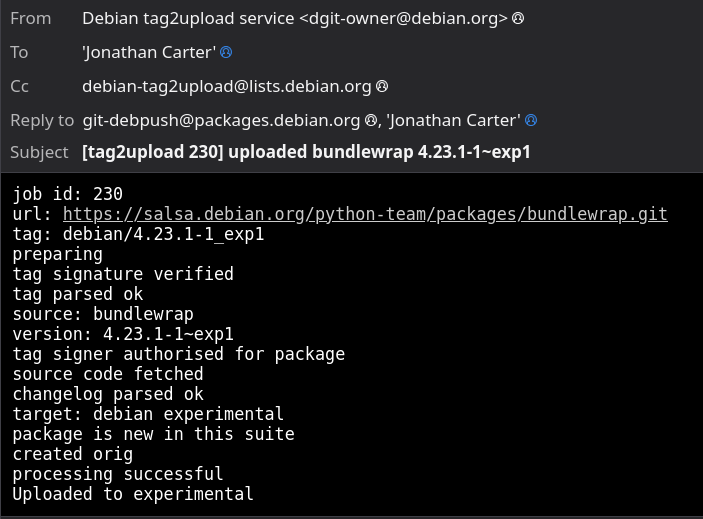
Ooh! That looked like it did something! And a minute later I received the notification of the upload in my inbox:
So, I m not 100% sure that this makes things much easier for me than doing a dput, but, it s not any more difficult or more work either (once you know how it works), so I ll be using git-debpush from now on, and I m sure as I get more used to the git workflow of doing things I ll understand more of the benefits. And at last, my one last use case for using FTP is now properly dead. RIP FTP :)

Russell Coker: Matching Intel CPUs

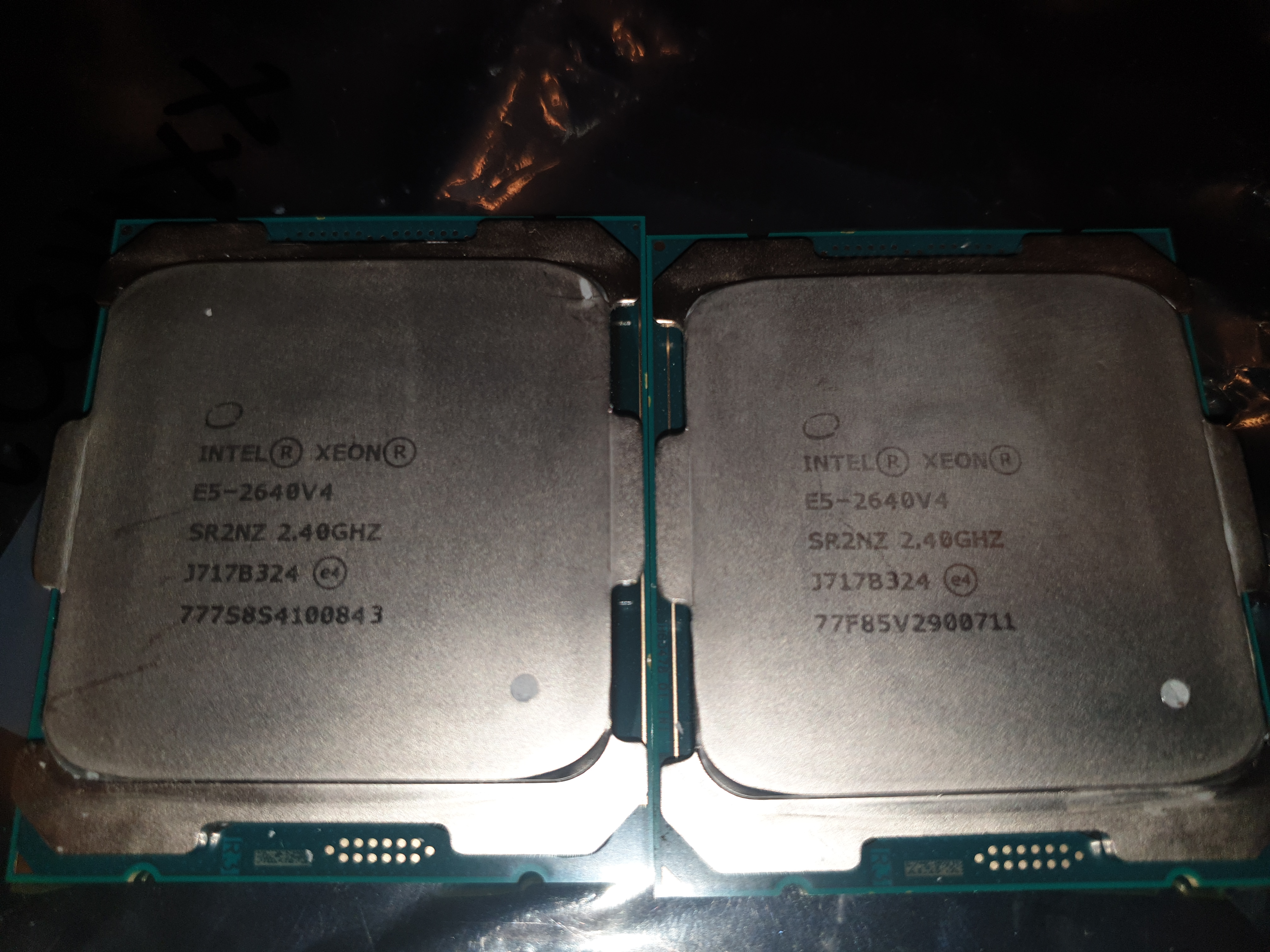
To run a SMP system with multiple CPUs you need to have CPUs that are identical , the question is what does identical mean. In this case I m interested in Intel CPUs because SMP motherboards and server systems for Intel CPUs are readily available and affordable. There are people selling matched pairs of CPUs on ebay which tend to be more expensive than randomly buying 2 of the same CPU model, so if you can identify 2 CPUs that are identical which are sold separately then you can save some money. Also if you own a two CPU system with only one CPU installed then buying a second CPU to match the first is cheaper and easier than buying two more CPUs and removing a perfectly working CPU. e5-2640 v4 cpus
Intel (R) Xeon (R)
E5-2640V4
SR2NZ 2.40GHZ
J717B324 (e4)
7758S4100843
Above is a pic of 2 E5-2640v4 CPUs that were in a SMP system I purchased along with a plain ASCII representation of the text on one of them. The bottom code (starting with 77 ) is apparently the serial number, one of the two codes above it is what determines how identical those CPUs are. The code on the same line as the nominal clock speed (in this case SR2NZ) is the spec number which is sometimes referred to as sspec [1]. The line below the sspec and above the serial number has J717B324 which doesn t have a google hit. I looked at more than 20 pics of E5-2640v4 CPUs on ebay, they all had the code SR2NZ but had different numbers on the line below. I conclude that the number on the line below probably indicates the model AND stepping while SR2NZ just means E5-2640v4 regardless of stepping. As I wasn t able to find another CPU on ebay with the same number on the line below the sspec I believe that it will be unreasonably difficult to get a match for an existing CPU. For the purpose of matching CPUs I believe that if the line above the serial number matches then the CPUs can be used together. I am not certain that CPUs with this number slightly mismatching won t work but I definitely wouldn t want to spend money on CPUs with this number being different.
smpboot: CPU0: Intel(R) Xeon(R) CPU E5-2699A v4 @ 2.40GHz (family: 0x6, model: 0x4f, stepping: 0x1)
When you boot Linux the kernel identifies the CPU in a manner like the above, the combination of family and model seem to map to one spec number. The combination of family, model, and stepping should be all that s required to have them work together. I think that Intel did the wrong thing in not making this clearer. It would have been very easy to print the stepping on the CPU case next to the sspec or the CPU model name. It also wouldn t have been too hard to make the CPU provide the magic number that is apparently the required match for SMP to the OS. Having the Intel web site provide a mapping of those numbers to steppings of CPUs also shouldn t be difficult for them. If anyone knows more about these issues please let me know.

Debian Outreach Team: GSoC 2025 Introduction: Make Debian for Raspberry Pi Build Again

Hello everyone! I am Kurva Prashanth, Interested in the lower level working of system software, CPUs/SoCs and Hardware design. I was introduced to Open Hardware and Embedded Linux while studying electronics and embedded systems as part of robotics coursework. Initially, I did not pay much attention to it and quickly moved on. However, a short talk on Liberating SBCs using Debian by Yuvraj at MiniDebConf India, 2021 caught my interest. The talk focused on Open Hardware platforms such as Olimex and BeagleBone Black, as well as the Debian distributions tailored for these ARM-based single-board computers has intrigued me to delve deeper into the realm of Open Hardware and Embedded Linux. These days I m trying to improve my abilities to contribute to Debian and Linux Kernel development. Before finding out about the Google Summer of Code project, I had already started my journey with Debian. I extensively used Debian system build tools(debootstrap, sbuild, deb-build-pkg, qemu-debootstrap) for Building Debian Image for Bela Cape a real-time OS for music making to achieve extremely fast audio and sensor processing times. In 2023, I had the opportunity to attend DebConf23 in Kochi, India - thanks to Nilesh Patra (@nilesh) and I met Hector Oron (@zumbi) over dinner at DebConf23 and It was nice talking about his contributions/work at Debian on armhf port and Debian System Administration that conversation got me interested in knowing more about Debian ARM, Installer and I found it fascinating that EmDebian was once a external project bringing Debian to embedded systems and now, Debian itself can be run on many embedded systems. And, also during DebCamp I got Introduced to PGP/GPG keys and the web of trust by Carlos Henrique Lima Melara (@charles) I learned how to use and generate GPG keys. After DebConf23 I tried debian packaging and I miserably failed to get sponsorship for a python library I packaged. I came across the Debian project for this year s Google Summer of Code and found the project titled Make Debian for Raspberry Pi Build Again quite interesting to me and applied. Gladly, on May 8th, I received an acceptance e-mail from GSoC. I got excited that I ll spend the summer working on something that I like doing. I am thrilled to be part of this project and I am super excited for the summer of 25. I m looking forward to work on what I most like, new connections and learning opportunities. So, let me talk a bit more about my project. I will be working on to Make Debian for Raspberry Pi SBC s under the guidance of Gunnar Wolf (@gwolf). In this post, I will describe the project I will be working on.

Why make Debian for Raspberry Pi build again? There is an available set of images for running Debian in Raspberry Pi computers (all models below the 5 series)! However, the maintainer severely lacking time to take care for them; called for help for somebody to adopt them, but have not been successful. The image generation scripts might have bitrotted a bit, but it is mostly all done. And there is a lot of interest and use still in having the images freshly generated and decently tested! This GSoC project is about getting the [https://raspi.debian.net/ Raspberry Pi Debian images] site working reliably, daily-built images become automatic again and ideally making it easily deployable to be run in project machines and migrating exsisting hosting infrastructure to Debian.

How much it differ from Debian build process? While the goal is to stay as close as possible to the Debian build process, Raspberry Pi boards require some necessary platform-specific changes primarily in the early boot sequence and firmware handling. Unlike typical Debian systems, Raspberry Pi boards depend on a non-standard bootloader and use non-free firmware (raspi-firmware), Introducing some hardware-specific differences in the initialization process. These differences are largely confined to the early boot and hardware initialization stages. Once the system boots, the userspace remains closely aligned with a typical Debian install, using Debian packages. The current modifications are required due to non-free firmware. However, several areas merit review: but there are a few parts that might be worth changing.
  1. Boot flow: Transitioning to a U-Boot based boot process (as used in Debian installer images for many other SBCs) would reduce divergence and better align with Debian Installer.
  2. Current scripts/workarounds: Some existing hacks may now be redundant with recent upstream support and could be removed.
  3. Board-specific images: Shift to architecture-specific base images with runtime detection could simplify builds and reduce duplication.
Debian already already building SD card images for a wide range of SBCs (e.g., BeagleBone, BananaPi, OLinuXino, Cubieboard, etc.) installer-arm64/images/u-boot and installer-armhf/images/u-boot, a similar approach for Raspberry Pi could improve maintainability and consistency with Debian s broader SBC support.

Quoted from Mail Discussion Thread with Mentor (Gunnar Wolf)
"One direction we wanted to explore was whether we should still be building one image per family, or whether we could instead switch to one image per architecture (armel, armhf, arm64). There were some details to iron out as RPi3 and RPi4 were quite different, but I think it will be similar to the differences between the RPi 0 and 1, which are handled at first-boot time. To understand what differs between families, take a look at Cyril Brulebois generate-recipe (in the repo), which is a great improvement over the ugly mess I had before he contributed it"
In this project, I intend to to build one image per architecture (armel, armhf, arm64) rather than continuing with the current model of building one image per board. This change simplifies image management, reduces redundancy, and leverages dynamic configuration at boot time to support all supported boards within each architecture. By using U-Boot and flash-kernel, we can detect the board type and configure kernel parameters, DTBs, and firmware during the first boot, reducing duplication across images and simplifying the maintenance burden and we can also generalize image creation while still supporting board-specific behavior at runtime. This method aligns with existing practices in the DebianInstaller team and aligns with Debian s long-term maintainability goals and better leverages upstream capabilities, ensuring a consistent and scalable boot experience. To streamline and standardize the process of building bootable Debian images for Raspberry Pi devices, I proposed a new workflow that leverages U-Boot and flash-kernel Debian packages. This provides a clean, maintainable, and reproducible way to generate images for armel, armhf and arm64 boards. The workflow is vmdb2, a lightweight, declarative tool designed to automate the creation of disk images. A typical vmdb2 recipe defines the disk layout, base system installation (via debootstrap), architecture-specific packages, and any custom post-install hooks and the image should includes U-Boot (the u-boot-rpi package), flash-kernel, and a suitable Debian kernel package like linux-image-arm64 or linux-image-armmp. U-Boot serves as the platform s bootloader and is responsible for loading the kernel and initramfs. Unlike Raspberry Pi s non-free firmware/proprietary bootloader, U-Boot provides an open and scriptable interface, allowing us to follow a more standard Debian boot process. It can be configured to boot using either an extlinux.conf or a boot.scr script generated automatically by flash-kernel. The role of flash-kernel is to bridge Debian s kernel installation system with the specifics of embedded bootloaders like U-Boot. When installed, it automatically copies the kernel image, initrd, and device tree blobs (DTBs) to the /boot partition. It also generates the necessary boot.scr script if the board configuration demands it. To work correctly, flash-kernel requires that the target machine be identified via /etc/flash-kernel/machine, which must correspond to an entry in its internal machine database.\ Once the vmdb2 build is complete, the resulting image will contain a fully configured bootable system with all necessary boot components correctly installed. The image can be flashed to an SD card and used to boot on the intended device without additional manual configuration. Because all key packages (U-Boot, kernel, flash-kernel) are managed through Debian s package system, kernel updates and boot script regeneration are handled automatically during system upgrades.

Current Workflow: Builds one Image per family The current vmdb2 recipe uses the Raspberry Pi GPU bootloader provided via the raspi-firmware package. This is the traditional boot process followed by Raspberry Pi OS, and it s tightly coupled with firmware files like bootcode.bin, start.elf, and fixup.dat. These files are installed to /boot/firmware, which is mounted from a FAT32 partition labeled RASPIFIRM. The device tree files (*.dtb) are manually copied from /usr/lib/linux-image-*-arm64/broadcom/ into this partition. The kernel is installed via the linux-image-arm64 package, and the boot arguments are injected by modifying /boot/firmware/cmdline.txt using sed commands. Booting depends on the root partition being labeled RASPIROOT, referenced through that file. There is no bootloader like UEFI-based or U-Boot involved the Raspberry Pi firmware directly loads the kernel, which is standard for Raspberry Pi boards.
- apt: install
  packages:
    ...
    - raspi-firmware  
The boot partition contents and kernel boot setup are tightly controlled via scripting in the recipe. Limitations of Current Workflow: While this setup works, it is
  1. Proprietary and Raspberry Pi specific It relies on the closed-source GPU bootloader the raspi-firmware package, which is tightly coupled to specific Raspberry Pi models.
  2. Manual DTB handling Device tree files are manually copied and hardcoded, making upgrades or board-specific changes error-prone.
  3. Not easily extendable to future Raspberry Pi boards Any change in bootloader behavior (as seen in the Raspberry Pi 5, which introduces a more flexible firmware boot process) would require significant rework.
  4. No UEFI-based/U-Boot The current method bypasses the standard bootloader layers, making it inconsistent with other Debian ARM platforms and harder to maintain long-term.
As Raspberry Pi firmware and boot processes evolve, especially with the introduction of Pi 5 and potentially Pi 6, maintaining compatibility will require more flexibility - something best delivered by adopting U-Boot and flash-kernel.

New Workflow: Building Architecture-Specific Images with vmdb2, U-Boot, flash-kernel, and Debian Kernel This workflow outlines an improved approach to generating bootable Debian images architecture specific, using vmdb2, U-Boot, flash-kernel, and Debian kernels and also to move away from Raspberry Pi s proprietary bootloader to a fully open-source boot process which improves maintainability, consistency, and cross-board support.

New Method: Shift to U-Boot + flash-kernel U-Boot (via Debian su-boot-rpi package) and flash-kernel bring the image building process closer to how Debian officially boots ARM devices. flash-kernel integrates with the system s initramfs and kernel packages to install bootloaders, prepare boot.scr or extlinux.conf, and copy kernel/initrd/DTBs to /boot in a format that U-Boot expects. U-Boot will be used as a second-stage bootloader, loaded by the Raspberry Pi s built-in firmware. Once U-Boot is in place, it will read standard boot scripts ( boot.scr) generated by flash-kernel, providing a Debian-compatible and board-flexible solution. Extending YAML spec for vmdb2 build with U-Boot and flash-kernel To improve an existing vmdb2 YAML spec(https://salsa.debian.org/raspi-team/image-specs/raspi_master.yaml), to integrate U-Boot, flash-kernel, and the architecture-specific Debian kernel into the image build process. By incorporating u-boot-rpi and flash-kernel from Debian packages, alongside the standard initramfs-tools, we align the image closer to Debian best practices while supporting both armhf and arm64 architectures. Below are key additions and adjustments needed in a vmdb2 YAML spec to support the workflow: Install U-Boot, flash-kernel, initramfs-tools and the architecture-specific Debian kernel.
- apt: install
  packages:
    - u-boot-rpi
    - flash-kernel
    - initramfs-tools
    - linux-image-arm64 # or linux-image-armmp for armhf 
  tag: tag-root
Replace linux-image-arm64 with the correct kernel package for specific target architecture. These packages should be added under the tag-root section in YAML spec for vmdb2 build recipe. This ensures that the necessary bootloader, kernel, and initramfs tools are included and properly configured in the image. Configure Raspberry Pi firmware to Load U-Boot Install the U-Boot binary as kernel.img in /boot/firmware we can also download and build U-Boot from source, but Debian provides tested binaries.
- shell:  
    cp /usr/lib/u-boot/rpi_4/u-boot.bin $ ROOT? /boot/firmware/kernel.img
    echo "enable_uart=1" >> $ ROOT? /boot/firmware/config.txt
  root-fs: tag-root
This makes the RPi firmware load u-boot.bin instead of the Linux kernel directly. Set Up flash-kernel for Debian-style Boot flash-kernel integrates with initramfs-tools and writes boot config suitable for U-Boot. We need to make sure /etc/flash-kernel/db contains an entry for board (most Raspberry Pi boards already supported in Bookworm). Set up /etc/flash-kernel.conf with:
- create-file: /etc/flash-kernel.conf
  contents:  
    MACHINE="Raspberry Pi 4"
    BOOTPART="/dev/disk/by-label/RASPIFIRM"
    ROOTPART="/dev/disk/by-label/RASPIROOT"
  unless: rootfs_unpacked
This allows flash-kernel to write an extlinux.conf or boot.scr into /boot/firmware. Clean up Proprietary/Non-Free Firmware Bootflow Remove the direct kernel loading flow:
- shell:  
    rm -f $ ROOT? /boot/firmware/vmlinuz*
    rm -f $ ROOT? /boot/firmware/initrd.img*
    rm -f $ ROOT? /boot/firmware/cmdline.txt
  root-fs: tag-root
Let U-Boot and flash-kernel manage kernel/initrd and boot parameters instead. Boot Flow After This Change
[SoC ROM] -> [start.elf] -> [U-Boot] -> [boot.scr] -> [Linux Kernel]
  1. This still depends on the Raspberry Pi firmware to start, but it only loads U-Boot, not Linux kernel.
  2. U-Boot gives you more flexibility (e.g., networking, boot menus, signed boot).
  3. Using flash-kernel ensures kernel updates are handled the Debian Installer way.
  4. Test with a serial console (enable_uart=1) in case HDMI doesn t show early boot logs.
Advantage of New Workflow
  1. Replaces the proprietary Raspberry Pi bootloader with upstream U-Boot.
  2. Debian-native tooling Uses flash-kernel and initramfs-tools to manage boot configuration.
  3. Consistent across boards Works for both armhf and arm64, unifying the image build process.
  4. Easier to support new boards Like the Raspberry Pi 5 and future models.
This transition will standardize a bit image-building process, making it aligned with upstream Debian Installer workflows.

vmdb2 configuration for arm64 using u-boot and flash-kernel NOTE: This is a baseline example and may require tuning.
# Raspberry Pi arm64 image using U-Boot and flash-kernel
steps:
  # ... (existing mkimg, partitions, mount, debootstrap, etc.) ...
  # Install U-Boot, flash-kernel, initramfs-tools and architecture specific kernel
  - apt: install
    packages:
      - u-boot-rpi
      - flash-kernel
      - initramfs-tools
      - linux - image - arm64 # or linux - image - armmp for armhf
    tag: tag-root
  # Install U-Boot binary as kernel.img in firmware partition
  - shell:  
      cp /usr/lib/u-boot/rpi_arm64 /u-boot.bin $ ROOT? /boot/firmware/kernel.img
      echo "enable_uart=1" >> $ ROOT? /boot/firmware/config.txt
    root-fs: tag-root
  # Configure flash-kernel for Raspberry Pi
  - create-file: /etc/flash-kernel.conf
    contents:  
      MACHINE="Generic Raspberry Pi ARM64"
      BOOTPART="/dev/disk/by-label/RASPIFIRM"
      ROOTPART="/dev/disk/by-label/RASPIROOT"
    unless: rootfs_unpacked
  # Remove direct kernel boot files from Raspberry Pi firmware
  - shell:  
      rm -f $ ROOT? /boot/firmware/vmlinuz*
      rm -f $ ROOT? /boot/firmware/initrd.img*
      rm -f $ ROOT? /boot/firmware/cmdline.txt
    root-fs: tag-root
  # flash-kernel will manage boot scripts and extlinux.conf
  # Rest of image build continues...

Required Changes to Support Raspberry Pi Boards in Debian (flash-kernel + U-Boot)

Overview of Required Changes
Component Required Task
Debian U-Boot Package Add build target for rpi_arm64 in u-boot-rpi. Optionally deprecate legacy 32-bit targets.
Debian flash-kernel Package Add or verify entries in db/all.db for Pi 4, Pi 5, Zero 2W, CM4. Ensure boot script generation works via bootscr.uboot-generic.
Debian Kernel Ensure DTBs are installed at /usr/lib/linux-image-<version>/ and available for flash-kernel to reference.

flash-kernel

Already Supported Boards in flash-kernel Debian Package https://sources.debian.org/src/flash-kernel/3.109/db/all.db/#L1700
Model Arch DTB-Id
Raspberry Pi 1 A/B/B+, Rev2 armel bcm2835-*
Raspberry Pi CM1 armel bcm2835-rpi-cm1-io1.dtb
Raspberry Pi Zero/Zero W armel bcm2835-rpi-zero*.dtb
Raspberry Pi 2B armhf bcm2836-rpi-2-b.dtb
Raspberry Pi 3B/3B+ arm64 bcm2837-*
Raspberry Pi CM3 arm64 bcm2837-rpi-cm3-io3.dtb
Raspberry Pi 400 arm64 bcm2711-rpi-400.dtb

uboot

Already Supported Boards in Debian U-Boot Package https://salsa.debian.org/installer-team/flash-kernel/-/blob/master/db/all.db

arm64 Model Arch Upstream Defconfig Debian Target - - - Raspberry Pi 3B arm64 rpi_3_defconfig rpi_3 Raspberry Pi 4B arm64 rpi_4_defconfig rpi_4 Raspberry Pi 3B/3B+/CM3/CM3+/4B/CM4/400/5B/Zero 2W arm64 rpi_arm64_defconfig rpi_arm64
armhf Model Arch Upstream Defconfig Debian Target - - - Raspberry Pi 2 armhf rpi_2_defconfig rpi_2 Raspberry Pi 3B (32-bit) armhf rpi_3_32b_defconfig rpi_3_32b Raspberry Pi 4B (32-bit) armhf rpi_4_32b_defconfig rpi_4_32b
armel Model Arch Upstream Defconfig Debian Target - - - Raspberry Pi armel rpi_defconfig rpi Raspberry Pi 1/Zero armel rpi_0_w rpi_0_w These boards are already defined in debian/rules under the u-boot-rpi source package and generates usable U-Boot binaries for corresponding Raspberry Pi models.

To-Do: Add Missing Board Support to U-Boot and flash-kernel in Debian Several Raspberry Pi models are missing from the Debian U-Boot and flash-kernel packages, even though upstream support and DTBs exist in the Debian kernel but are missing entries in the flash-kernel database to enable support for bootloader installation and initrd handling.

Boards Not Yet Supported in flash-kernel Debian Package
Model Arch DTB-Id
Raspberry Pi 3A+ (32 & 64 bit) armhf, arm64 bcm2837-rpi-3-a-plus.dtb
Raspberry Pi 4B (32 & 64 bit) armhf, arm64 bcm2711-rpi-4-b.dtb
Raspberry Pi CM4 arm64 bcm2711-rpi-cm4-io.dtb
Raspberry Pi CM 4S arm64 -
Raspberry Zero 2 W arm64 bcm2710-rpi-zero-2-w.dtb
Raspberry Pi 5 arm64 bcm2712-rpi-5-b.dtb
Raspberry Pi CM5 arm64 -
Raspberry Pi 500 arm64 -

Boards Not Yet Supported in Debian U-Boot Package
Model Arch Upstream defconfig(s)
Raspberry Pi 3A+/3B+ arm64 -, rpi_3_b_plus_defconfig
Raspberry Pi CM 4S arm64 -
Raspberry Pi 5 arm64 -
Raspberry Pi CM5 arm64 -
Raspberry Pi 500 arm64 -

So, what next? During the Community Bonding Period, I got hands-on with workflow improvements, set up test environments, and began reviewing Raspberry Pi support in Debian s U-Boot and flash-kernel and these are the logs of the project, where I provide weekly reports on the work done. You can check here: Community Bonding Period logs. My next steps include submitting patches to the u-boot and flash-kernel packages to ensure all missing Raspberry Pi entries are built and shipped. And, also to confirm the kernel DTB installation paths and make sure the necessary files are included for all Raspberry Pi variants. Finally, plan to validate changes with test builds on Raspberry Pi hardware. In parallel, I m organizing my tasks and setting up my environment to contribute more effectively. It s been exciting to explore how things work under the hood and to prepare for a summer of learning and contributing to this great community.

18 June 2025

Sergio Durigan Junior: GCC, glibc, stack unwinding and relocations A war story

I ve been meaning to write a post about this bug for a while, so here it is (before I forget the details!). First, I d like to thank a few people: I ll probably forget some details because it s been more than a week (and life at $DAYJOB moves fast), but we ll see.

The background story Wolfi OS takes security seriously, and one of the things we have is a package which sets the hardening compiler flags for C/C++ according to the best practices recommended by OpenSSF. At the time of this writing, these flags are (in GCC s spec file parlance):
*self_spec:
+ % !O:% !O1:% !O2:% !O3:% !O0:% !Os:% !0fast:% !0g:% !0z:-O2  -fhardened -Wno-error=hardened -Wno-hardened % !fdelete-null-pointer-checks:-fno-delete-null-pointer-checks  -fno-strict-overflow -fno-strict-aliasing % !fomit-frame-pointer:-fno-omit-frame-pointer  -mno-omit-leaf-frame-pointer
*link:
+ --as-needed -O1 --sort-common -z noexecstack -z relro -z now
The important part for our bug is the usage of -z now and -fno-strict-aliasing. As I was saying, these flags are set for almost every build, but sometimes things don t work as they should and we need to disable them. Unfortunately, one of these problematic cases has been glibc. There was an attempt to enable hardening while building glibc, but that introduced a strange breakage to several of our packages and had to be reverted. Things stayed pretty much the same until a few weeks ago, when I started working on one of my roadmap items: figure out why hardening glibc wasn t working, and get it to work as much as possible.

Reproducing the bug I started off by trying to reproduce the problem. It s important to mention this because I often see young engineers forgetting to check if the problem is even valid anymore. I don t blame them; the anxiety to get the bug fixed can be really blinding. Fortunately, I already had one simple test to trigger the failure. All I had to do was install the py3-matplotlib package and then invoke:
$ python3 -c 'import matplotlib'
This would result in an abortion with a coredump. I followed the steps above, and readily saw the problem manifesting again. OK, first step is done; I wasn t getting out easily from this one.

Initial debug The next step is to actually try to debug the failure. In an ideal world you get lucky and are able to spot what s wrong after just a few minutes. Or even better: you also can devise a patch to fix the bug and contribute it to upstream. I installed GDB, and then ran the py3-matplotlib command inside it. When the abortion happened, I issued a backtrace command inside GDB to see where exactly things had gone wrong. I got a stack trace similar to the following:
#0  0x00007c43afe9972c in __pthread_kill_implementation () from /lib/libc.so.6
#1  0x00007c43afe3d8be in raise () from /lib/libc.so.6
#2  0x00007c43afe2531f in abort () from /lib/libc.so.6
#3  0x00007c43af84f79d in uw_init_context_1[cold] () from /usr/lib/libgcc_s.so.1
#4  0x00007c43af86d4d8 in _Unwind_RaiseException () from /usr/lib/libgcc_s.so.1
#5  0x00007c43acac9014 in __cxxabiv1::__cxa_throw (obj=0x5b7d7f52fab0, tinfo=0x7c429b6fd218 <typeinfo for pybind11::attribute_error>, dest=0x7c429b5f7f70 <pybind11::reference_cast_error::~reference_cast_error() [clone .lto_priv.0]>)
    at ../../../../libstdc++-v3/libsupc++/eh_throw.cc:93
#6  0x00007c429b5ec3a7 in ft2font__getattr__(std::__cxx11::basic_string<char, std::char_traits<char>, std::allocator<char> >) [clone .lto_priv.0] [clone .cold] () from /usr/lib/python3.13/site-packages/matplotlib/ft2font.cpython-313-x86_64-linux-gnu.so
#7  0x00007c429b62f086 in pybind11::cpp_function::initialize<pybind11::object (*&)(std::__cxx11::basic_string<char, std::char_traits<char>, std::allocator<char> >), pybind11::object, std::__cxx11::basic_string<char, std::char_traits<char>, std::allocator<char> >, pybind11::name, pybind11::scope, pybind11::sibling>(pybind11::object (*&)(std::__cxx11::basic_string<char, std::char_traits<char>, std::allocator<char> >), pybind11::object (*)(std::__cxx11::basic_string<char, std::char_traits<char>, std::allocator<char> >), pybind11::name const&, pybind11::scope const&, pybind11::sibling const&):: lambda(pybind11::detail::function_call&)#1 ::_FUN(pybind11::detail::function_call&) [clone .lto_priv.0] ()
   from /usr/lib/python3.13/site-packages/matplotlib/ft2font.cpython-313-x86_64-linux-gnu.so
#8  0x00007c429b603886 in pybind11::cpp_function::dispatcher(_object*, _object*, _object*) () from /usr/lib/python3.13/site-packages/matplotlib/ft2font.cpython-313-x86_64-linux-gnu.so
...
Huh. Initially this didn t provide me with much information. There was something strange seeing the abort function being called right after _Unwind_RaiseException, but at the time I didn t pay much attention to it. OK, time to expand our horizons a little. Remember when I said that several of our packages would crash with a hardened glibc? I decided to look for another problematic package so that I could make it crash and get its stack trace. My thinking here is that maybe if I can compare both traces, something will come up. I happened to find an old discussion where Dann Frazier mentioned that Emacs was also crashing for him. He and I share the Emacs passion, and I totally agreed with him when he said that Emacs crashing is priority -1! (I m paraphrasing). I installed Emacs, ran it, and voil : the crash happened again. OK, that was good. When I ran Emacs inside GDB and asked for a backtrace, here s what I got:
#0  0x00007eede329972c in __pthread_kill_implementation () from /lib/libc.so.6
#1  0x00007eede323d8be in raise () from /lib/libc.so.6
#2  0x00007eede322531f in abort () from /lib/libc.so.6
#3  0x00007eede262879d in uw_init_context_1[cold] () from /usr/lib/libgcc_s.so.1
#4  0x00007eede2646e7c in _Unwind_Backtrace () from /usr/lib/libgcc_s.so.1
#5  0x00007eede3327b11 in backtrace () from /lib/libc.so.6
#6  0x000059535963a8a1 in emacs_backtrace ()
#7  0x000059535956499a in main ()
Ah, this backtrace is much simpler to follow. Nice. Hmmm. Now the crash is happening inside _Unwind_Backtrace. A pattern emerges! This must have something to do with stack unwinding (or so I thought keep reading to discover the whole truth). You see, the backtrace function (yes, it s a function) and C++ s exception handling mechanism use similar techniques to do their jobs, and it pretty much boils down to unwinding frames from the stack. I looked into Emacs source code, specifically the emacs_backtrace function, but could not find anything strange over there. This bug was probably not going to be an easy fix

The quest for a minimal reproducer Being able to easily reproduce the bug is awesome and really helps with debugging, but even better is being able to have a minimal reproducer for the problem. You see, py3-matplotlib is a huge package and pulls in a bunch of extra dependencies, so it s not easy to ask other people to just install this big package plus these other dependencies, and then run this command , especially if we have to file an upstream bug and talk to people who may not even run the distribution we re using. So I set up to try and come up with a smaller recipe to reproduce the issue, ideally something that s not tied to a specific package from the distribution. Having all the information gathered from the initial debug session, especially the Emacs backtrace, I thought that I could write a very simple program that just invoked the backtrace function from glibc in order to trigger the code path that leads to _Unwind_Backtrace. Here s what I wrote:
#include <execinfo.h>

int
main(int argc, char *argv[])
 
  void *a[4096];
  backtrace (a, 100);
  return 0;
 
After compiling it, I determined that yes, the problem did happen with this small program as well. There was only a small nuisance: the manifestation of the bug was not deterministic, so I had to execute the program a few times until it crashed. But that s much better than what I had before, and a small price to pay. Having a minimal reproducer pretty much allows us to switch our focus to what really matters. I wouldn t need to dive into Emacs or Python s source code anymore. At the time, I was sure this was a glibc bug. But then something else happened.

GCC 15 I had to stop my investigation efforts because something more important came up: it was time to upload GCC 15 to Wolfi. I spent a couple of weeks working on this (it involved rebuilding the whole archive, filing hundreds of FTBFS bugs, patching some programs, etc.), and by the end of it the transition went smooth. When the GCC 15 upload was finally done, I switched my focus back to the glibc hardening problem. The first thing I did was to yes, reproduce the bug again. It had been a few weeks since I had touched the package, after all. So I built a hardened glibc with the latest GCC and the bug did not happen anymore! Fortunately, the very first thing I thought was this must be GCC , so I rebuilt the hardened glibc with GCC 14, and the bug was there again. Huh, unexpected but very interesting.

Diving into glibc and libgcc At this point, I was ready to start some serious debugging. And then I got a message on Signal. It was one of those moments where two minds think alike: Gabriel decided to check how I was doing, and I was thinking about him because this involved glibc, and Gabriel contributed to the project for many years. I explained what I was doing, and he promptly offered to help. Yes, there are more people who love low level debugging! We spent several hours going through disassembles of certain functions (because we didn t have any debug information in the beginning), trying to make sense of what we were seeing. There was some heavy GDB involved; unfortunately I completely lost the session s history because it was done inside a container running inside an ephemeral VM. But we learned a lot. For example:
  • It was hard to actually understand the full stack trace leading to uw_init_context_1[cold]. _Unwind_Backtrace obviously didn t call it (it called uw_init_context_1, but what was that [cold] doing?). We had to investigate the disassemble of uw_init_context_1 in order to determined where uw_init_context_1[cold] was being called.
  • The [cold] suffix is a GCC function attribute that can be used to tell the compiler that the function is unlikely to be reached. When I read that, my mind immediately jumped to this must be an assertion , so I went to the source code and found the spot.
  • We were able to determine that the return code of uw_frame_state_for was 5, which means _URC_END_OF_STACK. That s why the assertion was triggering.
After finding these facts without debug information, I decided to bite the bullet and recompiled GCC 14 with -O0 -g3, so that we could debug what uw_frame_state_for was doing. After banging our heads a bit more, we found that fde is NULL at this excerpt:
// ...
  fde = _Unwind_Find_FDE (context->ra + _Unwind_IsSignalFrame (context) - 1,
                          &context->bases);
  if (fde == NULL)
     
#ifdef MD_FALLBACK_FRAME_STATE_FOR
      /* Couldn't find frame unwind info for this function.  Try a
         target-specific fallback mechanism.  This will necessarily
         not provide a personality routine or LSDA.  */
      return MD_FALLBACK_FRAME_STATE_FOR (context, fs);
#else
      return _URC_END_OF_STACK;
#endif
     
// ...
We re debugging on amd64, which means that MD_FALLBACK_FRAME_STATE_FOR is defined and therefore is called. But that s not really important for our case here, because we had established before that _Unwind_Find_FDE would never return NULL when using a non-hardened glibc (or a glibc compiled with GCC 15). So we decided to look into what _Unwind_Find_FDE did. The function is complex because it deals with .eh_frame , but we were able to pinpoint the exact location where find_fde_tail (one of the functions called by _Unwind_Find_FDE) is returning NULL:
if (pc < table[0].initial_loc + data_base)
  return NULL;
We looked at the addresses of pc and table[0].initial_loc + data_base, and found that the former fell within libgcc s text section, which the latter fell within /lib/ld-linux-x86-64.so.2 text. At this point, we were already too tired to continue. I decided to keep looking at the problem later and see if I could get any further.

Bisecting GCC The next day, I woke up determined to find what changed in GCC 15 that caused the bug to disappear. Unless you know GCC s internals like they are your own home (which I definitely don t), the best way to do that is to git bisect the commits between GCC 14 and 15. I spent a few days running the bisect. It took me more time than I d have liked to find the right range of commits to pass git bisect (because of how branches and tags are done in GCC s repository), and I also had to write some helper scripts that:
  • Modified the gcc.yaml package definition to make it build with the commit being bisected.
  • Built glibc using the GCC that was just built.
  • Ran tests inside a docker container (with the recently built glibc installed) to determine whether the bug was present.
At the end, I had a commit to point to:
commit 99b1daae18c095d6c94d32efb77442838e11cbfb
Author: Richard Biener <rguenther@suse.de>
Date:   Fri May 3 14:04:41 2024 +0200
    tree-optimization/114589 - remove profile based sink heuristics
Makes sense, right?! No? Well, it didn t for me either. Even after reading what was changed in the code and the upstream bug fixed by the commit, I was still clueless as to why this change fixed the problem (I say fixed because it may very well be an unintended consequence of the change, and some other problem might have been introduced).

Upstream takes over After obtaining the commit that possibly fixed the bug, while talking to Dann and explaining what I did, he suggested that I should file an upstream bug and check with them. Great idea, of course. I filed the following upstream bug: https://gcc.gnu.org/bugzilla/show_bug.cgi?id=120653 It s a bit long, very dense and complex, but ultimately upstream was able to find the real problem and have a patch accepted in just two days. Nothing like knowing the code base. The initial bug became: https://sourceware.org/bugzilla/show_bug.cgi?id=33088 In the end, the problem was indeed in how the linker defines __ehdr_start, which, according to the code (from elf/dl-support.c):
if (_dl_phdr == NULL)
   
    /* Starting from binutils-2.23, the linker will define the
       magic symbol __ehdr_start to point to our own ELF header
       if it is visible in a segment that also includes the phdrs.
       So we can set up _dl_phdr and _dl_phnum even without any
       information from auxv.  */


    extern const ElfW(Ehdr) __ehdr_start attribute_hidden;
    assert (__ehdr_start.e_phentsize == sizeof *GL(dl_phdr));
    _dl_phdr = (const void *) &__ehdr_start + __ehdr_start.e_phoff;
    _dl_phnum = __ehdr_start.e_phnum;
   
But the following definition is the problematic one (from elf/rtld.c):
extern const ElfW(Ehdr) __ehdr_start attribute_hidden;
This symbol (along with its counterpart, __ehdr_end) was being run-time relocated when it shouldn t be. The fix that was pushed added optimization barriers to prevent the compiler from doing the relocations. I don t claim to fully understand what was done here, and Jakub s analysis is a thing to behold, but in the end I was able to confirm that the patch fixed the bug. And in the end, it was indeed a glibc bug.

Conclusion This was an awesome bug to investigate. It s one of those that deserve a blog post, even though some of the final details of the fix flew over my head. I d like to start blogging more about these sort of bugs, because I ve encountered my fair share of them throughout my career. And it was great being able to do some debugging with another person, exchange ideas, learn things together, and ultimately share that deep satisfaction when we find why a crash is happening. I have at least one more bug in my TODO list to write about (another one with glibc, but this time I was able to get to the end of it and come up with a patch). Stay tunned. P.S.: After having published the post I realized that I forgot to explain why the -z now and -fno-strict-aliasing flags were important. -z now is the flag that I determined to be the root cause of the breakage. If I compiled glibc with every hardening flag except -z now, everything worked. So initially I thought that the problem had to do with how ld.so was resolving symbols at runtime. As it turns out, this ended up being more a symptom than the real cause of the bug. As for -fno-strict-aliasing, a Gentoo developer who commented on the GCC bug above mentioned that this OpenSSF bug had a good point against using this flag for hardening. I still have to do a deep dive on what was discussed in the issue, but this is certainly something to take into consideration. There s this very good write-up about strict aliasing in general if you re interested in understanding it better.

17 June 2025

Evgeni Golov: Arguing with an AI or how Evgeni tried to use CodeRabbit

Everybody is trying out AI assistants these days, so I figured I'd jump on that train and see how fast it derails. I went with CodeRabbit because I've seen it on YouTube ads work, I guess. I am trying to answer the following questions: To reduce the amount of output and not to confuse contributors, CodeRabbit was configured to only do reviews on demand. What follows is a rather unscientific evaluation of CodeRabbit based on PRs in two Foreman-related repositories, looking at the summaries CodeRabbit posted as well as the comments/suggestions it had about the code. Ansible 2.19 support PR: theforeman/foreman-ansible-modules#1848 summary posted The summary CodeRabbit posted is technically correct.
This update introduces several changes across CI configuration, Ansible roles, plugins, and test playbooks. It expands CI test coverage to a new Ansible version, adjusts YAML key types in test variables, refines conditional logic in Ansible tasks, adds new default variables, and improves clarity and consistency in playbook task definitions and debug output.
Yeah, it does all of that, all right. But it kinda misses the point that the addition here is "Ansible 2.19 support", which starts with adding it to the CI matrix and then adjusting the code to actually work with that version. Also, the changes are not for "clarity" or "consistency", they are fixing bugs in the code that the older Ansible versions accepted, but the new one is more strict about. Then it adds a table with the changed files and what changed in there. To me, as the author, it felt redundant, and IMHO doesn't add any clarity to understand the changes. (And yes, same "clarity" vs bugfix mistake here, but that makes sense as it apparently miss-identified the change reason) And then the sequence diagrams They probably help if you have a dedicated change to a library or a library consumer, but for this PR it's just noise, especially as it only covers two of the changes (addition of 2.19 to the test matrix and a change to the inventory plugin), completely ignoring other important parts. Overall verdict: noise, don't need this. comments posted CodeRabbit also posted 4 comments/suggestions to the changes. Guard against undefined result.task IMHO a valid suggestion, even if on the picky side as I am not sure how to make it undefined here. I ended up implementing it, even if with slightly different (and IMHO better readable) syntax. Inconsistent pipeline in when for composite CV versions That one was funny! The original complaint was that the when condition used slightly different data manipulation than the data that was passed when the condition was true. The code was supposed to do "clean up the data, but only if there are any items left after removing the first 5, as we always want to keep 5 items". And I do agree with the analysis that it's badly maintainable code. But the suggested fix was to re-use the data in the variable we later use for performing the cleanup. While this is (to my surprise!) valid Ansible syntax, it didn't make the code much more readable as you need to go and look at the variable definition. The better suggestion then came from Ewoud: to compare the length of the data with the number we want to keep. Humans, so smart! But Ansible is not Ewoud's native turf, so he asked whether there is a more elegant way to count how much data we have than to use list count in Jinja (the data comes from a Python generator, so needs to be converted to a list first). And the AI helpfully suggested to use count instead! However, count is just an alias for length in Jinja, so it behaves identically and needs a list. Luckily the AI quickly apologized for being wrong after being pointed at the Jinja source and didn't try to waste my time any further. Wouldn't I have known about the count alias, we'd have committed that suggestion and let CI fail before reverting again. Apply the same fix for non-composite CV versions The very same complaint was posted a few lines later, as the logic there is very similar just slightly different data to be filtered and cleaned up. Interestingly, here the suggestion also was to use the variable. But there is no variable with the data! The text actually says one need to "define" it, yet the "committable suggestion" doesn't contain that part. Interestingly, when asked where it sees the "inconsistency" in that hunk, it said the inconsistency is with the composite case above. That however is nonsense, as while we want to keep the same number of composite and non-composite CV versions, the data used in the task is different it even gets consumed by a totally different playbook so there can't be any real consistency between the branches. I ended up applying the same logic as suggested by Ewoud above. As that refactoring was possible in a consistent way. Ensure consistent naming for Oracle Linux subscription defaults One of the changes in Ansible 2.19 is that Ansible fails when there are undefined variables, even if they are only undefined for cases where they are unused. CodeRabbit complains that the names of the defaults I added are inconsistent. And that is technically correct. But those names are already used in other places in the code, so I'd have to refactor more to make it work properly. Once being pointed at the fact that the variables already exist, the AI is as usual quick to apologize, yay. add new parameters to the repository module PR: theforeman/foreman-ansible-modules#1860 summary posted Again, the summary is technically correct
The repository module was updated to support additional parameters for repository synchronization and authentication. New options were added for ansible collections, ostree, Python packages, and yum repositories, including authentication tokens, filtering controls, and version retention settings. All changes were limited to module documentation and argument specification.
But it doesn't add anything you'd not get from looking at the diff, especially as it contains a large documentation chunk explaining those parameters. No sequence diagram this time. That's a good thing! Overall verdict: noise (even if the amount is small), don't need this. comments posted CodeRabbit generated two comments for this PR. Interestingly, none of them overlapped with the issues ansible-lint and friends found. get rid of the FIXMEs Yepp, that's fair add validation for the new parameters Yepp, I forgot these (not intentionally!). The diff it suggests is nonsense, as it doesn't take into account the existing Ansible and Yum validations, but it clearly has read them as the style etc of the new ones matches. It also managed to group the parameters correctly by repository type, so it's something.
 if module.foreman_params['content_type'] != 'ansible_collection':
     invalid_list = [key for key in ['ansible_collection_requirements'] if key in module.foreman_params]
     if invalid_list:
         module.fail_json(msg="( 0 ) can only be used with content_type 'ansible_collection'".format(",".join(invalid_list)))
+
+# Validate ansible_collection specific parameters
+if module.foreman_params['content_type'] != 'ansible_collection':
+    invalid_list = [key for key in ['ansible_collection_auth_token', 'ansible_collection_auth_url'] if key in module.foreman_params]
+    if invalid_list:
+        module.fail_json(msg="( 0 ) can only be used with content_type 'ansible_collection'".format(",".join(invalid_list)))
+
+# Validate ostree specific parameters
+if module.foreman_params['content_type'] != 'ostree':
+    invalid_list = [key for key in ['depth', 'exclude_refs', 'include_refs'] if key in module.foreman_params]
+    if invalid_list:
+        module.fail_json(msg="( 0 ) can only be used with content_type 'ostree'".format(",".join(invalid_list)))
+
+# Validate python package specific parameters
+if module.foreman_params['content_type'] != 'python':
+    invalid_list = [key for key in ['excludes', 'includes', 'package_types', 'keep_latest_packages'] if key in module.foreman_params]
+    if invalid_list:
+        module.fail_json(msg="( 0 ) can only be used with content_type 'python'".format(",".join(invalid_list)))
+
+# Validate yum specific parameter
+if module.foreman_params['content_type'] != 'yum' and 'upstream_authentication_token' in module.foreman_params:
+    module.fail_json(msg="upstream_authentication_token can only be used with content_type 'yum'")
Interestingly, it also said "Note: If 'python' is not a valid content_type, please adjust the validation accordingly." which is quite a hint at a bug in itself. The module currently does not even allow to create content_type=python repositories. That should have been more prominent, as it's a BUG! parameter persistence in obsah PR: theforeman/obsah#72 summary posted Mostly correct. It did miss-interpret the change to a test playbook as an actual "behavior" change: "Introduced new playbook variables for database configuration" there is no database configuration in this repository, just the test playbook using the same metadata as a consumer of the library. Later on it does say "Playbook metadata and test fixtures", so unclear whether this is a miss-interpretation or just badly summarized. As long as you also look at the diff, it won't confuse you, but if you're using the summary as the sole source of information (bad!) it would. This time the sequence diagram is actually useful, yay. Again, not 100% accurate: it's missing the fact that saving the parameters is hidden behind an "if enabled" flag something it did represent correctly for loading them. Overall verdict: not really useful, don't need this. comments posted Here I was a bit surprised, especially as the nitpicks were useful! Persist-path should respect per-user state locations (nitpick) My original code used os.environ.get('OBSAH_PERSIST_PATH', '/var/lib/obsah/parameters.yaml') for the location of the persistence file. CodeRabbit correctly pointed out that this won't work for non-root users and one should respect XDG_STATE_HOME. Ewoud did point that out in his own review, so I am not sure whether CodeRabbit came up with this on its own, or also took the human comments into account. The suggested code seems fine too just doesn't use /var/lib/obsah at all anymore. This might be a good idea for the generic library we're working on here, and then be overridden to a static /var/lib path in a consumer (which always runs as root). In the end I did not implement it, but mostly because I was lazy and was sure we'd override it anyway. Positional parameters are silently excluded from persistence (nitpick) The library allows you to generate both positional (foo without --) and non-positional (--foo) parameters, but the code I wrote would only ever persist non-positional parameters. This was intentional, but there is no documentation of the intent in a comment which the rabbit thought would be worth pointing out. It's a fair nitpick and I ended up adding a comment. Enforce FQDN validation for database_host The library has a way to perform type checking on passed parameters, and one of the supported types is "FQDN" so a fully qualified domain name, with dots and stuff. The test playbook I added has a database_host variable, but I didn't bother adding a type to it, as I don't really need any type checking here. While using "FQDN" might be a bit too strict here technically a working database connection can also use a non-qualified name or an IP address, I was positively surprised by this suggestion. It shows that the rest of the repository was taken into context when preparing the suggestion. reset_args() can raise AttributeError when a key is absent This is a correct finding, the code is not written in a way that would survive if it tries to reset things that are not set. However, that's only true for the case where users pass in --reset-<parameter> without ever having set parameter before. The complaint about the part where the parameter is part of the persisted set but not in the parsed args is wrong as parsed args inherit from the persisted set. The suggested code is not well readable, so I ended up fixing it slightly differently. Persisted values bypass argparse type validation When persisting, I just yaml.safe_dump the parsed parameters, which means the YAML will contain native types like integers. The argparse documentation warns that the type checking argparse does only applies to strings and is skipped if you pass anything else (via default values). While correct, it doesn't really hurt here as the persisting only happens after the values were type-checked. So there is not really a reason to type-check them again. Well, unless the type changes, anyway. Not sure what I'll do with this comment. consider using contextlib.suppress This was added when I asked CodeRabbit for a re-review after pushing some changes. Interestingly, the PR already contained try: except: pass code before, and it did not flag that. Also, the code suggestion contained import contextlib in the middle of the code, instead in the head of the file. Who would do that?! But the comment as such was valid, so I fixed it in all places it is applicable, not only the one the rabbit found. workaround to ensure LCE and CV are always sent together PR: theforeman/foreman-ansible-modules#1867 summary posted
A workaround was added to the _update_entity method in the ForemanAnsibleModule class to ensure that when updating a host, both content_view_id and lifecycle_environment_id are always included together in the update payload. This prevents partial updates that could cause inconsistencies.
Partial updates are not a thing. The workaround is purely for the fact that Katello expects both parameters to be sent, even if only one of them needs an actual update. No diagram, good. Overall verdict: misleading summaries are bad! comments posted Given a small patch, there was only one comment. Implementation looks correct, but consider adding error handling for robustness. This reads correct on the first glance. More error handling is always better, right? But if you dig into the argumentation, you see it's wrong. Either: The AI accepted defeat once I asked it to analyze things in more detail, but why did I have to ask in the first place?! Summary Well, idk, really. Did the AI find things that humans did not find (or didn't bother to mention)? Yes. It's debatable whether these were useful (see e.g. the database_host example), but I tend to be in the "better to nitpick/suggest more and dismiss than oversee" team, so IMHO a positive win. Did the AI output help the humans with the review (useful summary etc)? In my opinion it did not. The summaries were either "lots of words, no real value" or plain wrong. The sequence diagrams were not useful either. Luckily all of that can be turned off in the settings, which is what I'd do if I'd continue using it. Did the AI output help the humans with the code (useful suggestions etc)? While the actual patches it posted were "meh" at best, there were useful findings that resulted in improvements to the code. Was the AI output misleading? Absolutely! The whole Jinja discussion would have been easier without the AI "help". Same applies for the "error handling" in the workaround PR. Was the AI output distracting? The output is certainly a lot, so yes I think it can be distracting. As mentioned, I think dropping the summaries can make the experience less distracting. What does all that mean? I will disable the summaries for the repositories, but will leave the @coderabbitai review trigger active if someone wants an AI-assisted review. This won't be something that I'll force on our contributors and maintainers, but they surely can use it if they want. But I don't think I'll be using this myself on a regular basis. Yes, it can be made "usable". But so can be vim ;-) Also, I'd prefer to have a junior human asking all the questions and making bad suggestions, so they can learn from it, and not some planet burning machine.

Matthew Garrett: Locally hosting an internet-connected server

I'm lucky enough to have a weird niche ISP available to me, so I'm paying $35 a month for around 600MBit symmetric data. Unfortunately they don't offer static IP addresses to residential customers, and nor do they allow multiple IP addresses per connection, and I'm the sort of person who'd like to run a bunch of stuff myself, so I've been looking for ways to manage this.

What I've ended up doing is renting a cheap VPS from a vendor that lets me add multiple IP addresses for minimal extra cost. The precise nature of the VPS isn't relevant - you just want a machine (it doesn't need much CPU, RAM, or storage) that has multiple world routeable IPv4 addresses associated with it and has no port blocks on incoming traffic. Ideally it's geographically local and peers with your ISP in order to reduce additional latency, but that's a nice to have rather than a requirement.

By setting that up you now have multiple real-world IP addresses that people can get to. How do we get them to the machine in your house you want to be accessible? First we need a connection between that machine and your VPS, and the easiest approach here is Wireguard. We only need a point-to-point link, nothing routable, and none of the IP addresses involved need to have anything to do with any of the rest of your network. So, on your local machine you want something like:

[Interface]
PrivateKey = privkeyhere
ListenPort = 51820
Address = localaddr/32

[Peer]
Endpoint = VPS:51820
PublicKey = pubkeyhere
AllowedIPs = VPS/0


And on your VPS, something like:

[Interface]
Address = vpswgaddr/32
SaveConfig = true
ListenPort = 51820
PrivateKey = privkeyhere

[Peer]
PublicKey = pubkeyhere
AllowedIPs = localaddr/32


The addresses here are (other than the VPS address) arbitrary - but they do need to be consistent, otherwise Wireguard is going to be unhappy and your packets will not have a fun time. Bring that interface up with wg-quick and make sure the devices can ping each other. Hurrah! That's the easy bit.

Now you want packets from the outside world to get to your internal machine. Let's say the external IP address you're going to use for that machine is 321.985.520.309 and the wireguard address of your local system is 867.420.696.005. On the VPS, you're going to want to do:

iptables -t nat -A PREROUTING -p tcp -d 321.985.520.309 -j DNAT --to-destination 867.420.696.005

Now, all incoming packets for 321.985.520.309 will be rewritten to head towards 867.420.696.005 instead (make sure you've set net.ipv4.ip_forward to 1 via sysctl!). Victory! Or is it? Well, no.

What we're doing here is rewriting the destination address of the packets so instead of heading to an address associated with the VPS, they're now going to head to your internal system over the Wireguard link. Which is then going to ignore them, because the AllowedIPs statement in the config only allows packets coming from your VPS, and these packets still have their original source IP. We could rewrite the source IP to match the VPS IP, but then you'd have no idea where any of these packets were coming from, and that sucks. Let's do something better. On the local machine, in the peer, let's update AllowedIps to 0.0.0.0/0 to permit packets form any source to appear over our Wireguard link. But if we bring the interface up now, it'll try to route all traffic over the Wireguard link, which isn't what we want. So we'll add table = off to the interface stanza of the config to disable that, and now we can bring the interface up without breaking everything but still allowing packets to reach us. However, we do still need to tell the kernel how to reach the remote VPN endpoint, which we can do with ip route add vpswgaddr dev wg0. Add this to the interface stanza as:

PostUp = ip route add vpswgaddr dev wg0
PreDown = ip route del vpswgaddr dev wg0


That's half the battle. The problem is that they're going to show up there with the source address still set to the original source IP, and your internal system is (because Linux) going to notice it has the ability to just send replies to the outside world via your ISP rather than via Wireguard and nothing is going to work. Thanks, Linux. Thinux.

But there's a way to solve this - policy routing. Linux allows you to have multiple separate routing tables, and define policy that controls which routing table will be used for a given packet. First, let's define a new table reference. On the local machine, edit /etc/iproute2/rt_tables and add a new entry that's something like:

1 wireguard


where "1" is just a standin for a number not otherwise used there. Now edit your wireguard config and replace table=off with table=wireguard - Wireguard will now update the wireguard routing table rather than the global one. Now all we need to do is to tell the kernel to push packets into the appropriate routing table - we can do that with ip rule add from localaddr lookup wireguard, which tells the kernel to take any packet coming from our Wireguard address and push it via the Wireguard routing table. Add that to your Wireguard interface config as:

PostUp = ip rule add from localaddr lookup wireguard
PreDown = ip rule del from localaddr lookup wireguard

and now your local system is effectively on the internet.

You can do this for multiple systems - just configure additional Wireguard interfaces on the VPS and make sure they're all listening on different ports. If your local IP changes then your local machines will end up reconnecting to the VPS, but to the outside world their accessible IP address will remain the same. It's like having a real IP without the pain of convincing your ISP to give it to you.

comment count unavailable comments

16 June 2025

Paul Tagliamonte: The Promised LAN

The Internet has changed a lot in the last 40+ years. Fads have come and gone. Network protocols have been designed, deployed, adopted, and abandoned. Industries have come and gone. The types of people on the internet have changed a lot. The number of people on the internet has changed a lot, creating an information medium unlike anything ever seen before in human history. There s a lot of good things about the Internet as of 2025, but there s also an inescapable hole in what it used to be, for me. I miss being able to throw a site up to send around to friends to play with without worrying about hordes of AI-feeding HTML combine harvesters DoS-ing my website, costing me thousands in network transfer for the privilege. I miss being able to put a lightly authenticated game server up and not worry too much at night wondering if that process is now mining bitcoin. I miss being able to run a server in my home closet. Decades of cat and mouse games have rendered running a mail server nearly impossible. Those who are brave enough to try are met with weekslong stretches of delivery failures and countless hours yelling ineffectually into a pipe that leads from the cheerful lobby of some disinterested corporation directly into a void somewhere 4 layers below ground level. I miss the spirit of curiosity, exploration, and trying new things. I miss building things for fun without having to worry about being too successful, after which security offices start demanding my supplier paperwork in triplicate as heartfelt thanks from their engineering teams. I miss communities that are run because it is important to them, not for ad revenue. I miss community operated spaces and having more than four websites that are all full of nothing except screenshots of each other. Every other page I find myself on now has an AI generated click-bait title, shared for rage-clicks all brought-to-you-by-our-sponsors completely covered wall-to-wall with popup modals, telling me how much they respect my privacy, with the real content hidden at the bottom bracketed by deceptive ads served by companies that definitely know which new coffee shop I went to last month. This is wrong, and those who have seen what was know it. I can t keep doing it. I m not doing it any more. I reject the notion that this is as it needs to be. It is wrong. The hole left in what the Internet used to be must be filled. I will fill it.

What comes before part b? Throughout the 2000s, some of my favorite memories were from LAN parties at my friends places. Dragging your setup somewhere, long nights playing games, goofing off, even building software all night to get something working being able to do something fiercely technical in the context of a uniquely social activity. It wasn t really much about the games or the projects it was an excuse to spend time together, just hanging out. A huge reason I learned so much in college was that campus was a non-stop LAN party we could freely stand up servers, talk between dorms on the LAN, and hit my dorm room computer from the lab. Things could go from individual to social in the matter of seconds. The Internet used to work this way my dorm had public IPs handed out by DHCP, and my workstation could serve traffic from anywhere on the internet. I haven t been back to campus in a few years, but I d be surprised if this were still the case. In December of 2021, three of us got together and connected our houses together in what we now call The Promised LAN. The idea is simple fill the hole we feel is gone from our lives. Build our own always-on 24/7 nonstop LAN party. Build a space that is intrinsically social, even though we re doing technical things. We can freely host insecure game servers or one-off side projects without worrying about what someone will do with it. Over the years, it s evolved very slowly we haven t pulled any all-nighters. Our mantra has become old growth , building each layer carefully. As of May 2025, the LAN is now 19 friends running around 25 network segments. Those 25 networks are connected to 3 backbone nodes, exchanging routes and IP traffic for the LAN. We refer to the set of backbone operators as The Bureau of LAN Management . Combined decades of operating critical infrastructure has driven The Bureau to make a set of well-understood, boring, predictable, interoperable and easily debuggable decisions to make this all happen. Nothing here is exotic or even technically interesting.

Applications of trusting trust The hardest part, however, is rejecting the idea that anything outside our own LAN is untrustworthy nearly irreversible damage inflicted on us by the Internet. We have solved this by not solving it. We strictly control membership the absolute hard minimum for joining the LAN requires 10 years of friendship with at least one member of the Bureau, with another 10 years of friendship planned. Members of the LAN can veto new members even if all other criteria is met. Even with those strict rules, there s no shortage of friends that meet the qualifications but we are not equipped to take that many folks on. It s hard to join -both socially and technically. Doing something malicious on the LAN requires a lot of highly technical effort upfront, and it would endanger a decade of friendship. We have relied on those human, social, interpersonal bonds to bring us all together. It s worked for the last 4 years, and it should continue working until we think of something better. We assume roommates, partners, kids, and visitors all have access to The Promised LAN. If they re let into our friends' network, there is a level of trust that works transitively for us I trust them to be on mine. This LAN is not for security , rather, the network border is a social one. Benign hacking in the original sense of misusing systems to do fun and interesting things is encouraged. Robust ACLs and firewalls on the LAN are, by definition, an interpersonal not technical failure. We all trust every other network operator to run their segment in a way that aligns with our collective values and norms. Over the last 4 years, we ve grown our own culture and fads around half of the people on the LAN have thermal receipt printers with open access, for printing out quips or jokes on each other s counters. It s incredible how much network transport and a trusting culture gets you there s a 3-node IRC network, exotic hardware to gawk at, radios galore, a NAS storage swap, LAN only email, and even a SIP phone network of redphones .

DIY We do not wish to, nor will we, rebuild the internet. We do not wish to, nor will we, scale this. We will never be friends with enough people, as hard as we may try. Participation hinges on us all having fun. As a result, membership will never be open, and we will never have enough connected LANs to deal with the technical and social problems that start to happen with scale. This is a feature, not a bug. This is a call for you to do the same. Build your own LAN. Connect it with friends homes. Remember what is missing from your life, and fill it in. Use software you know how to operate and get it running. Build slowly. Build your community. Do it with joy. Remember how we got here. Rebuild a community space that doesn t need to be mediated by faceless corporations and ad revenue. Build something sustainable that brings you joy. Rebuild something you use daily. Bring back what we re missing.

Kentaro Hayashi: Fixing long standing font issue about Debian Graphical Installer

Introduction This is just a note-taking about how fixed the long standing font issue about Debian Graphical Installer for up-coming trixie ready. Recently, this issue had been resolved by Cyril Brulebois. Thanks!

What is the problem? Because of Han unification, wrong font typefaces are rendered by default when you choose Japanese language using Graphical Debian installer.
"Wrong" glyph for Japanese
Most of typefaces seems correct, but there are wrong typefaces (Simplified Chinese) which is used for widget rendering. This issue will not be solved during using DroidSansFallback.ttf continuously for Japanese. Thus, it means that we need to switch font itself which contains Japanese typeface to fix this issue. If you wan to know about how Han Unification is harmful in this context, See

What causes this problem? In short, fonts-android (DroidSansFallback.ttf) had been used for CJK, especially for Japanese. Since Debian 9 (stretch), fonts-android was adopted for CJK fonts by default. Thus this issue was not resolved in Debian 9, Debian 10, Debian 11 and Debian 12 release cycle!

What is the impact about this issue? For sadly, Japanese native speakers can recognize such a unexpectedly rendered "Wrong" glyph, so it is not hard to continue Debian installation process. Even if there is no problem with the installer's functionality, it gives a terrible user experience for newbie. For example, how can you trust an installer which contains full of typos? It is similar situation for Japanese users.

How Debian Graphical Installer was fixed? In short, newly fonts-motoya-l-cedar-udeb was bundled for Japanese, and changed to switch that font via gtk-set-font command. It was difficult that what is the best font to deal font file size and visibility. Typically Japanese font file occupies extra a few MB. Luckily, some space was back for Installer, it was not seen as a problem (I guess). As a bonus, we tried to investigate a possibility of font compression mechanism for Installer, but it was regarded as too complicated and not suitable for trixie release cycle.

Conclution
  • The font issue was fixed in Debian Graphical Installer for Japanese
  • As recently fixed, not officially shipped yet (NOTE Debian Installer Trixie RC1 does not contain this fix) Try daily build installer if you want.
This article was written with Ultimate Hacking Keyboard 60 v2 with Rizer 60 (New my gear!).

Sven Hoexter: vym 3 Development Version in experimental

Took some time yesterday to upload the current state of what will be at some point vym 3 to experimental. If you're a user of this tool you can give it a try, but be aware that the file format changed, and can't be processed with vym releases before 2.9.500! Thus it's important to create a backup until you're sure that you're ready to move on. On the technical side this is also the switch from Qt5 to Qt6.

15 June 2025

Sahil Dhiman: A Look at .UA ccTLD Authoritative Name Servers

I find the case of the .UA country code top level domain (ccTLD) interesting simply because of the different name server secondaries they have now. Post Russian invasion, the cyber warfare peaked, and critical infrastructure like getting one side ccTLD down would be big news in anycase. Most (g/cc)TLDs are served by two (and less likely) by three or more providers. Even in those cases, not all authoritative name servers are anycasted. Take, example of .NL ccTLD name servers:
$ dig ns nl +short
ns1.dns.nl.
ns3.dns.nl.
ns4.dns.nl.
ns1.dns.nl is SIDN which also manages their registry. ns3.dns.nl is ReCodeZero/ipcom, another anycast secondary. ns4.dns.nl is CIRA, anycast secondary. That s 3 diverse, anycast networks to serve the .NL ccTLD. .DE has a bit more at name servers at 6 but only 3 seems anycasted. Now let s take a look at .UA. Hostmaster LLC is the registry operator of the .UA ccTLD since 2001.
$ dig soa ua +short
in1.ns.ua. domain-master.cctld.ua. 2025061434 1818 909 3024000 2020
Shows in1.ns.ua as primary nameserver (which can be intentionally deceptive too). I used bgp.tools for checking anycast and dns.coffee for timeline of when secondary nameserver was added. dns.coffee only has data going back till 2011 though. Let s deep dive at who s hosting each of the name servers:

in1.ns.ua by Intuix LLC
  • 74.123.224.40
  • 2604:ee00:0:101:0:0:0:40
  • unicast
  • Serving .UA since 13/12/2018.
  • Company by Dmitry Kohmanyuk and Igor Sviridov who re administrative and technical contacts for .UA zone as well as the IANA DB.

ho1.ns.ua by Hostmaster LLC
  • 195.47.253.1
  • 2001:67c:258:0:0:0:0:1
  • bgp.tools doesn t mark the prefix as anycast but basis test from various location, this is indeed anycasted (visible in atleast DE, US, UA etc.). Total POPs unknown.
  • Serving .UA atleast since 2011.
  • The registry themselves.

bg.ns.ua by ClouDNS
  • 185.136.96.185 and 185.136.97.185
  • 2a06:fb00:1:0:0:0:4:185 and 2a06:fb00:1:0:0:0:2:185
  • anycast
  • Serving .UA since 01/03/2022.
  • atleast 62 PoPs

cz.ns.ua by NIC.cz

nn.ns.ua by Netnod
  • 194.58.197.4
  • 2a01:3f1:c001:0:0:0:0:53
  • anycast
  • atleast 80 PoPs.
  • Serving .UA since 01/12/2022.
  • Netnod has the distinction of being one of the 13 root server operator (i.root-servers.net) and .SE operator.

pch.ns.ua by PCH
  • 204.61.216.12
  • 2001:500:14:6012:ad:0:0:1
  • anycast
  • atleast 328 POPs.
  • Serving .UA atleast since 2011.
  • With more than 36 years of production anycast DNS experience, two of the root name server operators and more than 172 top-level domain registries using our infrastructure, and more than 120 million resource records in service from https://www.pch.net/services/anycast.

rcz.ns.ua by RcodeZero
  • 193.46.128.10
  • 2a02:850:ffe0:0:0:0:0:10
  • anycast
  • Atleast 56 PoPs via 2 different cloud providers.
  • Serving .UA since 04/02/2022.
  • sister company of nic.at (.AT operator).

Some points to note
  • That s 1 unicast and 6 anycast name servers with hundreds of POPs from 7 different organizations.
  • Having X number of Point of Presence (POP) doesn t always mean each location is serving the .UA nameserver prefix.
  • Number of POPs keeps going up or down based on operational requirements and optimizations.
  • Highest concentration of DNS queries for a ccTLD would essentially originate in the country (or larger region) itself. If one of the secondaries doesn t have POP inside UA, the query might very well be served from outside the country, which can affect resolution and may even stop during outages and fiber cuts (which have become common there it seems). - Global POPs do help in faster resolutions for others/outside users though and ofcourse availability.
  • Having this much diversity does lessen the chance of the ccTLD going down. Theoretically, the adversary has to bring down 7 different networks/setups before resolution starts failing (post TTLs expiry).

11 June 2025

Iustin Pop: This blog finally goes git-annex!

A long, long time ago I have a few pictures on this blog, mostly in earlier years, because even with small pictures, the git repository became 80MiB soon this is not much in absolute terms, but the actual Markdown/Haskell/CSS/HTML total size is tiny compared to the picture, PDFs and fonts. I realised I need a better solution, probably about ten years ago, and that I should investigate git-annex. Then time passed, and I heard about git-lfs, so I thought that s the way forward. Now, I recently got interested again into doing something about this repository, and started researching.

Detour: git-lfs I was sure that git-lfs, being supported by large providers, would be the modern solution. But to my surprise, git-lfs is very server centric, which in hindsight makes sense, but for a home setup, it s not very good. Maybe I misunderstood, but git-lfs is more a protocol/method for a forge to store files, rather than an end-user solution. But then you need to backup those files separately (together with the rest of the forge), or implement another way of safeguarding them. Further details such as the fact that it keeps two copies of the files (one in the actual checked-out tree, one in internal storage) means it s not a good solution. Well, for my blog yes, but not in general. Then posts on Reddit about horror stories people being locked out of github due to quota, as an example, or this Stack Overflow post about git-lfs constraining how one uses git, convinced me that s not what I want. To each their own, but not for me I might want to push this blog s repo to github, but I definitely wouldn t want in that case to pay for github storage for my blog images (which are copies, not originals). And yes, even in 2025, those quotas are real GitHub limits and I agree with GitHub, storage and large bandwidth can t be free.

Back to the future: git-annex So back to git-annex. I thought it s going to be a simple thing, but oh boy, was I wrong. It took me half a week of continuous (well, in free time) reading and discussions with LLMs to understand a bit how it works. I think, honestly, it s a bit too complex, which is why the workflows page lists seven (!) levels of workflow complexity, from fully-managed, to fully-manual. IMHO, respect to the author for the awesome tool, but if you need a web app to help you manage git, it hints that the tool is too complex. I made the mistake of running git annex sync once, to realise it actually starts pushing to my upstream repo and creating new branches and whatnot, so after enough reading, I settled on workflow 6/7, since I don t want another tool to manage my git history. Maybe I m an outlier here, but everything automatic is a bit too much for me. Once you do managed yourself how git-annex works (on the surface, at least), it is a pretty cool thing. It uses a git-annex git branch to store metainformation, and that is relatively clean. If you do run git annex sync, it creates some extra branches, which I don t like, but meh.

Trick question: what is a remote? One of the most confusing things about git-annex was understanding its remote concept. I thought a remote is a place where you replicate your data. But not, that s a special remote. A normal remote is a git remote, but which is expected to be git/ssh/with command line access. So if you have a git+ssh remote, git-annex will not only try to push it s above-mentioned branch, but also copy the files. If such a remote is on a forge that doesn t support git-annex, then it will complain and get confused. Of course, if you read the extensive docs, you just do git config remote.<name>.annex-ignore true, and it will understand that it should not sync to it. But, aside, from this case, git-annex expects that all checkouts and clones of the repository are both metadata and data. And if you do any annex commands in them, all other clones will know about them! This can be unexpected, and you find people complaining about it, but nowadays there s a solution:
git clone   dir && cd dir
git config annex.private true
git annex init "temp copy"
This is important. Any leaf git clone must be followed by that annex.private true config, especially on CI/CD machines. Honestly, I don t understand why by default clones should be official data stores, but it is what it is. I settled on not making any of my checkouts stable , but only the actual storage places. Except those are not git repositories, but just git-annex storage things. I.e., special remotes. Is it confusing enough yet ?

Special remotes The special remotes, as said, is what I expected to be the normal git annex remotes, i.e. places where the data is stored. But well, they exist, and while I m only using a couple simple ones, there is a large number of them. Among the interesting ones: git-lfs, a remote that allows also storing the git repository itself (git-remote-annex), although I m bit confused about this one, and most of the common storage providers via the rclone remote. Plus, all of the special remotes support encryption, so this is a really neat way to store your files across a large number of things, and handle replication, number of copies, from which copy to retrieve, etc. as you with.

And many of other features git-annex has tons of other features, so to some extent, the sky s the limit. Automatic selection of what to add git it vs plain git, encryption handling, number of copies, clusters, computed files, etc. etc. etc. I still think it s cool but too complex, though!

Uses Aside from my blog post, of course. I ve seen blog posts/comments about people using git-annex to track/store their photo collection, and I could see very well how the remote encrypted repos any of the services supported by rclone could be an N+2 copy or so. For me, tracking photos would be a bit too tedious, but it could maybe work after more research. A more practical thing would probably be replicating my local movie collection (all legal, to be clear) better than just run rsync from time to time and tracking the large files in it via git-annex. That s an exercise for another day, though, once I get more mileage with it - my blog pictures are copies, so I don t care much if they get lost, but movies are primary online copies, and I don t want to re-dump the discs. Anyway, for later.

Migrating to git-annex Migrating here means ending in a state where all large files are in git-annex, and the plain git repo is small. Just moving the files to git annex at the current head doesn t remove them from history, so your git repository is still large; it won t grow in the future, but remains with old size (and contains the large files in its history). In my mind, a nice migration would be: run a custom command, and all the history is migrated to git-annex, so I can go back in time and the still use git-annex. I na vely expected this would be easy and already available, only to find comments on the git-annex site with unsure git-filter-branch calls and some web discussions. This is the discussion on the git annex website, but it didn t make me confident it would do the right thing. But that discussion is now 8 years old. Surely in 2025, with git-filter-repo, it s easier? And, maybe I m missing something, but it is not. Not from the point of view of plain git, that s easy, but because interacting with git-annex, which stores its data in git itself, so doing this properly across successive steps of a repo (when replaying the commits) is, I think, not well defined behaviour. So I was stuck here for a few days, until I got an epiphany: As I m going to rewrite the repository, of course I m keeping a copy of it from before git-annex. If so, I don t need the history, back in time, to be correct in the sense of being able to retrieve the binary files too. It just needs to be correct from the point of view of the actual Markdown and Haskell files that represent the meat of the blog. This simplified the problem a lot. At first, I wanted to just skip these files, but this could also drop commits (git-filter-repo, by default, drops the commits if they re empty), and removing the files loses information - when they were added, what were the paths, etc. So instead I came up with a rather clever idea, if I might say so: since git-annex replaces files with symlinks already, just replace the files with symlinks in the whole history, except symlinks that are dangling (to represent the fact that files are missing). One could also use empty files, but empty files are more valid in a sense than dangling symlinks, hence why I settled on those. Doing this with git-filter-repo is easy, in newer versions, with the new --file-info-callback. Here is the simple code I used:
import os
import os.path
import pathlib

SKIP_EXTENSIONS= 'jpg', 'jpeg', 'png', 'pdf', 'woff', 'woff2' 
FILE_MODES =  b"100644", b"100755" 
SYMLINK_MODE = b"120000"

fas_string = filename.decode()
path = pathlib.PurePosixPath(fas_string)
ext = path.suffix.removeprefix('.')

if ext not in SKIP_EXTENSIONS:
  return (filename, mode, blob_id)

if mode not in FILE_MODES:
  return (filename, mode, blob_id)

print(f"Replacing ' filename ' (extension '. ext ') in  os.getcwd() ")

symlink_target = '/none/binary-file-removed-from-git-history'.encode()
new_blob_id = value.insert_file_with_contents(symlink_target)
return (filename, SYMLINK_MODE, new_blob_id)
This goes and replaces files with a symlink to nowhere, but the symlink should explain why it s dangling. Then later renames or moving the files around work naturally , as the rename/mv doesn t care about file contents. Then, when the filtering is done via:
git-filter-repo --file-info-callback <(cat ~/filter-big.py ) --force
It is easy to onboard to git annex:
  • remove all dangling symlinks
  • copy the (binary) files from the original repository
  • since they re named the same, and in the same places, git sees a type change
  • then simply run git annex add on those files
For me it was easy as all such files were in a few directories, so just copying those directories back, a few git-annex add commands, and done. Of course, then adding a few rsync remotes, git annex copy --to, and the repository was ready. Well, I also found a bug in my own Hakyll setup: on a fresh clone, when the large files are just dangling symlinks, the builder doesn t complain, just ignores the images. Will have to fix.

Other resources This is a blog that I read at the beginning, and I found it very useful as an intro: https://switowski.com/blog/git-annex/. It didn t help me understand how it works under the covers, but it is well written. The author does use the sync command though, which is too magic for me, but also agrees about its complexity

The proof is in the pudding And now, for the actual first image to be added that never lived in the old plain git repository. It s not full-res/full-size, it s cropped a bit on the bottom. Earlier in the year, I went to Paris for a very brief work trip, and I walked around a bit it was more beautiful than what I remembered from way way back. So a bit random selection of a picture, but here it is:
Un bateau sur la Seine Un bateau sur la Seine
Enjoy!

Gunnar Wolf: Understanding Misunderstandings - Evaluating LLMs on Networking Questions

This post is a review for Computing Reviews for Understanding Misunderstandings - Evaluating LLMs on Networking Questions , a article published in Association for Computing Machinery (ACM), SIGCOMM Computer Communication Review
Large language models (LLMs) have awed the world, emerging as the fastest-growing application of all time ChatGPT reached 100 million active users in January 2023, just two months after its launch. After an initial cycle, they have gradually been mostly accepted and incorporated into various workflows, and their basic mechanics are no longer beyond the understanding of people with moderate computer literacy. Now, given that the technology is better understood, we face the question of how convenient LLM chatbots are for different occupations. This paper embarks on the question of whether LLMs can be useful for networking applications. This paper systematizes querying three popular LLMs (GPT-3.5, GPT-4, and Claude 3) with questions taken from several network management online courses and certifications, and presents a taxonomy of six axes along which the incorrect responses were classified: The authors also measure four strategies toward improving answers: The authors observe that, while some of those strategies were marginally useful, they sometimes resulted in degraded performance. The authors queried the commercially available instances of Gemini and GPT, which achieved scores over 90 percent for basic subjects but fared notably worse in topics that require understanding and converting between different numeric notations, such as working with Internet protocol (IP) addresses, even if they are trivial (that is, presenting the subnet mask for a given network address expressed as the typical IPv4 dotted-quad representation). As a last item in the paper, the authors compare performance with three popular open-source models: Llama3.1, Gemma2, and Mistral with their default settings. Although those models are almost 20 times smaller than the GPT-3.5 commercial model used, they reached comparable performance levels. Sadly, the paper does not delve deeper into these models, which can be deployed locally and adapted to specific scenarios. The paper is easy to read and does not require deep mathematical or AI-related knowledge. It presents a clear comparison along the described axes for the 503 multiple-choice questions presented. This paper can be used as a guide for structuring similar studies over different fields.

Freexian Collaborators: Debian Contributions: Updated Austin, DebConf 25 preparations continue and more! (by Anupa Ann Joseph)

Debian Contributions: 2025-05 Contributing to Debian is part of Freexian s mission. This article covers the latest achievements of Freexian and their collaborators. All of this is made possible by organizations subscribing to our Long Term Support contracts and consulting services.

Updated Austin, by Colin Watson and Helmut Grohne Austin is a frame stack sampling profiler for Python. It allows profiling Python applications without instrumenting them while losing some accuracy in the process, and is the only one of its kind presently packaged for Debian. Unfortunately, it hadn t been uploaded in a while and hence the last Python version it worked with was 3.8. We updated it to a current version and also dealt with a number of architecture-specific problems (such as unintended sign promotion, 64bit time_t fallout and strictness due to -Wformat-security ) in cooperation with upstream. With luck, it will migrate in time for trixie.

Preparing for DebConf 25, by Stefano Rivera and Santiago Ruano Rinc n DebConf 25 is quickly approaching, and the organization work doesn t stop. In May, Stefano continued supporting the different teams. Just to give a couple of examples, Stefano made changes in DebConf 25 website to make BoF and sprints submissions public, so interested people can already know if a BoF or sprint for a given subject is planned, allowing coordination with the proposer; or to enhance how statistics are made public to help the work of the local team. Santiago has participated in different tasks, including the logistics of the conference, like preparing more information about the public transportation that will be available. Santiago has also taken part in activities related to fundraising and reviewing more event proposals.

Miscellaneous contributions
  • Lucas fixed security issues in Valkey in unstable.
  • Lucas tried to help with the update of Redis to version 8 in unstable. The package hadn t been updated for a while due to licensing issues, but now upstream maintainers fixed them.
  • Lucas uploaded around 20 ruby-* packages to unstable that weren t updated for some years to make them build reproducible. Thanks to reproducible builds folks to point out those issues. Also some unblock requests (and follow-ups) were needed to make them reach trixie in time for the release.
  • Lucas is organizing a Debian Outreach session for DebConf 25, reaching out to all interns of Google Summer of Code and Outreachy programs from the last year. The session will be presented by in-person interns and also video recordings from the interns interested in participating but did not manage to attend the conference.
  • Lucas continuously works on DebConf Content team tasks. Replying to speakers, sponsors, and communicating internally with the team.
  • Carles improved po-debconf-manager: fixed bugs reported by Catalan translator, added possibility to import packages out of salsa, added using non-default project branches on salsa, polish to get ready for DebCamp.
  • Carles tested new apt in trixie and reported bugs to apt , installation-report , libqt6widget6 .
  • Carles used po-debconf-manager and imported remaining 80 packages, reviewed 20 translations, submitted (MR or bugs) 54 translations.
  • Carles prepared some topics for translation BoF in DebConf (gathered feedback, first pass on topics).
  • Helmut gave an introductory talk about the mechanics of Linux namespaces at MiniDebConf Hamburg.
  • Helmut sent 25 patches for cross compilation failures.
  • Helmut reviewed, refined and applied a patch from Jochen Sprickerhof to make the Multi-Arch hinter emit more hints for pure Python modules.
  • Helmut sat down with Christoph Berg (not affiliated with Freexian) and extended unschroot to support directory-based chroots with overlayfs. This is a feature that was lost in transitioning from sbuild s schroot backend to its unshare backend. unschroot implements the schroot API just enough to be usable with sbuild and otherwise works a lot like the unshare backend. As a result, apt.postgresql.org now performs its builds contained in a user namespace.
  • Helmut looked into a fair number of rebootstrap failures most of which related to musl or gcc-15 and imported patches or workarounds to make those builds proceed.
  • Helmut updated dumat to use sqop fixing earlier PGP verification problems thanks to Justus Winter and Neal Walfield explaining a lot of sequoia at MiniDebConf Hamburg.
  • Helmut got the previous zutils update for /usr-move wrong again and had to send another update.
  • Helmut looked into why debvm s autopkgtests were flaky and with lots of help from Paul Gevers and Michael Tokarev tracked it down to a race condition in qemu. He updated debvm to trigger the problem less often and also fixed a wrong dependency using Luca Boccassi s patch.
  • Santiago continued the switch to sbuild for Salsa CI (that was stopped for some months), and has been mainly testing linux, since it s a complex project that heavily customizes the pipeline. Santiago is preparing the changes for linux to submit a MR soon.
  • In openssh, Colin tracked down some intermittent sshd crashes to a root cause, and issued bookworm and bullseye updates for CVE-2025-32728.
  • Colin spent some time fixing up fail2ban, mainly reverting a patch that caused its tests to fail and would have banned legitimate users in some common cases.
  • Colin backported upstream fixes for CVE-2025-48383 (django-select2) and CVE-2025-47287 (python-tornado) to unstable.
  • Stefano supported video streaming and recording for 2 miniDebConfs in May: Macei and Hamburg. These had overlapping streams for one day, which is a first for us.
  • Stefano packaged the new version of python-virtualenv that includes our patches for not including the wheel for wheel.
  • Stefano got all involved parties to agree (in principle) to meet at DebConf for a mediated discussion on a dispute that was brought to the technical committee.
  • Anupa coordinated the swag purchase for DebConf 25 with Juliana and Nattie.
  • Anupa joined the publicity team meeting for discussing the upcoming events and BoF at DebConf 25.
  • Anupa worked with the publicity team to publish Bits post to welcome GSoc 2025 Interns.

Freexian Collaborators: Monthly report about Debian Long Term Support, May 2025 (by Roberto C. S nchez)

Like each month, have a look at the work funded by Freexian s Debian LTS offering.

Debian LTS contributors In May, 22 contributors have been paid to work on Debian LTS, their reports are available:
  • Abhijith PA did 8.0h (out of 0.0h assigned and 8.0h from previous period).
  • Adrian Bunk did 26.0h (out of 26.0h assigned).
  • Andreas Henriksson did 1.0h (out of 15.0h assigned and 3.0h from previous period), thus carrying over 17.0h to the next month.
  • Andrej Shadura did 3.0h (out of 10.0h assigned), thus carrying over 7.0h to the next month.
  • Bastien Roucari s did 20.0h (out of 20.0h assigned).
  • Ben Hutchings did 8.0h (out of 20.0h assigned and 4.0h from previous period), thus carrying over 16.0h to the next month.
  • Carlos Henrique Lima Melara did 12.0h (out of 11.0h assigned and 1.0h from previous period).
  • Chris Lamb did 15.5h (out of 0.0h assigned and 15.5h from previous period).
  • Daniel Leidert did 25.0h (out of 26.0h assigned), thus carrying over 1.0h to the next month.
  • Emilio Pozuelo Monfort did 21.0h (out of 16.75h assigned and 11.0h from previous period), thus carrying over 6.75h to the next month.
  • Guilhem Moulin did 11.5h (out of 8.5h assigned and 6.5h from previous period), thus carrying over 3.5h to the next month.
  • Jochen Sprickerhof did 3.5h (out of 8.75h assigned and 17.5h from previous period), thus carrying over 22.75h to the next month.
  • Lee Garrett did 26.0h (out of 12.75h assigned and 13.25h from previous period).
  • Lucas Kanashiro did 20.0h (out of 18.0h assigned and 2.0h from previous period).
  • Markus Koschany did 20.0h (out of 26.25h assigned), thus carrying over 6.25h to the next month.
  • Roberto C. S nchez did 20.75h (out of 24.0h assigned), thus carrying over 3.25h to the next month.
  • Santiago Ruano Rinc n did 15.0h (out of 12.5h assigned and 2.5h from previous period).
  • Sean Whitton did 6.25h (out of 6.0h assigned and 2.0h from previous period), thus carrying over 1.75h to the next month.
  • Sylvain Beucler did 26.25h (out of 26.25h assigned).
  • Thorsten Alteholz did 15.0h (out of 15.0h assigned).
  • Tobias Frost did 12.0h (out of 12.0h assigned).
  • Utkarsh Gupta did 1.0h (out of 15.0h assigned), thus carrying over 14.0h to the next month.

Evolution of the situation In May, we released 54 DLAs. The LTS Team was particularly active in May, publishing a higher than normal number of advisories, as well as helping with a wide range of updates to packages in stable and unstable, plus some other interesting work. We are also pleased to welcome several updates from contributors outside the regular team.
  • Notable security updates:
    • containerd, prepared by Andreas Henriksson, fixes a vulnerability that could cause containers launched as non-root users to be run as root
    • libapache2-mod-auth-openidc, prepared by Moritz Schlarb, fixes a vulnerability which could allow an attacker to crash an Apache web server with libapache2-mod-auth-openidc installed
    • request-tracker4, prepared by Andrew Ruthven, fixes multiple vulnerabilities which could result in information disclosure, cross-site scripting and use of weak encryption for S/MIME emails
    • postgresql-13, prepared by Bastien Roucari s, fixes an application crash vulnerability that could affect the server or applications using libpq
    • dropbear, prepared by Guilhem Moulin, fixes a vulnerability which could potentially result in execution of arbitrary shell commands
    • openjdk-17, openjdk-11, prepared by Thorsten Glaser, fixes several vulnerabilities, which include denial of service, information disclosure or bypass of sandbox restrictions
    • glibc, prepared by Sean Whitton, fixes a privilege escalation vulnerability
  • Notable non-security updates:
    • wireless-regdb, prepared by Ben Hutchings, updates information reflecting changes to radio regulations in many countries
This month s contributions from outside the regular team include the libapache2-mod-auth-openidc update mentioned above, prepared by Moritz Schlarb (the maintainer of the package); the update of request-tracker4, prepared by Andrew Ruthven (the maintainer of the package); and the updates of openjdk-17 and openjdk-11, also noted above, prepared by Thorsten Glaser. Additionally, LTS Team members contributed stable updates of the following packages:
  • rubygems and yelp/yelp-xsl, prepared by Lucas Kanashiro
  • simplesamlphp, prepared by Tobias Frost
  • libbson-xs-perl, prepared by Roberto C. S nchez
  • fossil, prepared by Sylvain Beucler
  • setuptools and mydumper, prepared by Lee Garrett
  • redis and webpy, prepared by Adrian Bunk
  • xrdp, prepared by Abhijith PA
  • tcpdf, prepared by Santiago Ruano Rinc n
  • kmail-account-wizard, prepared by Thorsten Alteholz
Other contributions were also made by LTS Team members to packages in unstable:
  • proftpd-dfsg DEP-8 tests (autopkgtests) were provided to the maintainer, prepared by Lucas Kanashiro
  • a regular upload of libsoup2.4, prepared by Sean Whitton
  • a regular upload of setuptools, prepared by Lee Garrett
Freexian, the entity behind the management of the Debian LTS project, has been working for some time now on the development of an advanced CI platform for Debian-based distributions, called Debusine. Recently, Debusine has reached a level of feature implementation that makes it very usable. Some members of the LTS Team have been using Debusine informally, and during May LTS coordinator Santiago Ruano Rinc n has made a call for the team to help with testing of Debusine, and to help evaluate its suitability for the LTS Team to eventually begin using as the primary mechanism for uploading packages into Debian. Team members who have started using Debusine are providing valuable feedback to the Debusine development team, thus helping to improve the platform for all users. Actually, a number of updates, for both bullseye and bookworm, made during the month of May were handled using Debusine, e.g. rubygems s DLA-4163-1. By the way, if you are a Debian Developer, you can easily test Debusine following the instructions found at https://wiki.debian.org/DebusineDebianNet. DebConf, the annual Debian Conference, is coming up in July and, as is customary each year, the week preceding the conference will feature an event called DebCamp. The DebCamp week provides an opportunity for teams and other interested groups/individuals to meet together in person in the same venue as the conference itself, with the purpose of doing focused work, often called sprints . LTS coordinator Roberto C. S nchez has announced that the LTS Team is planning to hold a sprint primarily focused on the Debian security tracker and the associated tooling used by the LTS Team and the Debian Security Team.

Thanks to our sponsors Sponsors that joined recently are in bold.

8 June 2025

Thorsten Alteholz: My Debian Activities in May 2025

Debian LTS This was my hundred-thirty-first month that I did some work for the Debian LTS initiative, started by Raphael Hertzog at Freexian. During my allocated time I uploaded or worked on: I also continued my to work on libxmltok and suricata. This month I also had to do some support on seger, for example to inject packages newly needed for builds. Debian ELTS This month was the eighty-second ELTS month. During my allocated time I uploaded or worked on: All packages I worked on have been on the list of longstanding packages. For example espeak-ng has been on this list for more than nine month. I now understood that there is a reason why packages are on this list. Some parts of the software have been almost completely reworked, so that the patches need a reverse rework. For some packages this is easy, but for others this rework needs quite some time. I also continued to work on libxmltok and suricata. Debian Printing Unfortunately I didn t found any time to work on this topic. Debian Astro This month I uploaded bugfix versions of: Debian Mobcom This month I uploaded bugfix versions of: misc This month I uploaded bugfix versions of: Thanks a lot to the Release Team who quickly handled all my unblock bugs! FTP master It is this time of the year when just a few packages arrive in NEW: it is Hard Freeze. So I enjoy this period and basically just take care of kernels or other important packages. As people seem to be more interested in discussions than in fixing RC bugs, my period of rest seems to continue for a while. So thanks for all this valuable discussions and really thanks to the few people who still take care of Trixie. This month I accepted 146 and rejected 10 packages. The overall number of packages that got accepted was 147.

Debian Outreach Team: GSoC 2024 Final Report: Project DebMobCom

GSoC 2024: Project DebMobCom

Introduction Hi, my name is Nathan Doris and this is my report on contributing to the Debian Mobile Communication project for GSoC 2024 under the guidance of my mentor, Thorsten Alteholz.

Project MobCom Debian s Mobile Communication team takes care of updating and creating packages for the open-source mobile communication software suite known as Osmocom. The ongoing development of this software stack requires constant updating and creation of packages to support this progress. The goal of GSoC 2024 DebMobCom is to update, recreate and add these Osmocom packages.

My Work Over the few months that I contributed to Debian I successfully updated/recreated more than a dozen packages for DebMobCom. A list of my accomplishments can be found here as well as on the Debian QA page.

What I Learned Before I began this journey I had very little experience with Debian packaging. By the end of GSoC not only had I learned about building packages but I also gained more knowledge regarding Linux, Debian, shell scripting, automake, C, GNU and gitlab/Salsa. As I reflect back on the past few months I am amazed at the amount and depth of information I have learned. Listed below are examples of items that I found especially important.
  • Debian Packaging Workflow
    • Every package to be built relies upon the information inside the /debian folder. This is where I learned the importance of every templated file such as the control, changelog, rules, watch, *.symbols, *.install and many others. As I worked on these files I witnessed the relationship between them and the finished .deb package. From this workflow I can appreciate the amount of imagination and work that was put into this process.
  • Debian Tooling
    • I learned many tools while building packages but sbuild accompanied by lintian is what I spent the most time with. Sbuild is an autobuilder that produces the final .deb packages. It also integrates with another tool, lintian, which checks each package and informs you of any errors such as policy violations, common mistakes and best practices. Thorsten s words, keep lintian happy still resonate with me after each package build.
    • Another tool I frequently require use of is quilt. Quilt is a wonderful tool that manages patches for packages. I became quite well versed in updating patches, removing and also creating my own.
  • Copyright
    • I hadn t realised how important licensing was until I started contributing to Debian. I predominantly used licensecheck to extract copyright information from source code. This was a tedious task but obviously extremely important in keeping Debian packages free.

Challenges What I found particularly challenging (and enjoyable) was the amount of troubleshooting required to complete tasks. Although I spent countless hours reading documentation such as the New Maintainers Guide, Policy Manual, Wiki and manual pages it was still extremely difficult. Complex packages are not quite covered in the docs so out-of-the-box thinking is required.

Conclusion First of all I d like to say a big thank you to my mentor Thorsten. His support was critical for my success. Contributing to Debian and the overall GSoC experience was such a positive event in my life. I enjoyed all aspects of the experience. The skills I have acquired will propel me forward into further open-source activities and communities. As I continue to contribute to this project my goal of becoming a Debian Maintainer is becoming a reality.

Colin Watson: Free software activity in May 2025

My Debian contributions this month were all sponsored by Freexian. Things were a bit quieter than usual, as for the most part I was sticking to things that seemed urgent for the upcoming trixie release. You can also support my work directly via Liberapay or GitHub Sponsors. OpenSSH After my appeal for help last month to debug intermittent sshd crashes, Michel Casabona helped me put together an environment where I could reproduce it, which allowed me to track it down to a root cause and fix it. (I also found a misuse of strlcpy affecting at least glibc-based systems in passing, though I think that was unrelated.) I worked with Daniel Kahn Gillmor to fix a regression in ssh-agent socket handling. I fixed a reproducibility bug depending on whether passwd is installed on the build system, which would have affected security updates during the lifetime of trixie. I backported openssh 1:10.0p1-5 to bookworm-backports. I issued bookworm and bullseye updates for CVE-2025-32728. groff I backported a fix for incorrect output when formatting multiple documents as PDF/PostScript at once. debmirror I added a simple autopkgtest. Python team I upgraded these packages to new upstream versions: In bookworm-backports, I updated these packages: I fixed problems building these packages reproducibly: I backported fixes for some security vulnerabilities to unstable (since we re in freeze now so it s not always appropriate to upgrade to new upstream versions): I fixed various other build/test failures: I added non-superficial autopkgtests to these packages: I packaged python-django-hashids and python-django-pgbulk, needed for new upstream versions of python-django-pgtrigger. I ported storm to Python 3.14. Science team I fixed a build failure in apertium-oci-fra.
7 June 2025

Evgeni Golov: show your desk - 2025 edition

Back in 2020 I posted about my desk setup at home. Recently someone in our #remotees channel at work asked about WFH setups and given quite a few things changed in mine, I thought it's time to post an update. But first, a picture! standing desk with a monitor, laptop etc (Yes, it's cleaner than usual, how could you tell?!) desk It's still the same Flexispot E5B, no change here. After 7 years (I bought mine in 2018) it still works fine. If I'd have to buy a new one, I'd probably get a four-legged one for more stability (they got quite affordable now), but there is no immediate need for that. chair It's still the IKEA Volmar. Again, no complaints here. hardware Now here we finally have some updates! laptop A Lenovo ThinkPad X1 Carbon Gen 12, Intel Core Ultra 7 165U, 32GB RAM, running Fedora (42 at the moment). It's connected to a Lenovo ThinkPad Thunderbolt 4 Dock. It just works . workstation It's still the P410, but mostly unused these days. monitor An AOC U2790PQU 27" 4K. I'm running it at 150% scaling, which works quite decently these days (no comparison to when I got it). speakers As the new monitor didn't want to take the old Dell soundbar, I have upgraded to a pair of Alesis M1Active 330 USB. They sound good and were not too expensive. I had to fix the volume control after some time though. webcam It's still the Logitech C920 Pro. microphone The built in mic of the C920 is really fine, but to do conference-grade talks (and some podcasts ), I decided to get something better. I got a FIFINE K669B, with a nice arm. It's not a Shure, for sure, but does the job well and Christian was quite satisfied with the results when we recorded the Debian and Foreman specials of Focus on Linux. keyboard It's still the ThinkPad Compact USB Keyboard with TrackPoint. I had to print a few fixes and replacement parts for it, but otherwise it's doing great. Seems Lenovo stopped making those, so I really shouldn't break it any further. mouse Logitech MX Master 3S. The surface of the old MX Master 2 got very sticky at some point and it had to be replaced. other notepad I'm still terrible at remembering things, so I still write them down in an A5 notepad. whiteboard I've also added a (small) whiteboard on the wall right of the desk, mostly used for long term todo lists. coaster Turns out Xeon-based coasters are super stable, so it lives on! yubikey Yepp, still a thing. Still USB-A because... reasons. headphones Still the Bose QC25, by now on the third set of ear cushions, but otherwise working great and the odd 15 cushion replacement does not justify buying anything newer (which would have the same problem after some time, I guess). I did add a cheap (~10 ) Bluetooth-to-Headphonejack dongle, so I can use them with my phone too (shakes fist at modern phones). And I do use the headphones more in meetings, as the Alesis speakers fill the room more with sound and thus sometimes produce a bit of an echo. charger The Bose need AAA batteries, and so do some other gadgets in the house, so there is a technoline BC 700 charger for AA and AAA on my desk these days. light Yepp, I've added an IKEA Tertial and an ALDI "face" light. No, I don't use them much. KVM switch I've "built" a KVM switch out of an USB switch, but given I don't use the workstation that often these days, the switch is also mostly unused.

Next.

Previous.