Search Results: "tg"

5 June 2014

Johannes Schauer: botch updates

My last update about ongoing development of botch, the bootstrap/build ordering tool chain, was four months ago and about several incremental updates. This post will be of similar nature. The most interesting news is probably the additional data that bootstrap.debian.net now provides. This is listed in the next section. All subsequent sections then list the changes under the hood that made the additions to bootstrap.debian.net possible.

bootstrap.debian.net The bootstrap.debian.net service used to have botch as a git submodule but now runs botch from its Debian package. This at least proves that the botch Debian package is mature enough to do useful stuff with it. In addition to the bootstrapping results by architecture, bootstrap.debian.net now also hosts the following additional services: Further improvements concern how dependency cycles are now presented in the html overviews. While before, vertices in a cycle where separated by commas as if they were simple package lists, vertices are now connected by unicode arrows. Dashed arrows indicate build dependencies while solid arrows indicate builds-from relationships. For what it's worth, installation set vertices now contain their installation set in their title attribute.

Debian package Botch has long depended on features of an unreleased version of dose3 which in turn depended on an unrelease version of libcudf. Both projects have recently made new releases so that I was now able to drop the dose3 git submodule and rely on the host system's dose3 version instead. This also made it possible to create a Debian package of botch which currently sits at Debian mentors. Writing the package also finally made me create a usable install target in the Makefile as well as adding stubs for the manpages of the 44 applications that botch currently ships. The actual content of these manpages still has to be written. The only documentation botch currently ships in the botch-doc package is an offline version of the wiki on gitorious. The new page ExamplesGraphs even includes pictures.

Cross By default, botch analyzes the native bootstrapping phase. That is, assume that the initial set of Essential:yes and build-essential packages magically exists and find out how to bootstrap the rest from there through native compilation. But part of the bootstrapping problem is also to create the set of Essential:yes and build-essential packages from nothing via cross compilation. Botch is unable to analyze the cross phase because too many packages cannot satisfy their crossbuild dependencies due to multiarch conflicts. This problem is only about the dependency metadata and not about whether a given source package actually crosscompiles fine in practice. Helmut Grohne has done great work with rebootstrap which is regularly run by jenkins.debian.net. He convinced me that we need an overview of what packages are blocking the analysis of the cross case and that it was useful to have a crossbuild order even if that was a fake order just to have a rough overview of the current situation in Debian Sid. I wrote a couple of scripts which would run dose-builddebcheck on a repository, analyze which packages fail to satisfy their crossbuild dependencies and why, fix those cases by adjusting package metadata accordingly and repeat until all relevant source packages satisfy their crossbuild dependencies. The result of this can then be used to identify the packages that need to be modified as well as to generate a crossbuild order. The fixes to the metadata are done in an automatic fashion and do not necessarily reflect the real fix that would solve the problem. Nevertheless, I ended up agreeing that it is better to have a slightly wrong overview than no overview at all.

Minimizing the dependency graph size Installation sets in the dependency graph are calculated independent from each other. If two binary packages provide A, then dependencies on A in different installation sets might choose different binary packages as providers of A. The same holds for disjunctive dependencies. If a package depends on A C and another package depends on C A then there is no coordination to choose C so to minimize the overall amount of vertices in the graph. I implemented two methods to minimize the impact of cases where the dependency solver has multiple options to satisfy a dependency through Provides and dependency disjunctions. The first method is inspired by Helmut Grohne. An algorithm goes through all disjunctive binary dependencies and removes all virtual packages, leaving only real packages. Of the remaining real packages, the first one is selected. For build dependencies, the algorithm drops all but the first package in every disjunction. This is also what sbuild does. Unfortunately this solution produces an unsatisfiable dependency situation in most cases. This is because oftentimes it is necessary to select the virtual disjunctive dependency because of a conflict relationship introduced by another package. The second method involves aspcud, a cudf solver which can optimize a solution by a criteria. This solution is based on an idea by Pietro Abate who implemented the basis for this idea back in 2012. In contrast to a usual cudf problem, binary packages now also depend on the source packages they build from. If we now ask aspcud to find an installation set for one of the base source packages (I chose src:build-essential) then it will return an installation set that includes source packages. As an optimization criteria the number of source packages in the installation set is minimized. This solution would be flawless if there were no conflicts between binary packages. Due to conflicts not all binary packages that must be coinstallable for this strategy to work can be coinstalled. The quick and dirty solution is to remove all conflicts before passing the cudf universe to aspcud. But this also means that the solution does sometimes not work in practice.

Test cases Botch now finally has a test target in its Makefile. The test target tests two code paths of the native.sh script and the cross.sh script. Running these two scripts covers testing most parts of botch. Given that I did lots of refactoring in the past weeks, the test cases greatly helped to assure that I didnt break anything in the process. I also added autopkgtests to the Debian packaging which test the same things as the test target but naturally run the installed version of botch instead. The autopkgtests were a great help in weeding out some lasts bugs which made botch depend on being executed from its source directory.

Python 3 Reading the suggestions in the Debian python policy I evaluated the possibility to use Python 3 for the Python scripts in botch. While I was at it I added transparent decompression for gzip, bz2 and xz based on the file magic, replaced python-apt with python-debian because of bug#748922 and added argparse argument parsing to all scripts. Unfortunately I had to find out that Python 3 support does not yet seem to be possible for botch for the following reasons:
  • no soap module for Python 3 in Debian (needed for bts access)
  • hash randomization is turned on by default in Python 3 and therefore the graph output of networkx is not deterministic anymore (bug#749710)
Thus I settled for changing the code such that it would be compatible with Python 2 as well as with Python 3. Because of the changed string handling and sys.stdout properties in Python 3 this proved to be tricky. On the other hand this showed me bugs in my code where I was wrongly relying on deterministic dictionary key traversal.

4 June 2014

Daniel Pocock: Trialing the xTuple/PostBooks next generation web UI

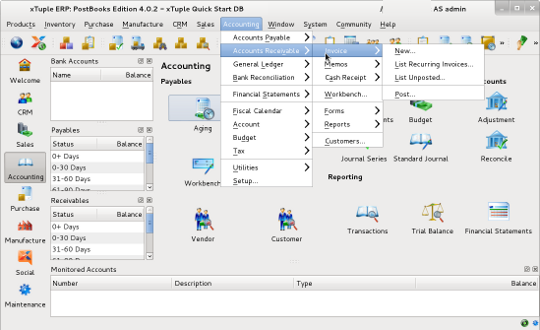
For some time I've been using PostBooks to keep track of finances. The traditional PostBooks system has a powerful Qt GUI. The xTuple team have been hard at work creating a shiny new web-based user interface. The traditional UI has no dedicated server - all users communicate directly with the PostgreSQL database where stored procedures and triggers ensure the correct logic is applied. The new model provides an xTuple application server that can handle requests from web users and potentially other third-party apps too. Who is it for? Some people may feel that the web UI is intended to appeal to mobile users. While it is useful for mobile and tablet devices, this is not strictly the aim, John has discussed this in a blog. One benefit of the web UI is that accountants and book-keepers do not need to have a copy of every exact PostBooks version that every client is using. Given that many people only need their accountant to look at their books for just a few hours at the end of each year, the ease of access with a web UI will make a big difference. Installing it quickly The xTuple Git repository provides a script to install the whole server quickly. Initially it just supported a single Ubuntu release, I just contributed some tweaks to generalize it for Debian wheezy and potentially other releases. It doesn't appear too difficult to generalize it further for Fedora or RHEL users. To get going, I recommend trying it in a fresh virtual machine, either in a server environment or desktop VirtualBox solution. The installation script will install various packages on the machine and mess about with the PostgreSQL setup so you will not want to run the automated setup script on any machine where you have existing databases. Once the virtual machine is setup, make sure sudo is installed and configured:
# apt-get install sudo
# visudo
and then run the install as your normal user:
git clone --recursive git://github.com/xtuple/xtuple.git
cd xtuple
git remote add XTUPLE git://github.com/xtuple/xtuple.git
git fetch XTUPLE
git checkout git describe --abbrev=0
chmod a+x scripts/install_xtuple.sh
scripts/install_xtuple.sh
If all goes well, 5-10 minutes later it is ready to run:
cd node-datasource
node main.js
The port numbers will appear on the screen and you can connect with a web browser. Trying it out Despite my comments above to the effect that this is not primarily aimed at mobile, the first and second device I tested with were both mobile devices, Samsung Galaxy S3 and a Samsung Galaxy Note 3. I feel the Note is far better for this type of application, primarily due to screen size and the fact that most of the forms in the application have fields that launch popup menus. It appears to work in both Chrome and Firefox on these devices. One handy feature is that the mobile device can dial numbers directly from the CRM address book, this is facilitated with the tel URI. My impression is that this is still a product that is in the final stages of development, although some people will be able to use it almost immediately. One significant thing to note is that the database schema is very stable due to the long history of the traditional xTuple/PostBooks products.

2 June 2014

Francesca Ciceri: 100 bugs triaged: achievement unlocked

After two weeks working as OPW intern for Mozilla, it's time for a recap!
What exactly I've been doing in these two weeks? 100 bugs triaged: achievement unlocked! Yes, this is the thing I'm most proud of. I'm a bit cheating here, as strictly speaking, since the beginning of the internship I've triaged only 44 bugs.
But I've decided to count from the beginning of my activity on bugzilla, at the end of March, since I've started work on that as part of the small contribution required for applying to OPW.
Therefore, it's all OPW related :) Here's the grand total. Right now, I've decided to work on an average of 5 bugs a day: it's mostly triage and/or verification, which is quite fun.
It consists in trying to have a more complete and detailed bug report for the developers: asking the right questions to the reporter, ensuring that the bug is filed against the right product or component and all the information about platforms and version are correct. Or verifying that the bug isn't a duplicate, which involves doing some voodoo with Bugzilla quicksearch (I'm not so good with that yet, mostly because I'm not imaginative enough in the queries... but I'm getting better!) Sometimes triaging means reading lots of documentation (to be sure that something is a bug and not a feature) and checking meta-bugs and release notes to be able to pinpoint the time when something was introduced and the reasoning behind it.
That takes a lot of time, but it makes you discover some funny things, like the Mighty Bouncing Unicorn. And while I know it sounds a bit cruel, it's really good when you're verifying a fix and you find it's not totally ok, or that it triggered another bug.
I've been assured that feeling satisfied after that it's an essential part of the sadistic QA work. Writing FAQs for new triager This started as a personal project even before knowing I've been selected for OPW, and it's now part of my internship: I've been writing a first draft of FAQ for those who approach for the first time the Bug Triaging and Verifying work in Mozilla. It meant taking a whole lot of IRC logs and scan them for the most asked questions during bugdays, and you can find here my first draft. I'll send a RFC today about it on dev-quality mailing list and link it to the main Bugdays page. Lessons learned So, what I've learned in these two weeks? That I'm pretty good at figuring things alone, but I like to have feedback on what I'm working on.
That testing things is an art, and perfectionism is a big plus.
That there are such things as stupid questions, but you have to ask them nonetheless.
That people in the Mozilla community are quite friendly and not scary at all. Not even in video! :) Wishlist I've been thinking about this a lot, and I think I'd like to have They will probably become my next pet project.

27 May 2014

Jon Dowland: Nine Inch Nails, Manchester, 2014

I spent the bank holiday weekend mostly in Manchester with my brother and a couple of friends, mostly to see Nine Inch Nails perform, but also to enjoy the pleasures of the city.

the Marble Arch's ceiling the Marble Arch's ceiling
We arrived on the Sunday and after checking in headed out to get some food. I'd booked us a table at the historic Marble Arch - the pub which gives its name to the parent company Marble Beers - and produce my most favourite ales. Whenever a Marble beer ends up as a guest at one of the Newcastle real ale pubs a friend of mine (who is much more on top of this stuff than I am) lets me know and we stop off for a few. Invariably there's a crowd of a dozen or so Manchester expats in bar when we do. I reserved our table over twitter, which is a bit of a novelty for me. My two friends are ale skeptics but - due to lack of choice - we all ended up sampling the Chocolate Marble and the Ginger 5.1, which went down a storm. They are possibly converts now. There was an Earl Grey IPA too, which was nice but a bit on the strong side for sessioning.
copyright   Jonathan Dowland 2014, http://creativecommons.org/licenses/by/4.0/ click for the animated version
The gig was great - I prefer club gigs to arena gigs but the sound techs for NIN know what they are doing and the mix was great. The visuals were stunning too. Highlights for me were "The Great Destroyer" - in particular the extended, improvised 5 minute glitch-meltdown coda; the slow build of "Eraser" and "The Day The World Went Away" - played faithfully to the CD mix rather than the traditional extended live arrangement. I miss the former live arrangement, which includes a drawn out drum-backed finish, but this arrangement had a lot of force, with all four of the band bashing guitars into a pummelling wall of sound. I've heard that at least one person has taped the show and it turns out recordings have just recently surfaced for the two club gigs my brother and I attended back in 2005 and 2007 - meaning there are now widely available, high quality ROIO copies for every NIN gig I've ever been to. Afterwards we tried to find a decent club. Manchester is a lot larger than my native city and there's plenty of places to go, if you know where they are. We had originally planned to visit The Factory on Charles Street, but we didn't believe it was open on the Sunday. The Factory is Peter Hook's (formerly of Joy Division/New Order) club - occupying the former office spaces of Factory records. I've chanced in there once before as it's right across the road from the Lass O' Gowrie pub, which is the haunt of choice for HE/tech people whenever we're in Manchester for conferences.
cheesy cocktail names cheesy cocktail names
Instead we gravitated towards Dry Bar on Oldham street. By coincidence this place also has historic ties to Factory Records. However the doormen wouldn't let us in! Finally we landed at a place which had one name on the door and a different name on the inside (Jack's). Like the aformentioned Lass O' Gowrie and perhaps half of all pubs and clubs in Manchester, the place is decked out as a shrine to the former musical giants of the City, with framed pictures of Mark E Smith, the Ha ienda again, the Stone Roses in their boy-band-looks hay day, John Peel (champion of many of them) and of course Tony Wilson. I can't help but wonder whether people who live here get royally sick of that. This place served some delicious albeit clich -titled Cocktails and played a pretty good set - the obligatory Madchester throwback interlude was followed by a chunk of Northern Soul and a couple of early Rap classics. Setlist wise it was pretty much identical to that of Foundation in Newcastle, 12 years ago, no doubt because Foundation was cribbing heavily from the Ha ienda in the first place.
Record haul Record haul
Monday was dedicated to exploring and shopping. Top of my list of places to go was my pilgrimage venue Vinyl Exchange. Whilst waiting for it to open we rolled around in Affleck's Palace, which turned out to have a small record stall within. After Vinyl Exchange we chanced across another record store right across the road - Picadilly Records - which happens to be larger and focuses more on new releases. It didn't take long before we found another small, DIY record shop, then another. We tried out the Fopp branch here - more Vinyl; then Urban Outfitters - more; then an Oxfam branch - even more. I actually got Vinyl snow blind at this point. I've been controlling myself admirably and only picked up a couple of bits and pieces. My best find was Fad Gadget's sophmore album "Incontinent".

Jon Dowland: 2012 In Review

2013 is nearly all finished up and so I thought I'd spend a little time writing up what was noteable in the last twelve months. When I did so I found an unfinished draft from the year before. It would be a shame for it to go to waste, so here it is. 2012 was an interesting year in many respects with personal highs and lows. Every year I see a lots of "round-up"-style blog posts on the web, titled things like "2012 in music", which attempt to summarize the highlights of the year in that particular context. Here's JWZ's effort, for example. Often they are prefixed with statements like "2012 was a strong year for music" or whatever. For me, 2012 was not a particularly great year. I discovered quite a lot of stuff that I love that was new to me, but not new in any other sense. In Music, there were a bunch of come-back albums that made the headlines. I picked up both of Orbital's Wonky and Brian Eno's Lux (debatably a comeback: his first ambient record since 1983, his first solo effort since 2005, but his fourth collaborative effort on Warp in the naughties). I've enjoyed them both, but I've already forgotten Wonky and I still haven't fully embraced Lux (and On Land has not been knocked from the top spot when I want to listen to ambience.) There was also Throbbing Gristle's (or X-TG) final effort, a semi/post-TG, partly posthumous double-album swan song effort which, even more than Lux, I still haven't fully digested. In all honesty I think it was eclipsed by the surprise one-off release of a live recording of a TG side project featuring Nik Void of Factory Floor: Carter Tutti Void's Transverse, which is excellent. Ostensibly a four-track release, there's a studio excerpt V4 studio (Slap 1) which is available from (at least) Amazon. There's also a much more obscure fifth "unreleased" track cruX which I managed to "buy" from one of the web shops for zero cost. The other big musical surprise for me last year was Beth Jeans Houghton and the Hooves of Destiny: Yours Truly, Cellophane Nose. I knew nothing of BJH, although it turns out I've heard some of her singles repeatedly on Radio 6, but her band's guitarist Ed Blazey and his partner lived in the flat below me briefly. In that time I managed to get to the pub with him just once, but he kindly gave me a copy of their album on 12" afterwards. It reminds me a bit of Goldfrapp circa "Seventh Tree": I really like it and I'm looking forward to whatever they do next. Reznor's How To Destroy Angels squeezed out An Omen EP which failed to set my world on fire as a coherent collection, despite a few strong songs individually. In movies, sadly once again I'd say most of the things I recall seeing would be "also rans". Prometheus was a disappointment, although I will probably rewatch it in 2D at least once. The final Batman was fun although not groundbreaking to me and it didn't surpass Ledger's efforts in The Dark Knight. Inception remains my favourite Nolan by a long shot. Looper is perhaps the stand-out, not least because it came from nowhere and I managed to avoid any hype. In games, I moaned about having moaning about too many games, most of which are much older than 2012. I started Borderlands 2 after enjoying Borderlands (disqualified on age grounds) but to this day haven't persued it much further. I mostly played the two similar meta-games: The Playstation Plus download free games in a fixed time period and the more sporadic but bountiful humble bundle whack-a-mole. More on these another time. In reading, as is typical I mostly read stuff that was not written in 2012. Of that which was, Charles Stross's The Apocalypse Codex was an improvement over The Fuller Memorandum which I did not enjoy much, but in general I'm finding I much prefer Stross's older work to his newer; David Byrne's How Music Works was my first (and currently last) Google Books ebook purchase, and I read it entirely on a Nexus 7. I thoroughly enjoyed the book but the experience has not made a convert of me away from paper. He leans heavily on his own experiences which is inevitable but fortunately they are wide and numerous. Iain Banks' Stonemouth was an enjoyable romp around a fictional Scottish town (one which, I am reliably informed, is incredibly realistical rendered). One of his "mainstream" novels, It avoided a particular plot pattern that I've grown to dread with Banks, much to my suprise (and pleasure). Finally, the stand-out pleasant surprise novel of the year was Pratchett and Baxter's The Long Earth. With a plot device not unlike Banks' Transition or Stross's Family Trade series, the pair managed to write a journey-book capturing the sense-of-wonder that these multiverse plots are good for. (Or perhaps I have a weakness for them). It's hard to find the lines between Baxter and Pratchett's writing, but the debatably-reincarnated Tibetan Monk-cum-Artificial Intelligence 'Lobsang' must surely be Pratchett's. Pratchett managed to squeeze out another non-Discworld novel (Dodger) as well as a long-overdue short story collection, although I haven't read either of them yet. On to 2013's write-up...

17 May 2014

Thorsten Glaser: Quotes of the day SWB Engrish

Stadtwerke Bonn conduct track works on the third
weekend of May 23-25th on several sections of the
line 61. The orbits of lines 61, 62 and 65 drive from
Friday 23 May to Sunday 25 May not on their usual
line paths. Due the track works a train replacement
service by busses will be established. Please note: The travel time of the shuttle busses
takes longer. It is recommend to adjust the traveling
plan. We apologise for any inconvenience! (Emphasis mine. Inconvenience, such as almost C N>K )

16 May 2014

Christoph Berg: PostgreSQL 9.4 on Debian

Yesterday saw the first beta release of the new PostgreSQL version 9.4. Along with the sources, we uploaded binary packages to Debian experimental and apt.postgresql.org, so there's now packages ready to be tested on Debian wheezy, squeeze, testing/unstable, and Ubuntu trusty, saucy, precise, and lucid. If you are using one of the release distributions of Debian or Ubuntu, add this to your /etc/apt/sources.list.d/pgdg.list to have 9.4 available: deb http://apt.postgresql.org/pub/repos/apt/ codename-pgdg main 9.4 On Debian jessie and sid, install the packages from experimental. Happy testing!

15 May 2014

Thorsten Glaser: Debian packaging example: PHP5 webapp with dbconfig-common and Apache 2.2/2.4 support

I m holding a Debian packaging workshop for our trainees at work tomorrow, and have prepared a sample package for a simple PHP web application (just a handful of files) with DB connection (PostgreSQL of course), automatic setup via dbconfig-common, and with support for both Apache 2.2 (wheezy, precise) and Apache 2.4 (jessie/sid), configuration-wise. (It is possible to install this without Apache, just it does not configure the webserver then.) Schema updates on software updates are also tested (there is neither Flyway nor Liquibase which are the tools we use at work for this, other than Roland Mas wonderful scripts for FusionForge in Debian, but to my delight I discovered that dbconfig-common can also do this). Comments, suggestions, flames, etc. welcome. I know that this should not be a native package, and will address this tomorrow, but I wanted something that serves as decent example for how to do this easily, Policy conformant and using modern techniques (even those I dislike myself for the sake of simplicity). Permission was granted by the business administration to reproduce this all under a BSD-style licence, so, enjoy sharing! Thanks to Roland Mas, for making FusionForge such a nice project, and Arno T ll for some instant IRC help on the Apache side of this. This is my first time using dbconfig-common, and now, I finally feel I know enough to finish the packaging of Kivitendo which I ve started earlier. Beta testers for that welcome, too. (And next week or so, I ll need this for a Maven thingy. I ll probably opt out on the DB side, there, though. Never did anything with that, either, not being a Java guy. I guess something web to go with tomcat7 anyone got this already?)

Russell Coker: Mobile Phones and Cognitive Costs

I previously wrote about the case for a Basic Income in Australia [1]. Since then I read an interesting article by Rutger Bregman in the Dutch site The Correspondent discussing the benefit that such Basic Income schemes have given in various places [2], he makes a great case for giving a Basic Income to poor people. However I believe that it should be provided to everyone. I believe that government payments shouldn t be means tested because the proportion of the population who earn more than the cutoff is usually very small (IE it doesn t save much money), because the money will be recovered from wealthy people in tax, and because the bureaucracy involved in determining who is eligible involves spending tax money to pay bureaucrats and costing everyone time in dealing with the process. The concept of an Attention Economy has been getting some interest recently. But discussions of it seem to be mostly concerned with the needs of fairly wealthy people, how to advertise to them, how to filter out unwanted ads for them, etc. But the costs in attention can be even worse for people on low incomes or social security because they have many attention costs that could be solved by money. Many common essential purchases (EG soap, basic foods, and purely functional clothes) can become difficult decisions if saving a few dollars is important. The amount of thought involved in buying such items can result in someone who s not well off having little energy to concentrate on other things. I think that to have an effective social security system we need to consider how much cognitive effort is being required of people who are receiving benefits. Last month I wrote yet another review of mobile phone plans in Australia [3]. Every time I do this it takes a significant amount of time because the Telcos devise overly complex plans to make it difficult to compare their offerings. It seems that they aim to make their offerings somewhat competitive if you can interpret them but confusing enough to allow many (most?) of their customers to pay needlessly high bills. I could just pick a random telco and pay whatever it takes, spending an extra $10 or $20 per month isn t such a big deal for me. Even though I advise a number of my relatives on the cheapest phone plan it s probably only barely saving enough money to be worth the effort, a major motivation for me is being stubborn and not wanting telcos to rip people off. The Importance of Mobile Phones A mobile phone seems to be essential for most people. Mobile phones are used for making medical appointments and for applying for work, so in almost every case some of the financial assistance paid to a job seeker or person on a disability pension will go towards mobile phone costs. The aims of the social security benefits seem to clearly involve a phone service. Given that most people who receive social security payments spend some of that money on mobile phone bills the government has a direct financial interest in not having such money wasted on needlessly expensive phone plans. As we also don t want to have people on social security spending time and attention trying to find the best phone plan it makes sense to have the government help manage this process. Good communications is regarded as essential to education and economic development. A huge amount of taxpayer money was spent on the NBN (and then wasted by Tony Abbott when he cancelled the original plans) for these benefits. Good phone access is also an issue of personal safety. While it is possible to call emergency services from a mobile phone that doesn t have a valid SIM there are probably few people who keep a spare phone charged for that purpose. Also there are a variety of issues that can impact life or health which can best be resolved by calling friends or relatives. Free Phones I think that the best solution to these problems is for the government to directly pay mobile phone bills. If we are going to have a Basic Income then the government should make the base payment for mobile phone calls for every resident, if not then the government should make the base payment for everyone who receives any form of social security payment. Obviously the amount of data that could be transferred over a 3G network is greatly in excess of the amount that any plans allow and offering true unlimited calling leads to people using mobile phones as baby-monitors, so some limits are necessary. But the government could cheaply pay for a phone plan that exceeds the requirements of most people and then allow anyone who wants more data or calls to pay extra. Which Plan? The cheapest all-inclusive mobile phone plan in recent times was Kogan who charged $299 per annum for 6G of data per month and unlimited calls. The cheapest current offer for unlimited calls seems to be Lebara s $30 per month offer which includes 2G of data. My observation is that people who use 3G Internet just for phone use (as opposed to tethering a laptop or providing home Internet), who use a home Wifi network for installing Android programs and don t play Ingress tend to use a lot less than 1G of data per month. I would use between 400M and 700M per month if I wasn t playing Ingress and didn t use my phone as a Wifi access point. In terms of call volume, 600 minutes a month should be enough to cover the basic needs of most people judging by the number of plans on offer with limits smaller than that. As a current Lebara offer is $30 per month for unlimited calls and 2G of data (and there are similar offers from other telcos), it should be possible for a telco to offer 600 minutes of calls and 1G of data for less than $15 per month. When the government is paying (no bad debts) and many of the users will use much less than the quota such a plan should be profitable at $10 per month or less. Implementation The way to implement this would be to start with a tender that has a hard requirement for the minimum amount of service provided. This would include the number of minutes per month for calls, the number of SMS sent, and the amount of data transfer. To avoid excessive billing (a standard telco scam) there should be a requirement that fees for extra use not exceed some small multiple of the base rate, for example if the government was paying $10 for 600 minutes of calls and 1G of data the excess usage charges could be capped at 3 cents per meg and 5 cents per minute (3* the base rate) which would be profitable for the telco but not a scam. If the telcos act in a market driven competitive manner they will compete to provide the most attractive offerings for $10 per month. If the build cost of the NBN had been invested at government bond rates (for any of the rates used for current bonds) then it would pay for the mobile phone bills for every resident forever, so the cost of providing phones for everyone is in the range of government telecommunications programs. If people who are working were to pay an extra $10 in tax and people who are on social security had their benefits reduced by $10 then that would be a great deal if it saved them the $20 or more that most people spend on a basic phone plan. Government Phone Delays A friend who s a single mother pays for an unlimited mobile phone plan because calls to the social security office are usually kept on hold for more than an hour. It s likely that she could save money over the course of a year by paying for a cheaper plan and just dealing with the occasional big bill, but she needs to budget carefully and feels that she can t take that risk. It seems stupid that government phone delays (partly caused by cutting funds for staff) cause increased expenses for people who are receiving social security payments. If the government implemented a smart queuing system that allowed them to call people back instead of making them wait on hold then it would save money overall. So there are obviously other ways that the government can save money on phone calls and time for everyone.

14 May 2014

C.J. Adams-Collier: Configuring voice service on a Cisco 2801 Integrated Services Router via Asterisk

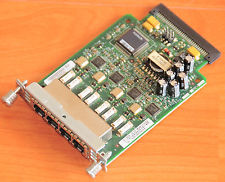
So I ve configured voice service a number of times, but never using Cisco equipment. There s a business starting up here on Orcas Island and they need a number of lines voice and fax service. I had a spare 2801 router laying around and heard that it s possible to provision voice service using these machines. So I looked on eBay for a module that will provide more than two FXS ports and decided on the VIC-4FXS. When it was delivered, I installed it and booted the router. It told me that it needed a PVDM DSP Module, so I got one of those as well. It has arrived. I have installed it. Now when I boot the router, I don t get a warning or an error. configure the router to send outbound calls to the SIP server configure the router to send inbound calls to FXS ports 2,3,4 in round robin
trunk group FXSlines
!
voice-port 0/2/1
 trunk-group FXSlines
!
voice-port 0/2/2
 trunk-group FXSlines
!
voice-port 0/2/3
 trunk-group FXSlines
configure the router to send inbound calls to the correct ports on the VIC-4FXS
dial-peer voice 1 pots
 preference 7
 destination-pattern 3602987792
 translate-outgoing called 10
 port 0/2/0
 forward-digits all
!
dial-peer voice 2 pots
 preference 2
 destination-pattern 3602987793
 translate-outgoing called 10
 port 0/2/1
 forward-digits all
!
dial-peer voice 3 pots
 preference 3
 destination-pattern 3602987794
 translate-outgoing called 10
 port 0/2/2
 forward-digits all
!
dial-peer voice 4 pots
 preference 4
 destination-pattern 3602987795
 translate-outgoing called 10
 port 0/2/3
 forward-digits all
configure the router to accept inbound calls from the asterisk call server
voice service voip
 allow-connections sip to sip
 no supplementary-service sip moved-temporarily
 no supplementary-service sip refer
 fax protocol t38 ls-redundancy 0 hs-redundancy 0 fallback cisco
 sip
  registrar server expires max 3600 min 3600
  localhost dns:8.8.8.8
configure the asterisk call server to send inbound calls to the router On asterisk call server, edit sip.conf to register with SIP server on cisco router at 172.16.78.209:
[fhvoice]
type=peer
insecure=port,invite
context=fhvoice
disallow=all
allow=ulaw
language=en
canreinvite=no
host=172.16.78.209
qualify=20000
dtmfmode=rfc2833
On asterisk call server, edit extensions.conf and add extensions to the incoming context:
exten => 3602987792,1,Dial(SIP/fhvoice/$ EXTEN ,30)
   same => n,Hangup()
exten => 3602987793,1,Dial(SIP/fhvoice/$ EXTEN ,30)
   same => n,Hangup()
exten => 3602987794,1,Dial(SIP/fhvoice/$ EXTEN ,30)
   same => n,Hangup()
exten => 3602987795,1,Dial(SIP/fhvoice/$ EXTEN ,30)
   same => n,Hangup()
configure the asterisk call server to accept outbound calls from the router

13 May 2014

Thorsten Glaser: L gen haben lange Leitern

Photo von Laternenmast mit Wahlplakaten, oben Pro NRW, unten Endlich tut mal jemand was gegen die rechte Hetzpartei! Ein Arbeitskollege fragt, ob man die nicht einfach mit einem langen Heckenschneider abmachen kann aber sie so l cherlich zu machen hat auch was

Finally, someone is doing something against this Nazi party! A coworker wondered whether it s legal to cut them off with a long tool, but making them ridiculous like this is also funny

(Explanation: the Pro NRW people put their campaign thingies (sorry, I don t speak English well) up on lamp posts very high, because they are taken down by other citizens immediately otherwise, so there s now people making fun of them for using long ladders (to put them up there, so the offended citizens need equally long ladders or tools with long arms) in leaning on the saying that lies have long legs here: ladders.)

8 May 2014

Riku Voipio: Arm builder updates

Debian has recently received a donation of 8 build machines from Marvell. The new machines come with Quad core MV78460 Armada XP CPU's, DDR3 DIMM slot so we can plug in more memory, and speedy sata ports. They replace the well served Marvell MV78200 based builders - ones that have been building debian armel since 2009. We are planning a more detailed announcement, but I'll provide a quick summary: The speed increase provided by MV78460 can viewed by comparing build times on selected builds since early april: Qemu build times. We can now build Qemu in 2h instead of 16h -8x faster than before! Certainly a substantial improvement, so impressive kit from Marvell! But not all packages gain this amount of speedup: webkitgtk build times. This example, webkitgtk, builds barely 3x faster. The explanation is found from debian/rules of webkitgkt:

# Parallel builds are unstable, see #714072 and #722520
# ifneq (,$(filter parallel=%,$(DEB_BUILD_OPTIONS)))
# NUMJOBS = $(patsubst parallel=%,%,$(filter parallel=%,$(DEB_BUILD_OPTIONS)))
# MAKEARGUMENTS += -j$(NUMJOBS)
# endif
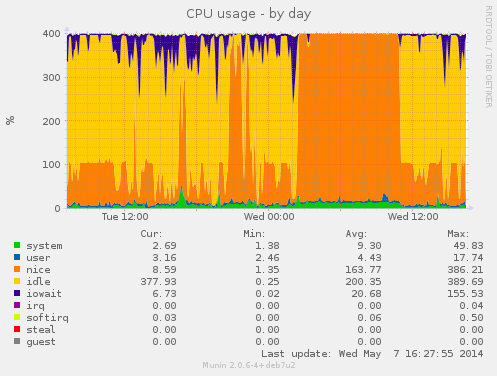
The old builders are single-core[1], so the regardless of parallel building, you can easily max out the cpu. New builders will use only 1 of 4 cores without parallel build support in debian/rules. During this buildd cpu usage graph, we see most time only one CPU is consumed. So for fast package build times.. make sure your packages supports parallel building. For developers, abel.debian.org is porter machine with Armada XP. It has schroot's for both armel and armhf. set "DEB_BUILD_OPTIONS=parallel=4" and off you go. Finally I'd like to thank Thomas Petazzoni, Maen Suleiman, Hector Oron, Steve McIntyre, Adam Conrad and Jon Ward for making the upgrade happen. Meanwhile, we have unrelated trouble - a bunch of disks have broken within a few days apart. I take the warranty just run out... [1] only from Linux's point of view. - mv78200 has actually 2 cores, just not SMP or coherent. You could run an RTOS on the other core while you run Linux on the other.

7 May 2014

Mario Lang: Planet bug: empty alt tags for hackergotchis

There is a strange bug in Planet Debian I am seeing since I joined. It is rather minor, but since it is an accessibility bug, I'd like to mention it here. I have written to the Planet Debian maintainers, and was told to figure it out myself. This is a pattern, accessibility is considered wishlist, apparently. And the affected people are supposed to fix it on their own. It is better if I don't say anything more about that attitude.

The Bug On Planet Debian, only some people have an alt tag for their hackergotchi, while all the configured entries look similar. There is no obvious difference in the configuration, but still, only some users here have a proper alt tag for their hackergotchi. Here is a list:
  • Dirk Eddelbuettel
  • Steve Kemp
  • Wouter Verhelst
  • Mehdi (noreply@blogger.com)
  • Andrew Pollock
  • DebConf Organizers
  • Francois Marier
  • The MirOS Project (tg@mirbsd.org)
  • Paul Tagliamonte
  • Lisandro Dami n Nicanor P rez Meyer (noreply@blogger.com)
  • Joey Hess
  • Chris Lamb
  • Mirco Bauer
  • Christine Spang
  • Guido G nther
These people/organisations currently displayed on Planet Debian have a proper alt tag for their hackergotchi. All the other members have none. In Lynx, it looks like the following:
hackergotchi for
And for those where it works, it looks like:
hackergotchi for Dirk Eddelbuettel
Strange, isn't it? If you have any idea why this might be happening, let me know, or even better, tell Planet Debian maintainers how to fix it. P.S.: Package planet-venus says it is a rewrite of Planet, and Planet can be found in Debian as well. I don't see it in unstable, maybe I am blind? Or has it been removed recently? If so, the package description of planet-venus is wrong.

6 May 2014

Steve Kemp: New emacs?

The recent flurry of activity with neovim have made me wonder if there could be something similar for the other editor, emacs. If you poke around recent GNU Emacs releases you'll come across random signs that the code carries a lot of baggage:
/usr/share/emacs/23.4/etc/MACHINES
There are special considerations for a variety of this system which is known as the Yellow Dog [GNU/]Linux' Yellow Dog [GNU/]Linux has been dead for many years now.
/etc/emacs/site-start.d/50dictionaries-common.el
Contains references to skipping stuff that runs under Emacs 19, 20, 21, & 22.
None of these are huge things, and the core code of Emacs is a pleasure to read in many places, but it does make you think, or not, whichever the case may be it is all good :) (I do all "real work" in emacs. I write all outgoing emails in vim, and use it for git/mercurial commit messsages, otherwise the only time I use it is for random one-line edits over slow links.)

4 May 2014

Thorsten Glaser: Maibaum f r Ada

While taking the tram to our favourite Croatian restaurant, I spotted something dedicated to Ada. We ll never know which one the language, the famous programmer, or someone else. A Maibaum (may pole, one of its many meanings). Click on the picture to get a slightly different one which has the text better legible. Ada-Maibaum

29 April 2014

Petter Reinholdtsen: Half the Coverity issues in Gnash fixed in the next release

I've been following the Gnash project for quite a while now. It is a free software implementation of Adobe Flash, both a standalone player and a browser plugin. Gnash implement support for the AVM1 format (and not the newer AVM2 format - see Lightspark for that one), allowing several flash based sites to work. Thanks to the friendly developers at Youtube, it also work with Youtube videos, because the Javascript code at Youtube detect Gnash and serve a AVM1 player to those users. :) Would be great if someone found time to implement AVM2 support, but it has not happened yet. If you install both Lightspark and Gnash, Lightspark will invoke Gnash if it find a AVM1 flash file, so you can get both handled as free software. Unfortunately, Lightspark so far only implement a small subset of AVM2, and many sites do not work yet. A few months ago, I started looking at Coverity, the static source checker used to find heaps and heaps of bugs in free software (thanks to the donation of a scanning service to free software projects by the company developing this non-free code checker), and Gnash was one of the projects I decided to check out. Coverity is able to find lock errors, memory errors, dead code and more. A few days ago they even extended it to also be able to find the heartbleed bug in OpenSSL. There are heaps of checks being done on the instrumented code, and the amount of bogus warnings is quite low compared to the other static code checkers I have tested over the years. Since a few weeks ago, I've been working with the other Gnash developers squashing bugs discovered by Coverity. I was quite happy today when I checked the current status and saw that of the 777 issues detected so far, 374 are marked as fixed. This make me confident that the next Gnash release will be more stable and more dependable than the previous one. Most of the reported issues were and are in the test suite, but it also found a few in the rest of the code. If you want to help out, you find us on the gnash-dev mailing list and on the #gnash channel on irc.freenode.net IRC server.

28 April 2014

Evgeni Golov: Debian Bug Squashing Party Salzburg 2014

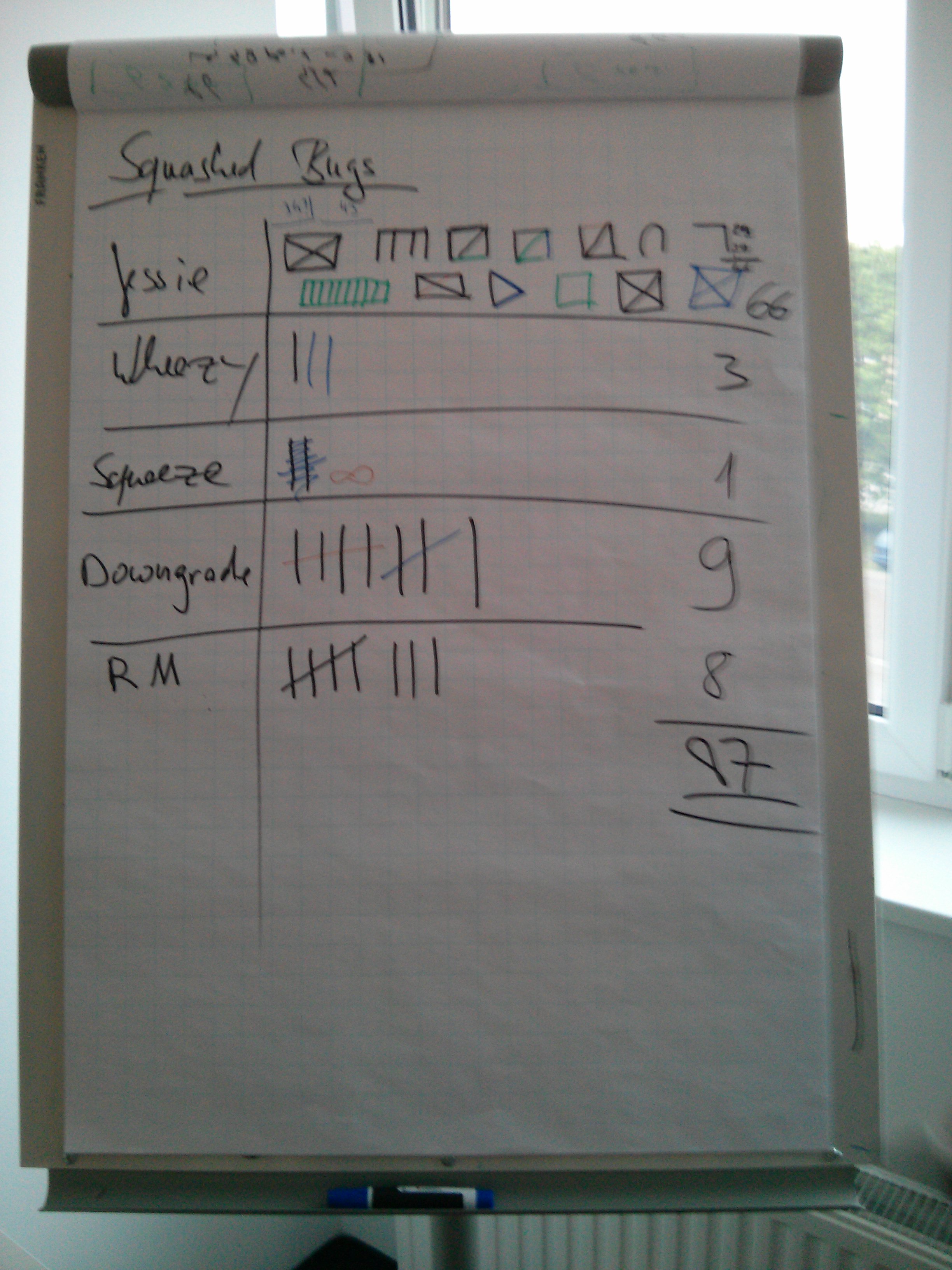
bsp2014_small This weekend, Bernd Zeimetz organized a BSP at the offices of conova in Salzburg, Austria. Three days of discussions, bugfixes, sparc removals and a lot of fun and laughter. We squashed a total of 87 bugs: 66 bugs affecting Jessie/Sid were closed, 9 downgraded and 8 closed via removals. As people tend to care about (old)stable, 3 bugs were fixed in Wheezy and one in Squeeze. These numbers might be not totaly correct, as were kinda creative at counting Marga promised a talk about an introduction to properly counting bugs using the Haus vom Nikolaus algorithm to the base of 7 . IMG_20140427_182902 Speaking of numbers, I touched the following bugs (not all RC): A couple of (non-free) pictures are available at Uwe s salzburg-cityguide.at. Thanks again to Bernd for organizing and conova and credativ for sponsoring!

27 April 2014

Vincent Bernat: Local corporate APT repositories

Distributing software efficiently accross your platform can be difficult. Every distribution comes with a package manager which is usually suited for this task. APT can be relied upon on when using Debian or a derivative. Unfortunately, the official repositories may not contain everything you need. When you require unpackaged software or more recent versions, it is possible to setup your own local repository. Most of what is presented here was setup for Dailymotion and was greatly inspired by the work done by Rapha l Pinson at Orange.

Setting up your repositories There are three kinds of repositories you may want to setup:
  1. A distribution mirror. Such a mirror will save bandwidth, provide faster downloads and permanent access, even when someone searches Google on Google.
  2. A local repository for your own packages with the ability to have a staging zone to test packages on some servers before putting them in production.
  3. Mirrors for unofficial repositories, like Ubuntu PPA. To avoid unexpected changes, such a repository will also get a staging and a production zone.
Before going further, it is quite important to understand what a repository is. Let s illustrate with the following line from my /etc/apt/sources.list:
deb http://ftp.debian.org/debian/ unstable main contrib non-free
In this example, http://ftp.debian.org/debian/ is the repository and unstable is the distribution. A distribution is subdivided into components. We have three components: main, contrib and non-free. To setup repositories, we will use reprepro. This is not the only solution but it has a good balance between versatility and simplicity. reprepro can only handle one repository. So, the first choice is about how you will split your packages in repositories, distributions and components. Here is what matters:
  • A repository cannot contain two identical packages (same name, same version, same architecture).
  • Inside a component, you can only have one version of a package.
  • Usually, a distribution is a subset of the versions while a component is a subset of the packages. For example, in Debian, with the distribution unstable, you choose to get the most recent versions while with the component main, you choose to get DFSG-free software only.
If you go for several repositories, you will have to handle several reprepro instances and won t be able to easily copy packages from one place to another. At Dailymotion, we put everything in the same repository but it would also be perfectly valid to have three repositories:
  • one to mirror the distribution,
  • one for your local packages, and
  • one to mirror unofficial repositories.
Here is our target setup: Local APT repository

Initial setup First, create a system user to work with the repositories:
$ adduser --system --disabled-password --disabled-login \
>         --home /srv/packages \
>         --group reprepro
All operations should be done with this user only. If you want to setup several repositories, create a directory for each of them. Each repository has those subdirectories:
  • conf/ contains the configuration files,
  • gpg/ contains the GPG stuff to sign the repository1,
  • logs/ contains the logs,
  • www/ contains the repository that should be exported by the web server.
Here is the content of conf/options:
outdir +b/www
logdir +b/logs
gnupghome +b/gpg
Then, you need to create the GPG key to sign the repository:
$ GNUPGHOME=gpg gpg --gen-key
Please select what kind of key you want:
   (1) RSA and RSA (default)
   (2) DSA and Elgamal
   (3) DSA (sign only)
   (4) RSA (sign only)
Your selection? 1
RSA keys may be between 1024 and 4096 bits long.
What keysize do you want? (2048) 4096
Requested keysize is 4096 bits
Please specify how long the key should be valid.
         0 = key does not expire
      <n>  = key expires in n days
      <n>w = key expires in n weeks
      <n>m = key expires in n months
      <n>y = key expires in n years
Key is valid for? (0) 10y
Key expires at mer. 08 nov. 2023 22:30:58 CET
Is this correct? (y/N) y
Real name: Dailymotion Archive Automatic Signing Key
Email address: the-it-operations@dailymotion.com
Comment: 
[...]
By setting an empty password, you allow reprepro to run unattended. You will have to distribute the public key of your new repository to let APT check the archive signature. An easy way is to ship it in some package.

Local mirror of an official distribution Let s start by mirroring a distribution. We want a local mirror of Ubuntu Precise. For this, we need to do two things:
  1. Setup a new distribution in conf/distributions.
  2. Configure the update sources in conf/updates.
Let s add this block to conf/distributions:
# Ubuntu Precise
Origin: Ubuntu
Label: Ubuntu
Suite: precise
Version: 12.04
Codename: precise
Architectures: i386 amd64
Components: main restricted universe multiverse
UDebComponents: main restricted universe multiverse
Description: Ubuntu Precise 12.04 (with updates and security)
Contents: .gz .bz2
UDebIndices: Packages Release . .gz
Tracking: minimal
Update: - ubuntu-precise ubuntu-precise-updates ubuntu-precise-security
SignWith: yes
This defines the precise distribution in our repository. It contains four components: main, restricted, universe and multiverse (like the regular distribution in official repositories). The Update line starts with a dash. This means reprepro will mark everything as deleted before updating with the provided sources. Old packages will not be kept when they are removed from Ubuntu. In conf/updates, we define the sources:
# Ubuntu Precise
Name: ubuntu-precise
Method: http://fr.archive.ubuntu.com/ubuntu
Fallback: http://de.archive.ubuntu.com/ubuntu
Suite: precise
Components: main main multiverse restricted universe
UDebComponents: main restricted universe multiverse
Architectures: amd64 i386
VerifyRelease: 437D05B5
GetInRelease: no
# Ubuntu Precise Updates
Name: ubuntu-precise-updates
Method: http://fr.archive.ubuntu.com/ubuntu
Fallback: http://de.archive.ubuntu.com/ubuntu
Suite: precise-updates
Components: main restricted universe multiverse
UDebComponents: main restricted universe multiverse
Architectures: amd64 i386
VerifyRelease: 437D05B5
GetInRelease: no
# Ubuntu Precise Security
Name: ubuntu-precise-security
Method: http://fr.archive.ubuntu.com/ubuntu
Fallback: http://de.archive.ubuntu.com/ubuntu
Suite: precise-security
Components: main restricted universe multiverse
UDebComponents: main restricted universe multiverse
Architectures: amd64 i386
VerifyRelease: 437D05B5
GetInRelease: no
The VerifyRelease lines are GPG key fingerprint to use to check the remote repository. The key needs to be imported in the local keyring:
$ gpg --keyring /usr/share/keyrings/ubuntu-archive-keyring.gpg \
>     --export 437D05B5   GNUPGHOME=gpg gpg --import
Another important point is that we merge three distributions (precise, precise-updates and precise-security) into a single distribution (precise) in our local repository. This may cause some difficulties with tools expecting the three distributions to be available (like the Debian Installer2). Next, you can run reprepro and ask it to update your local mirror:
$ reprepro update
This will take some time on the first run. You can execute this command every night. reprepro is not the fastest mirror solution but it is easy to setup, flexible and reliable.

Repository for local packages Let s configure the repository to accept local packages. For each official distribution (like precise), we will configure two distributions:
  • precise-staging contains packages that have not been fully tested and not ready to go to production.
  • precise-prod contains production packages copied from precise-staging.
In our workflow, packages are introduced in precise-staging where they can be tested and will be copied to precise-prod when we want them to be available for production. You can adopt a more complex workflow if you need. The reprepro part is quite easy. We add the following blocks into conf/distributions:
# Dailymotion Precise packages (staging)
Origin: Dailymotion #  
Label: dm-staging   #  
Suite: precise-staging
Codename: precise-staging
Architectures: i386 amd64 source
Components: main role/dns role/database role/web #  
Description: Dailymotion Precise staging repository
Contents: .gz .bz2
Tracking: keep
SignWith: yes
NotAutomatic: yes #  
Log: packages.dm-precise-staging.log
 --type=dsc email-changes
# Dailymotion Precise packages (prod)
Origin: Dailymotion #  
Label: dm-prod      #  
Suite: precise-prod
Codename: precise-prod
Architectures: i386 amd64 source
Components: main role/dns role/database role/web #  
Description: Dailymotion Precise prod repository
Contents: .gz .bz2
Tracking: keep
SignWith: yes
Log: packages.dm-precise-prod.log
First notice we use several components (in ):
  • main will contain packages that are not specific to a subset of the platform. If you put a package in main, it should work correctly on any host.
  • role/* are components dedicated to a subset of the platform. For example, in role/dns, we ship a custom version of BIND.
The staging distribution has the NotAutomatic flag (in ) which disallows the package manager to install those packages except if the user explicitely requests it. Just below, when a new dsc file is uploaded, the hook email-changes will be executed. It should be in the conf/ directory. The Origin and Label lines (in ) are quite important to be able to define an explicit policy of which packages should be installed. Let s say we use the following /etc/apt/sources.list file:
# Ubuntu packages
deb http://packages.dm.gg/dailymotion precise main restricted universe multiverse
# Dailymotion packages
deb http://packages.dm.gg/dailymotion precise-prod    main role/dns
deb http://packages.dm.gg/dailymotion precise-staging main role/dns
All servers have the precise-staging distribution. We must ensure we won t install those packages by mistake. The NotAutomatic flag is one possible safe-guard. We also use a tailored /etc/apt/preferences:
Explanation: Dailymotion packages of a specific component should be more preferred
Package: *
Pin: release o=Dailymotion, l=dm-prod, c=role/*
Pin-Priority: 950
Explanation: Dailymotion packages should be preferred
Package: *
Pin: release o=Dailymotion, l=dm-prod
Pin-Priority: 900
Explanation: staging should never be preferred
Package: *
Pin: release o=Dailymotion, l=dm-staging
Pin-Priority: -100
By default, packages will have a priority of 500. By setting a priority of -100 to the staging distribution, we ensure the packages cannot be installed at all. This is stronger than NotAutomatic which sets the priority to 1. When a package exists in Ubuntu and in our local repository, we ensure that, if this is a production package, we will use ours by using a priority of 900 (or 950 if we match a specific role component). Have a look at the How APT Interprets Priorities section of apt_preferences(5) manual page for additional information. Keep in mind that version matters only when the priority is the same. To check if everything works as you expect, use apt-cache policy:
$ apt-cache policy php5-memcache
  Installed: 3.0.8-1~precise2~dm1
  Candidate: 3.0.8-1~precise2~dm1
  Version table:
 *** 3.0.8-1~precise2~dm1 0
        950 http://packages.dm.gg/dailymotion/ precise-prod/role/web amd64 Packages
        100 /var/lib/dpkg/status
     3.0.8-1~precise1~dm4 0
        900 http://packages.dm.gg/dailymotion/ precise-prod/main amd64 Packages
       -100 http://packages.dm.gg/dailymotion/ precise-staging/main amd64 Packages
     3.0.6-1 0
        500 http://packages.dm.gg/dailymotion/ precise/universe amd64 Packages
If we want to install a package from the staging distribution, we can use apt-get with the -t precise-staging option to raise the priority of this distribution to 990. Once you have tested your package, you can copy it from the staging distribution to the production distribution:
$ reprepro -C main copysrc precise-prod precise-staging wackadoodle

Local mirror of third-party repositories Sometimes, you want a software published on some third-party repository without to repackage it yourself. A common example is the repositories edited by hardware vendors. Like for an Ubuntu mirror, there are two steps: defining the distribution and defining the source. We chose to put such mirrors into the same distributions as our local packages but with a dedicated component for each mirror. This way, those third-party packages will share the same workflow as our local packages: they will appear in the staging distribution, we validate them and copy them to the production distribution. The first step is to add the components and an appropriate Update line to conf/distributions:
Origin: Dailymotion
Label: dm-staging
Suite: precise-staging
Components: main role/dns role/database role/web vendor/hp
Update: hp
# [...]
Origin: Dailymotion
Label: dm-prod
Suite: precise-prod
Components: main role/dns role/database role/web vendor/hp
# [...]
We added the vendor/hp component to both the staging and the production distributions. However, only the staging distribution gets an Update line (remember, packages will be copied manually into the production distribution). We declare the source in conf/updates:
# HP repository
Name: hp
Method: http://downloads.linux.hp.com/SDR/downloads/ManagementComponentPack/
Suite: precise/current
Components: non-free>vendor/hp
Architectures: i386 amd64
VerifyRelease: 2689B887
GetInRelease: no
Don t forget to add the GPG key to your local keyring. Notice an interesting feature of reprepro: we copy the remote non-free component to our local vendor/hp component. Then, you can synchronize the mirror with reprepro update. Once the packages have been tested, you will have to copy them in the production distribution.

Building Debian packages Our reprepro setup seems complete, but how do we put packages into the staging distribution? You have several options to build Debian packages for your local repository. It really depends on how much time you want to invest in this activity:
  1. Build packages from source by adding a debian/ directory. This is the classic way of building Debian packages. You can start from scratch or use an existing package as a base. In the latest case, the package can be from the official archive but for a more recent distribution or a backport or from an unofficial repository.
  2. Use a tool that will create a binary package from a directory, like fpm. Such a tool will try to guess a lot of things to minimize your work. It can even download everything for you.
There is no universal solution. If you don t have the time budget for building packages from source, have a look at fpm. I would advise you to use the first approach when possible because you will get those perks for free:
  • You keep the sources in your repository. Whenever you need to rebuild something to fix an emergency bug, you won t have to hunt the sources which may be unavailable when you need them the most. Of course, this only works if you build packages that don t download stuff directly from the Internet.
  • You also keep the recipe3 to build the package in your repository. If someone enables some option and rebuild the package, you won t accidently drop this option on the next build. Those changes can be documented in debian/changelog. Moreover, you can use a version control software for the whole debian/ directory.
  • You can propose your package for inclusion into Debian. This will help many people once the package hits the archive.

Builders We chose pbuilder as a builder4. Its setup is quite straightforward. Here is our /etc/pbuilderrc:
DISTRIBUTION=$DIST
NAME="$DIST-$ARCH"
MIRRORSITE=http://packages.dm.gg/dailymotion
COMPONENTS=("main" "restricted" "universe" "multiverse")
OTHERMIRROR="deb http://packages.dm.gg/dailymotion $ DIST -staging main"
HOOKDIR=/etc/pbuilder/hooks.d
BASE=/var/cache/pbuilder/dailymotion
BASETGZ=$BASE/$NAME/base.tgz
BUILDRESULT=$BASE/$NAME/results/
APTCACHE=$BASE/$NAME/aptcache/
DEBBUILDOPTS="-sa"
KEYRING="/usr/share/keyrings/dailymotion-archive.keyring.gpg"
DEBOOTSTRAPOPTS=("--arch" "$ARCH" "--variant=buildd" "$ DEBOOTSTRAPOPTS[@] " "--keyring=$KEYRING")
APTKEYRINGS=("$KEYRING")
EXTRAPACKAGES=("dailymotion-archive-keyring")
pbuilder is expected to be invoked with DIST, ARCH and optionally ROLE environment variables. Building the initial bases can be done like this:
for ARCH in i386 amd64; do
  for DIST in precise; do
    export ARCH
    export DIST
    pbuilder --create
  done
done
We don t create a base for each role. Instead, we use a D hook to add the appropriate source:
#!/bin/bash
[ -z "$ROLE" ]    
  cat >> /etc/apt/sources.list <<EOF
deb http://packages.dm.gg/dailymotion $ DIST -staging role/$ ROLE 
EOF
 
apt-get update
We ensure packages from our staging distribution are preferred over other packages by adding an /etc/apt/preferences file in a E hook:
#!/bin/bash
cat > /etc/apt/preferences <<EOF
Explanation: Dailymotion packages are of higher priority
Package: *
Pin: release o=Dailymotion
Pin-Priority: 900
EOF
We also use a C hook to get a shell in case there is an error. This is convenient to debug a problem:
#!/bin/bash
apt-get install -y --force-yes vim less
cd /tmp/buildd/*/debian/..
/bin/bash < /dev/tty > /dev/tty 2> /dev/tty
A manual build can be run with:
$ ARCH=amd64 DIST=precise ROLE=web pbuilder \
>         --build somepackage.dsc

Version numbering To avoid to apply complex rules to chose a version number for a package, we chose to treat everything as a backport, even in-house software. We use the following scheme: X-Y~preciseZ+dmW.
  • X is the upstream version5.
  • Y is the Debian version. If there is no Debian version, use 0.
  • Z is the Ubuntu backport version. Again, if such a version doesn t exist, use 0.
  • W is our version of the package. We increment it when we make a change to the packaging. This is the only number we are allowed to control. All the others are set by an upstream entity, unless it doesn t exist and in this case, you use 0.
Let s suppose you need to backport wackadoodle. It is available in a more recent version of Ubuntu as 1.4-3. Your first backport will be 1.4-3~precise0+dm1. After a change to the packaging, the version will be 1.4-3~precise0+dm2. A new upstream version 1.5 is available and you need it. You will use 1.5-0~precise0+dm1. Later, this new upstream version will be available in some version of Ubuntu as 1.5-3ubuntu1. You will rebase your changes on this version and get 1.5-3ubuntu1~precise0+dm1. When using Debian instead of Ubuntu, a compatible convention could be : X-Y~bpo70+Z~dm+W.

Uploading To upload a package, a common setup is the following workflow:
  1. Upload the source package to an incoming directory.
  2. reprepro will notice the source package, check its correctness (signature, distribution) and put it in the archive.
  3. The builder will notice a new package needs to be built and build it.
  4. Once the package is built, the builder will upload the result to the incoming directory.
  5. reprepro will notice again the new binary package and integrate it in the archive.
This workflow has the disadvantage to have many moving pieces and to leave the user in the dark while the compilation is in progress. As an alternative, a simple script can be used to execute each step synchronously. The user can follow on their terminal that everything works as expected. Once we have the .changes file, the build script just issues the appropriate command to include the result in the archive:
$ reprepro -C main include precise-staging \
>      wackadoodle_1.4-3~precise0+dm4_amd64.changes
Happy hacking!

  1. The gpg/ directory could be shared by several repositories.
  2. We teached Debian Installer to work with our setup with an appropriate preseed file.
  3. fpm-cookery is a convenient tool to write recipes for fpm, similar to Homebrew or a BSD port tree. It could be used to achieve the same goal.
  4. sbuild is an alternative to pbuilder and is the official builder for both Debian and Ubuntu. Historically, pbuilder was more focused on developers needs.
  5. For a Git snapshot, we use something like 1.4-git20130905+1-ae42dc1 which is a snapshot made after version 1.4 (use 0.0 if no version has ever been released) at the given date. The following 1 is to be able to package different snapshots at the same date while the hash is here in case you need to retrieve the exact snapshot.

21 April 2014

John Goerzen: A Dry Spring

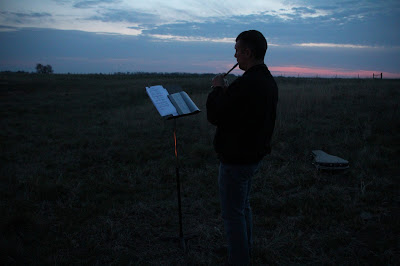
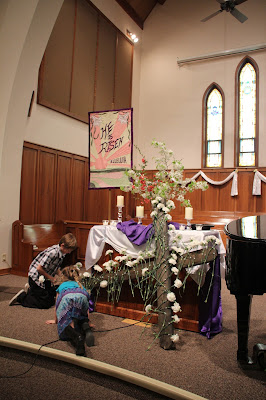
Spring in the prairie is a bit of an odd thing this year. Here and there, near ditches and creeks, a short, soft blanket of lush green grass covers the ground. A few feet away, patches of green are visible between the brown shoots of last year s grass. Some trees are already turning green, purple, red, and white, while others stand still and brown, stubbornly insisting that spring is not here yet. To look at the thermometer may not be much guide either; two days after the temperature was nearly 90, we woke to see a dusting of snow on the ground. It s been dry, terribly try in Kansas. Grass next to a gravel driveway or road often has a chalkish layer of dust on it, kicked up by passing cars or even a stiff wind. The earth thirsts. It is somehow fitting to celebrate Easter, that spring holiday, in the midst of the dry ground, to remember that water is not the only thing that can quench thirst. Easter morning began sleepily, as we got up early to head to a sunrise service. It was in a pasture just outside a small Kansas town, and we gathered there at about 6:15, wearing only light jackets against the breeze. A fire was burning, and there was water on hand to quickly douse any grass that caught first that wasn t supposed to and it was occasionally used. I was doing the prelude for the service, playing on my penny whistle. I enjoyed being able to do that, and was glad that the wind was calm enough that it didn t interfere too much with the music. We sang some hymns, listened to some Bible readings, and just stood in silence, listening to the crackle of the fire, some country dogs playing, and watching the sky to the east transform as the sun came up. Then it was on to church for breakfast, and a break before the Easter service the pipe organ ringing, piano playing with it, and deep trombone and full sanctuary of people singing our 4-part Easter hymns celebrating the day. Laura had the idea of pinning carnations onto the cross, and we got to watch everyone come up and add theirs. Jacob and Oliver enjoyed the sunrise service. They decided they would keep a watchful eye on the first and the dogs, they enjoyed muffins at breakfast and playing in the church after that. But if you are 4 or 7, what is Easter without an Easter egg hunt? And they got in several. Laura and I hid some eggs around the yard. Jacob asked me to use a radio to tell them when the eggs were ready. Here they are, bounding out the door to begin the hunt! And, of course, if you are 4 or 7 and have a geek for a dad, you will naturally think to bring radios with you to the next hunt. To tell your brother what you re finding, of course. It was a good weekend, and in fact, Jacob even volunteered to put up a wet floor sign after he spilled some water: On the last car ride of the day, Jacob decided he would write a story about his Easter. He decided he would publish a big book, and be a famous author and make other children happy. Oliver, of course, decided he needed an Easter story also. We couldn t very well publish a book in the car, but I did manage to use my phone to capture their stories. It s been a long and busy week, but there is much to be joyful about, even when tired.

18 April 2014

Thorsten Glaser: Stay off my computer, puppet!

I was out, seeing something that wasn t there yet when I was at school (the web was not ubiquitous, back then), and decided to have a look:
pageok

Ugh. Oh well, PocketIE doesn t provide a View Source thingy, so I asked Natureshadow (who got the same result on his Android, and had no View Source either apparently, so he used cURL to see it). We saw (here, re-enacted using ftp(1)):

	tg@blau:~ $ ftp -Vo - http://www.draitschbrunnen.de/
	<!-- pageok -->
	<!-- managed by puppet -->
	<html>
	<pre>pageok</pre>
	</html>
 

This is the final straw after puppet managed to trash a sudoers(5) at work (I warned people to not introduce it) now it breaks websites.

(Of course, tools are useful, but at best to the skill of their users. Merely dumbly copying recipes from the net without any understanding just makes debugging harder for those of us with skills.) ObQuestion: Does anyone have a transcript (into UTF-8) and a translation for the other half of the OpenBSD 2.8 poster? (I get asked this regularily.)
Update: One person sent me the Kanji and Kana for it in UTF-8 , and they and one more person told me it s Hands off my machine! or Don t lay a hand on my machine! . Now I m not studying Japanese, but it LGTM in FixedMisc [MirOS], and JMdict from MirPorts says: ore no mashin ni te (w)o dasu na (roughly: my machine; particle; hands; particle; put out; prohibition) Thanks all, now I know what to tell visitors who wonder about that poster on my wall. ObTip: I can install a few hundred Debian VMs at work manually before the effort needed to automate d-i would amortise. So I decided not to. Coworkers are shocked. I keep flexibility (can decide to have machines differ), and the boss accepts my explanations. Think before doing automation just for the sake of automation!

Next.

Previous.