Search Results: "sf"

25 December 2022

David Bremner: Why won't crusty old host recognize my shiny new terminal emulator?

Spiffy new terminal emulators seem to come with their own terminfo definitions. Venerable hosts that I ssh into tend not to know about those. kitty comes with a thing to transfer that definition, but it breaks if the remote host is running tcsh (don't ask). Similary the one liner for alacritty on the arch wiki seems to assume the remote shell is bash. Forthwith, a dumb shell script that works to send the terminfo of the current terminal emulator to the remote host. EDIT: Jakub Wilk worked out this can be replaced with the oneliner
infocmp   ssh $host tic -x -
#!/bin/sh
if [ "$#" -ne 1 ]; then
    printf "usage: sendterminfo host\n"
    exit 1
fi
host="$1"
filename=$(mktemp terminfoXXXXXX)
cleanup ()  
    rm "$filename"
 
trap cleanup EXIT
infocmp > "$filename"
remotefile=$(ssh "$host" mktemp)
scp -q "$filename" "$host:$remotefile"
ssh "$host" "tic -x \"$remotefile\""
ssh "$host" rm "$remotefile"

24 December 2022

Simon Josefsson: OpenPGP key on FST-01SZ

I use GnuPG to compute cryptographic signatures for my emails, git commits/tags, and software release artifacts (tarballs). Part of GnuPG is gpg-agent which talks to OpenSSH, which I login to remote servers and to clone git repositories. I dislike storing cryptographic keys on general-purpose machines, and have used hardware-backed OpenPGP keys since around 2006 when I got a FSFE Fellowship Card. GnuPG via gpg-agent handles this well, and the private key never leaves the hardware. The ZeitControl cards were (to my knowledge) proprietary hardware running some non-free operating system and OpenPGP implementation. By late 2012 the YubiKey NEO supported OpenPGP, and while the hardware and operating system on it was not free, at least it ran a free software OpenPGP implementation and eventually I setup my primary RSA key on it. This worked well for a couple of years, and when I in 2019 wished to migrate to a new key, the FST-01G device with open hardware running free software that supported Ed25519 had become available. I created a key and have been using the FST-01G on my main laptop since then. This little device has been working, the signature counter on it is around 14501 which means around 10 signatures/day since then! Currently I am in the process of migrating towards a new laptop, and moving the FST-01G device between them is cumbersome, especially if I want to use both laptops in parallel. That s why I need to setup a new hardware device to hold my OpenPGP key, which can go with my new laptop. This is a good time to re-visit alternatives. I quickly decided that I did not want to create a new key, only to import my current one to keep everything working. My requirements on the device to chose hasn t changed since 2019, see my summary at the end of the earlier blog post. Unfortunately the FST-01G is out of stock and the newer FST-01SZ has also out of stock. While Tillitis looks promising (and I have one to play with), it does not support OpenPGP (yet). What to do? Fortunately, I found some FST-01SZ device in my drawer, and decided to use it pending a more satisfactory answer. Hopefully once I get around to generate a new OpenPGP key in a year or so, I will do a better survey of options that are available on the market then. What are your (freedom-respecting) OpenPGP hardware recommendations?
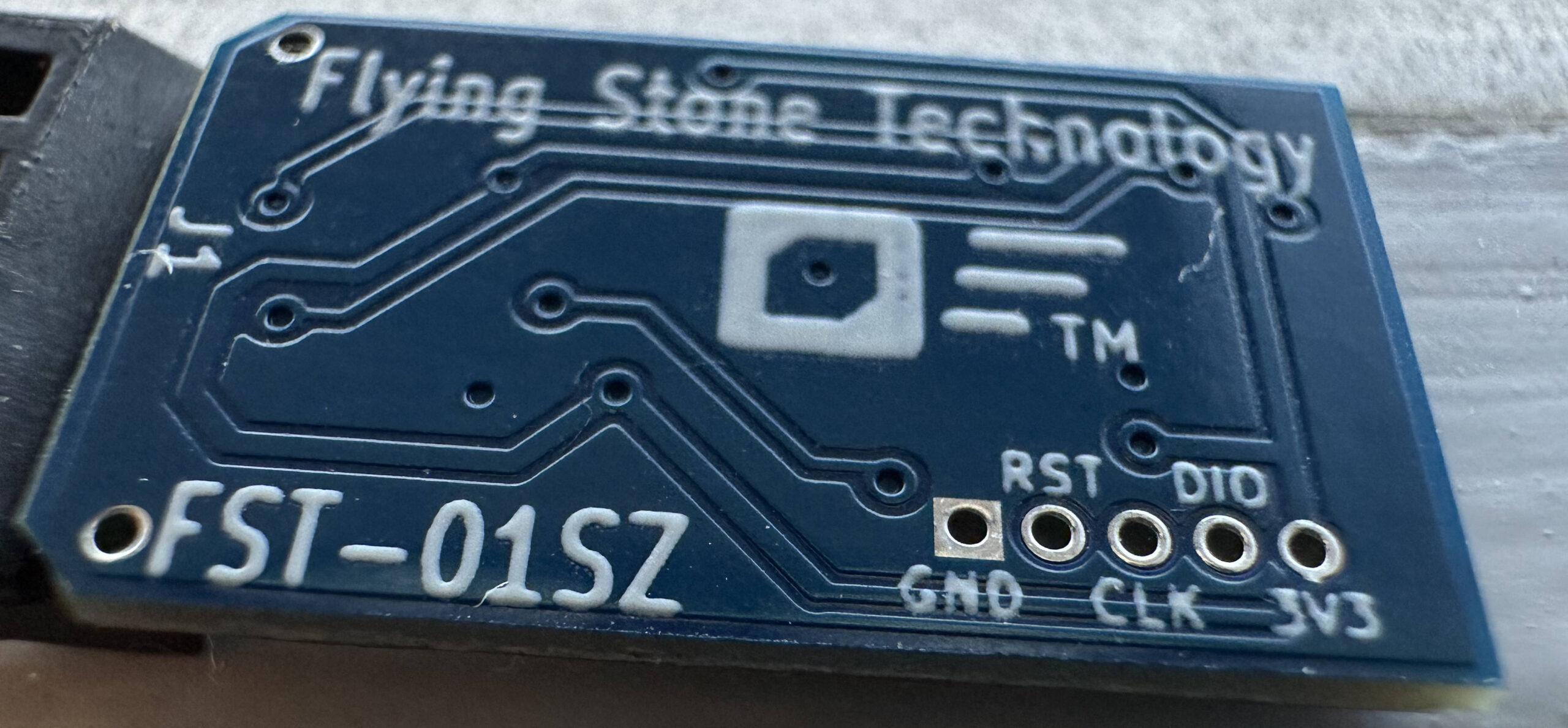
FST-01SZ circuit board
Similar to setting up the FST-01G, the FST-01SZ needs to be setup before use. I m doing the following from Trisquel 11 but any GNU/Linux system would work. When the device is inserted at first time, some kernel messages are shown (see /var/log/syslog or use the dmesg command):

usb 3-3: new full-speed USB device number 39 using xhci_hcd
usb 3-3: New USB device found, idVendor=234b, idProduct=0004, bcdDevice= 2.00
usb 3-3: New USB device strings: Mfr=1, Product=2, SerialNumber=3
usb 3-3: Product: Fraucheky
usb 3-3: Manufacturer: Free Software Initiative of Japan
usb 3-3: SerialNumber: FSIJ-0.0
usb-storage 3-3:1.0: USB Mass Storage device detected
scsi host1: usb-storage 3-3:1.0
scsi 1:0:0:0: Direct-Access     FSIJ     Fraucheky        1.0  PQ: 0 ANSI: 0
sd 1:0:0:0: Attached scsi generic sg2 type 0
sd 1:0:0:0: [sdc] 128 512-byte logical blocks: (65.5 kB/64.0 KiB)
sd 1:0:0:0: [sdc] Write Protect is off
sd 1:0:0:0: [sdc] Mode Sense: 03 00 00 00
sd 1:0:0:0: [sdc] No Caching mode page found
sd 1:0:0:0: [sdc] Assuming drive cache: write through
 sdc:
sd 1:0:0:0: [sdc] Attached SCSI removable disk
Interestingly, the NeuG software installed on the device I got appears to be version 1.0.9:

jas@kaka:~$ head /media/jas/Fraucheky/README
NeuG - a true random number generator implementation
						  Version 1.0.9
						     2018-11-20
					           Niibe Yutaka
			      Free Software Initiative of Japan
What's NeuG?
============
jas@kaka:~$ 
I could not find version 1.0.9 published anywhere, but the device came with a SD-card that contain a copy of the source, so I uploaded it until a more canonical place is located. Putting the device in the serial mode can be done using a sudo eject /dev/sdc command which results in the following syslog output.

usb 3-3: reset full-speed USB device number 39 using xhci_hcd
usb 3-3: device firmware changed
usb 3-3: USB disconnect, device number 39
sdc: detected capacity change from 128 to 0
usb 3-3: new full-speed USB device number 40 using xhci_hcd
usb 3-3: New USB device found, idVendor=234b, idProduct=0001, bcdDevice= 2.00
usb 3-3: New USB device strings: Mfr=1, Product=2, SerialNumber=3
usb 3-3: Product: NeuG True RNG
usb 3-3: Manufacturer: Free Software Initiative of Japan
usb 3-3: SerialNumber: FSIJ-1.0.9-42315277
cdc_acm 3-3:1.0: ttyACM0: USB ACM device
Now download Gnuk, verify its integrity and build it. You may need some additional packages installed, try apt-get install gcc-arm-none-eabi openocd python3-usb. As you can see, I m using the stable 1.2 branch of Gnuk, currently on version 1.2.20. The ./configure parameters deserve some explanation. The kdf_do=required sets up the device to require KDF usage. The --enable-factory-reset allows me to use the command factory-reset (with admin PIN) inside gpg --card-edit to completely wipe the card. Some may consider that too dangerous, but my view is that if someone has your admin PIN it is game over anyway. The --vidpid=234b:0000 is specifies the USB VID/PID to use, and --target=FST_01SZ is critical to set the platform (you ll may brick the device if you pick the wrong --target setting).

jas@kaka:~/src$ rm -rf gnuk neug
jas@kaka:~/src$ git clone https://gitlab.com/jas/neug.git
Cloning into 'neug'...
remote: Enumerating objects: 2034, done.
remote: Counting objects: 100% (2034/2034), done.
remote: Compressing objects: 100% (603/603), done.
remote: Total 2034 (delta 1405), reused 2013 (delta 1405), pack-reused 0
Receiving objects: 100% (2034/2034), 910.34 KiB   3.50 MiB/s, done.
Resolving deltas: 100% (1405/1405), done.
jas@kaka:~/src$ git clone https://salsa.debian.org/gnuk-team/gnuk/gnuk.git
Cloning into 'gnuk'...
remote: Enumerating objects: 13765, done.
remote: Counting objects: 100% (959/959), done.
remote: Compressing objects: 100% (337/337), done.
remote: Total 13765 (delta 629), reused 907 (delta 599), pack-reused 12806
Receiving objects: 100% (13765/13765), 12.59 MiB   3.05 MiB/s, done.
Resolving deltas: 100% (10077/10077), done.
jas@kaka:~/src$ cd neug
jas@kaka:~/src/neug$ git describe 
release/1.0.9
jas@kaka:~/src/neug$ git tag -v  git describe 
object 5d51022a97a5b7358d0ea62bbbc00628c6cec06a
type commit
tag release/1.0.9
tagger NIIBE Yutaka <gniibe@fsij.org> 1542701768 +0900
Version 1.0.9.
gpg: Signature made Tue Nov 20 09:16:08 2018 CET
gpg:                using EDDSA key 249CB3771750745D5CDD323CE267B052364F028D
gpg:                issuer "gniibe@fsij.org"
gpg: Good signature from "NIIBE Yutaka <gniibe@fsij.org>" [unknown]
gpg:                 aka "NIIBE Yutaka <gniibe@debian.org>" [unknown]
gpg: WARNING: This key is not certified with a trusted signature!
gpg:          There is no indication that the signature belongs to the owner.
Primary key fingerprint: 249C B377 1750 745D 5CDD  323C E267 B052 364F 028D
jas@kaka:~/src/neug$ cd ../gnuk/
jas@kaka:~/src/gnuk$ git checkout STABLE-BRANCH-1-2 
Branch 'STABLE-BRANCH-1-2' set up to track remote branch 'STABLE-BRANCH-1-2' from 'origin'.
Switched to a new branch 'STABLE-BRANCH-1-2'
jas@kaka:~/src/gnuk$ git describe
release/1.2.20
jas@kaka:~/src/gnuk$ git tag -v  git describe 
object 9d3c08bd2beb73ce942b016d4328f0a596096c02
type commit
tag release/1.2.20
tagger NIIBE Yutaka <gniibe@fsij.org> 1650594032 +0900
Gnuk: Version 1.2.20
gpg: Signature made Fri Apr 22 04:20:32 2022 CEST
gpg:                using EDDSA key 249CB3771750745D5CDD323CE267B052364F028D
gpg: Good signature from "NIIBE Yutaka <gniibe@fsij.org>" [unknown]
gpg:                 aka "NIIBE Yutaka <gniibe@debian.org>" [unknown]
gpg: WARNING: This key is not certified with a trusted signature!
gpg:          There is no indication that the signature belongs to the owner.
Primary key fingerprint: 249C B377 1750 745D 5CDD  323C E267 B052 364F 028D
jas@kaka:~/src/gnuk/src$ git submodule update --init
Submodule 'chopstx' (https://salsa.debian.org/gnuk-team/chopstx/chopstx.git) registered for path '../chopstx'
Cloning into '/home/jas/src/gnuk/chopstx'...
Submodule path '../chopstx': checked out 'e12a7e0bb3f004c7bca41cfdb24c8b66daf3db89'
jas@kaka:~/src/gnuk$ cd chopstx
jas@kaka:~/src/gnuk/chopstx$ git describe
release/1.21
jas@kaka:~/src/gnuk/chopstx$ git tag -v  git describe 
object e12a7e0bb3f004c7bca41cfdb24c8b66daf3db89
type commit
tag release/1.21
tagger NIIBE Yutaka <gniibe@fsij.org> 1650593697 +0900
Chopstx: Version 1.21
gpg: Signature made Fri Apr 22 04:14:57 2022 CEST
gpg:                using EDDSA key 249CB3771750745D5CDD323CE267B052364F028D
gpg: Good signature from "NIIBE Yutaka <gniibe@fsij.org>" [unknown]
gpg:                 aka "NIIBE Yutaka <gniibe@debian.org>" [unknown]
gpg: WARNING: This key is not certified with a trusted signature!
gpg:          There is no indication that the signature belongs to the owner.
Primary key fingerprint: 249C B377 1750 745D 5CDD  323C E267 B052 364F 028D
jas@kaka:~/src/gnuk/chopstx$ cd ../src
jas@kaka:~/src/gnuk/src$ kdf_do=required ./configure --enable-factory-reset --vidpid=234b:0000 --target=FST_01SZ
Header file is: board-fst-01sz.h
Debug option disabled
Configured for bare system (no-DFU)
PIN pad option disabled
CERT.3 Data Object is NOT supported
Card insert/removal by HID device is NOT supported
Life cycle management is supported
Acknowledge button is supported
KDF DO is required before key import/generation
jas@kaka:~/src/gnuk/src$ make   less
jas@kaka:~/src/gnuk/src$ cd ../regnual/
jas@kaka:~/src/gnuk/regnual$ make   less
jas@kaka:~/src/gnuk/regnual$ cd ../../
jas@kaka:~/src$ sudo python3 neug/tool/neug_upgrade.py -f gnuk/regnual/regnual.bin gnuk/src/build/gnuk.bin
gnuk/regnual/regnual.bin: 4608
gnuk/src/build/gnuk.bin: 109568
CRC32: b93ca829
Device: 
Configuration: 1
Interface: 1
20000e00:20005000
Downloading flash upgrade program...
start 20000e00
end   20002000
# 20002000: 32 : 4
Run flash upgrade program...
Wait 1 second...
Wait 1 second...
Device: 
08001000:08020000
Downloading the program
start 08001000
end   0801ac00
jas@kaka:~/src$ 
The kernel log will contain the following, and the card is ready to use as an OpenPGP card. You may unplug it and re-insert it as you wish.

usb 3-3: reset full-speed USB device number 41 using xhci_hcd
usb 3-3: device firmware changed
usb 3-3: USB disconnect, device number 41
usb 3-3: new full-speed USB device number 42 using xhci_hcd
usb 3-3: New USB device found, idVendor=234b, idProduct=0000, bcdDevice= 2.00
usb 3-3: New USB device strings: Mfr=1, Product=2, SerialNumber=3
usb 3-3: Product: Gnuk Token
usb 3-3: Manufacturer: Free Software Initiative of Japan
usb 3-3: SerialNumber: FSIJ-1.2.20-42315277
Setting up the card is the next step, and there are many tutorials around for this, eventually I settled with the following sequence. Let s start with setting the admin PIN. First make sure that pcscd nor scdaemon is running, which is good hygien since those processes cache some information and with a stale connection this easily leads to confusion. Cache invalidation sigh.

jas@kaka:~$ gpg-connect-agent "SCD KILLSCD" "SCD BYE" /bye
jas@kaka:~$ ps auxww grep -e pcsc -e scd
jas        30221  0.0  0.0   3468  1692 pts/3    R+   11:49   0:00 grep --color=auto -e pcsc -e scd
jas@kaka:~$ gpg --card-edit
Reader ...........: 234B:0000:FSIJ-1.2.20-42315277:0
Application ID ...: D276000124010200FFFE423152770000
Application type .: OpenPGP
Version ..........: 2.0
Manufacturer .....: unmanaged S/N range
Serial number ....: 42315277
Name of cardholder: [not set]
Language prefs ...: [not set]
Salutation .......: 
URL of public key : [not set]
Login data .......: [not set]
Signature PIN ....: forced
Key attributes ...: rsa2048 rsa2048 rsa2048
Max. PIN lengths .: 127 127 127
PIN retry counter : 3 3 3
Signature counter : 0
KDF setting ......: off
Signature key ....: [none]
Encryption key....: [none]
Authentication key: [none]
General key info..: [none]
gpg/card> admin
Admin commands are allowed
gpg/card> kdf-setup
gpg/card> passwd
gpg: OpenPGP card no. D276000124010200FFFE423152770000 detected
1 - change PIN
2 - unblock PIN
3 - change Admin PIN
4 - set the Reset Code
Q - quit
Your selection? 3
PIN changed.
1 - change PIN
2 - unblock PIN
3 - change Admin PIN
4 - set the Reset Code
Q - quit
Your selection? 
Now it would be natural to setup the PIN and reset code. However the Gnuk software is configured to not allow this until the keys are imported. You would get the following somewhat cryptical error messages if you try. This took me a while to understand, since this is device-specific, and some other OpenPGP implementations allows you to configure a PIN and reset code before key import.

Your selection? 4
Error setting the Reset Code: Card error
1 - change PIN
2 - unblock PIN
3 - change Admin PIN
4 - set the Reset Code
Q - quit
Your selection? 1
Error changing the PIN: Conditions of use not satisfied
1 - change PIN
2 - unblock PIN
3 - change Admin PIN
4 - set the Reset Code
Q - quit
Your selection? q
Continue to configure the card and make it ready for key import. Some settings deserve comments. The lang field may be used to setup the language, but I have rarely seen it use, and I set it to sv (Swedish) mostly to be able to experiment if any software adhears to it. The URL is important to point to somewhere where your public key is stored, the fetch command of gpg --card-edit downloads it and sets up GnuPG with it when you are on a clean new laptop. The forcesig command changes the default so that a PIN code is not required for every digital signature operation, remember that I averaged 10 signatures per day for the past 2-3 years? Think of the wasted energy typing those PIN codes every time! Changing the cryptographic key type is required when I import 25519-based keys.

gpg/card> name
Cardholder's surname: Josefsson
Cardholder's given name: Simon
gpg/card> lang
Language preferences: sv
gpg/card> sex
Salutation (M = Mr., F = Ms., or space): m
gpg/card> login
Login data (account name): jas
gpg/card> url
URL to retrieve public key: https://josefsson.org/key-20190320.txt
gpg/card> forcesig
gpg/card> key-attr
Changing card key attribute for: Signature key
Please select what kind of key you want:
   (1) RSA
   (2) ECC
Your selection? 2
Please select which elliptic curve you want:
   (1) Curve 25519
   (4) NIST P-384
Your selection? 1
The card will now be re-configured to generate a key of type: ed25519
Note: There is no guarantee that the card supports the requested size.
      If the key generation does not succeed, please check the
      documentation of your card to see what sizes are allowed.
Changing card key attribute for: Encryption key
Please select what kind of key you want:
   (1) RSA
   (2) ECC
Your selection? 2
Please select which elliptic curve you want:
   (1) Curve 25519
   (4) NIST P-384
Your selection? 1
The card will now be re-configured to generate a key of type: cv25519
Changing card key attribute for: Authentication key
Please select what kind of key you want:
   (1) RSA
   (2) ECC
Your selection? 2
Please select which elliptic curve you want:
   (1) Curve 25519
   (4) NIST P-384
Your selection? 1
The card will now be re-configured to generate a key of type: ed25519
gpg/card> 
Reader ...........: 234B:0000:FSIJ-1.2.20-42315277:0
Application ID ...: D276000124010200FFFE423152770000
Application type .: OpenPGP
Version ..........: 2.0
Manufacturer .....: unmanaged S/N range
Serial number ....: 42315277
Name of cardholder: Simon Josefsson
Language prefs ...: sv
Salutation .......: Mr.
URL of public key : https://josefsson.org/key-20190320.txt
Login data .......: jas
Signature PIN ....: not forced
Key attributes ...: ed25519 cv25519 ed25519
Max. PIN lengths .: 127 127 127
PIN retry counter : 3 3 3
Signature counter : 0
KDF setting ......: on
Signature key ....: [none]
Encryption key....: [none]
Authentication key: [none]
General key info..: [none]
gpg/card> 
The device is now ready for key import! Bring out your offline laptop and boot it and use the keytocard command on the subkeys to import them. This assumes you saved a copy of the GnuPG home directory after generating the master and subkeys before, which I did in my own previous tutorial when I generated the keys. This may be a bit unusual, and there are simpler ways to do this (e.g., import a copy of the secret keys into a fresh GnuPG home directory).

$ cp -a gnupghome-backup-mastersubkeys gnupghome-import-fst01sz-42315277-2022-12-24
$ ps auxww grep -e pcsc -e scd
$ gpg --homedir $PWD/gnupghome-import-fst01sz-42315277-2022-12-24 --edit-key B1D2BD1375BECB784CF4F8C4D73CF638C53C06BE
...
Secret key is available.
gpg: checking the trustdb
gpg: marginals needed: 3  completes needed: 1  trust model: pgp
gpg: depth: 0  valid:   1  signed:   0  trust: 0-, 0q, 0n, 0m, 0f, 1u
sec  ed25519/D73CF638C53C06BE
     created: 2019-03-20  expired: 2019-10-22  usage: SC  
     trust: ultimate      validity: expired
ssb  cv25519/02923D7EE76EBD60
     created: 2019-03-20  expired: 2019-10-22  usage: E   
ssb  ed25519/80260EE8A9B92B2B
     created: 2019-03-20  expired: 2019-10-22  usage: A   
ssb  ed25519/51722B08FE4745A2
     created: 2019-03-20  expired: 2019-10-22  usage: S   
[ expired] (1). Simon Josefsson <simon@josefsson.org>
gpg> key 1
sec  ed25519/D73CF638C53C06BE
     created: 2019-03-20  expired: 2019-10-22  usage: SC  
     trust: ultimate      validity: expired
ssb* cv25519/02923D7EE76EBD60
     created: 2019-03-20  expired: 2019-10-22  usage: E   
ssb  ed25519/80260EE8A9B92B2B
     created: 2019-03-20  expired: 2019-10-22  usage: A   
ssb  ed25519/51722B08FE4745A2
     created: 2019-03-20  expired: 2019-10-22  usage: S   
[ expired] (1). Simon Josefsson <simon@josefsson.org>
gpg> keytocard
Please select where to store the key:
   (2) Encryption key
Your selection? 2
sec  ed25519/D73CF638C53C06BE
     created: 2019-03-20  expired: 2019-10-22  usage: SC  
     trust: ultimate      validity: expired
ssb* cv25519/02923D7EE76EBD60
     created: 2019-03-20  expired: 2019-10-22  usage: E   
ssb  ed25519/80260EE8A9B92B2B
     created: 2019-03-20  expired: 2019-10-22  usage: A   
ssb  ed25519/51722B08FE4745A2
     created: 2019-03-20  expired: 2019-10-22  usage: S   
[ expired] (1). Simon Josefsson <simon@josefsson.org>
gpg> key 1
sec  ed25519/D73CF638C53C06BE
     created: 2019-03-20  expired: 2019-10-22  usage: SC  
     trust: ultimate      validity: expired
ssb  cv25519/02923D7EE76EBD60
     created: 2019-03-20  expired: 2019-10-22  usage: E   
ssb  ed25519/80260EE8A9B92B2B
     created: 2019-03-20  expired: 2019-10-22  usage: A   
ssb  ed25519/51722B08FE4745A2
     created: 2019-03-20  expired: 2019-10-22  usage: S   
[ expired] (1). Simon Josefsson <simon@josefsson.org>
gpg> key 2

sec  ed25519/D73CF638C53C06BE
     created: 2019-03-20  expired: 2019-10-22  usage: SC  
     trust: ultimate      validity: expired
ssb  cv25519/02923D7EE76EBD60
     created: 2019-03-20  expired: 2019-10-22  usage: E   
ssb* ed25519/80260EE8A9B92B2B
     created: 2019-03-20  expired: 2019-10-22  usage: A   
ssb  ed25519/51722B08FE4745A2
     created: 2019-03-20  expired: 2019-10-22  usage: S   
[ expired] (1). Simon Josefsson <simon@josefsson.org>
gpg> keytocard
Please select where to store the key:
   (3) Authentication key
Your selection? 3
sec  ed25519/D73CF638C53C06BE
     created: 2019-03-20  expired: 2019-10-22  usage: SC  
     trust: ultimate      validity: expired
ssb  cv25519/02923D7EE76EBD60
     created: 2019-03-20  expired: 2019-10-22  usage: E   
ssb* ed25519/80260EE8A9B92B2B
     created: 2019-03-20  expired: 2019-10-22  usage: A   
ssb  ed25519/51722B08FE4745A2
     created: 2019-03-20  expired: 2019-10-22  usage: S   
[ expired] (1). Simon Josefsson <simon@josefsson.org>
gpg> key 2
sec  ed25519/D73CF638C53C06BE
     created: 2019-03-20  expired: 2019-10-22  usage: SC  
     trust: ultimate      validity: expired
ssb  cv25519/02923D7EE76EBD60
     created: 2019-03-20  expired: 2019-10-22  usage: E   
ssb  ed25519/80260EE8A9B92B2B
     created: 2019-03-20  expired: 2019-10-22  usage: A   
ssb  ed25519/51722B08FE4745A2
     created: 2019-03-20  expired: 2019-10-22  usage: S   
[ expired] (1). Simon Josefsson <simon@josefsson.org>
gpg> key 3
sec  ed25519/D73CF638C53C06BE
     created: 2019-03-20  expired: 2019-10-22  usage: SC  
     trust: ultimate      validity: expired
ssb  cv25519/02923D7EE76EBD60
     created: 2019-03-20  expired: 2019-10-22  usage: E   
ssb  ed25519/80260EE8A9B92B2B
     created: 2019-03-20  expired: 2019-10-22  usage: A   
ssb* ed25519/51722B08FE4745A2
     created: 2019-03-20  expired: 2019-10-22  usage: S   
[ expired] (1). Simon Josefsson <simon@josefsson.org>
gpg> keytocard
Please select where to store the key:
   (1) Signature key
   (3) Authentication key
Your selection? 1
sec  ed25519/D73CF638C53C06BE
     created: 2019-03-20  expired: 2019-10-22  usage: SC  
     trust: ultimate      validity: expired
ssb  cv25519/02923D7EE76EBD60
     created: 2019-03-20  expired: 2019-10-22  usage: E   
ssb  ed25519/80260EE8A9B92B2B
     created: 2019-03-20  expired: 2019-10-22  usage: A   
ssb* ed25519/51722B08FE4745A2
     created: 2019-03-20  expired: 2019-10-22  usage: S   
[ expired] (1). Simon Josefsson <simon@josefsson.org>
gpg> quit
Save changes? (y/N) y
$ 
Now insert it into your daily laptop and have GnuPG and learn about the new private keys and forget about any earlier locally available card bindings this usually manifests itself by GnuPG asking you to insert a OpenPGP card with another serial number. Earlier I did rm -rf ~/.gnupg/private-keys-v1.d/ but the scd serialno followed by learn --force is nicer. I also sets up trust setting for my own key.

jas@kaka:~$ gpg-connect-agent "scd serialno" "learn --force" /bye
...
jas@kaka:~$ echo "B1D2BD1375BECB784CF4F8C4D73CF638C53C06BE:6:"   gpg --import-ownertrust
jas@kaka:~$ gpg --card-status
Reader ...........: 234B:0000:FSIJ-1.2.20-42315277:0
Application ID ...: D276000124010200FFFE423152770000
Application type .: OpenPGP
Version ..........: 2.0
Manufacturer .....: unmanaged S/N range
Serial number ....: 42315277
Name of cardholder: Simon Josefsson
Language prefs ...: sv
Salutation .......: Mr.
URL of public key : https://josefsson.org/key-20190320.txt
Login data .......: jas
Signature PIN ....: not forced
Key attributes ...: ed25519 cv25519 ed25519
Max. PIN lengths .: 127 127 127
PIN retry counter : 5 5 5
Signature counter : 3
KDF setting ......: on
Signature key ....: A3CC 9C87 0B9D 310A BAD4  CF2F 5172 2B08 FE47 45A2
      created ....: 2019-03-20 23:40:49
Encryption key....: A9EC 8F4D 7F1E 50ED 3DEF  49A9 0292 3D7E E76E BD60
      created ....: 2019-03-20 23:40:26
Authentication key: CA7E 3716 4342 DF31 33DF  3497 8026 0EE8 A9B9 2B2B
      created ....: 2019-03-20 23:40:37
General key info..: sub  ed25519/51722B08FE4745A2 2019-03-20 Simon Josefsson <simon@josefsson.org>
sec#  ed25519/D73CF638C53C06BE  created: 2019-03-20  expires: 2023-09-19
ssb>  ed25519/80260EE8A9B92B2B  created: 2019-03-20  expires: 2023-09-19
                                card-no: FFFE 42315277
ssb>  ed25519/51722B08FE4745A2  created: 2019-03-20  expires: 2023-09-19
                                card-no: FFFE 42315277
ssb>  cv25519/02923D7EE76EBD60  created: 2019-03-20  expires: 2023-09-19
                                card-no: FFFE 42315277
jas@kaka:~$ 
Verify that you can digitally sign and authenticate using the key and you are done!

jas@kaka:~$ echo foo gpg -a --sign gpg --verify
gpg: Signature made Sat Dec 24 13:49:59 2022 CET
gpg:                using EDDSA key A3CC9C870B9D310ABAD4CF2F51722B08FE4745A2
gpg: Good signature from "Simon Josefsson <simon@josefsson.org>" [ultimate]
jas@kaka:~$ ssh-add -L
ssh-ed25519 AAAAC3NzaC1lZDI1NTE5AAAAILzCFcHHrKzVSPDDarZPYqn89H5TPaxwcORgRg+4DagE cardno:FFFE42315277
jas@kaka:~$ 
So time to relax and celebrate christmas? Hold on not so fast! Astute readers will have noticed that the output said PIN retry counter: 5 5 5 . That s not the default PIN retry counter for Gnuk! How did that happen? Indeed, good catch and great question, my dear reader. I wanted to include how you can modify the Gnuk source code, re-build it and re-flash the Gnuk as well. This method is different than flashing Gnuk onto a device that is running NeuG so the commands I used to flash the firmware in the start of this blog post no longer works in a device running Gnuk. Fortunately modern Gnuk supports updating firmware by specifying the Admin PIN code only, and provides a simple script to achieve this as well. The PIN retry counter setting is hard coded in the openpgp-do.c file, and we run a a perl command to modify the file, rebuild Gnuk and upgrade the FST-01SZ. This of course wipes all your settings, so you will have the opportunity to practice all the commands earlier in this post once again!

jas@kaka:~/src/gnuk/src$ perl -pi -e 's/PASSWORD_ERRORS_MAX 3/PASSWORD_ERRORS_MAX 5/' openpgp-do.c
jas@kaka:~/src/gnuk/src$ make   less
jas@kaka:~/src/gnuk/src$ cd ../tool/
jas@kaka:~/src/gnuk/tool$ ./upgrade_by_passwd.py 
Admin password: 
Device: 
Configuration: 1
Interface: 0
../regnual/regnual.bin: 4608
../src/build/gnuk.bin: 110592
CRC32: b93ca829
Device: 
Configuration: 1
Interface: 0
20002a00:20005000
Downloading flash upgrade program...
start 20002a00
end   20003c00
Run flash upgrade program...
Waiting for device to appear:
  Wait 1 second...
  Wait 1 second...
Device: 
08001000:08020000
Downloading the program
start 08001000
end   0801b000
Protecting device
Finish flashing
Resetting device
Update procedure finished
jas@kaka:~/src/gnuk/tool$
Now finally, I wish you all a Merry Christmas and Happy Hacking!

23 December 2022

Scarlett Gately Moore: Debian uploads, Core22 KDE snap content pack and more!

I have been quite busy! I have been working on several projects so my cover image is a lovely sunset where I live. Debian: I have updated and uploaded several packages and working on more. KDE Snaps: I have reworked the CI to now do Core22 snaps! They will publish to the beta channel until we get them tested. First snap completed is the ever important KDE Frameworks / QT content snap + SDK! Applications will start after I tackle the kde-neon extention in snapcraft. GUI-Testing: I have begun learning/writing some GUI tests using python and https://invent.kde.org/sdk/selenium-webdriver-at-spi/, inspired by one of my favorite people, Harald. See https://apachelog.wordpress.com/2022/12/14/selenium-at-spi-gui-testing/ for more info and I hope to get these in repos near you soon! In closing, I am still seeking employment/sponsor amidst this terrible layoff season. If anyone knows of anyone with my diverse skill set please let me know. In the meantime if you can spare anything to keep the lights on I would be ever so grateful. Patreon: https://www.patreon.com/sgmoore Cash App: $ScarlettMoore0903 Stripe: https://buy.stripe.com/28o16y3PHcISfaE8ww Thank you, I want to wish everyone a very merry < insert your holiday here > !!!

20 December 2022

Russ Allbery: Review: Tess of the Road

Review: Tess of the Road, by Rachel Hartman
Series: Tess of the Road #1
Publisher: Random House
Copyright: 2018
Printing: 2022
ISBN: 1-101-93130-2
Format: Kindle
Pages: 536
Tess of the Road is the first book of a YA fantasy duology set in the same universe as Seraphina and Shadow Scale. It's hard to decide what to say about reading order (and I now appreciate the ambiguous answers I got). Tess of the Road is a sequel to Seraphina and Shadow Scale in the sense that there are numerous references to the previous duology, but it has a different protagonist and different concerns. You don't need to read the other duology first, but Tess of the Road will significantly spoil the resolution of the romance plot in Seraphina, and it will be obvious that you've skipped over background material. That said, Shadow Scale is not a very good book, and this is a much better book. I guess the summary is this: if you're going to read the first duology, read it first, but don't feel obligated to do so. Tess was always a curious, adventurous, and some would say unmanageable girl, nothing like her twin. Jeanne is modest, obedient, virtuous, and practically perfect in every way. Tess is not; after a teenage love affair resulting in an out-of-wedlock child and a boy who disappeared rather than marry her, their mother sees no alternative but to lie about which of the twins is older. If Jeanne can get a good match among the nobility, the family finances may be salvaged. Tess's only remaining use is to help her sister find a match, and then she can be shuffled off to a convent. Tess throws herself into court politics and does exactly what she's supposed to. She engineers not only a match, but someone Jeanne sincerely likes. Tess has never lacked competence. But this changes nothing about her mother's view of her, and Tess is depressed, worn, and desperately miserable in Jeanne's moment of triumph. Jeanne wants Tess to stay and become the governess of her eventual children, retaining their twin bond of the two of them against the world. Their older sister Seraphina, more perceptively, tries to help her join an explorer's expedition. Tess, in a drunken spiral of misery, insults everyone and runs away, with only a new pair of boots and a pack of food. This is going to be one of those reviews where the things I didn't like are exactly the things other readers liked. I see why people loved this book, and I wish I had loved it too. Instead, I liked parts of it a great deal and found other parts frustrating or a bit too off-putting. Mostly this is a preference problem rather than a book problem. My most objective complaint is the pacing, which was also my primary complaint about Shadow Scale. It was not hard to see where Hartman was going with the story, I like that story, I was on board with going there, but getting there took for-EV-er. This is a 536 page book that I would have edited to less than 300 pages. It takes nearly a hundred pages to get Tess on the road, and while some of that setup is necessary, I did not want to wallow in Tess's misery and appalling home life for quite that long. A closely related problem is that Hartman continues to love flashbacks. Even after Tess has made her escape, we get the entire history of her awful teenage years slowly dribbled out over most of the book. Sometimes this is revelatory; mostly it's depressing. I had guessed the outlines of what had happened early in the book (it's not hard), and that was more than enough motivation for me, but Hartman was determined to make the reader watch every crisis and awful moment in detail. This is exactly what some readers want, and sometimes it's even what I want, but not here. I found the middle of the book, where the story is mostly flashbacks and flailing, to be an emotional slog. Part of the problem is that Tess has an abusive mother and goes through the standard abuse victim process of being sure that she's the one who's wrong and that her mother is justified in her criticism. This is certainly realistic, and it eventually lead to some satisfying catharsis as Tess lets go of her negative self-image. But Tess's mother is a narcissistic religious fanatic with a persecution complex and not a single redeeming quality whatsoever, and I loathed reading about her, let alone reading Tess tiptoeing around making excuses for her. The point of this in the story is for Tess to rebuild her self-image, and I get it, and I'm sure this will work for some readers, but I wanted Tess's mother (and the rest of her family except her sisters) to be eaten by dragons. I do not like the emotional experience of hating a character in a book this much. Where Tess of the Road is on firmer ground is when Tess has an opportunity to show her best qualities, such as befriending a quigutl in childhood and, in the sort of impulsive decision that shows her at her best, learning their language. (For those who haven't read the previous books, quigutls are a dog-sized subspecies of dragon that everyone usually treats like intelligent animals, although they're clearly more than that.) Her childhood quigutl friend Pathka becomes her companion on the road, which both gives her wanderings some direction and adds some useful character interaction. Pathka comes with a plot that is another one of those elements that I think will work for some readers but didn't work for me. He's in search of a Great Serpent, a part of quigutl mythology that neither humans or dragons pay attention to. That becomes the major plot of the novel apart from Tess's emotional growth. Pathka also has a fraught relationship with his own family, which I think was supposed to parallel Tess's relationships but never clicked for me. I liked Tess's side of this relationship, but Pathka is weirdly incomprehensible and apparently fickle in ways that I found unsatisfying. I think Hartman was going for an alien tone that didn't quite work for me. This is a book that gets considerably better as it goes along, and the last third of the book was great. I didn't like being dragged through the setup, but I loved the character Tess became. Once she reaches the road crew, this was a book full of things that I love reading about. The contrast between her at the start of the book and the end is satisfying and rewarding. Tess's relationship with her twin Jeanne deserves special mention; their interaction late in the book is note-perfect and much better than I had expected. Unfortunately, Tess of the Road doesn't have a real resolution. It's only the first half of Tess's story, which comes back to that pacing problem. Ah well. I enjoyed this but I didn't love it. The destination was mostly worth the journey, but I thought the journey was much too long and I had to spend too much time in the company of people I hated far more intensely than was comfortable. I also thought the middle of the book sagged, a problem I have now had with two out of three of Hartman's books. But I can see why other readers with slightly different preferences loved it. I'm probably invested enough to read the sequel, although I'm a bit grumbly that the sequel is necessary. Followed by In the Serpent's Wake. Rating: 7 out of 10

19 December 2022

Russ Allbery: Review: Artifact Space

Review: Artifact Space, by Miles Cameron
Series: Arcana Imperii #1
Publisher: Gollancz
Copyright: June 2021
ISBN: 1-4732-3262-7
Format: Kindle
Pages: 483
Artifact Space is a military (mostly) science fiction novel, the first of an expected trilogy. Christian Cameron is a prolific author of historical fiction under that name, thrillers under the name Gordon Kent, and historical fantasy under the name Miles Cameron. This is his first science fiction novel. Marca Nbaro is descended from one of the great spacefaring mercantile families, but it's not doing her much good. She is a ward of the Orphanage, the boarding school for orphaned children of the DHC, generous in theory and a hellhole in practice. Her dream to serve on one of the Greatships, the enormous interstellar vessels that form the backbone of the human trading network, has been blocked by the school authorities, a consequence of the low-grade war she's been fighting with them throughout her teenage years. But Marca is not a person to take no for an answer. Pawning her family crest gets her just enough money to hire a hacker to doctor her school records, adding the graduation she was denied and getting her aboard the Greatship Athens as a new Midshipper. I don't read a lot of military science fiction, but there is one type of story that I love that military SF is uniquely well-suited to tell. It's not the combat or the tactics or the often-trite politics. It's the experience of the military as a system, a collective human endeavor. One ideal of the military is that people come to it from all sorts of backgrounds, races, and social classes, and the military incorporates them all into a system built for a purpose. It doesn't matter who you are or what you did before: if you follow the rules, do your job, and become part of a collaboration larger than yourself, you have a place and people to watch your back whether or not they know you or like you. Obviously, like any ideal, many militaries don't live up to this, and there are many stories about those failures. But the story of that ideal, told well, is a genre I like a great deal and is hard to find elsewhere. This sort of military story shares some features with found family, and it's not a coincidence that I also like found family stories. But found family still assumes that these people love you, or at least like you. For some protagonists, that's a tricky barrier both to cross and to believe one has crossed. The (admittedly idealized) military doesn't assume anyone likes you. It doesn't expect that you or anyone around you have the right feelings. It just expects you to do your job and work with other people who are doing their job. The requirements are more concrete, and thus in a way easier to believe in. Artifact Space is one of those military science fiction stories. I was entirely unsurprised to see that the author is a former US Navy career officer. The Greatships here are, technically, more of a merchant marine than a full-blown military. (The author noted in an interview that he based them on the merchant ships of Venice.) The weapons are used primarily for defense; the purpose of the Greatships is trade, and every crew member has a storage allotment in the immense cargo area that they're encouraged to use. The setting is in the far future, after a partial collapse and reconstruction of human society, in which humans have spread through interstellar space, settled habitable planets, and built immense orbital cities. The Athens is trading between multiple human settlements, but its true destination is far into the deep black: Tradepoint, where it can trade with the mysterious alien Starfish for xenoglas, a material that humans have tried and failed to reproduce and on which much of human construction now depends. This is, to warn, one of those stories where the scrappy underdog of noble birth makes friends with everyone and is far more competent than anyone expects. The story shape is not going to surprise you, and you have to have considerable tolerance for it to enjoy this book. Marca is ridiculously, absurdly central to the plot for a new Middie. Sometimes this makes sense given her history; other times, she is in the middle of improbable accidents that felt forced by the author. Cameron doesn't entirely break normal career progression, but Marca is very special in a way that you only get to be as the protagonist of a novel. That said, Cameron does some things with that story shape that I liked. Marca's hard-won survival skills are not weirdly well-suited for her new life aboard ship. To the contrary, she has to unlearn a lot of bad habits and let go of a lot of anxiety. I particularly liked her relationship with her more-privileged cabin mate, which at first seemed to only be a contrast between Thea's privilege and Marca's background, but turned into both of them learning from each other. There's a great mix of supporting characters, with a wide variety of interactions with Marca and a solid sense that all of the characters have their own lives and their own concerns that don't revolve around her. There is, of course, a plot to go with this. I haven't talked about it much because I think the summaries of this book are a bit of a spoiler, but there are several layers of political intrigue, threats to the ship, an interesting AI, and a good hook in the alien xenoglas trade. Cameron does a deft job balancing the plot with Marca's training and her slow-developing sense of place in the ship (and fear about discovery of her background and hacking). The pacing is excellent, showing all the skill I'd expect from someone with a thriller background and over forty prior novels under his belt. Cameron portrays the tedious work of learning a role on a ship without boring the reader, which is a tricky balancing act. I also like the setting: a richly multicultural future that felt like it included people from all of Earth, not just the white western parts. That includes a normalized androgyne third gender, which is the sort of thing you rarely see in military SF. Faster-than-light travel involves typical physics hand-waving, but the shape of the hand-waving is one I've not seen before and is a great excuse for copying the well-known property of oceangoing navies that longer ships can go faster. (One tech grumble, though: while Cameron does eventually say that this is a known tactic and Marca didn't come up with anything novel, deploying spread sensors for greater resolution is sufficiently obvious it should be standard procedure, and shouldn't have warranted the character reactions it got.) I thoroughly enjoyed this. Artifact Space is the best military SF that I've read in quite a while, at least back to John G. Hemry's JAG in space novels and probably better than those. It's going to strike some readers, with justification, as cliched, but the cliches are handled so well that I had only minor grumbling at a few absurd coincidences. Marca is a great character who is easy to care about. The plot was tense and satisfying, and the feeling of military structure, tradition, jargon, and ship pride was handled well. I had a very hard time putting this down and was sad when it ended. If you're in the mood for that class of "learning how to be part of a collaborative structure" style of military SF, recommended. Artifact Space reaches a somewhat satisfying conclusion, but leaves major plot elements unresolved. Followed by Deep Black, which doesn't have a release date at the time of this writing. Rating: 9 out of 10

18 December 2022

Ian Jackson: Rust needs #[throws]

tl;dr: Ok-wrapping as needed in today s Rust is a significant distraction, because there are multiple ways to do it. They are all slightly awkward in different ways, so are least-bad in different situations. You must choose a way for every fallible function, and sometimes change a function from one pattern to another. Rust really needs #[throws] as a first-class language feature. Code using #[throws] is simpler and clearer. Please try out withoutboats s fehler. I think you will like it. Contents A recent personal experience in coding style Ever since I read withoutboats s 2020 article about fehler, I have been using it in most of my personal projects. For Reasons I recently had a go at eliminating the dependency on fehler from Hippotat. So, I made a branch, deleted the dependency and imports, and started on the whack-a-mole with the compiler errors. After about a half hour of this, I was starting to feel queasy. After an hour I had decided that basically everything I was doing was making the code worse. And, bizarrely, I kept having to make individual decisons about what idiom to use in each place. I couldn t face it any more. After sleeping on the question I decided that Hippotat would be in Debian with fehler, or not at all. Happily the Debian Rust Team generously helped me out, so the answer is that fehler is now in Debian, so it s fine. For me this experience, of trying to convert Rust-with-#[throws] to Rust-without-#[throws] brought the Ok wrapping problem into sharp focus. What is Ok wrapping? Intro to Rust error handling (You can skip this section if you re already a seasoned Rust programer.) In Rust, fallibility is represented by functions that return Result<SuccessValue, Error>: this is a generic type, representing either whatever SuccessValue is (in the Ok variant of the data-bearing enum) or some Error (in the Err variant). For example, std::fs::read_to_string, which takes a filename and returns the contents of the named file, returns Result<String, std::io::Error>. This is a nice and typesafe formulation of, and generalisation of, the traditional C practice, where a function indicates in its return value whether it succeeded, and errors are indicated with an error code. Result is part of the standard library and there are convenient facilities for checking for errors, extracting successful results, and so on. In particular, Rust has the postfix ? operator, which, when applied to a Result, does one of two things: if the Result was Ok, it yields the inner successful value; if the Result was Err, it returns early from the current function, returning an Err in turn to the caller. This means you can write things like this:
    let input_data = std::fs::read_to_string(input_file)?;
and the error handling is pretty automatic. You get a compiler warning, or a type error, if you forget the ?, so you can t accidentally ignore errors. But, there is a downside. When you are returning a successful outcome from your function, you must convert it into a Result. After all, your fallible function has return type Result<SuccessValue, Error>, which is a different type to SuccessValue. So, for example, inside std::fs::read_to_string, we see this:
        let mut string = String::new();
        file.read_to_string(&mut string)?;
        Ok(string)
     
string has type String; fs::read_to_string must return Result<String, ..>, so at the end of the function we must return Ok(string). This applies to return statements, too: if you want an early successful return from a fallible function, you must write return Ok(whatever). This is particularly annoying for functions that don t actually return a nontrivial value. Normally, when you write a function that doesn t return a value you don t write the return type. The compiler interprets this as syntactic sugar for -> (), ie, that the function returns (), the empty tuple, used in Rust as a dummy value in these kind of situations. A block ( ... ) whose last statement ends in a ; has type (). So, when you fall off the end of a function, the return value is (), without you having to write it. So you simply leave out the stuff in your program about the return value, and your function doesn t have one (i.e. it returns ()). But, a function which either fails with an error, or completes successfuly without returning anything, has return type Result<(), Error>. At the end of such a function, you must explicitly provide the success value. After all, if you just fall off the end of a block, it means the block has value (), which is not of type Result<(), Error>. So the fallible function must end with Ok(()), as we see in the example for std::fs::read_to_string. A minor inconvenience, or a significant distraction? I think the need for Ok-wrapping on all success paths from fallible functions is generally regarded as just a minor inconvenience. Certainly the experienced Rust programmer gets very used to it. However, while trying to remove fehler s #[throws] from Hippotat, I noticed something that is evident in codebases using vanilla Rust (without fehler) but which goes un-remarked. There are multiple ways to write the Ok-wrapping, and the different ways are appropriate in different situations. See the following examples, all taken from a real codebase. (And it s not just me: I do all of these in different places, - when I don t have fehler available - but all these examples are from code written by others.) Idioms for Ok-wrapping - a bestiary Wrap just a returned variable binding If you have the return value in a variable, you can write Ok(reval) at the end of the function, instead of retval.
    pub fn take_until(&mut self, term: u8) -> Result<&'a [u8]>  
        // several lines of code
        Ok(result)
     
If the returned value is not already bound to variable, making a function fallible might mean choosing to bind it to a variable. Wrap a nontrivial return expression Even if it s not just a variable, you can wrap the expression which computes the returned value. This is often done if the returned value is a struct literal:
    fn take_from(r: &mut Reader<'_>) -> Result<Self>  
        // several lines of code
        Ok(AuthChallenge   challenge, methods  )
     
Introduce Ok(()) at the end For functions returning Result<()>, you can write Ok(()). This is usual, but not ubiquitous, since sometimes you can omit it. Wrap the whole body If you don t have the return value in a variable, you can wrap the whole body of the function in Ok( ). Whether this is a good idea depends on how big and complex the body is.
    fn from_str(s: &str) -> std::result::Result<Self, Self::Err>  
        Ok(match s  
            "Authority" => RelayFlags::AUTHORITY,
            // many other branches
            _ => RelayFlags::empty(),
         )
     
Omit the wrap when calling fallible sub-functions If your function wraps another function call of the same return and error type, you don t need to write the Ok at all. Instead, you can simply call the function and not apply ?. You can do this even if your function selects between a number of different sub-functions to call:
    fn fmt(&self, f: &mut std::fmt::Formatter<'_>) -> std::fmt::Result  
        if flags::unsafe_logging_enabled()  
            std::fmt::Display::fmt(&self.0, f)
          else  
            self.0.display_redacted(f)
         
     
But this doesn t work if the returned error type isn t the same, but needs the autoconversion implied by the ? operator. Convert a fallible sub-function error with Ok( ... ?) If the final thing a function does is chain to another fallible function, but with a different error type, the error must be converted somehow. This can be done with ?.
     fn try_from(v: i32) -> Result<Self, Error>  
         Ok(Percentage::new(v.try_into()?))
      
Convert a fallible sub-function error with .map_err Or, rarely, people solve the same problem by converting explicitly with .map_err:
     pub fn create_unbootstrapped(self) -> Result<TorClient<R>>  
         // several lines of code
         TorClient::create_inner(
             // several parameters
         )
         .map_err(ErrorDetail::into)
      
What is to be done, then? The fehler library is in excellent taste and has the answer. With fehler: fehler provides: This is precisely correct. It is very ergonomic. Consequences include: Limitations of fehler But, fehler is a Rust procedural macro, so it cannot get everything right. Sadly there are some wrinkles. But, Rust-with-#[throws] is so much nicer a language than Rust-with-mandatory-Ok-wrapping, that these are minor inconveniences. Please can we have #[throws] in the Rust language This ought to be part of the language, not a macro library. In the compiler, it would be possible to get the all the corner cases right. It would make the feature available to everyone, and it would quickly become idiomatic Rust throughout the community. It is evident from reading writings from the time, particularly those from withoutboats, that there were significant objections to automatic Ok-wrapping. It seems to have become quite political, and some folks burned out on the topic. Perhaps, now, a couple of years later, we can revisit this area and solve this problem in the language itself ? Explicitness An argument I have seen made against automatic Ok-wrapping, and, in general, against any kind of useful language affordance, is that it makes things less explicit. But this argument is fundamentally wrong for Ok-wrapping. Explicitness is not an unalloyed good. We humans have only limited attention. We need to focus that attention where it is actually needed. So explicitness is good in situtions where what is going on is unusual; or would otherwise be hard to read; or is tricky or error-prone. Generally: explicitness is good for things where we need to direct humans attention. But Ok-wrapping is ubiquitous in fallible Rust code. The compiler mechanisms and type systems almost completely defend against mistakes. All but the most novice programmer knows what s going on, and the very novice programmer doesn t need to. Rust s error handling arrangments are designed specifically so that we can avoid worrying about fallibility unless necessary except for the Ok-wrapping. Explicitness about Ok-wrapping directs our attention away from whatever other things the code is doing: it is a distraction. So, explicitness about Ok-wrapping is a bad thing. Appendix - examples showning code with Ok wrapping is worse than code using #[throws] Observe these diffs, from my abandoned attempt to remove the fehler dependency from Hippotat. I have a type alias AE for the usual error type (AE stands for anyhow::Error). In the non-#[throws] code, I end up with a type alias AR<T> for Result<T, AE>, which I think is more opaque but at least that avoids typing out -> Result< , AE> a thousand times. Some people like to have a local Result alias, but that means that the standard Result has to be referred to as StdResult or std::result::Result.
With fehler and #[throws] Vanilla Rust, Result<>, mandatory Ok-wrapping

Return value clearer, error return less wordy:
impl Parseable for Secret impl Parseable for Secret
#[throws(AE)]
fn parse(s: Option<&str>) -> Self fn parse(s: Option<&str>) -> AR<Self>
let s = s.value()?; let s = s.value()?;
if s.is_empty() throw!(anyhow!( secret value cannot be empty )) if s.is_empty() return Err(anyhow!( secret value cannot be empty ))
Secret(s.into()) Ok(Secret(s.into()))
No need to wrap whole match statement in Ok( ):
#[throws(AE)]
pub fn client<T>(&self, key: & static str, skl: SKL) -> T pub fn client<T>(&self, key: & static str, skl: SKL) -> AR<T>
where T: Parseable + Default where T: Parseable + Default
match self.end Ok(match self.end
LinkEnd::Client => self.ordinary(key, skl)?, LinkEnd::Client => self.ordinary(key, skl)?,
LinkEnd::Server => default(), LinkEnd::Server => default(),
)
Return value and Ok(()) entirely replaced by #[throws]:
impl Display for Loc impl Display for Loc
#[throws(fmt::Error)]
fn fmt(&self, f: &mut fmt::Formatter) fn fmt(&self, f: &mut fmt::Formatter) -> fmt::Result
write!(f, :? : , &self.file, self.lno)?; write!(f, :? : , &self.file, self.lno)?;
if let Some(s) = &self.section if let Some(s) = &self.section
write!(f, )?; write!(f, )?;
Ok(())
Call to write! now looks the same as in more complex case shown above:
impl Debug for Secret impl Debug for Secret
#[throws(fmt::Error)]
fn fmt(&self, f: &mut fmt::Formatter) fn fmt(&self, f: &mut fmt::Formatter)-> fmt::Result
write!(f, "Secret(***)")?; write!(f, "Secret(***)")
Much tiresome return Ok() noise removed:
impl FromStr for SectionName impl FromStr for SectionName
type Err = AE; type Err = AE;
#[throws(AE)]
fn from_str(s: &str) -> Self fn from_str(s: &str) ->AR< Self>
match s match s
COMMON => return SN::Common, COMMON => return Ok(SN::Common),
LIMIT => return SN::GlobalLimit, LIMIT => return Ok(SN::GlobalLimit),
_ => _ =>
; ;
if let Ok(n@ ServerName(_)) = s.parse() return SN::Server(n) if let Ok(n@ ServerName(_)) = s.parse() return Ok(SN::Server(n))
if let Ok(n@ ClientName(_)) = s.parse() return SN::Client(n) if let Ok(n@ ClientName(_)) = s.parse() return Ok(SN::Client(n))
if client == LIMIT return SN::ServerLimit(server) if client == LIMIT return Ok(SN::ServerLimit(server))
let client = client.parse().context( client name in link section name )?; let client = client.parse().context( client name in link section name )?;
SN::Link(LinkName server, client ) Ok(SN::Link(LinkName server, client ))
edited 2022-12-18 19:58 UTC to improve, and 2022-12-18 23:28 to fix, formatting


comment count unavailable comments

15 December 2022

Reproducible Builds: Supporter spotlight: David A. Wheeler on supply chain security

The Reproducible Builds project relies on several projects, supporters and sponsors for financial support, but they are also valued as ambassadors who spread the word about our project and the work that we do. This is the sixth instalment in a series featuring the projects, companies and individuals who support the Reproducible Builds project. We started this series by featuring the Civil Infrastructure Platform project and followed this up with a post about the Ford Foundation as well as a recent ones about ARDC, the Google Open Source Security Team (GOSST), Jan Nieuwenhuizen on Bootstrappable Builds, GNU Mes and GNU Guix and Hans-Christoph Steiner of the F-Droid project. Today, however, we will be talking with David A. Wheeler, the Director of Open Source Supply Chain Security at the Linux Foundation.

Holger Levsen: Welcome, David, thanks for taking the time to talk with us today. First, could you briefly tell me about yourself? David: Sure! I m David A. Wheeler and I work for the Linux Foundation as the Director of Open Source Supply Chain Security. That just means that my job is to help open source software projects improve their security, including its development, build, distribution, and incorporation in larger works, all the way out to its eventual use by end-users. In my copious free time I also teach at George Mason University (GMU); in particular, I teach a graduate course on how to design and implement secure software. My background is technical. I have a Bachelor s in Electronics Engineering, a Master s in Computer Science and a PhD in Information Technology. My PhD dissertation is connected to reproducible builds. My PhD dissertation was on countering the Trusting Trust attack, an attack that subverts fundamental build system tools such as compilers. The attack was discovered by Karger & Schell in the 1970s, and later demonstrated & popularized by Ken Thompson. In my dissertation on trusting trust I showed that a process called Diverse Double-Compiling (DDC) could detect trusting trust attacks. That process is a specialized kind of reproducible build specifically designed to detect trusting trust style attacks. In addition, countering the trusting trust attack primarily becomes more important only when reproducible builds become more common. Reproducible builds enable detection of build-time subversions. Most attackers wouldn t bother with a trusting trust attack if they could just directly use a build-time subversion of the software they actually want to subvert.
Holger: Thanks for taking the time to introduce yourself to us. What do you think are the biggest challenges today in computing? There are many big challenges in computing today. For example:
Holger: Do you think reproducible builds are an important part in secure computing today already? David: Yes, but first let s put things in context. Today, when attackers exploit software vulnerabilities, they re primarily exploiting unintentional vulnerabilities that were created by the software developers. There are a lot of efforts to counter this: We re just starting to get better at this, which is good. However, attackers always try to attack the easiest target. As our deployed software has started to be hardened against attack, attackers have dramatically increased their attacks on the software supply chain (Sonatype found in 2022 that there s been a 742% increase year-over-year). The software supply chain hasn t historically gotten much attention, making it the easy target. There are simple supply chain attacks with simple solutions: Unfortunately, attackers know there are other lines of attack. One of the most dangerous is subverted build systems, as demonstrated by the subversion of SolarWinds Orion system. In a subverted build system, developers can review the software source code all day and see no problem, because there is no problem there. Instead, the process to convert source code into the code people run, called the build system , is subverted by an attacker. One solution for countering subverted build systems is to make the build systems harder to attack. That s a good thing to do, but you can never be confident that it was good enough . How can you be sure it s not subverted, if there s no way to know? A stronger defense against subverted build systems is the idea of verified reproducible builds. A build is reproducible if given the same source code, build environment and build instructions, any party can recreate bit-by-bit identical copies of all specified artifacts. A build is verified if multiple different parties verify that they get the same result for that situation. When you have a verified reproducible build, either all the parties colluded (and you could always double-check it yourself), or the build process isn t subverted. There is one last turtle: What if the build system tools or machines are subverted themselves? This is not a common attack today, but it s important to know if we can address them when the time comes. The good news is that we can address this. For some situations reproducible builds can also counter such attacks. If there s a loop (that is, a compiler is used to generate itself), that s called the trusting trust attack, and that is more challenging. Thankfully, the trusting trust attack has been known about for decades and there are known solutions. The diverse double-compiling (DDC) process that I explained in my PhD dissertation, as well as the bootstrappable builds process, can both counter trusting trust attacks in the software space. So there is no reason to lose hope: there is a bottom turtle , as it were.
Holger: Thankfully, this has all slowly started to change and supply chain issues are now widely discussed, as evident by efforts like Securing the Software Supply Chain: Recommended Practices Guide for Developers which you shared on our mailing list. In there, Reproducible Builds are mentioned as recommended advanced practice, which is both pretty cool (we ve come a long way!), but to me it also sounds like this will take another decade until it s become standard normal procedure. Do you agree on that timeline? David: I don t think there will be any particular timeframe. Different projects and ecosystems will move at different speeds. I wouldn t be surprised if it took a decade or so for them to become relatively common there are good reasons for that. Today the most common kinds of attacks based on software vulnerabilities still involve unintentional vulnerabilities in operational systems. Attackers are starting to apply supply chain attacks, but the top such attacks today are typosquatting (creating packages with similar names) and dependency confusion) (convincing projects to download packages from the wrong repositories). Reproducible builds don t counter those kinds of attacks, they counter subverted builds. It s important to eventually have verified reproducible builds, but understandably other issues are currently getting prioritized first. That said, reproducible builds are important long term. Many people are working on countering unintentional vulnerabilities and the most common kinds of supply chain attacks. As these other threats are countered, attackers will increasingly target build systems. Attackers always go for the weakest link. We will eventually need verified reproducible builds in many situations, and it ll take a while to get build systems able to widely perform reproducible builds, so we need to start that work now. That s true for anything where you know you ll need it but it will take a long time to get ready you need to start now.
Holger: What are your suggestions to accelerate adoption? David: Reproducible builds need to be: I think there s a snowball effect. Once many projects packages are reproducible, it will be easier to convince other projects to make their packages reproducible. I also think there should be some prioritization. If a package is in wide use (e.g., part of minimum set of packages for a widely-used Linux distribution or framework), its reproducibility should be a special focus. If a package is vital for supporting some societally important critical infrastructure (e.g., running dams), it should also be considered important. You can then work on the ones that are less important over time.
Holger: How is the Best Practices Badge going? How many projects are participating and how many are missing? David: It s going very well. You can see some automatically-generated statistics, showing we have over 5,000 projects, adding more than 1/day on average. We have more than 900 projects that have earned at least the passing badge level.
Holger: How many of the projects participating in the Best Practices badge engaging with reproducible builds? David: As of this writing there are 168 projects that report meeting the reproducible builds criterion. That s a relatively small percentage of projects. However, note that this criterion (labelled build_reproducible) is only required for the gold badge. It s not required for the passing or silver level badge. Currently we ve been strategically focused on getting projects to at least earn a passing badge, and less on earning silver or gold badges. We would love for all projects to get earn a silver or gold badge, of course, but our theory is that projects that can t even earn a passing badge present the most risk to their users. That said, there are some projects we especially want to see implementing higher badge levels. Those include projects that are very widely used, so that vulnerabilities in them can impact many systems. Examples of such projects include the Linux kernel and curl. In addition, some projects are used within systems where it s important to society that they not have serious security vulnerabilities. Examples include projects used by chemical manufacturers, financial systems and weapons. We definitely encourage any of those kinds of projects to earn higher badge levels.
Holger: Many thanks for this interview, David, and for all of your work at the Linux Foundation and elsewhere!


For more information about the Reproducible Builds project, please see our website at reproducible-builds.org. If you are interested in ensuring the ongoing security of the software that underpins our civilisation and wish to sponsor the Reproducible Builds project, please reach out to the project by emailing contact@reproducible-builds.org.

14 December 2022

Russ Allbery: Review: Contact

Review: Contact, by Carl Sagan
Publisher: Pocket Books
Copyright: 1985
Printing: October 1986
ISBN: 0-671-43422-5
Format: Mass market
Pages: 434
Contact is a standalone first-contact science fiction novel. Carl Sagan (1934 1996) was best known as a non-fiction writer, astronomer, and narrator of the PBS non-fiction program Cosmos. This is his first and only novel. Ellie Arroway is the director of Project Argus, a radio telescope array in the New Mexico desert whose primary mission is SETI: the search for extra-terrestrial intelligence by scanning the skies for unexpected radio signals. Its assignment to SETI is controversial; there are radio astronomy projects waiting, and although 25% of the telescope time is assigned to non-SETI projects, some astronomers think the SETI mission should be scrapped and Argus fully diverted to more useful research. That changes overnight when Argus picks up a signal from Vega, binary pulses representing the sequence of prime numbers. The signal of course doesn't stop when the Earth rotates, so Ellie and her team quickly notify every radio observatory they can get hold of to follow the signal as it passes out of their line of sight. Before long, nearly every country with a radio telescope is involved, and Russian help is particularly vital since they have ship-mounted equipment. The US military and intelligence establishment isn't happy about this and make a few attempts to shove the genie back into the bottle and keep any further discoveries secret, without a lot of success. (Sagan did not anticipate the end of the Cold War, and yet ironically relations with the Russians in his version of the 1990s are warmer by far than they are today. Not that this makes the military types any happier.) For better or worse, making sense of the alien signal becomes a global project. You may be familiar with this book through its 1997 movie adaptation starring Jodie Foster. What I didn't know before reading this book is that it started life as a movie treatment, co-written with Ann Druyan, in 1979. When the movie stalled, Sagan expanded it into a novel. (Given the thanks to Druyan in the author's note, it may not be far wrong to name her as a co-author.) If you've seen the movie, you will have a good idea of what will happen, but the book gives the project a more realistic international scope. Ellie has colleagues carefully selected from all over the world, including for the climactic moment of the story. The biggest problem with Contact as a novel is that Sagan is a non-fiction writer who didn't really know how to write a novel. The long, detailed descriptions of the science and the astronomical equipment fit a certain type of SF story, but the descriptions of the characters, even Ellie, are equally detailed and yet use the same style. The book starts with an account of Ellie's childhood and path into science written like a biography or a magazine profile, not like a novel in which she's the protagonist. The same is true of the other characters: we get characterization of a sort, but the tone ranges from Wikipedia article to long-form essay and never quite feels like a story. Ellie is the most interesting character in the book, partly because the way Sagan writes her is both distant but oddly compelling. Sagan (or perhaps Druyan?) tries hard to show what life is like for a woman born in the middle of the 20th century who is interested in science and I think mostly succeeds, although Ellie's reactions to sexism felt weirdly emotionless. The descriptions of her relationships are even odder and the parts where this book felt the least like a novel, but Sagan does sell some of that tone as reflective of Ellie's personality. She's a scientist, the work is the center of her life, and everything else, even when important, is secondary. It doesn't entirely make the writing style work, but it helps. Sagan does attempt to give Ellie a personal development arc related to her childhood and her relationships with her father and step-father. I thought the conclusion to that was neither believable nor anywhere near as important as Sagan thought it was, which was off-putting. Better were her ongoing arguments with evangelical Christians, one of whom is a close-minded ass and the other of which is a far more interesting character. They felt wedged into this book, and I'm dubious a realistic version of Ellie would have been the person to have those debates, but it's a subject Sagan clearly has deep personal interest in and that shows in how they're written. The other problem with Contact as a novel is that Sagan does not take science fiction seriously as a genre, instead treating it as a way to explore a thought experiment. To a science fiction reader, or at least to this science fiction reader, the interesting bits of this story involve the aliens. Those are not the bits Sagan is interested in. His attention is on how this sort of contact, and project, would affect humanity and human politics. We do get some more traditional science fiction near the end of the book, but Sagan then immediately backs away from it, minimizes that part of the story, and focuses exclusively on the emotional and philosophical implications for humans of his thought experiment. Since I found his philosophical musings about agnosticism and wonder and discovery less interesting than the actual science fiction bits, I found this somewhat annoying. The ending felt a bit more like a cheap trick than a satisfying conclusion. Interestingly, this entire novel is set in an alternate universe, for reasons entirely unexplained (at least that I noticed) in the book. It's set in the late 1990s but was written in 1985, so of course this is an alternate future, but the 1985 of this world still isn't ours. Yuri Gagarin was the first man to set foot on the moon, and the space program and the Cold War developed in subtly different ways. I'm not sure why Sagan made that choice, but it felt to me like he was separating his thought experiment farther from our world to give the ending more plausible deniability. There are, at the time of the novel, permanent orbital colonies for (mostly) rich people, because living in space turns out to greatly extend human lifespans. That gives Sagan an opportunity to wax poetic about the life-altering effects of seeing Earth from space, which in his alternate timeline rapidly sped up nuclear disarmament and made the rich more protective of the planet. This is an old bit of space boosterism that isn't as common these days, mostly because it's become abundantly clear that human psychology doesn't work this way. Sadly, rich sociopaths remain sociopaths even when you send them into space. I was a bit torn between finding Sagan's predictions charmingly hopeful and annoyingly daft. I don't think this novel is very successful as a novel. It's much longer than it needs to be and long parts of it drag. But it's still oddly readable; even knowing the rough shape of the ending in advance, I found it hard to put down once the plot properly kicks into gear about two-thirds of the way through. There's a lot in here that I'd argue with Sagan about, but he's thoughtful and makes a serious attempt to work out the political and scientific ramifications of such a discovery in detail. Despite the dry tone, he does a surprisingly good job capturing the anticipation and excitement of a very expensive and risky scientific experiment. I'm not sure I would recommend this book to anyone, but I'm also the person who found Gregory Benford's Timescape to be boring and tedious, despite its rave reviews as a science fiction novel about the practice of science. If that sort of book is more your jam, you may like Contact better than I did. Rating: 6 out of 10

12 December 2022

Matthew Garrett: Quick update on Pluton and Linux

I've been ridiculously burned out for a while now but I'm taking the month off to recover and that's giving me an opportunity to catch up on a lot of stuff. This has included me actually writing some code to work with the Pluton in my Thinkpad Z13. I've learned some more stuff in the process, but based on everything I know I'd still say that in its current form Pluton isn't a threat to free software.

So, first up: by default on the Z13, Pluton is disabled. It's not obviously exposed to the OS at all, which also means there's no obvious mechanism for Microsoft to push out a firmware update to it via Windows Update. The Windows drivers that bind to Pluton don't load in this configuration. It's theoretically possible that there's some hidden mechanism to re-enable it at runtime, but that code doesn't seem to be in Windows at the moment. I'm reasonably confident that "Disabled" is pretty genuinely disabled.

Second, when enabled, Pluton exposes two separate devices. The first of these has an MSFT0101 identifier in ACPI, which is the ID used for a TPM 2 device. The Pluton TPM implementation doesn't work out of the box with existing TPM 2 drivers, though, because it uses a custom start method. TPM 2 devices commonly use something called a "Command Response Buffer" architecture, where a command is written into a buffer, the TPM is told to do a thing, and the response to the command ends up in another buffer. The mechanism to tell the TPM to do a thing varies, and an ACPI table exposed to the OS defines which of those various things should be used for a given TPM. Pluton systems have a mechanism that isn't defined in the existing version of the spec (1.3 rev 8 at the time of writing), so I had to spend a while staring hard at the Windows drivers to figure out how to implement it. The good news is that I now have a patch that successfully gets the existing Linux TPM driver code work correctly with the Pluton implementation.

The second device has an MSFT0200 identifier, and is entirely not a TPM. The Windows driver appears to be a relatively thin layer that simply takes commands from userland and passes them on to the chip - I haven't found any userland applications that make use of this, so it's tough to figure out what functionality is actually available. But what does seem pretty clear from the code I've looked at is that it's a component that only responds when it's asked - if the OS never sends it any commands, it's not able to do anything.

One key point from this recently published Microsoft doc is that the whole "Microsoft can update Pluton firmware" thing does just seem to be the ability for the OS to push new code to the chip at runtime. That means Microsoft can't arbitrarily push new firmware to the chip - the OS needs to be involved. This is unsurprising, but it's nice to see some stronger confirmation of that.

Anyway. tl;dr - Pluton can (now) be used as a regular TPM. Pluton also exposes some additional functionality which is not yet clear, but there's no obvious mechanism for it to compromise user privacy or restrict what users can run on a Free operating system. The Pluton firmware update mechanism appears to be OS mediated, so users who control their OS can simply choose not to opt in to that.

comment count unavailable comments

Vasudev Kamath: Installing Debian from GRML Live CD

I had bought a Thinkpad E470 laptop back in 2018 which was lying unused for quite some time. Recently when I wanted to use it, I found that the keyboard is not working, especially some keys and after some time the laptop will hang in Lenovo boot screen. I came back to Bangalore almost after 2 years from my hometown (WFH due to Covid) and thought it was the right time to get my laptop back to normal working state. After getting the keyboard replaced I noticed that 1TB HDD is no longer fast enough for my taste!. I've to admit I never thought I would start disliking HDD so quickly thanks to modern SSD based work laptops. So as a second upgrade I got the HDD removed from my laptop and got a 240G SSD. Yeah I know its reduction from my original size but I intend to continue using my old HDD via USB SATA enclosure as an external HDD which can house the extra data which I need to save. So now that I've a SSD I need to install Debian Unstable again on it and this is where I tried something new. My colleague (name redacted on request) suggested to me use GRML live CD and install Debian via debootstrap. And after giving a thought I decided to try this out. Some reason for going ahead with this are listed below

  1. Debian Installer does not support a proper BTRFS based root file system. It just allows btrfs as root but no subvolume support. Also I'm not sure about the luks support with btrfs as root.
  2. I also wanted to give a try to systemd-boot as my laptop is UEFI capable and I've slowly started disliking Grub.
  3. I really hate installing task-kde-desktop (Yeah you read it right, I've switched to be a KDE user for quite some time) which will pull tons of unwanted stuff and bloat. Well it's not just task-kde-desktop but any other task-desktop package does similar and I don't want to have too much of unused stuff and services running.
Disk Preparation As a first step I went to GRML website and downloaded current pre-release. Frankly, I'm using GRML for first time and I was not sure what to expect. When I booted it up I was bit taken a back to see its console based and I did not have a wired lan just a plain wireless dongle (Jiofi device) and was wondering what it will take to connect. But surprisingly curses based UI was pretty much straight forward to allow me to connect to Wifi AP. Another thing was the rescue CD had non-free firmware as the laptop was using ath10k device and needed non-free blobs to operate. Once I got shell prompt in rescue CD first thing I did was to reconfigure console-setup to increase font size which was very very small on default boot. Once that is done I did the following to create a 1G (FAT32) partition for EFI.
parted -a optimal -s /dev/sda mklabel gpt
parted -a optimal -s /dev/sda mkpart primary vfat 0% 1G
parted -a optimal -s /dev/sda set 1 esp on
mkfs.vfat -n boot_disk -F 32 /dev/sda1
So here is what I did: created a 1G vfat type partition and set the esp flag on it. This will be mounted to /boot/efi for systemd-boot. Next I created a single partition on the rest of the available free disk which will be used as the root file system. Next I encrypted the root parition using LUKS and then created the BTRFS file system on top of it.
cryptsetup luksFormat /dev/sda2
cryptsetup luksOpen /dev/sda2 ENC
mkfs.btrfs -L root_disk /dev/mapper/ENC
Next is to create subvolumes in BTRFS. I followed suggestion by colleague and created a top-level @ as subvolume below which created @/home @/var/log @/opt . Also enabled compression with zstd and level of 1 to avoid battery drain. Finally marked the @ as default subvolume to avoid adding it to fstab entry.
mount -o compress=zstd:1 /dev/mapper/ENC /mnt
btrfs subvol create /mnt/@
cd /mnt/@
btrfs subvol create ./home
btrfs subvol create ./opt
mkdir -p var
btrfs subvol create ./var/log
btrfs suvol set-default /mnt/@
Bootstrapping Debian Now that root disk is prepared next step was to bootstrap the root file system. I used debootstrap for this job. One thing I missed here from installer was ability to preseed. I tried looking around to figure out if we can preseed debootstrap but did not find much. If you know the procedure do point it to me.
cd /mnt/
debootstrap --include=dbus,locales,tzdata unstable @/ http://deb.debian.org/debian
Well this just gets a bare minimal installation of Debian I need to install rest of the things post this step manually by chroot into target folder @/. I like the grml-chroot command for chroot purpose, it does most of the job of mounting all required directory like /dev/ /proc /sys etc. But before entering chroot I need to mount the ESP partition we created to /boot/efi so that I can finalize the installation of kernel and systemd-boot.
umount /mnt
mount -o compress=zstd:1 /dev/mapper/ENC /mnt
mkdir -p /mnt/boot/efi
mount /dev/sda1 /mnt/boot/efi
grml-chroot /mnt /bin/bash
I remounted the root subvolume @ directly to /mnt now, remember I made @ as default subvolume before. I also mounted ESP partition with FAT32 file system to /boot/efi. Finally I used grml-chroot to get into chroot of newly bootstrapped file system. Now I will install the kernel and minimal KDE desktop installation and configure locales and time zone data for the new system. I wanted to use dracut instead of default initramfs-tools for initrd. I also need to install cryptsetup and btrfs-progs so I can decrypt and really boot into my new system.
apt-get update
apt-get install linux-image-amd64 dracut openssh-client \
                        kde-plasma-desktop plasma-workspace-wayland \
                        plasma-nm cryptsetup btrfs-progs sudo
Next is setting up crypttab and fstab entries for new system. Following entry is added to fstab
LABEL="root_disk" / btrfs defaults,compress=zstd:1 0 0
And the crypttab entry
ENCRYPTED_ROOT UUID=xxxx none discard,x-initrd.attach
I've not written actual UUID above this is just for the purpose of showing the content of /etc/crypttab. Once these entries are added we need to recreate initrd. I just reconfigured the installed kernel package for retriggerring the recreation of initrd using dracut. .. Reconfiguration was locales is done by editing /etc/locales.gen to uncomment en_US.UTF-8 and writing /etc/timezone with Asia/Kolkata. I used DEBIAN_FRONTEND=noninteractive to avoid another prompt asking for locale and timezone information.
export DEBIAN_FRONTEND=noninteractive
dpkg-reconfigure locales
dpkg-reconfigure tzdata
Added my user using adduser command and also set the root password as well. Added my user to sudo group so I can use sudo to elevate privileges.
Setting up systemd-boot So now basic usable system is ready last part is enabling the systemd-boot configuration as I'm not gonna use grub. I did following to install systemd-boot. Frankly I'm not expert of this it was colleague's suggestion. Before installing the systemd-boot I had to setup kernel command line. This can be done by writing command line to /etc/kernel/cmdline with following contents.
systemd.gpt_auto=no quiet root=LABEL=root_disk
I'm disabling systemd-gpt-generator to avoid race condition between crypttab entry and auto generated entry by systemd. I faced this mainly because of my stupidity of not adding entry root=LABEL=root_disk
apt-get install -y systemd-boot
bootctl install --make-entry-directory=yes --entry-token=machine-id
dpkg-reconfigure linux-image-6.0.0-5-amd64
Finally exit from the chroot and reboot into the freshly installed system. systemd-boot already ships a hook file zz-systemd-boot under /etc/kernel so its pretty much usable without any manual intervention. Previously after kernel installation we had to manually update kernel image in efi partitions using bootctl
Conclussion Though installing from live image is not new and debian-installer also does the same only difference is more control over installation and doing things which is installer is not letting you do (or should I say is not part of default installation?). If properly automated using scripts we can leverage this to do custom installation in large scale environments. I know there is FAI but I've not explored it and felt there is too much to setup for a simple installations with specific requirements. So finally I've a system with Debian which differs from default Debian installation :-). I should thank my colleague for rekindling nerd inside me who had stopped experimenting quite a long time back.

Russ Allbery: Review: The Unbroken

Review: The Unbroken, by C.L. Clark
Series: Magic of the Lost #1
Publisher: Orbit
Copyright: March 2021
ISBN: 0-316-54267-9
Format: Kindle
Pages: 490
The Unbroken is the first book of a projected fantasy trilogy. It is C.L. Clark's first novel. Lieutenant Touraine is one of the Sands, the derogatory name for the Balladairan Colonial Brigade. She, like the others of her squad, are conscript soldiers, kidnapped by the Balladairan Empire from their colonies as children and beaten into "civilized" behavior by Balladairan training. They fought in the Balladairan war against the Taargens. Now, they've been reassigned to El-Wast, capital city of Qaz l, the foremost of the southern colonies. The place where Touraine was born, from which she was taken at the age of five. Balladaire is not France and Qaz l is not Algeria, but the parallels are obvious and strongly implied by the map and the climates. Touraine and her squad are part of the forces accompanying Princess Luca, the crown princess of the Balladairan Empire, who has been sent to take charge of Qaz l and quell a rebellion. Luca's parents died in the Withering, the latest round of a recurrent plague that haunts Balladaire. She is the rightful heir, but her uncle rules as regent and is reluctant to give her the throne. Qaz l is where she is to prove herself. If she can bring the colony in line, she can prove that she's ready to rule: her birthright and her destiny. The Qaz li are uninterested in being part of Luca's grand plan of personal accomplishment. She steps off her ship into an assassination attempt, foiled by Touraine's sharp eyes and quick reactions, which brings the Sand to the princess's attention. Touraine's reward is to be assigned the execution of the captured rebels, one of whom recognizes her and names her mother before he dies. This sets up the core of the plot: Qaz li rebellion against an oppressive colonial empire, Luca's attempt to use the colony as a political stepping stone, and Touraine caught in between. One of the reasons why I am happy to see increased diversity in SFF authors is that the way we tell stories is shaped by our cultural upbringing. I was taught to tell stories about colonialism and rebellion in a specific ideological shape. It's hard to describe briefly, but the core idea is that being under the rule of someone else is unnatural as well as being an injustice. It's a deviation from the way the world should work, something unexpected that is inherently unstable. Once people unite to overthrow their oppressors, eventual success is inevitable; it's not only right or moral, it's the natural path of history. This is what you get when you try to peel the supremacy part away from white supremacy but leave the unshakable self-confidence and bedrock assumption that the universe cares what we think. We were also taught that rebellion is primarily ideological. One may be motivated by personal injustice, but the correct use of that injustice is to subsume it into concepts such as freedom and democracy. Those concepts are more "real" in some foundational sense, more central to the right functioning of the world, than individual circumstance. When the now-dominant group tells stories of long-ago revolution, there is no personal experience of oppression and survival in which to ground the story; instead, it's linked to anticipatory fear in the reader, to the idea that one's privileges could be taken away by a foreign oppressor and that the counter to this threat is ideological unity. Obviously, not every white fantasy author uses this story shape, but the tendency runs deep because we're taught it young. You can see it everywhere in fantasy, from Lord of the Rings to Tigana. The Unbroken uses a much different story shape, and I don't think it's a coincidence that the author is Black. Touraine is not sympathetic to the Qaz li. These are not her people and this is not her life. She went through hell in Balladairan schools, but she won a place, however tenuous. Her personal role model is General Cantic, the Balladairan Blood General who was also one of her instructors. Cantic is hard as nails, unforgiving, unbending, and probably a war criminal, but also the embodiment of a military ethic. She is tough but fair with the conscript soldiers. She doesn't put a stop to their harassment by the regular Balladairan troops, but neither does she let it go too far. Cantic has power, she knows how to keep it, and there is a place for Touraine in Cantic's world. And, critically, that place is not just hers: it's one she shares with her squad. Touraine's primary loyalty is not to Balladaire or to Qaz l. It's to the Sands. Her soldiers are neither one thing nor the other, and they disagree vehemently among themselves about what Qaz l and their other colonial homes should be to them, but they learned together, fought together, and died together. That theme is woven throughout The Unbroken: personal bonds, third and fourth loyalties, and practical ethics of survival that complicate and contradict simple dichotomies of oppressor and oppressed. Touraine is repeatedly offered ideological motives that the protagonist in the typical story shape would adopt. And she repeatedly rejects them for personal bonds: trying to keep her people safe, in a world that is not looking out for them. The consequence is that this book tears Touraine apart. She tries to walk a precarious path between Luca, the Qaz li, Cantic, and the Sands, and she falls off that path a lot. Each time I thought I knew where this book was going, there's another reversal, often brutal. I tend to be a happily-ever-after reader who wants the protagonist to get everything they need, so this isn't my normal fare. The amount of hell that Touraine goes through made for difficult reading, worse because much of it is due to her own mistakes or betrayals. But Clark makes those decisions believable given the impossible position Touraine is in and the lack of role models she has for making other choices. She's set up to fail, and the price of small victories is to have no one understand the decisions that she makes, or to believe her motives. Luca is the other viewpoint character of the book (and yes, this is also a love affair, which complicates both of their loyalties). She is the heroine of a more typical genre fantasy novel: the outsider princess with a physical disability and a razor-sharp mind, ambitious but fair (at least in her own mind), with a trusted bodyguard advisor who also knew her father and a sincere desire to be kinder and more even-handed in her governance of the colony. All of this is real; Luca is a protagonist, and the reader is not being set up to dislike her. But compared to Touraine's grappling with identity, loyalty, and ethics, Luca is never in any real danger, and her concerns start to feel too calculated and superficial. It's hard to be seriously invested in whether Luca proves herself or gets her throne when people are being slaughtered and abused. This, I think, is the best part of this book. Clark tells a traditional ideological fantasy of learning to be a good ruler, but she puts it alongside a much deeper and more complex story of multi-faceted oppression. She has the two protagonists fall in love with each other and challenges them to understand each other, and Luca does not come off well in this comparison. Touraine is frustrated, impulsive, physical, and sometimes has catastrophically poor judgment. Luca is analytical and calculating, and in most ways understands the political dynamics far better than Touraine. We know how this story usually goes: Luca sees Touraine's brilliance and lifts her out of the ranks into a role of importance and influence, which Touraine should reward with loyalty. But Touraine's world is more real, more grounded, and more authentic, and both Touraine and the reader know what Luca could offer is contingent and comes with a higher price than Luca understands. (Incidentally, the cover of The Unbroken, designed by Lauren Panepinto with art by Tommy Arnold, is astonishingly good at capturing both Touraine's character and the overall feeling of the book. Here's a larger version.) The writing is good but uneven. Clark loves reversals, and they did keep me reading, but I think there were too many of them. By the end of the book, the escalation of betrayals and setbacks was more exhausting than exciting, and I'd stopped trusting anything good would last. (Admittedly, this is an accurate reflection of how Touraine felt.) Touraine's inner monologue also gets a bit repetitive when she's thrashing in the jaws of an emotional trap. I think some of this is first-novel problems of over-explaining emotional states and character reasoning, but these problems combine to make the book feel a bit over-long. I'm also not in love with the ending. It's perhaps the one place in the book where I am more cynical about the politics than Clark is, although she does lay the groundwork for it. But this book is also full of places small and large where it goes a different direction than most fantasy and is better for it. I think my favorite small moment is Touraine's quiet refusal to defend herself against certain insinuations. This is such a beautiful bit of characterization; she knows she won't be believed anyway, and refuses to demean herself by trying. I'm not sure I can recommend this book unconditionally, since I think you have to be in the mood for it, but it's one of the most thoughtful and nuanced looks at colonialism and rebellion I can remember seeing in fantasy. I found it frustrating in places, but I'm also still thinking about it. If you're looking for a political fantasy with teeth, you could do a lot worse, although expect to come out the other side a bit battered and bruised. Followed by The Faithless, and I have no idea where Clark is going to go with the second book. I suppose I'll have to read and find out. Content note: In addition to a lot of violence, gore, and death, including significant character death, there's also a major plague. If you're not feeling up to reading about panic caused by contageous illness, proceed with caution. Rating: 7 out of 10

11 December 2022

Vincent Bernat: Akvorado: a flow collector, enricher, and visualizer

Earlier this year, we released Akvorado, a flow collector, enricher, and visualizer. It receives network flows from your routers using either NetFlow v9, IPFIX, or sFlow. Several pieces of information are added, like GeoIP and interface names. The flows are exported to Apache Kafka, a distributed queue, then stored inside ClickHouse, a column-oriented database. A web frontend is provided to run queries. A live version is available for you to play.
Akvorado web interface displays the result of a simple query using stacked areas
Akvorado s web frontend
Several alternatives exist: Akvorado differentiates itself from these solutions because: The proposed deployment solution relies on Docker Compose to set up Akvorado, Zookeeper, Kafka, and ClickHouse. I hope it should be enough for anyone to get started quickly. Akvorado is performant enough to handle 100 000 flows per second with 64 GB of RAM and 24 vCPU. With 2 TB of disk, you should expect to keep data for a few years. I spent some time writing a fairly complete documentation. It seems redundant to repeat its content in this blog post. There is also a section about its internal design if you are interested in how it is built. I also did a FRnOG presentation earlier this year, and a ClickHouse meetup presentation, which focuses more on how ClickHouse is used. I plan to write more detailed articles on specific aspects of Akvorado. Stay tuned!

  1. While the collector could write directly to the database, the queue buffers flows if the database is unavailable. It also enables you to process flows with another piece of software (like an anti-DDoS system).

10 December 2022

Simon Josefsson: Trisquel 11 on NV41PZ: First impressions

My NovaCustom NV41PZ laptop arrived a couple of days ago, and today I had some time to install it. You may want to read about my purchasing decision process first. I expected a rough ride to get it to work, given the number of people claiming that modern laptops can t run fully free operating systems. I first tried the Trisquel 10 live DVD and it booted fine including network, but the mouse trackpad did not work. Before investigating it, I noticed a forum thread about Trisquel 11 beta3 images, and being based on Ubuntu 22.04 LTS and has Linux-libre 5.15 it seemed better to start with more modern software. After installing through the live DVD successfully, I realized I didn t like MATE but wanted to keep using GNOME. I reverted back to installing a minimal environment through the netinst image, and manually installed GNOME (apt-get install gnome) since I prefer that over MATE, together with a bunch of other packages. I ve been running it for a couple of hours now, and here is a brief summary of the hardware components that works.
CPUAlder Lake Intel i7-1260P
Memory2x32GB Kingston DDR4 SODIMM 3200MHz
StorageSamsung 980 Pro 2TB NVME
BIOSDasharo Coreboot
GraphicsIntel Xe
Screen (internal)14 1920 1080
Screen (HDMI)Connected to Dell 27 2560 1440
Screen (USB-C)Connected to Dell 27 2560 1440 via Wavlink port extender
WebcamBuiltin 1MP Camera
MicrophoneIntel Alder Lake
KeyboardISO layout, all function keys working
MouseTrackpad, tap clicking and gestures
Ethernet RJ45Realtek RTL8111/8168/8411 with r8169 driver
Memory cardO2 Micro comes up as /dev/mmcblk0
Docking stationWavlink 4xUSB, 2xHDMI, DP, RJ45,
ConnectivityUSB-A, USB-C
AudioIntel Alder Lake
Hardware components and status
So what s not working? Unfortunately, NovaCustom does not offer any WiFi or Bluetooth module that is compatible with Trisquel, so the AX211 (1675x) Wifi/Bluetooth card in it is just dead weight. I imagine it would be possible to get the card to work if non-free firmware is loaded. I don t need Bluetooth right now, and use the Technoetic N-150 USB WiFi dongle when I m not connected to wired network. Compared against my X201, the following factors have improved. I m still unhappy about the following properties with both the NV41PZ and the X201. Hopefully my next laptop will have improved on this further. I hope to be able to resolve the WiFi part by replacing the WiFi module, there appears to be options available but I have not tested them on this laptop yet. Does anyone know of a combined WiFi and Bluetooth M.2 module that would work on Trisquel? While I haven t put the laptop to heavy testing yet, everything that I would expect a laptop to be able to do seems to work fine. Including writing this blog post!

Simon Josefsson: How to complicate buying a laptop

I m about to migrate to a new laptop, having done a brief pre-purchase review of options on Fosstodon and reaching a decision to buy the NovaCustom NV41. Given the rapid launch and decline of Mastodon instances, I thought I d better summarize my process and conclusion on my self-hosted blog until the fediverse self-hosting situation improves. Since 2010 my main portable computing device has been the Lenovo X201 that replaced the Dell Precision M65 that I bought in 2006. I have been incredibly happy with the X201, even to the point that in 2015 when I wanted to find a replacement, I couldn t settle on a decision and eventually realized I couldn t articulate what was wrong with the X201 and decided to just buy another X201 second-hand for my second office. There is still no deal-breaker with the X201, and I m doing most of my computing on it including writing this post. However, today I can better articulate what is lacking with the X201 that I desire, and the state of the available options on the market has improved since my last attempt in 2015. Briefly, my desired properties are: My workload for the machine is Emacs, Firefox, Nextcloud client, GNOME, Evolution (mail & calendar), LibreOffice Calc/Writer, compiling software and some podman/qemu for testing. I have used Debian as the main operating system for the entire life of this laptop, but have experimented with PureOS recently. My current X201 is useful enough for this, although support for 4K displays and a faster machine wouldn t hurt. Based on my experience in 2015 that led me to make no decision, I changed perspective. This is a judgement call and I will not be able to fulfil all criteria. I will have to decide on a balance and the final choice will include elements that I really dislike, but still it will hopefully be better than nothing. The conflict for me mainly center around these parts: A simple choice for me would be to buy one of the FSF RYF certified laptops. Right now that list only contains the 10+ year old Lenovo series, and I actually already have a X200 with libreboot that I bought earlier for comparison. The reason the X200 didn t work out as a replacement for me was the lack of a mouse trackpad, concerns about non-free EC firmware, Intel ME uncertainty (is it really neutralized?) and non-free CPU microcode (what are the bugs that it fixes?), but primarily that for some reason that I can t fully articulate it feels weird to use a laptop manufactured by Lenovo but modified by third parties to be useful. I believe in market forces to pressure manufacturers into Doing The Right Thing, and feel that there is no incentive for Lenovo to use libreboot in the future when this market niche is already fulfilled by re-sellers modifying Lenovo laptops. So I d be happier buying a laptop from someone who is natively supportive of they way I m computing. I m sure this aspect could be discussed a lot more, and maybe I ll come back to do that, and could even reconsider my thinking (the right-to-repair argument is compelling). I will definitely continue to monitor the list of RYF-certified laptops to see if future entries are more suitable options for me. Eventually I decided to buy the NovaCustom NV41 laptop, and it arrived quickly and I m in the process of setting it up. I hope to write a separate blog about it next.

Russ Allbery: Review: Trust

Review: Trust, by Mary Sisson
Series: Trang #2
Publisher: Mary Sisson
Copyright: 2012
Printing: December 2013
ASIN: B0087KQDQ0
Format: Kindle
Pages: 375
Trust is a direct sequel to Trang and should not be read out of order. Both the primary and secondary plot deal with the consequences of the ending of Trang and thus spoil it heavily. After a dodgy and unethical debriefing under mental probe (which took far too long to become relevant to the story) Philippe Trang is back at work as the human diplomat to a space station full of aliens in intergalactic space. At first, interspecies relations have not changed much, but soon Philippe will be drawn farther into the consequences of Trang's dramatic conclusion than he would have expected. And there are other complications: a new group of Special Forces soldiers, an extremely grumpy alien who disapproves of his species' current culture, and the continuing incomprehensible behavior of the Magic Man. I was hoping this series would be a hidden gem of diplomatic SF, a subgenre that I want to exist. Unfortunately, this entry takes a strong turn towards more conventional territory: a Star Trek plot. One of the merits of the first novel is that Trang, and the humans in general, didn't have much power. Humans were meeting aliens as equals or inferiors, and both sides were attempting to understand. Although the humans became central to the plot (probably unavoidable when they're the protagonists), it was somewhat by accident. I was hoping Sisson would lean into that setup, stress the equal footing, and focus on the complex diplomacy. Instead, Trust puts Trang in a position of considerable authority over one of the alien races. Like most Star Trek plots, this book is primarily about mapping strange alien behavior onto human morality to solve the problem of the week. As an entry in that genre, it's... okay. I still like Trang as a character, Sisson does an adequate job showing how weird aliens can be (although mostly by jumbling together extremes of human behavior instead of finding something truly alien), and the opinions of the aliens continue to matter. But I feel like this series is sliding towards making the humans central to everything, and I was not enthused by a plot that requires Trang sort out complex political problems for an entire alien race he knows next to nothing about. This book also adds more viewpoints, giving us several chapters from the perspective of one of Trang's escort soldiers and one from one of the aliens. I liked the alien perspective; it was probably the best chapter of the book. Seeing the human characters from an external perspective was amusing, and I liked how both the humans and the aliens surprised and confused each other. That said, it also felt like a bit of a cheat to tell the reader about the cultural forces at play that Trang was missing. I already thought Trang was being exceptionally dim about the alien gifts he was given, pocketing them without attempting to understand them and then never studying them later. Being shown more things he should have tried to figure out didn't help. You're a diplomat in an extended first contact situation: please have some basic curiosity about what's going on and talk it over with the people around you, rather than treating aliens like children. The soldier perspective adds a secondary plot that was okay but a bit silly, and I'm not sure why Sisson needed to introduce a second perspective to tell it. I think the same secondary plot would have been more interesting if she'd stuck with Trang's perspective and forced him to reconstruct what had been happening when he wasn't paying attention. As is, the plot relied too much on people being stupid and not talking to each other. There was nothing seriously wrong with this book, but it's also not fulfilling the potential of the first book of the series. It felt like okay self-published science fiction; that's not nothing, but there are a lot of books like that, and I wanted diplomatic science fiction that goes somewhere different. I may give the third book a chance, but I'm feeling less enthused now. Followed by Tribulations. Rating: 6 out of 10

9 December 2022

Matthew Garrett: End-to-end encrypted messages need more than libsignal

(Disclaimer: I'm not a cryptographer, and I do not claim to be an expert in Signal. I've had this read over by a couple of people who are so with luck there's no egregious errors, but any mistakes here are mine)

There are indications that Twitter is working on end-to-end encrypted DMs, likely building on work that was done back in 2018. This made use of libsignal, the reference implementation of the protocol used by the Signal encrypted messaging app. There seems to be a fairly widespread perception that, since libsignal is widely deployed (it's also the basis for WhatsApp's e2e encryption) and open source and has been worked on by a whole bunch of cryptography experts, choosing to use libsignal means that 90% of the work has already been done. And in some ways this is true - the security of the protocol is probably just fine. But there's rather more to producing a secure and usable client than just sprinkling on some libsignal.

(Aside: To be clear, I have no reason to believe that the people who were working on this feature in 2018 were unaware of this. This thread kind of implies that the practical problems are why it didn't ship at the time. Given the reduction in Twitter's engineering headcount, and given the new leadership's espousal of political and social perspectives that don't line up terribly well with the bulk of the cryptography community, I have doubts that any implementation deployed in the near future will get all of these details right)

I was musing about this last night and someone pointed out some prior art. Bridgefy is a messaging app that uses Bluetooth as its transport layer, allowing messaging even in the absence of data services. The initial implementation involved a bunch of custom cryptography, enabling a range of attacks ranging from denial of service to extracting plaintext from encrypted messages. In response to criticism Bridgefy replaced their custom cryptographic protocol with libsignal, but that didn't fix everything. One issue is the potential for MITMing - keys are shared on first communication, but the client provided no mechanism to verify those keys, so a hostile actor could pretend to be a user, receive messages intended for that user, and then reencrypt them with the user's actual key. This isn't a weakness in libsignal, in the same way that the ability to add a custom certificate authority to a browser's trust store isn't a weakness in TLS. In Signal the app key distribution is all handled via Signal's servers, so if you're just using libsignal you need to implement the equivalent yourself.

The other issue was more subtle. libsignal has no awareness at all of the Bluetooth transport layer. Deciding where to send a message is up to the client, and these routing messages were spoofable. Any phone in the mesh could say "Send messages for Bob here", and other phones would do so. This should have been a denial of service at worst, since the messages for Bob would still be encrypted with Bob's key, so the attacker would be able to prevent Bob from receiving the messages but wouldn't be able to decrypt them. However, the code to decide where to send the message and the code to decide which key to encrypt the message with were separate, and the routing decision was made before the encryption key decision. An attacker could send a message saying "Route messages for Bob to me", and then another saying "Actually lol no I'm Mallory". If a message was sent between those two messages, the message intended for Bob would be delivered to Mallory's phone and encrypted with Mallory's key.

Again, this isn't a libsignal issue. libsignal encrypted the message using the key bundle it was told to encrypt it with, but the client code gave it a key bundle corresponding to the wrong user. A race condition in the client logic allowed messages intended for one person to be delivered to and readable by another.

This isn't the only case where client code has used libsignal poorly. The Bond Touch is a Bluetooth-connected bracelet that you wear. Tapping it or drawing gestures sends a signal to your phone, which culminates in a message being sent to someone else's phone which sends a signal to their bracelet, which then vibrates and glows in order to indicate a specific sentiment. The idea is that you can send brief indications of your feelings to someone you care about by simply tapping on your wrist, and they can know what you're thinking without having to interrupt whatever they're doing at the time. It's kind of sweet in a way that I'm not, but it also advertised "Private Spaces", a supposedly secure way to send chat messages and pictures, and that seemed more interesting. I grabbed the app and disassembled it, and found it was using libsignal. So I bought one and played with it, including dumping the traffic from the app. One important thing to realise is that libsignal is just the protocol library - it doesn't implement a server, and so you still need some way to get information between clients. And one of the bits of information you have to get between clients is the public key material.

Back when I played with this earlier this year, key distribution was implemented by uploading the public key to a database. The other end would download the public key, and everything works out fine. And this doesn't sound like a problem, given that the entire point of a public key is to be, well, public. Except that there was no access control on this database, and the filenames were simply phone numbers, so you could overwrite anyone's public key with one of your choosing. This didn't let you cause messages intended for them to be delivered to you, so exploiting this for anything other than a DoS would require another vulnerability somewhere, but there are contrived situations where this would potentially allow the privacy expectations to be broken.

Another issue with this app was its handling of one-time prekeys. When you send someone new a message via Signal, it's encrypted with a key derived from not only the recipient's identity key, but also from what's referred to as a "one-time prekey". Users generate a bunch of keypairs and upload the public half to the server. When you want to send a message to someone, you ask the server for one of their one-time prekeys and use that. Decrypting this message requires using the private half of the one-time prekey, and the recipient deletes it afterwards. This means that an attacker who intercepts a bunch of encrypted messages over the network and then later somehow obtains the long-term keys still won't be able to decrypt the messages, since they depended on keys that no longer exist. Since these one-time prekeys are only supposed to be used once (it's in the name!) there's a risk that they can all be consumed before they're replenished. The spec regarding pre-keys says that servers should consider rate-limiting this, but the protocol also supports falling back to just not using one-time prekeys if they're exhausted (you lose the forward secrecy benefits, but it's still end-to-end encrypted). This implementation not only implemented no rate-limiting, making it easy to exhaust the one-time prekeys, it then also failed to fall back to running without them. Another easy way to force DoS.

(And, remember, a successful DoS on an encrypted communications channel potentially results in the users falling back to an unencrypted communications channel instead. DoS may not break the encrypted protocol, but it may be sufficient to obtain plaintext anyway)

And finally, there's ClearSignal. I looked at this earlier this year - it's avoided many of these pitfalls by literally just being a modified version of the official Signal client and using the existing Signal servers (it's even interoperable with Actual Signal), but it's then got a bunch of other weirdness. The Signal database (I /think/ including the keys, but I haven't completely verified that) gets backed up to an AWS S3 bucket, identified using something derived from a key using KERI, and I've seen no external review of that whatsoever. So, who knows. It also has crash reporting enabled, and it's unclear how much internal state it sends on crashes, and it's also based on an extremely old version of Signal with the "You need to upgrade Signal" functionality disabled.

Three clients all using libsignal in one form or another, and three clients that do things wrong in ways that potentially have a privacy impact. Again, none of these issues are down to issues with libsignal, they're all in the code that surrounds it. And remember that Twitter probably has to worry about other issues as well! If I lose my phone I'm probably not going to worry too much about whether the messages sent through my weird bracelet app being gone forever, but losing all my Twitter DMs would be a significant change in behaviour from the status quo. But that's not an easy thing to do when you're not supposed to have access to any keys! Group chats? That's another significant problem to deal with. And making the messages readable through the web UI as well as on mobile means dealing with another set of key distribution issues. Get any of this wrong in one way and the user experience doesn't line up with expectations, get it wrong in another way and the worst case involves some of your users in countries with poor human rights records being executed.

Simply building something on top of libsignal doesn't mean it's secure. If you want meaningful functionality you need to build a lot of infrastructure around libsignal, and doing that well involves not just competent development and UX design, but also a strong understanding of security and cryptography. Given Twitter's lost most of their engineering and is led by someone who's alienated all the cryptographers I know, I wouldn't be optimistic.

comment count unavailable comments

8 December 2022

Jonathan Dowland: Portland, Oregon and Beatdown Records, Newcastle

Powell's frontage Powell's frontage
I'm over on the west coast of the States attending 15th IEEE/ACM International Conference on Utility and Cloud Computing (UCC2022) in Vancouver, WA. Vancouver is a city on the southern extent of Washington, on the north side of the Columbia River from the (better known) Portland, Oregon. (Perhaps more about Vancouver in another post.) In between conference sessions I've made a couple of trips out to Portland to see bits and pieces. My friends with experience here all raved about Powell's City of Books, and with good reason. I managed to escape without a mortal wound to my finances, but only just.
Music Millennium. Keep Portland Weird! Music Millennium. Keep Portland Weird!
Likewise Music Millennium, emblazoned with the unofficial city slogan "Keep Portland Weird!" was a worthwhile pilgrimage. I was saved only by knowing that I had to carry home whatever I bought on the plane. Visiting MM made me realise something about my favourite record store at home, Beatdown Records: It is a truly world-class record store. I have bought from (and sold at) many times over the years, but the last time I had a realisation that it was somewhere a bit special was in between two of the UK's Covid lockdowns. My father and I both qualified for early access to the first two rounds of COVID-19 vaccinations on offer in the UK the Astra Zeneca and The Centre for Life (across the road from Beatdown Records) was the nearest place to go and get them. By the time of our second shot, shops had started to open up again and things had loosened up a bit. We had time to kill around the appointment so I took my Dad to Beatdown. The shop has a reasonably-sized front room with a selection of CDs and records, but the real gold is in the back. Dad hadn't realised there was a back. He's a pretty quiet person so when I took him to the back and he loudly exclaimed " Wow", it was quite satisfying.

30 November 2022

Matthew Garrett: Making unphishable 2FA phishable

One of the huge benefits of WebAuthn is that it makes traditional phishing attacks impossible. An attacker sends you a link to a site that looks legitimate but isn't, and you type in your credentials. With SMS or TOTP-based 2FA, you type in your second factor as well, and the attacker now has both your credentials and a legitimate (if time-limited) second factor token to log in with. WebAuthn prevents this by verifying that the site it's sending the secret to is the one that issued it in the first place - visit an attacker-controlled site and said attacker may get your username and password, but they won't be able to obtain a valid WebAuthn response.

But what if there was a mechanism for an attacker to direct a user to a legitimate login page, resulting in a happy WebAuthn flow, and obtain valid credentials for that user anyway? This seems like the lead-in to someone saying "The Aristocrats", but unfortunately it's (a) real, (b) RFC-defined, and (c) implemented in a whole bunch of places that handle sensitive credentials. The villain of this piece is RFC 8628, and while it exists for good reasons it can be used in a whole bunch of ways that have unfortunate security consequences.

What is the RFC 8628-defined Device Authorization Grant, and why does it exist? Imagine a device that you don't want to type a password into - either it has no input devices at all (eg, some IoT thing) or it's awkward to type a complicated password (eg, a TV with an on-screen keyboard). You want that device to be able to access resources on behalf of a user, so you want to ensure that that user authenticates the device. RFC 8628 describes an approach where the device requests the credentials, and then presents a code to the user (either on screen or over Bluetooth or something), and starts polling an endpoint for a result. The user visits a URL and types in that code (or is given a URL that has the code pre-populated) and is then guided through a standard auth process. The key distinction is that if the user authenticates correctly, the issued credentials are passed back to the device rather than the user - on successful auth, the endpoint the device is polling will return an oauth token.

But what happens if it's not a device that requests the credentials, but an attacker? What if said attacker obfuscates the URL in some way and tricks a user into clicking it? The user will be presented with their legitimate ID provider login screen, and if they're using a WebAuthn token for second factor it'll work correctly (because it's genuinely talking to the real ID provider!). The user will then typically be prompted to approve the request, but in every example I've seen the language used here is very generic and doesn't describe what's going on or ask the user. AWS simply says "An application or device requested authorization using your AWS sign-in" and has a big "Allow" button, giving the user no indication at all that hitting "Allow" may give a third party their credentials.

This isn't novel! Christoph Tafani-Dereeper has an excellent writeup on this topic from last year, which builds on Nestori Syynimaa's earlier work. But whenever I've talked about this, people seem surprised at the consequences. WebAuthn is supposed to protect against phishing attacks, but this approach subverts that protection by presenting the user with a legitimate login page and then handing their credentials to someone else.

RFC 8628 actually recognises this vector and presents a set of mitigations. Unfortunately nobody actually seems to implement these, and most of the mitigations are based around the idea that this flow will only be used for physical devices. Sadly, AWS uses this for initial authentication for the aws-cli tool, so there's no device in that scenario. Another mitigation is that there's a relatively short window where the code is valid, and so sending a link via email is likely to result in it expiring before the user clicks it. An attacker could avoid this by directing the user to a domain under their control that triggers the flow and then redirects the user to the login page, ensuring that the code is only generated after the user has clicked the link.

Can this be avoided? The best way to do so is to ensure that you don't support this token issuance flow anywhere, or if you do then ensure that any tokens issued that way are extremely narrowly scoped. Unfortunately if you're an AWS user, that's probably not viable - this flow is required for the cli tool to perform SSO login, and users are going to end up with broadly scoped tokens as a result. The logs are also not terribly useful.

The infuriating thing is that this isn't necessary for CLI tooling. The reason this approach is taken is that you need a way to get the token to a local process even if the user is doing authentication in a browser. This can be avoided by having the process listen on localhost, and then have the login flow redirect to localhost (including the token) on successful completion. In this scenario the attacker can't get access to the token without having access to the user's machine, and if they have that they probably have access to the token anyway.

There's no real moral here other than "Security is hard". Sorry.

comment count unavailable comments

29 November 2022

Sam Hartman: Introducing Carthage

For the past four years, I ve been working on Carthage, a free-software Infrastructure as Code framework. We ve finally reached a point where it makes sense to talk about Carthage and what it can do. This is the first in a series of blog posts to introduce Carthage, discuss what it can do and show how it works. Why Another IAC Framework It seems everywhere you look, there are products designed to support the IAC pattern. On the simple side, you could check a Containerfile into Git. Products like Terraform and Vagrant allow you to template cloud infrastructure and VMs. There are more commercial offerings than I can keep up with. We were disappointed by what was out there when we started Carthage. Other products have improved, but for many of our applications we re happy with what Carthage can build. The biggest challenge we ran into is that products wanted us to specify things at the wrong level. For some of our cyber training work we wanted to say things like We want 3 blue teams, each with a couple defended networks, a red team, and some neutral infrastructure for red to exploit. Yet the tools we were trying to use wanted to lay things out at the individual machine/container level. We found ourselves contemplating writing a program to generate input for some other IAC tool. Things were worse for our internal testing. Sometimes we d be shipping hardware to a customer. But sometimes we d be virtualizing that build out in a lab. Sometimes we d be doing a mixture. So we wanted to completely separate the descriptions of machines, networks, and software from any of the information about whether that was realized on hardware, VMs, containers, or a mixture. Dimensional Breakdown In discussing Carthage with Enrico Zini, he pointed me at Cognitive Dimensions of notation as a way to think about how Carthage approaches the IAC problem. I m more interested in the idea of breaking down a design along the idea of dimensions that allow examining the design space than I am particular adherence to Green s original dimensions. Low Viscosity, High Abstraction Reuse One of the guiding principles is that we want to be able to reuse different components at different scales and in different environments. These include being able to do things like: Hidden Dependencies To accomplish these abstraction goals, dependencies need to be non-local. For example, a software role might need to integrate with a directory if a directory is present in the environment. When writing the role, no one is going to know which directory to use, nor whether a directory is present. Taking that as an explicit input into the role is error-prone when the role is combined into large abstract units (bigger roles or collections of machines). Instead it is better to have a non-local dependency, and to find the directory if it is available. We accomplish this using dependency injection. In addition to being non-local, dependencies are sometimes hidden. It is very easy to overwhelm our cognitive capacity with even a fairly simple IAC description. An effective notation allows us to focus on the parts that matter when working with a particular part of the description. I ve found hiding dependencies, especially indirect dependencies, to be essential in building complex descriptions. Obviously, tools are required for examining these dependencies as part of debugging. First Class Modeling Clearly one of the goals of IAC descriptions is to actually build and manage infrastructure. It turns out that there are all sorts of things you want to do with the description well before you instantiate the infrastructure. You might want to query the description to build network diagrams, understand interdependencies, or even build inventory/bill of materials. We often find ourselves building Ansible inventory, switch configurations, DNS zones, and all sorts of configuration artifacts. These artifacts may be installed into infrastructure that is instantiated by the description, but they may be consumed in other ways. Allowing the artifacts to be consumed externally means that you can avoid pre-commitment and focus on whatever part of the description you originally want to work on. You may use an existing network at first. Later the IAC description may replace that, or perhaps it never will. As a result, Carthage separates modeling from instantiation. The model can generally be built and queried without needing to interact with clouds, VMs, or containers. We ve actually found it useful to build Carthage layouts that cannot ever be fully instantiated, for example because they never specify details like whether a model should be instantiated on a container or VM, or what kind of technology will realize a modeled network. This allows developing roles before the machines that use them or focusing on how machines will interact and how the network will be laid out before the details of installing on specific hardware. The modeling separation is by far the difference I value most between Carthage and other systems. A Tool for Experts. In Neal Stephenson s essay In the Beginning Was the Command Line , Stephenson points out that the kind of tools experts need are not the same tools that beginners need. The illustration of why a beginner might not be satisfied with a Hole Hog drill caught my attention. Carthage is a tool for experts. Despite what cloud providers will tell you, IAC is not easy. Doubly so when you start making reusable components. Trying to hide that or focus on making things easy to get started can make it harder for experts to efficiently solve the problems they are facing. When we have faced trade offs between making Carthage easy to pick up and making it powerful for expert users, we have chosen to support the experts. That said, Carthage today is harder to pick up than it needs to be. It s a relatively new project with few external users as of this time. Our documentation and examples need improvement, just like every project at this level of maturity. Similarly, as the set of things people try to do expand, we will doubtless run into bugs that our current test cases don t cover. So Carthage absolutely will get easier to learn and use than it is today. Also, we ve already had success building beginner-focused applications on top of Carthage. For our cyber training, we built web applications on top of Carthage that made rebuilding and exploring infrastructure easy. We ve had success using relatively understood tools like Ansible as integration and customization points for Carthage layouts. But in all these cases, when the core layout had significant reusable components and significant complexity in the networking, only an IAC expert was going to be able to maintain and develop that layout. What Carthage can do. Carthage has a number of capabilities today. One of Carthage s strengths is its extensible design. Abstract interfaces make it easy to add new virtualization platforms, cloud services, and support for various ways of managing real hardware. This approach has been validated by incrementally adding support for virtualization architectures and cloud services. As development has progressed, adding new integrations continues to get faster because we are able to reuse existing infrastructure. Today, Carthage can model: Carthage has excellent facilities for dealing with images on which VMs and Containers can be based, although it does have a bit of a Debian/Ubuntu bias in how it thinks about images: When instantiating infrastructure, Carthage can work with: We have also looked at Oracle Cloud and I believe Openstack, although that code is not merged. Future posts will talk about core Carthage concepts and how to use Carthage to build infrastructure.

comment count unavailable comments

24 November 2022

Russ Allbery: Review: Servant Mage

Review: Servant Mage, by Kate Elliott
Publisher: Tordotcom
Copyright: 2022
ISBN: 1-250-76904-3
Format: Kindle
Pages: 165
Servant Mage is a (so far at least) standalone fantasy novella. Fellian is a servant mage, which means that she makes Lamps for the customers of the inn, cleans the privies, and watches her effective owners find ways to put her deeper into indentured servitude. That's the only life permitted by the August Protector to those found to carry the taint of magical talent, caused by (it is said) demons who have bound themselves to their souls. Fellian's effective resistance is limited to giving covert reading lessons. Or was, before she is hired by a handsome man who needs a Lamplighter. A man who has been looking for her specifically, is a magical Adept, and looks suspiciously like a soldier for the despised and overthrown monarchists. A difficulty with writing a story that reverses cliches is that you have to establish the cliches in order to reverse them, which runs the risk that a lot of the story may feel cliched. I fear some of that happened here. Magic, in this world, is divided into elemental spheres, each of which has been restricted to limited and practical tasks by the Liberationists. The new regime searches the population for the mage-gifted and forces them into public service for the good of all (or at least that's how they describe it), with as little education as possible. Fellian was taught to light Lamps, but what she has is fire magic, and she's worked out some additional techniques on her own. The Adept is air, and one of the soldiers with him is earth. If you're guessing that two more elements turn up shortly and something important happens if you get all five of them together, you're perhaps sensing a bit of unoriginality in the magic system. That's not the cliche that's the primary target of this story, though. The current rulers of this country, led by the austere August Protector, are dictatorial anti-monarchists who are happy to force mages into indenture and deny people schooling. Fellian has indeed fallen in with the monarchists, who unsurprisingly are attempting to reverse the revolution. They, unlike the Liberationists, respect mages and are willing to train them, and they would like to recruit Fellian. I won't spoil the details of where Elliott is going with the plot, but it does eventually go somewhere refreshingly different. The path to get there, though, is familiar from any number of fantasy epics that start with a slave with special powers. Servant Mage is more aware of this than most, and Fellian is sharp-tongued and suspicious rather than innocent and trainable, but there are a lot of familiar character tropes and generic fantasy politics. This is the second story (along with the Spiritwalker trilogy) of Elliott's I've read that uses the French Revolution as a political model but fails to provide satisfying political depth. This one is a novella and can therefore be forgiven for not having the time to dive into revolutionary politics, but I wish Elliott would do more with this idea. Here, the anti-monarchists are straight-up villains, and while that's partly setup for more nuance than you might be expecting, it still felt like a waste of the setting. I want the book that tackles the hard social problem of reconciling the chaos and hopefulness of political revolution with magical powers that can be dangerous and oppressive without the structure of tradition. It feels like Elliott keeps edging towards that book but hasn't found the right hook to write it. Instead, we get a solid main character in Fellian, a bunch of supporting characters who mostly register as "okay," some magical set pieces that have all the right elements and yet didn't grab my sense of wonder, and a story that seemed heavily signposted. The conclusion was the best part of the story, but by the time we got there it wasn't as much of a surprise as I wanted it to be. I had this feeling with the Spiritwalker series as well: the pieces making up the story are of good quality, and Elliott's writing is solid, but the narrative magic never quite coheres for me. It's the sort of novella where I finished reading, went "huh," and then was excited to start a new book. I have no idea if there are plans for more stories in this universe, but Servant Mage felt like a prelude to a longer series. If that series does materialize, there are some signs that it could be more satisfying. At the end of the story, Fellian is finally in a place to do something original and different, and I am mildly curious what she might do. Maybe enough to read the next book, if one turns up. Mostly, though, I'm waiting for the sequel to Unconquerable Sun. Next April! Rating: 6 out of 10

Next.

Previous.