Search Results: "rul"

17 June 2020

Russ Allbery: Review: Network Effect

Review: Network Effect, by Martha Wells
Series: Murderbot Diaries #5
Publisher: Tor
Copyright: May 2020
ISBN: 1-250-22984-7
Format: Kindle
Pages: 351
Network Effect is the first Murderbot novel, although the fifth story of the series. The previous stories, beginning with All Systems Red, were novellas. Under no circumstances should you start reading the series here. Network Effect builds significantly on the story arc that ended with Exit Strategy and resolves some important loose ends from Artificial Condition. It's meant to be read in series order. I believe this is the first time in my life that I've started reading a book on the night of its release. I was looking forward to this novel that much, and it does not disappoint. I'll try not to spoil the previous books too much in this review, but at this point it's a challenge. Just go read them. They're great. The big question I had about the first Murderbot novel was how would it change the plot dynamic of the series. All of the novellas followed roughly the same plot structure: Murderbot would encounter some humans who need help, somewhat grudgingly help them while pursuing its own agenda, snark heavily about human behavior in the process, once again prove its competence, and do a little bit of processing of its feelings and a lot of avoiding them. This formula works great at short length. Would Wells change it at novel length, or if not, would it get tedious or strained? The answer is that Wells added in quite a bit more emotional processing and relationship management to flesh out the core of the book and created a plot with more layers and complexity than the novella plots, and the whole construction works wonderfully. This is exactly the book I was hoping for when I heard there would be a Murderbot novel. If you like the series, you'll like this, and should feel free to read it now without reading the rest of the review.
Overse added, "Just remember you're not alone here." I never know what to say to that. I am actually alone in my head, and that's where 90 plus percent of my problems are.
Many of the loose ends in the novellas were tied up in the final one, Exit Strategy. The biggest one that wasn't, at least in my opinion, was ART, the research transport who helped Murderbot considerably in Artificial Condition and clearly was more than it appeared to be. That is exactly the loose end that Wells resolves here, to great effect. I liked the dynamic between ART and Murderbot before, but it's so much better with an audience to riff off of (and yet better still when there are two audiences, one who already knew Murderbot and one who already knew ART). I like ART almost as much as Murderbot, and that's saying a lot. The emotional loose end of the whole series has been how Murderbot will decide to interact with other humans. I think that's not quite resolved by the end of the novel, but we and Murderbot have both learned considerably more. The novellas, except for the first, are mostly solo missions even when Murderbot is protecting clients. This is something more complicated; the interpersonal dynamics hearken back to the first novella and then go much deeper, particularly in the story-justified flashbacks. Wells uses Murderbot's irritated avoidance to keep some emotional dynamics underplayed and indirect, letting the reader discover them at opportune moments, and this worked beautifully for me. And Murderbot's dynamic with Amena is just wonderful, mostly because of how smart, matter-of-fact, trusting, and perceptive Amena is. That's one place where the novel length helps: Wells has more room to expand the characterization of characters other than Murderbot, something that's usually limited in the novellas to a character or two. And these characters are great. Murderbot is clearly the center of the story, but the other characters aren't just furniture for it to react to. They have their own story arcs, they're thoughtful, they learn, and it's a delight to watch them slot Murderbot into various roles, change their minds, adjust, and occasionally surprise it in quite touching ways, all through Murderbot's eyes.
Thiago had said he felt like he should apologize and talk to me more about it. Ratthi had said, "I think you should let it go for a while, at least until we get ourselves out of this situation. SecUnit is a very private person, it doesn't like to discuss its feelings." This is why Ratthi is my friend.
I have some minor quibbles. The targetSomething naming convention Murderbot comes up with and then is stuck with because it develops too much momentum is entertaining but confusing. A few of the action sequences were just a little on the long side; I find the emotional processing much more interesting. There's also a subplot with a character with memory holes and confusion that I thought dragged on too long, mostly because I found the character intensely irritating for some reason. But these are just quibbles. Network Effect is on par with the best of the novellas that precede it, and that's a high bar indeed. In this series, Wells has merged the long-running science fiction thread of artificial intelligences and the humanity of robots with the sarcastic and introspective first-person narration of urban fantasy, gotten the internal sensation of emotional avoidance note-perfect without making it irritating (that's some deep magic right there), and added in some top-tier negotiation of friendship and relationships without losing the action and excitement of a great action movie. It's a truly impressive feat and the novel is the best installment so far. I will be stunned if Network Effect doesn't make most of the award lists next year. Followed by Fugitive Telemetry, due out in April of 2021. You can believe that I have already preordered it. Rating: 9 out of 10

16 June 2020

Dirk Eddelbuettel: Rcpp 1.0.5 in two+ weeks: Please help test

rcpp logo With the current four-month release cycle, the next Rcpp release is due in July following the 1.0.4 release in March. Just prior to the 1.0.4 release I had asked this:
It would be particularly beneficial if those with unsual build dependencies tested it as we would increase overall coverage beyond what I get from testing against 1800+ CRAN packages. BioConductor would also be welcome.
but only on the rcpp-devel list, and only about a good week prior to the release. I remain rather disappointed and disillusioned about what happened after 1.0.4 was released. Two PRs in that release were soon seen to have side effects on more marginal test systems, precisely what added testing could have revealed. An additional issue arose from changes in R s make system, which is harder to anticipate or test. Each and every infelicity was fixed within a day or so, and we always make candidate releases available the current Rcpp as of this writing is 1.0.4.12 meaning twelve microreleases were made since 1.0.4. And those microreleases are always available for normal download and install.packages use via the Rcpp drat repository accessible to all. So it was truly troubling to see some, especially those with experience in setting up or running testing / ci platforms, pretend to be unable to access, install, and provide these for their own tests, or the tests of their users. It just doesn t pass a basic logic test: it takes a single call to install.packages(), or, even more easily, a single assignment of an auxiliary repo. All told this was a rather sad experience. So let s try to not repeat this. If you, or maybe users of a build or ci system you maintain, rely on Rcpp, and especially if you do so on systems outside the standard CRAN grid of three OSs and the triplet of previous, current, next releases of R, then please help by testing. I maitain these release as a volunteer, unpaid at that, and I simply cannot expand to more systesm. We take reverse dependency check seriously (and I just run two taking about a day each) but if you insist on building on stranger hardware or much older releases it will be up to you to ensure Rcpp passes. We prep for CRAN, and try our best to pass at CRAN. For nearly a dozen years. To install the current microrelease from the Rcpp drat repository, just do
install.packages("Rcpp", repos="https://rcppcore.github.io/drat")
That is all there is to it. You could even add the Rcpp drat repository to your repository list. Rcpp has become successful because so many people help with suggestions, documentation, and code. It is used by (as of today) 1958 CRAN packages, 205 BioConductor packages, and downloaded around a million times per month. So if you can, please help now with some more testing. If you like this or other open-source work I do, you can now sponsor me at GitHub. For the first year, GitHub will match your contributions.

This post by Dirk Eddelbuettel originated on his Thinking inside the box blog. Please report excessive re-aggregation in third-party for-profit settings.

15 June 2020

Enrico Zini: Qt5 custom build of Qt Creator

This is part of a series of posts on compiling a custom version of Qt5 in order to develop for both amd64 and a Raspberry Pi. These are instructions for building Qt Creator with the custom Qt, so that it can load and use Designer plugins built with it. Sadly, because of the requirement of being able to load Designer plugins, and because of the requirement of being able to compile custom widgets using the custom Qt and use them in the Designer, we need to also rebuild Qt Creator. The resulting packaging is at https://github.com/Truelite/qt5custom. Set up sources Open the source tarball, and add the Qt Creator packaging:
tar axf qt-creator-enterprise-src-4.12.2.tar.xz
cp -a debian-qtcreator qt-creator-enterprise-src-4.12.2/debian
ln -s qt-creator-enterprise-src-4.12.2.tar.xz qt-creator-enterprise-src_4.12.2.orig.tar.xz
If needed, install the Qt license:
cp qt-license.txt ~/.qt-license
Install build dependencies You can use apt build-dep to install dependencies manually:
cd qt-creator-enterprise-src-4.12.2
apt build-dep .
Alternatively, you can create an installable .deb metapackage that depends on the build dependencies:
apt install devscripts
mk-build-deps debian-qtcreator/control
apt -f install qt-creator-enterprise-src-build-deps_4.12.2-1_all.deb
Package build The package is built by debian/rules base on the excellent work done by Debian Qt5 maintainers. After installing the build dependencies, you can build like this:
cd qt-creator-enterprise-src-4.12.2
debuild -us -uc -rfakeroot
In debian/rules you can configure NUMJOBS with the number of available CPUs in the machine, to have parallel builds. debian/rules automatically picks qt5custom as the Qt version to use for the build. NOTE: Qt Creator 4.12.2 will NOT build if qtbase5custom-armhf-dev is installed. One needs to make sure to have qtbase5custom-dev installed, but NOT qtbase5custom-armhf-dev. Despite quite a bit of investigation, I have been unable to understand why, if both are installed, Qt Creator's build chooses the wrong one, and fails the build. Build output Building sources generates 4 packages: Using the custom Qt Creator Enterprise The packages are built with qt5custom and install their content in /opt/qt5custom. The packages are coinstallable with the version of Qt Creator packaged in Debian. The custom Qt Creator executable is installed in /opt/qt5custom/bin/qtcreator, which is not in $PATH by default. To run it, you can explitly use /opt/qt5custom/bin/qtcreator. qtcreator ran without an explicit path, runs the standard Debian version. Installing Designer plugins Designer plugings can be compiled with qt5custom and installed in /opt/qt5custom/plugins/designer/. Cross-building with Qt Creator Once the cross-build Qt5 packages are installed, one should see it appear in the Qt Creator kit configuration, where it can be selected and used normally. If one sets device type to "Generic Linux Device", chooses a compiler for "arm 32bit" and sets Qt Version to "qt5custom-armhf", one can smoothly cross-compile and execute and debug the built program directly on the device.

Arturo Borrero Gonz lez: A better Toolforge: a technical deep dive

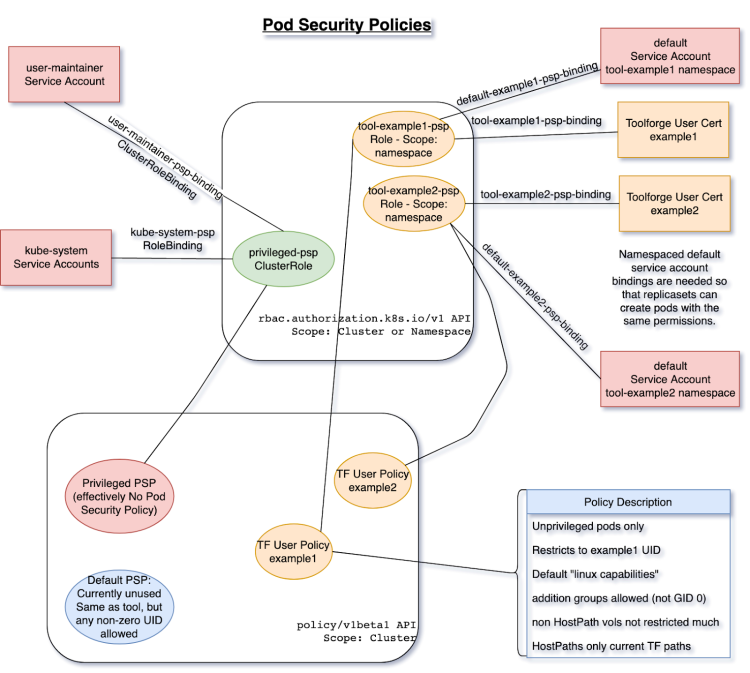
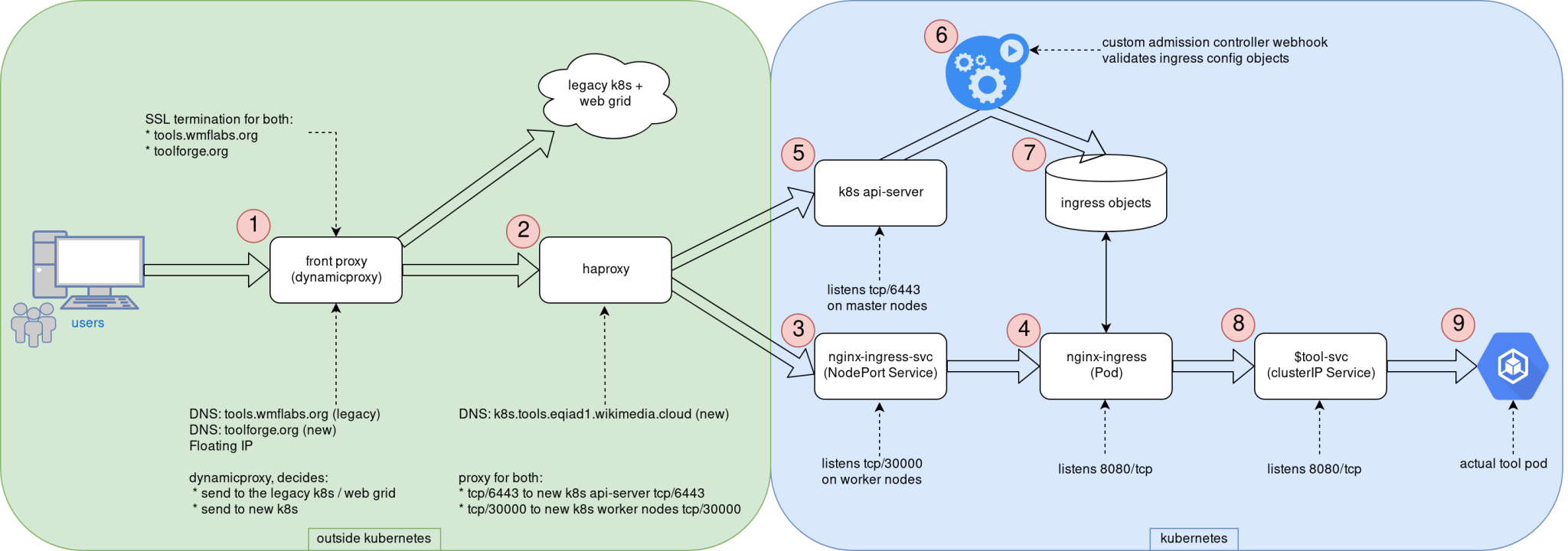
Logos This post was originally published in the Wikimedia Tech blog, and is authored by Arturo Borrero Gonzalez and Brooke Storm. In the previous post, we shared the context on the recent Kubernetes upgrade that we introduced in the Toolforge service. Today we would like to dive a bit more in the technical details. Custom admission controllers One of the key components of the Toolforge Kubernetes are our custom admission controllers. We use them to validate and enforce that the usage of the service is what we intended for. Basically, we have 2 of them: The source code is written in Golang, which is pretty convenient for natively working in a Kubernetes environment. Both code repositories include extensive documentation: how to develop, test, use, and deploy them. We decided to go with custom admission controllers because we couldn t find any native (or built-in) Kubernetes mechanism to accomplish the same sort of checks on user activity. With the Ingress controller, we want to ensure that Ingress objects only handle traffic to our internal domains, which by the time of this writing, are toolforge.org (our new domain) and tools.wmflabs.org (legacy). We safe-list the kube-system namespace and the tool-fourohfour namespace because both need special consideration. More on the Ingress setup later. The registry controller is pretty simple as well. It ensures that only our internal docker registry is used for user-scheduled containers running in Kubernetes. Again, we exclude from the checks containers running in the kube-system namespace (those used by Kubernetes itself). Other than that, the validation itself is pretty easy. For some extra containers we run (like those related to Prometheus metrics) what we do is simply upload those docker images to our internal registry. The controls provided by this admission controller helps us validate that only FLOSS software is run in our environment, which is one of the core rules of Toolforge. RBAC and Pod Security Policy setup I would like to comment next on our RBAC and Pod Security Policy setup. Using the Pod Security Policies (or PSP) we establish a set of constraints on what containers can and can t do in our cluster. We have many PSP configured in our setup: Each user can interact with their own namespace (this is how we achieve multi-tenancy in the cluster). Kubernetes knows about each user by means of TLS certs, and for that we have RBAC. Each user has a rolebinding to a shared cluster-role that defines how Toolforge tools can use the Kubernetes API. The following diagram shows the design of our RBAC and PSP in our cluster: RBAC and PSP for Toolforge diagram RBAC and PSP for Toolforge, original image in wikitech I mentioned that we know about each user by means of TLS certificates. This is true, and in fact, there is a key component in our setup called maintain-kubeusers. This custom piece of Python software is run as a pod inside the cluster and is responsible for reading our external user database (LDAP) and generating the required credentials, namespaces, and other configuration bits for them. With the TLS cert, we basically create a kubeconfig file that is then written into the homes NFS share, so each Toolforge user has it in their shell home directory. Networking and Ingress setup With the basic security controls in place, we can move on to explaining our networking and Ingress setup. Yes, the Ingress word might be a bit overloaded already, but we refer here to Ingress as the path that end-users follow from their web browser in their local machine to a webservice running in the Toolforge cluster. Some additional context here. Toolforge is not only Kubernetes, but we also have a Son of GridEngine deployment, a job scheduler that covers some features not available in Kubernetes. The grid can also run webservices, although we are encouraging users to migrate them to Kubernetes. For compatibility reasons, we needed to adapt our Ingress setup to accommodate the old web grid. Deciding the layout of the network and Ingress was definitely something that took us some time to figure out because there is not a single way to do it right. The following diagram can be used to explain the different steps involved in serving a web service running in the new Toolforge Kubernetes. Toolforge k8s network topology diagram Toolforge k8s network topology, original image in Wikitech The end-user HTTP/HTTPs request first hits our front proxy in (1). Running here is NGINX with a custom piece of LUA code that is able to decide whether to contact the web grid or the new Kubernetes cluster. TLS termination happens here as well, for both domains (toolforge.org and tools.wmflabs.org). Note this proxy is reachable from the internet, as it uses a public IPv4 address, a floating IP from CloudVPS, the infrastructure service we provide based on Openstack. Remember that our Kubernetes is directly built in virtual machines a bare-metal type deployment. If the request is directed to a webservice running in Kubernetes, the request now reaches haproxy in (2), which knows the cluster nodes that are available for Ingress. The original 80/TCP packet is now translated to 30000/TCP; this is the TCP port we use internally for the Ingress traffic. This haproxy instance provides load-balancing also for the Kubernetes API as well, using 6443/TCP. It s worth mentioning that unlike the Ingress, the API is only reachable from within the cluster and not from the internet. We have a NGINX-Ingress NodePort service listening in 30000/TCP in every Kubernetes worker node in (3); this helps the request to eventually reach the actual NGINX-Ingress pod in (4), which is listening in 8080/TCP. You can see in the diagram how in the API server (5) we hook the Ingress admission controller (6) to validate Kubernetes Ingress configuration objects before allowing them in for processing by NGINX-Ingress (7). The NGINX-Ingress process knows which tools webservices are online and how to contact them by means of an intermediate Service object in (8). This last Service object means the request finally reaches the actual tool pod in (9). At this point, it is worth noting that our Kubernetes cluster uses internally kube-proxy and Calico, both using Netfilter components to handle traffic. tools-webservice Most user-facing operations are simplified by means of another custom piece of Python code: tools-webservice. This package provides users with the webservice command line utility in our shell bastion hosts. Typical usage is to just run webservice start stop status. This utility creates all the required Kubernetes objects on-demand like Deployment, ReplicaSet, Ingress and Service to ease deploying web apps in Toolforge. Of course, advanced users can interact directly with Kubernetes API and create their custom configuration objects. This utility is just a wrapper, a shortcut. tool-fourohfour and tool-k8s-status The last couple of custom components we would like to mention are the tool-fourohfour and tool-k8s-status web services. These two utilities run inside the cluster as if they were any other user-created tool. The fourohfour tool allows for a controlled handling of HTTP 404 errors, and it works as the default NGINX-Ingress backend. The k8s-status tool shows plenty of information about the cluster itself and each tool running in the cluster, including links to the Server Admin Log, an auto-generated grafana dashboard for metrics, and more. For metrics, we use an external Prometheus server that contacts the Kubernetes cluster to scrape metrics. We created a custom metrics namespace in which we deploy all the different components we use to observe the behavior of the system: All the Prometheus data we collect is used in several different Grafana dashboards, some of them directed for user information like the ones linked by the k8s-status tool and some others for internal use by us the engineers. These are for internal use but are still public, like the Ingress specific dashboard, or the cluster state dashboard. Working publicly, in a transparent way, is key for the success of CloudVPS in general and Toolforge in particular. Like we commented in the previous post, all the engineering work that was done here was shared by community members. By the community, for the community We think this post sheds some light on how the Toolforge Kubernetes service works, and we hope it could inspire others when trying to build similar services or, even better, help us improve Toolforge itself. Since this was first put into production some months ago we detected already some margin for improvement in a couple of the components. As in many other engineering products, we will follow an iterative approach for evolving the service. Mind that Toolforge is maintained by the Wikimedia Foundation, but you can think of it as a service by the community for the community. We will keep an eye on it and have a list of feature requests and things to improve in the future. We are looking forward to it! This post was originally published in the Wikimedia Tech blog, and is authored by Arturo Borrero Gonzalez and Brooke Storm.

14 June 2020

Enrico Zini: Culture links

Those of you who watch a lot of Hollywood movies may have noticed a certain trend that has consumed the industry in the last few years. It ...
Video Essay Catalog No. 91 by Kevin B. Lee. Featured on the New York Times and other outlets. Originally published December 13, 2011 on Fandor. https://carpetbagger.blogs.nytimes.com/2011/12/19/staring-in-awe-its-the-spielberg-face/?_r=0
The Korowai cannibals live on top of trees. But is it true?
Bandicoot Cabbagepatch, Bandersnatch Cumberbund, and even Wimbledon Tennismatch: there seem to be endless variations on the name of Benedict Cumberbatch. [...] But how is a normal internet citizen supposed to know, when they hear someone say I just can t stop looking at gifs of Bombadil Rivendell that this person isn t talking about some other actor with a name and a voice and cheekbones? Or in other words, what makes for a reasonable variation of the name Bendandsnap Calldispatch?

12 June 2020

Enrico Zini: Qt5 custom build for armhf embedded development

This is part of a series of posts on compiling a custom version of Qt5 in order to develop for both amd64 and a Raspberry Pi. I split building Qt5 for armhf development in two parts: one cross-build environment to be installed on amd64 develpment systems, and a runtime part to be installed on the target armhf hardware. Building a Qt5 cross-building environment builds a mix of armhf and amd64 binares: the amd64 tools to use for cross-building, like moc, qmake, plugins for Qt Creator, and so on; armhf headers and libraries to use at cross-build time; armhf shared libraries to use at runtime. The procedure I came up with builds a devel package for amd64 development machines, which contains everything, and a second package that extracts from it only what is needed at runtime. The cross-build environment is coinstallable both with the version of Qt distributed with Debian, and with the amd64 custom Qt development package. The current build is sadly using -skip qtwebengine, because I have had no success so far getting QtWebEngine to compile as part of a cross-build Qt setup (the last road bump I can't overcome is nss and nspr not being coinstallable on amd64 and armhf, while both seem to be needed for it). The resulting packaging is at https://github.com/Truelite/qt5custom. Set up sources Open the source tarball, and add the amd64 packaging:
tar axf qt-everywhere-src-5.15.0.tar.xz
cp -a debian-cross qt-everywhere-src-5.15.0/debian
If needed, install the Qt license:
cp qt-license.txt ~/.qt-license
If debugging information are not needed in armhf development, remove --no-strip from ./configure invocation in the rules file, to build significantly smaller .deb packages. Install build dependencies Install cross-compilers:
dpkg --add-architecture armhf
apt install crossbuild-essential-armhf
You can use apt build-dep to install dependencies manually:
cd qt-everywhere-src-5.15.0
apt build-dep .
apt -a armhf build-dep .
Alternatively, you can create installable .deb metapackages that depends on the build dependencies:
apt install devscripts
mk-build-deps --host-arch amd64 debian-cross/control
mk-build-deps --host-arch armhf debian-cross/control
apt -f install qt-everywhere-cross-build-deps_5.15.0-1_amd64.deb qt-everywhere-cross-cross-build-deps_5.15.0-1_armhf.deb
Note that there are two sets of dependencies: one of amd64 packages, and one of armhf packages. Building the cross-build environment After installing the build dependencies, you can build like this:
cd qt-everywhere-src-5.15.0
fakeroot debian/rules binary
In debian/rules you can configure NUMJOBS with the number of available CPUs in the machine, to have parallel builds. This will build a package with the cross-build development environment for amd64, called qtbase5custom-armhf-dev Building the runtime environment To generate the runtime package for armhf, one needs to have the cross-build package (qtbase5custom-armhf-dev) installed in the system together with its build dependencies. At that point, the armhf runtime package can be built using the debian-armhf directory without further sources:
apt install crossbuild-essential-armhf debhelper qtbase5custom-armhf-dev*_amd64.deb qt-everywhere-src-cross-build-deps*_armhf.deb
mkdir runtime
cp -a debian-armhf runtime/debian
cd runtime
dpkg-buildpackage -a armhf
Building the runtime environment generates: If, while generating the cross-build environment, --no-strip was removed, the libqtcustom-dbgsym package with debugging symbols will not be generated. Using the cross-build environment These install their content in /opt, and are coninstallable with the version of Qt distributed in Debian, and with the custom Qt packages for amd64. One needs to be careful not to create programs that link, either directly or indirectly, with more than one of these coinstalled Qt, because the in memory layout of objects could be different and incompatible, causing unexpected results. Selecting which Qt version to use: qtchooser These Qt custom packages integrate with qtchooser to select the version of Qt to use at compile time. qtchooser --list-versions lists available versions. One can choose what to use by exporting QT_SELECT:
# apt install qtchooser qt5-qmake qt5-default
$ qtchooser --list-versions
4
5
qt4-x86_64-linux-gnu
qt4
qt5-x86_64-linux-gnu
qt5
qt5custom-x86_64-linux-gnu
qt5custom
qt5custom-armhf-x86_64-linux-gnu
qt5custom-armhf
$ qmake --version
QMake version 3.1
Using Qt version 5.11.3 in /usr/lib/x86_64-linux-gnu
$ export QT_SELECT=qt5custom-armhf
$ qmake --version
QMake version 3.1
Using Qt version 5.15.0 in /opt/qt5custom-armhf/lib
Cross-building software using custom Qt One just needs to export QT_SELECT=qt5custom-armhf in the environment, then proceed to build normally:
export QT_SELECT=qt5custom-armhf
fakeroot ./debian/rules clean binary
Or:
export QT_SELECT=qt5custom-armhf
qmake file.pro
If switching from one Qt to another, it is possible that the makefiles created by one qmake are not working well with the other. In that case, one can just remove them and regenerate them. The build result is ready to be copied into, and run in, the target armhf device.

11 June 2020

Enrico Zini: Qt5 custom build for amd64

This is part of a series of posts on compiling a custom version of Qt5 in order to develop for both amd64 and a Raspberry Pi. First step, build Qt5 5.15 packages for amd64. To prevent conflicting with Debian Qt packages, we'll install everything in /opt. We can install qtchooser configuration files to allow developers to easily switch between Debian's standard Qt version or the custom version, at will. The resulting packaging is at https://github.com/Truelite/qt5custom. Set up sources Open the source tarball, and add the amd64 packaging:
tar axf qt-everywhere-src-5.15.0.tar.xz
cp -a debian-amd64 qt-everywhere-src-5.15.0/debian
If needed, install the Qt license:
cp qt-license.txt ~/.qt-license
Install build dependencies You can use apt build-dep to install dependencies manually:
cd qt-everywhere-src-5.15.0
apt build-dep .
Alternatively, you can create an installable .deb metapackage that depends on the build dependencies:
apt install devscripts
mk-build-deps debian-amd64/control
apt -f install qt-everywhere-src-build-deps_5.15.0-1_amd64.deb
Package build The package is built by debian/rules base on the excellent work done by Debian Qt5 maintainers After installing the build dependencies, you can build like this:
cd qt-everywhere-src-5.15.0
fakeroot debian/rules binary
In debian/rules you can configure NUMJOBS with the number of available CPUs in the machine, to have parallel builds. Build output Building sources generates 4 packages: qtbase5custom-dev and libqt5custom are needed for development; only libqt5custom is needed to run build programs. Using custom Qt for amd64 These Qt custom packages install their content in /opt, and are coninstallable with the version of Qt distributed in Debian. One needs to be careful not to create programs that link, either directly or indirectly, with both the Debian Qt and the custom Qt, because the in memory layout of objects could be different and incompatible, causing unexpected results. Selecting which Qt version to use: qtchooser These Qt custom packages integrate with qtchooser to select the version of Qt to use at compile time. qtchooser --list-versions lists available versions. One can choose what to use by exporting QT_SELECT:
# apt install qtchooser qt5-qmake qt5-default
$ qtchooser --list-versions
4
5
qt4-x86_64-linux-gnu
qt4
qt5-x86_64-linux-gnu
qt5
qt5custom-x86_64-linux-gnu
qt5custom
$ qmake --version
QMake version 3.1
Using Qt version 5.11.3 in /usr/lib/x86_64-linux-gnu
$ export QT_SELECT=qt5custom
$ qmake --version
QMake version 3.1
Using Qt version 5.15.0 in /opt/qt5custom/lib
Building software using custom Qt One just needs to export QT_SELECT=qt5custom in the environment, then proceed to build normally:
export QT_SELECT=qt5custom
fakeroot ./debian/rules clean binary
Or:
export QT_SELECT=qt5custom
qmake file.pro
If switching from one Qt to another, it is possible that the makefiles created by one qmake are not working well with the other. In that case, one can just remove them and regenerate them.

Antoine Beaupr : CVE-2020-13777 GnuTLS audit: be scared

So CVE-2020-13777 came out while I wasn't looking last week. The GnuTLS advisory (GNUTLS-SA-2020-06-03) is pretty opaque so I'll refer instead to this tweet from @FiloSottile (Go team security lead):
PSA: don't rely on GnuTLS, please. CVE-2020-13777 Whoops, for the past 10 releases most TLS 1.0 1.2 connection could be passively decrypted and most TLS 1.3 connections intercepted. Trivially. Also, TLS 1.2 1.0 session tickets are awful.
You are reading this correctly: supposedly encrypted TLS connections made with affected GnuTLS releases are vulnerable to passive cleartext recovery attack (and active for 1.3, but who uses that anyways). That is extremely bad. It's pretty close to just switching everyone to HTTP instead of HTTPS, more or less. I would have a lot more to say about the security of GnuTLS in particular -- and security in general -- but I am mostly concerned about patching holes in the roof right now, so this article is not about that. This article is about figuring out what, exactly, was exposed in our infrastructure because of this.

Affected packages Assuming you're running Debian, this will show a list of packages that Depends on GnuTLS:
apt-cache --installed rdepends libgnutls30   grep '^ '   sort -u
This assumes you run this only on hosts running Buster or above. Otherwise you'll need to figure out a way to pick machines running GnuTLS 3.6.4 or later. Note that this list only first level dependencies! It is perfectly possible that another package uses GnuTLS without being listed here. For example, in the above list I have libcurl3-gnutls, so the be really thorough, I would actually need to recurse down the dependency tree. On my desktop, this shows an "interesting" list of targets:
  • apt
  • cadaver - AKA WebDAV
  • curl & wget
  • fwupd - another attack on top of this one
  • git (through the libcurl3-gnutls dependency)
  • mutt - all your emails
  • weechat - your precious private chats
Arguably, fetchers like apt, curl, fwupd, and wget rely on HTTPS for "authentication" more than secrecy, although apt has its own OpenPGP-based authentication so that wouldn't matter anyways. Still, this is truly distressing. And I haven't mentioned here things like gobby, network-manager, systemd, and others - the scope of this is broad. Hell, even good old lynx links against GnuTLS. In our infrastructure, the magic command looks something like this:
cumin -o txt -p 0  'F:lsbdistcodename=buster' "apt-cache --installed rdepends libgnutls30   grep '^ '   sort -u"   tee gnutls-rdepds-per-host   awk ' print $NF '   sort   uniq -c   sort -n
There, the result is even more worrisome, as those important packages seem to rely on GnuTLS for their transport security:
  • mariadb - all MySQL traffic and passwords
  • mandos - full disk encryption
  • slapd - LDAP passwords
mandos is especially distressing although it's probably not vulnerable because it seems it doesn't store the cleartext -- it's encrypted with the client's OpenPGP public key -- so the TLS tunnel never sees the cleartext either. Other reports have also mentioned the following servers link against GnuTLS and could be vulnerable:
  • exim
  • rsyslog
  • samba
  • various VNC implementations

Not affected Those programs are not affected by this vulnerability:
  • apache2
  • gnupg
  • python
  • nginx
  • openssh
This list is not exhaustive, naturally, but serves as an example of common software you don't need to worry about. The vulnerability only exists in GnuTLS, as far as we know, so programs linking against other libraries are not vulnerable. Because the vulnerability affects session tickets -- and those are set on the server side of the TLS connection -- only users of GnuTLS as a server are vulnerable. This means, for example, that while weechat uses GnuTLS, it will only suffer from the problem when acting as a server (which it does, in relay mode) or, of course, if the remote IRC server also uses GnuTLS. Same with apt, curl, wget, or git: it is unlikely to be a problem because it is only used as a client; the remote server is usually a webserver -- not git itself -- when using TLS.

Caveats Keep in mind that it's not because a package links against GnuTLS that it uses it. For example, I have been told that, on Arch Linux, if both GnuTLS and OpenSSL are available, the mutt package will use the latter, so it's not affected. I haven't confirmed that myself nor have I checked on Debian. Also, because it relies on session tickets, there's a time window after which the ticket gets cycled and properly initialized. But that is apparently 6 hours by default so it is going to protect only really long-lasting TLS sessions, which are uncommon, I would argue. My audit is limited. For example, it might have been better to walk the shared library dependencies directly, instead of relying on Debian package dependencies.

Other technical details It seems the vulnerability might have been introduced in this merge request, itself following a (entirely reasonable) feature request to make it easier to rotate session tickets. The merge request was open for a few months and was thoroughly reviewed by a peer before being merged. Interestingly, the vulnerable function (_gnutls_initialize_session_ticket_key_rotation), explicitly says:
 * This function will not enable session ticket keys on the server side. That is done
 * with the gnutls_session_ticket_enable_server() function. This function just initializes
 * the internal state to support periodical rotation of the session ticket encryption key.
In other words, it thinks it is not responsible for session ticket initialization, yet it is. Indeed, the merge request fixing the problem unconditionally does this:
memcpy(session->key.initial_stek, key->data, key->size);
I haven't reviewed the code and the vulnerability in detail, so take the above with a grain of salt. The full patch is available here. See also the upstream issue 1011, the upstream advisory, the Debian security tracker, and the Redhat Bugzilla.

Moving forward The impact of this vulnerability depends on the affected packages and how they are used. It can range from "meh, someone knows I downloaded that Debian package yesterday" to "holy crap my full disk encryption passwords are compromised, I need to re-encrypt all my drives", including "I need to change all LDAP and MySQL passwords". It promises to be a fun week for some people at least. Looking ahead, however, one has to wonder whether we should follow @FiloSottile's advice and stop using GnuTLS altogether. There are at least a few programs that link against GnuTLS because of the OpenSSL licensing oddities but that has been first announced in 2015, then definitely and clearly resolved in 2017 -- or maybe that was in 2018? Anyways it's fixed, pinky-promise-I-swear, except if you're one of those weirdos still using GPL-2, of course. Even though OpenSSL isn't the simplest and secure TLS implementation out there, it could preferable to GnuTLS and maybe we should consider changing Debian packages to use it in the future. But then again, the last time something like this happened, it was Heartbleed and GnuTLS wasn't affected, so who knows... It is likely that people don't have OpenSSL in mind when they suggest moving away from GnuTLS and instead think of other TLS libraries like mbedtls (previously known as PolarSSL), NSS, BoringSSL, LibreSSL and so on. Not that those are totally sinless either... "This is fine", as they say...

10 June 2020

Jonathan Dowland: Template Haskell and Stream-processing programs

I've written about what Template Haskell is, and given an example of what it can be used for, it's time to explain why I was looking at it in the context of my PhD work. Encoding stream-processing programs StrIoT is an experimental distributed stream-processing system that myself and others are building in order to explore our research questions. A user of StrIoT writes a stream-processing program, using a set of 8 functional operators provided for the purpose. A simple example is
streamFn :: Stream Int -> Stream Int
streamFn = streamFilter (<15)
         . streamFilter (>5)
         . streamMap (*2)
Our system is distributed: we take a stream-processing program and partition it into sub-programs, which are distributed to and run on separate nodes (perhaps cloud instances, or embedded devices like Raspberry Pis etc.). In order to do that, we need to be able to manipulate the stream-processing program as data. We've initially opted for a graph data-structure, with the vertices in the graph defined as
data StreamVertex = StreamVertex
      vertexId   :: Int
    , operator   :: StreamOperator
    , parameters :: [String]
    , intype     :: String
    , outtype    :: String
      deriving (Eq,Show)
A stream-processing program encoded this way, equivalent to the first example
path [ StreamVertex 0 Map    ["(*2)"]  "Int" "Int"
     , StreamVertex 1 Filter ["(>5)"]  "Int" "Int"
     , StreamVertex 2 Filter ["(<15)"] "Int" "Int"
     ]
We can easily manipulate instances of such types, rewrite them, partition them and generate code from them. Unfortunately, this is quite a departure from the first simple code example from the perspective of a user writing their program. Template Haskell gives us the ability to manipulate code as a data structure, and also to inspect names to gather information about them (their type, etc.). I started looking at TH to see if we could build something where the user-supplied program was as close to that first case as possible. TH limitations There are two reasons that we can't easily manipulate a stream-processing definition written as in the first example. The following expressions are equivalent, in some sense, but are not equal, and so yield completely different expression trees when quasi-quoted:
[  streamFilter (<15) . streamFilter (>5) . streamMap (*2)  ]
  \s -> streamFilter (<15) (streamFilter (>5) (streamMap (*2) s))  ]
[  streamMap (*2) >>> streamFilter (>5) >>> streamFilter (<15)  ]
[  \s -> s & streamMap (*2) & streamFilter (>5) & streamFilter (<15)  ]
[  streamFn  ] -- a named expression, defined outside the quasi-quotes
In theory, reify can give you the definition of a function from its name, but in practice it doesn't, because this was never implemented. So at the very least we would need to insist that a user included the entirety of a stream-processing program within quasi-quotes, and not split it up into separate bits, with some bits defined outside the quotes and references within (as in the last case above). We would probably have to insist on a consistent approach for composing operators together, such as always use (.) and never >>>, &, etc. which is limiting. Incremental approach After a while ruminating on this, and before moving onto something else, I thought I'd try approaching it from the other side. Could I introduce some TH into the existing approach, and improve it? The first thing I've tried is to change the parameters field to TH's ExpQ, meaning the map instance example above would be
StreamVertex 0 Map [ [  (*2)  ] ] "Int" "Int"
I worked this through. It's an incremental improvement ease and clarity for the user writing a stream-processing program. It catches a class of programming bugs that would otherwise slip through: the expressions in the brackets have to be syntactically valid (although they aren't type checked). Some of the StrIoT internals are also much improved, particularly the logical operator. Here's an excerpt from a rewrite rule that involves composing code embedded in strings, dealing with all the escaping rules and hoping we've accounted for all possible incoming expression encodings:
let f' = "(let f = ("++f++"); p = ("++p++"); g = ("++g++") in\
         \ \\ (a,b) v -> (f a v, if p v a then g b v else b))"
    a' = "("++a++","++b++")"
    q' = "(let p = ("++p++"); q = ("++q++") in \\v (y,z) -> p v y && q v z)"
And the same section after, manipulating ExpQ types:
let f' = [  \ (a,b) v -> ($(f) a v, if $(p) v a then $(g) b v else b)  ]
    a' = [  ($(a), $(b))  ]
    q' = [  \v (y,z) -> $(p) v y && $(q) v z  ]
I think the code-generation part of StrIoT could be radically refactored to take advantage of this change but I have not made huge inroads into that. Next steps This is, probably, where I am going to stop. This work is very interesting to me but not the main thrust of my research. But incrementally improving the representation gave me some ideas of what I could try next: The type would have collapsed down to
data StreamVertex = StreamVertex
      vertexId   :: Int
    , opAndParams :: ExpQ
      deriving (Eq,Show)
Example instances might be
StreamVertex 0 [  streamMap (*2)  ]
StreamVertex 1 [  streamExpand  ]
StreamVertex 2 [  streamScan (\c _ -> c+1) 0  ]
The vertexId field is a bit of wart, but we require that due to the graph data structure that we are using. A change there could eliminate it, too. By this point we are not that far away from where we started, and certainly much closer to the "pure" function application in the very first example.

9 June 2020

Molly de Blanc: Racism is a Free Software Issue

Racism is a free software issue. I gave a talk that touched on this at CopyLeft Conf 2019. I also talked a little bit about it at All Things Open 2019 and FOSDEM 2020 in my talk The Ethics Behind Your IoT. I know statistics, theory, and free software. I don t know about race and racism nearly as well. I might make mistakes I have made some and I will make more. Please, when I do, help me do better. I want to look at a few particular technologies and think about how they reinforce systemic racism. Worded another way: how is technology racist? How does technology hurt Black Indigenous People of Color (BIPOC)? How does technology keep us racist? How does technology make it easier to be racist?

Breathalyzers In the United States, Latinx folks are less likely to drink than white people and, overall, less likely to be arrested for DUIs3,4. However, they are more likely to be stopped by police while driving5,6. Who is being stopped by police is up to the police and they pull over a disproportionate number of Latinx drivers. After someone is pulled over for suspected drunk driving, they are given a breathalyzer test. Breathalyzers are so easy to (un)intentionally mis-calibrate that they have been banned as valid evidence in multiple states. The biases of the police are not canceled out by the technology that should, in theory, let us know whether someone is actually drunk.

Facial Recognition I could talk about for quite some time and, in fact, have. So have others. Google s image recognition software recognized black people as gorillas and to fix the issue it removed gorillas from it s image-labeling technology. Facial recognition software does a bad job at recognizing black people. In fact, it s also terrible at identifying indigenous people and other people of color. (Incidentally, it s also not great at recognizing women, but let s not talk about that right now.) As we use facial recognition technology for more things, from automated store checkouts (even more relevant in the socially distanced age of Covid-19), airport ticketing, phone unlocking, police identification, and a number of other things, it becomes a bigger problem that this software cannot tell the difference between two Asian people.

Targeted Advertising Black kids see 70% more online ads for food than white kids, and twice as many ads for junk food. In general BIPOC youth are more likely to see junk food advertisements online. This is intentional, and happens after they are identified as BIPOC youth.

Technology Reinforces Racism; Racism Builds Technology The technology we have developed reinforces racism on a society wide scale because it makes it harder for BIPOC people to interact with this world that is run by computers and software. It s harder to not be racist when the technology around us is being used to perpetuate racist paradigms. For example, if a store implements facial recognition software for checkout, black women are less likely to be identified. They are then more likely to be targeted as trying to steal from the store. We are more likely to take this to mean that black women are more likely to steal. This is how technology builds racism, People are being excluded largely because they are not building these technologies, because they are not welcome in our spaces. There simply are not enough Black and Hispanic technologists and that is a problem. We need to care about this because when software doesn t work for everyone, it doesn t work. We cannot build on the promise of free and open source software when we are excluding the majority of people.

4 June 2020

Reproducible Builds: Reproducible Builds in May 2020

Welcome to the May 2020 report from the Reproducible Builds project. One of the original promises of open source software is that distributed peer review and transparency of process results in enhanced end-user security. Nonetheless, whilst anyone may inspect the source code of free and open source software for malicious flaws, almost all software today is distributed as pre-compiled binaries. This allows nefarious third-parties to compromise systems by injecting malicious code into seemingly secure software during the various compilation and distribution processes. In these reports we outline the most important things that we and the rest of the community have been up to over the past month.

News The Corona-Warn app that helps trace infection chains of SARS-CoV-2/COVID-19 in Germany had a feature request filed against it that it build reproducibly. A number of academics from Cornell University have published a paper titled Backstabber s Knife Collection which reviews various open source software supply chain attacks:
Recent years saw a number of supply chain attacks that leverage the increasing use of open source during software development, which is facilitated by dependency managers that automatically resolve, download and install hundreds of open source packages throughout the software life cycle.
In related news, the LineageOS Android distribution announced that a hacker had access to the infrastructure of their servers after exploiting an unpatched vulnerability. Marcin Jachymiak of the Sia decentralised cloud storage platform posted on their blog that their siac and siad utilities can now be built reproducibly:
This means that anyone can recreate the same binaries produced from our official release process. Now anyone can verify that the release binaries were created using the source code we say they were created from. No single person or computer needs to be trusted when producing the binaries now, which greatly reduces the attack surface for Sia users.
Synchronicity is a distributed build system for Rust build artifacts which have been published to crates.io. The goal of Synchronicity is to provide a distributed binary transparency system which is independent of any central operator. The Comparison of Linux distributions article on Wikipedia now features a Reproducible Builds column indicating whether distributions approach and progress towards achieving reproducible builds.

Distribution work In Debian this month: In Alpine Linux, an issue was filed and closed regarding the reproducibility of .apk packages. Allan McRae of the ArchLinux project posted their third Reproducible builds progress report to the arch-dev-public mailing list which includes the following call for help:
We also need help to investigate and fix the packages that fail to reproduce that we have not investigated as of yet.
In openSUSE, Bernhard M. Wiedemann published his monthly Reproducible Builds status update.

Software development

diffoscope Chris Lamb made the changes listed below to diffoscope, our in-depth and content-aware diff utility that can locate and diagnose reproducibility issues. He also prepared and uploaded versions 142, 143, 144, 145 and 146 to Debian, PyPI, etc.
  • Comparison improvements:
    • Improve fuzzy matching of JSON files as file now supports recognising JSON data. (#106)
    • Refactor .changes and .buildinfo handling to show all details (including the GnuPG header and footer components) even when referenced files are not present. (#122)
    • Use our BuildinfoFile comparator (etc.) regardless of whether the associated files (such as the orig.tar.gz and the .deb) are present. [ ]
    • Include GnuPG signature data when comparing .buildinfo, .changes, etc. [ ]
    • Add support for printing Android APK signatures via apksigner(1). (#121)
    • Identify iOS App Zip archive data as .zip files. (#116)
    • Add support for Apple Xcode .mobilepovision files. (#113)
  • Bug fixes:
    • Don t print a traceback if we pass a single, missing argument to diffoscope (eg. a JSON diff to re-load). [ ]
    • Correct differences typo in the ApkFile handler. (#127)
  • Output improvements:
    • Never emit the same id="foo" anchor reference twice in the HTML output, otherwise identically-named parts will not be able to linked to via a #foo anchor. (#120)
    • Never emit an empty id anchor either; it is not possible to link to #. [ ]
    • Don t pretty-print the output when using the --json presenter; it will usually be too complicated to be readable by the human anyway. [ ]
    • Use the SHA256 over MD5 hash when generating page names for the HTML directory-style presenter. (#124)
  • Reporting improvements:
    • Clarify the message when we truncate the number of lines to standard error [ ] and reduce the number of maximum lines printed to 25 as usually the error is obvious by then [ ].
    • Print the amount of free space that we have available in our temporary directory as a debugging message. [ ]
    • Clarify Command [ ] failed with exit code messages to remove duplicate exited with exit but also to note that diffoscope is interpreting this as an error. [ ]
    • Don t leak the full path of the temporary directory in Command [ ] exited with 1 messages. (#126)
    • Clarify the warning message when we cannot import the debian Python module. [ ]
    • Don t repeat stderr from if both commands emit the same output. [ ]
    • Clarify that an external command emits for both files, otherwise it can look like we are repeating itself when, in reality, it is being run twice. [ ]
  • Testsuite improvements:
    • Prevent apksigner test failures due to lack of binfmt_misc, eg. on Salsa CI and elsewhere. [ ]
    • Drop .travis.yml as we use Salsa instead. [ ]
  • Dockerfile improvements:
    • Add a .dockerignore file to whitelist files we actually need in our container. (#105)
    • Use ARG instead of ENV when setting up the DEBIAN_FRONTEND environment variable at runtime. (#103)
    • Run as a non-root user in container. (#102)
    • Install/remove the build-essential during build so we can install the recommended packages from Git. [ ]
  • Codebase improvements:
    • Bump the officially required version of Python from 3.5 to 3.6. (#117)
    • Drop the (default) shell=False keyword argument to subprocess.Popen so that the potentially-unsafe shell=True is more obvious. [ ]
    • Perform string normalisation in Black [ ] and include the Black output in the assertion failure too [ ].
    • Inline MissingFile s special handling of deb822 to prevent leaking through abstract layers. [ ][ ]
    • Allow a bare try/except block when cleaning up temporary files with respect to the flake8 quality assurance tool. [ ]
    • Rename in_dsc_path to dsc_in_same_dir to clarify the use of this variable. [ ]
    • Abstract out the duplicated parts of the debian_fallback class [ ] and add descriptions for the file types. [ ]
    • Various commenting and internal documentation improvements. [ ][ ]
    • Rename the Openssl command class to OpenSSLPKCS7 to accommodate other command names with this prefix. [ ]
  • Misc:
    • Rename the --debugger command-line argument to --pdb. [ ]
    • Normalise filesystem stat(2) birth times (ie. st_birthtime) in the same way we do with the stat(1) command s Access: and Change: times to fix a nondeterministic build failure in GNU Guix. (#74)
    • Ignore case when ordering our file format descriptions. [ ]
    • Drop, add and tidy various module imports. [ ][ ][ ][ ]
In addition:
  • Jean-Romain Garnier fixed a general issue where, for example, LibarchiveMember s has_same_content method was called regardless of the underlying type of file. [ ]
  • Daniel Fullmer fixed an issue where some filesystems could only be mounted read-only. (!49)
  • Emanuel Bronshtein provided a patch to prevent a build of the Docker image containing parts of the build s. (#123)
  • Mattia Rizzolo added an entry to debian/py3dist-overrides to ensure the rpm-python module is used in package dependencies (#89) and moved to using the new execute_after_* and execute_before_* Debhelper rules [ ].

Chris Lamb also performed a huge overhaul of diffoscope s website:
  • Add a completely new design. [ ][ ]
  • Dynamically generate our contributor list [ ] and supported file formats [ ] from the main Git repository.
  • Add a separate, canonical page for every new release. [ ][ ][ ]
  • Generate a latest release section and display that with the corresponding date on the homepage. [ ]
  • Add an RSS feed of our releases [ ][ ][ ][ ][ ] and add to Planet Debian [ ].
  • Use Jekyll s absolute_url and relative_url where possible [ ][ ] and move a number of configuration variables to _config.yml [ ][ ].

Upstream patches The Reproducible Builds project detects, dissects and attempts to fix as many currently-unreproducible packages as possible. We endeavour to send all of our patches upstream where appropriate. This month, we wrote a large number of such patches, including:

Other tools Elsewhere in our tooling: strip-nondeterminism is our tool to remove specific non-deterministic results from a completed build. In May, Chris Lamb uploaded version 1.8.1-1 to Debian unstable and Bernhard M. Wiedemann fixed an off-by-one error when parsing PNG image modification times. (#16) In disorderfs, our FUSE-based filesystem that deliberately introduces non-determinism into directory system calls in order to flush out reproducibility issues, Chris Lamb replaced the term dirents in place of directory entries in human-readable output/log messages [ ] and used the astyle source code formatter with the default settings to the main disorderfs.cpp source file [ ]. Holger Levsen bumped the debhelper-compat level to 13 in disorderfs [ ] and reprotest [ ], and for the GNU Guix distribution Vagrant Cascadian updated the versions of disorderfs to version 0.5.10 [ ] and diffoscope to version 145 [ ].

Project documentation & website
  • Carl Dong:
  • Chris Lamb:
    • Rename the Who page to Projects . [ ]
    • Ensure that Jekyll enters the _docs subdirectory to find the _docs/index.md file after an internal move. (#27)
    • Wrap ltmain.sh etc. in preformatted quotes. [ ]
    • Wrap the SOURCE_DATE_EPOCH Python examples onto more lines to prevent visual overflow on the page. [ ]
    • Correct a preferred spelling error. [ ]
  • Holger Levsen:
    • Sort our Academic publications page by publication year [ ] and add Trusting Trust and Fully Countering Trusting Trust through Diverse Double-Compiling [ ].
  • Juri Dispan:

Testing framework We operate a large and many-featured Jenkins-based testing framework that powers tests.reproducible-builds.org that, amongst many other tasks, tracks the status of our reproducibility efforts as well as identifies any regressions that have been introduced. Holger Levsen made the following changes:
  • System health status:
    • Improve page description. [ ]
    • Add more weight to proxy failures. [ ]
    • More verbose debug/failure messages. [ ][ ][ ]
    • Work around strangeness in the Bash shell let VARIABLE=0 exits with an error. [ ]
  • Debian:
    • Fail loudly if there are more than three .buildinfo files with the same name. [ ]
    • Fix a typo which prevented /usr merge variation on Debian unstable. [ ]
    • Temporarily ignore PHP s horde](https://www.horde.org/) packages in Debian bullseye. [ ]
    • Document how to reboot all nodes in parallel, working around molly-guard. [ ]
  • Further work on a Debian package rebuilder:
    • Workaround and document various issues in the debrebuild script. [ ][ ][ ][ ]
    • Improve output in the case of errors. [ ][ ][ ][ ]
    • Improve documentation and future goals [ ][ ][ ][ ], in particular documentiing two real world tests case for an impossible to recreate build environment [ ].
    • Find the right source package to rebuild. [ ]
    • Increase the frequency we run the script. [ ][ ][ ][ ]
    • Improve downloading and selection of the sources to build. [ ][ ][ ]
    • Improve version string handling.. [ ]
    • Handle build failures better. [ ]. [ ]. [ ]
    • Also consider architecture all .buildinfo files. [ ][ ]
In addition:
  • kpcyrd, for Alpine Linux, updated the alpine_schroot.sh script now that a patch for abuild had been released upstream. [ ]
  • Alexander Couzens of the OpenWrt project renamed the brcm47xx target to bcm47xx. [ ]
  • Mattia Rizzolo fixed the printing of the build environment during the second build [ ][ ][ ] and made a number of improvements to the script that deploys Jenkins across our infrastructure [ ][ ][ ].
Lastly, Vagrant Cascadian clarified in the documentation that you need to be user jenkins to run the blacklist command [ ] and the usual build node maintenance was performed was performed by Holger Levsen [ ][ ][ ], Mattia Rizzolo [ ][ ] and Vagrant Cascadian [ ][ ][ ].

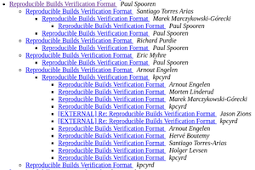
Mailing list: There were a number of discussions on our mailing list this month: Paul Spooren started a thread titled Reproducible Builds Verification Format which reopens the discussion around a schema for sharing the results from distributed rebuilders:
To make the results accessible, storable and create tools around them, they should all follow the same schema, a reproducible builds verification format. The format tries to be as generic as possible to cover all open source projects offering precompiled source code. It stores the rebuilder results of what is reproducible and what not.
Hans-Christoph Steiner of the Guardian Project also continued his previous discussion regarding making our website translatable. Lastly, Leo Wandersleb posted a detailed request for feedback on a question of supply chain security and other issues of software review; Leo is the founder of the Wallet Scrutiny project which aims to prove the security of Android Bitcoin Wallets:
Do you own your Bitcoins or do you trust that your app allows you to use your coins while they are actually controlled by them ? Do you have a backup? Do they have a copy they didn t tell you about? Did anybody check the wallet for deliberate backdoors or vulnerabilities? Could anybody check the wallet for those?
Elsewhere, Leo had posted instructions on his attempts to reproduce the binaries for the BlueWallet Bitcoin wallet for iOS and Android platforms.


If you are interested in contributing to the Reproducible Builds project, please visit our Contribute page on our website. However, you can get in touch with us via:

This month s report was written by Bernhard M. Wiedemann, Chris Lamb, Holger Levsen, Jelle van der Waa and Vagrant Cascadian. It was subsequently reviewed by a bunch of Reproducible Builds folks on IRC and the mailing list.

Gunnar Wolf: Tor from Telmex. When I say achievement unlocked , I mean it!

### The blockade has ended! For some introduction.. Back in 2016, Telmex Mexico's foremost communications provider and, through the brands grouped under the *Am rica M vil* brand, one of Latin America's most important ISPs set up rules to block connecitons to (at least) seven of Tor's *directory authorities* (*DirAuths*). We believe they might have blocked all of them, in an attempt to block connections from Tor from anywhere in their networks, but Tor is much more resourceful than that so, the measure was not too effective. Only... _Some_ blocking did hurt Telmex's users: The ability to play an active role in Tor. The ability to host Tor relays at home. Why? Because the *consensus protocol* requires relays to be reachable in order to be measured from the network's *DirAuths*. ### Technical work to prove the blocking We dug into the issue as part of the work we carried out in the project I was happy to lead between 2018 and 2019, *UNAM/DGAPA/PAPIME PE102718*. In March 2019, I presented a paper titled [Distributed Detection of Tor Directory Authorities Censorship in Mexico](https://www.thinkmind.org/index.php?view=article&articleid=icn_2019_6_20_38010) ([alternative download](http://ru.iiec.unam.mx/4538/) in the [Topic on Internet Censorship and Surveillance (TICS) track](https://tics.site/) of the XVIII International Conference on Networks. Then... We had many talks inside our group, but nothing seemed to move for several months. We did successfully push for increasing the number of Tor relays in Mexico (we managed to go from two to eleven stable relays not much in absolute terms, but quite good relatively, even more considering most users were not technically able to run one!) Jacobo N jera, journalist participant of our project, didn't leave things there just lying around waiting magically for justice to happen. Together with Vasilis Ververis, from the [Magma Project](https://magma.lavafeld.org/), they presented some weeks ago a [Case study: Tor Directory Authorities Censorship in Mexico](https://magma.lavafeld.org/guide/data-analysis.html#case-study-tor-directory-authorities-censorship-in-mexico). ### Pushing to action But a good part of being a journalist is knowing _how_ and _when_ to spread the word. Having already two technical studies showing the blocking in place, Jacobo presented his findings with [an article in GlobalVoices: *The largest telecommunications operator in Mexico blocks the secure network*](https://es.globalvoices.org/2020/05/28/en-mexico-el-mas-grande-operador-de-telecomunicaciones-bloquea-la-internet-segura/). Surprisingly (to me, at least), this story was picked up by a major Mexican newspaper: The same evening the story hit GlobalVoices, [Rodrigo Riquelme](https://www.eleconomista.com.mx/autor/rriquelme) posted an article, in the Technology section of *El Economista*, titled [Telmex blocks seven out of ten accesses to the Tor network in Mexico](https://www.eleconomista.com.mx/tecnologia/Telmex-bloquea-siete-de-10-accesos-a-la-red-Tor-en-Mexico-20200528-0078.html). And that very same day, Telmex sent a reply I am translating in full (that is now included at the end of Riquelme's article): > Mexico City, May 28, 2020 > > In relation to Tor navigation from TELMEX's network, the company > informs: > > In TELMEX, we are committed to the full respect to navigation > freedom for all of our users. > > TELMEX practices no application-level blocking policies; the Tor > application, as well as the rest of Internet applications, can be > freely accessed from our network. > > In order to protect the Internauts' information, the seven refered > nodes were in their time reported because they were associated with > the distribution of the WannaCry ransomware, which is the reason > they were filtered, but this does not hamper the use of the Tor > application. ### So we got an answer...? Jacobo knew we had to take advantage of this answer, and act fast! He entered rush-writing mode and, with the help of our good friend and lawyer Salvador Alc ntar, we wrote [a short letter to Renato Flores Cartas, Corporative Communication of Am rica M vil](https://internetanonima.net/respuesta-a-telmex-sobre-la-red-tor-en-mexico/), and sent it on June 1st. Next thing I know, this evening Jacobo was asking me if I could confirm the blocking was lifted. What I could not believe it! But, yes Today Jacobo published the confirmation that [the seven blocked IP routes were finally reachable again from ASN 8151 (UNINET / Telmex / Am rica M vil)!](https://internetanonima.net/confirmamos-desbloqueo-de-las-7-direcciones-de-la-red-tor-por-telmex/) Of course, this story was picked up again by El Economista [Telmex unblocks IP addresses for the Tor network's directory authority server IPs in Mexico](https://www.eleconomista.com.mx/tecnologia/Telmex-desbloquea-direcciones-IP-de-servidores-de-autoridad-de-la-red-Tor-en-Mexico-20200604-0094.html). ### Wrapping up How can I put this in words? I am very, very, very, *very, very, very*, **very, very, very** happy we managed to see this through! Although we have been pushing for increasing the usage of Tor among users at risk in Mexico Being a journalist, defending human rights, are still a high-risk profession in my country. We strongly believe in this, and will continue trying to raise awareness of the usage. But, just as with free software, *using* network anonymization tools is not all. We need more people to become active, to become engaged, to *become active participants* in anonymization. As the adage says, *anonymity loves company* In order to build strong, sufficient anonymization capability for everybody that needs it, we need more people to *provide relay services*. And this is a *huge* step to improve Mexico's participation in the Tor network! --- Image credits: [*Seeing My World Through a Keyhole*, by Kate Ter Haar](https://www.flickr.com/photos/katerha/4592429363) (CC-BY); [Tor logo (Wikimedia Commons)](https://commons.wikimedia.org/wiki/File:Tor-logo-2011-flat.svg)

2 June 2020

Sylvestre Ledru: Debian rebuild with clang 10 + some patches

Because of the lock-down in France and thanks to Lucas, I have been able to make some progress rebuilding Debian with clang instead of gcc.

TLDR Instead of patching clang itself, I used a different approach this time: patching Debian tools or implementing some workaround to mitigate an issue.
The percentage of packages failing drop from 4.5% to 3.6% (1400 packages to 1110 - on a total of 31014). I focused on two classes of issues:

Qmake As I have no intention to merge the patch upstream, I used a very dirty workaround. I overwrote the g++ qmake file by clang's:
https://salsa.debian.org/lucas/collab-qa-tools/-/blob/master/modes/clang10#L44-47 I dropped the number of this failure to 0, making some packages build flawlessly (example: qtcreator, chessx, fwbuilder, etc). However, some packages are still failing later and therefore increasing the number of failures in some other categories like link error. For example, qtads fails because of ordered comparison between pointer and zero or oscar fails on a -Werror,-Wdeprecated-copy error. Breaking the build later also highlighted some new classes of issues which didn't occur with clang < 10.
For example, warnings related to C++ range loop or implicit int float conversion (I fixed a bunch of them in Firefox) .

Symbol differences Historically, symbol management for C++ in Debian has been a pain. Russ Allbery wrote a blog post in 2012 explaining the situation. AFAIK, it hasn't changed much.
Once more, I took the dirty approach: if there new or missing symbols, don't fail the build.
The rational is the following: Packages in the Debian archive are supposed to build without any issue. If there is new or missing symbols, it is probably clang generating a different library but this library is very likely working as expected (and usable by a program compiled with g++ or clang). It is purely a different approach taken by the compiler developer. In order to mitigate this issue, before the build starts, I am modifying dpkg-gensymbols to transform the error into a warning.
So, the typical Debian error some new symbols appeared in the symbols file or some symbols or patterns disappeared in the symbols file will NOT fail the build. Unsurprisingly, all but one package (libktorrent) build. Even if I am pessimistic, I reported a bug on dpkg-dev to evaluate if we could improve dpkg-gensymbol not to fail on these cases.

Next steps The next offender is Imake.tmpl:2243:10: fatal error: ' X11 .rules' file not found with more than an hundred occurrences, reported upstream quite sometime ago. Then, the big issues are going to be much harder to fix as they are real issues/warnings (with -Werror) in the code of the packages. Example: -Wc++11-narrowing & Wreserved-user-defined-literal... The list is long.
I will probably work on that when llvm/clang 11 are in RC phase.

For maintainers & upstream Maintainer of Debian/Ubuntu packages? I am providing a list of failing packages per maintainer: https://clang.debian.net/maintainers.php
For upstream, it is also easy to test with clang. Usually, apt install clang && CC=clang CXX=clang++ <build step> is good enough.

Conclusion With these two changes, I have been able to fix about 290 packages. I think I will be able to get that down a bit more but we will soon reach a plateau as many warnings/issues will have to fix in the C/C++ code itself.

1 June 2020

Debian GSoC Kotlin project blog: Kotlin Update

A Quick Recap from last year: Kotlin is being packaged under the Google Summer of Code within the Debian organization itself. The major reason behind bringing Kotlin in Debian is to update all the Android packages which are now heavily dependent upon the Kotlin libraries. The major work to bring Kotlin into Debian is done for the version 1.3.30, by Saif Abdul Cassim (goes by m36 on IRC) as a part of his GSoC'2019. All his contributions to the team can be found in his blog posts. So, for now, we have a bootstrap package and a Kotlin package for the version with 1.3.30. There were still changes needed as we lacked some of the dependencies for Kotlin, and the source package lacked copyright information and didn t comply with Debian standards. What's the present year brought for Kotlin? To be specific the following were mainly left dependencies for Kotlin: And, we lack documentation for the newbies in order to get them started :( Most importantly the crucial part was and still is, to figure out how to upload the package? For GSoC'20, three students are selected as a part of project Android SDK tools in Debian. What's the work done/left? Work Done What's Blocking? What is the problem being faced? The Kotlin-Bootstrap package consists of JAR files for various dependencies of kotlin such as Gradle, kotlin compiler, and kotlinx. The package is added to the build-depends of the main package so that the JAR files can be provided. Since the kotlin-bootstrap consists of binaries (JAR files), it is not feasible to upload the package as free software. The other workaround was the Gradle 6.4 version, which consists of Kotlin files and generates a suitable JAR. But since the package needed Kotlin language itself, it was never updated, as it created a cyclic dependency. Final workaround came, which proposed Kotlin to build from itself, that was a pretty impressive suggestion. But, we still have to look if the solution is feasible? Because, as far as I last checked and conversed with ebourg on the mailing list here, Emmanuel Bbourg mentioned very clearly that the rebuilt package is our interest. So, this is under WIP. But, I fail to acknowledge the fact if we can drop the kotlin-bootstrap package totally, Kotlin will not be able to be built because each and every JAR file present in the bootstrap is needed. That pretty much is the ongoing work and the update on the kotlin package. We intend to bring Kotlin to the Debian Archive as soon as possible :) Have any queries or suggestions for Kotlin? Please feel to drop a message at #debian-mobile channel on OFTC.

31 May 2020

Chris Lamb: Free software activities in May 2020

Here is my monthly update covering what I have been doing in the free software world during May 2020 (previous month): In Lintian, the static analysis tool for Debian packages:
Reproducible builds One of the original promises of open source software is that distributed peer review and transparency of process results in enhanced end-user security. However, whilst anyone may inspect the source code of free and open source software for malicious flaws, almost all software today is distributed as pre-compiled binaries. This allows nefarious third-parties to compromise systems by injecting malicious code into ostensibly secure software during the various compilation and distribution processes. The motivation behind the Reproducible Builds effort is to ensure no flaws have been introduced during this compilation process by promising identical results are always generated from a given source, thus allowing multiple third-parties to come to a consensus on whether a build was compromised. The initiative is proud to be a member project of the Software Freedom Conservancy, a not-for-profit 501(c)(3) charity focused on ethical technology and user freedom. Conservancy acts as a corporate umbrella allowing projects to operate as non-profit initiatives without managing their own corporate structure. If you like the work of the Conservancy or the Reproducible Builds project, please consider becoming an official supporter.
Elsewhere in our tooling, I made the following changes to diffoscope, our in-depth and content-aware diff utility that can locate and diagnose reproducibility issues, including preparing and uploading versions 142, 143, 144, 145 and 146 to Debian: I also performed a huge overhaul of diffoscope's website:
Lastly, I made a large number of changes to the main Reproducible Builds website and documentation:
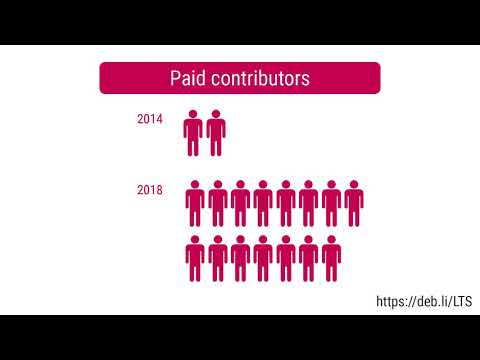
Debian LTS This month I contributed 17 hours to Debian Long Term Support (LTS) and 9 hours on its sister Extended LTS project. You can find out more about the two projects via the following video:
Debian I filed the following bug reports in Debian this month: I also filed a number of bugs against packages that are not compatible with Django 3.x, (organised around a single master bug) including django-taggit, sorl-thumbnail, django-simple-captcha, django-cas-server, django-cors-headers, python-django-csp, django-pipeline, python-django-jsonfield, python-django-contact-form, django-model-utils, django-fsm, django-modeltranslation, django-oauth-toolkit, libthumbor, python-django-extensions, python-django-imagekit, python-django-navtag, python-django-tagging, djangorestframework, django-haystack, django-taggit, django-simple-captcha, python-django-registration, python-django-pyscss, python-django-compressor, python-django-crispy-forms & python-django-mptt,
Lastly, I made the following uploads to Debian: I also sponsored an upload for adminer (4.7.7-1), also uploading it to buster-backports.

30 May 2020

Reproducible Builds (diffoscope): diffoscope 146 released

The diffoscope maintainers are pleased to announce the release of diffoscope version 146. This version includes the following changes:
[ Chris Lamb ]
* Refactor .changes and .buildinfo handling to show all details (including
  the GPG header and footer components), even when referenced files are not
  present. (Closes: reproducible-builds/diffoscope#122)
* Normalise filesystem stat(2) "birth times" (ie. st_birthtime) in the same
  way we do with stat(1)'s "Access:" and "Change:" times to fix a
  nondetermistic build failure on GNU Guix.
  (Closes: reproducible-builds/diffoscope#74)
* Drop the (default) subprocess.Popen(shell=False) keyword argument so that
  the more unsafe shell=True is more obvious.
* Ignore lower vs. upper-case when ordering our file format descriptions.
* Don't skip string normalisation in Black.
[ Mattia Rizzolo ]
* Add a "py3dist" override for the rpm-python module (Closes: #949598)
* Bump the debhelper compat level to 13 and use the new
  execute_after_*/execture_before_* style rules.
* Fix a spelling error in changelog.
[ Daniel Fullmer ]
* Mount GuestFS filesystem images readonly.
[ Jean-Romain Garnier ]
* Prevent an issue where (for example) LibarchiveMember's has_same_content
  method is called regardless of the actual type of file.
You find out more by visiting the project homepage.

27 May 2020

Russ Allbery: Review: Middlegame

Review: Middlegame, by Seanan McGuire
Publisher: Tor
Copyright: May 2019
ISBN: 1-250-19551-9
Format: Kindle
Pages: 528
Roger and Dodger are cuckoo children, alchemical constructs created by other alchemical constructs masquerading as humans. They are halves of the primal force of the universe, the Doctrine of Ethos (which is not what the Doctrine of Ethos is, but that is one of my lesser problems with this book), divided into language and math and kept separate to properly mature. In this case, separate means being adopted by families on opposite coasts of the United States, ignorant of each other's existence and closely monitored by agents Reed controls. None of that prevents Roger and Dodger from becoming each other's invisible friends at the age of seven, effortlessly communicating psychically even though they've never met. That could have been the start of an enjoyable story that hearkened back to an earlier age of science fiction: the secret science experiments discover that they have more power than their creators expected, form a clandestine alliance, and fight back against the people who are trying to control them. I have fond memories of Escape to Witch Mountain and would have happily read that book. Unfortunately, that isn't the story McGuire wanted to tell. The story she told involves ripping Roger and Dodger apart, breaking Dodger, and turning Roger into an abusive asshole. Whooboy, where to start. This book made me very angry, in a way that I would not have been if it didn't contain the bones of a much better novel. Four of them, to be precise: four other books that would have felt less gratuitously cruel and less apparently oblivious to just how bad Roger's behavior is. There are some things to like. One of them is that the structure of this book is clever. I can't tell you how it's clever because the structure doesn't become clear until more than halfway through and it completely changes the story in a way that would be a massive spoiler. But it's an interesting spin on an old idea, one that gave Roger and Dodger a type of agency in the story that has far-ranging implications. I enjoyed thinking about it. That leads me to another element I liked: Erin. She makes only fleeting appearances until well into the story, but I thought she competed with Dodger for being the best character of the book. The second of the better novels I saw in the bones of Middlegame was the same story told from Erin's perspective. I found myself guessing at her motives and paying close attention to hints that led to a story with a much different emotional tone. Viewing the ending of the book through her eyes instead of Roger and Dodger's puts it in a different, more complicated, and more thought-provoking light. Unfortunately, she's not McGuire's protagonist. She instead is one of the monsters of this book, which leads to my first, although not my strongest, complaint. It felt like McGuire was trying too hard to write horror, packing Middlegame with the visuals of horror movies without the underlying structure required to make them effective. I'm not a fan of horror personally, so to some extent I'm grateful that the horrific elements were ineffective, but it makes for some frustratingly bad writing. For example, one of the longest horror scenes in the book features Erin, and should be a defining moment for the character. Unfortunately, it's so heavy on visuals and so focused on what McGuire wants the reader to be thinking that it doesn't show any of the psychology underlying Erin's decisions. The camera is pointed the wrong way; all the interesting storytelling work, moral complexity, and world-building darkness is happening in the character we don't get to see. And, on top of that, McGuire overuses foreshadowing so much that it robs the scene of suspense and terror. Again, I'm partly grateful, since I don't read books for suspense and terror, but it means the scene does only a fraction of the work it could. This problem of trying too hard extends to the writing. McGuire has a bit of a tendency in all of her books to overdo the descriptions, but is usually saved by narrative momentum. Unfortunately, that's not true here, and her prose often seems overwrought. She also resorts to this style of description, which never fails to irritate me:
The thought has barely formed when a different shape looms over him, grinning widely enough to show every tooth in its head. They are even, white, and perfect, and yet he somehow can't stop himself from thinking there's something wrong with them, that they're mismatched, that this assortment of teeth was never meant to share a single jaw, a single terrible smile.
This isn't effective. This is telling the reader how they're supposed to feel about the thing you're describing, without doing the work of writing a description that makes them feel that way. (Also, you may see what I mean by overwrought.) That leads me to my next complaint: the villains. My problem is not so much with Leigh, who I thought was an adequate monster, if a bit single-note. There's some thought and depth behind her arguments with Reed, a few hints of her own motives that were more convincing for not being fully shown. The descriptions of how dangerous she is were reasonably effective. She's a good villain for this type of dark fantasy story where the world is dangerous and full of terrors (and reminded me of some of the villains from McGuire's October Daye series). Reed, though, is a storytelling train wreck. The Big Bad of the novel is the least interesting character in it. He is a stuffed tailcoat full of malicious incompetence who is only dangerous because the author proclaims him to be. It only adds insult to injury that he kills off a far more nuanced and creative villain before the novel starts, replacing her ambiguous goals with Snidely Whiplash mustache-twirling. The reader has to suffer through extended scenes focused on him as he brags, monologues, and obsesses over his eventual victory without an ounce of nuance or subtlety. Worse is the dynamic between him and Leigh, which is only one symptom of the problem with Middlegame that made me the most angry: the degree to this book oozes patriarchy. Every man in this book, including the supposed hero, orders around the women, who are forced in various ways to obey. This is the most obvious between Leigh and Reed, but it's the most toxic, if generally more subtle, between Roger and Dodger. Dodger is great. I had absolutely no trouble identifying with and rooting for her as a character. The nasty things that McGuire does to her over the course of the book (and wow does that never let up) made me like her more when she tenaciously refuses to give up. Dodger is the math component of the Doctrine of Ethos, and early in the book I thought McGuire handled that well, particularly given how difficult it is to write a preternatural genius. Towards the end of this book, her math sadly turns into a very non-mathematical magic (more on this in a moment), but her character holds all the way through. It felt like she carved her personality out of this story through sheer force of will and clung to it despite the plot. I wanted to rescue her from this novel and put her into a better book, such as the one in which her college friends (who are great; McGuire is very good at female friendships when she writes them) stage an intervention, kick a few people out of her life, and convince her to trust them. Unfortunately, Dodger is, by authorial fiat, half of a bound pair, and the other half of that pair is Roger, who is the sort of nice guy everyone likes and thinks is sweet and charming until he turns into an emotional trap door right when you need him the most and dumps you into the ocean to drown. And then somehow makes you do all the work of helping him feel better about his betrayal. The most egregious (and most patriarchal) thing Roger does in this book is late in the book and a fairly substantial spoiler, so I can't rant about that properly. But even before that, Roger keeps doing the the same damn emotional abandonment trick, and the book is heavily invested into justifying it and making excuses for him. Excuses that, I should note, are not made for Dodger; her failings are due to her mistakes and weaknesses, whereas Roger's are natural reactions to outside forces. I got very, very tired of this, and I'm upset by how little awareness the narrative voice showed for how dysfunctional and abusive this relationship is. The solution is always for Dodger to reunite with Roger; it's built into the structure of the story. I have a weakness for the soul-bound pair, in part from reading a lot of Mercedes Lackey at an impressionable age, but one of the dangerous pitfalls of the concept is that the characters then have to have an almost flawless relationship. If not, it can turn abusive very quickly, since the characters by definition cannot leave each other. It's essentially coercive, so as soon as the relationship shows a dark side, the author needs to be extremely careful. McGuire was not. There is an attempted partial patch, late in the book, for the patriarchal structure. One of the characters complains about it, and another says that the gender of the language and math pairs is random and went either way in other pairs. Given that both of the pairs that we meet in this story have the same male-dominant gender dynamic, what I took from this is that McGuire realized there was a problem but wasn't able to fix it. (I'm also reminded of David R. Henry's old line that it's never a good sign when the characters start complaining about the plot.) The structural problems are all the more frustrating because I think there were ways out of them. Roger is supposedly the embodiment of language, not that you'd be able to tell from most scenes in this novel. For reasons that I do not understand, McGuire expressed that as a love of words: lexicography, translation, and synonyms. This makes no sense to me. Those are some of the more structured and rules-based (and hence mathematical) parts of language. If Roger had instead been focused on stories collecting them, telling them, and understanding why and how they're told he would have had a clearer contrast with Dodger. More importantly, it would have solved the plot problem that McGuire solved with a nasty bit of patriarchy. So much could have been done with Dodger building a structure of math around Roger's story-based expansion of the possible, and it would have grounded Dodger's mathematics in something more interesting than symbolic magic. To me, it's such an obvious lost opportunity. I'm still upset about this book. McGuire does a lovely bit of world-building with Asphodel Baker, what little we see of her. I found the hidden alchemical war against her work by L. Frank Baum delightful, and enjoyed every excerpt from the fictional Over the Woodward Wall scattered throughout Middlegame. But a problem with inventing a fictional book to excerpt in a real novel is that the reader may decide that the fictional book sounds a lot better than the book they're reading, and start wishing they could just read that book instead. That was certainly the case for me. I'm sad that Over the Woodward Wall doesn't exist, and am mostly infuriated by Middlegame. Dodger and Erin deserved to live in a better book. Should you want to read this anyway (and I do know people who liked it), serious content warning for self-harm. Rating: 4 out of 10

26 May 2020

Russ Allbery: Review: The Ten Thousand Doors of January

Review: The Ten Thousand Doors of January, by Alix E. Harrow
Publisher: Redhook
Copyright: September 2019
ISBN: 0-316-42198-7
Format: Kindle
Pages: 373
In 1901, at the age of seven, January found a Door. It was barely more than a frame in a ruined house in a field in Kentucky, but she wrote a story about opening it, and then did.
Once there was a brave and temeraryous (sp?) girl who found a Door. It was a magic Door that's why it has a capital D. She opened the Door.
The Door led to a bluff over the sea and above a city, a place very far from Kentucky, and she almost stayed, but she came back through the Door when her guardian, Mr. Locke, called. The adventure cost her a diary, several lectures, days of being locked in her room, and the remnants of her strained relationship with her father. When she went back, the frame of the Door was burned to the ground. That was the end of Doors for January for some time, and the continuation of a difficult childhood. She was cared for by her father's employer as a sort of exotic pet, dutifully attempting to obey, grateful for Mr. Locke's protection, and convinced that he was occasionally sneaking her presents through a box in the Pharaoh Room out of some hidden kindness. Her father appeared rarely, said little, and refused to take her with him. Three things helped: the grocery boy who smuggled her stories, an intimidating black woman sent by her father to replace her nurse, and her dog.
Once upon a time there was a good girl who met a bad dog, and they became the very best of friends. She and her dog were inseparable from that day forward.
I will give you a minor spoiler that I would have preferred to have had, since it would have saved me some unwarranted worry and some mental yelling at the author: The above story strains but holds. January's adventure truly starts the day before her seventeenth birthday, when she finds a book titled The Ten Thousand Doors in the box in the Pharaoh Room. As you may have guessed from the title, The Ten Thousand Doors of January is a portal fantasy, but it's the sort of portal fantasy that is more concerned with the portal itself than the world on the other side of it. (Hello to all of you out there who, like me, have vivid memories of the Wood between the Worlds.) It's a book about traveling and restlessness and the possibility of escape, about the ability to return home again, and about the sort of people who want to close those doors because the possibility of change created by people moving around freely threatens the world they have carefully constructed. Structurally, the central part of the book is told by interleaving chapters of January's tale with chapters from The Ten Thousand Doors. That book within a book starts with the framing of a scholarly treatment but quickly becomes a biography of a woman: Adelaide Lee Larson, a half-wild farm girl who met her true love at the threshold of a Door and then spent much of her life looking for him. I am not a very observant reader for plot details, particularly for books that I'm enjoying. I read books primarily for the emotional beats and the story structure, and often miss rather obvious story clues. (I'm hopeless at guessing the outcomes of mysteries.) Therefore, when I say that there are many things January is unaware of that are obvious to the reader, that's saying a lot. Even more clues were apparent when I skimmed the first chapter again, and a more observant reader would probably have seen them on the first read. Right down to Mr. Locke's name, Harrow is not very subtle about the moral shape of this world. That can make the early chapters of the book frustrating. January is being emotionally (and later physically) abused by the people who have power in her life, but she's very deeply trapped by false loyalty and lack of external context. Winning free of that is much of the story of the book, and at times it has the unpleasantness of watching someone make excuses for her abuser. At other times it has the unpleasantness of watching someone be abused. But this is the place where I thought the nested story structure worked marvelously. January escapes into the story of The Ten Thousand Doors at the worst moments of her life, and the reader escapes with her. Harrow uses the desire to switch scenes back to the more adventurous and positive story to construct and reinforce the emotional structure of the book. For me, it worked extremely well. It helps that the ending is glorious. The payoff is worth all the discomfort and tension-building in the first half of the book. Both The Ten Thousand Doors and the surrounding narrative reach deeply satisfying conclusions, ones that are entangled but separate in just the ways that they need to be. January's abilities, actions, and decisions at the end of the book were just the outcome that I needed but didn't entirely guess in advance. I could barely put down the last quarter of this story and loved every moment of the conclusion. This is the sort of book that can be hard to describe in a review because its merits don't rest on an original twist or easily-summarized idea. The elements here are all elements found in other books: portal fantasy, the importance of story-telling, coming of age, found family, irrepressible and indomitable characters, and the battle of the primal freedom of travel and discovery and belief against the structural forces that keep rulers in place. The merits of this book are in the small details: the way that January's stories are sparse and rare and sometimes breathtaking, the handling of tattoos, the construction of other worlds with a few deft strokes, and the way Harrow embraces the emotional divergence between January's life and Adelaide's to help the reader synchronize the emotional structure of their reading experience with January's.
She writes a door of blood and silver. The door opens just for her.
The Ten Thousand Doors of January is up against a very strong slate for both the Nebula and the Hugo this year, and I suspect it may be edged out by other books, although I wouldn't be unhappy if it won. (It probably has a better shot at the Nebula than the Hugo.) But I will be stunned if Harrow doesn't walk away with the Mythopoeic Award. This seems like exactly the type of book that award was created for. This is an excellent book, one of the best I've read so far this year. Highly recommended. Rating: 9 out of 10

25 May 2020

Russ Allbery: Review: The Last Emperox

Review: The Last Emperox, by John Scalzi
Series: Interdependency #3
Publisher: Tor
Copyright: April 2020
ISBN: 0-7653-8917-7
Format: Kindle
Pages: 318
This is the conclusion of the Interdependency trilogy, which is a single story told in three books. Start with The Collapsing Empire. You don't want to read this series out of order. All the pieces and players are in place, the causes and timeline of the collapse of the empire she is accidentally ruling are now clear, and Cardenia Wu-Patrick knows who her friends and enemies are. What she doesn't know is what she can do about it. Her enemies, unfettered Cardenia's ethics or desire to save the general population, have the advantage of clearer and more achievable goals. If they survive and, almost as important, remain in power, who cares what happens to everyone else? As with The Consuming Fire, the politics may feel a bit too on-the-nose for current events, this time for the way that some powerful people are handling (or not handling) the current pandemic. Also as with The Consuming Fire, Scalzi's fast-moving story, likable characters, banter, and occasional humorous descriptions prevent those similarities from feeling heavy or didactic. This is political wish fulfillment to be sure, but it doesn't try to justify itself or linger too much on its improbabilities. It's a good story about entertaining people trying (mostly) to save the world with a combination of science and political maneuvering. I picked up The Last Emperox as a palate cleanser after reading Gideon the Ninth, and it provided exactly what I was looking for. That gave me an opportunity to think about what Scalzi does in his writing, why his latest novel was one of my first thoughts for a palate cleanser, and why I react to his writing the way that I do. Scalzi isn't a writer about whom I have strong opinions. In my review of The Collapsing Empire, I compared his writing to the famous description of Asimov as the "default voice" of science fiction, but that's not quite right. He has a distinct and easily-recognizable style, heavy on banter and light-hearted description. But for me his novels are pleasant, reliable entertainment that I forget shortly after reading them. They don't linger or stand out, even though I enjoy them while I'm reading them. That's my reaction. Others clearly do not have that reaction, fully engage with his books, and remember them vividly. That indicates to me that there's something his writing is doing that leaves substantial room for difference of personal taste and personal reaction to the story, and the sharp contrast between The Last Emperox and Gideon the Ninth helped me put my finger on part of it. I don't feel like Scalzi's books try to tell me how to feel about the story. There's a moment in The Last Emperox where Cardenia breaks down crying over an incredibly difficult decision that she's made, one that the readers don't find out about until later. In another book, there would be considerably more emotional build-up to that moment, or at least some deep analysis of it later once the decision is revealed. In this book, it's only a handful of paragraphs and then a few pages of processing later, primarily in dialogue, and less focused on the emotions of the characters than on the forward-looking decisions they've made to deal with those emotions. The emotion itself is subtext. Many other authors would try to pull the reader into those moments and make them feel what the characters are feeling. Scalzi just relates them, and leaves the reader free to feel what they choose to feel. I don't think this is a flaw (or a merit) in Scalzi's writing; it's just a difference, and exactly the difference that made me reach for this book as an emotional break after a book that got its emotions all over the place. Calling Scalzi's writing emotionally relaxing isn't quite right, but it gives me space to choose to be emotionally relaxed if I want to be. I can pick the level of my engagement. If I want to care about these characters and agonize over their decisions, there's enough information here to mull over and use to recreate their emotional states. If I just want to read a story about some interesting people and not care too much about their hopes and dreams, I can choose to do that instead, and the book won't fight me. That approach lets me sidle up on the things that I care about and think about them at my leisure, or leave them be. This approach makes Scalzi's books less intense than other novels for me. This is where personal preference comes in. I read books in large part to engage emotionally with the characters, and I therefore appreciate books that do a lot of that work for me. Scalzi makes me do the work myself, and the result is not as effective for me, or as memorable. I think this may be part of what I and others are picking up on when we say that Scalzi's writing is reminiscent of classic SF from decades earlier. It used to be common for SF to not show any emotional vulnerability in the main characters, and to instead focus on the action plot and the heroics and martial virtues. This is not what Scalzi is doing, to be clear; he has a much better grasp of character and dialogue than most classic SF, adds considerable light-hearted humor, and leaves clear clues and hooks for a wide range of human emotions in the story. But one can read Scalzi in that tone if one wants to, since the emotional hooks do not grab hard at the reader and dig in. By comparison, you cannot read Gideon the Ninth without grappling with the emotions of the characters. The book will not let you. I think this is part of why Scalzi is so consistent for me. If you do not care deeply about Gideon Nav, you will not get along with Gideon the Ninth, and not everyone will. But several main characters in The Last Emperox (Mance and to some extent Cardenia) did little or nothing for me emotionally, and it didn't matter. I liked Kiva and enjoyed watching her strategically smash her way through social conventions, but it was easy to watch her from a distance and not get too engrossed in her life or her thoughts. The plot trundled along satisfyingly, regardless. That lack of emotional involvement precludes, for me, a book becoming the sort of work that I will rave about and try to press into other people's hands, but it also makes it comfortable and gentle and relaxing in a way that a more emotionally fraught book could not be. This is a long-winded way to say that this was a satisfying conclusion to a space opera trilogy that I enjoyed reading, will recommend mildly to others, and am already forgetting the details of. If you liked the first two books, this is an appropriate and fun conclusion with a few new twists and a satisfying amount of swearing (mostly, although not entirely, from Kiva). There are a few neat (albeit not horribly original) bits of world-building, a nice nod to and subversion of Asimov, a fair bit of political competency wish fulfillment (which I didn't find particularly believable but also didn't mind being unbelievable), and one enjoyable "oh no she didn't" moment. If you like the thing that Scalzi is doing, you will enjoy this book. Rating: 8 out of 10

22 May 2020

Steve Kemp: Updated my linux-security-modules for the Linux kernel

Almost three years ago I wrote my first linux-security-module, inspired by a comment I read on LWN I did a little more learning/experimentation and actually produced a somewhat useful LSM, which allows you to restrict command-execution via the use of a user-space helper: Because the detection is done in userspace writing your own custom rules is both safe and easy. No need to touch the kernel any further! Yesterday I rebased all the modules so that they work against the latest stable kernel 5.4.22 in #7.
The last time I'd touched them they were built against 5.1, which was itself a big jump forwards from the 4.16.7 version I'd initially used.
Finally I updated the can-exec module to make it gated, which means you can turn it on, but not turn it off without a reboot. That was an obvious omission from the initial implementation #11. Anyway updated code is available here: I'd kinda like to write more similar things, but I lack inspiration.

Next.

Previous.