
Search Results: "pm"

25 October 2022

Arturo Borrero Gonz lez: Netfilter Workshop 2022 summary

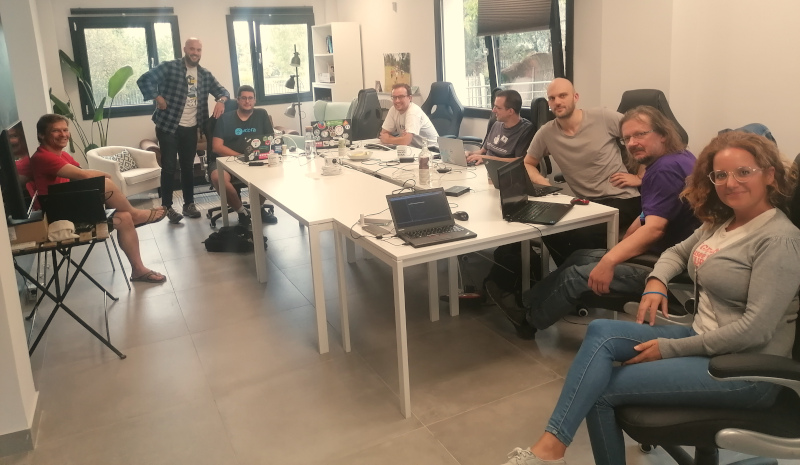
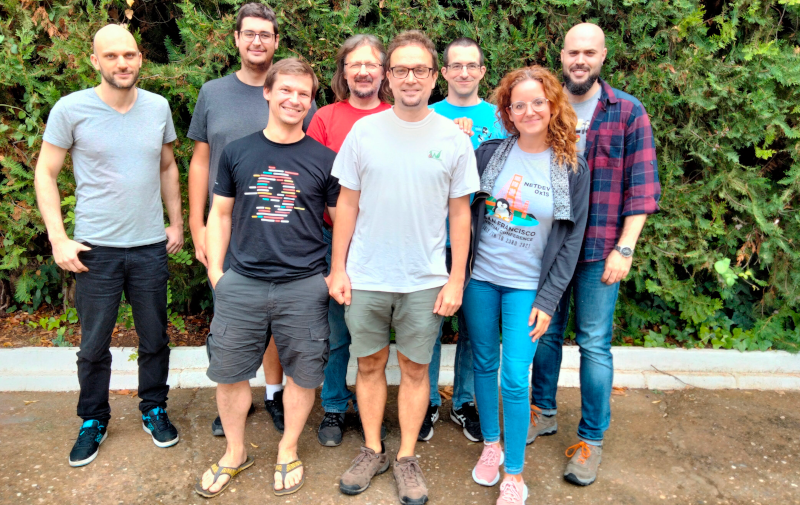
Netfilter logo This is my report from the Netfilter Workshop 2022. The event was held on 2022-10-20/2022-10-21 in Seville, and the venue was the offices of Zevenet. We started on Thursday with Pablo Neira (head of the project) giving a short welcome / opening speech. The previous iteration of this event was in virtual fashion in 2020, two years ago. In the year 2021 we were unable to meet either in person or online. This year, the number of participants was just eight people, and this allowed the setup to be a bit more informal. We had kind of an un-conference style meeting, in which whoever had something prepared just went ahead and opened a topic for debate. In the opening speech, Pablo did a quick recap on the legal problems the Netfilter project had a few years ago, a topic that was settled for good some months ago, in January 2022. There were no news in this front, which was definitely a good thing. Moving into the technical topics, the workshop proper, Pablo started to comment on the recent developments to instrument a way to perform inner matching for tunnel protocols. The current implementation supports VXLAN, IPIP, GRE and GENEVE. Using nftables you can match packet headers that are encapsulated inside these protocols. He mentioned the design and the goals, that was to have a kernel space setup that allows adding more protocols by just patching userspace. In that sense, more tunnel protocols will be supported soon, such as IP6IP, UDP, and ESP. Pablo requested our opinion on whether if nftables should generate the matching dependencies. For example, if a given tunnel is UDP-based, a dependency match should be there otherwise the rule won t work as expected. The agreement was to assist the user in the setup when possible and if not, print clear error messages. By the way, this inner thing is pure stateless packet filtering. Doing inner-conntracking is an open topic that will be worked on in the future. Pablo continued with the next topic: nftables automatic ruleset optimizations. The times of linear ruleset evaluation are over, but some people have a hard time understanding / creating rulesets that leverage maps, sets, and concatenations. This is where the ruleset optimizations kick in: it can transform a given ruleset to be more optimal by using such advanced data structures. This is purely about optimizing the ruleset, not about validating the usefulness of it, which could be another interesting project. There were a couple of problems mentioned, however. The ruleset optimizer can be slow, O(n!) in worst case. And the user needs to use nested syntax. More improvements to come in the future. Next was Stefano Brivio s turn (Red Hat engineer). He had been involved lately in a couple of migrations to nftables, in particular libvirt and KubeVirt. We were pointed to https://libvirt.org/firewall.html, and Stefano walked us through the 3 or 4 different virtual networks that libvirt can create. He evaluated some options to generate efficient rulesets in nftables to instrument such networks, and commented on a couple of ideas: having a null matcher in nftables set expression. Or perhaps having kind of subsets, something similar to a view in a SQL database. The room spent quite a bit of time debating how the nft_lookup API could be extended to support such new search operations. We also discussed if having intermediate facilities such as firewalld could provide the abstraction levels that could make developers more comfortable. Using firewalld also may have the advantage that coordination between different system components writing ruleset to nftables is handled by firewalld itself and developers are freed of the responsibility of doing it right. Next was Fernando F. Mancera (Red Hat engineer). He wanted to improve error reporting when deleting table/chain/rules with nftables. In general, there are some inconsistencies on how tables can be deleted (or flushed). And there seems to be no correct way to make a single table go away with all its content in a single command. The room agreed in that the commands destroy table and delete table should be defined consistently, with the following meanings: This topic diverted into another: how to reload/replace a ruleset but keep stateful information (such as counters). Next was Phil Sutter (Netfilter coreteam member and Red Hat engineer). He was interested in discussing options to make iptables-nft backward compatible. The use case he brought was simple: What happens if a container running iptables 1.8.7 creates a ruleset with features not supported by 1.8.6. A later container running 1.8.6 may fail to operate. Phil s first approach was to attach additional metadata into rules to assist older iptables-nft in decoding and printing the ruleset. But in general, there are no obvious or easy solutions to this problem. Some people are mixing different tooling version, and there is no way all cases can be predicted/covered. iptables-nft already refuses to work in some of the most basic failure scenarios. An other way to approach the issue could be to introduce some kind of support to print raw expressions in iptables-nft, like -m nft xyz. Which feels ugly, but may work. We also explored playing with the semantics of release version numbers. And another idea: store strings in the nft rule userdata area with the equivalent matching information for older iptables-nft. In fact, what Phil may have been looking for is not backwards but forward compatibility. Phil was undecided which path to follow, but perhaps the most common-sense approach is to fall back to a major release version bump (2.x.y) and declaring compatibility breakage with older iptables 1.x.y. That was pretty much it for the first day. We had dinner together and went to sleep for the next day. The room The second day was opened by Florian Westphal (Netfilter coreteam member and Red Hat engineer). Florian has been trying to improve nftables performance in kernels with RETPOLINE mitigations enabled. He commented that several workarounds have been collected over the years to avoid the performance penalty of such mitigations. The basic strategy is to avoid function indirect calls in the kernel. Florian also described how BPF programs work around this more effectively. And actually, Florian tried translating nf_hook_slow() to BPF. Some preliminary benchmarks results were showed, with about 2% performance improvement in MB/s and PPS. The flowtable infrastructure is specially benefited from this approach. The software flowtable infrastructure already offers a 5x performance improvement with regards the classic forwarding path, and the change being researched by Florian would be an addition on top of that. We then moved into discussing the meeting Florian had with Alexei in Zurich. My personal opinion was that Netfilter offers interesting user-facing interfaces and semantics that BPF does not. Whereas BPF may be more performant in certain scenarios. The idea of both things going hand in hand may feel natural for some people. Others also shared my view, but no particular agreement was reached in this topic. Florian will probably continue exploring options on that front. The next topic was opened by Fernando. He wanted to discuss Netfilter involvement in Google Summer of Code and Outreachy. Pablo had some personal stuff going on last year that prevented him from engaging in such projects. After all, GSoC is not fundamental or a priority for Netfilter. Also, Pablo mentioned the lack of support from others in the project for mentoring activities. There was no particular decision made here. Netfilter may be present again in such initiatives in the future, perhaps under the umbrella of other organizations. Again, Fernando proposed the next topic: nftables JSON support. Fernando shared his plan of going over all features and introduce programmatic tests from them. He also mentioned that the nftables wiki was incomplete and couldn t be used as a reference for missing tests. Phil suggested running the nftables python test-suite in JSON mode, which should complain about missing features. The py test suite should cover pretty much all statements and variations on how the nftables expression are invoked. Next, Phil commented on nftables xtables support. This is, supporting legacy xtables extensions in nftables. The most prominent problem was that some translations had some corner cases that resulted in a listed ruleset that couldn t be fed back into the kernel. Also, iptables-to-nftables translations can be sloppy, and the resulting rule won t work in some cases. In general, nft list ruleset nft -f may fail in rulesets created by iptables-nft and there is no trivial way to solve it. Phil also commented on potential iptables-tests.py speed-ups. Running the test suite may take very long time depending on the hardware. Phil will try to re-architect it, so it runs faster. Some alternatives had been explored, including collecting all rules into a single iptables-restore run, instead of hundreds of individual iptables calls. Next topic was about documentation on the nftables wiki. Phil is interested in having all nftables code-flows documented, and presented some improvements in that front. We are trying to organize all developer-oriented docs on a mediawiki portal, but the extension was not active yet. Since I worked at the Wikimedia Foundation, all the room stared at me, so at the end I kind of committed to exploring and enabling the mediawiki portal extension. Note to self: is this perhaps https://www.mediawiki.org/wiki/Portals ? Next presentation was by Pablo. He had a list of assorted topics for quick review and comment. Following this, a new topic was introduced by Stefano. He wanted to talk about nft_set_pipapo, documentation, what to do next, etc. He did a nice explanation of how the pipapo algorithm works for element inserts, lookups, and deletion. The source code is pretty well documented, by the way. He showed performance measurements of different data types being stored in the structure. After some lengthly debate on how to introduce changes without breaking usage for users, he declared some action items: writing more docs, addressing problems with non-atomic set reloads and a potential rework of nft_rbtree. After that, the next topic was kubernetes & netfilter , also by Stefano. Actually, this topic was very similar to what we already discussed regarding libvirt. Developers want to reduce packet matching effort, but also often don t leverage nftables most performant features, like sets, maps or concatenations. Some Red Hat developers are already working on replacing everything with native nftables & firewalld integrations. But some rules generators are very bad. Kubernetes (kube-proxy) is a known case. Developers simply won t learn how to code better ruleset generators. There was a good question floating around: What are people missing on first encounter with nftables? The Netfilter project doesn t have a training or marketing department or something like that. We cannot force-educate developers on how to use nftables in the right way. Perhaps we need to create a set of dedicated guidelines, or best practices, in the wiki for app developers that rely on nftables. Jozsef Kadlecsik (Netfilter coreteam) supported this idea, and suggested going beyond: such documents should be written exclusively from the nftables point of view: stop approaching the docs as a comparison to the old iptables semantics. Related to that last topic, next was Laura Garc a (Zevenet engineer, and venue host). She shared the same information as she presented in the Kubernetes network SIG in August 2020. She walked us through nftlb and kube-nftlb, a proof-of-concept replacement for kube-proxy based on nftlb that can outperform it. For whatever reason, kube-nftlb wasn t adopted by the upstream kubernetes community. She also covered latest changes to nftlb and some missing features, such as integration with nftables egress. nftlb is being extended to be a full proxy service and a more robust overall solution for service abstractions. In a nutshell, nftlb uses a templated ruleset and only adds elements to sets, which is exactly the right usage of the nftables framework. Some other projects should follow its example. The performance numbers are impressive, and from the early days it was clear that it was outperforming classical LVS-DSR by 10x. I used this opportunity to bring a topic that I wanted to discuss. I ve seen some SRE coworkers talking about katran as a replacement for traditional LVS setups. This software is a XDP/BPF based solution for load balancing. I was puzzled about what this software had to offer versus, for example, nftlb or any other nftables-based solutions. I commented on the highlighs of katran, and we discussed the nftables equivalents. nftlb is a simple daemon which does everything using a JSON-enabled REST API. It is already packaged into Debian, ready to use, whereas katran feels more like a collection of steps that you need to run in a certain order to get it working. All the hashing, caching, HA without state sharing, and backend weight selection features of katran are already present in nftlb. To work on a pure L3/ToR datacenter network setting, katran uses IPIP encapsulation. They can t just mangle the MAC address as in traditional DSR because the backend server is on a different L3 domain. It turns out nftables has a nft_tunnel expression that can do this encapsulation for complete feature parity. It is only available in the kernel, but it can be made available easily on the userspace utility too. Also, we discussed some limitations of katran, for example, inability to handle IP fragmentation, IP options, and potentially others not documented anywhere. This seems to be common with XDP/BPF programs, because handling all possible network scenarios would over-complicate the BPF programs, and at that point you are probably better off by using the normal Linux network stack and nftables. In summary, we agreed that nftlb can pretty much offer the same as katran, in a more flexible way. Group photo Finally, after many interesting debates over two days, the workshop ended. We all agreed on the need for extending it to 3 days next time, since 2 days feel too intense and too short for all the topics worth discussing. That s all on my side! I really enjoyed this Netfilter workshop round.
20 October 2022

Mike Gabriel: Ubuntu Touch development - Wanna sponsor ARM64 CPU power for CI build infrastructure?

What is Ubuntu Touch? (And what does sunweaver have to do with it?) With Ubuntu Touch, the UBports Foundation offers a truly unique mobile experience - a viable alternative to Android and iOS. The UBports community provides a free and open-source GNU/Linux-based mobile operating system. One that can be installed and used today. Currently, there is an intensive effort going on lifting Ubuntu Touch from its current Ubuntu 16.04 base up to an Ubuntu 20.04 base. (And very soon after that to an Ubuntu 22.04 base...). With the Ubuntu Touch 20.04 base the progress bar is already at (I'd say) 89%, but we recently got hit by a drawback. I am currently involved in the Ubuntu Touch core development team at UBports and on medium short notice our current ARM64 server sponsor has announced to decommission our ARM64 build server that currently powers all the ARM64 and armhf CI builds. Call for Hardware Sponsoring So, the UBports core development team is currently desperately looking for a sponsor (or a few sponsors) who can provide us with (datacenter-hosted) ARM-based CPU power. It is important, that also 32-bit ARM builds are possible with the hardware provided. For testing, I recently ordered a HoneyComb LX2 (by SolidRun) as a possible solution (multi-node in the end), but the board arrived in a non-usable state, it seems. So this also didn't work out as easy as expected. As the former provider/sponsor is about to pull the plug, this call for help is kind of urgent. Please get in touch if you can help us out or know people who can. Thanks!!!
Mike (sunweaver at debian.org, libera.chat, OFTC, Telegram, matrix.org, etc.)

19 October 2022

Shirish Agarwal: Pune Rains, Uncosted Budgets, Hearing Loss Covid, Fracking

Pune Rains Lemme start with a slightly funny picture that tells as much about Pune, my city as anything else does.
Pune- Leave your attitude behind, we have our own
This and similar tags, puns and whatnot you will find if you are entering Pune from the road highway. You can also find similar similar symbols and Puns all over the city and they are partly sarcasm and ironic and partly the truth. Puneities work from the attitude that they know everything rather than nothing, including yours truly  . What is the basis of that or why is there such kind of confidence I have no clue or idea, it is what it is. Approximately 24 hrs. ago, apparently we had a cloudburst. What I came to know later is that we got 100 mm of rain. Sharing from local news site. Much more interesting was a thread made on Reddit where many people half-seriously asked where they can buy a boat. One of the reasons being even if it s October, in fact, we passed middle of October and it s still raining. Even today in the evening, it rained for quite a while. As I had shared in a few blog posts before, June where rains should have started, it didn t, it actually started late July or even August, so something has shifted. The current leadership does not believe in Anthropogenic Climate Change or human activity induced climate change even though that is a reality. I could share many links and even using the term above should give links to various studies. Most of the people who are opposed to it are either misinformed or influenced from the fossil fuel industry. Again, could share many links, but will share just one atm. I have talked to quite a few people about it but nobody has ever been able to give a convincing answer as to why GM had to crush the cars. Let s even take the argument that it was the worst manufactured car in history and there have been quite a few, have the others been crushed? If not, then the reason shared or given by most people sounds hollow. And if you look into it, they had an opportunity that they let go, and now most of them are scrambling and yet most of the legacy auto manufacturers will be out of existence if they don t get back into the game in the next 2-3 years. There have been a bunch of announcements but we are yet to see. The Chinese though have moved far ahead, although one has to remark that they have been doing that for the last decade, so they have a 10-year head start, hardly surprising then. But I need to get back to the subject, another gentleman on Reddit remarked that if you start to use boat, and others start to use boat, then the Govt. will tax it. In fact, somebody had shared the below the other day
Different types of taxes collected by GOI
Many of the taxes that I have shared above are by the Modi Govt. who came on the platform, manifesto that once they come to power they will reduce taxes for the common man, they have reduced taxes but only for the Corporates. For the common man, the taxes have only gone up, both direct tax and indirect tax. Any reference to the Tory party who have also done similar things and have also shared that it is labor who had done large expenditures even though they have been 8 years in power, I am sure for most is purely coincidental. Incidentally, that is the same tack that was taken even by the Republican party. They all like to give tax benefits to the 1% while for the rest is austerity claiming some reason, even if it has been proven to be false.
Corporate Tax Rate, Revenue Loss to Govt.
The figures mentioned above are findings of parliamentary panel so nobody can accuse of anybody having a bias. Also, I probably had shared this but still feel the need to re-share it as people still believe that 2G scam happened even though there are plenty of arguments I can share to prove how it was all a fabricated lie.
Vinod Rai Mafinama in Uttarakhand High Court.
Part 2 of the same Mafinama.
How pathetic Mr. Rai s understanding of economics is can be gauged from the fact that he was made Chairman of IDFC and subsequently had to be thrown out. That whole lie was engineered to throw UPA out and it worked. There are and have been many such coincidences happening over the last 8 years, parallel stories happening in India and UK. This was just yesterday, about a year back Air India was given back to the Tatas, There was controversy about the supposed auctions as only Indigo was the only other party allowed to be at auction but not allowed to buy but more as a spectator as they already have 60% of the Indian civil aviation market. And there was lot of cheering from the Govt. side that finally Air India has been bought home to its true owners, the Tatas. The Tatas too started cheering and sharing how they will take down all the workers, worker unions and everything will be happy glory within a year. In fact, just couple of days back they shared new plans. Btw for the takeover of Air India, they had bought loans from the Banks and they are in the category of too big to fail. As I have shared couple of times before, RBI has not shared any inspection reports of nationalized or private banks after 2013/14. While by law, RBI is supposed to do inspection reports every 3 months and share them in the Public domain. And if you ask any of their supporter, for everything they will say UPA did x or y, which only goes to show morally bankrupt the present Govt. is. Coming back to the topic, before I forget, the idea of sharing their plans is so that they can again borrow money from the banks. But that is not the only story. Just one day back, Smita Prakash, one of the biggest cheerleaders of the present Govt. (she is the boss at Asia News International (ANI)) posted how Air India had treated her sister and other 21 passengers. Basically, they had bought business tickets but the whole cabin was dirty, they complained and they were forced to sit in economy class, not just her cousin sister but the other 21 odd passengers too. Of course Ms Smita became calm as her sister was given free air tickets on Vistara and other goodies. Of course, after that she didn t post anything about the other 21 odd passengers after that. And yes, I understand she is supposed to be a reporter but as can be seen from the twitter thread, there is or was no follow up. Incidentally, she is one of many who has calling others about Revdi culture (freebies to the masses.) but guess that only applies to other people not her or her sister. Again, if there are any coincidences of similar nature in the UK or when Trump was P.M. of the U.S. they are just coincidental .

The Uncosted budget India and the UK have many parallels, it s mind boggling. Before we get into the nitty-gritties, saw something that would be of some interest to the people here.
For those who might not be able to see above, apparently there is place in UK called Tufton Street where there are quite a few organizations that are shadowy and whose finances are not known as to how they are financed. Ms. Truss and quite a few of the people in the cabinet are from the same shadowy organizations. Mr. Kwasi Kwarteng, the just-departed chancellor is and was part of the same group. Now even for me it was a new term to learn and understand what is an uncosted budget is. To make it much more easier I share the example using a common person who goes to the bank for a loan

Now M/S X wants a loan of say Rs. 1000/- for whatever reason. He/she/they go to the bank and asks give me a loan of say INR 1000/- The banks asks them to produce a statement of accounts to show what their financial position is. They produce a somewhat half-filled statement of accounts In which all liabilities are shown, but incomes are not. The bank says you already have so much liabilities, how are you gonna pay those, accounts have to be matched otherwise you are not solvent. M/s X adamantly refuses to do any changes citing that they don t need to. At this point, M/s X credit rating goes down and nobody in the market will give them a loan. At the same time, the assets they had held, their value also depreciates because it became known that they can t act responsibly. So whose to say whether or not M/s X has those number of assets and priced them accurately. But the drama doesn t end there, M/s X says this is the responsibility of actually Mr. Z ( cue The Bank of England) as they are my accountant/lawyer etc. M/s Z says as any lawyer/accountant should. This is not under my remit. If the clients either gives incomplete information or false information or whatever then it is their responsibility not mine. And in fact, the Chancellor is supposed to be the one who is given the responsibility of making the budget. The Chancellor is very similar to our Finance Minister. Because the UK has constitutional monarchy, I am guessing the terms are slightly different, otherwise the functionality seems to be the same. For two weeks, there was lot of chaos, lot of pension funds lost quite a bit in the market and in the end Mr. Kwasi Kwarteng was ousted out of the job. Incredibly, the same media and newspapers who had praised Mr. Kwarteng just few weeks back as the best Tory budget, they couldn t wait to bury him. And while I have attempted to simplify what happened, the best explanation of what has happened can be found in an article from the guardian. Speculation is rife in the UK as to who s ruling atm as the new Chancellor has reversed almost all the policies that Ms. Truss had bought and she is now more or less a figurehead. Mr. Hunt, the new chancellor doesn t have anybody behind him. Apparently, the gentleman wanted to throw his hat the ring in the Tory leadership contest that was held about a month back and he couldn t get 20 MP s to support him. Another thing that is different between UK and India is that in UK by law the PM has to answer questions put up to him or her by the opposition leaders. That is the way accountability is measured there. This is known as PMQ s or Prime Minister Questions and Answers. One can just go to YouTube or any streaming service and give Liz Truss and PMQ s and if they are interested of a certain date, give a date and they can see how she answered the questions thrown at her. Unfortunately, all she could do in both times were non-answers. In fact, the Tories seem to be using some of Labor s policies after they had bad-mouthed the same policies. Politics of right-wing both in the UK and the US seems so out of touch with the people whom they are supposed to protect and administer. An article about cyclists which is sort of half-truth, half irony shows how screwed up the policies are of the RW (right-wing). Now they are questions about the pensions triple-lock. Sadly, it is the working class who would suffer the most, most of the rich have already moved their money abroad several years ago. The Financial Times, did share a video about how things have been unfolding

Seems Ms. Truss forgot to add Financial Times in the list of anti-growth coalition she is so fond of. Also, the Tory party seems to want to create more tax havens in the UK and calling them investment zones. Of course, most of the top tax havens are situated around the UK itself. I wouldn t go more into as that would probably require its own article, although most of that information is all in public domain. Fracking I don t really want to take much time as the blog post has become long. There have been many articles written why Fracking is bad and that is why even the Tories had put in their Manifesto that they won t allow Fracking but apparently, today they are trying to reopen Fracking. And again how bad it is and can be found out by the article in Guardian.

17 October 2022

Dima Kogan: gnuplot output in an FLTK widget

Overview
I make a lot of plots, and the fragmentation of tools in this space really bugs me. People writing Python code mostly use matplotlib, R people use ggplot2. MS people use the internal Excel thing. I've seen people use gtkdatabox for GTK widgets, rrdtool for logging, qcustomplot for qt. And so on. This is really unhelpful, and it would benefit everybody if there was a single solid plotting backend with lots of bindings to different languages and tools. For my own usage, I've been fighting this quixotic battle, using gnuplot as the plotting backend for all my use cases. gnuplot is
  • very mature
  • stable
  • fast
  • powerful
  • supported on every (with reason) platform
  • supports lots and lots of output backends
There are some things it can't do, but those can be added, and I haven't felt it to be limiting in over 20 years of using it. I rarely use it directly, and usually interact with it through one of I wrote all of these, although the Perl library was taken over by others long ago. Recently I needed a plotting widget for an FLTK program written in Python. It would be great if there was a C++ class deriving from Fl_Widget that would be wrapped by pyfltk, but there isn't. But it turns out that I already had all the tools to quickly hack together something that mostly works. This is a not-ready-for-primetime hack, but it works so well, I'd like to write it up. Hopefully this will be done "properly" someday.

Approach
Alright. So here I'm trying to tie together a Python program, gnuplot output and an FLTK widget. This is a Python program, I can use gnuplotlib to talk to the gnuplot backend. In a perfect world, gnuplot would ship a backend interfacing to FLTK. But it doesn't. What it does do is to ship an x11 backend that makes plots with X11 commands, and it allows these commands to be directed to an arbitrary X11 window. So we
  1. Make an FLTK widget that simply creates an X11 window, and never actually draws into it
  2. Tell gnuplot to plot into this window

Demo
This is really simple, and works shockingly well. Here's my Fl_gnuplotlib widget:
#!/usr/bin/python3
import sys
import gnuplotlib as gp
import fltk
class Fl_Gnuplotlib_Window(fltk.Fl_Window):
    def __init__(self, x,y,w,h, **plot_options):
        super().__init__(x,y,w,h)
        self.end()
        self._plot                 = None
        self._delayed_plot_options = None
        self.init_plot(**plot_options)
    def init_plot(self, **plot_options):
        if 'terminal' in plot_options:
            raise Exception("Fl_Gnuplotlib_Window needs control of the terminal, but the user asked for a specific 'terminal'")
        if self._plot is not None:
            self._plot = None
        self._delayed_plot_options = None
        xid = fltk.fl_xid(self)
        if xid == 0:
            # I don't have an xid (yet?), so I delay the init
            self._delayed_plot_options = plot_options
            return
        # will barf if we already have a terminal
        gp.add_plot_option(plot_options,
                           terminal = f'x11 window "0x xid:x "')
        self._plot = gp.gnuplotlib(**plot_options)
    def plot(self, *args, **kwargs):
        if self._plot is None:
            if self._delayed_plot_options is None:
                raise Exception("plot has not been initialized")
            self.init_plot(**self._delayed_plot_options)
            if self._plot is None:
                raise Exception("plot has not been initialized. Delayed initialization failed")
        self._plot.plot(*args, **kwargs)
Clearly it's simply making an Fl_Window, and pointing gnuplotlib at it. And a sample application that uses this widget:
#!/usr/bin/python3
import sys
import numpy as np
import numpysane as nps
from fltk import *
from Fl_gnuplotlib import *
window = Fl_Window(800, 600, "plot")
plot   = Fl_Gnuplotlib_Window(0, 0, 800,600)
iplot = 0
plotx = np.arange(1000)
ploty = nps.cat(plotx*plotx,
                np.sin(plotx/100),
                plotx)
def timer_callback(*args):
    global iplot, plotx, ploty, plot
    plot.plot(plotx,
              ploty[iplot],
              _with = 'lines')
    iplot += 1
    if iplot == len(ploty):
        iplot = 0
    Fl.repeat_timeout(1.0, timer_callback)
window.resizable(window)
window.end()
window.show()
Fl.add_timeout(1.0, timer_callback)
Fl.run()
This is nice and simple. Exactly what a program using a widget to make a plot (while being oblivious to the details) should look like. It creates a window, places the one plotting widget into it, and cycles the plot inside it at 1Hz (cycling between a parabola, a sinusoid and a line). Clearly we could place other UI elements around it, or add more plots, or whatever. The output looks like this:
Fl_gnuplotlib_demo.gif
To run you need to apt install python3-numpysane python3-gnuplotlib python3-fltk. If running an older distro on a non-Debian-based distro, you should grab those from source.

Discussion
This works. But it's a hack. Some issues:
  • This plotting widget currently can output only. It can make whatever plot we like, but it cannot accept UI input from the container program in any way
  • More than that, when focused it completely replaces the FLTK event logic for that window. So all keyboard input is swallowed, including the keys to access FLTK menus, to exit the application, etc, etc.
  • This approach requires us to use the x11 gnuplot terminal. This works, but it's no longer the terminal preferred by the gnuplot devs, and it it's maintained as vigilantly as the others.
  • And it has bugs. For instance, asking to plot into a window that doesn't yet exist, causes it to create a new window. This breaks FLTK applications that start up and create a plot immediately. Here's a mailing list thread discussing these issues.
So this is a very functional hack, but it's still hack. And it feels like making this solid will take a lot of work. Maybe. I'll push more on this as I need it. Stay tuned!

Jeremy Bicha: Ubuntu bug fix anniversary

I first installed Ubuntu when Ubuntu 6.06 LTS Dapper Drake was released. I was brand new to Linux. This was Ubuntu s first LTS release; the very first release of Ubuntu was only a year and a half before. I was impressed by how usable and useful the system was. It soon became my primary home operating system and I wanted to help make it better. On October 15, 2009, I was helping test the release candidates ISOs for the Ubuntu 9.10 release. Specifically, I tested Edubuntu. Edubuntu has since been discontinued but at the time it was an official Ubuntu flavor preloaded with lots of education apps. One of those education apps was Moodle, an e-learning platform. When testing Moodle, I found that a default installation would make Moodle impossible to use locally. I figured out how to fix this issue. This was really exciting: I finally found an Ubuntu bug I knew how to fix. I filed the bug report. This was very late in the Ubuntu 9.10 release process and Ubuntu was in the Final Freeze state. In Final Freeze, every upload to packages included in the default install need to be individually approved by a member of the Ubuntu Release Team. Also, I didn t have upload rights to Ubuntu. Jordan Mantha (LaserJock), an Edubuntu maintainer, sponsored my bug fix upload. I also forwarded my patch to Debian. While trying to figure out what wasn t working with Moodle, I stumbled across a packaging bug. Edubuntu provided a choice of MySQL or PostgreSQL for the system default database. MySQL was the default, but if PostgreSQL were chosen instead, Moodle wouldn t work. I figured out how to fix this bug too a week later. Jordan sponsored this upload and Steve Langasek from the Release Team approved it so it also was able to be fixed before 9.10 was released. Although the first bug was new to 9.10 because of a behavior change in a low-level dependency, this PostgreSQL bug existed in stable Ubuntu releases. Therefore, I prepared Stable Release Updates for Ubuntu 9.04 and Ubuntu 8.04 LTS. Afterwards Six months later, I was able to attend my first Ubuntu Developer Summit. I was living in Bahrain (in the Middle East) at the time and a trip to Belgium seemed easier to me than if I were living in the United States where I usually live. This was the Ubuntu Developer Summit where planning for Ubuntu 10.10 took place. I like to believe that I helped with the naming since I added Maverick to the wiki page where people contribute suggestions. I did not apply for financial sponsorship to attend and I stayed in a budget hotel on the other side of Brussels. The event venue was on the outskirts of Brussels so there wasn t a direct bus or metro line to get there. I rented a car. I didn t yet have a smartphone and I had a LOT of trouble navigating to and from the site every day. I learned then that it s best to stay close to the conference site since a lot of the event is actually in the unstructured time in the evenings. Fortunately, I managed to arrive in time for Mark Shuttleworth s keynote where the Unity desktop was first announced. This was released in Ubuntu 10.10 in the Ubuntu Netbook Remix and became the default for Ubuntu Desktop in Ubuntu 11.04. Ubuntu s switch to Unity provided me with a huge opportunity. In April 2011, GNOME 3.0 was released. I wanted to try it but it wasn t yet packaged in Ubuntu or Debian. It was suggested that I could help work on packaging the major new version in a PPA. The PPA was convenient because I was able to get permission to upload there easier than being able to upload directly to Ubuntu. My contributions there then enabled me to get upload rights to the Ubuntu Desktop packages later that year. At a later Ubuntu Developer Summit, it was suggested that I start an official Ubuntu flavor for GNOME. So along with Tim Lunn (darkxst), I co-founded Ubuntu GNOME. Years later, Canonical stopped actively developing Unity; instead, Ubuntu GNOME was merged into Ubuntu Desktop. Along the way, I became an Ubuntu Core Developer and a Debian Developer. And in January 2022, I joined Canonical on the Desktop Team. This all still feels amazing to me. It took me a long time to be comfortable calling myself a developer! Conclusion My first Ubuntu bugfix was 13 years ago this week. Because Ubuntu historically uses alphabetical adjective animal release names, 13 years means that we have rolled around to the letter K again! Later today, we begin release candidate ISO testing for Ubuntu 22.10 Kinetic Kudu . I encourage you to help us test the release candidates and report bugs that you find. If you figure out how to fix a bug, we still sponsor bug fixes. If you are an Ubuntu contributor, I highly encourage you to attend an Ubuntu Summit if you can. The first Ubuntu Summit in years will be in 3 weeks in Prague, but the intent is for the Ubuntu Summits to be recurring events again.

14 October 2022

Shirish Agarwal: Dowry, Racism, Railways

Dowry Few days back, had posted about the movie Raksha Bandhan and whatever I felt about it. Sadly, just couple of days back, somebody shared this link. Part of me was shocked and part of me was not. Couple of acquaintances of mine in the past had said the same thing for their daughters. And in such situations you are generally left speechless because you don t know what the right thing to do is. If he has shared it with you being an outsider, how many times he must have told the same to their wife and daughters? And from what little I have gathered in life, many people have justified it on similar lines. And while the protests were there, sadly the book was not removed. Now if nurses are reading such literature, how their thought process might be forming, you can tell :(. And these are the ones whom we call for when we are sick and tired :(. And I have not taken into account how the girls/women themselves might be feeling. There are similar things in another country but probably not the same, nor the same motivations though although feeling helplessness in both would be a common thing. But such statements are not alone. Another gentleman in slightly different context shared this as well
The above is a statement shared in a book recommended for CTET (Central Teacher s Eligibility Test that became mandatory to be taken as the RTE (Right To Education) Act came in.). The statement says People from cold places are white, beautiful, well-built, healthy and wise. And people from hot places are black, irritable and of violent nature. Now while I can agree with one part of the statement that people residing in colder regions are more fair than others but there are loads of other factors that determine fairness or skin color/skin pigmentation. After a bit of search came to know that this and similar articulation have been made in an idea/work called Environmental Determinism . Now if you look at that page, you would realize this was what colonialism is and was all about. The idea that the white man had god-given right to rule over others. Similarly, if you are fair, you can lord over others. Seems simplistic, but yet it has a powerful hold on many people in India. Forget the common man, this thinking is and was applicable to some of our better-known Freedom fighters. Pune s own Bal Gangadhar Tilak The Artic Home to the Vedas. It sort of talks about Aryans and how they invaded India and became settled here. I haven t read or have access to the book so have to rely on third-party sources. The reason I m sharing all this is that the right-wing has been doing this myth-making for sometime now and unless and until you put a light on it, it will continue to perpetuate  . For those who have read this blog, do know that India is and has been in casteism from ever. They even took the fair comment and applied it to all Brahmins. According to them, all Brahmins are fair and hence have god-given right to lord over others. What is called the Eton boy s network serves the same in this casteism. The only solution is those idea under limelight and investigate. To take the above, how does one prove that all fair people are wise and peaceful while all people black and brown are violent. If that is so, how does one count for Mahatma Gandhi, Martin Luther King Junior, Nelson Mandela, Michael Jackson the list is probably endless. And not to forget that when Mahatma Gandhiji did his nonviolent movements either in India or in South Africa, both black and brown people in millions took part. Similar examples of Martin Luther King Jr. I know and read of so many non-violent civl movements that took place in the U.S. For e.g. Rosa Parks and the Montgomery Bus Boycott. So just based on these examples, one can conclude that at least the part about the fair having exclusive rights to being fair and noble is not correct. Now as far as violence goes, while every race, every community has had done violence in the past or been a victim of the same. So no one is and can be blameless, although in light of the above statement, the question can argumentated as to who were the Vikings? Both popular imagination and serious history shares stories about Vikings. The Vikings were somewhat nomadic in nature even though they had permanent settlements but even then they went on raids, raped women, captured both men and women and sold them at slaves. So they are what pirates came to be, but not the kind Hollywood romanticizes about. Europe in itself has been a tale in conflict since time immemorial. It is only after the formation of EU that most of these countries stopped fighting each other From a historical point perspective, it is too new. So even the part of fair being non-violent dies in face of this evidence. I could go on but this is enough on that topic.

Railways and Industrial Action around the World. While I have shared about Railways so many times on this blog, it continues to fascinate me that how people don t understand the first things about Railways. For e.g. Railways is a natural monopoly. What that means is and you can look at all and any type of privatization around the world, you will see it is a monopoly. Unlike the road or Skies, Railways is and would always be limited by infrastructure and the ability to have new infrastructure. Unlike in road or Skies (even they have their limits) you cannot run train services on a whim. At any particular point in time, only a single train could and should occupy a stretch of Railway network. You could have more trains on one line, but then the likelihood of front or rear-end collisions becomes a real possibility. You also need all sorts of good and reliable communications, redundant infrastructure so if one thing fails then you have something in place. The reason being a single train can carry anywhere from 2000 to 5000 passengers or more. While this is true of Indian Railways, Railways around the world would probably have some sort of similar numbers.It is in this light that I share the below videos.
To be more precise, see the fuller video
Now to give context to the recording above, Mike Lynch is the general secretary at RMT. For those who came in late, both UK and the U.S. have been threatened by railway strikes. And the reason for the strikes or threat of strikes is similar. Now from the company perspective, all they care is to invest less and make the most profits that can be given to equity shareholders. At the same time, they have freezed the salaries of railway workers for the last 3 years. While the politicians who were asking the questions, apparently gave themselves raise twice this year. They are asking them to negotiate at 8% while inflation in the UK has been 12.3% and projected to go higher. And it is not only the money. Since the 1980s when UK privatized the Railways, they stopped investing in the infrastructure. And that meant that the UK Railway infrastructure over period of time started getting behind and is even behind say Indian Railways which used to provide most bang for the buck. And Indian Railways is far from ideal. Ironically, most of the operators on UK are nationalized Railways of France, Germany etc. but after the hard Brexit, they too are mulling to cut their operations short, they have too  There is also the EU Entry/Exit system that would come next year. Why am I sharing about what is happening in UK Rail, because the Indian Government wants to follow the same thing, and fooling the public into saying we would do it better. What inevitably will happen is that ticket prices go up, people no longer use the service, the number of services go down and eventually they are cancelled. This has happened both in Indian Railways as well as Airlines. In fact, GOI just recently announced a credit scheme just a few days back to help Airlines stay afloat. I was chatting with a friend who had come down to Pune from Chennai and the round-trip cost him INR 15k/- on that single trip alone. We reminisced how a few years ago, 8 years to be precise, we could buy an Air ticket for 2.5k/- just a few days before the trip and did it. I remember doing/experiencing at least a dozen odd trips via air in the years before 2014. My friend used to come to Pune, almost every weekend because he could afford it, now he can t do that. And these are people who are in the above 5-10% of the population. And this is not just in UK, but also in the United States. There is one big difference though, the U.S. is mainly a freight carrier while the UK Railway Operations are mostly passenger based. What was and is interesting that Scotland had to nationalize their services as they realized the Operators cannot or will not function when they were most needed. Most of the public even in the UK seem to want a nationalized rail service, at least their polls say so. So, it would definitely be interesting to see what happens in the UK next year. In the end, I know I promised to share about books, but the above incidents have just been too fascinating to not just share the news but also share what I think about them. Free markets function good where there is competition, for example what is and has been happening in China for EV s but not where you have natural monopolies. In all Railway privatization, you have to handover the area to one person, then they have no motivation. If you have multiple operators, then there would always be haggling as to who will run the train and at what time. In either scenario, it doesn t work and raises prices while not delivering anything better  I do take examples from UK because lot of things are India are still the legacy of the British. The whole civil department that was created in 1953 is/was a copy of the British civil department at that time and it is to this day. P.S. Just came to know that the UK Chancellor Kwasi Kwarteng was just sacked as UK Chancellor. I do commend Truss for facing the press even though she might be dumped a week later unlike our PM who hasn t faced a single press conference in the last 8 odd years.

https://www.youtube.com/watch?v=oTP6ogBqU7of The difference in Indian and UK politics seems to be that the English are now asking questions while here in India, most people are still sleeping without a care in the world. Another thing to note Minidebconf Palakkad is gonna happen 12-13th November 2022. I am probably not gonna go but would request everyone who wants to do something in free software to attend it. I am not sure whether I would be of any use like this and also when I get back, it would be an empty house. But for people young and old, who want to do anything with free/open source software it is a chance not to be missed. Registration of the same closes on 1st of November 2022. All the best, break a leg  Just read this, beautifully done.

Simon Josefsson: On language bindings & Relaunching Guile-GnuTLS

The Guile bindings for GnuTLS has been part of GnuTLS since spring 2007 when Ludovic Court s contributed it after some initial discussion. I have been looking into getting back to do GnuTLS coding, and during a recent GnuTLS meeting one topic was Guile bindings. It seemed like a fairly self-contained project to pick up on. It is interesting to re-read the old thread when this work was included: some of the concerns brought up there now have track record to be evaluated on. My opinion that the cost of introducing a new project per language binding today is smaller than the cost of maintaining language bindings as part of the core project. I believe the cost/benefit ratio has changed during the past 15 years: introducing a new project used to come with a significant cost but this is no longer the case, as tooling and processes for packaging have improved. I have had similar experience with Java, C# and Emacs Lisp bindings for GNU Libidn as well, where maintaining them centralized slow down the pace of updates. Andreas Metzler pointed to a similar conclusion reached by Russ Allbery. There are many ways to separate a project into two projects; just copying the files into a new git repository would have been the simplest and was my original plan. However Ludo mentioned git-filter-branch in an email, and the idea of keeping all git history for some of the relevant files seemed worth pursuing to me. I quickly found git-filter-repo which appears to be the recommend approach, and experimenting with it I found a way to filter out the GnuTLS repo into a small git repository that Guile-GnuTLS could be based on. The commands I used were the following, if you want to reproduce things.
$ git clone https://gitlab.com/gnutls/gnutls.git guile-gnutls
$ cd guile-gnutls/
$ git checkout f5dcbdb46df52458e3756193c2a23bf558a3ecfd
$ git-filter-repo --path guile/ --path m4/guile.m4 --path doc/gnutls-guile.texi --path doc/extract-guile-c-doc.scm --path doc/cha-copying.texi --path doc/fdl-1.3.texi
I debated with myself back and forth whether to include some files that would be named the same in the new repository but would share little to no similar lines, for example configure.ac, Makefile.am not to mention README and NEWS. Initially I thought it would be nice to preserve the history for all lines that went into the new project, but this is a subjective judgement call. What brought me over to a more minimal approach was that the contributor history and attribution would be quite strange for the new repository: Should Guile-GnuTLS attribute the work of the thousands of commits to configure.ac which had nothing to do with Guile? Should the people who wrote that be mentioned as contributor of Guile-GnuTLS? I think not. The next step was to get a reasonable GitLab CI/CD pipeline up, to make sure the project builds on some free GNU/Linux distributions like Trisquel and PureOS as well as the usual non-free distributions like Debian and Fedora to have coverage of dpkg and rpm based distributions. I included builds on Alpine and ArchLinux as well, because they tend to trigger other portability issues. I wish there were GNU Guix docker images available for easy testing on that platform as well. The GitLab CI/CD rules for a project like this are fairly simple. To get things out of the door, I tagged the result as v3.7.9 and published a GitLab release page for Guile-GnuTLS that includes OpenPGP-signed source tarballs manually uploaded built on my laptop. The URLs for these tarballs are not very pleasant to work with, and discovering new releases automatically appears unreliable, but I don t know of a better approach. To finish this project, I have proposed a GnuTLS merge request to remove all Guile-related parts from the GnuTLS core. Doing some GnuTLS-related work again felt nice, it was quite some time ago so thank you for giving me this opportunity. Thoughts or comments? Happy hacking!

10 October 2022

Joachim Breitner: rec-def: Minesweeper case study

I m on the train back from MuniHac, where I gave a talk about the rec-def library that I have excessively blogged about recently (here, here, here and here). I got quite flattering comments about that talk, so if you want to see if they were sincere, I suggest you watch the recording of Getting recursive definitions off their bottoms (but it s not necessary for the following). After the talk, Franz Thoma approached me and told me a story of how we was once implementing the game Minesweeper in Haskell, and in particular the part of the logic where, after the user has uncovered a field, the game would automatically uncover all fields that are next to a neutral field, i.e. one with zero adjacent bombs. He was using a comonadic data structure, which makes a context-dependent parallel computation such as uncovering one field quite natural, and was hoping that using a suitable fix-point operator, he can elegantly obtain not just the next step, but directly the result of recursively uncovering all these fields. But, much to his disappointment, that did not work out: Due to the recursion inherent in that definition, a knot-tying fixed-point operator will lead to a cyclic definition.
Microsoft Minesweeper Microsoft Minesweeper
He was wondering if the rec-def library could have helped him, and we sat down to find out, and this is the tale of this blog post. I will avoid the comonadic abstractions and program it more naively, though, to not lose too many readers along the way. Maybe read Chris Penner s blog post and Finch s functional pearl Getting a Quick Fix on Comonads if you are curious about that angle.

Minesweeper setup Let s start with defining a suitable data type for the grid of the minesweeper board. I ll use the Array data type, it s Ix-based indexing is quite useful for grids: The library lacks a function to generate an array from a generating function, but it is easy to add: Let s also fix the size of the board, as a pair of lower and upper bounds (this is the format that the Ix type class needs): Now board is simply a grid of boolean values, with True indicating that a bomb is there: It would be nice to be able to see these board in a nicer way. So let us write A function that prints a grid, including a frame, given a function that prints something for each coordinate. Together with a function that prints a bomb (as *), we can print the board: The expression b ! c looks up a the coordinate in the array, and is True when there is a bomb at that coordinate. So here is our board, with two bombs:
ghci> putStrLn $ pBombs board1
######
#    #
#*   #
#*   #
#    #
######
But that s not what we want to show to the user: Every field should have have a number that indicates the number of bombs in the surrounding fields. To that end, we first define a function that takes a coordinate, and returns all adjacent coordinates. This also takes care of the border, using inRange: With that, we can calculate what to display in each cell a bomb, or a number: With a suitable printing function, we can now see the full board: And here it is:
ghci> putStrLn $ pBoard board1
######
#11  #
#*2  #
#*2  #
#11  #
######
Next we have to add masks: We need to keep track of which fields the user already sees. We again use a grid of booleans, and define a function to print a board with the masked fields hidden behind ?:
So this is what the user would see
ghci> putStrLn $ pMasked board1 mask1
######
#11 ?#
#????#
#????#
#????#
######

Uncovering some fields With that setup in place, we now implement the piece of logic we care about: Uncovering all fields that are next to a neutral field. Here is the first attempt: The idea is that we calculate the new mask m1 from the old one m0 by the following logic: A field is visible if it was visible before (m0 ! c), or if any of its neighboring, neutral fields are visible. This works so far: I uncovered the three fields next to the one neutral visible field:
ghci> putStrLn $ pMasked board1 $ solve0 board1 mask1
######
#11  #
#?2  #
#????#
#????#
######
But that s not quite what we want: We want to keep doing that to uncover all fields.

Uncovering all fields So what happens if we change the logic to: A field is visible if it was visible before (m0 ! c), or if any of its neighboring, neutral fields will be visible. In the code, this is just a single character change: Instead of looking at m0 to see if a neighbor is visible, we look at m1: (This is roughly what happened when Franz started to use the kfix comonadic fixed-point operator in his code, I believe.) Does it work? It seems so:
ghci> putStrLn $ pMasked board1 $ solve1 board1 mask1
######
#11  #
#?2  #
#?2  #
#?1  #
######
Amazing, isn t it! Unfortunately, it seems to work by accident. If I start with a different mask: which looks as follows:
ghci> putStrLn $ pMasked board1 mask2
######
#11??#
#????#
#????#
#??? #
######
Then our solve1 function does not work, and just sits there:
ghci> putStrLn $ pMasked board1 $ solve1 board1 mask2
######
#11^CInterrupted.
Why did it work before, but now now? It fails to work because as the code tries to figure out if a field, it needs to know if the next field will be uncovered. But to figure that out, it needs to know if the present field will be uncovered. With the normal boolean connectives ( and or), this does not make progress. It worked with mask1 more or less by accident: None of the fields on in the first column don t have neutral neighbors, so nothing happens there. And for all the fields in the third and forth column, the code will know for sure that they will be uncovered based on their upper neighbors, which come first in the neighbors list, and due to the short-circuting properties of , it doesn t have to look at the later cells, and the vicious cycle is avoided.

rec-def to the rescue This is where rec-def comes in: By using the RBool type in m1 instead of plain Bool, the recursive self-reference is not a problem, and it simply works: Note that I did not change the algorithm, or the self-reference through m1; I just replaced Bool with RBool, with RB. and or with RB.or. And used RB.get at the end to get a normal boolean out. And , here we go:
ghci> putStrLn $ pMasked board1 $ solve2 board1 mask2
######
#11  #
#?2  #
#?2  #
#?1  #
######
That s the end of this repetition of let s look at a tying-the-knot-problem and see how rec-def helps , which always end up a bit anti-climatic because it just works , at least in these cases. Hope you enjoyed it nevertheless.

7 October 2022

Reproducible Builds: Reproducible Builds in September 2022

Welcome to the September 2022 report from the Reproducible Builds project! In our reports we try to outline the most important things that we have been up to over the past month. As a quick recap, whilst anyone may inspect the source code of free software for malicious flaws, almost all software is distributed to end users as pre-compiled binaries. If you are interested in contributing to the project, please visit our Contribute page on our website.
David A. Wheeler reported to us that the US National Security Agency (NSA), Cybersecurity and Infrastructure Security Agency (CISA) and the Office of the Director of National Intelligence (ODNI) have released a document called Securing the Software Supply Chain: Recommended Practices Guide for Developers (PDF). As David remarked in his post to our mailing list, it expressly recommends having reproducible builds as part of advanced recommended mitigations . The publication of this document has been accompanied by a press release.
Holger Levsen was made aware of a small Microsoft project called oss-reproducible. Part of, OSSGadget, a larger collection of tools for analyzing open source packages , the purpose of oss-reproducible is to:
analyze open source packages for reproducibility. We start with an existing package (for example, the NPM left-pad package, version 1.3.0), and we try to answer the question, Do the package contents authentically reflect the purported source code?
More details can be found in the README.md file within the code repository.
David A. Wheeler also pointed out that there are some potential upcoming changes to the OpenSSF Best Practices badge for open source software in relation to reproducibility. Whilst the badge programme has three certification levels ( passing , silver and gold ), the gold level includes the criterion that The project MUST have a reproducible build . David reported that some projects have argued that this reproducibility criterion should be slightly relaxed as outlined in an issue on the best-practices-badge GitHub project. Essentially, though, the claim is that the reproducibility requirement doesn t make sense for projects that do not release built software, and that timestamp differences by themselves don t necessarily indicate malicious changes. Numerous pragmatic problems around excluding timestamps were raised in the discussion of the issue.
Sonatype, a pioneer of software supply chain management , issued a press release month to report that they had found:
[ ] a massive year-over-year increase in cyberattacks aimed at open source project ecosystems. According to early data from Sonatype s 8th annual State of the Software Supply Chain Report, which will be released in full this October, Sonatype has recorded an average 700% jump in repository attacks over the last three years.
More information is available in the press release.
A number of changes were made to the Reproducible Builds website and documentation this month, including Chris Lamb adding a redirect from /projects/ to /who/ in order to keep old or archived links working [ ], Jelle van der Waa added a Rust programming language example for SOURCE_DATE_EPOCH [ ][ ] and Mattia Rizzolo included Protocol Labs amongst our project-level sponsors [ ].

Debian There was a large amount of reproducibility work taking place within Debian this month:
  • The nfft source package was removed from the archive, and now all packages in Debian bookworm now have a corresponding .buildinfo file. This can be confirmed and tracked on the associated page on the tests.reproducible-builds.org site.
  • Vagrant Cascadian announced on our mailing list an informal online sprint to help clear the huge backlog of reproducible builds patches submitted by performing NMU (Non-Maintainer Uploads). The first such sprint took place on September 22nd with the following results:
    • Holger Levsen:
      • Mailed #1010957 in man-db asking for an update and whether to remove the patch tag for now. This was subsequently removed and the maintainer started to address the issue.
      • Uploaded gmp to DELAYED/15, fixing #1009931.
      • Emailed #1017372 in plymouth and asked for the maintainer s opinion on the patch. This resulted in the maintainer improving Vagrant s original patch (and uploading it) as well as filing an issue upstream.
      • Uploaded time to DELAYED/15, fixing #983202.
    • Vagrant Cascadian:
      • Verify and updated patch for mylvmbackup (#782318)
      • Verified/updated patches for libranlip. (#788000, #846975 & #1007137)
      • Uploaded libranlip to DELAYED/10.
      • Verified patch for cclive. (#824501)
      • Uploaded cclive to DELAYED/10.
      • Vagrant was unable to reproduce the underlying issue within #791423 (linuxtv-dvb-apps) and so the bug was marked as done .
      • Researched #794398 (in clhep).
    The plan is to repeat these sprints every two weeks, with the next taking place on Thursday October 6th at 16:00 UTC on the #debian-reproducible IRC channel.
  • Roland Clobus posted his 13th update of the status of reproducible Debian ISO images on our mailing list. During the last month, Roland ensured that the live images are now automatically fed to openQA for automated testing after they have been shown to be reproducible. Additionally Roland asked on the debian-devel mailing list about a way to determine the canonical timestamp of the Debian archive. [ ]
  • Following up on last month s work on reproducible bootstrapping, Holger Levsen filed two bugs against the debootstrap and cdebootstrap utilities. (#1019697 & #1019698)
Lastly, 44 reviews of Debian packages were added, 91 were updated and 17 were removed this month adding to our knowledge about identified issues. A number of issue types have been updated too, including the descriptions of cmake_rpath_contains_build_path [ ], nondeterministic_version_generated_by_python_param [ ] and timestamps_in_documentation_generated_by_org_mode [ ]. Furthermore, two new issue types were created: build_path_used_to_determine_version_or_package_name [ ] and captures_build_path_via_cmake_variables [ ].

Other distributions In openSUSE, Bernhard M. Wiedemann published his usual openSUSE monthly report.

diffoscope diffoscope is our in-depth and content-aware diff utility. Not only can it locate and diagnose reproducibility issues, it can provide human-readable diffs from many kinds of binary formats. This month, Chris Lamb prepared and uploaded versions 222 and 223 to Debian, as well as made the following changes:
  • The cbfstools utility is now provided in Debian via the coreboot-utils package so we can enable that functionality within Debian. [ ]
  • Looked into Mach-O support.
  • Fixed the try.diffoscope.org service by addressing a compatibility issue between glibc/seccomp that was preventing the Docker-contained diffoscope instance from spawning any external processes whatsoever [ ]. I also updated the requirements.txt file, as some of the specified packages were no longer available [ ][ ].
In addition Jelle van der Waa added support for file version 5.43 [ ] and Mattia Rizzolo updated the packaging:
  • Also include coreboot-utils in the Build-Depends and Test-Depends fields so that it is available for tests. [ ]
  • Use pep517 and pip to load the requirements. [ ]
  • Remove packages in Breaks/Replaces that have been obsoleted since the release of Debian bullseye. [ ]

Reprotest reprotest is our end-user tool to build the same source code twice in widely and deliberate different environments, and checking whether the binaries produced by the builds have any differences. This month, reprotest version 0.7.22 was uploaded to Debian unstable by Holger Levsen, which included the following changes by Philip Hands:
  • Actually ensure that the setarch(8) utility can actually execute before including an architecture to test. [ ]
  • Include all files matching *.*deb in the default artifact_pattern in order to archive all results of the build. [ ]
  • Emit an error when building the Debian package if the Debian packaging version does not patch the Python version of reprotest. [ ]
  • Remove an unneeded invocation of the head(1) utility. [ ]

Upstream patches The Reproducible Builds project detects, dissects and attempts to fix as many currently-unreproducible packages as possible. We endeavour to send all of our patches upstream where appropriate. This month, we wrote a large number of such patches, including:

Testing framework The Reproducible Builds project runs a significant testing framework at tests.reproducible-builds.org in order to check packages and other artifacts for reproducibility. This month, however, the following changes were made:
  • Holger Levsen:
    • Add a job to build reprotest from Git [ ] and use the correct Git branch when building it [ ].
  • Mattia Rizzolo:
    • Enable syncing of results from building live Debian ISO images. [ ]
    • Use scp -p in order to preserve modification times when syncing live ISO images. [ ]
    • Apply the shellcheck shell script analysis tool. [ ]
    • In a build node wrapper script, remove some debugging code which was messing up calling scp(1) correctly [ ] and consquently add support to use both scp -p and regular scp [ ].
  • Roland Clobus:
    • Track and handle the case where the Debian archive gets updated between two live image builds. [ ]
    • Remove a call to sudo(1) as it is not (or no longer) required to delete old live-build results. [ ]

Contact As ever, if you are interested in contributing to the Reproducible Builds project, please visit our Contribute page on our website. However, you can get in touch with us via:

6 October 2022

Matthew Garrett: Cloud desktops aren't as good as you'd think

Fast laptops are expensive, cheap laptops are slow. But even a fast laptop is slower than a decent workstation, and if your developers want a local build environment they're probably going to want a decent workstation. They'll want a fast (and expensive) laptop as well, though, because they're not going to carry their workstation home with them and obviously you expect them to be able to work from home. And in two or three years they'll probably want a new laptop and a new workstation, and that's even more money. Not to mention the risks associated with them doing development work on their laptop and then drunkenly leaving it in a bar or having it stolen or the contents being copied off it while they're passing through immigration at an airport. Surely there's a better way?

This is the thinking that leads to "Let's give developers a Chromebook and a VM running in the cloud". And it's an appealing option! You spend far less on the laptop, and the VM is probably cheaper than the workstation - you can shut it down when it's idle, you can upgrade it to have more CPUs and RAM as necessary, and you get to impose all sorts of additional neat security policies because you have full control over the network. You can run a full desktop environment on the VM, stream it to a cheap laptop, and get the fast workstation experience on something that weighs about a kilogram. Your developers get the benefit of a fast machine wherever they are, and everyone's happy.

But having worked at more than one company that's tried this approach, my experience is that very few people end up happy. I'm going to give a few reasons here, but I can't guarantee that they cover everything - and, to be clear, many (possibly most) of the reasons I'm going to describe aren't impossible to fix, they're simply not priorities. I'm also going to restrict this discussion to the case of "We run a full graphical environment on the VM, and stream that to the laptop" - an approach that only offers SSH access is much more manageable, but also significantly more restricted in certain ways. With those details mentioned, let's begin.

The first thing to note is that the overall experience is heavily tied to the protocol you use for the remote display. Chrome Remote Desktop is extremely appealing from a simplicity perspective, but is also lacking some extremely key features (eg, letting you use multiple displays on the local system), so from a developer perspective it's suboptimal. If you read the rest of this post and want to try this anyway, spend some time working with your users to find out what their requirements are and figure out which technology best suits them.

Second, let's talk about GPUs. Trying to run a modern desktop environment without any GPU acceleration is going to be a miserable experience. Sure, throwing enough CPU at the problem will get you past the worst of this, but you're still going to end up with users who need to do 3D visualisation, or who are doing VR development, or who expect WebGL to work without burning up every single one of the CPU cores you so graciously allocated to their VM. Cloud providers will happily give you GPU instances, but that's going to cost more and you're going to need to re-run your numbers to verify that this is still a financial win. "But most of my users don't need that!" you might say, and we'll get to that later on.

Next! Video quality! This seems like a trivial point, but if you're giving your users a VM as their primary interface, then they're going to do things like try to use Youtube inside it because there's a conference presentation that's relevant to their interests. The obvious solution here is "Do your video streaming in a browser on the local system, not on the VM" but from personal experience that's a super awkward pain point! If I click on a link inside the VM it's going to open a browser there, and now I have a browser in the VM and a local browser and which of them contains the tab I'm looking for WHO CAN SAY. So your users are going to watch stuff inside their VM, and re-compressing decompressed video is going to look like shit unless you're throwing a huge amount of bandwidth at the problem. And this is ignoring the additional irritation of your browser being unreadable while you're rapidly scrolling through pages, or terminal output from build processes being a muddy blur of artifacts, or the corner case of "I work for Youtube and I need to be able to examine 4K streams to determine whether changes have resulted in a degraded experience" which is a very real job and one that becomes impossible when you pass their lovingly crafted optimisations through whatever codec your remote desktop protocol has decided to pick based on some random guesses about the local network, and look everyone is going to have a bad time.

The browser experience. As mentioned before, you'll have local browsers and remote browsers. Do they have the same security policy? Who knows! Are all the third party services you depend on going to be ok with the same user being logged in from two different IPs simultaneously because they lost track of which browser they had an open session in? Who knows! Are your users going to become frustrated? Who knows oh wait no I know the answer to this one, it's "yes".

Accessibility! More of your users than you expect rely on various accessibility interfaces, be those mechanisms for increasing contrast, screen magnifiers, text-to-speech, speech-to-text, alternative input mechanisms and so on. And you probably don't know this, but most of these mechanisms involve having accessibility software be able to introspect the UI of applications in order to provide appropriate input or expose available options and the like. So, I'm running a local text-to-speech agent. How does it know what's happening in the remote VM? It doesn't because it's just getting an a/v stream, so you need to run another accessibility stack inside the remote VM and the two of them are unaware of each others existence and this works just as badly as you'd think. Alternative input mechanism? Good fucking luck with that, you're at best going to fall back to "Send synthesized keyboard inputs" and that is nowhere near as good as "Set the contents of this text box to this unicode string" and yeah I used to work on accessibility software maybe you can tell. And how is the VM going to send data to a braille output device? Anyway, good luck with the lawsuits over arbitrarily making life harder for a bunch of members of a protected class.

One of the benefits here is supposed to be a security improvement, so let's talk about WebAuthn. I'm a big fan of WebAuthn, given that it's a multi-factor authentication mechanism that actually does a good job of protecting against phishing, but if my users are running stuff inside a VM, how do I use it? If you work at Google there's a solution, but that does mean limiting yourself to Chrome Remote Desktop (there are extremely good reasons why this isn't generally available). Microsoft have apparently just specced a mechanism for doing this over RDP, but otherwise you're left doing stuff like forwarding USB over IP, and that means that your USB WebAuthn no longer works locally. It also doesn't work for any other type of WebAuthn token, such as a bluetooth device, or an Apple TouchID sensor, or any of the Windows Hello support. If you're planning on moving to WebAuthn and also planning on moving to remote VM desktops, you're going to have a bad time.

That's the stuff that comes to mind immediately. And sure, maybe each of these issues is irrelevant to most of your users. But the actual question you need to ask is what percentage of your users will hit one or more of these, because if that's more than an insignificant percentage you'll still be staffing all the teams that dealt with hardware, handling local OS installs, worrying about lost or stolen devices, and the glorious future of just being able to stop worrying about this is going to be gone and the financial benefits you promised would appear are probably not going to work out in the same way.

A lot of this falls back to the usual story of corporate IT - understand the needs of your users and whether what you're proposing actually meets them. Almost everything I've described here is a corner case, but if your company is larger than about 20 people there's a high probability that at least one person is going to fall into at least one of these corner cases. You're going to need to spend a lot of time understanding your user population to have a real understanding of what the actual costs are here, and I haven't seen anyone do that work before trying to launch this and (inevitably) going back to just giving people actual computers.

There are alternatives! Modern IDEs tend to support SSHing out to remote hosts to perform builds there, so as long as you're ok with source code being visible on laptops you can at least shift the "I need a workstation with a bunch of CPU" problem out to the cloud. The laptops are going to need to be more expensive because they're also going to need to run more software locally, but it wouldn't surprise me if this ends up being cheaper than the full-on cloud desktop experience in most cases.

Overall, the most important thing to take into account here is that your users almost certainly have more use cases than you expect, and this sort of change is going to have direct impact on the workflow of every single one of your users. Make sure you know how much that's going to be, and take that into consideration when suggesting it'll save you money.

comment count unavailable comments

3 October 2022

Shirish Agarwal: Death Certificate, Legal Heir, Succession Certificate, and Indian Bureaucracy.

Death Certificate After waiting for almost two, two, and a half months, I finally got mum s death certificate last week. A part of me was saddened as it felt like I was nailing her or putting nails to the coffin or whatever it is, (even though I m an Agarwal) I just felt sad and awful. I was told just get a death certificate and your problems will be over. Some people wanted me to give some amount under the table or something which I didn t want to party of and because of that perhaps it took a month, month and a half more as I came to know later that it had been issued almost a month and a half back. The inflation over the last 8 years of the present Govt. has made the corrupt even more corrupt, all the while projecting and telling others that the others are corrupt. There had been also a few politicians who were caught red-handed but then pieces of evidence & witnesses vanish overnight. I don t really wanna go in that direction as it would make for an unpleasant reading with no solutions at all unless the present Central Govt. goes out.

Intestate and Will I came to know the word Intestate. This was a new word/term for me. A lookup told me that intestate means a person dying without putting a will. That legal term comes from U.K. law. I had read a long long time back that almost all our laws have and were made or taken from U.K. law. IIRC, massive sections of the CRPC Act even today have that colonial legacy. While in its (BJP) manifesto that had been shared with the public at the time of the election, they had shared that they will remove a whole swathe of laws that don t make sense in today s environment. But when hard and good questions were asked, they trimmed a few, modified a few, and left most of them as it is. Sadly, most of the laws that they did modify increased Government control over people instead of decreasing, It s been 8 years and yet we still don t have a Privacy law. They had made something but it was too vague and would have invited suits from day 1 so pretty much on backburner :(. A good insight into what I mean is an article in the Hindu I read a few days back. Once you read that article, I am sure you will have as many questions as I have but sadly no answers. Law is not supposed to be partisan but today it is. I could cite examples from both the U.S. and UK courts about progressive judgments or the way they go about it, but then again when our people think they know better  But this again does not help me apart from setting some kind of background of where we are.) I have on this blog also shared how Africans have been setting new records in transparency and they did it almost 5 years back. For those new to the blog, African countries have been now broadcasting proceedings of their SC for almost 5 years now. I noticed it when privacy law was being debated and a few handles that I follow on Twitter and elsewhere had gone and given their submission in their SC. It was fascinating to not only hear but also read about the case from multiple viewpoints. And just to remind people, I am sharing all of this from Pune, Maharashtra which is the second-biggest city in Maharashtra that has something like six million people and probably a million or more transitory students, and casual laborers but then again that doesn t help me other than providing a kind of context to what I m sharing.. Now a couple of years back or more I had asked mum to make a will. If she wanted to bequeath something to somebody else she could do that, had shared about that. There was some article in Indian Express or elsewhere that told people what they should be doing, especially if they had cost the barrier of age 60. Now for reasons best known to her, she refused and now I have to figure out what is the right way to go about doing things.

Twitter Experiences Now before Twitter, a few people had been asking me about having a legal heir certificate, while others are asking about a succession certificate and some claim a Death Certificate is enough. Now I asked the same question on Twitter hoping at the max of 5-10 responses but was overwhelmed by the response. I got something like 50-60 odd replies. Probably, one of the better responses was given by Dr. Paras Jain who shared the following

Answer is qualified Movable assets nothing required Bank LIC flat with society nomination done nothing required except death certificate. However, each will insist on a notarized indemnity bond If the nomination is not done. Depends on whims & fancy of each mind legal heir certificate,+ all Dr. Paras Jain. (cleared up the grammar a little, otherwise, views are of Dr. Paras.) What was interesting for me is that most people just didn t give me advice, many of them also shared their own experiences or what they did or went through. I was surprised to learn e.g. that a succession certificate can take up to 6 months or more. Part of me isn t surprised to learn that as do know we have a huge pendency of cases in High Courts, District Courts leading all the way to the Supreme Court. India Today shared a brief article sharing the same and similar issues. Such delays have become far too common now

Supertech Demolition and Others Over the last couple of months, a number of high-profile demolitions have taken place and in most cases, the loss has been of homebuyers. See for e.g. the case of Supertech. A much more detailed article was penned by Moneylife. There were a few Muslims whose homes were demolished just a couple of months back that were being celebrated, but now just 2-3 days back a politician by the name of Shrikant Tyagi, a BJP leader, his flat was partly demolished and there was a lot of hue and cry. Although we shouldn t be discussing on the basis of religion but legality, somehow the idea has been put that there are two kinds of laws, one for the majority, the other for the minority. And this has been going on for the last 8 odd years, hence you see different reactions to the same incidents instead of similar reactions. In all the cases, no strictures are passed either against the Municipality or against lenders. The most obvious question, let s say for argument s sake, I was a homeowner in Supertech. I bought a flat for say 10 lakhs in 2012. According to the courts, today I am supposed to get 22 lakhs at 12% simple interest for 10 years. Let s say even if the builder was in a position and does honor the order, the homeowner will not get a house in the same area as the circle rate would probably have quadrupled by then at the very least. The circle rate alone might be the above amount. The reason is very simple, a builder buys land on the cheap when there is no development around. His/her/their whole idea is once development happens due to other builders also building flats, the whole area gets developed and they are able to sell the flats at a premium. Even Circle rates get affected as the builder pays below the table and asks the officers of the municipal authority to hike the circle rate every few months. Again, wouldn t go into much depth as the whole thing is rotten to the core. There are many such projects. I have shared Krishnaraj Rao s videos on this blog a few times. I am sure there are a few good men like him. At the end, sadly this is where we are  P.S. I haven t shared any book reviews this week as this post itself has become too long. I probably may blog about a couple of books in the next couple of days, till later.

Russ Allbery: Review: Jingo

Review: Jingo, by Terry Pratchett
Series: Discworld #21
Publisher: Harper
Copyright: 1997
Printing: May 2014
ISBN: 0-06-228020-1
Format: Mass market
Pages: 455
This is the 21st Discworld novel and relies on the previous Watch novels for characterization and cast development. I would not start here. In the middle of the Circle Sea, the body of water between Ankh-Morpork and the desert empire of Klatch, a territorial squabble between one fishing family from Ankh-Morpork and one from Klatch is interrupted by a weathercock rising dramatically from the sea. When the weathercock is shortly followed by the city to which it is attached and the island on which that city is resting, it's justification for more than a fishing squabble. It's a good reason for a war over new territory. The start of hostilities is an assassination attempt on a prince of Klatch. Vimes and the Watch start investigating, but politics outraces police work. Wars are a matter for the nobility and their armies, not for normal civilian leadership. Lord Vetinari resigns, leaving the city under the command of Lord Rust, who is eager for a glorious military victory against their long-term rivals. The Klatchians seem equally eager to oblige. One of the useful properties of a long series is that you build up a cast of characters you can throw at a plot, and if you can assume the reader has read enough of the previous books, you don't have to spend a lot of time on establishing characterization and can get straight to the story. Pratchett uses that here. You could read this cold, I suppose, because most of the Watch are obvious enough types that the bits of characterization they get are enough, but it works best with the nuance and layers of the previous books. Of course Colon is the most susceptible to the jingoism that prompts the book's title, and of course Angua's abilities make her the best detective. The familiar characters let Pratchett dive right in to the political machinations. Everyone plays to type here: Vetinari is deftly maneuvering everyone into place to make the situation work out the way he wants, Vimes is stubborn and ethical and needs Vetinari to push him in the right direction, and Carrot is sensible and effortlessly charismatic. Colon and Nobby are, as usual, comic relief of a sort, spending much of the book with Vetinari while not understanding what he's up to. But Nobby gets an interesting bit of characterization in the form of an extended turn as a spy that starts as cross-dressing and becomes an understated sort of gender exploration hidden behind humor that's less mocking than one might expect. Pratchett has been slowly playing more with gender in this series, and while it's simple and a bit deemphasized, I like it. I think the best part of this book, thematically, is the contrast between Carrot's and Vimes's reactions to the war. Carrot is a paragon of a certain type of ethics in Watch novels, but a war is one of the things that plays to his weaknesses. Carrot follows rules, and wars have rules of a type. You can potentially draw Carrot into them. But Vimes, despite being someone who enforces rules professionally, is deeply suspicious of them, which makes him harder to fool. Pratchett uses one of the Klatchian characters to hold a mirror up to Vimes in ways that are minor spoilers, but that I quite liked. The argument of jingoism, made by both Lord Rust and by the Klatchian prince, is that wars are something special, outside the normal rules of justice. Vimes absolutely refuses this position. As someone from the US, his reaction to Lord Rust's attempted militarization of the Watch was one of the best moments of the book.
Not a muscle moved on Rust's face. There was a clink as Vimes's badge was set neatly on the table. "I don't have to take this," Vimes said calmly. "Oh, so you'd rather be a civilian, would you?" "A watchman is a civilian, you inbred streak of pus!"
Vimes is also willing to think of a war as a possible crime, which may not be as effective as Vetinari's tricky scheming but which is very emotionally satisfying. As with most Pratchett books, the moral underpinnings of the story aren't that elaborate: people are people despite cultural differences, wars are bad, and people are too ready to believe the worst of their neighbors. The story arc is not going to provide great insights into human character that the reader did not already have. But watching Vimes stubbornly attempt to do the right thing regardless of the rule book is wholly satisfying, and watching Vetinari at work is equally, if differently, enjoyable. Not the best Discworld novel, but one of the better ones. Followed by The Last Continent in publication order, and by The Fifth Elephant thematically. Rating: 8 out of 10

Marco d'Itri: Debian bookworm on a Lenovo T14s Gen3 AMD

I recently upgraded my laptop to a Lenovo T14s Gen3 AMD and I am happy to report that it works just fine with Debian/unstable using a 5.19 kernel. The only issue is that some firmware files are still missing and I had to install them manually. Updates are needed for the firmware-amd-graphics package (#1019847) for the Radeon 680M GPU (AMD Rembrandt) and for the firmware-atheros package (#1021157) for the Qualcomm NFA725A Wi-Fi card (which is actually reported as a NFA765). s2idle (AKA "modern suspend") works too, and a ~10 seconds delay on resume has been removed by setting iommu=pt on the kernel command line. For improved energy efficiency it is recommended to switch from the acpi_cpufreq CPU frequency scaling driver to amd_pstate. Please note that so far it is not loaded automatically. As expected, fwupdmgr can update the system BIOS and the firmware of the NVMe device. Everybody should do it immediately, because there are major suspend bugs with BIOS releases earlier than 1.25.

2 October 2022

Dirk Eddelbuettel: RcppArmadillo 0.11.4.0.1 on CRAN: Updates

armadillo image Armadillo is a powerful and expressive C++ template library for linear algebra and scientific computing. It aims towards a good balance between speed and ease of use, has a syntax deliberately close to Matlab, and is useful for algorithm development directly in C++, or quick conversion of research code into production environments. RcppArmadillo integrates this library with the R environment and language and is widely used by (currently) 1023 packages other packages on CRAN, downloaded 26.4 million times (per the partial logs from the cloud mirrors of CRAN), and the CSDA paper (preprint / vignette) by Conrad and myself has been cited 497 times according to Google Scholar. This release reflect as new upstream release 11.4.0 Conrad made recently. It turns out that it triggered warnings under g++-12 for about five packages in the fortify mode default for Debian builds. Conrad then kindly addressed this with a few fixes. The full set of changes (since the last CRAN release 0.11.2.4.0) follows.

Changes in RcppArmadillo version 0.11.4.0.1 (2022-10-01
  • Upgraded to Armadillo release 11.4.0 (Ship of Theseus)
    • faster handling of compound expressions by sum()
    • extended pow() with various forms of element-wise power operations
    • added find_nan() to find indices of NaN elements
  • Also applied fixes to avoid g++-12 warnings affecting just a handful of CRAN packages.

Courtesy of my CRANberries, there is a diffstat report relative to previous release. More detailed information is on the RcppArmadillo page. Questions, comments etc should go to the rcpp-devel mailing list off the R-Forge page. If you like this or other open-source work I do, you can sponsor me at GitHub.

This post by Dirk Eddelbuettel originated on his Thinking inside the box blog. Please report excessive re-aggregation in third-party for-profit settings.

29 September 2022

Antoine Beaupr : Detecting manual (and optimizing large) package installs in Puppet

Well this is a mouthful. I recently worked on a neat hack called puppet-package-check. It is designed to warn about manually installed packages, to make sure "everything is in Puppet". But it turns out it can (probably?) dramatically decrease the bootstrap time of Puppet bootstrap when it needs to install a large number of packages.

Detecting manual packages On a cleanly filed workstation, it looks like this:
root@emma:/home/anarcat/bin# ./puppet-package-check -v
listing puppet packages...
listing apt packages...
loading apt cache...
0 unmanaged packages found
A messy workstation will look like this:
root@curie:/home/anarcat/bin# ./puppet-package-check -v
listing puppet packages...
listing apt packages...
loading apt cache...
288 unmanaged packages found
apparmor-utils beignet-opencl-icd bridge-utils clustershell cups-pk-helper davfs2 dconf-cli dconf-editor dconf-gsettings-backend ddccontrol ddrescueview debmake debootstrap decopy dict-devil dict-freedict-eng-fra dict-freedict-eng-spa dict-freedict-fra-eng dict-freedict-spa-eng diffoscope dnsdiag dropbear-initramfs ebtables efibootmgr elpa-lua-mode entr eog evince figlet file file-roller fio flac flex font-manager fonts-cantarell fonts-inconsolata fonts-ipafont-gothic fonts-ipafont-mincho fonts-liberation fonts-monoid fonts-monoid-tight fonts-noto fonts-powerline fonts-symbola freeipmi freetype2-demos ftp fwupd-amd64-signed gallery-dl gcc-arm-linux-gnueabihf gcolor3 gcp gdisk gdm3 gdu gedit gedit-plugins gettext-base git-debrebase gnome-boxes gnote gnupg2 golang-any golang-docker-credential-helpers golang-golang-x-tools grub-efi-amd64-signed gsettings-desktop-schemas gsfonts gstreamer1.0-libav gstreamer1.0-plugins-base gstreamer1.0-plugins-good gstreamer1.0-plugins-ugly gstreamer1.0-pulseaudio gtypist gvfs-backends hackrf hashcat html2text httpie httping hugo humanfriendly iamerican-huge ibus ibus-gtk3 ibus-libpinyin ibus-pinyin im-config imediff img2pdf imv initramfs-tools input-utils installation-birthday internetarchive ipmitool iptables iptraf-ng jackd2 jupyter jupyter-nbextension-jupyter-js-widgets jupyter-qtconsole k3b kbtin kdialog keditbookmarks keepassxc kexec-tools keyboard-configuration kfind konsole krb5-locales kwin-x11 leiningen lightdm lintian linux-image-amd64 linux-perf lmodern lsb-base lvm2 lynx lz4json magic-wormhole mailscripts mailutils manuskript mat2 mate-notification-daemon mate-themes mime-support mktorrent mp3splt mpdris2 msitools mtp-tools mtree-netbsd mupdf nautilus nautilus-sendto ncal nd ndisc6 neomutt net-tools nethogs nghttp2-client nocache npm2deb ntfs-3g ntpdate nvme-cli nwipe obs-studio okular-extra-backends openstack-clients openstack-pkg-tools paprefs pass-extension-audit pcmanfm pdf-presenter-console pdf2svg percol pipenv playerctl plymouth plymouth-themes popularity-contest progress prometheus-node-exporter psensor pubpaste pulseaudio python3-ldap qjackctl qpdfview qrencode r-cran-ggplot2 r-cran-reshape2 rake restic rhash rpl rpm2cpio rs ruby ruby-dev ruby-feedparser ruby-magic ruby-mocha ruby-ronn rygel-playbin rygel-tracker s-tui sanoid saytime scrcpy scrcpy-server screenfetch scrot sdate sddm seahorse shim-signed sigil smartmontools smem smplayer sng sound-juicer sound-theme-freedesktop spectre-meltdown-checker sq ssh-audit sshuttle stress-ng strongswan strongswan-swanctl syncthing system-config-printer system-config-printer-common system-config-printer-udev systemd-bootchart systemd-container tardiff task-desktop task-english task-ssh-server tasksel tellico texinfo texlive-fonts-extra texlive-lang-cyrillic texlive-lang-french texlive-lang-german texlive-lang-italian texlive-xetex tftp-hpa thunar-archive-plugin tidy tikzit tint2 tintin++ tipa tpm2-tools traceroute tree trocla ucf udisks2 unifont unrar-free upower usbguard uuid-runtime vagrant-cachier vagrant-libvirt virt-manager vmtouch vorbis-tools w3m wamerican wamerican-huge wfrench whipper whohas wireshark xapian-tools xclip xdg-user-dirs-gtk xlax xmlto xsensors xserver-xorg xsltproc xxd xz-utils yubioath-desktop zathura zathura-pdf-poppler zenity zfs-dkms zfs-initramfs zfsutils-linux zip zlib1g zlib1g-dev
157 old: apparmor-utils clustershell davfs2 dconf-cli dconf-editor ddccontrol ddrescueview decopy dnsdiag ebtables efibootmgr elpa-lua-mode entr figlet file-roller fio flac flex font-manager freetype2-demos ftp gallery-dl gcc-arm-linux-gnueabihf gcolor3 gcp gdu gedit git-debrebase gnote golang-docker-credential-helpers golang-golang-x-tools gtypist hackrf hashcat html2text httpie httping hugo humanfriendly iamerican-huge ibus ibus-pinyin imediff input-utils internetarchive ipmitool iptraf-ng jackd2 jupyter-qtconsole k3b kbtin kdialog keditbookmarks keepassxc kexec-tools kfind konsole leiningen lightdm lynx lz4json magic-wormhole manuskript mat2 mate-notification-daemon mktorrent mp3splt msitools mtp-tools mtree-netbsd nautilus nautilus-sendto nd ndisc6 neomutt net-tools nethogs nghttp2-client nocache ntpdate nwipe obs-studio openstack-pkg-tools paprefs pass-extension-audit pcmanfm pdf-presenter-console pdf2svg percol pipenv playerctl qjackctl qpdfview qrencode r-cran-ggplot2 r-cran-reshape2 rake restic rhash rpl rpm2cpio rs ruby-feedparser ruby-magic ruby-mocha ruby-ronn s-tui saytime scrcpy screenfetch scrot sdate seahorse shim-signed sigil smem smplayer sng sound-juicer spectre-meltdown-checker sq ssh-audit sshuttle stress-ng system-config-printer system-config-printer-common tardiff tasksel tellico texlive-lang-cyrillic texlive-lang-french tftp-hpa tikzit tint2 tintin++ tpm2-tools traceroute tree unrar-free vagrant-cachier vagrant-libvirt vmtouch vorbis-tools w3m wamerican wamerican-huge wfrench whipper whohas xdg-user-dirs-gtk xlax xmlto xsensors xxd yubioath-desktop zenity zip
131 new: beignet-opencl-icd bridge-utils cups-pk-helper dconf-gsettings-backend debmake debootstrap dict-devil dict-freedict-eng-fra dict-freedict-eng-spa dict-freedict-fra-eng dict-freedict-spa-eng diffoscope dropbear-initramfs eog evince file fonts-cantarell fonts-inconsolata fonts-ipafont-gothic fonts-ipafont-mincho fonts-liberation fonts-monoid fonts-monoid-tight fonts-noto fonts-powerline fonts-symbola freeipmi fwupd-amd64-signed gdisk gdm3 gedit-plugins gettext-base gnome-boxes gnupg2 golang-any grub-efi-amd64-signed gsettings-desktop-schemas gsfonts gstreamer1.0-libav gstreamer1.0-plugins-base gstreamer1.0-plugins-good gstreamer1.0-plugins-ugly gstreamer1.0-pulseaudio gvfs-backends ibus-gtk3 ibus-libpinyin im-config img2pdf imv initramfs-tools installation-birthday iptables jupyter jupyter-nbextension-jupyter-js-widgets keyboard-configuration krb5-locales kwin-x11 lintian linux-image-amd64 linux-perf lmodern lsb-base lvm2 mailscripts mailutils mate-themes mime-support mpdris2 mupdf ncal npm2deb ntfs-3g nvme-cli okular-extra-backends openstack-clients plymouth plymouth-themes popularity-contest progress prometheus-node-exporter psensor pubpaste pulseaudio python3-ldap ruby ruby-dev rygel-playbin rygel-tracker sanoid scrcpy-server sddm smartmontools sound-theme-freedesktop strongswan strongswan-swanctl syncthing system-config-printer-udev systemd-bootchart systemd-container task-desktop task-english task-ssh-server texinfo texlive-fonts-extra texlive-lang-german texlive-lang-italian texlive-xetex thunar-archive-plugin tidy tipa trocla ucf udisks2 unifont upower usbguard uuid-runtime virt-manager wireshark xapian-tools xclip xserver-xorg xsltproc xz-utils zathura zathura-pdf-poppler zfs-dkms zfs-initramfs zfsutils-linux zlib1g zlib1g-dev
Yuck! That's a lot of shit to go through. Notice how the packages get sorted between "old" and "new" packages. This is because popcon is used as a tool to mark which packages are "old". If you have unmanaged packages, the "old" ones are likely things that you can uninstall, for example. If you don't have popcon installed, you'll also get this warning:
popcon stats not available: [Errno 2] No such file or directory: '/var/log/popularity-contest'
The error can otherwise be safely ignored, but you won't get "help" prioritizing the packages to add to your manifests. Note that the tool ignores packages that were "marked" (see apt-mark(8)) as automatically installed. This implies that you might have to do a little bit of cleanup the first time you run this, as Debian doesn't necessarily mark all of those packages correctly on first install. For example, here's how it looks like on a clean install, after Puppet ran:
root@angela:/home/anarcat# ./bin/puppet-package-check -v
listing puppet packages...
listing apt packages...
loading apt cache...
127 unmanaged packages found
ca-certificates console-setup cryptsetup-initramfs dbus file gcc-12-base gettext-base grub-common grub-efi-amd64 i3lock initramfs-tools iw keyboard-configuration krb5-locales laptop-detect libacl1 libapparmor1 libapt-pkg6.0 libargon2-1 libattr1 libaudit-common libaudit1 libblkid1 libbpf0 libbsd0 libbz2-1.0 libc6 libcap-ng0 libcap2 libcap2-bin libcom-err2 libcrypt1 libcryptsetup12 libdb5.3 libdebconfclient0 libdevmapper1.02.1 libedit2 libelf1 libext2fs2 libfdisk1 libffi8 libgcc-s1 libgcrypt20 libgmp10 libgnutls30 libgpg-error0 libgssapi-krb5-2 libhogweed6 libidn2-0 libip4tc2 libiw30 libjansson4 libjson-c5 libk5crypto3 libkeyutils1 libkmod2 libkrb5-3 libkrb5support0 liblocale-gettext-perl liblockfile-bin liblz4-1 liblzma5 libmd0 libmnl0 libmount1 libncurses6 libncursesw6 libnettle8 libnewt0.52 libnftables1 libnftnl11 libnl-3-200 libnl-genl-3-200 libnl-route-3-200 libnss-systemd libp11-kit0 libpam-systemd libpam0g libpcre2-8-0 libpcre3 libpcsclite1 libpopt0 libprocps8 libreadline8 libselinux1 libsemanage-common libsemanage2 libsepol2 libslang2 libsmartcols1 libss2 libssl1.1 libssl3 libstdc++6 libsystemd-shared libsystemd0 libtasn1-6 libtext-charwidth-perl libtext-iconv-perl libtext-wrapi18n-perl libtinfo6 libtirpc-common libtirpc3 libudev1 libunistring2 libuuid1 libxtables12 libxxhash0 libzstd1 linux-image-amd64 logsave lsb-base lvm2 media-types mlocate ncurses-term pass-extension-otp puppet python3-reportbug shim-signed tasksel ucf usr-is-merged util-linux-extra wpasupplicant xorg zlib1g
popcon stats not available: [Errno 2] No such file or directory: '/var/log/popularity-contest'
Normally, there should be unmanaged packages here. But because of the way Debian is installed, a lot of libraries and some core packages are marked as manually installed, and are of course not managed through Puppet. There are two solutions to this problem:
  • really manage everything in Puppet (argh)
  • mark packages as automatically installed
I typically chose the second path and mark a ton of stuff as automatic. Then either they will be auto-removed, or will stop being listed. In the above scenario, one could mark all libraries as automatically installed with:
apt-mark auto $(./bin/puppet-package-check   grep -o 'lib[^ ]*')
... but if you trust that most of that stuff is actually garbage that you don't really want installed anyways, you could just mark it all as automatically installed:
apt-mark auto $(./bin/puppet-package-check)
In my case, that ended up keeping basically all libraries (because of course they're installed for some reason) and auto-removing this:
dh-dkms discover-data dkms libdiscover2 libjsoncpp25 libssl1.1 linux-headers-amd64 mlocate pass-extension-otp pass-otp plocate x11-apps x11-session-utils xinit xorg
You'll notice xorg in there: yep, that's bad. Not what I wanted. But for some reason, on other workstations, I did not actually have xorg installed. Turns out having xserver-xorg is enough, and that one has dependencies. So now I guess I just learned to stop worrying and live without X(org).

Optimizing large package installs But that, of course, is not all. Why make things simple when you can have an unreadable title that is trying to be both syntactically correct and click-baity enough to flatter my vain ego? Right. One of the challenges in bootstrapping Puppet with large package lists is that it's slow. Puppet lists packages as individual resources and will basically run apt install $PKG on every package in the manifest, one at a time. While the overhead of apt is generally small, when you add things like apt-listbugs, apt-listchanges, needrestart, triggers and so on, it can take forever setting up a new host. So for initial installs, it can actually makes sense to skip the queue and just install everything in one big batch. And because the above tool inspects the packages installed by Puppet, you can run it against a catalog and have a full lists of all the packages Puppet would install, even before I even had Puppet running. So when reinstalling my laptop, I basically did this:
apt install puppet-agent/experimental
puppet agent --test --noop
apt install $(./puppet-package-check --debug \
    2>&1   grep ^puppet\ packages 
      sed 's/puppet packages://;s/ /\n/g'
      grep -v -e onionshare -e golint -e git-sizer -e github-backup -e hledger -e xsane -e audacity -e chirp -e elpa-flycheck -e elpa-lsp-ui -e yubikey-manager -e git-annex -e hopenpgp-tools -e puppet
) puppet-agent/experimental
That massive grep was because there are currently a lot of packages missing from bookworm. Those are all packages that I have in my catalog but that still haven't made it to bookworm. Sad, I know. I eventually worked around that by adding bullseye sources so that the Puppet manifest actually ran. The point here is that this improves the Puppet run time a lot. All packages get installed at once, and you get a nice progress bar. Then you actually run Puppet to deploy configurations and all the other goodies:
puppet agent --test
I wish I could tell you how much faster that ran. I don't know, and I will not go through a full reinstall just to please your curiosity. The only hard number I have is that it installed 444 packages (which exploded in 10,191 packages with dependencies) in a mere 10 minutes. That might also be with the packages already downloaded. In any case, I have that gut feeling it's faster, so you'll have to just trust my gut. It is, after all, much more important than you might think.

Similar work The blueprint system is something similar to this:
It figures out what you ve done manually, stores it locally in a Git repository, generates code that s able to recreate your efforts, and helps you deploy those changes to production
That tool has unfortunately been abandoned for a decade at this point. Also note that the AutoRemove::RecommendsImportant and AutoRemove::SuggestsImportant are relevant here. If it is set to true (the default), a package will not be removed if it is (respectively) a Recommends or Suggests of another package (as opposed to the normal Depends). In other words, if you want to also auto-remove packages that are only Suggests, you would, for example, add this to apt.conf:
AutoRemove::SuggestsImportant false;
Paul Wise has tried to make the Debian installer and debootstrap properly mark packages as automatically installed in the past, but his bug reports were rejected. The other suggestions in this section are also from Paul, thanks!

27 September 2022

Fran ois Marier: Upgrading from chan_sip to res_pjsip in Asterisk 18

After upgrading to Ubuntu Jammy and Asterisk 18.10, I saw the following messages in my logs:
WARNING[360166]: loader.c:2487 in load_modules: Module 'chan_sip' has been loaded but was deprecated in Asterisk version 17 and will be removed in Asterisk version 21.
WARNING[360174]: chan_sip.c:35468 in deprecation_notice: chan_sip has no official maintainer and is deprecated.  Migration to
WARNING[360174]: chan_sip.c:35469 in deprecation_notice: chan_pjsip is recommended.  See guides at the Asterisk Wiki:
WARNING[360174]: chan_sip.c:35470 in deprecation_notice: https://wiki.asterisk.org/wiki/display/AST/Migrating+from+chan_sip+to+res_pjsip
WARNING[360174]: chan_sip.c:35471 in deprecation_notice: https://wiki.asterisk.org/wiki/display/AST/Configuring+res_pjsip
and so I decided it was time to stop postponing the overdue migration of my working setup from chan_sip to res_pjsip. It turns out that it was not as painful as I expected, though the conversion script bundled with Asterisk didn't work for me out of the box.

Debugging Before you start, one very important thing to note is that the SIP debug information you used to see when running this in the asterisk console (asterisk -r):
sip set debug on
now lives behind this command:
pjsip set logger on

SIP phones The first thing I migrated was the config for my two SIP phones (Snom 300 and Snom D715). The original config for them in sip.conf was:
[2000]
; Snom 300
type=friend
qualify=yes
secret=password123
encryption=no
context=full
host=dynamic
nat=no
directmedia=no
mailbox=10@internal
vmexten=707
dtmfmode=rfc2833
call-limit=2
disallow=all
allow=g722
allow=ulaw
[2001]
; Snom D715
type=friend
qualify=yes
secret=password456
encryption=no
context=full
host=dynamic
nat=no
directmedia=yes
mailbox=10@internal
vmexten=707
dtmfmode=rfc2833
call-limit=2
disallow=all
allow=g722
allow=ulaw
and that became the following in pjsip.conf:
[transport-udp]
type = transport
protocol = udp
bind = 0.0.0.0
external_media_address = myasterisk.dyn.example.com
external_signaling_address = myasterisk.dyn.example.com
local_net = 192.168.0.0/255.255.0.0
[2000]
type = aor
max_contacts = 1
[2000]
type = auth
username = 2000
password = password123
[2000]
type = endpoint
context = full
dtmf_mode = rfc4733
disallow = all
allow = g722
allow = ulaw
direct_media = no
mailboxes = 10@internal
auth = 2000
outbound_auth = 2000
aors = 2000
[2001]
type = aor
max_contacts = 1
[2001]
type = auth
username = 2001
password = password456
[2001]
type = endpoint
context = full
dtmf_mode = rfc4733
disallow = all
allow = g722
allow = ulaw
direct_media = yes
mailboxes = 10@internal
auth = 2001
outbound_auth = 2001
aors = 2001
The different direct_media line between the two phones has to do with how they each connect to my Asterisk server and whether or not they have access to the Internet.

Internal calls For some reason, my internal calls (from one SIP phone to the other) didn't work when using "aliases". I fixed it by changing this blurb in extensions.conf from:
[speeddial]
exten => 1000,1,Dial(SIP/2000,20)
exten => 1001,1,Dial(SIP/2001,20)
to:
[speeddial]
exten => 1000,1,Dial($ PJSIP_DIAL_CONTACTS(2000) ,20)
exten => 1001,1,Dial($ PJSIP_DIAL_CONTACTS(2001) ,20)
I have not yet dug into what this changes or why it's necessary and so feel free to leave a comment if you know more here.

PSTN trunk Once I had the internal phones working, I moved to making and receiving phone calls over the PSTN, for which I use VoIP.ms with encryption. I had to change the following in my sip.conf:
[general]
register => tls://555123_myasterisk:password789@vancouver2.voip.ms
externhost=myasterisk.dyn.example.com
localnet=192.168.0.0/255.255.0.0
tcpenable=yes
tlsenable=yes
tlscertfile=/etc/asterisk/asterisk.cert
tlsprivatekey=/etc/asterisk/asterisk.key
tlscapath=/etc/ssl/certs/
[voipms]
type=peer
host=vancouver2.voip.ms
secret=password789
defaultuser=555123_myasterisk
context=from-voipms
disallow=all
allow=ulaw
allow=g729
insecure=port,invite
canreinvite=no
trustrpid=yes
sendrpid=yes
transport=tls
encryption=yes
to the following in pjsip.conf:
[transport-tls]
type = transport
protocol = tls
bind = 0.0.0.0
external_media_address = myasterisk.dyn.example.com
external_signaling_address = myasterisk.dyn.example.com
local_net = 192.168.0.0/255.255.0.0
cert_file = /etc/asterisk/asterisk.cert
priv_key_file = /etc/asterisk/asterisk.key
ca_list_path = /etc/ssl/certs/
method = tlsv1_2
[voipms]
type = registration
transport = transport-tls
outbound_auth = voipms
client_uri = sip:555123_myasterisk@vancouver2.voip.ms
server_uri = sip:vancouver2.voip.ms
[voipms]
type = auth
password = password789
username = 555123_myasterisk
[voipms]
type = aor
contact = sip:555123_myasterisk@vancouver2.voip.ms
[voipms]
type = identify
endpoint = voipms
match = vancouver2.voip.ms
[voipms]
type = endpoint
context = from-voipms
disallow = all
allow = ulaw
allow = g729
from_user = 555123_myasterisk
trust_id_inbound = yes
media_encryption = sdes
auth = voipms
outbound_auth = voipms
aors = voipms
rtp_symmetric = yes
rewrite_contact = yes
send_rpid = yes
timers = no
The TLS method line is needed since the default in Debian OpenSSL is too strict. The timers line is to prevent outbound calls from getting dropped after 15 minutes. Finally, I changed the Dial() lines in these extensions.conf blurbs from:
[from-voipms]
exten => 5551231000,1,Goto(2000,1)
exten => 2000,1,Dial(SIP/2000&SIP/2001,20)
exten => 2000,n,Goto(in2000-$ DIALSTATUS ,1)
exten => 2000,n,Hangup
exten => in2000-BUSY,1,VoiceMail(10@internal,su)
exten => in2000-BUSY,n,Hangup
exten => in2000-CONGESTION,1,VoiceMail(10@internal,su)
exten => in2000-CONGESTION,n,Hangup
exten => in2000-CHANUNAVAIL,1,VoiceMail(10@internal,su)
exten => in2000-CHANUNAVAIL,n,Hangup
exten => in2000-NOANSWER,1,VoiceMail(10@internal,su)
exten => in2000-NOANSWER,n,Hangup
exten => _in2000-.,1,Hangup(16)
[pstn-voipms]
exten => _1NXXNXXXXXX,1,Set(CALLERID(all)=Francois Marier <5551231000>)
exten => _1NXXNXXXXXX,n,Dial(SIP/voipms/$ EXTEN )
exten => _1NXXNXXXXXX,n,Hangup()
exten => _NXXNXXXXXX,1,Set(CALLERID(all)=Francois Marier <5551231000>)
exten => _NXXNXXXXXX,n,Dial(SIP/voipms/1$ EXTEN )
exten => _NXXNXXXXXX,n,Hangup()
exten => _011X.,1,Set(CALLERID(all)=Francois Marier <5551231000>)
exten => _011X.,n,Authenticate(1234)
exten => _011X.,n,Dial(SIP/voipms/$ EXTEN )
exten => _011X.,n,Hangup()
exten => _00X.,1,Set(CALLERID(all)=Francois Marier <5551231000>)
exten => _00X.,n,Authenticate(1234)
exten => _00X.,n,Dial(SIP/voipms/$ EXTEN )
exten => _00X.,n,Hangup()
to:
[from-voipms]
exten => 5551231000,1,Goto(2000,1)
exten => 2000,1,Dial(PJSIP/2000&PJSIP/2001,20)
exten => 2000,n,Goto(in2000-$ DIALSTATUS ,1)
exten => 2000,n,Hangup
exten => in2000-BUSY,1,VoiceMail(10@internal,su)
exten => in2000-BUSY,n,Hangup
exten => in2000-CONGESTION,1,VoiceMail(10@internal,su)
exten => in2000-CONGESTION,n,Hangup
exten => in2000-CHANUNAVAIL,1,VoiceMail(10@internal,su)
exten => in2000-CHANUNAVAIL,n,Hangup
exten => in2000-NOANSWER,1,VoiceMail(10@internal,su)
exten => in2000-NOANSWER,n,Hangup
exten => _in2000-.,1,Hangup(16)
[pstn-voipms]
exten => _1NXXNXXXXXX,1,Set(CALLERID(all)=Francois Marier <5551231000>)
exten => _1NXXNXXXXXX,n,Dial(PJSIP/$ EXTEN @voipms)
exten => _1NXXNXXXXXX,n,Hangup()
exten => _NXXNXXXXXX,1,Set(CALLERID(all)=Francois Marier <5551231000>)
exten => _NXXNXXXXXX,n,Dial(PJSIP/1$ EXTEN @voipms)
exten => _NXXNXXXXXX,n,Hangup()
exten => _011X.,1,Set(CALLERID(all)=Francois Marier <5551231000>)
exten => _011X.,n,Authenticate(1234)
exten => _011X.,n,Dial(PJSIP/$ EXTEN @voipms)
exten => _011X.,n,Hangup()
exten => _00X.,1,Set(CALLERID(all)=Francois Marier <5551231000>)
exten => _00X.,n,Authenticate(1234)
exten => _00X.,n,Dial(PJSIP/$ EXTEN @voipms)
exten => _00X.,n,Hangup()
Note that it's not just replacing SIP/ with PJSIP/, but it was also necessary to use a format supported by pjsip for the channel since SIP/trunkname/extension isn't supported by pjsip.

25 September 2022

Sergio Talens-Oliag: Kubernetes Static Content Server

This post describes how I ve put together a simple static content server for kubernetes clusters using a Pod with a persistent volume and multiple containers: an sftp server to manage contents, a web server to publish them with optional access control and another one to run scripts which need access to the volume filesystem. The sftp server runs using MySecureShell, the web server is nginx and the script runner uses the webhook tool to publish endpoints to call them (the calls will come from other Pods that run backend servers or are executed from Jobs or CronJobs).

HistoryThe system was developed because we had a NodeJS API with endpoints to upload files and store them on S3 compatible services that were later accessed via HTTPS, but the requirements changed and we needed to be able to publish folders instead of individual files using their original names and apply access restrictions using our API. Thinking about our requirements the use of a regular filesystem to keep the files and folders was a good option, as uploading and serving files is simple. For the upload I decided to use the sftp protocol, mainly because I already had an sftp container image based on mysecureshell prepared; once we settled on that we added sftp support to the API server and configured it to upload the files to our server instead of using S3 buckets. To publish the files we added a nginx container configured to work as a reverse proxy that uses the ngx_http_auth_request_module to validate access to the files (the sub request is configurable, in our deployment we have configured it to call our API to check if the user can access a given URL). Finally we added a third container when we needed to execute some tasks directly on the filesystem (using kubectl exec with the existing containers did not seem a good idea, as that is not supported by CronJobs objects, for example). The solution we found avoiding the NIH Syndrome (i.e. write our own tool) was to use the webhook tool to provide the endpoints to call the scripts; for now we have three:
  • one to get the disc usage of a PATH,
  • one to hardlink all the files that are identical on the filesystem,
  • one to copy files and folders from S3 buckets to our filesystem.

Container definitions

mysecureshellThe mysecureshell container can be used to provide an sftp service with multiple users (although the files are owned by the same UID and GID) using standalone containers (launched with docker or podman) or in an orchestration system like kubernetes, as we are going to do here. The image is generated using the following Dockerfile:
ARG ALPINE_VERSION=3.16.2
FROM alpine:$ALPINE_VERSION as builder
LABEL maintainer="Sergio Talens-Oliag <sto@mixinet.net>"
RUN apk update &&\
 apk add --no-cache alpine-sdk git musl-dev &&\
 git clone https://github.com/sto/mysecureshell.git &&\
 cd mysecureshell &&\
 ./configure --prefix=/usr --sysconfdir=/etc --mandir=/usr/share/man\
 --localstatedir=/var --with-shutfile=/var/lib/misc/sftp.shut --with-debug=2 &&\
 make all && make install &&\
 rm -rf /var/cache/apk/*
FROM alpine:$ALPINE_VERSION
LABEL maintainer="Sergio Talens-Oliag <sto@mixinet.net>"
COPY --from=builder /usr/bin/mysecureshell /usr/bin/mysecureshell
COPY --from=builder /usr/bin/sftp-* /usr/bin/
RUN apk update &&\
 apk add --no-cache openssh shadow pwgen &&\
 sed -i -e "s ^.*\(AuthorizedKeysFile\).*$ \1 /etc/ssh/auth_keys/%u "\
 /etc/ssh/sshd_config &&\
 mkdir /etc/ssh/auth_keys &&\
 cat /dev/null > /etc/motd &&\
 add-shell '/usr/bin/mysecureshell' &&\
 rm -rf /var/cache/apk/*
COPY bin/* /usr/local/bin/
COPY etc/sftp_config /etc/ssh/
COPY entrypoint.sh /
EXPOSE 22
VOLUME /sftp
ENTRYPOINT ["/entrypoint.sh"]
CMD ["server"]
The /etc/sftp_config file is used to configure the mysecureshell server to have all the user homes under /sftp/data, only allow them to see the files under their home directories as if it were at the root of the server and close idle connections after 5m of inactivity:
etc/sftp_config
# Default mysecureshell configuration
<Default>
   # All users will have access their home directory under /sftp/data
   Home /sftp/data/$USER
   # Log to a file inside /sftp/logs/ (only works when the directory exists)
   LogFile /sftp/logs/mysecureshell.log
   # Force users to stay in their home directory
   StayAtHome true
   # Hide Home PATH, it will be shown as /
   VirtualChroot true
   # Hide real file/directory owner (just change displayed permissions)
   DirFakeUser true
   # Hide real file/directory group (just change displayed permissions)
   DirFakeGroup true
   # We do not want users to keep forever their idle connection
   IdleTimeOut 5m
</Default>
# vim: ts=2:sw=2:et
The entrypoint.sh script is the one responsible to prepare the container for the users included on the /secrets/user_pass.txt file (creates the users with their HOME directories under /sftp/data and a /bin/false shell and creates the key files from /secrets/user_keys.txt if available). The script expects a couple of environment variables:
  • SFTP_UID: UID used to run the daemon and for all the files, it has to be different than 0 (all the files managed by this daemon are going to be owned by the same user and group, even if the remote users are different).
  • SFTP_GID: GID used to run the daemon and for all the files, it has to be different than 0.
And can use the SSH_PORT and SSH_PARAMS values if present. It also requires the following files (they can be mounted as secrets in kubernetes):
  • /secrets/host_keys.txt: Text file containing the ssh server keys in mime format; the file is processed using the reformime utility (the one included on busybox) and can be generated using the gen-host-keys script included on the container (it uses ssh-keygen and makemime).
  • /secrets/user_pass.txt: Text file containing lines of the form username:password_in_clear_text (only the users included on this file are available on the sftp server, in fact in our deployment we use only the scs user for everything).
And optionally can use another one:
  • /secrets/user_keys.txt: Text file that contains lines of the form username:public_ssh_ed25519_or_rsa_key; the public keys are installed on the server and can be used to log into the sftp server if the username exists on the user_pass.txt file.
The contents of the entrypoint.sh script are:
entrypoint.sh
#!/bin/sh
set -e
# ---------
# VARIABLES
# ---------
# Expects SSH_UID & SSH_GID on the environment and uses the value of the
# SSH_PORT & SSH_PARAMS variables if present
# SSH_PARAMS
SSH_PARAMS="-D -e -p $ SSH_PORT:=22  $ SSH_PARAMS "
# Fixed values
# DIRECTORIES
HOME_DIR="/sftp/data"
CONF_FILES_DIR="/secrets"
AUTH_KEYS_PATH="/etc/ssh/auth_keys"
# FILES
HOST_KEYS="$CONF_FILES_DIR/host_keys.txt"
USER_KEYS="$CONF_FILES_DIR/user_keys.txt"
USER_PASS="$CONF_FILES_DIR/user_pass.txt"
USER_SHELL_CMD="/usr/bin/mysecureshell"
# TYPES
HOST_KEY_TYPES="dsa ecdsa ed25519 rsa"
# ---------
# FUNCTIONS
# ---------
# Validate HOST_KEYS, USER_PASS, SFTP_UID and SFTP_GID
_check_environment()  
  # Check the ssh server keys ... we don't boot if we don't have them
  if [ ! -f "$HOST_KEYS" ]; then
    cat <<EOF
We need the host keys on the '$HOST_KEYS' file to proceed.
Call the 'gen-host-keys' script to create and export them on a mime file.
EOF
    exit 1
  fi
  # Check that we have users ... if we don't we can't continue
  if [ ! -f "$USER_PASS" ]; then
    cat <<EOF
We need at least the '$USER_PASS' file to provision users.
Call the 'gen-users-tar' script to create a tar file to create an archive that
contains public and private keys for users, a 'user_keys.txt' with the public
keys of the users and a 'user_pass.txt' file with random passwords for them 
(pass the list of usernames to it).
EOF
    exit 1
  fi
  # Check SFTP_UID
  if [ -z "$SFTP_UID" ]; then
    echo "The 'SFTP_UID' can't be empty, pass a 'GID'."
    exit 1
  fi
  if [ "$SFTP_UID" -eq "0" ]; then
    echo "The 'SFTP_UID' can't be 0, use a different 'UID'"
    exit 1
  fi
  # Check SFTP_GID
  if [ -z "$SFTP_GID" ]; then
    echo "The 'SFTP_GID' can't be empty, pass a 'GID'."
    exit 1
  fi
  if [ "$SFTP_GID" -eq "0" ]; then
    echo "The 'SFTP_GID' can't be 0, use a different 'GID'"
    exit 1
  fi
 
# Adjust ssh host keys
_setup_host_keys()  
  opwd="$(pwd)"
  tmpdir="$(mktemp -d)"
  cd "$tmpdir"
  ret="0"
  reformime <"$HOST_KEYS"   ret="1"
  for kt in $HOST_KEY_TYPES; do
    key="ssh_host_$ kt _key"
    pub="ssh_host_$ kt _key.pub"
    if [ ! -f "$key" ]; then
      echo "Missing '$key' file"
      ret="1"
    fi
    if [ ! -f "$pub" ]; then
      echo "Missing '$pub' file"
      ret="1"
    fi
    if [ "$ret" -ne "0" ]; then
      continue
    fi
    cat "$key" >"/etc/ssh/$key"
    chmod 0600 "/etc/ssh/$key"
    chown root:root "/etc/ssh/$key"
    cat "$pub" >"/etc/ssh/$pub"
    chmod 0600 "/etc/ssh/$pub"
    chown root:root "/etc/ssh/$pub"
  done
  cd "$opwd"
  rm -rf "$tmpdir"
  return "$ret"
 
# Create users
_setup_user_pass()  
  opwd="$(pwd)"
  tmpdir="$(mktemp -d)"
  cd "$tmpdir"
  ret="0"
  [ -d "$HOME_DIR" ]   mkdir "$HOME_DIR"
  # Make sure the data dir can be managed by the sftp user
  chown "$SFTP_UID:$SFTP_GID" "$HOME_DIR"
  # Allow the user (and root) to create directories inside the $HOME_DIR, if
  # we don't allow it the directory creation fails on EFS (AWS)
  chmod 0755 "$HOME_DIR"
  # Create users
  echo "sftp:sftp:$SFTP_UID:$SFTP_GID:::/bin/false" >"newusers.txt"
  sed -n "/^[^#]/   s/:/ /p  " "$USER_PASS"   while read -r _u _p; do
    echo "$_u:$_p:$SFTP_UID:$SFTP_GID::$HOME_DIR/$_u:$USER_SHELL_CMD"
  done >>"newusers.txt"
  newusers --badnames newusers.txt
  # Disable write permission on the directory to forbid remote sftp users to
  # remove their own root dir (they have already done it); we adjust that
  # here to avoid issues with EFS (see before)
  chmod 0555 "$HOME_DIR"
  # Clean up the tmpdir
  cd "$opwd"
  rm -rf "$tmpdir"
  return "$ret"
 
# Adjust user keys
_setup_user_keys()  
  if [ -f "$USER_KEYS" ]; then
    sed -n "/^[^#]/   s/:/ /p  " "$USER_KEYS"   while read -r _u _k; do
      echo "$_k" >>"$AUTH_KEYS_PATH/$_u"
    done
  fi
 
# Main function
exec_sshd()  
  _check_environment
  _setup_host_keys
  _setup_user_pass
  _setup_user_keys
  echo "Running: /usr/sbin/sshd $SSH_PARAMS"
  # shellcheck disable=SC2086
  exec /usr/sbin/sshd -D $SSH_PARAMS
 
# ----
# MAIN
# ----
case "$1" in
"server") exec_sshd ;;
*) exec "$@" ;;
esac
# vim: ts=2:sw=2:et
The container also includes a couple of auxiliary scripts, the first one can be used to generate the host_keys.txt file as follows:
$ docker run --rm stodh/mysecureshell gen-host-keys > host_keys.txt
Where the script is as simple as:
bin/gen-host-keys
#!/bin/sh
set -e
# Generate new host keys
ssh-keygen -A >/dev/null
# Replace hostname
sed -i -e 's/@.*$/@mysecureshell/' /etc/ssh/ssh_host_*_key.pub
# Print in mime format (stdout)
makemime /etc/ssh/ssh_host_*
# vim: ts=2:sw=2:et
And there is another script to generate a .tar file that contains auth data for the list of usernames passed to it (the file contains a user_pass.txt file with random passwords for the users, public and private ssh keys for them and the user_keys.txt file that matches the generated keys). To generate a tar file for the user scs we can execute the following:
$ docker run --rm stodh/mysecureshell gen-users-tar scs > /tmp/scs-users.tar
To see the contents and the text inside the user_pass.txt file we can do:
$ tar tvf /tmp/scs-users.tar
-rw-r--r-- root/root        21 2022-09-11 15:55 user_pass.txt
-rw-r--r-- root/root       822 2022-09-11 15:55 user_keys.txt
-rw------- root/root       387 2022-09-11 15:55 id_ed25519-scs
-rw-r--r-- root/root        85 2022-09-11 15:55 id_ed25519-scs.pub
-rw------- root/root      3357 2022-09-11 15:55 id_rsa-scs
-rw------- root/root      3243 2022-09-11 15:55 id_rsa-scs.pem
-rw-r--r-- root/root       729 2022-09-11 15:55 id_rsa-scs.pub
$ tar xfO /tmp/scs-users.tar user_pass.txt
scs:20JertRSX2Eaar4x
The source of the script is:
bin/gen-users-tar
#!/bin/sh
set -e
# ---------
# VARIABLES
# ---------
USER_KEYS_FILE="user_keys.txt"
USER_PASS_FILE="user_pass.txt"
# ---------
# MAIN CODE
# ---------
# Generate user passwords and keys, return 1 if no username is received
if [ "$#" -eq "0" ]; then
  return 1
fi
opwd="$(pwd)"
tmpdir="$(mktemp -d)"
cd "$tmpdir"
for u in "$@"; do
  ssh-keygen -q -a 100 -t ed25519 -f "id_ed25519-$u" -C "$u" -N ""
  ssh-keygen -q -a 100 -b 4096 -t rsa -f "id_rsa-$u" -C "$u" -N ""
  # Legacy RSA private key format
  cp -a "id_rsa-$u" "id_rsa-$u.pem"
  ssh-keygen -q -p -m pem -f "id_rsa-$u.pem" -N "" -P "" >/dev/null
  chmod 0600 "id_rsa-$u.pem"
  echo "$u:$(pwgen -s 16 1)" >>"$USER_PASS_FILE"
  echo "$u:$(cat "id_ed25519-$u.pub")" >>"$USER_KEYS_FILE"
  echo "$u:$(cat "id_rsa-$u.pub")" >>"$USER_KEYS_FILE"
done
tar cf - "$USER_PASS_FILE" "$USER_KEYS_FILE" id_* 2>/dev/null
cd "$opwd"
rm -rf "$tmpdir"
# vim: ts=2:sw=2:et

nginx-scsThe nginx-scs container is generated using the following Dockerfile:
ARG NGINX_VERSION=1.23.1
FROM nginx:$NGINX_VERSION
LABEL maintainer="Sergio Talens-Oliag <sto@mixinet.net>"
RUN rm -f /docker-entrypoint.d/*
COPY docker-entrypoint.d/* /docker-entrypoint.d/
Basically we are removing the existing docker-entrypoint.d scripts from the standard image and adding a new one that configures the web server as we want using a couple of environment variables:
  • AUTH_REQUEST_URI: URL to use for the auth_request, if the variable is not found on the environment auth_request is not used.
  • HTML_ROOT: Base directory of the web server, if not passed the default /usr/share/nginx/html is used.
Note that if we don t pass the variables everything works as if we were using the original nginx image. The contents of the configuration script are:
docker-entrypoint.d/10-update-default-conf.sh
#!/bin/sh
# Replace the default.conf nginx file by our own version.
set -e
if [ -z "$HTML_ROOT" ]; then
  HTML_ROOT="/usr/share/nginx/html"
fi
if [ "$AUTH_REQUEST_URI" ]; then
  cat >/etc/nginx/conf.d/default.conf <<EOF
server  
  listen       80;
  server_name  localhost;
  location /  
    auth_request /.auth;
    root  $HTML_ROOT;
    index index.html index.htm;
   
  location /.auth  
    internal;
    proxy_pass $AUTH_REQUEST_URI;
    proxy_pass_request_body off;
    proxy_set_header Content-Length "";
    proxy_set_header X-Original-URI \$request_uri;
   
  error_page   500 502 503 504  /50x.html;
  location = /50x.html  
    root /usr/share/nginx/html;
   
 
EOF
else
  cat >/etc/nginx/conf.d/default.conf <<EOF
server  
  listen       80;
  server_name  localhost;
  location /  
    root  $HTML_ROOT;
    index index.html index.htm;
   
  error_page   500 502 503 504  /50x.html;
  location = /50x.html  
    root /usr/share/nginx/html;
   
 
EOF
fi
# vim: ts=2:sw=2:et
As we will see later the idea is to use the /sftp/data or /sftp/data/scs folder as the root of the web published by this container and create an Ingress object to provide access to it outside of our kubernetes cluster.

webhook-scsThe webhook-scs container is generated using the following Dockerfile:
ARG ALPINE_VERSION=3.16.2
ARG GOLANG_VERSION=alpine3.16
FROM golang:$GOLANG_VERSION AS builder
LABEL maintainer="Sergio Talens-Oliag <sto@mixinet.net>"
ENV WEBHOOK_VERSION 2.8.0
ENV WEBHOOK_PR 549
ENV S3FS_VERSION v1.91
WORKDIR /go/src/github.com/adnanh/webhook
RUN apk update &&\
 apk add --no-cache -t build-deps curl libc-dev gcc libgcc patch
RUN curl -L --silent -o webhook.tar.gz\
 https://github.com/adnanh/webhook/archive/$ WEBHOOK_VERSION .tar.gz &&\
 tar xzf webhook.tar.gz --strip 1 &&\
 curl -L --silent -o $ WEBHOOK_PR .patch\
 https://patch-diff.githubusercontent.com/raw/adnanh/webhook/pull/$ WEBHOOK_PR .patch &&\
 patch -p1 < $ WEBHOOK_PR .patch &&\
 go get -d && \
 go build -o /usr/local/bin/webhook
WORKDIR /src/s3fs-fuse
RUN apk update &&\
 apk add ca-certificates build-base alpine-sdk libcurl automake autoconf\
 libxml2-dev libressl-dev mailcap fuse-dev curl-dev
RUN curl -L --silent -o s3fs.tar.gz\
 https://github.com/s3fs-fuse/s3fs-fuse/archive/refs/tags/$S3FS_VERSION.tar.gz &&\
 tar xzf s3fs.tar.gz --strip 1 &&\
 ./autogen.sh &&\
 ./configure --prefix=/usr/local &&\
 make -j && \
 make install
FROM alpine:$ALPINE_VERSION
LABEL maintainer="Sergio Talens-Oliag <sto@mixinet.net>"
WORKDIR /webhook
RUN apk update &&\
 apk add --no-cache ca-certificates mailcap fuse libxml2 libcurl libgcc\
 libstdc++ rsync util-linux-misc &&\
 rm -rf /var/cache/apk/*
COPY --from=builder /usr/local/bin/webhook /usr/local/bin/webhook
COPY --from=builder /usr/local/bin/s3fs /usr/local/bin/s3fs
COPY entrypoint.sh /
COPY hooks/* ./hooks/
EXPOSE 9000
ENTRYPOINT ["/entrypoint.sh"]
CMD ["server"]
Again, we use a multi-stage build because in production we wanted to support a functionality that is not already on the official versions (streaming the command output as a response instead of waiting until the execution ends); this time we build the image applying the PATCH included on this pull request against a released version of the source instead of creating a fork. The entrypoint.sh script is used to generate the webhook configuration file for the existing hooks using environment variables (basically the WEBHOOK_WORKDIR and the *_TOKEN variables) and launch the webhook service:
entrypoint.sh
#!/bin/sh
set -e
# ---------
# VARIABLES
# ---------
WEBHOOK_BIN="$ WEBHOOK_BIN:-/webhook/hooks "
WEBHOOK_YML="$ WEBHOOK_YML:-/webhook/scs.yml "
WEBHOOK_OPTS="$ WEBHOOK_OPTS:--verbose "
# ---------
# FUNCTIONS
# ---------
print_du_yml()  
  cat <<EOF
- id: du
  execute-command: '$WEBHOOK_BIN/du.sh'
  command-working-directory: '$WORKDIR'
  response-headers:
  - name: 'Content-Type'
    value: 'application/json'
  http-methods: ['GET']
  include-command-output-in-response: true
  include-command-output-in-response-on-error: true
  pass-arguments-to-command:
  - source: 'url'
    name: 'path'
  pass-environment-to-command:
  - source: 'string'
    envname: 'OUTPUT_FORMAT'
    name: 'json'
EOF
 
print_hardlink_yml()  
  cat <<EOF
- id: hardlink
  execute-command: '$WEBHOOK_BIN/hardlink.sh'
  command-working-directory: '$WORKDIR'
  http-methods: ['GET']
  include-command-output-in-response: true
  include-command-output-in-response-on-error: true
EOF
 
print_s3sync_yml()  
  cat <<EOF
- id: s3sync
  execute-command: '$WEBHOOK_BIN/s3sync.sh'
  command-working-directory: '$WORKDIR'
  http-methods: ['POST']
  include-command-output-in-response: true
  include-command-output-in-response-on-error: true
  pass-environment-to-command:
  - source: 'payload'
    envname: 'AWS_KEY'
    name: 'aws.key'
  - source: 'payload'
    envname: 'AWS_SECRET_KEY'
    name: 'aws.secret_key'
  - source: 'payload'
    envname: 'S3_BUCKET'
    name: 's3.bucket'
  - source: 'payload'
    envname: 'S3_REGION'
    name: 's3.region'
  - source: 'payload'
    envname: 'S3_PATH'
    name: 's3.path'
  - source: 'payload'
    envname: 'SCS_PATH'
    name: 'scs.path'
  stream-command-output: true
EOF
 
print_token_yml()  
  if [ "$1" ]; then
    cat << EOF
  trigger-rule:
    match:
      type: 'value'
      value: '$1'
      parameter:
        source: 'header'
        name: 'X-Webhook-Token'
EOF
  fi
 
exec_webhook()  
  # Validate WORKDIR
  if [ -z "$WEBHOOK_WORKDIR" ]; then
    echo "Must define the WEBHOOK_WORKDIR variable!" >&2
    exit 1
  fi
  WORKDIR="$(realpath "$WEBHOOK_WORKDIR" 2>/dev/null)"   true
  if [ ! -d "$WORKDIR" ]; then
    echo "The WEBHOOK_WORKDIR '$WEBHOOK_WORKDIR' is not a directory!" >&2
    exit 1
  fi
  # Get TOKENS, if the DU_TOKEN or HARDLINK_TOKEN is defined that is used, if
  # not if the COMMON_TOKEN that is used and in other case no token is checked
  # (that is the default)
  DU_TOKEN="$ DU_TOKEN:-$COMMON_TOKEN "
  HARDLINK_TOKEN="$ HARDLINK_TOKEN:-$COMMON_TOKEN "
  S3_TOKEN="$ S3_TOKEN:-$COMMON_TOKEN "
  # Create webhook configuration
    
    print_du_yml
    print_token_yml "$DU_TOKEN"
    echo ""
    print_hardlink_yml
    print_token_yml "$HARDLINK_TOKEN"
    echo ""
    print_s3sync_yml
    print_token_yml "$S3_TOKEN"
   >"$WEBHOOK_YML"
  # Run the webhook command
  # shellcheck disable=SC2086
  exec webhook -hooks "$WEBHOOK_YML" $WEBHOOK_OPTS
 
# ----
# MAIN
# ----
case "$1" in
"server") exec_webhook ;;
*) exec "$@" ;;
esac
The entrypoint.sh script generates the configuration file for the webhook server calling functions that print a yaml section for each hook and optionally adds rules to validate access to them comparing the value of a X-Webhook-Token header against predefined values. The expected token values are taken from environment variables, we can define a token variable for each hook (DU_TOKEN, HARDLINK_TOKEN or S3_TOKEN) and a fallback value (COMMON_TOKEN); if no token variable is defined for a hook no check is done and everybody can call it. The Hook Definition documentation explains the options you can use for each hook, the ones we have right now do the following:
  • du: runs on the $WORKDIR directory, passes as first argument to the script the value of the path query parameter and sets the variable OUTPUT_FORMAT to the fixed value json (we use that to print the output of the script in JSON format instead of text).
  • hardlink: runs on the $WORKDIR directory and takes no parameters.
  • s3sync: runs on the $WORKDIR directory and sets a lot of environment variables from values read from the JSON encoded payload sent by the caller (all the values must be sent by the caller even if they are assigned an empty value, if they are missing the hook fails without calling the script); we also set the stream-command-output value to true to make the script show its output as it is working (we patched the webhook source to be able to use this option).

The du hook scriptThe du hook script code checks if the argument passed is a directory, computes its size using the du command and prints the results in text format or as a JSON dictionary:
hooks/du.sh
#!/bin/sh
set -e
# Script to print disk usage for a PATH inside the scs folder
# ---------
# FUNCTIONS
# ---------
print_error()  
  if [ "$OUTPUT_FORMAT" = "json" ]; then
    echo " \"error\":\"$*\" "
  else
    echo "$*" >&2
  fi
  exit 1
 
usage()  
  if [ "$OUTPUT_FORMAT" = "json" ]; then
    echo " \"error\":\"Pass arguments as '?path=XXX\" "
  else
    echo "Usage: $(basename "$0") PATH" >&2
  fi
  exit 1
 
# ----
# MAIN
# ----
if [ "$#" -eq "0" ]   [ -z "$1" ]; then
  usage
fi
if [ "$1" = "." ]; then
  DU_PATH="./"
else
  DU_PATH="$(find . -name "$1" -mindepth 1 -maxdepth 1)"   true
fi
if [ -z "$DU_PATH" ]   [ ! -d "$DU_PATH/." ]; then
  print_error "The provided PATH ('$1') is not a directory"
fi
# Print disk usage in bytes for the given PATH
OUTPUT="$(du -b -s "$DU_PATH")"
if [ "$OUTPUT_FORMAT" = "json" ]; then
  # Format output as  "path":"PATH","bytes":"BYTES" 
  echo "$OUTPUT"  
    sed -e "s%^\(.*\)\t.*/\(.*\)$% \"path\":\"\2\",\"bytes\":\"\1\" %"  
    tr -d '\n'
else
  # Print du output as is
  echo "$OUTPUT"
fi
# vim: ts=2:sw=2:et:ai:sts=2

The s3sync hook scriptThe s3sync hook script uses the s3fs tool to mount a bucket and synchronise data between a folder inside the bucket and a directory on the filesystem using rsync; all values needed to execute the task are taken from environment variables:
hooks/s3sync.sh
#!/bin/ash
set -euo pipefail
set -o errexit
set -o errtrace
# Functions
finish()  
  ret="$1"
  echo ""
  echo "Script exit code: $ret"
  exit "$ret"
 
# Check variables
if [ -z "$AWS_KEY" ]   [ -z "$AWS_SECRET_KEY" ]   [ -z "$S3_BUCKET" ]  
  [ -z "$S3_PATH" ]   [ -z "$SCS_PATH" ]; then
  [ "$AWS_KEY" ]   echo "Set the AWS_KEY environment variable"
  [ "$AWS_SECRET_KEY" ]   echo "Set the AWS_SECRET_KEY environment variable"
  [ "$S3_BUCKET" ]   echo "Set the S3_BUCKET environment variable"
  [ "$S3_PATH" ]   echo "Set the S3_PATH environment variable"
  [ "$SCS_PATH" ]   echo "Set the SCS_PATH environment variable"
  finish 1
fi
if [ "$S3_REGION" ] && [ "$S3_REGION" != "us-east-1" ]; then
  EP_URL="endpoint=$S3_REGION,url=https://s3.$S3_REGION.amazonaws.com"
else
  EP_URL="endpoint=us-east-1"
fi
# Prepare working directory
WORK_DIR="$(mktemp -p "$HOME" -d)"
MNT_POINT="$WORK_DIR/s3data"
PASSWD_S3FS="$WORK_DIR/.passwd-s3fs"
# Check the moutpoint
if [ ! -d "$MNT_POINT" ]; then
  mkdir -p "$MNT_POINT"
elif mountpoint "$MNT_POINT"; then
  echo "There is already something mounted on '$MNT_POINT', aborting!"
  finish 1
fi
# Create password file
touch "$PASSWD_S3FS"
chmod 0400 "$PASSWD_S3FS"
echo "$AWS_KEY:$AWS_SECRET_KEY" >"$PASSWD_S3FS"
# Mount s3 bucket as a filesystem
s3fs -o dbglevel=info,retries=5 -o "$EP_URL" -o "passwd_file=$PASSWD_S3FS" \
  "$S3_BUCKET" "$MNT_POINT"
echo "Mounted bucket '$S3_BUCKET' on '$MNT_POINT'"
# Remove the password file, just in case
rm -f "$PASSWD_S3FS"
# Check source PATH
ret="0"
SRC_PATH="$MNT_POINT/$S3_PATH"
if [ ! -d "$SRC_PATH" ]; then
  echo "The S3_PATH '$S3_PATH' can't be found!"
  ret=1
fi
# Compute SCS_UID & SCS_GID (by default based on the working directory owner)
SCS_UID="$ SCS_UID:=$(stat -c "%u" "." 2>/dev/null) "   true
SCS_GID="$ SCS_GID:=$(stat -c "%g" "." 2>/dev/null) "   true
# Check destination PATH
DST_PATH="./$SCS_PATH"
if [ "$ret" -eq "0" ] && [ -d "$DST_PATH" ]; then
  mkdir -p "$DST_PATH"   ret="$?"
fi
# Copy using rsync
if [ "$ret" -eq "0" ]; then
  rsync -rlptv --chown="$SCS_UID:$SCS_GID" --delete --stats \
    "$SRC_PATH/" "$DST_PATH/"   ret="$?"
fi
# Unmount the S3 bucket
umount -f "$MNT_POINT"
echo "Called umount for '$MNT_POINT'"
# Remove mount point dir
rmdir "$MNT_POINT"
# Remove WORK_DIR
rmdir "$WORK_DIR"
# We are done
finish "$ret"
# vim: ts=2:sw=2:et:ai:sts=2

Deployment objectsThe system is deployed as a StatefulSet with one replica. Our production deployment is done on AWS and to be able to scale we use EFS for our PersistenVolume; the idea is that the volume has no size limit, its AccessMode can be set to ReadWriteMany and we can mount it from multiple instances of the Pod without issues, even if they are in different availability zones. For development we use k3d and we are also able to scale the StatefulSet for testing because we use a ReadWriteOnce PVC, but it points to a hostPath that is backed up by a folder that is mounted on all the compute nodes, so in reality Pods in different k3d nodes use the same folder on the host.

secrets.yamlThe secrets file contains the files used by the mysecureshell container that can be generated using kubernetes pods as follows (we are only creating the scs user):
$ kubectl run "mysecureshell" --restart='Never' --quiet --rm --stdin \
  --image "stodh/mysecureshell:latest" -- gen-host-keys >"./host_keys.txt"
$ kubectl run "mysecureshell" --restart='Never' --quiet --rm --stdin \
  --image "stodh/mysecureshell:latest" -- gen-users-tar scs >"./users.tar"
Once we have the files we can generate the secrets.yaml file as follows:
$ tar xf ./users.tar user_keys.txt user_pass.txt
$ kubectl --dry-run=client -o yaml create secret generic "scs-secret" \
  --from-file="host_keys.txt=host_keys.txt" \
  --from-file="user_keys.txt=user_keys.txt" \
  --from-file="user_pass.txt=user_pass.txt" > ./secrets.yaml
The resulting secrets.yaml will look like the following file (the base64 would match the content of the files, of course):
secrets.yaml
apiVersion: v1
data:
  host_keys.txt: TWlt...
  user_keys.txt: c2Nz...
  user_pass.txt: c2Nz...
kind: Secret
metadata:
  creationTimestamp: null
  name: scs-secret

pvc.yamlThe persistent volume claim for a simple deployment (one with only one instance of the statefulSet) can be as simple as this:
pvc.yaml
apiVersion: v1
kind: PersistentVolumeClaim
metadata:
  name: scs-pvc
  labels:
    app.kubernetes.io/name: scs
spec:
  accessModes:
  - ReadWriteOnce
  resources:
    requests:
      storage: 8Gi
On this definition we don t set the storageClassName to use the default one.

Volumes in our development environment (k3d)In our development deployment we create the following PersistentVolume as required by the Local Persistence Volume Static Provisioner (note that the /volumes/scs-pv has to be created by hand, in our k3d system we mount the same host directory on the /volumes path of all the nodes and create the scs-pv directory by hand before deploying the persistent volume):
k3d-pv.yaml
apiVersion: v1
kind: PersistentVolume
metadata:
  name: scs-pv
  labels:
    app.kubernetes.io/name: scs
spec:
  capacity:
    storage: 8Gi
  volumeMode: Filesystem
  accessModes:
  - ReadWriteOnce
  persistentVolumeReclaimPolicy: Delete
  claimRef:
    name: scs-pvc
  storageClassName: local-storage
  local:
    path: /volumes/scs-pv
  nodeAffinity:
    required:
      nodeSelectorTerms:
      - matchExpressions:
        - key: node.kubernetes.io/instance-type
          operator: In
          values:
          - k3s
And to make sure that everything works as expected we update the PVC definition to add the right storageClassName:
k3d-pvc.yaml
apiVersion: v1
kind: PersistentVolumeClaim
metadata:
  name: scs-pvc
  labels:
    app.kubernetes.io/name: scs
spec:
  accessModes:
  - ReadWriteOnce
  resources:
    requests:
      storage: 8Gi
  storageClassName: local-storage

Volumes in our production environment (aws)In the production deployment we don t create the PersistentVolume (we are using the aws-efs-csi-driver which supports Dynamic Provisioning) but we add the storageClassName (we set it to the one mapped to the EFS driver, i.e. efs-sc) and set ReadWriteMany as the accessMode:
efs-pvc.yaml
apiVersion: v1
kind: PersistentVolumeClaim
metadata:
  name: scs-pvc
  labels:
    app.kubernetes.io/name: scs
spec:
  accessModes:
  - ReadWriteMany
  resources:
    requests:
      storage: 8Gi
  storageClassName: efs-sc

statefulset.yamlThe definition of the statefulSet is as follows:
statefulset.yaml
apiVersion: apps/v1
kind: StatefulSet
metadata:
  name: scs
  labels:
    app.kubernetes.io/name: scs
spec:
  serviceName: scs
  replicas: 1
  selector:
    matchLabels:
      app: scs
  template:
    metadata:
      labels:
        app: scs
    spec:
      containers:
      - name: nginx
        image: stodh/nginx-scs:latest
        ports:
        - containerPort: 80
          name: http
        env:
        - name: AUTH_REQUEST_URI
          value: ""
        - name: HTML_ROOT
          value: /sftp/data
        volumeMounts:
        - mountPath: /sftp
          name: scs-datadir
      - name: mysecureshell
        image: stodh/mysecureshell:latest
        ports:
        - containerPort: 22
          name: ssh
        securityContext:
          capabilities:
            add:
            - IPC_OWNER
        env:
        - name: SFTP_UID
          value: '2020'
        - name: SFTP_GID
          value: '2020'
        volumeMounts:
        - mountPath: /secrets
          name: scs-file-secrets
          readOnly: true
        - mountPath: /sftp
          name: scs-datadir
      - name: webhook
        image: stodh/webhook-scs:latest
        securityContext:
          privileged: true
        ports:
        - containerPort: 9000
          name: webhook-http
        env:
        - name: WEBHOOK_WORKDIR
          value: /sftp/data/scs
        volumeMounts:
        - name: devfuse
          mountPath: /dev/fuse
        - mountPath: /sftp
          name: scs-datadir
      volumes:
      - name: devfuse
        hostPath:
          path: /dev/fuse
      - name: scs-file-secrets
        secret:
          secretName: scs-secrets
      - name: scs-datadir
        persistentVolumeClaim:
          claimName: scs-pvc
Notes about the containers:
  • nginx: As this is an example the web server is not using an AUTH_REQUEST_URI and uses the /sftp/data directory as the root of the web (to get to the files uploaded for the scs user we will need to use /scs/ as a prefix on the URLs).
  • mysecureshell: We are adding the IPC_OWNER capability to the container to be able to use some of the sftp-* commands inside it, but they are not really needed, so adding the capability is optional.
  • webhook: We are launching this container in privileged mode to be able to use the s3fs-fuse, as it will not work otherwise for now (see this kubernetes issue); if the functionality is not needed the container can be executed with regular privileges; besides, as we are not enabling public access to this service we don t define *_TOKEN variables (if required the values should be read from a Secret object).
Notes about the volumes:
  • the devfuse volume is only needed if we plan to use the s3fs command on the webhook container, if not we can remove the volume definition and its mounts.

service.yamlTo be able to access the different services on the statefulset we publish the relevant ports using the following Service object:
service.yaml
apiVersion: v1
kind: Service
metadata:
  name: scs-svc
  labels:
    app.kubernetes.io/name: scs
spec:
  ports:
  - name: ssh
    port: 22
    protocol: TCP
    targetPort: 22
  - name: http
    port: 80
    protocol: TCP
    targetPort: 80
  - name: webhook-http
    port: 9000
    protocol: TCP
    targetPort: 9000
  selector:
    app: scs

ingress.yamlTo download the scs files from the outside we can add an ingress object like the following (the definition is for testing using the localhost name):
apiVersion: networking.k8s.io/v1
kind: Ingress
metadata:
  name: scs-ingress
  labels:
    app.kubernetes.io/name: scs
spec:
  ingressClassName: nginx
  rules:
  - host: 'localhost'
    http:
      paths:
      - path: /scs
        pathType: Prefix
        backend:
          service:
            name: scs-svc
            port:
              number: 80

DeploymentTo deploy the statefulSet we create a namespace and apply the object definitions shown before:
$ kubectl create namespace scs-demo
namespace/scs-demo created
$ kubectl -n scs-demo apply -f secrets.yaml
secret/scs-secrets created
$ kubectl -n scs-demo apply -f pvc.yaml
persistentvolumeclaim/scs-pvc created
$ kubectl -n scs-demo apply -f statefulset.yaml
statefulset.apps/scs created
$ kubectl -n scs-demo apply -f service.yaml
service/scs-svc created
$ kubectl -n scs-demo apply -f ingress.yaml
ingress.networking.k8s.io/scs-ingress created
Once the objects are deployed we can check that all is working using kubectl:
$ kubectl  -n scs-demo get all,secrets,ingress
NAME        READY   STATUS    RESTARTS   AGE
pod/scs-0   3/3     Running   0          24s
NAME            TYPE       CLUSTER-IP  EXTERNAL-IP  PORT(S)                  AGE
service/scs-svc ClusterIP  10.43.0.47  <none>       22/TCP,80/TCP,9000/TCP   21s

NAME                   READY   AGE
statefulset.apps/scs   1/1     24s
NAME                         TYPE                                  DATA   AGE
secret/default-token-mwcd7   kubernetes.io/service-account-token   3      53s
secret/scs-secrets           Opaque                                3      39s
NAME                                   CLASS  HOSTS      ADDRESS     PORTS   AGE
ingress.networking.k8s.io/scs-ingress  nginx  localhost  172.21.0.5  80      17s
At this point we are ready to use the system.

Usage examples

File uploadsAs previously mentioned in our system the idea is to use the sftp server from other Pods, but to test the system we are going to do a kubectl port-forward and connect to the server using our host client and the password we have generated (it is on the user_pass.txt file, inside the users.tar archive):
$ kubectl -n scs-demo port-forward service/scs-svc 2020:22 &
Forwarding from 127.0.0.1:2020 -> 22
Forwarding from [::1]:2020 -> 22
$ PF_PID=$!
$ sftp -P 2020 scs@127.0.0.1                                                 1
Handling connection for 2020
The authenticity of host '[127.0.0.1]:2020 ([127.0.0.1]:2020)' can't be \
  established.
ED25519 key fingerprint is SHA256:eHNwCnyLcSSuVXXiLKeGraw0FT/4Bb/yjfqTstt+088.
This key is not known by any other names
Are you sure you want to continue connecting (yes/no/[fingerprint])? yes
Warning: Permanently added '[127.0.0.1]:2020' (ED25519) to the list of known \
  hosts.
scs@127.0.0.1's password: **********
Connected to 127.0.0.1.
sftp> ls -la
drwxr-xr-x    2 sftp     sftp         4096 Sep 25 14:47 .
dr-xr-xr-x    3 sftp     sftp         4096 Sep 25 14:36 ..
sftp> !date -R > /tmp/date.txt                                               2
sftp> put /tmp/date.txt .
Uploading /tmp/date.txt to /date.txt
date.txt                                      100%   32    27.8KB/s   00:00
sftp> ls -l
-rw-r--r--    1 sftp     sftp           32 Sep 25 15:21 date.txt
sftp> ln date.txt date.txt.1                                                 3
sftp> ls -l
-rw-r--r--    2 sftp     sftp           32 Sep 25 15:21 date.txt
-rw-r--r--    2 sftp     sftp           32 Sep 25 15:21 date.txt.1
sftp> put /tmp/date.txt date.txt.2                                           4
Uploading /tmp/date.txt to /date.txt.2
date.txt                                      100%   32    27.8KB/s   00:00
sftp> ls -l                                                                  5
-rw-r--r--    2 sftp     sftp           32 Sep 25 15:21 date.txt
-rw-r--r--    2 sftp     sftp           32 Sep 25 15:21 date.txt.1
-rw-r--r--    1 sftp     sftp           32 Sep 25 15:21 date.txt.2
sftp> exit
$ kill "$PF_PID"
[1]  + terminated  kubectl -n scs-demo port-forward service/scs-svc 2020:22
  1. We connect to the sftp service on the forwarded port with the scs user.
  2. We put a file we have created on the host on the directory.
  3. We do a hard link of the uploaded file.
  4. We put a second copy of the file we created locally.
  5. On the file list we can see that the two first files have two hardlinks

File retrievalsIf our ingress is configured right we can download the date.txt file from the URL http://localhost/scs/date.txt:
$ curl -s http://localhost/scs/date.txt
Sun, 25 Sep 2022 17:21:51 +0200

Use of the webhook containerTo finish this post we are going to show how we can call the hooks directly, from a CronJob and from a Job.

Direct script call (du)In our deployment the direct calls are done from other Pods, to simulate it we are going to do a port-forward and call the script with an existing PATH (the root directory) and a bad one:
$ kubectl -n scs-demo port-forward service/scs-svc 9000:9000 >/dev/null &
$ PF_PID=$!
$ JSON="$(curl -s "http://localhost:9000/hooks/du?path=.")"
$ echo $JSON
 "path":"","bytes":"4160" 
$ JSON="$(curl -s "http://localhost:9000/hooks/du?path=foo")"
$ echo $JSON
 "error":"The provided PATH ('foo') is not a directory" 
$ kill $PF_PID
As we only have files on the base directory we print the disk usage of the . PATH and the output is in json format because we export OUTPUT_FORMAT with the value json on the webhook configuration.

Jobs (s3sync)The following job can be used to synchronise the contents of a directory in a S3 bucket with the SCS Filesystem:
job.yaml
apiVersion: batch/v1
kind: Job
metadata:
  name: s3sync
  labels:
    cronjob: 's3sync'
spec:
  template:
    metadata:
      labels:
        cronjob: 's3sync'
    spec:
      containers:
      - name: s3sync-job
        image: alpine:latest
        command: 
        - "wget"
        - "-q"
        - "--header"
        - "Content-Type: application/json"
        - "--post-file"
        - "/secrets/s3sync.json"
        - "-O-"
        - "http://scs-svc:9000/hooks/s3sync"
        volumeMounts:
        - mountPath: /secrets
          name: job-secrets
          readOnly: true
      restartPolicy: Never
      volumes:
      - name: job-secrets
        secret:
          secretName: webhook-job-secrets
The file with parameters for the script must be something like this:
s3sync.json
 
  "aws":  
    "key": "********************",
    "secret_key": "****************************************"
   ,
  "s3":  
    "region": "eu-north-1",
    "bucket": "blogops-test",
    "path": "test"
   ,
  "scs":  
    "path": "test"
   
 
Once we have both files we can run the Job as follows:
$ kubectl -n scs-demo create secret generic webhook-job-secrets \            1
  --from-file="s3sync.json=s3sync.json"
secret/webhook-job-secrets created
$ kubectl -n scs-demo apply -f webhook-job.yaml                              2
job.batch/s3sync created
$ kubectl -n scs-demo get pods -l "cronjob=s3sync"                           3
NAME           READY   STATUS      RESTARTS   AGE
s3sync-zx2cj   0/1     Completed   0          12s
$ kubectl -n scs-demo logs s3sync-zx2cj                                      4
Mounted bucket 's3fs-test' on '/root/tmp.jiOjaF/s3data'
sending incremental file list
created directory ./test
./
kyso.png
Number of files: 2 (reg: 1, dir: 1)
Number of created files: 2 (reg: 1, dir: 1)
Number of deleted files: 0
Number of regular files transferred: 1
Total file size: 15,075 bytes
Total transferred file size: 15,075 bytes
Literal data: 15,075 bytes
Matched data: 0 bytes
File list size: 0
File list generation time: 0.147 seconds
File list transfer time: 0.000 seconds
Total bytes sent: 15,183
Total bytes received: 74
sent 15,183 bytes  received 74 bytes  30,514.00 bytes/sec
total size is 15,075  speedup is 0.99
Called umount for '/root/tmp.jiOjaF/s3data'
Script exit code: 0
$ kubectl -n scs-demo delete -f webhook-job.yaml                             5
job.batch "s3sync" deleted
$ kubectl -n scs-demo delete secrets webhook-job-secrets                     6
secret "webhook-job-secrets" deleted
  1. Here we create the webhook-job-secrets secret that contains the s3sync.json file.
  2. This command runs the job.
  3. Checking the label cronjob=s3sync we get the Pods executed by the job.
  4. Here we print the logs of the completed job.
  5. Once we are finished we remove the Job.
  6. And also the secret.

Final remarksThis post has been longer than I expected, but I believe it can be useful for someone; in any case, next time I ll try to explain something shorter or will split it into multiple entries.

Shirish Agarwal: Rama II, Arthur C. Clarke, Aliens

Rama II This would be more of a short post about the current book I am reading. Now people who have seen Arrival would probably be more at home. People who have also seen Avatar would also be familiar to the theme or concept I am sharing about. Now before I go into detail, it seems that Arthur C. Clarke wanted to use a powerful god or mythological character for the name and that is somehow the RAMA series started. Now the first book in the series explores an extraterrestrial spaceship that earth people see/connect with. The spaceship is going somewhere and is doing an Earth flyby so humans don t have much time to explore the spaceship and it is difficult to figure out how the spaceship worked. The spaceship is around 40 km. long. They don t meet any living Ramans but mostly automated systems and something called biots. As I m still reading it, I can t really say what happens next. Although in Rama or Rama I, the powers that be want to destroy it while in the end last they don t. Whether they could have destroyed it or not would be whole another argument. What people need to realize is that the book is a giant What IF scenario.

Aliens If there were any intelligent life in the Universe, I don t think they will take the pain of visiting Earth. And the reasons are far more mundane than anything else. Look at how we treat each other. One of the largest democracies on Earth, The U.S. has been so divided. While the progressives have made some good policies, the Republicans are into political stunts, consider the political stunt of sending Refugees to Martha s Vineyard. The ex-president also made a statement that he can declassify anything just by thinking about it. Now understand this, a refugee is a legal migrant whose papers would be looked into by the American Govt. and till the time he/she/their application is approved or declined they can work, have a house, or do whatever to support themselves. There is a huge difference between having refugee status and being an undocumented migrant. And it isn t as if the Republicans don t know this, they did it because they thought they will be able to get away with it. Both the above episodes don t throw us in a good light. If we treat others like the above, how can we expect to be treated? And refugees always have a hard time, not just in the U.S, , the UK you name it. The UK just some months ago announced a controversial deal where they will send Refugees to Rwanda while their refugee application is accepted or denied, most of them would be denied. The Indian Government is more of the same. A friend, a casual acquaintance Nishant Shah shared the same issues as I had shared a few weeks back even though he s an NRI. So, it seems we are incapable of helping ourselves as well as helping others. On top of it, we have the temerity of using the word alien for them. Now, just for a moment, imagine you are an intelligent life form. An intelligent life-form that could coax energy from the stars, why would you come to Earth, where the people at large have already destroyed more than half of the atmosphere and still arguing about it with the other half. On top of it, we see a list of authoritarian figures like Putin, Xi Jinping whose whole idea is to hold on to power for as long as they can, damn the consequences. Mr. Modi is no different, he is the dumbest of the lot and that s saying something. Most of the projects made by him are in disarray, Pune Metro, my city giving an example. And this is when Pune was the first applicant to apply for a Metro. Just like the UK, India too has tanked the economy under his guidance. Every time they come closer to target dates, the targets are put far into the future, for e.g. now they have said 2040 for a good economy. And just like in other countries, he has some following even though he has a record of failure in every sector of the economy, education, and defense, the list is endless. There isn t a single accomplishment by him other than screwing with other religions. Most of my countrymen also don t really care or have a bother to see how the economy grows and how exports play a crucial part otherwise they would be more alert. Also, just like the UK, India too gave tax cuts to the wealthy, most people don t understand how economies function and the PM doesn t care. The media too is subservient and because nobody asks the questions, nobody seems to be accountable :(.

Religion There is another aspect that also has been to the fore, just like in medieval times, I see a great fervor for religion happening here, especially since the pandemic and people are much more insecure than ever before. Before, I used to think that insecurity and religious appeal only happen in the uneducated, and I was wrong. I have friends who are highly educated and yet still are blinded by religion. In many such cases or situations, I find their faith to be a sham. If you have faith, then there shouldn t be any room for doubt or insecurity. And if you are not in doubt or insecure, you won t need to talk about your religion. The difference between the two is that a person is satiated himself/herself/themselves with thirst and hunger. That person would be in a relaxed mode while the other person would continue to create drama as there is no peace in their heart. Another fact is none of the major religions, whether it is Christianity, Islam, Buddhism or even Hinduism has allowed for the existence of extraterrestrials. We have already labeled them as aliens even before meeting them & just our imagination. And more often than not, we end up killing them. There are and have been scores of movies that have explored the idea. Independence day, Aliens, Arrival, the list goes on and on. And because our religions have never thought about the idea of ET s and how they will affect us, if ET s do come, all the religions and religious practices would panic and die. That is the possibility why even the 1947 Roswell Incident has been covered up . If the above was not enough, the bombing of Hiroshima and Nagasaki by the Americans would always be a black mark against humanity. From the alien perspective, if you look at the technology that they have vis-a-vis what we have, they will probably think of us as spoilt babies and they wouldn t be wrong. Spoilt babies with nuclear weapons are not exactly a healthy mix

Earth To add to our fragile ego, we didn t even leave earth even though we have made sure we exploit it as much as we can. We even made the anthropocentric or homocentric view that makes man the apex animal and to top it we have this weird idea that extraterrestrials come here or will invade for water. A species that knows how to get energy out of stars but cannot make a little of H2O. The idea belies logic and again has been done to death. Why we as humans are so insecure even though we have been given so much I fail to understand. I have shared on numerous times the Kardeshev Scale on this blog itself. The above are some of the reasons why Arthur C. Clarke s works are so controversial and this is when I haven t even read the whole book. It forces us to ask questions that we normally would never think about. And I have to repeat that when these books were published for the first time, they were new ideas. All the movies, from Stanley Kubrick s 2001: Space Odyssey, Aliens, Arrival, and Avatar, somewhere or the other reference some aspect of this work. It is highly possible that I may read and re-read the book couple of times before beginning the next one. There is also quite a bit of human drama, but then that is to be expected. I have to admit I did have some nice dreams after reading just the first few pages, imagining being given the opportunity to experience an Extraterrestrial spaceship that is beyond our wildest dreams. While the Governments may try to cover up or something, the ones who get to experience that spacecraft would be unimaginable. And if they were able to share the pictures or a Livestream, it would be nothing short of amazing. For those who want to, there is a lot going on with the New James Webb Telescope. I am sure it would give rise to more questions than answers.

20 September 2022

Simon Josefsson: Privilege separation of GSS-API credentials for Apache

To protect web resources with Kerberos you may use Apache HTTPD with mod_auth_gssapi however, all web scripts (e.g., PHP) run under Apache will have access to the Kerberos long-term symmetric secret credential (keytab). If someone can get it, they can impersonate your server, which is bad. The gssproxy project makes it possible to introduce privilege separation to reduce the attack surface. There is a tutorial for RPM-based distributions (Fedora, RHEL, AlmaLinux, etc), but I wanted to get this to work on a DPKG-based distribution (Debian, Ubuntu, Trisquel, PureOS, etc) and found it worthwhile to document the process. I m using Ubuntu 22.04 below, but have tested it on Debian 11 as well. I have adopted the gssproxy package in Debian, and testing this setup is part of the scripted autopkgtest/debci regression testing. First install the required packages:
root@foo:~# apt-get update
root@foo:~# apt-get install -y apache2 libapache2-mod-auth-gssapi gssproxy curl
This should give you a working and running web server. Verify it is operational under the proper hostname, I ll use foo.sjd.se in this writeup.
root@foo:~# curl --head http://foo.sjd.se/
HTTP/1.1 200 OK
The next step is to create a keytab containing the Kerberos V5 secrets for your host, the exact steps depends on your environment (usually kadmin ktadd or ipa-getkeytab), but use the string HTTP/foo.sjd.se and then confirm using something like the following.
root@foo:~# ls -la /etc/gssproxy/httpd.keytab
-rw------- 1 root root 176 Sep 18 06:44 /etc/gssproxy/httpd.keytab
root@foo:~# klist -k /etc/gssproxy/httpd.keytab -e
Keytab name: FILE:/etc/gssproxy/httpd.keytab
KVNO Principal
---- --------------------------------------------------------------------------
   2 HTTP/foo.sjd.se@GSSPROXY.EXAMPLE.ORG (aes256-cts-hmac-sha1-96) 
   2 HTTP/foo.sjd.se@GSSPROXY.EXAMPLE.ORG (aes128-cts-hmac-sha1-96) 
root@foo:~# 
The file should be owned by root and not be in the default /etc/krb5.keytab location, so Apache s libapache2-mod-auth-gssapi will have to use gssproxy to use it.

Then configure gssproxy to find the credential and use it with Apache.
root@foo:~# cat<<EOF > /etc/gssproxy/80-httpd.conf
[service/HTTP]
mechs = krb5
cred_store = keytab:/etc/gssproxy/httpd.keytab
cred_store = ccache:/var/lib/gssproxy/clients/krb5cc_%U
euid = www-data
process = /usr/sbin/apache2
EOF
For debugging, it may be useful to enable more gssproxy logging:
root@foo:~# cat<<EOF > /etc/gssproxy/gssproxy.conf
[gssproxy]
debug_level = 1
EOF
root@foo:~#
Restart gssproxy so it finds the new configuration, and monitor syslog as follows:
root@foo:~# tail -F /var/log/syslog &
root@foo:~# systemctl restart gssproxy
You should see something like this in the log file:
Sep 18 07:03:15 foo gssproxy[4076]: [2022/09/18 05:03:15]: Exiting after receiving a signal
Sep 18 07:03:15 foo systemd[1]: Stopping GSSAPI Proxy Daemon
Sep 18 07:03:15 foo systemd[1]: gssproxy.service: Deactivated successfully.
Sep 18 07:03:15 foo systemd[1]: Stopped GSSAPI Proxy Daemon.
Sep 18 07:03:15 foo gssproxy[4092]: [2022/09/18 05:03:15]: Debug Enabled (level: 1)
Sep 18 07:03:15 foo systemd[1]: Starting GSSAPI Proxy Daemon
Sep 18 07:03:15 foo gssproxy[4093]: [2022/09/18 05:03:15]: Kernel doesn't support GSS-Proxy (can't open /proc/net/rpc/use-gss-proxy: 2 (No such file or directory))
Sep 18 07:03:15 foo gssproxy[4093]: [2022/09/18 05:03:15]: Problem with kernel communication! NFS server will not work
Sep 18 07:03:15 foo systemd[1]: Started GSSAPI Proxy Daemon.
Sep 18 07:03:15 foo gssproxy[4093]: [2022/09/18 05:03:15]: Initialization complete.
The NFS-related errors is due to a default gssproxy configuration file, it is harmless and if you don t use NFS with GSS-API you can silence it like this:
root@foo:~# rm /etc/gssproxy/24-nfs-server.conf
root@foo:~# systemctl try-reload-or-restart gssproxy
The log should now indicate that it loaded the keytab:
Sep 18 07:18:59 foo systemd[1]: Reloading GSSAPI Proxy Daemon 
Sep 18 07:18:59 foo gssproxy[4182]: [2022/09/18 05:18:59]: Received SIGHUP; re-reading config.
Sep 18 07:18:59 foo gssproxy[4182]: [2022/09/18 05:18:59]: Service: HTTP, Keytab: /etc/gssproxy/httpd.keytab, Enctype: 18
Sep 18 07:18:59 foo gssproxy[4182]: [2022/09/18 05:18:59]: New config loaded successfully.
Sep 18 07:18:59 foo systemd[1]: Reloaded GSSAPI Proxy Daemon.
To instruct Apache or actually, the MIT Kerberos V5 GSS-API library used by mod_auth_gssap loaded by Apache to use gssproxy instead of using /etc/krb5.keytab as usual, Apache needs to be started in an environment that has GSS_USE_PROXY=1 set. The background is covered by the gssproxy-mech(8) man page and explained by the gssproxy README.

When systemd is used the following can be used to set the environment variable, note the final command to reload systemd.
root@foo:~# mkdir -p /etc/systemd/system/apache2.service.d
root@foo:~# cat<<EOF > /etc/systemd/system/apache2.service.d/gssproxy.conf
[Service]
Environment=GSS_USE_PROXY=1
EOF
root@foo:~# systemctl daemon-reload
The next step is to configure a GSS-API protected Apache resource:
root@foo:~# cat<<EOF > /etc/apache2/conf-available/private.conf
<Location /private>
  AuthType GSSAPI
  AuthName "GSSAPI Login"
  Require valid-user
</Location>
Enable the configuration and restart Apache the suggested use of reload is not sufficient, because then it won t be restarted with the newly introduced GSS_USE_PROXY variable. This just applies to the first time, after the first restart you may use reload again.
root@foo:~# a2enconf private
Enabling conf private.
To activate the new configuration, you need to run:
systemctl reload apache2
root@foo:~# systemctl restart apache2
When you have debug messages enabled, the log may look like this:
Sep 18 07:32:23 foo systemd[1]: Stopping The Apache HTTP Server 
Sep 18 07:32:23 foo gssproxy[4182]: [2022/09/18 05:32:23]: Client [2022/09/18 05:32:23]: (/usr/sbin/apache2) [2022/09/18 05:32:23]: connected (fd = 10)[2022/09/18 05:32:23]: (pid = 4651) (uid = 0) (gid = 0)[2022/09/18 05:32:23]:
Sep 18 07:32:23 foo gssproxy[4182]: message repeated 4 times: [ [2022/09/18 05:32:23]: Client [2022/09/18 05:32:23]: (/usr/sbin/apache2) [2022/09/18 05:32:23]: connected (fd = 10)[2022/09/18 05:32:23]: (pid = 4651) (uid = 0) (gid = 0)[2022/09/18 05:32:23]:]
Sep 18 07:32:23 foo systemd[1]: apache2.service: Deactivated successfully.
Sep 18 07:32:23 foo systemd[1]: Stopped The Apache HTTP Server.
Sep 18 07:32:23 foo systemd[1]: Starting The Apache HTTP Server
Sep 18 07:32:23 foo gssproxy[4182]: [2022/09/18 05:32:23]: Client [2022/09/18 05:32:23]: (/usr/sbin/apache2) [2022/09/18 05:32:23]: connected (fd = 10)[2022/09/18 05:32:23]: (pid = 4657) (uid = 0) (gid = 0)[2022/09/18 05:32:23]:
root@foo:~# Sep 18 07:32:23 foo gssproxy[4182]: message repeated 8 times: [ [2022/09/18 05:32:23]: Client [2022/09/18 05:32:23]: (/usr/sbin/apache2) [2022/09/18 05:32:23]: connected (fd = 10)[2022/09/18 05:32:23]: (pid = 4657) (uid = 0) (gid = 0)[2022/09/18 05:32:23]:]
Sep 18 07:32:23 foo systemd[1]: Started The Apache HTTP Server.
Finally, set up a dummy test page on the server:
root@foo:~# echo OK > /var/www/html/private
To verify that the server is working properly you may acquire tickets locally and then use curl to retrieve the GSS-API protected resource. The "--negotiate" enables SPNEGO and "--user :" asks curl to use username from the environment.
root@foo:~# klist
Ticket cache: FILE:/tmp/krb5cc_0
Default principal: jas@GSSPROXY.EXAMPLE.ORG
Valid starting Expires Service principal
09/18/22 07:40:37 09/19/22 07:40:37 krbtgt/GSSPROXY.EXAMPLE.ORG@GSSPROXY.EXAMPLE.ORG
root@foo:~# curl --negotiate --user : http://foo.sjd.se/private
OK
root@foo:~#
The log should contain something like this:
Sep 18 07:56:00 foo gssproxy[4872]: [2022/09/18 05:56:00]: Client [2022/09/18 05:56:00]: (/usr/sbin/apache2) [2022/09/18 05:56:00]: connected (fd = 10)[2022/09/18 05:56:00]: (pid = 5042) (uid = 33) (gid = 33)[2022/09/18 05:56:00]:
Sep 18 07:56:00 foo gssproxy[4872]: [CID 10][2022/09/18 05:56:00]: gp_rpc_execute: executing 6 (GSSX_ACQUIRE_CRED) for service "HTTP", euid: 33,socket: (null)
Sep 18 07:56:00 foo gssproxy[4872]: [CID 10][2022/09/18 05:56:00]: gp_rpc_execute: executing 1 (GSSX_INDICATE_MECHS) for service "HTTP", euid: 33,socket: (null)
Sep 18 07:56:00 foo gssproxy[4872]: [CID 10][2022/09/18 05:56:00]: gp_rpc_execute: executing 6 (GSSX_ACQUIRE_CRED) for service "HTTP", euid: 33,socket: (null)
Sep 18 07:56:00 foo gssproxy[4872]: [CID 10][2022/09/18 05:56:00]: gp_rpc_execute: executing 9 (GSSX_ACCEPT_SEC_CONTEXT) for service "HTTP", euid: 33,socket: (null)
The Apache log will look like this, notice the authenticated username shown.
127.0.0.1 - jas@GSSPROXY.EXAMPLE.ORG [18/Sep/2022:07:56:00 +0200] "GET /private HTTP/1.1" 200 481 "-" "curl/7.81.0"
Congratulations, and happy hacking!

17 September 2022

Russ Allbery: Effective altruism and the control trap

William MacAskill has been on a book tour for What We Owe to the Future, which has put effective altruism back in the news. That plus the decision by GiveWell to remove GiveDirectly from their top charity list got me thinking about charity again. I think effective altruism, by embracing long-termism, is falling into an ethical trap, and I'm going to start heavily discounting their recommendations for donations. Background Some background first for people who have no idea what I'm talking about. Effective altruism is the idea that we should hold charities accountable for effectiveness. It's not sufficient to have an appealing mission. A charity should demonstrate that the money they spend accomplishes the goals they claimed it would. There is a lot of debate around defining "effective," but as a basic principle, this is sound. Mainstream charity evaluators such as Charity Navigator measure overhead and (arguable) waste, but they don't ask whether the on-the-ground work of the charity has a positive effect proportional to the resources it's expending. This is a good question to ask. GiveWell is a charity research organization that directs money for donors based on effective altruism principles. It's one of the central organizations in effective altruism. GiveDirectly is a charity that directly transfers money from donors to poor people. It doesn't attempt to build infrastructure, buy specific things, or fund programs. It identifies poor people and gives them cash with no strings attached. Long-termism is part of the debate over what "effectiveness" means. It says we should value impact on future generations more highly than we tend to do. (In other words, we should have a much smaller future discount rate.) A sloppy but intuitive expression of long-termism is that (hopefully) there will be far more humans living in the future than are living today, and therefore a "greatest good for the greatest number" moral philosophy argues that we should invest significant resources into making the long-term future brighter. This has obvious appeal to those of us who are concerned about the long-term impacts of climate change, for example. There is a lot of overlap between the communities of effective altruism, long-termism, and "rationalism." One way this becomes apparent is that all three communities have a tendency to obsess over the risks of sentient AI taking over the world. I'm going to come back to that. Psychology of control GiveWell, early on, discovered that GiveDirectly was measurably more effective than most charities. Giving money directly to poor people without telling them how to spend it produced more benefits for those people and their surrounding society than nearly all international aid charities. GiveDirectly then became the baseline for GiveWell's evaluations, and GiveWell started looking for ways to be more effective than that. There is some logic to thinking more effectiveness is possible. Some problems are poorly addressed by markets and too large for individual spending. Health care infrastructure is an obvious example. That said, there's also a psychological reason to look for other charities. Part of the appeal of charity is picking a cause that supports your values (whether that be raw effectiveness or something else). Your opinions and expertise are valued alongside your money. In some cases, this may be objectively true. But in all cases, it's more flattering to the ego than giving poor people cash. At that point, the argument was over how to address immediate and objectively measurable human problems. The innovation of effective altruism is to tie charitable giving to a research feedback cycle. You measure the world, see if it is improving, and adjust your funding accordingly. Impact is measured by its effects on actual people. Effective altruism was somewhat suspicious of talking directly to individuals and preferred "objective" statistical measures, but the point was to remain in contact with physical reality. Enter long-termism: what if you could get more value for your money by addressing problems that would affect vast numbers of future people, instead of the smaller number of people who happen to be alive today? Rather than looking at the merits of that argument, look at its psychology. Real people are messy. They do things you don't approve of. They have opinions that don't fit your models. They're hard to "objectively" measure. But people who haven't been born yet are much tidier. They're comfortably theoretical; instead of having to go to a strange place with unfamiliar food and languages to talk to people who aren't like you, you can think hard about future trends in the comfort of your home. You control how your theoretical future people are defined, so the results of your analysis will align with your philosophical and ideological beliefs. Problems affecting future humans are still extrapolations of problems visible today in the world, though. They're constrained by observations of real human societies, despite the layer of projection and extrapolation. We can do better: what if the most serious problem facing humanity is the possible future development of rogue AI? Here's a problem that no one can observe or measure because it's never happened. It is purely theoretical, and thus under the control of the smart philosopher or rich western donor. We don't know if a rogue AI is possible, what it would be like, how one might arise, or what we could do about it, but we can convince ourselves that all those things can be calculated with some probability bar through the power of pure logic. Now we have escaped the uncomfortable psychological tension of effective altruism and returned to the familiar world in which the rich donor can define both the problem and the solution. Effectiveness is once again what we say it is. William MacAskill, one of the originators of effective altruism, now constantly talks about the threat of rogue AI. In a way, it's quite sad. Where to give money? The mindset of long-termism is bad for the human brain. It whispers to you that you're smarter than other people, that you know what's really important, and that you should retain control of more resources because you'll spend them more wisely than others. It's the opposite of intellectual humility. A government funding agency should take some risks on theoretical solutions to real problems, and maybe a few on theoretical solutions to theoretical problems (although an order of magnitude less). I don't think this is a useful way for an individual donor to think. So, if I think effective altruism is abandoning the one good idea it had and turning back into psychological support for the egos of philosophers and rich donors, where does this leave my charitable donations? To their credit, GiveWell so far seems uninterested in shifting from concrete to theoretical problems. However, they believe they can do better by picking projects than giving people money, and they're committing to that by dropping GiveDirectly (while still praising them). They may be right. But I'm increasingly suspicious of the level of control donors want to retain. It's too easy to trick oneself into thinking you know better than the people directly affected. I have two goals when I donate money. One is to make the world a better, kinder place. The other is to redistribute wealth. I have more of something than I need, and it should go to someone who does need it. The net effect should be to make the world fairer and more equal. The first goal argues for effective altruism principles: where can I give money to have the most impact on making the world better? The second goal argues for giving across an inequality gradient. I should find the people who are struggling the most and transfer as many resources to them as I can. This is Peter Singer's classic argument for giving money to the global poor. I think one can sometimes do better than transferring money, but doing so requires a deep understanding of the infrastructure and economies of scale that are being used as leverage. The more distant one is from a society, the more dubious I think one should be of one's ability to evaluate that, and the more wary one should be of retaining any control over how resources are used. Therefore, I'm pulling my recurring donation to GiveWell. Half of it is going to go to GiveDirectly, because I think it is an effective way of redistributing wealth while giving up control. The other half is going to my local foodbank, because they have a straightforward analysis of how they can take advantage of economy of scale, and because I have more tools available (such as local news) to understand what problem they're solving and if they're doing so effectively. I don't know that those are the best choices. There are a lot of good ones. But I do feel strongly that the best charity comes from embracing the idea that I do not have special wisdom, other people know more about what they need than I do, and deploying my ego and logic from the comfort of my home is not helpful. Find someone who needs something you have an excess of. Give it to them. Treat them as equals. Don't retain control. You won't go far wrong.

Next.

Previous.