Search Results: "mt"

12 February 2017

Shirish Agarwal: Density and accessibility

Around 2 decades back and a bit more I was introduced to computers. The top-line was 386DX which was mainly used as fat servers and some lucky institutions had the 386SX where IF we were lucky we could be able to play some games on it. I was pretty bad at Prince of Persia or most of the games of the era as most of the games depended on lightning reflexes which I didn t possess. Then 1997 happened and I was introduced to GNU/Linux but my love of/for games still continued even though I was bad at most of them. The only saving grace was turn-based RPG s (role-playing games) which didn t have permadeath, so you could plan your next move. Sometimes a wrong decision would lead to getting a place from where it was impossible to move further. As the decision was taken far far break which lead to the tangent, the only recourse was to replay the game which eventually lead to giving most of those kind of games. Then in/around 2000 Maxis came out with Sims. This was the time where I bought my first Pentium. I had never played a game which had you building stuff, designing stuff, no violence and the whole idea used to be about balancing priorities of trying to get new stuff, go to work, maintain relationships and still make sure you are eating, sleeping, have a good time. While I might have spent probably something close to 500 odd hours in the game or even more so, I spent the least amount of time in building the house. It used to be 4 4 when starting (you don t have much of in-game money and other stuff you wanted to buy as well) to 8 8 or at the very grand 12 12. It was only the first time I spent time trying to figure out where the bathroom should be, where the kitchen should, where the bedroom should be and after that I could do that blind-folded. The idea behind my house-design used to be simplicity, efficient (for my character). I used to see other people s grand creations of their houses and couldn t understand why they made such big houses. Now few days back, I saw few episodes of a game called Stranded Deep . The story, plot is simple. You, the player are going in a chartered plane and suddenly lightning strikes ( game trope as today s aircrafts are much better able to deal with lightning strikes) and our hero or heroine washes up on a beach with raft with the barest of possessions. Now the whole game is based upon him/her trying to survive, once you get the hang of the basic mechanics and you know what is to be done, you can do it. The only thing the game doesn t have is farming but as the game has unlimited procedural world, you just paddle or with boat motor go island hopping and take all that what you need. What was interesting to me was seeing a gamer putting so much time and passion in making a house. When I was looking at that video, I realized that maybe because I live in a dense environment, even the designs we make either of houses or anything else is more to try to get more and more people rather than making sure that people are happy which leads to my next sharing. Couple of days back, I read Virali Modi s account of how she was molested three times when trying to use Indian Railways. She made a petition on change.org While I do condemn the molestation as it s an affront against individual rights, freedom, liberty, free movement, dignity. Few of the root causes as pointed out by her, for instance the inability or non-preference to give differently-abled people the right to board first as well as awaiting to see that everybody s boarded properly before starting the train are the most minimum steps that Indian Railways could take without spending even a paise. The same could be told/shared about sensitizing people, although I have an idea of why does Indian Railway not employ women porters or women attendants for precisely this job. I accompanied a blind gentleman friend few times on Indian Railways and let me tell you, it was one of the most unpleasant experiences. The bogies which is given to them is similar or even less than what you see in unreserved compartments. The toilets were/are smelly, the gap between the station and the train was/is considerable for everybody from blind people, differently-abled people, elderly people as well. This is one of the causes of accidents which happen almost every day on Indian Railways. I also learnt that especially for blind people they are looking for a sort of low-frequency whistle/noise which tells them the disabled coupe/bogie/coach will come at a specific spot in the Station. In a platform which could have anything between 1500-2000 people navigating it wouldn t be easy. I don t know about other places but Indian Railway Stations need to learn a lot to make it a space for differently abled to navigate by themselves. Pune Station operates (originating or passing through) around 200 odd trains, with exceptions of all the specials and weekly trains that ply through, adding those would probably another 5-10 trains to the mix. Each train carries anywhere between 750-1000 odd people so roughly anywhere between 15-20 million pass through Pune Railway Station daily. Even if we take conservative estimates of around 5% of the public commuting from Pune, it would mean around 750,000 people travelling daily. Pune Railway Station has 6 stations and if I spread them equally it would come to around 100,000 people on one platform in 24 hours. Divide that equally by 24 hours and it comes to 4,160 people per hour. Now you take those figures and you see the Pune platforms are under severe pressure. I have normalized many figures. For instance, just like airports, even in railways, there are specific timings where more trains come and go. From morning 0500 hrs to late night 2300 hrs. there would be lot many trains, whereas the graveyard shifts would have windows where maintenance of tracks and personnel takes place. I dunno if people can comprehend 4000 odd people on the platform. Add to that you usually arrive at least an hour or two before a train departs even if you are a healthy person as Indian Railways has a habit of changing platforms of trains at the last minute. So if you a differently abled person with some luggage for a long-distance train, the problems just multiply. See drag accidents because of gap between railway bogies and platforms. The width of the entrance to the bogie is probably between 30-40 inches but the design is such that 5-10 inches are taken on each side. I remembered the last year, our current Prime Minister, Mr. Narendra Modi had launched Accessible Campaign with great fanfare and we didn t hear anything much after that. Unfortunately, the site itself has latency and accessibility issues, besides not giving any real advice even if a person wants to know what building norms should one follow if one wants to make an area accessible. This was easily seen by last year s audit in Delhi as well as other places. A couple of web-searches later, I landed up at a Canadian site to have some idea about the width of the wheelchair itself as well as additional room to manoeuvre. Unfortunately, the best or the most modern coaches/bogies that Indian Railways has to offer are the LHB Bogies/Coaches. Now while the Coaches/Bogies by themselves are a big improvement from the ICF Coaches which we still have and use, if you read the advice and directions shared on the Canadian site, the coaches are far from satisfactory for people who are wheel-chair bound. According to Government s own census records, 0.6% of the population have movement issues. Getting all the differently-abled people together, it comes between 2, 2.5% of the population which is quite a bit. If 2-3 people out of every 100 people are differently-abled then we need to figure out something for them.While I don t have any ideas as to how we could improve the surroundings, it is clear that we need the change. While I was thinking,dreaming,understanding some of the nuances inadvertently, my attention/memories shifted to my toilet experiences at both Mumbai and the Doha Airport. As had shared then, had been pleasantly surprised to see that both in Mumbai Airport as well as the Doha Airport, the toilets were pretty wide, a part of me was happy and a part of me was seeing the added space as wastefulness. With the understanding of needs of differently-abled people it started to make whole lot of sense. I don t remember if I had shared then or not. Although am left wondering where they go for loo in the aircraft. The regular toilets are a tight fit for obese people, I am guessing aircrafts have toilets for differently-abled people as well. Looking back at last year s conference, we had 2-3 differently-abled people. I am just guessing that it wouldn t have been a pleasant experience for them. For instance, where we were staying, at UCT it had stairs, no lifts so by default they probably were on ground-floor. Then where we were staying and where most of the talks were about a few hundred metres away and the shortest distance were by stairs, the round-about way was by road but had vehicles around so probably not safe that way as well. I am guessing they had to be dependant on other people to figure out things. There were so many places where there were stairs and no ramps and even if there were ramps they were probably a bit more than the 1:12 which is the advice given. I have heard that this year s venue is also a bit challenging in terms of accessibility for differently-abled people. I am clueless as to did differently-able find debconf16 in terms of accessibility or not ? A related query to that one, if a Debconf s final report mentions issues with accessibility, do the venues make any changes so that at some future date, differently-abled people would have a better time. I know of Indian institutions reluctance to change, to do expenditure, dunno how western countries do it. Any ideas, comments are welcome.
Filed under: Miscellenous Tagged: #386, #accessibility, #air-travel, #Computers, #differently-abled, #Railways, gaming

9 February 2017

Sven Hoexter: Limit host access based on LDAP groupOfUniqueNames with sssd

For CentOS 4 to CentOS 6 we used pam_ldap to restrict host access to machines, based on groupOfUniqueNames listed in an openldap. With RHEL/CentOS 6 RedHat already deprecated pam_ldap and highly recommended to use sssd instead, and with RHEL/CentOS 7 they finally removed pam_ldap from the distribution. Since pam_ldap supported groupOfUniqueNames to restrict logins a bigger collection of groupOfUniqueNames were created to restrict access to all kind of groups/projects and so on. But sssd is in general only able to filter based on an "ldap_access_filter" or use the host attribute via "ldap_user_authorized_host". That does not allow the use of "groupOfUniqueNames". So to allow a smoth migration I had to configure sssd in some way to still support groupOfUniqueNames. The configuration I ended up with looks like this:
[domain/hostacl]
autofs_provider = none 
ldap_schema = rfc2307bis
# to work properly we've to keep the search_base at the highest level
ldap_search_base = ou=foo,ou=people,o=myorg
ldap_default_bind_dn = cn=ro,ou=ldapaccounts,ou=foo,ou=people,o=myorg
ldap_default_authtok = foobar
id_provider = ldap
auth_provider = ldap
chpass_provider = none
ldap_uri = ldaps://ldapserver:636
ldap_id_use_start_tls = false
cache_credentials = false
ldap_tls_cacertdir = /etc/pki/tls/certs
ldap_tls_cacert = /etc/pki/tls/certs/ca-bundle.crt
ldap_tls_reqcert = allow
ldap_group_object_class = groupOfUniqueNames
ldap_group_member = uniqueMember
access_provider = simple
simple_allow_groups = fraappmgmtt
[sssd]
domains = hostacl
services = nss, pam
config_file_version = 2
Important side note: With current sssd versions you're more or less forced to use ldaps with a validating CA chain, though hostnames are not required to match the CN/SAN so far. Relevant are: In practise what we do is match the member of the groupOfUniqueNames to the sssd internal group representation. The best explanation about the several possible object classes in LDAP for group representation I've found so far is unfortunately in a german blog post. Another explanation is in the LDAP wiki. In short: within a groupOfUniqueNames you'll find a full DN, while in a posixGroup you usually find login names. Different kind of object class requires a different handling. Next step would be to move auth and nss functionality to sssd as well.

7 February 2017

Carl Chenet: The Gitlab database incident and the Backup Checker project

The Gitlab.com database incident of 2017/01/31 and the resulting data loss reminded everyone (at least for the next days) how it s easy to lose data, even when you think all your systems are safe. Being really interested by the process of backing up data, I read with interest the report (kudos to the Gitlab company for being so transparent about it) and I was soooo excited to find the following sentence:
Regular backups seem to also only be taken once per 24 hours, though team-member-1 has not yet been able to figure out where they are stored. According to team-member-2 these don t appear to be working, producing files only a few bytes in size.
Whoa, guys! I m so sorry for you about the data loss, but from my point of view I was so excited to find a big FOSS company publicly admitting and communicating about a perfect use case for the Backup Checker project, a Free Software I ve been writing these last years. Data loss: nobody cares before, everybody cries after Usually people don t care about the backups. It s a serious business for web hosters and the backup team from big companies but otherwise and in other places, nobody cares. Usually everybody agrees about how backups are important but few people make them or install an automatized system to create backups and the day before, nobody verifies they are usable. The reason is obvious: it s totally boring, and in some cases e.g for large archives, difficult. Because verifying backups is boring for humans, I launched the Backup Checker project in order to automatize this task. Backup Checker offers a wide range of features, checking lots of different archives (tar. gz,bz2,xz , zip, tree of files and offer lots of different tests (hash sum, size equal, smaller/greater than , unix rights, ,). Have a look at the official documentation for a exhaustive list of features and possible tests. Automatize the controls of your backups with Backup Checker Checking your backups means to describe in a configuration file how a backup should be, e.g a gzipped database dump. You usually know about what size the archive is going to be, what the owner and the group owner should be. Even easier, with Backup Checker you can generate this list of criterias from an actual archive, and remove uneeded criterias to create a template you can re-use for different kind of archives. Ok, 2 minutes of your time for a real word example, I use an existing database sql dump in an tar.gz archive to automatically create the list describing this backup:
$ backupchecker -G database-dump.tar.gz
$ cat database-dump.list
[archive]
mtime  1486480274.2923253
[files]
database.sql  =7854803 uid 1000 gid 1000 owner chaica group chaica mode 644 type f mtime 1486480253.0
Now, just remove parameters too precise from this list to get a backup template. Here is a possible result:
[files]
database.sql  >6m uid 1000 gid 1000 mode 644 type f
We define here a template for the archive, meaning that the database.sql file in the archive should have a size greater than 6 megabytes, be owned by the user with the uid of 1000 and the group with a gid of 1000, this file should have the mode 644 and be a regular file. In order to use a template instead of the complete list, you also need to remove the sha512 from the .conf file. Pretty easy hmm? Ok, just for fun, lets replicate the part of the Gitlab.com database incident mentioned above and write an archive with an empty sql dump inside an archive:
$ touch /tmp/database.sql && \
tar zcvf /tmp/database-dump.tar.gz /tmp/database.sql && \
cp /tmp/database-dump.tar.gz .
Now we launch Backup Checker with the previously created template. If you didn t change the name of database-dump.list file, the command should only be:
$ backupchecker -C database-dump.conf
$ cat a.out 
WARNING:root:1 file smaller than expected while checking /tmp/article-backup-checker/database-dump.tar.gz: 
WARNING:root:database.sql size is 0. Should have been bigger than 6291456.
The automatized controls of Backup Checker trigger a warning in the log file. The empty sql dump has been identified inside the archive. A step further As you could read in this article, verifying some of your backups is not a time consuming task, given the fact you have a FOSS project dedicated to this task, with an easy way to realize a template of your backups and to use it. This article provided a really simple example of such a use case, the Backup Checker has lots of features to offer when verifying your backups. Read the official documentation for more complete descriptions of the available possibilities. Data loss, especially for projets storing user data is always a terrible event in the life of an organization. Lets try to learn from mistakes which could happen to anyone and build better backup systems. More information about the Backup Checker project

5 February 2017

Vincent Bernat: A Makefile for your Go project

My most loathed feature of Go is the mandatory use of GOPATH: I do not want to put my own code next to its dependencies. Hopefully, this issue is slowly starting to be accepted by the main authors. In the meantime, you can workaround this problem with more opinionated tools (like gb) or by crafting your own Makefile. For the later, you can have a look at Filippo Valsorda s example or my own take which I describe in more details here. This is not meant to be an universal Makefile but a relatively short one with some batteries included. It comes with a simple Hello World! application.

Project structure For a standalone project, vendoring is a must-have1 as you cannot rely on your dependencies to not introduce backward-incompatible changes. Some packages are using versioned URLs but most of them aren t. There is currently no standard tool to handle vendoring. My personal take is to vendor all dependencies with Glide. It is a good practice to split an application into different packages while the main one stay fairly small. In the hellogopher example, the CLI is handled in the cmd package while the application logic for printing greetings is in the hello package:
.
  cmd/
    hello.go
    root.go
    version.go
  glide.lock (generated)
  glide.yaml
  vendor/ (dependencies will go there)
  hello/
    root.go
    root_test.go
  main.go
  Makefile
  README.md

Down the rabbit hole Let s take a look at the various features of the Makefile.

GOPATH handling Since all dependencies are vendored, only our own project needs to be in the GOPATH:
PACKAGE  = hellogopher
GOPATH   = $(CURDIR)/.gopath
BASE     = $(GOPATH)/src/$(PACKAGE)
$(BASE):
    @mkdir -p $(dir $@)
    @ln -sf $(CURDIR) $@
The base import path is hellogopher, not github.com/vincentbernat/hellogopher: this shortens imports and makes them easily distinguishable from imports of dependency packages. However, your application won t be go get-able. This is a personal choice and can be adjusted with the $(PACKAGE) variable. We just create a symlink from .gopath/src/hellogopher to our root directory. The GOPATH environment variable is automatically exported to the shell commands of the recipes. Any tool should work fine after changing the current directory to $(BASE). For example, this snippet builds the executable:
.PHONY: all
all:   $(BASE)
    cd $(BASE) && $(GO) build -o bin/$(PACKAGE) main.go

Vendoring dependencies Glide is a bit like Ruby s Bundler. In glide.yaml, you specify what packages you need and the constraints you want on them. Glide computes a glide.lock file containing the exact versions for each dependencies (including recursive dependencies) and download them in the vendor/ folder. I choose to check into the VCS both glide.yaml and glide.lock files. It s also possible to only check in the first one or to also check in the vendor/ directory. A work-in-progress is currently ongoing to provide a standard dependency management tool with a similar workflow. We define two rules2:
GLIDE = glide
glide.lock: glide.yaml   $(BASE)
    cd $(BASE) && $(GLIDE) update
    @touch $@
vendor: glide.lock   $(BASE)
    cd $(BASE) && $(GLIDE) --quiet install
    @ln -sf . vendor/src
    @touch $@
We use a variable to invoke glide. This enables a user to easily override it (for example, with make GLIDE=$GOPATH/bin/glide).

Using third-party tools Most projects need some third-party tools. We can either expect them to be already installed or compile them in our private GOPATH. For example, here is the lint rule:
BIN    = $(GOPATH)/bin
GOLINT = $(BIN)/golint
$(BIN)/golint:   $(BASE) #  
    go get github.com/golang/lint/golint
.PHONY: lint
lint: vendor   $(BASE) $(GOLINT) #  
    @cd $(BASE) && ret=0 && for pkg in $(PKGS); do \
        test -z "$$($(GOLINT) $$pkg   tee /dev/stderr)"   ret=1 ; \
     done ; exit $$ret
As for glide, we let the user a chance to override which golint executable to use. By default, it uses a private copy. But a user can use its own copy with make GOLINT=/usr/bin/golint. In , we have the recipe to build the private copy. We simply issue go get3 to download and build golint. In , the lint rule executes golint on each package contained in the $(PKGS) variable. We ll explain this variable in the next section.

Working with non-vendored packages only Some commands need to be provided with a list of packages. Because we use a vendor/ directory, the shortcut ./... is not what we expect as we don t want to run tests on our dependencies4. Therefore, we compose a list of packages we care about:
PKGS = $(or $(PKG), $(shell cd $(BASE) && \
    env GOPATH=$(GOPATH) $(GO) list ./...   grep -v "^$(PACKAGE)/vendor/"))
If the user has provided the $(PKG) variable, we use it. For example, if they want to lint only the cmd package, they can invoke make lint PKG=hellogopher/cmd which is more intuitive than specifying PKGS. Otherwise, we just execute go list ./... but we remove anything from the vendor directory.

Tests Here are some rules to run tests:
TIMEOUT = 20
TEST_TARGETS := test-default test-bench test-short test-verbose test-race
.PHONY: $(TEST_TARGETS) check test tests
test-bench:   ARGS=-run=__absolutelynothing__ -bench=.
test-short:   ARGS=-short
test-verbose: ARGS=-v
test-race:    ARGS=-race
$(TEST_TARGETS): test
check test tests: fmt lint vendor   $(BASE)
    @cd $(BASE) && $(GO) test -timeout $(TIMEOUT)s $(ARGS) $(PKGS)
A user can invoke tests in different ways:
  • make test runs all tests;
  • make test TIMEOUT=10 runs all tests with a timeout of 10 seconds;
  • make test PKG=hellogopher/cmd only runs tests for the cmd package;
  • make test ARGS="-v -short" runs tests with the specified arguments;
  • make test-race runs tests with race detector enabled.

Tests coverage go test includes a test coverage tool. Unfortunately, it only handles one package at a time and you have to explicitely list the packages to be instrumented, otherwise the instrumentation is limited to the currently tested package. If you provide too many packages, the compilation time will skyrocket. Moreover, if you want an output compatible with Jenkins, you ll need some additional tools.
COVERAGE_MODE    = atomic
COVERAGE_PROFILE = $(COVERAGE_DIR)/profile.out
COVERAGE_XML     = $(COVERAGE_DIR)/coverage.xml
COVERAGE_HTML    = $(COVERAGE_DIR)/index.html
.PHONY: test-coverage test-coverage-tools
test-coverage-tools:   $(GOCOVMERGE) $(GOCOV) $(GOCOVXML) #  
test-coverage: COVERAGE_DIR := $(CURDIR)/test/coverage.$(shell date -Iseconds)
test-coverage: fmt lint vendor test-coverage-tools   $(BASE)
    @mkdir -p $(COVERAGE_DIR)/coverage
    @cd $(BASE) && for pkg in $(PKGS); do \ #  
        $(GO) test \
            -coverpkg=$$($(GO) list -f '  join .Deps "\n"  ' $$pkg   \
                    grep '^$(PACKAGE)/'   grep -v '^$(PACKAGE)/vendor/'   \
                    tr '\n' ',')$$pkg \
            -covermode=$(COVERAGE_MODE) \
            -coverprofile="$(COVERAGE_DIR)/coverage/ echo $$pkg   tr "/" "-" .cover" $$pkg ;\
     done
    @$(GOCOVMERGE) $(COVERAGE_DIR)/coverage/*.cover > $(COVERAGE_PROFILE)
    @$(GO) tool cover -html=$(COVERAGE_PROFILE) -o $(COVERAGE_HTML)
    @$(GOCOV) convert $(COVERAGE_PROFILE)   $(GOCOVXML) > $(COVERAGE_XML)
First, we define some variables to let the user override them. We also require the following tools (in ):
  • gocovmerge merges profiles from different runs into a single one;
  • gocov-xml converts a coverage profile to the Cobertura format;
  • gocov is needed to convert a coverage profile to a format handled by gocov-xml.
The rules to build those tools are similar to the rule for golint described a few sections ago. In , for each package to test, we run go test with the -coverprofile argument. We also explicitely provide the list of packages to instrument to -coverpkg by using go list to get a list of dependencies for the tested package and keeping only our owns.

Final result While the main goal of using a Makefile was to work around GOPATH, it s also a good place to hide the complexity of some operations, notably around test coverage. The excerpts provided in this post are a bit simplified. Have a look at the final result for more perks!

  1. In Go, vendoring is about both bundling and dependency management. As the Go ecosystem matures, the bundling part (fixed snapshots of dependencies) may become optional but the vendor/ directory may stay for dependency management (retrieval of the latest versions of dependencies matching a set of constraints).
  2. If you don t want to automatically update glide.lock when a change is detected in glide.yaml, rename the target to deps-update and make it a phony target.
  3. There is some irony for bad mouthing go get and then immediately use it because it is convenient.
  4. I think ./... should not include the vendor/ directory by default. Dependencies should be trusted to have run their own tests in the environment they expect them to succeed. Unfortunately, this is unlikely to change.

2 February 2017

Paul Wise: FLOSS Activities January 2017

Changes

Issues

Review

Administration
  • Debian: reboot 1 non-responsive VM, redirect 2 users to support channels, redirect 1 contributor to xkb upstream, redirect 1 potential contributor, redirect 1 bug reporter to mirror team, ping 7 folks about restarting processes with upgraded libs, manually restart the sectracker process due to upgraded libs, restart the package tracker process due to upgraded libs, investigate failures connecting to the XMPP service, investigate /dev/shm issue on abel.d.o, clean up after rename of the fedmsg group.
  • Debian mentors: lintian/security updates & reboot
  • Debian packages: deploy 2 contributions to the live server
  • Debian wiki: unblacklist 1 IP address, whitelist 10 email addresses, disable 18 accounts with bouncing email, update email for 2 accounts with bouncing email, reported 1 Debian member as MIA, redirect 1 user to support channels, add 4 domains to the whitelist.
  • Reproducible builds: rescheduled Debian pyxplot:amd64/unstable for themill.
  • Openmoko: security updates & reboots.

Debian derivatives
  • Send the annual activity ping mail.
  • Happy new year messages on IRC, forward to the list.
  • Note that SerbianLinux does not provide source packages.
  • Expand URL shortener on SerbianLinux page.
  • Invite PelicanHPC, Netrunner, DietPi, Hamara Linux (on IRC), BitKey to the census.
  • Add research publications link to the census template
  • Fix Symbiosis sources.list
  • Enquired about SalentOS downtime
  • Fixed and removed some 404 BlankOn links (blog, English homepage)
  • Fixed changes to AstraLinux sources.list
  • Welcome Netrunner to the census

Sponsors I renewed my support of Software Freedom Conservancy. The openchange 1:2.2-6+deb8u1 upload was sponsored by my employer. All other work was done on a volunteer basis.

1 February 2017

Antoine Beaupr : Testing new hardware with Stressant

I got a new computer and wondered... How can I test it? One of those innocent questions that brings hours and hours of work and questionning...

A new desktop: Intel NUC devices After reading up on Jeff Atwood's blog and especially his article on the scooter computer, I have discovered a whole range of small computers that could answer my need for a faster machine in my office at a low price tag and without taking up too much of my precious desk space. After what now seems like a too short review I ended up buying a new Intel NUC device from NCIX.com, along with 16GB of RAM and an amazing 500GB M.2 hard drive for around 750$. I am very happy with the machine. It's very quiet and takes up zero space on my desk as I was able to screw it to the back of my screen. You can see my review of the hardware compatibility and installation report in the Debian wiki. I wish I had taken more time to review the possible alternatives - for example I found out about the amazing Airtop PC recently and, although that specific brand is a bit too expensive, the space of small computers is far and wide and deserves a more thorough review than just finding the NUC by accident while shopping for laptops on System76.com...

Reviving the Stressant project But this, and Atwood's Is Your Computer Stable? article, got me thinking about how to test new computers. It's one thing to build a machine and fire it up, but how do you know everything is actually really working? It is common practice to do a basic stress test or burn-in when you get a new machine in the industry - how do you proceed with such tests? Back in the days when I was working at Koumbit, I wrote a tool exactly for that purpose called Stressant. Since I am the main author of the project and I didn't see much activity on it since I left, I felt it would be a good idea to bring it under my personal wing again, and I have therefore moved it to my Gitlab where I hope to bring it back to life. Parts of the project's rationale are explained in an "Intent To Package" the "breakin" tool (Debian bug #707178), which, after closer examination, ended up turning into a complete rewrite. The homepage has a bit more information about how the tool works and its objectives, but generally, the idea is to have a live CD or USB stick that you can just plugin into a machine to run a battery of automated tests (memtest86, bonnie++, stress-ng and disk wiping, for example) or allow for interactive rescue missions on broken machines. At Koumbit, we had Debirf-based live images that we could boot off the network fairly easily that we would use for various purposes, although nothing was automated yet. The tool is based on Debian, but since it starts from boot, it should be runnable on any computer. I was able to bring the project back to life, to a certain extent, by switching to vmdebootstrap instead of debirf for builds, but that removed netboot support. Also, I hope that Gitlab could provide with an autobuilder for the images, but unfortunately there's a bug in Docker that makes it impossible to mount loop images in Docker images (which makes it impossible to build Docker in Docker, apparently).

Should I start yet another project? So there's still a lot of work to do in this project to get it off the ground. I am still a bit hesitant in getting into this, however, for a few reasons:
  1. It's yet another volunteer job - which I am trying to reduce for health and obvious economic reasons. That's a purely personal reason and there isn't much you can do about it.
  2. I am not sure the project is useful. It's one thing to build a tool that can do basic tests on a machine - I can probably just build an live image for myself that will do everything I need - it's another completely different thing to build something that will scale to multiple machines and be useful for more various use cases and users.
(A variation of #1 is how everything and everyone is moving to the cloud. It's become a common argument that you shouldn't run your own metal these days, and we seem to be fighting an uphill economic battle when we run our own datacenters, rack or even physical servers these days. I still think it's essential to have some connexion to metal to be autonomous in our communications, but I'm worried that focusing on such a project is another of my precious dead entreprises... ) Part #2 is obviously where you people come in. Here's a few questions I'd like to have feedback on:
  1. (How) do you perform stress-testing of your machines before putting them in production (or when you find issues you suspect to be hardware-related)?
  2. Would a tool like breakin or stressant be useful in your environment?
  3. Which tools do you use now for such purposes?
  4. Would you contribute to such a project? How?
  5. Do you think there is room for such a project in the existing ecology of projects) or should I contribute to an existing project?
Any feedback here would be, of course, greatly appreciated.

31 January 2017

Elizabeth Ferdman: 8 Week Progress Update for PGP Clean Room

During the last few weeks, I learned about internationalization in bash and did a lot of refactoring/decomposing of the UI code, making the code a lot more DRY. Internationalization This intro to Internationalization in Bash from the Linux Journal and this Slackware doc put me on the road to internationalizing the UI code I had written thus far. Instead of hardcoding strings into the whiptail commands, like this:
PRIMARY_UID=$(whiptail --inputbox "$PRIMARY_UID_TEXT_EN" 8 78 --title "$PRIMARY_UID_TITLE_EN" 3>&1 1>&2 2>&3)
I set up a Message Catalog in a Portable Object file for English: en.po. The .po file contains msgid-msgstr key-value pairs:
msgid "EXPIRY_TEXT"
msgstr ""
"Please specify how long the key should be valid.\n"
"\t   0 = key does not expire\n"
"\t <n> = key expires in n days\n"
"\t<n>w = key expires in n weeks\n"
"\t<n>m = key expires in n months\n"
"\t<n>y = key expires in n years"
msgid "PRIMARY_UID_TITLE"
msgstr "Primary UID"
To make these .po files usable in a script, use the Linux utility msgfmt to turn .po files into Message Object files:
mkdir -p $HOME/project/locale/en_US/LC_MESSAGES/
msgfmt -o $HOME/project/locale/en_US/LC_MESSAGES/ui-strings.mo po/en.po
Now that we have a Message Object file, we can access the key value pairs in a script using the gettext command. Pass the name of the msgid as a string to get back the localized natural language string:
whiptail_yesno()  	
	whiptail --yesno "$(gettext $1)" $DIMENS --title "$(gettext $2)"
	return $?
if whiptail_yesno "ENCR_SUBKEY_YESNO_TEXT" "ENCR_SUBKEY_YESNO_TITLE"; then
...
In order for this to work, though, it s important to export some environmental variables before running gettext. Mine look like:
export TEXTDOMAINDIR=$HOME/gpg-helper-scripts/locale
export TEXTDOMAIN=ui-strings
export LANG=en_US.UTF-8
Refactoring/Reorganizing
gpg-helper-scripts/
  gpg/
       create_keys.sh
       add_uids.py
  whiptail/
       main_menu.sh
       gen_keys.sh
       smartcard_init.sh
       whiptail_helper.sh
  po/
       en.po
  locale/
       en_US/LC_MESSAGES/ui-strings.mo
  details/
       gpg-algos
       smartcard-workflow
  init.sh
  README.md
While setting up whiptail functions I learned that one does not simply return values in bash. With the help of another Linux Journal article, I came up with:
whiptail_password()  
	__resultvar=$1	
	result=$(whiptail --passwordbox "$(gettext $2)" $DIMENS --title "$(gettext $3)" 3>&1 1>&2 2>&3)
	eval $__resultvar="'$result'"
 
to store user input as variables while keeping the code DRY. I also looked a little bit at Google s Shell Style Guide, gave my files better names and organized the directory structure. GPG I was curious about the correct abbreviations, key lengths and usages for all of the gpg2.1.16 supported algorithms so I created a reference in details/gpg-algos that will come in handy for validating the user s input for different types of keys. Moving Forward Now that the code is much more readable, I can think more about the UI and the options that I want to include:
Lots more options could be added here.. Let me know your ideas. Thanks for reading!

30 January 2017

Francois Marier: Creating a home music server using mpd

I recently setup a music server on my home server using the Music Player Daemon, a cross-platform free software project which has been around for a long time.

Basic setup Start by installing the server and the client package:
apt install mpd mpc
then open /etc/mpd.conf and set these:
music_directory    "/path/to/music/"
bind_to_address    "192.168.1.2"
bind_to_address    "/run/mpd/socket"
zeroconf_enabled   "yes"
password           "Password1"
before replacing the alsa output:
audio_output  
   type    "alsa"
   name    "My ALSA Device"
 
with a pulseaudio one:
audio_output  
   type    "pulse"
   name    "Pulseaudio Output"
 
In order for the automatic detection (zeroconf) of your music server to work, you need to prevent systemd from creating the network socket:
systemctl stop mpd.service
systemctl stop mpd.socket
systemctl disable mpd.socket
otherwise you'll see this in /var/log/mpd/mpd.log:
zeroconf: No global port, disabling zeroconf
Once all of that is in place, start the mpd daemon:
systemctl start mpd.service
and create an index of your music files:
MPD_HOST=Password1@/run/mpd/socket mpc update
while watching the logs to notice any files that the mpd user doesn't have access to:
tail -f /var/log/mpd/mpd.log

Enhancements I also added the following in /etc/logcheck/ignore.server.d/local-mpd to silence unnecessary log messages in logcheck emails:
^\w 3  [ :0-9] 11  [._[:alnum:]-]+ systemd\[1\]: Started Music Player Daemon.$
^\w 3  [ :0-9] 11  [._[:alnum:]-]+ systemd\[1\]: Stopped Music Player Daemon.$
^\w 3  [ :0-9] 11  [._[:alnum:]-]+ systemd\[1\]: Stopping Music Player Daemon...$
and created a cronjob in /etc/cron.d/mpd-francois to update the database daily and stop the music automatically in the evening:
# Refresh DB once a day
5 1 * * *  mpd  MPD_HOST=Password1@/run/mpd/socket /usr/bin/mpc --quiet update
# Think of the neighbours
0 22 * * 0-4  mpd  MPD_HOST=Password1@/run/mpd/socket /usr/bin/mpc --quiet stop
0 23 * * 5-6  mpd  MPD_HOST=Password1@/run/mpd/socket /usr/bin/mpc --quiet stop

Clients To let anybody on the local network connect, I opened port 6600 on the firewall (/etc/network/iptables.up.rules since I'm using Debian's iptables-apply):
-A INPUT -s 192.168.1.0/24 -p tcp --dport 6600 -j ACCEPT
Then I looked at the long list of clients on the mpd wiki.

Desktop The official website suggests two clients which are available in Debian and Ubuntu: Both of them work well, but haven't had a release since 2011, even though there is some activity in 2013 and 2015 in their respective source control repositories. Ario has a simpler user interface but gmpc has cover art download working out of the box, which is why I might stick with it. In both cases, it is possible to configure a polipo proxy so that any external resources are fetched via Tor.

Android On Android, I got these two to work: I picked M.A.L.P. since it includes a nice widget for the homescreen.

iOS On iOS, these are the most promising clients I found: since MPoD and MPaD don't appear to be available on the AppStore anymore.

21 January 2017

Dirk Eddelbuettel: Updated Example Repo for RMarkdown and Metropolis/Mtheme

During useR! 2016, Nick Tierney had asked on Twitter about rmarkdown and metropolis and whether folks had used RMarkdown-driven LaTeX Beamer presentations. My firm hell yeah answer, based on having used mtheme outright or in local mods for quite some time (see my talks page), lead to this blog post of mine describing this GitHub repo I had quickly set up during breaks at useR! 2016. The corresponding blog post and the repo have some more details on how I do this, in particular about local packages (also with sources on GitHub) for the non-standard fonts I use. This week I got around to updating the repo / example a little by making the default colours (in my example) a little less awful, and a page on blocks and, most importantly, turning the example into the animated gif below:
And thanks to the beautiful tint package -- see its repo and CRAN package --- I now know how to create a template package. So if there is interest (and spare time), we could build a template package for RStudio too. With that, may I ask a personal favour of anybody still reading the post? Please do not hit my twitter handle with questions for support. All my code is an GitHub, and issue tickets there are much preferred. Larger projects like Rcpp also have their own mailing lists, and it is much better to use those. And if you like neither, maybe ask on StackOverflow. But please don't spam my Twitter handle. Thank you.

18 January 2017

Jonathan Dowland: RetroPie, NES Classic and Bluetooth peripherals

I wanted to write a more in-depth post about RetroPie the Retro Gaming Appliance OS for Raspberry Pis, either technically or more positively, but unfortunately I don't have much positive to write. What I hoped for was a nice appliance that I could use to play old games from the comfort of my sofa. Unfortunately, nine times out of ten, I had a malfunctioning Linux machine and the time I'd set aside for jumping on goombas was being spent trying to figure out why bluetooth wasn't working. I have enough opportunities for that already, both at work and at home. I feel a little bad complaining about an open source, volunteer project: in its defence I can say that it is iterating fast and the two versions I tried in a relatively short time span were rapidly different. So hopefully a lot of my woes will eventually be fixed. I've also read a lot of other people get on with it just fine. Instead, I decided the Nintendo Classic NES Mini was the plug-and-play appliance for me. Alas, it became the "must have" Christmas toy for 2016 and impossible to obtain for the recommended retail price. I did succeed in finding one in stock at Toys R Us online at one point, only to have the checkout process break and my order not go through. Checking Stock Informer afterwards, that particular window of opportunity was only 5 minutes wide. So no NES classic for me! My adventures in RetroPie weren't entirely fruitless, thankfully: I discovered two really nice pieces of hardware.
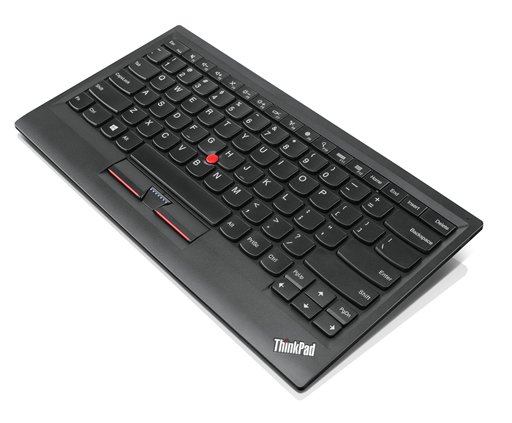
ThinkPad Keyboard ThinkPad Keyboard
The first is Lenovo's ThinkPad Compact Bluetooth Keyboard with TrackPoint, a very compact but pleasant to use Bluetooth keyboard including a trackpoint. I miss the trackpoint from my days as a Thinkpad laptop user. Having a keyboard and mouse combo in such a small package is excellent. My only two complaints would be the price (I was lucky to get one cheaper on eBay) and the fact it's bluetooth only: there's a micro-USB port for charging, but it would be nice if it could be used as a USB keyboard too. There's a separate, cheaper USB model.
8bitdo SFC30 8bitdo SFC30
The second neat device is a clone of the SNES gamepad by HK company 8bitdo called the SFC30. This looks and feels very much like the classic Nintendo SNES controller, albeit slightly thicker from front to back. It can be used in a whole range of different modes, including attached USB; Bluetooth pretending to be a keyboard; Bluetooth pretending to be a controller; and a bunch of other special modes designed to work with iOS or Android devices in various configurations. The manufacturer seem to be actively working on firmware updates to further enhance the controller. The firmware is presently closed source, but it would not be impossible to write an open source firmware for it (some people have figured out the basis for the official firmware). I like the SFC30 enough that I spent some time trying to get it working for various versions of Doom. There are just enough buttons to control a 2.5D game like Doom, whereas something like Quake or a more modern shooter would not work so well. I added support for several 8bitdo controllers directly into Chocolate Doom (available from 2.3.0 onwards) and into SDL2, a popular library for game development, which I think is used by Steam, so Steam games may all gain SFC30 support in the future too.

14 January 2017

Mike Gabriel: UIF bug: Caused by flawed IPv6 DNS resolving in Perl's NetAddr::IP

TL;DR; If you use NetAddr::IP->new6() for resolving DNS names to IPv6 addresses, the addresses returned by NetAddr::IP are not what you might expect. See below for details. Issue #2 in UIF Over the last couple of days, I tried to figure out the cause of a weird issue observed in UIF (Universal Internet Firewall [1], a nice Perl tool for setting up ip(6)tables based Firewalls). Already a long time ago, I stumbled over a weird DNS resolving issue of DNS names to IPv6 addresses in UIF that I reported as issue #2 [2] against upstream UIF back then. I happen to be co-author of UIF. So, I felt very ashamed all the time for not fixing the issue any sooner. As many of us DDs try to get our packages into shape before the next Debian release these days, I find myself doing the same. I started investigating the underlying cause of issue #2 in UIF a couple of days ago. Issue #119858 on CPAN Today, I figured out that the Perl code in UIF is not causing the observed phenomenon. The same behaviour is reproducible with a minimal and pure NetAddr::IP based Perl script (reported as Debian bug #851388 [2]. Thanks to Gregor Herrmann for forwarding Debian bug upstream (#119858 [3]). Here is the example script that shows the flawed behaviour:
#!/usr/bin/perl
use NetAddr::IP;
my $hostname = "google-public-dns-a.google.com";
my $ip6 = NetAddr::IP->new6($hostname);
my $ip4 = NetAddr::IP->new($hostname);
print "$ip6 <- WTF???\n";
print "$ip4\n";
exit(0);
... gives...
[mike@minobo ~]$ ./netaddr-ip_resolv-ipv6.pl
0:0:0:0:0:0:808:808/128 <- WTF???
8.8.8.8/32
In words... So what happens in NetAddr::IP is that with the new6() "constructor" you initialize a new IPv6 address. If the address is a DNS name, NetAddr::IP internally resolves it into an IPv4 address and converts this IPv4 address into some IPv6'ish format. This bogus IPv6 address is not the one matching the given DNS name. Impacted Software in Debian Various Debian packages use NetAddr::IP and may be affected by this flaw, here is an incomplete list (use apt-rdepends -r libnetaddr-ip-perl for the complete list): Any of the above packages could be affected if NetAddr::IP->new6(<dnsname>) is being used. I haven't checked any of the code bases, but possibly the corresponding maintainers may want to do that. References light+love
Mike

Jonathan McDowell: Cloning a USB LED device

A month or so ago I got involved in a discussion on IRC about notification methods for a headless NAS. One of the options considered was some sort of USB attached LED. DealExtreme had a cheap Webmail notifier , which was already supported by mainline kernels as a Riso Kagaku device but it had been sold out for some time. This seemed like a fun problem to solve with a tinyAVR and V-USB. I had my USB relay board so I figured I could use that to at least get some code to the point that the kernel detected it as the right device, and the relay output could be configured as one of the colours to ensure it was being driven in roughly the right manner. The lack of a full lsusb dump (at least when I started out) made things a bit harder, plus the fact that the Riso uses an output report unlike the relay code, which uses a control message. However I had the kernel source for the driver and with a little bit of experimentation had something which would cause the driver to be loaded and the appropriate files in /sys/class/leds/ to be created. The relay was then successfully activated when the red LED was supposed to be on.

hid-led 0003:1294:1320.0001: hidraw0: USB HID v1.01 Device [MAIL  MAIL ] on usb-0000:00:14.0-6.2/input0
hid-led 0003:1294:1320.0001: Riso Kagaku Webmail Notifier initialized
I subsequently ordered some Digispark clones and modified the code to reflect the pins there (my relay board used pins 1+2 for USB, the Digispark uses pins 3+4). I then soldered a tricolour LED to the board, plugged it in and had a clone of the Riso Kaguku device for about 1.50 in parts (no doubt much cheaper in bulk). Very chuffed. In case it s useful to someone, the code is released under GPLv3+ and is available at https://the.earth.li/gitweb/?p=riso-kagaku-clone.git;a=summary or on GitHub at https://github.com/u1f35c/riso-kagaku-clone. I m seeing occasional issues on an older Dell machine that only does USB2 with enumeration, but it generally is fine once it gets over that. (FWIW, Jon, who started the original discussion, ended up with a BlinkStick Nano which is a neater device with 2 LEDs but still based on an Tiny85.)

12 January 2017

Ritesh Raj Sarraf: Laptop Mode Tools 1.71

I am pleased to announce the 1.71 release of Laptop Mode Tools. This release includes some new modules, some bug fixes, and there are some efficiency improvements too. Many thanks to our users; most changes in this release are contributions from our users. A filtered list of changes in mentioned below. For the full log, please refer to the git repository. Source tarball, Feodra/SUSE RPM Packages available at:
https://github.com/rickysarraf/laptop-mode-tools/releases Debian packages will be available soon in Unstable. Homepage: https://github.com/rickysarraf/laptop-mode-tools/wiki
Mailing List: https://groups.google.com/d/forum/laptop-mode-tools
1.71 - Thu Jan 12 13:30:50 IST 2017
    * Fix incorrect import of os.putenv
    * Merge pull request #74 from Coucouf/fix-os-putenv
    * Fix documentation on where we read battery capacity from
    * cpuhotplug: allow disabling specific cpus
    * Merge pull request #78 from aartamonau/cpuhotplug
    * runtime-pm: refactor listed_by_id()
    * wireless-power: Use iw and fallback to iwconfig if it not available
    * Prefer available AC supply information over battery state to determine ON_AC
    * On startup, we want to force the full execution of LMT.
    * Device hotplugs need a forced execution for LMT to apply the proper settings
    * runtime-pm: Refactor list_by_type()
    * kbd-backlight: New module to control keyboard backlight brightness
    * Include Transmit power saving in wireless cards
    * Don't run in a subshell
    * Try harder to check battery charge
    * New module: vgaswitcheroo
    * Revive bluetooth module. Use rfkill primarily. Also don't unload (incomplete list of) kernel modules
What is Laptop Mode Tools
Description: Tools for Power Savings based on battery/AC status
 Laptop mode is a Linux kernel feature that allows your laptop to save
 considerable power, by allowing the hard drive to spin down for longer
 periods of time. This package contains the userland scripts that are
 needed to enable laptop mode.
 .
 It includes support for automatically enabling laptop mode when the
 computer is working on batteries. It also supports various other power
 management features, such as starting and stopping daemons depending on
 power mode, automatically hibernating if battery levels are too low, and
 adjusting terminal blanking and X11 screen blanking
 .
 laptop-mode-tools uses the Linux kernel's Laptop Mode feature and thus
 is also used on Desktops and Servers to conserve power

Categories:

Keywords:

Like:

11 January 2017

Dirk Eddelbuettel: nanotime 0.1.0: Now on Windows

Last month, we released nanotime, a package to work with nanosecond timestamps. See the initial release announcement for some background material and a few first examples. nanotime relies on the RcppCCTZ package for high(er) resolution time parsing and formatting: R itself stops a little short of a microsecond. And it uses the bit64 package for the actual arithmetic: time at this granularity is commonly represented at (integer) increments (at nanosecond resolution) relative to an offset, for which the standard epoch of Januar 1, 1970 is used. int64 types are a perfect match here, and bit64 gives us an integer64. Naysayers will point out some technical limitations with R's S3 classes, but it works pretty much as needed here. The one thing we did not have was Windows support. RcppCCTZ and the CCTZ library it uses need real C++11 support, and the g++-4.9 compiler used on Windows falls a little short lacking inter alia a suitable std::get_time() implementation. Enter Dan Dillon who ported this from LLVM's libc++ which lead to Sunday's RcppCCTZ 0.2.0 release. And now we have all our ducks in a row: everything works on Windows too. The next paragraph summarizes the changes for both this release as well as the initial one last month:

Changes in version 0.1.0 (2017-01-10)
  • Added Windows support thanks to expanded RcppCCTZ (closes #6)
  • Added "mocked up" demo with nanosecond delay networking analysis
  • Added 'fmt' and 'tz' options to output functions, expanded format.nanotime (closing #2 and #3)
  • Added data.frame support
  • Expanded tests

Changes in version 0.0.1 (2016-12-15)
  • Initial CRAN upload.
  • Package is functional and provides examples.

We also have a diff to the previous version thanks to CRANberries. More details and examples are at the nanotime page; code, issue tickets etc at the GitHub repository.

This post by Dirk Eddelbuettel originated on his Thinking inside the box blog. Please report excessive re-aggregation in third-party for-profit settings.

9 January 2017

Petter Reinholdtsen: Where did that package go? geolocated IP traceroute

Did you ever wonder where the web trafic really flow to reach the web servers, and who own the network equipment it is flowing through? It is possible to get a glimpse of this from using traceroute, but it is hard to find all the details. Many years ago, I wrote a system to map the Norwegian Internet (trying to figure out if our plans for a network game service would get low enough latency, and who we needed to talk to about setting up game servers close to the users. Back then I used traceroute output from many locations (I asked my friends to run a script and send me their traceroute output) to create the graph and the map. The output from traceroute typically look like this:
traceroute to www.stortinget.no (85.88.67.10), 30 hops max, 60 byte packets
 1  uio-gw10.uio.no (129.240.202.1)  0.447 ms  0.486 ms  0.621 ms
 2  uio-gw8.uio.no (129.240.24.229)  0.467 ms  0.578 ms  0.675 ms
 3  oslo-gw1.uninett.no (128.39.65.17)  0.385 ms  0.373 ms  0.358 ms
 4  te3-1-2.br1.fn3.as2116.net (193.156.90.3)  1.174 ms  1.172 ms  1.153 ms
 5  he16-1-1.cr1.san110.as2116.net (195.0.244.234)  2.627 ms he16-1-1.cr2.oslosda310.as2116.net (195.0.244.48)  3.172 ms he16-1-1.cr1.san110.as2116.net (195.0.244.234)  2.857 ms
 6  ae1.ar8.oslosda310.as2116.net (195.0.242.39)  0.662 ms  0.637 ms ae0.ar8.oslosda310.as2116.net (195.0.242.23)  0.622 ms
 7  89.191.10.146 (89.191.10.146)  0.931 ms  0.917 ms  0.955 ms
 8  * * *
 9  * * *
[...]
This show the DNS names and IP addresses of (at least some of the) network equipment involved in getting the data traffic from me to the www.stortinget.no server, and how long it took in milliseconds for a package to reach the equipment and return to me. Three packages are sent, and some times the packages do not follow the same path. This is shown for hop 5, where three different IP addresses replied to the traceroute request. There are many ways to measure trace routes. Other good traceroute implementations I use are traceroute (using ICMP packages) mtr (can do both ICMP, UDP and TCP) and scapy (python library with ICMP, UDP, TCP traceroute and a lot of other capabilities). All of them are easily available in Debian. This time around, I wanted to know the geographic location of different route points, to visualize how visiting a web page spread information about the visit to a lot of servers around the globe. The background is that a web site today often will ask the browser to get from many servers the parts (for example HTML, JSON, fonts, JavaScript, CSS, video) required to display the content. This will leak information about the visit to those controlling these servers and anyone able to peek at the data traffic passing by (like your ISP, the ISPs backbone provider, FRA, GCHQ, NSA and others). Lets pick an example, the Norwegian parliament web site www.stortinget.no. It is read daily by all members of parliament and their staff, as well as political journalists, activits and many other citizens of Norway. A visit to the www.stortinget.no web site will ask your browser to contact 8 other servers: ajax.googleapis.com, insights.hotjar.com, script.hotjar.com, static.hotjar.com, stats.g.doubleclick.net, www.google-analytics.com, www.googletagmanager.com and www.netigate.se. I extracted this by asking PhantomJS to visit the Stortinget web page and tell me all the URLs PhantomJS downloaded to render the page (in HAR format using their netsniff example. I am very grateful to Gorm for showing me how to do this). My goal is to visualize network traces to all IP addresses behind these DNS names, do show where visitors personal information is spread when visiting the page.

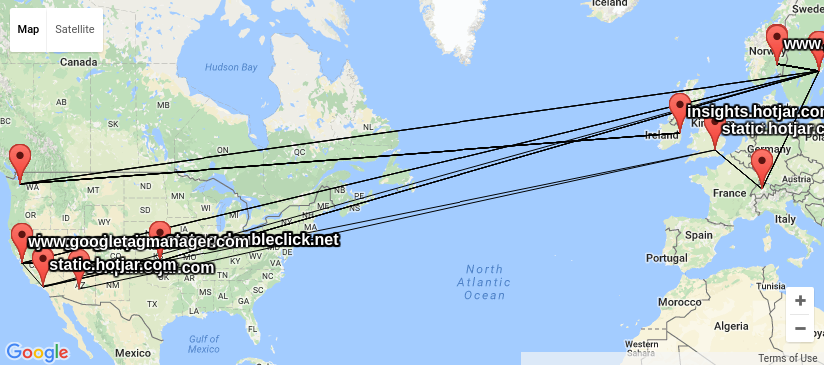
map of combined traces for URLs used by www.stortinget.no using GeoIP When I had a look around for options, I could not find any good free software tools to do this, and decided I needed my own traceroute wrapper outputting KML based on locations looked up using GeoIP. KML is easy to work with and easy to generate, and understood by several of the GIS tools I have available. I got good help from by NUUG colleague Anders Einar with this, and the result can be seen in my kmltraceroute git repository. Unfortunately, the quality of the free GeoIP databases I could find (and the for-pay databases my friends had access to) is not up to the task. The IP addresses of central Internet infrastructure would typically be placed near the controlling companies main office, and not where the router is really located, as you can see from the KML file I created using the GeoLite City dataset from MaxMind.

scapy traceroute graph for URLs used by www.stortinget.no I also had a look at the visual traceroute graph created by the scrapy project, showing IP network ownership (aka AS owner) for the IP address in question. The graph display a lot of useful information about the traceroute in SVG format, and give a good indication on who control the network equipment involved, but it do not include geolocation. This graph make it possible to see the information is made available at least for UNINETT, Catchcom, Stortinget, Nordunet, Google, Amazon, Telia, Level 3 Communications and NetDNA.

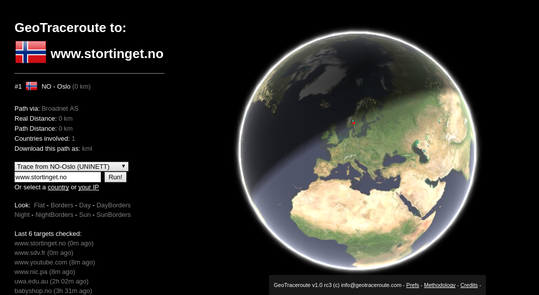
example geotraceroute view for www.stortinget.no In the process, I came across the web service GeoTraceroute by Salim Gasmi. Its methology of combining guesses based on DNS names, various location databases and finally use latecy times to rule out candidate locations seemed to do a very good job of guessing correct geolocation. But it could only do one trace at the time, did not have a sensor in Norway and did not make the geolocations easily available for postprocessing. So I contacted the developer and asked if he would be willing to share the code (he refused until he had time to clean it up), but he was interested in providing the geolocations in a machine readable format, and willing to set up a sensor in Norway. So since yesterday, it is possible to run traces from Norway in this service thanks to a sensor node set up by the NUUG assosiation, and get the trace in KML format for further processing.

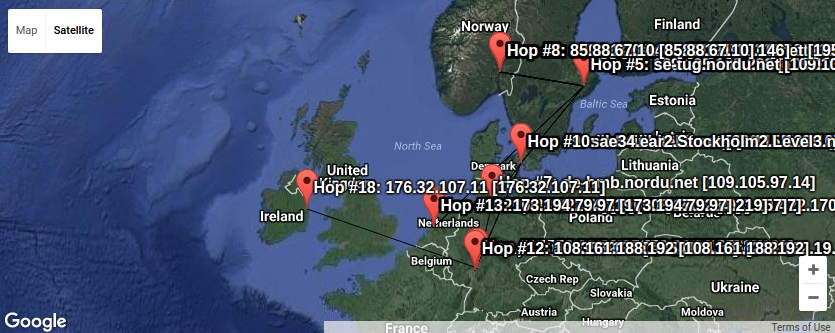
map of combined traces for URLs used by www.stortinget.no using geotraceroute Here we can see a lot of trafic passes Sweden on its way to Denmark, Germany, Holland and Ireland. Plenty of places where the Snowden confirmations verified the traffic is read by various actors without your best interest as their top priority. Combining KML files is trivial using a text editor, so I could loop over all the hosts behind the urls imported by www.stortinget.no and ask for the KML file from GeoTraceroute, and create a combined KML file with all the traces (unfortunately only one of the IP addresses behind the DNS name is traced this time. To get them all, one would have to request traces using IP number instead of DNS names from GeoTraceroute). That might be the next step in this project. Armed with these tools, I find it a lot easier to figure out where the IP traffic moves and who control the boxes involved in moving it. And every time the link crosses for example the Swedish border, we can be sure Swedish Signal Intelligence (FRA) is listening, as GCHQ do in Britain and NSA in USA and cables around the globe. (Hm, what should we tell them? :) Keep that in mind if you ever send anything unencrypted over the Internet. PS: KML files are drawn using the KML viewer from Ivan Rublev, as it was less cluttered than the local Linux application Marble. There are heaps of other options too. As usual, if you use Bitcoin and want to show your support of my activities, please send Bitcoin donations to my address 15oWEoG9dUPovwmUL9KWAnYRtNJEkP1u1b.

8 January 2017

Bits from Debian: New Debian Developers and Maintainers (November and December 2016)

The following contributors got their Debian Developer accounts in the last two months: The following contributors were added as Debian Maintainers in the last two months: Congratulations!

7 January 2017

Enrico Zini: Teamwork

When I saw this video or this video I thought of this article. When I feel part of a tightly coordinated and synchronized team I feel proud for the achievements of the team as a whole, which I see as bigger than what I could have achieved alone. I also don't feel at risk of taking bad decisions. I feel less responsible. If I do what I'm told, I can't be blamed for doing the wrong things. I find it relaxing, every once in a while, to not have to be in charge. I guess this could be part of the allure of a totalitarian regime: being freed from the burden of growing up Thinking about this, reading those articles about romantic relationships, I see quite a bit of parallels also with organising cooperation and teamwork. It looks like I ended up making parallels between Polyamory, Anarchism, and Free Software again. If you think there should traditionally be also a mention of BDSM, go back to "I find it relaxing, every once in a while, to not have to be in charge".

2 January 2017

Ross Gammon: Happy New Year My Free Software activities in December 2016

So that was 2016! Here s a summary of what I got up to on my computer(s) in December, a check of how I went against my plan, and the TODO list for the next month or so. With a short holiday to Oslo, Christmas holidays, Christmas parties (at work and with Alexander at school, football etc.), travelling to Brussels with work, birthdays (Alexander & Antje), I missed a lot of deadlines, and failed to reach most of my Free Software goals (including my goals for new & updated packages in Debian Stretch the soft freeze is in a couple of days). To top it all off, I lost my grandmother at the ripe old age of 93. Rest in peace Nana. I wish I could have made it to the funeral, but it is sometimes tough living on the other side of the world to your family. Debian Ubuntu Other Plan status & update for next month Debian Before the 5th January 2017 Debian Stretch soft freeze I hope to: For the Debian Stretch release: Ubuntu Other

Markus Koschany: My Free Software Activities in December 2016

Welcome to gambaru.de. Here is my monthly report that covers what I have been doing for Debian. If you re interested in Android, Java, Games and LTS topics, this might be interesting for you. Debian Android Debian Games Debian Java Debian LTS This was my tenth month as a paid contributor and I have been paid to work 13,5 hours on Debian LTS, a project started by Rapha l Hertzog. In that time I did the following: Non-maintainer uploads

31 December 2016

Jonathan McDowell: IMDB Top 250: Complete. Sort of.

Back in 2010, inspired by Juliet, I set about doing 101 things in 1001 days. I had various levels of success, but one of the things I did complete was the aim of watching half of the IMDB Top 250. I didn t stop at that point, but continued to work through it at a much slower pace until I realised that through the Queen s library I had access to quite a few DVDs of things I was missing, and that it was perfectly possible to complete the list by the end of 2016. So I did. I should point out that I didn t set out to watch the list because I m some massive film buff. It was more a mixture of watching things that I wouldn t otherwise choose to, and also watching things I knew were providing cultural underpinnings to films I had already watched and enjoyed. That said, people have asked for some sort of write up when I was done. So here are some random observations, which are almost certainly not what they were looking for.

My favourite film is not in the Top 250 First question anyone asks is What s your favourite film? . That depends a lot on what I m in the mood for really, but fairly consistently my answer is The Hunt for Red October. This has never been in the Top 250 that I ve noticed. Which either says a lot about my taste in films, or the Top 250, or both. Das Boot was in the list and I would highly recommend it (but then I like all submarine movies it seems).

The Shawshank Redemption is overrated I can t recall a time when The Shawshank Redemption was not top of the list. It s a good film, and I ve watched it many times, but I don t think it s good enough to justify its seemingly unbroken run. I don t have a suggestion for a replacement, however.

The list is constantly changing I say I ve completed the Top 250, but that s working from a snapshot I took back in 2010. Today the site is telling me I ve watched 215 of the current list. Last night it was 214 and I haven t watched anything in between. Some of those are films released since 2010 (in particular new releases often enter high and then fall out of the list over a month or two), but the current list has films as old as 1928 (The Passion of Joan of Arc) that weren t there back in 2010. So keeping up to date is not simply a matter of watching new releases.

The best way to watch the list is terrestrial TV There were various methods I used to watch the list. Some I d seen in the cinema when they came out (or was able to catch that way anyway - the QFT showed Duck Soup, for example). Netflix and Amazon Video had some films, but overall a very disappointing percentage. The QUB Library, as previously mentioned, had a good number of DVDs on the list (especially the older things). I ended up buying a few (Dial M for Murder on 3D Bluray was well worth it; it s beautifully shot and unobtrusively 3D), borrowed a few from friends and ended up finishing off the list by a Lovefilm one month free trial. The single best source, however, was UK terrestrial TV. Over the past 6 years Freeview (the free-to-air service here) had the highest percentage of the list available. Of course this requires some degree of organisation to make sure you don t miss things.

Films I enjoyed Not necessarily my favourite, but things I wouldn t have necessarily watched and was pleasantly surprised by. No particular order, and I m leaving out a lot of films I really enjoyed but would have got around to watching anyway.
  • Clint Eastwood films - Gran Torino and Million Dollar Baby were both excellent but neither would have appealed to me at first glance. I hated Unforgiven though.
  • Jimmy Stewart. I m not a fan of It s a Wonderful Life (which I d already watched because it s Lister s favourite film), but Harvey is obviously the basis of lots of imaginary friend movies and Rear Window explained a Simpsons episode (there were a lot of Simpsons episodes explained by watching the list).
  • Spaghetti Westerns. I wouldn t have thought they were my thing, but I really enjoyed the Sergio Leone films (A Fistful of Dollars etc.). You can see where Tarantino gets a lot of his inspiration.
  • Foreign language films. I wouldn t normally seek these out. And in general it seems I cannot get on with Italian films (except Life is Beautiful), but Amores Perros, Amelie and Ikiru were all better than expected.
  • Kind Hearts and Coronets. For some reason I didn t watch this until almost the end; I think the title always put me off. Turned out to be very enjoyable.

Films I didn t enjoy I m sure these mark me out as not being a film buff, but there are various things I would have turned off if I d caught them by accident rather than setting out to watch them. I ve kept the full list available, if you re curious.

Next.

Previous.