Search Results: "jan"

9 January 2016

Jan Wagner: New blogging engine

Exactly 3 years after I moved on from Wordpress to Octopress I thought it's time for something new. Some of you might have noticed that I've not much blogged in the past. A new Octopress version was promised a year ago. While I've liked writing in Markdown, the deployment workflow was horribly broken and keeping Octopress up to date was impossible. I blogged so seldom that I needed to consult the documentation every time in the recent days. After looking into several projects, Ghost seems most promising. And the good news: it has a split-screen Markdown editor with integrated live preview. The Ghost Logo There are several migration scripts out there, but I only found one which was able to also export tags. The import into Ghost worked like a charm.

8 January 2016

Alessio Treglia: OpenStack: a .deb guy on (the) board

The elections for the new OpenStack board are coming closer
and this time the Open Source community has a great
opportunity of representation: Giuseppe Patern is standing as a candidate for the board.

Although Giuseppe is considered by HP and Forrester Research
among the top talented consultants in the world,
Gippa (as he s largely known in the industry) is still one of us ,
a nerd that grew up with a keyboard on his hands.
As he s one of the candidates of the OpenStack board,
Fabio Marzocca wishing to know more has interviewed him.

[FM] The hard question. You re a techie. Why the hell are you running for the board?

[GP] This is indeed a good question It all started as a challenge from some clients and friends that are working in the OpenStack project. The truth is that the board and most of the management of the foundation are from vendors. I m not questioning here if they do a good job or not, it is very likely that they tend to protect their own interests. In my opinion it lacks some community spirit that have fostered Linux development such as Debian and Ubuntu. That s why I m running for it, to bring the community where it should be.

[FM] Back to Debian and Ubuntu, could you tell us your story with Linux?

[GP] I discovered Linux in 1994, but only in 1996 things were serious. By the time I just finished high school and I applied for a job in a local Internet Service Provider. At 15 years I was well known in the local community as I was installing and maintaining several BBSes, so it wasn t hard to get the job. I can say it was love at first sight. I started with Slackware (was the first distro), but I moved into redhat first and then debian. When I was working for the IBM Linux Technology Center, I was in charge of helping porting Linux to PowerPC and backporting LVM to make it similar to AIX. Sun was also a good playground as they acquired Cobalt, a hardware appliance based on debian. Then I shifted more towards Enterprise Linux adoption with 6 years in RedHat and then I went to Canonical. I was happy to go back to Debian and Ubuntu community, because I still believe that Ubuntu Developer Summits (UDS) were the real spirit of a Linux community.

[FM] Another hard question. We know you re somehow involved in the rebellion of Devuan.org. What is your opinion about systemd?

[GP] Let me tell you that it s not totally black/white and let s see the two sides here. Something like systemd was indeed needed. Each distro has its own way of init ing the system and for a package maintainer or commercial software maker, maintaining different init behaviour is insane. And as an init replacement it totally makes sense. However, IMHO systemd went too far away, incorporating into its code something that should not happen. A DHCP client into an init system, seriously? I doubt it was in the spirit of the Unix and Linux system
However, in the real world of pets vs cattle , where application matters more than systems, having a systemd as it is, doesn t change that much.

[FM] OpenStack was incubated in Ubuntu and the roots are quite clear. Is there something else that you would like to see from Debian and Ubuntu in OpenStack?

[GP] Stability, if I can name just one. Currently OpenStack is released every 6 months, which was probably the best choice to speed up the development. However, this is now becoming a weakness, as enterprise customers can t upgrade their critical infrastructures every 6 months. Traditionally Debian is maniacally focused on given a bullet-proof distribution, this is something that in my opinion is missing from OpenStack.

[FM] Gippa, tell us just 2 or 3 topics you will bring to action in case of election

[GP] I d like to introduce an OpenStack LTS process, following the Ubuntu approach: while releasing every 6 months is fair enough for development and testing environments, having a stable release every 2-3 years can give enterprise customers the peace of mind they need while running production environments.
I d also love to see a consolidation of the core (Nova/Neutron/Cinder/Swift): vendors and developers are introducing new features and projects while I d love to see for example- a more stable and scalable Neutron and a more stable connection to Oslo (in particular rabbitmq).
In general, I would encourage more attention to who is actually deploying, integrating and using OpenStack every day. I would also try to foster the ecosystem of ISVs in order to release and certify their software for OpenStack. And last but not least- to see interoperation between regional datacenters: I dream of a world where companies in a given territory can work together , and this is only possible through standards. I hope that OpenStack can represent this standard.

[FM] When are the elections and how can we vote?

[GP] Individual Member Director elections for the 2016 Board will be held online from Monday January 11, 2016 to Friday January 15, 2016. More informations on the website.

Dirk Eddelbuettel: AsioHeaders 1.11.0-1

Making it easier to use C++ in R has been a really nice and rewarding side effect of the work on Rcpp. One really good idea came from something Jay Emerson, Michael Kane and had I kicked about for way too long: shipping Boost headers for easier use by R and CRAN packages (such as their family of packages around bigmemory). The key idea here is headers: Experienced C++ authors such as library writers can organise C++ code in such a way that one can (almost always) get by without any linking. Which makes deployment so much easier in most use cases, and surely also with R which knows how to set an include path. So after years of "yes we really should", Jay deserves the credit for actually sitting down almost three years ago and creating the first version. So at the end of January 2013, we released BH version 1.51.0-0. By now the package is used fifty-four other CRAN packages --- clearly a much stronger uptake then we ever expected. I took over maintenance at some point, and we are currently in-line with the most recent Boost release 1.60.0. But some people were always lusting after (some) parts of Boost which also require linking. For some libraries (such as Boost.Date_Time in my RcppBDT package) you can set a #define to not require linking (and forego some string formatting or parsing we get from R anyway). Some others are trickier; Boost Regex is one example. I do not think you can use it without linking (but then C++11 helps and finally brings regular expression in the default library). Another library which the systems / network programmers at work would frequently rely upon is Boost.Asio, a cross-platform C++ library for network and low-level I/O programming. It was already used on CRAN by the iptools package by Bob Rudis and Oliver Keyes which shied away from building on Windoze (while 'doze and Boost do get along, but the CRAN system makes it a little more involved). A couple of days ago, I somehow learned that the Asio library actually comes in two flavours: the well-known Boost.Asio (requiring linking), and also as a header-only standalone library! Well, well, well -- so I ran that by Bob and Oliver asking if that would be useful. And the response was a resounding and pretty much immediate Hell, Yes!. So I wrapped it in a package, told Bob about it, who tested it and gave the thumbs up. And after a slightly longer-than-usual on-boarding, the package is now on CRAN. As network (and systems) programming is not entirely uncommon even at CRAN, I hope that this package may find a few more use cases. A new version of iptools should be forthcoming "shortly", including for the first time a Windows build thanks to this package. The indefatigable Martin Morgan already spotted our GitHub repo and scored the first fork. Comments and suggestions about AsioHeaders are welcome via the issue tracker at the GitHub GitHub repo.

This post by Dirk Eddelbuettel originated on his Thinking inside the box blog. Please report excessive re-aggregation in third-party for-profit settings.

6 January 2016

Daniel Pocock: Want to use free software to communicate with your family in Christmas 2016?

Was there a friend or family member who you could only communicate with using a proprietary, privacy-eroding solution like Skype or Facebook this Christmas? Would you like to be only using completely free and open solutions to communicate with those people next Christmas? Developers Even if you are not developing communications software, could the software you maintain make it easier for people to use "sip:" and "xmpp:" links to launch other applications? Would this approach make your own software more convenient at the same time? If your software already processes email addresses or telephone numbers in any way, you could do this. If you are a web developer, could you make WebRTC part of your product? If you already have some kind of messaging or chat facility in your website, WebRTC is the next logical step. If you are involved with the Debian or Fedora projects, please give rtc.debian.org and FedRTC.org a go and share your feedback. If you are involved with other free software communities, please come to the Free-RTC mailing list and ask how you can run something similar. Everybody can help Do you know any students who could work on RTC under Google Summer of Code, Outreachy or any other student projects? We are particularly keen on students with previous experience of Git and at least one of Java, C++ or Python. If you have contacts in any universities who can refer talented students, that can also help a lot. Please encourage them to contact me directly. In your workplace or any other organization where you participate, ask your system administrator or developers if they are planning to support SIP, XMPP and WebRTC. Refer them to the RTC Quick Start Guide. If your company web site is built with the Drupal CMS, refer them to the DruCall module, it can be installed by most webmasters without any coding. If you are using Debian or Ubuntu in your personal computer or office and trying to get best results with the RTC and VoIP packages on those platforms, please feel free to join the new debian-rtc mailing list to discuss your experiences and get advice on which packages to use. Everybody is welcome to ask questions and share their experiences on the Free-RTC mailing list. Please also come and talk to us at FOSDEM 2016, where RTC is in the main track again. FOSDEM is on 30-31 January 2016 in Brussels, attendance is free and no registration is necessary. This mission can be achieved with lots of people making small contributions along the way.

5 January 2016

Benjamin Mako Hill: Celebrate Aaron Swartz in Seattle (or Atlanta, Chicago, Dallas, NYC, SF)

I m organizing an event at the University of Washington in Seattle that involves a reading, the screening of a documentary film, and a Q&A about Aaron Swartz. The event coincides with the third anniversary of Aaron s death and the release of a new book of Swartz s writing that I contributed to. aaronsw-tiob_bwcstw The event is free and open the public and details are below:

WHEN: Wednesday, January 13 at 6:30-9:30 p.m.

WHERE: Communications Building (CMU) 120, University of Washington

We invite you to celebrate the life and activism efforts of Aaron Swartz, hosted by UW Communication professor Benjamin Mako Hill. The event is next week and will consist of a short book reading, a screening of a documentary about Aaron s life, and a Q&A with Mako who knew Aaron well details are below. No RSVP required; we hope you can join us.

Aaron Swartz was a programming prodigy, entrepreneur, and information activist who contributed to the core Internet protocol RSS and co-founded Reddit, among other groundbreaking work. However, it was his efforts in social justice and political organizing combined with his aggressive approach to promoting increased access to information that entangled him in a two-year legal nightmare that ended with the taking of his own life at the age of 26.

January 11, 2016 marks the third anniversary of his death. Join us two days later for a reading from a new posthumous collection of Swartz s writing published by New Press, a showing of The Internet s Own Boy (a documentary about his life), and a Q&A with UW Communication professor Benjamin Mako Hill a former roommate and friend of Swartz and a contributor to and co-editor of the first section of the new book. If you re not in Seattle, there are events with similar programs being organized in Atlanta, Chicago, Dallas, New York, and San Francisco. All of these other events will be on Monday January 11 and registration is required for all of them. I will be speaking at the event in San Francisco.

4 January 2016

Bernd Zeimetz: open-vm-tools updated

In January 2014 the open-vm-tools package was orphaned and I took the chance to take over the maintenance. Unfortunately the package is still not 100% in the shape I d like to see it, but I m getting closer. I have to say Thank You for a lot of good bug reports, especially for those use cases which are hard to test/reproduce for me (running Debian in a Windows-based VMware Workstation Player for example .). At conova communications GmbH, the company I work for, we are using the package on all of our Debian VMs, both for customer and internal use. It is essential for us to have properly working open-vm-tools - not only to be able to shutdown the VM from VMware vCenter, but also because tools like vSphere Data Protection and Veeam depend on it. Good thing is that I can work on and test the package at work and breakages are detected early and fast normally. Getting a good contact to the VMware upstream was easy and the developers there are helpful and reply pretty fast to their emails. Also as it seems there are finally real commits showing up in the open-vm-tools github repository again, not only huge single commits with a full release. It is not only nice to see that they are moving into the right direction again, but also this is really helpful in fixing (urgent) bugs before the next release of open-vm-tools - or to backport a fix to the versoin in stable/oldstable. Since a few days we have open-vm-tools 10.0.5-3227872 in If you are using VMware ESX 5.5 or newer, you should upgrade to the backports versions. Same if you use a recent VMware player version. Please note that since 10.0.0 the open-vm-dkms package is only necessary if you need the legacy vmxnet module. This is only the case if you are using very old VM hardware versions. vmxnet3 is shipped in the Debian kernel, so you don t need to compile extra modules to use it. The vmhgfs module was replaced by a fuse-based implementation. If you d like to help maintaining the package, please send bugs/patches via the Debian BTS or even better - send pull requests for pkg-open-vm-tools. The repository is mirrored to git.bzed.at in case you want to avoid github.

Lunar: Reproducible builds: week 36 in Stretch cycle

What happened in the reproducible builds effort between December 27th and January 2nd: Infrastructure dak now silently accepts and discards .buildinfo files (commit 1, 2), thanks to Niels Thykier and Ansgar Burchardt. This was later confirmed as working by Mattia Rizzolo. Packages fixed The following packages have become reproducible due to changes in their build dependencies: banshee-community-extensions, javamail, mono-debugger-libs, python-avro. The following packages became reproducible after getting fixed: Some uploads fixed some reproducibility issues, but not all of them: Untested changes: reproducible.debian.net The testing distribution (the upcoming stretch) is now tested on armhf. (h01ger) Four new armhf build nodes provided by Vagrant Cascandian were integrated in the infrastructer. This allowed for 9 new armhf builder jobs. (h01ger) The RPM-based build system, koji, is now in unstable and testing. (Marek Marczykowski-G recki, Ximin Luo). Package reviews 131 reviews have been removed, 71 added and 53 updated in the previous week. 58 new FTBFS reports were made by Chris Lamb and Chris West. New issues identified this week: nondeterminstic_ordering_in_gsettings_glib_enums_xml, nondeterminstic_output_in_warnings_generated_by_breathe, qt_translate_noop_nondeterminstic_ordering. Misc. Steven Chamberlain explained in length why reproducible cross-building across architectures mattered, and posted results of his tests comparing a stage1 debootstrapped chroot of linux-i386 once done from official Debian packages, the others cross-built from kfreebsd-amd64.

3 January 2016

Carl Chenet: To be alerted if no more tweet is sent from your Twitter account: Twitterwatch

This version 0.1 of Twitterwatch is dedicated to Ian Murdock, Debian project Founder. If you use an automated system like Feed2tweet in order to feed your Twitter account from your website of any RSS feed, it is of the utmost important to know when this system is broken, because you are losing traffic because of this malfunction. At the Journal du hacker, a French-speaking FOSS website where people contribute weblinks like Hacker News or Lobste.rs, every new contribution is sent through the RSS feed to the Twitter account of the Journal du hacker. A lot of our readers only follow the news on Twitter. So if the link breaks, our readers are not fed any more :) To be alerted to this issue, I wrote a small self hosted and documented app. I m proud to introduce Twitterwatch ! It runs with Python 3.4 and the Tweepy library. You can install it from PyPI or from sources. The documentation is available on Readthedocs. You can read about how to install it, configure it and use it. It s the first release but the main features do the job already. In order to use it, you need a twitterwatch.ini file as following:
[twitter]
consumer_key=ml6jaiBnf3pkU9uIrKNIxAr3o
consumer_secret=4Cmljklzerkhfer4hlj3ljl2hfvc123rezrfsdatpokaelzerp
access_token=213416790-jgJnrJG5gz132nzerl5zerwi1ahmnwkfJFN9nr2j
access_token_secret=WjanlPgqDKlunJ4Knr11k2bnfk3jfnwkFjeriFZERj16Z
[schedule]
; duration between 2 checks in minutes
check_interval=60
[mail]
host=localhost
from=admin@myserver.org
to=foo@mylaptop.org
The most difficult part is now complete. To launch Twitterwatch, just launch the following command:
$ twitterwatch /path/to/twitterwatch.ini
Whenever no more new tweet is sent from your Twitter account during 60 minutes, you ll receive the following mail (here the user is @journalduhacker):
Title: Twitter stream of journalduhacker has stopped
Body: Twitter stream of journalduhacker has stopped since 23/12/2015 - 14:49:23
It is still pretty rough, but it does the job. New features will come whenever I need them (or if you require/open bugs/submit push requests ;) ). Write a comment to tell me what you think of it or why you use it!

2 January 2016

Junichi Uekawa: 2015 added a new family member.

2015 added a new family member. That meant that I needed a new approach to working and my personal life. What awaits 2016?

1 January 2016

Thorsten Alteholz: My Debian Activities in December 2015

FTP assistant Due to Christmas, I only marked 254 packages for accept and rejected 17 of them. I had to send 14 emails to maintainers. Squeeze LTS This was my eighteenth month that I did some work for the Squeeze LTS initiative, started by Raphael Hertzog at Freexian. As other members of the LTS team had to give back some hours of their workload, this month my initial workload of 18.25h had been increased to 21.25h. Altogether I uploaded those DLAs: I also started to work on CVEs for packages t-coffee and pitivi, only to recognize that the versions in Squeeze are not affected. Further I prepared patches for passenger and srtp but I could not test them yet, so an upload will be in January. This month I also experienced something strange. Due to the upload of the new version of mysql, I had to process a package for squeeze-lts in NEW. I seldom see a package, that creates so much red output from lintian. I assume this always happens when an old package will be checked by the latest lintian and is a good sign for all the development within Debian. I also tested Raphaels patch for #796784 and could confirm that everything works as expected. Unfortunately the php5 upload must be delayed until Januar. This month I also had another week of frontdesk duties. Other stuff The Advent season is over and the Debian Med Advent Calendar is full to bursting. The incredible number of 150 bugs have been closed this year! Due to the GSL transition a new upload of all meep packages had to be done and all in all I could close #748822, #807210, #807212, #807213, #807214, #807215 and #807747.

31 December 2015

Chris Lamb: Free software activities in December 2015

Here is my monthly update covering a large part of what I have been doing in the free software world (previously):
Debian My work in the Reproducible Builds project was also covered in more depth in Lunar's weekly reports (#31, #32, #33, #34).
LTS

This month I have been paid to work 12 hours on Debian Long Term Support (LTS). In that time I did the following:
  • Issued DLA 363-1 for libphp-phpmailer fixing a header injection vulnerability.
  • Issued DLA 365-1 for foomatic-filters correcting a shell injection vulnerability.
  • Issued DLA 369-1 for pygments fixing an issue shell injection vulnerability.
  • Issued DLA 374-1 for cacti to fix an SQL injection vulnerability.
  • Did some futher investigation of CVE-2011-5325 in busybox.

Uploads
  • python-django (1.9) New upstream release.
  • redis (3.0.6) New upstream stable release. I additionally backported this package to Debian stable.
  • redis (3.2~rc1) Uploaded upstream's "testing/next" branch to experimental for testing.
  • gunicorn (19.4.1) New upstream release.


Patches contributed

I also filed FTBFS bugs against acpid, android-platform-frameworks-base, antlr3, artemis, beignet, bisonc++, bobcat, bustle, cargo, checkbox-ng, code2html, cplay, datanommer.commands, dcmtkpp, debci, diffutils, diod, django-restricted-resource, docker-libkv, doomsday, dvdauthor, dwww, elasticsearch, elki, flask-script, freeipa, fso-frameworkd, funny-manpages, ggcov, ghc-mod, gmpc-plugins, gparted, gs-collections, guacamole-server, guncat, haskell-concrete-typerep, haskell-geniplate, haskell-nats, haskell-x509-util, hawtbuf, heimdal, htsjdk, inspircd, jboss-xnio, jenkins-winstone, jpeginfo, jruby-openssl, kaffeine, kdbg, ktp-accounts-kcm, kuser, libcommons-cli-java, libcommons-openpgp-java, libconfig-model-lcdproc-perl, libdata-faker-perl, libexplain, libgettext-commons-java, libgtk2-ex-printdialog-perl, libmoops-perl, libnet-frame-perl, libsendmail-milter-perl, libupnp, libuv, libvpx, liwc, m4, maven2, meep-mpich2, nagios-plugin-check-multi, natlog, netpipe, ocserv, ogre-1.8, orthanc-dicomweb, perspectives-extension, php-mail, php-pinba, phpseclib, pkg-haskell-tools, plastimatch, plexus-compiler, plexus-compiler-1.0, python-acme, python-crontab, python-cs, python-csscompressor, python-debian, python-distutils-extra, python-django-compressor, python-django-openstack-auth, python-django-tagging, python-pygit2, python-pyramid, python-pywcs, python-releases, python-shade, python-statsd, python-tasklib, python-tasklib, python-webm, python-websockets, regina-normal, rinetd, roboptim-core, rpm2html, rpm2html, ruby-factory-girl, ruby-fogbugz, ruby-i18n-inflector, ruby-loofah, ruby-protected-attributes, ruby-rack-contrib, ruby-rufus-scheduler, ruby-sanitize, ruby-sidetiq, ruby-sinatra, scsh-0.6, shogun, sleekxmpp, slugimage, spatial4j, sqwebmail-de, trac-announcer, ttt, txaws, umbrello, wine-gecko-2.21, xboxdrv, xfonts-wqy, xserver-xorg-video-openchrome, yorick & yoshimi.

Raphaël Hertzog: My Free Software Activities in December 2015

My monthly report covers a large part of what I have been doing in the free software world. I write it for my donators (thanks to them!) but also for the wider Debian community because it can give ideas to newcomers and it s one of the best ways to find volunteers to work with me on projects that matter to me. Debian LTS This month I have been paid to work 21.25 hours on Debian LTS. During this time I worked on the following things: Distro Tracker I put a big focus on tracker.debian.org work this month. I completed the switch of the mail interface from packages.qa.debian.org to tracker.debian.org and I announced the change on debian-devel-announce. The changes resulted in a few problems that I quickly fixed (like #807073) and some other failures seen only by me and that were generated by weird spam messages (did you know that a subject can t have a newline character but that it can be encoded and folded over multiple lines?). Related to that I fixed some services so that they send their mails to tracker.debian.org directly instead of relying on the old emails (they get forwarded for now but it would be nice to be able to get rid of that forward). I updated (with the help of Lucas Nussbaum) the service that forwards the Launchpad bugs to the tracker, I sent a patch to update the @packages.debian.org aliases (not yet applied), I updated the configuration of all git commit notice scripts in the Alioth collab-maint and python-modules project (many remain to be done). I asked Ubuntu s Merge-O-Matic to use the new emails as well (see LP 1525497). DAK and the Debian BTS still have to be updated, as of yet nobody reacted to my announce last but not least I updated many wiki pages which duplicated the instructions to setup the commit notice sent to the PTS. While on a good track I opted to tackle the long-standing RC bug that was plaguing tracker.debian.org (#789183), so I updated the codebase to rely on Twitter s bootstrap v4 instead of v2. I had to switch to something else for the icons since glyphicons is no longer provided as part of bootstrap and the actual license for the standalone version was not suitable for use. I opted for Github s Octicons. I made numerous little improvements while doing that (closing some bugs in the process) and I believe that the result is more pleasant to use. I also did a lot of bug triage and fixed a few small issues like the incomplete architecture list (#793547), or fixing a page used only by people with javascript disabled that was not working. Or the invalid links for packages still using CVS (ugh, see #561228). Misc packaging Django. After having added DEP-8 tests (as part of my LTS work, see above), I discovered that the current version in unstable did not pass its test suite so I filed the issue upstream (ticket 26016) and added the corresponding patch. And I encouraged others to update python-bcrypt in Debian to a newer version that would have worked with Django 1.9 (see #803096). I also fixed another small issue in Django (see ticket 26017 with my pull request that got accepted). I asked the release managers to consider accepting the latest 1.7.x version in jessie (see #807654) but I have gotten zero answer so far. And I m not the only one waiting an answer. It s a bit of a sad situation we still have a few weeks until the next point release but for once I do it in advance and I would love to have timely feedback. Last but not least, I started the maintaining the current LTS release (1.8.x) in jessie-backports. Tryton. I upgraded to Tryton 3.8 and discovered an issue that I filed in #806781. I sponsored 5 new tryton modules for Matthias Behrle (who is DM) as well as one security upload (for CVE-2015-0861). Debian Handbook. I uploaded a new version to Debian Unstable and requested (to the release managers) the permission to upload a backport of it to jessie so that jessie has a version of the package that documents jessie and not wheezy contrary to my other Django request, this one should be non-controversial but I also have had zero answer so far, see #807515. Misc. I filed #808583 when sbuild stopped working with Perl 5.22. I handled #807860 on publican, I found the corresponding upstream ticket and discovered a work around with the help of upstream (see here). Kali related work I reported a bug to #debian-apt about apt miscalculating download size (ending up with 18 EB!) which resulted in a fix here in version 1.1.4. Installing a meta-package that needed more than 2GB was no longer possible without this fix and we have a kali-linux-all metapackage in that situation that gets regularly installed in a Jenkins test. I added captcha support to Distro Tracker and enabled this feature on pkg.kali.org. I filed #808863 against uhd-host because it was not possible to install the package in a systemd-nspawn s managed chroot where /proc is read-only. And we started using this to test dist-upgrade from one version of Kali to the next Thanks See you next month for a new summary of my activities.

No comment Liked this article? Click here. My blog is Flattr-enabled.

30 December 2015

Bits from Debian: Debian lamenta el fallecimiento de Ian Murdock

Ian Murdock Con el coraz n compungido, Debian lamenta el fallecimiento de Ian Murdock, firme partidario del software libre y abierto, padre, hijo y el 'ian' en Debian. Ian empez el proyecto en agosto de 1993, publicando la primera versi n de Debian m s tarde en el mismo a o. Debian se convertir a as en el sistema operativo universal para el mundo, funcionando en cualquier dispositivo, desde sistemas embebidos hasta la estaci n espacial. Ian se centr en crear una distribuci n y una cultura de comunidad que hiciera lo correcto tanto en lo tico como en lo t cnico. Publicar cuando est listo y una postura firme sobre la libertad de software son las reglas de oro en el mundo del software libre y de c digo abierto. La devoci n le gui en su trabajo, tanto en Debian como en los a os posteriores, siempre trabajando hacia un futuro lo mejor posible. El sue o de Debian est vivo, la comunidad permanece incre blemente activa con miles de desarrolladores que trabajan incontables horas para ofrecer un sistema operativo seguro y confiable. La comunidad de Debian da el p same a la familia en este momento tan dif cil. Su familia nos ha pedido discreci n durante estos momentos dif ciles y deseamos respetarlo. Desde dentro de Debian y de la amplia comunidad de Linux podemos expresar nuestras muestras de condolencia a in-memoriam-ian@debian.org, donde ser n guardadas y archivadas.

29 December 2015

Jose M. Calhariz: Preview of switchconf 0.0.15-1

Since the last version 0.0.9 on Debian, I have made some changes until version 0.0.14. The version 0.0.15 is only to include a fix for the new findutils. I thank you to Andreas Metzler for the fix and the prompt NMU. The files are here, take notice about the replaced ~ in the original by _: switchconf_0.0.15.orig.tar.xz switchconf_0.0.15-1_wip1.debian.tar.xz switchconf_0.0.15-1_wip1_all.deb If you need the dsc file, just ask me. Here comes the changelog since 0.0.9, without the lastest NMU:
switchconf (0.0.15-1~wip1) UNRELEASED; urgency=low
  * New upstream version:
    * Replace 'find -perm +1' by 'find -perm /1', thank you Andreas
      Metzler for the patch and the NMU.
  * Add systemd service file, thank you Felipe Sateler for reviewing it.
  * Bump standards-version to 3.9.6, no changes needed.
  * New maintainer email address.
 -- Jose M Calhariz <jose@calhariz.com>  Tue, 29 Dec 2015 19:59:07 +0000
switchconf (0.0.14-1) UNRELEASED; urgency=low
  * Force the use of bash, instead of a POSIX shell.
 -- Jose M Calhariz <jose.calhariz@ist.utl.pt>  Sun, 24 Aug 2014 04:37:04 +0100
switchconf (0.0.13-2) UNRELEASED; urgency=low
  * Add Homepage field pointing to alioth page of the project
 -- Jose M Calhariz <jose.calhariz@ist.utl.pt>  Sun, 02 Mar 2014 18:01:07 +0000
switchconf (0.0.13-1) wheezy; urgency=low
  * New upstream version:
    * Distribution tar is now compressed by xz
  * Change to source format 3.0 (quilt)
 -- Jose M Calhariz <jose.calhariz@ist.utl.pt>  Sun, 02 Mar 2014 15:56:31 +0000
switchconf (0.0.12-1) wheezy; urgency=low
  * Fixed some typos on switchconf
 -- Jose M Calhariz <jose.calhariz@ist.utl.pt>  Sun, 02 Mar 2014 15:39:09 +0000
switchconf (0.0.11-1) wheezy; urgency=low
  * New upstream version:
    * Makefile: add target dist-exp to build distribution files.
    * Add flag -f with the path to the configuration file.
  * Update debian/rules to version 0.24.
  * Update debian/control with new name and email address of Maintainer.
  * Update copyright.
 -- Jose M Calhariz <jose.calhariz@ist.utl.pt>  Sun, 16 Feb 2014 18:04:22 +0000
switchconf (0.0.10-1) UNRELEASED; urgency=low
  * New upstream version:
    * Fix return code on error.
    * Use syslog system to report errors.
 -- Jose M Calhariz <jose.calhariz@ist.utl.pt>  Thu, 16 Jan 2014 20:23:46 +0000

Daniel Pocock: Real-Time Communication in FOSDEM 2016 main track

FOSDEM is nearly here and Real-Time Communications is back with a bang. Whether you are keen on finding the perfect privacy solution, innovative new features or just improving the efficiency of existing telephony, you will find plenty of opportunities at FOSDEM. Main track Saturday, 30 January, 17:00 Dave Neary presents How to run a telco on free software. This session is of interest to anybody building or running a telco-like service or any system administrator keen to look at a practical application of cloud computing with OpenStack. Sunday, 31 January, 10:00 is my own presentation on Free Communications with Free Software. This session looks at the state of free communications, especially open standards like SIP, XMPP and WebRTC and practical solutions like DruCall (for Drupal), Lumicall (for Android) and much more. Sunday, 31 January, 11:00 Guillaume Roguez and Adrien B raud from Savoir-faire Linux present Building a peer-to-peer network for Real-Time Communication. They explain how their Ring solution, based on OpenDHT, can provide a true peer-to-peer solution. and much, much more....
  • XMPP Summit 19 is on January 28 and 29, the Thursday and Friday before FOSDEM as part of the FOSDEM Fringe.
  • The FOSDEM Beer Night on Friday, 29 January provides a unique opportunity for Real-Time Communication without software
  • The Real-Time Lounge will operate in the K building over both days of FOSDEM, come and meet the developers of your favourite RTC projects
  • The Real-Time dev-room is the successor of the previous XMPP and Telephony dev-rooms. The Real-Time dev-room is in K.3.401 and the schedule will be announced shortly.
Volunteers and sponsors still needed Please come and join the FreeRTC mailing list to find out more about ways to participate, the Saturday night dinner and other opportunities. The FOSDEM team is still fundraising. If your company derives benefit from free software and events like FOSDEM, please see the sponsorship pages.

Stefano Zacchiroli: Shuttleworth Foundation Flash Grant - 2015 report

1 year of Shuttleworth Foundation Flash Grant As announced last year, starting January 2015 I've benefited from a "Flash Grant" kindly awarded to me by the Shuttleworth Foundation. This post reports publicly about how I've used the money to promote Free Software via my own activism, over the period January-December 2015. I'm lucky to have a full-time academic job that provides me with a salary and basic computer hardware. But Free Software not being the only focus of my job, it gets difficult at times to get travel funding to specific Free Software events. So that is what I've mostly used the grant money for: attend Free Software events that I wouldn't have been able to attend otherwise. On grant money I've attended LibrePlanet 2015 (2015-03-19-boston-libreplanet label in the financial reports below), where I've given the talk Distributions and the Free "Cloud", and FSFE's LLW 2015 (2015-04-15-barcelona-fsfe-legal) workshop. Furthermore I've used the grant to reimburse otherwise not reimbursed out of pocket expenses in a trip to San Francisco (2015-11-06-san-francisco-gsoc+osi) that have been otherwise sponsored by Google (to attend the Summer of Code Mentor Summit) and OSI (to attend a F2F meeting of the Board of Directors). Finally, I've used grant money to offer lunch to invited lecturers in my master-level Free Software class at the university (label 2015-foss-class). Actual financial reports are reported below, in ledger format. It should be noted that, contrary to the usual expected 6-month duration of flash grants, I've used only about half the grant amount over a 12-month period; I do not plan to pocket what remains, but rather keep on using it over the next year, reporting again publicly at the end of the period. Also, I did not breakdown further out of pocket expenses, but they invariably stand for public transport tickets and meals. Balance sheet Overall:
         1966,11 EUR  Assets:Funds
        -4052,52 EUR  Equity:Opening balances
         2086,41 EUR  Expenses
           15,90 EUR    Bank:Commissions
          424,00 EUR    Conference:Registration
           56,50 EUR    Teaching:Speaker-invitation
         1590,01 EUR    Travel
          249,02 EUR      Lodgement
          562,51 EUR      Out-of-pocket
          778,48 EUR      Plane
--------------------
                   0

Breakdown by purpose: Journal
2014-12-03 Shuttleworth Foundation flash grant                                    Equity:Opening balances                     -4052,52 EUR    -4052,52 EUR
                                                                                  Assets:Funds                                 4052,52 EUR               0
2014-12-04 bank commissions on incoming transfer                                  Expenses:Bank:Commissions                      15,90 EUR       15,90 EUR
                                                                                  Assets:Funds                                  -15,90 EUR               0
2014-12-24 plane tickets Paris-Boston round trip to attend LibrePlanet 2015       Expenses:Travel:Plane                         627,84 EUR      627,84 EUR
                                                                                  Assets:Funds                                 -627,84 EUR               0
2015-01-02 LibrePlanet 2015 registration + travel fund contribution               Expenses:Conference:Registration              424,00 EUR      424,00 EUR
                                                                                  Assets:Funds                                 -424,00 EUR               0
2015-03-02 plane tickets Paris-Barcelona round trip to attend LLW 2015            Expenses:Travel:Plane                         150,64 EUR      150,64 EUR
                                                                                  Assets:Funds                                 -150,64 EUR               0
2015-03-19 lunch with invited speaker for lecture about FOSS release management   Expenses:Teaching:Speaker-invitation           28,00 EUR       28,00 EUR
                                                                                  Assets:Funds                                  -28,00 EUR               0
2015-03-25 lunch with invited speaker for lecture about FOSS business models      Expenses:Teaching:Speaker-invitation           28,50 EUR       28,50 EUR
                                                                                  Assets:Funds                                  -28,50 EUR               0
2015-04-03 LibrePlanet 2015 out of pocket expenses                                Expenses:Travel:Out-of-pocket                 213,38 EUR      213,38 EUR
                                                                                  Assets:Funds                                 -213,38 EUR               0
2015-04-15 LLW 2015 out of pocket expenses                                        Expenses:Travel:Out-of-pocket                  80,00 EUR       80,00 EUR
                                                                                  Assets:Funds                                  -80,00 EUR               0
2015-05-06 hotel in Barcelona for LLW 2015 (3 nights)                             Expenses:Travel:Lodgement                     249,02 EUR      249,02 EUR
                                                                                  Assets:Funds                                 -249,02 EUR               0
2015-11-29 OSI F2F Fall 2015 out of pocket expenses                               Expenses:Travel:Out-of-pocket                 269,13 EUR      269,13 EUR
                                                                                  Assets:Funds                                 -269,13 EUR               0

28 December 2015

Carl Chenet: Parse your rss feed and post to Twitter with feed2tweet

What s more important today for a website than relaying your new blog posts to the social networks, especially Twitter ? Lots of unmaintained or unreliable third-parties web services offer this feature. I tried and was really disappointed using them. Feed2tweet, forked from rss2twitter, now offer a self-hosted, documented, easy-to-read Python application to automatically transfer the new posts in your RSS feed to the social network Twitter. Have a look at the official documentation on Readthedocs in order to install, configure and use Feed2tweet. It is as easy as creating a Twitter app, then writing a feed2tweet.ini file with the following lines:
[twitter]
consumer_key=ml9jaiBnf3pmU9uIrKNIxAr3v
consumer_secret=8Cmljklzerkhfer4hlj3ljl2hfvc123rezrfsdctpokaelzerp
access_token=213416590-jgJnrJG5gz132nzerl5zerwi0ahmnwkfJFN9nr3j
access_token_secret=3janlPMqDKlunJ4Hnr90k2bnfk3jfnwkFjeriFZERj32Z
  • Une erreur est survenue ; le flux est probablement indisponible. Veuillez r essayer plus tard.
uri: https://www.mycoolwebsite.com/rss [hashtaglist] several_words_hashtags_list: severalwordshashtaglist.txt
Then just launch feed2tweet:
$ feed2tweet -c /path/to/feed2tweet.ini
The first version 0.1 is now available from Github. If it helps you, Github stars are appreciated :)

Aigars Mahinovs: Moving to Germany

After a long contemplation about what I want to do with my life and just as long a negotiation, I have accepted a job offer at BMW and will be moving from Latvia to Ulm, Germany in January 2016. It is going to be a big change and a big shake-up in my life, but the change should be for the better, eventually. I am going to move there using my car, loading a single car load of essential stuff and leaving the rest behind. My cat will be amond the essentials, so I have already started training him for car rides. The cat is not thrilled about it. I'll be renting out my current apartment - I wish to find someone that I know to rent to, but if noone comes up, then I'll have to give it to a renting company to rent out for me. There should be little change for my online activities, but this means that I will be less available for parties in Riga for the forseable future. Wish me luck!

27 December 2015

Vincent Sanders: The only pleasure I get from moving house is stumbling across books I had forgotton I owned

I have to agree with John Burnside on that statement, after having recently moved house again rediscovering our book collection has been a salve for an otherwise exhausting undertaking. I returned to Cambridge four years ago, initially on my own and then subsequently the family moved down to be with me.

We rented a house but, with two growing teenagers, the accommodation was becoming a little crowded. Melodie and I decided the relocation was permanent and started looking for our own property, eventually finding something to our liking in Cottenham village.

Melodie took the opportunity to have the house cleaned and decorated while empty because of overlapping time with our rental property. This meant we had to be a little careful while moving in as there was still wet paint in places.

Some of our books
Moving weekend was made bearable by Steve, Jonathan and Jo lending a hand especially on the trips to Yorkshire to retrieve, amongst other things, the aforementioned book collection. We were also fortunate to have Andy and Jane doing many other important jobs around the place while the rest of us were messing about in vans.

The desk in the study
The seemingly obligatory trip to IKEA to acquire furniture was made much more fun by trying to park a luton van which was only possible because Steve and Jonathan helped me. Though it turns out IKEA ship mattresses rolled up so tight they can be moved in an estate car so taking the van was unnecessary.

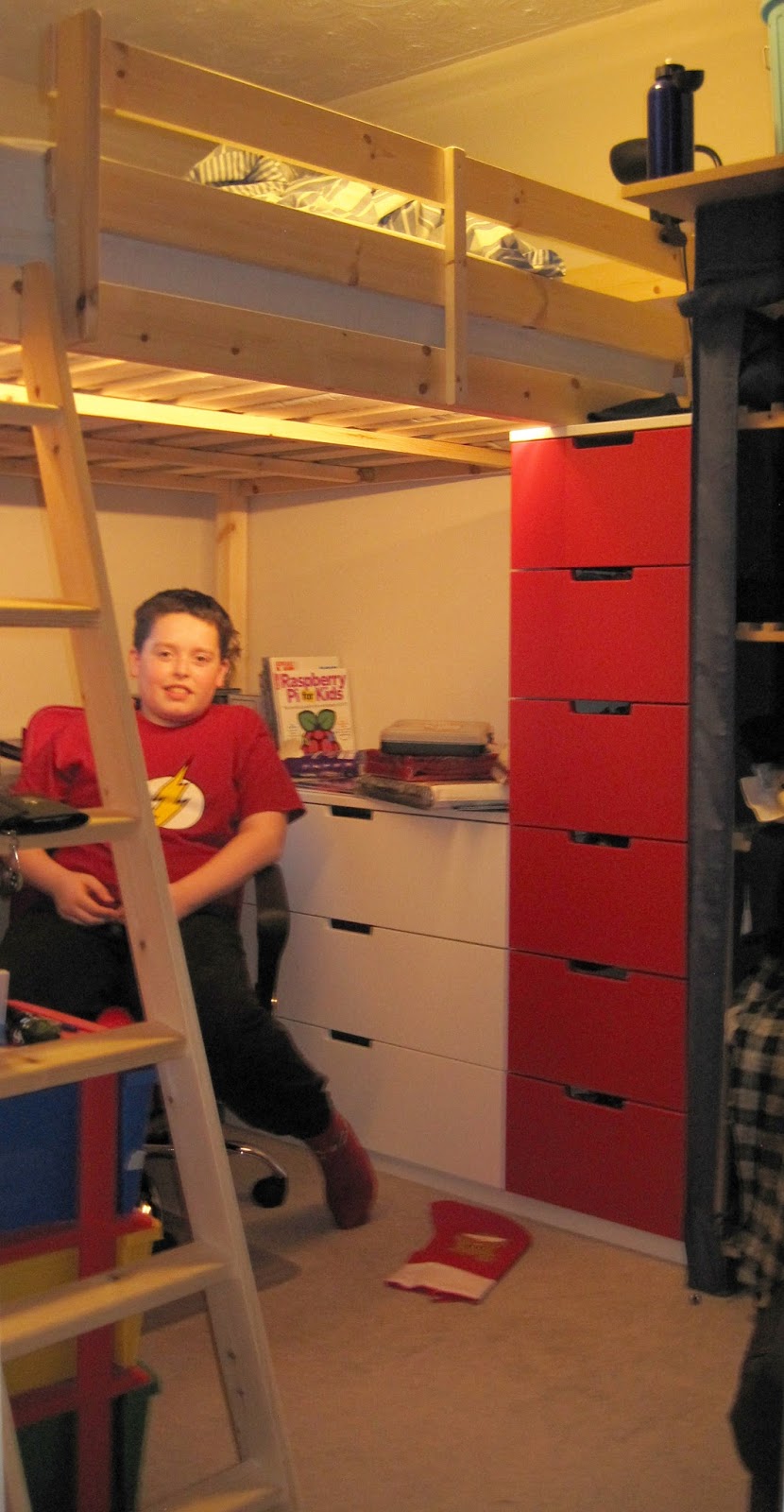
Alex under his loft bed
Having moved in it seems like every weekend is filled with a never ending "todo" list of jobs. From clearing gutters to building a desk in the study. Eight weeks on and the list seems to be slowly shrinking meaning I can even do some lower priority things like the server rack which was actually a fun project.


Joshua in his completed roomThe holidays this year afforded me some time to finish the boys bedrooms. They both got loft beds with a substantial area underneath. This allows them both to have double beds along with a desk and plenty of storage. Completing the rooms required the construction of some flat pack furniture which rather than simply do myself I supervised the boys doing it themselves.

Alexander building flat pack furniture
Teaching them by letting them get on with it was a surprisingly effective and both of them got the hang of the construction method pretty quickly. There was only a couple of errors from which they learned immediately and did not repeat (draw bottoms having a finished side and front becomes back when you are constructing upside down)

Joshua assembling flat pack furniture
The house is starting to feel like home and soon all the problems will fade from memory while the good will remain. Certainly our first holiday season has been comfortable here and I look forward to many more re-reading our books.

Lars Wirzenius: Coming back to Finland after five years

It was a shock to be back in Finland after five years. The country had gone bad. I was born in Finland, and lived here all my life, until January, 2010. I then moved abroad for five years, with my then-girlfriend, now wife. We lived in New Zealand, Scotland, and England. In October 2014 we came back, because my next job happened to be in Finland. When we came back, I found that the country had changed, or I had lost my rose-coloured glasses. The Finland I left was a place where equality and solidarity were assumed, though not universal. The country I came back to turned out to be racist, scared, and quickly abandoning everything that used to be examples of why the country is a good place to live. Some of the change has, possibly, only happened during 2015 and the refugee crisis in Europe, but the change started earlier. Examples: Now, it is clear that Finland was never the kind of idyllic utopia that I thought it was, back when I was young. The older I get, the clearer it is that I was naive. The change over five years is still quite remarkable. I can't ever go back home. Now, I am sometimes ashamed of being Finnish.
Next.

Previous.