Search Results: "ghe"

1 February 2013

Russell Coker: Speaking Stacks

Brianna Laugher wrote a blog post about the speaking stack used in the free software activism BoF at LCA 2013 [1]. Occupy Wall St uses what they call a progressive speaking stack this means that white men step back in the queue and people from marginalised groups step forward [2]. During the free software activism BoF the speaking queue that was used was that people who hadn t already spoken had priority over those who had spoken before. This was a really good idea and could be used a lot more in LCA and other conferences. It is fairly common that a small number of delegates take up the vast majority of question time. I suggest that all white men watch the questions and observe how many are asked by white men and how many are asked by everyone else. Also note the way that questions are asked, who shouts a question, who wins when two delegates ask at the same time, and who waits until the end of the talk. The Reasons for a Speaking Stack In Occupy Wall St there is a real benefit in giving priority to members of minority groups. The political needs of white men are generally reasonably well publicised due to disparities in media coverage. As the aim of the occupy movement is not to replace one group of white men with another there is an obvious need to get opinions from members of minority groups. Bugs in software generally affect members of all groups equally (with the exception of bugs related to accessibility features). But even so I think it is important to encourage diversity among people who ask questions. When someone is in the audience sees that no-one who is in their minority group is asking questions they will get the impression that they are just watching someone else s conference. We should aim to have a conference for everyone. How to Implement it When taking questions for one of my talks I generally try to give priority to people who find it difficult to be heard. But doing that requires some concentration and I often don t have any to spare when giving a demanding technical talk. I think that this needs to be managed by the moderator/MC/microphone holder. Someone who doesn t need to think much about the content of the talk can concentrate on choosing the best people to ask questions. Also a significant issue is questions that are called out during a talk. Some speakers insist that questions are only asked at the end of their talk. But I prefer some degree of interaction with the audience so my talks often end up being more about having a conversation with the audience than reading from a script. The difficulty with an interactive talk is that it strongly favors those who are prepared to shout a question over those who wait their turn. I think I ll try to make a strict policy of having people raise their hand to ask a question in future to address this issue, but I will need assistance from someone who s not concentrating on the technical issues. For a conference I think it would make sense for the people who hold the microphones to keep a mental list of who s asked questions. If someone asks their share of questions on the first day of the conference then they would deserve a lower priority for questions on later days. This would also encourage delegates to consider whether their question is really worth asking during the lecture or whether they should save their question quota and talk to the speaker afterwards. Also we could ask delegates to exercise restraint. One suggestion I heard was that people should set themselves a quota of 3 questions per conference or 1 per day. In a conference with ~600 delegates and ~33 sessions per day if everyone asked a question each day that would be about 18 questions per session more than is typical. So it seems that anyone who asks a single question per day is still likely to be asking more than 1/600 of all questions. Exceptions There are occasions when multiple questions and comments make sense. One example is where a member of the audience has significant expertise in the topic in question. Another is when a speaker completes significantly before the end of their allotted time and some questions from the MC or an experienced member of the audience can help them spend all their time educating the audience. But I think there needs to be a compelling reason that has a clear benefit for the audience. General Benefits How many of the repeat questions are useful to the audience? It seems to me that there is a correlation between multiple questions and questions that are more about the person asking than about clarifying issues that are likely to matter to the audience. Would such limits improve the quality of the discussion even for people who don t care about diversity? Also I have asked a disproportionate number of questions in the past. I am reducing the number of questions that I ask although I think I asked more than 3 at this conference.


27 January 2013

Russell Coker: LCA 2012

LCA 2013 [1] is starting so it seems like time to finish my write-up of LCA 2012. As usual it was a great conference, although I got sick immediately after getting there which reduced my ability to attend. Android A major unofficial theme of the conference was Android. Most delegates seemed to have Android phones, the Samsung Galaxy S and Galaxy Nexus seemed to be the most popular phones. Many delegates had two or more phones for development purposes. A large portion of the casual conversation at the conference concerned Android. There were a couple of really interesting talks about the Serval mesh networking project [2] which involves Android phones running in ad-hoc Wifi mode for long range communication without any official base station. Serval allows transferring messages, pictures, and voice calls. If you need to get longer range you can mount one phone in a convenient place and other phones will decide to use it as a relay there is no need to have a dedicated relay device (such as a mobile phone tower or Wifi access point). Serval is supposed to work with Wifi access points but due to Java not exposing some networking details to the higher levels of software the code that was available at the time of the conference didn t support networks other than a /24, which meant that the conference Wifi network didn t work with Serval. As an aside most people at the conference who installed Serval were using a development version that was newer than the version on the Android market. I can t remember what the extra features were though. Serval was designed for emergency situations, it can be installed on phones (and pushed to other phones via Wifi) in the field and allow communications when the infrastructure is broken. Also it s designed with some aim of circumventing censorship which among other things means that there are no facilities for tracking use. I think it would be really handy to be able to in some way track viewing of or interest in images that are transported via the mesh (maybe by something similar in concept to Google +1). Then in a crowd sourced environment people who take photos would be encouraged in their work by audience appreciation. One thing that interests me is the possibility of using Serval on a cruise ship. A cruise ship is an environment where mobile phone calls are unreasonably expensive, cabin phones aren t much use (who pays for a cruise and hangs out in their cabin?), and where there is usually a Wifi network installed. If a ship has a single bridged Wifi network that allows connecting to Wifi before authenticating for Internet access (which is probably the common case) then you could transport VOIP over that network without paying and without incurring any expense on the cruise company. One of the Serval developers assured me that this should be possible, of course a cruise ship with 3,000 passengers probably doesn t use a /24 for their Wifi so the current versions of Serval won t work At the geek my dinner event (a party where everyone brought $20 of food/drink which was cooked by volunteers) an artist showed me some art work that she created on her Samsung Galaxy Note (which was the biggest phone on sale at the time), it was very impressive. She recommended Picasso Mirror Draw, Sketch Free, Sketch Book Mobile Express, and Freenote as free graphical programs for Android. Samsung has a Noteworthy Project advertising campaign based on the artistic uses of the Galaxy Note which has some good videos of artists [3]. Chris Neugebauer and Paris Buttfield-Addison gave an informative and amusing talk about Android UI development (this link has the video) [4]. It s a pity that I missed seeing that one live but fortunately the video is of high quality. Accommodation picture of women cleaning As I ve become interested in Sociology I couldn t help but notice the pictures that accompanied the rules about cleaning the dormitory (which were displayed over the kitchen sink), it seems to imply that cleaning is only women s work. I wonder whether the people who created that poster deliberately chose pictures of women or whether they just chose the first available pictures from a collection of stock photos. Someone who was near my dorm room seemed to not realise how their alarm impacts other people. For the first two mornings I was woken repeatedly after 6AM by someone who was pressing the snooze button on their alarm. When sleeping in close proximity to other people the reasonable options involve some combination of having no loud alarm, immediately turning the alarm off and getting up (not pressing snooze to have it go off repeatedly), and setting the alarm for a time when almost everyone wants to get up (EG 1 hour before the first session). Networking Chris Neugebauer organised the Unprofessional Delegates Networking Session which was a great event. It was an event held at the same time as the Professional Delegates Networking Session with the difference being that you had to pay $5 for food and there was no free drink. A lot of great people attended the UPDNS so I m glad I don t pay for the PDNS. It seems that we won t have a UPDNS this year unfortunately. Conclusion LCA is always great fun and very educational. I recommend attending every year.

26 January 2013

Eddy Petrișor: (Serial) console flooded with kernel messages?

(If you want to ignore the explanations and see how to stop the Linux kernel from flooding the console with low importance messages, go straight to the bottom of the article, is the small bit at end with larger font.)

After connecting to the serial console on my Linksys WRT160NL router I was faced with the problem that the console was flooded with all sorts of messages such as:
DROP IN=eth1 OUT= SRC=X.Y.Z.W DST=255.255.255.255 PROTO=UDP SPT=58488 DPT=2008 LEN=26
DROP IN=eth1 OUT= SRC=X.Y.Z.U DST=178.156.183.255 PROTO=UDP SPT=137 DPT=137 LEN=58
DROP IN=eth1 OUT= SRC=X.Y.Z.W DST=255.255.255.255 PROTO=UDP SPT=58488 DPT=2008 LEN=26
ACCEPT IN=br0 OUT=eth1 SRC=a.b.c.d DST=69.171.246.16 PROTO=TCP SPT=3651 DPT=443
DROP IN=eth1 OUT= SRC=X.Y.Z.U DST=178.156.183.255 PROTO=UDP SPT=137 DPT=137 LEN=58
DROP IN=eth1 OUT= SRC=X.Y.Z.W DST=255.255.255.255 PROTO=UDP SPT=58488 DPT=2008 LEN=26
DROP IN=eth1 OUT= SRC=178.156.183.146 DST=255.255.255.255 PROTO=UDP SPT=17500 DPT=17500 LEN=120
DROP IN=eth1 OUT= SRC=178.156.183.146 DST=178.156.183.255 PROTO=UDP SPT=17500 DPT=17500 LEN=120
DROP IN=eth1 OUT= SRC=178.156.183.146 DST=255.255.255.255 PROTO=UDP SPT=17500 DPT=17500 LEN=120
DROP IN=eth1 OUT= SRC=X.Y.Z.W DST=255.255.255.255 PROTO=UDP SPT=58488 DPT=2008 LEN=26
DROP IN=eth1 OUT= SRC=178.156.177.142 DST=255.255.255.255 PROTO=UDP SPT=17500 DPT=17500 LEN=153

The serial console was working, but it was impossible to do anything practical in these conditions. I tried looking on the net for 'linux stop console flooding' and similar terms, but didn't get too far, except the fact the problem was the loglevel.

Here is the explanation of what this means (quote from Documentation/kernel-parameters.txt):

        loglevel=       All Kernel Messages with a loglevel smaller than the
                        console loglevel will be printed to the console. It can
                        also be changed with klogd or other programs. The
                        loglevels are defined as follows:
                        0 (KERN_EMERG)          system is unusable
                        1 (KERN_ALERT)          action must be taken immediately
                        2 (KERN_CRIT)           critical conditions
                        3 (KERN_ERR)            error conditions
                        4 (KERN_WARNING)        warning conditions
                        5 (KERN_NOTICE)         normal but significant condition
                        6 (KERN_INFO)           informational
                        7 (KERN_DEBUG)          debug-level messages


This was enough to go through my local git tree of the kernel in the Documentation directory and grep for loglevel. This brought me to this interesting bit from Documentation/sysctl/kernel.txt
==============================================================
printk:
The four values in printk denote: console_loglevel,
default_message_loglevel, minimum_console_loglevel and
default_console_loglevel respectively.
These values influence printk() behavior when printing or
logging error messages. See 'man 2 syslog' for more info on
the different loglevels.
- console_loglevel: messages with a higher priority than
  this will be printed to the console
- default_message_loglevel: messages without an explicit priority
  will be printed with this priority
- minimum_console_loglevel: minimum (highest) value to which
  console_loglevel can be set
- default_console_loglevel: default value for console_loglevel
==============================================================

So I ran 'cat /proc/sys/kernel/printk' and got (I managed to read it through the flood of messages from the firewall):

7       4       1       7
According to the explanations above, that meant that console_loglevel was too, so to fix it I ran:
echo '2 4 1 7' > /proc/sys/kernel/printk
And, behold, the serial console was usable.

25 January 2013

Johannes Schauer: Bootstrappable Debian - New Milestone

This post is about the port bootstrap build ordering tool (naming suggestions welcome) which was started as a Debian Google Summer of Code project in 2012 and continued to be developed afterwards. Sources are available through gitorious. In the end of November 2012, I managed to put down an approximation algorithm to the feedback arc set problem which allowed to break the dependency graph into a directed acyclic graph with only few removed build dependencies. I wrote about this effort on our mailinglist but didnt mention it here because it was still too much of a proof-of-concept. Later, in January 2013, I mentioned the result of this algorithm in an email wookey and me wrote to debian-devel mailinglist. Many things happened since November 2012:
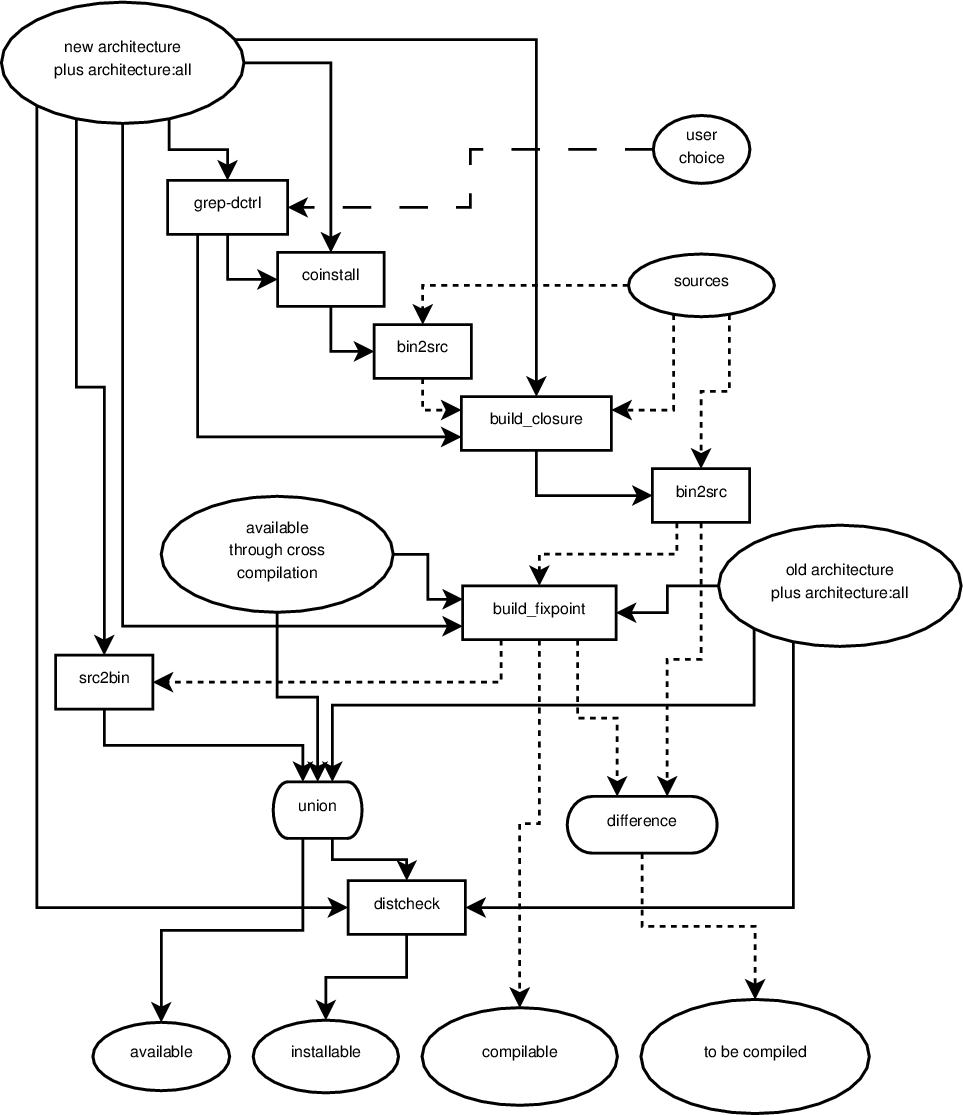
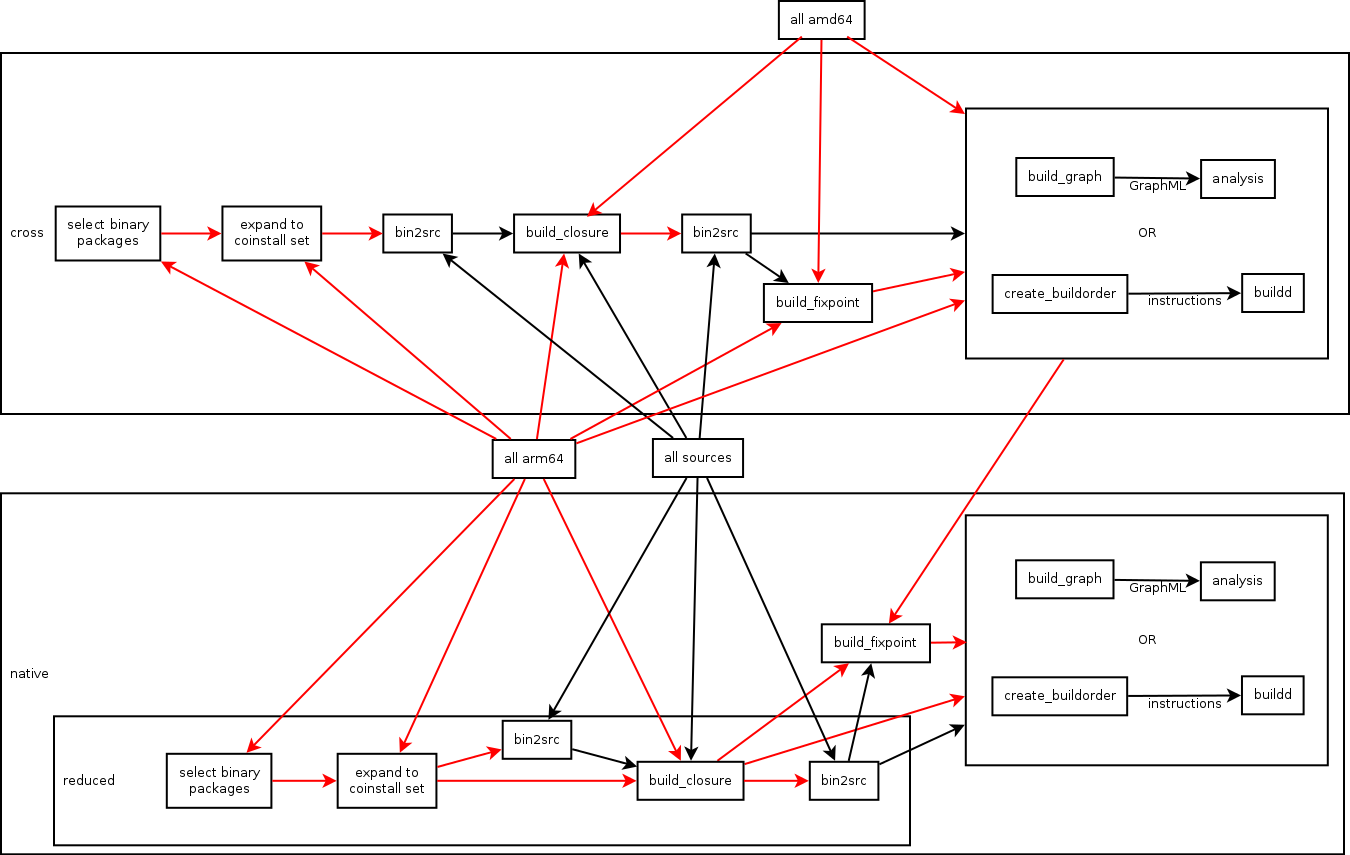
Processing pipeline instead of monolithic tools The tools I developed so far tried to accomplish everything by themselves, reusing functionality implemented in a central library. Therefor, if one wanted to try out even trivial new things, it mostly meant to hack some OCaml code. Pietro Abate suggested to instead develop smaller tools which could work independently of each other, would only execute one algorithm each and could easily be connected together in different ways to achieve different effects. This switch is now done and all functionality from the old tools is moved into a new toolset. The exchange format between the tools is either plain text files in deb822 control format (Packages/Sources files) or a dependency graph. The dependency graph is currently marshalled by OCaml but future versions should work with just passing a GraphML (an XML graph format) representation around. This new way of doing things seems close to the UNIX philosophy (each program does one thing well, data is stored as text, every program is a filter). For example the deb822 control output can easily be manipulated using grep-dctrl(1) and there exist many tools which can read, analyze and manipulate GraphML. It is a big improvement over the old, monolithic tools which did not allow to manipulate any intermediate result by external, existing tools. Currently, a shell script (native.sh) will execute all tools in a meaningful order, connecting them together correctly. The same tools will be used for a future cross.sh but they will be connected differently. I wrote about a first proposal of what the individual tools should do and how they should be connected in this email from which I also linked a confusing overview of the pipeline. This overview has recently been improved to be even more confusing and the current version of the lower half (the native part) now looks like this: native reduced Solid arrows represent a flow of binary packages, dottend arrows represent a flow of source packages, ovals represent a set of packages, boxes with rounded corners represent set operations, rectangular boxes represent filters. There is only one input to a filter, which is the arrow connected to the top of the box. Outgoing arrows from the bottom represent the filtered input. Ingoing arrows to either side are arguments to the filter and control how the filter behaves depending on the algorithm. I will explain this better once the pipeline proved to be less in flux. The pipeline is currently executed like this by native.sh.

Two new ways to break dependency cycles have been discovered So far, we knew of three ways to formally break dependency cycles:
  • remove build dependencies through build profiles
  • find out that the build dependency is only used to build arch:all packages and therefor put it into Build-Depends-Indep
  • cross compile some source packages
Two new methods can be added to the above:

Dependency graph definition changed Back in September when I was visiting irill, Pietro found a flaw in how the dependency graph used to be generated. He supplied a new definition of the dependency graph which does away with the problem he found. After fixing some small issues with his code, I changed all the existing algorithms to use the new graph definition. The old graph is as of today removed from the repository. Thanks to Pietro for supplying the new graph definition - I must still admit that my OCaml foo is not strong enough to have come up with his code.

Added complexity for profile built source packages As mentioned in the introduction, wookey and me addressed the debian-devel list with a proposal on necessary changes for an automated bootstrapping of Debian. During the discussiong, two important things came up which are to be considered by the dependency graph algorithms:
  • profile built source packages may not create all binary packages
  • profile built source packages may need additional build dependencies
Both things make it necessary to alter the dependency graph during the generation of a feedback arc set and feedback vertex set beyond the simple removal of edges. Luckily, the developed approximation algorithms can be extended to support such changes in the graph.

Different feedback arc set algorithms The initially developed feedback arc set algorithm is well suited to discover build dependency edges which should be dropped. It performs far worse when creating the final build order because it only considers edges by itself and not how many edges of a source package can be dropped by profile building it. The adjusted algorithm for generating a build order is more of a feedback vertex set algorithm because instead of greedily finding the edge with most cycles through it, it greedily finds the source package which would break most cycles if it was profile built.

Generating a build order with less profile built source packages After implementing all the features above I now feel more confident to publish the current status of the tools to a wider audience. The following test shows a run of the aforementioned ./native.sh shell script. Its final output is a list of source packages which have to be profile built and a build order. Using the resulting build order, starting from a minimal build system (essential:yes, build-essential and debhelper), all source packages will be compiled which are needed to compile all binary packages in the system. The result will therefor be a list of source and binary packages which fulfill the following property:
  • all binary packages can be built from the available source packages
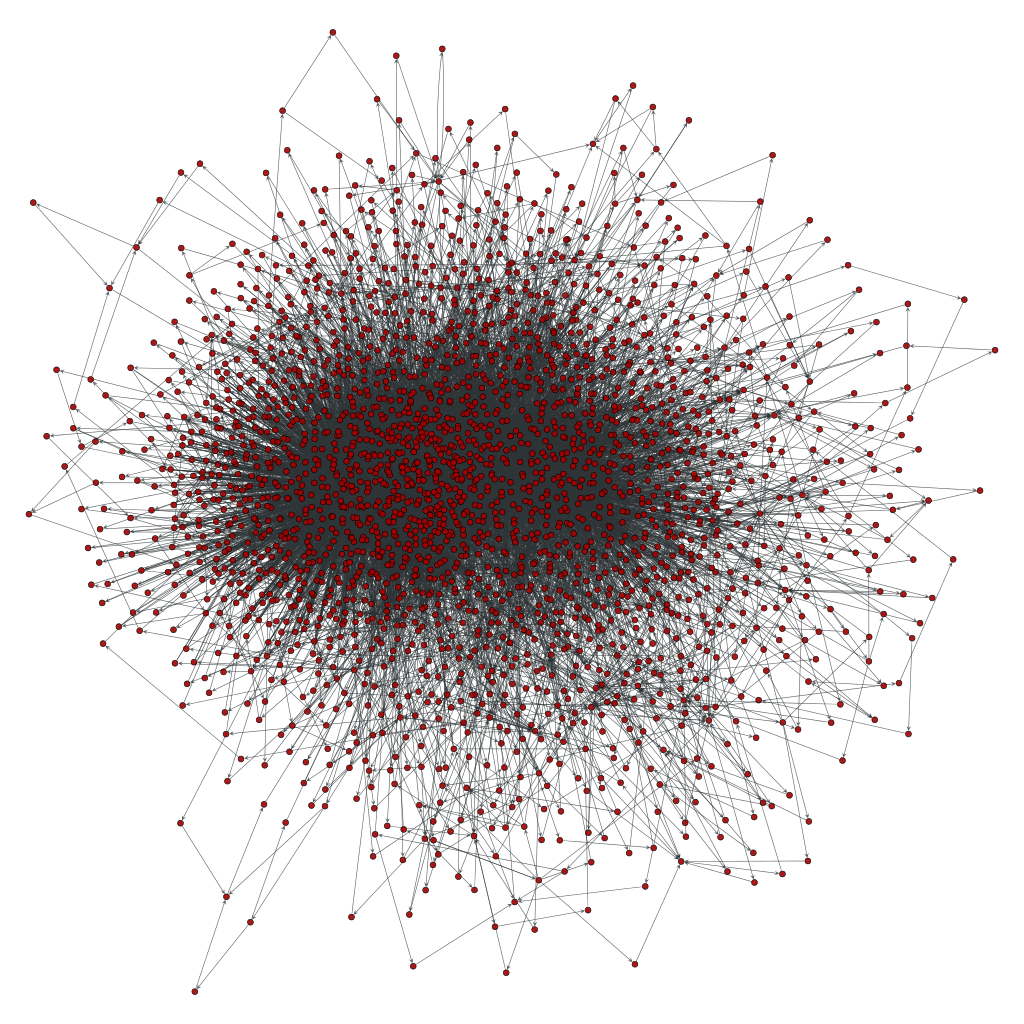
  • all source packages can be built with the available binary packages
I called this a "reduceded distribution" in earlier posts. The interesting property of this specific selection is, that it contains the biggest problem set of Debian when bootstrapping it: a 900 to 1000 nodes big strongly connected component. Here is a visualization of the problem: hideous mess Source packages do not yet come with build profiles and the cross build situation can not yet be analyzed, so the following assumptions were made: The last point is about 14 build dependencies which were decided to be broken by the feedback arc set algorithm but for which other data sources did not indicate that they are actually breakable. Those 14 are dynamically generated by native.sh. If above assumptions should not be too far from the actual situation, then not more than 73 source packages have to be modified to bootstrap a reduced distribution. This reduced distribution even includes dependency-wise "big" packages like webkit, metacity, iceweasel, network-manager, tracker, gnome-panel, evolution-data-server, kde-runtime, libav and nautilus. By changing one line in native.sh one could easily develop a build order which generates gnome-desktop or really any given (meta-)package selection. All of native.sh takes only 80 seconds to execute on my system (Core i5, 2.5 GHz, singlethreaded). Here is the final build order which creates 2044 binary packages from 613 source packages.
  1. nspr, libio-pty-perl, libmcrypt, unzip, libdbi-perl, cdparanoia, libelf, c-ares, liblocale-gettext-perl, libibverbs, numactl, ilmbase, tbb, check, libogg, libatomic-ops, libnl($), orc($), libaio, tcl8.4, kmod, libgsm, lame, opencore-amr, tcl8.5, exuberant-ctags, mhash, libtext-iconv-perl, libutempter, pciutils, gperf, hspell, recode, tcp-wrappers, fdupes, chrpath, libbsd, zip, procps, wireless-tools, cpufrequtils, ed, libjpeg8, hesiod, pax, less, dietlibc, netkit-telnet, psmisc, docbook-to-man, libhtml-parser-perl, libonig, opensp($), libterm-size-perl, linux86, libxmltok, db-defaults, java-common, sharutils, libgpg-error, hardening-wrapper, cvsps, p11-kit, libyaml, diffstat, m4
  2. openexr, enca, help2man, speex, libvorbis, libid3tag, patch, openjade1.3, openjade, expat, fakeroot, libgcrypt11($), ustr, sysvinit, netcat, libirman, html2text, libmad, pth, clucene-core, libdaemon($), texinfo, popt, net-tools, tar, libsigsegv, gmp, patchutils($), dirac, cunit, bridge-utils, expect, libgc, nettle, elfutils, jade, bison
  3. sed, indent, findutils, fastjar, cpio, chicken, bzip2, aspell, realpath, dctrl-tools, rsync, ctdb, pkg-config($), libarchive, gpgme1.0, exempi, pump, re2c, klibc, gzip, gawk, flex-old, original-awk, mawk, libtasn1-3($), flex($), libtool
  4. libcap2, mksh, readline6, libcdio, libpipeline, libcroco, schroedinger, desktop-file-utils, eina, fribidi, libusb, binfmt-support, silgraphite2.0, atk1.0($), perl, gnutls26($), netcat-openbsd, ossp-uuid, gsl, libnfnetlink, sg3-utils, jbigkit, lua5.1, unixodbc, sqlite, wayland, radvd, open-iscsi, libpcap, linux-atm, gdbm, id3lib3.8.3, vo-aacenc, vo-amrwbenc, fam, faad2, hunspell, dpkg, tslib, libart-lgpl, libidl, dh-exec, giflib, openslp-dfsg, ppl($), xutils-dev, blcr, bc, time, libdatrie, libpthread-stubs, guile-1.8, libev, attr, libsigc++-2.0, pixman, libpng, libssh2, sqlite3, acpica-unix, acl, a52dec
  5. json-c, cloog-ppl, libverto, glibmm2.4, rtmpdump, libdbd-sqlite3-perl, nss, freetds, slang2, libpciaccess, iptables, e2fsprogs, libnetfilter-conntrack, bash, libthai, python2.6($), libice($), libpaper, libfontenc($), libxau, libxdmcp($), openldap($), cyrus-sasl2($), openssl, python2.7($)
  6. psutils, libevent, stunnel4, libnet-ssleay-perl, libffi, readline5, file, libvoikko, gamin, libieee1284, build-essential, libcap-ng($), lcms($), keyutils, libxml2, libxml++2.6, gcc-4.6($), binutils, dbus($), libsm($), libxslt, doxygen($)
  7. liblqr, rarian, xmlto, policykit-1($), libxml-parser-perl, tdb, devscripts, eet, libasyncns, libusbx, icu, linux, libmng, shadow, xmlstarlet, tidy, gavl, flac, dbus-glib($), libxcb, apr, krb5, alsa-lib
  8. usbutils, enchant, neon27, uw-imap, libsndfile, yasm, xcb-util, gconf($), shared-mime-info($), audiofile, ijs($), jbig2dec, libx11($)
  9. esound, freetype, libxkbfile, xvidcore, xcb-util-image, udev($), libxfixes, libxext($), libxt, libxrender
  10. tk8.4, startup-notification, libatasmart, fontconfig, libxp, libdmx, libvdpau, libdrm, libxres, directfb, libxv, libxxf86dga, libxxf86vm, pcsc-lite, libxss, libxcomposite, libxcursor, libxdamage, libxi($), libxinerama, libxrandr, libxmu($), libxpm, libxfont($)
  11. xfonts-utils, libxvmc, xauth, libxtst($), libxaw($)
  12. pmake, corosync, x11-xserver-utils, x11-xkb-utils, coreutils, xft, nas, cairo
  13. libedit, cairomm, tk8.5, openais, pango1.0($)
  14. ocaml, blt, ruby1.8, firebird2.5, heimdal, lvm2($)
  15. cvs($), python-stdlib-extensions, parted, llvm-2.9, ruby1.9.1, findlib, qt4-x11($)
  16. xen, mesa, audit($), avahi($)
  17. x11-utils, xorg-server, freeglut, libva
  18. jasper, tiff3, python3.2($)
  19. openjpeg, qt-assistant-compat, v4l-utils, qca2, jinja2, markupsafe, lcms2, sip4, imlib2, netpbm-free, cracklib2, cups($), postgresql-9.1
  20. py3cairo, pycairo, pam, libgnomecups, gobject-introspection($)
  21. gdk-pixbuf, libgnomeprint, gnome-menus, gsettings-desktop-schemas, pangomm, consolekit, vala-0.16($), colord($), atkmm1.6
  22. libgee, gtk+3.0($), gtk+2.0($)
  23. gtkmm2.4, poppler($), openssh, libglade2, libiodbc2, gcr($), libwmf, systemd($), gcj-4.7, java-atk-wrapper($)
  24. torque, ecj($), vala-0.14, gnome-keyring($), gcc-defaults, gnome-vfs($)
  25. libidn, libgnome-keyring($), openmpi
  26. mpi-defaults, dnsmasq, wget, lynx-cur, ghostscript, curl
  27. fftw3, gnupg, libquvi, xmlrpc-c, raptor, liboauth, groff, fftw, boost1.49, apt
  28. boost-defaults, libsamplerate, cmake, python-apt
  29. qjson, qtzeitgeist, libssh, qimageblitz, pkg-kde-tools, libical, dwarves-dfsg, automoc, attica, yajl, source-highlight, pygobject, pygobject-2, mysql-5.5($)
  30. libdbd-mysql-perl, polkit-qt-1, libdbusmenu-qt, raptor2, dbus-python, apr-util
  31. rasqal, serf, subversion($), apache2
  32. git, redland
  33. xz-utils, util-linux, rpm, man-db, make-dfsg, libvisual, cryptsetup, libgd2, gstreamer0.10
  34. mscgen, texlive-bin
  35. dvipng, luatex
  36. libconfig, transfig, augeas, blas, libcaca, autogen, libdbi, linuxdoc-tools, gdb, gpm
  37. ncurses, python-numpy($), rrdtool, w3m, iproute, gcc-4.7, libtheora($), gcc-4.4
  38. libraw1394, base-passwd, lm-sensors, netcf, eglibc, gst-plugins-base0.10
  39. libiec61883, qtwebkit, libvirt, libdc1394-22, net-snmp, jack-audio-connection-kit($), bluez
  40. redhat-cluster, gvfs($), pulseaudio($)
  41. phonon, libsdl1.2, openjdk-6($)
  42. phonon-backend-gstreamer($), gettext, libbluray, db, swi-prolog, qdbm, swig2.0($)
  43. highlight, libselinux, talloc, libhdate, libftdi, libplist, python-qt4, libprelude, libsemanage, php5
  44. samba, usbmuxd, libvpx, lirc, bsdmainutils, libiptcdata, libgtop2, libgsf, telepathy-glib, libwnck3, libnotify, libunique3, gnome-desktop3, gmime, glib2.0, json-glib, libgnomecanvas, libcanberra, orbit2, udisks, d-conf, libgusb
  45. libgnomeprintui, libimobiledevice, nautilus($), libbonobo, librsvg
  46. evas, wxwidgets2.8, upower, gnome-disk-utility, libgnome
  47. ecore, libbonoboui
  48. libgnomeui
  49. graphviz
  50. exiv2, libexif, lapack, soprano, libnl3, dbus-c++
  51. atlas, libffado, graphicsmagick, libgphoto2, network-manager
  52. pygtk, jackd2, sane-backends, djvulibre
  53. libav($), gpac($), ntrack, python-imaging, imagemagick, dia
  54. x264($), matplotlib, iceweasel
  55. strigi, opencv, libproxy($), ffms2
  56. kde4libs, frei0r, glib-networking
  57. kde-baseapps, kate, libsoup2.4
  58. geoclue, kde-runtime, totem-pl-parser, libgweather, librest, libgdata
  59. webkit
  60. zenity, gnome-online-accounts
  61. metacity, evolution-data-server
  62. gnome-panel
  63. tracker
The final recompilation of profile built source packages is omitted. Source packages marked with a ($) are selected to be profile built. All source packages listed in the same line can be built in parallel as they do not depend upon each other. This order looks convincing as it first compiles a multitude of source packages which have no or only few build dependencies lacking. Later steps allow fewer source packages to be compiled in parallel. The amount of needed build dependencies is highest in the source packages that are built last.

24 January 2013

Benjamin Mako Hill: Aaron Swartz

I moved to Boston in 2005 at the same time that Aaron Swartz did and we were introduced by a mutual friend. Aaron was one of my first friends in Boston and we became close. When Aaron moved to San Francisco, I moved into his apartment in Somerville where he kept a room for a year or so. Mika and I still live there. His old posters remain on our walls and his old books remain on our shelves. Aaron s brothers Ben and Noah both lived with us and remain close friends. I have spent hours (days?) reading and thinking about Aaron over the last two weeks. It has been disorienting but beautiful to read the descriptions of, and commentaries on, Aaron s life. Although I suspect I may never feel ready, there are several things I want to say about Aaron s death, about Aaron s work, and about what Aaron means to me. 1. Aaron s Death The reaction to Aaron s death has been overwhelming and inspirational. At some point in the near future I plan to join some of the important campaigns already being waged in his name. There are many attempts to understand why Aaron died and many attempts to prevent it from happening to others in the future. Unfortunately, I am familiar with the process of soul-searching and second-guessing that happens when a friend commits suicide. I m sure that every one of his friends has asked themselves, as I have, What could I have done differently? I don t know the answer, but I do know this: Aaron was facing the real risk of losing half his life to prison. But even if one believed that he was only facing the likely loss of ten percent or even one percent of his life I wish that we all, and I wish that I in particular, had reacted with the passion, time, anger, activity, and volume proportional to how we have reacted in the last two weeks when he lost the whole thing. 2. Aaron s Work Of course, Aaron and I worked on related projects and I followed his work. And despite all the incredible things that have been said about Aaron, I feel that Aaron s work was more focused, more ambitious, more transformative, more innovative, and more reckless (in a positive sense) than the outpour online suggests. Although discussion of Aaron has focused his successes, achievements, and victories, the work that inspired me most was not the projects that were most popular or successful. Much of Aaron s work was deeply, and as it turned out overly, ambitious. His best projects were self-conscious attempts to transform knowledge production, organization, and dissemination. Although he moved from project to project, his work was consistently focused on bringing semantic-web concepts and technologies to peer production, to the movement for free culture, and to progressive political activism and on the meta-politics necessary to remove barriers to this work. For example, Aaron created an online collaborative encyclopedia project called the TheInfoNetwork (TIN) several years before Wikipedia was started. I talked to Aaron at length about that project for a research project I am working on. Aaron s work was years ahead of its time; in 2000, TIN embraced more of the Wikimedia Foundation s current goals and principles than Wikipedia did when it was launched. While Wikipedia sought to create a free reference work online, Aaron s effort sought to find out what a reference work online could look like. It turned out to be too ambitious, perhaps, but it taught many, including myself, an enormous amount in that process. When I met Aaron, he was in the process starting a company, Infogami, that was trying to chase many of TIN s goals. Infogami was conceived of as a wiki aware of the structure of data. The model was both simple and profound. Years later, Wikimedia Deutschland s WikiData project is beginning to bring some of these ideas to the mainstream. Infogami merged with Reddit as equal halves of a company with a shared technological foundation based on some of Aaron s other work. But when Reddit took off, Infogami was rarely mentioned, even by Aaron. I think that is too bad. Reddit got traction because it made the most popular stuff more visible; Reddit is popular, fundamentally, because popular things are popular. But popular is not necessary positive. For that reason, Reddit never struck me as either surprising or transformative. But what started as Aaron s half the company, on the other hand, aimed to create a powerful form of democratized information production and dissemination. And although Infogami didn t take off, the ideas and code behind the project found life at the heart of Open Library and will continue to influence and inspire countless other projects. I believe that Infogami s lessons and legacy will undergird a generation of transformative peer production technologies in a way that the Reddit website important as it is will not. 3. What Aaron Means to Me A lot of what has been written about Aaron speaks to his intelligence, his curiosity, his generosity, his ethics and his drive. Although I recognize all these qualities in the Aaron I knew, I ve felt alienated by how abstract some of the discussion of Aaron has been my memories are of particularities.
I remember the time Aaron was hospitalized and I spent two hours on the phone going through my bookshelves arguing with him about the virtues of the books in my library as we tried to decide which books I would bring him. I remember Aaron confronting Peter Singer intellectual founder of the modern animal rights movement at the Boston Vegetarian Food Festival to ask if humans had a moral obligation to stop animals from killing each other. I lurked behind, embarrassed about the question but curious to hear the answer. (Singer sighed and said yes sort of and complemented Aaron on the enormous Marxist commentary he was carrying.) I remember 1-800-INTERNET.com. I remember talking with Aaron about whether being wealthy could be ethical. I argued it could not but Aaron argued uncharacteristically I thought that it could. Aaron told Mika she should slap him if he ever became wealthy. The very next day, it was announced that his company had been acquired and that Aaron was a millionaire. I remember the standing bets I had with Aaron and how he would email me every time news reports favored his claims (but never when they did not). And I remember that I won t hear from him again.
Aaron was a friend and inspiration. I miss him deeply and I am very sad.

Russell Coker: Power Supplies and Wires

For some time I ve been wondering how the wire size for power supplies limits the power. So I ve done some quick calculations to determine if it s a problem. The first type that is of interest are the Inverters that are used to convert 12VDC to 240VAC (mains power) to allow electric devices to be operated in a car. I ve seen some reports from dissatisfied user about Inverters not supplying as much power as expected and I ve had problems with my 150W Inverter not always supplying my Thinkpad (which definitely doesn t draw 150W). The second type is phone chargers as charging a phone in a reasonable amount of time is always a problem. Inverter Rating Fine Print vs Laptop PSU My Thinkpad Power Supply claims Efficiency Level IV which according to the US EPA document describing the efficiency marking protocol for external power supplies [1] means that it is at least 85% efficient when supplying 50W+. The peak output of the PSU is 4.5A at 20V which is 90W peak output, 90/0.85 == 106W power drawn. One would hope that wouldn t be a problem from a 150W PSU. But the fine print on the PSU says that it can provide 110W continuously and 150W for 10 minutes. So according to my calculations I m within 4W of overloading the PSU if my Thinkpad uses full power. It also says that it is designed for 13.8V input. I have no idea how the performance of the Inverter changes as the supply Voltage changes between the 12.6V that a 6 cell lead-acid battery is designed to provide and the 13.8V charge from the car alternator. But I have had occasions when my Inverter stopped working correctly presumably due to being unable to supply as much current as my Thinkpad draws. As an aside I measured the Voltage in my car (with the engine off) at 12.85V from the cigarette lighter socket and 13.02V directly from the battery. I wonder if there is some sort of overload protection on the cigarette lighter which has a side effect of reducing the Voltage. Resistance in wires reduces the Voltage, but all Voltage meters are designed to have a high resistance to prevent that from being an issue. If anyone has an explanation for the 0.17Volt drop then please write a comment! Can a Car Provide 130W from the Cigarette Lighter socket? If the Inverter is also 85% efficient (and it might be less as it has no indication of efficiency on the box) then when supplying 110W it would draw 110/0.85 == 129.4W (I ll round it up to 130W). The power in Watts is equal to the Voltage multiplied by the current in Amps (W=V*I). Therefore I=W/V so if the car battery was at 12.85V then 130W/12.85V == 10.12A will flow. The current that goes through a circuit is equal to the Voltage divided by the resistance (see the Wikipedia page on Ohm s law for more information). This also means that the resistance equals the Voltage divided by the current. 12.85V/10.12A == 1.27 Ohms. Note that this is the resistance of the entire circuit, all the wires going to the battery, the circuitry inside the Inverter, and the internal resistance of the battery. The Inverter s cable is 1M long (2 meters of wire) and each wire is about 3.5mm in diameter including the insulation which means that the copper wire is probably equivalent to a single core conductor that is about 1mm in diameter. According to one of the online guides to resistance [2] wire that is 1.02mm in diameter will have a resistance of 0.02 Ohms per meter which gives a resistance of 0.04 Ohms. 0.04 Ohms is 3% of the total resistance of the circuit which doesn t seem like it will be a real problem. In practice I ve noticed that the connector gets extremely hot when it s in use while the cable doesn t get warm enough to notice. I suspect that the quality of the connector limits the power that is available but I don t have an easy way of measuring this. Inverters that are rated at 300W are designed to attach directly to the battery. An Inverter that is rated at 300W would draw 300W/0.85 == 352W from the battery. That needs 352W/13.02V == 27.04A and therefore a circuit resistance of 13.02V/27.04A == 0.48 Ohms total resistance. I wonder whether dirt on the battery terminals would give a significant portion of that. Phone Charging I ve also been wondering about why mobile phones take so long to charge, and now I ve finally done the calculations. The latest standard for mobile phones is to use USB for charging. The Wikipedia page about USB says that the standard is for USB 2.0 to supply up to 500mA at 5V +-5%. That means 0.5A*5V == 2.5W +- 5%. If we assume that the internal power supply in a phone is also 85% efficient then that means 2.5*0.85 == 2.125W going to the battery. My Samsung Galaxy S3 has a battery which is rated at 7.98Wh. According to the Wikipedia page about Lithium Ion batteries the charge/discharge efficiency is 80% to 90% I ll assume that it s 85% for further calculations. If the battery in the phone is 85% efficient and the phone is doing nothing but charging then the charge time for a regular USB port would be 7.98Wh/0.85/2.125W == 4.42 hours (4 hours 25 minutes) of charge time. That probably means something closer to 5 hours to totally charge the phone while it s running. There are dedicated charging ports for USB which can supply up to 1.5A. The 3rd party charger which came with my phone was rated at 1A and would hopefully be capable of completely charging the phone in less than 3 hours (but in practice isn t). It s interesting to note that MacBooks expose the amount of current drawn from a USB port with a GUI, so it should be possible to measure a phone charge rate by connecting it to a MacBook (which is cheaper than cutting up a phone cable). My old Samsung Galaxy S has a battery which is rated at 5.55Wh, by the same calculations it would take slightly more than 3 hours to charge on a standard USB port or 1.5 hours on my newest USB charger. In practice it has never got anywhere close to that, I presume that the phone is designed to draw less than 500mA. Phone Cable Resistance The charger that came with my Galaxy S has a cable that is about 1.75M long, the cable is flat and measures just over 1mm thick and about 2mm wide. Presumably the wire is equivalent to a single core that s about 0.4mm in diameter thus giving it a resistance of about 0.134 Ohm per meter, or 1.75*2*0.134 == 0.469 Ohm for the cable. The charger is rated at 0.7A. To supply 0.7A at 5V the resistance would be 5V/0.7A == 7.143 Ohm so about 6.6% of the total resistance of the circuit would be in the wire from the charger to the phone. The charger that came with my Galaxy S3 has a round cable that s just over 3mm thick and about 90cm long. If each wire in the cable is equivalent to a solid wire that is 0.912mm in diameter then it would be 0.0264 Ohm per meter of wire or 0.9*2*0.0264 == 0.0475 Ohm. The total circuit resistance would be 5V/1A == 5 Ohm. So 0.0475 Ohm is less than 1% of the circuit resistance. Voltage Drop The Voltage across a part of a circuit is proportional to the resistance (see the Wikipedia page on Series and Parallel Circuits for a good explanation). Basically this means that if 1% of the resistance of a circuit is in the wire then 1% of the Voltage drop will also be in the wire, so if we have a 5V supply with my Galaxy S3 cable then each of the two wires in the cable will have a difference of about 0.025V between the ends and the phone will receive a supply of 4.95V, the difference isn t something that is worth worrying about. But the cable from my Galaxy S has a resistance equivalent to 6.6% of the circuit resistance which means that the theoretical charge time will be 6% longer than it might be or 6% more current will be drawn from the mains than should be needed. Conclusion The charger that came with my Samsung Galaxy S isn t much good. Wasting 6.6% of the power in the wire is unreasonable. Phones keep getting more power hungry and batteries keep getting larger. There are third party phone batteries and external batteries that are charged by USB which have more than twice the capacity of the stock phone batteries this means more than twice the charge time. This problem will keep getting worse. The problem of a phone in active use drawing more power than the charger can provide (and running out of battery while on the charger) seems likely to stay with us. So while an Android phone has the potential to be a great little embedded server it seems that hacking the power supply is going to be a required first step for realising that potential. The decision to make 5V the USB power standard was reasonable at the time as it was the voltage used for most things on the motherboard. The decision to use USB as the phone charging standard was also reasonable, it allows phones to be charged anywhere. The combination of those two decisions isn t good for the user. If a higher Voltage such as 12V was used then 5* the power could be supplied through the same wires at the same level of efficiency. It would be really good if cars came with built in Inverters and supplied 240VAC or 110VAC depending on the region they were manufactured for. It s becoming a fairly common feature to have a cigarette lighter port in the car boot as well as at least two ports inside the car. When a car has three sockets and only one device to actually light cigarettes (which I suspect is only provided to fill an empty socket) it s very obvious that people want to connect random devices. Also having USB charging ports inside the car would be a really good idea (one for each seat would be good for Ingress).

23 January 2013

Russ Allbery: Log parsing and infinite streams

I have a problem I have to solve for work that involves correlating Apache access and error logs. Part of WebAuth logs successful authentications to the Apache error log, and I want to correlate User-Agent strings with users so that we can figure out what devices our users are using by percentage of users rather than percentage of hits. The problem, as those who have tried to do this prior to Apache 2.4 know, is that Apache doesn't provide any easy way to correlate access and error log entries (made even more complex because two separate components are involved). I could have just hacked something together, but I've written way too many ad hoc log parsers, and, see, I was reading this book.... The book in question is Mark Jason Dominus's Higher Order Perl. I'm not quite done with it, and will post a full review when I am. I have some problems with it, mostly around the author's choice of example problems. But there is one chapter on infinite streams, and the moment I read that chapter on the train, it struck me as the perfect solution to log parsing problems. I'm not much of a functional programming person (which is where Dominus is drawing most of the material for this book), so I don't know if this terminology is standard or somewhat unique to the book. An infinite stream in this context is basically a variation on an interator that lets you look at the next item without consuming it. The power comes from putting this modified iterator in front of a generator and use it to consume one element at a time, and then compose this with transformation and filtering functions. That gives you all the power of the iterator to store state and lets you process one logical element from the stream at a time, without inverting your flow of control. Dominus provides code in the book for a very nice functional implementation of this that's about as close as you're probably going to get to writing Haskell in Perl. Unfortunately, his publisher decided to write their own free software license, so the license is kind of weird and doesn't explicitly permit redistribution of modified code. It's probably fine, but I didn't feel like dealing with it, and I'm more comfortable with writing object-oriented code at the moment (at least in Perl), so I decided to write an object-oriented version of the same code specific for log parsing. That's what I've been doing since shortly after lunch, and I can't remember the last time I've had this much fun writing code. I have a reasonable first cut at a (fully tested and fully test-driven) log parsing framework built on top of a reasonably generic implementation of the core ideas behind infinite streams. I also used this as an opportunity to experiment with Module::Build, and have discovered that the things I most disliked about it have apparently all been fixed. And I'm also using Perl 5.10 features. (I was tempted to start using some things from 5.12, but I do actually need to run this on Debian stable.) It's rather satisfying to write a thoroughly modern Perl module. There are some definite drawbacks to writing this in an object-oriented fashion. There's rather more machinery and glue that has to be set up, it's probably a bit slower, and it tends to accumulate layers of calls. One of the advantages of the method with standalone functions and a very simple, transparent data structure is that it's easier to eliminate unnecessary call nesting. But I suspect the object-oriented version will do what I want without any difficulties, and if I feel very inspired, I can always fiddle with it later. Maybe I'll eventually use this as a project to experiment with Moose as well. I'm surprised that no one else has done this, but I poked around on CPAN a fair bit and couldn't find anything. This will all show up on CPAN (as Log::Stream) as soon as I've finished enough of it to implement my sample application. And then I'll hopefully find some time to rewrite our metrics system using it, which should simplify it considerably....

22 January 2013

Jon Dowland: HD audio and more archiving

Having obtained a respectable set of headphones last year, I started pondering about high definition music. Could I hear the difference between a track mixed at CD quality, 16 bit samples / 44.1kHz sample rate, and the same track mixed at a higher bit or sample rate? A number of artists have made HD audio releases available in a variety of formats, most of which are now obsolete (see: SACD, DVD-Audio) and/or hard to demux to something more modern. However some artists have made digital HD audio releases. The last two Nine Inch Nails records were released in HD and are more readily available.
These releases also had nice per-track embedded art These releases also had nice per-track embedded art
"Ghosts - " had a standard-quality digital release but a high quality Blu-Ray release was also available, commercially. All versions were Creative Commons licensed, so people have legimitely demuxed the Blu Ray release and made it available in other formats. One was uploaded to archive.org, although it sadly lacks precise lineage information: "The Slip" was released in HD audio digitally. However, I noticed that nobody had uploaded the HD release to archive.org, and having developed an interest in archiving, I did: I tried performing some listening tests on my desktop computer, which has an M-Audio "Audiophile" 24/96 PCI sound card. However, in non-blind tests, I failed to distinguish the SD and HD versions of these songs. A friend suggested that despite the card's quoted rates, the signal-to-noise ratio was such that you wouldn't get high enough fidelity to play 24/96 properly. I can only take their word for it My preferred music player can only decode 24/44.1 but I recently learned that my phone, an Apple iPhone, can decode up to 24 bit, 48kHz. I decided to downsample the above two releases in order to try further listening tests on my phone. I uploaded both to archive.org: So far in non-blind tests I have not noticed a particular difference. Whether it's my equipment, my ears, these particular tracks or whether HD audio being audibly better than CD quality is a myth, I am not sure yet. I'm planning to do some proper ABX testing of various lossy codecs and bitrates prior to a major CD ripping exercise, so I may try proper ABX testing of HD audio at the same time. (I'm collecting together past and future log posts about archiving under the tag 'archiving').

18 January 2013

Russell Coker: Phone Calls and Other Distractions

Harald Welte has written about the distraction of phone calls and how it impacts engineering work [1]. He asks why people feel that they are entitled to interrupt him given the cost to his work. Some years ago while working as a programmer I was discussing such things with a colleague who worked for the consulting part of the same company. He was really surprised when I told him that a phone call at the wrong time would cost me at least 30 minutes work and possibly an hour or more. His work was also quite technical and demanding but the difference between software development (where you need to think about a lot of program state to consider where the problem might be) and consulting (where you have to deal with a smaller number of configuration file options and sometimes getting debugging information to someone like me) is considerable. So the attitudes towards receiving calls also tends to be quite different. Computer work requires more concentration, thought, and knowledge of system state than many (most?) career choices. If someone finds that an unexpected phone call costs them no more than a few minutes work then it s quite reasonable of them to phone other people whenever they feel like it generally by default people think that everyone else is just like them. In terms of managing interruptions to my work, I generally encourage people to email me and that works reasonably well. So I don t have too many problems with distracting phone calls. I used Jabber for a while a few years ago but I didn t reinstall my Jabber server after it became corrupt because of the distraction. I believe that was due to using Jabber in the wrong way. I should have just started a Jabber client when I wasn t doing anything important and then killed it when I started doing some serious coding. Having a Jabber message interrupt me when I m watching a TED talk or reading blogs is no big deal. In fact I could tell everyone who has my phone number that if they see me on Jabber then they can just phone me if they wish while knowing that it won t distract me from anything serious. I wonder if I could configure a Jabber client to only receive messages when a program such as mplayer is running. I have configured my laptop and workstation to never alert me for new mail. If I m not concentrating then I ll be checking my email frequently and if I am concentrating I don t want a distraction. I have configured my phone to give one brief vibration when it gets mail and not make any sound, I will only notice that if I m not concentrating on anything. It s a standard Android feature to associate ring tones with phone numbers, it s a pity that the K9 MUA doesn t allow associating email addresses with notifications. There are some people who s email could usefully trigger an audible alert. There is an K9 feature request from 2009 to allow notifications only when the IMAP flag Flagged is set which would allow the mail server to determine which users are important, but there s no sign that it will be implemented soon. I ve started playing with Google+ recently due to Ingress team interaction being managed through it. Google+ seems quite poor in this regard, it defaults to making a ring tone for lots of different events. Turning that off is easy enough but getting notifications only about things that are important to me seems impossible. I would like to get an audible alert when someone makes a Google+ post with an Ingress code (because they expire quickly and because they only seem to be posted at times when I m not busy) but not get audible alerts about anything else. I m sure that most people who use Google+ would like to have different notifications for various types of event. But the Android client has options for whether there should be vibration and/or noise and for which events get the notifications. No options for different notifications for different events and for treating some community posts differently from others. It seems that the default settings for most programs suit people who never need to spend much time concentrating on a task. It also seems that most programs don t offer configuration options that suit the needs of people who do concentrate a lot but who also sometimes receive important phone calls and email. It s ironic that so many applications are designed in the least optimal way for the type of people who develop applications. The Google+ developers have an excuse as doing what I desire would be quite complex. But there are other programs which should deal with such things in a user friendly manner.

14 January 2013

Robert Collins: Multi-machine parallel testing of nova with testrepository

I recently added a formal interface to testrepository to enable cross-machine scaling of test runs. As testrepository is still a static scheduler, this isn t perfect, but its quite a minimal interface, which makes it easy to implement. I will likely evolve it in reaction to feedback and experience. In the long term I d love to have a super generic tool that matches that interface, so the project VCS copy of .testr.conf can just call out to it. However I don t yet have that, but I do have a simple by-hand implementation that I use to run nova s tests across my personal laptop, desktop and work laptop. Testr models this by assuming each test running process can be mapped to a single instance id (which could be a chroot, vm, cloud instances, ) and then running one or more commands in the instance, before disposing of it. This by hand implementation consists of 4 things:
  1. A tiny script to rsync my source directory to the relevant places before I run tests. (This takes <2seconds on my home wifi).
  2. A script to allocate instance ids (I just use ints)
  3. A script to discard them
  4. And a script to copy tempfiles onto the target machine and run a given command.
I do my testing in lxc containers, because I like my primary environment to be free of project-specific quirks and workarounds. lxc is not needed though, if you don t want it. So, to set this up for yourself:
  1. on each host, make an lxc container (e.g. following) http://wiki.openstack.org/DependsOnUbuntu
  2. start them all (lxc-start -n nova -d)
  3. Make SSH config entries for the lxc containers, so you can get at them remotely. (make sure your host * rules are at the end of the file otherwise the master overrides won t work [and you might not notice for some time...]):
    Host desktop-nova.lxc
    # lxc addresses may be present on localhost too, so namespace the control
    # path to avoid connecting to the wrong container.
      ControlPath ~/.ssh/master-lxc-%r@%h:%p
      hostname 10.0.3.19
      ProxyCommand ssh 192.168.1.106 nc -q0 %h %p
    Host hplaptop-nova.lxc
    # lxc addresses may be present on localhost too, so namespace the control
    # path to avoid connecting to the wrong container.
      ControlPath ~/.ssh/master-lxc-%r@%h:%p
      hostname 10.0.3.244
      ProxyCommand ssh 192.168.1.116 nc -q0 %h %p
  4. make a script to copy your nova source tree to each test location. I called mine sync
    #!/bin/bash           
    cd $(dirname $0)
    echo syncing in $(pwd) 
    (rsync -a . desktop-nova.lxc:source/openstack/nova --delete-after && echo dell done) &
    (rsync -a . hplaptop-nova.lxc:source/openstack/nova --delete-after && echo hp done)
  5. Make sure you have the base directory on each location
    ssh desktop-nova.lxc mkdir -p source/openstack
    ssh hplaptop-nova.lxc mkdir -p source/openstack
  6. Sync your code over.
    ./sync
  7. And check tests run by running a few.
    ssh hplaptop-nova.lxc "cd source/openstack/nova && ./run_tests.sh compute"
    ssh hplaptop-nova.lxc "cd source/openstack/nova && ./run_tests.sh compute"
    This will check the test environment: we re not going to be running tests on each node via run-tests or even testr (because it gets immediately meta), but if this fails, later attempts won t work. Your test virtualenv is inside the source tree, so it is copied implicitly by the sync.
  8. Decide what concurrency you want. For me, I picked 12: I have a desktop i7 with 4 cores, and two laptops with 2 cores each, and hyperthreads are on on all of them I m going to set a concurrency figure of 12 between the cores (8) and threads (16) counts, and possibly balance it more in future. A higher number assumes less contention between ALU s and other elements of the core pipeline, and I expect quite some contention because most of nova s unittests are CPU bound not I/O. If the test servers are not busy, I can always raise it later.
  9. Create scripts to create / dispose / execute logical worker threads.
  10. Creation. I call this instance-provision and all it does is find the lowest ints not currently allocated and return them.
    #!/usr/bin/env python
    import os.path
    import sys
    if not os.path.isdir('.instances'):
        os.mkdir('.instances')
    running_ids = os.listdir('.instances')
    count = int(sys.argv[1])
    top = count + len(running_ids)
    ids = [str(i) for i in range(top)]
    new = set(ids) - set(running_ids)
    for id in new:
        file('.instances/%s' % id, 'w').close()
    print(' '.join(new))
  11. Disposal is easy: remove the file marking the instance as in-use.
    #!/bin/bash
    echo freeing $@
    cd .instances
    rm $@
  12. Execution is a little trickier. We need to run some commands locally, and other ones by copying in temp files that testr has setup to the machine sshing to the remote machine, cd ing to the right directory, sourcing the virtual env, and finally running the command.
    #!/bin/bash
    instance="$(($1 % 4))"
    case $instance in
    [0]) node=
         local="true"
         ;;
    [1]) node=hplaptop-nova.lxc
         local=""
         ;;
    [2-3]) node=desktop-nova.lxc
         local=""
         ;;
    *)   echo "Unknown instance $instance" >&2
         exit 1
         ;;
    esac
    shift
    files=
    # accumulate files to copy
    while [ "--" != "$1" ]; do 
    files="$files $1"
    shift ; done 
    shift   
    if [ -n "$files" -a -z "$local" ]; then
        echo copying $files to node.
        for f in $files; do
            rsync $f $node:$(dirname $f) ;
        done
    fi  
    if [ -n "$local" ]; then
        eval $@
    else
        echo ssh to $node
        ssh $node "cd source/openstack/nova && . .venv/bin/activate && $@"
    fi
  13. Finally, tell testr how to use this. (Don t commit this change to nova, as it would break other people). Add this to your .testr.conf.
    test_run_concurrency=echo 12
    instance_provision=./instance-provision $INSTANCE_COUNT
    instance_execute=./instance-execute $INSTANCE_ID $FILES -- $COMMAND
    instance_dispose=./instance-dispose $INSTANCE_IDS
Now, when you run testr run parallel, it will run across your machines. Just do a ./sync before running tests to get the code out there. It is possible to wrap all of this up via automation (or to include just-in-time provisioned cloud instances), but I like the results of still rough scripts here it strikes a good balance between effort, reliability and performance.

11 January 2013

Patrick Matth i: What an ugly (PHP) work..

We still have got some more or less webapplications which are not compatible with PHP higher than version 5.2.x, which is the only blocker for the last Lenny servers to upgrade them to Squeeze.. I do not think that I am alone with this ****** topic :) So the new masterplan is to deploy those applications on seperated Wheezy servers, with PHP 5.2.x running as FastCGI, so that most parts of the system are security supported . First; I didn t documented my steps and I am not 100% done (something like 99%) but I have done the following to have it as clean as possible : PHP 5.2.x is just not able to detect the new multiarch paths, it fails at most dir options. Since patching the whole build system would be *too* much work I decided to hack around this (ln -s /usr/lib/x86 ./foo.so /usr/lib/), then some adjustions to the build dependencies, disablieng some modules, like SSL and libdb (incompatible versions), disabling merged patches and refresh the suhosin hardening patch; I get an working PHP 5.2.17 package on Wheezy.
But this is too easy!
I want packages which I could co-install with the PHP 5.4 packages from Wheezy, 5.2 should only used withing vHosts where I have enabled them.. So I rewrote the whole packaging (*burg* IMHO at all) to use php52 instead of php5 as packaging namespace and also everything is put into /opt as prefix. Much painfull work, but yeah it works.. :)
Some packages, like php52-dev or php-pear are broken, but those were not my goal of this action. If someone is interested in those packages please send me an email.
Since PHP 5.2 is not supported any longer (and that this is at all a big hack) I will not publish the source and binaries at all.

Benjamin Mako Hill: Goodbye PyBlosxom, Hello WordPress

Since 2004, I ve used the blogging software PyBlosxom. Over that time, the software has served me well and I have even written a series of patches and plugins. PyBloxsom is blog software designed for hackers. It assumes you already have a text editor you love and relies on features of a POSIX filesystem instead of a relational database. It s designed so you can keep your blog under revision control (since 2004 I ve used GNU Arch, baz, bzr and now git). It is also hackers software in the sense that you should expect to write code to use it (e.g., the configuration is pure Python). I love it. What PyBlosxom does not have is a large community. This summer, the most recent long-time maintainer of the project, Will Kahn-Greene, stepped down. Although the project eventually found a new maintainer, the reality is the project entered maintenance mode years ago and many features available in more popular blogging platforms are unlikely to make it PyBlosxom. The situation with comment spam is particularly dire. I ve written several antispam plugins but time has shown that I don t have the either the expertise or the time to make them as awesome as they need to be to really work in today s web. So, after many months of weighing, waffling, and planning I ve switched to WordPress a great piece of free software with an enormous and established community As you ll know if you ve read my interview on The Setup, I think a lot about the technology I surround myself with. I considered WordPress when I started my blog back in 2004 and rejected it soundly. Eight years ago, I would have laughed at you if you told me I d be using it today; If PyBlosxom is for hackers, WordPress is designed for everyone else. But the way I evaluate software has changed over that period. In the nineties, I used to download every new version of the Linux kernel to compile it it took hours! to try out the latest features. Configurabilty, hackability, and the ability to write my own features was after a point more important than the features the software came with. Today, I m much more aware of the fact that for all the freedom that my software gives me, I simply do not have the time, energy, or inclination to take advantage of that freedom to hack very often. Today, I give much more value to software that is not just free, but that is maintained by a community of people who can do all the work that I would do if I had unlimited time. Although I don t have the time or experience to make WordPress do everything I would like, the collective of all WordPress users does. And they ve done a lot of it already! The flip side matters as well: Today, I give more value to other people using my software. When WordPress doesn t do something and I write a plugin or patch, there are tons of people ready to pick it up and use it and perhaps even to collaborate on it with me. Want to guess how many patches my PyBlosxom plugins have received? None, if my memory serves me. In the past, I ve written about how free software is a victory even when it doesn t build a community. I still believe that. But the large communities at the heart of the most successful free software communities (the promise of open source ) are deeply important in a way that I increasingly value. In that spirit: If you want to make the jump from PyBlosxom to WordPress, I ve shared a Git repository with the scripts I used and wrote for the transition.

8 January 2013

Russell Coker: The Death of the Netbook

The Age has an interesting article about how Apple supposedly killed the Netbook [1]. It s one of many articles with a similar spin on the news that the last two companies making Netbooks are going to cease production. The main point of these articles is that Apple decided that Netbooks were crap and killed the market for them by producing tablets and light laptops that squeeze them out of the market. Is the Macbook Air a Netbook? According to the Wikipedia page the Macbook Air [2] weighs 1080g for the 11 version and 1340g for the 13 version. According to Wikipedia the EeePC 701 (the first EeePC) weighs 922g and the last EeePC weighs 1460g [3]. The last EeePC produced is heavier than ANY Macbook Air while the first (and lightest) EeePC is only 158g lighter than the 11 Macbook Air. The 11 Macbook Air is 300*192*17mm (979cm^3) in size while the EeePC 701 is 225*165*35mm (1299cm^3) and the biggest EeePC was 266*191*38mm (1931cm^3). So the 11 Macbook Air is 13% wider than the widest EeePC but takes less volume than any EeePC. The 13 Macbook Air is 325*227*17mm (1254cm^3) which is still less volume than any EeePC. The Wikipedia page about Netbooks defines them as being small, lightweight, legacy-free (in terms of hardware not software) and cheap [4]. The Macbook Air clearly meets all the criteria apart from price. The Apple US web site offers the version of the 11 Macbook Air with 64G of storage for $999 with free shipping, for comparison the EeePC 701 was on sale in stores for $500 in 2008. The CPI adjusted price for the EeePC 701 would be at least $550 in today s money. The Macbook is a bit less than twice as expensive as the EeePC was, but that s more of an issue of Apple being expensive a few years ago companies like HP were also selling Netbooks that were more expensive than the EeePC. Unless having an awful keyboard is a criteria for being a Netbook I think that the Macbook Air meets the criteria. As an aside, a relative recently asked me for advice on a device that is like a Macbook Air but cheaper. Does anyone know of a good option? Is Netbook Production Ceasing? Officeworks currently sells an ASUS Notebook that has a 11.6 display and weighs 1.3kg for $398, it s got a metal body that looks a bit like a Macbook Air (which is the latest fashion and is good for heat dissipation). That s not advertised as a Netbook or a Eee product but it s cheap, lighter than the heaviest EeePC, and not much bigger than an EeePC. It seems that the general prices of laptops other than Apple products (which have always had higher prices) have been dropping a lot recently. There are lots of good options if you want a laptop that costs $500 or less. Even Thinkpads (one of the most expensive and best designed ranges of laptops) are well below $1000. Do the Articles about Netbooks Make Sense? The claims being made are that Apple skipped Netbooks because they couldn t make a good profit. This disregards the fact that the iPhone and iPad (which are very profitable) are in the high end of the price range that was occupied by Netbooks. While Apple does make a good deal of money from the iPhone App Market it would be possible to make a Netbook with a lower production price than an iPhone because making things smaller requires more engineering work and often more expensive parts. This also disregards the fact that there are a range devices which work as an iPad case with keyboard, an iPad with such a keyboard meets most criteria for being a Netbook, so Apple is one iPad keyboard device away from selling Netbooks. It s interesting to note that I haven t yet seen an article about the profits from Netbooks which didn t make an issue of the MS-Windows license fees. The first Netbooks only ran Linux but later on they switched to Windows, that had to make a big impact on profits. An article about Netbooks which just assumes that everyone has to pay a MS license fee is missing too much of the Netbook history to be useful. I wonder if anyone could make products that are as profitable as the iPhone and Macbook Air if they had to pay for MS license fees and design their hardware to work with MS software (as opposed to Apple who can change their software to allow a cheaper hardware design). The articles also claim that Netbooks give a bad user experience. When I bought my EeePC 701 it was the fastest system I owned for loading OpenOffice, SSD random read speeds were really good (writes sucked but that didn t matter so much). The keyboard on an EeePC 701 is not nearly as good as a full size laptop but it is also a lot better than using a tablet, I ve used both a 10 Android tablet and an EeePC as a ssh client and there is no comparison. When I m going somewhere that requires random sysadmin work (or other serious typing) and I can t carry much weight then I still take my EeePC 701 and I don t consider taking a tablet. The low resolution of the screen is a major issue, but it s about the same as a Macbook Air so that s not an advantage for Apple. I knew some people who used an EeePC 701 for the majority of their work, I couldn t do that but obviously some people have different requirements. I now use my phone for many tasks that I used to do on my EeePC (even light sysadmin work) so my EeePC sometimes goes unused for months. But it s still an important part of my collection of computers. It works well for what it does and I don t feel any need to buy a replacement. When it wears out I ll probably buy something similar to an 11 Macbook Air to replace it unless there s a good option of a tablet with a detachable keyboard. My plans for computer ownership for the near future are based on a reasonably large Android phone (currently a Samsung Galaxy S3 but maybe a Galaxy Note 2 or similar next year), a small laptop or large tablet with hardware keyboard (currently an EeePC 701), a large laptop (currently a Thinkpad T61), and a workstation (currently a NEC system with an Intel E4600 CPU and a Dell U2711 27 monitor). A reasonably small and light system with a hardware keyboard and solid state storage is an important part of my computer needs. If tablet computers with hardware keyboards replace traditional Netbooks that s not really killing Netbooks but introducing a new version of the same thing. But a good way of getting web hits on an article is to claim that a once popular product is dead.

6 January 2013

Russ Allbery: Pod::Thread 1.00 (and spin 1.80)

Well, this wasn't really what I intended to do with the tail end of my vacation, but I got started on it last night after fixing a different bug and failed to stop. Thread is the macro language (converted to HTML by a program called spin) that I use for maintaining all of my web pages, as mentioned in the previous release announcements from this week. Pod::Thread converts POD documentation into thread so that spin can convert it to HTML. This has multiple advantages over converting it directly to HTML for my web site, such as being able to use spin's methods for adding navigation links and not having to come up with separate style sheets. This release finally converts Pod::Thread to use Pod::Simple as the POD parser, which means I no longer have any modules using Pod::Parser. I find Pod::Simple a bit more fiddly to work with, but it's actively maintained and higher-quality. This conversion, for example, fixes a problem with being too aggressive about turning =item into a numeric list, something that I really couldn't fix with Pod::Parser. Also fixed in this release is the bug that got me started down this path: mishandling of URLs with anchor text. This is the second Perl module that I've converted to my new coding style and augmented test suite, and I'm getting a little bit faster at it, but it still took me a full day. (Although that included the Pod::Simple rewrite, which required touching most of the code.) I'm not entirely sure that should have been my top priority today, but oh well, I had to do it sometime. You can get the latest version from my web tools distribution page. I also uploaded a new Debian package to my personal repository. I also released spin 1.80, a follow-on from the previous release, that fixes a bug in the new code to determine last modification date from Git.

4 January 2013

Thorsten Glaser: on the linguistic gender of hosts, with an xz reminder

Let s start a convention: bare-metal machines have the linguistic male gender ( der Computer , he needs to be rebooted), whereas VMs have the linguistic female gender ( die virtuelle Maschine , she runs better since the last upgrade of Linux-KVM), and neutral linguistic gender is used when you cannot or do not want or need to make such distinction.
This is, of course, entirely unrelated to human gender, but not unrelated to #debian-68k (on OFTC) discussions ;-) ObRant: DO NOT USE xz COMPRESSION LEVELS ABOVE 6! (For -7 we can make exceptions, for example in Debian *-dbg or *-source packages.) You may use -e if you absolutely need the better compression, but please think of the poor sods who have to create the archives. You must not use the highest compression levels -8 or -9 since they have absolutely insane memory requirements on compression and will still hinder machines with less RAM on decompression. (Using -e only affects CPU usage at compression time; decompression is exactly as fast and memory-consuming as without.) Furthermore, DO NOT CHOOSE A COMPRESSION LEVEL WITH A DICTIONARY SIZE MUCH LARGER THAN THE DATA TO COMPRESS, as that makes absolutely no sense and will rather worsen than improve compression. As a reminder, xz uses the following dictionary sizes: Decompression uses less than 1 MiB more than the dictionary size, but the dictionary must always be allocated wholly. (You re fine to use custom presets, but mind the RAM usage!) As a general rule, if you have something of up to 20 MiB to compress, -4 is fine, and -5 will only be better if you have similar data spread across the whole of the file instead of close to each other. When I make mksh distfiles, I instead put files close to each other that have related content, which improves compression much more nicely without penalising low-memory systems; for example, you could put documentation, Makefiles, scripts, m4(1) files, and C source code into groups before archiving, instead of doing it alphabetically. Another note on bzip2: its decompression is slow. I see no reason to use it any more, at all. Use gzip(1) if you care for compatibility or have an issue with xz not having a free copyright licence, and xz otherwise.

27 December 2012

Jamie McClelland: Live video streaming using vp8enc and webm on Debian

The vp8 video codec and webm container format (which are alternates for theora/ogg and h264/flv) are getting lots of attention, especially as more web browsers are supporting html5 - which includes a new video tag that plays video directly in a web page, rather than requiring a plugin. With Google fully behind these new formats (and converting YouTube videos) and even skype using vp8, it seems as though it could supplant h264/flash as the default video codec and container. After years under the boot of the proprietary flash video, this change could usher in a lot of exciting developments. While the shift in formats is also significant for on-demand video, I'm focusing on live streaming in this blog. There are a lot of tools needed to successfully stream a live video. Enough of them support vp8 and webm to create a live video stream, however, not all of the right versions of these tools have landed in Debian. Without any patches or changes, if you try to send a live video stream to icecast using vp8 encoding and webm, you'll get something like this:
0 jamie@animal:~$ gst-launch v4l2src ! video/x-raw,width=320,height=240 ! vp8enc ! webmmux ! shout2send ip=icecast.server port=8000 password=secret mount=/test.webm
WARNING: erroneous pipeline: could not link webmmux0 to shout2send0
1 jamie@animal:~$
I've documented the steps for patching/upgrading gstreamer and icecast2 so you can get a live video stream using vp8 encoding and the webmc container that originates on a Debian wheezy machine using gstreamer and streams to a Debian squeeze server running icecast2. On the workstation, you'll need libshout3 version 2.3.0 or higher, which is at the moment available in experimental and installable without bringing in any dependencies. In addition, you will need to bring in gstreamer1.0 from sid and you will need to rebuild gstreamer1.0-plugins-good after libshout-dev has been installed from experimental. So, begin by adding experimental and sid to your sources list by creating the files /etc/apt/sources.list.d/experimental.list and /etc/apt/sources/lists.d/sid.list with the respective contents:
deb http://mirror.cc.columbia.edu/debian experimental main
and
deb http://mirror.cc.columbia.edu/debian sid main 
deb-src http://mirror.cc.columbia.edu/debian sid main
In order to avoid upgrading your entire machine to sid (experimental packages won't upgrade by default), you'll also need to add the file /etc/apt/preferences.d/sid:
Package: *
Pin: release n=sid
Pin-Priority: 200
Then update and install:
apt-get update
apt-get install -t experimental libshout3
apt-get install gir1.2-clutter-gst-1.0 gir1.2-gst-plugins-base-1.0 gir1.2-gstreamer-1.0 gstreamer0.10-ffmpeg  gstreamer1.0-libav:amd64 gstreamer1.0-plugins-bad:amd64 gstreamer1.0-plugins-base:amd64 gstreamer1.0-plugins-base-apps gstreamer1.0-plugins-good:amd64 gstreamer1.0-pulseaudio:amd64 gstreamer1.0-tools gstreamer1.0-x:amd64 libclutter-gst-1.0-0:amd64 libgstreamer-plugins-bad1.0-0:amd64 libgstreamer-plugins-base1.0-0:amd64 libgstreamer-plugins-base1.0 libgstreamer1.0-0:amd64 libgstreamer1.0
Fortunately, the version of gstreamer1.0-plugins-good in sid includes a fix for a bug patched on November 31, 2012 that allows the use of the webm container. However, for it to work properly gstreamer1.0-plugins-good has to be built against libshout version 2.3.0 or higher (which is in experimental, not sid). Therefore, you have install libshout-dev from experimental and then rebuild gstreamer1.0-plugins-good.
sudo apt-get build-dep gstreamer1.0-plugins-good
sudo apt-get -t experimental install libshout-dev
apt-get source gstreamer1.0-plugins-good
cd gst-plugins-good1.0-1.0.4
dch -v 1.0.4-1+webmmux
fakeroot debian/rules binary
sudo dpkg -i ../gstreamer1.0-plugins-good_1.0.4-1+webmmux_amd64.deb
Now if you try the command, things should work on the client side. When streaming to an icecast2 server running squeeze, I don't get any errors, however, when opening the streaming page via the icecast URL, there is a play button, which can be clicked, but no picture is shown. That's because the version of Icecast2 in squeeze doesn't support either vp8 or webm. On the server side, you will need icecast2 version 2.4beta or higher. This version hasn't landed anywhere in Debian as of this writing. However, you can build it from source by following these steps (the patches I'm removing have all been applied to the new upstream version).
apt-get source icecast2
wget http://downloads.xiph.org/releases/icecast/icecast-2.4-beta.tar.gz
tar -xzvf icecast-2.4-beta.tar.gz
cp -r icecast2-2.3.2/debian icecast-2.3.99.0/
cd icecast-2.3.99.0/
rm debian/patches/ 1001_autotools_avoid_debian-subdir.patch,1002_add_missing_xspf_file,1003_fix_memory_leak.patch,series 
dch -v 2.3.99.0-1
fakeroot debian/rules binary
When you install it, be sure to replace the icecast2.xml configuration file and update it with your server-specific customizations. Hopefully this version of icecast2 will make it to experimental soon. And now... you can successfully stream via:
gst-launch-1.0 v4l2src ! video/x-raw,width=320,height=240 ! vp8enc ! webmmux !  shout2send ip=icecast.server port=8000 password=secret mount=/test.webm
If you want full audio and video, here's a more complete pipeline: gst-launch-1.0 v4l2src ! queue ! video/x-raw,width=320,height=240 ! tee name=tscreen ! queue ! autovideosink tscreen. ! queue ! videorate ! video/x-raw,framerate=25/2 ! queue ! vp8enc ! queue ! webmmux name=mux pulsesrc ! queue ! audioconvert ! vorbisenc ! queue ! queue ! mux. mux. ! queue ! shout2send ip=hobo port=8000 mount=jamie.webm password=secret Unfortunately, since I'm not sure how to deal with the python2.7 vs python3 dependecies, my elegant mobi python script that creates this pipeline for you using python-gtk as been reduced to a crude bash script. Another item on the todo list is opus audio encoding. gstreamer doesn't seem able to use opus in the webm container (although it seems to work with ogg). In the course of this research I found directions for getting gstreamer-1.0 installed on debian independent of packages installed on the system. If you follow the directions above, these steps should not be necessary. I'm including in case you need the latest sources for another reason. Extra steps I needed were:

24 December 2012

Bastian Blank: Relaying e-mail over unreliable connections

Introduction I still prefer to handle all my mails at home. I got backup set-up on my own and have anything in direct access. This network is connected to the internet via an end-user DSL connection without a static IP-address and without any useful SLA. However relaying mails over such an unreliable connection is still an unsolved problem. There exists a lot of solutions for this problem. I'm currently building a new e-mail setup, so I tried to collect all the used and maybe possible solutions for the relay problem. I will show some of them.
Don't do it The easiest solution is to just don't try to collect mails at home. This solution is somewhat against the rules, but I know people who prefers it. Access to the mails is usually done with IMAP and a copy is made if needed. This is not really a solution, but it works for many people.
SMTP SMTP is the mail protocol used in the internet. It is used for all public mail exchanges. By itself it can't be used to submit mails to remote destinations With some preparations it can be used to relay mail over unreliable connections. There are three different turn commands in SMTP that can be used to start the mail flow. Two of them will be
VPN or dynamic DNS with TLS with or without extended turn (ETRN) Using SMTP themself is an easy solution. It can relay mails without much hasle But it needs either a fixed or authenticated connection. SMTP can use a fixed connection. This is usually provided by some sort of VPN. The VPN can be encrypted, but does not need to. This allow the MTA to connect to the downstream server if it is available. The other solution is to authenticate the downstream server. Authentication is available via TLS and X.509 certificates. It still needs some way to find it, but with dynamic DNS this is no real problem. Both variants can be combined with the extended turn command. Extended turn allows to request a queue flush for a domain. It can be used to request mails only to be delivered if the downstream server is available at all. This reduces the load on the MTA.
Authenticated turn (ATRN) On-demand mail relay is a rarely supported ESMTP feature. The Authenticated turn command effectively reverses the SMTP connection and allows, after authentication, the flow of mails from the server to the client via standard SMTP. There exists some stand-alone implementations, but no widely used MTA includes an implementation.
POP3/IMAP and fetchmail/getmail All e-mails can be delivered to mailboxes and retrieved by the end-users system and re-injected into the delivery system. Both fetchmail and getmail are able to retrieve mail from POP3 and IMAP servers. They are either directly delivered via a MDA like procmail or maildrop. Otherwise they are submitted via the sendmail interface or SMTP and delivered by the MTA. Neither POP3 nor IMAP have support for meta data like the real recipient or sender.
Mailbox per address The mails for each address are delivered to its own mailbox. This allows proper identification of the recipient address. It still have no real idea of the sender address. Because it needs to poll one mailbox per address, this highers the resources needed on both sides dramatically.
Multi-drop mailbox The mails for all addresses are delivered into one mailbox. The original recipient must be saved in a custom header to allow this information to be restored. Only one mailbox needs to be polled for mail addresses.
UUCP One of the oldest transports used for mail is UUCP. It effectively copies a file to a different system and pipes it into a program. UUCP can be used to transport mails in various ways.
rmail Each mail is copied verbatim to the client. It saves the sender address in form of a "From" pseudo header in the mail itself and supplies the recipient on the command-line. So it have access to both sender and recipient address.
Batched SMTP Batched SMTP transfers old-style SMTP transactions over UUCP The MTA (Exim supports this) or a special tool (in the bsmtpd package) writes this files and after a given time or size they are dispatched via UUCP to the remote system. The bsmtpd packages was removed from Debian some years ago.
Dovecot synchronization Dovecot support bi-directional synchronization of mailbox contents. It holds all data on both sides. The internal log is used to merge changes done on both sides, so it should not loose any data. This synchronization can be used to work with the data on both sides (via Dovecot of cause) or create backups. It needs shell access to the user owning the data on both sides.
Conclusions There is no one size fits all solution for this problem. If you admin the remote system, you can implement any of this solutions If it is managed by someone else you need good luck. Almost all solutions does not support current SMTP features. The one I'm really missing is DSN, aka configurable delivery notices. POP3 and IMAP handle already delivered mail and have no need for this. All UUCP variants does not handle it, because they are much older anyway. Only SMTP itself supports all of its features. I still use rmail over UUCP for my mails at home and it works flawless. UUCP itself runs over SSH, it can compress data on the fly and authenticate using private keys.

23 December 2012

Benjamin Mako Hill: The Cost of Collaboration for Code and Art

This post was written with Andr s Monroy-Hern ndez for the Follow the Crowd Research Blog. The post is a summary of a paper forthcoming in Computer-Supported Cooperative Work 2013. You read also read the full paper: The Cost of Collaboration for Code and Art: Evidence from Remixing. It is part of a series of papers I have written with Monroy-Hern ndez using data from Scratch. You can find the others on my academic website.
Does collaboration result in higher quality creative works than individuals working alone? Is working in groups better for functional works like code than for creative works like art? Although these questions lie at the heart of conversations about collaborative production on the Internet and peer production, it can be hard to find research settings where you can compare across both individual and group work and across both code and art. We set out to tackle these questions in the context of a very large remixing community.

Example of a remix in the Scratch online community, and the project it is based off. The orange arrows indicate pieces which were present in the original and reused in the remix.

Remixing platforms provide an ideal setting to answer these questions. Most support the sharing, and collaborative rating, of both individually and collaboratively authored creative works. They also frequently combine code with artistic media like sound and graphics. We know that that increased collaboration often leads to higher quality products. For example, studies of Wikipedia have suggested that vandalism is detected and removed within minutes, and that high quality articles in Wikipedia, by several measures, tend to be produced by more collaboration. That said, we also know that collaborative work is not always better for example, that brainstorming results in less good ideas when done in groups. We attempt to answer this broad question, asked many times before, in the context of remixing: Which is the better description, the wisdom of crowds or too many cooks spoil the broth ? That, fundamentally, forms our paper s first research question: Are remixes, on average, higher quality than single-authored works? A number of critics of peer production, and some fans, have suggested that mass collaboration on the Internet might work much better for certain kinds of works. The argument is that free software and Wikipedia can be built by a crowd because they are functional. But more creative works like music, a novel, or a drawing might benefit less, or even be hurt by, participation by a crowd. Our second research question tries to get at this possibility: Are code-intensive remixes, higher quality than media-intensive remixes? We try to answers to these questions using a detailed dataset from Scratch a large online remixing community where young people build, share, and collaborate on interactive animations and video games. The community was built to support users of the Scratch programming environment: a desktop application with functionality similar to Flash created by the Lifelong Kindergarten Group at the MIT Media Lab. Scratch is designed to allow users to build projects by integrating images, music, sound and other media with programming code. Scratch is used by more than a million, mostly young, users. Measuring quality is tricky and we acknowledge that there are many ways to do it. In the paper, we rely most heavily a measure of peer ratings in Scratch called loveits very similar to likes on Facebook. We find similar results with several other metrics and we control for the number of views a project receives. In answering our first research question, we find that remixes are, on average, rated as being of lower quality than works of single authorship. This finding was surprising to us but holds up across a number of alternative tests and robustness checks. In answering our second question, we find rough support for the common wisdom that remixing tends to be more effective for functional works than for artistic media. The more code-intensive a project is, on average, the closer the gap is between a remix and a work of single authorship. But the more media-intensive a project is, the bigger the gap. You can see the relationships that our model predicts in the graph below.

Two plots of estimated values for prototypical projects showing the predicted number of loveits using our estimates. In the left panel, the x-axis varies number of blocks while holding media intensity at the sample median. The right panel varies the number of media elements while holding the number of blocks at the sample median. Ranges for each are from 0 to the 90th percentile.

Both of us are supporters and advocates of remixing. As a result, we were initially a little troubled by our result in this paper. We think the finding suggests an important limit to the broadest claims of the benefit of collaboration in remixing and peer production. That said, we also reject the blind repetition of the mantra that collaboration is always better for every definition of better, and for every type of work. We think it s crucial to learn and understand the limitations and challenges associated with remixing and we re optimistic that this work can influence the design of social media and collaboration systems to help remixing and peer production thrive. For more, see our full paper, The Cost of Collaboration for Code and Art: Evidence from Remixing.

22 December 2012

Russell Coker: Everyone Needs a Tablet

Care2 has an interesting article about people being offended by a picture of a poor Afro-American boy using an iPad [1]. It seems that people object to poor people having what is in many ways the greatest educational tool available because it can also be seen as a status symbol. I wonder if one of the cheaper Android tablets (at 1/3 the price of an iPad or less) would get the same response. Dvice has an inspiring article by Evan Ackerman about an experiment where a large quantity of Motorolla Xoom tablets were delivered to Ethiopian kids who couldn t read and didn t know English [2]. The kids learned printed English and learned to hack the devices to enable all the hardware features! I don t expect that kids in first-world countries would get the same benefits as kids in countries such as the US and Australia are distracted by TV, games consoles, and other forms of entertainment that aren t readily available in Ethiopian villages. But the potential benefits for widespread deployment of tablets in the poorer parts of first-world countries seems significant. I think that the government of every first-world country should give a voucher to every resident who is more than two years old for a $100 discount off the list price of a tablet. If someone is happy with a cheap Android tablet then $100 will cover the prices. If they want something better then they can pay more. I m happy for wealthy people to get a $100 discount on the price of one of the more expensive tablets, it seems that means testing such government subsidies just causes political issues without saving much money. Apart from the obvious educational benefits for people who own tablets (which means adults as well as children) there are also benefits in having everyone own a tablet. If everyone owned a tablet then the resale price of a low-end tablet would approach zero and the resale price of even more desirable tablets such as the iPad would drop a lot. This would reduce the incentive to steal tablets and allow people to use them in situations where there is less safety. If most people felt safe to use a tablet computer on public transport and started doing educational things instead of reading newspapers then it would improve the overall education of the population. Newspapers generally aren t educational and in the case of News Corp publications and other tabloids you can become less well informed by reading them I believe that on average newspapers have a negative educational value in Australia. The cost of giving a $100 tablet voucher to every resident of Australia would be about $2,200,000,000 (plus administrative costs) which seems like a lot of money. But when compared to the costs of building infrastructure it s not significant. I ve just read some government announcements regarding transport budget which includes items such as $6,500,000 to determine the best route for a new rail line. So if we were to get 350 new rail lines (and we need more than this) then merely determining the routes would cost as much as getting a tablet for everyone in the country!

John Goerzen: Faces

A couple of weeks ago, I walked in to a nice, sit-down restaurant, with a smile on my face. It s the kind of restaurant with folded cloth napkins on the tables. Table for three, please as Jacob and Oliver were with me. This much isn t unusual. I have periodically taken them out to eat for quite some time, and they enjoy it. But there were a few unusual things about this particular day. I suppose the main one is that they had just been doing this. Yes, painting your own face can be a lot of fun. And also serious business. The boys and I were in Santa Fe, NM on a train trip. It had been a year since their last train trip, and that s longer than they are typically used to. I d taken Jacob on a train trip with just the two of us before, but this was the first trip with just the two boys and me. And one of the places we visited was the excellent Santa Fe Children s Museum. It may be the best children s museum I ve ever seen. Not the largest, or the flashiest, but that s part of the reason I say best . They had chimes (and many other percussive instruments to produce different pitches, including mounted hubcaps and varying length wooden planks). They had a great magnets table with washers and nuts, so children can build their own bridges, stairs, etc. using magnetism. A giant bubble table, tunnels to crawl in outside, etc. A great place. And, apparently, the thing they were really known for I did not know this in advance is the paint your own face station. Jacob and Oliver really got into it. Oliver informed me he was a lion and I heard ROAR! ROAR! periodically all afternoon. Jacob asked me to help paint a J, and the spirals, on his cheeks. After some careful thought, he informed me that he was spiral man . Next to the paint your own face area was a clean your own face area. Most kids were being helped to clean their own face by their parents on their way out. Jacob and Oliver protested that plan, so I figured, if they want to enjoy painted faces all day, why not? And this, of course, led into lunch with self-painted faces. Nobody at the restaurant commented, but the owner had a huge grin when he saw them. (It was a Mediterranean place, and I m sure the owner would have commented had there not been a language barrier.) Incidentally, the boys became quite the fans of souvlaki. Later, as we walked around Santa Fe Plaza and another museum, they drew smiles all over the place. Several kind people asked them, Did you enjoy the children s museum? Yes, everyone in Santa Fe seemed to know precisely where kids with painted faces had been that day. Santa Fe is an amazing and beautiful city. It was warm and friendly, and the architecture and layout was fun to see and pedestrian-friendly. We walked past the Cathedral Basilica of St. Francis of Assisi several times, and went in once. For some reason I could never fully explain, I could often smell their incense even a block or two away. It added to the crisp wintry feel of the plaza. The point of the trip wasn t Santa Fe, though. It was Jacob and Oliver on Amtrak, which is the thing they were really most excited about of course. They were excited as usual, and despite the fact that the train comes through this area only at around 3AM, were plenty excited to be on the train. And, in fact, didn t fall asleep again until about 5 due to the excitement (though they did an excellent job of being quiet). Of course, 6AM was morning so they were wide awake by then. Jacob had been planning what he d eat on the train for days already, and had announced he would be having French toast for breakfast and pizza at lunch. He was a bit disappointed to see that French toast wasn t on the menu this time, but pancakes saved the day. While waiting for the dining car to open at 6:30, we went to the lounge car for awhile. I had brought along various things for them to do on the train, of course, and among them was a notebook and some markers. Jacob loved drawing suns and stars, and sometimes writing short notes. He gave notes to several friendly people that happened to be visiting with us on the train. Oliver enjoyed it too, but he was more intrigued by the cheap set of multi-colored post-it notes. There were two happy, and somewhat tired, boys getting off that train in the middle of the night when we returned.

Next.

Previous.