Search Results: "dom"

17 April 2022

Matthew Garrett: The Freedom Phone is not great at privacy

The Freedom Phone advertises itself as a "Free speech and privacy first focused phone". As documented on the features page, it runs ClearOS, an Android-based OS produced by Clear United (or maybe one of the bewildering array of associated companies, we'll come back to that later). It's advertised as including Signal, but what's shipped is not the version available from the Signal website or any official app store - instead it's this fork called "ClearSignal".

The first thing to note about ClearSignal is that the privacy policy link from that page 404s, which is not a great start. The second thing is that it has a version number of 5.8.14, which is strange because upstream went from 5.8.10 to 5.9.0. The third is that, despite Signal being GPL 3, there's no source code available. So, I grabbed jadx and started looking for differences between ClearSignal and the upstream 5.8.10 release. The results were, uh, surprising.

First up is that they seem to have integrated ACRA, a crash reporting framework. This feels a little odd - in the absence of a privacy policy, it's unclear what information this gathers or how it'll be stored. Having a piece of privacy software automatically uploading information about what you were doing in the event of a crash with no notification other than a toast that appears saying "Crash Report" feels a little dubious.

Next is that Signal (for fairly obvious reasons) warns you if your version is out of date and eventually refuses to work unless you upgrade. ClearSignal has dealt with this problem by, uh, simply removing that code. The MacOS version of the desktop app they provide for download seems to be derived from a release from last September, which for an Electron-based app feels like a pretty terrible idea. Weirdly, for Windows they link to an official binary release from February 2021, and for Linux they tell you how to use the upstream repo properly. I have no idea what's going on here.

They've also added support for network backups of your Signal data. This involves the backups being pushed to an S3 bucket using credentials that are statically available in the app. It's ok, though, each upload has some sort of nominally unique identifier associated with it, so it's not trivial to just download other people's backups. But, uh, where does this identifier come from? It turns out that Clear Center, another of the Clear family of companies, employs a bunch of people to work on a ClearID[1], some sort of decentralised something or other that seems to be based on KERI. There's an overview slide deck here which didn't really answer any of my questions and as far as I can tell this is entirely lacking any sort of peer review, but hey it's only the one thing that stops anyone on the internet being able to grab your Signal backups so how important can it be.

The final thing, though? They've extended Signal's invitation support to encourage users to get others to sign up for Clear United. There's an exposed API endpoint called "get_user_email_by_mobile_number" which does exactly what you'd expect - if you give it a registered phone number, it gives you back the associated email address. This requires no authentication. But it gets better! The API to generate a referral link to send to others sends the name and phone number of everyone in your phone's contact list. There does not appear to be any indication that this is going to happen.

So, from a privacy perspective, going to go with things being some distance from ideal. But what's going on with all these Clear companies anyway? They all seem to be related to Michael Proper, who founded the Clear Foundation in 2009. They are, perhaps unsurprisingly, heavily invested in blockchain stuff, while Clear United also appears to be some sort of multi-level marketing scheme which has a membership agreement that includes the somewhat astonishing claim that:

Specifically, the initial focus of the Association will provide members with supplements and technologies for:

9a. Frequency Evaluation, Scans, Reports;

9b. Remote Frequency Health Tuning through Quantum Entanglement;

9c. General and Customized Frequency Optimizations;


- there's more discussion of this and other weirdness here. Clear Center, meanwhile, has a Chief Physics Officer? I have a lot of questions.

Anyway. We have a company that seems to be combining blockchain and MLM, has some opinions about Quantum Entanglement, bases the security of its platform on a set of novel cryptographic primitives that seem to have had no external review, has implemented an API that just hands out personal information without any authentication and an app that appears more than happy to upload all your contact details without telling you first, has failed to update this app to keep up with upstream security updates, and is violating the upstream license. If this is their idea of "privacy first", I really hate to think what their code looks like when privacy comes further down the list.

[1] Pointed out to me here

comment count unavailable comments

14 April 2022

Dirk Eddelbuettel: drat 0.2.3 on CRAN: Arm M1 Support

drat user A new minor release of drat arrived on CRAN today. drat stands for drat R Archive Template, and helps with easy-to-create and easy-to-use repositories for R packages. Since its inception in early 2015 it has found widespread adoption among R users because repositories with marked releases is the better way to distribute code. See below for a few custom reference examples. Because for once it really is as your mother told you: Friends don t let friends install random git commit snapshots. Properly rolled-up releases it is. Just how CRAN shows us: a model that has demonstrated for two-plus decades how to do this. And you can too: drat is easy to use, documented by six vignettes and just works. Detailed information about drat is at its documentation site. This release adds support for the macOS Arm M1 architecture, initially supplied in a PR last fall and now finalized with additional tests. The NEWS file summarises the release as follows:

Changes in drat version 0.2.3 (2022-04-13)
  • Arm M1 repos are now supported (#126 and #131 fixing #125)
  • A vignette typo has been fixed (#130)

Courtesy of my CRANberries, there is a comparison to the previous release. More detailed information is on the drat page as well as at the documentation site. If you like this or other open-source work I do, you can now sponsor me at GitHub.

This post by Dirk Eddelbuettel originated on his Thinking inside the box blog. Please report excessive re-aggregation in third-party for-profit settings.

8 April 2022

Reproducible Builds: Reproducible Builds in March 2022

Welcome to the March 2022 report from the Reproducible Builds project! In our monthly reports we outline the most important things that we have been up to over the past month.
The in-toto project was accepted as an incubating project within the Cloud Native Computing Foundation (CNCF). in-toto is a framework that protects the software supply chain by collecting and verifying relevant data. It does so by enabling libraries to collect information about software supply chain actions and then allowing software users and/or project managers to publish policies about software supply chain practices that can be verified before deploying or installing software. CNCF foundations hosts a number of critical components of the global technology infrastructure under the auspices of the Linux Foundation. (View full announcement.)
Herv Boutemy posted to our mailing list with an announcement that the Java Reproducible Central has hit the milestone of 500 fully reproduced builds of upstream projects . Indeed, at the time of writing, according to the nightly rebuild results, 530 releases were found to be fully reproducible, with 100% reproducible artifacts.
GitBOM is relatively new project to enable build tools trace every source file that is incorporated into build artifacts. As an experiment and/or proof-of-concept, the GitBOM developers are rebuilding Debian to generate side-channel build metadata for versions of Debian that have already been released. This only works because Debian is (partial) reproducible, so one can be sure that that, if the case where build artifacts are identical, any metadata generated during these instrumented builds applies to the binaries that were built and released in the past. More information on their approach is available in README file in the bomsh repository.
Ludovic Courtes has published an academic paper discussing how the performance requirements of high-performance computing are not (as usually assumed) at odds with reproducible builds. The received wisdom is that vendor-specific libraries and platform-specific CPU extensions have resulted in a culture of local recompilation to ensure the best performance, rendering the property of reproducibility unobtainable or even meaningless. In his paper, Ludovic explains how Guix has:
[ ] implemented what we call package multi-versioning for C/C++ software that lacks function multi-versioning and run-time dispatch [ ]. It is another way to ensure that users do not have to trade reproducibility for performance. (full PDF)

Kit Martin posted to the FOSSA blog a post titled The Three Pillars of Reproducible Builds. Inspired by the shock of infiltrated or intentionally broken NPM packages, supply chain attacks, long-unnoticed backdoors , the post goes on to outline the high-level steps that lead to a reproducible build:
It is one thing to talk about reproducible builds and how they strengthen software supply chain security, but it s quite another to effectively configure a reproducible build. Concrete steps for specific languages are a far larger topic than can be covered in a single blog post, but today we ll be talking about some guiding principles when designing reproducible builds. [ ]
The article was discussed on Hacker News.
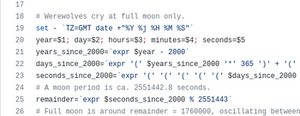
Finally, Bernhard M. Wiedemann noticed that the GNU Helloworld project varies depending on whether it is being built during a full moon! (Reddit announcement, openSUSE bug report)

Events There will be an in-person Debian Reunion in Hamburg, Germany later this year, taking place from 23 30 May. Although this is a Debian event, there will be some folks from the broader Reproducible Builds community and, of course, everyone is welcome. Please see the event page on the Debian wiki for more information. Bernhard M. Wiedemann posted to our mailing list about a meetup for Reproducible Builds folks at the openSUSE conference in Nuremberg, Germany. It was also recently announced that DebConf22 will take place this year as an in-person conference in Prizren, Kosovo. The pre-conference meeting (or Debcamp ) will take place from 10 16 July, and the main talks, workshops, etc. will take place from 17 24 July.

Misc news Holger Levsen updated the Reproducible Builds website to improve the documentation for the SOURCE_DATE_EPOCH environment variable, both by expanding parts of the existing text [ ][ ] as well as clarifying meaning by removing text in other places [ ]. In addition, Chris Lamb added a Twitter Card to our website s metadata too [ ][ ][ ]. On our mailing list this month:

Distribution work In Debian this month:
  • Johannes Schauer Marin Rodrigues posted to the debian-devel list mentioning that he exploited the property of reproducibility within Debian to demonstrate that automatically converting a large number of packages to a new internal source version did not change the resulting packages. The proposed change could therefore be applied without causing breakage:
So now we have 364 source packages for which we have a patch and for which we can show that this patch does not change the build output. Do you agree that with those two properties, the advantages of the 3.0 (quilt) format are sufficient such that the change shall be implemented at least for those 364? [ ]
In openSUSE, Bernhard M. Wiedemann posted his usual monthly reproducible builds status report.

Tooling diffoscope is our in-depth and content-aware diff utility. Not only can it locate and diagnose reproducibility issues, it can provide human-readable diffs from many kinds of binary formats. This month, Chris Lamb prepared and uploaded versions 207, 208 and 209 to Debian unstable, as well as made the following changes to the code itself:
  • Update minimum version of Black to prevent test failure on Ubuntu jammy. [ ]
  • Updated the R test fixture for the 4.2.x series of the R programming language. [ ]
Brent Spillner also worked on adding graceful handling for UNIX sockets and named pipes to diffoscope. [ ][ ][ ]. Vagrant Cascadian also updated the diffoscope package in GNU Guix. [ ][ ] reprotest is the Reproducible Build s project end-user tool to build the same source code twice in widely different environments and checking whether the binaries produced by the builds have any differences. This month, Santiago Ruano Rinc n added a new --append-build-command option [ ], which was subsequently uploaded to Debian unstable by Holger Levsen.

Upstream patches The Reproducible Builds project detects, dissects and attempts to fix as many currently-unreproducible packages as possible. We endeavour to send all of our patches upstream where appropriate. This month, we wrote a large number of such patches, including:

Testing framework The Reproducible Builds project runs a significant testing framework at tests.reproducible-builds.org, to check packages and other artifacts for reproducibility. This month, the following changes were made:
  • Holger Levsen:
    • Replace a local copy of the dsa-check-running-kernel script with a packaged version. [ ]
    • Don t hide the status of offline hosts in the Jenkins shell monitor. [ ]
    • Detect undefined service problems in the node health check. [ ]
    • Update the sources.lst file for our mail server as its still running Debian buster. [ ]
    • Add our mail server to our node inventory so it is included in the Jenkins maintenance processes. [ ]
    • Remove the debsecan package everywhere; it got installed accidentally via the Recommends relation. [ ]
    • Document the usage of the osuosl174 host. [ ]
Regular node maintenance was also performed by Holger Levsen [ ], Vagrant Cascadian [ ][ ][ ] and Mattia Rizzolo.
If you are interested in contributing to the Reproducible Builds project, please visit our Contribute page on our website. However, you can get in touch with us via:

5 April 2022

Matthew Garrett: Bearer tokens are just awful

As I mentioned last time, bearer tokens are not super compatible with a model in which every access is verified to ensure it's coming from a trusted device. Let's talk about that in a bit more detail.

First off, what is a bearer token? In its simplest form, it's simply an opaque blob that you give to a user after an authentication or authorisation challenge, and then they show it to you to prove that they should be allowed access to a resource. In theory you could just hand someone a randomly generated blob, but then you'd need to keep track of which blobs you've issued and when they should be expired and who they correspond to, so frequently this is actually done using JWTs which contain some base64 encoded JSON that describes the user and group membership and so on and then have a signature associated with them so whenever the user presents one you can just validate the signature and then assume that the contents of the JSON are trustworthy.

One thing to note here is that the crypto is purely between whoever issued the token and whoever validates the token - as far as the server is concerned, any client who can just show it the token is just fine as long as the signature is verified. There's no way to verify the client's state, so one of the core ideas of Zero Trust (that we verify that the client is in a trustworthy state on every access) is already violated.

Can we make things not terrible? Sure! We may not be able to validate the client state on every access, but we can validate the client state when we issue the token in the first place. When the user hits a login page, we do state validation according to whatever policy we want to enforce, and if the client violates that policy we refuse to issue a token to it. If the token has a sufficiently short lifetime then an attacker is only going to have a short period of time to use that token before it expires and then (with luck) they won't be able to get a new one because the state validation will fail.

Except! This is fine for cases where we control the issuance flow. What if we have a scenario where a third party authenticates the client (by verifying that they have a valid token issued by their ID provider) and then uses that to issue their own token that's much longer lived? Well, now the client has a long-lived token sitting on it. And if anyone copies that token to another device, they can now pretend to be that client.

This is, sadly, depressingly common. A lot of services will verify the user, and then issue an oauth token that'll expire some time around the heat death of the universe. If a client system is compromised and an attacker just copies that token to another system, they can continue to pretend to be the legitimate user until someone notices (which, depending on whether or not the service in question has any sort of audit logs, and whether you're paying any attention to them, may be once screenshots of your data show up on Twitter).

This is a problem! There's no way to fit a hosted service that behaves this way into a Zero Trust model - the best you can say is that a token was issued to a device that was, around that time, apparently trustworthy, and now it's some time later and you have literally no idea whether the device is still trustworthy or if the token is still even on that device.

But wait, there's more! Even if you're nowhere near doing any sort of Zero Trust stuff, imagine the case of a user having a bunch of tokens from multiple services on their laptop, and then they leave their laptop unlocked in a cafe while they head to the toilet and whoops it's not there any more, better assume that someone has access to all the data on there. How many services has our opportunistic new laptop owner gained access to as a result? How do we revoke all of the tokens that are sitting there on the local disk? Do you even have a policy for dealing with that?

There isn't a simple answer to all of these problems. Replacing bearer tokens with some sort of asymmetric cryptographic challenge to the client would at least let us tie the tokens to a TPM or other secure enclave, and then we wouldn't have to worry about them being copied elsewhere. But that wouldn't help us if the client is compromised and the attacker simply keeps using the compromised client. The entire model of simply proving knowledge of a secret being sufficient to gain access to a resource is inherently incompatible with a desire for fine-grained trust verification on every access, but I don't see anything changing until we have a standard for third party services to be able to perform that trust verification against a customer's policy.

Still, at least this means I can just run weird Android IoT apps through mitmproxy, pull the bearer token out of the request headers and then start poking the remote API with curl. It may all be broken, but it's also got me a bunch of bug bounty credit, so, it;s impossible to say if its bad or not,

(Addendum: this suggestion that we solve the hardware binding problem by simply passing all the network traffic through some sort of local enclave that could see tokens being set and would then sequester them and reinject them into later requests is OBVIOUSLY HORRIFYING and is also probably going to be at least three startup pitches by the end of next week)

comment count unavailable comments

Kees Cook: security things in Linux v5.10

Previously: v5.9 Linux v5.10 was released in December, 2020. Here s my summary of various security things that I found interesting: AMD SEV-ES
While guest VM memory encryption with AMD SEV has been supported for a while, Joerg Roedel, Thomas Lendacky, and others added register state encryption (SEV-ES). This means it s even harder for a VM host to reconstruct a guest VM s state. x86 static calls
Josh Poimboeuf and Peter Zijlstra implemented static calls for x86, which operates very similarly to the static branch infrastructure in the kernel. With static branches, an if/else choice can be hard-coded, instead of being run-time evaluated every time. Such branches can be updated too (the kernel just rewrites the code to switch around the branch ). All these principles apply to static calls as well, but they re for replacing indirect function calls (i.e. a call through a function pointer) with a direct call (i.e. a hard-coded call address). This eliminates the need for Spectre mitigations (e.g. RETPOLINE) for these indirect calls, and avoids a memory lookup for the pointer. For hot-path code (like the scheduler), this has a measurable performance impact. It also serves as a kind of Control Flow Integrity implementation: an indirect call got removed, and the potential destinations have been explicitly identified at compile-time. network RNG improvements
In an effort to improve the pseudo-random number generator used by the network subsystem (for things like port numbers and packet sequence numbers), Linux s home-grown pRNG has been replaced by the SipHash round function, and perturbed by (hopefully) hard-to-predict internal kernel states. This should make it very hard to brute force the internal state of the pRNG and make predictions about future random numbers just from examining network traffic. Similarly, ICMP s global rate limiter was adjusted to avoid leaking details of network state, as a start to fixing recent DNS Cache Poisoning attacks. SafeSetID handles GID
Thomas Cedeno improved the SafeSetID LSM to handle group IDs (which required teaching the kernel about which syscalls were actually performing setgid.) Like the earlier setuid policy, this lets the system owner define an explicit list of allowed group ID transitions under CAP_SETGID (instead of to just any group), providing a way to keep the power of granting this capability much more limited. (This isn t complete yet, though, since handling setgroups() is still needed.) improve kernel s internal checking of file contents
The kernel provides LSMs (like the Integrity subsystem) with details about files as they re loaded. (For example, loading modules, new kernel images for kexec, and firmware.) There wasn t very good coverage for cases where the contents were coming from things that weren t files. To deal with this, new hooks were added that allow the LSMs to introspect the contents directly, and to do partial reads. This will give the LSMs much finer grain visibility into these kinds of operations. set_fs removal continues
With the earlier work landed to free the core kernel code from set_fs(), Christoph Hellwig made it possible for set_fs() to be optional for an architecture. Subsequently, he then removed set_fs() entirely for x86, riscv, and powerpc. These architectures will now be free from the entire class of kernel address limit attacks that only needed to corrupt a single value in struct thead_info. sysfs_emit() replaces sprintf() in /sys
Joe Perches tackled one of the most common bug classes with sprintf() and snprintf() in /sys handlers by creating a new helper, sysfs_emit(). This will handle the cases where kernel code was not correctly dealing with the length results from sprintf() calls, which might lead to buffer overflows in the PAGE_SIZE buffer that /sys handlers operate on. With the helper in place, it was possible to start the refactoring of the many sprintf() callers. nosymfollow mount option
Mattias Nissler and Ross Zwisler implemented the nosymfollow mount option. This entirely disables symlink resolution for the given filesystem, similar to other mount options where noexec disallows execve(), nosuid disallows setid bits, and nodev disallows device files. Quoting the patch, it is useful as a defensive measure for systems that need to deal with untrusted file systems in privileged contexts. (i.e. for when /proc/sys/fs/protected_symlinks isn t a big enough hammer.) Chrome OS uses this option for its stateful filesystem, as symlink traversal as been a common attack-persistence vector. ARMv8.5 Memory Tagging Extension support
Vincenzo Frascino added support to arm64 for the coming Memory Tagging Extension, which will be available for ARMv8.5 and later chips. It provides 4 bits of tags (covering multiples of 16 byte spans of the address space). This is enough to deterministically eliminate all linear heap buffer overflow flaws (1 tag for free , and then rotate even values and odd values for neighboring allocations), which is probably one of the most common bugs being currently exploited. It also makes use-after-free and over/under indexing much more difficult for attackers (but still possible if the target s tag bits can be exposed). Maybe some day we can switch to 128 bit virtual memory addresses and have fully versioned allocations. But for now, 16 tag values is better than none, though we do still need to wait for anyone to actually be shipping ARMv8.5 hardware. fixes for flaws found by UBSAN
The work to make UBSAN generally usable under syzkaller continues to bear fruit, with various fixes all over the kernel for stuff like shift-out-of-bounds, divide-by-zero, and integer overflow. Seeing these kinds of patches land reinforces the the rationale of shifting the burden of these kinds of checks to the toolchain: these run-time bugs continue to pop up. flexible array conversions
The work on flexible array conversions continues. Gustavo A. R. Silva and others continued to grind on the conversions, getting the kernel ever closer to being able to enable the -Warray-bounds compiler flag and clear the path for saner bounds checking of array indexes and memcpy() usage. That s it for now! Please let me know if you think anything else needs some attention. Next up is Linux v5.11.

2022, Kees Cook. This work is licensed under a Creative Commons Attribution-ShareAlike 4.0 License.
CC BY-SA 4.0

2 April 2022

Ian Jackson: Otter (game server) 1.0.0 released

I have just released Otter 1.0.0. Recap: what is Otter Otter is my game server for arbitrary board games. Unlike most online game systems. It does not know (nor does it need to know) the rules of the game you are playing. Instead, it lets you and your friends play with common tabletop/boardgame elements such as hands of cards, boards, and so on. So it s something like a tabletop simulator (but it does not have any 3D, or a physics engine, or anything like that). There are provided game materials and templates for Penultima, Mao, and card games in general. Otter also supports uploadable game bundles, which allows users to add support for additional games - and this can be done without programming. For more information, see the online documentation. There are a longer intro and some screenshots in my 2021 introductory blog post about Otter Releasing 1.0.0 I m calling this release 1.0.0 because I think I can now say that its quality, reliability and stability is suitable for general use. In particular, Otter now builds on Stable Rust, which makes it a lot easier to install and maintain. Switching web framework, and async Rust I switched Otter from the Rocket web framework to Actix. There are things to prefer about both systems, and I still have a soft spot for Rocket. But ultimately I needed a framework which was fully released and supported for use with Stable Rust. There are few if any Rust web frameworks that are not async. This is rather a shame. Async Rust is a considerably more awkward programming environment than ordinary non-async Rust. I don t want to digress into a litany of complaints, but suffice it to say that while I really love Rust, my views on async Rust are considerably more mixed. Future plans In the near future I plan to add a couple of features to better support some particular games: currency-like resources, and a better UI for dice-like randomness. In the longer term, Otter s, installation and account management arrangements are rather unsophisticated and un-webby. There is not currently any publicly available instance for you to try it out without installing it on a machine of your own. There s not even any provided binaries: you must built Otter yourself. I hope to be able to improve this situation but it involves dealing with cloud CI and containers and so-on, which can all be rather unpleasant. Users on chiark will find an instance of Otter there.

comment count unavailable comments

1 April 2022

Antoine Beaupr : Salvaged my first Debian package

I finally salvaged my first Debian package, python-invoke. As part of ITS 964718, I moved the package from the Openstack Team to the Python team. The Python team might not be super happy with it, because it's breaking some of its rules, but at least someone (ie. me) is actively working (and using) the package.

Wait what People not familiar with Debian will not understand anything in that first paragraph, so let me expand. Know-it-all Debian developers (you know who you are) can skip to the next section. Traditionally, the Debian project (my Linux-based operating system of choice) has prided itself on the self-managed, anarchistic organisation of its packaging. Each package maintainer is the lord of their little kingdom. Some maintainers like to accumulate lots of kingdoms to rule over. (Yes, it really doesn't sound like anarchism when you put it like that. Yes, it's complicated: there's a constitution and voting involved. And yes, we're old.) Therefore, it's really hard to make package maintainers do something they don't want. Typically, when things go south, someone makes a complaint to the Debian Technical Committee (CTTE) which is established by the Debian constitution to resolve such conflicts. The committee is appointed by the Debian Project leader, elected each year (and there's an election coming up if you haven't heard). Typically, the CTTE will then vote and formulate a decision. But here's the trick: maintainers are still free to do whatever they want after that, in a sense. It's not like the CTTE can just break down doors and force maintainers to type code. (I won't go into the details of the why of that, but it involves legal issues and, I think, something about the Turing halting problem. Or something like that.) Anyways. The point is all that is super heavy and no one wants to go there... (Know-it-all Debian developers, I know you are still reading this anyways and disagree with that statement, but please, please, make it true.) ... but sometimes, packages just get lost. Maintainers get distracted, or busy with something else. It's not that they want to abandon their packages. They love their little fiefdoms. It's just there was a famine or a war or something and everyone died, and they have better things to do than put up fences or whatever. So clever people in Debian found a better way of handling such problems than waging war in the poor old CTTE's backyard. It's called the Package Salvaging process. Through that process, a maintainer can propose to take over an existing package from another maintainer, if a certain set of condition are met and a specific process is followed. Normally, taking over another maintainer's package is basically a war declaration, rarely seen in the history of Debian (yes, I do think it happened!), as rowdy as ours is. But through this process, it seems we have found a fair way of going forward. The process is basically like this:
  1. file a bug proposing the change
  2. wait three weeks
  3. upload a package making the change, with another week delay
  4. you now have one more package to worry about
Easy right? It actually is! Process! It's magic! It will cure your babies and resurrect your cat!

So how did that go? It went well! The old maintainer was actually fine with the change because his team wasn't using the package anymore anyways. He asked to be kept as an uploader, which I was glad to oblige. (He replied a few months after the deadline, but I wasn't in a rush anyways, so that doesn't matter. It was polite for him to answer, even if, technically, I was already allowed to take it over.) What happened next is less shiny for me though. I totally forgot about the ITS, even after the maintainer reminded me of its existence. See, the thing is the ITS doesn't show up on my dashboard at all. So I totally forgot about it (yes, twice). In fact, the only reason I remembered it was that got into the process of formulating another ITS (1008753, trocla) and I was trying to figure out how to write the email. Then I remembered: "hey wait, I think I did this before!" followed by "oops, yes, I totally did this before and forgot for 9 months". So, not great. Also, the package is still not in a perfect shape. I was able to upload the upstream version that was pending 1.5.0 to clear out the ITS, basically. And then there's already two new upstream releases to upload, so I pushed 1.7.0 to experimental as well, for good measure. Unfortunately, I still can't enable tests because everything is on fire, as usual. But at least my kingdom is growing.

Appendix Just in case someone didn't notice the hyperbole, I'm not a monarchist promoting feudalism as a practice to manage a community. I do not intend to really "grow my kingdom" and I think the culture around "property" of "packages" is kind of absurd in Debian. I kind of wish it would go away. (Update: It has also been pointed out that I might have made Debian seem more confrontational than it actually is. And it's kind of true: most work and interactions in Debian actually go fine, it's only a minority of issues that degenerate into conflicts. It's just that they tend to take up a lot of space in the community, and I find that particularly draining. And I think think our "package ownership" culture is part of at least some of those problems.) Team maintenance, the LowNMU process, and low threshold adoption processes are all steps in the good direction, but they are all opt in. At least the package salvaging process is someone a little more ... uh... coercive? Or at least it allows the community to step in and do the right thing, in a sense. We'll see what happens with the coming wars around the recent tech committee decision, which are bound to touch on that topic. (Hint: our next drama is called "usrmerge".) Hopefully, LWN will make a brilliant article to sum it up for us so that I don't have to go through the inevitable debian-devel flamewar to figure it out. I already wrecked havoc on the #debian-devel IRC channel asking newbie questions so I won't stir that mud any further for now. (Update: LWN, of course, did make an article about usrmerge in Debian. I will read it soon and can then tell you know if it's brilliant, but they are typically spot on.)

Paul Wise: FLOSS Activities March 2022

Focus This month I didn't have any particular focus. I just worked on issues in my info bubble.

Changes

Issues

Review
  • Spam: reported 3 Debian bug reports and 53 Debian mailing list posts
  • Debian wiki: RecentChanges for the month
  • Debian BTS usertags: changes for the month
  • Debian screenshots:

Administration
  • Debian servers: investigate wiki mail delivery issue, restart backup director
  • Debian wiki: unblock IP addresses, approve accounts

Communication
  • Forward python-plac test failure issue upstream
  • Participate in Debian Project Leader election discussions
  • Respond to queries from Debian users and contributors on the mailing lists and IRC

Sponsors The oci-python-sdk and plac work was sponsored. All other work was done on a volunteer basis.

28 March 2022

Russell Coker: Feedburner Seems to be Dying

Many years ago Feedburner was a useful service. It proxied the RSS feed of your blog and gave you analytics of what happened with it. Now feeds using Feedburner randomly give HTTP error 404s. The Feedburner Twitter account is inactive and recommends that people Tweet at Google instead. It seems that Google wants to get rid of the service and random 404s probably aren t a high priority for them. I ve just gone through the config for Planet Linux Australia [1] and changed as many Feedburner URLs as possible to direct feed URLs. I did this by loading the Feedburner feed, getting the URL for the site, and then guessing the feed URL (usually just appending /feed to the domain name). I recommend that everyone abandon Feedburner, it s not reliable enough to use and doesn t seem to have any active support.

Russell Coker: Hangouts Replacement

Google is currently in the process of killing Hangouts. Last year Hangouts was quite a nice IM system with integrated video chat and voice calling. Now they have decided to kill it and replace it with Google Chat and Google Meet both of which are integrated with the Gmail app on Android. To start getting people off the old platform they have disabled video and audio chats with more than 2 people in Hangouts. To do a video call you have to use Meet which has a worse user interface and isn t integrated with text chat, so if in a text discussion someone says let s have a video call you have to open a new app. Meet also doesn t appear to have a facility to notify group members that someone has joined a group call so it s required that Chat (or something else) is used to tell people they can join Meet. Many of my relatives use Hangouts because they are forced to have it installed on their Android phones and because it worked quite well. Now it doesn t work well and will soon be going away. So another option is needed. I m considering Matrix as a replacement. Matrix has a good feature set and is being worked on a lot. The video conferencing is through a connection to a Jitsi server and is well integrated giving functionality more like Hangouts than Chat/Meet. For the LUV Matrix server the URL https://luv.asn.au/.well-known/matrix/client has the following contents:
 
  "m.homeserver":  
    "base_url": "https://luv.asn.au"
   
  "jitsi":  
    "preferredDomain": "jitsi.perthchat.org"
   
  "im.vector.riot.jitsi":  
    "preferredDomain": "jitsi.perthchat.org"
   
 
This specifies the Jitsi server to be used for chats started from that Matrix server. The PerthChat.org people seem to be leading the way for self hosted Matrix in Australia. Note that other people shouldn t link to their Jitsi server without discussing it with them first. I only included real data because it s published on the web so there s no point in keeping it secret. The Flounder free software users group [1] uses Matrix a lot. We will probably discuss Matrix at the next meeting on Saturday. There is also Element Call [2] which is apparently more integrated with Matrix (and also newer and possibly buggier). Jitsi works and we can change to a different service easily enough at a later time.

27 March 2022

Russ Allbery: Review: A Song for a New Day

Review: A Song for a New Day, by Sarah Pinsker
Publisher: Berkley
Copyright: September 2019
ISBN: 1-9848-0259-3
Format: Kindle
Pages: 372
Luce Cannon was touring with a session band when the shutdown began. First came the hotel evacuation in the middle of the night due to bomb threats against every hotel in the state. Then came the stadium bombing just before they were ready to go on stage. Luce and most of the band performed anyway, with a volunteer crew and a shaken crowd. It was, people later decided, the last large stage show in the United States before the congregation laws shut down public gatherings. That was the end of Luce's expected career, and could have been the end of music, or at least public music. But Luce was stubborn and needed the music. Rosemary grew up in the aftermath: living at home with her parents well away from other people, attending school virtually, and then moving seamlessly into a virtual job for Superwally, the corporation that ran essentially everything. A good fix for some last-minute technical problems with StageHoloLive's ticketing system got her an upgraded VR hoodie and complimentary tickets to the first virtual concert she'd ever attended. She found the experience astonishing, prompting her to browse StageHoloLive job openings and then apply for a technical job and, on a whim, an artist recruiter role. That's how Rosemary found herself, quite nerve-wrackingly, traveling out into the unsafe world to look for underground musicians who could become StageHoloLive acts. A Song for a New Day was published in 2019 and had a moment of fame at the beginning of 2020, culminating in the Nebula Award for best novel, because it's about lockdowns, isolation, and the suppression of public performances. There's even a pandemic, although it's not a respiratory disease (it's some variety of smallpox or chicken pox) and is only a minor contributing factor to the lockdowns in this book. The primary impetus is random violence. Unfortunately, the subsequent two years have not been kind to this novel. Reading it in 2022, with the experience of the past two years fresh in my mind, was a frustrating and exasperating experience because the world setting is completely unbelievable. This is not entirely Pinsker's fault; this book was published in 2019, was not intended to be about our pandemic, and therefore could not reasonably predict its consequences. Still, it required significant effort to extract the premise of the book from the contradictory evidence of current affairs and salvage the pieces of it I still enjoyed. First, Pinsker's characters are the most astonishingly incurious and docile group of people I've seen in a recent political SF novel. This extends beyond the protagonists, where it could arguably be part of their characterization, to encompass the entire world (or at least the United States; the rest of the world does not appear in this book at all so far as I can recall). You may be wondering why someone bombs a stadium at the start of the book. If so, you are alone; this is not something anyone else sees any reason to be curious about. Why is random violence spiraling out of control? Is there some coordinated terrorist activity? Is there some social condition that has gotten markedly worse? Race riots? Climate crises? Wars? The only answer this book offers is a completely apathetic shrug. There is a hint at one point that the government may have theories that they're not communicating, but no one cares about that either. That leads to the second bizarre gap: for a book that hinges on political action, formal political structures are weirdly absent. Near the end of the book, one random person says that they have been inspired to run for office, which so far as I can tell is the first mention of elections in the entire book. The "government" passes congregation laws shutting down public gatherings and there are no protests, no arguments, no debate, but also no suppression, no laws against the press or free speech, no attempt to stop that debate. There's no attempt to build consensus for or against the laws, and no noticeable political campaigning. That's because there's no need. So far as one can tell from this story, literally everyone just shrugs and feels sad and vaguely compliant. Police officers exist and enforce laws, but changing those laws or defying them in other than tiny covert ways simply never occurs to anyone. This makes the book read a bit like a fatuous libertarian parody of a docile populace, but this is so obviously not the author's intent that it wouldn't be satisfying to read even as that. To be clear, this is not something that lasts only a few months in an emergency when everyone is still scared. This complete political docility and total incuriosity persists for enough years that Rosemary grows up within that mindset. The triggering event was a stadium bombing followed by an escalating series of random shootings and bombings. (The pandemic in the book only happens after everything is locked down and, apart from adding to Rosemary's agoraphobia and making people inconsistently obsessed with surface cleanliness, plays little role in the novel.) I lived through 9/11 and the Oklahoma City bombing in the US, other countries have been through more protracted and personally dangerous periods of violence (the Troubles come to mind), and never in human history has any country reacted to a shock of violence (or, for that matter, disease) like the US does in this book. At points it felt like one of those SF novels where the author is telling an apparently normal story and all the characters turn out to be aliens based on spiders or bats. I finally made sense of this by deciding that the author wasn't using sudden shocks like terrorism or pandemics as a model, even though that's what the book postulates. Instead, the model seems to be something implicitly tolerated and worked around: US school shootings, for instance, or the (incorrect but widespread) US belief in a rise of child kidnappings by strangers. The societal reaction here looks less like a public health or counter-terrorism response and more like suburban attitudes towards child-raising, where no child is ever left unattended for safety reasons but we routinely have school shootings no other country has at the same scale. We have been willing to radically (and ineffectually) alter the experience of childhood due to fears of external threat, and that's vaguely and superficially similar to the premise of this novel. What I think Pinsker still misses (and which the pandemic has made glaringly obvious) is the immense momentum of normality and the inability of adults to accept limitations on their own activities for very long. Even with school shootings, kids go to school in person. We now know that parts of society essentially collapse if they don't, and political pressure becomes intolerable. But by using school shootings as the model, I managed to view Pinsker's setup as an unrealistic but still potentially interesting SF extrapolation: a thought experiment that ignores countervailing pressures in order to exaggerate one aspect of society to an extreme. This is half of Pinsker's setup. The other half, which made less of a splash because it didn't have the same accident of timing, is the company Superwally: essentially "what if Amazon bought Walmart, Google, Facebook, Netflix, Disney, and Live Nation." This is a more typical SF extrapolation that left me with a few grumbles about realism, but that I'll accept as a plot device to talk about commercialization, monopolies, and surveillance capitalism. But here again, the complete absence of formal political structures in this book is not credible. Superwally achieves an all-pervasiveness that in other SF novels results in corporations taking over the role of national governments, but it still lobbies the government in much the same way and with about the same effectiveness as Amazon does in our world. I thought this directly undermined some parts of the end of the book. I simply did not believe that Superwally would be as benign and ineffectual as it is shown here. Those are a lot of complaints. I found reading the first half of this book to be an utterly miserable experience and only continued reading out of pure stubbornness and completionism. But the combination of the above-mentioned perspective shift and Pinsker's character focus did partly salvage the book for me. This is not a book about practical political change, even though it makes gestures in that direction. It's primarily a book about people, music, and personal connection, and Pinsker's portrayal of individual and community trust in all its complexity is the one thing the book gets right. Rosemary's character combines a sort of naive arrogance with self-justification in a way that I found very off-putting, but the pivot point of the book is the way in which Luce and her community extends trust to her anyway, as part of staying true to what they believe. The problem that I think Pinsker was trying to write about is atomization, which leads to social fragmentation into small trust networks with vast gulfs between them. Luce and Rosemary are both characters who are willing to bridge those gulfs in their own ways. Pinsker does an excellent job describing the benefits, the hurt, the misunderstandings, the risk, and the awkward process of building those bridges between communities that fundamentally do not understand each other. There's something deep here about the nature of solidarity, and how you need both people like Luce and people like Rosemary to build strong and effective communities. I've kept thinking about that part. It's also helpful for a community to have people who are curious about cause and effect, and who know how a bill becomes a law. It's hard to sum up this book, other than to say that I understand why it won a Nebula but it has deep world-building flaws that have become far more obvious over the past two years. Pinsker tries hard to capture the feeling of live music for both the listener and the performer and partly succeeded even for me, which probably means others will enjoy that part of the book immensely. The portrayal of the difficult dynamics of personal trust was the best part of the book for me, but you may have to build scaffolding and bracing for your world-building disbelief in order to get there. On the whole, I think A Song for a New Day is worth reading, but maybe not right now. If you do read it now, tell yourself at the start that this is absolutely not about the pandemic and that everything political in this book is a hugely simplified straw-man extrapolation, and hopefully you'll find the experience less frustrating than I found it. Rating: 6 out of 10

24 March 2022

Ingo Juergensmann: New Server NVMe Issues

My current server is somewhat aged. I bought it new in July 2014 with a 6-core Xeon E5-2630L, 32 GB RAM and 4x 3.5 hot-swappable drives. Gladly I had the opportunity to extend the memory to 128 GB RAM at no additional cost by using memory from my ex-employer. It also has 4x 2 TB WD Red HDDs with 5400 rpm hooked up to the SATA backplane, but unfortunately only two of them are SATA-3 with 6 Gbit/s. The new server is a used/refurbished Supermicro server with 2x 14-core Xeon E5-2683 and 256 GB RAM and 4x 3.5 hot-swappable drives. It also came with a Hardware-RAID SAS/SATA 8-port controller with BBU. I also ordered two slim drive kits (MCP-220-81504-0N & MCP-220-81506-0N) to be able to use 2x 3.5 slots for rotational HDDs as a cheap storage. Right now I added 2x 128 GB Supermicro SATA DOMs, 4x WD Red 4 TB SSDs and a Sonnet Fusion 4 4 Silent and 4x 1 TB Seagate Firecuda 520 NVMe disks. And here the issue starts: The NVMe should be capable of 4-5 GB/s, but they are connected to a PCIe 3.0 x16 port via the Sonnet Fusion 4 4, which itself features a PCIe bridge, so bifurbacation is not necessary. When doing some tests with bonnie++ I get around 1 GB/s transfer rates out of a RAID10 setup with all 4 NVMes. In fact, regardless of the RAID level there are only transfer rates of about 1 1.2 GB/s with bonnie++. (All software RAIDs with mdadm.) But also when constructing a RAID each NVMe gives around 300-600 MB/s in sync speed except for one exception: RAID1. Regardless of how many NVMe disks in a RAID1 setup the sync speed is up to 2.5 GB/s for each of the NVMe disks. So the lower transfer rates with bonnie++ or other RAID levels shouldn t be limited by bus speed nor by CPU speed. Alas, atop shows upto 100% CPU usage for all tests. I even tested In my understanding RAID10 should perform similar to RAID1 in terms of syncing and better and while bonnie++ tests (up to 2x write and 4x read speed compared to a single disk). For the bonnie++ tests I even made some tests that are available here. You can find the test parameters listed in the hostname column: Baldur is the hostname, then followed by the layout (near-2, far-2, offset-2), chunk size and concurrency of bonnie++. In the end there was no big impact of the chunk size of the RAID. So, now I m wondering what the reason for the slow performance of those 4x NVMe disks is? Bus speed of the PCIe 3.0 x16 shouldn t be the cause, because I assume that the software RAID will need to transfer the blocks in RAID1 as well as in RAID10 over the bus. Same goes for the CPU: the amount of CPU work should be roughly the same for RAID1 and for RAID10. RAID10 should even have an advantage because the blocks only need to be synced to 2 disks in a stripe set. Bonnie++ tests are a different topic for sure. But when testing reading with dd from the md-devices I only get around 1-1.5 GB/s as well. Even when using LVM RAID instead of LVM on top of md RAID. All NVMe disks are already set to 4k and IO scheduler is set to mq-deadline. Is there anything I could do to improve the performance of the NVMe disks? On the other head, pure transfer rates are not that important to a server that runs a dozen of VMs. Here the improved IOPS performance over rotation disks is a clear performance gain. But I m still curious if I could get maybe 2 GB/s out of a RAID10 setup with the NVMe disks. Then again having two independent RAID1 setups for MariaDB and for PostgreSQL databases might be a better choice over a single RAID10 setup?

17 March 2022

Raphaël Hertzog: Freexian s report about Debian Long Term Support, February 2022

A Debian LTS logo
Every month we review the work funded by Freexian s Debian LTS offering. Please find the report for February below. Debian project funding
  • In February Rapha l and the LTS worked on a survey of Debian developers meant to solicit ideas for improvements in the Debian project at large. You can see the results of the initial discussion here in the list of ideas of which there are already over 30.
  • The full survey is due to be emailed to Debian Developers shortly.
  • In February 2250 was put aside to fund Debian projects.
Debian LTS contributors In February, 12 contributors were paid to work on Debian LTS, their reports are available below. If you re interested in participating in the LTS or ELTS teams, we welcome participation from the Debian community. Simply get in touch with Jeremiah or Rapha l if you are if you are interested in participating. Evolution of the situation In February we released 24 DLAs. The security tracker currently lists 61 packages with a known CVE and the dla-needed.txt file has 26 packages needing an update. You can find out more about the Debian LTS project via the following video:
Thanks to our sponsors Sponsors that joined recently are in bold.

16 March 2022

Michael Ablassmeier: python logging messages and exit codes

Everyone knows that an application exit code should change based on the success, error or maybe warnings that happened during execution. Lately i came along some python code that was structured the following way:
#!/usr/bin/python3
import sys
import logging
def warnme():
    # something bad happens
    logging.warning("warning")
    sys.exit(2)
def evil():
    # something evil happens
    logging.error("error")
    sys.exit(1)
def main():
    logging.basicConfig(
        level=logging.DEBUG,
    )   
    [..]
the situation was a little bit more complicated, some functions in other modules also exited the application, so sys.exit() calls were distributed in lots of modules an files. Exiting the application in some random function of another module is something i dont consider nice coding style, because it makes it hard to track down errors. I expect:
  • exit code 0 on success
  • exit code 1 on errors
  • exit code 2 on warnings
  • warnings or errors shall be logged in the function where they actually happen: the logging module will show the function name with a better format option: nice for debugging.
  • one function that exits accordingly, preferrably main()

How to do better? As the application is using the logging module, we have a single point to collect warnings and errors that might happen accross all modules. This works by passing a custom handler to the logging module which tracks emitted messages. Heres an small example:
#!/usr/bin/python3
import sys
import logging
class logCount(logging.Handler):
    class LogType:
        def __init__(self):
            self.warnings = 0
            self.errors = 0
    def __init__(self):
        super().__init__()
        self.count = self.LogType()
    def emit(self, record):
        if record.levelname == "WARNING":
            self.count.warnings += 1
        if record.levelname == "ERROR":
            self.count.errors += 1
            
def infome():
    logging.info("hello world")
def warnme():
    logging.warning("help, an warning")
def evil():
    logging.error("yikes")
def main():
    EXIT_WARNING = 2
    EXIT_ERROR = 1
    counter = logCount()
    logging.basicConfig(
        level=logging.DEBUG,
        handlers=[counter, logging.StreamHandler(sys.stderr)],
    )
    infome()
    warnme()
    evil()
    if counter.count.errors != 0:
        raise SystemExit(EXIT_ERROR)
    if counter.count.warnings != 0:
        raise SystemExit(EXIT_WARNING)
if __name__ == "__main__":
    main()
python3 count.py ; echo $?
INFO:root:hello world
WARNING:root:help, an warning
ERROR:root:yikes
1
This also makes easy to define something like:
  • hey, got 2 warnings, change exit code to error?
  • got 3 warnings, but no strict passed, ingore those, exit with success!
  • etc..

15 March 2022

Kunal Mehta: How to mirror the Russian Wikipedia with Debian and Kiwix

It has been reported that the Russian government has threatened to block access to Wikipedia for documenting narratives that do not agree with the official position of the Russian government. One of the anti-censorship strategies I've been working on is Kiwix, an offline Wikipedia reader (and plenty of other content too). Kiwix is free and open source software developed by a great community of people that I really enjoy working with. With threats of censorship, traffic to Kiwix has increased fifty-fold, with users from Russia accounting for 40% of new downloads! You can download copies of every language of Wikipedia for offline reading and distribution, as well as hosting your own read-only mirror, which I'm going to explain today. Disclaimer: depending on where you live it may be illegal or get you in trouble with the authorities to rehost Wikipedia content, please be aware of your digital and physical safety before proceeding. With that out of the way, let's get started. You'll need a Debian (or Ubuntu) server with at least 30GB of free disk space. You'll also want to have a webserver like Apache or nginx installed (I'll share the Apache config here). First, we need to download the latest copy of the Russian Wikipedia.
$ wget 'https://download.kiwix.org/zim/wikipedia/wikipedia_ru_all_maxi_2022-03.zim'
If the download is interrupted or fails, you can use wget -c $url to resume it. Next let's install kiwix-serve and try it out. If you're using Ubuntu, I strongly recommend enabling our Kiwix PPA first.
$ sudo apt update
$ sudo apt install kiwix-tools
$ kiwix-serve -p 3004 wikipedia_ru_all_maxi_2022-03.zim
At this point you should be able to visit http://yourserver.com:3004/ and see the Russian Wikipedia. Awesome! You can use any available port, I just picked 3004. Now let's use systemd to daemonize it so it runs in the background. Create /etc/systemd/system/kiwix-ru-wp.service with the following:
[Unit]
Description=Kiwix Russian Wikipedia
[Service]
Type=simple
User=www-data
ExecStart=/usr/bin/kiwix-serve -p 3004 /path/to/wikipedia_ru_all_maxi_2022-03.zim
Restart=always
[Install]
WantedBy=multi-user.target
Now let's start it and enable it at boot:
$ sudo systemctl start kiwix-ru-wp
$ sudo systemctl enable kiwix-ru-wp
Since we want to expose this on the public internet, we should put it behind a more established webserver and configure HTTPS. Here's the Apache httpd configuration I used:
<VirtualHost *:80>
        ServerName ru-wp.yourserver.com
        ServerAdmin webmaster@localhost
        DocumentRoot /var/www/html
        ErrorLog $ APACHE_LOG_DIR /error.log
        CustomLog $ APACHE_LOG_DIR /access.log combined
        <Proxy *>
                Require all granted
        </Proxy>
        ProxyPass / http://127.0.0.1:3004/
        ProxyPassReverse / http://127.0.0.1:3004/
</VirtualHost>
Put that in /etc/apache2/sites-available/kiwix-ru-wp.conf and run:
$ sudo a2ensite kiwix-ru-wp
$ sudo systemctl reload apache2
Finally, I used certbot to enable HTTPS on that subdomain and redirect all HTTP traffic over to HTTPS. This is an interactive process that is well documented so I'm not going to go into it in detail. You can see my mirror of the Russian Wikipedia, following these instructions, at https://ru-wp.legoktm.com/. Anyone is welcome to use it or distribute the link, though I am not committing to running it long-term. This is certainly not a perfect anti-censorship solution, the copy of Wikipedia that Kiwix provides became out of date the moment it was created, and the setup described here will require you to manually update the service when the new copy is available next month. Finally, if you have some extra bandwith, you can also help seed this as a torrent.

5 March 2022

Reproducible Builds: Reproducible Builds in February 2022

Welcome to the February 2022 report from the Reproducible Builds project. In these reports, we try to round-up the important things we and others have been up to over the past month. As ever, if you are interested in contributing to the project, please visit our Contribute page on our website.
Jiawen Xiong, Yong Shi, Boyuan Chen, Filipe R. Cogo and Zhen Ming Jiang have published a new paper titled Towards Build Verifiability for Java-based Systems (PDF). The abstract of the paper contains the following:
Various efforts towards build verifiability have been made to C/C++-based systems, yet the techniques for Java-based systems are not systematic and are often specific to a particular build tool (eg. Maven). In this study, we present a systematic approach towards build verifiability on Java-based systems.

GitBOM is a flexible scheme to track the source code used to generate build artifacts via Git-like unique identifiers. Although the project has been active for a while, the community around GitBOM has now started running weekly community meetings.
The paper Chris Lamb and Stefano Zacchiroli is now available in the March/April 2022 issue of IEEE Software. Titled Reproducible Builds: Increasing the Integrity of Software Supply Chains (PDF), the abstract of the paper contains the following:
We first define the problem, and then provide insight into the challenges of making real-world software build in a reproducible manner-this is, when every build generates bit-for-bit identical results. Through the experience of the Reproducible Builds project making the Debian Linux distribution reproducible, we also describe the affinity between reproducibility and quality assurance (QA).

In openSUSE, Bernhard M. Wiedemann posted his monthly reproducible builds status report.
On our mailing list this month, Thomas Schmitt started a thread around the SOURCE_DATE_EPOCH specification related to formats that cannot help embedding potentially timezone-specific timestamp. (Full thread index.)
The Yocto Project is pleased to report that it s core metadata (OpenEmbedded-Core) is now reproducible for all recipes (100% coverage) after issues with newer languages such as Golang were resolved. This was announced in their recent Year in Review publication. It is of particular interest for security updates so that systems can have specific components updated but reducing the risk of other unintended changes and making the sections of the system changing very clear for audit. The project is now also making heavy use of equivalence of build output to determine whether further items in builds need to be rebuilt or whether cached previously built items can be used. As mentioned in the article above, there are now public servers sharing this equivalence information. Reproducibility is key in making this possible and effective to reduce build times/costs/resource usage.

diffoscope diffoscope is our in-depth and content-aware diff utility. Not only can it locate and diagnose reproducibility issues, it can provide human-readable diffs from many kinds of binary formats. This month, Chris Lamb prepared and uploaded versions 203, 204, 205 and 206 to Debian unstable, as well as made the following changes to the code itself:
  • Bug fixes:
    • Fix a file(1)-related regression where Debian .changes files that contained non-ASCII text were not identified as such, therefore resulting in seemingly arbitrary packages not actually comparing the nested files themselves. The non-ASCII parts were typically in the Maintainer or in the changelog text. [ ][ ]
    • Fix a regression when comparing directories against non-directories. [ ][ ]
    • If we fail to scan using binwalk, return False from BinwalkFile.recognizes. [ ]
    • If we fail to import binwalk, don t report that we are missing the Python rpm module! [ ]
  • Testsuite improvements:
    • Add a test for recent file(1) issue regarding .changes files. [ ]
    • Use our assert_diff utility where we can within the test_directory.py set of tests. [ ]
    • Don t run our binwalk-related tests as root or fakeroot. The latest version of binwalk has some new security protection against this. [ ]
  • Codebase improvements:
    • Drop the _PATH suffix from module-level globals that are not paths. [ ]
    • Tidy some control flow in Difference._reverse_self. [ ]
    • Don t print a warning to the console regarding NT_GNU_BUILD_ID changes. [ ]
In addition, Mattia Rizzolo updated the Debian packaging to ensure that diffoscope and diffoscope-minimal packages have the same version. [ ]

Website updates There were quite a few changes to the Reproducible Builds website and documentation this month as well, including:
  • Chris Lamb:
    • Considerably rework the Who is involved? page. [ ][ ]
    • Move the contributors.sh Bash/shell script into a Python script. [ ][ ][ ]
  • Daniel Shahaf:
    • Try a different Markdown footnote content syntax to work around a rendering issue. [ ][ ][ ]
  • Holger Levsen:
    • Make a huge number of changes to the Who is involved? page, including pre-populating a large number of contributors who cannot be identified from the metadata of the website itself. [ ][ ][ ][ ][ ]
    • Improve linking to sponsors in sidebar navigation. [ ]
    • drop sponsors paragraph as the navigation is clearer now. [ ]
    • Add Mullvad VPN as a bronze-level sponsor . [ ][ ]
  • Vagrant Cascadian:

Upstream patches The Reproducible Builds project attempts to fix as many currently-unreproducible packages as possible. February s patches included the following:

Testing framework The Reproducible Builds project runs a significant testing framework at tests.reproducible-builds.org, to check packages and other artifacts for reproducibility. This month, the following changes were made:
  • Daniel Golle:
    • Update the OpenWrt configuration to not depend on the host LLVM, adding lines to the .config seed to build LLVM for eBPF from source. [ ]
    • Preserve more OpenWrt-related build artifacts. [ ]
  • Holger Levsen:
  • Temporary use a different Git tree when building OpenWrt as our tests had been broken since September 2020. This was reverted after the patch in question was accepted by Paul Spooren into the canonical openwrt.git repository the next day.
    • Various improvements to debugging OpenWrt reproducibility. [ ][ ][ ][ ][ ]
    • Ignore useradd warnings when building packages. [ ]
    • Update the script to powercycle armhf architecture nodes to add a hint to where nodes named virt-*. [ ]
    • Update the node health check to also fix failed logrotate and man-db services. [ ]
  • Mattia Rizzolo:
    • Update the website job after contributors.sh script was rewritten in Python. [ ]
    • Make sure to set the DIFFOSCOPE environment variable when available. [ ]
  • Vagrant Cascadian:
    • Various updates to the diffoscope timeouts. [ ][ ][ ]
Node maintenance was also performed by Holger Levsen [ ] and Vagrant Cascadian [ ].

Finally If you are interested in contributing to the Reproducible Builds project, please visit our Contribute page on our website. However, you can get in touch with us via:

3 March 2022

Joerg Jaspert: Scan for SSH private keys without passphrase

SSH private key scanner (keys without passphrase) So for policy reasons, customer wanted to ensure that every SSH private key in use by a human on their systems has a passphrase set. And asked us to make sure this is the case. There is no way in SSH to check this during connection, so client side needs to be looked at. Which means looking at actual files on the system. Turns out there are multiple formats for the private keys - and I really do not want to implement something able to deal with that on my own. OpenSSH to the rescue, it ships a little tool ssh-keygen, most commonly known for its ability to generate SSH keys. But it can do much more with keys. One action is interesting here for our case: The ability to print out the public key to a given private key. For a key that is unprotected, this will just work. A key with a passphrase instead leads to it asking you for one. So we have our way to check if a key is protected by a passphrase. Now we only need to find all possible keys (note, the requirement is not keys in .ssh/ , but all possible, so we need to scan for them. But we do not want to run ssh-keygen on just any file, we would like to do it when we are halfway sure, that it is actually a key. Well, turns out, even though SSH has multiple formats, they all appear to have the string PRIVATE KEY somewhere very early (usually first line). And they are tiny - even a 16384bit RSA key is just above 12000 bytes long. Lets find every file thats less then 13000 bytes and has the magic string in it, and throw it at ssh-keygen - if we get a public key back, flag it. Also, we supply a random (ohwell, hardcoded) passphrase, to avoid it prompting for any. Scanning the whole system, one will find quite a surprising number of unprotected SSH keys. Well, better description possibly Unprotected RSA private keys , so the output does need to be checked by a human. This, of course, can be done in shell, quite simple. So i wrote some Rust code instead, as I am still on my task to try and learn more of it. If you are interested, you can find sshprivscanner and play with it, patches/fixes/whatever welcome.

Enrico Zini: Migrating from procmail to sieve

Anarcat's "procmail considered harmful" post convinced me to get my act together and finally migrate my venerable procmail based setup to sieve. My setup was nontrivial, so I migrated with an intermediate step in which sieve scripts would by default pipe everything to procmail, which allowed me to slowly move rules from procmailrc to sieve until nothing remained in procmailrc. Here's what I did. Literature review https://brokkr.net/2019/10/31/lets-do-dovecot-slowly-and-properly-part-3-lmtp/ has a guide quite aligned with current Debian, and could be a starting point to get an idea of the work to do. https://wiki.dovecot.org/HowTo/PostfixDovecotLMTP is way more terse, but more aligned with my intentions. Reading the former helped me in understanding the latter. https://datatracker.ietf.org/doc/html/rfc5228 has the full Sieve syntax. https://doc.dovecot.org/configuration_manual/sieve/pigeonhole_sieve_interpreter/ has the list of Sieve features supported by Dovecot. https://doc.dovecot.org/settings/pigeonhole/ has the reference on Dovecot's sieve implementation. https://raw.githubusercontent.com/dovecot/pigeonhole/master/doc/rfc/spec-bosch-sieve-extprograms.txt is the hard to find full reference for the functions introduced by the extprograms plugin. Debugging tools:
  • doveconf to dump dovecot's configuration to see if what it understands matches what I mean
  • sieve-test parses sieve scripts: sieve-test file.sieve /dev/null is a quick and dirty syntax check
Backup of all mails processed One thing I did with procmail was to generate a monthly mailbox with all incoming email, with something like this:
BACKUP="/srv/backupts/test- date +%Y-%m-d .mbox"
:0c
$BACKUP
I did not find an obvious way in sieve to create montly mailboxes, so I redesigned that system using Postfix's always_bcc feature, piping everything to an archive user. I'll then recreate the monthly archiving using a chewmail script that I can simply run via cron. Configure dovecot
apt install dovecot-sieve dovecot-lmtpd
I added this to the local dovecot configuration:
service lmtp  
  unix_listener /var/spool/postfix/private/dovecot-lmtp  
    user = postfix
    group = postfix
    mode = 0666
   
 
protocol lmtp  
  mail_plugins = $mail_plugins sieve
 
plugin  
  sieve = file:~/.sieve;active=~/.dovecot.sieve
 
This makes Dovecot ready to receive mail from Postfix via a lmtp unix socket created in Postfix's private chroot. It also activates the sieve plugin, and uses ~/.sieve as a sieve script. The script can be a file or a directory; if it is a directory, ~/.dovecot.sieve will be a symlink pointing to the .sieve file to run. This is a feature I'm not yet using, but if one day I want to try enabling UIs to edit sieve scripts, that part is ready. Delegate to procmail To make sieve scripts that delegate to procmail, I enabled the sieve_extprograms plugin:
 plugin  
   sieve = file:~/.sieve;active=~/.dovecot.sieve
+  sieve_plugins = sieve_extprograms
+  sieve_extensions +vnd.dovecot.pipe
+  sieve_pipe_bin_dir = /usr/local/lib/dovecot/sieve-pipe
+  sieve_trace_dir = ~/.sieve-trace
+  sieve_trace_level = matching
+  sieve_trace_debug = yes
  
and then created a script for it:
mkdir -p /usr/local/lib/dovecot/sieve-pipe/
(echo "#!/bin/sh'; echo "exec /usr/bin/procmail") > /usr/local/lib/dovecot/sieve-pipe/procmail
chmod 0755 /usr/local/lib/dovecot/sieve-pipe/procmail
And I can have a sieve script that delegates processing to procmail:
require "vnd.dovecot.pipe";
pipe "procmail";
Activate the postfix side These changes switched local delivery over to Dovecot:
--- a/roles/mailserver/templates/dovecot.conf
+++ b/roles/mailserver/templates/dovecot.conf
@@ -25,6 +25,8 @@
 
+auth_username_format = %Ln
+
 
diff --git a/roles/mailserver/templates/main.cf b/roles/mailserver/templates/main.cf
index d2c515a..d35537c 100644
--- a/roles/mailserver/templates/main.cf
+++ b/roles/mailserver/templates/main.cf
@@ -64,8 +64,7 @@ virtual_alias_domains =
 
-mailbox_command = procmail -a "$EXTENSION"
-mailbox_size_limit = 0
+mailbox_transport = lmtp:unix:private/dovecot-lmtp
 
Without auth_username_format = %Ln dovecot won't be able to understand usernames sent by postfix in my specific setup. Moving rules over to sieve This is mostly straightforward, with the luxury of being able to do it a bit at a time. The last tricky bit was how to call spamc from sieve, as in some situations I reduce system load by running the spamfilter only on a prefiltered selection of incoming emails. For this I enabled the filter directive in sieve:
 plugin  
   sieve = file:~/.sieve;active=~/.dovecot.sieve
   sieve_plugins = sieve_extprograms
-  sieve_extensions +vnd.dovecot.pipe
+  sieve_extensions +vnd.dovecot.pipe +vnd.dovecot.filter
   sieve_pipe_bin_dir = /usr/local/lib/dovecot/sieve-pipe
+  sieve_filter_bin_dir = /usr/local/lib/dovecot/sieve-filter
   sieve_trace_dir = ~/.sieve-trace
   sieve_trace_level = matching
   sieve_trace_debug = yes
  
Then I created a filter script:
mkdir -p /usr/local/lib/dovecot/sieve-filter/"
(echo "#!/bin/sh'; echo "exec /usr/bin/spamc") > /usr/local/lib/dovecot/sieve-filter/spamc
chmod 0755 /usr/local/lib/dovecot/sieve-filter/spamc
And now what was previously:
:0 fw
  /usr/bin/spamc
:0
* ^X-Spam-Status: Yes
.spam/
Can become:
require "vnd.dovecot.filter";
require "fileinto";
filter "spamc";
if header :contains "x-spam-level" "**************"  
    discard;
  elsif header :matches "X-Spam-Status" "Yes,*"  
    fileinto "spam";
 
Updates Ansgar mentioned that it's possible to replicate the monthly mailbox using the variables and date extensions, with a hacky trick from the extensions' RFC:
require "date"
require "variables"
if currentdate :matches "month" "*"   set "month" "$ 1 ";  
if currentdate :matches "year" "*"   set "year" "$ 1 ";  
fileinto :create "$ month -$ year ";

2 March 2022

Keith Packard: picolibc-testing

Testing Picolibc with the glibc tests Picolibc has a bunch of built-in tests, but more testing is always better, right? I decided to see how hard it would be to run some of the tests provided in the GNU C Library (glibc). Parallel meson build files Similar to how Picolibc uses meson build files to avoid modifying the newlib autotools infrastructure, I decided to take the glibc code and write meson build rules that would compile the tests against Picolibc header files and link against Picolibc libraries. I decided to select a single target for this project so I could focus on getting things building and not worry too much about making it portable. I wanted to pick something that had hardware floating point so that I would have rounding modes and exception support, so I picked the ARM Cortex M7 with hard float ABI:
$ arm-none-eabi-gcc -mcpu=cortex-m7 -mfloat-abi=hard
It should be fairly easy to extend this to other targets, but for now, that's what I've got working. There's a cross-cortex-m7.txt file containing all of the cross compilation details which is used when running meson setup. All of the Picolibc-specific files live in a new picolibc directory so they are isolated from the main glibc code. Pre-loading a pile of hacks Adapt Picolibc to support the Glibc test code required a bunch of random hacks, from providing _unlocked versions of the stdio macros to stubbing out various unsupportable syscalls (like sleep and chdir). Instead of modifying the Glibc code, I created a file called hacks.h which is full of this stuff and used the gcc -include parameter to read that into the compiler before starting compilation on all of the files. Supporting command line parameters The glibc tests all support a range of command line parameters, some of which turned out to be quite useful for this work. Picolibc had limited semihosting support for accessing the command line, but that required modifying applications to go fetch the command line using a special semihosting function. To make this easier, I added a new crt0 variant for picolibc called (oddly) semihost. This extends the existing hosted variant by adding a call to the semihosting library to fetch the current command line and splitting that into words at each space. It doesn't handle any quoting, but it's sufficient for the needs here. Avoiding glibc headers The glibc tests use some glibc-specific extensions to the standard POSIX C library, so I needed to include those in the test builds. Headers for those extensions are mixed in with the rest of the POSIX standard headers, which conflict with the Picolibc versions. To work around this, I stuck stub #include files in the picolibc directory which directly include the appropriate headers for the glibc API extensions. This includes things like argp.h and array_length.h. For other headers which weren't actually needed for picolibc, I created empty files. Adding more POSIX to Picolibc At this point, code was compiling but failing to find various standard POSIX functions which aren't available in Picolibc. That included some syscalls which could be emulated using semihosting, like gettimeofday and getpagesize. It also included some generally useful additions, like replacing ecvtbuf and fcvtbuf with ecvt_r and fcvt_r. The _r variants provide a target buffer size instead of assuming that it was large enough as the Picolibc buf variants did. Which tests are working? So far, I've got some of the tests in malloc, math, misc and stdio-common running. There are a lot of tests in the malloc directory which cover glibc API extensions or require POSIX syscalls not supported by semihosting. I think I've added all of the tests which should be supported. For the math tests, I'm testing the standard POSIX math APIs in both float and double forms, except for the Bessel and Gamma functions. Picolibc's versions of those are so bad that they violate some pretty basic assumptions about error bounds built into the glibc test code. Until Picolibc gets better versions of these functions, we'll have to skip testing them this way. In the misc directory, I've only added tests for ecvt, fcvt, gcvt, dirname and hsearch. I don't think there are any other tests there which should work. Finally, for stdio-common, almost all of the tests expect a fully functioning file system, which semihosting really can't support. As a result, we're only able to run the printf, scanf and some of the sprintf tests. All in all, we're running 78 of the glibc test programs, which is a small fraction of the total tests, but I think it's the bulk of the tests which cover APIs that don't depend too much on the underlying POSIX operating system. Bugs found and fixed in Picolibc This exercise has resulted in 17 fixes in Picolibc, which can be classified as:
  1. Math functions taking sNaN and not raising FE_INVALID and returning qNaN. Almost any operation on an sNaN value is supposed to signal an invalid operand and replace that with a qNaN so that further processing doesn't raise another exception. This was fairly easy to fix, just need to use return x + x; instead of return x;.
  2. Math functions failing to set errno. I'd recently restructured the math library to get rid of the separate IEEE version of the functions which didn't set errno and missed a couple of cases that needed to use the errno-setting helper functions.
  3. Corner cases in string/float conversion, including the need to perform round-to-even for '%a' conversions in printf and supporting negative decimal values for fcvt. This particular exercise led to replacing the ecvtbuf and fcvtbuf APIs with glibc's ecvt_r and fcvt_r versions as those pass explicit buffer lengths, making overflow prevention far more reliable.
  4. A bunch of malloc entry points were not handling failure correctly; allocation values close to the maximum possible size caused numerous numeric wrapping errors with the usual consequences (allocations "succeed", but return a far smaller buffer than requested). Also, realloc was failing to check the return value from malloc before copying the old data, which really isn't a good idea.
  5. Tinystdio's POSIX support code was returning an error instead of EOF at end of file.
  6. Error bounds for the Picolibc math library aren't great; I had to generate Picolibc-specific ulps files. Most functions are between 0 and 3 ulps, but for some reason, the float version of erfc (ercf) has errors as large as 64 ulps. That needs investigation.
Tests added to Picolibc With all of the fixes applied to Picolibc, I added some tests to verify them without relying on running the glibc tests, that includes sNaN vs qNaN tests for math functions, testing fopen and mktemp, checking the printf %a rounding support and adding a ecvt/fcvt tests. I also discovered that the github-based CI system was compiling but not testing when using clang with a riscv target, so that got added in. Where's the source code? The Picolibc changes are sitting on the glibc-testing branch. I'll merge them once the current CI pass finishes. The hacked-up Glibc bits are in a glibc mirror at github in the picolibc project on the picolibc-testing branch. It would be interesting to know what additional tests should be usable in this environment. And, perhaps, finding a way to use this for picolibc CI testing in the future. Concluding thoughts Overall, I'm pretty pleased with these results. The bugs in malloc are fairly serious and could easily result in trouble, but the remaining issues are mostly minor and shouldn't have a big impact on applications using Picolibc. I'll get the changes merged and start thinking about doing another Picolibc release.

Fran ois Marier: Ways to refer to locahost in Chromium

The filter rules preventing websites from portscanning the local machine have recently been tightened in Brave. It turns out there are a surprising number of ways to refer to the local machine in Chromium. localhost and friends 127.0.0.1 is the first address that comes to mind when thinking of the local machine. localhost is typically aliased to that address (via /etc/hosts), though that convention is not mandatory. The IPv6 equivalent is [::1]. 0.0.0.0 0.0.0.0 is not a routable address, but that's what's used to tell a service to bind (listen) on all network interfaces. In Chromium, it resolves to the local machine, just like 127.0.0.1. The IPv6 equivalent is [::].

DNS-based Of course, another way to encode these numerical URLs is to create A / AAAA records for them under a domain you control. I've done this under my personal domain: For these to work, you'll need to:
  • Make sure you can connect to IPv6-only hosts, for example by connecting to an appropriate VPN if needed.
  • Put nameserver 8.8.8.8 in /etc/resolv.conf since you need a DNS server that will not filter these localhost domains. (For example, Unbound will do that if you use private-address: 127.0.0.0/8 in the server config.)
  • Go into chrome://settings/security and disable Always use secure connections to make sure the OS resolver is used.
  • Turn off the chrome://flags/#block-insecure-private-network-requests flag since that security feature (CORS-RFC1918) is designed to protect against these kinds of requests.
127.0.0.0/8 subnet Technically, the entire 127.0.0.0/8 subnet can used to refer to the local machine. However, it's not a reliable way to portscan a machine from a web browser because it only catches the services that listen on all interfaces (i.e. 0.0.0.0). For example, on my machine, if I nmap 127.0.0.1, I get:
PORT     STATE SERVICE   VERSION
22/tcp   open  ssh       OpenSSH 8.2p1
25/tcp   open  smtp      Postfix smtpd
whereas if I nmap 127.0.1.25, I only get:
PORT   STATE SERVICE VERSION
22/tcp open  ssh     OpenSSH 8.2p1
That's because I've got the following in /etc/postfix/main.cf:
inet_interfaces = loopback-only
which I assume is explicitly binding 127.0.0.1. Nevertheless, it would be good to get that fixed in Brave too.

Next.

Previous.