Search Results: "cts"

11 April 2024

Jonathan McDowell: Sorting out backup internet #1: recursive DNS

I work from home these days, and my nearest office is over 100 miles away, 3 hours door to door if I travel by train (and, to be honest, probably not a lot faster given rush hour traffic if I drive). So I m reliant on a functional internet connection in order to be able to work. I m lucky to have access to Openreach FTTP, provided by Aquiss, but I worry about what happens if there s a cable cut somewhere or some other long lasting problem. Worst case I could tether to my work phone, or try to find some local coworking space to use while things get sorted, but I felt like arranging a backup option was a wise move. Step 1 turned out to be sorting out recursive DNS. It s been many moons since I had to deal with running DNS in a production setting, and I ve mostly done my best to avoid doing it at home too. dnsmasq has done a decent job at providing for my needs over the years, covering DHCP, DNS (+ tftp for my test device network). However I just let it forward to my ISP s nameservers, which means if that link goes down it ll no longer be able to resolve anything outside the house. One option would have been to either point to a different recursive DNS server (Cloudfare s 1.1.1.1 or Google s Public DNS being the common choices), but I ve no desire to share my lookup information with them. As another approach I could have done some sort of failover of resolv.conf when the primary network went down, but then I would have to get into moving files around based on networking status and that felt a bit clunky. So I decided to finally setup a proper local recursive DNS server, which is something I ve kinda meant to do for a while but never had sufficient reason to look into. Last time I did this I did it with BIND 9 but there are more options these days, and I decided to go with unbound, which is primarily focused on recursive DNS. One extra wrinkle, pointed out by Lars, is that having dynamic name information from DHCP hosts is exceptionally convenient. I ve kept dnsmasq as the local DHCP server, so I wanted to be able to forward local queries there. I m doing all of this on my RB5009, running Debian. Installing unbound was a simple matter of apt install unbound. I needed 2 pieces of configuration over the default, one to enable recursive serving for the house networks, and one to enable forwarding of queries for the local domain to dnsmasq. I originally had specified the wildcard address for listening, but this caused problems with the fact my router has many interfaces and would sometimes respond from a different address than the request had come in on.
/etc/unbound/unbound.conf.d/network-resolver.conf
server:
  interface: 192.0.2.1
  interface: 2001::db8:f00d::1
  access-control: 192.0.2.0/24 allow
  access-control: 2001::db8:f00d::/56 allow

/etc/unbound/unbound.conf.d/local-to-dnsmasq.conf
server:
  domain-insecure: "example.org"
  do-not-query-localhost: no
forward-zone:
  name: "example.org"
  forward-addr: 127.0.0.1@5353

I then had to configure dnsmasq to not listen on port 53 (so unbound could), respond to requests on the loopback interface (I have dnsmasq restricted to only explicitly listed interfaces), and to hand out unbound as the appropriate nameserver in DHCP requests - once dnsmasq is not listening on port 53 it no longer does this by default.
/etc/dnsmasq.d/behind-unbound
interface=lo
port=5353
dhcp-option=option6:dns-server,[2001::db8:f00d::1]
dhcp-option=option:dns-server,192.0.2.1

With these minor changes in place I now have local recursive DNS being handled by unbound, without losing dynamic local DNS for DHCP hosts. As an added bonus I now get 10/10 on Test IPv6 - previously I was getting dinged on the ability for my DNS server to resolve purely IPv6 reachable addresses. Next step, actually sorting out a backup link.

Reproducible Builds: Reproducible Builds in March 2024

Welcome to the March 2024 report from the Reproducible Builds project! In our reports, we attempt to outline what we have been up to over the past month, as well as mentioning some of the important things happening more generally in software supply-chain security. As ever, if you are interested in contributing to the project, please visit our Contribute page on our website. Table of contents:
  1. Arch Linux minimal container userland now 100% reproducible
  2. Validating Debian s build infrastructure after the XZ backdoor
  3. Making Fedora Linux (more) reproducible
  4. Increasing Trust in the Open Source Supply Chain with Reproducible Builds and Functional Package Management
  5. Software and source code identification with GNU Guix and reproducible builds
  6. Two new Rust-based tools for post-processing determinism
  7. Distribution work
  8. Mailing list highlights
  9. Website updates
  10. Delta chat clients now reproducible
  11. diffoscope updates
  12. Upstream patches
  13. Reproducibility testing framework

Arch Linux minimal container userland now 100% reproducible In remarkable news, Reproducible builds developer kpcyrd reported that that the Arch Linux minimal container userland is now 100% reproducible after work by developers dvzv and Foxboron on the one remaining package. This represents a real world , widely-used Linux distribution being reproducible. Their post, which kpcyrd suffixed with the question now what? , continues on to outline some potential next steps, including validating whether the container image itself could be reproduced bit-for-bit. The post, which was itself a followup for an Arch Linux update earlier in the month, generated a significant number of replies.

Validating Debian s build infrastructure after the XZ backdoor From our mailing list this month, Vagrant Cascadian wrote about being asked about trying to perform concrete reproducibility checks for recent Debian security updates, in an attempt to gain some confidence about Debian s build infrastructure given that they performed builds in environments running the high-profile XZ vulnerability. Vagrant reports (with some caveats):
So far, I have not found any reproducibility issues; everything I tested I was able to get to build bit-for-bit identical with what is in the Debian archive.
That is to say, reproducibility testing permitted Vagrant and Debian to claim with some confidence that builds performed when this vulnerable version of XZ was installed were not interfered with.

Making Fedora Linux (more) reproducible In March, Davide Cavalca gave a talk at the 2024 Southern California Linux Expo (aka SCALE 21x) about the ongoing effort to make the Fedora Linux distribution reproducible. Documented in more detail on Fedora s website, the talk touched on topics such as the specifics of implementing reproducible builds in Fedora, the challenges encountered, the current status and what s coming next. (YouTube video)

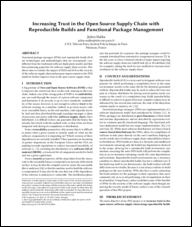
Increasing Trust in the Open Source Supply Chain with Reproducible Builds and Functional Package Management Julien Malka published a brief but interesting paper in the HAL open archive on Increasing Trust in the Open Source Supply Chain with Reproducible Builds and Functional Package Management:
Functional package managers (FPMs) and reproducible builds (R-B) are technologies and methodologies that are conceptually very different from the traditional software deployment model, and that have promising properties for software supply chain security. This thesis aims to evaluate the impact of FPMs and R-B on the security of the software supply chain and propose improvements to the FPM model to further improve trust in the open source supply chain. PDF
Julien s paper poses a number of research questions on how the model of distributions such as GNU Guix and NixOS can be leveraged to further improve the safety of the software supply chain , etc.

Software and source code identification with GNU Guix and reproducible builds In a long line of commendably detailed blog posts, Ludovic Court s, Maxim Cournoyer, Jan Nieuwenhuizen and Simon Tournier have together published two interesting posts on the GNU Guix blog this month. In early March, Ludovic Court s, Maxim Cournoyer, Jan Nieuwenhuizen and Simon Tournier wrote about software and source code identification and how that might be performed using Guix, rhetorically posing the questions: What does it take to identify software ? How can we tell what software is running on a machine to determine, for example, what security vulnerabilities might affect it? Later in the month, Ludovic Court s wrote a solo post describing adventures on the quest for long-term reproducible deployment. Ludovic s post touches on GNU Guix s aim to support time travel , the ability to reliably (and reproducibly) revert to an earlier point in time, employing the iconic image of Harold Lloyd hanging off the clock in Safety Last! (1925) to poetically illustrate both the slapstick nature of current modern technology and the gymnastics required to navigate hazards of our own making.

Two new Rust-based tools for post-processing determinism Zbigniew J drzejewski-Szmek announced add-determinism, a work-in-progress reimplementation of the Reproducible Builds project s own strip-nondeterminism tool in the Rust programming language, intended to be used as a post-processor in RPM-based distributions such as Fedora In addition, Yossi Kreinin published a blog post titled refix: fast, debuggable, reproducible builds that describes a tool that post-processes binaries in such a way that they are still debuggable with gdb, etc.. Yossi post details the motivation and techniques behind the (fast) performance of the tool.

Distribution work In Debian this month, since the testing framework no longer varies the build path, James Addison performed a bulk downgrade of the bug severity for issues filed with a level of normal to a new level of wishlist. In addition, 28 reviews of Debian packages were added, 38 were updated and 23 were removed this month adding to ever-growing knowledge about identified issues. As part of this effort, a number of issue types were updated, including Chris Lamb adding a new ocaml_include_directories toolchain issue [ ] and James Addison adding a new filesystem_order_in_java_jar_manifest_mf_include_resource issue [ ] and updating the random_uuid_in_notebooks_generated_by_nbsphinx to reference a relevant discussion thread [ ]. In addition, Roland Clobus posted his 24th status update of reproducible Debian ISO images. Roland highlights that the images for Debian unstable often cannot be generated due to changes in that distribution related to the 64-bit time_t transition. Lastly, Bernhard M. Wiedemann posted another monthly update for his reproducibility work in openSUSE.

Mailing list highlights Elsewhere on our mailing list this month:

Website updates There were made a number of improvements to our website this month, including:
  • Pol Dellaiera noticed the frequent need to correctly cite the website itself in academic work. To facilitate easier citation across multiple formats, Pol contributed a Citation File Format (CIF) file. As a result, an export in BibTeX format is now available in the Academic Publications section. Pol encourages community contributions to further refine the CITATION.cff file. Pol also added an substantial new section to the buy in page documenting the role of Software Bill of Materials (SBOMs) and ephemeral development environments. [ ][ ]
  • Bernhard M. Wiedemann added a new commandments page to the documentation [ ][ ] and fixed some incorrect YAML elsewhere on the site [ ].
  • Chris Lamb add three recent academic papers to the publications page of the website. [ ]
  • Mattia Rizzolo and Holger Levsen collaborated to add Infomaniak as a sponsor of amd64 virtual machines. [ ][ ][ ]
  • Roland Clobus updated the stable outputs page, dropping version numbers from Python documentation pages [ ] and noting that Python s set data structure is also affected by the PYTHONHASHSEED functionality. [ ]

Delta chat clients now reproducible Delta Chat, an open source messaging application that can work over email, announced this month that the Rust-based core library underlying Delta chat application is now reproducible.

diffoscope diffoscope is our in-depth and content-aware diff utility that can locate and diagnose reproducibility issues. This month, Chris Lamb made a number of changes such as uploading versions 259, 260 and 261 to Debian and made the following additional changes:
  • New features:
    • Add support for the zipdetails tool from the Perl distribution. Thanks to Fay Stegerman and Larry Doolittle et al. for the pointer and thread about this tool. [ ]
  • Bug fixes:
    • Don t identify Redis database dumps as GNU R database files based simply on their filename. [ ]
    • Add a missing call to File.recognizes so we actually perform the filename check for GNU R data files. [ ]
    • Don t crash if we encounter an .rdb file without an equivalent .rdx file. (#1066991)
    • Correctly check for 7z being available and not lz4 when testing 7z. [ ]
    • Prevent a traceback when comparing a contentful .pyc file with an empty one. [ ]
  • Testsuite improvements:
    • Fix .epub tests after supporting the new zipdetails tool. [ ]
    • Don t use parenthesis within test skipping messages, as PyTest adds its own parenthesis. [ ]
    • Factor out Python version checking in test_zip.py. [ ]
    • Skip some Zip-related tests under Python 3.10.14, as a potential regression may have been backported to the 3.10.x series. [ ]
    • Actually test 7z support in the test_7z set of tests, not the lz4 functionality. (Closes: reproducible-builds/diffoscope#359). [ ]
In addition, Fay Stegerman updated diffoscope s monkey patch for supporting the unusual Mozilla ZIP file format after Python s zipfile module changed to detect potentially insecure overlapping entries within .zip files. (#362) Chris Lamb also updated the trydiffoscope command line client, dropping a build-dependency on the deprecated python3-distutils package to fix Debian bug #1065988 [ ], taking a moment to also refresh the packaging to the latest Debian standards [ ]. Finally, Vagrant Cascadian submitted an update for diffoscope version 260 in GNU Guix. [ ]

Upstream patches This month, we wrote a large number of patches, including: Bernhard M. Wiedemann used reproducibility-tooling to detect and fix packages that added changes in their %check section, thus failing when built with the --no-checks option. Only half of all openSUSE packages were tested so far, but a large number of bugs were filed, including ones against caddy, exiv2, gnome-disk-utility, grisbi, gsl, itinerary, kosmindoormap, libQuotient, med-tools, plasma6-disks, pspp, python-pypuppetdb, python-urlextract, rsync, vagrant-libvirt and xsimd. Similarly, Jean-Pierre De Jesus DIAZ employed reproducible builds techniques in order to test a proposed refactor of the ath9k-htc-firmware package. As the change produced bit-for-bit identical binaries to the previously shipped pre-built binaries:
I don t have the hardware to test this firmware, but the build produces the same hashes for the firmware so it s safe to say that the firmware should keep working.

Reproducibility testing framework The Reproducible Builds project operates a comprehensive testing framework running primarily at tests.reproducible-builds.org in order to check packages and other artifacts for reproducibility. In March, an enormous number of changes were made by Holger Levsen:
  • Debian-related changes:
    • Sleep less after a so-called 404 package state has occurred. [ ]
    • Schedule package builds more often. [ ][ ]
    • Regenerate all our HTML indexes every hour, but only every 12h for the released suites. [ ]
    • Create and update unstable and experimental base systems on armhf again. [ ][ ]
    • Don t reschedule so many depwait packages due to the current size of the i386 architecture queue. [ ]
    • Redefine our scheduling thresholds and amounts. [ ]
    • Schedule untested packages with a higher priority, otherwise slow architectures cannot keep up with the experimental distribution growing. [ ]
    • Only create the stats_buildinfo.png graph once per day. [ ][ ]
    • Reproducible Debian dashboard: refactoring, update several more static stats only every 12h. [ ]
    • Document how to use systemctl with new systemd-based services. [ ]
    • Temporarily disable armhf and i386 continuous integration tests in order to get some stability back. [ ]
    • Use the deb.debian.org CDN everywhere. [ ]
    • Remove the rsyslog logging facility on bookworm systems. [ ]
    • Add zst to the list of packages which are false-positive diskspace issues. [ ]
    • Detect failures to bootstrap Debian base systems. [ ]
  • Arch Linux-related changes:
    • Temporarily disable builds because the pacman package manager is broken. [ ][ ]
    • Split reproducible_html_live_status and split the scheduling timing . [ ][ ][ ]
    • Improve handling when database is locked. [ ][ ]
  • Misc changes:
    • Show failed services that require manual cleanup. [ ][ ]
    • Integrate two new Infomaniak nodes. [ ][ ][ ][ ]
    • Improve IRC notifications for artifacts. [ ]
    • Run diffoscope in different systemd slices. [ ]
    • Run the node health check more often, as it can now repair some issues. [ ][ ]
    • Also include the string Bot in the userAgent for Git. (Re: #929013). [ ]
    • Document increased tmpfs size on our OUSL nodes. [ ]
    • Disable memory account for the reproducible_build service. [ ][ ]
    • Allow 10 times as many open files for the Jenkins service. [ ]
    • Set OOMPolicy=continue and OOMScoreAdjust=-1000 for both the Jenkins and the reproducible_build service. [ ]
Mattia Rizzolo also made the following changes:
  • Debian-related changes:
    • Define a systemd slice to group all relevant services. [ ][ ]
    • Add a bunch of quotes in scripts to assuage the shellcheck tool. [ ]
    • Add stats on how many packages have been built today so far. [ ]
    • Instruct systemd-run to handle diffoscope s exit codes specially. [ ]
    • Prefer the pgrep tool over grepping the output of ps. [ ]
    • Re-enable a couple of i386 and armhf architecture builders. [ ][ ]
    • Fix some stylistic issues flagged by the Python flake8 tool. [ ]
    • Cease scheduling Debian unstable and experimental on the armhf architecture due to the time_t transition. [ ]
    • Start a few more i386 & armhf workers. [ ][ ][ ]
    • Temporarly skip pbuilder updates in the unstable distribution, but only on the armhf architecture. [ ]
  • Other changes:
    • Perform some large-scale refactoring on how the systemd service operates. [ ][ ]
    • Move the list of workers into a separate file so it s accessible to a number of scripts. [ ]
    • Refactor the powercycle_x86_nodes.py script to use the new IONOS API and its new Python bindings. [ ]
    • Also fix nph-logwatch after the worker changes. [ ]
    • Do not install the stunnel tool anymore, it shouldn t be needed by anything anymore. [ ]
    • Move temporary directories related to Arch Linux into a single directory for clarity. [ ]
    • Update the arm64 architecture host keys. [ ]
    • Use a common Postfix configuration. [ ]
The following changes were also made by:
  • Jan-Benedict Glaw:
    • Initial work to clean up a messy NetBSD-related script. [ ][ ]
  • Roland Clobus:
    • Show the installer log if the installer fails to build. [ ]
    • Avoid the minus character (i.e. -) in a variable in order to allow for tags in openQA. [ ]
    • Update the schedule of Debian live image builds. [ ]
  • Vagrant Cascadian:
    • Maintenance on the virt* nodes is completed so bring them back online. [ ]
    • Use the fully qualified domain name in configuration. [ ]
Node maintenance was also performed by Holger Levsen, Mattia Rizzolo [ ][ ] and Vagrant Cascadian [ ][ ][ ][ ]

If you are interested in contributing to the Reproducible Builds project, please visit our Contribute page on our website. However, you can get in touch with us via:

Wouter Verhelst: OpenSC and the Belgian eID

Getting the Belgian eID to work on Linux systems should be fairly easy, although some people do struggle with it. For that reason, there is a lot of third-party documentation out there in the form of blog posts, wiki pages, and other kinds of things. Unfortunately, some of this documentation is simply wrong. Written by people who played around with things until it kind of worked, sometimes you get a situation where something that used to work in the past (but wasn't really necessary) now stopped working, but it's still added to a number of locations as though it were the gospel. And then people follow these instructions and now things don't work anymore. One of these revolves around OpenSC. OpenSC is an open source smartcard library that has support for a pretty large number of smartcards, amongst which the Belgian eID. It provides a PKCS#11 module as well as a number of supporting tools. For those not in the know, PKCS#11 is a standardized C API for offloading cryptographic operations. It is an API that can be used when talking to a hardware cryptographic module, in order to make that module perform some actions, and it is especially popular in the open source world, with support in NSS, amongst others. This library is written and maintained by mozilla, and is a low-level cryptographic library that is used by Firefox (on all platforms it supports) as well as by Google Chrome and other browsers based on that (but only on Linux, and as I understand it, only for linking with smartcards; their BoringSSL library is used for other things). The official eID software that we ship through eid.belgium.be, also known as "BeID", provides a PKCS#11 module for the Belgian eID, as well as a number of support tools to make interacting with the card easier, such as the "eID viewer", which provides the ability to read data from the card, and validate their signatures. While the very first public version of this eID PKCS#11 module was originally based on OpenSC, it has since been reimplemented as a PKCS#11 module in its own right, with no lineage to OpenSC whatsoever anymore. About five years ago, the Belgian eID card was renewed. At the time, a new physical appearance was the most obvious difference with the old card, but there were also some technical, on-chip, differences that are not so apparent. The most important one here, although it is not the only one, is the fact that newer eID cards now use a NIST P-384 elliptic curve-based private keys, rather than the RSA-based ones that were used in the past. This change required some changes to any PKCS#11 module that supports the eID; both the BeID one, as well as the OpenSC card-belpic driver that is written in support of the Belgian eID. Obviously, the required changes were implemented for the BeID module; however, the OpenSC card-belpic driver was not updated. While I did do some preliminary work on the required changes, I was unable to get it to work, and eventually other things took up my time so I never finished the implementation. If someone would like to finish the work that I started, the preliminal patch that I wrote could be a good start -- but like I said, it doesn't yet work. Also, you'll probably be interested in the official documentation of the eID card. Unfortunately, in the mean time someone added the Applet 1.8 ATR to the card-belpic.c file, without also implementing the required changes to the driver so that the PKCS#11 driver actually supports the eID card. The result of this is that if you have OpenSC installed in NSS for either Firefox or any Chromium-based browser, and it gets picked up before the BeID PKCS#11 module, then NSS will stop looking and pass all crypto operations to the OpenSC PKCS#11 module rather than to the official eID PKCS#11 module, and things will not work at all, causing a lot of confusion. I have therefore taken the following two steps:
  1. The official eID packages now conflict with the OpenSC PKCS#11 module. Specifically only the PKCS#11 module, not the rest of OpenSC, so you can theoretically still use its tools. This means that once we release this new version of the eID software, when you do an upgrade and you have OpenSC installed, it will remove the PKCS#11 module and anything that depends on it. This is normal and expected.
  2. I have filed a pull request against OpenSC that removes the Applet 1.8 ATR from the driver, so that OpenSC will stop claiming that it supports the 1.8 applet.
When the pull request is accepted, we will update the official eID software to make the conflict versioned, so that as soon as it works again you will again be able to install the OpenSC and BeID packages at the same time. In the mean time, if you have the OpenSC PKCS#11 module installed on your system, and your eID authentication does not work, try removing it.

9 April 2024

Ian Jackson: Why we ve voted No to CfD for Derril Water solar farm

[personal profile] ceb and I are members of the Derril Water Solar Park cooperative. We were recently invited to vote on whether the coop should bid for a Contract for Difference, in a government green electricity auction. We ve voted No. Green electricity from your mainstream supplier is a lie For a while [personal profile] ceb and I have wanted to contribute directly to green energy provision. This isn t really possible in the mainstream consumer electricy market. Mainstream electricity suppliers 100% green energy tariffs are pure greenwashing. In a capitalist boondoogle, they basically divvy up the electricity so that customers on the (typically more expensive) green tariff get the green electricity, and the other customers get whatever is left. (Of course the electricity is actually all mixed up by the National Grid.) There are fewer people signed up for these tariffs than there is green power generated, so this basically means signing up for a green tariff has no effect whatsoever, other than giving evil people more money. Ripple About a year ago we heard about Ripple. The structure is a little complicated, but the basic upshot is: Ripple promote and manage renewable energy schemes. The schemes themselves are each an individual company; the company is largely owned by a co-operative. The co-op is owned by consumers of electricity in the UK., To stop the co-operative being an purely financial investment scheme, shares ownership is limited according to your electricity usage. The electricity is be sold on the open market, and the profits are used to offset members electricity bills. (One gotcha from all of this is that for this to work your electricity billing provider has to be signed up with Ripple, but ours, Octopus, is.) It seemed to us that this was a way for us to directly cause (and pay for!) the actual generation of green electricity. So, we bought shares in one these co-operatives: we are co-owners of the Derril Water Solar Farm. We signed up for the maximum: funding generating capacity corresponding to 120% of our current electricity usage. We paid a little over 5000 for our shares. Contracts for Difference The UK has a renewable energy subsidy scheme, which goes by the name of Contracts for Difference. The idea is that a renewable energy generation company bids in advance, saying that they ll sell their electricity at Y price, for the duration of the contract (15 years in the current round). The lowest bids win. All the electricity from the participating infrastructure is sold on the open market, but if the market price is low the government makes up the difference, and if the price is high, the government takes the winnings. This is supposedly good for giving a stable investment environment, since the price the developer is going to get now doesn t depends on the electricity market over the next 15 years. The CfD system is supposed to encourage development, so you can only apply before you ve commissioned your generation infrastructure. Ripple and CfD Ripple recently invited us to agree that the Derril Water co-operative should bid in the current round of CfDs. If this goes ahead, and we are one of the auction s winners, the result would be that, instead of selling our electricity at the market price, we ll sell it at the fixed CfD price. This would mean that our return on our investment (which show up as savings on our electricity bills) would be decoupled from market electricity prices, and be much more predictable. They can t tell us the price they d want to bid at, and future electricity prices are rather hard to predict, but it s clear from the accompanying projections that they think we d be better off on average with a CfD. The documentation is very full of financial projections and graphs; other factors aren t really discussed in any detail. The rules of the co-op didn t require them to hold a vote, but very sensibly, for such a fundamental change in the model, they decided to treat it roughly the same way as for a rules change: they re hoping to get 75% Yes votes. Voting No The reason we re in this co-op at all is because we want to directly fund renewable electricity. Participating in the CfD auction would involve us competing with capitalist energy companies for government subsidies. Subsidies which are supposed to encourage the provision of green electricity. It seems to us that participating in this auction would remove most of the difference between what we hoped to do by investing in Derril Water, and just participating in the normal consumer electricity market. In particular, if we do win in the auction, that s probably directly removing the funding and investment support model for other, market-investor-funded, projects. In other words, our buying into Derril Water ceases to be an additional green energy project, changing (in its minor way) the UK s electricity mix. It becomes a financial transaction much more tenously connected (if connected at all) to helping mitigate the climate emergency. So our conclusion was that we must vote against.

comment count unavailable comments

Matthew Palmer: How I Tripped Over the Debian Weak Keys Vulnerability

Those of you who haven t been in IT for far, far too long might not know that next month will be the 16th(!) anniversary of the disclosure of what was, at the time, a fairly earth-shattering revelation: that for about 18 months, the Debian OpenSSL package was generating entirely predictable private keys. The recent xz-stential threat (thanks to @nixCraft for making me aware of that one), has got me thinking about my own serendipitous interaction with a major vulnerability. Given that the statute of limitations has (probably) run out, I thought I d share it as a tale of how huh, that s weird can be a powerful threat-hunting tool but only if you ve got the time to keep pulling at the thread.

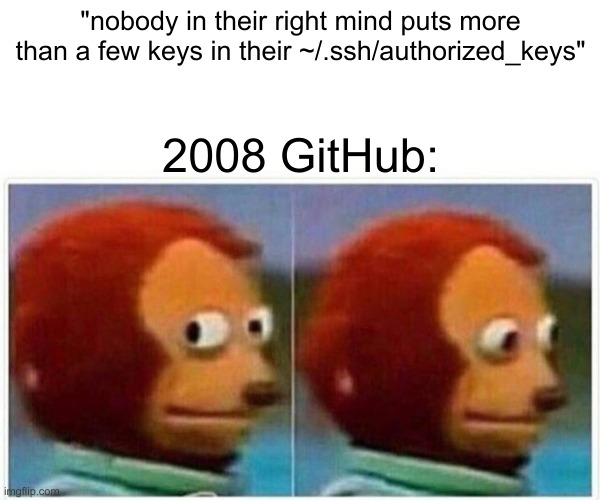
Prelude to an Adventure Our story begins back in March 2008. I was working at Engine Yard (EY), a now largely-forgotten Rails-focused hosting company, which pioneered several advances in Rails application deployment. Probably EY s greatest claim to lasting fame is that they helped launch a little code hosting platform you might have heard of, by providing them free infrastructure when they were little more than a glimmer in the Internet s eye. I am, of course, talking about everyone s favourite Microsoft product: GitHub. Since GitHub was in the right place, at the right time, with a compelling product offering, they quickly started to gain traction, and grow their userbase. With growth comes challenges, amongst them the one we re focusing on today: SSH login times. Then, as now, GitHub provided SSH access to the git repos they hosted, by SSHing to git@github.com with publickey authentication. They were using the standard way that everyone manages SSH keys: the ~/.ssh/authorized_keys file, and that became a problem as the number of keys started to grow. The way that SSH uses this file is that, when a user connects and asks for publickey authentication, SSH opens the ~/.ssh/authorized_keys file and scans all of the keys listed in it, looking for a key which matches the key that the user presented. This linear search is normally not a huge problem, because nobody in their right mind puts more than a few keys in their ~/.ssh/authorized_keys, right?
2008-era GitHub giving monkey puppet side-eye to the idea that nobody stores many keys in an authorized_keys file
Of course, as a popular, rapidly-growing service, GitHub was gaining users at a fair clip, to the point that the one big file that stored all the SSH keys was starting to visibly impact SSH login times. This problem was also not going to get any better by itself. Something Had To Be Done. EY management was keen on making sure GitHub ran well, and so despite it not really being a hosting problem, they were willing to help fix this problem. For some reason, the late, great, Ezra Zygmuntowitz pointed GitHub in my direction, and let me take the time to really get into the problem with the GitHub team. After examining a variety of different possible solutions, we came to the conclusion that the least-worst option was to patch OpenSSH to lookup keys in a MySQL database, indexed on the key fingerprint. We didn t take this decision on a whim it wasn t a case of yeah, sure, let s just hack around with OpenSSH, what could possibly go wrong? . We knew it was potentially catastrophic if things went sideways, so you can imagine how much worse the other options available were. Ensuring that this wouldn t compromise security was a lot of the effort that went into the change. In the end, though, we rolled it out in early April, and lo! SSH logins were fast, and we were pretty sure we wouldn t have to worry about this problem for a long time to come. Normally, you d think patching OpenSSH to make mass SSH logins super fast would be a good story on its own. But no, this is just the opening scene.

Chekov s Gun Makes its Appearance Fast forward a little under a month, to the first few days of May 2008. I get a message from one of the GitHub team, saying that somehow users were able to access other users repos over SSH. Naturally, as we d recently rolled out the OpenSSH patch, which touched this very thing, the code I d written was suspect number one, so I was called in to help.
The lineup scene from the movie The Usual Suspects They're called The Usual Suspects for a reason, but sometimes, it really is Keyser S ze
Eventually, after more than a little debugging, we discovered that, somehow, there were two users with keys that had the same key fingerprint. This absolutely shouldn t happen it s a bit like winning the lottery twice in a row1 unless the users had somehow shared their keys with each other, of course. Still, it was worth investigating, just in case it was a web application bug, so the GitHub team reached out to the users impacted, to try and figure out what was going on. The users professed no knowledge of each other, neither admitted to publicising their key, and couldn t offer any explanation as to how the other person could possibly have gotten their key. Then things went from weird to what the ? . Because another pair of users showed up, sharing a key fingerprint but it was a different shared key fingerprint. The odds now have gone from winning the lottery multiple times in a row to as close to this literally cannot happen as makes no difference.
Milhouse from The Simpsons says that We're Through The Looking Glass Here, People
Once we were really, really confident that the OpenSSH patch wasn t the cause of the problem, my involvement in the problem basically ended. I wasn t a GitHub employee, and EY had plenty of other customers who needed my help, so I wasn t able to stay deeply involved in the on-going investigation of The Mystery of the Duplicate Keys. However, the GitHub team did keep talking to the users involved, and managed to determine the only apparent common factor was that all the users claimed to be using Debian or Ubuntu systems, which was where their SSH keys would have been generated. That was as far as the investigation had really gotten, when along came May 13, 2008.

Chekov s Gun Goes Off With the publication of DSA-1571-1, everything suddenly became clear. Through a well-meaning but ultimately disasterous cleanup of OpenSSL s randomness generation code, the Debian maintainer had inadvertently reduced the number of possible keys that could be generated by a given user from bazillions to a little over 32,000. With so many people signing up to GitHub some of them no doubt following best practice and freshly generating a separate key it s unsurprising that some collisions occurred. You can imagine the sense of oooooooh, so that s what s going on! that rippled out once the issue was understood. I was mostly glad that we had conclusive evidence that my OpenSSH patch wasn t at fault, little knowing how much more contact I was to have with Debian weak keys in the future, running a huge store of known-compromised keys and using them to find misbehaving Certificate Authorities, amongst other things.

Lessons Learned While I ve not found a description of exactly when and how Luciano Bello discovered the vulnerability that became CVE-2008-0166, I presume he first came across it some time before it was disclosed likely before GitHub tripped over it. The stable Debian release that included the vulnerable code had been released a year earlier, so there was plenty of time for Luciano to have discovered key collisions and go hmm, I wonder what s going on here? , then keep digging until the solution presented itself. The thought hmm, that s odd , followed by intense investigation, leading to the discovery of a major flaw is also what ultimately brought down the recent XZ backdoor. The critical part of that sequence is the ability to do that intense investigation, though. When I reflect on my brush with the Debian weak keys vulnerability, what sticks out to me is the fact that I didn t do the deep investigation. I wonder if Luciano hadn t found it, how long it might have been before it was found. The GitHub team would have continued investigating, presumably, and perhaps they (or I) would have eventually dug deep enough to find it. But we were all super busy myself, working support tickets at EY, and GitHub feverishly building features and fighting the fires in their rapidly-growing service. As it was, Luciano was able to take the time to dig in and find out what was happening, but just like the XZ backdoor, I feel like we, as an industry, got a bit lucky that someone with the skills, time, and energy was on hand at the right time to make a huge difference. It s a luxury to be able to take the time to really dig into a problem, and it s a luxury that most of us rarely have. Perhaps an understated takeaway is that somehow we all need to wrestle back some time to follow our hunches and really dig into the things that make us go hmm .

Support My Hunches If you d like to help me be able to do intense investigations of mysterious software phenomena, you can shout me a refreshing beverage on ko-fi.
  1. the odds are actually probably more like winning the lottery about twenty times in a row. The numbers involved are staggeringly huge, so it s easiest to just approximate it as really, really unlikely .

5 April 2024

Dirk Eddelbuettel: RcppArmadillo 0.12.8.2.0 on CRAN: Upstream Fix

armadillo image Armadillo is a powerful and expressive C++ template library for linear algebra and scientific computing. It aims towards a good balance between speed and ease of use, has a syntax deliberately close to Matlab, and is useful for algorithm development directly in C++, or quick conversion of research code into production environments. RcppArmadillo integrates this library with the R environment and language and is widely used by (currently) 1136 other packages on CRAN, downloaded 33.5 million times (per the partial logs from the cloud mirrors of CRAN), and the CSDA paper (preprint / vignette) by Conrad and myself has been cited 578 times according to Google Scholar. This release brings a new upstream bugfix release Armadillo 12.8.2 prepared by Conrad two days ago. It took the usual day to noodle over 1100+ reverse dependencies and ensure two failures were independent of the upgrade (i.e., no change to worse in CRAN parlance). It took CRAN another because we hit a random network outage for (spurious) NOTE on a remote URL, and were then caught in the shrapnel from another large package ecosystem update spuriously pointing some build failures that were due to a missing rebuild to us. All good, as human intervention comes to the rescue. The set of changes since the last CRAN release follows.

Changes in RcppArmadillo version 0.12.8.2.0 (2024-04-02)
  • Upgraded to Armadillo release 12.8.2 (Cortisol Injector)
    • Workaround for FFTW3 header clash
    • Workaround in testing framework for issue under macOS
    • Minor cleanups to reduce code bloat
    • Improved documentation

Courtesy of my CRANberries, there is a diffstat report relative to previous release. More detailed information is on the RcppArmadillo page. Questions, comments etc should go to the rcpp-devel mailing list off the Rcpp R-Forge page. If you like this or other open-source work I do, you can sponsor me at GitHub.

This post by Dirk Eddelbuettel originated on his Thinking inside the box blog. Please report excessive re-aggregation in third-party for-profit settings.

Bits from Debian: apt install dpl-candidate: Sruthi Chandran

The Debian Project Developers will shortly vote for a new Debian Project Leader known as the DPL. The DPL is the official representative of representative of The Debian Project tasked with managing the overall project, its vision, direction, and finances. The DPL is also responsible for the selection of Delegates, defining areas of responsibility within the project, the coordination of Developers, and making decisions required for the project. Our outgoing and present DPL Jonathan Carter served 4 terms, from 2020 through 2024. Jonathan shared his last Bits from the DPL post to Debian recently and his hopes for the future of Debian. Recently, we sat with the two present candidates for the DPL position asking questions to find out who they really are in a series of interviews about their platforms, visions for Debian, lives, and even their favorite text editors. The interviews were conducted by disaster2life (Yashraj Moghe) and made available from video and audio transcriptions: Voting for the position starts on April 6, 2024. Editors' note: This is our official return to Debian interviews, readers should stay tuned for more upcoming interviews with Developers and other important figures in Debian as part of our "Meet your Debian Developer" series. We used the following tools and services: Turboscribe.ai for the transcription from the audio and video files, IRC: Oftc.net for communication, Jitsi meet for interviews, and Open Broadcaster Software (OBS) for editing and video. While we encountered many technical difficulties in the return to this process, we are still able and proud to present the transcripts of the interviews edited only in a few areas for readability. 2024 Debian Project Leader Candidate: Sruthi Chandran Sruthi's interview Hi Sruthi, so for the first question, who are you and could you tell us a little bit about yourself? [Sruthi]:
I usually talk about me whenever I am talking about answering the question who am I, I usually say like I am a librarian turned free software enthusiast and a Debian Developer. So I had no technical background and I learned, I was introduced to free software through my husband and then I learned Debian packaging, and eventually I became a Debian Developer. So I always give my example to people who say I am not technically inclined, I don't have technical background so I can't contribute to free software. So yeah, that's what I refer to myself.
For the next question, could you tell me what do you do in Debian, and could you mention your story up until here today? [Sruthi]:
Okay, so let me start from my initial days in Debian. I started contributing to Debian, my first contribution was a Tibetan font. We went to a Tibetan place and they were saying they didn't have a font in Linux. So that's how I started contributing. Then I moved on to Ruby packages, then I have some JavaScript and Go packages, all dependencies of GitLab. So I was involved with maintaining GitLab for some time, now I'm not very active there. But yeah, so GitLab was the main package I was contributing to since I contributed since 2016 to maybe like 2020 or something. Later I have come [over to] packaging. Now I am part of some of the teams, delegated teams, like community team and outreach team, as well as the Debconf committee. And the biggest, I think, my activity in Debian, I would say is organizing Debconf 2023. So it was a great experience and yeah, so that's my story in Debian.
So what are three key terms about you and your candidacy? [Sruthi]:
Okay, let me first think about it. For candidacy, I can start with diversity is one point I started expressing from the first time I contested for DPL. But to be honest, that's the main point I want to bring.
[Yashraj]:
So for diversity, if you could break down your thoughts on diversity and make them, [about] your three points including diversity.
[Sruthi]:
So in addition to, eventually when starting it was just diversity. Now I have like a bit more ideas, like community, like I want to be a leader for the Debian community. More than, I don't know, maybe people may not agree, but I would say I want to be a leader of Debian community rather than a Debian operating system. I connect to community more and third point I would say.
The term of a DPL lasts for an year. So what do you think during, what would you try to do during that, that you can't do from your position now? [Sruthi]:
Okay. So I, like, I am very happy with the structure of Debian and how things work in Debian. Like you can do almost a lot of things, like almost all things without being a DPL. Whatever change you want to bring about or whatever you want to do, you can do without being a DPL. Anyone, like every DD has the same rights. Only things I feel [the] DPL has hold on are mainly the budget or the funding part, which like, that's where they do the decision making part. And then comes like, and one advantage of DPL driving some idea is that somehow people tend to listen to that with more, like, tend to give more attention to what DPL is saying rather than a normal DD. So I wanted to, like, I have answered some of the questions on how to, how I plan to do the financial budgeting part, how I want to handle, like, and the other thing is using the extra attention that I get as a DPL, I would like to obviously start with the diversity aspect in Debian. And yeah, like, I, what I want to do is not, like, be a leader and say, like, take Debian to one direction where I want to go, but I would rather take suggestions and inputs from the whole community and go about with that. So yes, that's what I would say.
And taking a less serious question now, what is your preferred text editor? [Sruthi]:
Vim.
[Yashraj]:
Vim, wholeheartedly team Vim?
[Sruthi]:
Yes.
[Yashraj]:
Great. Well, this was made in Vim, all the text for this.
[Sruthi]:
So, like, since you mentioned extra data, I'll give my example, like, it's just a fun note, when I started contributing to Debian, as I mentioned, I didn't have any knowledge about free software, like Debian, and I was not used to even using Linux. So, and I didn't have experience with these text editors. So, when I started contributing, I used to do the editing part using gedit. So, that's how I started. Eventually, I moved to Nano, and once I reached Vim, I didn't move on.
Team Vim. Next question. What, what do you think is the importance of the Debian project in the world today? And where would you like to see it in 10 years, like 10 years into the future? [Sruthi]:
Okay. So, Debian, as we all know, is referred to as the universal operating system without, like, it is said for a reason. We have hundreds and hundreds of operating systems, like Linux, distributions based on Debian. So, I believe Debian, like even now, Debian has good influence on the, at least on the Linux or Linux ecosystem. So, what we implement in Debian has, like, is going to affect quite a lot of, like, a very good percentage of people using Linux. So, yes. So, I think Debian is one of the leading Linux distributions. And I think in 10 years, we should be able to reach a position, like, where we are not, like, even now, like, even these many years after having Linux, we face a lot of problems in newer and newer hardware coming up and installing on them is a big problem. Like, firmwares and all those things are getting more and more complicated. Like, it should be getting simpler, but it's getting more and more complicated. So, I, one thing I would imagine, like, I don't know if we will ever reach there, but I would imagine that eventually with the Debian, we should be able to have some, at least a few of the hardware developers or hardware producers have Debian pre-installed and those kind of things. Like, not, like, become, I'm not saying it's all, it's also available right now. What I'm saying is that it becomes prominent enough to be opted as, like, default distro.
What part of Debian has made you And what part of the project has kept you going all through these years? [Sruthi]:
Okay. So, I started to contribute in 2016, and I was part of the team doing GitLab packaging, and we did have a lot of training workshops and those kind of things within India. And I was, like, I had interacted with some of the Indian DDs, but I never got, like, even through chat or mail. I didn't have a lot of interaction with the rest of the world, DDs. And the 2019 Debconf changed my whole perspective about Debian. Before that, I wasn't, like, even, I was interested in free software. I was doing the technical stuff and all. But after DebConf, my whole idea has been, like, my focus changed to the community. Debian community is a very welcoming, very interesting community to be with. And so, I believe that, like, 2019 DebConf was a for me. And that kept, from 2019, my focus has been to how to support, like, how, I moved to the community part of Debian from there. Then in 2020 I became part of the community team, and, like, I started being part of other teams. So, these, I would say, the Debian community is the one, like, aspect of Debian that keeps me whole, keeps me held on to the Debian ecosystem as a whole.
Continuing to speak about Debian, what do you think, what is the first thing that comes to your mind when you think of Debian, like, the word, the community, what's the first thing? [Sruthi]:
I think I may sound like a broken record or something.
[Yashraj]:
No, no.
[Sruthi]:
Again, I would say the Debian community, like, it's the people who makes Debian, that makes Debian special. Like, apart from that, if I say, I would say I'm very, like, one part of Debian that makes me very happy is the, how the governing system of Debian works, the Debian constitution and all those things, like, it's a very unique thing for Debian. And, and it's like, when people say you can't work without a proper, like, establishment or even somebody deciding everything for you, it's difficult. When people say, like, we have been, Debian has been proving it for quite a long time now, that it's possible. So, so that's one thing I believe, like, that's one unique point. And I am very proud about that.
What areas do you think Debian is failing in, how can it (that standing) be improved? [Sruthi]:
So, I think where Debian is failing now is getting new people into Debian. Like, I don't remember, like, exactly the answer. But I remember hearing someone mention, like, the average age of a Debian Developer is, like, above 40 or 45 or something, like, exact age, I don't remember. But it's like, Debian is getting old. Like, the people in Debian are getting old and we are not getting enough of new people into Debian. And that's very important to have people, like, new people coming up. Otherwise, eventually, like, after a few years, nobody, like, we won't have enough people to take the project forward. So, yeah, I believe that is where we need to work on. We are doing some efforts, like, being part of GSOC or outreachy and having maybe other events, like, local events. Like, we used to have a lot of Debian packaging workshops in India. And those kind of, I think, in Brazil and all, they all have, like, local communities are doing. But we are not very successful in retaining the people who maybe come and try out things. But we are not very good at retaining the people, like, retaining people who come. So, we need to work on those things. Right now, I don't have a solid answer for that. But one thing, like, I was thinking about is, like, having a Debian specific outreach project, wherein the focus will be about the Debian, like, starting will be more on, like, usually what happens in GSOC and outreach is that people come, have the, do the contributions, and they go back. Like, they don't have that connection with the Debian, like, Debian community or Debian project. So, what I envision with these, the Debian outreach, the Debian specific outreach is that we have some part of the internship, like, even before starting the internship, we have some sessions and, like, with the people in Debian having, like, getting them introduced to the Debian philosophy and Debian community and Debian, how Debian works. And those things, we focus on that. And then we move on to the technical internship parts. So, I believe this could do some good in having, like, when you have people you can connect to, you tend to stay back in a project mode. When you feel something more than, like, right now, we have so many technical stuff to do, like, the choice for a college student is endless. So, if they want, if they stay back for something, like, maybe for Debian, I would say, we need to have them connected to the Debian project before we go into technical parts. Like, technical parts, like, there are other things as well, where they can go and do the technical part, but, like, they can come here, like, yeah. So, that's what I was saying. Focused outreach projects is one thing. That's just one. That's not enough. We need more of, like, more ideas to have more new people come up. And I'm very happy with, like, the DebConf thing. We tend to get more and more people from the places where we have a DebConf. Brazil is an example. After the Debconf, they have quite a good improvement on Debian contributors. And I think in India also, it did give a good result. Like, we have more people contributing and staying back and those things. So, yeah. So, these were the things I would say, like, we can do to improve.
For the final question, what field in free software do you, what field in free software generally do you think requires the most work to be put into it? What do you think is Debian's part in that field? [Sruthi]:
Okay. Like, right now, what comes to my mind is the free software licenses parts. Like, we have a lot of free software licenses, and there are non-free software licenses. But currently, I feel free software is having a big problem in enforcing these licenses. Like, there are, there may be big corporations or like some people who take up the whole, the code and may not follow the whole, for example, the GPL licenses. Like, we don't know how much of those, how much of the free softwares are used in the bigger things. Yeah, I agree. There are a lot of corporations who are afraid to touch free software. But there would be good amount of free software, free work that converts into property, things violating the free software licenses and those things. And we do not have the kind of like, we have SFLC, SFC, etc. But still, we do not have the ability to go behind and trace and implement the licenses. So, enforce those licenses and bring people who are violating the licenses forward and those kind of things is challenging because one thing is it takes time, like, and most importantly, money is required for the legal stuff. And not always people who like people who make small software, or maybe big, but they may not have the kind of time and money to have these things enforced. So, that's a big challenge free software is facing, especially in our current scenario. I feel we are having those, like, we need to find ways how we can get it sorted. I don't have an answer right now what to do. But this is a challenge I felt like and Debian's part in that. Yeah, as I said, I don't have a solution for that. But the Debian, so DFSG and Debian sticking on to the free software licenses is a good support, I think.
So, that was the final question, Do you have anything else you want to mention for anyone watching this? [Sruthi]:
Not really, like, I am happy, like, I think I was able to answer the questions. And yeah, I would say who is watching. I won't say like, I'm the best DPL candidate, you can't have a better one or something. I stand for a reason. And if you believe in that, or the Debian community and Debian diversity, and those kinds of things, if you believe it, I hope you would be interested, like, you would want to vote for me. That's it. Like, I'm not, I'll make it very clear. I'm not doing a technical leadership part here. So, those, I can't convince people who want technical leadership to vote for me. But I would say people who connect with me, I hope they vote for me.

4 April 2024

John Goerzen: The xz Issue Isn t About Open Source

You ve probably heard of the recent backdoor in xz. There have been a lot of takes on this, most of them boiling down to some version of:
The problem here is with Open Source Software.
I want to say not only is that view so myopic that it pushes towards the incorrect, but also it blinds us to more serious problems. Now, I don t pretend that there are no problems in the FLOSS community. There have been various pieces written about what this issue says about the FLOSS community (usually without actionable solutions). I m not here to say those pieces are wrong. Just that there s a bigger picture. So with this xz issue, it may well be a state actor (aka spy ) that added this malicious code to xz. We also know that proprietary software and systems can be vulnerable. For instance, a Twitter whistleblower revealed that Twitter employed Indian and Chinese spies, some knowingly. A recent report pointed to security lapses at Microsoft, including preventable lapses in security. According to the Wikipedia article on the SolarWinds attack, it was facilitated by various kinds of carelessness, including passwords being posted to Github and weak default passwords. They directly distributed malware-infested updates, encouraged customers to disable anti-malware tools when installing SolarWinds products, and so forth. It would be naive indeed to assume that there aren t black hat actors among the legions of programmers employed by companies that outsource work to low-cost countries some of which have challenges with bribery. So, given all this, we can t really say the problem is Open Source. Maybe it s more broad:
The problem here is with software.
Maybe that inches us closer, but is it really accurate? We have all heard of Boeing s recent issues, which seem to have some element of root causes in corporate carelessness, cost-cutting, and outsourcing. That sounds rather similar to the SolarWinds issue, doesn t it?
Well then, the problem is capitalism.
Maybe it has a role to play, but isn t it a little too easy to just say capitalism and throw up our hands helplessly, just as some do with FLOSS as at the start of this article? After all, capitalism also brought us plenty of products of very high quality over the years. When we can point to successful, non-careless products and I own some of them (for instance, my Framework laptop). We clearly haven t reached the root cause yet. And besides, what would you replace it with? All the major alternatives that have been tried have even stronger downsides. Maybe you replace it with better regulated capitalism , but that s still capitalism.
Then the problem must be with consumers.
As this argument would go, it s consumers buying patterns that drive problems. Buyers individual and corporate seek flashy features and low cost, prizing those over quality and security. No doubt this is true in a lot of cases. Maybe greed or status-conscious societies foster it: Temu promises people to shop like a billionaire , and unloads on them cheap junk, which all but guarantees that shipments from Temu containing products made with forced labor are entering the United States on a regular basis . But consumers are also people, and some fraction of them are quite capable of writing fantastic software, and in fact, do so. So what we need is some way to seize control. Some way to do what is right, despite the pressures of consumers or corporations. Ah yes, dear reader, you have been slogging through all these paragraphs and now realize I have been leading you to this:
Then the solution is Open Source.
Indeed. Faults and all, FLOSS is the most successful movement I know where people are bringing us back to the commons: working and volunteering for the common good, unleashing a thousand creative variants on a theme, iterating in every direction imaginable. We have FLOSS being vital parts of everything from $30 Raspberry Pis to space missions. It is bringing education and communication to impoverished parts of the world. It lets everyone write and release software. And, unlike the SolarWinds and Twitter issues, it exposes both clever solutions and security flaws to the world. If an authentication process in Windows got slower, we would all shrug and mutter Microsoft under our breath. Because, really, what else can we do? We have no agency with Windows. If an authentication process in Linux gets slower, anybody that s interested anybody at all can dive in and ask why and trace it down to root causes. Some look at this and say FLOSS is responsible for this mess. I look at it and say, this would be so much worse if it wasn t FLOSS and experience backs me up on this. FLOSS doesn t prevent security issues itself. What it does do is give capabilities to us all. The ability to investigate. Ability to fix. Yes, even the ability to break and its cousin, the power to learn. And, most rewarding, the ability to contribute.

Lukas M rdian: Netplan v1.0 paves the way to stable, declarative network management

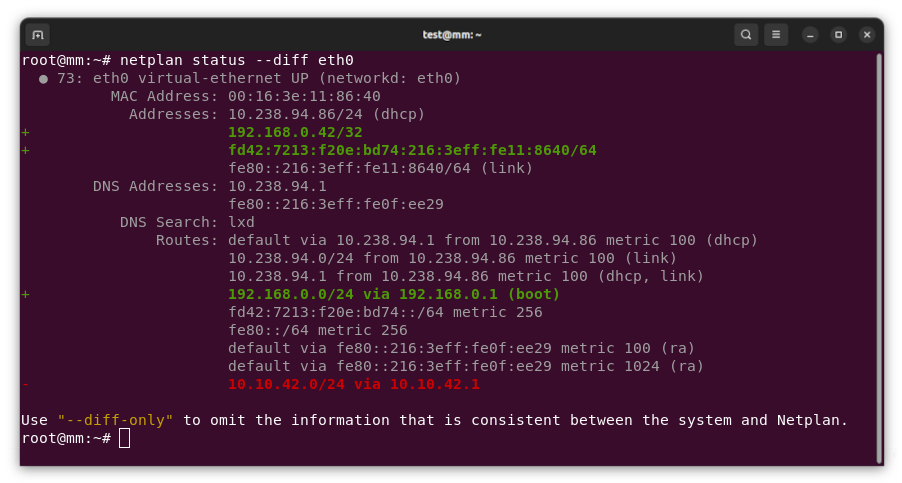
New netplan status diff subcommand, finding differences between configuration and system state As the maintainer and lead developer for Netplan, I m proud to announce the general availability of Netplan v1.0 after more than 7 years of development efforts. Over the years, we ve so far had about 80 individual contributors from around the globe. This includes many contributions from our Netplan core-team at Canonical, but also from other big corporations such as Microsoft or Deutsche Telekom. Those contributions, along with the many we receive from our community of individual contributors, solidify Netplan as a healthy and trusted open source project. In an effort to make Netplan even more dependable, we started shipping upstream patch releases, such as 0.106.1 and 0.107.1, which make it easier to integrate fixes into our users custom workflows. With the release of version 1.0 we primarily focused on stability. However, being a major version upgrade, it allowed us to drop some long-standing legacy code from the libnetplan1 library. Removing this technical debt increases the maintainability of Netplan s codebase going forward. The upcoming Ubuntu 24.04 LTS and Debian 13 releases will ship Netplan v1.0 to millions of users worldwide.

Highlights of version 1.0 In addition to stability and maintainability improvements, it s worth looking at some of the new features that were included in the latest release:
  • Simultaneous WPA2 & WPA3 support.
  • Introduction of a stable libnetplan1 API.
  • Mellanox VF-LAG support for high performance SR-IOV networking.
  • New hairpin and port-mac-learning settings, useful for VXLAN tunnels with FRRouting.
  • New netplan status diff subcommand, finding differences between configuration and system state.
Besides those highlights of the v1.0 release, I d also like to shed some light on new functionality that was integrated within the past two years for those upgrading from the previous Ubuntu 22.04 LTS which used Netplan v0.104:
  • We added support for the management of new network interface types, such as veth, dummy, VXLAN, VRF or InfiniBand (IPoIB).
  • Wireless functionality was improved by integrating Netplan with NetworkManager on desktop systems, adding support for WPA3 and adding the notion of a regulatory-domain, to choose proper frequencies for specific regions.
  • To improve maintainability, we moved to Meson as Netplan s buildsystem, added upstream CI coverage for multiple Linux distributions and integrations (such as Debian testing, NetworkManager, snapd or cloud-init), checks for ABI compatibility, and automatic memory leak detection.
  • We increased consistency between the supported backend renderers (systemd-networkd and NetworkManager), by matching physical network interfaces on permanent MAC address, when the match.macaddress setting is being used, and added new hardware offloading functionality for high performance networking, such as Single-Root IO Virtualisation virtual function link-aggregation (SR-IOV VF-LAG).
The much improved Netplan documentation, that is now hosted on Read the Docs , and new command line subcommands, such as netplan status, make Netplan a well vested tool for declarative network management and troubleshooting.

Integrations Those changes pave the way to integrate Netplan in 3rd party projects, such as system installers or cloud deployment methods. By shipping the new python3-netplan Python bindings to libnetplan, it is now easier than ever to access Netplan functionality and network validation from other projects. We are proud that the Debian Cloud Team chose Netplan to be the default network management tool in their official cloud-images for Debian Bookworm and beyond. Ubuntu s NetworkManager package now uses Netplan as it s default backend on Ubuntu 23.10 Desktop systems and beyond. Further integrations happened with cloud-init and the Calamares installer.
Please check out the Netplan version 1.0 release on GitHub! If you want to learn more, follow our activities on Netplan.io, GitHub, Launchpad, IRC or our Netplan Developer Diaries blog on discourse.

3 April 2024

Bits from Debian: Proxmox Platinum Sponsor of DebConf24

proxmoxlogo We are pleased to announce that Proxmox has committed to sponsor DebConf24 as a Platinum Sponsor. Proxmox provides powerful and user-friendly open-source server software. Enterprises of all sizes and industries use Proxmox solutions to deploy efficient and simplified IT infrastructures, minimize total cost of ownership, and avoid vendor lock-in. Proxmox also offers commercial support, training services, and an extensive partner ecosystem to ensure business continuity for its customers. Proxmox Server Solutions GmbH was established in 2005 and is headquartered in Vienna, Austria. Proxmox builds its product offerings on top of the Debian operating system. With this commitment as Platinum Sponsor, Proxmox is contributing to make possible our annual conference, and directly supporting the progress of Debian and Free Software, helping to strengthen the community that continues to collaborate on Debian projects throughout the rest of the year. Thank you very much, Proxmox, for your support of DebConf24! Become a sponsor too! DebConf24 will take place from 28th July to 4th August 2024 in Busan, South Korea, and will be preceded by DebCamp, from 21st to 27th July 2024. DebConf24 is accepting sponsors! Interested companies and organizations may contact the DebConf team through sponsors@debconf.org, or visit the Become a DebConf Sponsor website.

Joey Hess: reflections on distrusting xz

Was the ssh backdoor the only goal that "Jia Tan" was pursuing with their multi-year operation against xz? I doubt it, and if not, then every fix so far has been incomplete, because everything is still running code written by that entity. If we assume that they had a multilayered plan, that their every action was calculated and malicious, then we have to think about the full threat surface of using xz. This quickly gets into nightmare scenarios of the "trusting trust" variety. What if xz contains a hidden buffer overflow or other vulnerability, that can be exploited by the xz file it's decompressing? This would let the attacker target other packages, as needed. Let's say they want to target gcc. Well, gcc contains a lot of documentation, which includes png images. So they spend a while getting accepted as a documentation contributor on that project, and get added to it a png file that is specially constructed, it has additional binary data appended that exploits the buffer overflow. And instructs xz to modify the source code that comes later when decompressing gcc.tar.xz. More likely, they wouldn't bother with an actual trusting trust attack on gcc, which would be a lot of work to get right. One problem with the ssh backdoor is that well, not all servers on the internet run ssh. (Or systemd.) So webservers seem a likely target of this kind of second stage attack. Apache's docs include png files, nginx does not, but there's always scope to add improved documentation to a project. When would such a vulnerability have been introduced? In February, "Jia Tan" wrote a new decoder for xz. This added 1000+ lines of new C code across several commits. So much code and in just the right place to insert something like this. And why take on such a significant project just two months before inserting the ssh backdoor? "Jia Tan" was already fully accepted as maintainer, and doing lots of other work, it doesn't seem to me that they needed to start this rewrite as part of their cover. They were working closely with xz's author Lasse Collin in this, by indications exchanging patches offlist as they developed it. So Lasse Collin's commits in this time period are also worth scrutiny, because they could have been influenced by "Jia Tan". One that caught my eye comes immediately afterwards: "prepares the code for alternative C versions and inline assembly" Multiple versions and assembly mean even more places to hide such a security hole. I stress that I have not found such a security hole, I'm only considering what the worst case possibilities are. I think we need to fully consider them in order to decide how to fully wrap up this mess. Whether such stealthy security holes have been introduced into xz by "Jia Tan" or not, there are definitely indications that the ssh backdoor was not the end of what they had planned. For one thing, the "test file" based system they introduced was extensible. They could have been planning to add more test files later, that backdoored xz in further ways. And then there's the matter of the disabling of the Landlock sandbox. This was not necessary for the ssh backdoor, because the sandbox is only used by the xz command, not by liblzma. So why did they potentially tip their hand by adding that rogue "." that disables the sandbox? A sandbox would not prevent the kind of attack I discuss above, where xz is just modifying code that it decompresses. Disabling the sandbox suggests that they were going to make xz run arbitrary code, that perhaps wrote to files it shouldn't be touching, to install a backdoor in the system. Both deb and rpm use xz compression, and with the sandbox disabled, whether they link with liblzma or run the xz command, a backdoored xz can write to any file on the system while dpkg or rpm is running and noone is likely to notice, because that's the kind of thing a package manager does. My impression is that all of this was well planned and they were in it for the long haul. They had no reason to stop with backdooring ssh, except for the risk of additional exposure. But they decided to take that risk, with the sandbox disabling. So they planned to do more, and every commit by "Jia Tan", and really every commit that they could have influenced needs to be distrusted. This is why I've suggested to Debian that they revert to an earlier version of xz. That would be my advice to anyone distributing xz. I do have a xz-unscathed fork which I've carefully constructed to avoid all "Jia Tan" involved commits. It feels good to not need to worry about dpkg and tar. I only plan to maintain this fork minimally, eg security fixes. Hopefully Lasse Collin will consider these possibilities and address them in his response to the attack.

2 April 2024

Bits from Debian: Bits from the DPL

Dear Debianites This morning I decided to just start writing Bits from DPL and send whatever I have by 18:00 local time. Here it is, barely proof read, along with all it's warts and grammar mistakes! It's slightly long and doesn't contain any critical information, so if you're not in the mood, don't feel compelled to read it! Get ready for a new DPL! Soon, the voting period will start to elect our next DPL, and my time as DPL will come to an end. Reading the questions posted to the new candidates on debian-vote, it takes quite a bit of restraint to not answer all of them myself, I think I can see how that aspect contributed to me being reeled in to running for DPL! In total I've done so 5 times (the first time I ran, Sam was elected!). Good luck to both Andreas and Sruthi, our current DPL candidates! I've already started working on preparing handover, and there's multiple request from teams that have came in recently that will have to wait for the new term, so I hope they're both ready to hit the ground running! Things that I wish could have gone better Communication Recently, I saw a t-shirt that read:
Adulthood is saying, 'But after this week things will slow down a bit' over and over until you die.
I can relate! With every task, crisis or deadline that appears, I think that once this is over, I'll have some more breathing space to get back to non-urgent, but important tasks. "Bits from the DPL" was something I really wanted to get right this last term, and clearly failed spectacularly. I have two long Bits from the DPL drafts that I never finished, I tend to have prioritised problems of the day over communication. With all the hindsight I have, I'm not sure which is better to prioritise, I do rate communication and transparency very highly and this is really the top thing that I wish I could've done better over the last four years. On that note, thanks to people who provided me with some kind words when I've mentioned this to them before. They pointed out that there are many other ways to communicate and be in touch with the community, and they mentioned that they thought that I did a good job with that. Since I'm still on communication, I think we can all learn to be more effective at it, since it's really so important for the project. Every time I publicly spoke about us spending more money, we got more donations. People out there really like to see how we invest funds in to Debian, instead of just making it heap up. DSA just spent a nice chunk on money on hardware, but we don't have very good visibility on it. It's one thing having it on a public line item in SPI's reporting, but it would be much more exciting if DSA could provide a write-up on all the cool hardware they're buying and what impact it would have on developers, and post it somewhere prominent like debian-devel-announce, Planet Debian or Bits from Debian (from the publicity team). I don't want to single out DSA there, it's difficult and affects many other teams. The Salsa CI team also spent a lot of resources (time and money wise) to extend testing on AMD GPUs and other AMD hardware. It's fantastic and interesting work, and really more people within the project and in the outside world should know about it! I'm not going to push my agendas to the next DPL, but I hope that they continue to encourage people to write about their work, and hopefully at some point we'll build enough excitement in doing so that it becomes a more normal part of our daily work. Founding Debian as a standalone entity This was my number one goal for the project this last term, which was a carried over item from my previous terms. I'm tempted to write everything out here, including the problem statement and our current predicaments, what kind of ground work needs to happen, likely constitutional changes that need to happen, and the nature of the GR that would be needed to make such a thing happen, but if I start with that, I might not finish this mail. In short, I 100% believe that this is still a very high ranking issue for Debian, and perhaps after my term I'd be in a better position to spend more time on this (hmm, is this an instance of "The grass is always better on the other side", or "Next week will go better until I die?"). Anyway, I'm willing to work with any future DPL on this, and perhaps it can in itself be a delegation tasked to properly explore all the options, and write up a report for the project that can lead to a GR. Overall, I'd rather have us take another few years and do this properly, rather than rush into something that is again difficult to change afterwards. So while I very much wish this could've been achieved in the last term, I can't say that I have any regrets here either. My terms in a nutshell COVID-19 and Debian 11 era My first term in 2020 started just as the COVID-19 pandemic became known to spread globally. It was a tough year for everyone, and Debian wasn't immune against its effects either. Many of our contributors got sick, some have lost loved ones (my father passed away in March 2020 just after I became DPL), some have lost their jobs (or other earners in their household have) and the effects of social distancing took a mental and even physical health toll on many. In Debian, we tend to do really well when we get together in person to solve problems, and when DebConf20 got cancelled in person, we understood that that was necessary, but it was still more bad news in a year we had too much of it already. I can't remember if there was ever any kind of formal choice or discussion about this at any time, but the DebConf video team just kind of organically and spontaneously became the orga team for an online DebConf, and that lead to our first ever completely online DebConf. This was great on so many levels. We got to see each other's faces again, even though it was on screen. We had some teams talk to each other face to face for the first time in years, even though it was just on a Jitsi call. It had a lasting cultural change in Debian, some teams still have video meetings now, where they didn't do that before, and I think it's a good supplement to our other methods of communication. We also had a few online Mini-DebConfs that was fun, but DebConf21 was also online, and by then we all developed an online conference fatigue, and while it was another good online event overall, it did start to feel a bit like a zombieconf and after that, we had some really nice events from the Brazillians, but no big global online community events again. In my opinion online MiniDebConfs can be a great way to develop our community and we should spend some further energy into this, but hey! This isn't a platform so let me back out of talking about the future as I see it... Despite all the adversity that we faced together, the Debian 11 release ended up being quite good. It happened about a month or so later than what we ideally would've liked, but it was a solid release nonetheless. It turns out that for quite a few people, staying inside for a few months to focus on Debian bugs was quite productive, and Debian 11 ended up being a very polished release. During this time period we also had to deal with a previous Debian Developer that was expelled for his poor behaviour in Debian, who continued to harass members of the Debian project and in other free software communities after his expulsion. This ended up being quite a lot of work since we had to take legal action to protect our community, and eventually also get the police involved. I'm not going to give him the satisfaction by spending too much time talking about him, but you can read our official statement regarding Daniel Pocock here: https://www.debian.org/News/2021/20211117 In late 2021 and early 2022 we also discussed our general resolution process, and had two consequent votes to address some issues that have affected past votes: In my first term I addressed our delegations that were a bit behind, by the end of my last term all delegation requests are up to date. There's still some work to do, but I'm feeling good that I get to hand this over to the next DPL in a very decent state. Delegation updates can be very deceiving, sometimes a delegation is completely re-written and it was just 1 or 2 hours of work. Other times, a delegation updated can contain one line that has changed or a change in one team member that was the result of days worth of discussion and hashing out differences. I also received quite a few requests either to host a service, or to pay a third-party directly for hosting. This was quite an admin nightmare, it either meant we had to manually do monthly reimbursements to someone, or have our TOs create accounts/agreements at the multiple providers that people use. So, after talking to a few people about this, we founded the DebianNet team (we could've admittedly chosen a better name, but that can happen later on) for providing hosting at two different hosting providers that we have agreement with so that people who host things under debian.net have an easy way to host it, and then at the same time Debian also has more control if a site maintainer goes MIA. More info: https://wiki.debian.org/Teams/DebianNet You might notice some Openstack mentioned there, we had some intention to set up a Debian cloud for hosting these things, that could also be used for other additional Debiany things like archive rebuilds, but these have so far fallen through. We still consider it a good idea and hopefully it will work out some other time (if you're a large company who can sponsor few racks and servers, please get in touch!) DebConf22 and Debian 12 era DebConf22 was the first time we returned to an in-person DebConf. It was a bit smaller than our usual DebConf - understandably so, considering that there were still COVID risks and people who were at high risk or who had family with high risk factors did the sensible thing and stayed home. After watching many MiniDebConfs online, I also attended my first ever MiniDebConf in Hamburg. It still feels odd typing that, it feels like I should've been at one before, but my location makes attending them difficult (on a side-note, a few of us are working on bootstrapping a South African Debian community and hopefully we can pull off MiniDebConf in South Africa later this year). While I was at the MiniDebConf, I gave a talk where I covered the evolution of firmware, from the simple e-proms that you'd find in old printers to the complicated firmware in modern GPUs that basically contain complete operating systems- complete with drivers for the device their running on. I also showed my shiny new laptop, and explained that it's impossible to install that laptop without non-free firmware (you'd get a black display on d-i or Debian live). Also that you couldn't even use an accessibility mode with audio since even that depends on non-free firmware these days. Steve, from the image building team, has said for a while that we need to do a GR to vote for this, and after more discussion at DebConf, I kept nudging him to propose the GR, and we ended up voting in favour of it. I do believe that someone out there should be campaigning for more free firmware (unfortunately in Debian we just don't have the resources for this), but, I'm glad that we have the firmware included. In the end, the choice comes down to whether we still want Debian to be installable on mainstream bare-metal hardware. At this point, I'd like to give a special thanks to the ftpmasters, image building team and the installer team who worked really hard to get the changes done that were needed in order to make this happen for Debian 12, and for being really proactive for remaining niggles that was solved by the time Debian 12.1 was released. The included firmware contributed to Debian 12 being a huge success, but it wasn't the only factor. I had a list of personal peeves, and as the hard freeze hit, I lost hope that these would be fixed and made peace with the fact that Debian 12 would release with those bugs. I'm glad that lots of people proved me wrong and also proved that it's never to late to fix bugs, everything on my list got eliminated by the time final freeze hit, which was great! We usually aim to have a release ready about 2 years after the previous release, sometimes there are complications during a freeze and it can take a bit longer. But due to the excellent co-ordination of the release team and heavy lifting from many DDs, the Debian 12 release happened 21 months and 3 weeks after the Debian 11 release. I hope the work from the release team continues to pay off so that we can achieve their goals of having shorter and less painful freezes in the future! Even though many things were going well, the ongoing usr-merge effort highlighted some social problems within our processes. I started typing out the whole history of usrmerge here, but it's going to be too long for the purpose of this mail. Important questions that did come out of this is, should core Debian packages be team maintained? And also about how far the CTTE should really be able to override a maintainer. We had lots of discussion about this at DebConf22, but didn't make much concrete progress. I think that at some point we'll probably have a GR about package maintenance. Also, thank you to Guillem who very patiently explained a few things to me (after probably having have to done so many times to others before already) and to Helmut who have done the same during the MiniDebConf in Hamburg. I think all the technical and social issues here are fixable, it will just take some time and patience and I have lots of confidence in everyone involved. UsrMerge wiki page: https://wiki.debian.org/UsrMerge DebConf 23 and Debian 13 era DebConf23 took place in Kochi, India. At the end of my Bits from the DPL talk there, someone asked me what the most difficult thing I had to do was during my terms as DPL. I answered that nothing particular stood out, and even the most difficult tasks ended up being rewarding to work on. Little did I know that my most difficult period of being DPL was just about to follow. During the day trip, one of our contributors, Abraham Raji, passed away in a tragic accident. There's really not anything anyone could've done to predict or stop it, but it was devastating to many of us, especially the people closest to him. Quite a number of DebConf attendees went to his funeral, wearing the DebConf t-shirts he designed as a tribute. It still haunts me when I saw his mother scream "He was my everything! He was my everything!", this was by a large margin the hardest day I've ever had in Debian, and I really wasn't ok for even a few weeks after that and I think the hurt will be with many of us for some time to come. So, a plea again to everyone, please take care of yourself! There's probably more people that love you than you realise. A special thanks to the DebConf23 team, who did a really good job despite all the uphills they faced (and there were many!). As DPL, I think that planning for a DebConf is near to impossible, all you can do is show up and just jump into things. I planned to work with Enrico to finish up something that will hopefully save future DPLs some time, and that is a web-based DD certificate creator instead of having the DPL do so manually using LaTeX. It already mostly works, you can see the work so far by visiting https://nm.debian.org/person/ACCOUNTNAME/certificate/ and replacing ACCOUNTNAME with your Debian account name, and if you're a DD, you should see your certificate. It still needs a few minor changes and a DPL signature, but at this point I think that will be finished up when the new DPL start. Thanks to Enrico for working on this! Since my first term, I've been trying to find ways to improve all our accounting/finance issues. Tracking what we spend on things, and getting an annual overview is hard, especially over 3 trusted organisations. The reimbursement process can also be really tedious, especially when you have to provide files in a certain order and combine them into a PDF. So, at DebConf22 we had a meeting along with the treasurer team and Stefano Rivera who said that it might be possible for him to work on a new system as part of his Freexian work. It worked out, and Freexian funded the development of the system since then, and after DebConf23 we handled the reimbursements for the conference via the new reimbursements site: https://reimbursements.debian.net/ It's still early days, but over time it should be linked to all our TOs and we'll use the same category codes across the board. So, overall, our reimbursement process becomes a lot simpler, and also we'll be able to get information like how much money we've spent on any category in any period. It will also help us to track how much money we have available or how much we spend on recurring costs. Right now that needs manual polling from our TOs. So I'm really glad that this is a big long-standing problem in the project that is being fixed. For Debian 13, we're waving goodbye to the KFreeBSD and mipsel ports. But we're also gaining riscv64 and loongarch64 as release architectures! I have 3 different RISC-V based machines on my desk here that I haven't had much time to work with yet, you can expect some blog posts about them soon after my DPL term ends! As Debian is a unix-like system, we're affected by the Year 2038 problem, where systems that uses 32 bit time in seconds since 1970 run out of available time and will wrap back to 1970 or have other undefined behaviour. A detailed wiki page explains how this works in Debian, and currently we're going through a rather large transition to make this possible. I believe this is the right time for Debian to be addressing this, we're still a bit more than a year away for the Debian 13 release, and this provides enough time to test the implementation before 2038 rolls along. Of course, big complicated transitions with dependency loops that causes chaos for everyone would still be too easy, so this past weekend (which is a holiday period in most of the west due to Easter weekend) has been filled with dealing with an upstream bug in xz-utils, where a backdoor was placed in this key piece of software. An Ars Technica covers it quite well, so I won't go into all the details here. I mention it because I want to give yet another special thanks to everyone involved in dealing with this on the Debian side. Everyone involved, from the ftpmasters to security team and others involved were super calm and professional and made quick, high quality decisions. This also lead to the archive being frozen on Saturday, this is the first time I've seen this happen since I've been a DD, but I'm sure next week will go better! Looking forward It's really been an honour for me to serve as DPL. It might well be my biggest achievement in my life. Previous DPLs range from prominent software engineers to game developers, or people who have done things like complete Iron Man, run other huge open source projects and are part of big consortiums. Ian Jackson even authored dpkg and is now working on the very interesting tag2upload service! I'm a relative nobody, just someone who grew up as a poor kid in South Africa, who just really cares about Debian a lot. And, above all, I'm really thankful that I didn't do anything major to screw up Debian for good. Not unlike learning how to use Debian, and also becoming a Debian Developer, I've learned a lot from this and it's been a really valuable growth experience for me. I know I can't possible give all the thanks to everyone who deserves it, so here's a big big thanks to everyone who have worked so hard and who have put in many, many hours to making Debian better, I consider you all heroes! -Jonathan

1 April 2024

Simon Josefsson: Towards reproducible minimal source code tarballs? On *-src.tar.gz

While the work to analyze the xz backdoor is in progress, several ideas have been suggested to improve the software supply chain ecosystem. Some of those ideas are good, some of the ideas are at best irrelevant and harmless, and some suggestions are plain bad. I d like to attempt to formalize two ideas, which have been discussed before, but the context in which they can be appreciated have not been as clear as it is today.
  1. Reproducible tarballs. The idea is that published source tarballs should be possible to reproduce independently somehow, and that this should be continuously tested and verified preferrably as part of the upstream project continuous integration system (e.g., GitHub action or GitLab pipeline). While nominally this looks easy to achieve, there are some complex matters in this, for example: what timestamps to use for files in the tarball? I ve brought up this aspect before.
  2. Minimal source tarballs without generated vendor files. Most GNU Autoconf/Automake-based tarballs pre-generated files which are important for bootstrapping on exotic systems that does not have the required dependencies. For the bootstrapping story to succeed, this approach is important to support. However it has become clear that this practice raise significant costs and risks. Most modern GNU/Linux distributions have all the required dependencies and actually prefers to re-build everything from source code. These pre-generated extra files introduce uncertainty to that process.
My strawman proposal to improve things is to define new tarball format *-src.tar.gz with at least the following properties:
  1. The tarball should allow users to build the project, which is the entire purpose of all this. This means that at least all source code for the project has to be included.
  2. The tarballs should be signed, for example with PGP or minisign.
  3. The tarball should be possible to reproduce bit-by-bit by a third party using upstream s version controlled sources and a pointer to which revision was used (e.g., git tag or git commit).
  4. The tarball should not require an Internet connection to download things.
    • Corollary: every external dependency either has to be explicitly documented as such (e.g., gcc and GnuTLS), or included in the tarball.
    • Observation: This means including all *.po gettext translations which are normally downloaded when building from version controlled sources.
  5. The tarball should contain everything required to build the project from source using as much externally released versioned tooling as possible. This is the minimal property lacking today.
    • Corollary: This means including a vendored copy of OpenSSL or libz is not acceptable: link to them as external projects.
    • Open question: How about non-released external tooling such as gnulib or autoconf archive macros? This is a bit more delicate: most distributions either just package one current version of gnulib or autoconf archive, not previous versions. While this could change, and distributions could package the gnulib git repository (up to some current version) and the autoconf archive git repository and packages were set up to extract the version they need (gnulib s ./bootstrap already supports this via the gnulib-refdir parameter), this is not normally in place.
    • Suggested Corollary: The tarball should contain content from git submodule s such as gnulib and the necessary Autoconf archive M4 macros required by the project.
  6. Similar to how the GNU project specify the ./configure interface we need a documented interface for how to bootstrap the project. I suggest to use the already well established idiom of running ./bootstrap to set up the package to later be able to be built via ./configure. Of course, some projects are not using the autotool ./configure interface and will not follow this aspect either, but like most build systems that compete with autotools have instructions on how to build the project, they should document similar interfaces for bootstrapping the source tarball to allow building.
If tarballs that achieve the above goals were available from popular upstream projects, distributions could more easily use them instead of current tarballs that include pre-generated content. The advantage would be that the build process is not tainted by unnecessary files. We need to develop tools for maintainers to create these tarballs, similar to make dist that generate today s foo-1.2.3.tar.gz files. I think one common argument against this approach will be: Why bother with all that, and just use git-archive outputs? Or avoid the entire tarball approach and move directly towards version controlled check outs and referring to upstream releases as git URL and commit tag or id. One problem with this is that SHA-1 is broken, so placing trust in a SHA-1 identifier is simply not secure. Another counter-argument is that this optimize for packagers benefits at the cost of upstream maintainers: most upstream maintainers do not want to store gettext *.po translations in their source code repository. A compromise between the needs of maintainers and packagers is useful, so this *-src.tar.gz tarball approach is the indirection we need to solve that. Update: In my experiment with source-only tarballs for Libntlm I actually did use git-archive output. What do you think?

Arturo Borrero Gonz lez: Kubecon and CloudNativeCon 2024 Europe summary

Kubecon EU 2024 Paris logo This blog post shares my thoughts on attending Kubecon and CloudNativeCon 2024 Europe in Paris. It was my third time at this conference, and it felt bigger than last year s in Amsterdam. Apparently it had an impact on public transport. I missed part of the opening keynote because of the extremely busy rush hour tram in Paris. On Artificial Intelligence, Machine Learning and GPUs Talks about AI, ML, and GPUs were everywhere this year. While it wasn t my main interest, I did learn about GPU resource sharing and power usage on Kubernetes. There were also ideas about offering Models-as-a-Service, which could be cool for Wikimedia Toolforge in the future. See also: On security, policy and authentication This was probably the main interest for me in the event, given Wikimedia Toolforge was about to migrate away from Pod Security Policy, and we were currently evaluating different alternatives. In contrast to my previous attendances to Kubecon, where there were three policy agents with presence in the program schedule, Kyverno, Kubewarden and OpenPolicyAgent (OPA), this time only OPA had the most relevant sessions. One surprising bit I got from one of the OPA sessions was that it could work to authorize linux PAM sessions. Could this be useful for Wikimedia Toolforge? OPA talk I attended several sessions related to authentication topics. I discovered the keycloak software, which looks very promising. I also attended an Oauth2 session which I had a hard time following, because I clearly missed some additional knowledge about how Oauth2 works internally. I also attended a couple of sessions that ended up being a vendor sales talk. See also: On container image builds, harbor registry, etc This topic was also of interest to me because, again, it is a core part of Wikimedia Toolforge. I attended a couple of sessions regarding container image builds, including topics like general best practices, image minimization, and buildpacks. I learned about kpack, which at first sight felt like a nice simplification of how the Toolforge build service was implemented. I also attended a session by the Harbor project maintainers where they shared some valuable information on things happening soon or in the future , for example: On networking I attended a couple of sessions regarding networking. One session in particular I paid special attention to, ragarding on network policies. They discussed new semantics being added to the Kubernetes API. The different layers of abstractions being added to the API, the different hook points, and override layers clearly resembled (to me at least) the network packet filtering stack of the linux kernel (netfilter), but without the 20 (plus) years of experience building the right semantics and user interfaces. Network talk I very recently missed some semantics for limiting the number of open connections per namespace, see Phabricator T356164: [toolforge] several tools get periods of connection refused (104) when connecting to wikis This functionality should be available in the lower level tools, I mean Netfilter. I may submit a proposal upstream at some point, so they consider adding this to the Kubernetes API. Final notes In general, I believe I learned many things, and perhaps even more importantly I re-learned some stuff I had forgotten because of lack of daily exposure. I m really happy that the cloud native way of thinking was reinforced in me, which I still need because most of my muscle memory to approach systems architecture and engineering is from the old pre-cloud days. That being said, I felt less engaged with the content of the conference schedule compared to last year. I don t know if the schedule itself was less interesting, or that I m losing interest? Finally, not an official track in the conference, but we met a bunch of folks from Wikimedia Deutschland. We had a really nice time talking about how wikibase.cloud uses Kubernetes, whether they could run in Wikimedia Cloud Services, and why structured data is so nice. Group photo
31 March 2024

Russell Coker: Links March 2024

Bruce Schneier wrote an interesting blog post about his workshop on reimagining democracy and the unusual way he structured it [1]. It would be fun to have a security conference run like that! Matthias write an informative blog post about Wayland Wayland really breaks things Just for now which links to a blog debate about the utility of Wayland [2]. Wayland seems pretty good to me. Cory Doctorow wrote an insightful article about the AI bubble comparing it to previous bubbles [3]. Charles Stross wrote an insightful analysis of the implications if the UK brought back military conscription [4]. Looks like the era of large armies is over. Charles Stross wrote an informative blog post about the Worldcon in China, covering issues of vote rigging for location, government censorship vs awards, and business opportunities [5]. The Paris Review has an interesting article about speaking to the CIA s Creative Writing Group [6]. It doesn t explain why they have a creative writing group that has some sort of semi-official sanction. LongNow has an insightful article about the threats to biodiversity in food crops and the threat that poses to humans [7]. Bruce Schneier and Albert Fox Cahn wrote an interesting article about the impacts of chatbots on human discourse [8]. If it makes people speak more precisely then that would be great for all Autistic people!

29 March 2024

Raphaël Hertzog: Freexian is looking to expand its team with more Debian contributors

It s been a while that I haven t posted anything on my blog, the truth is that Freexian has been doing very well in the last years and that I have a hard time to allocate time to write articles or even to contribute to my usual Debian projects the exception being debusine since that s part of the Freexian work (have a look at our most recent announce!).
That being said, given Freexian s growth and in the hope to reduce my workload, we are looking to extend our team with Debian members of more varied backgrounds and skills, so they can help us in areas like sales / marketing / project management. Have a look at our announce on debian-jobs@lists.debian.org.
As a mission-oriented company, we are looking to work with persons already involved in Debian (or persons who were waiting the right opportunity to get involved). All our collaborators can spend 20% of their paid work time on the Debian projects they care about.

24 March 2024

Niels Thykier: debputy v0.1.21

Earlier today, I have just released debputy version 0.1.21 to Debian unstable. In the blog post, I will highlight some of the new features.
Package boilerplate reduction with automatic relationship substvar Last month, I started a discussion on rethinking how we do relationship substvars such as the $ misc:Depends . These generally ends up being boilerplate runes in the form of Depends: $ misc:Depends , $ shlibs:Depends where you as the packager has to remember exactly which runes apply to your package. My proposed solution was to automatically apply these substvars and this feature has now been implemented in debputy. It is also combined with the feature where essential packages should use Pre-Depends by default for dpkg-shlibdeps related dependencies. I am quite excited about this feature, because I noticed with libcleri that we are now down to 3-5 fields for defining a simple library package. Especially since most C library packages are trivial enough that debputy can auto-derive them to be Multi-Arch: same. As an example, the libcleric1 package is down to 3 fields (Package, Architecture, Description) with Section and Priority being inherited from the Source stanza. I have submitted a MR to show case the boilerplate reduction at https://salsa.debian.org/siridb-team/libcleri/-/merge_requests/3. The removal of libcleric1 (= $ binary:Version ) in that MR relies on another existing feature where debputy can auto-derive a dependency between an arch:any -dev package and the library package based on the .so symlink for the shared library. The arch:any restriction comes from the fact that arch:all and arch:any packages are not built together, so debputy cannot reliably see across the package boundaries during the build (and therefore refuses to do so at all). Packages that have already migrated to debputy can use debputy migrate-from-dh to detect any unnecessary relationship substitution variables in case you want to clean up. The removal of Multi-Arch: same and intra-source dependencies must be done manually and so only be done so when you have validated that it is safe and sane to do. I was willing to do it for the show-case MR, but I am less confident that would bother with these for existing packages in general. Note: I summarized the discussion of the automatic relationship substvar feature earlier this month in https://lists.debian.org/debian-devel/2024/03/msg00030.html for those who want more details. PS: The automatic relationship substvars feature will also appear in debhelper as a part of compat 14.
Language Server (LSP) and Linting I have long been frustrated by our poor editor support for Debian packaging files. To this end, I started working on a Language Server (LSP) feature in debputy that would cover some of our standard Debian packaging files. This release includes the first version of said language server, which covers the following files:
  • debian/control
  • debian/copyright (the machine readable variant)
  • debian/changelog (mostly just spelling)
  • debian/rules
  • debian/debputy.manifest (syntax checks only; use debputy check-manifest for the full validation for now)
Most of the effort has been spent on the Deb822 based files such as debian/control, which comes with diagnostics, quickfixes, spellchecking (but only for relevant fields!), and completion suggestions. Since not everyone has a LSP capable editor and because sometimes you just want diagnostics without having to open each file in an editor, there is also a batch version for the diagnostics via debputy lint. Please see debputy(1) for how debputy lint compares with lintian if you are curious about which tool to use at what time. To help you getting started, there is a now debputy lsp editor-config command that can provide you with the relevant editor config glue. At the moment, emacs (via eglot) and vim with vim-youcompleteme are supported. For those that followed the previous blog posts on writing the language server, I would like to point out that the command line for running the language server has changed to debputy lsp server and you no longer have to tell which format it is. I have decided to make the language server a "polyglot" server for now, which I will hopefully not regret... Time will tell. :) Anyhow, to get started, you will want:
$ apt satisfy 'dh-debputy (>= 0.1.21~), python3-pygls'
# Optionally, for spellchecking
$ apt install python3-hunspell hunspell-en-us
# For emacs integration
$ apt install elpa-dpkg-dev-el markdown-mode-el
# For vim integration via vim-youcompleteme
$ apt install vim-youcompleteme
Specifically for emacs, I also learned two things after the upload. First, you can auto-activate eglot via eglot-ensure. This badly feature interacts with imenu on debian/changelog for reasons I do not understand (causing a several second start up delay until something times out), but it works fine for the other formats. Oddly enough, opening a changelog file and then activating eglot does not trigger this issue at all. In the next version, editor config for emacs will auto-activate eglot on all files except debian/changelog. The second thing is that if you install elpa-markdown-mode, emacs will accept and process markdown in the hover documentation provided by the language server. Accordingly, the editor config for emacs will also mention this package from the next version on. Finally, on a related note, Jelmer and I have been looking at moving some of this logic into a new package called debpkg-metadata. The point being to support easier reuse of linting and LSP related metadata - like pulling a list of known fields for debian/control or sharing logic between lintian-brush and debputy.
Minimal integration mode for Rules-Requires-Root One of the original motivators for starting debputy was to be able to get rid of fakeroot in our build process. While this is possible, debputy currently does not support most of the complex packaging features such as maintscripts and debconf. Unfortunately, the kind of packages that need fakeroot for static ownership tend to also require very complex packaging features. To bridge this gap, the new version of debputy supports a very minimal integration with dh via the dh-sequence-zz-debputy-rrr. This integration mode keeps the vast majority of debhelper sequence in place meaning most dh add-ons will continue to work with dh-sequence-zz-debputy-rrr. The sequence only replaces the following commands:
  • dh_fixperms
  • dh_gencontrol
  • dh_md5sums
  • dh_builddeb
The installations feature of the manifest will be disabled in this integration mode to avoid feature interactions with debhelper tools that expect debian/<pkg> to contain the materialized package. On a related note, the debputy migrate-from-dh command now supports a --migration-target option, so you can choose the desired level of integration without doing code changes. The command will attempt to auto-detect the desired integration from existing package features such as a build-dependency on a relevant dh sequence, so you do not have to remember this new option every time once the migration has started. :)

Marco d'Itri: CISPE's call for new regulations on VMware

A few days ago CISPE, a trade association of European cloud providers, published a press release complaining about the new VMware licensing scheme and asking for regulators and legislators to intervene. But VMware does not have a monopoly on virtualization software: I think that asking regulators to interfere is unnecessary and unwise, unless, of course, they wish to question the entire foundations of copyright. Which, on the other hand, could be an intriguing position that I would support... I believe that over-reliance on a single supplier is a typical enterprise risk: in the past decade some companies have invested in developing their own virtualization infrastructure using free software, while others have decided to rely entirely on a single proprietary software vendor. My only big concern is that many public sector organizations will continue to use VMware and pay the huge fees designed by Broadcom to extract the maximum amount of money from their customers. However, it is ultimately the citizens who pay these bills, and blaming the evil US corporation is a great way to avoid taking responsibility for these choices.
"Several CISPE members have stated that without the ability to license and use VMware products they will quickly go bankrupt and out of business."
Insert here the Jeremy Clarkson "Oh no! Anyway..." meme.

19 March 2024

Colin Watson: apt install everything?

On Mastodon, the question came up of how Ubuntu would deal with something like the npm install everything situation. I replied:
Ubuntu is curated, so it probably wouldn t get this far. If it did, then the worst case is that it would get in the way of CI allowing other packages to be removed (again from a curated system, so people are used to removal not being self-service); but the release team would have no hesitation in removing a package like this to fix that, and it certainly wouldn t cause this amount of angst. If you did this in a PPA, then I can t think of any particular negative effects.
OK, if you added lots of build-dependencies (as well as run-time dependencies) then you might be able to take out a builder. But Launchpad builders already run arbitrary user-submitted code by design and are therefore very carefully sandboxed and treated as ephemeral, so this is hardly novel. There s a lot to be said for the arrangement of having a curated system for the stuff people actually care about plus an ecosystem of add-on repositories. PPAs cover a wide range of levels of developer activity, from throwaway experiments to quasi-official distribution methods; there are certainly problems that arise from it being difficult to tell the difference between those extremes and from there being no systematic confinement, but for this particular kind of problem they re very nearly ideal. (Canonical has tried various other approaches to software distribution, and while they address some of the problems, they aren t obviously better at helping people make reliable social judgements about code they don t know.) For a hypothetical package with a huge number of dependencies, to even try to upload it directly to Ubuntu you d need to be an Ubuntu developer with upload rights (or to go via Debian, where you d have to clear a similar hurdle). If you have those, then the first upload has to pass manual review by an archive administrator. If your package passes that, then it still has to build and get through proposed-migration CI before it reaches anything that humans typically care about. On the other hand, if you were inclined to try this sort of experiment, you d almost certainly try it in a PPA, and that would trouble nobody but yourself.

18 March 2024

Joey Hess: policy on adding AI generated content to my software projects

I am eager to incorporate your AI generated code into my software. Really! I want to facilitate making the process as easy as possible. You're already using an AI to do most of the hard lifting, so why make the last step hard? To that end, I skip my usually extensive code review process for your AI generated code submissions. Anything goes as long as it compiles! Please do remember to include "(AI generated)" in the description of your changes (at the top), so I know to skip my usual review process. Also be sure to sign off to the standard Developer Certificate of Origin so I know you attest that you own the code that you generated. When making a git commit, you can do that by using the --signoff option. I do make some small modifications to AI generated submissions. For example, maybe you used AI to write this code:
+ // Fast inverse square root
+ float fast_rsqrt( float number )
+  
+  float x2 = number * 0.5F;
+  float y  = number;
+  long i  = * ( long * ) &y;
+  i  = 0x5f3659df - ( i >> 1 );
+  y  = * ( float * ) &i;
+  return (y * ( 1.5F - ( x2 * y * y ) ));
+  
...
- foo = rsqrt(bar)
+ foo = fast_rsqrt(bar)
Before AI, only a genious like John Carmack could write anything close to this, and now you've generated it with some simple prompts to an AI. So of course I will accept your patch. But as part of my QA process, I might modify it so the new code is not run all the time. Let's only run it on leap days to start with. As we know, leap day is February 30th, so I'll modify your patch like this:
- foo = rsqrt(bar)
+ time_t s = time(NULL);
+ if (localtime(&s)->tm_mday == 30 && localtime(&s)->tm_mon == 2)
+   foo = fast_rsqrt(bar);
+ else
+   foo = rsqrt(bar);
Despite my minor modifications, you did the work (with AI!) and so you deserve the credit, so I'll keep you listed as the author. Congrats, you made the world better! PS: Of course, the other reason I don't review AI generated code is that I simply don't have time and have to prioritize reviewing code written by falliable humans. Unfortunately, this does mean that if you submit AI generated code that is not clearly marked as such, and use my limited reviewing time, I won't have time to review other submissions from you in the future. I will still accept all your botshit submissions though! PPS: Ignore the haters who claim that botshit makes AIs that get trained on it less effective. Studies like this one just aren't believable. I asked Bing to summarize it and it said not to worry about it!

Next.

Previous.