Search Results: "ah"

28 February 2021

Chris Lamb: Free software activities in February 2021

Here is my monthly update covering what I have been doing in the free software world during February 2021 (previous month):

Reproducible Builds The motivation behind the Reproducible Builds effort is to ensure no flaws have been introduced during compilation process by promising identical results are always generated from a given source, therefore allowing multiple third-parties to come to a consensus on whether a build was compromised. The project is proud to be a member project of the Software Freedom Conservancy. Conservancy acts as a corporate umbrella allowing projects to operate as non-profit initiatives without managing their own corporate structure. If you like the work of the Conservancy or the Reproducible Builds project, please consider becoming an official supporter. This month, I: I also made the following changes to diffoscope, including preparing and uploading versions 167 and 168 to Debian:

Debian Uploads I also sponsored an upload of adminer (4.7.9-1) for Alexandre Rossi. Debian LTS This month I have worked 18 hours on Debian Long Term Support (LTS) and 12 hours on its sister Extended LTS project. You can find out more about the project via the following video:

22 February 2021

Russ Allbery: Review: Finder

Review: Finder, by Suzanne Palmer
Series: Finder Chronicles #1
Publisher: DAW Books
Copyright: 2019
ISBN: 0-7564-1511-X
Format: Kindle
Pages: 391
Fergus Ferguson is a repo man, or professional finder as he'd prefer. He locates things taken by people who don't own them and returns them to their owners. In this case, the thing in question is a sentient starship, and the person who stole it is Arum Gilger, a warlord in a wired-together agglomeration of space habitats and mined-out asteroids named Cernekan. Cernee, as the locals call it, is in the backwaters of human space near the Gap between the spiral arms of the galaxy. One of Fergus's first encounters in Cernee is with an old lichen farmer named Mattie Vahn who happens to take the same cable car between stations that he does. Bad luck for Fergus, since that's also why Gilger's men first disable and then blow up the cable car, leaving Mattie dead and Fergus using the auto-return feature of Mattie's crates to escape to the Vahns' home station. The Vahns are not a power in Cernee, not exactly, but they do have some important alliances and provide an inroads for Fergus to get the lay of the land and map out a plan to recover the Venetia's Sword. This is a great hook. I would happily read a whole series about an interstellar repo man, particularly one like Fergus who only works for the good guys and recovers things from petty warlords. Fergus is a thoughtful, creative loner whose style is improvised plans, unexpected tactics, and thinking on his feet rather than either bluster or force (although there is a fair bit of death in this book, some of which is gruesome). About two-thirds of the book is in roughly that expected shape. Fergus makes some local contacts, maps out the political terrain, and maneuvers himself towards his target through a well-crafted slum of wired-together habitats and working-class miners. Also, full points for the creative security system on the starship that tries to solve a nearly impossible problem (a backdoor supplementing pre-shared keys with a cultural authentication scheme that can't be vulnerable to brute force or database searches). Halfway through, though, Palmer throws a curve ball at the reader that involves the unexplained alien presence that's been lurking around the system. That part of the plot shifts focus somewhat abruptly from the local power struggle Fergus has been navigating to something far more intrusive and personal. Fergus has to both reckon with a drastic change in his life and deal with memories of his early life on an Earth drowning in climate change, his abusive childhood, and his time spent in the Martian resistance. This is also a fine topic for an SF novel, but I think Finder suffered a bit from falling between two stools. The fun competence drama of the lone repossession agent striking back against petty tyrants by taking away their toys is derailed by the sudden burst of introspection and emotional processing, but the processing is not deep or complex enough to carry the story on its own. Fergus had an awful and emotionally alienated childhood followed by some nasty trauma, to which he has responded by carefully never getting close to anyone so that he never hurts anyone who relies on him. And yet, he's a fundamentally decent person and makes friends despite himself, and from there you can probably write the rest of the arc yourself. There's nothing wrong with this as the emotional substrate of a book that's primarily focused on an action plot, but the screeching change of focus threw me off. The good news is that the end of the book returns to the bits that I liked about the first half. The mixed news is that I thought the political situation in Cernee resolved much too easily and much too straightforwardly. I would have preferred the twisty alliances to stay twisty, rather than collapse messily into a far simpler moral duality. I will also speak on behalf of all the sentient starship lovers out there and complain that the Venetia's Sword was woefully underused. It had better show up in a future volume! This unsteadiness and a few missed opportunities make Finder a good book rather than a great one, but I was still happily entertained and willing to write that off as first-novel unevenness. There are a lot of background elements left unresolved for a future volume, but Finder comes to a satisfying conclusion. Recommended if you're looking for an undemanding space action story with a quick pace and decent, if not very deep, characters. Followed by Driving the Deep. Rating: 7 out of 10

18 February 2021

Russ Allbery: Review: Solutions and Other Problems

Review: Solutions and Other Problems, by Allie Brosh
Publisher: Gallery Books
Copyright: September 2020
ISBN: 1-9821-5694-5
Format: Hardcover
Pages: 519
Solutions and Other Problems is the long-awaited second volume of Allie Brosh's work, after the amazing Hyperbole and a Half. The first collection was a mix of original material and pieces that first appeared on her blog. This is all new work, although one of the chapters is now on her blog as a teaser. As with all of Brosh's previous work, Solutions and Other Problems is mostly drawings (in her highly original, deceptively simple style) with a bit of prose in between. It's a similar mix of childhood stories, off-beat interpretations of day-to-day life, and deeper and more personal topics. But this is not the same type of book as Hyperbole and a Half, in a way that is hard to capture in a review. When this book was postponed and then temporarily withdrawn, I suspected that something had happened to Brosh. I was hoping that it was just the chaos of her first book publication, but, sadly, no. We find out about some of what happened in Solutions and Other Problems, in varying amounts of detail, and it's heart-wrenching. That by itself gives the book a more somber tone. But, beyond that, I think Solutions and Other Problems represents a shift in mood and intention. The closest I can come to it is to say that Hyperbole and a Half felt like Brosh using her own experiences as a way to tell funny stories, and this book feels like Brosh using funny stories to talk about her experiences. There are still childhood hijinks and animal stories mixed in, but even those felt more earnest, more sad, and less assured or conclusive. This is in no way a flaw, to be clear; just be aware that if you were expecting more work exactly like Hyperbole and a Half, this volume is more challenging and a bit more unsettling. This does not mean Brosh's trademark humor is gone. Chapter seventeen, "Loving-Kindness Exercise," is one of the funniest things I've ever read. "Neighbor Kid" captures my typical experience of interacting with children remarkably well. And there are, of course, more stories about not-very-bright pets, including a memorable chapter ("The Kangaroo Pig Gets Drunk") on just how baffling our lives must be to the animals around us. But this book is more serious, even when there's humor and absurdity layered on top, and anxiety felt like a constant companion. As with her previous book, many of the chapters are stories from Brosh's childhood. I have to admit this is not my favorite part of Brosh's work, and the stories in this book in particular felt a bit less funny and somewhat more uncomfortable and unsettling. This may be a very individual reaction; you can judge your own in advance by reading "Richard," the second chapter of the book, which Brosh posted to her blog. I think it's roughly typical of the childhood stories here. The capstone of Hyperbole and a Half was Brosh's fantastic two-part piece on depression, which succeeded in being hilarious and deeply insightful at the same time. I think the capstone of Solutions and Other Problems is the last chapter, "Friend," which is about being friends with yourself. For me, it was a good encapsulation of both the merits of this book and the difference in tone. It's less able to find obvious humor in a psychological struggle, but it's just as empathetic and insightful. The ending is more ambiguous and more conditional; the tone is more wistful. It felt more personal and more raw, and therefore a bit less generalized. Her piece on depression made me want to share it with everyone I knew; this piece made me want to give Brosh a virtual hug and tell her I'm glad she's alive and exists in the world. That about sums up my reaction to this book. I bought Solutions and Other Problems in hardcover because I think this sort of graphic work benefits from high-quality printing, and I was very happy with that decision. Gallery Books used heavy, glossy paper and very clear printing. More of the text is outside of the graphic panels than I remember from the previous book. I appreciated that; I thought it made the stories much easier to read. My one quibble is that Brosh does use fairly small lettering in some of the panels and the color choices and the scrawl she uses for stylistic reasons sometimes made that text difficult for me to read. In those few places, I would have appreciated the magnifying capabilities of reading on a tablet. I don't think this is as good as Hyperbole and a Half, but it is still very good and very worth reading. It's harder reading, though, and you'll need to brace yourself more than you did before. If you're new to Brosh, start with Hyperbole and a Half, or with the blog, but if you liked those, read this too. Rating: 8 out of 10

16 February 2021

Michael Prokop: How to properly use 3rd party Debian repository signing keys with apt

(Blogging this, since this is a recurring anti-pattern I noticed at several customers and often comes up during deployments of 3rd party repositories.) Update on 2021-02-19: clarified, that Signed-By requires apt >= 1.1, thanks Vincent Bernat Many upstream projects provide Debian repository instructions like this:
curl -fsSL https://example.com/stable/debian.gpg   sudo apt-key add -
Do not follow this, for different reasons, including:
  1. You do not see what you get before adding the GPG key to your global apt trust store
  2. You can t easily script this via your preferred configuration management (the apt-key manpage clearly discourages programmatic usage)
  3. The signing key is considered valid for all your enabled Debian repositories (instead of only a specific one)
  4. You need GnuPG (either gnupg2 or gnupg1) on your system for usage with apt-key
There s a much better approach to this: download the GPG key, make sure it s in the appropriate format, then use it via deb [signed-by=/usr/share/keyrings/ ] in your apt s sources list configuration. Note and FTR: the Signed-By feature is available starting with apt 1.1 (so apt in Debian jessie/8 and older does not support it). TL;DR: As an example, let s demonstrate this with the Tailscale Debian repository for buster.
Downloading the GPG file will give you an ascii-armored GPG file:
% curl -fsSL -o buster.gpg https://pkgs.tailscale.com/stable/debian/buster.gpg
% gpg --keyid-format long buster.gpg 
gpg: WARNING: no command supplied.  Trying to guess what you mean ...
pub   rsa4096/458CA832957F5868 2020-02-25 [SC]
      2596A99EAAB33821893C0A79458CA832957F5868
uid                           Tailscale Inc. (Package repository signing key) <info@tailscale.com>
sub   rsa4096/B1547A3DDAAF03C6 2020-02-25 [E]
% file buster.gpg
buster.gpg: PGP public key block Public-Key (old)
If you have apt version >= 1.4 available (Debian >=stretch/9 and Ubuntu >=bionic/18.04), you can use this file directly as follows:
% sudo mv buster.gpg /usr/share/keyrings/tailscale.asc
% cat /etc/apt/sources.list.d/tailscale.list
deb [signed-by=/usr/share/keyrings/tailscale.asc] https://pkgs.tailscale.com/stable/debian buster main
% sudo apt update
[...]
And you re done! Iff your apt version really is older than 1.4, you need to convert the ascii-armored GPG file into a GPG key public ring file (AKA binary OpenPGP format), either by just dearmor-ing it (if you don t care about checking ID + fingerprint):
% gpg --dearmor < buster.gpg > tailscale.gpg
or if you prefer to go via GPG, you can also use a temporary GPG home directory (if you don t care about going through your personal GPG setup):
% mkdir --mode=700 /tmp/gpg-tmpdir
% gpg --homedir /tmp/gpg-tmpdir --import ./buster.gpg
gpg: keybox '/tmp/gpg-tmpdir/pubring.kbx' created
gpg: /tmp/gpg-tmpdir/trustdb.gpg: trustdb created
gpg: key 458CA832957F5868: public key "Tailscale Inc. (Package repository signing key) <info@tailscale.com>" imported
gpg: Total number processed: 1
gpg:               imported: 1
% gpg --homedir /tmp/gpg-tmpdir --output tailscale.gpg  --export-options=export-minimal --export 0x458CA832957F5868
% rm -rf /tmp/gpg-tmpdir
The resulting GPG key public ring file should look like that:
% file tailscale.gpg 
tailscale.gpg: PGP/GPG key public ring (v4) created Tue Feb 25 04:51:20 2020 RSA (Encrypt or Sign) 4096 bits MPI=0xc00399b10bc12858...
% gpg tailscale.gpg 
gpg: WARNING: no command supplied.  Trying to guess what you mean ...
pub   rsa4096/458CA832957F5868 2020-02-25 [SC]
      2596A99EAAB33821893C0A79458CA832957F5868
uid                           Tailscale Inc. (Package repository signing key) <info@tailscale.com>
sub   rsa4096/B1547A3DDAAF03C6 2020-02-25 [E]
Then you can use this GPG file on your system as follows:
% sudo mv tailscale.gpg /usr/share/keyrings/tailscale.gpg
% cat /etc/apt/sources.list.d/tailscale.list
deb [signed-by=/usr/share/keyrings/tailscale.gpg] https://pkgs.tailscale.com/stable/debian buster main
% sudo apt update
[...]
Such a setup ensures:
  1. You can verify the GPG key file (ID + fingerprint)
  2. You can easily ship files via /usr/share/keyrings/ and refer to it in your deployment scripts, configuration management, (and can also easily update or get rid of them again!)
  3. The GPG key is valid only for the repositories with the corresponding [signed-by=/usr/share/keyrings/ ] entry
  4. You don t need to install GnuPG (neither gnupg2 nor gnupg1) on the system which is using the 3rd party Debian repository
Thanks: Guillem Jover for reviewing an early draft of this blog article.

15 February 2021

Rapha&#235;l Hertzog: Freexian s report about Debian Long Term Support, January 2020

A Debian LTS logo Like each month, have a look at the work funded by Freexian s Debian LTS offering. Debian project funding In January, we put aside 2175 EUR to fund Debian projects. As part of this Carles Pina i Estany started to work on better no-dsa support for the PTS which recently resulted in two merge requests which will hopefully be deployed soon. We re looking forward to receive more projects from various Debian teams! Learn more about the rationale behind this initiative in this article. Debian LTS contributors In January, 13 contributors have been paid to work on Debian LTS, their reports are available: Evolution of the situation In January we released 28 DLAs and held our first LTS team meeting for 2021 on IRC, with the next public IRC meeting coming up at the end of March. During that meeting Utkarsh shared that after he rolled out the python-certbot update (on December 8th 2020) the maintainer told him: I just checked with Let s Encrypt, and the stats show that you just saved 142,500 people from having their certificates start failing next month. I didn t know LTS was still that used!

Finally, we would like to welcome sipgate GmbH as a new silver sponsor. Also remember that we are constantly looking for new contributors. Please contact Holger if you are interested. The security tracker currently lists 43 packages with a known CVE and the dla-needed.txt file has 23 packages needing an update. Thanks to our sponsors Sponsors that joined recently are in bold.

10 February 2021

Dirk Eddelbuettel: RcppSMC 0.2.3 on CRAN: Updated Snapshot

A new release 0.2.3 of the RcppSMC package arrived on CRAN earlier today. Once again it progressed as a very quick pretest-publish within minutes of submission thanks CRAN! RcppSMC provides Rcpp-based bindings to R for the Sequential Monte Carlo Template Classes (SMCTC) by Adam Johansen described in his JSS article. Sequential Monte Carlo is also referred to as Particle Filter in some contexts. This release somewhat belatedly merges a branch Leah had been working on and which we all realized is ready . We now have a good snapshot to base new work on, as maybe with the Google Summer of Code 2021.

Changes in RcppSMC version 0.2.3 (2021-02-10)
  • Addition of a Github Action CI runner (Dirk)
  • Switching to inheritance for the moveset rather than pointers to functions (Leah in #45).

Courtesy of my CRANberries, there is a diffstat report for this release. More information is on the RcppSMC page. Issues and bugreports should go to the GitHub issue tracker. If you like this or other open-source work I do, you can now sponsor me at GitHub.

This post by Dirk Eddelbuettel originated on his Thinking inside the box blog. Please report excessive re-aggregation in third-party for-profit settings.

7 February 2021

Chris Lamb: Favourite books of 2020

I won't reveal precisely how many books I read in 2020, but it was definitely an improvement on 74 in 2019, 53 in 2018 and 50 in 2017. But not only did I read more in a quantitative sense, the quality seemed higher as well. There were certainly fewer disappointments: given its cultural resonance, I was nonplussed by Nick Hornby's Fever Pitch and whilst Ian Fleming's The Man with the Golden Gun was a little thin (again, given the obvious influence of the Bond franchise) the booked lacked 'thinness' in a way that made it interesting to critique. The weakest novel I read this year was probably J. M. Berger's Optimal, but even this hybrid of Ready Player One late-period Black Mirror wasn't that cringeworthy, all things considered. Alas, graphic novels continue to not quite be my thing, I'm afraid. I perhaps experienced more disappointments in the non-fiction section. Paul Bloom's Against Empathy was frustrating, particularly in that it expended unnecessary energy battling its misleading title and accepted terminology, and it could so easily have been an 20-minute video essay instead). (Elsewhere in the social sciences, David and Goliath will likely be the last Malcolm Gladwell book I voluntarily read.) After so many positive citations, I was also more than a little underwhelmed by Shoshana Zuboff's The Age of Surveillance Capitalism, and after Ryan Holiday's many engaging reboots of Stoic philosophy, his Conspiracy (on Peter Thiel and Hulk Hogan taking on Gawker) was slightly wide of the mark for me. Anyway, here follows a selection of my favourites from 2020, in no particular order:

Fiction Wolf Hall & Bring Up the Bodies & The Mirror and the Light Hilary Mantel During the early weeks of 2020, I re-read the first two parts of Hilary Mantel's Thomas Cromwell trilogy in time for the March release of The Mirror and the Light. I had actually spent the last few years eagerly following any news of the final instalment, feigning outrage whenever Mantel appeared to be spending time on other projects. Wolf Hall turned out to be an even better book than I remembered, and when The Mirror and the Light finally landed at midnight on 5th March, I began in earnest the next morning. Note that date carefully; this was early 2020, and the book swiftly became something of a heavy-handed allegory about the world at the time. That is to say and without claiming that I am Monsieur Cromuel in any meaningful sense it was an uneasy experience to be reading about a man whose confident grasp on his world, friends and life was slipping beyond his control, and at least in Cromwell's case, was heading inexorably towards its denouement. The final instalment in Mantel's trilogy is not perfect, and despite my love of her writing I would concur with the judges who decided against awarding her a third Booker Prize. For instance, there is something of the longueur that readers dislike in the second novel, although this might not be entirely Mantel's fault after all, the rise of the "ugly" Anne of Cleves and laborious trade negotiations for an uninspiring mineral (this is no Herbertian 'spice') will never match the court intrigues of Anne Boleyn, Jane Seymour and that man for all seasons, Thomas More. Still, I am already looking forward to returning to the verbal sparring between King Henry and Cromwell when I read the entire trilogy once again, tentatively planned for 2022.

The Fault in Our Stars John Green I came across John Green's The Fault in Our Stars via a fantastic video by Lindsay Ellis discussing Roland Barthes famous 1967 essay on authorial intent. However, I might have eventually come across The Fault in Our Stars regardless, not because of Green's status as an internet celebrity of sorts but because I'm a complete sucker for this kind of emotionally-manipulative bildungsroman, likely due to reading Philip Pullman's His Dark Materials a few too many times in my teens. Although its title is taken from Shakespeare's Julius Caesar, The Fault in Our Stars is actually more Romeo & Juliet. Hazel, a 16-year-old cancer patient falls in love with Gus, an equally ill teen from her cancer support group. Hazel and Gus share the same acerbic (and distinctly unteenage) wit and a love of books, centred around Hazel's obsession of An Imperial Affliction, a novel by the meta-fictional author Peter Van Houten. Through a kind of American version of Jim'll Fix It, Gus and Hazel go and visit Van Houten in Amsterdam. I'm afraid it's even cheesier than I'm describing it. Yet just as there is a time and a place for Michelin stars and Haribo Starmix, there's surely a place for this kind of well-constructed but altogether maudlin literature. One test for emotionally manipulative works like this is how well it can mask its internal contradictions while Green's story focuses on the universalities of love, fate and the shortness of life (as do almost all of his works, it seems), The Fault in Our Stars manages to hide, for example, that this is an exceedingly favourable treatment of terminal illness that is only possible for the better off. The 2014 film adaptation does somewhat worse in peddling this fantasy (and has a much weaker treatment of the relationship between the teens' parents too, an underappreciated subtlety of the book). The novel, however, is pretty slick stuff, and it is difficult to fault it for what it is. For some comparison, I later read Green's Looking for Alaska and Paper Towns which, as I mention, tug at many of the same strings, but they don't come together nearly as well as The Fault in Our Stars. James Joyce claimed that "sentimentality is unearned emotion", and in this respect, The Fault in Our Stars really does earn it.

The Plague Albert Camus P. D. James' The Children of Men, George Orwell's Nineteen Eighty-Four, Arthur Koestler's Darkness at Noon ... dystopian fiction was already a theme of my reading in 2020, so given world events it was an inevitability that I would end up with Camus's novel about a plague that swept through the Algerian city of Oran. Is The Plague an allegory about the Nazi occupation of France during World War Two? Where are all the female characters? Where are the Arab ones? Since its original publication in 1947, there's been so much written about The Plague that it's hard to say anything new today. Nevertheless, I was taken aback by how well it captured so much of the nuance of 2020. Whilst we were saying just how 'unprecedented' these times were, it was eerie how a novel written in the 1940s could accurately how many of us were feeling well over seventy years on later: the attitudes of the people; the confident declarations from the institutions; the misaligned conversations that led to accidental misunderstandings. The disconnected lovers. The only thing that perhaps did not work for me in The Plague was the 'character' of the church. Although I could appreciate most of the allusion and metaphor, it was difficult for me to relate to the significance of Father Paneloux, particularly regarding his change of view on the doctrinal implications of the virus, and spoiler alert that he finally died of a "doubtful case" of the disease, beyond the idea that Paneloux's beliefs are in themselves "doubtful". Answers on a postcard, perhaps. The Plague even seemed to predict how we, at least speaking of the UK, would react when the waves of the virus waxed and waned as well:
The disease stiffened and carried off three or four patients who were expected to recover. These were the unfortunates of the plague, those whom it killed when hope was high
It somehow captured the nostalgic yearning for high-definition videos of cities and public transport; one character even visits the completely deserted railway station in Oman simply to read the timetables on the wall.

Tinker, Tailor, Soldier, Spy John le Carr There's absolutely none of the Mad Men glamour of James Bond in John le Carr 's icy world of Cold War spies:
Small, podgy, and at best middle-aged, Smiley was by appearance one of London's meek who do not inherit the earth. His legs were short, his gait anything but agile, his dress costly, ill-fitting, and extremely wet.
Almost a direct rebuttal to Ian Fleming's 007, Tinker, Tailor has broken-down cars, bad clothes, women with their own internal and external lives (!), pathetically primitive gadgets, and (contra Mad Men) hangovers that significantly longer than ten minutes. In fact, the main aspect that the mostly excellent 2011 film adaption doesn't really capture is the smoggy and run-down nature of 1970s London this is not your proto-Cool Britannia of Austin Powers or GTA:1969, the city is truly 'gritty' in the sense there is a thin film of dirt and grime on every surface imaginable. Another angle that the film cannot capture well is just how purposefully the novel does not mention the United States. Despite the US obviously being the dominant power, the British vacillate between pretending it doesn't exist or implying its irrelevance to the matter at hand. This is no mistake on Le Carr 's part, as careful readers are rewarded by finding this denial of US hegemony in metaphor throughout --pace Ian Fleming, there is no obvious Felix Leiter to loudly throw money at the problem or a Sheriff Pepper to serve as cartoon racist for the Brits to feel superior about. By contrast, I recall that a clever allusion to "dusty teabags" is subtly mirrored a few paragraphs later with a reference to the installation of a coffee machine in the office, likely symbolic of the omnipresent and unavoidable influence of America. (The officer class convince themselves that coffee is a European import.) Indeed, Le Carr communicates a feeling of being surrounded on all sides by the peeling wallpaper of Empire. Oftentimes, the writing style matches the graceless and inelegance of the world it depicts. The sentences are dense and you find your brain performing a fair amount of mid-flight sentence reconstruction, reparsing clauses, commas and conjunctions to interpret Le Carr 's intended meaning. In fact, in his eulogy-cum-analysis of Le Carr 's writing style, William Boyd, himself a ventrioquilist of Ian Fleming, named this intentional technique 'staccato'. Like the musical term, I suspect the effect of this literary staccato is as much about the impact it makes on a sentence as the imperceptible space it generates after it. Lastly, the large cast in this sprawling novel is completely believable, all the way from the Russian spymaster Karla to minor schoolboy Roach the latter possibly a stand-in for Le Carr himself. I got through the 500-odd pages in just a few days, somehow managing to hold the almost-absurdly complicated plot in my head. This is one of those classic books of the genre that made me wonder why I had not got around to it before.

The Nickel Boys Colson Whitehead According to the judges who awarded it the Pulitzer Prize for Fiction, The Nickel Boys is "a devastating exploration of abuse at a reform school in Jim Crow-era Florida" that serves as a "powerful tale of human perseverance, dignity and redemption". But whilst there is plenty of this perseverance and dignity on display, I found little redemption in this deeply cynical novel. It could almost be read as a follow-up book to Whitehead's popular The Underground Railroad, which itself won the Pulitzer Prize in 2017. Indeed, each book focuses on a young protagonist who might be euphemistically referred to as 'downtrodden'. But The Nickel Boys is not only far darker in tone, it feels much closer and more connected to us today. Perhaps this is unsurprising, given that it is based on the story of the Dozier School in northern Florida which operated for over a century before its long history of institutional abuse and racism was exposed a 2012 investigation. Nevertheless, if you liked the social commentary in The Underground Railroad, then there is much more of that in The Nickel Boys:
Perhaps his life might have veered elsewhere if the US government had opened the country to colored advancement like they opened the army. But it was one thing to allow someone to kill for you and another to let him live next door.
Sardonic aper us of this kind are pretty relentless throughout the book, but it never tips its hand too far into on nihilism, especially when some of the visual metaphors are often first-rate: "An American flag sighed on a pole" is one I can easily recall from memory. In general though, The Nickel Boys is not only more world-weary in tenor than his previous novel, the United States it describes seems almost too beaten down to have the energy conjure up the Swiftian magical realism that prevented The Underground Railroad from being overly lachrymose. Indeed, even we Whitehead transports us a present-day New York City, we can't indulge in another kind of fantasy, the one where America has solved its problems:
The Daily News review described the [Manhattan restaurant] as nouveau Southern, "down-home plates with a twist." What was the twist that it was soul food made by white people?
It might be overly reductionist to connect Whitehead's tonal downshift with the racial justice movements of the past few years, but whatever the reason, we've ended up with a hard-hitting, crushing and frankly excellent book.

True Grit & No Country for Old Men Charles Portis & Cormac McCarthy It's one of the most tedious cliches to claim the book is better than the film, but these two books are of such high quality that even the Coen Brothers at their best cannot transcend them. I'm grouping these books together here though, not because their respective adaptations will exemplify some of the best cinema of the 21st century, but because of their superb treatment of language. Take the use of dialogue. Cormac McCarthy famously does not use any punctuation "I believe in periods, in capitals, in the occasional comma, and that's it" but the conversations in No Country for Old Men together feel familiar and commonplace, despite being relayed through this unconventional technique. In lesser hands, McCarthy's written-out Texan drawl would be the novelistic equivalent of white rap or Jar Jar Binks, but not only is the effect entirely gripping, it helps you to believe you are physically present in the many intimate and domestic conversations that hold this book together. Perhaps the cinematic familiarity helps, as you can almost hear Tommy Lee Jones' voice as Sheriff Bell from the opening page to the last. Charles Portis' True Grit excels in its dialogue too, but in this book it is not so much in how it flows (although that is delightful in its own way) but in how forthright and sardonic Maddie Ross is:
"Earlier tonight I gave some thought to stealing a kiss from you, though you are very young, and sick and unattractive to boot, but now I am of a mind to give you five or six good licks with my belt." "One would be as unpleasant as the other."
Perhaps this should be unsurprising. Maddie, a fourteen-year-old girl from Yell County, Arkansas, can barely fire her father's heavy pistol, so she can only has words to wield as her weapon. Anyway, it's not just me who treasures this book. In her encomium that presages most modern editions, Donna Tartt of The Secret History fame traces the novels origins through Huckleberry Finn, praising its elegance and economy: "The plot of True Grit is uncomplicated and as pure in its way as one of the Canterbury Tales". I've read any Chaucer, but I am inclined to agree. Tartt also recalls that True Grit vanished almost entirely from the public eye after the release of John Wayne's flimsy cinematic vehicle in 1969 this earlier film was, Tartt believes, "good enough, but doesn't do the book justice". As it happens, reading a book with its big screen adaptation as a chaser has been a minor theme of my 2020, including P. D. James' The Children of Men, Kazuo Ishiguro's Never Let Me Go, Patricia Highsmith's Strangers on a Train, James Ellroy's The Black Dahlia, John Green's The Fault in Our Stars, John le Carr 's Tinker, Tailor Soldier, Spy and even a staged production of Charles Dicken's A Christmas Carol streamed from The Old Vic. For an autodidact with no academic background in literature or cinema, I've been finding this an effective and enjoyable means of getting closer to these fine books and films it is precisely where they deviate (or perhaps where they are deficient) that offers a means by which one can see how they were constructed. I've also found that adaptations can also tell you a lot about the culture in which they were made: take the 'straightwashing' in the film version of Strangers on a Train (1951) compared to the original novel, for example. It is certainly true that adaptions rarely (as Tartt put it) "do the book justice", but she might be also right to alight on a legal metaphor, for as the saying goes, to judge a movie in comparison to the book is to do both a disservice.

The Glass Hotel Emily St. John Mandel In The Glass Hotel, Mandel somehow pulls off the impossible; writing a loose roman- -clef on Bernie Madoff, a Ponzi scheme and the ephemeral nature of finance capital that is tranquil and shimmeringly beautiful. Indeed, don't get the wrong idea about the subject matter; this is no over over-caffeinated The Big Short, as The Glass Hotel is less about a Madoff or coked-up financebros but the fragile unreality of the late 2010s, a time which was, as we indeed discovered in 2020, one event away from almost shattering completely. Mandel's prose has that translucent, phantom quality to it where the chapters slip through your fingers when you try to grasp at them, and the plot is like a ghost ship that that slips silently, like the Mary Celeste, onto the Canadian water next to which the eponymous 'Glass Hotel' resides. Indeed, not unlike The Overlook Hotel, the novel so overflows with symbolism so that even the title needs to evoke the idea of impermanence permanently living in a hotel might serve as a house, but it won't provide a home. It's risky to generalise about such things post-2016, but the whole story sits in that the infinitesimally small distance between perception and reality, a self-constructed culture that is not so much 'post truth' but between them. There's something to consider in almost every character too. Take the stand-in for Bernie Madoff: no caricature of Wall Street out of a 1920s political cartoon or Brechtian satire, Jonathan Alkaitis has none of the oleaginous sleaze of a Dominic Strauss-Kahn, the cold sociopathy of a Marcus Halberstam nor the well-exercised sinuses of, say, Jordan Belford. Alkaitis is dare I say it? eminently likeable, and the book is all the better for it. Even the C-level characters have something to say: Enrico, trivially escaping from the regulators (who are pathetically late to the fraud without Mandel ever telling us explicitly), is daydreaming about the girlfriend he abandoned in New York: "He wished he'd realised he loved her before he left". What was in his previous life that prevented him from doing so? Perhaps he was never in love at all, or is love itself just as transient as the imaginary money in all those bank accounts? Maybe he fell in love just as he crossed safely into Mexico? When, precisely, do we fall in love anyway? I went on to read Mandel's Last Night in Montreal, an early work where you can feel her reaching for that other-worldly quality that she so masterfully achieves in The Glass Hotel. Her f ted Station Eleven is on my must-read list for 2021. "What is truth?" asked Pontius Pilate. Not even Mandel cannot give us the answer, but this will certainly do for now.

Running the Light Sam Tallent Although it trades in all of the clich s and stereotypes of the stand-up comedian (the triumvirate of drink, drugs and divorce), Sam Tallent's debut novel depicts an extremely convincing fictional account of a touring road comic. The comedian Doug Stanhope (who himself released a fairly decent No Encore for the Donkey memoir in 2020) hyped Sam's book relentlessly on his podcast during lockdown... and justifiably so. I ripped through Running the Light in a few short hours, the only disappointment being that I can't seem to find videos online of Sam that come anywhere close to match up to his writing style. If you liked the rollercoaster energy of Paul Beatty's The Sellout, the cynicism of George Carlin and the car-crash invertibility of final season Breaking Bad, check this great book out.

Non-fiction Inside Story Martin Amis This was my first introduction to Martin Amis's work after hearing that his "novelised autobiography" contained a fair amount about Christopher Hitchens, an author with whom I had a one of those rather clich d parasocial relationship with in the early days of YouTube. (Hey, it could have been much worse.) Amis calls his book a "novelised autobiography", and just as much has been made of its quasi-fictional nature as the many diversions into didactic writing advice that betwixt each chapter: "Not content with being a novel, this book also wants to tell you how to write novels", complained Tim Adams in The Guardian. I suspect that reviewers who grew up with Martin since his debut book in 1973 rolled their eyes at yet another demonstration of his manifest cleverness, but as my first exposure to Amis's gift of observation, I confess that I was thought it was actually kinda clever. Try, for example, "it remains a maddening truth that both sexual success and sexual failure are steeply self-perpetuating" or "a hospital gym is a contradiction like a young Conservative", etc. Then again, perhaps I was experiencing a form of nostalgia for a pre-Gamergate YouTube, when everything in the world was a lot simpler... or at least things could be solved by articulate gentlemen who honed their art of rhetoric at the Oxford Union. I went on to read Martin's first novel, The Rachel Papers (is it 'arrogance' if you are, indeed, that confident?), as well as his 1997 Night Train. I plan to read more of him in the future.

The Collected Essays, Journalism and Letters: Volume 1 & Volume 2 & Volume 3 & Volume 4 George Orwell These deceptively bulky four volumes contain all of George Orwell's essays, reviews and correspondence, from his teenage letters sent to local newspapers to notes to his literary executor on his deathbed in 1950. Reading this was part of a larger, multi-year project of mine to cover the entirety of his output. By including this here, however, I'm not recommending that you read everything that came out of Orwell's typewriter. The letters to friends and publishers will only be interesting to biographers or hardcore fans (although I would recommend Dorian Lynskey's The Ministry of Truth: A Biography of George Orwell's 1984 first). Furthermore, many of his book reviews will be of little interest today. Still, some insights can be gleaned; if there is any inconsistency in this huge corpus is that his best work is almost 'too' good and too impactful, making his merely-average writing appear like hackwork. There are some gems that don't make the usual essay collections too, and some of Orwell's most astute social commentary came out of series of articles he wrote for the left-leaning newspaper Tribune, related in many ways to the US Jacobin. You can also see some of his most famous ideas start to take shape years if not decades before they appear in his novels in these prototype blog posts. I also read Dennis Glover's novelised account of the writing of Nineteen-Eighty Four called The Last Man in Europe, and I plan to re-read some of Orwell's earlier novels during 2021 too, including A Clergyman's Daughter and his 'antebellum' Coming Up for Air that he wrote just before the Second World War; his most under-rated novel in my estimation. As it happens, and with the exception of the US and Spain, copyright in the works published in his lifetime ends on 1st January 2021. Make of that what you will.

Capitalist Realism & Chavs: The Demonisation of the Working Class Mark Fisher & Owen Jones These two books are not natural companions to one another and there is likely much that Jones and Fisher would vehemently disagree on, but I am pairing these books together here because they represent the best of the 'political' books I read in 2020. Mark Fisher was a dedicated leftist whose first book, Capitalist Realism, marked an important contribution to political philosophy in the UK. However, since his suicide in early 2017, the currency of his writing has markedly risen, and Fisher is now frequently referenced due to his belief that the prevalence of mental health conditions in modern life is a side-effect of various material conditions, rather than a natural or unalterable fact "like weather". (Of course, our 'weather' is being increasingly determined by a combination of politics, economics and petrochemistry than pure randomness.) Still, Fisher wrote on all manner of topics, from the 2012 London Olympics and "weird and eerie" electronic music that yearns for a lost future that will never arrive, possibly prefiguring or influencing the Fallout video game series. Saying that, I suspect Fisher will resonate better with a UK audience more than one across the Atlantic, not necessarily because he was minded to write about the parochial politics and culture of Britain, but because his writing often carries some exasperation at the suppression of class in favour of identity-oriented politics, a viewpoint not entirely prevalent in the United States outside of, say, Tour F. Reed or the late Michael Brooks. (Indeed, Fisher is likely best known in the US as the author of his controversial 2013 essay, Exiting the Vampire Castle, but that does not figure greatly in this book). Regardless, Capitalist Realism is an insightful, damning and deeply unoptimistic book, best enjoyed in the warm sunshine I found it an ironic compliment that I had quoted so many paragraphs that my Kindle's copy protection routines prevented me from clipping any further. Owen Jones needs no introduction to anyone who regularly reads a British newspaper, especially since 2015 where he unofficially served as a proxy and punching bag for expressing frustrations with the then-Labour leader, Jeremy Corbyn. However, as the subtitle of Jones' 2012 book suggests, Chavs attempts to reveal the "demonisation of the working class" in post-financial crisis Britain. Indeed, the timing of the book is central to Jones' analysis, specifically that the stereotype of the "chav" is used by government and the media as a convenient figleaf to avoid meaningful engagement with economic and social problems on an austerity ridden island. (I'm not quite sure what the US equivalent to 'chav' might be. Perhaps Florida Man without the implications of mental health.) Anyway, Jones certainly has a point. From Vicky Pollard to the attacks on Jade Goody, there is an ignorance and prejudice at the heart of the 'chav' backlash, and that would be bad enough even if it was not being co-opted or criminalised for ideological ends. Elsewhere in political science, I also caught Michael Brooks' Against the Web and David Graeber's Bullshit Jobs, although they are not quite methodical enough to recommend here. However, Graeber's award-winning Debt: The First 5000 Years will be read in 2021. Matt Taibbi's Hate Inc: Why Today's Media Makes Us Despise One Another is worth a brief mention here though, but its sprawling nature felt very much like I was reading a set of Substack articles loosely edited together. And, indeed, I was.

The Golden Thread: The Story of Writing Ewan Clayton A recommendation from a dear friend, Ewan Clayton's The Golden Thread is a journey through the long history of the writing from the Dawn of Man to present day. Whether you are a linguist, a graphic designer, a visual artist, a typographer, an archaeologist or 'just' a reader, there is probably something in here for you. I was already dipping my quill into calligraphy this year so I suspect I would have liked this book in any case, but highlights would definitely include the changing role of writing due to the influence of textual forms in the workplace as well as digression on ergonomic desks employed by monks and scribes in the Middle Ages. A lot of books by otherwise-sensible authors overstretch themselves when they write about computers or other technology from the Information Age, at best resulting in bizarre non-sequiturs and dangerously Panglossian viewpoints at worst. But Clayton surprised me by writing extremely cogently and accurate on the role of text in this new and unpredictable era. After finishing it I realised why for a number of years, Clayton was a consultant for the legendary Xerox PARC where he worked in a group focusing on documents and contemporary communications whilst his colleagues were busy inventing the graphical user interface, laser printing, text editors and the computer mouse.

New Dark Age & Radical Technologies: The Design of Everyday Life James Bridle & Adam Greenfield I struggled to describe these two books to friends, so I doubt I will suddenly do a better job here. Allow me to quote from Will Self's review of James Bridle's New Dark Age in the Guardian:
We're accustomed to worrying about AI systems being built that will either "go rogue" and attack us, or succeed us in a bizarre evolution of, um, evolution what we didn't reckon on is the sheer inscrutability of these manufactured minds. And minds is not a misnomer. How else should we think about the neural network Google has built so its translator can model the interrelation of all words in all languages, in a kind of three-dimensional "semantic space"?
New Dark Age also turns its attention to the weird, algorithmically-derived products offered for sale on Amazon as well as the disturbing and abusive videos that are automatically uploaded by bots to YouTube. It should, by rights, be a mess of disparate ideas and concerns, but Bridle has a flair for introducing topics which reveals he comes to computer science from another discipline altogether; indeed, on a four-part series he made for Radio 4, he's primarily referred to as "an artist". Whilst New Dark Age has rather abstract section topics, Adam Greenfield's Radical Technologies is a rather different book altogether. Each chapter dissects one of the so-called 'radical' technologies that condition the choices available to us, asking how do they work, what challenges do they present to us and who ultimately benefits from their adoption. Greenfield takes his scalpel to smartphones, machine learning, cryptocurrencies, artificial intelligence, etc., and I don't think it would be unfair to say that starts and ends with a cynical point of view. He is no reactionary Luddite, though, and this is both informed and extremely well-explained, and it also lacks the lazy, affected and Private Eye-like cynicism of, say, Attack of the 50 Foot Blockchain. The books aren't a natural pair, for Bridle's writing contains quite a bit of air in places, ironically mimics the very 'clouds' he inveighs against. Greenfield's book, by contrast, as little air and much lower pH value. Still, it was more than refreshing to read two technology books that do not limit themselves to platitudinal booleans, be those dangerously naive (e.g. Kevin Kelly's The Inevitable) or relentlessly nihilistic (Shoshana Zuboff's The Age of Surveillance Capitalism). Sure, they are both anti-technology screeds, but they tend to make arguments about systems of power rather than specific companies and avoid being too anti-'Big Tech' through a narrower, Silicon Valley obsessed lens for that (dipping into some other 2020 reading of mine) I might suggest Wendy Liu's Abolish Silicon Valley or Scott Galloway's The Four. Still, both books are superlatively written. In fact, Adam Greenfield has some of the best non-fiction writing around, both in terms of how he can explain complicated concepts (particularly the smart contract mechanism of the Ethereum cryptocurrency) as well as in the extremely finely-crafted sentences I often felt that the writing style almost had no need to be that poetic, and I particularly enjoyed his fictional scenarios at the end of the book.

The Algebra of Happiness & Indistractable: How to Control Your Attention and Choose Your Life Scott Galloway & Nir Eyal A cocktail of insight, informality and abrasiveness makes NYU Professor Scott Galloway uncannily appealing to guys around my age. Although Galloway definitely has his own wisdom and experience, similar to Joe Rogan I suspect that a crucial part of Galloway's appeal is that you feel you are learning right alongside him. Thankfully, 'Prof G' is far less err problematic than Rogan (Galloway is more of a well-meaning, spirited centrist), although he, too, has some pretty awful takes at time. This is a shame, because removed from the whirlwind of social media he can be really quite considered, such as in this long-form interview with Stephanie Ruhle. In fact, it is this kind of sentiment that he captured in his 2019 Algebra of Happiness. When I look over my highlighted sections, it's clear that it's rather schmaltzy out of context ("Things you hate become just inconveniences in the presence of people you love..."), but his one-two punch of cynicism and saccharine ("Ask somebody who purchased a home in 2007 if their 'American Dream' came true...") is weirdly effective, especially when he uses his own family experiences as part of his story:
A better proxy for your life isn't your first home, but your last. Where you draw your last breath is more meaningful, as it's a reflection of your success and, more important, the number of people who care about your well-being. Your first house signals the meaningful your future and possibility. Your last home signals the profound the people who love you. Where you die, and who is around you at the end, is a strong signal of your success or failure in life.
Nir Eyal's Indistractable, however, is a totally different kind of 'self-help' book. The important background story is that Eyal was the author of the widely-read Hooked which turned into a secular Bible of so-called 'addictive design'. (If you've ever been cornered by a techbro wielding a Wikipedia-thin knowledge of B. F. Skinner's behaviourist psychology and how it can get you to click 'Like' more often, it ultimately came from Hooked.) However, Eyal's latest effort is actually an extended mea culpa for his previous sin and he offers both high and low-level palliative advice on how to avoid falling for the tricks he so studiously espoused before. I suppose we should be thankful to capitalism for selling both cause and cure. Speaking of markets, there appears to be a growing appetite for books in this 'anti-distraction' category, and whilst I cannot claim to have done an exhausting study of this nascent field, Indistractable argues its points well without relying on accurate-but-dry "studies show..." or, worse, Gladwellian gotchas. My main criticism, however, would be that Eyal doesn't acknowledge the limits of a self-help approach to this problem; it seems that many of the issues he outlines are an inescapable part of the alienation in modern Western society, and the only way one can really avoid distraction is to move up the income ladder or move out to a 500-acre ranch.

4 February 2021

Ulrike Uhlig: On anger, misunderstandings, and hearing with different ears

Anger Anger is a feeling that is mostly taboo in our society. People tend to think that anger and rage are the same thing and reject anger. We are taught to suppress it. But: The suppression of anger can cause a lot of trouble, giving rise to virulent progeny such as malice, passive aggression, hostility, rage, sabotage, hate, blame, guilt, controlling behavior, shame, self-blame, and self-destruction. (Quoted from: Anne Katherine, Where to draw the line ). When we talk about anger, we need to distinguish between acting out anger, and feeling anger. In general, when you hear me talking about anger, I m talking about the feeling named anger in English. Anger is a normal feeling with a super power: it gives us the energy to change a situation that we consider to be unsustainable. We can express the feeling of anger verbally by saying for example: That thing makes me really angry , I can t talk right now, I am very angry about what I just heard . Let s also note that there may be other feelings lying below anger, such as sadness, frustration, grief, fear, etc. Mixing emotions This is a page from the wonderful Making Comics by Scott McCloud. (Yes, emotions are complex! See some more of Scott McCloud s pages about emotion in comics)

Bottling up feelings Most of the time, people don t get angry suddenly, even though it might seem like that from the outside. Instead, they ve been bottling up feelings for a while, and at some point, a small trigger is enough to make the bottle overflow. The reasons for bottling up feelings can be as diverse as people:
  • Low self-esteem: not thinking one has the right and the capacity to express unpleasant feelings
  • Not knowing how to express unpleasant feelings. For example not having learnt to say: I am not comfortable, I ll leave now, I ll get back to you once I know what s going on / if this is about me / if I feel like it.
  • Not trusting one s own feelings, specifically common in people who have been victims of gaslighting
  • Repressing emotions, specifically anger, sometimes to the point of not being able to feel one s own feelings anymore
  • Not being able to express disagreement and instead applying the fawn response: trying to please the other in order to avoid further conflict. See: Fight, flight, freeze, or fawn
  • Not being able to express boundaries: stop , this is enough , I don t accept this , etc.
  • Not being in a situation or a space in which feelings can be expressed freely, for example a workplace or a hierarchical situation where this might be disadvantageous
These are just some examples I can come up with in 3 minutes, the list is non exhaustive. When someone s bottle overflows, their peers can be confused and not know how to react to what they perceive as a sudden outburst while what they are seeing might just be the other person s first time tentative of saying no or stop . Oftentimes, the responsibility for the situation is then put on the shoulders of the person who supposedly exploded : they have been behaving differently than usual or not within the expectations, right? Well, it s not that simple. Conflicts are relational. The other party might have ignored signs, requests, feelings, and needs of the angry person for a while. Maybe the relationship has been deteriorating since some time? Maybe there was a power imbalance, that has never been revisited, updated, questioned? Or maybe their bottle is being filled by something else in their life and getting too small to contain all the drops of suppressed emotions. People change, and relationships change. We cannot assume that because a person has accepted something for months or years, that they always will. I think that anger can be a sign of such change or need thereof.

A message has four sides and that creates misunderstandings Friedemann Schulz von Thun has created a theory, the four-sides model, that establishes four facets of a message:
  • Fact: What is the message about?
  • Self-disclosure: What does the speaker reveal about herself (with or without intention)?
  • Relation: What is the speaker s relationship towards the receiver of the message?
  • Appeal: What does the speaker want to obtain?
Let me adapt Schulz von Thun s example to a situation that happened to me once: I came to a friend s house and I smelled some unknown thing when I entered the apartment. I asked: what s that smell? I actually never bake, so I don t know anything about whatever it is people put into cakes. I wanted to say: I don t know what that smell is, tell me what it is? She replied: You never like anything I do, my furniture gets criticized, my cake s not right, and you criticize me all the time. We ended up in such a big misunderstanding that I left her house 5 minutes after I arrived. With Schulz von Thun s model we can understand what happened here: The speaker s question What s that smell in the kitchen? has four sides:
  1. Factual: There is a smell.
  2. Self-disclosure: I don t know what it is.
  3. Relational: You know what it is.
  4. Appeal: Tell me what it is!
The receiver can hear the question with 4 different ears:
  1. Factual part: There is a smell.
  2. Self-disclosure: I don t like the smell.
  3. Relationship: You re not good at baking cake.
  4. Appeal: Don t bake cake anymore.
At this point, the receiver will probably reply: Bake the cake yourself next time!

Behind the message Sometimes, we hear more strongly with one ear than with the other ears. For example, some people hear more on the relational side and they will always hear You re not good at . Other people hear more on the appeal side and will always try to guess into a message what the other person wants or expects of them.

Form and contents of a message Getting back to anger, I think that it s often not the contents i.e. the factual facet of a message that triggers our bottle to overflow, but the (perceived) intention of the speaker, i.e. the appeal facet. For example, a speaker might have an intention to silence us by using gaslighting, or tone policing. Or a speaker wants to explicitly hurt us because that s how they learnt to deal with their own feelings of hurt. The actual relation between speaker and receiver also seems to play a role in how anger can get triggered, when we hear with the relational ear. There are many nonverbal underlying layers to our communication:
  • The position of both speaker and receiver to each other: are they equals or is there any kind of power imbalance between them? A power imbalance can be a (perceived) dependency: For example, one person in a friendship has a kid and the other one regularly helps them so that the parent has some time to advance their work or career: this can create a feeling of not being good enough by oneself and having to rely on others. Or there is indeed a dependency in which the speaker is a team lead and the receiver a subordinate.
  • The needs of each person: a need to solve problems quickly for one person might conflict with the need to be involved in decision making of the other person. (See Taibi Kahler s drivers)
  • The inner beliefs of each person: in childhood we might have constructed the inner belief: You re okay, I m not okay , or Nobody cares about what I want , or I have to be nice (friendly, hardworking, strong, etc.) all the time otherwise nobody loves me - as some examples.
So, suppose person A offers to help person B, and what person B hears instead is their overprotective mother instead of their friend. Person A might be surprised to see B overreact or disappear for a while to get back their feelings of autonomy and integrity as an adult. Or person C expresses she d like to handle problem X like this while person D might well not hear this as a proposal to handle a problem, but as a decision made without involving her. Which might propel D back to her childhood in which she could also not take decisions autonomously. Then D might react like she would react as a child, slamming a door, shout, run away, freeze, or fawn.

Communication is complex! So, whenever we hear a message, not only do we hear the message with four ears, but also, we hear it with our position, our needs, and our inner beliefs. And sometimes, our bottle is already full, and then it overflows. At that point, I find it important that both sides reflect on the situation and stay in contact. Using empathy and compassion, we can try to better understand what s going on, where we might have hurt the other person, for example, or what was being misunderstood. Did we hear only one side of the message? Do our respective strategies conflict with each other? If we cannot hear each other anymore or always hear only one side of the message, we can try to do a mediation. Obviously, if at that point one side does not actually want to solve the problem, or thinks it s not their problem, then there s not much we can do, and mediation would not help. The examples above might sound familiar to you. I chose them because I ve seen them happen around me often, and I understand them as shared patterns. While all beings on this planets are unique, we share a common humanity, for example through such patterns and common experiences.

31 January 2021

Paul Wise: FLOSS Activities January 2021

Focus This month I didn't have any particular focus. I just worked on issues in my info bubble.

Changes

Issues

Review

Administration
  • Debian ports: fix header on incoming.ports.d.o/buildd
  • Debian wiki: unblock IP addresses, approve accounts

Communication
  • Initiate discussions about aptly, Linux USB gadgets maintenance
  • Respond to queries from Debian users and contributors on the mailing lists and IRC
  • Invite organisations to post on FOSSjobs

Sponsors The samba work, apt-listchanges work, pytest-rerunfailures upload, python-testfixtures/python-scrapy bugs and python-scrapy related backports were sponsored by my employer. All other work was done on a volunteer basis.

Chris Lamb: Free software activities in January 2021

Here is my monthly update covering what I have been doing in the free software world during January 2021 (previous month):

Reproducible Builds One of the original promises of open source software is that distributed peer review and transparency of process results in enhanced end-user security. However, whilst anyone may inspect the source code of free and open source software for malicious flaws, almost all software today is distributed as pre-compiled binaries. This allows nefarious third-parties to compromise systems by injecting malicious code into ostensibly secure software during the various compilation and distribution processes. The motivation behind the Reproducible Builds effort is to ensure no flaws have been introduced during this compilation process by promising identical results are always generated from a given source, thus allowing multiple third-parties to come to a consensus on whether a build was compromised. This month, I:
I also made the following changes to diffoscope, our in-depth and content-aware diff utility that can locate and diagnose reproducibility issues, releasing version 164, version 165 and version 166 as well as triaging and merging many contributions from others:

Debian Uploads Debian LTS This month I worked 18 hours on Debian Long Term Support (LTS) and 12 hours on its sister Extended LTS project. You can find out more about the project via the following video:

29 January 2021

Jamie McClelland: So... is Signal good or bad?

After Facebook updated their Whatsapp privacy policy, and a certain rich capitalist who doesn't like Facebook for reasons different then mine told the world to use Signal, Signal's downloads went up by 4,200%. As often happens when something becomes popular, the criticisms start to fly! For the record, I currently think promoting Signal is an important tactical strategy for the left. [I also think we should promote and install federated chat apps like conversations and element and delta chat whereever it is possible.] Here are some of the main criticisms I hear that I think are a distraction: Here are some criticisms that I think are nuanced: These last two are not exactly two sides of the same coin, but they are related. How Signal manages to balance privacy and protection from abuse will be the real test as to whether promoting Signal continues to be a useful strategy for the left.

26 January 2021

Gunnar Wolf: Back to school... As a student

Although it was a much larger step when I made a similar announcement seven years ago, when I started my Specialization, it is still a big challenge ahead, and I am very happy to pursue this: I have been admitted to a PhD program at UNAM, the university I have worked at for almost 20 years, and one of the top universities in Latin America. What program will I be part of? Doctorado en Ciencia e Ingenier a de la Computaci n (Computer Science and Engineering Doctorate Quite a broad program name, yes, sounds like anything goes). I am happy to say I managed to do as I hoped seven years ago. As that blog post says, I managed to keep an eye on my keyring-maint duties as well Will even try to link that work with what I do at school. Over the years I spent pursuing my Specialization and Masters degrees at IPN ESIME, I managed to publish two academic papers on the keyring-maint work: Strengthening a Curated Web of Trust in a Geographically Distributed Project and Insights on the large-scale deployment of a curated Web-of-Trust: the Debian project s cryptographic keyring. Since that time, several relevant things have happened. Mainly, the SKS Keyserver panorama started looking quite bleak: Various attacks such as the poisoned certificates or *certificate flooding have been mounted against the keyserver network, having as a direct outcome the questioning of the future of the decentralized transitional trust model we take for granted in the OpenPGP world. The global SKS keyserver network has quickly eroded, and its continued functioning is no longer something we can take as a given. Different methods have come up, attempting to answer to this situation, such as WKD and DANE, but they all lose something that can be seen as the essence, almost the heart of the distributed, decentralized Web-of-Trust paradigm: The ability to carry the full certificates for the keys. And that s the problem I will try to tackle with my work: How can we, in the light of the known weaknesses, keep a working, decentralized, distributed trust scheme?

25 January 2021

Iustin Pop: Raspbian/Raspberry PI OS with initrd

Background While Raspbian, ahem, Raspberry PI OS is mostly Debian, the biggest difference is the kernel, both in terms of code and packaging. The packaging is weird since it needs to deal with the fact that there s no bootloader per se, the firmware parses /boot/config.txt and depending on the setting of 64bit and/or kernel line, it loads a specific file. Normally, one of kernel7.img, kernel7l.img or kernel8.img. While this configuration file supports an initrd, it doesn t have a clean way to associate an initrd with a kernel, but rather you have to (like for the actual kernel) settle on a hard-coded initrd name. Due to this, the normal way of using an initrd doesn t work, and one has to do two things:
  • enable building initrd s at all
  • settle on the naming for the initrd
  • ensure the initrd is updated correctly
There are quite a few of forum threads about this, but there s no official support for this. The best link I found was this Stack Exchange post, which goes most of the way, but fails at the third point above.

My trivial solution Instead of naming tricks the above post suggests, I settled on having a fixed name. It risks boot failure when the kernel architecture will change, which could be worked around with hard-coded kernel too, but I haven t done that yet. First, enable initrd creation/update in /etc/default/raspberrypi-kernel, like the post says. Uncomment INITRD=yes, but not the RPI_INITRD. This will enable creating/updating the initrd when the kernel package is installed and/or other packages trigger it via hooks. Second, naming: choose an initrd name. I have simply this in my config.txt:
initramfs initrd.img followkernel
So the value is fully hard-coded, and the actual work is done in the next part. Last, add an initramfs-hook in (e.g.) /etc/initramfs/post-update.d/rpi-initrd. Note that, by default (unless other packages have created it), the /etc/initramfs directory doesn t exist. It s not the confusingly-named /etc/initramfs-tools/ directory, which is related to building the initrd, but rather to doing things with the (already built) initrd. This directory is briefly explain in the Debian kernel-handbook guide. This is my contents:
#!/bin/bash

ABI="$1"
INITRD="$2"
BOOTDIR="$(dirname "$INITRD")"

# Note: the match below _must_ be synced with the boot kernel
if [[ "$ABI" == *-v8+ ]]; then
        echo "Building v8l+ image, updating top initrd"
        cp -p "$INITRD" "$BOOTDIR/initrd.img"
fi
This script seems to me much simpler, so in principle less chance of bugs, than all the renaming and editing config.txt I saw in that stack exchange post. As far as I know, all one needs to care about is to sync the ABI passed to this hook with the kernel one is running, and since there is only one kernel version installed at a time on Raspbian (as there s no versioning in the kernel names), this should work correctly. With this hook, the update also works correctly when packages trigger initrd updates, not only when new kernels are installed. Note that the cp there is needed since the book partition is FAT, so no symbolic links/hard links allowed. Happy initrd ing!

20 January 2021

Rapha&#235;l Hertzog: Freexian s report about Debian Long Term Support, December 2020

A Debian LTS logo Like each month, have a look at the work funded by Freexian s Debian LTS offering. Debian project funding In December, we put aside 2100 EUR to fund Debian projects. The first project proposal (a tracker.debian.org improvement for the security team) was received and quickly approved by the paid contributors, then we opened a request for bids and the bid winner was announced today (it was easy, we had only one candidate). Hopefully this first project will be completed until our next report. We re looking forward to receive more projects from various Debian teams! Learn more about the rationale behind this initiative in this article. Debian LTS contributors In December, 12 contributors have been paid to work on Debian LTS, their reports are available: Evolution of the situation December was a quiet month as we didn t have a team meeting nor any other unusual activity and we released 43 DLAs. The security tracker currently lists 30 packages with a known CVE and the dla-needed.txt file has 25 packages needing an update. This month we are pleased to welcome Deveryware as new sponsor! Thanks to our sponsors Sponsors that joined recently are in bold.

17 January 2021

Wouter Verhelst: Dear Google

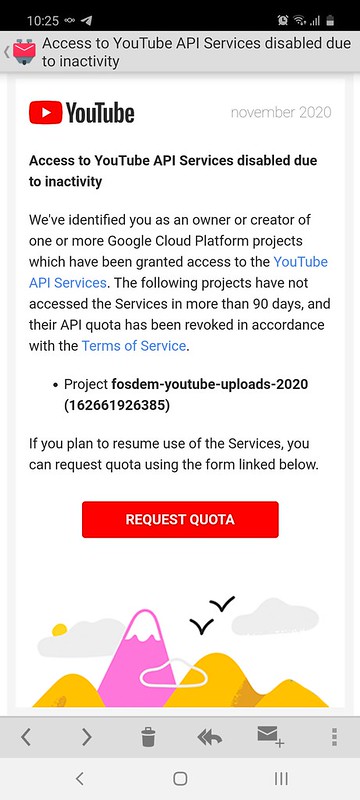
... Why do you have to be so effing difficult about a YouTube API project that is used for a single event per year? FOSDEM creates 600+ videos on a yearly basis. There is no way I am going to manually upload 600+ videos through your webinterface, so we use the API you provide, using a script written by Stefano Rivera. This script grabs video filenames and metadata from a YAML file, and then uses your APIs to upload said videos with said metadata. It works quite well. I run it from cron, and it uploads files until the quota is exhausted, then waits until the next time the cron job runs. It runs so well, that the first time we used it, we could upload 50+ videos on a daily basis, and so the uploads were done as soon as all the videos were created, which was a few months after the event. Cool! The second time we used the script, it did not work at all. We asked one of our key note speakers who happened to be some hotshot at your company, to help us out. He contacted the YouTube people, and whatever had been broken was quickly fixed, so yay, uploads worked again. I found out later that this is actually a normal thing if you don't use your API quota for 90 days or more. Because it's happened to us every bloody year. For the 2020 event, rather than going through back channels (which happened to be unavailable this edition), I tried to use your normal ways of unblocking the API project. This involves creating a screencast of a bloody command line script and describing various things that don't apply to FOSDEM and ghaah shoot me now so meh, I created a new API project instead, and had the uploads go through that. Doing so gives me a limited quota that only allows about 5 or 6 videos per day, but that's fine, it gives people subscribed to our channel the time to actually watch all the videos while they're being uploaded, rather than being presented with a boatload of videos that they can never watch in a day. Also it doesn't overload subscribers, so yay. About three months ago, I started uploading videos. Since then, every day, the "fosdemtalks" channel on YouTube has published five or six videos. Given that, imagine my surprise when I found this in my mailbox this morning... Google lies, claiming that my YouTube API project isn't being used for 90 days and informing me that it will be disabled This is an outright lie, Google. The project has been created 90 days ago, yes, that's correct. It has been used every day since then to upload videos. I guess that means I'll have to deal with your broken automatic content filters to try and get stuff unblocked... ... or I could just give up and not do this anymore. After all, all the FOSDEM content is available on our public video host, too.
15 January 2021

Michael Prokop: Revisiting 2020

* Mainly to recall what happened last year and to give thoughts and plan for the upcoming year(s) I m once again revisiting my previous year (previous editions: 2019, 2018, 2017, 2016, 2015, 2014, 2013 + 2012). Due to the Coronavirus disease (COVID-19) pandemic, 2020 was special for several reasons, but overall I consider myself and my family privileged and am very grateful for that. In terms of IT events, I planned to attend Grazer Linuxdays and DebConf in Haifa/Israel. Sadly Grazer Linuxdays didn t take place at all, and DebConf took place online instead (which I didn t really participate in for several reasons). I took part in the well organized DENOG12 + ATNOG 2020/1 online meetings. I still organize our monthly Security Treff Graz (STG) meetups, and for half of the year, those meetings took place online (which worked OK-ish overall IMO). Only at the beginning of 2020, I managed to play Badminton (still playing in the highest available training class (in german: Kader ) at the University of Graz / Universit ts-Sportinstitut, USI). For the rest of the year except for ~2 weeks in October or so the sessions couldn t occur. Plenty of concerts I planned to attend were cancelled for obvious reasons, including the ones I would have played myself. But I managed to attend Jazz Redoute 2020 Dom im Berg, Martin Grubinger in Musikverein Graz and Emiliano Sampaio s Mega Mereneu Project at WIST Moserhofgasse (all before the corona situation kicked in). The concert from Ton Feinig & RTV Slovenia Big Band occurred under strict regulations in Summer, as well as Elektra Opera by Richard Strau in a very special setting (only one piano player instead of the orchestra because of a Corona case in the orchestra) in Autumn. At the beginning of 2020, I also visited Literaturshow Roboter mit Senf at Literaturhaus Graz. The lack of concerts and rehearsals also severely impacted my playing the drums (including at HTU BigBand Graz), which pretty much didn t take place. :( Grml-wise we managed to publish release 2020.06, codename Ausgehfuahangl. Regarding jenkins-debian-glue I tried to clarify its state and received some really lovely feedback. I consider 2020 as the year where I dropped regular usage of Jabber (so far my accounts still exist, but I m no longer regularly online and am not sure for how much longer I ll keep my accounts alive as such). Business-wise it was our seventh year of business with SynPro Solutions GmbH. No big news but steady and ongoing work with my other business duties Grml Solutions and Grml-Forensic. As usual, I shared childcare with my wife. Due to the corona situation, my wife got a new working schedule, which shuffled around our schedule a bit on Mondays + Tuesdays. Still, we managed to handle the homeschooling/distance learning quite well. Currently we re sitting in the third lockdown, and yet another round of homeschooling/distance learning is going on those days (let s see how long ). I counted 112 actual school days in all of 2020 for our older daughter with only 68 school days since our first lockdown on 16th of March, whereas we had 213(!) press conferences by our Austrian government in 2020. (Further rants about the situation in Austria snipped.) Book reading-wise I managed to complete 60 books (see Mein Lesejahr 2020 ). Once again, I noticed that what felt like good days for me always included reading books, so I ll try to keep my reading pace for 2021. I ll also continue with my hobbies Buying Books and Reading Books , to get worse at Tsundoku. Hoping for vaccination and a more normal 2021, Schwuppdiwupp!

Mike Gabriel: UBports: Packaging of Lomiri Operating Environment for Debian (part 04)

Before and during FOSDEM 2020, I agreed with the people (developers, supporters, managers) of the UBports Foundation to package the Unity8 Operating Environment for Debian. Since 27th Feb 2020, Unity8 has now become Lomiri. Things got delayed a little recently as my main developer contact on the upstream side was on sick leave for a while. Fortunately, he has now fully recovered and work is getting back on track. Recent Uploads to Debian related to Lomiri Over the past 3 months I worked on the following bits and pieces regarding Lomiri in Debian: The next projects / packages ahead are lomiri-ui-toolkit, integrating changes required for Lomiri into Ayatana Indicators and then moving on with several other, smaller packages. Credits Many big thanks go to Marius and Dalton for their work on the UBports project and being always available for questions, feedback, etc. Thanks to Florian Leeber for being my point of contact for topcis regarding my cooperation with the UBports Foundation.

8 January 2021

Dirk Eddelbuettel: #32: Portable Continuous Integration using r-ci

Welcome to the 32th post in the rarely raucous R recommendations series, or R4 for short. This post covers continuous integration, a topic near and dear to many of us who have to recognise its added value. The popular and widely-used service at Travis is undergoing changes driven by a hard-to-argue with need for monetization. A fate that, if we re honest, lies ahead for most free services so who know, maybe one day we have to turn away from other currently ubiquitous service. Because one never knows, it can pay off to not get to tied to any one service. Which brings us to today s post and my r-ci service which allows me to run CI at Travis, at GitHub, at Azure, and on local Docker containers as the video demonstrates. It will likely also work at GitLab and other services, I simply haven t tried any others.

The slides are here. The r-ci website introduces r-ci at a high-level. This repo at GitHub contains run.sh, and can be used to raise issues, ask questions, or provide feedback. If you like this or other open-source work I do, you can sponsor me at GitHub.

This post by Dirk Eddelbuettel originated on his Thinking inside the box blog. Please report excessive re-aggregation in third-party for-profit settings.

7 January 2021

John Goerzen: This Is How Tyrants Go: Alone

I remember reading an essay a month or so ago sadly I forget where talking about how things end for tyrants. If I were to sum it up, it would be with the word alone. Their power fading, they find that they had few true friends or believers; just others that were greedy for power or riches and, finding those no longer to be had, depart the sinking ship. The article looked back at examples like Nixon and examples from the 20th century in Europe and around the world. Today we saw images of a failed coup attempt. But we also saw hope. Already senior staff in the White House are resigning. Ones that had been ardent supporters. In the end, just 6 senators supported the objection to the legitimate electors. Six. Lindsay Graham, Mike Pence, and Mitch McConnel all deserted Trump. CNN reports that there are serious conversations about invoking the 25th amendment and removing him from office, because even Republicans are to the point of believing that America should not have two more weeks of this man. Whether those efforts are successful or not, I don t know. What I do know is that these actions have awakened many people, in a way that nothing else could for four years, to the dangers of Trump and, in the end, have bolstered the cause of democracy. Hard work will remain but today, Donald Trump is in the White House alone, abandoned by allies and blocked by Twitter. And we know that within two weeks, he won t be there at all. We will get through this.

6 January 2021

Urvika Gola: Dog tails and tales from 2020

There is no denying in the fact that 2020 was a challenging year for everybody, including animals. In India, animals such as dogs who mostly filled their bellies at street food stalls, were starving as there were no street eateries operating during a long long lockdown. I was in my home town, New Delhi, working from home like most of us. During the month of July 2020, a dog near the place I live (we fondly called her Brownie) delivered 7 pups in wilderness. I would never forget my first sight of them, inside a dirty, garbage filled land there were the cutest, cleanest, tiniest ball of fur! All of them were toppled as the land s surface was uneven.. The first instinct was to put them all together on a flat surface. After the search mission completed, this was the sight..
Brownie and her litter put together in the same land where she gave birth.
The next day, I sought help from a animal-lover person to build a temporary shed for the puppies! We came and changed sheets, cleaned the surroundings and put fresh water for Brownie until
..it started raining heavily one night and we were worried if the shed would sustain the heavy rainfall.
Next morning the first thing was to check on the pups, luckily, the pups were fine however, the entire area and their bed was damp. Without any second thought, the pups were moved from there to a safe house shelter as it was predicted that the rains will continue for a few more weeks due to monsoon. Soon, 2 months went by, from observing the pups crawl over, their eyes open and to their first bark, despite the struggles, it was an beautiful experience.
Brownie weaned off the pups and thus, they were ready for adoption! However, my biggest fear was, will anyone come forward to adopt them??

With such thoughts parallelly running in my mind, I started to post about adoption for these 7 pups.
To my biggest surprise, one by one, 5 amazing humans came forward and decided to give these pups a better life than what they would get on the streets of India. I wouldn t be able to express in words how grateful I will to be all the five dog parents who decided to adopt an Indian Street Puppy/Indies/Desi Puppy, opening up the space in their hearts and homes for the pups!

One of the 5 adopted pups is adopted by a person who hails from USA, but currently working in India. It s so heartwarming to see, that in India, despite so much awareness created against breeders and their methods, people still prefer to go for foreign bred puppy and disregard Indian/Desi Dogs.. On the other hand, there are foreigners who value the life of a Indian/Desi Dog : )

The 5 Adopted Pups who now have a permanent loving family!

The adorable, Robin !
Don and his new big brother!
The naughty and handsome, Swayze !
First Pup who got adopted Pluto
Playful and Beautiful, Bella !
If this isn t perfect, I don t know what is! God had planned loving families for them and they found it..
However, Its been almost six months now, that we haven t found a permanent home for 2 of the 7 pups, but they have the perfect foster family taking care of them right now.

UP FOR ADOPTION Delhi/NCR
Meet Momo and Beesa,
2 out of the 7 pups, who are still waiting for a forever home, currently living with a loving foster family.

Vaccinations, Deworming is done.
Female pups, 6 months old.

Now as winters are here, Along with one of my friend, who is also fostering the two pups, arranged gunny sack bags for our street, stray dogs. Two NGOs namely, Lotus Indie Foundation and We Exist Foundation who work Animal Welfare in India, were providing dog beds to ground volunteers like us. We are fortunate that they selected us and helped us to make winters less harsh for the stray dogs. However, the cold is such, I also purchased dog coats as well and put in on a few furries. After hours of running behind dogs and convincing them to wear coats, we managed to put it on a few.
Brownie, the mom dog!
This is a puppy!
She did not let us put coat on her
Another topic that needs more sensitivity is Sterilization/Neutering of dogs, that s a viable method cited by the Government to control dog population and end suffering of puppies who die under the wheels of cars. However, the implementation of this is worrisome, as it s not as robust. In a span of 6 months, I managed to get 5 dog sterilized in my area, number is not big but I feel it s a good start as an individual  When I see them now, healthier, happier, running around, with no fear of getting attacked by dogs, I can t express the content I feel. For 2 of the dogs (Brownie and her friend) I got it done personally from a private vet. For the other 3, I got it done via Municipal Corporations who do it for free for dogs, you d have to call them and they come with dog catchers and a van and drop them back in the same area, but volunteers like us have to be very vigilant and active during the whole process to follow up with them.
Dogs getting dropped off after sterilization.
My 2020 ended with this, I am not sure why I am I even writing this in my blog where mostly I focused on my technical work and experiences, but this pandemic was challenging was everybody and what we planned couldn t happen, but because of 2020, because of the pandemic, I was on WFH in my city and I was able to help a few dogs in my area have a healthy life ahead!

What I learned during this entire adventure was, there are a lot of sweet, sensitive, caring people that we are just yet to meet. Along the way, we will also meet insensitive and discouraging people, who are unwilling to change or listen, ignore them and continue your good.

Have 1 person by your side, it s so much stronger than 10 against you. Silver lining! Hope you all had some positive experiences despite the adversity faced by every single one of us.

Next.

Previous.