Search Results: "ag"

25 October 2025

Sam Hartman: My First Successful AI Coding Experience

Yesterday, I had my first successful AI coding experience. I ve used AI coding tools before and come away disappointed. The results were underwhelming: low-quality code, inconsistent abstraction levels, and subtle bugs that take longer to fix than it would take to write the whole thing from scratch. Those problems haven t vanished. The code quality this time was still disappointing. As I asked the AI to refined its work, it would randomly drop important constraints or refactor things in unhelpful ways. And yet, this experience was different and genuinely valuable for two reasons. The first benefit was the obvious one: the AI helped me get over the blank-page problem. It produced a workable skeleton for the project imperfect, but enough to start building on. The second benefit was more surprising. I was working on a problem in odds-ratio preference optimization specifically, finding a way to combine similar examples in datasets for AI training. I wanted an ideal algorithm, one that extracted every ounce of value from the data. The AI misunderstood my description. Its first attempt was laughably simple it just concatenated two text strings. Thanks, but I can call strcat or the Python equivalent without help. However, the second attempt was different. It was still not what I had asked for but as I thought about it, I realized it was good enough. The AI had created a simpler algorithm that would probably solve my problem in practice. In trying too hard to make the algorithm perfect, I d overlooked that the simpler approach might be the right one. The AI, by misunderstanding, helped me see that. This experience reminded me of something that happened years ago when I was mentoring a new developer. They came to me asking how to solve a difficult problem. Rather than telling them it was impossible, I explained what would be required: a complex authorization framework, intricate system interactions, and a series of political and organizational hurdles that would make deployment nearly impossible. A few months later, they returned and said they d found a solution. I was astonished until I looked more closely. What they d built wasn t the full, organization-wide system I had envisioned. Instead, they d reframed the problem. By narrowing the scope reducing the need for global trust and deep integration they d built a local solution that worked well enough within their project. They succeeded precisely because they didn t see all the constraints I did. Their inexperience freed them from assumptions that had trapped me. That s exactly what happened with the AI. It didn t know which boundaries not to cross. In its simplicity, it found a path forward that I had overlooked. My conclusion isn t that AI coding is suddenly great. It s that working with someone or something that thinks differently can open new paths forward. Whether it s an AI, a peer, or a less experienced engineer, that collaboration can bring fresh perspectives that challenge your assumptions and reveal simpler, more practical ways to solve problems.

comment count unavailable comments

Jonathan Dowland: franken keyboard

Since it's spooky season, let me present to you the FrankenKeyboard!
The FrankenKeyboard
8bitdo retro keyboard For some reason I can't fathom, I was persuaded into buying an 8bitdo retro mechanical keyboard. It was very reasonably priced, and has a few nice fun features: built-in bluetooth and 2.4GHz wireless (with the supplied dongle); colour scheme inspired by the Nintendo Famicom; fun to use knobs for volume control; some basic macro support; and funky oversized mashable macro keys (which work really well as "Copy" and "Paste") The 8bitdo keyboards come with switch-types I had not previously experienced: Kailh Box White v2. I'm used to Cherry MX Reds, but I loved the feel of the Box White v2s. The 8bitdo keyboards all have hot-swappable key switches. It's relatively compact (comes without a numpad), but still larger than my TEX Shura, which (at home) is my daily driver. I also miss the trackpoint mouse on the Shura. Finally, the 8bitdo model I bought has American ANSI key layout, which I can tolerate but is not as nice as ISO. I later learned that they have a limited range of ISO-layout keyboards too, but not (yet) in the Famicom colour scheme I'd bought. DIY Shura My existing Shura's key switches are soldered on and can't be swapped out. But I really preferred the Kailh white switches. I decided to buy a second Shura, this time as a "DIY kit" which accepts hot-swappable switches. I then moved the Kailh Box White v2 switches over from the 8bitdo keyboard. keycaps Part of justifying buying the DIY kit was the possibility that I could sell on my older Shura with the Cherry MX Red switches. My existing Shura's key caps are for the ISO-GB layout and have their legends printed onto them. After three years the legends have faded in a few places. The DIY kit comes with a set of ABS "double-shot" key caps (where the key legends are plastic rather than printed). They look a lot nicer, but I don't look at my keys. I'm considering applying the new, pristine key caps to the old Shura board, to make it more attractive to buyers. One problem is I'm not sure the new set of caps includes the ISO-UK specific ones. It might be that potential buyers might prefer to have used caps with the correct legends rather than pristine ones which are mislabelled. franken keyboard Given I wasn't going to use the new key cap set, I borrowed most of the caps from the 8bitdo keyboard. I had to retain the G, H and B keys from my older Shura as they are specially molded to leave space for the trackpoint, and a couple of the modifier keys which weren't the right size. Hence the odd look! (It needs some tweaking. That left-ALT looks out of place. It may be that the 8bitdo caps are temporary. Left "cmd" is really Fn, and "Caps lock" is really "Super". The right-hand red dot is a second "Super".) Since taking the photo I've removed the "stabilisers" under the right-shift and backspace keys, in order to squeeze a couple more keys in their place. the new keycap set includes a regular-sized "BS" key, as the JIS keyboard layout has a regular-sized backspace. (Everyone should have a BS key in my opinion.) I plan to map my new keys to "Copy" and "Paste" actions following the advice in this article.

23 October 2025

Russ Allbery: Review: Politics on the Edge

Review: Politics on the Edge, by Rory Stewart
Publisher: Penguin Books
Copyright: 2023, 2025
Printing: 2025
ISBN: 979-8-217-06167-9
Format: Kindle
Pages: 429
Rory Stewart is a former British diplomat, non-profit executive, member of Parliament, and cabinet minister. Politics on the Edge is a memoir of his time in the UK Parliament from 2019 to 2019 as a Tory (Conservative) representing the Penrith and The Border constituency in northern England. It ends with his failed run against Boris Johnson for leader of the Conservative Party and Prime Minister. This book provoked many thoughts, only some of which are about the book. You may want to get a beverage; this review will be long. Since this is a memoir told in chronological order, a timeline may be useful. After Stewart's time as a regional governor in occupied Iraq (see The Prince of the Marshes), he moved to Kabul to found and run an NGO to preserve traditional Afghani arts and buildings (the Turquoise Mountain Foundation, about which I know nothing except what Stewart wrote in this book). By his telling, he found that work deeply rewarding but thought the same politicians who turned Iraq into a mess were going to do the same to Afghanistan. He started looking for ways to influence the politics more directly, which led him first to Harvard and then to stand for Parliament. The bulk of this book covers Stewart's time as MP for Penrith and The Border. The choice of constituency struck me as symbolic of Stewart's entire career: He was not a resident and had no real connection to the district, which he chose for political reasons and because it was the nearest viable constituency to his actual home in Scotland. But once he decided to run, he moved to the district and seems sincerely earnest in his desire to understand it and become part of its community. After five years as a backbencher, he joined David Cameron's government in a minor role as Minister of State in the Department for Environment, Food, and Rural Affairs. He then bounced through several minor cabinet positions (more on this later) before being elevated to Secretary of State for International Development under Theresa May. When May's government collapsed during the fight over the Brexit agreement, he launched a quixotic challenge to Boris Johnson for leader of the Conservative Party. I have enjoyed Rory Stewart's writing ever since The Places in Between. This book is no exception. Whatever one's other feelings about Stewart's politics (about which I'll have a great deal more to say), he's a talented memoir writer with an understated and contemplative style and a deft ability to shift from concrete description to philosophical debate without bogging down a story. Politics on the Edge is compelling reading at the prose level. I spent several afternoons happily engrossed in this book and had great difficulty putting it down. I find Stewart intriguing since, despite being a political conservative, he's neither a neoliberal nor any part of the new right. He is instead an apparently-sincere throwback to a conservatism based on epistemic humility, a veneration of rural life and long-standing traditions, and a deep commitment to the concept of public service. Some of his principles are baffling to me, and I think some of his political views are obvious nonsense, but there were several things that struck me throughout this book that I found admirable and depressingly rare in politics. First, Stewart seems to learn from his mistakes. This goes beyond admitting when he was wrong and appears to include a willingness to rethink entire philosophical positions based on new experience.
I had entered Iraq supporting the war on the grounds that we could at least produce a better society than Saddam Hussein's. It was one of the greatest mistakes in my life. We attempted to impose programmes made up by Washington think tanks, and reheated in air-conditioned palaces in Baghdad a new taxation system modelled on Hong Kong; a system of ministers borrowed from Singapore; and free ports, modelled on Dubai. But we did it ultimately at the point of a gun, and our resources, our abstract jargon and optimistic platitudes could not conceal how much Iraqis resented us, how much we were failing, and how humiliating and degrading our work had become. Our mission was a grotesque satire of every liberal aspiration for peace, growth and democracy.
This quote comes from the beginning of this book and is a sentiment Stewart already expressed in The Prince of the Marshes, but he appears to have taken this so seriously that it becomes a theme of his political career. He not only realized how wrong he was on Iraq, he abandoned the entire neoliberal nation-building project without abandoning his belief in the moral obligation of international aid. And he, I think correctly, identified a key source of the error: an ignorant, condescending superiority that dismissed the importance of deep expertise.
Neither they, nor indeed any of the 12,000 peacekeepers and policemen who had been posted to South Sudan from sixty nations, had spent a single night in a rural house, or could complete a sentence in Dinka, Nuer, Azande or Bande. And the international development strategy written jointly between the donor nations resembled a fading mission statement found in a new space colony, whose occupants had all been killed in an alien attack.
Second, Stewart sincerely likes ordinary people. This shone through The Places in Between and recurs here in his descriptions of his constituents. He has a profound appreciation for individual people who have spent their life learning some trade or skill, expresses thoughtful and observant appreciation for aspects of local culture, and appears to deeply appreciate time spent around people from wildly different social classes and cultures than his own. Every successful politician can at least fake gregariousness, and perhaps that's all Stewart is doing, but there is something specific and attentive about his descriptions of other people, including long before he decided to enter politics, that makes me think it goes deeper than political savvy. Third, Stewart has a visceral hatred of incompetence. I think this is the strongest through-line of his politics in this book: Jobs in government are serious, important work; they should be done competently and well; and if one is not capable of doing that, one should not be in government. Stewart himself strikes me as an insecure overachiever: fiercely ambitious, self-critical, a bit of a micromanager (I suspect he would be difficult to work for), but holding himself to high standards and appalled when others do not do the same. This book is scathing towards multiple politicians, particularly Boris Johnson whom Stewart clearly despises, but no one comes off worse than Liz Truss.
David Cameron, I was beginning to realise, had put in charge of environment, food and rural affairs a Secretary of State who openly rejected the idea of rural affairs and who had little interest in landscape, farmers or the environment. I was beginning to wonder whether he could have given her any role she was less suited to apart perhaps from making her Foreign Secretary. Still, I could also sense why Cameron was mesmerised by her. Her genius lay in exaggerated simplicity. Governing might be about critical thinking; but the new style of politics, of which she was a leading exponent, was not. If critical thinking required humility, this politics demanded absolute confidence: in place of reality, it offered untethered hope; instead of accuracy, vagueness. While critical thinking required scepticism, open-mindedness and an instinct for complexity, the new politics demanded loyalty, partisanship and slogans: not truth and reason but power and manipulation. If Liz Truss worried about the consequences of any of this for the way that government would work, she didn't reveal it.
And finally, Stewart has a deeply-held belief in state capacity and capability. He and I may disagree on the appropriate size and role of the government in society, but no one would be more disgusted by an intentional project to cripple government in order to shrink it than Stewart. One of his most-repeated criticisms of the UK political system in this book is the way the cabinet is formed. All ministers and secretaries come from members of Parliament and therefore branches of government are led by people with no relevant expertise. This is made worse by constant cabinet reshuffles that invalidate whatever small amounts of knowledge a minister was able to gain in nine months or a year in post. The center portion of this book records Stewart's time being shuffled from rural affairs to international development to Africa to prisons, with each move representing a complete reset of the political office and no transfer of knowledge whatsoever.
A month earlier, they had been anticipating every nuance of Minister Rogerson's diary, supporting him on shifts twenty-four hours a day, seven days a week. But it was already clear that there would be no pretence of a handover no explanation of my predecessor's strategy, and uncompleted initiatives. The arrival of a new minister was Groundhog Day. Dan Rogerson was not a ghost haunting my office, he was an absence, whose former existence was suggested only by the black plastic comb.
After each reshuffle, Stewart writes of trying to absorb briefings, do research, and learn enough about his new responsibilities to have the hope of making good decisions, while growing increasingly frustrated with the system and the lack of interest by most of his colleagues in doing the same. He wants government programs to be successful and believes success requires expertise and careful management by the politicians, not only by the civil servants, a position that to me both feels obviously correct and entirely at odds with politics as currently practiced. I found this a fascinating book to read during the accelerating collapse of neoliberalism in the US and, to judge by current polling results, the UK. I have a theory that the political press are so devoted to a simplistic left-right political axis based on seating arrangements during the French Revolution that they are missing a significant minority whose primary political motivation is contempt for arrogant incompetence. They could be convinced to vote for Sanders or Trump, for Polanski or Farage, but will never vote for Biden, Starmer, Romney, or Sunak. Such voters are incomprehensible to those who closely follow and debate policies because their hostile reaction to the center is not about policies. It's about lack of trust and a nebulous desire for justice. They've been promised technocratic competence and the invisible hand of market forces for most of their lives, and all of it looks like lies. Everyday living is more precarious, more frustrating, more abusive and dehumanizing, and more anxious, despite (or because of) this wholehearted embrace of economic "freedom." They're sick of every complaint about the increasing difficulty of life being met with accusations about their ability and work ethic, and of being forced to endure another round of austerity by people who then catch a helicopter ride to a party on some billionaire's yacht. Some of this is inherent in the deep structural weaknesses in neoliberal ideology, but this is worse than an ideological failure. The degree to which neoliberalism started as a project of sincere political thinkers is arguable, but that is clearly not true today. The elite class in politics and business is now thoroughly captured by people whose primary skill is the marginal manipulation of complex systems for their own power and benefit. They are less libertarian ideologues than narcissistic mediocrities. We are governed by management consultants. They are firmly convinced their organizational expertise is universal, and consider the specific business of the company, or government department, irrelevant. Given that context, I found Stewart's instinctive revulsion towards David Cameron quite revealing. Stewart, later in the book, tries to give Cameron some credit by citing several policy accomplishments and comparing him favorably to Boris Johnson (which, true, is a bar Cameron probably flops over). But I think Stewart's baffled astonishment at Cameron's vapidity says a great deal about how we have ended up where we are. This last quote is long, but I think it provides a good feel for Stewart's argument in this book.
But Cameron, who was rumoured to be sceptical about nation-building projects, only nodded, and then looking confidently up and down the table said, "Well, at least we all agree on one extremely straightforward and simple point, which is that our troops are doing very difficult and important work and we should all support them." It was an odd statement to make to civilians running humanitarian operations on the ground. I felt I should speak. "No, with respect, we do not agree with that. Insofar as we have focused on the troops, we have just been explaining that what the troops are doing is often futile, and in many cases making things worse." Two small red dots appeared on his cheeks. Then his face formed back into a smile. He thanked us, told us he was out of time, shook all our hands, and left the room. Later, I saw him repeat the same line in interviews: "the purpose of this visit is straightforward... it is to show support for what our troops are doing in Afghanistan". The line had been written, in London, I assumed, and tested on focus groups. But he wanted to convince himself it was also a position of principle. "David has decided," one of his aides explained, when I met him later, "that one cannot criticise a war when there are troops on the ground." "Why?" "Well... we have had that debate. But he feels it is a principle of British government." "But Churchill criticised the conduct of the Boer War; Pitt the war with America. Why can't he criticise wars?" "British soldiers are losing their lives in this war, and we can't suggest they have died in vain." "But more will die, if no one speaks up..." "It is a principle thing. And he has made his decision. For him and the party." "Does this apply to Iraq too?" "Yes. Again he understands what you are saying, but he voted to support the Iraq War, and troops are on the ground." "But surely he can say he's changed his mind?" The aide didn't answer, but instead concentrated on his food. "It is so difficult," he resumed, "to get any coverage of our trip." He paused again. "If David writes a column about Afghanistan, we will struggle to get it published." "But what would he say in an article anyway?" I asked. "We can talk about that later. But how do you get your articles on Afghanistan published?" I remembered how the US politicians and officials had shown their mastery of strategy and detail. I remembered the earnestness of Gordon Brown when I had briefed him on Iraq. Cameron seemed somehow less serious. I wrote as much in a column in the New York Times, saying that I was afraid the party of Churchill was becoming the party of Bertie Wooster.
I don't know Stewart's reputation in Britain, or in the constituency that he represented. I know he's been accused of being a self-aggrandizing publicity hound, and to some extent this is probably true. It's hard to find an ambitious politician who does not have that instinct. But whatever Stewart's flaws, he can, at least, defend his politics with more substance than a corporate motto. One gets the impression that he would respond favorably to demonstrated competence linked to a careful argument, even if he disagreed. Perhaps this is an illusion created by his writing, but even if so, it's a step in the right direction. When people become angry enough at a failing status quo, any option that promises radical change and punishment for the current incompetents will sound appealing. The default collapse is towards demagogues who are skilled at expressing anger and disgust and are willing to promise simple cures because they are indifferent to honesty. Much of the political establishment in the US, and possibly (to the small degree that I can analyze it from an occasional news article) in the UK, can identify the peril of the demagogue, but they have no solution other than a return to "politics as usual," represented by the amoral mediocrity of a McKinsey consultant. The rare politicians who seem to believe in something, who will argue for personal expertise and humility, who are disgusted by incompetence and have no patience for facile platitudes, are a breath of fresh air. There are a lot of policies on which Stewart and I would disagree, and perhaps some of his apparent humility is an affectation from the rhetorical world of the 1800s that he clearly wishes he were inhabiting, but he gives the strong impression of someone who would shoulder a responsibility and attempt to execute it with competence and attention to detail. He views government as a job, where coworkers should cooperate to achieve defined goals, rather than a reality TV show. The arc of this book, like the arc of current politics, is the victory of the reality TV show over the workplace, and the story of Stewart's run against Boris Johnson is hard reading because of it, but there's a portrayal here of a different attitude towards politics that I found deeply rewarding. If you liked Stewart's previous work, or if you want an inside look at parliamentary politics, highly recommended. I will be thinking about this book for a long time. Rating: 9 out of 10

21 October 2025

Gunnar Wolf: LLM Hallucinations in Practical Code Generation Phenomena, Mechanism, and Mitigation

This post is a review for Computing Reviews for LLM Hallucinations in Practical Code Generation Phenomena, Mechanism, and Mitigation , a article published in Proceedings of the ACM on Software Engineering, Volume 2, Issue ISSTA
How good can large language models (LLMs) be at generating code? This may not seem like a very novel question, as several benchmarks (for example, HumanEval and MBPP, published in 2021) existed before LLMs burst into public view and started the current artificial intelligence (AI) inflation. However, as the paper s authors point out, code generation is very seldom done as an isolated function, but instead must be deployed in a coherent fashion together with the rest of the project or repository it is meant to be integrated into. Today, several benchmarks (for example, CoderEval or EvoCodeBench) measure the functional correctness of LLM-generated code via test case pass rates. This paper brings a new proposal to the table: comparing LLM-generated repository-level evaluated code by examining the hallucinations generated. The authors begin by running the Python code generation tasks proposed in the CoderEval benchmark against six code-generating LLMs. Next, they analyze the results and build a taxonomy to describe code-based LLM hallucinations, with three types of conflicts (task requirement, factual knowledge, and project context) as first-level categories and eight subcategories within them. The authors then compare the results of each of the LLMs per the main hallucination category. Finally, they try to find the root cause for the hallucinations. The paper is structured very clearly, not only presenting the three research questions (RQ) but also referring to them as needed to explain why and how each partial result is interpreted. RQ1 (establishing a hallucination taxonomy) is the most thoroughly explored. While RQ2 (LLM comparison) is clear, it just presents straightforward results without much analysis. RQ3 (root cause discussion) is undoubtedly interesting, but I feel it to be much more speculative and not directly related to the analysis performed. After tackling their research questions, Zhang et al. propose a possible mitigation to counter the effect of hallucinations: enhance the LLM with retrieval-augmented generation (RAG) so it better understands task requirements, factual knowledge, and project context. The presented results show that all of the models are clearly (though modestly) improved by the proposed RAG-based mitigation. The paper is clearly written and easy to read. It should provide its target audience with interesting insights and discussions. I would have liked more details on their RAG implementation, but I suppose that s for a follow-up work.

Emmanuel Kasper: How configuration is passed from the BinderHub helm chart to a running BinderHub

Context: At $WORK I am doing a lot of datascience work around Jupyter Notebooks and their ecosystem. Right now I am setting BinderHub, which is a service to start a Jupyter Notebook from a git repo in your browser. For setting up BinderHub I am using the BinderHub helm chart, and I was wondering how configuration changes are propagated from the BinderHub helm chart to the process running in a Kubernetes Pod. After going through this I can say I am not right now a great fan of Helm, as it looks to me like an unnecessary, overengineered abstraction layer on top of Kubernetes manifests. Or maybe it is just that I don t want to learn the golang templating synthax. I am looking forward to testing Kustomize as an alternative, but I havn t had the chance yet. Starting from the list of config parameters available: Although many parameters are mentioned in the installer document, you have to go to the developer doc at https://binderhub.readthedocs.io/en/latest/reference/ref-index.html to get a whole overview. In my case I want to set the hostname parameter for the Gitlab Repoprovider. This is the relevelant snippet in the developer doc:
hostname c.GitLabRepoProvider.hostname = Unicode('gitlab.com')
    The host of the GitLab instance
The string c.GitLabRepoProvider.hostname here means, that the value of the hostname parameter will be loaded at the path config.GitLabRepoProvider inside a configuration file. Using the yaml synthax this means the configuration file should contain a snippet like:
config:
  GitlabRepoProvider
    hostname: my-domain.com
Digging through Kubernetes constructs: Helm values files When installing BinderHub using the provided helm chart, we can either put the configuration snippet in the config.yaml or secret.yaml helm values files. In my case I have put the snippet in config.yaml, since the hostname is not a secret thing, I can verify with yq that it correctly set:
$ yq --raw-output '.config.GitLabRepoProvider.hostname' config.yaml
my-domain.com
How do we make sure this parameter is properly applied to our running binder processes ? As said previouly this parameter is passed as a value file to helm ( value or -f option) in the command:
$ helm upgrade \                                                                                  
    binderhub \                                                                                     
    jupyterhub/binderhub \                                                                          
    --install \                                                                                     
    --version=$(RELEASE) \                                                                          
    --create-namespace \                                                                            
    --namespace=binderhub \                                                                         
    --values secret.yaml \                                                                                
    --values config.yaml \                                                                                
    --debug 
According to the helm documentation in https://helm.sh/docs/helm/helm_install/ the values file are concatenated to form a single object, and priority will be given to the last (right-most) file specified. For example, if both myvalues.yaml and override.yaml contained a key called Test , the value set in override.yaml would take precedence:
$ helm install --values myvalues.yaml --values override.yaml  myredis ./redis
Digging through Kubernetes constructs: Secrets and Volumes When helm upgrade is run the helm values of type config are stashed in a Kubernetes secret binder-secret: https://github.com/jupyterhub/binderhub/blob/main/helm-chart/binderhub/templates/secret.yaml#L12
stringData:
   - /*
    Stash away relevant Helm template values for
    the BinderHub Python application to read from
    in binderhub_config.py.
  */ 
  values.yaml:  
     - pick .Values "config" "imageBuilderType" "cors" "dind" "pink" "extraConfig"   toYaml   nindent 4  
We can verify that our hostname is passed to our Secret:
$ kubectl get secret binder-secret -o yaml   yq --raw-output '.data."values.yaml"'    base64 --decode
...
  GitLabRepoProvider:
    hostname: my-domain.com
...
Finally a configuration file inside the Binder pod is populated from the Secret, using the Kubernetes Volume construct. Looking at the Pod, we do see a volume called config, created from the binder-secret Secret:
$ kubectl get pod -l component=binder -o yaml   grep --context 4 binder-secret
    volumes:
    - name: config
      secret:
        defaultMode: 420
        secretName: binder-secret
That volume is mounted inside the pod at /etc/binderhub/config:
      volumeMounts:
      - mountPath: /etc/binderhub/config/
        name: config
        readOnly: true
Runtime verification Looking inside our pod we see our hostname value available in a file underneath the mount point:
oc exec binder-74d9c7db95-qtp8r -- grep hostname /etc/binderhub/config/values.yaml
    hostname: my-domain.com

Russ Allbery: Review: Space Trucker Jess

Review: Space Trucker Jess, by Matthew Kressel
Publisher: Fairwood Press
Copyright: July 2025
ISBN: 1-958880-27-2
Format: Kindle
Pages: 472
Space Trucker Jess is a stand-alone far-future space fantasy novel. Jess is a sixteen-year-old mechanic working grey-market jobs on Chadeisson Station with a couple of younger kids. She's there because her charming and utterly unreliable father got caught running a crypto scam and is sitting in detention. This was only the latest in a long series of scams, con jobs, and misadventures she's been dragged through since her mother disappeared without a word. Jess is cynical, world-weary, and infuriated by her own sputtering loyalty to her good-for-nothing dad. What Jess wants most in the universe is to own a CCM 6454 Spark Megahauler, the absolute best cargo ship in the universe according to Jess. She should know; she's worked on nearly every type of ship in existence. With her own ship, she could make a living hauling cargo, repairing her own ship, and going anywhere she wants, free of her father and his endless schemes. (A romantic relationship with her friend Leurie would be a nice bonus.) Then her father is taken off the station on a ship leaving the galactic plane, no one will tell her why, and all the records of the ship appear to have been erased. Jess thinks her father is an asshole, but that doesn't mean she can sit idly by when he disappears. That's how she ends up getting in serious trouble with station security due to some risky in-person sleuthing, followed by an expensive flight off the station with a dodgy guy and a kid in a stolen spaceship. The setup for this book was so great. Kressel felt the need to make up a futuristic slang for Jess and her friends to speak, which rarely works as well as the author expects and does not work here, but apart from that I was hooked. Jess is sarcastic, blustery, and a bit of a con artist herself, but with the idealistic sincerity of someone who knows that her life is been kind of broken and understands the value of friends. She's profoundly cynical in the heartbreakingly defensive way of a sixteen-year-old with a rough life. I have a soft spot in my heart for working-class science fiction (there isn't nearly enough of it), and there are few things I enjoy more than reading about the kind of protagonist who has Opinions about starship models and a dislike of shoddy work. I think this is the only book I've bought solely on the basis of one of the Big Idea blog posts John Scalzi hosts. I really wish this book had stuck with the setup instead of morphing into a weird drug-enabled mystical space fantasy, to which Jess's family is bizarrely central. SPOILERS below because I can't figure out how to rant about what annoyed me without them. Search for the next occurrence of spoilers to skip past them. There are three places where this book lost me. The first was when Jess, after agreeing to help another kid find his father, ends up on a world obsessed with a religious cult involving using hallucinatory drugs to commune with alien gods. Jess immediately flags this as unbelievable bullshit and I was enjoying her well-founded cynicism until Kressel pulls the rug out from under both Jess and the reader by establishing that this new-age claptrap is essentially true. Kressel does try to put a bit of a science fiction gloss on it, but sadly I think that effort was unsuccessful. Sometimes absurdly powerful advanced aliens with near-telepathic powers are part of the fun of a good space opera, but I want the author to make an effort to connect the aliens to plausibility or, failing that, at least avoid sounding indistinguishable from psychic self-help grifters or religious fantasy about spiritual warfare. Stargate SG-1 and Babylon 5 failed on the first part but at least held the second line. Kressel gets depressingly close to Seth territory, although at least Jess is allowed to retain some cynicism about motives. The second, related problem is that Jess ends up being a sort of Chosen One, which I found intensely annoying. This may be a fault of reader expectations more than authorial skill, but one of the things I like to see in working-class science fiction is for the protagonist to not be absurdly central to the future of the galaxy, or to at least force themselves into that position through their own ethics and hard work. This book turns into a sort of quest story with epic fantasy stakes, which I thought was much less interesting than the story the start of the book promised and which made Jess a less interesting character. Finally, this is one of those books where Jess's family troubles and the plot she stumbles across turn into the same plot. Space Trucker Jess is far from alone in having that plot structure, and that's the problem. I'm not universally opposed to this story shape, but Jess felt like the wrong character for it. She starts the story with a lot of self-awareness about how messed up her family dynamics were, and I was rooting for her to find some space to construct her own identity separate from her family. To have her family turn out to be central not only to this story but to the entire galaxy felt like it undermined that human core of the story, although I admit it's a good analogy to the type of drama escalation that dysfunctional families throw at anyone attempting to separate from them. Spoilers end here. I rather enjoyed the first third of this book, despite being a bit annoyed at the constructed slang, and then started rolling my eyes and muttering things about the story going off the rails. Jess is a compelling enough character (and I'm stubborn enough) that I did finish the book, so I can say that I liked the very end. Kressel does finally arrive at the sort of story that I wanted to read all along. Unfortunately, I didn't enjoy the path he took to get there. I think much of my problem was that I wanted Jess to be a more defiant character earlier in the novel, and I wanted her family problems to influence her character growth but not be central to her story. Both of these may be matters of opinion and an artifact of coming into the book with the wrong assumptions. If you are interested in a flawed and backsliding effort to untangle one's identity from a dysfunctional family and don't mind some barely-SF space mysticism and chosen one vibes, it's possible this book will click with you. It's not one that I can recommend, though. I still want the book that I hoped I was getting from that Big Idea piece. Rating: 4 out of 10

20 October 2025

Matthew Garrett: Where are we on X Chat security?

AWS had an outage today and Signal was unavailable for some users for a while. This has confused some people, including Elon Musk, who are concerned that having a dependency on AWS means that Signal could somehow be compromised by anyone with sufficient influence over AWS (it can't). Which means we're back to the richest man in the world recommending his own "X Chat", saying The messages are fully encrypted with no advertising hooks or strange AWS dependencies such that I can t read your messages even if someone put a gun to my head.

Elon is either uninformed about his own product, lying, or both.

As I wrote back in June, X Chat genuinely end-to-end encrypted, but ownership of the keys is complicated. The encryption key is stored using the Juicebox protocol, sharded between multiple backends. Two of these are asserted to be HSM backed - a discussion of the commissioning ceremony was recently posted here. I have not watched the almost 7 hours of video to verify that this was performed correctly, and I also haven't been able to verify that the public keys included in the post were the keys generated during the ceremony, although that may be down to me just not finding the appropriate point in the video (sorry, Twitter's video hosting doesn't appear to have any skip feature and would frequently just sit spinning if I tried to seek to far and I should probably just download them and figure it out but I'm not doing that now). With enough effort it would probably also have been possible to fake the entire thing - I have no reason to believe that this has happened, but it's not externally verifiable.

But let's assume these published public keys are legitimately the ones used in the HSM Juicebox realms[1] and that everything was done correctly. Does that prevent Elon from obtaining your key and decrypting your messages? No.

On startup, the X Chat client makes an API call called GetPublicKeysResult, and the public keys of the realms are returned. Right now when I make that call I get the public keys listed above, so there's at least some indication that I'm going to be communicating with actual HSMs. But what if that API call returned different keys? Could Elon stick a proxy in front of the HSMs and grab a cleartext portion of the key shards? Yes, he absolutely could, and then he'd be able to decrypt your messages.

(I will accept that there is a plausible argument that Elon is telling the truth in that even if you held a gun to his head he's not smart enough to be able to do this himself, but that'd be true even if there were no security whatsoever, so it still says nothing about the security of his product)

The solution to this is remote attestation - a process where the device you're speaking to proves its identity to you. In theory the endpoint could attest that it's an HSM running this specific code, and we could look at the Juicebox repo and verify that it's that code and hasn't been tampered with, and then we'd know that our communication channel was secure. Elon hasn't done that, despite it being table stakes for this sort of thing (Signal uses remote attestation to verify the enclave code used for private contact discovery, for instance, which ensures that the client will refuse to hand over any data until it's verified the identity and state of the enclave). There's no excuse whatsoever to build a new end-to-end encrypted messenger which relies on a network service for security without providing a trustworthy mechanism to verify you're speaking to the real service.

We know how to do this properly. We have done for years. Launching without it is unforgivable.

[1] There are three Juicebox realms overall, one of which doesn't appear to use HSMs, but you need at least two in order to obtain the key so at least part of the key will always be held in HSMs

comment count unavailable comments

Dirk Eddelbuettel: RcppArmadillo 15.2.0-0 on GitHub: New Upstream, Simpler OpenMP

armadillo image Armadillo is a powerful and expressive C++ template library for linear algebra and scientific computing. It aims towards a good balance between speed and ease of use, has a syntax deliberately close to Matlab, and is useful for algorithm development directly in C++, or quick conversion of research code into production environments. RcppArmadillo integrates this library with the R environment and language and is widely used by (currently) 1270 other packages on CRAN, downloaded 42 million times (per the partial logs from the cloud mirrors of CRAN), and the CSDA paper (preprint / vignette) by Conrad and myself has been cited 650 times according to Google Scholar. This versions updates to the 15.2.0 upstream release made today. It brings a few changes over Armadillo 15.0 (see below for more). It follows the most recent RcppArmadillo 15.0.2-2 release and the Armadillo 15 upstream transition with its dual focus on moving on from C++11 and deprecation of a number of API access points. As we had a few releases last month to manage the transition, we will sit this upgrade out and not upload to CRAN in order to normalize our update cadence towards the desired about six in six months (that the CRAN Policy asks for). One can of course install as usual directly from the GitHub repository as well as from r-universe which also offers binaries for all CRAN platforms. The transition to Armadillo 15 appears to be going slowly but steadily. We had well over 300 packages with either a need to relax the C++11 setting and/or update away from now-deprecated API access points. That number has been cut in half thanks to a lot of work from a lot of package maintainers which is really appreciated! Of course, a lot remains to be done. Issues #489 and #491 contain the over sixty PRs and patches I prepared for all packages with at least one reverse dependency. Most (but not all) have aided in CRAN updates, some packages are still outstanding in terms of updates. As before meta-issue #475 regroups all the resources for the transition. If you, dear reader, have a package that is affected and I could be of assistance please do reach out. The other change we made is to greatly simplify the detection and setup of OpenMP. As before, we rely on configure to attempt compilation of a minimal OpenMP-using program in order to pass the success or failure onto Armadillo as a can-or-cannot use OpenMP. In the year 2025 one of the leading consumer brands still cannot ship an OS where this works out of the box, so we try to aide there. For all others systems, R actually covers this pretty well and has a reliable configuration variable that we rely upon. Just as we recommend for downstream users of the package. This setup should be robust, but is a change so by all means if you knowingly rely on OpenMP please test and report back. The detailed changes since the last CRAN release follow.

Changes in RcppArmadillo version 15.2.0-0 (2025-10-20) (GitHub Only)
  • Upgraded to Armadillo release 15.2.0 (Medium Roast Deluxe)
    • Added rande() for generating matrices with elements from exponential distributions
    • shift() has been deprecated in favour of circshift(), for consistency with Matlab/Octave
    • Reworked detection of aliasing, leading to more efficient compiled code
  • OpenMP detection in configure has been simplified

More detailed information is on the RcppArmadillo page. Questions, comments etc should go to the rcpp-devel mailing list off the Rcpp R-Forge page.

This post by Dirk Eddelbuettel originated on his Thinking inside the box blog. If you like this or other open-source work I do, you can sponsor me at GitHub.

Thomas Lange: New FAI images available, Rocky Linux 10 and AlmaLinux 10 support

New FAI ISOs using FAI 6.4.3 are available. They are using Debian 13 aka trixie, kernel 6.12 and you can now install Rocky Linux 10 and AlmaLinux 10 using these images. There's also a variant for installing Linux Mint 22.2 and Ubuntu 24.04 which includes all packages on the ISO.

Birger Schacht: A plea for <dialog>

A couple of weeks ago there was an article on the Freexian blog about Using JavaScript in Debusine without depending on JavaScript. It describes how JavaScript is used in the Debusine Django app, namely for progressive enhancement rather than core functionality . This is an approach I also follow when implementing web interfaces and I think developments in web technologies and standardization in recent years have made this a lot easier. One of the examples described in the post, the Bootstrap toast messages, was something that I implemented myself recently, in a similar but slightly different way. In the main app I develop for my day job we also use the Bootstrap framework. I have also used it for different personal projects (for example the GSOC project I did for Debian in 2018, was also a Django app that used Bootstrap). Bootstrap is still primarily a CSS framework, but it also comes with a JavaScript library for some functionality. Previous versions of Bootstrap depended on jQuery, but since version 5 of Bootstrap, you don t need jQuery anymore. In my experience, two of the more commonly used JavaScript utilities of Bootstrap are modals (also called lightbox or popup, they are elements that are displayed above the main content of a website) and toasts (also called alerts, they are little notification windows that often disappear after a timeout). The thing is, Bootstrap 5 was released in 2021 and a lot has happened since then regarding web technologies. I believe that both these UI components can nowadays be implemented using standard HTML5 elements. An eye opening talk I watched was Stop using JS for that from last years JSConf(!). In this talk the speaker argues that the Rule of least power is one of the core principles of web development, which means we should use HTML over CSS and CSS over JavaScript. And the speaker also presents some CSS rules and HTML elements that added recently and that help to make that happen, one of them being the dialog element:
The <dialog> HTML element represents a modal or non-modal dialog box or other interactive component, such as a dismissible alert, inspector, or subwindow. The Dialog element at MDN
The baseline for this element is widely available :
This feature is well established and works across many devices and browser versions. It s been available across browsers since March 2022. The Dialog element at MDN
This means there is an HTML element that does what a modal Bootstrap does! Once I had watched that talk I removed all my Bootstrap modals and replaced them with HTML <dialog> elements (JavaScript is still needed to .show() and .close() the elements, though, but those are two methods instead of a full library). This meant not only that I replaced code that depended on an external library, I m now also a lot more flexible regarding the styling of the elements. When I started implementing notifications for our app, my first approach was to use Bootstrap toasts, similar to how it is implemented in Debusine. But looking at the amount of HTML code I had to write for a simple toast message, I thought that it might be possible to also implement toasts with the <dialog> element. I mean, basically it is the same, only the styling is a bit different. So what I did was that I added a #snackbar area to the DOM of the app. This would be the container for the toast messages. All the toast messages are simply <dialog> elements with the open attribute, which means that they are visible right away when the page loads.
<div id="snackbar">
   % for message in messages % 
    <dialog class="mytoast alert alert-  message.tags  " role="alert" open>
        message  
    </dialog>
   % endfor % 
</div>
This looks a lot simpler than the Bootstrap toasts would have. To make the <dialog> elements a little bit more fancy, I added some CSS to make them fade in and out:
.mytoast  
    z-index: 1;
    animation: fadein 0.5s, fadeout 0.5s 2.6s;
 
@keyframes fadein  
    from  
        opacity: 0;
     
    to  
        opacity: 1;
     
 
@keyframes fadeout  
    from  
        opacity: 1;
     
    to  
        opacity: 0;
     
 
To close a <dialog> element once it has faded away, I had to add one JavaScript event listener:
window.addEventListener('load', () =>  
    document.querySelectorAll(".mytoast").forEach((element) =>  
        element.addEventListener('animationend', function(e)  
            e.animationName == "fadeout" && element.close();
         );
     );
 );
(If one would want to use the same HTML code for both script and noscript users, then the CSS should probably adapted: it fades away and if there is no JavaScript to close the element, it stays visible after the animation is over. A solution would for example be to use a close button and for noscript users simply let it stay visible - this is also what happens with the noscript messages in Debusine). So there are many new elements in HTML and a lot of new features of CSS. It makes sense to sometimes ask ourselves if instead of the solutions we know (or what a web search / some AI shows us as the most common solution) there might be some newer solution that was not there when the first choice was created. Using standardized solutions instead of custom libraries makes the software more maintainable. In web development I also prefer standardized elements over a third party library because they have usually better accessibility and UX. In How Functional Programming Shaped (and Twisted) Frontend Development the author writes:
Consider the humble modal dialog. The web has <dialog>, a native element with built-in functionality: it manages focus trapping, handles Escape key dismissal, provides a backdrop, controls scroll-locking on the body, and integrates with the accessibility tree. It exists in the DOM but remains hidden until opened. No JavaScript mounting required. [ ] you ve trained developers to not even look for native solutions. The platform becomes invisible. When someone asks how do I build a modal? , the answer is install a library or here s my custom hook, never use <dialog>. Ahmad Alfy

19 October 2025

Colin Watson: Mistaken dichotomies about dgit

In Could the XZ backdoor have been detected with better Git and Debian packaging practices? , Otto contrasts git-buildpackage managed git repositories with dgit managed repositories , saying that the dgit managed repositories cannot incorporate the upstream git history and are thus less useful for auditing the full software supply-chain in git . Otto does qualify this earlier with a package that has not had the history recorded in dgit earlier , but the last sentence of the section is a misleading oversimplification. It s true for repositories that have been synthesized by dgit (which indeed was the focus of that section of Otto s article), but it s not true in general for repositories that are managed by dgit. I suspect this was just slightly unclear writing, so I don t want to nitpick here, but rather to take the opportunity to try to clear up some misconceptions around dgit that I ve often heard at conferences and seen on mailing lists. I m not a dgit developer, although I m a happy user of it and I ve tried to help out in various design discussions over the years.
dgit and git-buildpackage sit at different layers It seems very common for people to think of git-buildpackage and dgit as alternatives, as the example I quoted at the start of this article suggests. It s really better to think of dgit as a separate and orthogonal layer. You can use dgit together with tools such as git-buildpackage. In that case, git-buildpackage handles the general shape of your git history, such as helping you to import new upstream versions, and dgit handles gatewaying between the archive and git. The advantages become evident when you start using tag2upload, in which case you can just use git debpush to push a tag and the tag2upload service deals with building the source package and uploading it to the archive for you. This is true regardless of how you put your package s git history together. (There s currently a wrinkle around pristine-tar support, so at the moment I personally tend to use dgit push-source for new upstream versions and git debpush for new Debian revisions, since I haven t yet convinced myself that I see no remaining value in pristine upstream tarballs.)
dgit supports complete history If the maintainer has never used dgit, and so dgit clone synthesizes a repository based on the current contents of the Debian archive, then there s indeed no useful history there; in that situation it doesn t go back and import everything from the snapshot archive the way that gbp import-dscs --debsnap does. However, if the maintainer uses dgit, then dgit s view will include more history, and it s absolutely possible for that to include complete upstream git history as well. Try this:
$ dgit clone man-db
canonical suite name for unstable is sid
fetching existing git history
last upload to archive: specified git info (debian)
downloading http://ftp.debian.org/debian//pool/main/m/man-db/man-db_2.13.1.orig.tar.xz...
  % Total    % Received % Xferd  Average Speed   Time    Time     Time  Current
                                 Dload  Upload   Total   Spent    Left  Speed
100 2060k  100 2060k    0     0  4643k      0 --:--:-- --:--:-- --:--:-- 4652k
downloading http://ftp.debian.org/debian//pool/main/m/man-db/man-db_2.13.1.orig.tar.xz.asc...
  % Total    % Received % Xferd  Average Speed   Time    Time     Time  Current
                                 Dload  Upload   Total   Spent    Left  Speed
100   833  100   833    0     0  16322      0 --:--:-- --:--:-- --:--:-- 16660
HEAD is now at 167835b0 releasing package man-db version 2.13.1-1
dgit ok: ready for work in man-db
$ git -C man-db log --graph --oneline   head
* 167835b0 releasing package man-db version 2.13.1-1
*   f7910493 New upstream release (2.13.1)
 \
  *   3073b72e Import man-db_2.13.1.orig.tar.xz
   \
    * 349ce503 Release man-db 2.13.1
    * 0d6635c1 Update Russian manual page translation
    * cbf87caf Update Italian translation
    * fb5c5017 Update German manual page translation
    * dae2057b Update Brazilian Portuguese manual page translation
That package uses git-dpm, since I prefer the way it represents patches. But it works fine with git-buildpackage too:
$ dgit clone isort
canonical suite name for unstable is sid
fetching existing git history
last upload to archive: specified git info (debian)
downloading http://ftp.debian.org/debian//pool/main/i/isort/isort_7.0.0.orig.tar.gz...
  % Total    % Received % Xferd  Average Speed   Time    Time     Time  Current
                                 Dload  Upload   Total   Spent    Left  Speed
100  786k  100  786k    0     0  1772k      0 --:--:-- --:--:-- --:--:-- 1774k
HEAD is now at f812aae releasing package isort version 7.0.0-1
dgit ok: ready for work in isort
$ git -C isort log --graph --oneline   head
* f812aae releasing package isort version 7.0.0-1
*   efde62f Update upstream source from tag 'upstream/7.0.0'
 \
  * 9694f3d New upstream version 7.0.0
*   9cbfe0b releasing package isort version 6.1.0-1
*   5423ffe Mark isort and python3-isort Multi-Arch: foreign
*   5eaf5bf Update upstream source from tag 'upstream/6.1.0'
 \ 
  * edafbfc New upstream version 6.1.0
*     aedfd25 Merge branch 'debian/master' into fix992793
If you look closely you ll see another difference here: the second only includes one commit representing the new upstream release, and doesn t have complete upstream history. This doesn t represent a difference between git-dpm and git-buildpackage. Both tools can operate in both ways: for example, git-dpm import-new-upstream --parent and gbp import-orig --upstream-vcs-tag do broadly similar things, and something like gbp import-dscs --debsnap --upstream-vcs-tag='%(version)s' can be used to do a bulk import provided that upstream s tags are named consistently enough. This is not generally the default because adding complete upstream history requires extra setup: the maintainer has to add an extra git remote pointing to upstream and select the correct tag when importing a new version, and some upstreams forget to push git tags or don t have the sort of consistency you might want. The Debian Python team s policy says that Complete upstream Git history should be avoided in the upstream branch , which is why the isort history above looks the way it does. I don t love this because I think the results are less useful, but I understand why it s there: in a moderately large team maintaining thousands of packages, getting everyone to have the right git remotes set up would be a recipe for frustrating inconsistency. However, in packages I maintain myself, I strongly value having complete upstream history in order to make it easier to debug problems, and I think it makes things a bit more transparent to auditors too, so I m willing to go to a little extra work to make that happen. Doing that is completely compatible with using dgit.

Otto Kek l inen: Could the XZ backdoor have been detected with better Git and Debian packaging practices?

Featured image of post Could the XZ backdoor have been detected with better Git and Debian packaging practices?The discovery of a backdoor in XZ Utils in the spring of 2024 shocked the open source community, raising critical questions about software supply chain security. This post explores whether better Debian packaging practices could have detected this threat, offering a guide to auditing packages and suggesting future improvements. The XZ backdoor in versions 5.6.0/5.6.1 made its way briefly into many major Linux distributions such as Debian and Fedora, but luckily didn t reach that many actual users, as the backdoored releases were quickly removed thanks to the heroic diligence of Andres Freund. We are all extremely lucky that he detected a half a second performance regression in SSH, cared enough to trace it down, discovered malicious code in the XZ library loaded by SSH, and reported promtly to various security teams for quick coordinated actions. This episode makes software engineers pondering the following questions: As a Debian Developer, I decided to audit the xz package in Debian, share my methodology and findings in this post, and also suggest some improvements on how the software supply-chain security could be tightened in Debian specifically. Note that the scope here is only to inspect how Debian imports software from its upstreams, and how they are distributed to Debian s users. This excludes the whole story of how to assess if an upstream project is following software development security best practices. This post doesn t discuss how to operate an individual computer running Debian to ensure it remains untampered as there are plenty of guides on that already.
Downloading Debian and upstream source packages Let s start by working backwards from what the Debian package repositories offer for download. As auditing binaries is extremely complicated, we skip that, and assume the Debian build hosts are trustworthy and reliably building binaries from the source packages, and the focus should be on auditing the source code packages. As with everything in Debian, there are multiple tools and ways to do the same thing, but in this post only one (and hopefully the best) way to do something is presented for brevity. The first step is to download the latest version and some past versions of the package from the Debian archive, which is easiest done with debsnap. The following command will download all Debian source packages of xz-utils from Debian release 5.2.4-1 onwards:
$ debsnap --verbose --first 5.2.4-1 xz-utils
Getting json https://snapshot.debian.org/mr/package/xz-utils/
...
Getting dsc file xz-utils_5.2.4-1.dsc: https://snapshot.debian.org/file/a98271e4291bed8df795ce04d9dc8e4ce959462d
Getting file xz-utils_5.2.4.orig.tar.xz.asc: https://snapshot.debian.org/file/59ccbfb2405abe510999afef4b374cad30c09275
Getting file xz-utils_5.2.4-1.debian.tar.xz: https://snapshot.debian.org/file/667c14fd9409ca54c397b07d2d70140d6297393f
source-xz-utils/xz-utils_5.2.4-1.dsc:
Good signature found
validating xz-utils_5.2.4.orig.tar.xz
validating xz-utils_5.2.4.orig.tar.xz.asc
validating xz-utils_5.2.4-1.debian.tar.xz
All files validated successfully.
Once debsnap completes there will be a subfolder source-<package name> with the following types of files:
  • *.orig.tar.xz: source code from upstream
  • *.orig.tar.xz.asc: detached signature (if upstream signs their releases)
  • *.debian.tar.xz: Debian packaging source, i.e. the debian/ subdirectory contents
  • *.dsc: Debian source control file, including signature by Debian Developer/Maintainer
Example:
$ ls -1 source-xz-utils/
...
xz-utils_5.6.4.orig.tar.xz
xz-utils_5.6.4.orig.tar.xz.asc
xz-utils_5.6.4-1.debian.tar.xz
xz-utils_5.6.4-1.dsc
xz-utils_5.8.0.orig.tar.xz
xz-utils_5.8.0.orig.tar.xz.asc
xz-utils_5.8.0-1.debian.tar.xz
xz-utils_5.8.0-1.dsc
xz-utils_5.8.1.orig.tar.xz
xz-utils_5.8.1.orig.tar.xz.asc
xz-utils_5.8.1-1.1.debian.tar.xz
xz-utils_5.8.1-1.1.dsc
xz-utils_5.8.1-1.debian.tar.xz
xz-utils_5.8.1-1.dsc
xz-utils_5.8.1-2.debian.tar.xz
xz-utils_5.8.1-2.dsc

Verifying authenticity of upstream and Debian sources using OpenPGP signatures As seen in the output of debsnap, it already automatically verifies that the downloaded files match the OpenPGP signatures. To have full clarity on what files were authenticated with what keys, we should verify the Debian packagers signature with:
$ gpg --verify --auto-key-retrieve --keyserver hkps://keyring.debian.org xz-utils_5.8.1-2.dsc
gpg: Signature made Fri Oct 3 22:04:44 2025 UTC
gpg: using RSA key 57892E705233051337F6FDD105641F175712FA5B
gpg: requesting key 05641F175712FA5B from hkps://keyring.debian.org
gpg: key 7B96E8162A8CF5D1: public key "Sebastian Andrzej Siewior" imported
gpg: Total number processed: 1
gpg: imported: 1
gpg: Good signature from "Sebastian Andrzej Siewior" [unknown]
gpg: aka "Sebastian Andrzej Siewior <bigeasy@linutronix.de>" [unknown]
gpg: aka "Sebastian Andrzej Siewior <sebastian@breakpoint.cc>" [unknown]
gpg: WARNING: This key is not certified with a trusted signature!
gpg: There is no indication that the signature belongs to the owner.
Primary key fingerprint: 6425 4695 FFF0 AA44 66CC 19E6 7B96 E816 2A8C F5D1
Subkey fingerprint: 5789 2E70 5233 0513 37F6 FDD1 0564 1F17 5712 FA5B
The upstream tarball signature (if available) can be verified with:
$ gpg --verify --auto-key-retrieve xz-utils_5.8.1.orig.tar.xz.asc
gpg: assuming signed data in 'xz-utils_5.8.1.orig.tar.xz'
gpg: Signature made Thu Apr 3 11:38:23 2025 UTC
gpg: using RSA key 3690C240CE51B4670D30AD1C38EE757D69184620
gpg: key 38EE757D69184620: public key "Lasse Collin <lasse.collin@tukaani.org>" imported
gpg: Total number processed: 1
gpg: imported: 1
gpg: Good signature from "Lasse Collin <lasse.collin@tukaani.org>" [unknown]
gpg: WARNING: This key is not certified with a trusted signature!
gpg: There is no indication that the signature belongs to the owner.
Primary key fingerprint: 3690 C240 CE51 B467 0D30 AD1C 38EE 757D 6918 4620
Note that this only proves that there is a key that created a valid signature for this content. The authenticity of the keys themselves need to be validated separately before trusting they in fact are the keys of these people. That can be done by checking e.g. the upstream website for what key fingerprints they published, or the Debian keyring for Debian Developers and Maintainers, or by relying on the OpenPGP web-of-trust .

Verifying authenticity of upstream sources by comparing checksums In case the upstream in question does not publish release signatures, the second best way to verify the authenticity of the sources used in Debian is to download the sources directly from upstream and compare that the sha256 checksums match. This should be done using the debian/watch file inside the Debian packaging, which defines where the upstream source is downloaded from. Continuing on the example situation above, we can unpack the latest Debian sources, enter and then run uscan to download:
$ tar xvf xz-utils_5.8.1-2.debian.tar.xz
...
debian/rules
debian/source/format
debian/source.lintian-overrides
debian/symbols
debian/tests/control
debian/tests/testsuite
debian/upstream/signing-key.asc
debian/watch
...
$ uscan --download-current-version --destdir /tmp
Newest version of xz-utils on remote site is 5.8.1, specified download version is 5.8.1
gpgv: Signature made Thu Apr 3 11:38:23 2025 UTC
gpgv: using RSA key 3690C240CE51B4670D30AD1C38EE757D69184620
gpgv: Good signature from "Lasse Collin <lasse.collin@tukaani.org>"
Successfully symlinked /tmp/xz-5.8.1.tar.xz to /tmp/xz-utils_5.8.1.orig.tar.xz.
The original files downloaded from upstream are now in /tmp along with the files renamed to follow Debian conventions. Using everything downloaded so far the sha256 checksums can be compared across the files and also to what the .dsc file advertised:
$ ls -1 /tmp/
xz-5.8.1.tar.xz
xz-5.8.1.tar.xz.sig
xz-utils_5.8.1.orig.tar.xz
xz-utils_5.8.1.orig.tar.xz.asc
$ sha256sum xz-utils_5.8.1.orig.tar.xz /tmp/xz-5.8.1.tar.xz
0b54f79df85912504de0b14aec7971e3f964491af1812d83447005807513cd9e xz-utils_5.8.1.orig.tar.xz
0b54f79df85912504de0b14aec7971e3f964491af1812d83447005807513cd9e /tmp/xz-5.8.1.tar.xz
$ grep -A 3 Sha256 xz-utils_5.8.1-2.dsc
Checksums-Sha256:
0b54f79df85912504de0b14aec7971e3f964491af1812d83447005807513cd9e 1461872 xz-utils_5.8.1.orig.tar.xz
4138f4ceca1aa7fd2085fb15a23f6d495d27bca6d3c49c429a8520ea622c27ae 833 xz-utils_5.8.1.orig.tar.xz.asc
3ed458da17e4023ec45b2c398480ed4fe6a7bfc1d108675ec837b5ca9a4b5ccb 24648 xz-utils_5.8.1-2.debian.tar.xz
In the example above the checksum 0b54f79df85... is the same across the files, so it is a match.

Repackaged upstream sources can t be verified as easily Note that uscan may in rare cases repackage some upstream sources, for example to exclude files that don t adhere to Debian s copyright and licensing requirements. Those files and paths would be listed under the Files-Excluded section in the debian/copyright file. There are also other situations where the file that represents the upstream sources in Debian isn t bit-by-bit the same as what upstream published. If checksums don t match, an experienced Debian Developer should review all package settings (e.g. debian/source/options) to see if there was a valid and intentional reason for divergence.

Reviewing changes between two source packages using diffoscope Diffoscope is an incredibly capable and handy tool to compare arbitrary files. For example, to view a report in HTML format of the differences between two XZ releases, run:
diffoscope --html-dir xz-utils-5.6.4_vs_5.8.0 xz-utils_5.6.4.orig.tar.xz xz-utils_5.8.0.orig.tar.xz
browse xz-utils-5.6.4_vs_5.8.0/index.html
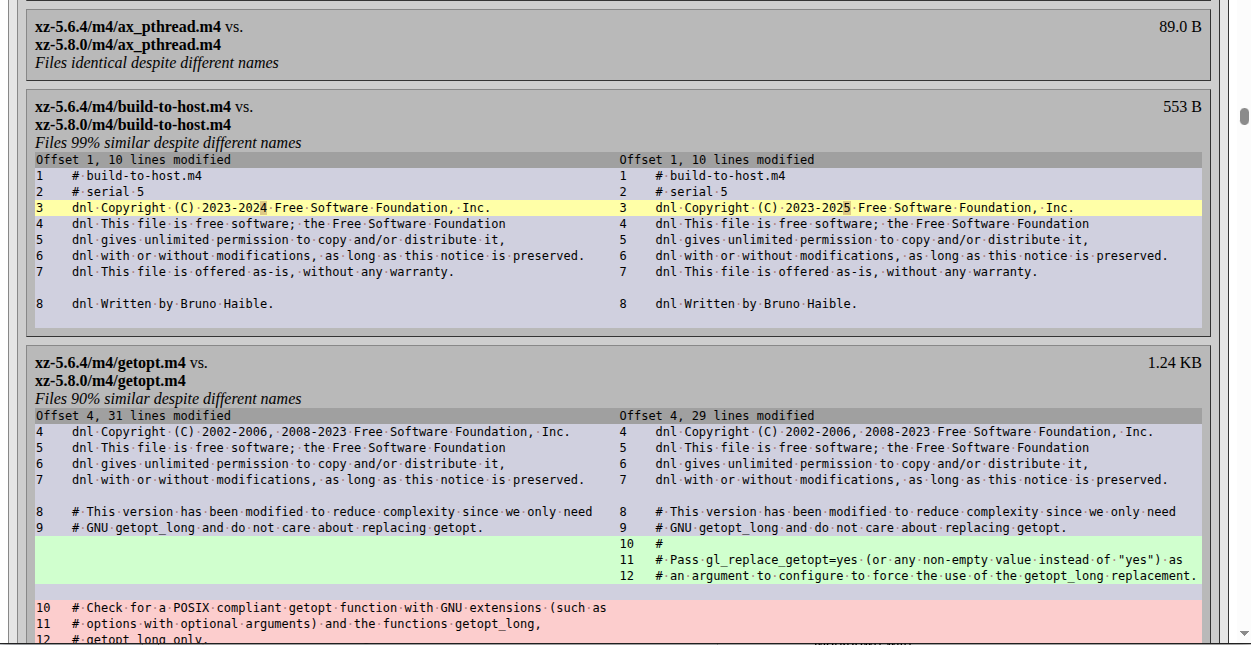
Inspecting diffoscope output of differences between two XZ Utils releases If the changes are extensive, and you want to use a LLM to help spot potential security issues, generate the report of both the upstream and Debian packaging differences in Markdown with:
diffoscope --markdown diffoscope-debian.md xz-utils_5.6.4-1.debian.tar.xz xz-utils_5.8.1-2.debian.tar.xz
diffoscope --markdown diffoscope.md xz-utils_5.6.4.orig.tar.xz xz-utils_5.8.0.orig.tar.xz
The Markdown files created above can then be passed to your favorite LLM, along with a prompt such as:
Based on the attached diffoscope output for a new Debian package version compared with the previous one, list all suspicious changes that might have introduced a backdoor, followed by other potential security issues. If there are none, list a short summary of changes as the conclusion.

Reviewing Debian source packages in version control As of today only 93% of all Debian source packages are tracked in git on Debian s GitLab instance at salsa.debian.org. Some key packages such as Coreutils and Bash are not using version control at all, as their maintainers apparently don t see value in using git for Debian packaging, and the Debian Policy does not require it. Thus, the only reliable and consistent way to audit changes in Debian packages is to compare the full versions from the archive as shown above. However, for packages that are hosted on Salsa, one can view the git history to gain additional insight into what exactly changed, when and why. For packages that are using version control, their location can be found in the Git-Vcs header in the debian/control file. For xz-utils the location is salsa.debian.org/debian/xz-utils. Note that the Debian policy does not state anything about how Salsa should be used, or what git repository layout or development practices to follow. In practice most packages follow the DEP-14 proposal, and use git-buildpackage as the tool for managing changes and pushing and pulling them between upstream and salsa.debian.org. To get the XZ Utils source, run:
$ gbp clone https://salsa.debian.org/debian/xz-utils.git
gbp:info: Cloning from 'https://salsa.debian.org/debian/xz-utils.git'
At the time of writing this post the git history shows:
$ git log --graph --oneline
* bb787585 (HEAD -> debian/unstable, origin/debian/unstable, origin/HEAD) Prepare 5.8.1-2
* 4b769547 d: Remove the symlinks from -dev package.
* a39f3428 Correct the nocheck build profile
* 1b806b8d Import Debian changes 5.8.1-1.1
* b1cad34b Prepare 5.8.1-1
* a8646015 Import 5.8.1
* 2808ec2d Update upstream source from tag 'upstream/5.8.1'
 \
  * fa1e8796 (origin/upstream/v5.8, upstream/v5.8) New upstream version 5.8.1
  * a522a226 Bump version and soname for 5.8.1
  * 1c462c2a Add NEWS for 5.8.1
  * 513cabcf Tests: Call lzma_code() in smaller chunks in fuzz_common.h
  * 48440e24 Tests: Add a fuzzing target for the multithreaded .xz decoder
  * 0c80045a liblzma: mt dec: Fix lack of parallelization in single-shot decoding
  * 81880488 liblzma: mt dec: Don't modify thr->in_size in the worker thread
  * d5a2ffe4 liblzma: mt dec: Don't free the input buffer too early (CVE-2025-31115)
  * c0c83596 liblzma: mt dec: Simplify by removing the THR_STOP state
  * 831b55b9 liblzma: mt dec: Fix a comment
  * b9d168ee liblzma: Add assertions to lzma_bufcpy()
  * c8e0a489 DOS: Update Makefile to fix the build
  * 307c02ed sysdefs.h: Avoid <stdalign.h> even with C11 compilers
  * 7ce38b31 Update THANKS
  * 688e51bd Translations: Update the Croatian translation
*   a6b54dde Prepare 5.8.0-1.
*   77d9470f Add 5.8 symbols.
*   9268eb66 Import 5.8.0
*   6f85ef4f Update upstream source from tag 'upstream/5.8.0'
 \ \
  *   afba662b New upstream version 5.8.0
   /
  * 173fb5c6 doc/SHA256SUMS: Add 5.8.0
  * db9258e8 Bump version and soname for 5.8.0
  * bfb752a3 Add NEWS for 5.8.0
  * 6ccbb904 Translations: Run "make -C po update-po"
  * 891a5f05 Translations: Run po4a/update-po
  * 4f52e738 Translations: Partially fix overtranslation in Serbian man pages
  * ff5d9447 liblzma: Count the extra bytes in LZMA/LZMA2 decoder memory usage
  * 943b012d liblzma: Use SSE2 intrinsics instead of memcpy() in dict_repeat()
This shows both the changes on the debian/unstable branch as well as the intermediate upstream import branch, and the actual real upstream development branch. See my Debian source packages in git explainer for details of what these branches are used for. To only view changes on the Debian branch, run git log --graph --oneline --first-parent or git log --graph --oneline -- debian. The Debian branch should only have changes inside the debian/ subdirectory, which is easy to check with:
$ git diff --stat upstream/v5.8
debian/README.source   16 +++
debian/autogen.sh   32 +++++
debian/changelog   949 ++++++++++++++++++++++++++
...
debian/upstream/signing-key.asc   52 +++++++++
debian/watch   4 +
debian/xz-utils.README.Debian   47 ++++++++
debian/xz-utils.docs   6 +
debian/xz-utils.install   28 +++++
debian/xz-utils.postinst   19 +++
debian/xz-utils.prerm   10 ++
debian/xzdec.docs   6 +
debian/xzdec.install   4 +
33 files changed, 2014 insertions(+)
All the files outside the debian/ directory originate from upstream, and for example running git blame on them should show only upstream commits:
$ git blame CMakeLists.txt
22af94128 (Lasse Collin 2024-02-12 17:09:10 +0200 1) # SPDX-License-Identifier: 0BSD
22af94128 (Lasse Collin 2024-02-12 17:09:10 +0200 2)
7e3493d40 (Lasse Collin 2020-02-24 23:38:16 +0200 3) ###############
7e3493d40 (Lasse Collin 2020-02-24 23:38:16 +0200 4) #
426bdc709 (Lasse Collin 2024-02-17 21:45:07 +0200 5) # CMake support for building XZ Utils
If the upstream in question signs commits or tags, they can be verified with e.g.:
$ git verify-tag v5.6.2
gpg: Signature made Wed 29 May 2024 09:39:42 AM PDT
gpg: using RSA key 3690C240CE51B4670D30AD1C38EE757D69184620
gpg: issuer "lasse.collin@tukaani.org"
gpg: Good signature from "Lasse Collin <lasse.collin@tukaani.org>" [expired]
gpg: Note: This key has expired!
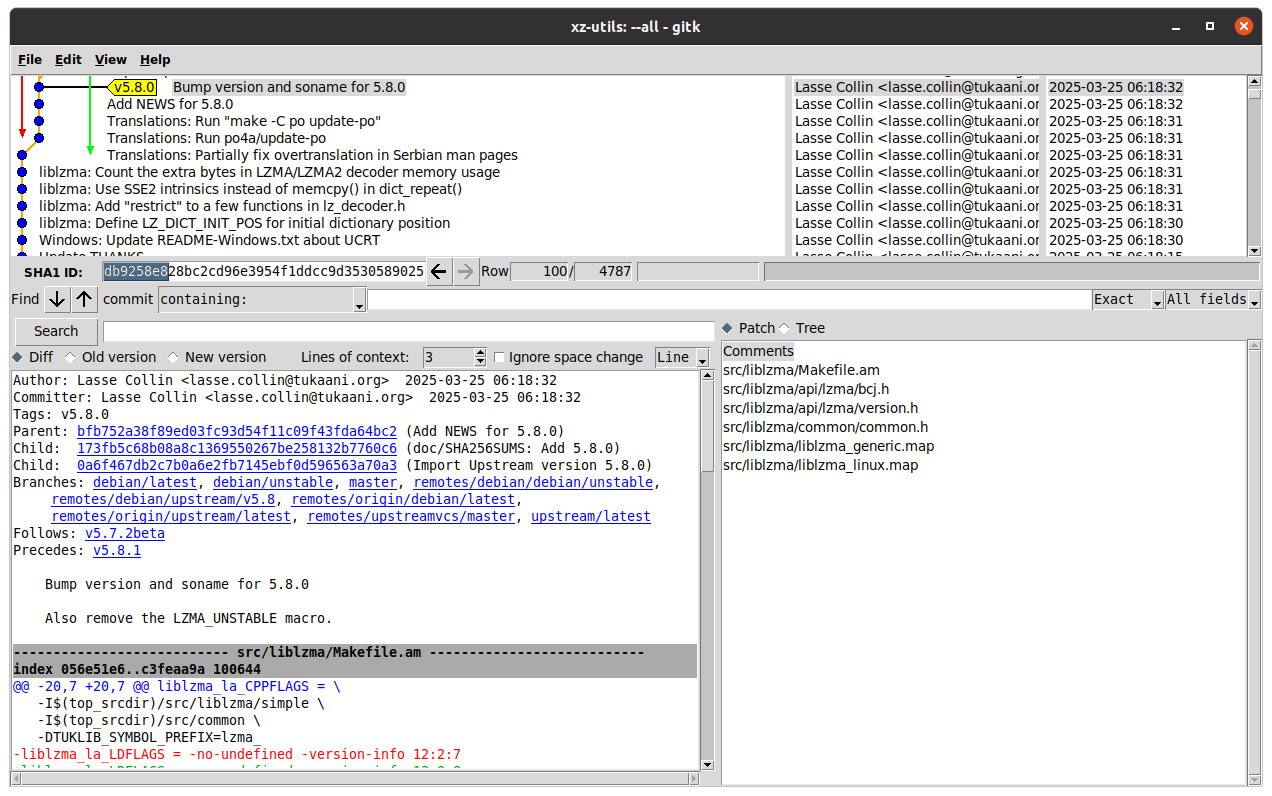
The main benefit of reviewing changes in git is the ability to see detailed information about each individual change, instead of just staring at a massive list of changes without any explanations. In this example, to view all the upstream commits since the previous import to Debian, one would view the commit range from afba662b New upstream version 5.8.0 to fa1e8796 New upstream version 5.8.1 with git log --reverse -p afba662b...fa1e8796. However, a far superior way to review changes would be to browse this range using a visual git history viewer, such as gitk. Either way, looking at one code change at a time and reading the git commit message makes the review much easier. Browsing git history in gitk --all

Comparing Debian source packages to git contents As stated in the beginning of the previous section, and worth repeating, there is no guarantee that the contents in the Debian packaging git repository matches what was actually uploaded to Debian. While the tag2upload project in Debian is getting more and more popular, Debian is still far from having any system to enforce that the git repository would be in sync with the Debian archive contents. To detect such differences we can run diff across the Debian source packages downloaded with debsnap earlier (path source-xz-utils/xz-utils_5.8.1-2.debian) and the git repository cloned in the previous section (path xz-utils):
diff
$ diff -u source-xz-utils/xz-utils_5.8.1-2.debian/ xz-utils/debian/
diff -u source-xz-utils/xz-utils_5.8.1-2.debian/changelog xz-utils/debian/changelog
--- debsnap/source-xz-utils/xz-utils_5.8.1-2.debian/changelog 2025-10-03 09:32:16.000000000 -0700
+++ xz-utils/debian/changelog 2025-10-12 12:18:04.623054758 -0700
@@ -5,7 +5,7 @@
 * Remove the symlinks from -dev, pointing to the lib package.
 (Closes: #1109354)

- -- Sebastian Andrzej Siewior <sebastian@breakpoint.cc> Fri, 03 Oct 2025 18:32:16 +0200
+ -- Sebastian Andrzej Siewior <sebastian@breakpoint.cc> Fri, 03 Oct 2025 18:36:59 +0200
In the case above diff revealed that the timestamp in the changelog in the version uploaded to Debian is different from what was committed to git. This is not malicious, just a mistake by the maintainer who probably didn t run gbp tag immediately after upload, but instead some dch command and ended up with having a different timestamps in the git compared to what was actually uploaded to Debian.

Creating syntetic Debian packaging git repositories If no Debian packaging git repository exists, or if it is lagging behind what was uploaded to Debian s archive, one can use git-buildpackage s import-dscs feature to create synthetic git commits based on the files downloaded by debsnap, ensuring the git contents fully matches what was uploaded to the archive. To import a single version there is gbp import-dsc (no s at the end), of which an example invocation would be:
$ gbp import-dsc --verbose ../source-xz-utils/xz-utils_5.8.1-2.dsc
Version '5.8.1-2' imported under '/home/otto/debian/xz-utils-2025-09-29'
Example commit history from a repository with commits added with gbp import-dsc:
$ git log --graph --oneline
* 86aed07b (HEAD -> debian/unstable, tag: debian/5.8.1-2, origin/debian/unstable) Import Debian changes 5.8.1-2
* f111d93b (tag: debian/5.8.1-1.1) Import Debian changes 5.8.1-1.1
* 1106e19b (tag: debian/5.8.1-1) Import Debian changes 5.8.1-1
 \
  * 08edbe38 (tag: upstream/5.8.1, origin/upstream/v5.8, upstream/v5.8) Import Upstream version 5.8.1
   \
    * a522a226 (tag: v5.8.1) Bump version and soname for 5.8.1
    * 1c462c2a Add NEWS for 5.8.1
    * 513cabcf Tests: Call lzma_code() in smaller chunks in fuzz_common.h
An online example repository with only a few missing uploads added using gbp import-dsc can be viewed at salsa.debian.org/otto/xz-utils-2025-09-29/-/network/debian%2Funstable An example repository that was fully crafted using gbp import-dscs can be viewed at salsa.debian.org/otto/xz-utils-gbp-import-dscs-debsnap-generated/-/network/debian%2Flatest. There exists also dgit, which in a similar way creates a synthetic git history to allow viewing the Debian archive contents via git tools. However, its focus is on producing new package versions, so fetching a package with dgit that has not had the history recorded in dgit earlier will only show the latest versions:
$ dgit clone xz-utils
canonical suite name for unstable is sid
starting new git history
last upload to archive: NO git hash
downloading http://ftp.debian.org/debian//pool/main/x/xz-utils/xz-utils_5.8.1.orig.tar.xz...
downloading http://ftp.debian.org/debian//pool/main/x/xz-utils/xz-utils_5.8.1.orig.tar.xz.asc...
downloading http://ftp.debian.org/debian//pool/main/x/xz-utils/xz-utils_5.8.1-2.debian.tar.xz...
dpkg-source: info: extracting xz-utils in unpacked
dpkg-source: info: unpacking xz-utils_5.8.1.orig.tar.xz
dpkg-source: info: unpacking xz-utils_5.8.1-2.debian.tar.xz
synthesised git commit from .dsc 5.8.1-2
HEAD is now at f9bcaf7 xz-utils (5.8.1-2) unstable; urgency=medium
dgit ok: ready for work in xz-utils
$ dgit/sid   git log --graph --oneline
* f9bcaf7 xz-utils (5.8.1-2) unstable; urgency=medium 9 days ago (HEAD -> dgit/sid, dgit/dgit/sid)
 \
  * 11d3a62 Import xz-utils_5.8.1-2.debian.tar.xz 9 days ago
* 15dcd95 Import xz-utils_5.8.1.orig.tar.xz 6 months ago
Unlike git-buildpackage managed git repositories, the dgit managed repositories cannot incorporate the upstream git history and are thus less useful for auditing the full software supply-chain in git.

Comparing upstream source packages to git contents Equally important to the note in the beginning of the previous section, one must also keep in mind that the upstream release source packages, often called release tarballs, are not guaranteed to have the exact same contents as the upstream git repository. Projects might strip out test data or extra development files from their release tarballs to avoid shipping unnecessary files to users, or projects might add documentation files or versioning information into the tarball that isn t stored in git. While a small minority, there are also upstreams that don t use git at all, so the plain files in a release tarball is still the lowest common denominator for all open source software projects, and exporting and importing source code needs to interface with it. In the case of XZ, the release tarball has additional version info and also a sizeable amount of pregenerated compiler configuration files. Detecting and comparing differences between git contents and tarballs can of course be done manually by running diff across an unpacked tarball and a checked out git repository. If using git-buildpackage, the difference between the git contents and tarball contents can be made visible directly in the import commit. In this XZ example, consider this git history:
* b1cad34b Prepare 5.8.1-1
* a8646015 Import 5.8.1
* 2808ec2d Update upstream source from tag 'upstream/5.8.1'
 \
  * fa1e8796 (debian/upstream/v5.8, upstream/v5.8) New upstream version 5.8.1
  * a522a226 (tag: v5.8.1) Bump version and soname for 5.8.1
  * 1c462c2a Add NEWS for 5.8.1
The commit a522a226 was the upstream release commit, which upstream also tagged v5.8.1. The merge commit 2808ec2d applied the new upstream import branch contents on the Debian branch. Between these is the special commit fa1e8796 New upstream version 5.8.1 tagged upstream/v5.8. This commit and tag exists only in the Debian packaging repository, and they show what is the contents imported into Debian. This is generated automatically by git-buildpackage when running git import-orig --uscan for Debian packages with the correct settings in debian/gbp.conf. By viewing this commit one can see exactly how the upstream release tarball differs from the upstream git contents (if at all). In the case of XZ, the difference is substantial, and shown below in full as it is very interesting:
$ git show --stat fa1e8796
commit fa1e8796dabd91a0f667b9e90f9841825225413a
(debian/upstream/v5.8, upstream/v5.8)
Author: Sebastian Andrzej Siewior <sebastian@breakpoint.cc>
Date: Thu Apr 3 22:58:39 2025 +0200
New upstream version 5.8.1
.codespellrc   30 -
.gitattributes   8 -
.github/workflows/ci.yml   163 -
.github/workflows/freebsd.yml   32 -
.github/workflows/netbsd.yml   32 -
.github/workflows/openbsd.yml   35 -
.github/workflows/solaris.yml   32 -
.github/workflows/windows-ci.yml   124 -
.gitignore   113 -
ABOUT-NLS   1 +
ChangeLog   17392 +++++++++++++++++++++
Makefile.in   1097 +++++++
aclocal.m4   1353 ++++++++
build-aux/ci_build.bash   286 --
build-aux/compile   351 ++
build-aux/config.guess   1815 ++++++++++
build-aux/config.rpath   751 +++++
build-aux/config.sub   2354 +++++++++++++
build-aux/depcomp   792 +++++
build-aux/install-sh   541 +++
build-aux/ltmain.sh   11524 ++++++++++++++++++++++
build-aux/missing   236 ++
build-aux/test-driver   160 +
config.h.in   634 ++++
configure   26434 ++++++++++++++++++++++
debug/Makefile.in   756 +++++
doc/SHA256SUMS   236 --
doc/man/txt/lzmainfo.txt   36 +
doc/man/txt/xz.txt   1708 ++++++++++
doc/man/txt/xzdec.txt   76 +
doc/man/txt/xzdiff.txt   39 +
doc/man/txt/xzgrep.txt   70 +
doc/man/txt/xzless.txt   36 +
doc/man/txt/xzmore.txt   31 +
lib/Makefile.in   623 ++++
m4/.gitignore   40 -
m4/build-to-host.m4   274 ++
m4/gettext.m4   392 +++
m4/host-cpu-c-abi.m4   529 +++
m4/iconv.m4   324 ++
m4/intlmacosx.m4   71 +
m4/lib-ld.m4   170 +
m4/lib-link.m4   815 +++++
m4/lib-prefix.m4   334 ++
m4/libtool.m4   8488 +++++++++++++++++++++
m4/ltoptions.m4   467 +++
m4/ltsugar.m4   124 +
m4/ltversion.m4   24 +
m4/lt~obsolete.m4   99 +
m4/nls.m4   33 +
m4/po.m4   456 +++
m4/progtest.m4   92 +
po/.gitignore   31 -
po/Makefile.in.in   517 +++
po/Rules-quot   66 +
po/boldquot.sed   21 +
po/ca.gmo   Bin 0 -> 15587 bytes
po/cs.gmo   Bin 0 -> 7983 bytes
po/da.gmo   Bin 0 -> 9040 bytes
po/de.gmo   Bin 0 -> 29882 bytes
po/en@boldquot.header   35 +
po/en@quot.header   32 +
po/eo.gmo   Bin 0 -> 15060 bytes
po/es.gmo   Bin 0 -> 29228 bytes
po/fi.gmo   Bin 0 -> 28225 bytes
po/fr.gmo   Bin 0 -> 10232 bytes
To be able to easily inspect exactly what changed in the release tarball compared to git release tag contents, the best tool for the job is Meld, invoked via git difftool --dir-diff fa1e8796^..fa1e8796. Meld invoked by git difftool --dir-diff afba662b..fa1e8796 to show differences between git release tag and release tarball contents To compare changes across the new and old upstream tarball, one would need to compare commits afba662b New upstream version 5.8.0 and fa1e8796 New upstream version 5.8.1 by running git difftool --dir-diff afba662b..fa1e8796. Meld invoked by git difftool --dir-diff afba662b..fa1e8796 to show differences between to upstream release tarball contents With all the above tips you can now go and try to audit your own favorite package in Debian and see if it is identical with upstream, and if not, how it differs.
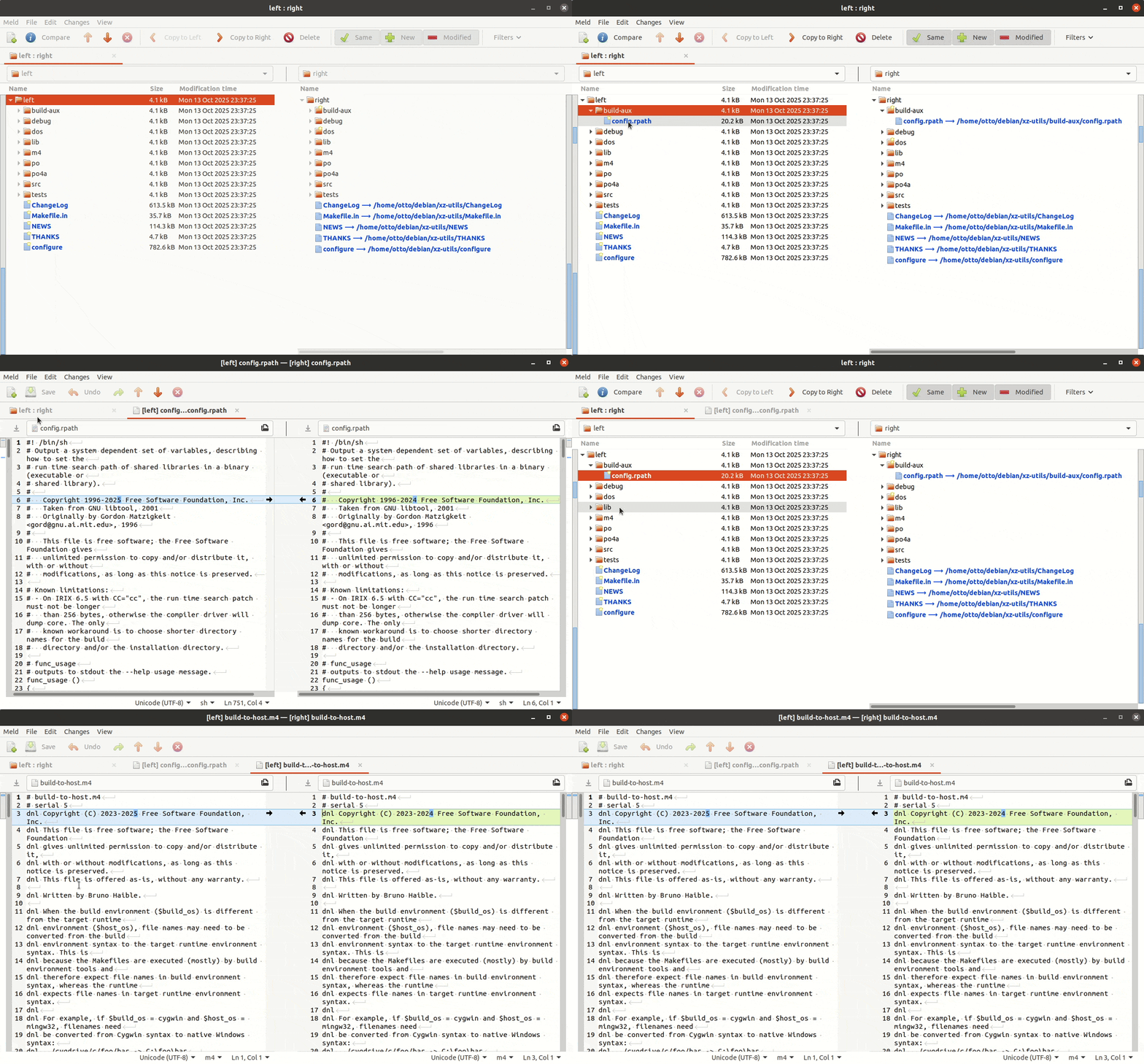
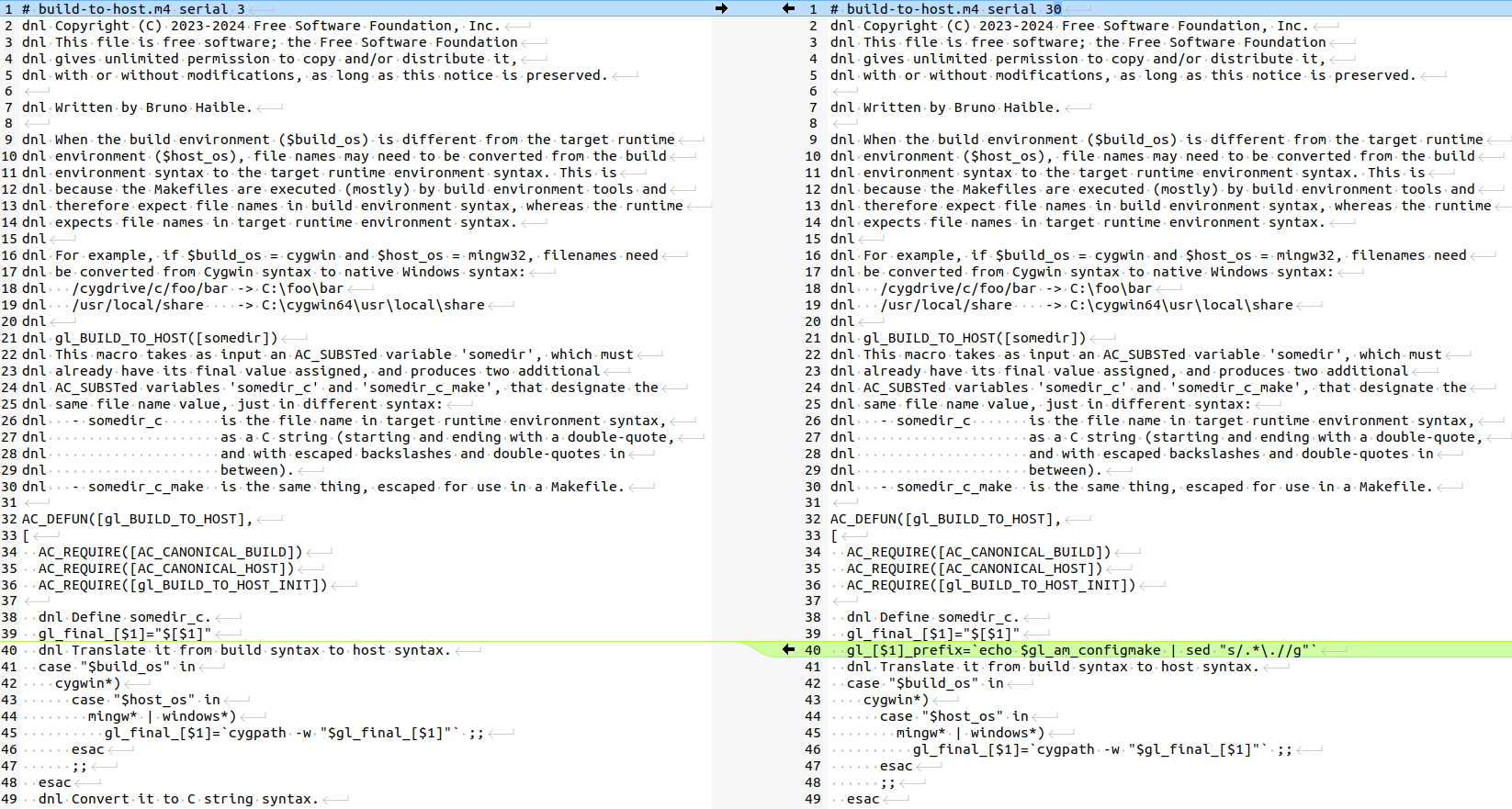
Should the XZ backdoor have been detected using these tools? The famous XZ Utils backdoor (CVE-2024-3094) consisted of two parts: the actual backdoor inside two binary blobs masqueraded as a test files (tests/files/bad-3-corrupt_lzma2.xz, tests/files/good-large_compressed.lzma), and a small modification in the build scripts (m4/build-to-host.m4) to extract the backdoor and plant it into the built binary. The build script was not tracked in version control, but generated with GNU Autotools at release time and only shipped as additional files in the release tarball. The entire reason for me to write this post was to ponder if a diligent engineer using git-buildpackage best practices could have reasonably spotted this while importing the new upstream release into Debian. The short answer is no . The malicious actor here clearly anticipated all the typical ways anyone might inspect both git commits, and release tarball contents, and masqueraded the changes very well and over a long timespan. First of all, XZ has for legitimate reasons for several carefully crafted .xz files as test data to help catch regressions in the decompression code path. The test files are shipped in the release so users can run the test suite and validate that the binary is built correctly and xz works properly. Debian famously runs massive amounts of testing in its CI and autopkgtest system across tens of thousands of packages to uphold high quality despite frequent upgrades of the build toolchain and while supporting more CPU architectures than any other distro. Test data is useful and should stay. When git-buildpackage is used correctly, the upstream commits are visible in the Debian packaging for easy review, but the commit cf44e4b that introduced the test files does not deviate enough from regular sloppy coding practices to really stand out. It is unfortunately very common for git commit to lack a message body explaining why the change was done, and to not be properly atomic with test code and test data together in the same commit, and for commits to be pushed directly to mainline without using code reviews (the commit was not part of any PR in this case). Only another upstream developer could have spotted that this change is not on par to what the project expects, and that the test code was never added, only test data, and thus that this commit was not just a sloppy one but potentially malicious. Secondly, the fact that a new Autotools file appeared (m4/build-to-host.m4) in the XZ Utils 5.6.0 is not suspicious. This is perfectly normal for Autotools. In fact, starting from XZ Utils version 5.8.1 it is now shipping a m4/build-to-host.m4 file that it actually uses now. Spotting that there is anything fishy is practically impossible by simply reading the code, as Autotools files are full custom m4 syntax interwoven with shell script, and there are plenty of backticks ( ) that spawn subshells and evals that execute variable contents further, which is just normal for Autotools. Russ Cox s XZ post explains how exactly the Autotools code fetched the actual backdoor from the test files and injected it into the build. Inspecting the m4/build-to-host.m4 changes in Meld launched via git difftool There is only one tiny thing that maybe a very experienced Autotools user could potentially have noticed: the serial 30 in the version header is way too high. In theory one could also have noticed this Autotools file deviates from what other packages in Debian ship with the same filename, such as e.g. the serial 3, serial 5a or 5b versions. That would however require and an insane amount extra checking work, and is not something we should plan to start doing. A much simpler solution would be to simply strongly recommend all open source projects to stop using Autotools to eventually get rid of it entirely.

Not detectable with reasonable effort While planting backdoors is evil, it is hard not to feel some respect to the level of skill and dedication of the people behind this. I ve been involved in a bunch of security breach investigations during my IT career, and never have I seen anything this well executed. If it hadn t slowed down SSH by ~500 milliseconds and been discovered due to that, it would most likely have stayed undetected for months or years. Hiding backdoors in closed source software is relatively trivial, but hiding backdoors in plain sight in a popular open source project requires some unusual amount of expertise and creativity as shown above.

Is the software supply-chain in Debian easy to audit? While maintaining a Debian package source using git-buildpackage can make the package history a lot easier to inspect, most packages have incomplete configurations in their debian/gbp.conf, and thus their package development histories are not always correctly constructed or uniform and easy to compare. The Debian Policy does not mandate git usage at all, and there are many important packages that are not using git at all. Additionally the Debian Policy also allows for non-maintainers to upload new versions to Debian without committing anything in git even for packages where the original maintainer wanted to use git. Uploads that bypass git unfortunately happen surpisingly often. Because of the situation, I am afraid that we could have multiple similar backdoors lurking that simply haven t been detected yet. More audits, that hopefully also get published openly, would be welcome! More people auditing the contents of the Debian archives would probably also help surface what tools and policies Debian might be missing to make the work easier, and thus help improve the security of Debian s users, and improve trust in Debian.

Is Debian currently missing some software that could help detect similar things? To my knowledge there is currently no system in place as part of Debian s QA or security infrastructure to verify that the upstream source packages in Debian are actually from upstream. I ve come across a lot of packages where the debian/watch or other configs are incorrect and even cases where maintainers have manually created upstream tarballs as it was easier than configuring automation to work. It is obvious that for those packages the source tarball now in Debian is not at all the same as upstream. I am not aware of any malicious cases though (if I was, I would report them of course). I am also aware of packages in the Debian repository that are misconfigured to be of type 1.0 (native) packages, mixing the upstream files and debian/ contents and having patches applied, while they actually should be configured as 3.0 (quilt), and not hide what is the true upstream sources. Debian should extend the QA tools to scan for such things. If I find a sponsor, I might build it myself as my next major contribution to Debian. In addition to better tooling for finding mismatches in the source code, Debian could also have better tooling for tracking in built binaries what their source files were, but solutions like Fraunhofer-AISEC s supply-graph or Sony s ESSTRA are not practical yet. Julien Malka s post about NixOS discusses the role of reproducible builds, which may help in some cases across all distros.

Or, is Debian missing some policies or practices to mitigate this? Perhaps more importantly than more security scanning, the Debian Developer community should switch the general mindset from anyone is free to do anything to valuing having more shared workflows. The ability to audit anything is severely hampered by the fact that there are so many ways to do the same thing, and distinguishing what is a normal deviation from a malicious deviation is too hard, as the normal can basically be almost anything. Also, as there is no documented and recommended default workflow, both those who are old and new to Debian packaging might never learn any one optimal workflow, and end up doing many steps in the packaging process in a way that kind of works, but is actually wrong or unnecessary, causing process deviations that look malicious, but turn out to just be a result of not fully understanding what would have been the right way to do something. In the long run, once individual developers workflows are more aligned, doing code reviews will become a lot easier and smoother as the excess noise of workflow differences diminishes and reviews will feel much more productive to all participants. Debian fostering a culture of code reviews would allow us to slowly move from the current practice of mainly solo packaging work towards true collaboration forming around those code reviews. I have been promoting increased use of Merge Requests in Debian already for some time, for example by proposing DEP-18: Encourage Continuous Integration and Merge Request based Collaboration for Debian packages. If you are involved in Debian development, please give a thumbs up in dep-team/deps!21 if you want me to continue promoting it.

Can we trust open source software? Yes and I would argue that we can only trust open source software. There is no way to audit closed source software, and anyone using e.g. Windows or MacOS just have to trust the vendor s word when they say they have no intentional or accidental backdoors in their software. Or, when the news gets out that the systems of a closed source vendor was compromised, like Crowdstrike some weeks ago, we can t audit anything, and time after time we simply need to take their word when they say they have properly cleaned up their code base. In theory, a vendor could give some kind of contractual or financial guarantee to its customer that there are no preventable security issues, but in practice that never happens. I am not aware of a single case of e.g. Microsoft or Oracle would have paid damages to their customers after a security flaw was found in their software. In theory you could also pay a vendor more to have them focus more effort in security, but since there is no way to verify what they did, or to get compensation when they didn t, any increased fees are likely just pocketed as increased profit. Open source is clearly better overall. You can, if you are an individual with the time and skills, audit every step in the supply-chain, or you could as an organization make investments in open source security improvements and actually verify what changes were made and how security improved. If your organisation is using Debian (or derivatives, such as Ubuntu) and you are interested in sponsoring my work to improve Debian, please reach out.

18 October 2025

Julian Andres Klode: Sound Removals

Problem statement Currently if you have an automatically installed package A (= 1) where
  • A (= 1) Depends B (= 1)
  • A (= 2) Depends B (= 2)
and you upgrade B from 1 to 2; then you can:
  1. Remove A (= 1)
  2. Upgrade A to version 2
If A was installed by a chain initiated by Recommends (say X Rec Y, Y Depends A), the solver sometimes preferred removing A (and anything depending on it until it got). I have a fix pending to introduce eager Recommends which fixes the practical case, but this is still not sound. In fact we can show that the solver produces the wrong result for small minimal test cases, as well as the right result for some others without the fix (hooray?). Ensuring sound removals is more complex, and first of all it begs the question: When is a removal sound? This, of course, is on us to define. An easy case can be found in the Debian policy, 7.6.2 Replacing whole packages, forcing their removal : If B (= 2) declares a Conflicts: A (= 1) and Replaces: A (= 1), then the removal is valid. However this is incomplete as well, consider it declares Conflicts: A (< 1) and Replaces: A (< 1); the solution to remove A rather than upgrade it would still be wrong. This indicates that we should only allow removing A if the conflicts could not be solved by upgrading it. The other case to explore is package removals. If B is removed, A should be removed as well; however it there is another package X that Provides: B (= 1) and it is marked for install, A should not be removed. That said, the solver is not allowed to install X to satisfy the depends B (= 1) - only to satisfy other dependencies [we do not want to get into endless loops where we switch between alternatives to keep reverse dependencies installed].

Proposed solution To solve this, I propose the following definition: Definition (sound removal): A removal of package P is sound if either:
  1. A version v is installed that package-conflicts with B.
  2. A package Q is removed and the installable versions of P package-depends on Q.
where the other definitions are: Definition (installable version): A version v is installable if either it is installed, or it is newer than an installed version of the same package (you may wish to change this to accomodate downgrades, or require strict pinning, but here be dragons). Definition (package-depends): A version v package-depends on a package B if either:
  1. there exists a dependency in v that can be solved by any version of B, or
  2. there exists a package C where v package-depends C and any (c in C) package-depends B (transitivity)
Definition (package-conflicts): A version v package-conflicts with an installed package B if either:
  1. it declares a conflicts against an installable version of B; or
  2. there exists a package C where v package-conflicts C, and b package-depends C for installable versions b.

Translating this into a (modified) SAT solver One approach may be to implement the logic in the conflict analysis that drives backtracking, i.e. we assume a package A and when we reach not A, we analyse if the implication graph for not A constitutes a sound removal, and then replace the assumption A with the assumption A or "learned reason. However, while this seems a plausible mechanism for a DPLL solver, for a modern CDCL solver, it s not immediately evident how to analyse whether not A is sound if the reason for it is a learned clause, rather than a problem clause. Instead we propose a static encoding of the rules into a slightly modified SAT solver: Given c1, , cn that transitive-conflicts A and D1, , Dn that A package-depends on, introduce the rule: A unless c1 or c2 or ... cn ... or not D1 or not D2 ... or not Dn Rules of the form A... unless B... - where A... and B... are CNF - are intuitively the same as A... or B..., however the semantic here is different: We are not allowed to select B... to satisfy this clause. This requires a SAT solver that tracks a reason for each literal being assigned, such as solver3, rather than a SAT solver like MiniSAT that only tracks reasons across propagation (solver3 may track A depends B or C as the reason for B without evaluating C, whereas MiniSAT would only track it as the reason given not C).

Is it actually sound? The proposed definition of a sound removal may still proof unsound as I either missed something in the conclusion of the proposed definition that violates my goal I set out to achieve, or I missed some of the goals. I challenge you to find cases that cause removals that look wrong :D

17 October 2025

Dirk Eddelbuettel: ML quacks: Combining duckdb and mlpack

A side project I have been working on a little since last winter and which explores extending duckdb with mlpack is now public at the duckdb-mlpack repo. duckdb is an excellent small (as in runs as a self-contained binary ) database engine with both a focus on analytical payloads (OLAP rather than OLTP) and an impressive number of already bolted-on extensions (for example for cloud data access) delivered as a single-build C++ executable (or of course as a library used from other front-ends). mlpack is an excellent C++ library containing many/most machine learning algorithms, also built in a self-contained manner (or library) making it possible to build compact yet powerful binaries, or to embed (as opposed to other ML framework accessed from powerful but not lightweight run-times such as Python or R). The compact build aspect as well as the common build tools (C++, cmake) make these two a natural candidate for combining them. Moreover, duckdb is a champion of data access, management and control and the complementary machine learning insights and predictions offered by mlpack are fully complementary and hence fit this rather well. duckdb also has a very robust and active extension system. To use it, one starts from a template repository and its use this template button, runs a script and can then start experimenting. I have now grouped my initial start and test functions into a separate repository duckdb-example-extension to keep the duckdb-mlpack one focused on the extend to mlpack aspect. duckdb-mlpack is right an MVP , i.e. a minimally viable product (or demo). It just runs the adaboost classifier but does so on any dataset fitting the rectangular setup with columns of features (real valued) and a final column (integer valued) of labels. I had hope to use two select queries for both features and then labels but it turns a table function (returning a table of data from a query) can only run one select *. So the basic demo, also on the repo README is now to run the following script (where the SELECT * FROM mlpack_adaboost((SELECT * FROM D)); is the key invocation of the added functionality):
#!/bin/bash

cat <<EOF   build/release/duckdb
SET autoinstall_known_extensions=1;
SET autoload_known_extensions=1; # for httpfs

CREATE TEMP TABLE Xd AS SELECT * FROM read_csv("https://mlpack.org/datasets/iris.csv");
CREATE TEMP TABLE X AS SELECT row_number() OVER () AS id, * FROM Xd;
CREATE TEMP TABLE Yd AS SELECT * FROM read_csv("https://mlpack.org/datasets/iris_labels.csv");
CREATE TEMP TABLE Y AS SELECT row_number() OVER () AS id, CAST(column0 AS double) as label FROM Yd;
CREATE TEMP TABLE D AS SELECT * FROM X INNER JOIN Y ON X.id = Y.id;
ALTER TABLE D DROP id;
ALTER TABLE D DROP id_1;
CREATE TEMP TABLE A AS SELECT * FROM mlpack_adaboost((SELECT * FROM D));

SELECT COUNT(*) as n, predicted FROM A GROUP BY predicted;
EOF
to produce the following tabulation / group by:
./sampleCallRemote.sh
Misclassified: 1
 
    n     predicted  
  int64     int32    
 
     50           0  
     49           1  
     51           2  
 
$
(Note that this requires the httpfs extension. So when you build from a freshly created extension repository you may be ahead of the most recent release of duckdb by a few commits. It is easy to check out the most recent release tag (or maybe the one you are running for your local duckdb binary) to take advantage of the extensions you likely already have for that version. So here, and in the middle of October 2025, I picked v1.4.1 as I run duckdb version 1.4.1 on my box.) There are many other neat duckdb extensions. The core ones are regrouped here while a list of community extensions is here and here. For this (still more minimal) extension, I added a few TODO items to the README.md: Please reach out if you are interested in working on any of this.

This post by Dirk Eddelbuettel originated on his Thinking inside the box blog. If you like this or other open-source work I do, you can now sponsor me at GitHub.

David Bremner: Hibernate on the pocket reform 13/n

Context

Some progress upstream Recently Sebastian Reichel at Collabora [1] has made a few related commits, apparently inspired in part by my kvetching on this blog.

Disconnecting and reconnecting PCI busses At some point I noticed error message about the nvme device on resume. I then learned how to disconnect and reconnect PCI buses in Linux. I ended up with something like the following. At least the PCI management seems to work. I can manually disconnect all the PCI busses and rescan to connect them again on a running system. It presumably helps that I am not using the nvme device in this system.
set -x
echo platform >  /sys/power/pm_test
echo reboot > /sys/power/disk
rmmod mt76x2u
sleep 2
echo 1   tee /sys/bus/pci/devices/0003:30:00.0/remove
sleep 2
echo 1   tee /sys/bus/pci/devices/0004:41:00.0/remove
sleep 2
echo 1   tee /sys/bus/pci/devices/0004:40:00.0/remove
sleep 2
echo LSPCI:
lspci -t
sleep 2
echo disk >  /sys/power/state
sleep 2
echo 1   tee /sys/bus/pci/rescan
sleep 2
modprobe mt76x2u

Minimal changes to upstream With the ongoing work at collabora I decided to try a minimal patch stack to get the pocket reform to boot. I added the following 3 commits (available from [3]).
09868a4f2eb (HEAD -> reform-patches) copy pocket-reform dts from reform-debian-packages
152e2ae8a193 pocket/panel: sleep fix v3
18f65da9681c add-multi-display-panel-driver
It does indeed boot and seems stable.
$ uname -a
Linux anthia 6.18.0-rc1+ #19 SMP Thu Oct 16 11:32:04 ADT 2025 aarch64 GNU/Linux
Running the hibernation script above I get no output from the lspci, but seemingly issues with PCI coming back from hibernate:
[  424.645109] PM: hibernation: Allocated 361823 pages for snapshot
[  424.647216] PM: hibernation: Allocated 1447292 kbytes in 3.23 seconds (448.07 MB/s)
[  424.649321] Freezing remaining freezable tasks
[  424.654767] Freezing remaining freezable tasks completed (elapsed 0.003 seconds)
[  424.661070] rk_gmac-dwmac fe1b0000.ethernet end0: Link is Down
[  424.740716] rockchip-dw-pcie a40c00000.pcie: Failed to receive PME_TO_Ack
[  424.742041] PM: hibernation: hibernation debug: Waiting for 5 second(s).
[  430.074757] pci 0004:40:00.0: [1d87:3588] type 01 class 0x060400 PCIe Root Port
F F & Zn [  watchdog: CPU4: Watchdog detected hard LOCKUP on cpu 5
[  456.039004] Modules linked in: xt_CHECKSUM xt_tcpudp nft_chain_nat xt_MASQUERADE nf_nat nf_conntrack nf_defrag_ipv6 nf_defrag_ipv4 nft_compat x_tables bridge stp llc nf_tables aes_neon_bs aes_neon_blk ccm dwmac_rk binfmt_misc mt76x2_common mt76x02_usb mt76_usb mt76x02_lib mt76 mac80211 rk805_pwrkey snd_soc_tlv320aic31xx snd_soc_simple_card reform2_lpc(OE) libarc4 rockchip_saradc industrialio_triggered_buffer kfifo_buf industrialio cfg80211 rockchip_thermal rockchip_rng hantro_vpu cdc_acm v4l2_vp9 v4l2_jpeg rockchip_rga rfkill snd_soc_rockchip_i2s_tdm videobuf2_dma_sg v4l2_h264 panthor snd_soc_audio_graph_card drm_gpuvm snd_soc_simple_card_utils drm_exec evdev joydev dm_mod nvme_fabrics efi_pstore configfs nfnetlink autofs4 ext4 crc16 mbcache jbd2 btrfs blake2b_generic xor xor_neon raid6_pq mali_dp snd_soc_meson_axg_toddr snd_soc_meson_axg_fifo snd_soc_meson_codec_glue panfrost drm_shmem_helper gpu_sched ao_cec_g12a meson_vdec(C) videobuf2_dma_contig videobuf2_memops v4l2_mem2mem videobuf2_v4l2 videodev
[  456.039060]  videobuf2_common mc dw_hdmi_i2s_audio meson_drm meson_canvas meson_dw_mipi_dsi meson_dw_hdmi mxsfb mux_mmio panel_edp imx_dcss ti_sn65dsi86 nwl_dsi mux_core pwm_imx27 hid_generic usbhid hid xhci_plat_hcd onboard_usb_dev xhci_hcd nvme nvme_core snd_soc_hdmi_codec snd_soc_core nvme_keyring nvme_auth hkdf snd_pcm_dmaengine snd_pcm snd_timer snd soundcore fan53555 rtc_pcf8523 micrel phy_package stmmac_platform stmmac pcs_xpcs rk808_regulator phylink sdhci_of_dwcmshc mdio_devres dw_mmc_rockchip of_mdio sdhci_pltfm phy_rockchip_usbdp fixed_phy dw_mmc_pltfm fwnode_mdio typec phy_rockchip_naneng_combphy phy_rockchip_samsung_hdptx pwm_rockchip sdhci dwc3 libphy dw_wdt dw_mmc ehci_platform rockchip_dfi mdio_bus cqhci ulpi ohci_platform ehci_hcd udc_core ohci_hcd rockchipdrm phy_rockchip_inno_usb2 usbcore dw_hdmi_qp analogix_dp dw_mipi_dsi cpufreq_dt dw_mipi_dsi2 i2c_rk3x usb_common drm_dp_aux_bus [last unloaded: mt76x2u]
[  456.039111] Sending NMI from CPU 4 to CPUs 5:
[  471.942262] page_pool_release_retry() stalled pool shutdown: id 9, 2 inflight 60 sec
[  532.989611] page_pool_release_retry() stalled pool shutdown: id 9, 2 inflight 121 sec
This does look like some progress, probably thanks to Sebastien. Comparing with the logs in hibernate-pocket-12, the resume process is not bailing out complaining about PHY.

Attempt to reapply PCI reset patches Following the procedure in hibernate-pocket-12, I attempted to re-apply the pci reset patches [2]. In particular I followed the hints output by b4. Unfortunately there are too many conflicts now for me to sensibly resolve.
  1. https://gitlab.collabora.com/hardware-enablement/rockchip-3588/linux.git#rockchip-devel
  2. https://lore.kernel.org/all/20250715-pci-port-reset-v6-0-6f9cce94e7bb@oss.qualcomm.com/#r
  3. https://salsa.debian.org/bremner/collabora-rockchip-3588#reform-patches

14 October 2025

Gunnar Wolf: Can a server be just too stable?

One of my servers at work leads a very light life: it is our main backups server (so it has a I/O spike at night, with little CPU involvement) and has some minor services running (i.e. a couple of Tor relays and my personal email server yes, I have the authorization for it ). It is a very stable machine But today I was surprised: As I am about to migrate it to Debian 13 (Trixie), naturally, I am set to reboot it. But before doing so:
$ w
 12:21:54 up 1048 days, 0 min,  1 user,  load average: 0.22, 0.17, 0.17
USER     TTY      FROM             LOGIN@   IDLE   JCPU   PCPU  WHAT
gwolf             192.168.10.3     12:21           0.00s  0.02s sshd-session: gwolf [priv]
Wow. Did I really last reboot this server on December 1 2022? (Yes, I know this might speak bad of my security practices, as there are several kernel updates I never applied, even having installed the relevant packages. Still, it got me impressed ) Debian. Rock solid. Debian Rocks

Dirk Eddelbuettel: qlcal 0.0.17 on CRAN: Regular Update

The seventeenth release of the qlcal package arrivied at CRAN today, once again following a QuantLib release as 1.40 came out this morning. qlcal delivers the calendaring parts of QuantLib. It is provided (for the R package) as a set of included files, so the package is self-contained and does not depend on an external QuantLib library (which can be demanding to build). qlcal covers over sixty country / market calendars and can compute holiday lists, its complement (i.e. business day lists) and much more. Examples are in the README at the repository, the package page, and course at the CRAN package page. This releases mainly synchronizes qlcal with the QuantLib release 1.40. Only one country calendar got updated; the diffstat looks larger as the URL part of the copyright got updated throughout. We also updated the URL for the GPL-2 badge: when CRAN checks this, they always hit a timeout as the FSF server possibly keeps track of incoming requests; we now link to version from the R Licenses page to avoid this.

Changes in version 0.0.17 (2025-07-14)
  • Synchronized with QuantLib 1.40 released today
  • Calendar updates for Singapore
  • URL update in README.md

Courtesy of my CRANberries, there is a diffstat report for this release. See the project page and package documentation for more details, and more examples.

This post by Dirk Eddelbuettel originated on his Thinking inside the box blog. If you like this or other open-source work I do, you can sponsor me at GitHub.

Freexian Collaborators: Debian Contributions: Old Debian Printing software and C23, Work to decommission packages.qa.debian.org, rebootstrap uses *-for-host and more! (by Anupa Ann Joseph)

Debian Contributions: 2025-09 Contributing to Debian is part of Freexian s mission. This article covers the latest achievements of Freexian and their collaborators. All of this is made possible by organizations subscribing to our Long Term Support contracts and consulting services.

Updating old Debian Printing software to meet C23 requirements, by Thorsten Alteholz The work of Thorsten fell under the motto gcc15 . Due to the introduction of gcc15 in Debian, the default language version was changed to C23. This means that for example, function declarations without parameters are no longer allowed. As old software, which was created with ANSI C (or C89) syntax, made use of such function declarations, it was a busy month. One could have used something like -std=c17 as compile flags, but this would have just postponed the tasks. As a result Thorsten uploaded modernized versions of ink, nm2ppa and rlpr for the Debian printing team.

Work done to decommission packages.qa.debian.org, by Rapha l Hertzog Rapha l worked to decommission the old package tracking system (packages.qa.debian.org). After figuring out that it was still receiving emails from the bug tracking system (bugs.debian.org), from multiple debian lists and from some release team tools, he reached out to the respective teams to either drop those emails or adjust them so that they are sent to the current Debian Package Tracker (tracker.debian.org).

rebootstrap uses *-for-host, by Helmut Grohne Architecture cross bootstrapping is an ongoing effort that has shaped Debian in various ways over the years. A longer effort to express toolchain dependencies now bears fruit. When cross compiling, it becomes important to express what architecture one is compiling for in Build-Depends. As these packages have become available in trixie , more and more packages add this extra information and in August, the libtool package gained a gfortran-for-host dependency. It was the first package in the essential build closure to adopt this and required putting the pieces together in rebootstrap that now has to build gcc-defaults early on. There still are hundreds of packages whose dependencies need to be updated though.

Miscellaneous contributions
  • Rapha l dropped the Build Log Scan integration in tracker.debian.org since it was showing stale data for a while as the underlying service has been discontinued.
  • Emilio updated pixman to 0.46.4.
  • Emilio coordinated several transitions, and NMUed guestfs-tools to unblock one.
  • Stefano uploaded Python 3.14rc3 to Debian unstable. It s not yet used by any packages, but it allows testing the level of support in packages to begin.
  • Stefano upgraded almost all of the debian-social infrastructure to Debian trixie .
  • Stefano published the sponsorship brochures for DebConf 26.
  • Stefano attended the Debian Technical Committee meeting.
  • Stefano uploaded routine upstream updates for a handful of Python packages (pycparser, beautifulsoup4, platformdirs, pycparser, python-authlib, python-cffi, python-mitogen, python-resolvelib, python-super-collections, twine).
  • Stefano reviewed and responded to DebConf 25 feedback.
  • Stefano investigated and fixed a request visibility bug in debian-reimbursements (for admin-altered requests).
  • Lucas reviewed a couple of merge requests from external contributors for Go and Ruby packages.
  • Lucas updated some ruby packages to its latest upstream version (thin, passenger, and puma is still WIP).
  • Lucas set up the build environment to run rebuilds of reverse dependencies of ruby using ruby3.4. As an alternative, he is looking for personal repositories provided by Debusine to perform this task more easily. This is the preparation for the transition to ruby3.4 as the default in Debian.
  • Lucas helped on the next round of the Outreachy internship program.
  • Helmut sent patches for 30 cross build failures and responded to cross building support questions on the mailing list.
  • Helmut continued to maintain rebootstrap. As gcc version 15 became the default, test jobs for version 14 had to be dropped. A fair number of patches were applied to packages and could be dropped.
  • Helmut resumed removing RC-buggy packages from unstable and sponsored a termrec upload to avoid its deletion. This work was paused to give packages some time to migrate to forky .
  • Santiago reviewed different merge requests created by different contributors. Those MRs include a new test to build reverse dependencies, created by Aquila Macedo as part of his GSoC internship; restore how lintian was used in experimental, thanks Otto Kek l inen; and the fix by Christian Bayle to support again extra repositories in deb822-style sources, whose support was broken with the move to sbuild+unshare last month.
  • While doing some new upstream release updates, thanks to Debusine s reverse dependencies autopkgtest checks, Santiago discovered that paramiko 4.0 will introduce a regression in libcloud by the drop of support for the obsolete DSA keys. Santiago finally uploaded to unstable both paramiko 4.0, and a regression fix for libcloud.
  • Santiago has taken part in different discussions and meetings for the preparation of DebConf 26. The DebConf 26 local team aims to prepare for the conference with enough time in advance.
  • Carles kept working on the missing-package-relations and reporting missing Recommends. He improved the tooling to detect and report bugs creating 269 bugs and followed up comments. 37 bugs have been resolved, others acknowledged. The missing Recommends are a mixture of packages that are gone from Debian, packages that changed name, typos and also packages that were recommended but are not packaged in Debian.
  • Carles improved the missing-package-relations to report broken Suggests only for packages that used to be in Debian but are removed from it now. No bugs have been created yet for this case but identified 1320 of them.
  • Colin spent much of the month chasing down build/test regressions in various Python packages due to other upgrades, particularly relating to pydantic, python-pytest-asyncio, and rust-pyo3.
  • Colin optimized some code in ubuntu-dev-tools (affecting e.g. pull-debian-source) that made O(n) HTTP requests when it could instead make O(1).
  • Anupa published Micronews as part of Debian Publicity team work.

13 October 2025

Jonathan McDowell: onak 0.6.4 released

A bit delayed in terms of an announcement, but last month I tagged a new version of onak, my OpenPGP compatible keyserver. It s been 2 years since the last release, and this is largely a bunch of minor fixes to make compilation under Debian trixie with more recent CMake + GCC versions happy. OpenPGP v6 support, RFC9580, hasn t made it. I ve got a branch which adds it, but a lack of keys to do any proper testing with, and no X448 support implemented, mean I m not ready to include it in a release yet. The plan is that ll land for 0.7.0 (along with some backend work), but no idea when that might be. Available locally or via GitHub.
0.6.4 - 7th September 2025
  • Fix building with CMake 4.0
  • Fixes for building with GCC 15
  • Rename keyd(ctl) to onak-keyd(ctl)

Wouter Verhelst: RPM and ECDSA GPG keys

Dear lazyweb, At work, we are trying to rotate the GPG signing keys for the Linux packages of the eID middleware We created new keys, and they will be installed on all Linux machines that have the eid-archive package installed soon (they were already supposed to be, but we made a mistake). Running some tests, however, I have a bit of a problem:
[wouter@rhel rpm-gpg]$ sudo rpm --import RPM-GPG-KEY-BEID-RELEASE
[wouter@rhel rpm-gpg]$ sudo rpm --import RPM-GPG-KEY-BEID-RELEASE-2025
fout: RPM-GPG-KEY-BEID-RELEASE-2025: key 1 import failed.
[wouter@rhel rpm-gpg]$ sudo rpm --import RPM-GPG-KEY-BEID-CONTINUOUS
This is on RHEL9. The only difference between the old keys and the new one, apart of course from the fact that the old one is, well, old, is that the old one uses the RSA algorithm whereas the new one uses ECDSA on the NIST P-384 curve (the same algorithm as the one used by the eID card). Does RPM not support ECDSA keys? Does anyone know where this is documented? (Yes, I probably should have tested this before publishing the new key, but this is where we are)

Next.

Previous.