Search Results: "mak"

15 July 2012

Paul Tagliamonte: usage of vcs-git in the Debian archive

I ve recently gone through some of the unpacked source sitting in the lintian lab, and I ve got a few cool stats. First of all, the types of VCS tags I ve found:
      1 vcs-git
    123 Vcs-git
   6480 Vcs-Git
      1 Vcs-GIT
      5 VCS-git
     86 VCS-Git
Interesting! It seems the (IMHO correct) Vcs-Git style has a lot of adoption
     17 XS-Vcs-Git
and a few old style git tags :) Well, let s take a look at the most common prefixes:
   6498 git
    196 http
     15 https
All pretty stock, when I see (to my shock) a:
      4 git+ssh
Oh noes! Let s get rid of those, folks! :) So, let s check out the most popular domains to host git packages:
    5375 git.debian.org
     555 anonscm.debian.org
     171 github.com
OK, I d like to stop right here. As much as I hate nonfree software, and I think relying on as part of our infrastructure sucks, there is a degree of sense to keeping stuff on GitHub. If upstream is on GitHub, it may make it easier to coordinate and work with them. However! These are repos sitting in people s personal accounts which means taking over the package in the event someone needed to is not practical. The person with the highest number of Debian repos on GitHub is 19, followed by 12, 5 and a few 4s. Enter github.com/debian IMHO, we should consider putting the repos that are already on GitHub under Debian namespace, so that the team of maintainers may be able to add new collaborators. I mean, we have the account and some friendly DDs who offered to take care of this organization outside the project. That, or get us off GitHub entirely. I m not sure that s wise, though. However, even though there are a ton of repos on GitHub, it s about 1/40th of the total number of VCS tagged packages in Debian. On with the show:
      60 git.debian-maintainers.org
      39 gitorious.org
      26 git.b9.com
      22 git.lxde.org
      19 git.kitenet.net
      19 git.brad-smith.co.uk
      18 git.gag.com
And some of the more interesting ones:
      1 code.launchpad.net
for Vcs-Git??? :)
      1 git.debian.org:
Looks like it was a login@git.d.o: URL that was just changed slightly. Let s double-check our VCS tags, people :) The breakdown of Debian VCS d URLs:
      1 anonscm.alioth.debian.org
      1 anonscp.debian.org
      1 git.debian.org:
      2 scm.alioth.debian.org
     12 alioth.debian.org
    555 anonscm.debian.org
   5375 git.debian.org
And out of git.d.o, 2544 of them use the git://git.debian.org/git/pkg-foo pattern rather then the git://git.debian.org/pkg-foo pattern. Interesting! roughly 78 use /users and roughly 113 use /git/users I had no idea we had so many complexities in our VCS pointers :) When I get some more time, I ll go through and figure out which team has the most Git VCS tags :)

Cyril Brulebois: Bus factor

Stuff/team I m currently involved with: I don t feel like getting hit by a bus, but I would hate burning out and going away from all this. People have called repeatedly for help in core packaging team. And that has been true for the X Strike Force for a while (hint: Julien only managed to pull me into this because I ported the Graphical Installer from DirectFB to X11). The same holds with non-packaging teams. I m pretty sure Steve would love to see new members in debian-cd. I m also pretty sure having more people involved in the d-i team would be very nice, especially if one could find out how to make the whole release process less insane than it is currently. I guess we could try out new ideas right after the release; it feels to me that right now is just not the time to fight the current release process.

Mike Hommey: Comment spam

Three weeks ago, I slightly modified the comment system on this blog for an experiment. This blog is a standard wordpress installation. Comments are normally directed to the wp-comments-post.php script by the HTML form. What I did is: During the past three weeks, on this blog, there were 7170 comments, 8 of which were actual comments. 7162 were spam (~99.9%). This means a large portion of spammers didn t care about actually checking the comment forms and used the standard wordpress url, and another large portion don t run javascript on their bots, although a very few do.

Francois Marier: Browsing privacy and ad blocking on Android

On the desktop, I usually rely on Privoxy to strip out ads, tracking resources and other privacy-invading elements. So I was looking for an equivalent solution on Android. Firefox 10 With the current version of Firefox for Android, you can simply install the Adblock Plus extension and it will filter most undesirable elements from webpages. Unfortunately, that extension is not yet available for the latest Firefox Beta, so I had to find another solution. Android Adblock It turns out that there is an Open Source proxy similar to Privoxy (though much more limited in functionality) available for Android: Adblock (also available on the F-Droid Free Software market). However, its default configuration really doesn't block much and so you'll probably want to import a new blocklist as soon as you install it. I used a combination of the Easylist and EasyPrivacy blocklists. Configuring Fennec to use a proxy Unlike its desktop cousin, Firefox for Android (also called Fennec) doesn't expose proxy settings in the user interface. Instead, you have to open the about:config page and configure the following settings manually:

network.proxy.http = localhost
network.proxy.http_port = 8080
network.proxy.ssl = localhost
network.proxy.ssl_port = 8080
network.proxy.type = 1
Once you're done, test your connection by going into the AdBlock application and turning the proxy off. Then switch back to Firefox and go to a new website. You should get an error message telling you that the proxy is blocking connections. That means it's successfully using your proxy to talk to other websites and not connecting to them directly. (It might also be possible to set this up in the default Android browser or in the Chrome for Android Beta, but I haven't been able to find how. Feel free to leave a comment if you know how it's done.) Bonus tips While you're at it, I highly recommend you turn on the Do Not Track feature in Firefox. Some large sites (like Twitter) have recently committed to turning off individual tracking on web requests which contain this new privacy header. Also, if you want to help move the mobile web away from a WebKit monoculture (remember how bad the Internet Explorer 6 monoculture was for the web?), then please consider joining the Mobile Testdrivers team and help us make Firefox rock on Android!

Steve Langasek: For those who care about my foot

Sitting in the airport during a layover on my way back from DebConf is one of the few times of year that time and motivation come together and routinely lead me to blog. Each year's DebConf has been special in its own way. This year at DebConf 12, in addition to the usual routine of catching up with all my far-away Debian friends, and of making new Debian friends in a country I've never been before, I got a special treat: my first opportunity to experience the practice of medicine in a foreign country. Last Saturday after arriving in Managua, I discovered that the very pretty paving stones making up the hotel walkway were also very slippery when wet, and the thin rubber strips that had been helpfully put in place to make them less slippery did not measurably succeed in doing so. So as it was raining that afternoon (as it does nearly every afternoon this time of year in Nicaragua), I slipped, and made the critical error of not falling. Instead, I stopped my slide - as it happens, by using the big toe of my left foot as if it were a roller skate brake. I don't recommend this, particularly if, as in my case, you already had it on your todo list to consult a podiatrist after DebConf regarding an ongoing feeling of weakness in precisely that part of precisely that foot. So while everything seemed fine the next day, Monday I woke up early with excruciating pain in my foot which, having forgotten about the incident two days prior, seemed to come from nowhere. After favoring the foot for another day and trying to keep the pain at bay using just OTC drugs, by Tuesday my foot was quite swollen and a source of concern. So I visited the clinic on the university campus, where the doctor diagnosed me with a dropped arch plus cellulitis due to bacteria entering through some invisible cut. Conclusion: university campus clinics are equally useless the world over. But at least in addition to pointlessly prescribing antibiotics, the doctor also prescribed some anti-inflammatory drugs to help bring the swelling down. Nevertheless, my questionable mobility kept both me and Patty from attending the day trip on Wednesday, which was a real shame as I had been keen to climb a volcano that day with my fellow Debian Developers (which in the end didn't happen for anyone, but that's a story for someone else's blog). Instead I took it easy for the day at the hotel, together with a few others who had opted not to attend the day trip, catching up on email and other work and hoping matters would improve. But by the end of the day the swelling was as bad as ever, if not worse, and I had no idea what was going on. Was it broken? Was something dislocated? And so I decided that the following day I would go to the hospital. The nearest hospital, as given in the DebConf local information page, is the Hospital Militar. It's a strange sort of thing as an American who remembers the 1980s to be seeking medical care from a facility operated by the Nicaraguan military; but accompanied by Fitoria, my native escort from the local team I had nothing to worry about; and besides, as a frequent international traveler I long ago learned the secret truth that people are people everywhere, no matter what flag they were born under. The highlight of the hospital visit was definitely when a member of the hospital staff, in full military uniform, shooed me towards a chair instead of standing to talk to her because "every patient has the right to sit, no matter what country they're in". After six x-rays and a doctor's consult, the conclusion was that it's probably not a broken bone and that it will probably clear up in just a couple of days with an even-better anti-inflammatory prescription and taking care of it by not walking on it. And indeed, my foot was already feeling better by Friday and aside from a little tenderness is now just about 100%. There are plenty of other entries on Planet Debian talking about the conference itself, and I don't think I have much to add to what's already been said there. But as for Nicaragua, I can conclude that it must be one of the best countries in the world to break your foot in - between the help of the hotel staff, the top-notch medical professionals, and above all the support of the DebConf local team (with a very big thank you again to Fitoria!), this is one brand of socialized medicine I can appreciate.

14 July 2012

Romain Francoise: Getting clickable URLs in xterm (sort of)

My terminal emulator of choice is xterm: it's fast, light, and (since it's pretty much the reference implementation) it has excellent support for everything a console user could desire... except for one thing that would be very, very convenient: making URLs clickable. Other terminal emulators have this feature, but they also have problems that make them inferior to xterm in different ways. Over the years people have come up with various workarounds for this situation, like screen scraping utilities (urlview, urlscan) that can be hooked up to other console programs to extract and browse URLs, but they're still not as convenient as just using the mouse, and often require the program to run on the same machine as the browser. Fortunately, xterm #277 (released in January 2012) added a new feature that provides almost exactly what I had been looking for: it can now spawn programs using the exec-formatted action and give them as argument the contents of the current selection or clipboard. So you can add the following to your ~/.Xresources: *VT100*translations: #override Meta <Btn1Up>: exec-formatted("x-www-browser '%t'", PRIMARY) which makes xterm run x-www-browser on the selection when it receives Alt + left click. (Adjust for whatever your Meta key is.) This is advantageously combined with a charClass setting to make xterm treat URLs as a single word, so that you can just double-click on them to select them: XTerm*charClass: 33:48,36-47:48,58-59:48,61:48,63-64:48,95:48,126:48 With both of these enabled, opening URLs is now just a matter of:
  1. Double-clicking the URL to select it
  2. Doing Alt + click anywhere on the xterm window to run the browser
which, while more involved than a single click, it still much faster than having to copy the URL manually to the browser.

Rudy Godoy: svn changelist

Not few times I ve come upon the situation where I m working over a Subversion working copy locally and I wanted to commit bits of what I ve already baked and ready to go. Odds are that there s only one file not belonging to such changeset but mostly there are many files scattered around. This situation, I learned, can be managed with a lot more flexibility and fun.
svn changelist is a nice tool for such situation. svn changelist allows you to create a list of files I want to do something with meaning that you can use the changelist on your usual svn operations, read commit, remove, etc. Let s suppose you start with a project myapp, then you start creating three files A, B and C.
dragon% touch A B C
dragon% ls -lh
total 0
-rw-r--r-- 1 rudy rudy 0 Jul 13 20:16 A
-rw-r--r-- 1 rudy rudy 0 Jul 13 20:16 B
-rw-r--r-- 1 rudy rudy 0 Jul 13 20:16 C
dragon% svn add A B C
A A
A B
A C
dragon% svn ci "first commit of A, B and C" .
Adding A
Adding B
Adding C
Transmitting file data ...
Committed revision 1.
Now we want to edit A and add few pieces of text. Then edit B also.
dragon% echo "This file looks empty, so let's put some text inside it" > A
dragon%
dragon% echo "I'm afraid this one also is empty. Just in case" >> B
Now, I need to work on this C file and that implies touching B also. I don t want to commit the changes I ve already made since I haven t made up my mind about them.
dragon% echo "C is a nice name for a source file, but this one doesn't look like one does it?" > C
dragon% echo "I'm going to add few lines to B too" >> B

dragon% svn st
M A
M B
M C
So, let s suppose I m ready to hit the key and commit the 2nd revision. But I m not done on A, so I want to commit just B and C the way they are now. Here svn changelist enters the arena. I can create a changelist for the two files and do several tasks related to them. Let s see.
dragon% svn changelist mylist B C
Path 'B' is now a member of changelist 'mylist'.
Path 'C' is now a member of changelist 'mylist'.
Now I have a changelist named mylist that I can do operations with. For instance,
dragon% svn st
M A
--- Changelist 'mylist':
M B
M C

dragon% svn diff --changelist mylist
Index: B
===================================================================
--- B (revision 1)
+++ B (working copy)
@@ -0,0 +1,2 @@
+I'm afraid this one also is empty. Just in case
+I'm going to add few lines to B too
Index: C
===================================================================
--- C (revision 1)
+++ C (working copy)
@@ -0,0 +1 @@
+C is a nice name for a source file, but this one doesn't look like one does it?
Now let s commit the list.
dragon% svn ci -m "Comitting files from the mylist changelist" --changelist mylist
Sending B
Sending C
Transmitting file data ..
Committed revision 2.

dragon% svn st
M A
Now that I ve committed the files, the changelist mylist vanishes from our working copy. I cannot do any new operations with it. Few things you have to consider when using svn changelist.
changelist s are created in a one-time list, that means you cannot add another file to an existing list. If I type svn changelist mylist A it will define the changelist mylist to have just one member, A. It will not add A to the existing member files, B and C. Now, you are free to remove any file from an existing changelist using svn changelist mylist --remove B, for our previous example. That will make the changelist shrink to just have one element, C. You can also have as many changelists as you want, and member files can be associated to each one of them. Use case for that could be a diff over specific files. For this test project it almost makes no difference using this feature, but when you have lots of file sitting modified on your working copy, this feature will keep your hair on it s place, and maybe save the day. svn changelist is available since Subversion 1.5.

13 July 2012

Matthew Garrett: Microsoft's ill-chosen magic constants

Paolo Bonzini noticed something a little awkward in the Linux kernel support code for Microsoft's HyperV virtualisation environment - specifically, that the magic constant passed through to the hypervisor was "0xB16B00B5", or, in English, "BIG BOOBS". It turns out that this isn't an exception - when the code was originally submitted it also contained "0x0B00B135". That one got removed when the Xen support code was ripped out.

At the most basic level it's just straightforward childish humour, and the use of vaguely-English strings in magic hex constants is hardly uncommon. But it's also specifically male childish humour. Puerile sniggering at breasts contributes to the continuing impression that software development is a boys club where girls aren't welcome. It's especially irritating in this case because Azure may depend on this constant, so changing it will break things.

So, full marks, Microsoft. You've managed to make the kernel more offensive to half the population and you've made it awkward for us to rectify it.

comment count unavailable comments

Christian Perrier: DebConf running: stage 10

A new neighbourhood to explore today: the South-West/West area. Indeed, my original plan was going towards Lagunas de Nejapa and Asososca. However, I now understood that such non urban areas in Managua are almost inaccessible. It sound like walking and hiking in the nature is not something that urban inhabitants of Managua do often. So, in short, these places are....just impossible to go to. Anyway, I wanted to see this, just in case. As a consequence, I ended heading westward from Hotel Seminole through Avenida Miguel Obando Y Bravo (the busy highway close to the hotel, where we boarded the Day Trip buses). Running along this one is not a bad thing as it is not that busy, particularly at 05:45..:-) After crossinb Pista de la Unan that goes north towards the lake, I went 200m east then headed north up to reach the very busy Pista Juan Pablo II (or Pista de la Resistencia). For those who went to the day trip, this is the highway we went through at the beginning of the journey to Leon. It sounds crazy to run along a busy highway but: I followed that one during about 4km until it ends facing a cone-style mountain, about 150m high (former volcano crater?) After that long run straight, I ended at a big crossing, where the highways go either north or south....but a small street continues westward and is apparently going around the Laguna de Nejapa, at least according to Google Maps. However, there is indeed, as too often here, a barrier (which OSM would have told me, indeed). Hence, disappointed, I only could go back to the busy streets. I however decided that I would NOT come through the same way but rather try to run in smaller streets. This is where the problem lies. Indeed, Managua "barrios" are not always connected by streets to the large and busy streets that surround them. This is mostly because several rivers run south to north, towards the lake. And these are canalyzed to avoid floodings, which means there are not that many bridges to cross them. So, it often ends that a barrio is only connected on one or two of its sides, which makes travelling through them particularly difficult and puzzling (especially going in the east-west directions). So, I happened to search my way many times in these places, particularly in Barrio Pablo Sexto where the rivers directions are really confusing..:-) I finally had no other choice than going down to the big Pista Juan Pablo II and come back the same way to the hotel. The final result is a 15km run in 1h20. Not that a bad pace in these weather conditions. GPS trace

Russell Coker: Some Proprietary Platform Issues

Android vs iPad I m currently in discussions with a client about a potential future project which involves a tablet computer talking to some electronic equipment. The options are an Android tablet and an iPad. One advantage of Android is that it runs on devices of all shapes and sizes, so we can choose a device that fits the need rather than designing everything around the iPad. But the real problem with iPad is Apple. To run an app on an iPad you need to submit it to Apple, hopefully get it accepted into the App Market, then install it. This process causes some delay, a minor fee, and has the potential to derail the project if Apple doesn t accept the app on the first try. With Android there is no need to even deal with Google, the app can be installed directly without the Google Play store. I may end up working with an iPad (which admittedly is really nice hardware), but it seems most likely that the project in question will run on Android only. Windows vs Linux and Apple OS/X One of my clients recently paid a web development company to redevelop his web site. I turned out that the web developers in question only knew how to develop for Windows and my client didn t discover this until too late. Now a site that s currently using a small fraction of the resources on a $80 per month Linode instance will run on a Windows virtual server costing $300 per month (which includes SQL server license). The Windows virtual server will probably be managed (because my client uses only Apple and Linux systems and doesn t employ anyone with Windows skills) which adds an extra $100 per month. If the server isn t managed then they will have to hire someone to apply patches and that won t necessarily be cheaper. So using Windows is going to cost my client an extra $400 per month when compared to the possibility of running a Linux system on the existing virtual server. Even if my client had someone with Windows skills to run the server it would still be an extra $300 per month. If the NBN was available then my client could run a Windows server in their office, but it s not yet available in their area. Even for a company that employs people with more Windows skills than Linux skills there are still economic factors in favor of Linux due to smaller hardware requirements and the lack of license fees for all the core software (OS, database server, web server, etc). Summary These anecdotes aren t unusual, it s the sort of thing that happens all the time. Sometimes the result is good (EG avoiding the iPad), sometimes it isn t (being stuck with a proprietary web service). I think I ll have to suggest to my clients that every contract have a no proprietary software clause. Contracts can be amended if there is a reason, but it seems best to make a preemptive strike against companies that sneak proprietary software in and cause significant unexpected expense and difficulty. Related posts:
  1. The Lenovo U1 Hybrid an example of how Proprietary OSs Suck Lenovo have announced their innovative new U1 Hybrid laptop [1]....
  2. My Prediction for the iPhone I have previously written about how I refused an offer...
  3. Liberty and Mobile Phones I own two mobile phones at the moment, I use...

Matthew Garrett: A 12pt font should look useful everywhere

In the past I used to argue that accurate desktop DPI was important, since after all otherwise you could print out a 12 point font and hold up the sheet of paper to your monitor and it would be different. I later gave up on the idea that accurate DPI measurement was generally useful to the desktop, but there's still something seductively attractive about the idea that a 12 point font should be the same everywhere, and someone recently wrote about that. Like many seductively attractive ideas it's actually just trying to drug you and steal your kidneys, so here's why it's a bad plan.

Solutions solve problems. Before we judge whether a solution is worthwhile or not, we need to examine the problem that it's solving. "My 12pt font looks different depending on the DPI of my display" isn't a statement of a problem, it's a statement of fact. How do we turn it into a problem? "My 12pt font looks different depending on which display I'm using and so it's hard to judge what it'll look like on paper" is a problem. Way back in prehistory when Apple launched the original Mac, they defined 72dpi as their desktop standard because the original screen was approximately 72dpi. Write something on a Mac, print it and hold the paper up to the monitor and the text would be the same size. This sounds great! Except that (1) this is informative only if your monitor is the same distance away as your reader will be from the paper, and (2) even in the classic Mac period of the late 80s and early 90s, Mac monitors varied between 66 and 80dpi and so this was already untrue. It turns out that this isn't a real problem. It's arguably useful for designers to be able to scale their screen contents to match a sheet of paper the same distance away, but that's still not how they'll do most of their work. And it's certainly not an argument for enforcing this on the rest of the UI.

So "It'll look different on the screen and paper" isn't really a problem, and so that's not what this is a solution for. Let's find a different problem. Here's one - "I designed a UI that works fine on 100DPI displays but is almost unusable on 200DPI displays". This problem is a much better one to solve, because it actually affects real people rather than the dying breed who have to care about what things look like when turned into ink pasted onto bits of dead tree. And it sounds kind of like designing UIs to be resolution independent would be a great solution to this. Instead of drawing a rectangle that's 100 pixels wide, let me draw one that's one inch wide. That way it'll look identical on 100dpi and 200dpi systems, and now I can celebrate with three lines of coke and wake up with $5,000 of coffee table made out of recycled cinema posters or whatever it is that designers do these days. A huge pile of money from Google will be turning up any day now.

Stop. Do not believe this.

Websites have been the new hotness for a while now, so let's apply this to them. Let's imagine a world in which the New York Times produced an electronic version in the form of a website, and let's imagine that people viewed this website on both desktops and phones. In this world the website indicates that content should be displayed in a 12pt font, and that both the desktop and phone software stacks render this to an identical size, and as such the site would look identical if the desktop's monitor and the phone were the same distance away from me.

The flaw in this should be obvious. If I'm reading something on my phone then the screen is a great deal closer to me than my desktop's monitor usually is. If the fonts are rendered identically on both then the text on my phone will seem unnecessarily large and I won't get to see as much content. I'll end up zooming out and now your UI is smaller than you expected it to be, and if your design philosophy was based on the assumption that the UI would be identical on all displays then there's probably now a bunch of interface that's too small for me to interact with. Congratulations. I hate you.

So "Let's make our fonts the same size everywhere" doesn't solve the problem, because you still need to be aware of how different devices types are used differently and ensure that your UI works on all of them. But hey, we could special case that - let's have different device classes and provide different default font sizes for each of them. We'll render in 12pt on desktops and 7pt on phones. Happy now?

Not really, because it still makes this basic assumption that people want their UI to look identical across different machines with different DPI. Some people do buy high-DPI devices because they want their fonts to look nicer, and the approach Apple have taken with the Retina Macbook Pro is clearly designed to cater to that group. But other people buy high-DPI devices because they want to be able to use smaller fonts and still have them be legible, and they'll get annoyed if all their applications just make the UI larger to compensate for their increased DPI. And let's not forget the problem of wildly differing displays on the same hardware. If I have a window displaying a 12pt font on my internal display and then drag that window to an attached projector, what size should that font be? If you say 12pt then I really hope that this is an accurate representation of your life, because I suspect most people have trouble reading a screen of 12pt text from the back of an auditorium.

That covers why I think this approach is wrong. But how about why it's dangerous? Once you start designing with the knowledge that your UI will look the same everywhere, you start enforcing that assumption in your design. 12pt text will look the same everywhere, so there's no need to support other font sizes. And just like that you've set us even further back in terms of accessibility support, because anyone who actually needs to make the text bigger only gets to do so if they also make all of your other UI elements bigger. Full marks. Dismissed.

The only problem "A 12pt font should be the same everywhere" solves is "A 12pt font isn't always the same size". The problem people assume it solves is "It's difficult to design a UI that is appropriate regardless of display DPI", and it really doesn't. Computers aren't sheets of paper, and a real solution to the DPI problem needs to be based on concepts more advanced than one dating back to the invention of the printing press. Address the problem, not your assumption of what the problem is.

comment count unavailable comments

Jonathan McDowell: Revoked: 0xF1BD4BE45B430367 (1024D key)

I generated 0x94FA372B2DA8B985 (my 4096R GPG key) back in 2008, and revoked my old 1024R v3 key around the same time. However I left my main 1024D key alone, figuring I'd get round to revoking it at some point once the new one was sufficiently trusted. This probably happened some time ago, so today I have finally revoked this key:
pub   1024D/0xF1BD4BE45B430367 1999-10-26 [revoked: 2012-07-13]
uid                            Jonathan McDowell <noodles@earth.li>
If you're not in the habit of refreshing your GPG keyring regularly now might be a good time to (gpg --refresh-keys) or at the very least pull my updated key (gpg --recv-key 0xF1BD4BE45B430367) to make sure you don't accidentally continue to use it. (If I haven't signed your key with my stronger one please do wave a fingerprint/ID at me next time we meet, and ask me for the same in return.)

C.J. Adams-Collier: NIST::NVD 1.00.00

I m leaving myself some room for bug fixes. It works for us in house. I would love to help others to give it a try. especially those who could benefit from making nearly immediately answered queries to the NIST s NVD database. The code in this release cannot by itself track the feed from the feds in real time. The nvd entry loader needs a little bit of love in the area of record merging before this starts working. It s on my TODO list. I m sorry for the outage of git.colliertech.org. I ll get that back up here shortly. In the meantime, feel free to grab it from this location while the CPAN indexes and processes my submission. http://www.colliertech.org/federal/NIST/NIST-NVD-1.00.00.tar.bz2 don t forget to check the cryptographic signature: http://www.colliertech.org/federal/NIST/NIST-NVD-1.00.00.tar.bz2.crc

12 July 2012

Christian Perrier: DebConf running: stages 8 and 9

I failed. I didn't go running the day after the Cheese and Wine party (tuesday). I wonder why...:-) Indeed, I was feeling well, but slightly tired and I woke up at 8am, which means that I would have to go out quite late, in the heat...and run while feeling tired. And something I have learnt in all my running activities is that when one feels not in shape, better not insist. This is where injuries can come. Moreover, the next day was meant to be the Day Trip, with a goal for me: climb the Cerro negro volcano as fast as I can, training with my sticks for difficult climbs, in the heat...in the perspective of future races I would like to do in French Alps, in the upcoming years (such as La Montagn'hard : I recommend watching the video). Sadly, a landslide has cut the road 2km away from the starting point and, despite my desperate attempts to still form a group of "strong people" to go there and do the extra 4km walk anyway....we later learned that the entire road to Cerro Negro is closed and we'd have no chance to go on it. That infortunate, though I hopefully have another chance in the upcoming two weeks, where I'm supposed to come back and climb the volcano with Elizabeth (but, I of course will not leave my beloved one alone on a volcano!). So, I ended up staying on the beach at Las Pe itas. And, as I explained to No l, on days where I *decided* to run, I *need* to run. It's like a drug as you'd guess. So, I went running on the beach..:-). In the early afternoon, during a very hot day (probably the best weather we ever had, which makes me even more regret "my" volcano), about 34 C, no shade...and some wind, and sand...:-) Running on the beach is not as hard as one would imagine as long as you stay at the limit of the water, where the sand is compact. Indeed, this is even good for articulations as the sand soil is of course soft and absorbs impacts. The only drawback is that this beach is quite not so flat and this is sometimes like running across a hill all time long. Anyway, I went north up to Poneloya, up to the point where a river blocks the path along the beach, then I headed back. I had originally the intent to continue south-east, past the place where we were, up to the start of Juan Venaco island. However, the face wind when comign back, as well as the very hot sun, really achieved me....and I decided it would be wiser to stop. I however couldn't resist running IN the waves, which means I now have very humid shoes (but I have two pairs of those...:-)) Today (Thursday), was a more standard run in Managua, with No l and Ralf. We once again went to the South suburbs hills. All three of us were suite tired as it seems, so we chose a quite slow pace and, still, the climb was not that easy. We went the same way I went with Ralf a few days ago, but we didn't enter the "dogs path" this time, but rather tried to continue the road south. After 4.5 km, we had however to stop because the path didn't go further and, anyway, I think it was enough for all of us..:-) The way back, we tried another way, which was not particularly touristic (close to the National Soccer Stadium....a not so impressive stadium, but soccer is not the national sport here in Nicaragua, where people are more in base-ball or boxing). Both GPS traces: See you tomorrow for yet another GPS trace..:-)

Enrico Zini: More diversity in Debian skills

More diversity in Debian skills This blog post has been co-authored with Francesca Ciceri. In his Debconf talk, zack said:
We need to understand how to invite people with different backgrounds than packaging to join the Debian project [...] I don't know what exactly, but we need to do more to attract those kinds of people.
Francesca and I know what we could do: make other kinds of contributions visible. Basically, we should track and acknowledge the contributions of webmasters, translators, programmers, sysadmins, event organisers, and so on, at the same level as what we do for packagers: DDPO, minechangelogs, Portfolio... For any non-packaging activity that we can make visible and credited, we get: Here's an example: who's the lead translator for German? And if you are German, who's the lead translator for Spanish? Czech? Thai? I (Enrico) don't know the answers, not even for Italian, but we all should! Or at least it should be trivial to find out. To start to change this, is just a matter of programming. Francesca already worked on a list of trackable data sources, at least for translators. Here are some more details, related to translation: And here are some notes about other fields: And finally, if you are still wondering who those translation coordinators are, they are listed here, although not all teams keep that page up to date. Of course, when a data source is too hard to mine, it can make sense to see if the workflow could be improved, rather than spending months writing compicated mining code. This is a fun project for people at Debconf to get together and try. If by the end of the conference we had a way to credit some group of non-packaging contributors, even if just one like translators or website contributors, at least we would finally have started having official trackers for the activities of non-packagers.

11 July 2012

Andrew Pollock: [tech] Polar epically anti-developer? A product review of the Polar WearLink + transmitter with Bluetooth

Continuing in my better running through technology phase that I'm currently going through, I got all excited when I discovered that Polar make a Bluetooth-enabled heart rate monitor chest strap. Prior to this, I'd be lamenting how there wasn't a large choice of ANT+ enabled Android phones (to my knowledge there's just something Sony makes) So I got all excited and ordered a strap and it arrived today. This is my initial review (I haven't gone running with it yet, I've just had a tinker) I'll start with the bad first
the battery cover is a bit dicky
I took the battery cover off to confirm it came with a battery and then had a whale of a time getting it back on. I haven't managed to get it on as flush with the back as before I took it off. This appears to be a common complaint in the Amazon product reviews also.
hard to tell what its auto off timeout is, whether it's on, etc
Basically there's a large lack of feedback as to what's going on. Is it on or off? Is it wet enough to turn itself on? Is it reading a heart rate, or is the Bluetooth pairing just not working? The most accurate way I've found to determine if it's "working" or not is to unpair it and then repair it again. If you get a PIN prompt it's talking. By accident, I've found indications that it will turn itself off after not reading a heart rate for 10 minutes, and to reset it, you detach it and wait 30 seconds and reattach it. This would have been good information to include in the manual
Now for the good
reasonable Android app support
Heart Rate Monitor for Polar claims to support it, but I haven't managed to get it to do anything useful yet. I was pleasantly surprised to discover that My Tracks has support for it. Noom CardioTrainer is one that I was already trying out alongside Strava Run (which doesn't have support for it). There's also Sports Tracker and Endomondo. The UI for both of these also show the battery level. I've found that trying to have multiple apps reading the heart rate monitor simultaneously seems to be an exercise in fail, and that the Sports Tracker app seems to start a background service which subsequently causes all sorts of problems for any of the other apps started after it has started.
And the ugly Looking back at all the Amazon product reviews, they're pretty much split equally between 5 stars and 1 stars. The product seems to either work flawlessly or absolutely dreadfully. I was beginning to think I was in the latter group and that I'd bought a white elephant, but now that I've gotten to the bottom of the idiosyncrasies of talking to it from Android, it seems to be behaving fairly reliably. Talking to it from Linux, and the reason behind the title of this post One of the first things I tried doing after Android was being initially flaky for me, was to try and talk to it from a Linux laptop. This proved fairly straightforward using rfcomm. I didn't get anything human readable out of it though. Being curious as to how these Android apps were able to decode the data, I went looking for some API documentation, and a Google search led me to this sad forum discussion. So the API information is not freely available, and their CEO personally signs off on who gets access to it. How ludicrous. Do they want to sell product or not? That said, I did also find this blog post which, courtesy of the aforementioned Open Source My Tracks Android app, lays it all out for you. So them being all anti-development with their information is kind of pointless. Polar's website doesn't mention anything about their management, so I have no idea who their CEO even is. Wikipedia is also none the wiser. I'm looking forward to going for a run tomorrow and seeing how this thing pans out.

Sjoerd Simons: Hacker Cat

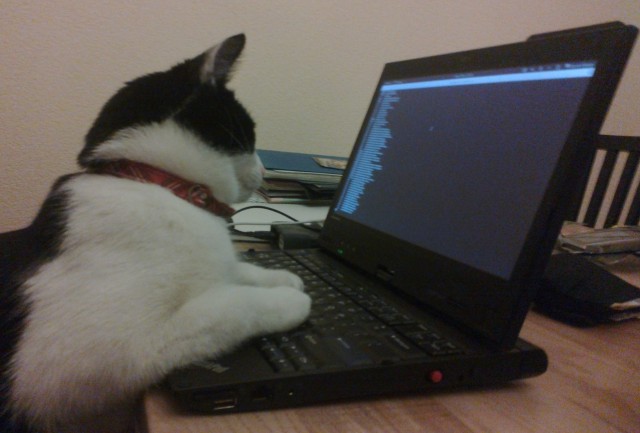
It appears I didn't get around to make any blogposts this year, so to fix that and given that that the internet can always use more pictures of cats: Hacker cat What Zappa was working on will likely always remain a mystery.
Dirk Eddelbuettel: Getting numpy data into R -- Take Two

A couple of days ago, I had posted a short Python script to convert numpy files into a simple binary format which R can read quickly. Nice, but still needing an extra file. Shortly thereafter, I found Carl Rogers cnpy library which makes reading and writing numpy files from C++ a breeze, and I quickly wrapped this up into a new package RcppCNPy which was released a few days ago. This post will show a quick example, also summarized in the short pdf vignette describing the package, and provided as a demo within the package.
R> library(RcppCNPy)
Loading required package: Rcpp
R> library(rbenchmark)
R> 
R> n <- 1e5
R> k <- 50
R> 
R> M <- matrix(seq(1.0, n*k, by=1.0), n, k)
R> 
R> txtfile <- tempfile(fileext=".txt")
R> write.table(M, file=txtfile)
R> 
R> pyfile <- tempfile(fileext=".py")
R> npySave(pyfile, M)
R> 
R> pygzfile <- tempfile(fileext=".py")
R> npySave(pygzfile, M)
R> system(paste("gzip -9", pygzfile))
R> pygzfile <- paste(pygzfile, ".gz", sep="")
R> 
R> 
We first load the new package (as well as the rbenchmark package used for the benchmarking example) into R. We then create a large matrix of 100,000 rows and 50 columns. Not quite big data by any stretch, but large enough for ascii reading to be painfully slow. We also write two npy files and compress the second one. Next, we use the benchmark function to time the three approaches:
R> res <- benchmark(read.table(txtfile),
+                  npyLoad(pyfile),
+                  npyLoad(pygzfile),
+                  order="relative",
+                  columns=c("test", "replications", "elapsed", "relative"),
+                  replications=10)
R> print(res)
                 test replications elapsed relative
2     npyLoad(pyfile)           10   1.241  1.00000
3   npyLoad(pygzfile)           10   3.098  2.49637
1 read.table(txtfile)           10  96.744 77.95649
R> 
As shown by this example, loading a numpy file directly beats the pants off reading the data from ascii: it is about 78 times faster. Reading a compressed file is somewhat slower as the data stream has to be passed through the uncompressor provide by the zlib library. So instead of reading a binary blob in one go (once the file header has been parsed) we have to operate piecemeal---which is bound to be slower. It does however save in storage space (and users can make this tradeoff between speed and size) and is still orders of magnitude faster than parsing the ascii file. Finally, and not shown here, we unlink the temporary files. Summing up, this post demonstrated how the RcppCNPy package can be a useful to access data in numpy files (which may even be compressed). Data can also be written from R to be accessed later by numpy.

10 July 2012

Raphael Geissert: Experimental IPv6 support

For a few hours now, http.debian.net is also reachable over IPv6. The service is still experimental, as the code makes a few assumptions that are not yet automatically verified and the IPv6 GeoIP database is sort-of experimental too.

Note that the results between a request over IPv4 and one over IPv6 may vary quite a bit. Requests over IPv6 are redirected only to hosts that support it. A great number of mirrors, however, don't support IPv6.

Gunnar Wolf: From DebCamp to DebConf through cheese, wine and an intro track

One week. One long week. One beautiful week. One of the two major weeks of the year has passed since my previous post. Surely, we are in the middle of the two Major Weeks of the year, in the yearly schedule I have upheld for almost(!) ten years: DebConf+DebCamp. Yesterday, DebConf officially started. For the first time ever, we had a DebConf track targetted at the local (for a wide definition of local: All of the Central American countries) communities, which I chaired. We had the following talk lineup during this track: I believe it was a great success, and I hope the talks are useful in the future. They will be put online soon thanks to the tireless work of our work team. Today we sadly lost the presence of our DPL due to very happy circumstances he will surely announce himself. But DebConf will continue nevertheless - And proof of that is our anual, great, fun and inviting Cheese and Wine Party! After a series of organizational hiccups I hope nobody notices (oops, was I supposed not to say this?), today we had a beautiful, fun and most successful cheese and wine party, as we have had year after year since 2005. As many other people, we did our humble contribution for this party to be the success it deserves. There is lots of great cheeses, great wines, and much other great stuff we have to thank to each of the individuals who made this C&W party the success it was. Yes, it might be among the least-academic parts of our conference, but at the same time, it's one of its most cherished -and successful- traditions. And above all else, we have to thank our Great Leader^W^WCheeseMaster (who we still need to convince to play by our Great Leader's mandates - And no, I don't mean Zack here!) Hugs and thanks to my good and dear friend Christian Perrier for giving form to one of DebConf's social traditions that makes it so unique, so different from every other academic or communitary conference I have ever been part of. We still have most of the week to go. And if you are not in Managua (and are not coming soon), you can follow our activities following our video streams. Remember, debian/rules, now more than ever! And even given the (perpetual) heat in Managua: Wheezy is frozen, whee! [ all photos here taken by regina ]
AttachmentSize
100_2110.JPG1.53 MB
100_2119.JPG1.49 MB
100_2121.JPG1.52 MB
100_2135.JPG1.49 MB
100_2144.JPG1.11 MB
100_2146.JPG1.53 MB
100_2145.JPG1.08 MB
100_2122.JPG1.51 MB

Next.

Previous.