Search Results: "cas"

22 January 2009

Benjamin Mako Hill: Annual Free Software Foundation Fundraiser

When I explain the importance of free software, I often use some variation of the following example:
Suppose I see a beautiful sunset and I want to describe it to a loved one on the other side of the world. Today's communication technology makes this possible. In the process, however, the technology in question puts constraints on message communicated. For example, if I pick up my cellphone, my description of the sunset will be limited to words and sounds that can be transmitted by phone. If I happen to have a camera phone and the ability to send a picture message, I will be able to communicate a very different type of description. If I'm limited to 150 characters in an SMS message, my message will be constrained differently again.
The point of the example is this: the technology I use to communicate puts limits and constraints on my communication. Technology defines what I can say, how I can say it, when I can say it, and even who I can say it to. This is neither good nor bad. It is simply the nature of technology. But it means that those who control our technology control us, to some degree. As information technology becomes increasingly central to our lives, the way we experience, understand, and act in the world is increasingly controlled by technology and, by extension, by those who control technology. I believe that the single most important struggle for freedom in the twenty first century is over the question of who will set these terms. Who will control the technology that controls our lives? Free software can be understood as an answer to this question: An answer in the form of an unambiguous statement that technology must be under the control of its users. When free software triumphs, we will live in a world where users control their technological destiny. We simply cannot afford to fail. The Free Software Foundation is the most important organization fighting for the rights of users in this struggle. Here are some of the ways that I plan to direct the FSF to support software freedom in the coming year:
Network Services Last year, the FSF organized a meeting on software freedom and network services that lead to the creation of the Autonomo.us group and the release of the Franklin Street Statement on Freedom and Network Services. As network services --- like those built by Facebook, Google, and others --- continue rise in popularity, progress in this conversation is of increasing importance. This year, I will direct the FSF to build on the work of Autonomo.us to launch the first of what I hope will be several FSF position statements on software freedom and network services. More importantly, the FSF will begin to provide support and planning for solutions --- technologies, social campaigns, and legal steps --- that will protect computer users whose freedom is currently threatened by network services. Enforcing free software licenses Early on, people who decided to work on free software did so because they agreed with --- or, at the very least, were willing to abide by --- the principles and rules laid out in our licenses. In our push for software freedom, we have created software of immense value and attracted companies and individuals to our community who are less willing, or simply less interested, in protecting users' freedom. In December 2008, the FSF went to court for the first time in the organization's history to force Cisco to uphold the freedom of the users of FSF copyrighted software. This lawsuit asks Cisco to live up to its obligations under the GPL and to ensure that it does so in the future. The FSF needs the support of its community in this and in future enforcement actions. The FSF has operated a compliance lab for several years and has ensured software freedom for countless users. As free software becomes more successful in the next year, the FSF will be playing an increased role in protecting software freedom from those who do not share its principles. Continuing the fight against software patents As I said last year, one cannot write non-trivial software today without running a serious risk of infringing patents. The software patent minefield we've found ourselves in is a very fundamental threat to the success of free software and we've already begun to see the first casualties and costs. We must eliminate software patents. Now. The FSF will continue its work toward this end. The FSF's End Software Patents project's major contribution this year was a brief submitted in the In Re Bilski case at the U.S. Court of Appeals for the Federal Circuit. Recently, an opinion was issued which seems to mark an important shift away from broad protection for software patents. With this victory, now is the time to keep up this momentum. The FSF is drawing up a strategy to do just this and will be announcing the relaunch of its campaign on February 9,2009 led by Ciaran O'Riordan.
Every recent fundraising appeal seems to mention the difficult economic climate and it seems to cliche to do so here. That said, the effect of a bad economy is, in fact, felt most strongly in non-profits dependent on donations. The FSF is not immune. The FSF's work is essential for success on the issues I've described here and on all of its other campaigns and projects. Although the cost of a membership or donation may be less easy to afford this year for many of you, the free software movement cannot afford a weakened FSF at this important moment. If you are not an FSF associate member, now is the time to become one. If you are already a member, please join me in giving generously through a tax-deductible donation. The FSF is a very lean, very humble organization of passionate and dedicated individuals working tirelessly for software freedom. Every single gift makes a difference.

David Welton: Github Part III

Since this seems to be fairly constructive, I'll keep going. Those not interested in Github, or the dynamics of open source code creation can safely tune out. Chris, the Github dude, has some more to say: http://ozmm.org/posts/forking_continued.html
I mentioned the Network Graph and Fork Queue but David mentioned neither. I think he doesn t know what they are, probably because I didn t explain what they are :)
I had had a look at them, and they're handy tools (I would never accuse Github of not doing good work, that's not the issue at all), but I would respectfully submit that perhaps Chris is looking at things from a very Github-centric perspective, in which it's second nature to go look at those. They aren't obvious, and certainly don't jump out at the user to say "hey, maybe this code your looking out isn't the latest and greatest!". For someone just cruising around, perhaps it should be more evident who's the 'top dog'? Chris then goes on with a very helpful and illustrative demo of how things work at Github, which is good stuff. However, at the end, he says something that I don't agree with:
It may seem strange, and perhaps even like a lot of work. Why should I have to check to see which is the most current? In the old model, there s always a canonical repository.
That's precisely the problem. It does seem like a lot of work, especially when your search space is not limited to Github, but may include other places like Sourceforge, RubyForge, Google Code, project specific sites, and so on.
In the old model, actionwebservice wouldn t have made it past 1.2.6. Welcome to distributed version control.
Plenty of 'old style' projects have survived beyond their founders' interest in the project. What happens is that you ask for permission to work on the project, and either :
  1. It's given to you, in which case you can keep working on the canonical code. For instance, someone could have asked DHH to work on the RubyForge version of actionwebservice. Did they? Did he say no? At the very least, he could have been asked to point the RubyForge actionwebservice page at some other site with a more current version of the code.
  2. You have to fork the project, and in that case, sure, you might as well have been using the Github model.
I've often found that people are happy to let you contribute to their projects, though, and part of my original point with all of this is that if people just go spitting out forks willy-nilly, it creates a "paradox of choice" type problem, and perhaps takes something away from the community aspect of open source projects. As people are fond of saying at the Apache Software Foundation, it's about the people, not necessarily about the code. I'm not saying that forks are always bad and that everything should be centrally done, but there's a balance to be struck between people just working on their own, and some sort of onerous, bureaucratic Central Project Authority. It's nice that people who want to improve the code make themselves heard on a mailing list/forum/whatever, and thus cover the "people" part of merging in new code and new ideas. More often than not, help and contributions are more than welcome. Design decisions and conversations recorded on mailing lists are available for people to peruse in the future when they have questions. Just to repeat something that bears repeating: I am not claiming that Github will lead to social disintegration of open source projects or anything drastic like that. However, I'm a bit wary of certain patterns I've seen. It's certainly possible that I'm wrong - as I mentioned, one error I might be making is that people are dumping code they simply wouldn't have shared on Github, because Github makes it so easy. I do hope my worries are unfounded, and in any case, it's a good thing that the Github guys are interested in the problem too, and will hopefully do things to alleviate it where possible.

David Welton: Github Part III

Since this seems to be fairly constructive, I'll keep going. Those not interested in Github, or the dynamics of open source code creation can safely tune out. Chris, the Github dude, has some more to say: http://ozmm.org/posts/forking_continued.html
I mentioned the Network Graph and Fork Queue but David mentioned neither. I think he doesn???t know what they are, probably because I didn???t explain what they are :)
I had had a look at them, and they're handy tools (I would never accuse Github of not doing good work, that's not the issue at all), but I would respectfully submit that perhaps Chris is looking at things from a very Github-centric perspective, in which it's second nature to go look at those. They aren't obvious, and certainly don't jump out at the user to say "hey, maybe this code your looking out isn't the latest and greatest!". For someone just cruising around, perhaps it should be more evident who's the 'top dog'? Chris then goes on with a very helpful and illustrative demo of how things work at Github, which is good stuff. However, at the end, he says something that I don't agree with:
It may seem strange, and perhaps even like a lot of work. ???Why should I have to check to see which is the most current? In the old model, there???s always a canonical repository.???
That's precisely the problem. It does seem like a lot of work, especially when your search space is not limited to Github, but may include other places like Sourceforge, RubyForge, Google Code, project specific sites, and so on.
In the old model, actionwebservice wouldn???t have made it past 1.2.6. Welcome to distributed version control.
Plenty of 'old style' projects have survived beyond their founders' interest in the project. What happens is that you ask for permission to work on the project, and either :
  1. It's given to you, in which case you can keep working on the canonical code. For instance, someone could have asked DHH to work on the RubyForge version of actionwebservice. Did they? Did he say no? At the very least, he could have been asked to point the RubyForge actionwebservice page at some other site with a more current version of the code.
  2. You have to fork the project, and in that case, sure, you might as well have been using the Github model.
I've often found that people are happy to let you contribute to their projects, though, and part of my original point with all of this is that if people just go spitting out forks willy-nilly, it creates a "paradox of choice" type problem, and perhaps takes something away from the community aspect of open source projects. As people are fond of saying at the Apache Software Foundation, it's about the people, not necessarily about the code. I'm not saying that forks are always bad and that everything should be centrally done, but there's a balance to be struck between people just working on their own, and some sort of onerous, bureaucratic Central Project Authority. It's nice that people who want to improve the code make themselves heard on a mailing list/forum/whatever, and thus cover the "people" part of merging in new code and new ideas. More often than not, help and contributions are more than welcome. Design decisions and conversations recorded on mailing lists are available for people to peruse in the future when they have questions. Just to repeat something that bears repeating: I am not claiming that Github will lead to social disintegration of open source projects or anything drastic like that. However, I'm a bit wary of certain patterns I've seen. It's certainly possible that I'm wrong - as I mentioned, one error I might be making is that people are dumping code they simply wouldn't have shared on Github, because Github makes it so easy. I do hope my worries are unfounded, and in any case, it's a good thing that the Github guys are interested in the problem too, and will hopefully do things to alleviate it where possible.

Y Giridhar Appaji Nag: The Mozart of Madras

I have been listening to music from the Laya project since a few days. It is a set of CDs I picked up from an interesting hippie-ish place called Psybabas on Castle street. Actually, one rarely gets to listen to such sounds. Ideas of similar music can be found scattered in the movies from the early 90s; Hai la sa reminds me of ETilOni sEpalanTa from donga donga. My favorite track though is LA ilAha ill-Allah which sounds very fresh and different from how one would expect it to be.

On a related noted, ETilOni sEpalanTa was composed by A. R. Rahman. I have great respect for the gentleman and recently H pointed me to an article in Tehelka titled The Mystic Master. While a lot has been written about him recently, mostly in the backdrop of The Golden Globe that he won, this article dwells on the person unlike probably anybody did before. Must read.

Pablo Lorenzzoni: I feel so old

I don t know maybe it s because my birthday is coming (Feb 10th)... or maybe because my wife s birthday is around the corner (Jan 26th), but I am feeling too old these days. I know, though, that at least part of it is due to Web 2.0! I feel like being the last geek still using my own mail server (everybody else is using Google Apps) and a console-based MUA (I am using Mutt for as long as I remember everybody else seems to be on Google s Gmail). I still don t have a Twitter or an Identi.ca account. I still use my ICQ account! I never got an OpenID. Just yesterday I was lost in a conversation about Google Reader! I am a lost case Is this how it is to become an old days geek? Now I know what those bearded geeks from the 70s felt

Russell Coker: SE-LAPP

On Tuesday afternoon I gave a talk on behalf of KaiGai Kohei about SE Linux and the LAPP (Linux Apache, PostgreSQL, PHP/Perl) stack. KaiGai has blogged about this [1], unfortunately Google Translation does a poor job of Japanese and has particular problems with KaiGai s work (could anyone who knows Japanese and English well please submit some tips to Google). KaiGai s post is useful for links to his notes which are good background reading. My talks about SE-LAPP and SE-PostgreSQL have been getting some notice, Bob Edwards referenced SE-PostgreSQL in his talk about database security. It s good to see KaiGai s great work getting the notice that it deserves. I hope that it becomes a standard feature of the PostgreSQL code base in the near future! Also Casey Schaufler, James Morris, and I have bought KaiGai a present of some Tasmanian wine, in recognition of his great work.

John Goerzen: Hope

Our power alone cannot protect us, nor does it entitle us to do as we please. . . Our security emanates from the justness of our cause; the force of our example; the tempering qualities of humility and restraint. - Barack Obama, inaugural speech, Jan. 20, 2009
This, right here, is why, for the first time in my life, I actually feel good about an American president. Why I have hope about our government for the first time in years. Why I m glad I used a vacation day to sit on the couch and watch TV yesterday. On the occasion, once every 4 or 8 years, that is a celebration of American strength, power, and pride, we see our new president speaking of humility, of peace, of moral leadership, this is something remarkable. Past presidents have used occasions such as these to speak of crushing our enemies, of wanting people dead or alive, of grand government promises that turned out to triple the national debt. Obama spoke of extending the hand of friendship to anyone that would unclench their fist. He spoke that we had kicked the can down the road too far, and now we ve reached the end of the road. We have to stop thinking that we can have everything: low taxes, expensive programs, and a large military, simply by mortgaging our future. And he leveled with us: we all are in this together, and all have to work to make it better. Conventional politicians assumed it would be political suicide to say even half of what Obama has said. Yet he went out there and did it. He was blasted during the campaign by people on both sides of the political spectrum for being just words . He s the first presidential candidate that meant what he said about bringing Americans, and their representatives, together. The shock in Washington has he invited gasp! both an openly gay bishop and an anti-gay evangelical minister to give prayers was telling. It s as if people were saying, Wait, he really MEANT that? Yes, he did. Let s hope he can pull it off. And as Rev. Lowry concluded with his benediction:
With your hands of power and your heart of love, help us then, now, Lord, to work for that day when nations shall not lift up sword against nation, when tanks will be beaten into tractors, when every man and every woman shall sit under his or her own vine and fig tree and none shall be afraid, when justice will roll down like waters and righteousness as a mighty stream. . . Let all those who do justice and love mercy say Amen. (amen) Say Amen! (Amen!) Say Amen! (AMEN!)

Joerg Jaspert: Bugs, Bugs, Bugs and a nice speed improvement

This all started when a DSA (Debian SysAdmin (those with root rights on all .debian.org machines)) wanted to upgrade the kernel running on our ftp-master host. It was shortly before dinstall, but hey, there it went, and the machine rebooted into a 2.6.28. Besides murphy taking his share making the machine fsck its huge filesystem that is all fine. What wasn t fine was the result we found. An odd one. Suddenly one tool we run during our dinstall run decided to blow up. Well, it did nt break, it just went dead-slow. Usual runtime had been about 5 minutes before, now we had over an hour - and only about 20% of the work was done. YUCK. Thats sure not going to work. Reboot in a 2.6.27 kernel did not show this problem, going back to .28 had it again. Which meant we had yet another reboot to get a working system. At which point investigation of the problem started. Turns out that pythons popen2.popen2 function is closing all available filehandles before it forks. Thats all fine and also what you usually want. Problem is (and all the glory to have found the cause goes to Peter weasel Palfrader) that the .28 kernel included a patch titled rlimit: permit setting RLIMITNOFILE to RLIMINFINITY (0c2d64fb6cae9aae480f6a46cfe79f8d7d48b59f) that allows, as the title implies, to set the limit for number of files to infinity. More citation from weasels mail: Closer investigation showed that the broken default ulimit did not apply to system processes (like stuff started from init). In the end I could establish that all processes that passed through pam_limit at one point had the bad resource limit. Apparently the pam library in Debian etch (4.0) initializes the limits to some default values when it doesn t have any settings in limit.conf to override them. Turns out that for nofiles this is RLIMINFINITY. Commenting out case RLIMITNOFILE in pam_limit.c:267 of our pam package version 0.79-5 fixes that - tho I m not sure what side effects that has. Debian lenny (the upcoming 5.0 version) doesn t have this issue as it uses a different pam (version). So, whatever the fix might be for etch, if any, there is no way we Ftpmaster can force DSA to live with a 2.6.27 kernel forever on our host. As the problem occurs when using popen2 - lets get rid of it. Luckily popen2 was used in dak by people that either did not know the gzip module python has, or it has been there since before that exists. Don t know, but that made removing popen2 a not too hard deal, done by our newest addition to the Ftpteam, Mike O Connor, stew (Thanks!). A pretty nice side effect is a huge improvement to the speed of the tool Prior, using popen2, it took around 5 minutes to do its job. Now using the gzip module we are down to some 44 seconds. Yes, below one minute, but well, must have some effect if you stop forking a thousand times and all that thousand times close all (1024) available filehandles But that alone isn t enough. There was a second tool also using popen2 (thankfully only once instead of a million times). Fixing that tool got its runtime from 2 minutes down to 0.7 seconds. Yes, less than one second, getting the same result out. Thats the gain you get from not going like get a tempfile, zcat foo > tempfile, filehandle=open(file), dowork including reading its content but foo=gzipfile.readitscontents, dowork(foo) . I like it. And am now sure that avoid popen2 at nearly all costs, if you can is a good motto. :)

21 January 2009

Kyle McMartin: fudcon f11

I was in Boston last week for FUDcon F11. As usual, despite bringing several tonnes of camera gear, I couldn t be bothered to pull it out aside from a few (terrible) casual shots. But hey, I m not big on being spontaneous. Anyway, the two hackfest days were really productive (as were the days I managed to make it out to the Red Hat office.) Although sadly we didn t make it into MIT for the Sunday hackfest day, due to the weather and the Sunday bus schedule in Arlington. paul's intro session Instead of DaveJ doing his usual what s going on in the kernel for F$next I pitched that session and Dave held a session on dracut, he and Jeremy s new framework for building initramfs. My session was well attended and got a lot of questions about various things like the new drivers/staging policy (though, that s a post for another time.) dcbw and notting The rest of the time was productively spent poking at updates for the kernel for F9 and F10, rebasing them to 2.6.28, and poking at 2.6.29-rc1 for rawhide. This meant btrfs, while not ready for your critical data, was in mainline! After pushing out the new build, I spent most of the weekend doing some btrfs testing, and pushing out a new btrfsprogs build. Once they were composed into rawhide, I believe Fedora became the first to ship the mainline working btrfs in a distro. paul's closing session All said, it was a fairly productive weekend, and FUDPub on Saturday night was a great chance to catch up with a bunch of my coworkers who I rarely get to see. I kind of wish I had bothered to set up an umbrella and get some decent shots of my friends, colleagues and coworkers having a raucous good time, but oh well, there s always next release. off-topic
I absolutely hate being politic, and desperately hate posting about life or whatever, since I don t care about yours and don t see why you should care about mine, but the callous arrogance of these striking transit workers here in Ottawa is beginning to irritate me. These are people who ve threatened to picket students attempting to get to school if the universities accepted funding from the municipal government to continue to run replacement shuttles, and (though they ve reached a side agreement now) had threatened to picket for attempting to hire more drivers to increase their ParaTranspo service which provides shuttle services for the elderly and less-able-bodied residents of Ottawa. My point is, one of the shops I walked past on the high street yesterday said it best: Caution, possibly NSFW depending on your point of view. Given that I live in a (fairly) suburban part of Ottawa, this means I get to enjoy a forty minute walk to the nearest (competent) grocery store or coffee shop, and haven t bothered much. But hey, wonderful North American urban planning strikes again. Huzzah.

David Welton: More Github

Before I get started, I want to make it quite clear that I have no problems with Github - au contraire, they provide a very nice service. What my speculation centers around is the social dynamics of Github. One of the Github guys writes a nice response to my original post, here: http://ozmm.org/posts/linux_vs_classic_dev_style.html First of all, apologies for the comment bug. In theory, it has been fixed by the Typo guys, I just need to find the time to upgrade. Chris mentions that it's possible to create a "SourceForge style" project on Github. I see that it's possible to add collaborators, so I guess that's what he means. I still find it a bit ugly to have things at .../davidw/... but that's not very important if the URL is at least stable, rather than hopping around to whoever has the latest fork and updates of the code in question. In my other post, I talked about people being less interested in doing what it takes to contribute to existing projects, rather than forking them, unless it's really called for. Here's a concrete example of how things might go wrong. At my current consulting gig, we were looking at utilizing actionwebservice to do some SOAP stuff. That code is not part of Rails anymore, but that's not the problem - surely someone has decided to take up maintenance of the gem, right? Well, yes... but let's look:
root@fortrock:~# gem1.8 search -r actionwebservice
*** REMOTE GEMS ***
actionwebservice (1.2.6)
datanoise-actionwebservice (2.2.2)
dougbarth-actionwebservice (2.1.1)
nmeans-actionwebservice (2.1.1)
So we have the original, clearly out of date, and three others. Yuck... I guess we'll use the 2.2.2 one, but who knows if perhaps the others contain some good stuff too? Let's Google it. http://www.google.com/search?hl=en&q=actionwebservice The first link is to a RubyForge project, which is basically dead. A few links down, there is a link talking about a more recent version, at the Datanoise site. However, it's one of many. Confusing. If you go to the github page for the datanoise version of actionwebservice, the README has this:
The latest Action Web Service version can be downloaded from http://rubyforge.org/projects/actionservice
Hrm. We were just there and that doesn't seem quite right... Sure, it's an easy enough oversight to ignore, but it adds to the confusion. Now, this is not really a serious problem, but do you see how it could get worse over time, as various people fork the code, write blog entries, and so on? It would get harder for someone interested in utilizing the code in question to ascertain which is "the" version. It's not hard to imagine situations where two forks add different bits of useful code. Typically, in situations like this, new users, those who don't know the code at all, are also the people least able to look through all the diffs and changes and log entries and what not in an attempt to merge any changes that might be useful. This leads to a "paradox of choice" type of problem. Another consideration, this one more positive, is that perhaps people are putting code in Github that, in the past, might have simply remained on their own computers, with no effort whatsoever to share it, so in that sense, Github might be doing people a service by at least making the code public. However, even in that case, if the service fills up with code that people have simply "thrown over the wall", rather than creating a genuine open source project, with a community, communication channels, and so on, it could get a reputation for having code that you have to handle with care, as a lot of is just stuff slapped up there without much thought to quality or continuity. Anyway, the Github guys have done a nice job with the service, and I'm sure they'll continue to improve it. Who knows, perhaps they have some good ideas about mitigating some of these potential problems that they'll be rolling out soon.

20 January 2009

Holger Levsen: Memetime


And again we will be recording and streaming the talks and discussions in the Debian Dev room. For that, we are still looking for a good DV camera with line-in (audio) - please contact me in case you can lend us one for those two days.

Eric Warmenhoven: I ve decided to take up parenting as a hobby

My son Andrew is now ten weeks old, and already I ve learned so much. For example Being a good parent occasionally means being a proper adversary It s much harder than you might expect, and happens more often than you might expect. A pacifier is an excellent way to calm him down, especially when he has gas pain (and a pacifier can also reduce the risk of SIDS); however, he would let it fall out of his mouth when he wasn t sucking on it. Rather than hold it in, if you tug on the pacifier a little bit, it teaches him how to suck on it so it doesn t fall out. Sometimes what s best is actually not so good Andrew has a food allergy, but we re not exactly sure what he s allergic to. For the last couple weeks, he s been on Nutramigen, a hypoallergenic formula specifically for babies with food allergies, and has been responding really well. Meanwhile, Lisa s been on an elimination diet, eating mainly chicken and rice, trying to get everything he might possibly be allergic to out of her system so she can start nursing again. Recently, Lisa started nursing at an occasional feeding, and he coincidentally seems to have gotten more fussy. He s not screaming in pain like he was before going on the formula, and it s hard to say that it s because of the breast milk. Still, we re thinking about going back to just formula and seeing if he improves again. I read too much When I was a child, and still to this day, I had pretty severe sleep problems. I didn t sleep through the night until I was 18 months old. So before Andrew was born, Lisa and I read a few books about how to establish a healthy sleep pattern. All of them had various theories about why children develop sleep problems, and how to quiet a baby and establish a routine. Now we re so full of conflicting theories about problems that will develop if we do or don t follow some guideline, that it s hard to make a decision about what s best sometimes. It doesn t help that, in part due to his food allergy, he ll sleep through the night one night, and the next night wake up every few hours. Fortunately, only one feeding in the middle of the night has been the norm for quite some time, so it hasn t been too bad.

Obey Arthur Liu: Debian Summer of Code 08 : Where are they now (part 1/3)

It s been a while now since the 2008 Summer of Code ended. This year, twelve (?) projects were selected. That s twelve students working full time on a Debian-related project during the summer. The Google Summer of Code has sometimes been criticized in the past for having a poor student-developer retention rate inside the host projects. One of the goals of the program has always been to bring new people to budding or established free software organizations and it s a pity that some would leave the project as soon as the program ends. On the other end, poor integration of created code within the project leads to work that is hard to merge in, or worse, doesn t get merged in at all. That s a waste of time and resources and a probably cause of global warming as well. Hopefully, it s not always the case. Some people choose to stay committed within the organization in the long-term. Useful code gets merged in and pushed to the public. I am going to give a talk about this at FOSDEM (go to FOSDEM!) so I m giving you a little preview. I need your help to collect information for my talk. As you know, information is always hard to come by with these kinds of projects so anything can be useful. Without further ado, let s have a look at the cast of the Debian Google Summer of Code 2008: Netconf, a network configuration management system Presentation Netconf is a network configuration management system designed with modern network infrastructures and the needs of roaming users in mind. It is a personal project of Martin Krafft that he started in 2007. He did some presentations about it that you can find on the dev website. The project proposal was introduced by the mentor. The work was mainly about completing the roadmap items for version 1.0. Most of the design was done and code fleshed out. The stated goal was to have netconf ready for lenny. Martin noted that due to lack of regular free time, he couldn t reach that goal by himself. Student Jonathan Roes was a computer science graduate student from the University of North Carolina at Charlotte. He had programming experience as a hobby for a long time and wrote some free games and libraries for the Nintendo DS and some proprietary webapps. He submitted a few little patches in mid-march right after the publication of accepted mentoring organizations and went on to work from mid-may to mid-august. He wrote a lot of code right into the trunk since the whole project was a prototype. Result The last commit by Jonathan was also the last to date in the main netconf git repository. No further progress has been made and obviously netconf didn t get into lenny. I couldn t find any further public involvement of Jonathan within Debian. The ultimate Debian database, all things Debian in a SQL database Presentation The Ultimate Debian database wants to reunite all Debian data sources in a SQL database The project was mentored by Lucas Nussbaum and co-mentored by Stefano Zacchiroli and Marc HE Brockschmidt. The project proposal was introduced by Lucas. Student Christian Neronus Von Essen is.. well, there wasn t much information readily available on him. Result The whole project is coded up and working well with a whole bunch of data sources. There will be a talk at FOSDEM about this so I ll leave it to Lucas to talk about it in detail. I couldn t find any further public involvement of Christian within Debian. Security-beta, a beta testing for Debian security updates Presentation The task is to improve the quality assurance process for security updates by providing a public security update beta test program in addition to the existing QA done for security updates. During the preparation of security updates, there s an inherent delay between the initial upload of the fixed packages and the time until the packages have been built on porter machines. This time gap will be used for a new security update beta program. The project was supposed to be mentored by Moritz M hlenhoff. Student The project was supposed to be done by Nico Nion Golde. He is studying computer sciences at the Technical University of Berlin. He s also a DD. Result There s no nothing. Nico, what happened ? And obviously, he s still developing for Debian. Debgraph, a generic infrastructure for the development of packages management tools Presentation In a large software ecosystem such as Debian Linux, there is the potential for dependencies among software packages to create complex management and technical problems. For example, dependency loops (cycles) in which a package directly or indirectly depends on itself can confuse package management tools as they determine the proper order of package installation. debgraph helps developers to solve this problem by enabling generic queries (e.g., Give me all the nodes that depend on package X ) against the graph of packages and thus automating much of the manual labor that is typically involved in resolving dependency problems. The project was mentored by Robert Lemmen, who introduced the project proposal. The project was already started and the C++ code foundation was done by the time it was proposed. Student The project was executed by Adam Jensen, research assistant in the Software Engineering and Network Systems Laboratory at Michigan State University. Result Adam maintained a blog about his progress and finished ahead of schedule. However, the resulting work seems to be unused, which is a pity since the code could be used within other programs (package managers?). I couldn t find any further public involvement of Adam within Debian.
That s all for now. The information is quite fragmented I admit. Most of it was pulled from Google, mailing lists, commit logs, blogs, whatever. If some projects are lacking in information here, it s because I couldn t find it readily (which is an issue in itself!). In my next post, I ll try to analyze the success and failures to extract some insight. Teaser: pet projects!
If you re a student or a mentor mentioned above, feel free to fill any of the blanks in my report. It s much appreciated. You re not a student or mentor mentioned above and have an opinion on how to improve the next Debian Summer of Code ? Feel free to comment.
Sledge, ping! Here s a list of projects to be described in my next posts:

19 January 2009

Stefano Zacchiroli: gitweb vs DSA 1708-1 on lenny

packages backported by yours truly Just in case you need backported packages for DSA 1708-1 affecting backported gitweb to Etch (and in case you trust my as a builder), I've made available mines (arch amd64, signed with my DD GPG key, together with backports of build-deps). No, sorry, no upload to bpo: I did the rebuilds in a hurry, without bothering to check the backports guidelines as I usually do before uploading to bpo. Packages tested and working properly on medium-sized machines, including a forge-like service. Ah, right, beware that gitweb.css changed location since the last version in bpo, the new location is /usr/share/gitweb/gitweb.css, upgrade your links / alises / whatever to avoid a 80's theme for your brand new gitweb.

Stefano Zacchiroli: worst quoting practice

On the saga of weird SPAM, today I received a SPAM message in French about advertising a backgammon portal (WTF?). One of the funniest part was the end of the message (original, horrible line breaking preserved):
P.S.: Pour un meilleur suivi des communications, merci de bien vouloir laisser
l'int gralit 
du message et de r pondre au-dessus de l'historique.

Which roughly translates to: "to better follow further communications, please keep the totality of the original message and write your response on top of it". To be read as: "just in case you know how to quote properly, please don't do that".

Gunnar Wolf: About the recent events and possible outcomes in Israel and Palestine

Several friends, from different groups and backgrounds and with different points of view regarding the current war in Israel (and regarding the Arab-Israeli conflict in general) have asked me for an explanation on what is happening there, what is (my view of) the real conflict, its causes... and any possible answers. And yet I am quite far from being an authority, I do want to write something about it. Be prepared, as this post is quite long.
And yet, after writing frankly a lot more than what I expected... It is by far not enough. I have still much more to add, but I have to say "stop" at some point. So, here you have it: My points of view, as well as some explanation on why are we standing where we currently are.
I am writing this based just on my personal experiencie and, of course, my personal point of view. Furthermore, I wrote a good part of this text while riding a bus, with no network access, so I am offering very few references - In any case, it will allow me to make much more progress. References always take as much time as the text itself! About me Why am I writing this? Why do people ask for my opinion? I must start by explaining who I am, so the rest of this makes sense. I am a Mexican Jew. That means, I was born in a Jewish (albeit secular) family, and grew up in an environment with general Jewish culture. My direct family (say, my parents and brother, and to a lesser degree my closest cousins) are not at all religious, I'd even venture to say most of us are complete atheists. Yet, besides the cultural belonging (which is a mixture of a Eastern European culture with lots of Idish words and dishes and general humor), my family has a strong national identification - In other words, I grew up in a fully Zionist environment, which traces back to Poland.
My grandmother was member of Hashomer Hatzair in Poland, since the early years of its existence, late 1910s and early 1920s. What is it? To make it short, a Zionist Socialist, Kibbutzian youth movement. It has many similarities (and somewhat stems indirectly from) the Scouts many of you will be familiar with, but -obviously- has a way lengthier agenda. And, yes, nowadays I feel it is somewhat out of reach with the current state of the world - It was founded in 1913, and only slightly adjusted its principles since then.
I will talk more about Hashomer later on.
My grandmother arrived in the late 1920s to Mexico, for familiar and economic reasons, but still dreamt about living in Israel for a long time. As they grew up, first my uncle joined Hashomer in Mexico in the late 1940s, when it still pursued a very much Soviet-style ideals for Israel (one of the core points that changed during the 1950s); both my father and my mother joined in the late 1950s (in fact, that's where they met). My cousins and myself were very active in the 1980s and 1990s.
The Iszaevich family has something very unusual, I'd say, engraved in our genes. We live very deeply our ideologies. That's the only explanation I can find to the way we all have led our lives. I won't go into the other family members' details, but just into mine: I was fully convinced of all we taught to our younger members and what we discussed among ourselves. I am among the very few people who really learnt Hebrew at my school, and that was only because I really cared - I know some people that just after 12 years of pseudo-learning could maybe utter a few phrases.
After finishing high school I went with my Hashomer group, together with people my age from other similar-minded Mexican Zionist youth groups, to live and learn for a year in Israel, on what is usually known as shnat hajshar - A year to get ready. To get ready to what? But of course, to come and give back go the younger groups of the movement, and finally go back to Israel and settle there definitively. I came back to Mexico, and after one year I did the only thing that was logical: I became an Israeli and went to live to a kibutz - Zikim, a beautiful place just between Ashkelon and Gaza, very near the sea shore. It was a beautiful period in my life, and I really enjoyed it - But it didn't last for very long - I quickly grew to hate the Israeli society at large. A society full of rage, of hatred. Not just between Arabs and Israelis, as many would think from the outside, but between religious and seculars. And between immigrants and locals. And between leftists and rightists (in several dimensions, as it is one of the countries where you can most easily be a economic leftist while being a political rightist - a complex society it is). A society full of disrespect and intolerance. A very hypocritical society. And one of the things that most shocked me: I wanted to live in a society of proud of its existence, that's what I had learnt Israel was - But Israelis aspire and dream of being anything else (and mostly US-Americans) in a way that made me sick, more than anything I had previously seen in Mexico.
I loved the life at the Kibutz, and I loved being an agricultor, doing hard work every day and literally getting the fruit of it. However, I cannot live isolated to a 300-people universe - At least once a week you have to go to the city if you don't want to become insane. And I could not stand the sick Israeli society.
Anyway, to make things short: After six months as an Israeli, I came back to Mexico. I went through a long period of finding myself, as I could not uphold anymore my Hashomer ideology (if I am not going to live by it, how can I continue teaching it?). Many people do anyway, but for the first months, where my Hashomer work was basically all of my life, I felt really uncomfortable. So, in short, I severed all of my relations to the Jewish community, and even denied for a long time my Jewishness until I found a (I think) better balance.
Today I am at peace. But anyway, I wanted to talk about myself in the critical period that marked me in this regard: The 1990s. Enough, lets get down to business. Zionism 1870-1920 Many people argue that the Jews invaded the Palestinians homeland - And yes, nowadays I cannot counter this. But we cannot judge what happened then based on what we see now.
Modern Zionism started around the 1870s. The Jewish history is full of pogroms and persecution, in different countries all over Europe - And a group of young people decided the only solution was to build a place to call their own. And yes, this was full of idealism and in no small part the foolishness of youth. For several centuries and up to 1920, all of current Middle East were provinces of the Ottoman Empire. Before Zionism began, the population of today-Israel was very sparse, not more than 400,000 people - up to 5% of them Jewish, around 10% Christian Arabs, and the remainder, Muslim Arabs. Of course, the low population was mostly because the country was mostly hostile - A desert in the South, mostly swamps in the North, and some minor towns mostly in the hills. It was a mostly forgotten province, away from the central Turkish rule, and there had been no frictions with the local population. It was a nice place to go, thinking -again- as a fool youngster, or as an idealist. They said, lets take a folk without a land to a land without a folk.
The number of accomplishing Zionists (this is, people who actually went to Israel instead of just talking about doing so) was not high during the first decades. But towards the 1890s, it gained critical mass. The political Zionist movement was born, with Theodor Herzl as a leader, and they started pushing -politically- for different governments to concede a territory to Jews. They went to the Turks, and didn't really get much echo. Went to other colonial powers of the time, and got unfeasible promises with no real backing (i.e. Birobidjan in Eastern Russia, Uganda in Africa)... And, as it happens in strongly ideologized movements, the movement started splitting into different groups with slightly different positions.
And no, I am not talking about the People Front for the Liberation of Judea and the People Judean Liberation Front, but I very well could. Sometimes the differences are as ridiculous as that. But hey, I take that most of my readers are acquinted with the Free Software issues, right? Think BSD vs. GPL vs. OpenSource. To give a broad idea - Only in Mexico City, with a very small Jewish community (~30,000 people), in the mid-1990s we had over 10 such movements, with 50-150 youngsters attending each. And even though some were local, and even though some very important ideologies are not represented in this country, they are all different enough to exist as separate entities. British Mandate The Ottoman empire was divided after the first World War. Its possesions in Europe became independent states, while in Asia (and Africa, if you take the semi-independent Egypt and part of Sudan into account) they were taken over as colonies or protectorates by France and the UK - Evidently, attempting to secure a long-term dominion over the area. In some aspects, they failed. In some aspects, they were (and still are) tremendously successful. The division of people by setting arbitrary boundaries has led to countries sustainable only by force and a harsh rule (such as Iraq, Lebanon and Syria), or doomed to poverty (and thus submission) due to lack of natural resources (as Jordan). Focusing on Israel/Palestine, the UK entered the area by making mutually incompatible promises to arabs and Jews - i.e. the Hussein-McMahon letters and the Balfour declaration, both ambiguous enough to lead to... Well, today. The UK rule was disastrous to the region, both in giving (and taking away) power from all sorts of puppet regimes, and swiftly going away as soon as things started looking too complicated. Yes, typical colonialism.
So, while up to the 1920s there was no real animosity between Arabs and Jews (as i.e. the Faisal-Weizmann agreement shows), during the next decades the seeds of hatred started growing, from both sides.
Many people still quote the 1947 partition plan as the direct antecedent towards Israel's real existence - That was not the first partition plan that existed. Ten years earlier, the Peel commision suggested a similar partition involving forceful population transfer. And many people see the separation of Transjordan (now Jordan) from Palestine in 1922 as a first partition. It is understandable that both partition plans (much more the 1947 than the 1937 one) were accepted by Zionists: Going from having nothing to having something (and against all odds in the environment they lived) is acceptable.
From the Zionist side, two main groups rejected the partitions: The right-wing and religious groups, insisting that the whole of the Mandate should become Israel, and the left-wing groups, which advocated for a single, bi-national state, with equal rights for all of its population. Go over and read this last link, as it was quite interesting (to me at least) to see how this solution has kept existing and regarded by (relatively) many people, and has many interesting links. 1948 onwards: Where did the refugees come from? The November 1947 partition didn't exactly translate to a planned, smooth Israeli independence - It led to six months of revolts (basically, a civil war). By mid May, the UK government and troops abandoned the territory, and one day later, Israel declared its independence. And, of course, all neighbouring countries (and Iraq) sent their troops to invade Israel. The war lasted for over six months (cease-fire was signed in January 1949). There was an intense Arab campaign indicating the armies would enter Israel and devastate it, leaving no stone in place, indicating Arab population to temporarily leave the Jewish-destined areas. The war, they said, would not take more than a couple of months, and they would be able to go back home.
Only that... When the war ended, the results were far from what the Arab governments expected. Not only Israel continued to exist, but it conquered important territories.
Of course, the Israelis were not innocent from said exodus: During the 1947-1948 civil war, and the independence war, some of the existing so-called self-defense forces (some of them were really defensive, while some were quite aggressive, even terrorist) attacked Arab villages in strategic or predominantly Jewish areas to prompt them to leave - yes, what we today call ethnic cleansing.
I had (in my head) the number of 650,000 Arabs (from a total of slightly over a million) fleeing to neighbouring countries. Wikipedia states that it is somewhere between 367,000 and 950,000. A similar number of Jews were expelled from Arab countries, many of which arrived to settle at Israel (and many others went elsewhere - For instance, a good part of the Mexican Jewish community is from Syrian origins - Many of them fleed in those years). Israel didn't accept back the (relatively few) Arabs that requested to resettle, as they were seen as hostile population - but neither did the countries that "temporarily" accepted the Palestinians accepted them as citizens. The Palestinian refugee camps today, mainly in in Lebanon, Syria, and the occupied territories held by Israel have terrible living conditions, and its population -despite living there for over 60 years- have no civil rights at all. Note that I'm omitting Jordan here, although it has several camps as well, as their situation is way better.
The Arab population that didn't leave did receive full Israeli citizenship. No, their living standards are not up to level with the average Israeli. The country and the society do have a sensible degree of racism and segregation. But the situation is nowhere as terrible as it is in the camps.
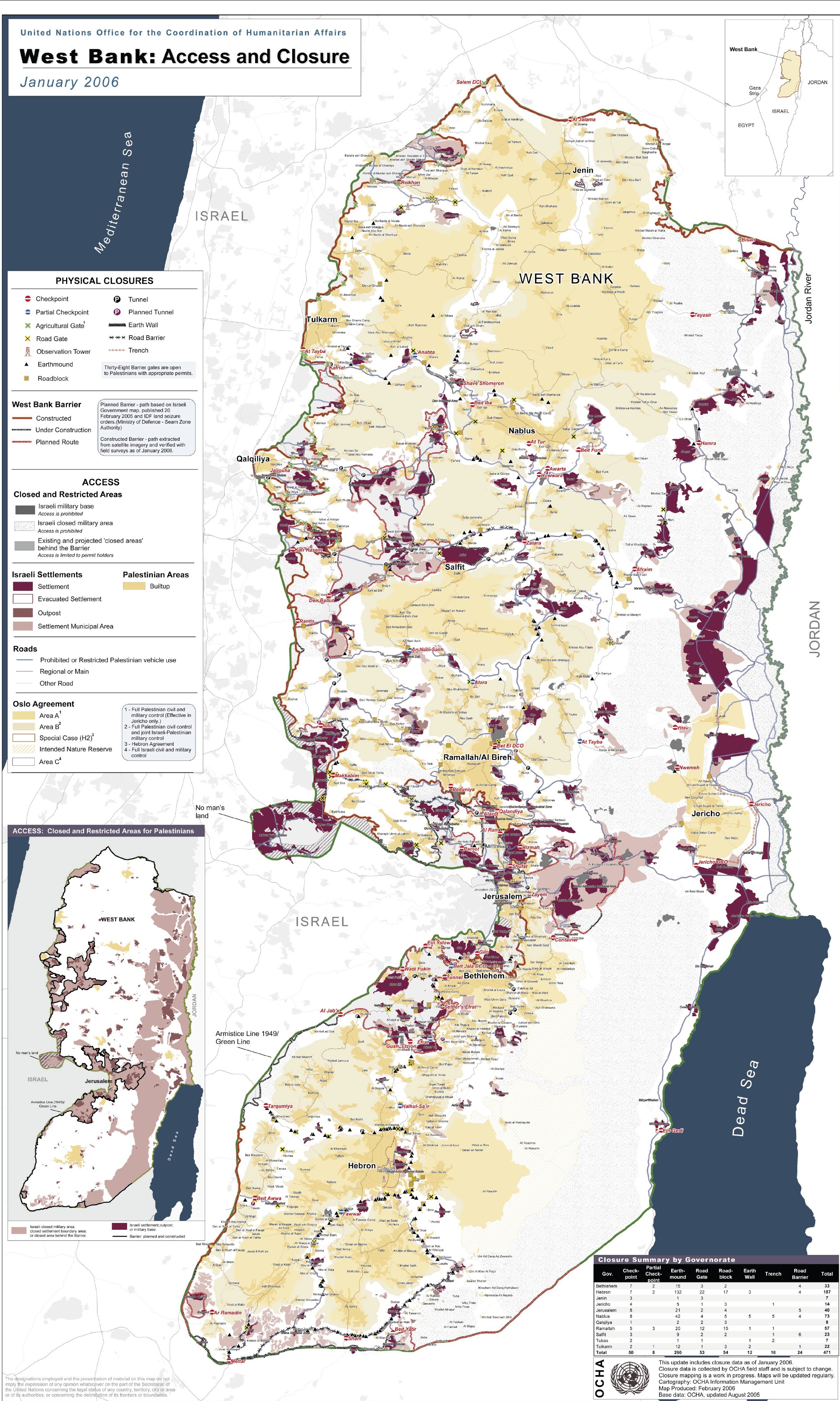
The areas which were originally to become Palestinian and were not conquered by Israel -this is, current-day West Bank and Gaza- bacame respectively Jordan and Egyptian territory. While Jordan did fully extend its soverignty covering the West Bank, Egypt didn't - Gaza is, since 1949, occupied military territory. Gaza, among the most densely populated areas in the world, has had their inhabitants under military rule ever since. When Israel returned the Sinai after signing the peace treaty with President Sadat, Egypt didn't accept Gaza back - And that's where today's greatest problem is born.
Now, Israel conquered those territories in 1967, along with the very sparsely populated Sinai and Golan. For the first ten years, the territories were basically only administered (yes, under a military rule). In 1977, with the first right-wing Israeli government, an extensive settlement policy began (and led partly to today's seemingly unsolvable situation). In 1980-1982, Israel withdrew from the Sinai. In 1981, Israel claimed full soverignty over the whole of Jerusalem and the Golan. In 1993, the "Oslo Agreement" was signed between Israel and the PLO, and it seemed we were heading towards a bright future. I lived in Israel between 1994 and 1996 - Yes, the most hope-filled period in the country's life.
Since 1996, I have tried to keep up to date with the country's evolution. All in all, even if I won't live there again, it is a country I learnt to love, a society I have long studied (even if in the end I did include many references, I wrote most of this text just off the top of my head, with the data I remember - so it might have several big errata). And yes, I keep the political stand I had 12 years ago: The only solution is to dialogue, to treat the current enemies -and not only their governments- with respect, recognizing their dignity and right to life, to self-determination. Only then we will change the status quo. How not to fight hatred Since 1993, the dream of peaceful coexistence seems to have faded. What we saw during the past three weeks, along to what we saw in Lebanon in 2006, is plainly a gross mistake if the goal is to achieve good, lasting peace.
Try to imagine how could life in Gaza be, even in the total absence of Israeli attacks. Just to set some numbers first: The Gaza strip hosts almost 1.5 million people on 360 km . When I lived in Israel, I was constantly surprised at how small a country it is - Israel tops at 550Km North to South, 150Km east to West (it is amazing, almost wherever you stand, except in the middle of the Negev, you can see the country's borders. Yes, I recognize as the border the so-called Green Line); over half of the territory is a desert, and it hosts seven million inhabitants. And it is hard to imagine how that country can be economically viable.
I do not find it feasible to imagine Gaza and the West Bank integrating a single country, and not only because they are separated by ~40Km, but because they are so sociologically different. People in the West Bank, yes, live opressed under military rule and subject to a much more constant, more visible apartheid-like state (as the territory is truly sprinkled with Jewish outposts which many Israelis refuse to recognize as their own, but still, which have incredibly higher living standards). The best land has been taken away from them, yes, but they have some space between cities to have some farming, to communicate, to... Breathe. Besides, West Bank inhabitants -even those in refugee camps- have much better living standards than anybody in Gaza. It is still an overpopulated area, but not nearly as much as Gaza.
Gazan population have been driven towards extremism. And yes, there was a civil war between Palestinian factions, as the world views between both populations are completely different - However hostile a Jenin inhabitant can be towards Israel, he does not lead the life -if it can so be called- you see at Khan Yunis.
But back to Gaza... What Israel is doing (and not only during this military operation terror campaign is wrong, from any rational point of view. Israel wants Hamas to become weaker? Then don't drive the population into supporting them!
Palestinians started giving over 50% of their support to Fatah (ex-PLO), and under 20% to Hamas. That was less than 15 years ago. However, Fatah has shown to be corrupt and inefficient at building infrastructure and improving life conditions, ineffective at negotiating a permanent agreement which secures dignity and sustainability to their people. Hamas stands as a religious, righteous organization. There are no serious corruption charges against any Hamas leaders. Hamas is clearly still at war - They didn't subscribe any peace agreement so far, and their stated #1 goal is to build a Muslim State in the whole of Israel. And the Hamas movement -like Hizbollah in Lebanon- has built quite a bit of infrastructure in the areas they control - Mainly housing. Yes, housing where they mix their own offices, many will accuse, getting human shields for free. But still, they are benefactors to a dehumanized, pauperized population.
I find it obvious that, if living conditions were at a basic level in the region, support of Hamas would decrease. Even more, of course, if they improved due to Israeli support. Israel controls this territory, so it is responsible for the well-being of its population, like it or not. And Gaza is simply too small and low on resources to survive by itself.
I was a bit surprised to find mention -although very brief- of a three state solution - And yes, this is close to what I would expect as a viable outcome. It is clear that Israel will not ever grant full citizenship to the Palestinians, as they would -euphemistically speaking- challenge the Jewish character of the State. Dropping the euphemism, Israel relies on apartheid in order not to become an Arab majority country. I might have some numbers wrong, but AFAIK, there are ~7 million Israelis, 20% of which are Arab citizens (which means, 1.4 million Arabs and probably 5 million Jews, with many other minor denominations for the difference), and ~4 million Palestinians live in the territories. Today, the country is already predominantly Arab, or at least is close to being so. So, Israel should permanently, formally disengage from all of the occupied territories. And in order to ensure violence stops, start a comprehensive, unconditional, long-term aid program. Start with giving them autonomy to regain their sea, as the Gaza port has long been closed. Allow the airport to operate again. Instead of bombing tunnels in the Egypt-Gaza borders, allow Gaza to trade with Egypt - Perhaps even to integrate territorialy, if the conditions are met. Treat their people with respect, and help them ease the terrible situation they have lived for so many decades - and then, undoubtely, terror will stop.
The West Bank? Possibly it could become a Palestinian state by itself. Possibly, it could integrate back to Jordan. That would be up to Jordans and Palestinians to decide. Of course, Jordan has already a large segment of its population defining itself as Palestinians, which counts both for and against. So, I won't venture into this supposition.
But anyway - Back to what prompted me to write this text -yes, a very or maybe even too long text - I hope somebody even takes the time to read it!- is to explain what is my point of view on the current situation, and why.
Today, a cease-fire was announced, after 23 days of murder and destruction. I sadly do not hold very high hopes for it to be lasting, much the less to be enough, to lead to what they call a de-escalation of the conflict. The most I can currently do is to voice my opinion, and hope that mine is just one more voice pointing to a sane solution, to a permanent, dignifying way out, for all people involved. Every people has the right for survival and for safety. We cannot deny this to any others. And certainly, we cannot expect anybody not to fight for their right to live.

Axel Beckert: Mini-ITX based Home Server: Hardware Review

Mostly for my backups needs, I planned a Mini-ITX based home server around the Chenbro ES34069 Mini-ITX case which features four hot-swap S-ATA bays. I wanted a low-consumption motherboard and CPU in there (not only because of the default 120W power supply) and since low-consumption mainboards with 4 S-ATA connectors are quite seldom I ve chosen the not so cheap VIA EPIA SN18000G mainboard with actively cooled 1.8 GHz VIA C7 processor and a maximum power consumption of less than 30W (including CPU). Waiting for delivery While the Chenbro ES34069 case I ordered at digitec only needed a few weeks to deliver, the VIA EPIA SN18000G mainboard from Brack took over eleven weeks to deliver, it finally has been delivered on Wednesday, 5th of November 2008. I initially ordered the VIA board for CHF 324, now it s at CHF 397 (without rebate even at CHF 439) because Brack seems to have had a lot of hassles to get some of them at all. Although they usually sell for the prices at the time they ship the hardware (market price), they sold it to me at their purchase price, so it became only about CHF 15 more expensive than when I ordered. And since the RAM price dropped by one third during those eleven weeks, the whole order became about CHF 25 cheaper, the order was CHF 10 cheaper overall than when ordered. :-) (Still waiting for the according voucher, though.) So I ve joined the two main components together, installed Debian Lenny on it, crammed four 400 GB Samsung S-ATA disks (formerly in a TheCus N4100) and the 160 GB 2.5 harddisk from my MicroClient JrSX (I never really used it in there, it always runs from CF card) into it, created a software RAID-5 and now fill it with music, games and backups. But not everything was as easy as it sounds above. Although Chenbro lists the VIA EPIA SN18000G as officially compatible mainboard for the ES34069, not everything really fitted as expected. So here s my review of this hardware combination. Chenbro ES34069 It s really awesome how much features you can stuff in such a small case. Of course it s not as small as a thin client case or the mCubed HFX micro case, but it s smaller than most book-size cases like the ASUS Pundits, just a little bit thicker. Inside the case (laying on its left side) there are two decks. The lower deck contains the 3.5 hot-swappable S-ATA harddisk bays, the internal part of the power supply and the two fans for cooling the interal power supply components and the disks. The upper deck has space for the mainboard, a 2.5 harddisk, a slim-line optical drive slot and all the front-panel stuff (card reader, LEDs, USB sockets). Both decks are divided in two section. The front section belongs to the case itself and the back section containing the mainboard mount points and the two fans can be easily unplugged after removing four screws and keeping an eye on the cables from the lower to the upper deck. That way the mainboard can be mounted very easily. So far a very convincing design. To mount the 2.5 harddisk in between the mainboard and the front panel, it s not really necessary, but convenient to remove the slim-line optical drive slot, since you then have better access to the harddisk s IDE socket. To remove the slot, you need to remove the front cover. That sounded easier than it actually was and I nearly broke of one its catches. :-/ Although all parts of the case seems to fitting very well together, the bays for the hot-swappable drives weren t perfect: The drive slots not always connected even if the latch iss already closed. This was definitely better with the TheCus N4100. Additionally the bays seem to be made for slightly larger disks, so mine had play and the screws pressed the it together and you need to take care that the screws don t cant. A big positive point of the case was that there were all necessary screws included and they were fitting. This was a bigger problem with the TheCus N4100, since many harddisks ship with their own screws, but those are seldom the needed flat-head ones. Even a P-ATA to slim-line optical drive adapter was included, so I don t need to buy one. (Would have costed CHF 42 at digitec.) VIA EPIA SN18000G While it s surely not the most performant board out there, I m quite satisfied with its performance. I installed BackupPC 3.1.0 as backup system on it and it works like a charm. It daily backs up up to 14 machines over ssh tunnels more to come) and is way more performant than expected. But I probably had very low expectations due to everyone arguing about the bad performance of the VIA C7. ;-) Not nice, but known is the problem that most (but not all) USB connectors on the SN mainboard have 2.00mm pitch while all the case s plugs have 2.54mm pitch. Apropriate adaptors are available from Mini-ITX.com. Thanks to Akim for this tip! Power consumption I hoped to get more details into this posting, e.g. measured power consumption, etc. But then I recently read in the c t magazine how inexact my watt meter (from Brennenstuhl) is, so its values would probably bring more confusion than help. Additionally I don t feel like powering down the server just for measurement. Feedback I got quite a few mails with hints to further Mini-ITX boards and TDP but also with questions about the case. I hope that this blog post asnwers some of the questions also for other readers. Thanks to all who replied to my initial blog post about my Chenbro/VIA based home server, either by mail, or comment, or both. :-) Further plans For deploying music to my other computers I tried both, mediatomb and gmediaserver but none really convinced me. Currently I just mount the media directory using the FUSE and ssh based sshfs. Not sure if I ll add NFS due to it s user base syncing hell. Further plans are an HTTP proxy with ad filtering and caching capabilities, it ll be Privoxy combined with either Squid or Polipo. Maybe even a Tor SOCKS proxy.

18 January 2009

Biella Coleman: Blue Cross No Shield

After two years of phone calls, nasty emails, filing claims and reports, Blue Cross Blue Shield of NJ finally ponied up every last cent of cash they originally did not want to pay. Since the ordeal began, many BCBS customers left comments here where I chronicled my plight and many have also sent me emails as well. In the end, I think I was successful mostly because I had the email of the director of public relations (he made the mistake of emailing me) because well, I would send him these emails and I think he just did not want to receive anymore. Recently I received an email from Reynold Weidenaar with a pointer to his webpage where he is also chronicling what is happening with BCBS since they want to deny coverage for physical therapy. This is great and more folks need to do this exact thing, which is chronicle every last detail in a public place. In the end, they have a lot of paperwork and we need to turn it back to them and in very large numbers.

Wouter Verhelst: FOSDEM Debian Devroom: annotated schedule

FOSDEM is a 2-day weekend of insanity. 218 talks this year; if you want to understand exactly how insane that is, have a look at the schedule grid. There are 19 rooms where events are held; possibly more, since I understand not every devroom has sent in its schedule yet. Might be hard for people to make a choice that way, I guess. Now there're supposed to be abstracts of each talk on the FOSDEM website, but reading them all can be quite tedius. In an effort to help, at least for the Debian devroom, here's the schedule for our devroom with a bit of explanation of what it's about. Note that this is mainly aimed at people not familiar with Debian; those who are should probably understand it enough by looking at the titles. Saturday: 13:00 - 14:00: 'Outside broadcast on a budget - the DebConf video team and DVswitch'. DVswitch is the software used to create those excellent Debian videos. The best ones yet, IMO, are the ones of Debconf8. Check them out. There's nothing Debian-specific about DVswitch, except that it was written by Debian people. It's a great way to do live Internet .ogg streaming by using nothing more than DV cams, Firewire, and plain old Ethernet. 14:00 - 15:00: 'Ultimate Debian Database: datamining Debian made easy!'. UDD is a SQL database containing a shitload of data related to Debian, and which should allow easy datamining. Hence the title. This probably won't be of any interest to people who are not either a Debian Developer or a statistician, but I might be mistaken. 15:00 - 16:00: 'Introducing DDE, Debian Data Export'. This is a new project Enrico came up with, and which is related to the same subject as the previous talk. I don't know much more beyond what's in the abstract. However, given the fact that Enrico is going to be doing this talk, it can't be bad. Seriously. 16:00 - 17:00: 'The Debian status quo on the Openmoko Neo Freerunner'. Yup, Debian runs on the OpenMoko, and has done so since Debconf8, last august. This talk should give some more insight; if you have an OpenMoko, this definately is for you. 17:00 - 17:30: 'Running Debian on Inexpensive Network Storage Devices'. I've been running Debian on a Thecus N2100 for a few years now, and it's great. There are more options, however, and Martin does most of the hard work related to these devices. He's done a similar talk on the two previous FOSDEMs (go check out the videos), and this one will mainly be an update on what's going to be new in Lenny. 17:30 - 18:15: 'Grid Computing with Debian, Globus and ARC'. These guys are a group of academics from three different universities who've been doing grid computing (i.e., something like 'SETI@Home', but then somewhat different) with Debian and some other technologies. They'll be explaining how, exactly. I don't know much about this talk; it could be great, or it could fail miserably. I guess we'll see. 18:15 - 19:00: 'What does the DPL do?'. This is really firmly targetted at Debian people. If you're not in the least interested in how Debian does things, you'll be bored. Sunday 09:15 - 10:00: 'The state of Virtualization in Debian'. If you're a Debian user interested in virtualization, this talk is for you. Henning will explain what virtualization options exist in the upcoming 'Lenny' release, and how to use them. 10:00 - 11:00: 'TDebs'. This might not be too interesting to you unless you happen to be involved in Debian infrastructure. TDebs don't exist yet, but will sometime soon; Neil will be explaining how, why, and what. 11:00 - 12:00: 'Internationalization in Debian: How to improve further?' If you're interested in i18n, this is probably for you. 12:00 - 13:00: 'The Common Debian Build System (CDBS)'. CDBS is one way to build a Debian package. This is probably only of interest to Debian people. 13:00 - 14:00: 'Release management in Debian - can we do better?'. Frans isn't a member of the release team, but has some criticism on how they function. He intends to present his arguments in order to start a discussion. This is Debian internal kitchery, really. 14:00 - 15:00: 'Lenny - the road to release'. Neil is a member of the release team, and is going to explain how we got to the current state. I hope he'll also explain why we still haven't released. I guess we'll see :-) 15:00 - 16:00: 'The long road to KDE4 in Debian'. Um, yeah. I'm not a KDE guy, but I understand some other people are. In any case, might be an interesting talk even if you don't use Debian, since I understand it will look at some of the new features in KDE (and how they relate to packaging). 16:00 - 17:00: 'Debian and Google Summer of Code 2008: wrap-up and insights'. I guess Leslie will be there. The speaker was a student working on Debian during this year's SoC, and he will present what's been accomplished. There, that's it. Now my only hope is that there'll be many people attending. If previous editions are any indication, however, that won't be a problem.

Next.

Previous.