Search Results: "tar"

8 March 2013

Maximilian Attems: Wrong moves

A bizarre closed user-tracking schism is rebased from shaky grounds to an unexisting target. It is sad to see this continous decline due to unchallenged decisions.

Vasudev Kamath: Multi-Arch lintian check for font packages

I've provided a new patch #701061 for lintian to warn about font packages that are not marked as Multi-Arch foreign or allowed. Its already included in the lintian by Neils Thykier and will be part of version 2.5.12. The following tag has been implemented
font-package-not-multi-arch-foreign
A Bit of History for this implementation is as follows: We got a bug report on one of the fonts in pkg-fonts team that its not been installed in i386 architecture on a amd64 multi-arch system #694864. We were first confused but Daniel Kahn Gillmor pointed that we indeed need to mark all font packages as Multi-Arch foreign. He proposed that we should write a lintian check for this which I volunteered to do and then forgot!. Recently I was checking my QA page and landed into Ubuntu's page of my package where I saw they were patching imported font package and marking them as Multi-Arch: foreign and I suddenly remembered my promise! and this patch was the result of same enlightenment :-). Since there is huge number of font packages maintained by pkg-fonts devel we targeted this for Jessie release.
Here by I request all font package maintainers to consider marking their packages as Multi-Arch foreign. I also request people to join us on pkg-fonts-devel and help us doing this for all font packages maintained by the team, we really lack people in the team.

Sylvain Le Gall: Always test your HD first

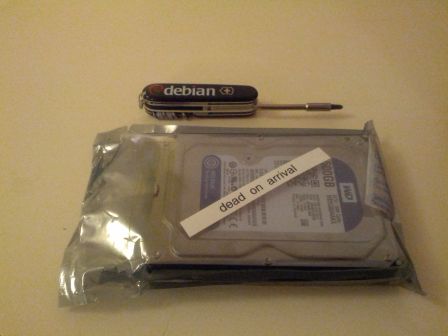
I just received a WD 500GB Blue, to replace the hard drive of my wife's computer. First thing after unpacking: start to test. And I was right to do it... there are bad blocks on it. WD 500GB DOA The story: I tend to do proactive replacement of hard drive, to avoid losing too much data or be in hurry when the current one fails. There are two ways to monitor a hard drive: Logcheck is pretty straightforward to install. It scans your log every two hours and send you a report of what is happening. It is not a very precise tool and you have to tune it a little bit to just send you what is relevant (install extra rules to ignore what you know is not of interest). Whenever you start to see log entry like that:
Jan 24 18:16:08 foo kernel: [ 1965.343980] ata5.00: exception Emask 0x50 SAct 0x39 SErr 0x800 action 0x6 frozen
Jan 24 18:16:08 foo kernel: [ 1965.343991] ata5.00: irq_stat 0x08000000, interface fatal error
Jan 24 18:16:08 foo kernel: [ 1965.344001] ata5: SError:   HostInt  
Jan 24 18:16:08 foo kernel: [ 1965.344036] ata5.00: failed command: READ FPDMA QUEUED
Jan 24 18:16:08 foo kernel: [ 1965.344055] ata5.00: cmd 60/08:00:18:31:44/00:00:1a:00:00/40 tag 0 ncq 4096 in
Jan 24 18:16:08 foo kernel: [ 1965.344059]          res 40/00:2c:e6:c2:fd/00:00:26:00:00/40 Emask 0x50 (ATA bus error)
Jan 24 18:16:08 foo kernel: [ 1965.344071] ata5.00: status:   DRDY  
Jan 24 18:16:08 foo kernel: [ 1965.344081] ata5.00: failed command: WRITE FPDMA QUEUED
It is a good time to think about changing your hardrive -- but it is maybe too late. Smartmontools (aka smartd) is dedicated tool to monitor hard drives and do a good job. I think it is not installed by default in Debian, but it should be. It scans your hard drive for SMART capabilities and monitor the health of the HD using internal tools. In the case of bad blocks, you will start to see entry like that:
Feb 17 14:05:17 bar smartd[1268]: Device: /dev/sda [SAT], 1 Currently unreadable (pending) sectors
Feb 17 14:35:17 bar smartd[1268]: Device: /dev/sda [SAT], 1 Currently unreadable (pending) sectors
Obviously when you see this log, it is also a good time to change your hard drive. In the case of my wife's HD, I just got data from logcheck. It means that the error is not that important (transient failure, something is wrong but the HD can cope with it). But I still decided to get a new one for my wife. Whenever, I receive a new drive, the first thing I do is to check it for errors. You can do that using the program badblocks in write mode. It takes ages to test (count up to 1 day for 1TB on USB), but at the end you know that you have a good candidate -- where it is worth install your data. You just have to follow this procedure
  1. dmesg grep sd
  2. try to find what drive is the one you want to test in the output of 1.
  3. cfdisk /dev/sdX, sdX being the drive you want to test
  4. check that what you see in cfdisk is what you expect to test: right name and capacity for the drive
  5. sudo badblocks -wvs /dev/sdX
  6. run sudo tail -f /var/log/syslog in parallel just in case
  7. wait
If some errors appears in /var/log/syslog, you know something bad is happening. Whenever you have a single failing block, don't think it is ok. It is NOT ok for a HD to start its life with failing blocks. In this case, repack the drive and send it for replacement ASAP. In the case of my hard drive: smartd mail:
The following warning/error was logged by the smartd daemon:
Device: /dev/sda [SAT], 15 Currently unreadable (pending) sectors
syslog entries:
Mar  2 20:52:57 foo kernel: [ 8317.419715] ata4.00: exception Emask 0x0 SAct 0x1 SErr 0x0 action 0x0
Mar  2 20:52:57 foo kernel: [ 8317.419724] ata4.00: irq_stat 0x40000008
Mar  2 20:52:57 foo kernel: [ 8317.419732] ata4.00: failed command: READ FPDMA QUEUED
Mar  2 20:52:57 foo kernel: [ 8317.419747] ata4.00: cmd 60/80:00:00:af:08/00:00:28:00:00/40 tag 0 ncq 65536 in
Mar  2 20:52:57 foo kernel: [ 8317.419750]          res 41/40:00:65:af:08/00:00:28:00:00/40 Emask 0x409 (media error) <F>
Mar  2 20:52:57 foo kernel: [ 8317.419758] ata4.00: status:   DRDY ERR  
Mar  2 20:52:57 foo kernel: [ 8317.419764] ata4.00: error:   UNC  
Mar  2 20:52:57 foo kernel: [ 8317.423959] ata4.00: configured for UDMA/133
I am not blaming any particular brand (like Western Digital), all computer parts I have ever bought had to follow the same procedure and it is a known fact that computer parts as a non-zero percentage of chance to be DOA (dead on arrival) or after a few weeks. But as a consumer you should be aware of that and take action to avoid spending 10h configuring your computer to see it failing after a week... The waste of time to test is a win on the long term.

Hideki Yamane: Re: checking package with clang

As I wrote before, I've posted a patch to BTS that add an option use clang compiler to pbuilder. However, pbuilder maintainer Junichi wasn't satisfied with it because he thought it seems to be overhead, introduce complexity and also hook script is enough.

I didn't agree with his opinion since I thought every time we need to add and remove its script, but Thorsten Glaser shows just specifying environment variables can solve it, and moreover, he points other compiler can be supported via hook, too. Sounds good, right? :)

Then I post a new hook script, it works with gcc-4. 4-8 and clang (gcc-4.8 needs experimental apt line for pbuilder). Please test it if you'd be interested.

Paul Tagliamonte: Ubuntu: The Community

Alas. The blogosphere has been slammed with discontent. Count me as one of them. It s been a long time since the last position (I ve held) of significance in Ubuntu, a LoCo Council Member, which I left with a heavy heart. I felt, at the time, that Ubuntu, The Community was no longer in control of Ubuntu The Distro . Technical opinions of Ubuntu community members started to get disregarded (starting with the gawd-awful Yahoo search switch), and it continued to get worse as Canonical stopped becoming a contributor to Ubuntu and started becoming it s sole guiding force. In comes the mess called Ubuntu One which, for the record, is a wrong name, it s not Ubuntu in any sense, it s not Community driven, it just uses Ubuntu as one of it s platforms. Trading on Ubuntu s good name started this mess. Slowly, like the ship of theseus, Canonical started to swap out bit by bit until nothing was left without Canonical assignment. I always assumed it was so that selling the code for another company to use the code for non-free purpose was the reason. Oh well. Look at us now: Starting off on an ill-thought out path because others are unwilling to say they just didn t understand the whole problem. This is a long way of saying: Ex-Ubuntu ers: You re welcome in Debian. I ve set up #ubuntu-expats on oftc. Please join us. You re welcome there. Working in Debian has been an absolute dream; it feels like contributing to Ubuntu in the early days. Come. Have a say. Re-join a Community that isn t just Like us on Facebook . I still consider myself an Ubuntu Community Member, but I don t think there s any community left.

7 March 2013

Pau Garcia i Quiles: Mark s divisive leadership

Mark Shuttleworth recently critized Jonathan Riddell for proposing Xubuntu and others join the Kubuntu community. I thought I could make a few amendments to Mark s writing:

Jonathan Mark says that Canonical Kubuntu is not taking care of the Ubuntu community.

Consider for a minute, Jonathan Mark, the difference between our actions.

Canonical Kubuntu, as one stakeholder in the Ubuntu community, is spending a large amount of energy to evaluate how its actions might impact on all the other stakeholders, and offering to do chunks of work in support of those other stakeholder needs.

You, as one stakeholder in the Ubuntu community, are inviting people to contribute less to the broader project [all the X and Wayland -based desktops], and more to one stakeholder [Unity and Mir].

Hmm. Just because you may not get what you want is no basis for divisive leadership.

Yes, you should figure out what s important to Kubuntu Ubuntu Unity and Mir, and yes, you should motivate folks to help you achieve those goals. But it s simply wrong to suggest that Canonical Kubuntu isn t hugely accommodating to the needs of others, or that it s not possible to contribute or participate in the parts of Ubuntu which Canonical Kubuntu has a particularly strong interest in. Witness the fantastic work being done on both the system and the apps to bring Ubuntu Plasma to the phone and tablet. That may not be your cup of tea, but it s tremendously motivating and exciting and energetic. See Mark? I only needed to do a little search and replace on your words and suddenly, meaning is completely reversed! Canonical started looking only after its own a couple of years ago and totally dumped the community. Many people have noticed this and written about this in the past two years. How dare you say Jonathan or anyone from Kubuntu is proposing contributing less to the broader community? The broader community uses X and/or Wayland. Canonical recently came with Mir, a replacement for X and Wayland, out of thin air. Incompatible with X and Wayland. No mention of it at all to anyone from X or Wayland. No mention of it at FOSDEM one month ago, even though I, as the organizer of the Cross Desktop DevRoom, had been stalking your guy for months because we wanted diversity (and we got it: Gnome, KDE, Razor, XFCE, Enlightenment, etc, we even invided OpenBox, FVWM, CDE and others!). I even wrote a mail to you personally warning you Unity was going to lose its opportunity to be on the stand at FOSDEM. You never answered, of course. Don t you think Mir, a whole new replacement for X and Wayland, which has been in development for 8 months, deserved a mention at the largest open source event in Europe? Come on, man. It is perfectly fine to say yes, Canonical is not so interested in the community. It s our way or the highway . But do not pretend it s anything else or someone else is a bad guy. In fact, is there any bad guy in this story at all!? I think there is not, it s just people with different visions and chosen paths to achieve them. Maybe Mir and Unity are great ideas, much better than X and Wayland. But that s not what we are talking about. We are talking about community, and Canonical has been steadily destroying it for a long time already. If you cannot or do not want to see that, you ve got a huge problem going on.

Daniel Pocock: This blog has upgraded to XCP, IPv6 and Debian 7.0 (wheezy)

If you noticed I hadn't updated the blog for a few days, you may have already anticipated that I've been up to something.... and you would be right. The virtualisation platform that powers this blog (and a lot more, including Lumicall and DruCall) has just been updated to Xen Cloud Platform (XCP) on Debian 7.0 (Wheezy, release candidate 1) The former platform was regular Xen with the xm toolstack on Debian 6.0 (squeeze) (and before that, lenny). The dom0 base system had been running uninterrupted for 720 days at the point I shut it down earlier this week - that is the typical timeframe between two major Debian releases, and it is also a firm endorsement of Debian's stability. Furthermore, the new setup is on new hardware with a new hosting provider, Init7 who offer native IPv6 in a secure Swiss data center. So I've taken the opportunity to add some AAAA records to my DNS, restart Apache and you can now access this blog with pure IPv6 As well as thanking Init7 for making the transition go very smoothly, I'd also like to point out a couple of other things that helped: using provider-independent (PI) IP addresses, and the sheer convenience of using tinc to securely bridge the VLANs in the old and new data centers for a week allowed this change to happen with hardly any downtime at all.

Vincent Sanders: Man cannot discover new oceans unless he has the courage to lose sight of the shore

Continuing with my whirlwind introduction to NetSurf Development now is the time to start examining the code, how its arranged and how to interact with the existing developers.

The way the NetSurf source is structured is around the idea of the frontends each being a native browser. While this implies that there are nine separate browsers that happen to share a common code base the separation is not quite that well defined.

Each frontend provides the OS entry point (the main() function in a c program) and calls out to standard browser initialisation entry function netsurf_init() and then starts running the browsers main dispatch loop with netsurf_main_loop() when that exits the frontend cleans up with netsurf_exit().

The frontends provide a large selection of functions which are called from the core code. These routines run from running the event scheduler through to rendering graphics and text.
Finding your way aroundThe browsers directory layout is fairly shallow consisting of some Makefiles, the nine frontend directories and eleven others.

The Makefiles are GNU make and represent a pretty straightforward linear build system. We do not use recursive make or autotools. There are plans to use the core buildsystem that all the other components use.

The frontend directories contain the code for the frontend and the makefile fragments to build them which are included by the top level Makefile.

In addition there is:
desktop
This contains the non frontend specific code that actually behaves like a browser. For example desktop/netsurf.c contains the three primary functions we outlined in the introduction. You will also find much of the function and data structures interfaces the frontend must provide. It is unlikely someone new to the project will need to change anything in here (there be dragons) but is an important set of routines.
utils
Here you will find the utility and compatibility interfaces, things like url handling, logging, user messages, base64 handling. These are utility interfaces that do not justify splitting out their functionality to a separate library but are useful everywhere. Changing an interface in here would likely result in a major refactor.
For example one quirk is the logging macro was created before varadic C preprocessor macros were universal so it must be called as LOG(("hello %s world", world_type)) e.g. with double brackets. Fixing this and perhaps improving the logging functionality would be "nice" but the changes would be massive and potentially conflict with ongoing work.
content
This contains all the core code to handle contents i.e. html, css, javascript, images. The handling includes retrieval of the resources from URI , correct caching of the received objects and managing the objects state. It should be explicitly stated that the content handlers are separate and use this core functionality. The actual content handlers to deal with object contents such as the routines to decode image files or render html are elsewhere.
image
This is where the content handlers for the various image types are kept. The majority of these image types (jpeg, png, webp, gif, bmp) use a standard library to perform the actual decode (libjpeg, libpng etc.). One special feature used by most image handlers is that of a decoded image cache which is distinct and separate from the content cache.
The decoded image cache manages decoding of the source images (the jpegs and pngs) into frontend specific "render" bitmaps. For example the gtk frontend keeps the decoded images as a cairo surface ready for immediate plotting.
The cache uses a demand based (when the browser actually displays the image) just in time strategy which has been carefully balanced, with real world input, to reduce the overhead of unnecessary image decoding and processing against memory usage for the render bitmaps.
css
The css content handlers provide for the processing of css source text and use the NetSurf libcss library to process into a bytecode suitable for applying style selection at render time.
javascript
The javascript handlers (strictly speaking this should be named the "script" directory as all types of script are handled here) provide basic functionality to bind a javascript engine to the rest of the browser, principally the Document Object Model (DOM) accessed with libdom. The only engine that currently has bindings is Spidermonkey from the Mozilla foundation.
render
This is the heart of the browser containing the content handler for html (and plain text). This handler deals with:
  • Acquiring the html.
  • Running the base parser as data arrives which generates the DOM and hence DOM events from which additional resource (stylesheets etc.) fetches are started.
  • Deal with script loading
  • Constructing the box model used for layout
  • Performing the Layout and rendering of the document.
Because this module has so many jobs to do it has inevitably become very complex and involved, it is also the principle area of core development . Currently NetSurf lacks a dynamic renderer so changes made by scripts post document load event are not visible. This also has the side effect that the render is only started after the DOM has finished construction and all the resources on a page have completed their fetch which can lead to undesirable display latency.
Docs
Documentation about building and using NetSurf. If anyone wants a place to start improving NetSurf, this is it, it is very incomplete. It must be noted this is not where dynamically generated documentation is found. For the current Doxygen output the best place to look is the most recent build on the Continuous Integration system.
resources
These are runtime resources which are common to all frontends. To be strictly correct they may be the sources which get converted into runtime resources e.g. The FatMessages file which is teh message text for all frontends in all languages, this gets processed at build time into separate files ready.
!NetSurf
This is another resources directory and technically the resources for the riscos frontend. The naming and reliance on this directory are historical. To allow the RISC OS frontend to be run directly from the source directory and an inability of RISC OS to process symbolic links most common runtime resources end up in here and linked to from elsewhere.
test
These are some basic canned test programs and files, principally to test elements of the utils and perform specific exercise of various javascript components.
Getting started
Once a developer has a checked out working build environment and can run the executable for their chosen frontend (and maybe done some web browsing :-) it is time to look at contributing.

If a developer does not have a feature or bug in mind when they begin the best way to get started is often to go bug hunting. The NetSurf bugtacker has lots to choose from unfortunately. Do remember to talk to us (IRC is the best bet if you are bug hunting) about what you are up to but do not be impatient. Some of those bugs are dirty great Shelob types and are not being fixed because even the core developers are stumped!

When first getting going I cannot recommend reading the code enough, this seems to be a skill that many inexperienced open source developers have yet to acquire, especially if they are from a predominately proprietary development background. One wonderful feature of open source software is you get to see all of it, all the elegant nice code and all the "what the hell were they thinking" code too.

One important point is to use your tools well the source is in git, if you learn how to use git well you will gain a skill that is readily portable, not just for NetSurf. And not just revision control tools, learn to use your debugger well and tools like valgrind. Those skills will replay the time spent learning them themselves many times over.

When using git one thing to remember is commit early and often, it does not matter if you have lots of junk commits and dead ends, once you have something viable you can use
git rebase --interactive
and rewrite it all into a single sensible set of commits. Also please do remember to develop on a branch, or if you did not
git pull --rebase
is your friend to avoid unnecessary merges.
Playing nicely with othersThe NetSurf community is a small band of unpaid volunteers. On average we manage to collectively put in, perhaps, ten hours a week with the occasional developer weekend where we often manage over twenty hours each.

The result is that developer time is exceptionally valuable, add in a mature codebase with its fair share of technical debt and you get a group who, when they get to work on NetSurf, are incredibly busy. To be fair we are just like every other small open source project in that respect.

What this means to a new contributor is that they should try and do their homework before asking the obvious questions. The documentation is there for a reason and in spite of its obvious shortcomings please read it!

When asking questions it should be noted that currently the majority of active contributors are in the Europe so if you visit the IRC channel or post questions to lists the time difference is something to keep in mind.

I carefully said contributor above and not developer, users trying the CI builds and reporting results are welcome...as long as they report useful bugs to the bug tracker. Simon Tatham has produced an excellent resource on this subject.

Also we are always happy to receive translations to new languages (diff against the FatMessages file would be outstandingly useful but anything is welcome), artwork, documentation. Just recall what I mentioned about busy developers. Surest way to get us to see something is the development mailing list, you will probably get a reply, though I will not promise how fast!

Some of the more common mistakes when interacting with the community are:
In conclusion
Hopefully this has been of some use although I had hoped to cover more and provide deeper insights and advice on the codebase but there is only so much generalisation to be done before it is just easier for the developer to go read the code for themselves.

I look forward to lots of new contributions :-) though I fear this may all end up as more of a crib sheet for next time we do GSOC, time will tell.

Vincent Sanders: The way to get started is to quit talking and begin doing

When Walt Disney said that he almost certainly did not have software developers in mind. However it is still good advice, especially if you have no experience with a piece of software you want to change.

Others have written extensively on the topic of software as more than engineering and the creative aspects, comparing it to a craft, which is a description I am personally most comfortable with. As with any craft though you have to understand the material you have to work with and an existing codebase is often a huge amount of material.

While developing NetSurf we get a lot of people who talk a lot about what we "ought" or "should" do to improve the browser but few who actually get off their collective posteriors and contribute. In fact according to the ohloh analysis of the revision control system there are roughly six of us who contribute significantly on a regular basis and of those only four who have interests beyond a specific frontend.

It has been mentioned by a couple of new people who have recently compiled the browser from source that it is somewhat challenging to get started. To address this criticism I intend to give a whirlwind introduction to getting started with the NetSurf codebase, perhaps we can even get some more contributors!

This first post will cover the mechanics of acquiring and building the source and the next will look at working with the codebase and the Netsurf community.

This is my personal blog, the other developers might disagree with my approach, which is why this is in my blog and not on the NetSurf website. That being said comments are enabled and I am sure they will correct anything I get wrong.
ResourcesNetSurf has a selection of resources which are useful to a new developer:
Build environmentThe first thing a new developer has to consider is their build environment. NetSurf supports nine frontends on several Operating Systems (OS) but is limited on the build environment that can be used.

The developer will require a Unix like system but let's be honest, we have not tried with anything other than Linux distributions in some time or MAC OS X for the cocoa frontend because its a special snowflake.

Traditionally at this point in this kind of introduction it would be traditional to provide the command line for various packaging systems to install the build environment and external libraries. We do have documentation that does this but no one reads it, or at least it feels like that. Instead we have chosen to provide a shell fragment that encodes all the bootstrap knowledge in one place, its kept in the revision control system so it can be updated.

To use: download it, read it (hey running random shell code is always a bad idea), source it into your environment and run ns-apt-get-install on a Debain based system or ns-yum-install on Fedora. The rest of this posting will assume the functionality of this script is available, if you want to do it the hard way please refer to the script for the relevant commands and locations.

For Example:
$ wget http://git.netsurf-browser.org/netsurf.git/plain/Docs/env.sh
$ less env.sh
$ source env.sh
$ ns-apt-get-install

Historically NetSurf built on more platforms natively but the effort to keep these build environments working was extensive and no one was prepared to do the necessary maintenance work. This is strictly a build setup decision and does not impact the supported platforms.

Since the last release NetSurf has moved to the git version control system from SVN. This has greatly improved our development process and allows for proper branching and merging we previously struggled to implement.

In addition to the core requirements external libraries NetSurf depends on will need to be installed. Native frontends where the compiled output is run on the same system it was built on are pretty straightforward in that the native package management system can be used to install the libraries for that system.

For cross building to the less common frontends we provide a toolchain repository which will build the entire cross toolchain and library set (we call this the SDK) direct from source. This is what the CI system uses to generate its output so is well tested.
External LibrariesNetSurf depends upon several external development libraries for image handling, network fetching etc. The libraries for the GTK frontend are installed by default if using the development script previously mentioned.

Generally a minimum of libcurl, libjpeg and libpng are necessary along with whatever libraries are required for the toolkit.
Project Source and Internal Libraries
One important feature of NetSurf is that a lot of functionality is split out into libraries. These are internal libraries and although technically separate projects, releases bundle them all together and for development we assume they will all be built together.

The development script provides the ns-clone function which clones all the project sources directly from their various git repositories. Once cloned the ns-make script can be used to build and install all the internal libraries into a local target ready for building the browser.

For Example:

$ source env.sh
$ ns-clone
$ ns-make-libs install
Frontend selectionAs I have mentioned NetSurf supports several windowing environments (toolkits if you like) however on some OS there is only one toolkit so the two get conflated together.

NetSurf currently has nine frontends to consider:
Building and running NetSurfFor a developer new to the project I recommend that the gtk version be built natively which is what I describe here.

Once the internal libraries have been installed, building NetSurf itself is as simple as running make.

For Example:
$ source env.sh
$ ns-make -C $ TARGET_WORKSPACE /$ NS_BROWSER TARGET=gtk

Though generally most developers would change into the netsurf source directory and run make there. The target (frontend) selection defaults to gtk on Linux systems so that can also be omitted Once the browser is built it can be run from the source tree to test.

For Example:
$ source env.sh
$ cd $ TARGET_WORKSPACE /$ NS_BROWSER
$ ns-make
$ ./nsgtk

The build can be configured by editing a Makefile.config file. An example Makefile.config.example can be copied into place and the configuration settings overridden as required. The default values can be found in Makefile.defaults which should not be edited directly.

Logging is enabled with the command line switch -v and user options can be specified on the command line, options on the command line will override those sourced from a users personal configuration, generally found in ~/.netsurf/Choices although this can be compile time configured.

5 March 2013

Debian Med: Debian Med sprint report (by Andreas Tille)

This is the report about my work at Debian Med sprint ten days ago in Sch nberger Strand. If you are interested in Sprints in general you might be interested in work item 2. below.
  1. Wrote draft article for Indian health care magazin. If you might like to proofread the article I'd be very happy (it is not yet to late for changes.) There is also a PDF version.
  2. I have given a short talk proving the importance of sprints. The slides are basically graphs and I try to prove that sprints are a really good idea. The background knowledge is that the Debian Med team is doing sprints since 2011 and looking at all graphs you can see that this has a really positive effect. Thanks to Debian and its sponsors for supporting this kind of sprints.
  3. Packaging
    • Worked with T. Travis on flexbar and uploaded the package to new queue
    • Worked with Ch. Gille on strap-base and uploaded the package to new queue
    • Discussed strategy how to strip glam2 source from meme upstream with T. Booth. Meme upstream agreed to keep the original license of Glam2 and backport the changes from Meme source archive
    • Discussed igv packaging issues with O. Sallou who updated the package and documented some issues about its dependency goby
    • Worked together with I. Maintz on cellprofiler
    • Worked together with I. Maintz on a couple of R packages which are mostly predependencies but also one Debian Med primary target (r-cran-boolnet) was uploaded to new
  4. Discussing / chatting
    • Some chat with Ch. Steigies (Debian Games, Debian m68k, Debian Science)
    • Discussion with M. Banck about DebiChem
  5. Little bit of MoM mentoring
  6. Maintain Debian Med tasks files about newly commited packages of other sprint participants
  7. General infrastucture issues
    • Issues with machine-readable files importer into UDD
    • Try to revive PET data in UDD
    • Work on installation of future blends.debian.net host (install needed packages, create UDD clone)
Thanks to all participants of the sprint and specifically to Steffen M ller who took over the work of organising. It was fun to meet you all and I'm even looking right now forward to the next sprint hopefully beeing able to continue the graphing of positive results of sprints in our team metrics.
We had some nice food, not so nice weather and from my perspective the only drawback was that at home there would have been perfect conditions for skiing ... but finally there are preferences. ;-)
See you at next sprint!

Martin Pitt: Automatically generating documentation from GIR files

Many libraries build a GObject introspection repository (*.gir) these days which allows the library to be used from many scripting (Python, JavaScript, Perl, etc.) and other (e. g. Vala) languages without the need for manually writing bindings for each of those. One issue that I hear surprisingly often is there is zero documentation for those bindings . Tools for building documentation out of a .gir have existed for a long time already, just far too many people seem to not know about them. For example, to build Yelp XML documentation out of the libnotify bindings for Python:
  $ g-ir-doc-tool --language=Python -o /tmp/notify-doc /usr/share/gir-1.0/Notify-0.7.gir
Then you can call yelp /tmp/notify-doc to browse the documentation. You can of course also use the standard Mallard tools to convert them to HTML for sticking them on a website:
  $ cd /tmp/notify-doc
  $ yelp-build html .
Admittedly they are far from pretty, and there are still lots of refinements that should be done for the documentation itself (like adding language specific examples) and also for the generated result (prettification, dynamic search, and what not), but it s certainly far from nothign , and a good start. If you are interested in working on this, please show up in #introspection or discuss it on bugzilla, desktop-devel-list@, or the library specific lists/bug trackers.

Lisandro Dami&aacute;n Nicanor P&eacute;rez Meyer: My Debian freeze experience (so far)

This is the first freeze in which I'm involved with upload rights. And it turned out to be a quite interesting ride so far, so I thought it would be nice to write about it.

As some of you may know, I'm a part of the Qt/KDE team. Before the freeze I was mostly involved in leaf packages, with some patch here or there, nothing fancy. And then the freeze came...

Bugs in Qt

...and bugs appeared in Qt. But they didn't get solved, even if the patches were there. Due to personal reasons, the manpower in Qt/KDE land decreased below normal levels (which were already low).

I took the time to review them, apply them in a local branch, build and test the fixes. I did a Qt upload before, but it was a team-consented one. This time there was not much reaction in our IRC channel as it used to be, so I was doubting if going ahead or not. I asked Ana, my great friend and former sponsor, for an opinion on the subject, and she gave me a really important advice: the patches were looking good and there is one really big true: if something get's broken, it can be fixed with a later upload.

You might be asking yourself why I was that afraid of doing the upload. Well, when one maintains such a medular package for many users one has to be careful And I also got used that those "big ones" like Qt where normally handled by hand skilled people. Do not take me wrong here, it's not that those people where keeping them for themselves, it's knowing that one does not has the same skills nor experience as them.

But again, no one was able to upload and I had the chance and will to do another upload if needed, so off it went. That was Qt 4:4.8.2-2.

Then new experiences followed: asking a buildd maintainer for a giveback, asking the Release Team for an unblock (more on this later), etc. While sponsoring me, Ana gave me another excellent advice which I always keep in my mind:

You can't know **everything** about Debian.

And that also includes a not so technical skill: communicating with other teams. But finally we got this new version of Qt in testing. Cool :-)

Of course, new bugs appeared, and my lack of skills (and sometimes, time) where replaced by team work: Pino looking at patches and Sune contacting upstream. The eleven uploads that followed are a nice example of team work, even if I was the one who signed and did the uploads. Whoever uses Qt must know that these wonderful people (including those who are not so active nowadays like Modestas or Fathi) have done lots to bring the better to their users.Thank you guys!

Be careful, they might bite you back!

Coming back to the non-technical skills, sometimes you have to communicate with other teams in Debian. And each team is (naturally) a separate world: possibly different people, different goals, etc. Of course, we share the goal to make Debian the best experience we can, but we do not necessarily agree on the paths to achieve so.

During the freeze, there is a team that gets lots of pressure, and not by chance: the Release Team. They handle a very important task, which is to ride the freeze to get to a release. OK, that's what everyone knows. Now, one thing is knowing that and another is really understanding what does that means.

Of course I was in the first group. From the outside, communicating with the RT was a kind of "special art", and not an easy one. I have even been advised to not ask for more than one or two unblocks per weekend, as they might "bite me back". So I put on my flamesuit on and... launched reportbug release.debian.org.

Now I'm really happy to say that my experience was far from what I described above. And yes, I had the chance to even disagree on some stuff. But remember: non-technical skills, a.k.a. social skills. Once I started to know what was going on inside the RT (joining #debian-release was a big help for that) I learnt some nice tips to approach them. Please allow me to list some of them:

  • Remember: you are the maintainer of the package, they are like gatekeepers that are there to help us coordinate to do a release. But they don't maintain the code, you do that. So try to be verbose when needed, explain the changes and don't forget a nice diff. They need to understand what is going on: they can't read your mind.
  • They are human beings too: not everyday might be their best day (the same goes for you too!). And they are under the pressure of a release. Be patient, that finally pays off.
  • Does your changes seem not so clear? try to improve them.
  • The package has a lot of changes but you really feel they are needed? Try to explain that as good as you can.
  • Try to put yourself in their position: do we really want this? If in doubt, there is a nice way to know what they think: a pre-approval bug.
I want to make a stop in this last point. A pre-approval bug it's an unblock bug in which you edit the subject to add "pre-approval" in it. Easy, isn't it? It gives you the opportunity to know what the RT thinks before doing the upload. In other words: it gives you the chance to communicate and do things in the best possible way for all the parts involved.

I've have also seen pre-approval bugs that were really not needed. But to learn where the threshold of what can be directly uploaded and what deserves a pre-approval bug is you need to know the guidelines the RT gives you. Do you still have doubts? fire a pre-approval bug and try to be clear.

Of course, this are all fruits of my experience with the RT during this time. If the RT thinks different from what I'm writing here, please stand up: we are hear to listen to you and learn :-)

As a side note, I think I should file a wishlist bug to include the pre-approval bug option in reportbug. Yes, I'm lazy :-)

Summing up

Overall this was a very nice and positive experience. We are not done yet. Are we really done at some point? Let's hope not, because this is where the fun comes from :-)

4 March 2013

Robert Collins: subunit version 2 progress

Subunit V2 is coming along very well. Current status: Remaining things to do:

3 March 2013

Lucas Nussbaum: DPL game

When Francesca started her DPL game, I too started think about possible candidates. Here is my shortlist of dream candidates: Seriously, if you are a DD, you have the right to run. There s no need for someone to nominate you. If you think that you could possibly say something interesting during the discussion period, and can spare the time to participate in the -vote@ discussions, please run. DPL campaigns used to be a great time where Debian visions, goals, politics and random stuff were discussed. The more candidates, the more interesting campaigns (8 candidates in 2007!). Also, there are already two three other candidates, so even if you don t want the job, it s not that risky. (Initially, I thought about nominating everyone, but security-wise, it might not be such a great idea.)

Gregor Herrmann: DPL game

when francesca started her DPL game, I also started thinking about people I'd like to encourage to stand as a DPL candidate. unfortunately my initial "short list" contained 18 names, which doesn't fit the game's rules very well. after waiting a bit, 9 of them were mentioned by others already, so I can leave them out here (which also means no public hug, sorry, please complain to the inventor of the game!). from the remaining 9, I've now chosen my Fantastic Four (in alphabtic order of first names): in my opinion, the DPL task is mostly about managing, & those four people are in my experience all very good at organising projects & dealing with people, & are therefore well suited for this task. let's see if they feel motivated to take on the challenge! (the nomination period has already started, so don't hestitate!)

2 March 2013

Rapha&#235;l Hertzog: My Free Software Activities in February 2013

This is my monthly summary of my free software related activities. If you re among the people who made a donation to support my work (78.31 , thanks everybody!), then you can learn how I spent your money. Otherwise it s just an interesting status update on my various projects. Debian packaging I wanted to update publican to the latest upstream release but I stopped after a few hours of work during which I filed two bugs that a modicum of testing should have caught before release. So I decided to wait for the next minor release. I uploaded python-django 1.4.4 and 1.4.5, new upstream maintenance and security releases which thus went into wheezy. I also prepared a stable update of Django (1.2.3-3+squeeze5) which required me to backport the last 2 sets of security patches. I uploaded a new revision of wordpress to fix a problem with TinyMCE (#700289) and to update/add many translation files (#697208). Bug reporting and misc fixes Live-build issue. I experienced some intermittent failures when building HDD live images with live-build on armel. Daniel Baumann directed me to the problematic piece of code (the oversizing of the image size was not enough) so I committed a small fix by increasing the oversizing factor to 6%. Live-config issue. I also reported another issue that I diagnosed in live-config (#701788), namely that the script which setups sudo was failing when the default user is root. git-buildpackage issue. I filed #700411 after noticing that git-import-orig imported the debian directory provided by upstream. Those directories are not used with 3.0 (quilt) source package and their presence in the upstream branch is thus harmful: any change to the upstream debian directory will result in conflicts when you merge a new upstream release in your packaging branch. rubygems integration. Later I had to package a bunch of ruby applications that were using Bundler and I wanted to reuse as many packaged ruby modules that I could. But for this, those modules had to provide the required rubygems meta-information. I filed #700419 to request those on rake-compiler and with the help of C dric Boutillier (and others on #debian-ruby), we identified a bunch of ruby modules which could get those with a simple recompilation. I filed bin-nmu requests in #700605. Misc bugs. simple-cdd offers to select profiles to install but I noticed that the associated debconf template was not translated (#700915). The startup scripts (provided by initscripts) in charge of activating the swap are supposed to handle a noswap kernel command line option to disable swap. In #701301, I reported that the option was not working correctly if quiet was present first in the command line due to spurious break statements. Debian France Administrative work. We were late for some legal procedures so I wrote the report of the last general assembly and sent it to the Tribunal d instance of Sarreguemines to record the changes in the administrative board. I also completed the special register of the association, it s a notebook that is legally required and that must document any important change in the governance structure of the association (new members of the board, headquarters change, new bylaws, etc.). Galette developments. Debian France is funding a few enhancements to the Galette free software that we re using to manage the association. I am in touch with the Galette developer to answer his questions and ensure that his work will meet our needs. Librement I have been looking for talented developers who have a genuine interest in my Librement project. I want to fund the initial development of the project but I don t have the means to fund it entirely. So I really wanted to find developers who would find an interest beside the money that I would pay. I got in touch with the team of developers from Scopyleft and they look like very good candidates. But they re heavy users of the Scrum development method and asked me to play the role of product owner . So I started to describe the project with user stories (i.e. create the backlog in the Scrum jargon), you can have a look at them here on trello.com. If you re interested by the topic of free software funding, feel free to review and to send me your comments. My goal is clearly to have a minimal viable product with the first iteration(s) that I fund and then use the platform itself to fund further developments of the project. Thanks See you next month for a new summary of my activities.

5 comments Liked this article? Click here. My blog is Flattr-enabled.

Joerg Jaspert: Goodbye Lenny

So this weekend was removal time, namely Lenny. I started out by getting all the different archives which had a Lenny release placed onto archive.debian.org, namely volatile, backports, security and of course the main archive. Actually, they got put onto one of the two hosts that hold this archive and are now syncing to the other. Today started by removing Lenny from those archives. As volatile is dead as an extra archive that was easy - DSA turned off the machine. Backports and security got all their files removed in one big removal after which I had them forget they ever dealt with Lenny. The main archive is a different story. Due to its size I can t simply remove all files at once. This would break every mirror, as they don t delete too many files at once. For the official mirror scripts that magic number is 40000. Both, backports and security, had less than that for their lenny suites, but the main archive has somewhere around 195k files that need to go away. Slightly more than the limit. For that reason I set out to only delete parts of the files for each mirror push. Lucky our toolset supports this easily, I simply had to declare the lenny suites empty and let our clean-suite tool do its work. Worked flawlessly - if one considers 8 hour runtime to mark the files as delete-able no flaw. Took another two hours to actually delete the first 20000 files out of our pool. The next mirror push will thus delete every lenny related entry in our dists/ tree and some 20000 files out of pool. The following mirror pushes will continue deletion, in batches of 10000, until all of lenny is gone.

Bastian Blank: LDAP, Insignificant Space and Postfix

For some, LDAP, just like X.500, is black magic. I won't argue against. Sometimes it really shows surprising behavior. It always makes sense, if you think about what LDAP is built for. One surprising behavior is the handling of the "Insignificant Space"
LDAP supports syntax and comparator methods. The syntax specifies how the entry should look. Usually this is some form of text, but numbers or stuff like telephone numbers are supported as well. The comparators specifies how the values are compared. Most of the text comparators are defined to apply the handling of insignificant spaces. Insignificant space handling normalizes the use of spaces. First all leading and trailing spaces are removed. All the internal spaces are normalized to at most two spaces. At the end all strings starts and ends with one space to allow proper sub-string matches. The resulting strings are used for comparisons. This behavior makes sense most of the time. If the user want to find something in the directory, he usually don't cares about spaces, but about content. But I found one occurrence where this produces some grieve. Postfix supports LDAP since some time. And lets say, it does not care about spaces in its queries. This is no problem as e-mail addresses do not contain spaces. Or do they?
Yes, e-mail addresses can contain spaces. This is not widely known, but still allowed. This addresses are quoted and the command looks like RCPT TO:<" test"@example.com>. The local part is quoted and contains a space at the beginning. And this is where the problem starts. Postfix sanitizes the address. It uses a simplified internal representation of the address for all lookups. So the address gets test@example.com. This form is used in all table lookups. The LDAP table uses the internal form of the address. This address is copied verbatim into the query. This query may look this way (mail= test@example.com). It is sent to the server this way. The LDAP server applies the insignificant space modifications. The query is now interpreted and the comparator specified modifications are applied. The query gets effectively changed to (mail=test@example.com). And this is where the fun starts. Postfix accepts undeliverable mails. Depending on the setup, such LDAP queries may be used to check for valid addresses. Because of the space handling, the sender can add spaces to the beginning of the address and it will still be considered valid. In later steps this addresses are not longer valid. Addresses starting with spaces are considered invalid in some locations of Postfix. What surprised me a bit is that virtual alias handling did not map them. The unmodified addressed showed up on the LMTP backend server. That's why they showed up my radar. I would say Postfix is wrong in this case. The LDAP server applies the spec correctly and defines spaces in e-mail addresses as insignificant. Postfix on the other side considers them significant. The easiest fix would be to not allow any spaces in the LDAP table.

1 March 2013

Joerg Jaspert: tmux - like screen, just nicer. Replacing clusterssh too.

By now I am a long time happy user of tmux instead of screen. I started using it somewhere in 2011 and by now I only have one usage of screen left over (direct ttyS0 access for one serial). As usual I have a custom config for it, and if you are interested there is a link for you: tmux.conf. But the more interesting part and why I blog is that I also wrote a little helper around tmux. Ingeniously called tm. And a colleague said I should let other people use it too and place it somewhere accessible. So, err, here it is. Or better, the usage output of it, the actual script has a link somewhere below.
tmux helper by Joerg Jaspert <joerg@ganneff.de>
Call as: tm CMD [host]...
CMD is one of
 ls          List running sessions
 s           Open ssh session to host
 ms          Open multi ssh sessions to hosts, synchronizing input
 $anything   Either plain tmux session with name of $anything or
             session according to TMDIR file
TMDIR file:
Each file in $TMDIR defines a tmux session.
Filename is the commandline option $anything
Content is defined as:
  First line: Session name
  Second line: extra tmux options
  Any following line: A hostname to open a shell with in the normal
  ssh syntax. (ie [user@]hostname)
Environment variables recognized by this script:
TMPDIR - Where tmux stores its session information
         DEFAULT: If unset: /tmp
TMSORT - Should ms sort the hostnames, so it always opens the same
         session, no matter in which order hostnames are presented
         DEFAULT: true
TMOPTS - Extra options to give to the tmux call
         Note that this ONLY affects the final tmux call to attach
         to the session, not to the earlier ones creating it
         DEFAULT: -2
TMDIR  - Where are session information files stored
         DEFAULT: $ HOME /.tmux.d
TMWIN  - Where does your tmux starts numbering its windows?
         This script tries to find the information in your config,
         but as it only checks $HOME/.tmux.conf it might fail.
         So if your window numbers start at anything different to 0,
         like mine do at 1, then you can set TMWIN to 1

It is mainly useful for using tmux as a ssh-multiplexer and replacement for clusterssh though its happy to do any other tmux session too. As the help text may already have told you, you can use it to list existing tmux sessions (oh, wow!). Honestly, that one is there because tm ls is shorter than tmux ls More interestingly, tm s HOSTNAME opens a tmux session with the first window being a ssh shell to HOSTNAME. Should you later type tm s HOSTNAME again, it will attach to the existing session. But the real kicker for me (and colleagues) actually is the ms subcommand of it. ms being short for multi-session, it is my way of no-longer using clusterssh. Basically you type tm ms HOST1 user@HOST2 and it opens a session with one tmux window consisting of two panes. Showing you host1 and host2 at the same time. And the input to both is synchronized, that is - all your input is send to both of them. You aren t limited to just two hosts, do as many as you wish. Actually, I have no idea if tmux has an upper limit, but I did already have more than 100 hosts open at once. The major limitation there is not tmux - but simply the available screenspace, as all hosts are shown in ONE window! (The one advantage of clusterssh, it uses one xterm per host) This is quite helpful in all kinds of administration work involving clusters - imaging installing a package on 5 hosts of a cluster, you usually want it on all of them - or any kind of situations where one wants to run one command on many systems. As I m already said, I m lazy. And so there is a way to easily define multisessions that one uses regulary, by creating files inside the directory behind $TMDIR, usually $ HOME /.tmux.d. They are simple text files and let you easily define sessions you can then (re)open with a simple tm whateveritsname. And if you want the whole script by now: tm

Daniel Pocock: Monitoring JBoss, Tomcat and other application servers with JMXetric

JMXetric 1.0 was finally released in February, let's have a quick look at how conveniently it can be integrated with an application server. A more thorough analysis of gmetric4j and JMXetric can be found in the sections I contributed to the new O'Reilly book Monitoring with Ganglia General comments about JVM instrumentation and the JVM boot classpath Monitoring agents (there are a number of them out there) are loaded at an early stage by the JVM and it needs to have access to any of their dependencies through the boot classpath. JMXetric explicitly declares it's dependencies in MANIFEST.MF:
Boot-Class-Path: oncrpc-1.0.7.jar gmetric4j-1.0.2.jar
As no absolute path is specified, the JVM will look for those JARs in the same directory where the jmxetric.jar is located. Furthermore, the JVM will expect the exact filenames to match. If other filenames are used (e.g. for a newer version of gmetric), then the JVM command line needs to specify the filenames and locations, for example:
-Xbootclasspath/a:/opt/ganglia/jmxetric/gmetric4j-1.0.3.jar
Starting JBoss 7 with JMXetric To start with, unpack a vanilla JBoss distribution:
$ mkdir ~/opt
$ cd ~/opt
$ tar xzf ~/Downloads/jboss-as-7.1.0.Final.tar.gz
Now get the JMXetric code and put it, together with dependencies, in the same directory:
$ mkdir -p ~/opt/ganglia/jmxetric
$ cd ~/opt/ganglia/jmxetric
$ wget http://search.maven.org/remotecontent?filepath=info/ganglia/jmxetric/jmxetric/1.0.2/jmxetric-1.0.2.jar
$ wget http://search.maven.org/remotecontent?filepath=info/ganglia/gmetric4j/gmetric4j/1.0.2/gmetric4j-1.0.2.jar
$ wget http://search.maven.org/remotecontent?filepath=org/acplt/oncrpc/1.0.7/oncrpc-1.0.7.jar
Set up a config file for JMXetric:
$ mkdir -p ~/opt/ganglia/jmxetric/etc
$ cd ~/opt/ganglia/jmxetric/etc
$ wget https://raw.github.com/ganglia/jmxetric/master/etc/jmxetric.xml
$ cp jmxetric.xml jmxetric-jboss.xml
$ vi jmxetric-jboss.xml
and insert the following code:
                <!-- report web server request count -->
		<mbean name="jboss.as:subsystem=web,connector=http" pname="http">
			<attribute name="requestCount" type="int32"/>
		</mbean>
Finally, tell JBoss about the agent:
$ cd ~/opt/jboss-as-7.1.0.Final
$ vi bin/standalone.conf
and apply the following changes to standalone.conf:
--- bin/standalone.conf
+++ ../jboss-as-7.1.0.Final.for-jmxetric/bin/standalone.conf
@@ -4,6 +4,7 @@
 ##                                                                          ##
 ##############################################################################
 
+JBOSS_MODULES_SYSTEM_PKGS="org.jboss.logmanager"
 #
 # This file is optional; it may be removed if not needed.
 #
@@ -48,6 +49,8 @@
 #
 if [ "x$JAVA_OPTS" = "x" ]; then
    JAVA_OPTS="-Xms64m -Xmx512m -XX:MaxPermSize=256m -Djava.net.preferIPv4Stack=true -Dorg.jboss.resolver.warning=true -Dsun.rmi.dgc.client.gcInterval=3600000 -Dsun.rmi.dgc.server.gcInterval=3600000"
+   JAVA_OPTS="$JAVA_OPTS -Djava.util.logging.manager=org.jboss.logmanager.LogManager -Xbootclasspath/p:$JBOSS_HOME/modules/org/jboss/logmanager/main/jboss-logmanager-1.2.2.GA.jar -Xbootclasspath/p:$JBOSS_HOME/modules/org/jboss/logmanager/log4j/main/jboss-logmanager-log4j-1.0.0.GA.jar -Xbootclasspath/p:$JBOSS_HOME/modules/org/apache/log4j/main/log4j-1.2.16.jar"
+   JAVA_OPTS="$JAVA_OPTS -javaagent:$HOME/opt/ganglia/jmxetric/jmxetric-1.0.2.jar=host=jboss-host.example.org,port=8649,wireformat31x=true,config=$HOME/opt/ganglia/jmxetric/etc/jmxetric-jboss.xml"
    JAVA_OPTS="$JAVA_OPTS -Djboss.modules.system.pkgs=$JBOSS_MODULES_SYSTEM_PKGS -Djava.awt.headless=true"
    JAVA_OPTS="$JAVA_OPTS -Djboss.server.default.config=standalone.xml"
 else
Note that we are adding some of the core JBoss logging code to the boot classpath - that is because JMXetric depends on the logger, and like many monitoring agents, it is impacted by JBoss bug AS-3681. Adding these extra classpath settings is the workaround. Now go ahead and start JBoss, you should see a log message informing you that JMXetric is operational:
$ cd ~/opt/jboss-as-7.1.0.Final
$ chmod a+x bin/*.sh
$ bin/standalone.sh
=========================================================================
  JBoss Bootstrap Environment
  JBOSS_HOME: ...
.
.
.
=========================================================================
JMXetricAgent instrumented JVM, see https://github.com/ganglia/jmxetric
12:59:34,395 INFO  [info.ganglia.gmetric4j.GMonitor] Setting up 1 samplers
12:59:34,536 INFO  [org.jboss.modules] JBoss Modules version 1.1.1.GA
12:59:34,617 INFO  [org.jboss.msc] JBoss MSC version 1.0.2.GA
12:59:34,653 INFO  [org.jboss.as] JBAS015899: JBoss AS 7.1.0.Final "Thunder" starting
.
.
.
I hope this example is useful for you. Please feel free to share recipes you develop for collecting useful JVM metrics, and also any custom charts/reports through collaboration with the Ganglia community mailing list, the Ganglia wiki or your own blog.

Next.

Previous.
