Search Results: "ina"

6 January 2013

Neil Williams: bootstrapping arm64

I'm still working on perl-cross-debian (just uploaded 0.0.2) and there's more to do on that with upstream but part of the reason to work on perl cross-building is to do what I can to help with the ARM64 port.

So, I went back to Wookey's talk at DebConf12 which leads to the current list of cross-build results for arm64 and started through the list.

coreutils is listed as failing but that was an archive error (MD5sum hash mismatch), so that just needs a retry. I don't have access to that buildd, yet, so nothing I can do there.

Next on the list (excluding those just waiting for build-deps) was klibc.

aarch64-linux-gnu-gcc -Wp,-MD,usr/klibc/.__static_init.o.d -nostdinc -iwithprefix
include -I/ PKGBUILDDIR /usr/include/arch/x86_64 -Iusr/include/arch/x86_64
-I/ PKGBUILDDIR /usr/include/bits64
-Iusr/include/bits64 -I/ PKGBUILDDIR /usr/klibc/../include
-Iusr/klibc/../include -I/ PKGBUILDDIR /usr/include -Iusr/include
-I/ PKGBUILDDIR /linux/include -Ilinux/include
-I/ PKGBUILDDIR /linux/arch/x86/include -Ilinux/arch/x86/include
-D__KLIBC__=2 -D__KLIBC_MINOR__=0 -D_BITSIZE=64 -fno-stack-protector -fwrapv -m64 -Os
-fno-asynchronous-unwind-tables -fomit-frame-pointer -falign-functions=1 -falign-jumps=1 -falign-loops=1
-W -Wall -Wno-sign-compare -Wno-unused-parameter -c -o usr/klibc/__static_init.o usr/klibc/__static_init.c
aarch64-linux-gnu-gcc: error: unrecognized command line option '-m64'
make[4]: *** [usr/klibc/__static_init.o] Error 1


Turns out that this is a build failure I understood, at least initially. A little digging and a trivial patch was begun:

--- a/usr/klibc/arch/arm/MCONFIG
+++ b/usr/klibc/arch/arm/MCONFIG
@@ -30,6 +30,13 @@
ifeq ($(CONFIG_AEABI),y)
KLIBCREQFLAGS += -mabi=aapcs-linux -mno-thumb-interwork
else
+# aarch64
+ifeq ($(CONFIG_AARCH64),y)
+KLIBCREQFLAGS +=
+KLIBCOPTFLAGS += -mgeneral-regs-only
+else
KLIBCREQFLAGS += -mabi=apcs-gnu -mno-thumb-interwork
endif
endif
+endif
+

Alongside a trivial change to debian/rules

ifeq ($(DEB_HOST_ARCH),arm64)
DEB_MAKE_ENVVARS := ARCH=arm CONFIG_AARCH64=y CPU_ARCH=armv8-a CPU_TUNE=generic
endif

OK, then things get a bit more awkward,

....
code/debian/cross/klibc/klibc-2.0.1/linux/arch/arm/include -Ilinux/arch/arm/include -D__KLIBC__=2
-D__KLIBC_MINOR__=0 -D_BITSIZE=32 -fno-stack-protector -fwrapv -fno-exceptions -Os
-march=armv8-a -mtune=generic -mgeneral-regs-only -W -Wall -Wno-sign-compare -Wno-unused-parameter
-c -o ../foo.o usr/klibc/arch/arm/crt0.S
usr/klibc/arch/arm/crt0.S: Assembler messages:
usr/klibc/arch/arm/crt0.S:19: Error: operand 1 should be an integer register -- mov r0,sp'
usr/klibc/arch/arm/crt0.S:20: Error: operand 1 should be an integer register -- mov r1,#0'

Hmm. Assembly, well, yes, I've done assembly before, I know what mov should normally do, sp is likely to be the stack pointer .... where's my AARCH64 assembly PDF again... PRD03-GENC-010197 ...

OK, so maybe the r0 and r1 should be x0 and x1, hmm, that at least doesn't raise assembly errors. So a tentative change:

--- a/usr/klibc/arch/arm/crt0.S
+++ b/usr/klibc/arch/arm/crt0.S
@@ -15,9 +15,13 @@
#ifdef __thumb__
.thumb_func
#endif
-
+#ifdef __aarch64__
+_start: mov x0, sp
+ mov x1, #0
+ bl __libc_init
+#else
_start: mov r0, sp
mov r1, #0
bl __libc_init
-
+#endif
.size _start,.-_start

Next stage, however, leaves me quite a bit more lost:

....
klibc-2.0.1/linux/arch/arm/include -Ilinux/arch/arm/include
-D__KLIBC__=2 -D__KLIBC_MINOR__=0 -D_BITSIZE=32 -fno-stack-protector -fwrapv -fno-exceptions -Os
-march=armv8-a -mtune=generic -mgeneral-regs-only -W -Wall -Wno-sign-compare -Wno-unused-parameter
-c -o usr/klibc/arch/arm/setjmp.o usr/klibc/arch/arm/setjmp.S
usr/klibc/arch/arm/setjmp.S: Assembler messages:
usr/klibc/arch/arm/setjmp.S:32: Error: unknown mnemonic stmia' -- stmia r0, r4,r5,r6,r7,r8,r9,r10,fp,sp,lr '
usr/klibc/arch/arm/setjmp.S:33: Error: operand 1 should be an integer register -- mov r0,#0'
usr/klibc/arch/arm/setjmp.S:34: Error: operand 1 should be an integer register -- mov pc,lr'
usr/klibc/arch/arm/setjmp.S:42: Error: unknown mnemonic ldmia' -- ldmia r0, r4,r5,r6,r7,r8,r9,r10,fp,sp,lr '
usr/klibc/arch/arm/setjmp.S:43: Error: unknown mnemonic movs' -- movs r0,r1'
usr/klibc/arch/arm/setjmp.S:44: Error: unknown mnemonic moveq' -- moveq r0,#1'
usr/klibc/arch/arm/setjmp.S:45: Error: operand 1 should be an integer register -- mov pc,lr'
make[5]: *** [usr/klibc/arch/arm/setjmp.o] Error 1


So now I'm out of my depth of AARCH64 assembly (apart from the recurrence of mov r0 vs mov x0 etc.). If the above is useful then maybe someone can work out what is wrong with setjmp.S or whether AARCH64 just means that klibc needs to gain a arch/arm64/ directory and not try to duplicate each entire assembly block within #ifdef clauses.

I don't really know where else to put an incomplete investigation like this, so it's here for anyone to find.

(Oh, and if you're reading those arm64 cross-build logs, then a few hundred occurrences of ldconfig: /usr/lib/aarch64-linux-gnu/*.so is for unknown machine 183. in every build log (success or fail) is apparently entirely normal until more packages get fixed. Really slows down scanning the build log. :-(

I may try busybox or libusb next. libusb looks like a classic "you might have told me to cross-compile but I'm going to use g++ anyway because I know best" cross-building problem, indicative of yet another BDBS. sigh.

Resources:
Getting started with 64-bit ARM development
ARMv8 images for developers
AArch64 for everyone, Marcin Juszkiewicz
Howto/HelloAarch64 - Linaro wiki
AArch64 gcc options

Russ Allbery: Pod::Thread 1.00 (and spin 1.80)

Well, this wasn't really what I intended to do with the tail end of my vacation, but I got started on it last night after fixing a different bug and failed to stop. Thread is the macro language (converted to HTML by a program called spin) that I use for maintaining all of my web pages, as mentioned in the previous release announcements from this week. Pod::Thread converts POD documentation into thread so that spin can convert it to HTML. This has multiple advantages over converting it directly to HTML for my web site, such as being able to use spin's methods for adding navigation links and not having to come up with separate style sheets. This release finally converts Pod::Thread to use Pod::Simple as the POD parser, which means I no longer have any modules using Pod::Parser. I find Pod::Simple a bit more fiddly to work with, but it's actively maintained and higher-quality. This conversion, for example, fixes a problem with being too aggressive about turning =item into a numeric list, something that I really couldn't fix with Pod::Parser. Also fixed in this release is the bug that got me started down this path: mishandling of URLs with anchor text. This is the second Perl module that I've converted to my new coding style and augmented test suite, and I'm getting a little bit faster at it, but it still took me a full day. (Although that included the Pod::Simple rewrite, which required touching most of the code.) I'm not entirely sure that should have been my top priority today, but oh well, I had to do it sometime. You can get the latest version from my web tools distribution page. I also uploaded a new Debian package to my personal repository. I also released spin 1.80, a follow-on from the previous release, that fixes a bug in the new code to determine last modification date from Git.

5 January 2013

Ian Wienand: Position Independent Code and x86-64 libraries

A comment pointed out that the original article from 2008 made a few simplifications that were a bit misleading, so I have taken some time to update this. Thanks for the feedback. If you've ever tried to link non-position independent code into a shared library on x86-64, you should have seen a fairly cryptic error about invalid relocations and missing symbols. Hopefully this will clear it up a little. Let's start with a small program to illustrate.
int global = 100;
int function(int i)  
    return i + global;
 
Firstly, inspect the disassembley of this function:
$gcc -c function.c
$objdump --disassemble function.o
0000000000000000 <function>:
   0:   55                      push   %rbp
   1:   48 89 e5                mov    %rsp,%rbp
   4:   89 7d fc                mov    %edi,-0x4(%rbp)
   7:   8b 05 00 00 00 00       mov    0x0(%rip),%eax        # d <function+0xd>
   d:   03 45 fc                add    -0x4(%rbp),%eax
  10:   c9                      leaveq
  11:   c3                      retq
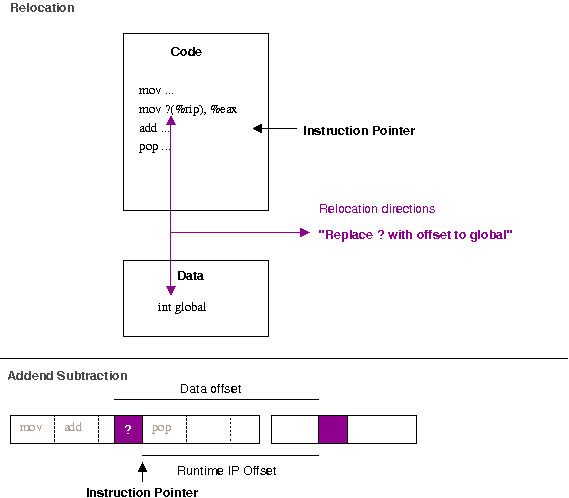
Lets just go through that for clarity: The IP relative move is really the trick here. We know from the code that it has to move the value of the global variable here. The zero value is simply a place holder - the compiler currently does not determine the required address (i.e. how far away from the instruction pointer the memory holding the global variable is). It leaves behind a relocation -- a note that says to the linker "you should determine the correct address of foo (global in our case), and then patch this bit of the code to point to that addresss". Relocations with addend The top portion of the image above gives some idea of how it works. We can examine relocations in binaries with the readelf tool.
$ readelf --relocs ./function.o
Relocation section '.rela.text' at offset 0x518 contains 1 entries:
  Offset          Info           Type           Sym. Value    Sym. Name + Addend
000000000009  000800000002 R_X86_64_PC32     0000000000000000 global + fffffffffffffffc
There are many different types of relocations for different situations; the exact rules for different relocation types are described in the ABI documentation for the architecture. The R_X86_64_PC32 relocation is defined as "the base of the section the symbol is within, plus the symbol value, plus the addend". The addend makes it look more tricky than it is; remember that when an instruction is executing the instruction pointer points to the next instruction to be executed. Therefore, to correctly find the data relative to the instruction pointer, we need to subtract the extra. This can be seen more clearly when layed out in a linear fashion (as in the bottom of the above diagram). If you try and build a shared object (dynamic library) with an object file with this type of relocation, you should get something like:
$ gcc -shared function.c
/usr/bin/ld: /tmp/ccQ2ttcT.o: relocation R_X86_64_32 against  a local symbol' can not be used when making a shared object; recompile with -fPIC
/tmp/ccQ2ttcT.o: could not read symbols: Bad value
collect2: ld returned 1 exit status
If you look back at the disassembly, we notice that the R_X86_64_32 relocation has left only 4-bytes (32-bits) of space left for the relocation entry (the zeros in 7: 8b 15 00 00 00 00). So why does this matter when you're creating a shared library? The first thing to remember is that in a shared library situation, we can not depend on the local value of global actually being the one we want. Consider the following example, where we override the value of global with a LD_PRELOAD library.
$ cat function.c
int global = 100;
int function(int i)  
    return i + global;
 
$ gcc -fPIC -shared -o libfunction.so function.c
$ cat preload.c
int global = 200;
$ gcc -shared preload.c -o libpreload.so
$ cat program.c
#include <stdio.h>
int function(int i);
int main(void)  
   printf("%d\n", function(10));
 
$ gcc -L. -lfunction program.c -o program
$ LD_LIBRARY_PATH=. ./program
110
$ LD_PRELOAD=libpreload.so LD_LIBRARY_PATH=. ./program
210
If the code in libfunction.so were to have a fixed offset into its own data section, it will not be able to be overridden at run-time by the value provided by libpreload.so. Additionally, there are only 4-bytes available to patch in for the address of global -- since a shared library could conceivably be loaded anywhere in the 64-bit (8-byte) address space we therefore need 8-bytes of space to cover ourselves for all possible addresses global might turn up at. The two basic possibilities for an object file are to be either linked into an executable or linked into a shared-library. In the executable case, the value of global will be in the exectuable's data section, which should definitely be reachable with a 32-bit offset of the current instruction-pointer. The instruction-pointer relative address can simply be patched in and the executable is finalised. But what about the shared-library case, where we know the value of global could essentially be anywhere within the 64-bit address space? It is possible to leave 8-bytes of space for the address of global, by telling gcc to use the large-code model. e.g.
$ gcc -c -mcmodel=large function.c
$ objdump --disassemble ./function.o
./function.o:     file format elf64-x86-64
Disassembly of section .text:
0000000000000000 <function>:
   0:  55                      push   %rbp
   1:  48 89 e5                mov    %rsp,%rbp
   4:  89 7d fc                mov    %edi,-0x4(%rbp)
   7:  48 b8 00 00 00 00 00    movabs $0x0,%rax
   e:  00 00 00
  11:  8b 10                   mov    (%rax),%edx
  13:  8b 45 fc                mov    -0x4(%rbp),%eax
  16:  01 d0                   add    %edx,%eax
  18:  5d                      pop    %rbp
  19:  c3                      retq
However, this creates a problem if you really want to share this code. By having to patch in an address of global directly, this means the run-time code above does not remain unchanged. Two separate processes therefore can't share this code -- they each need separate copies that are identical but for their own addresses of global patched into it. By enabling Position Independent Code (PIC, with the flag -fPIC) you can ensure the code remains share-able. PIC means that the output binary does not expect to be loaded at a particular base address, but is happy being put anywhere in memory (compare the output of readelf --segments on a binary such as /bin/ls to that of any shared library). This is obviously critical for implementing lazy-loading (i.e. only loaded when required) shared-libraries, where you may have many libraries loaded in essentially any order at any location. Of course, any problem in computer science can be solved with a layer of abstraction and that is essentially what is done when compiling with -fPIC. To examine this case, let's see what happens with PIC turned on.
$ gcc -fPIC -shared -c  function.c
$ objdump --disassemble ./function.o
./function.o:     file format elf64-x86-64
Disassembly of section .text:
0000000000000000 <function>:
   0:   55                      push   %rbp
   1:   48 89 e5                mov    %rsp,%rbp
   4:   89 7d fc                mov    %edi,-0x4(%rbp)
   7:   48 8b 05 00 00 00 00    mov    0x0(%rip),%rax        # e <function+0xe>
   e:   8b 00                   mov    (%rax),%eax
  10:   03 45 fc                add    -0x4(%rbp),%eax
  13:   c9                      leaveq
  14:   c3                      retq
It's almost the same! We setup the frame pointer with the first two instructions as before. We push the first argument into memory in the pre-allocated "red-zone" as before. Then, however, we do an IP relative load of an address into rax. Next we de-reference this into eax (e.g. eax = *rax in C) before adding the incoming argument to it and returning.
$ readelf --relocs ./function.o
Relocation section '.rela.text' at offset 0x550 contains 1 entries:
  Offset          Info           Type           Sym. Value    Sym. Name + Addend
00000000000a  000800000009 R_X86_64_GOTPCREL 0000000000000000 global + fffffffffffffffc
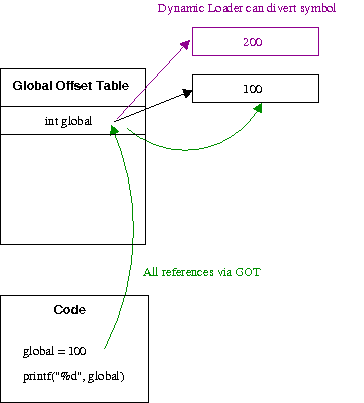
The magic here is again in the relocations. Notice this time we have a P_X86_64_GOTPCREL relocation. This says "replace the data at offset 0xa with the global offset table (GOT) entry of global. Global Offset Table operation with data variables As shown above, the GOT ensures the abstraction required so symbols can be diverted as expected. Each entry is essentially a pointer to the real data (hence the extra dereference in the code above). Since we can assume the GOT is at a fixed offset from the program code within plus or minus 2Gib, the code can use a 32-bit IP relative address to gain access to the table entries. So, taking a look a the final shared-library binary we see a final offset hard-coded
$ gcc -shared -fPIC -o libfunction.so function.c
$ objdump --disassemble ./libfunction.so
00000000000006b0 <function>:
 6b0:  55                      push   %rbp
 6b1:  48 89 e5                mov    %rsp,%rbp
 6b4:  89 7d fc                mov    %edi,-0x4(%rbp)
 6b7:  48 8b 05 8a 02 20 00    mov    0x20028a(%rip),%rax        # 200948 <_DYNAMIC+0x1d8>
 6be:  8b 10                   mov    (%rax),%edx
 6c0:  8b 45 fc                mov    -0x4(%rbp),%eax
 6c3:  01 d0                   add    %edx,%eax
 6c5:  5d                      pop    %rbp
 6c6:  c3                      retq
 6c7:  90                      nop
Every process who wants to share this code just needs to make sure they have their unique address of global at 0x20028a(%rip). Since each process has a separate address-space, this means they can all have different values for global but share the same code! Thus the default of the small-code model is sensible. It is exceedingly rare for an executable to need more than 4-byte offsets for a relative access to a variable in it's data region, so using a full 8-byte value would just be a waste of space. Although leaving 8-bytes would allow access to the variable anywhere in the 64-bit address space; when building a shared library, you really want to use -fPIC to ensure the library can actually be shared, which introduces a different relocation and access to data via the GOT. This should explain why gcc -shared function.c works on x86-32, but does not work on x86-64. Inspecting the code reveals why:
$ objdump --disassemble ./function.o
00000000 <function>:
   0:   55                      push   %ebp
   1:   89 e5                   mov    %esp,%ebp
   3:   a1 00 00 00 00          mov    0x0,%eax
   8:   03 45 08                add    0x8(%ebp),%eax
   b:   5d                      pop    %ebp
   c:   c3                      ret
$ readelf --relocs ./function.o
Relocation section '.rel.text' at offset 0x2ec contains 1 entries:
 Offset     Info    Type            Sym.Value  Sym. Name
00000004  00000701 R_386_32          00000000   global
We start out the same, with the first two instructions setting up the frame pointer. However, next we load a memory value into eax -- as we can see from the relocation information, the address of global. Next we add the incoming argument from the stack (0x8(%ebp)) to the value in this memory location; implicitly dereferencing it. But since we only have a 32-bit address-space, the 4-bytes allocated is enough to access any possible address. So while this can work, you're not creating position-independent code and hence not enabling code-sharing. The disadvantage of PIC code is that you require "bouncing" through the GOT, which requires more loads and reads to find an address than directly referencing it. However, if your program is at the point that this is becoming a performance issue you're probably not reading this blog! Hopefully, this helps clear up that possibly cryptic error message. Further searches around position-independent code, global-offset tables and code-sharing should also yield you more information if it remains unclear.

Jan Wagner: Brainfucked intellectual property rights

This issue is about a bit specific situation in Germany and it's (mainly tax-financed) public service broadcasting. If you think you are not interested, please skip this entry. :) Just beginning from scratch... In Germany we have (like most european countries) a public service broadcasting. Starting with 2013 the system collecting the funding of the public service broadcasting changed from GEZ to Beitragsservice.
To make it short (and a bit simplified) ... it changed from "most 'families' have to pay" to "every menage has to pay". This means, even if you don't have any device to use the service of the german public service broadcasting but are a menage, you have to pay for it. This sitiation is even more worse than pay-TV. Don't get me wrong ... I'm neither against public service broadcasting nor against paying for it in principle. In the rare cases I'm watching TV, this is most likely a channel of the public service broadcasting. Same counts for the rest of my small family. Mostly we are watching news and documentations ... also some movies are watched. The kids are watching KiKA, which we like cause it's Ads-free and it's not just some cartoons with hidden violence. So we most likely benefit from public service broadcasting. Anyways ... in common we are not using "TV" as most of the others may do. We still like some sort of the broadcast, but we are missing it cause various reasons. For our luck there is a service called 'Mediathek' provided by the most german public service broadcasting channels. If you missed a broadcast or are prevented for any reason, you may watch the broadcast there. Unfortunately the timeframe you can access the broadcast is very short, in most cases 7 days. This is manifested in the so called Rundfunkstaatsvertrag, more precisely in the 12. Rundfunk nderungsstaatsvertrag. The 'Tagesschau' has a good explanation about the issue. This means, in simple words, the tax payed broadcasts needs to be deleted after a (in my eyes) short time. WTF?!? Why do we wipe work we all payed for it? Guess what ... it was implemented by lobbying from commercial print media and private (e.g. ads-financed) TV-channels. A comment about a related problem, which I agree, can be found here. Another challenge ... How do you know there is a broadcasting your are interested in? How do you know when it is broadcasted? I remember, my parents was subscribed to a daily newspaper, which included an additional TV paper, my parents-in-law bought also one.
As we are neither subscribed to a daily newspaper nor buying a TV paper, we have to solve that differently (beside that a printed paper won't help us I think). When we use the opportunity to watch TV at the evening, I just use an electronical TV paper (-app). If we find something which fits, we are fine .. if not, we do other things. This sounds a bit like an old school behaviour and it is not, how I would like to use a media today. I like using a feedreader. You can subscribe differnt 'channels' of information feeds and it is a way I would love to use TV. In the past I used a tool called 'Mediathek', which is a tool for Mac OSX. With this tool it was easily possible to find broadcasts, you could subscribe to so called 'channels', which means broadcasts of a same series for example. You could also mark them as "unread" und "read" .. something like a feedreader.
On the other way, it was also possible to list recent broadcast per genres and popular broadcast of the recent and the last week. This was very comfortable as this was working for several mediathek sites for german public service broadcasting channels in one central place. For every broadcast you could just view it or download it to view it later. You could even download subscribed channels automatically. After using the Mediathek-App and being satisfied by the Mediathek sites of the german public service broadcasting channels for several years, this week the server(s) behind the App was shut down. What the f....?!? On Twitter the author stated that the shutdown was cause by problems with the copyright law. Das Erste, ZDF and WDR denied that they has anything todo with this recent issue. The question is ... what is the direct cause for shutting down such a good service. This smells a bit like the PirateBay issue, but in this case the content which is Mediathek providing access to isn't pirated, but legal hosted. So where is the real issue? In my mind, the german citizen has payed to produce this content and should have the right to access the content is an usable way. The Mediathek App did provide such a way and it is really pissing me off that this access isn't available anymore, at least for this reason. Actually I don't see any solution to access our payed content in a decent way. Footnote: I think it's obscenely, that publishing houses and commercial broadcaster trying to gain their turnover at the expense of the german citizen by forcing the german legislature to implement Depublication,.

Ian Campbell: Debugging Initramfs Issues With No Console

The QNAP TS-XXX NAS boxes are nice little systems but one thing I really miss is a console. Martin Michlmayr has some instructions (TS-119, TS-219, TS-41x) on his excellent Debian On QNAP pages on how to build a suitable adaptor but sadly even though I've managed to get all the parts I've been too lazy to actually solder the thing together (it doesn't help that I nearly always burn myself when I use a soldering iron!). This became more pressing when someone reported that Debian bug #693263 in qcontrol was not fixed in Wheezy since the issue appeared to be in the initramfs hook. Worse it seemed like something in my proposed fix was causing the system to not boot at all! Having finally found the hardware needed to reproduce the issue my first thought was to try netconsole. To do this I edited /etc/initramfs-tools/modules to add:
      mv643xx_eth
      netconsole netconsole=@<IP>/eth0,@<DST-IP>/<DST-MAC>
The option syntax is described in netconsole.txt but briefly: <IP> is the address of the TS-419P II I'm debugging on, and <DST-IP> and <DST-MAC> are the IP and MAC address of another machine on the network. Having done that, running update-initramfs -u and rebooting I can use netcat -u -l -p 6666 on the other machine to see all the kernel messages. So far so good but this doesn't get me any debugging from the userspace portions of the initramfs. To get those we have to get a bit hacky by editing /usr/share/initramfs-tools/init, first to change:

     # Parse command line options
    -for x in $(cat /proc/cmdline); do
    +for x in $(cat /proc/cmdline) debug; do
            case $x in
and secondly:

             debug)
                     debug=y
                     quiet=n
    -                exec >/run/initramfs/initramfs.debug 2>&1
    +                exec >/dev/kmsg 2>&1
                     set -x
                     ;;
The first of these simulates adding debug to the kernel command line (which can't otherwise easily be edited on these systems) and the second redirects the initramfs process's output to the kernel log. The overall effect is that the output of the initramfs processes appears over netcat.

Olly Betts: Empty Strings in C++

Gaurav (one of Xapian's GSoC students this year) queried my advice that it's better not to explicitly initialise a std::string in C++ like this:
std::string s = "";
but instead to write:
std::string s;
It could be argued that the former makes it clearer that the string is initialised (since C++ does inherit C's behaviour of not implicitly initialising variables of fundamental types, such as int and double). But objects aren't left uninitialised - the default constructor gets called (or if there isn't one, the code won't compile). The downside is that you get quite a lot more code from the first version than the second. Perhaps compilers will grow smarter and in future both the above will compile to the same code, but that's not true today. Here's a simple bit of test code:
#include <string>
std::string f()  
#ifdef EXPLICIT_INIT
    std::string s = "";
#else
    std::string s;
#endif
    return s;
 
And I'll compile it with GCC (g++ (Debian 4.7.2-4) 4.7.2) on x86-64 to produce assembler output:
$ g++ -O2 -S s.cc -o s1.s
$ g++ -DEXPLICIT_INIT -O2 -S s.cc -o s2.s
$ diff s1.s s2.s
1a2,4
>   .section        .rodata.str1.1,"aMS",@progbits,1
> .LC0:
>   .string ""
9,10c12,25
<   movq    %rdi, %rax
<   movq    $_ZNSs4_Rep20_S_empty_rep_storageE+24, (%rdi)
---
>   pushq   %rbx
>   .cfi_def_cfa_offset 16
>   .cfi_offset 3, -16
>   movl    $.LC0, %esi
>   movq    %rdi, %rbx
>   subq    $16, %rsp
>   .cfi_def_cfa_offset 32
>   leaq    15(%rsp), %rdx
>   call    _ZNSsC1EPKcRKSaIcE
>   addq    $16, %rsp
>   .cfi_def_cfa_offset 16
>   movq    %rbx, %rax
>   popq    %rbx
>   .cfi_def_cfa_offset 8
(As an aside, I wouldn't recommend spending a lot of time digging into the assembler your compiler produces, but if there's more than one equivalent way to write code for a common case (as here) and you want to know which is most efficient, it can be informative to see what code is produced for each). You don't really need to know x86-64 assembler to grasp what's happening above, which is lucky, since I don't really know x86-64 assembler. In the first hunk, we get an empty literal string being added to the rodata (read-only data) section; and in the second, instead of two instructions which copy a standard empty string representation, we get much more elaborate code, including a function call to _ZNSsC1EPKcRKSaIcE - the C++ mangled name for the std::string from const char * constructor:
$ c++filt _ZNSsC1EPKcRKSaIcE
std::basic_string<char, std::char_traits<char>, std::allocator<char> >::basic_string(char const*, std::allocator<char> const&)
I also tested the example above with clang (Debian clang version 3.0-6 (tags/RELEASE_30/final) (based on LLVM 3.0)) and the resultant code is fairly similar for each case. The overhead for doing this once isn't going to matter, but if it happens every time you declare a std::string variable, the cumulative effects may be measurable. And as well as taking longer to execute, the larger code will cause greater CPU cache pressure.

Russ Allbery: Automated Perl testing

I started several coding projects today, but none of them reached an announcable conclusion, so this seems like a good day to write up my current discoveries in automated Perl testing modules. This post isn't about test frameworks like Test::More and friends, or even about helper modules (although I do recommend Test::Warn if you want to test warning code in your modules). It's not about writing functionality tests. Rather, it's about various CPAN modules that can be used almost identically in just about every Perl module distribution (and in some other places, like Perl scripts inside a larger package written in another language). You can drop a small driver script into your t directory and (mostly) run make test with no further customization. If you want to see the driver scripts for all of the below that I'm currently using, see the t directory of the Term::ANSIColor distribution. They'll slowly make their way into my other modules, and probably, despite the name of the package, rra-c-util, since that's my equivalent of gnulib and I have tools to synchronize shared code from that package. The driver script generally tests whether the module is installed, skips the test if not, and otherwise dispatches to the "test everything" routine in the module. Test::MinimumVersion: This tests that you're not accidentally using a newer Perl feature than you were expecting. It's very handy if you want to support backward compatibility to a particular version of Perl. It knows about features as far back as 5.004_05. It won't be able to catch everything, but it will catch some of the most obvious things. Test::Perl::Critic: This is sort of the thousand-pound gorilla. Test::Perl::Critic runs all of your code through perlcritic and reports any errors. You will probably need to combine this with a perlcriticrc file in your distribution that you configure it to use, since otherwise the person running the tests may have customized perlcritic. If you let it run perltidy to check for formatting problems, you'll also want a perltidyrc. See the driver script mentioned above for how I set that up. I usually configure this test to only run for me (by checking an environment variable) since the results vary a lot depending on what version of perlcritic is installed, and it's likely new versions will cause the test to start failing. If you use this, expect to need to add ## no critic annotations to your code. Test::Pod: Checks for syntax errors in your POD documentation so that you won't have those embarassing POD ERRORS sections. Note that the latest version of podlators turns syntax errors into fatal errors, so soon you won't have to worry as much about this. But if you'd been using this module all along, you wouldn't have to worry about the fact that pod2man may start faliing due to syntax errors you never fixed! Test::Pod::Coverage: Only of interest to module distributions, not ramdom scripts, this checks that every sub provided by your module has POD documentation. It understands various subs that don't need to be documented (such as the ones you provide to implement a tied class) and lets you mark some subs as not requiring documentation. Test::Pod::Spelling: Checks your POD documentation for spelling mistakes with a spell checker. (Note that perlcritic, and hence Test::Perl::Critic, can also do this, but I use this module separately since I think the output is more readable.) You will almost certainly want to make this test maintainer-only, since spell checkers and spelling dictionaries vary a lot. But it prevents a lot of embarassment when you read your documentation on search.cpan.org and find that obvious spelling error you never saw before. Test::Strict: Checks all Perl code to ensure that it compiles, checks whether it has use strict, and optionally checks whether it has use warnings. This is great; I use this even with packages that just have a few Perl utility scripts in a package otherwise written in C, since I previously kept releasing packages with helper scripts with obvious syntax errors since I didn't run them much. Another place it's useful is if you have internal Debian packages that wrap up Perl utility scripts; just create a small test suite with this module and run it from override_dh_auto_check and you won't ever release a package with scripts that won't run. You can also do test suite coverage testing with this module (and Devel::Cover), but that you'll want to mark maintainer-only since it takes a while. Test::Synopsis: Checks the code in the SYNOPSIS section of any POD documentation to ensure that it compiles. No more syntax errors in your example code in the documentation! All of these modules are, of course, packaged for Debian (thanks largely to the wonderful Perl packaging team!), and otherwise available on CPAN. There are a variety of others, of course; these are just the main ones that I've found personally useful. One final whine, however: all this wonderful Perl testing infrastructure desperately needs a common module and a common interface for providing a list of files to check. Every one of these modules reinvents that wheel, and most of them do it a slightly different way than all the others. Most of them check in either blib or lib (or sometimes both). Most of them also add t. Most of them don't include Makefile.PL, but some of them do. Almost none of them look in examples. Some have a simple way to add more files or directories; some don't. Some can be run from the t directory and still find things, but most of them can't. And of course the syntax is different in every case! Most of the work in my driver scripts is finding the right way to add a few additional directories to the scope of the testing, and in one annoying case (Test::Synopsis), I actually had to use Perl::Critic::Utils (for lack of a better module) to build a list of files to check instead of using the build-in file list, since the build-in file list required all module code be in lib. A module to abstract out all of this and provide a common interface would be easy to write. Most of the work would involve talking to all the authors of all these different modules and asking them to use it. If someone in the Perl community felt like doing that, it would make life so much easier for everyone.

4 January 2013

David Welton: The Software Millionaire Next Door

I've been reading "The Millionaire Next Door" and have so far found it to be a pleasant book with a good message: don't waste your money on silly things and appearance (fancy suits, fancy cars, expensive boats, etc...), save what you do earn consistently and constantly, invest wisely, and so on. Wikipedia has a good summary:
http://en.wikipedia.org/wiki/The_Millionaire_Next_Door
One of the things I like about it is that it focuses on "ordinary" wealthy people, those with a million or more in the bank, but not the Warren Buffets or Bill Gates types that are extreme statistical outliers. There are plenty of people in the US who have done well by themselves by slowly but surely putting together enough money to be financially independent, without, however, being in the spotlight. As the book says, these are the kind of people who maybe own a local chain of businesses doing something fairly ordinary, but doing it well enough to succeed. They may very well not live in a fancy house, nor drive an expensive car, or otherwise outwardly draw much attention to themselves. The world of software does not revolve around "dressing for success" (you noticed?), but we do tend to focus on the "big winners". Gates, Jobs, Zuckerberg, Larry & Sergey, Larry Ellison, and so on are the stars of the show. Of course, the economics of software being what they are, instances of winner-take-all markets with one big fish and a lot of also-rans are not uncommon. However, that is not the only story, and I think it'd be interesting to know more about those in our industry who have accumulated significant wealth, yet are not the guys with more money than they could possibly ever spend on things that aren't, say, country-sized chunks of real-estate. I'm guessing they'd fall into these categories: It'd be very interesting to gather some actual data on this, although I'm not in a position to do so myself - I wouldn't even really know where to start. As I age, I think the third category has begun to seem appealing in many ways - I'm simply not cut out for the Big Company life, and I'm not interested in living in Silicon Valley and going "all in" on the latest startup - I already did that, and while it was fun and I don't regret it, it's not the kind of thing I'd want to do now that I'm married and have kids. Incidentally, this more relaxed, under the radar approach is exactly what is expoused in one of my favorite books of the past few years, Start Small, Stay Small. Edit : I finished reading the book and reviewed it here: http://davids-book-reviews.blogspot.com/

Russell Coker: Links January 2013

AreWomenHuman has an interesting article about ViolentAcrez and the wide support for trolling (including by media corporations) [1]. Chrys Stevenson wrote an important article for the ABC about the fundamentalist Christians who are trying to take over the Australian education system [2]. Tavi Gevinson gave an interesting TED talk titled A teen just trying to figure it out about her work starting Rookie magazine and her ideas about feminism [3]. Burt Rutan gave an interesting and inspiring TED talk about the future of space expploration [4]. One of his interesting points is that fun really is defendable in regard to tourism paying for the development of other space industries. Stephen Petranek gave an interesting TED talk about how to prepare for some disasters that could kill a significant portion of the world s population [5]. Some of these are risks of human extinction, we really need to spend some money on it. John Wilbanks gave an intresting TED talk about the way that current informed consent laws prevent large-scale medical research [6]. He says I live in a web world where when you share things beautiful stuff happens, not bad stuff . Joey Hess was interviewed for The Setup and the interview sparked a very interesting Hacker News discussion about workflow for software development [7]. Like most developers I prefer large screens with high resolution, I have an EeePC 701 which works reasonably well for an ultra-portable system but I largely don t use it now I have an Android phone (extremely portable and totally awful input usually beats moderately portable and mostly awful input for me). But Joey s methods are interesting and it seems that for some people different systems give the best result. Jeff Masters gave an insightful TED talk about the weather disasters that may seriously impact the US in the next 30 years [8]. Governments really need to start preparing for such things, some of them are really cheap to mitigate if work is started early. Bryan Stevenson gave an inspiring TED talk about the lack of justice in the US justice system [9]. Wouter Verhelst wrote an insightful article about some of the criticisms of Linux from Windows users [10]. He references a slightly satirical post he previously wrote about why Windows isn t ready for desktop use. Paul Carr wrote an interesting article comparing disruptive business practices of dot-com companies to the more extreme aspects of Ayn Rand s doctrine [11]. In reading some of the links from that article I discovered that Ayn Rand was even more of a sociopath than I had previously realised. Lindy West gave an amazing Back Fence PDX talk about dealing with nasty blog comments from the PUA/MRA communities [12]. After investigating them she just feels sorry for the trolls who s lives suck. Hang from the Vlogbrothers explains gender, sex, sexual orientation, etc [13]. Rick Falkvinge wrote an interesting article about recent political news from Brazil, they had a proposed law that was very positive for liberty on the Internet but it was sabotaged by the media and telcos [14]. We should try to avoid paying any money to the media industry so that they can go away sooner. Amy Cuddy gave an interesting TED talk about body language, power, and the imposter syndrome [15]. Caleb Chung gave an interesting TED talk about toy design which focussed on Pleo a robotic dinosaur with a SD card and USB socket to allow easy reprogramming by the user [16].

Russ Allbery: spin 1.79

spin is the program that I use to generate all of my web pages, including this journal, from a bespoke macro language. I've been slowly evolving it since 1999 and really do intend to turn it into a proper Perl module one of these days.... My web site was one of the few places left that I was still using Subversion, and I finally decided to do something about that during this vacation. The main reason why it wasn't trivial was that I was using Subversion Id strings to get a more accurate last change date for files rather than just using file timestamps. (Nit-picky, I know, but if I'm not allowed to be nit-picky on my own web site, where can I be?) This release recognizes when the source directory is a Git working tree and supports determining the last modification date from git log instead (by way of the Git::Repository Perl module). I also updated all my various (not released) helper scripts for maintaining the site to use Git rather than Subversion, which mostly involved changing svn to git and removing some fiddly bits that Git doesn't require. Of course, this means that I also removed the \id thread commands on all my pages, which in turn means that I just updated the last modification date of every file, making it somewhat hard to test since every thread-generated page on my site has now been modified today. *heh* You can get the latest release of spin from my web tools distribution page. I also released version 1.44 of my release utility, which I use to help automate some of the work of generating software releases. The change there is to use Git rather than Subversion to commit changes to the .versions file that drives some of the software-related parts of my web site. You can get the latest version of release from my scripts page.

3 January 2013

Joey Hess: overcast

My least favorite forecast, and we've been having a lot of it lately. Since winter began (Dec 21st), my PV array has produced only 102 amp-hours of power. There have been only 3 days that could be considered sunny at all (even for a few hours). To put this in some perspective for you, Wolfram Alpha tells me that 102 amp-hours is half of a typical car battery capacity. So I've really had to scrimp & save. I disconnected my router to save power, and I plumbed the depths of the battery bank (further than it's really safe to go). And I was completely out of power for several days. So, I've bought a generator. I had to order it online, because it seems every store in the entire eastern US is completly out of stock, due to hurricane Sandy. This house has a generator shed (complete with a massive old generator that doesn't work), but I put the new, small generator in the furthest outbuilding, from where it can only barely be heard in the house. Later I'll be able to run a cable from its 12v terminal to charge the battery bank (if the sun doesn't get there first); for now it only powers my laptop. Nasty noisy smelly dirty thing, it pains me to run it. Back to the "overcast" forecast. I've heard meterologists say that one unexpected consequence of climate change seems to be that weather patterns are persisting longer, giving us this summer's weeks of neverending heat, and large, slow-moving storms. I suspect this could also explain the blankets of clouds that have been settling in for weeks at a time, on and off since mid-November. But I only have 2.5 years of not very good data. Before, I paid about as much attention to whether it was sunny as anyone else, which is to say, not really very much. Anyone know of a source of historical cloud cover data?

2 January 2013

Niels Thykier: Getting space for more packages

In 2011, I wrote about how small files could consume a lot of space. I meant to do a follow-up on the savings but I forgot about it until now. In 2.5.7, we started compressing some of the collected data files. Some of these are ridiculously compressable (#664794). Even better, compressing them is sometimes faster than writing them directly to the disk, so in some cases it is a pure win/win. For lintian.d.o, we also see a vast size reduction in overall size of the laboratory. I have taken a few samples occasionally. The samples were done with du(1):
$ du -csh [--apparent-size] laboratory/*
Version/date du -csh apparent-size
N/A around 20 Mar 2012 (#664794) 16G 13G
2.5.6 (Fri Apr 27 2012) 14GB N/A
2.5.6 (Mon Jun 04 2012)) N/A 12G
2.5.10.2 (Fri Sep 21 2012) 12G 8.3G
2.5.11 (Wed Jan 2 2013) 10G 6.1G
And the most awesome part of this? The comparison is quite biased against the 2.5.11 entry, which is the only entry to also process experimental (approx. 10% extra packages). Some of the early entries (2.5.6 and older ) might also have suffered from the too many links issue[1]. I only wish I had been better at collecting data points, so I could have made a proper graph of it. :) It sounds almost too good to be true, but if you look at the size of one of the linux-image packages[1], the space usage dropped from 27M to 15M between 2.5.5 to 2.5.9. Currently it is squeezed down to 14M (tested with head of the git master branch). [1] I believe is about 5-10% less binary packages processed for those runs. [2] linux-image-3.2.0-2-amd64_3.2.20-1_amd64.deb

1 January 2013

Craig Small: procps 3.3.6 and Mudlet 2.0

Mudlet - Graphical MUD clientYesterday was a busy Debian day for me with the release of not one but two packages. procps procps version 3.3.6 was released both as an upstream and a Debian package. While there were many bug fixes in this release, the main new feature for it was the top inspect feature. The top inspect feature allows you to run top in the normal way then you can inspect a specific process you have selected within top for more information. Examples of this include fuser or lsof type output to see what files or libraries are open but really the limit is how clever the operator is and how often you would need this information. Even scripts can be run off this feature if you have some customised or cooked output you need to see. Once the output is there, you can search for text. There will be a small hold-up with the Debian packages as the section for the library has been moved to libs, where it should be. At least I think that s why there is a delay. procps infrastructure procps currently has only an email list and a gitorious git repository. While this works most of the time, there are two main problems with this setup. The first is that the only two ways you can report bugs is send an email to the list or create a git merge request. The email has the problem with tracking and gathering history while the git sets the bar pretty high for reporting something has gone wrong. Second problem is there is no tarball file repository. gitorious does have the feature of downloading tarballs of the tag checkpoints, but this is the raw repository. When you make a tarball with make dist there are some generated files included in the tarball that don t appear in the gitorious ones, which means its not a simple for some as you expect. So I ll be creating a project for these two features soon. Not sure where they will be but I use sourceforge for both these for a few other projects so that might be where they end up. Mudlet Mudlet, the multi-user dungeon or MUD client, has finally made it to version 2.0! It looks a lot more stable and polished at least from the scripting side than the previous RC versions but has all the features that we ve come to expect with it. The most important thing is that the developers have finally put a line in the sand and said this is version 2.0 . The Debian package was uploaded yesterday and should be on its way to your local mirror soon.

Russ Allbery: 2012 Book Reading in Review

For the year of 2012, I finished and reviewed 60 books, the same number as 2011. Given how stressful and chaotic much of the year was, I count this a major triumph. The hardest part was not the reading but the review writing; the end of the year required a significant push to finish writing reviews of all the books I'd read that year, and at one point I was reviewing things I'd read more than two months earlier. But I can enter 2013 entirely caught-up. This continues to feel like about the right pace, striking a balance between reading enough that I can pursue multiple reading goals at the same time, while leaving enough time for other projects and video games. I gave three novels a 10 out of 10 this year, but the stand-out even among that group was Elizabeth Wein's Code Name Verity. Not only was it my favorite book of the year, but it was one of the best books I've ever read. The other two 10-rated books are also highly recommended, of course: Matt Ruff's fascinating novel of multiple personalities, Set This House in Order; and C.J. Cherryh's SF classic, Cyteen. The latter was a re-read in advance of reading the sequel, Regenesis, which I also recommend if you've read and liked the last third of Cyteen. Other fiction highlights of the year were China Mi ville's Embassytown and Suzanne Collins's The Hunger Games triology, particularly the third book, Mockingjay. Embassytown continues the trend from Mi ville's The City & The City of tighter, faster-moving novels while moving into space opera and first contact territory. It keeps Mi ville in the top rank of current SFF writers, despite having some suspension of disbelief problems. Collins's world-building in The Hunger Games also has suspension of disbelief problems, but I understood why the series was so popular. I was caught by surprise by its look at violence and its after-effects and was particularly impressed by Mockingjay and Collins's chosen ending. I think this is a popular series that lives up to the hype. There were no 10 ratings in non-fiction this year, but several books nonetheless stood out. John Kenneth Galbraith's The Affluent Society is a thought-provoking book that questions the foundation of a consumer-oriented economy while perceptively pointing out how it distorts choices away from public goods. Susan Cain's Quiet is a passionate defense of introversion in an extroverted world. And, finally, Joshua Bloch's Effective Java and Damian Conway's Perl Best Practices are both insightful looks at the good and bad of their respective languages and taught me a great deal as a practicing programmer. One final highlight to mention: Eclipse Phase by Posthuman Studios is an excellent RPG sourcebook, at least from the perspective of interesting world-building. I haven't played it, but I thoroughly enjoyed reading it (and have acquired nearly all of the supplements). The full analysis includes some additional personal reading statistics, probably only of interest to me.

Christian Perrier: [life] [running] 2012 summary

Yet another yearly summary of my running activities. It seems, indeed, that running has now slightly taken precedence over free software activities in my life and priorities for my free time. To my fellow free software friends: don't worry, I'm not on my way to stop investing my time in Debian. It's quite clear that I'm reducing my involvement, mostly because days only have 24 hours...not because I'm bored or tired by free software development. But, certainly, it became an important thing that running currently has a small priority over Debian nowadays, for me. So, what happened on that front in 2012 for running bubulle? I finally managed to run 2900 km during the year, which is over 400km more than 2011. This is mostly due to the increasing part of running in my daily commute : a typical work week can now be something like this: With such an organization, I can end up with weeks where I run up to 50-60 kilometers in 5 days, with peaks that may include 26km in one *work* day. I also end up having room in trains between the runs, I wonder why..:-) And, of course, during week-ends, I spend some parts of my time running too..:-). Indeed, just like for many drugs, I feel sad during days where I haven't run at all and it's usually hard for me to spend more than 2 days without. Indeed, the longest time period without running, this year, has been 9 days, just after the Caen marathon, in June. Mostly because, at that time, I reached a moment where training (and believe me, very boring and hard training) consumed all my motivation. But these moments are indeed very rare and training is mostly *never* boring for me. Mostly because I like running in the nature, in forests, woods, fields, country. Never wearing an MP3 player or any kind of such device toplay music, but just enjoying the outside, whether it's raining, winding, sunny hot. Running (particularly my daily commute) is also the moment where I *think* about my work, my technical activities, my own life, whatever. I think I even sometimes translated some software, mentally, while running..:) Indeed, there have been 205 days in this year where I ran at least once. Last year was 181 so....drug addiction is increasing. So, 2900 kilometers. That's about the distance from my place to Moscow in Russia. 282 hours (11 days18 hours.....9d21h last year). Average speed: 10,3km/h (10,5km/h last year). Cumulated height difference: 33,400 meters (27700m last year). More distance, more time, a bit slower: this is an obvious consequence of more trail running (which includes more difficulties, such as running on volcanoes!). Most active month: November with 331km. Less active month: June with 141km. This year was also a year of records: I ran 10 official races during the year : two "ultra" races (70km Le Puy-Firminy in November, by night and 80km Paris Ecotrail in March), two marathons (Caen and Val de Rueil), four half-marathons and two "short" (less than 30km) trail races. How about next^W this year? Well, my goals are currently being secured: All this of course is assuming that no injury comes up (my ankles are sometimes yelling outbut I'm fortunate enough to not have articulation problems that many runners have, particularly in knees). We'll see on January 1st 2014...:-)

31 December 2012

Benjamin Mako Hill: Freedom for Users, Not for Software

I finally published a short essay I wrote about a year ago: Freedom for Users, Not for Software. Anybody who has hung around the free software community for a while will be familiar with the confusion created by the ambiguity between "free as in price" versus "free as freedom." In the essay I argue that there is a less appreciated semantic ambiguity that arises when we begin to think that what matters is that software is free. Software doesn't need freedom, of course; Users of software need freedom. My essay looks at how the focus on free software, as opposed to on free users, has created challenges and divisions in the free software movement. The essay was recently published in Wealth of the Commons: A World Beyond Market and State, a book edited by David Bollier and Silke Helfrich and published by Levellers Press. The book includes essays by 73 authors that include some other folks from the free software and free culture communities along with a ton of people working on very different types of commons. My essay is short and has two parts: The first is basically a short introduction to free software movement. The second lays out what I see as major challenges for free software. I will point out that these are some of the areas that I am working most closely with the FSF who are having their annual fundraiser at the moment to support and build advocacy programs around.

Chris Lamb: 2012: Selected highlights

January Started cycling again. By the end of the year I had done 2,300 miles. (Strava profile) /wp-content/2012/highlights/01.png February Private concert at the British Museum of Haydn baryton trios for the annual winding of the Thomas Tompion Mostyn clock. /wp-content/2012/highlights/02.jpg March Zadok Baroque premiere concert, East Sheen. (review) /wp-content/2012/highlights/03.jpg April Belsize Baroque concert, Bloomsbury. /wp-content/2012/highlights/04.jpg May Lute concert, Greenwich. /wp-content/2012/highlights/05.jpg June Left Playfire. /wp-content/2012/highlights/06.jpg July/August YCombinator, California. /wp-content/2012/highlights/07.jpg September Renaissance viol weekend, West Sussex. /wp-content/2012/highlights/09.jpg October Moved house. /wp-content/2012/highlights/10.jpg November Battersea Park 5K. Ran 200 miles this year. /wp-content/2012/highlights/11.jpg December Beethoven Triple concerto, Cambridge. (more) /wp-content/2012/highlights/12.jpg

Russ Allbery: Review: Wasted Heart

Review: Wasted Heart, by Lynn Galli
Publisher: Penikila
Copyright: 2010
ISBN: 1-935611-32-1
Format: Kindle
Pages: 252
Austy is a lawyer working for the US District Attorney's office in Seattle. Six months ago, she moved there from Virginia, in large part because she fell in love with her best friend. Her married best friend. Now, she's trying (mostly unsuccessfully) to deal with the Seattle lesbian scene while becoming (successfully) the go-to lawyer for prosecuting cases with a substantial technology component. Two things are about to complicate that life: meeting and working with FBI special agent Elise Bridie, and working on a case that involves her best friend's company. Yes, that best friend. This is, as you might have guessed, a lesbian romance novel, so with that should come my "reading out of genre disclaimer": it's rather easy, when reading a genre one normally doesn't read, to find books fresh and interesting when they're unoriginal to regular genre readers, or to miss genre conventions or reactions because one has not read the previous work. You should therefore take my opinions with a grain of salt, particularly if you read more romance novels than I do (which wouldn't be hard). I grabbed this book for a few reasons: I felt like reading a warm-hearted story focused on human relationships, I wanted a reasonably fast read (since I'm obsessed with meaningless numeric milestones, like how many books I read in a year), and I wanted something with an upbeat ending. Romance generally delivers on those fronts. Lesbian romance has the added bonus of avoiding a whole bunch of gender essentialism and heterosexual romance tropes that tend to give me hives. Landing was excellent, so I thought I'd see if I could find more of that. Wasted Heart does indeed deliver, although it's not quite as good as Landing. There's a bit too much physical attraction and love based on appearance for my taste, but Galli leavens that with quite a lot of interesting psychology. Both Austy and Elise are private and cautious people, and for me that makes the romance feel more realistic. It also draws out the initial phase of getting to know the other person, which is the part of the romance that I often find the most interesting. Elise in particular is a great character maybe a little too ideal in a few places, but smart and observant in a way that's very fun to read about. Like a lot of romances, there is some annoying miscommunication and misunderstanding (predictably right around the height of the tension), but it's not quite as stupid as those problems usually are, and Galli doesn't drag it out until one starts wanting to hit the characters with blunt objects. As good or better is the community that surrounds the main characters. Galli has a full cast of believable and interesting characters, most notably including Austy's old gang from Virginia. The tensions between having a group of friends one cares about deeply, wanting to build a new life after making a major break and major decision but having difficulty sustaining that under the onslaught of those friends, and being easily tossed about by expressive and outgoing people when one is private and a bit quiet all play out here. And, refreshingly, without a lot of angst, and with quite a bit of intelligent introspection. Both Austy and her friends are smarter and more considerate than most of the characters I've seen in this sort of situation. Another good bit is the little pieces of legal drama. Galli doesn't neglect Austy's work life, and while this is certainly not a legal thriller or procedural, we do get some nice scenes of Austy doing her job. I love courtroom scenes, particularly ones (like these) that are more on the realistic side, so that was a nice bonus. Austy and Elise's jobs also lead to a somewhat predictable bit of drama, and I was a bit less enamored of that; the more I thought about it, the less well it hung together for me. But I did like that it stayed firmly on the realistic side, including a look at psychological aftereffects for real people rather than thriller protagonists. This is not the sort of book that I would tell someone to rush out and buy, but it met my criteria nicely and delivered just the sort of entertainment I was looking for. (And it's not particularly expensive on Kindle, at least in the US.) There was a bit too much focus on physical appearance and physical infatuation, and Elise might be just a little too perfect, but I enjoyed it. Note that I read the special edition, which includes a (much appreciated) epilogue that closes out the story. That seems to be the default edition for sale everywhere I look, but in case you see the older version, I recommend the special edition. Rating: 7 out of 10

Russell Coker: Modern Swap Use

A while ago I wrote a blog post debunking the idea that swap should be twice as large as RAM [1]. The issue of swap size has come up for discussion in a mailing list so it seems that it s worth another blog post. Swap Size In my previous post I suggested making swap space equal to RAM size for systems with less than 1G of RAM and half RAM size for systems with 2-4G of RAM with a maximum of 2G for any system. Generally it s better to have the kernel Oom handler kill a memory hungry process than to have the entire system go so slow that a hardware reset is needed. I wrote memlockd to lock the important system programs and the shared objects and data files they use into RAM to make it easier to recover from some bad paging situations [2], but even that won t always make it possible to login to a thrashing system in a reasonable amount of time. But it s not always good to reduce swap size. Sometimes if you don t have enough swap then performance sucks in situations where it would be OK if there was more swap. One factor in this regard is that pages mapped read-only from files are discarded when there is great memory pressure and no swap space to page-out the read-write pages. This can mean that you get thrashing among memory for executables and shared objects while there s lots of unused data pages in RAM that can t be paged out. One noteworthy corner case in this regard is Chromium which seems to take a lot of RAM if you have many tabs open for a long time. Another factor is that there is a reasonable amount of memory allocated which will almost never get used (EG all the X based workstations which have 6 gettys running on virtual consoles which will almost never be used). So a system which has a large amount of RAM relative to it s use (EG a single-user workstation with 8G of RAM) can still benefit from having a small amount of swap to allow larger caches. One workstation I run has 8G of RAM for a single user and typically has about 200M of the 1G swap space in use. It doesn t have enough swap to make much difference if really memory hungry programs are run, but having 4G of memory for cache instead of 3.8G might make a difference to system performance. So even systems which can run without using any swap can still be expected to give better performance if there is some swap space for programs that are very inactive. I have some systems with as much 4G of swap, but they are for corner cases where swap is allocated but there isn t a lot of paging going on. For example I have a workstation with 3G of RAM and 4G of swap for the benefit of Chromium. Hardware Developments Disk IO performance hasn t increased much when compared to increases in RAM size over the last ~15 years. A low-end 1988 era hard drive could sustain 512KB/s contiguous transfer rates and had random access times of about 28ms. A modern SATA disk will have contiguous transfer rates getting close to 200MB/s and random access times less than 4ms. So we are looking at about 400* the contiguous performance and about 10* the random access since 1988. In 1988 2MB was a lot of RAM for a PC, now no-one would buy a new PC with less than 4G so we are looking at something like 2000* the RAM size in the same period. When comparing with 1993 (when I first ran a Linux server 24*7) it was 4M of RAM, maybe 15ms random access, and maybe 1MB/s contiguous IO approximately double everything I had in 1988. But I ll use the numbers from 1988 because I m more certain of them even though I never ran an OS capable of proper memory management on the 1988 PC. In the most unrealistically ideal situation paging IO will be a factor of 5* more expensive now relatively than it was in 1988 (RAM size increase by a factor of 2000 divided by contiguous IO performance increase by a factor of 400). But in a more realistic situation (random IO) it will be 200* more expensive relatively than it was. In the early 90s a Linux system with swap use equal or greater than RAM could perform well (my recollection is that a system with 4M of RAM and 4M of active swap performed well and the same system with 8M of active swap was usable). But nowadays there s no chance of a system that has 4G of RAM and 4G of swap in active use being usable in any way unless you have some corner case of an application allocating RAM and not using it much. Note that 4G of RAM doesn t make a big system by today s standards, so it might be reasonable to compare 2M in 1988 to 8G or 16G today. But I think that assuming 4G of RAM for the purpose of comparison makes my point. Using Lots of Swap It is probably possible to have some background Chromium tabs using 4G of paged out RAM with good system performance. I ve had a system use 2G of swap for Chromium and perform well overall. There are surely many other ways that a user can launch processes that use a lot of memory and not use them actively. But this will probably require that the user know how the system works and alter their usage patterns. If you have a lot of swap in use and one application starts to run slowly you really don t want to flip to another application which would only make things worse. If you use tmpfs for /tmp then you need enough swap to store everything that is written to /tmp. There is no real upper limit to how much data that could be apart from the fact that applications and users generally don t want to write big data files that disappear on reboot. I generally only use a tmpfs for /tmp on servers. Programs that run on servers tend not to store a large amount of data in /tmp and that data is usually very temporary, unlike workstation users who store large video files in /tmp and leave them there until the next reboot. Are there any other common corner cases that allow using a lot of swap space without serious performance problems? My Swap Space Allocation When I setup Linux workstations for other people I generally use 1G of swap. For a system that often has multiple users (via the user-switch feature) I use 2G of swap if it only has 3G of RAM (I run many systems which are limited to 3G of RAM by their chipset). For systems that I personally use I generally allocate 4G of swap, this is to cater to excessive RAM use by Chromium and also because I test out random memory hungry programs and can t easily predict how much swap space will be needed a typical end-user desktop system is a lot more predictable than a workstation used for software development. For servers I generally allocate 512M of swap space. That s enough to page out things that aren t used and make space for cache memory. If that turns out to be inadequate then it s probably best to just let the watchdog daemon reboot the system.

30 December 2012

Tanguy Ortolo: A desktop file managers failure: writing an USB stick image

Installing an operating system When you want to install a new operating system, the first thing to do is to get an installer medium, which usually involves two steps: downloading an image, and writing it to a medium. There are two major types of media usable for that purpose: optical discs and USB sticks. There used to be a third one, floppy disks, but it is no longer used, and it was conceptually very similar to USB sticks.Power-user If you are a power-user, you probably use USB stick, to be able to reuse them and because they are easier to carry. For you, writing an optical disc or an USB drive is almost the same:
$ wodim image.iso
$ dd if=image.img of=/dev/sdc
Regular user But what would you suggest to a normal user? USB stick? You should not: while it is technically much easier to write an USB stick (just copy blocks from the image to the peripheral file, without any need to use any specific function), desktop file manager make it much harder. Indeed, for a desktop user, burning an ISO image to an optical disk is quite simple: right-click on the image file and choose the burn option. But writing an image to an USB stick? There is no similar option, so that will involve calling a power-user friend, which will tell you to open a terminal and type dd if= .
Nautilus file manager context menu, with a  burn  option

Nautilus's context menu: write to optical disc

Moral
Power-users
Continue using USB sticks as installation media, but tell regular users to use optical discs until desktop file managers adapt.
Regular users
Use optical discs. If your computer does not have an optical reader, either invite a power user friend, or buy an USB optical reader.
Desktop developers
Please, fix that! Writing an image to an USB stick should not be harder than burning it to an optical disc! People are using more and more computers without an optical reader, and that situation is certainly not new, as it is only similar to that of the time when we were using floppy disks.

Next.

Previous.

