Search Results: "will"

15 February 2013

Niels Thykier: Das Lintian-overrider 2000 vs unjustified overrides

In January, I did a TV-shop ad -style post on a little script called lintian-overrider and it prompted Simon to ask:
That s a great tool, but don t you fear it makes unjustified overrides too easy ?
In my experience, people sometimes have issues writing overrides (justified or not). In fact it sometimes leaves them really frustrated with Lintian. If that frustration eventually leads to them reject Lintian, then we are doing the project a disservice. I will quote Russ Allbery as I believe he covered when he wrote:
I care most about all of the regular Debian developers [...] continuing to use Lintian, so that Lintian can stay as effective as it is now at getting people to make archive-wide changes. [...] This only works if we can get nearly everyone uploading packages to run Lintian all the time.
If a handful of people adds overrides for tags they should not have, then we can fix that (e.g. by filing a bug against their packages). But it is unlikely that we will ever make them run Lintian again once they have boycott it.

Francesca Ciceri: The DPL game

In his latest bits from the DPL, Stefano wrote:
I'd like to respond (also) here to inquiries I'm receiving these days: I will not run again as DPL. So you have about 20 days to mob\^Wconvince other DDs to run, or decide to run yourself. Do not to wait for the vary last minute, as that makes for lousy campaigns.
Ladies and gentlemen, I am pleased to present you... THE DPL GAME GOALS:
The goal of the game is to let people know you think they'd be nice DPLs.
The point is not to pressure them, but to let them know they're awesome and make them at least consider the idea to run for DPL. The winners are those who have at least one of their Fantastic Four running for DPL. Bonus points if one of them ends being the next DPL. RULES:
Name three persons (plus a reserve, just in case) you'd like to see as candidates for DPL. Publicly list them (on your blog or on identi.ca using the hashtag #DPLgame) or at least let them know that you'd like to have them as candidate for DPL (via private mail).
You may want to add a couple of lines explaining the rationale for your choices. AGE:
0-99 NUMBER OF PLAYERS:
The more the merrier Some suggestions on how to play:
First think of the qualities a DPL needs to do, in your opinion, a good job. Then look around you: the people you work with, the people you see interact on mailing list, etc. There must be someone with those qualities.
Here are my Fantastic Four (in rigorous alphabetic order): In my opinion, they all more or less have: enthusiasm, a general understanding of dynamics inside the project and of various technical sides of the project itself, ability to delegate and coordinate with different people (inside and outside the project), good communication skills and some diplomacy and ability in de-escalating conflicts. These are people I worked with or I observed working and discussing on mailing lists, and I think they'd do a good job. But -hey!- we are almost a thousand of developers and you cannot possibly know everyone or observe all the people who work in the various teams. This is why you should pick your four names!

Michal Čihař: phpMyAdmin at GSoC 2013

As you have probably already noticed, Google Summer of Code 2013 has been officially announced. As usual, we want to participate with phpMyAdmin. We really want good students to participate, so our selection process will be again slightly stricter than in last years. So if you want to participate as a student on phpMyAdmin, please check our applicant guide. The most important thing is that we expect you to show knowledge of the code before being accepted and fixing some bug for upcoming 4.0 release is great opportunity to start with that! Also student themselves usually don't bring new ideas, so it's pretty much on the organization to come with projects it would like to see. We are currently collecting these on our wiki. We will most likely add some new ones to the list as well, so feel free to get in touch if you have some brilliant idea. Also voting on feature requests might help us to choose what users see as most important improvements.

Filed under: English Phpmyadmin 0 comments Flattr this!

Robert Collins: More subunit needs

Of course, as happens sadly often, the scope creeps.. Additional pain points Zope s test runner runs things that are not tests, but which users want to know about layers . At the moment these are reported as individual tests, but this is problematic in a couple of ways. Firstly, the same test runs on multiple backend runners, so timing and stats get more complex. Secondly, if a layer fails to setup or teardown, tools like testrepository that have watched the stream will think a test failed, and on the next run try to explicitly run that test but that test doesn t really exist, so it won t run [unless an actual test that needs the layer is being run]. Openstack uses python coverage to gather coverage statistics during test runs. Each worker running tests needs to gather and return such statistics. The current subunit protocol has no space to hand this around, without it pretending to be a test [see a pattern here?]. And that has the same negative side effect test runners like testrepository will try to run that test . While testrepository doesn t want to know about coverage itself, it would be nice to be able to pass everything around and have a local hook handle the aggregation of that data. The way TAP is reflected into subunit today is to mangle each tap test into a subunit test , but for full benefits subunit tests have a higher bar they are individually addressable and runnable. So a TAP test script is much more equivalent to a subunit test. A similar concept is landing in Python s unittest soon subtests which will give very lightweight additional assertions within a larger test concept. Many C test runners that emit individual tests as simple assertions have this property as well there may be 5 or 10 executables each with dozens of assertions, but only the executables are individually addressable there is no way to run just one assertion from an executable as a test . It would be nice to avoid the friction that currently exists when dealing with that situation. Minimum requirements to support these Layers can be supported via timestamped stdout output, or fake tests. Neither is compelling, as the former requires special casing in subunit processors to data mine it, and the latter confuses test runners. A way to record something that is structured like a test (has an id the layer, an outcome in progress / ok / failed, and attachment data for showing failure details) but isn t a test would allow the data to flow around without causing confusion in the system. TAP support could change to just show the entire output as progress on one test and then fail or not at the end. This would result in a cognitive mismatch for folk from the TAP world, as TAP runners report each assertion as a test , and this would be hidden from subunit. Having a way to record something that is associated with an actual test, and has a name, status, attachment content for the TAP comments field that would let subunit processors report both the addressable tests (each TAP script) and the individual items, but know that only the overall scripts are runnable. Python subtests could use a unique test for each subtest, but that has the same issue has layers. Python will ensure a top level test errors if a subtest errors, so strictly speaking we probably don t need an associated-with concept, but we do need to be able to say that a test-like thing happened that isn t actually addressable. Coverage information could be about a single test, or even a subtest, or it could be about the entire work undertaken by the test process. I don t think we need a single standardised format for Coverage data (though that might be an excellent project for someone to undertake). It is also possible to overthink things :) . We have the idea of arbitrary attachments for tests. Perhaps arbitrary attachments outside of test scope would be better than specifying stdout/stderr as specific things. On the other hand stdout and stderr are well known things. Proposal version 2 A packetised length prefixed binary protocol, with each packet containing a small signature, length, routing code, a binary timestamp in UTC, a set of UTF8 tags (active only, no negative tags), a content tag one of (estimate + number, stdin, stdout, stderr, file, test), test-id, runnable, test-status (one of exists/inprogress/xfail/xsuccess/success/fail/skip), an attachment name, mime type, a last-block marker and a block of bytes. The std/stdout/stderr content tags are gone, replaced with file. The names stdin,stdout,stderr can be placed in the attachment name field to signal those well known files, and any other files that the test process wants to hand over can be simply embedded. Processors that don t expect them can just pass them on. Runnable is a boolean, indicating whether this packet is describing a test that can be executed deliberately (vs an individual TAP assertion, Python sub-test etc). This permits describing things like zope layers which are top level test-like things (they start, stop and can error) though they cannot be run.. and it doesn t explicitly model the setup/teardown aspect that they have. Should we do that? Testid is for identifying tests. With the runnable flag to indicate whether a test really is a test, subtests can just be namespaced by the generator reporters can choose whether to be naive and report every test , or whether to use simple string prefix-with-non-character-seperator to infer child elements. Impact on Python API If we change the API to:
class TestInfo(object):
    id = unicode
    status = ('exists', 'inprogress', 'xfail', 'xsuccess', 'success', 'fail', 'error', 'skip')
    runnable = boolean
class StreamingResult(object):
    def startTestRun(self):
        pass
    def stopTestRun(self):
        passs
    def estimate(self, count, route_code=None, timestamp=None):
        pass
    def file(self, name, bytes, eof=False, mime=None, test_info=None, route_code=None, timestamp=None):
        """Inform the result about the contents of an attachment."""
    def status(self, test_info, route_code=None, timestamp=None):
        """Inform the result about a test status with no attached data."""
This would permit the full semantics of a subunit stream to be represented I think, while being a narrow interface that should be easy to implement. Please provide feedback! I ll probably start implementing this soon.

14 February 2013

Russell Coker: Conversion of Video Files

To convert video files between formats I use Makefiles, this means I can run make -j2 on my dual-core server to get both cores going at once. avconv uses 8 threads for it s computation and I ve seen it take up to 190% CPU time for brief periods of time, but overall it seems to average a lot less, if nothing else then running two copies at once allows one to calculate while the other is waiting for disk IO. Here is a basic Makefile to generate a subdirectory full of mp4 files from a directory full of flv files. I used to use this to convert my Youtube music archive for my Android devices until I installed MX Player which can play every type of video file you can imagine [1]. I ll probably encounter some situation where this script becomes necessary again so I keep it around. It s also a very simple example of how to run a batch conversion of video files. MP4S:=$(shell for n in *.flv ; do echo $$n sed -e s/^/mp4\\// -e s/flv$$/mp4/ ; done)

all: $(MP4S)

mp4/%.mp4: %.flv
avconv -i $< -strict experimental -b $$(~/bin/video-encoding-rate $<) $@ > /dev/null Here is a more complex Makefile. I use it on my directory of big videos (more than 1280*720 resolution) and scales them down for my favorite Android devices (Samsung Galaxy S3, Samsung Galaxy S, and Sony Ericsson Xperia X10). My Galaxy S3 can t play a FullHD version of Gangnam Style without going slow so I need to do this even for the fastest phones. This makefile generates three subdirectories of mp4 files for the three devices. S3MP4S:=$(shell for n in *.mp4 ; do echo $$n sed -e s/^/s3\\// -e s/.mp4$$/-s3.mp4/ -e s/.flv$$/-s3.mp4/; done)
XPERIAMP4S:=$(shell for n in *.mp4 ; do echo $$n sed -e s/^/xperiax10\\// -e s/.mp4$$/-xperiax10.mp4/ -e s/.flv$$/-xperiax10.mp4/; done)
SMP4S:=$(shell for n in *.mp4 ; do echo $$n sed -e s/^/galaxys\\// -e s/.mp4$$/-galaxys.mp4/ -e s/.flv$$/-galaxys.mp4/; done)

all: $(S3MP4S) $(XPERIAMP4S) $(SMP4S)

s3/%-s3.mp4: %.mp4
avconv -i $< -strict experimental -s $(shell ~/bin/video-scale-resolution 1280 720 $<) $@ > /dev/null

galaxys/%-galaxys.mp4: %.mp4
echo avconv -i $< -strict experimental -s $(shell ~/bin/video-scale-resolution 800 480 $<) $@ > /dev/null

xperiax10/%-xperiax10.mp4: %.mp4
echo avconv -i $< -strict experimental -s $(shell ~/bin/video-scale-resolution 854 480 $<) $@ > /dev/null The following script is used by the above Makefile to determine the resolution to use. Some Youtube videos have unusual combinations of width and height (Linkin Park seems to like doing this) so I scale them down so it fits the phone in one dimension and the other dimension is scaled appropriately. This requires a script from the Mplayer package and expects it to be in the location that it s used in the Debian package, for distributions other than Debian a minor change will be required. #!/bin/bash
set -e
OUT_VIDEO_WIDTH=$1
OUT_VIDEO_HEIGHT=$2

eval $(/usr/share/mplayer/midentify.sh $3)
XMULT=$(echo $ID_VIDEO_WIDTH*100/$OUT_VIDEO_WIDTH bc)
YMULT=$(echo $ID_VIDEO_HEIGHT*100/$OUT_VIDEO_HEIGHT bc)
if [ $XMULT -gt $YMULT ]; then
NEWX=$OUT_VIDEO_WIDTH
NEWY=$(echo $OUT_VIDEO_WIDTH*$ID_VIDEO_HEIGHT/$ID_VIDEO_WIDTH/2*2 bc)
else
NEWX=$(echo $OUT_VIDEO_HEIGHT*$ID_VIDEO_WIDTH/$ID_VIDEO_HEIGHT/2*2 bc)
NEWY=$OUT_VIDEO_HEIGHT
fi
echo $ NEWX x$ NEWY Note that I can t preserve TAB characters in a blog post. So those Makefiles won t work until you replace strings of 8 spaces with a TAB character.

Jon Dowland: Rpm, Yum, Puppet and GPG

I wrote that I would double-check how secure the module selection and downloading is in Puppet. Well, puppet module resolves, fetches and downloads unsigned tarballs from a HTTP source and unpacks them without any verification whatsoever. Related: I've been looking at rpm/yum GPG behaviour. rpm supports checking the signature of RPMs as a separate operation from installing them. You can't ask it to not install a package if the signature is absent or not correct. yum is better when dealing with repositories. It can be told to check the GPG signature on all RPMs both globally (the [main] section of yum.conf) and on a per-repository basis. GPG signature checking can be disabled on the command line with --nogpgcheck. It cannot be selectively enabled on the command line. However, yum install can install local RPMs and RPMs on web servers as well as from repositories. In both of these cases, it will not check the GPG signature at all, no matter what you've put in your yum.conf. Finally, even if all the above worked properly, the GPG keys published by Fedora have almost no public signatures (none at all for EPEL), so neither you nor I could establish a trust path to them. Luckily I can establish a trust path to the RH security key.

Robert Collins: Time to revise the subunit protocol

Subunit is seven and a half years old now Conrad Parker and I first sketched it up at a CodeCon camping and coding, a brilliant combination in mid 2005.
revno: 1
committer: Robert Collins <robertc@robertcollins.net>
timestamp: Sat 2005-08-27 15:01:20 +1000
message:  design up a protocol with kfish
It has proved remarkably resilient as a protocol the basic nature hasn t changed at all, even though we ve added tags, timestamps, support for attachments of arbitrary size. However a growing number of irritations have been building up with it. I think it is time to design another iteration of the protocol, one that will retain the positive qualities of the current protocol, while helping it become suitable for the next 7 years. Ideally we can keep compatibility and make it possible for a single stream to be represented in any format. Existing design The existing design is a mostly human readable line orientated protocol that can be sniffed out from the regular output of make or other build systems. Binary attachments are done using HTTP chunking, and the parser has to maintain state about the current test, tags, timing data and test progression [a simple stack of progress counters]. How to arrange subunit output is undefined, how to select tests to run is undefined. This makes writing a parser quite easy, and the tagging and timestamp facility allow multiplexing streams from two or more concurrent test runs into one with good fidelity but also requires that state be buffered until the end of a test, as two tests cannot be executing at once. Dealing with debuggers The initial protocol was intended to support dropping into a debugger just pass each line read through to stdout, and connect stdin to the test process, and voila, you have a working debugger connection. This works, but the current line based parsers make using it tedious the line buffered nature of it makes feedback on what has been typed fiddly, and stdout tends to be buffered, leading to an inability to see print statements and the like. All in-principle fixable, right ? When running two or more test processes, which test process should stdin be connected to? What if two or more drop into a debugger at once? What is being typed to which process is more luck than anything else. We ve added some idioms in testrepository that control test execution by a similar but different format one test per line to list tests, and have runners permit listing and selecting by a list. This works well, but the inconsistency with subunit itself is a little annoying you need two parsers, and two output formats. Good points The current protocol is extremely easy to implement for emitters, and the arbitrary attachments and tagging features have worked extremely well. There is a comprehensive Python parser which maps everything into Python unittest API calls (an extended version of the standard, with good backwards compatibility). Pain points The debugging support was a total failure, and the way the parser depraminates it s toys when a test process corrupts an outcome line is extremely frustrating. (other tests execute but the parser sees them as non-subunit chatter and passes the lines on through stdout). Dealing with concurrency The original design didn t cater for concurrency. There are three concurrency issues the corruption issue (see below for more detail) and multiplexing. Consider two levels of nested concurrency: A supervisor process such as testrepository starts 2 (or more but 2 is sufficient to reason about the issue) subsidiary worker processes (I1 and I2), each of which starts 2 subsidiary processes of their own (W1, W2, W3, W4). Each of the 4 leaf processes is outputting subunit which gets multiplexed in the 2 intermediary processes, and then again in the supervisor. Why would there be two layers? A concrete example is using testrepository to coordinate test runs on multiple machines at once, with each machine running a local testrepository to broker tests amongst the local CPUs. This could be done with 4 separate ssh sessions and no intermediaries, but that only removes a fraction of the issues. What issues? Well, consider some stdout chatter that W1 outputs. That will get passed to I1 and from there to the supervisor and captured. But there is nothing marking the chatter as belonging to W1: there is no way to tell where it came from. If W1 happened to fail, and there was a diagnostic message printed, we ve lost information. Or at best muddled it all up. Secondly, buffering imagine that a test on W1 hangs. I1 will know that W1 is running a test, but has no way to tell the supervisor (and thus the user) that this is the case, without writing to stdout [and causing a *lot* of noise if that happens a lot]. We could have I1 write to stdout only if W1 s test is taking more than 5 seconds or something but this is a workaround for a limitation of the protocol. Adding to the confusion, the clock on W1 and W3 may be very skewed, so timestamps for everything have to be carefully synchronised by the multiplexer. Thirdly, scheduling if W1/W2 are on a faster machine than W3/W4 then a partition of equal-timed tests onto each machine will lead one idle before the other finishes. It would be nice to be able to pass tests to run to the faster machine when it goes idle, rather than having to start a new runner each time. Lastly, what to do when W1 and W2 both wait for user input on stdin (e.g. passphrases, debugger input, $other). Naively connecting stdin to all processes doesn t work well. A GUI supervisor could connect a separate fd to each of I1 and I2, but that doesn t help when it is W1 and W2 reading from stdin. So additional requirement over baseline subunit:
  1. make it possible for stdout and stderr output to be captured from W1 and routed through I1 to the supervisor without losing its origin. It might be chatter from a noisy test, or it might be build output. Either way, the user probably will benefit if we can capture it and show it to them later when they review the test run. The supervisor should probably show it immediately as well the protocol doesn t need to care about that, just make it possible.
  2. make it possible to pass information about tests that have not completed through one subunit stream while they are still incomplete.
  3. make it possible (but optional) to pass tests to run to a running process that accepts subunit.
  4. make it possible to route stdin to a specific currently process like W1. This and point 3 suggest that we need a bidirectional protocol rather than the solely unidirectional protocol we have today. I don t know of a reliable portable way to tell when some process is seeking such input, so that will be up to the user I think. (e.g. printing (pdb) to stdout might be a sufficiently good indicator.)
Dealing with corruption Consider the following subunit fragment:
test: foo
starting serversuccess:foo
This is a classic example of corruption: the test foo started a server and helpfully wrote to stdout explaining that it did that, but missed the newline. As a result the success message for the test wasn t printed on a line of its own, and the subunit parser will believe that foo never completed. Every subsequent test is then ignored. This is usually easy to identify and fix, but its a head-scratcher when it happens. Another way it can happen is when a build tool like make runs tests in parallel, and they output subunit onto the same stdout file handle. A third way is when a build tool like make runs two separate test scripts serially, and the first one starts a test but errors hard and doesn t finish it. That looks like:
test: foo
test: bar
success: bar
One way that this sort of corruption can be mitigated is to put subunit on it s own file descriptor, but this has several caveats: it is harder to tunnel through things like ssh and it doesn t solve the failing test script case. I think it is unreasonable to require a protocol where arbitrary interleaving of bytes between different test runner streams will work so the make -j2 case can be ignored at the wire level though we should create a simple way to safely mux the output from such tests when the execute. The root of the issue is that a dropped update leaves bad state in the parser and it never recovers. So some way to recover, or less state to carry in the parser, would neatly solve things. I favour reducing parser state as that should shift stateful complexity onto end nodes / complex processors, rather than being carried by every node in the transmission path. Dependencies Various suggestions have been made JSON, Protobufs, etc A key design goal of the first subunit was a low barrier to entry. We keep that by being backward compatible, but being easy to work with for the new revision is also a worthy goal. High level proposal A packetised length prefixed binary protocol, with each packet containing a small signature, length, routing code, a binary timestamp in UTC, a set of UTF8 tags (active only, no negative tags), a content tag one of (estimate + number, stdin, stdout, stderr, test- + test id), test status (one of exists/inprogress/xfail/xsuccess/success/fail/skip), an attachment name, mime type, a last-block marker and a block of bytes. The content tags: Test status values are pretty ordinary. Exists is used to indicate a test that can be run when listing tests, and inprogress is used to report a test that has started but not necessarily completed. Attachment names must be unique per routing code + testid. So how does this line up? Interleaving and recovery We could dispense with interleaving and say the streams are wholly binary, or we can say that packets can start either after a \n or directly after another packet. If we say that binary-only is the approach to take, it would be possible to write a filter that would apply the newline heuristic (or even look for packet headers at every byte offset. I think mandating adjacent to a packet or after \n is a small concession to make and will avoid tools like testrepository forcing users to always configure a heuristic filter. Non-subunit content can be wrapped in subunit for forwarding (the I1 in W1->I1->Supervisor chain would do the wrapping). This won t eliminate corruption but it will localise it and permit the stream to recover: the test that was corrupted will show up as incomplete, or with incomplete attachment data. listing Test listing would emit many small non-timestamped packets. It may be useful to have a wrapper packet for bulk amounts of fine grained data like listing is, or for multiplexers with many input streams that will often have multiple data packets available to write at once. Selecting tests to run Same as for listing while passing regexes down to the test runner to select groups of tests is a valid use case, thats not something subunit needs to worry about : if the selection is not the result of the supervisor selecting by test id, then it is known at the start of the test run and can just be a command line parameter to the backend : subunit is relevant for passing instructions to a runner mid-execution. Because the supervisor cannot just hand out some tests and wait for the thing it ran to report that it can accept incremental tests on stdin, supervisor processes will need to be informed about that out of band. Debugging Debugging is straight forward . The parser can read the first 4 or so bytes of a packet one at a time to determine if it is a packet or a line of stdout/stderr, and then either read to end of line, or the binary length of the packet. So, we combine a few things; non-subunit output should be wrapped and presented to the user. Subunit that is being multiplexed and forwarded should prepend a routing code to the packet (e.g. I1 would append 1 or 2 to select which of W1/W2 the content came from, and then forward the packet. S would append 1 or 2 to indicate I1/I2 the routing code is a path through the tree of forwarding processes). The UI the user is using needs to supply some means to switch where stdin is attached. And stdin input should be routed via stdin packets. When there is no routing code left, the packet should be entirely unwrapped and presented as raw bytes to the process in question. Multiplexing Very straight forward unwrap the outer layer of the packet, add or adjust the routing code, serialise a header + adjusted length + rest of packet as-is. No buffering is needed, so the supervisor can show in-progress tests (and how long they have been running for). Parsing / representation in Python or other languages The parser should be very simple to write. Once parsed, this will be fundamentally different to the existing Python TestCase->TestResult API that is in used today. However it should be easy to write two adapters: old-style <-> this new-style. old-style -> new-style is useful for running existing tests suites and generating subunit, because thats way the subunit generation is transparent. new-style->old-style is useful for using existing test reporting facilities (such as junitxml or html TestResult objects) with subunit streams. Importantly though, a new TestResult style that supports the features of this protocol would enable some useful features for regular Python test suites: The API might be something like:
class StreamingResult(object):
    def startTestRun(self):
        pass
    def stopTestRun(self):
        pass
    def estimate(self, count, route_code=None):
        pass
    def stdin(self, bytes, route_code=None):
        pass
    def stdout(self, bytes, route_code=None):
        pass
    def test(self, test_id, status, attachment_name=None, attachment_mime=None, attachment_eof=None, attachment_bytes=None):
        pass
This would support just-in-time debugging by wiring up pdb to the stdin/stdout handlers of the result object, rather than actual stdin/stdout of the process a simple matter once written. Alternatively, the test runner could replace sys.stdin/stdout etc with thunk file-like objects, which might be a good idea anyway to capture spurious output happening during a test run. That would permit pdb to Just Work (even if the test process is internally running concurrent tests.. until it has two pdb objects running concurrently :) Generation new streams Should be very easy in anything except shell. For shell, we can have a command line tool that when invoked outputs a subunit stream for one instruction. E.g. test foo completed + some attachments or test foo starting .

13 February 2013

Hideki Yamane: introducing debian-mirror.sakura.ne.jp

Now we Debian JP (local Debian community in Japan) are pleased to announce new Debian full-mirror server named debian-mirror.sakura.ne.jp is running, kindly offered by Sakura Internet, Inc. which is one of most famous VPS/hosting provider in Japan.

So, their VPS/hosting user can use it without any setting now via magical GeoMirror as ftp.jp.debian.org (thanks to Yasuhiro Araki).

It is run at Ishikari DC, northen island Hokkaido.


I had a chance to visit there 3 month ago (you can see my entry in Google+ if you want), it was so interesting and exciting. They are trying to make power-saved data center as Google, Facebook or so, and it had succeed now since its PUE (Power Usage Effectiveness) is same level as Google one, wow :-)

I hope we will provide stable and comfortable Debian environment to their users and they would use Debian more and more, then we'll get their "wants" and "needs" to improve Debian itself.

Thanks to folks in Sakura Internet!

Lars Wirzenius: Public libraries bad for authors and publishers?

Brett points at a Guardian article on Terry Deary and his opinion that libraries are no longer relevant. In fact, Mr. Deary goes further: he thinks libraries are destroying the book business by preventing authors, publishers, and bookshops from getting paid. From the article:
As one of the most popular library authors his books were borrowed more than 500,000 times during 2011/12 Deary will have received the maximum amount possible for a writer from the Public Lending Right scheme, which gives authors 6.2p every time one of their books is borrowed, up to a cap of 6,600. "If I sold the book I'd get 30p per book. I get six grand, and I should be getting 180,000. But never mind my selfish author perception what about the bookshops? The libraries are doing nothing for the book industry. They give nothing back, whereas bookshops are selling the book, and the author and the publisher get paid, which is as it should be. What other entertainment do we expect to get for free?" he asked.
He's making several of the same false claims that people in the media business always make whenever they see people enjoying any kind of cultural products without paying for them.
  1. Every loan from a library is not a lost sale. More than 500 thousand loans does not mean 500 thousand lost sales. When borrowing a book is free, people will do it even if they aren't sure if they're going to like a book. The cheapest book by Mr. Deary I Amazon UK is 4.27 when sold as new by amazon (I'll ignored used books for the moment). The threshold for buying a book at that price is much, much higher than borrowing on for free.
  2. Letting people have stuff for free does not automatically mean they won't pay for other stuff. Indeed, they may well pay for the very stuff they got for free. See the several experiments to let customers set their own price for music, books, or computer games, or the success Cory Doctorow has letting people download e-books of his novels for free, and then letting people donate one or more hardcopies of the book to schools and libraries. This is not a model that will work well for everyone, but it proves the point: charging people money for each copy is not necessary to make good profit. In fact, studies of "Internet pirates", or people who download music and movies (and books) more or less illegally from the Internet, show that such people tend to spend more money on music and movies (and books!) than the average person. That's not something the publishers want to talk about, or hear. (I am talking here about real research, not the propganda material that lobbying organisations produce.)
  3. Why would people buy a book in the first place? They need to know they'll like it, but more importantly, they need to like reading in the first place. See point 1: if books cost any amount of money, the threshold for getting one is high. If you don't have easy, convenient access to books when you're a child, you're unlikely to be a reader of books when you're an adult. Public libraries are the perfect way to give people access to a wide variety of literature. In fact, they're about the most perfect marketing ploy in the history of media: the libraries pay for the books, and they pay each time they loan out a book, and every time a new future customer is brainwashed that much more into getting more stuff in the future. Libraries are not just for children, of course. Adult readers use them as well, and they're just as important as children, as far as the marketing ploy is concerned.
It's a bit sad that bookshops are dying out. Public libraries have, however, nothing to do with it. Online booksellers are usually cheaper, and have vastly larger catalogues, and that's a much more likely culprit. Also, bookshops have no intrinsic right to exist: they're middle-men who make a living by making it more convenient for customers to get what they want, and if they get out-competed, that's business life. Now, I neglected above to consider the possibility of buying used books. The reason for that is that media companies, and their lobbying organisations, would like to make selling of used books, music recordings, movies, and computer games not happen anymore. For example, Sony, and files patents for, stopping people from playing used games on its game consoles, even without Internet access. Mr. Deary seems to be following the MPAA and RIAA checklist on how to talk about those evil people who enjoy something without paying for it every time. It can't be long before he starts asking for a ban on selling used books. Let's hope, however, that reality and facts and sense win this time, and that we can let Mr. Deary live alone in his little horrible hallucination.

Julien Danjou: Cloud tools for Debian

Recently, I've worked on the cloud utilities that are provided as standard in Ubuntu, and I ported them to Debian. Let's see how that brings Debian to the cloud! Basics of a cloud image When starting an instance on a IaaS platform, your instance image is raw, un-configured. Therefore, you need to have a way to configure it automagically at boot time, based on what you want to do with it. Usually, IaaS platforms provides for this a metadata server, like Amazon EC2 does. It's a special HTTP server listening on a special and hard-coded IP address that your instance can request to know basic information about itself, like its hostname, and retrieve basic user metadata to auto-configure itself. You can check the documentation about the OpenStack metadata service for more information. Also, image have a predefined size at upload time. So when you run it on a platform, the disk size you request is usually bigger than the size of your image disk: you mayneed to resize and grow your image to use the full disk space that is allocated to your instance. Needed tools
To run a cloud platform, and especially Amazon EC2 or OpenStack, you need to configure and update your image based on the context you're started in. This also includes extending your template image disk to use the full available disk size provided to the running instance. Ubuntu provides a set of cloud utils, which is actually composed of different source packages (cloud-init, cloud-utils and clout-initiramfs-tools). Combined, these 3 packages will allow you to run a number of step, from disk resize at boot time to Puppet configuration handling. So Ubuntu got this working right a long time ago, but unfortunately, Debian was really late on that. Until now. I've worked on getting these into Debian, and you can now find these 3 packages adapted and uploaded to Debian sid. All you need to do, is to build a Debian image and then run:
apt-get install cloud-init cloud-tools cloud-initiramfs-growroot

And voil : at the next reboot, your instance will extend its root partition size to the full available disk size, and ask the metadata server to configure things like its hostname. The packages sources are available on Debian's git server for cloud-utils and cloud-initramfs-tools and you can build them yourself until the packages are processed by ftp-master and get out of the NEW queue. cloud-init on the other hand is directly available in sid. One of next steps would probably be to build or enhance a tool like vmbuilder to be able to build cloud-compatible Debian images with a simple command line.

Patrick Matth i: otrs and geoip-database updates

I have just uploaded the monthly update of geoip-database to Debian unstable and squeeze-backports, unblock request already filled. I also uploaded otrs2 in the new version 3.2.1+dfsg1-1, which is also fixing bug #690306, fixing because the upgrade will abort with a list of MySQL tables where the administrator has to fix ether the engine from MyISAM to InnoDB (or the other way, as he want to) and by fxing the default engine of his MySQL database server. Ugly issue, ugly hack, but there is no better solution.. Full changelog of otrs Debian packaging:
   * New upstream release.
     - Add new dependency libyaml-libyaml-perl.
     - Refresh patch 03-postmaster.
     - Refresh patch 05-opt.
     - Refresh patch 13-dont-chown-links.
     - Refresh patch 16-disable-DashboardProductNotify.
     - Refresh patch 19-fix-SetPermissions-to-include-some-more-dirs.
     - Rewrite patch 25-use-locale-country, since all_country_names() does not
       accept arguments.
     - Refresh patch 26-font-paths.
     - Rewrite patch 04-backup.
     - Rewrite patch 15-usable-apache-config.
     - Rewrite patch 21-use-debian-libjs-packages.
     - Rewrite patch 23-load-debian-libjs.
     - Remove old database schemas and add new 3.2 ones.
   * Monitor all releases again.
   * Drop patch 24-default-myisam and check with the new otrs.CheckDB.pl script,
     if the available tables and the used storage engine are equal. If it is not
     the case the installation should abort, so that the administrator can fix
     his MySQL server or the already created tables.
     Closes: #690306
   * Remove deprecated packaging notes from README.Debian.
   * Remove deprecated NEWS file from packaging.
   * Remove deprecated files from otrs2.examples.
   * Solve duplicate-changelog-files by not installing the CHANGES file.
   * Remove some more deprecated files from otrs2.docs.
   * Add lintian override for empty-binary package otrs.
   * Remove some old permission fixes from debian/rules.
   * Add upstream patch 01-innodb-fk-error to fix some foreign key errors if the
     tables are created with InnoDB.

Raphael Geissert: A bashism a week: negative matches

Probably due to the popular way of expressing the negation of a character class in regular expressions, it is common to see negative patterns such as [^b] in shell scripts.

However, using an expression such as [^b] where the shell is the one processing the pattern will cause trouble with shells that don't support that extension. The right way to express the negation is using an exclamation mark, as in: [!b]

Big fat note: this only applies to patterns that the shell is responsible for processing. Some of such cases are:

case foo in
[!m]oo)
echo bar
;;
esac
and
# everything but backups:
for file in documents/*[!~]; do
echo doing something with "$file" ...
done

If the pattern is processed by another program, beware that most won't interpret the exclamation the way the shell does. E.g.

$ printf "foo\nbar\nbaz\n"   grep '^[^b]'
foo
$ printf "foo\nbar\nbaz\n" grep '^[!b]'
bar
baz

12 February 2013

Martin Pitt: umockdev: record and mock hardware for debugging and testing

What is this? umockdev is a set of tools and a library to mock hardware devices for programs that handle Linux hardware devices. It also provides tools to record the properties and behaviour of particular devices, and to run a program or test suite under a test bed with the previously recorded devices loaded. This allows developers of software like gphoto or libmtp to receive these records in bug reports and recreate the problem on their system without having access to the affected hardware, as well as writing regression tests for those that do not need any particular privileges and thus are capable of running in standard make check. After working on it for several weeks and lots of rumbling on G+, it s now useful and documented enough for the first release 0.1! Component overview umockdev consists of the following parts: Example: Record and replay PtP/MTP USB devices So how do you use umockdev? For the debug a problem use case you usually don t want to write a program that uses libumockdev, but just use the command line tools. Let s capture some runs from libmtp tools, and replay them in a mock environment: Example: using the library to fake a battery If you want to write regression tests, it s usually more flexible to use the library instead of calling everything through umockdev-run. As a simple example, let s pretend we want to write tests for upower. Batteries, and power supplies in general, are simple devices in the sense that userspace programs such as upower only communicate with them through sysfs and uevents. No /dev nor ioctls are necessary. docs/examples/ has two example programs how to use libumockdev to create a fake battery device, change it to low charge, sending an uevent, and running upower on a local test system D-BUS in the testbed, with watching what happens with upower --monitor-detail. battery.c shows how to do that with plain GObject in C, battery.py is the equivalent program in Python that uses the GI binding. You can just run the latter like this:
  umockdev-wrapper python3 docs/examples/battery.py
and you will see that upowerd (which runs on a temporary local system D-BUS in the test bed) will report a single battery with 75% charge, which gets down to 2.5% a second later. The gist of it is that you create a test bed with
  UMockdevTestbed *testbed = umockdev_testbed_new ();
and add a device with certain sysfs attributes and udev properties with
    gchar *sys_bat = umockdev_testbed_add_device (
            testbed, "power_supply", "fakeBAT0", NULL,
            /* attributes */
            "type", "Battery",
            "present", "1",
            "status", "Discharging",
            "energy_full", "60000000",
            "energy_full_design", "80000000",
            "energy_now", "48000000",
            "voltage_now", "12000000",
            NULL,
            /* properties */
            "POWER_SUPPLY_ONLINE", "1",
            NULL);
You can then e. g. change an attribute and synthesize a change uevent with
  umockdev_testbed_set_attribute (testbed, sys_bat, "energy_now", "1500000");
  umockdev_testbed_uevent (testbed, sys_bat, "change");
With Python or other introspected languages, or in Vala it works the same way, except that it looks a bit leaner due to proper object semantics. Packages I have a packaging branch for Ubuntu and a recipe to do daily builds with the latest upstream code into my daily builds PPA (for 12.10 and raring). I will soon upload it to Raring proper, too. What s next? The current set of features should already get you quite far for a range of devices. I d love to get feedback from you if you use this for anything useful, in particular how to improve the API, the command line tools, or the text dump format. I m not really happy with the split between umockdev (sys/dev) and ioctl files and the relatively complicated CLI syntax of umockdev-record, so any suggestion is welcome. One use case that I have for myself is to extend the coverage of ioctls for input devices such as touch screens and wacom tablets, so that we can write some tests for gnome-settings-daemon plugins. I also want to find a way to pass ioctls back to the test suite/calling program instead of having to handle them all in the preload library, which would make it a lot more flexible. However, due to the nature of the ioctl ABI this is not easy. Where to go to The code is hosted on github in the umockdev project; this started out as a systemd branch to add this functionality to libudev, but after a discussion with Kay we decided to keep it separate. But I kept it in git anyway, given how popular it is today. For the bzr lovers, Launchpad has an import at lp:umockdev. Release tarballs will be on Launchpad as well. Please file bugs and enhancement requests in the git hub tracker. Finally, if you have questions or want to discuss something, you can always find me on IRC (pitti on Freenode or GNOME). Thanks for your attention and happy testing!

Petter Reinholdtsen: "Electronic" paper invoices - using vCard in a QR code

Here in Norway, electronic invoices are spreading, and the solution promoted by the Norwegian government require that invoices are sent through one of the approved facilitators, and it is not possible to send electronic invoices without an agreement with one of these facilitators. This seem like a needless limitation to be able to transfer invoice information between buyers and sellers. My preferred solution would be to just transfer the invoice information directly between seller and buyer, for example using SMTP, or some HTTP based protocol like REST or SOAP. But this might also be overkill, as the "electronic" information can be transferred using paper invoices too, using a simple bar code. My bar code encoding of choice would be QR codes, as this encoding can be read by any smart phone out there. The content of the code could be anything, but I would go with the vCard format, as it too is supported by a lot of computer equipment these days. The vCard format support extentions, and the invoice specific information can be included using such extentions. For example an invoice from SLX Debian Labs (picked because we ask for donations to the Debian Edu project and thus have bank account information publicly available) for NOK 1000.00 could have these extra fields:
X-INVOICE-NUMBER:1
X-INVOICE-AMOUNT:NOK1000.00
X-INVOICE-KID:123412341234
X-INVOICE-MSG:Donation to Debian Edu
X-BANK-ACCOUNT-NUMBER:16040884339
X-BANK-IBAN-NUMBER:NO8516040884339
X-BANK-SWIFT-NUMBER:DNBANOKKXXX
The X-BANK-ACCOUNT-NUMBER field was proposed in a stackoverflow answer regarding how to put bank account information into a vCard. For payments in Norway, either X-INVOICE-KID (payment ID) or X-INVOICE-MSG could be used to pass on information to the seller when paying the invoice. The complete vCard could look like this:
BEGIN:VCARD
VERSION:2.1
ORG:SLX Debian Labs Foundation
ADR;WORK:;;Gunnar Schjelderups vei 29D;OSLO;;0485;Norway
URL;WORK:http://www.linuxiskolen.no/slxdebianlabs/
EMAIL;PREF;INTERNET:sdl-styret@rt.nuug.no
REV:20130212T095000Z
X-INVOICE-NUMBER:1
X-INVOICE-AMOUNT:NOK1000.00
X-INVOICE-MSG:Donation to Debian Edu
X-BANK-ACCOUNT-NUMBER:16040884339
X-BANK-IBAN-NUMBER:NO8516040884339
X-BANK-SWIFT-NUMBER:DNBANOKKXXX
END:VCARD
The resulting QR code created using qrencode would look like this, and should be readable (and thus checkable) by any smart phone, or for example the zbar bar code reader and feed right into the approval and accounting system. The extension fields will most likely not show up in any normal vCard reader, so those parts would have to go directly into a system handling invoices. I am a bit unsure how vCards without name parts are handled, but a simple test indicate that this work just fine. Update 2013-02-12 11:30: Added KID to the proposal based on feedback from Sturle Sunde.

11 February 2013

Francesca Ciceri: DIY: Debian swirl plushie in six easy steps

please, do try this at home finished swirl The first time I met my Debian team mates (from the Publicity and WWW teams) was during DebConf11 in Banja Luka, in 2011. I was very excited, and being the craft geek I am, I decided to bring them little handmade gifts. After some thought, I opted for a Debian swirl plush charm/keychain. And here is how I made it, in six easy steps. It's a really simple project, you just need a bit of patience for the sewing part: the swirl is sewn by hand and it's very important to make regular stitches. The finished swirl measures approximately 7.5x12 cm. What you'll need tools for the project Step 1 first step: trace the swirl on felt Make a sketch of your swirl on paper or, if you don't feel too confident about your drawing skills, print this pattern I made. Trace it on the felt and cut it on felt twice (you'll need two swirl-shaped pieces for the plushie). You can also fold the felt double and cut just one time (as I did). Step 2 second step: where to start sewing Pin the two swirl-shaped pieces together, with the wrong sides inside. With the red thread, using back stitch, sew them together, starting from the lower end as indicated in the image above. Step 3 third step: stuffing When you reach the point marked in the image above, start stuffing the filling into the curved part of the swirl (use a pen to stuff it more easily in the narrow part of the curve). Step 4 fourth step: more stuffing Continue stuffing the swirl and sewing it until you reach the point marked in the picture above. Step 5 fifth step: how to place the ring Now it's time to add the ribbon and the ring: cut 4 cm of ribbon and fold it lenghtwise. Slide on it the ring and fold it again, then put the two ends between the folds of the swirl, as shown in the picture above. Step 6 sixth step: sewing til the end Continue sewing til the end. Congratulations, you now have a Debian plushie. I really loved creating these, and I'm really happy to know that the swirls I made are now scattered around the world: one in Austria, one in Australia, one in Denmark, four in Germany, three in Italy and one in Martinique. And the one I made for this tutorial will end in Italy as well (Mark, it's yours). If you have any doubts about the pattern, you can contact me. And if you make one, please send me a pic. This pattern is released under CC-BY-SA 3.0 license: this means that you can share, distribute, modify and even use it commercially but you'll need to mention the original author (OH HAI! it's me!) and maintain the same license.

Vasudev Kamath: CDBS Packaging : copyright file support

One of the thing CDBS provides is support for verifying / generating debian/copyright file. This feature will be help full if new files show up in newer releases. It can also be helpful to generate the first version of copyright file. But don't blindly follow this feature, you need to cross verify the things it generates. To use this feature add the following line to your debian/rules file first
include /usr/share/cdbs/1/rules/utils.mk 
 
Now create a file called debian/copyright_hints using touch command
touch debian/copyright_hints
Now run the following command to allow CDBS to do its magic and generate a new file called debian/copyright_newhints
DEB_MAINTAINER_MODE=1 fakeroot debian/rules build
As you see we set the variable DEB_MAINTAINER_MODE which means this is feature to help the maintainer rather than targeted for automatic builds. So if there is no new things added to the new release you should see something like this in the build log.
Scanning upstream source for new/changed copyright notices...
licensecheck -c '.*' -r --copyright -i '^debian/(changelog copyright( _hints _newhints))' -l '99999' *   /usr/lib/cdbs/licensecheck2dep5 > debian/co$
yright_newhints
19 combinations of copyright and licensing found.
No new copyright notices found - assuming no news is good news...
In case there are new files added you should get output similar to below
Scanning upstream source for new/changed copyright notices...
licensecheck -c '.*' -r --copyright -i '^debian/(changelog copyright( _hints _newhints))' -l '99999' *   /usr/lib/cdbs/licensecheck2dep5 > debian/co$
yright_newhints
0 combinations of copyright and licensing found.
Format: http://www.debian.org/doc/packaging-manuals/ 
Upstream-Name: FIXME
Upstream-Contact: FIXME
Source: FIXME
Disclaimer: Autogenerated by CDBS
...
To fix the situation please do the following:
  1) Fully compare debian/copyright_hints with debian/copyright_newhints
  2) Update debian/copyright as needed
  3) Replace debian/copyright_hints with debian/copyright_newhints
So as the last 3 points says you need to compare your copyright_hints and the newly generated file by CDBS copyright_newhints for difference and update the debian/copyright as required and replace the existing debian/copyright_hints with debian/copyright_newhints. Tips
  1. This feature can be used to generate the copyright file for the first time you need a copyright file with only debian/* copyright in it.
  2. If you are using it to generate copyright file for the first time be sure to cross verify the things mentioned in the file than just blindly copy pasting.
  3. If there are binary files like images are involved in your project be sure to clean up those from your copyright_hints before trying to build the package. Because of too much of binary cruft in any files means dpkg-source will be angry at you :-).
Last but not the least, I know CDBS provides some really cool features which we will explore with next few posts but always keep in mind this quote by Jonas. (Of course don't ask me to prove that Jonas did say it as there is no pgp signature of him with quote to verify ;-) )
CDBS is tool to help packagers and does not involve any magic.

Russell Coker: Phone/Tablet Sizes

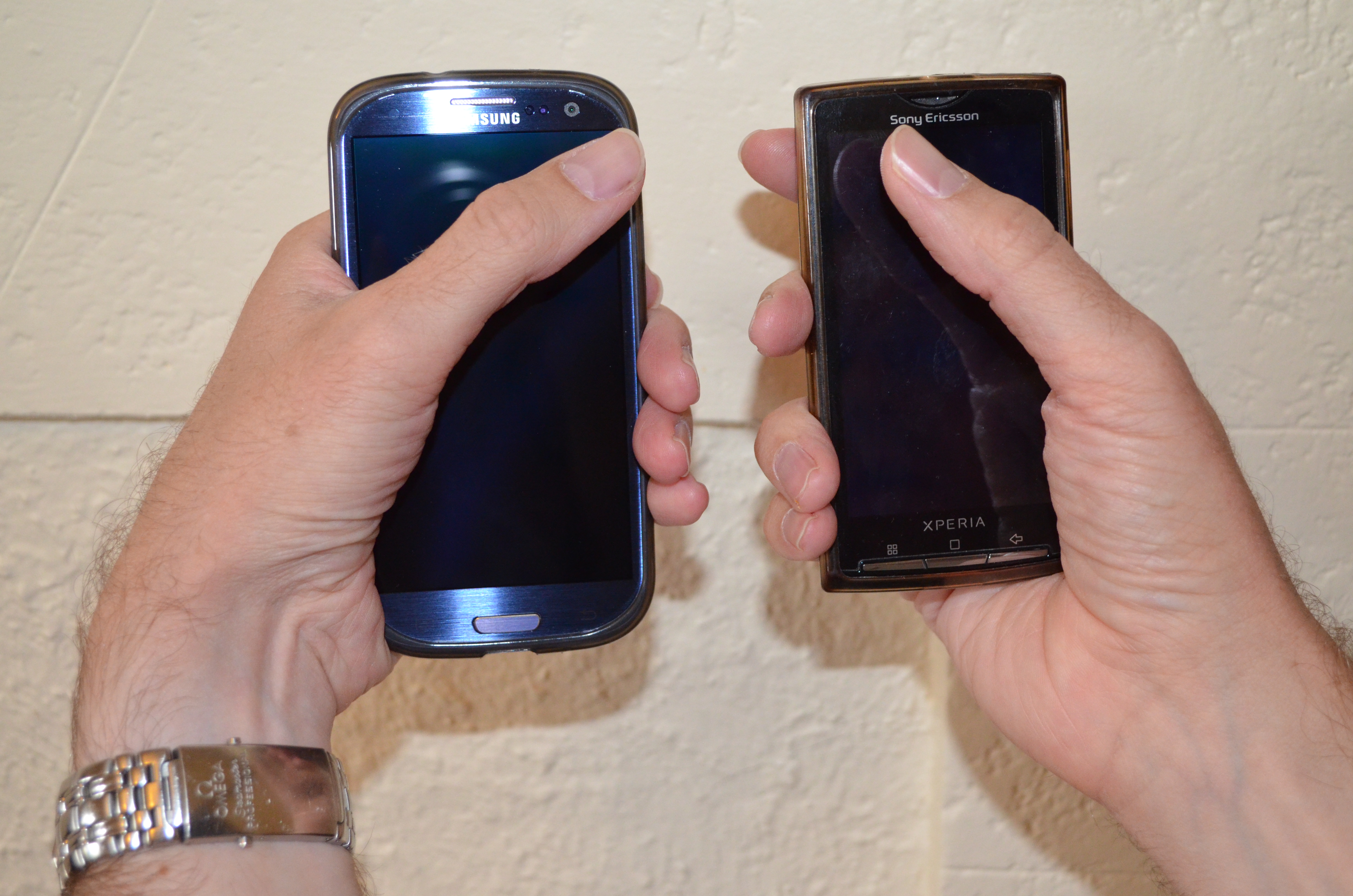
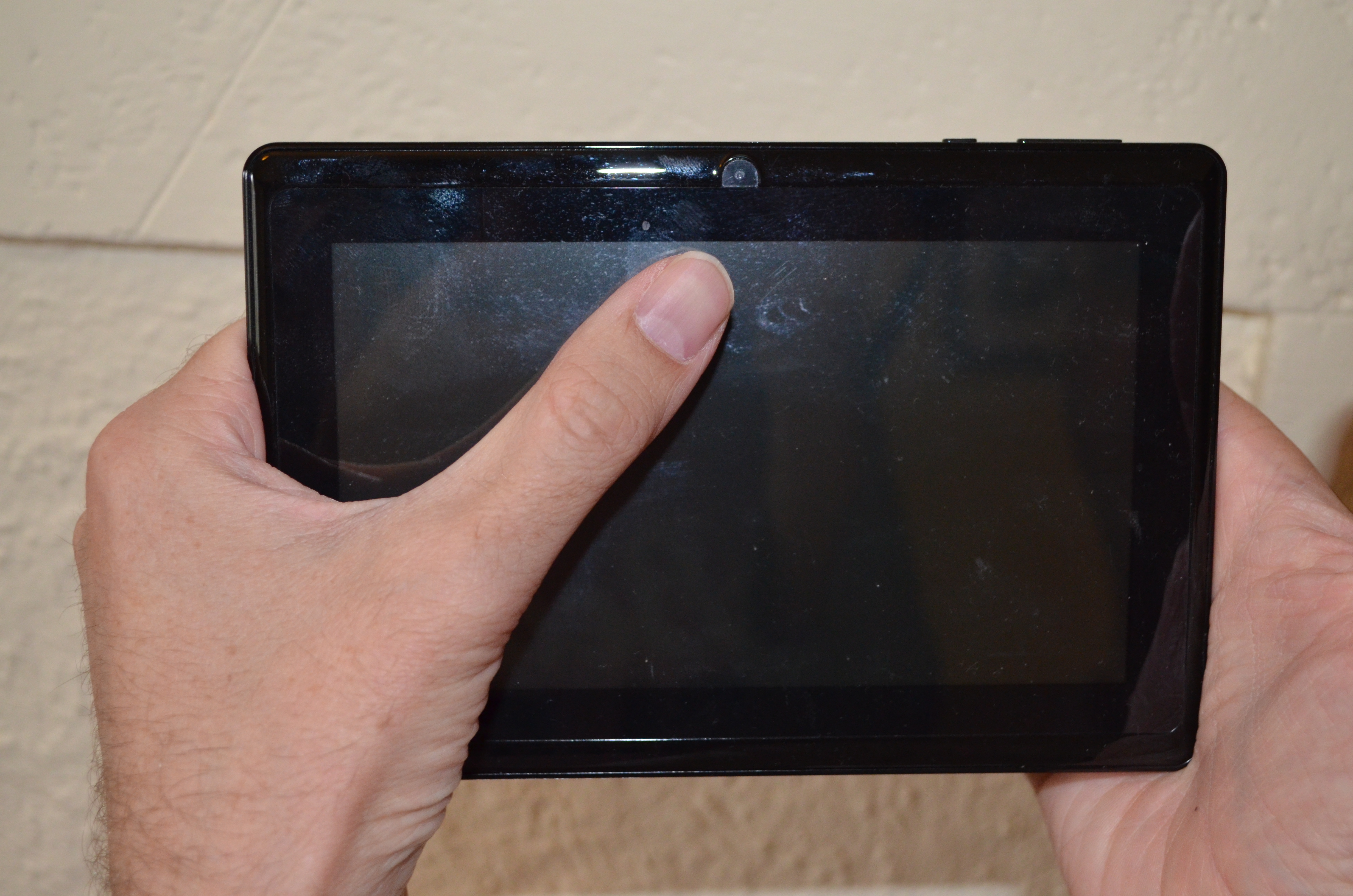
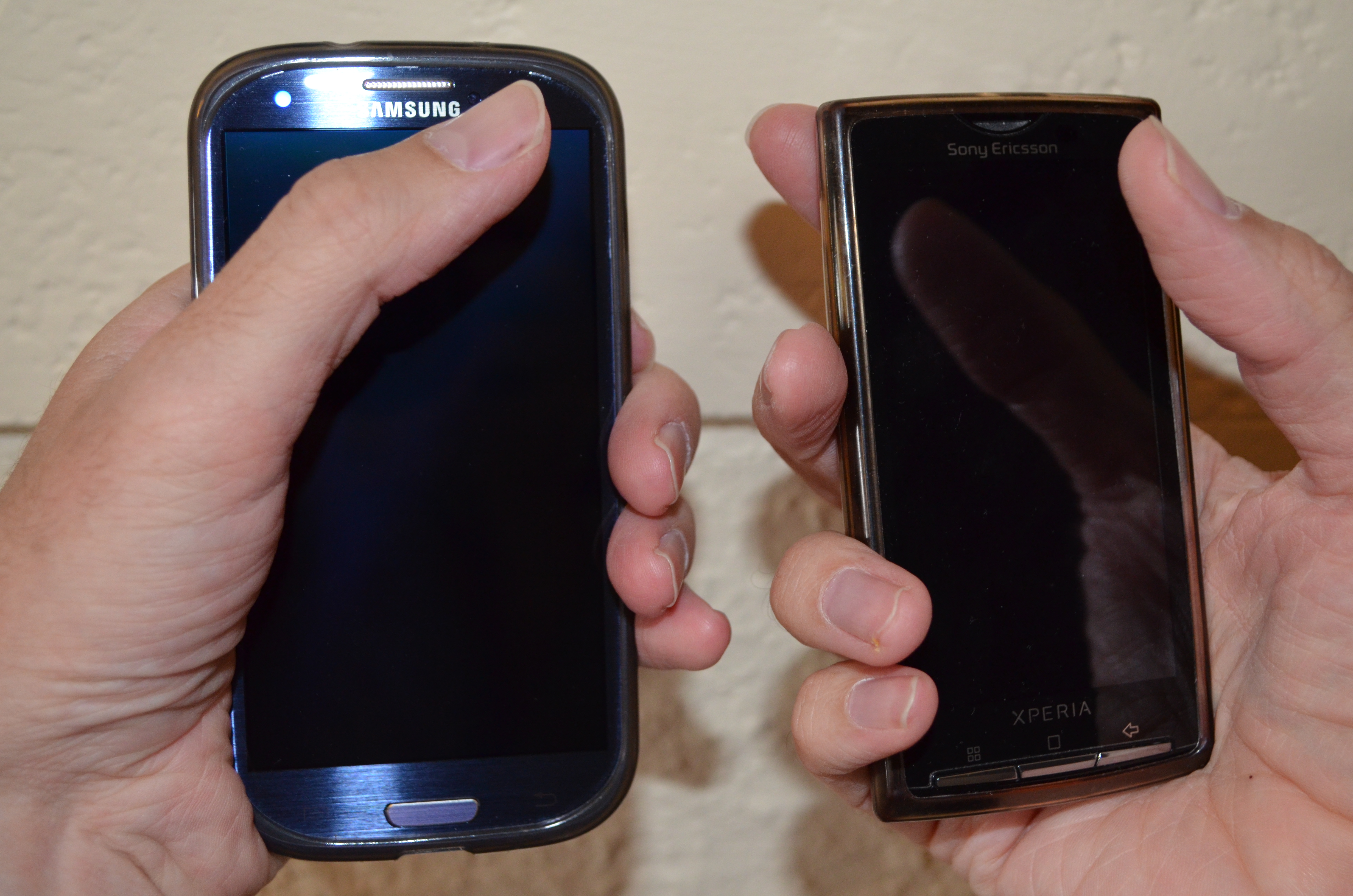
Galaxy S3 vs Xperia X10 1/2Galaxy S3 vs Xperia X10 2/2 The above two pictures show me holding a Samsung Galaxy S3 which has a 4.8 display in my left hand and a Sony Ericsson Xperia X10 which has a 4.0 display in my right hand. I am holding both phones in a manner that allows me to touch the top opposite corner with my thumb the position I need for one-handed phone use. The Xperia X10 can be completely enclosed by my hand, when I have a bottom corner resting in my palm it won t slide down while the Galaxy S3 can slide. Also one thing I didn t realise before having the pictures taken is that my posture is quite different when using the two phones. With the Galaxy S3 my wrist is clearly bent and this seems more likely to cause me to have more problems with Carpal Tunnel Syndrome [1]. I haven t had any serious problems with CTS for the last 2.5 years but I have had minor problems that suggest that I will have to be careful about my posture for the rest of my life. So it seems that a 4.8 phone is just too big for ideal one-handed use (grasping the vertical phone from the bottom). As I had CTS problems with my left hand I will try to use my new phone with my right hand as much as possible. Also I can reach further than the width of the phone screen when I grasp it from the side, so for me a size of about 5.2 would be better than the 4.8 of the Galaxy S3. It s quite likely that the Samsung Galaxy Note with it s 5.3 screen would be a better device for me to grasp from the side. But the Galaxy Note 2 might be a little too large for me. Note that I am only considering ways of holding the device that permit full operation. Anything that involves changing position for different uses or occasionally using two hands for a mostly one-hand operation doesn t count. 7 inch tablet The above picture is of me holding a 7 Android tablet (which I have just returned to Aldi [2]). When holding it from the sides I can reach more than half the screen with one hand so it seems that the ideal size for a tablet to be held in two hands for me would be 8 or even a little larger. A tablet larger than that could only be properly used if resting on my lap or a desk so for me 8 is the size that differentiates things which can be strictly used as tablets (holding with two hands and using thumbs for input) and things which are more like Netbooks (on desk typing). Ideal Device Sizes for people based on Height I am about 190cm tall. If we assume that height and hand size are strongly correlated then we can look at median heights of various age groups and determine what might be a good device size. I am also assuming that everyone wants to have the largest possible device, but some people have other criteria such as the size of their pockets. For me it s 8 tablet, 5.2 side-grip phone, and 4 bottom-grip phone. I used data from a chart of the average heights of American boys [3] and a chart of the average heights of American girls [4] to determine what size devices might suit children of various ages. Note that before the age of 12 the height of boys and girls is near enough to identical.
Device Two Hand Tablet Use Phone Grasp from Side Phone Grasp from Below
7 tablet 14yo boy or 17yo girl noone noone
Galaxy Note 5.3 10yo 95th percentile 17yo boy noone
Galaxy S3 4.8 6yo 17yo boy or 95th percentile 17yo girl almost noone
Galaxy S and iPhone 5 4.0 3yo 10yo 95th percentile 17yo boy
iPhone 4 3.5 noone 8yo 14yo boy or 16yo girl
One thing that particularly interests me is the educational use of Android devices for children. As few people buy new phones and tablets for young children that largely means that children borrow devices from their parents or are given older phones when relatives no longer need them. So it seems that if all other things are equal then an adult might choose a phone with a 4.8 display to allow it to be used as a tablet by children in the 6-10 age range. Conclusion It seems that the iPhone 4 is a good size for one-handed use by women of average height. By the standards of the people who don t regard gripping a phone from below as a significant feature the iPhone 4 would be designed for the hand of an 8yo. By any standards all iPhones other than the iPhone 5 were not the ideal size for most adults to use maybe they are well designed to fit in a pocket while unused. Charles Stross criticised the iPhone because it s too small to be seen well by people with poor vision [5], he also makes many other interesting points about the use of phones and I recommend reading his article (and the rest of his blog). The common tablet size of 7 seems like it might be ideal for women to hold with both hands, but for men of average height a 7.5 tablet might be better suited, it sounds like a small difference but it changes button size (good for people with thicker fingers) and allows displaying more data at once (15% greater screen area). Of course if you want to use a tablet on a desk then something much bigger would be better, maybe 12 or 14 . I think that there is a real market for 14 tablets that are designed to be carried around the home or office and then used on a table or lap which differs from the tablets that are designed to be more portable. There is also the use case of holding the phone in one hand while typing with the other which I haven t considered in this post. I don t think it s interesting because in that case almost everyone will find that the limitation is the size of their pockets and the size of an object that can be held to one s face for a phone call not the size of their hands. I ve previously written about my search for Geeky jeans and the ability to put a 7 tablet in my jeans pocket [6]. So I think that pocket size isn t a phone selection issue for men. The fact that women s clothing tends to have tiny pockets is another issue, if someone knows of a good analysis of phone size vs pockets in women s clothes then please let me know.

Vasudev Kamath: New Series of Posts on CDBS packaging

Well this is just an introductory post to set of posts I'm going to write down here on my blog. Idea is to improve the documentation of CDBS but I still don't have any idea on how I can patch the existing documentation, but in the mean time I'm learning new tricks from Jonas which I want to document some where so I thought my blog would be a good place as whole blog is in markdown format and its the same format me and Jonas agreed to convert the existing CDBS documentation. So this blog will act as a documentation and these post will be then altered modified and put back into a proper CDBS documentation later. I know many people don't like CDBS and most of it because there is no proper documentation, so I'm trying to improve the situation so sit back and enjoy the upcoming posts :-). OK I was sloppy in giving theory on what others think about the CDBS thanks to Phill Hands and Jonas for enlightening me. So with these series I'm just trying to explain CDBS features with real examples and examples how you can tame nasty packaging beasts with CDBS easily.

10 February 2013

Stefano Zacchiroli: bits from the DPL for January 2013

(insert here: I've been to FOSDEM, I got a nasty flu, and other $lame_excuses for the delay in sending out this report) Dear Project Members, here's the monthly DPL activity report, this time for January 2013. About the next DPL This is the last DPL report before the start of the election process for the next term: around early March, about 20 days from now, the Secretary will send out the call for nominations. I'd like to respond (also) here to inquiries I'm receiving these days: I will not run again as DPL. So you have about 20 days to mob^Wconvince other DDs to run, or decide to run yourself. Do not to wait for the vary last minute, as that makes for lousy campaigns. I'm available to give feedback about my DPL experience to prospective candidates, ... and also to join mobbing^Wconvincing actions toward potential candidates. Just contact me. Call for helps Assets Cloud Images Work has gone on also on the front of supporting Debian installation in public "clouds". Thanks to Arnaud Patard, Jose Miguel Parrella Romero, Pierre Couzy, and Gianugo Rabellino, we now have Debian testing images for Microsoft Azure. Together with Amazon EC2, this is the second large provider supporting Debian via images maintained by Debian Developers. More providers are welcome, exactly as more hardware/CD vendors shipping Debian are always welcome. If you want to contribute support for other providers just show up on the -cloud mailing list and say so. Some documentation effort in view of Wheezy are in need of help too, in order to let our users know about "cloud" options, see #695681. DPL helpers The DPL helpers experiment goes on. We have had 2 more IRC meetings in January (see the minutes). Documentation of the "team" communication channels (mailing list, IRC, Git, etc.) is now available from the DPL wiki page. Talks I've given an invited Debian talk at Polytech'Grenoble, as part of a free software event organized for students of local universities. Slides of the talk are available. I'd like to thank Vincent Danjean for the event organization. Let's release Wheezy now!
Cheers.
PS the day-to-day activity log for January 2013 is available at the usual place master:/srv/leader/news/bits-from-the-DPL.txt.201301

Matthew Garrett: Linux Foundation Secure Boot support released - what does it mean?

The UEFI bootloader that the Linux Foundation have been working on has just been released. That means we now have two signed bootloaders available - this one and shim.
Does this mean Linux distributions can now support Secure Boot?They've actually been able to for a while. Ubuntu shipped with Secure Boot support last October, and Fedora shipped with Secure Boot support in January. Both used Shim rather than the Linux Foundation loader, and Shim's also being used by a variety of smaller distributions. The LF loader is a different solution to the same problem.
Is the Linux Foundation the preferred loader for distributions?Probably not in most cases. One of the primary functional differences between Shim and the LF loader is that the LF loader is based around cryptographic hashes rather than signing keys. This means that the user has to explicitly add a hash to the list of permitted binaries whenever a distribution updates their bootloader or kernel. Doing that involves being physically present at the machine, so it's kind of a pain.
Why use it at all, then?Being hash based means that you don't need to maintain any signing infrastructure. This means that distributions can support Secure Boot without having to change their build process at all. Shim already supports this use case (and some distributions are using it), but the LF loader has nicer UI for managing it.
Any other reasons?Actually, yes. Shim implements Secure Boot loading in a less than entirely ideal way - it duplicates the firmware's entire binary loading, validation, relocation and execution code. This is necessary because the UEFI specification doesn't provide any mechanism for adding additional authentication mechanisms. The main downside of this is that the standard UEFI LoadImage() and StartImage() calls don't work under Shim. The LF loader hooks into the low-level security architecture and installs its own handlers, which means the standard UEFI interfaces work. The upshot is that you can use bootloaders like Gummiboot or efilinux without having to modify them to call out to Shim.
Why doesn't Shim do the same?The UEFI architecture is slightly complicated. The UEFI specification itself defines the upper layers of the firmware, basically covering everything that UEFI applications and operating systems need. It doesn't define the lower layers of a UEFI implementation. Those are contained in the UEFI Platform Initialization spec, and that's what defines the security architecture interfaces that the LF loader hooks into. The problem is that it's completely valid to implement the UEFI specification without implementing the Platform Initialization specification, and if anyone does that then the LF loader will fail.
Can't you try both approaches?Yes, and that's actually pretty much the plan now. I'm working on integrating the LF loader's UI and security code into Shim with the aim of producing one loader that'll satisfy the full set of use cases, and James is happy with this.
Which should I use?Depends. If you want to support gummiboot (and aren't willing to patch it to call out to Shim), you'll need to use the LF loader. If you want to use key-based signing setups to avoid forcing re-enrolment on updates, you'll need to use Shim. If you're somewhere in the middle, you can probably use either. Once we've got the code merged, you won't have to make a choice.

comment count unavailable comments

Next.

Previous.