Search Results: "nic"

19 April 2010

Russell Coker: Creating a Micro Conference

The TEDxVolcano The TED conference franchise has been extended to TEDxVolcano [1], this is a small conference that features people who are stranded by the Eyjafjallaj kull volcano in Iceland. As usual TED is an inspiration to us all, so there is obvious potential for other conferences to be organised in similar situations there s no reason why a free software conference can t be organised in Europe right now! What You Need to run a Conference If a conference will have limited attendance (EG due to a volcano preventing anyone from flying to the area) then filming everything is very important. I ve seen adverts for digital cameras that support Full HD resolution (1920*1080) for as little as $AU400. $AU600 will get you a digital camcorder that does Full HD which will offer some benefits for recording long movies (such as the ability to store the video on an external hard drive). If I was stuck in a foreign hotel with not much to do then I would be prepared to buy a digital camera or camcorder for the purpose of running such a conference (my current digital camera is 5.1MP and only has 3* optical zoom, it s a nice camera but I could do with something better. A tripod can cost up to $100, but I recently bought myself a 15cm tall tripod for $10 that would do at a pinch. Once you have high quality video you can easily upload it to something like Blip.TV. Of course you get a better result if you do some post-production work to merge images of the slides for the lecture into the video, but that is a lot of work and probably requires a camera that outputs uncompressed video for best results. The next issue is getting a venue. Different hotels cater for different parts of the market, some cater to tourists, some to business travel, some to conferences. If you want a venue at short notice you may be able to get a good deal if you find a hotel that is adversely affected, for example I m sure that there are some quite empty conference hotels in Europe right now but the tourist hotels are probably reasonably busy (why not do some tourism if you are stuck). I expect that hotels really don t want to have empty conference rooms and are prepared to offer good deals for bookings at short notice. Of course you would want to try to ensure that hotel rooms aren t too expensive in that hotel as some delegates will want to stay in the hotel which hosts the conference. The minimal staffing for a micro conference is probably two people, one for taking payment, directing people, etc, and the other to film the lectures and moderate panel discussions. Rumor has it that attending without paying is a problem at conferences, for conferences that are planned in advance corporations will try and send multiple employees on the one ticket and have them share a name-tag one issue with this is that there is a fixed quantity of food supplied and if extra people appear then everyone who paid gets less, another is that people who pay really hate to see freeloaders. The best reference I ve found for people not paying at conferences is Jon Oxer s description of how Leslie Cachia of Letac Drafting Services brazenly stole a book from him [2]. Name-tags are needed for any meeting with more than about 15 people. I m not sure how to get proper name-tags (ones that pin on to clothing and have printed names maybe the bigger hotels can add this to the conference package). But a roll of sticky labels from an office supply store is pretty cheap. Costs in Wellington Along with a few other people I considered running a small security conference immediately before or after LCA 2010, that ended up not happening but I will consider doing it in future. When considering that the general plan was to get a hotel to provide a meeting room for 10-30 people (we had no real idea of the demand). When investigating the possibilities for running a conference in Wellington I discovered that the hotel fees for a conference room can either be based on paying a fixed fee for the room plus additional expenses for each item or you can pay a fixed rate per person. It seemed that there was the potential to save a small amount of money by paying the fixed fees and avoiding some payments for things like tea/coffee service. But the amount that could be saved would be small and it would incur extra effort in managing it saving $5 per person is a good thing if you have 600 delegates, but if you have 30 then it s probably a waste of time. So it seemed best to go for one of the packages, you tell the hotel what time you want the lunch and snack breaks and how you want the tables arranged and they just do everything. The cost for this seemed to be in the range of $nz35 to $nz55 per delegate per day. There is some flexibility in room arrangement, so a room that seats 12 people in the board-room layout (tables in a rectangle facing the center) would fit 25 in the classroom layout (tables all facing the front) or 50 in the theater layout (chairs facing the front with no tables). So the hotel could accommodate changes in the size at relatively short notice (whatever their notice period for buying the food). The cost for a catered conference dinner seemed to be about $nz45 per diner. In many cases it would be possible to get a meal that is either cheaper, better, or both by going somewhere else, but that wastes time and effort. So that gave an overall conference cost of about $nz135 for a two day conference with a dinner at the end of the first day. Given that the cheapest budget rate from Wotif.com for a 3 star hotel in Wellington is currently $nz85 per night it seems that $nz135 for a two day conference including dinner is pretty cheap as the minimum accommodation cost would be $nz170. Also note that the hotels which I considered for hosting the conference had rates for their hotel rooms that were significantly greater than $nz85 per night. The hotels all offer other services such as catered cocktail parties , these would be good things for any company that wants to sponsor the conference. Different cities can have vastly different prices for hotels. But I expect that the way conference rooms are booked and managed is similar world-wide and the ratio of conference costs to hotel booking fees to also be similar. Most of the hotels that cater to conferences seem to be owned by multi-national corporations. It would probably make sense to charge delegates an extra $10 or $15 above the cost of running the conference to cover unexpected expenses. Of course it s difficult to balance wanting to charge a low rate to attract more people with wanting to avoid the risk of a financial loss. Conclusion The hard part is getting speakers. If you can get speakers and panel participants who can fill the time slots and have interesting things to say then all the other parts of organising a micro conference should be relatively easy. When the cost is less than $150 per delegate then a syndicate of a few people can easily agree to split the loss if the number of delegates turns out to be smaller than expected, a potential loss of $2000 shared among a few people shouldn t be a huge problem. Also if the conference is booked at short notice (EG because of a volcano) then the hotel shouldn t require any deposit for anything other than the food which is specially ordered (IE not the tea, coffee, etc) that limits the potential loss to something well under $100 per delegate who doesn t attend. Anyone who has enough dedication to a topic to consider running a conference should be prepared to risk a small financial loss. But based on my past observations of the generosity of conference delegates I m sure that if at the conference closing the organiser said unfortunately this conference cost more than the money you paid me, could you please put something in this hat on the way out then the response would be quite positive. Note that I am strictly considering non-profit conferences. If you want to make money by running a conference then most things are different.

18 April 2010

Steve Kemp: Different cultures call us by different names

This past week has had a couple of minor software releases:
chronicle
I made a new release which improves support for foreign language; so dates can be internationalised, etc. The online demos now include one in with French month names.
slaughter
The perl-based sysadmin tool had a minor update earlier today, after it was pointed out that I didn't correctly cope with file content checks. I'm still pretty pleased with the way this works out, even if it is intentionally simple.
milli
This is a simple bug-record-thingy which I was playing with recently, and I've now started using to record bugs in other projects. I'll pretend its a fancy distributed-bug-tracker, but actually it isn't. It's nothing more than a bunch of text-files associated with a project, which have sufficiently random names that collisions are unlikely and which thus becomes semi-distributed-friendly.
Today I'll be learning to love Javascript a little more. I want to use the gallerific image gallery - but it doesn't make thumbnails automatically - which galleria does. I need to either come up with my own which looks like galleriffic, or port the thumbnail bits over. (I'm currently using a slightly modified version of gallerifific for my people-shots.) ObFilm: Hancock

17 April 2010

Stefano Zacchiroli: oh my

let's face it After having tamed for a day and a half my INBOX, my IRC log, and my @replies, of an unexpected message flow about the election results, after having being pinged by the -press team to contribute a quote for a very nice and professional press release, after having fired mutt -s "Bits from the (newbie) DPL" debian-devel-announce@lists.debian.org, ... it's time to realize that I've been elected DPL. I still have a bunch of mixed feelings (happiness, fear, responsibility, etc.) to disentangle, but above all I'm really proud of our processes (well I don't mind the result either!). I'm grateful to the other candidates and to all the people that took part in campaigning discussions. As I've observed already, campaigning has been exciting for me. It wouldn't have been so without the courage of all candidates and the inquiries of all contributors. No wonder we have had both the highest percentage of voters of recent years (yes, WAT runs of course helped that), and an absolute number of voters close to that of past "heated" elections. In days in which most of the big players in the distro market are companies (and hence take money-driven decision), I can't be more proud to be a member of a huge volunteer project whose processes are driven by a truly do-ocratic and democratic constitution. See you in a bit. PS 1 in case you wondered, yes, I've fired mutt, but I'm far from having written something in the body of the mail! In the next few hours I'll first distill a personal TODO-list / detailed-plan out of my platform and of the inputs that I've already received. Then I'll finalize my first ever DPL bits to d-d-a. PS 2 In the meantime ... I'll surely be looking for a new "maintainer" for RCBW, any taker? :-) PS 3 shameless plug! The mythical Debian Kilt is being weaved again, and you still have your chance of getting one in time for DebConf10. If you're interested, check out this post by Phil Hands and sign up on the wiki, I'm definitely getting one!

16 April 2010

Steve McIntyre: End of the road, and congratulations

By my reckoning I've got about 7 hours left in my tenure as DPL. There's still a few things I haven't finished up yet and won't by the end of the day, and for those I apologise. I'll try to follow through anyway. Congratulations to Zack for winning the election this year, and of course thanks to the other candidates for standing and helping to make it such an interesting campaign. I have great hopes for the future of Debian with our new Italian overlord in charge - he's got some very good ideas and I already know he has the enthusiasm to put in the efforts that are needed. :-) Now it's time for me to step back and concentrate on technical work for a while. Oh, and make wedding plans for next year. TTFN.

Andrew Pollock: [tech] On the iPad

I tend not to be a huge Apple fanboy. They make nice stuff, but it's just too closed for my liking. I like to tinker. I had a PowerBook for a while, but I gave it to Sarah in favour of a Linux laptop. Sarah's been a happy Mac user for a number of years, and had an iPhone (until I gave her a Nexus One). For a "normal" user like her, a Mac is fine, especially if you want to embrace Apple's entire ecosystem. Anyway, the iPad. When it was announced, I sat up and took notice. Why? This seemed like something I might actually use as a casual computing device. I mean, I'm almost in the target market for Chrome OS these days. I spend most of my time in a web browser, and the rest of my time in a terminal window SSHing to another computer. I could leave this thing lying around on the coffee table in the living room, and instead of digging my phone out of my pocket to look something up, I could pick this up instead. It is also appealing because I found Microsoft's Surface to be pretty cool. The iPad is like a more affordable, portable, version of that. It also appeals to me as a computing platform for my parents. Their computing needs have simplified over the years, but they're still running Windows, largely because I've never had the time to try and foist Linux on them. Since I moved to the US, my visits back home have been too brief to do a proper migration. I think an iPad that supported user switching would be perfect. Mum and Dad could share it, and read their email and do their web browsing from anywhere in the house. Since the first generation iPad doesn't do user profiles and lacks a camera, I'll wait impatiently for the second generation one. I heard a rumour today that it would have a camera, and do user profile switching based on the face of whoever was in front of it. That would be pretty cool. I'd also be very interested in an Android tablet. I love Android's speech to text input support, and I could really see an Android tablet stuck to the wall in the kitchen, instead of a whiteboard on the fridge and a paper calendar. The WePad also sounds intriguing. So I'm not so bothered by the iPad's closed nature. I think for the set of users who have basic computing needs, and don't care about openness, it's very cool.

15 April 2010

Josselin Mouette: A new toy

It takes a lot to prepare for a big trip if you want to really enjoy it. This time, we re going to Japan, and we bought some stuff to stay connected there. First, there s the new camera: that s a Sony 230. We haven t made a photo trip to see all its capabilities yet, but it looks like an excellent toy so far. You ll see probably more photos on this blog in the future. And there s the new laptop: a Packard-Bell Dot-M/A. Theoretically it s called a netbook, but in practice it has everything a real laptop has. The reason I chose this model is that it features Radeon (X1270) graphics and a 64-bit processor, all in a 11,6" laptop which is one of the cheapest of all. Lots of power in one kilogram for a low price, although the drawback is more cells in the battery. Getting the Dot-M/A to work under Debian I first tried to install lenny on it, and while it worked nicely there are several problems with hardware support.

  1. The CPU runs extremely slow; you would think it is an Atom. It takes no less than one minute to boot a minimal installation. This is a very strange issue.
  2. Wi-Fi doesn t work, even after installing the firmware.
  3. 2D works out of the box, but 3D doesn t: the kernel doesn t recognize the PCI ID.
  4. Frequency scaling doesn t work, it always runs at full speed which eats battery at an impressive pace.
Upgrading to squeeze solved the first three issues in a blink. The CPU is now as fast as you can expect from an Athlon 64 @1,2 GHz, there s wifi and 3D. OTOH I was hit by a GStreamer bug when the useless snd_pcsp module was loaded why isn t this thing blacklisted by default? ACPI nightmare CPU frequency scaling is another story. I discovered that the BIOS for such Athlon L110 computers does not expose P-states in the ACPI DSDT table. Which means Linux cannot tell at which frequencies it is supposed to work. However, thanks to the awesome work from a guy named Krists Krilovs and the awesome tutorial from the Gentoo wiki I was able to: After a reboot, I immediately noticed the fan slowing down. Under GNOME, the CPU was no less than 10 C cooler and the CPU frequency applet started to work. <hrule> The Debian kernel maintainers deliberately chose not to provide support for loading a DSDT table from the initrd. There are very good reasons for this, and anyway it shouldn t be necessary to hack something as awful as that to have power saving support. The question remains: how do we deal with this madness? There needs to be some kind of support out-of-the-box for the Athlon L110, which is otherwise a very nice beast. Could the powernow-k8 module set hard-coded defaults when it detects this CPU model? It would be better than the current situation. Other pieces of the toy Otherwise this laptop is very good hardware. Among other things, I enjoyed: There is one minor annoyance: the integrated RealTek Ethernet card is only 100 Mbits/s. With all this performance otherwise, you would have expected Gigabit, but well, not everyone has GigE at home yet.

Bernd Zeimetz: gimp-plugin-registry package updated

Yesterday I finally found the time to update gimp-plugin-registry, the (hopefully!) largest and best collection of plugins for The GIMP. As usual here comes a short summary of the changes: Hope you like my work, suggestions and bug reports are welcome as usual!

Jan Hauke Rahm: MiniDebconf in Berlin, T 8 weeks

To give a short update on where we stand now with the amazing plan of having a Mini Debconf in Berlin this year. There are just 8 weeks left which means there is lots of stuff to do and it needs to be done soon. But luckily Of course, all this is written in the wiki and you can put yourself in it at any time to offer your help! And if you have questions or want to join more real time ;), point your IRC client to OFTC and
/join #debian-miniconf-berlin
Help is still needed with video and audio stuff. If you think you know how to move a camera, or you can even work a sound mixer, get in touch with us. We need a few volunteers to cover the whole two days. Also, more generally help is needed in order to have people to talk to at all times both for speakers and visitors. No special knowledge is necessary although it might prove handy to know what Debian actually is. :) Interested? As a visitor or helper? Anyways, get in touch with us and it s going to be awesome! </commercial>

Gustavo Noronha Silva: WebKit2 and WebKitGTK+

So you ve seen people talking about WebKit2, perhaps have seen someone claiming it drops support for Linux , and you ve been wondering what the hell that means for WebKitGTK+. Well, welcome to the preemptive Q&A section with WebKitGTK+ maintainers =D. Let s first explore some history so we can better understand what exactly is going on. What exactly is WebKit2? Currently, when we say WebKit we really mean one of the ports that are built on top of WebCore using the WebKit layer. WebCore is the part that does all of the hard Web-related work, WebKit an API layer that exposes WebCore functionality in a coherent way, so that the platform-specific ports can expose a public API layer for their applications to use, which is usually also called WebKit . This WebKit layer was designed by Apple to build the Mac, and Windows ports it maintains, and was later released as Free Software so that other ports, such as the GTK+, Qt, EFL ports could be built on top of it, instead of having to do all the heavy lifting from WebCore directly.

Current WebKit model WebKit2 is nothing more than the second version of that interface, with a whole lot of changes on what you can expect from it, and on how it interacts with WebCore, and the platform-specific API and UI. First of all, the first WebKit was not API stable, and that interface was usually not made public by the various ports - they only exposed their platform-specific APIs. WebKit2 is being designed to provide a stable, cross-platform, C-based, non-blocking public API. This is huge. It will allow cross-platform code to be written without having to consider language, and port differences for basic functionality. The second big change is the API will be made fully non-blocking. Currently most things you do are asynchronous already, but some of them may be completed in a synchronous ways (like, loading a string into WebKit instead of an URI). This is important for responsiveness, and is also a very important need for what comes next: process splitting. WebKit2 will bring into WebKit proper the concept of splitting the UI process from the Web process, similar to what Chromium has. It also much more awesome than what Chrome has for a large number of reasons, including, but not limited to:

  1. It s being contributed directly to the WebKit project, in a cross-platform way that lets ports such as WebKitGTK+ take advantage of it, instead of being shipped directly into Safari, like Google does with Chrome;
  2. The process separation goes bellow the API layer, meaning that all complexity involved in managing the process separation is handled by the library, and hopefully none of it leaks to the application using it; that means that applications like Devhelp and Yelp will be able to take advantage of this without having to make their lives more complicated;
There s a much better diagram in WebKit2 s wiki page, but here goes a simplified version that demonstrates what I m talking about:
WebKit2 model
What WebKit2 is not? WebKit2 is NOT a rewrite of the whole WebKit stack. Webcore will continue mostly unchanged, and all ports currently building on top of it will keep working. It is also not a fork - the code lives in the same tree as the current version of WebKit, which will allow us to progressively move towards using this new, improved layer. WebKit2 is not Apple-only, and it is not dropping Linux support. Initial builds of the code that is being landed will likely show up building on Linux in the near future (specially because us porters are already eager to play with it). What happens to WebKitGTK+? In the near future, nothing special. We will continue working towards making it feature-complete, more stable, faster, and rocking on it as always. We will, though, start working out how we can best take advantage of WebKit2 in order to provide an even more awesome library for the G world. What this means is you can expect us to have a library that will provide a nice GTK+ widget, just like we have today, with a GObject-based API, like we have today, but that is built on top of this new WebKit2 infrastructure, taking advantage of the process-splitting, and the bigger focus on not blocking the UI thread. This should give us a platform that is more stable, and faster and more responsive than what we already have today. The API is bound to change, of course, but the WebKit2 version of WebKitGTK+ will be a separate, parallel-installable library, and we will keep supporting the WebKit1 version while we work on making the new one at least as good as the current one. This is long term we re talking here. We ll likely see WebKitGTK+ 1.4, and 1.6 come to life before we are satisfied enough with WebKitGTK+2. We hope this clears some of the doubts up, and lightens your hearts! The WebKitGTK+ maintainers.

Joachim Breitner: A mathematician s status symbol

While writing my diploma thesis, I often wished I had a blackboard in my room: A place to quickly scribble some ideas on, somewhere where I can easily erease and replace stuff. Also, somewhere where you can literally (and not just figuratively) step back from and look at from the distance. For my 25th birthday, my parents organized a discharged part of a blackboard from my old scool, and yesterday, we installed it in my room in Karlsruhe:
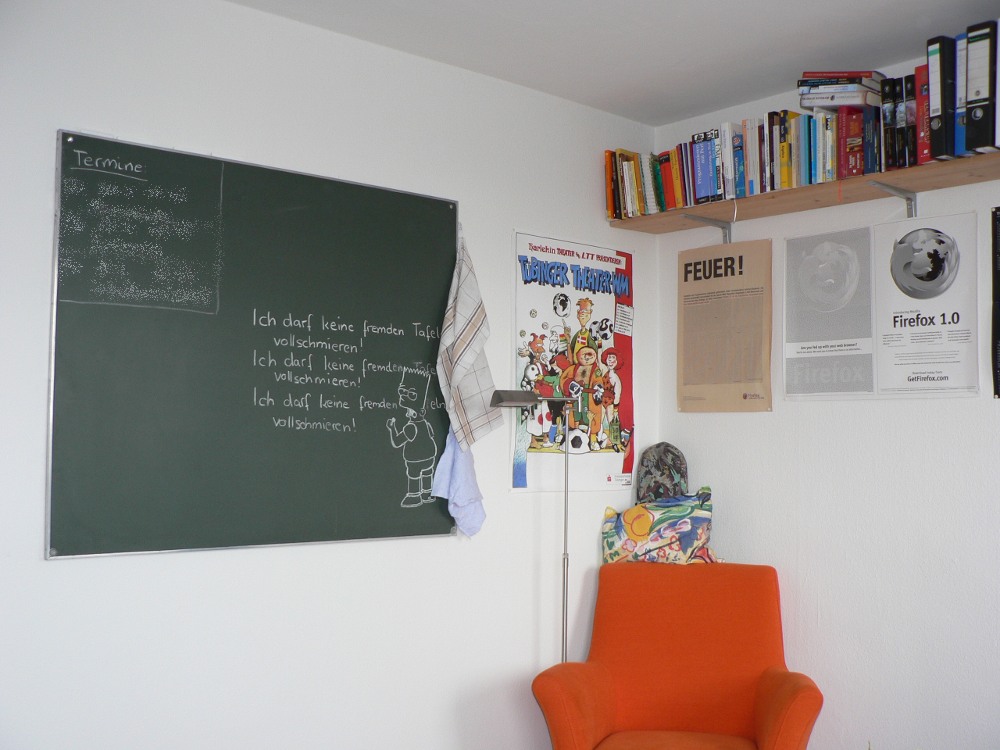
A blackboard in my room
Although my diploma thesis is finished, I m sure it will be a nice and useful piece of furniture, and if only to draw funny things on (as my girlfriend did on this picture).

Joachim Breitner: zpub article in Linux-Magazin

The 05/2010 issue of the German Linux-Magazin contains an article of mine about DocBook, Subversion and zpub. I was quite surprised to find it there I submitted it in January and did not receive any feedback. But of course it is a nice surprise to find out it was accepted! The article, the zpub website and zpub itself is only available in German so far, but there is an English blog post describing zpub.

MJ Ray: Debian Project Leader Election Campaign Round-up

I ve been AWOL for most of the debian project leader election campaigns this year, but I still want to vote, so I ve been dredging the emails on the last day. Maybe someone still has to vote and reads this, or maybe it ll help someone to interpret the result. What I ve done this year is to make a quick tally of platform points and campaign answers that I liked and disliked for each candidate, then total them up to get an order. If anyone gets a negative (more dislikes than likes), then I ll rank them below NOTA. Platforms: Margarita Manterola, Stefano Zacchiroli, Wouter Verhelst, Charles Plessy. Some of the questions: Make of that what you will. It surprised me which way the scores came out, but there was one answer with such a massive problem (in my opinion) that I ranked its giver equal with the next candidate down anyway. If you re a debian developer (DD), have you voted yet?

14 April 2010

Sandro Tosi: select count(bugs) in reportbug where status is open = 91

well, the actual select (against UDD) would be
udd=> select source, all_bugs from bugs_count where source = 'reportbug';
source all_bugs
----------+----------
reportbug 91
but the result is the same: less than 100 bugs against reportbug! Yay!

As you can see from the bugs graph, the Christmas and Easter holidays helped quite a lot to squash those bugs. When I first step into the reportbug world, the bugs count was around 250, and I first imagined in my mind to brake the 200 barrier, than the 150 and finally the less-than-100 one: while the first 2 limits where the hardest one (new to the codebase, other interest) the last one is the one I'm most proud of.
They seem quite nice-to-have stuff but recently I've tried to concentrate on reply fast to new report, fix as many reported crashes as possible and implement some of the long-awaited features.

Additionally, sometimes "No, sorry" is the proper reply to a bug and then it can be closed: it's hypocrite to keep bugs opened while internally you think it's a wontfix but you're not closing them because of a fear of possibly upset the reporters.

There will be more in the future, that's for sure, but I think this is the reportbug we'll see in squeeze, modulo some new crashes or very interesting feature we want it, so expect minor releases from now until squeeze+1

Matt Zimmerman: Pop visualization

It s no surprise that information visualization and related fields have been active research topics in the past decade. The widespread availability of large, valuable data sets has created a need for improved tools and techniques for making sense of it. This is highly technical work, requiring expertise in design, mathematics, software and other fields, and there is a vibrant community of professionals and amateurs who experiment and critique the latest methods. In the geeky blogs that I follow, I see more and more amateur interest in visualization. Visualization is starting to take on political significance as well, as evidenced by the appointment of information design pioneer Edward Tufte to a US government advisory panel to help explain economic policy to the American public. A technology is confirmed to be truly and vitally relevant, though, when it enters the mainstream consciousness in the form of humor. In the case of visualization, geeks have been trading funny charts and graphs for many years, but this phenomenon seems to have finally crossed the chasm into popular Internet culture with the advent of the Venn diagram meme. Now, anyone with an elementary education and a drawing program can create their own chuckle-inducing infographics and enjoy their 15 minutes of Twitter fame. Likewise for the X as seen by Y two-dimensional grids, revealing how various (stereotyped) groups perceive each other. This is the future, becoming more evenly distributed by the minute.

13 April 2010

Gunnar Wolf: Regarding the fatal cycling accident in Ciudad Universitaria

My blog is written in English, even though I sometimes post content relevant locally. Anyway, I want this to be as widely known as possible. We are about to launch a website/community for my University's cyclists, BiciUNAMonos. Please note the site I'm linking is still very preliminary in several ways. But that's the least relevant for now. I am translating here a message written by fellow cyclist (and researcher in the Institute of Astronomy of my University) Sergio Mendoza.
Regarding the fatal cycling accident in Ciudad Universitaria Yesterday night I got home, and was quite surprised to open my mailbox and find a considerable amount of messages under the subject Urgent: Fallen cyclist! I immediately noticed something was very wrong, and was surprised they were contacting me. When I decided to read the first such message, I realized what happened: Dr. Jorge Villanueva was run over by the Puma [internal University service] bus number 14, route 2, which was being driven over the speed limit. This happened last Sunday, April 11. On Sundays, all of Ciudad Universitaria becomes a cycling and running circuit. I was immediately brought back to the moment that, when I was leaving my office in the Astronomy Institute and heading towards Cerro del Agua avenue, a lady driving over the speed limit on the circuit that comes from Metro Universidad threw her car at me. I saw her at a few centimeters distance from her windshield... To the day I don't know how I pulled my bike away, as I was going to hit the windshield with my shoulder. Everything happened in slow motion, I just heard several cars honking at this imprudent lady. I didn't have a scratch, but got excessively close to getting a strong hit, and with the adrenaline raging I gave a kind caress with my closed fist to her brand new car. I had to free my adrenaline somehow... My legs were trembling when I tried to pedal. I told her, lady, I am excessively visible in my bike, why did you do this? , she didn't answer, she just looked despectively at me. This kind of accidents happen every day in the University and its main entries. Precisely today, a University professor threw his car at me entering the University via Cerro del Agua. When I reached him and confronted him, he told me completely sure of his words that I was invading the lane with my bike, and that it was my fault. Anybody would have thought a car-driving university professor is capable of reading the Metropolitant Transit Regulations that clearly states on its 1st article: The priority for using the public space, for the different transport modes will be according to the following priorization: I. Pedestrians; II. Cyclists; III. Users and providers of massive, collective or individual public transport service; IV. users of particular automotor transport; and V. users and providers of freight transport. We are now organizing to put up the first ghost bike in Ciudad Universitaria. This happens few days before the formal inauguration of BiciUNAMonos, the universitary association of urban cyclists; we will do this remembering our university mate. I see every day more people in the University hitting their bike pedals to get to their faculties, centers and research institutes, but what is striking is the lack of University infrastructure. The few cycleways we have are built to use a bycicle system that is open only until 16:00. It is good, but it is in no way useful for those of us who use the bike every day and at every hour, no matter the weather. The main problem lies at the communication points, when cyclists arrive from outside Ciudad Universitaria and have to take the regular circuits to reach the cycleways. The Transit Regulation, in the 1st article I quoted above, defines in an excellent way the priorities that must exist to allow human movility. In this regard we have to mention that:
  1. The pedestrians must be enormously protected with walkways and semaphores to allow them to safely walk. In Ciudad Unviersitaria there are many places that don't even have a walkway or semaphores, and drivers do not respect the pedestrian's preference. Also, now in the central area of Ciudad Universitaria we have the Pumabus system on a confined lane, providing an excellent service to the pedestrians to move within the campus.
  2. The cyclist comes next in this priorization, but there is nothing obvious for him. There are a couple of cyclist ways, usually invaded by pedestrians, and explicitly made to use the Bicipuma system. Cyclists need their own lane for circulation in the Universitary circuit; pedestrians have walkways, Pumab s has its confined lanes, but the cyclists still lack it. The third lane that remains is precisely for the IV and V entries in the Metropolitan Transport Regulations. They can perfectly share the remaining lane in the campus.
The last thing I wanted was to formally announce BiciUNAMonos reminding a fallen cyclist and dedicating a ghost bycicle to his memory in Ciudad Universtiaria, but we don't have a choice. We have to make it very clear to the University community that the bicycle is the best transport system, and that the drivers' imprudence inside Ciudad Universitaria must be strongly punished. Sergio Mendoza
President
http://www.biciunamonos.org
Coincidentally, today I also had a freightening experience. Taking one of my usual routes to work, going up from the sporting area in the Western half of the campus (just before where the map lists the highest point in my ride), just by Investigaciones Biom dicas, I heard a car hitting the breaks behind me and passing me (on my right side) quite narrowly. I was, as always, driving towards the center of the lane, to be able to respond to unforseen events (as this one, precisely). The Universitary authorities had the great(?) idea of placing round, small bumps before the Pumabus stations to avoid drivers parking in front of them. I have seen a strong accident caused by them, and was close to suffering one myself some months ago. I know that just after Biom dicas there are some such bumps, so I never ride too much to the right I don't know what was on this driver's head. Ciudad Universitaria has a 40 Km/h speed limit. Yes, it might seem too low - Circuits are wide and well planned. But there is a lot of cyclist and pedestrian transit, at all times, and I must recognize such a limit is well in place. I often take a longer route to my Institute, bordering the University along Av. Delf n Madrigal. People tell me I'm crazy, as this is an avenue that's often taken at high speed - Usually, cars pass me by between 60 and 80 Km/h. However, I even feel safer going that way than going inside the University. Contrary to the popular belief, Universitary people do not have better driving habits than the bulk of the population. And it's often much easier to drive along a way where the traffic even if it goes at three times my speed runs only in one direction, unlike the swarming of people going in every possible direction inside the main campus. Anyway, last Sunday we lost a University professor, we lost a cyclist. Some people lost a friend, a family member. We have to make this case well known, we have to speak with the authorities so they see the Bicipuma system is good, but not enough. Cycling is the only way to go for a city as complex as ours. A much needed first step is to allow proper vial connections linking the University and the many avenues that surround it. Another one is to make a campaign so the cyclists are not seen as Sergio regards as intruders in the streets The street belongs to us all. Cyclists should never drive on walkways or among pedestrians. Drivers need to learn to share the streets with us.

Guido G?nther: Simple git data provider for Zeitgeist

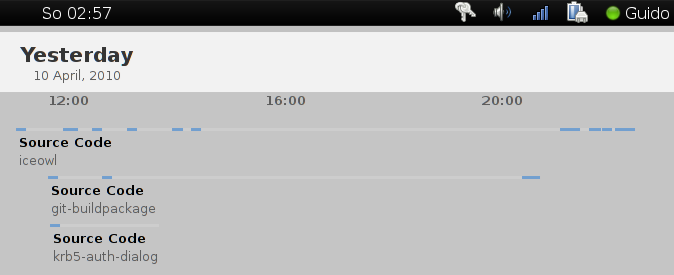
gnome-activity-journal recently entered Debian and it could become a great tool to keep track of hacking activities. The underlying zeitgeist can log these and other events and make the information available via DBus. I couldn't find a data provider that feeds the information about Git commits to it so I wrote a simple post commit hook. This way one can easily see when one worked on a source repository: gnome-activity-journal Now is there a nice way to store additional information like current branch or commit message along with that?

12 April 2010

Ingo Juergensmann: Syncing N97 with DAViCal

A few days ago I blogged about my problems syncing my N97 with iCal, Sunbird and other calendar apps. Today I tried DAViCal instead of Apples calendarserver (caldavd). To my surprise it worked fairly well, although not flawlessly. To make it short: I can now sync between my N97 smartphone via Bluetooth and iCal on OS X and Sunbird (tested on OS X as well): creating appointments on the N97, syncing via iSync and having the appointment exported to DAViCal via iCal works pretty well. Deleting dates works well in iCal as well. It has some problems as mentioned before on N97, though. But when you delete the date in iCal, it will vanish on the N97 as well.


It was somewhat tricky to get it that far. The problem is, that iSync can only sync to a local calendar in iCal. But with DAViCal you can publish/export that local calendar to the server where it is display a another calendar principal. That why syncing with the N97 works pretty well, although you might end up with double entry in iCal. I unchecked the N97 prinicipal/calendar from the server in iCal, as you can see in the screenshot above.

I haven't been able to test calendar sycing on Debian yet, but I believe that there will be some app that will work. And there are still problems. For example I have an appointment in July and August that are displayed in iCal and Sunbird, but not on the N97. Maybe there are some attributes to those dates that prevent them from being imported into the N97. Dunno.
But so far this is the best syncing solution so far. I'll test how well this works out for me...

Chris Lawrence: epcp for R

I finally have packaged up a very rough port of my epcp routine from Stata to R as part of a package unimaginatively called cnlmisc; you can download it here. In addition to the diagnostics that the Stata routine provides, the glm method includes a bunch of R-square-like measures from various sources (including Greene and Long). The only part I m sure works at the moment is the epcp for glm objects (including survey s and Zelig s wrappers thereof); the others that are coded (for polr and VGAM) are probably half-working or totally broken, and some wrappers aren t there yet at all. The error bounds suggested by Herron aren t there either. The print routines need a lot of work too; eventually it will have a nice toLatex() wrapper as well. But it beats having it sit on my hard drive gathering dust; plus I may eventually get motivated to write a JSS piece or something based on it. epcp for Stata is still available at my site. For more information on the measure, see Michael C. Herron (1999), Postestimation Uncertainty in Limited Dependent Variable Models Political Analysis 8(1): 83 98 or Moshe Ben-Akiva and Steven Lerman (1985), Discrete Choice Analysis, MIT Press.

11 April 2010

John Goerzen: Final comments on our trip to Europe

I wrote a lot about our trip to Europe here, and I had a few more comments to share. I had a great time there. It was fun to stay with people, and it was also fun to explore cities on our own. I am eager to be able to go back. Communication
I ll admit I wasn t sure how I d do there. I speak only a little German, and no Czech at all. I have never been in a situation in which I don t speak the dominant language, and this is probably typical for Americans. (I m not going to count the few exceptions of eating at small Mexican restaurants in the USA where the staff speaks little English, as it s not really the same experience to be in that situation for an hour or two.) I was most apprehensive about our time in Berlin and Prague. In those cities, we didn t know anyone. And, although I speak a little German, I speak no Czech at all. In the end, though, it all worked out fine. I never saw anyone get frustrated with us for our lack of language knowledge, and we also never got rattled. With patience and a bit of ingenuity, we figured things out in every different situation. I feel a sense of accomplishment from that, and I think it s left me more ready to travel in the future. And, I d also have to say, that was one of the most interesting lessons of the trip: how two people that don t share a common language can still communicate. It might be slow, but it s also rewarding and easier than I might ever have thought. I remember particularly buying a couple of fragile carved wood souvenirs at the Zeidler Holzkunst (wood art) shop in the Altes Rathaus in Leipzig (Seiffener Volkskunsterzeugnisse was on the window). The shopkeeper spoke no English. We were interested in some rather fragile items, and I wanted to ask her if she could pack it in a box. I didn t know the German words for pack or box . So after a couple seconds thought, I realized I knew how to tell her, in German, that we re from America. And then I asked, Can you? (in German) and gestured for a square box, figuring maybe she d put it together that we d need to pack it well to take it home with us. Success. She quickly produced a box, and asked if that s what we wanted. A few minutes later, a bit of pointing towards the glass case communicated what we wanted to buy. It took a little longer than it would have from someone that spoke English, but this was more rewarding in the end. The train station in Prague was another challenge. It didn t have nearly as much English signage as other train stations we d been in. We did a little wondering around, and some educated guesses, and a brief English conversation in a bank, we eventually found an ATM, a place to change the big bills for smaller ones, and a Metro ticket shop that was open. Clothes Many Americans, and American travel books, suggest not wearing jeans and tennis shoes in Europe. Many commented that people dressed more formally in Europe. That advice appeared to be rather wrong, especially in L beck, where it appeared that many people dressed less formally than in the USA. As we went south and east, we saw fewer jeans, but still they were rather common. Our biggest blunder here was probably the shoes that we brought for Terah. She brought some shoes that looked nice, but weren t very good for walking. She wound up with some painful blisters on her feet, and wished she had just brought her regular tennis shoes. Luggage and Packing We try to travel light when we can. All of our luggage for the entire trip fit into two carryon-size suitcases, though we sometimes separated some items out into a backpack for ease of use in airports/airplanes. This worked out about right. We did laundry once in Germany so we didn t have to pack enough clothes for the entire trip. As far as electronics go, we brought along an international GSM phone from onesimcard.com, my Droid (which could use Wifi but not GSM), Terah s iPod Touch, a GPS, my digital camera, and a laptop. That also was about right. We used the Droid to call back to Indiana to check on the boys, using SIP over WiFi for free calling via Google Voice. The laptop is a small one, so didn t add a lot of weight or bulk. It was nice to have to check out maps and Facebook. The GPS was somewhat less useful than I had anticipated. I had pre-loaded it with street-level maps of most of Europe, and also put on it points in Berlin that had been suggested to us. The transit maps were really more useful most places, especially when combined with a detailed street-level map. In Berlin, though, the detail on the street-level map from our hotel was somewhat lacking, so the GPS came in handy. It was also nice to quickly be able to see where the nearest S-Bahn and U-Bahn stops were, then cross-referencing with our transit map to figure out how to get where we wanted to go. One night in Leipzig, after a concert at the Gewandhaus, we made a couple of wrong turns on our way to a tram stop. The GPS would have saved us 15 minutes of walking had we brought it along, but we figured it out with our street map and it wasn t really a problem. Rick Steves is a big advocate of money belts when traveling. These are a belt with a zippered pouch, and are worn under your pants (though over your shirt, if it s tucked in). The idea is that it s hard to pickpocket. He suggests having a days worth of cash in a front pocket, and passports and larger bills in the money belt. We brought one but never used it. I kept small cash in my pocket, and we kept passports and my wallet (with larger bills) in Terah s purse, which was on a strap around her neck, zippered shut, and held under her arm. We had no problems. I tend not to keep my wallet in my back pocket even when traveling in the USA. Also, the hotels we stayed in had safes, and the residences were of course plenty safe, so we had no problem leaving valuables there. I brought only a single lens for my Digital Rebel XTi, a 28mm fixed lens that is small and light. That was just fine, and I was happy to have a fixed lens for photography in dark churches. Also, I wouldn t have wanted to carry around a bulky zoom lens all over. We sometimes took the camera with us, and sometimes not. In Berlin in particular, we just left it in the hotel room. I figured (correctly) that there would be plenty of photos on Flickr of the sites we were visiting, and we could just enjoy the time a little better if we weren t worrying about a camera too. But I was glad to have it along. Transportation The transportation systems in the cities we visited felt more, well, balanced than they often are in the USA. It s not that there weren t busy car-filled avenues, but more that there were also quiet shopping streets where cars were banned. Cars often seemed to be more of an option than a necessity, and not always the best option at that. Public transportation was common, as were pedestrian routes and bicycle lanes. The only American city I ve visited that felt even close to this approach was Portland, OR. I wish we adopted it more often here. I also admire the German intercity rail service, operated by Deutsche Bahn. You can get all over the country pretty quickly. The trains we rode on were quiet, smooth, and timely. I wish we had that kind of service in more parts of the USA.

Gunnar Wolf: Lets all get running

There is no clear reason, but for many months already, I have almost given up running Which is a shame, as I enjoy it so much. And yes, I can talk a lot about why not, but outside of one seemingly stupid point there is really no reason. And yes, I have taken on cycling, although on a very different fashion: Cycling is by far not as good as an exercise as running Yes, cycling for ~1h on average 3 times a week has kept my body from becoming sedentary again, but I do feel some increased clumsiness and a undeniable weight gain that I don't want to allow. I said there is one seemingly stupid point: Shoes. My running shoes are around two year old, and they are an important factor on me not running. Why? Because they started giving me blisters at ~5Km. And my shoe size is beyond what is considered as normal by Mexican standards European 44-45 (US 10 -11). Shoe-shopping is always frustrating and very off-putting for me, as instead of what most people do (go to one store, ask for their favorite n pairs on their size, test them on, pay, be happy), I follow almost the opposite process (go to n stores, ask for whatever they have on my size, test it on, pray, pay). Of course, for some people, entering many stores and checking what's offered at each is a thrill by itself. For me, that sounds as thrilling as visiting the dentist for an endodontic treatment. Oh, and to make things even better, I am quite low on cash. Scarcity economics explain that if a given good is hard to find, it will probably be more expensive. So, while many people in Mexico buy ~US$30 shoes, I often get to pay ~US$90. Fun, hah? Anyway, I had a short semi-vacation to Argentina. I decided to kill this excuse, and went shoe-shopping. Fearsome memories sprang in my mind when the first store said they didn't have anything right for me. But they pointed to a second store, one block away, where I found (I was even able to choose between several models!) a nice pair of Olimpikus. In 2008, I was routinely running slightly over 10Km. Today I went out to get back the feeling, and made a not-so-great-but-still-satisfying 4Km. And upon arriving back home, I read Christian's chronicle on his Paris Marathon run Well, only 10% of what my fellow DD achieved But I am definitively back on track. I expect to make some time to get a run, at least three times a week, trying to push my limit at least back to the nice spot I was at two years ago.

Next.

Previous.