A new version of the nanotime package for working with nanosecond timestamps is now on CRAN.
nanotime uses the RcppCCTZ package for (efficient) high(er) resolution time parsing and formatting, and the bit64 package for the actual integer64 arithmetic.
This release adds an improved default display format always showing nine digits of fractional seconds. It also changes the print() method to call format() first, and we started to provide some better default Ops methods. These fixes were suggested by Matt Dowle. We also corrected a small issue which could lead to precision loss in formatting as pointed out by Leonardo Silvestri.
Changes in version 0.1.1 (2017-02-04)
The default display format now always shows nine digits (#10 closing #9)
The default print method was updated to use formated output, and a new new converter as.integer64 was added
Several 'Ops' method are now explicitly defined allowing casting of results (rather than falling back on bit64 behaviour)
The format routine is now more careful about not loosing precision (#13 closing #12)
Welcome to gambaru.de. Here is my monthly report that covers what I have been doing for Debian. If you re interested in Java, Games and LTS topics, this might be interesting for you.
Debian Games
In January 2017 we had the last chance to get new upstream releases into the next stable release of Debian 9 aka Stretch. Hence I packaged new versions of pygame-sdl2, renpy, fife, unknown-horizons, redeclipse and redeclipse-data and also backported Red Eclipse to Jessie.
I uploaded fifechan to unstable and applied an upstream patch to fix a segmentation fault (#852247) in Unknown Horizons.
Package cleanups and improvements: freeorion (#843538), I enabled support for mips64el again; I tidied up gtkatlantic, powermanga, lincity-ng, opencity and tecnoballz; I applied a patch from Reiner Herrmann to make the build of netpanzer reproducible (#827150); In spring I changed the build-dependency of asciidoc to asciidoc-base (#850387) although it turned out later that this wasn t strictly needed. I also removed ConvertUTF8 related code from spring because it might be non-free. I don t think this is necessarily true but I didn t want to argue with Lintian in this case.
I sponsored a new upstream release of pentobi for Juhani Numminen.
I backported minetest 0.4.5 to jessie-backports and fixed #851114, which I think was not really an issue since we already provide the font sources in Debian and Minetest depends on the respective package.
I triaged RC bug #847812 in pysolfc, provided a patch and reassigned the issue to src:pillow. Apparently this affected a lot more 32 bit applications written in Python.
Debian Java
For Debian Java the situation was very similar but I didn t want to break too many reverse-dependencies right before the freeze. So I chose rather harmless packages and updated objenesis, syncany and jackson-dataformat-xml. At first I couldn t build objenesis 2.5 from source but after some consultation on the debian-java list, it became clear that the test failure was probably an upstream bug. Henri Tremblay kindly issued a new release of Objenesis which addressed the build failure.
I prepared security updates for groovy and groovy2 in Jessie. (#853233, #853235)
Debian LTS
This was my eleventh month as a paid contributor and I have been paid to work 12,75 hours on Debian LTS, a project started by Rapha l Hertzog. In that time I did the following:
From 16. January until 22. January I was in charge of our LTS frontdesk. I triaged security issues in imagemagick, wordpress, hesiod, opus, mysql-5.5, netbeans, groovy and zoneminder.
DLA-779-1. Issued a security update for Tomcat 7 fixing 1 CVE and a regression when running Tomcat with SecurityManager enabled.
DLA-761-2. Issued a regression update for python-bottle. (Debian bug #850176).
DLA-781-1 and DLA-781-2. Issued a security update for Asterisk fixing 2 CVE after I had prepared the package last month. Later Brad Barnett discovered a regression when using SIP communication and provided assistance with debugging the issue. I corrected this one in DLA-781-2.
DLA-792-1. Issued a security update for libphp-swiftmailer fixing 1 CVE.
DLA-793-1. Issued a security update for opus fixing 1 CVE.
DLA-794-1. Issued a security update for groovy fixing 1 CVE.
DLA-797-1. Issued a security update for mysql-5.5 fixing 10 CVE. The update was prepared by Lars Tangvald.
DLA-813-1. Issued a security update for wordpress fixing 9 CVE.
Misc
In xarchiver (#850103) I added binutils to the list of suggested packages, in iftop (#850040) I applied a patch from Brian Russell and I packaged a new upstream release of mediathekview, a Java application to watch and download broadcasts from German television stations. I had to make some major packaging changes because the build system switched from Ant to Gradle but there were fewer issues than expected.
Whilst I am an avid podcast listener, this was actually my first appearance on one. It was an curious and somewhat disconcerting feeling to be "just" talking to Adam and Jerod in the moment yet knowing all the time that anything and everything I said would be distributed more widely in the future.
It has been a quiet start to the year due to work keeping me very busy. Most of my spare time (when not sitting shattered on the sofa) was spent resurrecting my old website from backups. My son had plenty of visitors coming to visit as well, which prompted me to restart work on my model railway in the basement. Last year I received a whole heap of track, and also a tunnel formation from a friend at work. I managed to finish the supporting structure for the tunnel, and connect one end of it to the existing track layout. The next step (which will be a bit harder) is to connect the other end of the tunnel into the existing layout. The basement is one of the favourite things for me to keep my son and his friends occupied when there is a visit. The railway and music studio are very popular with the little guests.
Debian
Packaged latest Gramps 4.2.5 release for Debian so that it will be part of the Stretch release.
Package latest abcmidi release so it too would be part of Stretch. The upstream author had changed his website, so it took a while to locate a tarball.
Tested my latest patches to convert Cree.py to Qt5, but found another Qt4 Qt5 change to take into account (SIGNAL function). I ran out of time to fully investigate that one, before Creepy was booted out of testing again. I am seriously considering the removal of Cree.py from Debian, as the upstream maintainer does not seem very active any more, and I am a little tired of being upstream for a project that I don t actually use myself. It was only because it was a reverse dependency of osm-gps-map that I originally got involved.
Started preparing a Gramps 5.2.5 backport for Jessie, but found that the tests I enabled in unstable were failing in the Jessie build. I need to investigate this further.
Ubuntu
Announced the Ubuntu Studio 16.02.2 point release date on the Ubuntu Studio mailing lists asking for testers. The date subsequently got put back to February the 9th.
Upgraded my Ubuntu Studio machine from Wily to Xenial.
Other
Resurrected my old Drupal Gammon One Name Study website. I used Drupal VM to get the site going again, before transferring it to the new webhost. It was originally a Drupal 7 site, and I did not have the required versions of Ansible & Vagrant on my Ubuntu Xenial machine, so the process was quite involved. I will blog about that separately, as it may be a useful lesson for others. As part of that, I started on a backport of vagrant, but found a bug which I need to follow up on.
Also managed to extract my old WordPress blog posts from the same machine that had the failed Drupal instance, and import them into this blog. I also learnt some stuff in that process that I will blog about at some point.
Plan status from last month & update for next month
Debian
Before the 5th February 2017 Debian Stretch hard freeze I hope to:
Keep an eye on the Release Critical bugs list, and see if I can help fix any.
Generally:
Finish the Gramps 5.2.5 backport for Jessie.
Package all the latest upstream versions of my Debian packages, and upload them to Experimental to keep them out of the way of the Stretch release.
Begin working again on all the new stuff I want packaged in Debian.
Ubuntu
Finish the ubuntustudio-lightdm-theme, ubuntustudio-default-settings transition including an update to the ubuntustudio-meta packages. Still to do (actually started today)
Reapply to become a Contributing Developer. Still to do
Start working on an Ubuntu Studio package tracker website so that we can keep an eye on the status of the packages we are interested in. Started
Start testing & bug triaging Ubuntu Studio packages. Still to do
Test Len s work on ubuntustudio-controls Still to do
Other
Try and resurrect my old Gammon one-name study Drupal website from a backup and push it to the new GoONS Website project. Done
Give JMRI a good try out and look at what it would take to package it. In progress
Also look at OpenPLC for simulating the relay logic of real railway interlockings (i.e. a little bit of the day job at home involving free software fun!).
FTP assistant
This month I only marked 146 packages for accept and rejected 25 packages. I only sent 3 emails to maintainers asking questions.
Nevertheless I could pass a big mark. All in all I accepted more than 10000 packages now!
Debian LTS
This was my thirty-first month that I did some work for the Debian LTS initiative, started by Raphael Hertzog at Freexian.
This month my all in all workload has been 12.75h. During that time I did uploads of
[DLA 805-1] bind9 security update for three CVEs
[DLA 806-1] zoneminder security update for one CVE
Unfortunately the upload of jasper had to be postponed, as there is no upstream fix for most of the open CVEs yet.
I also suggested to mark th slum-llnl CVE as , as the patch would be too invasive. Further I did another week of frontdesk work.
Last but not least I took care of about 140 items of the TODO list[1]. Ok, it was not that much work, but the enormous number is impressing :-). I also had a look at [2] and filed bugs against two packages. Within hours the maintainers responded to that bugs, clarified everything to mark the CVEs as not-affected and nobody has to care about them anymore. This is a good example of how the knowledge of the maintainer can help the security teams! So, if you have some time left, have a look at [3] and take care of something.
[1] https://security-tracker.debian.org/tracker/status/todo
[2] https://security-tracker.debian.org/tracker/status/unreported
[3] https://security-tracker.debian.org/tracker
Other stuff
This month I sponsored a new round of sidedoor and printrun. After advocating Dara Adib to become Debian Maintainer, I hope my activities as sponsor can be reduced again :-).
Further I uploaded another version of setserial, but as you can see in #850762 it does not seem to satisfy everybody. I also uploaded new upstream versions of duktape and pipexec.
As I didn t do any DOPOM in December I adopted two packages in January: pescetti and salliere. I dedicate those uploads to my aunt Birgit, who was a passionate bridge player. You will never be forgotten.
The soft freeze has been on going for almost a month now and the full stretch freeze will start tomorrow night (UTC). It has definitely been visible in the number of unblock requests that we have received so far. Fortunately, we are no where near the rate of the jessie freeze. At the moment, all unblock requests are waiting for the submitter (either for a clarification or an upload).
Looking at stretch at a glance (items are in no particular order):
Secure boot support is progressing too slowly.
The openssl transition is still on-going and badly needs closure.
Secure boot support
Currently, we are blocked on two items:
We do not have signing done yet for the boot packages (not even manual signing).
Our shim is not yet signed, so no hardware would be trusting our boot chain out of the box.
After they are done, we are missing a handful of uploads to provide a signed bootloader etc. plus d-i and some infrastructure bits need to be updated. At the moment, we are waiting for a handful of key people/organisations to move on their part. As such, there is not a lot you can do to assist here (unless you are already involved in the work).
On the flip side, if both of these items are resolved soon, there is a good chance that we can support secure boot in stretch.See bug#820036 and blockers for more information on the remaining items.
Where can you help with the release?
At the moment, the best you can do is to:
Test (packages, upgrades, etc.) and report bugs
File bugs against release-notes for issues that should be documented
Fix RC bugs (please see the next section)
Release Critical Bug report
The UDD bugs interface currently knows about the following release critical bugs:
Affecting stretch: 294 (key packages: 158)
That s the number we need to get down to zero before the release. They can be split in two big categories:
Affecting stretch and unstable: 232 (key packages: 134)
Those need someone to find a fix, or to finish the work to upload a fix to unstable:
30 bugs are tagged patch . (key packages: 21)
Please help by reviewing the patches, and (if you are a DD) by uploading them.
17 bugs are marked as done, but still affect unstable. (key packages: 5)
This can happen due to missing builds on some architectures, for example. Help investigate!
185 bugs are neither tagged patch, nor marked done. (key packages: 108)
Help make a first step towards resolution!
Affecting stretch only: 62 (key packages: 24)
Those are already fixed in unstable, but the fix still needs to migrate to stretch. You can help by submitting unblock requests for fixed packages, by investigating why packages do not migrate, or by reviewing submitted unblock requests.
36 bugs are in packages that are unblocked by the release team. (key packages: 14)
26 bugs are in packages that are not unblocked. (key packages: 10)
So last weekend I attended Devconf.cz in Brno and together with Dennis Gilmore gave a talk about Reproducible Builds and Fedora (Slides) which was fun and - I think - pretty well received.
Then on the following Tuesday, so three days ago, after using Debian as the primary OS on my primary computer for more than two decades, I finally made the long anticipated switch and I must say, so far I'm really happy with my new environment, even though I'm not yet again using a tiled window manager (but instead Xfce), cannot yet do all the things I could do before and even have to reconfigure a VM twice and restart another to get back wireless network after suspend and resume
So what have I done? Nothing too dramatic: I've switched to Qubes OS and now I'm running Debian jessie and stretch and Fedora and Whonix on my primary computer, just not as my primary OS
IOW: hardware is basically software and while I want the red pill, who knows what's really inside the box?
If you have no idea what I'm talking about, this intro about Qubes OS might be helpful. Or you dive directly into this six year old post, where Joanna Rutkowska described how she partitioned her digital life using Qubes.
I'm not sure where this journey will lead me to, but I'm confident this is the right direction. And in case you wondered, I'll keep working on Debian, as far as I know now
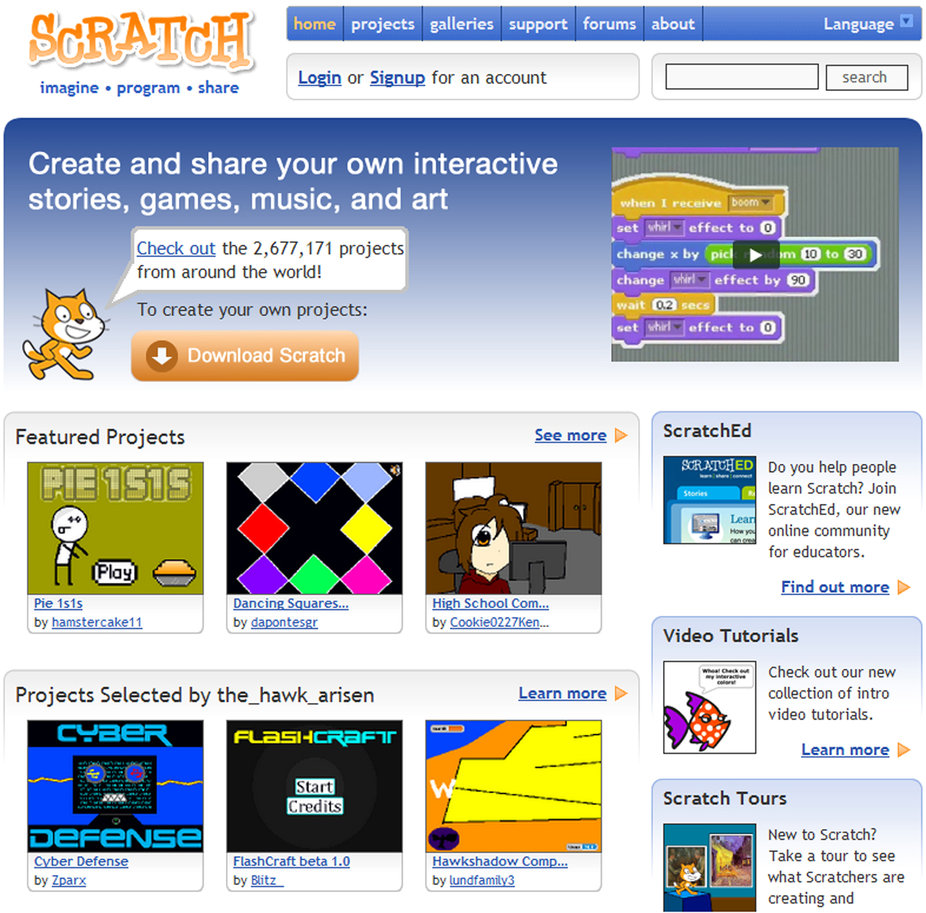
Scratch is a block-based programming language created by the Lifelong Kindergarten Group (LLK) at the MIT Media Lab. Scratch gives kids the power to use programming to create their own interactive animations and computer games. Since 2007, the online community that allows Scratch programmers to share, remix, and socialize around their projects has drawn more than 16 million users who have shared nearly 20 million projects and more than 100 million comments. It is one of the most popular ways for kids to learn programming and among the larger online communities for kids in general.
Front page of the Scratch online community (https://scratch.mit.edu) during the period covered by the dataset.
Since 2010, I havepublishedaseriesofpapers using quantitative data collected from the database behind the Scratch online community. As the source of data for many of my first quantitative and data scientific papers, it s not a major exaggeration to say that I have built my academic career on the dataset.
I was able to do this work because I happened to be doing my masters in a research group that shared a physical space ( The Cube ) with LLK and because I was friends with Andr s Monroy-Hern ndez, who started in my masters cohort at the Media Lab. A year or so after we met, Andr s conceived of the Scratch online community and created the first version for his masters thesis project. Because I was at MIT and because I knew the right people, I was able to get added to the IRB protocols and jump through the hoops necessary to get access to the database.
Over the years, Andr s and I have heard over and over, in conversation and in reviews of our papers, that we were privileged to have access to such a rich dataset. More than three years ago, Andr s and I began trying to figure out how we might broaden this access. Andr s had the idea of taking advantage of the launch of Scratch 2.0 in 2013 to focus on trying to release the first five years of Scratch 1.x online community data (March 2007 through March 2012) most of the period that the codebase he had written ran the site.
After more work than I have put into any single research paper or project, Andr s and I have published a data descriptor in Nature s new journal Scientific Data. This means that the data is now accessible to other researchers. The data includes five years of detailed longitudinal data organized in 32 tables with information drawn from more than 1 million Scratch users, nearly 2 million Scratch projects, more than 10 million comments, more than 30 million visits to Scratch projects, and much more. The dataset includes metadata on user behavior as well the full source code for every project. Alongside the data is the source code for all of the software that ran the website and that users used to create the projects as well as the code used to produce the dataset we ve released.
Releasing the dataset was a complicated process. First, we had navigate important ethical concerns about the the impact that a release of any data might have on Scratch s users. Toward that end, we worked closely with the Scratch team and the the ethics board at MIT to design a protocol for the release that balanced these risks with the benefit of a release. The most important features of our approach in this regard is that the dataset we re releasing is limited to only public data. Although the data is public, we understand that computational access to data is different in important ways to access via a browser or API. As a result, we re requiring anybody interested in the data to tell us who they are and agree to a detailed usage agreement. The Scratch team will vet these applicants. Although we re worried that this creates a barrier to access, we think this approach strikes a reasonable balance.
Beyond the the social and ethical issues, creating the dataset was an enormous task. Andr s and I spent Sunday afternoons over much of the last three years going column-by-column through the MySQL database that ran Scratch. We looked through the source code and the version control system to figure out how the data was created. We spent an enormous amount of time trying to figure out which columns and rows were public. Most of our work went into creating detailed codebooks and documentation that we hope makes the process of using this data much easier for others (the data descriptor is just a brief overview of what s available). Serializing some of the larger tables took days of computer time.
In this process, we had a huge amount of help from many others including an enormous amount of time and support from Mitch Resnick, Natalie Rusk, Sayamindu Dasgupta, and Benjamin Berg at MIT as well as from many other on the Scratch Team. We also had an enormous amount of feedback from a group of a couple dozen researchers who tested the release as well as others who helped us work through through the technical, social, and ethical challenges. The National Science Foundation funded both my work on the project and the creation of Scratch itself.
Because access to data has been limited, there has been less research on Scratch than the importance of the system warrants. We hope our work will change this. We can imagine studies using the dataset by scholars in communication, computer science, education, sociology, network science, and beyond. We re hoping that by opening up this dataset to others, scholars with different interests, different questions, and in different fields can benefit in the way that Andr s and I have. I suspect that there are other careers waiting to be made with this dataset and I m excited by the prospect of watching those careers develop.
You can find out more about the dataset, and how to apply for access, by reading the data descriptor on Nature s website.
Yes, You Should Not discard cached ssh host keys without looking. An unexpected change of an ssh host key is always a
reason to step back from the keyboard and think. However, there are situations when you know that a
systems ssh host key has changed, for example when the system reachable under this host name has been redeployed,
which happens
increasingly often proportionally to the devopsness of your environment, or for example in test environments.
Later versions of ssh offer you the ssh-keygen -R command line to paste from the error message, so that you can abort
the connection attempt, paste the command and reconnect again. This will still ask for confirmation of the new host key
though.
Almost every sysadmin has an alias or wrapper to make handling of this situation easier. Solutions range from using
StrictHostKeyChecking no and/or UserKnownHostsFile /dev/null , turning off this layer of
securit altogether either globally or usually too broadly, to more-or-less sophisticated solutions that involve turning
off know-host file hashing, parsing client output and/or grep-sed-awk magic. grml even comes with an insecssh script
that is rather neat and that I used until I developed my own.
Later ssh versions (not including the 6.7 in Debian jessie, but the 7.4 in debian sid) do offer a -G command line
option which will give access to configuration options after the complete client configurtion was processed. This will
allow you to neatly get access to the actual hostname the ssh client will connect to. This can, in turn be used to
obtain the IP address so that all traces of the host and its IP addresses can be removed from the known_hosts file
before the actual connection is done.
The following script is the insecssh that I currently use. It only uses documented interfaces to the ssh client which
I consider rather neat.
Ugliness results from the necessity of following CNAMEs manually since there is - to my knowlegde (educate me!) - no
command line utility that has the output simplicity and selection powers of dig which can automatically follow CNAMEs
without relying on the recursor having the CNAME cached or not.
Use this script if you know that a host has changed its host key. It will first zap all knowledge of the previous
host key from known_hosts and then invoke the ssh client with the given arguments from its command line, with options
added so that you ll see the new host key in random art and that you don t need to manually confirm the new
host key.
From time to time I've to use chromium for creepy stuff like
lifesize video conferencing with document sharing. The document sharing
requires a chromium extension. Suddenly that stopped working today
and I could not reinstall the extension. After trying a lot of
stuff I had a look at the debian changelog and found out about:
A major new update of the RPushbullet package is now on CRAN. RPushbullet interfacing the neat Pushbullet service for inter-device messaging, communication, and more. It lets you easily send alerts like the one to the to your browser, phone, tablet, ... -- or all at once.
This release owes a lot to Seth Wenchel who was instrumental in driving several key refactorings. We now use the curl package instead of relying on system() calls to the binary. We also switched from RJSONIO to jsonlite. A new helper function to create the required resourcefile was added, and several other changes were made as detailed below in the extract from the NEWS.Rd file.
Changes in version 0.3.0 (2017-02-03)
The curl binary use was replaced by use of the curl package; several new helper functions added (PRs #30, #36 by Seth closing #29)
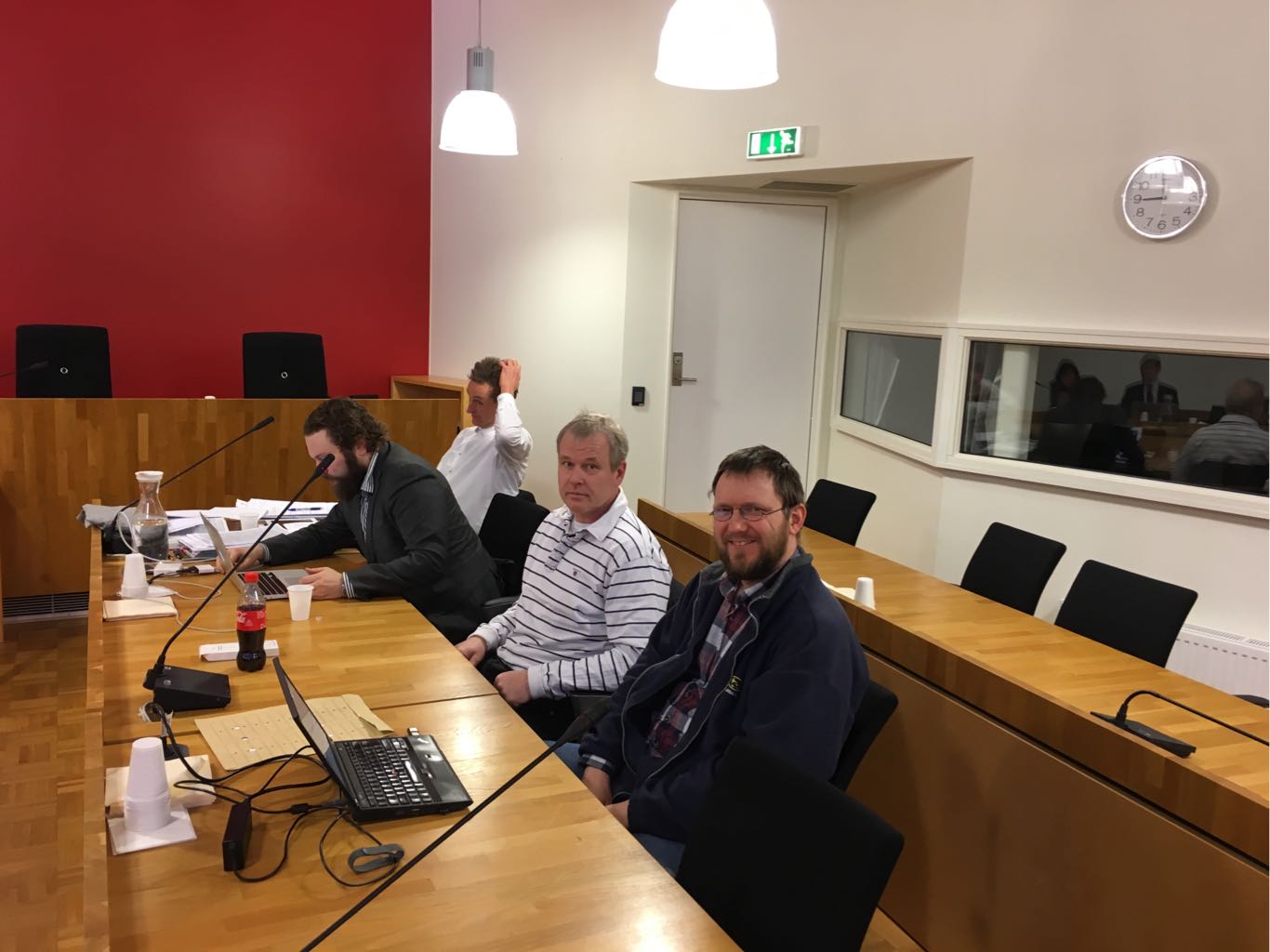
On Wednesday, I spent the entire day in court in Follo Tingrett
representing the member association
NUUG, alongside the member
association EFN and the DNS registrar
IMC, challenging the seizure of the DNS name popcorn-time.no. It
was interesting to sit in a court of law for the first time in my
life. Our team can be seen in the picture above: attorney Ola
Tellesb , EFN board member Tom Fredrik Blenning, IMC CEO Morten Emil
Eriksen and NUUG board member Petter Reinholdtsen.
The
case at hand is that the Norwegian National Authority for
Investigation and Prosecution of Economic and Environmental Crime (aka
kokrim) decided on their own, to seize a DNS domain early last
year, without following
the
official policy of the Norwegian DNS authority which require a
court decision. The web site in question was a site covering Popcorn
Time. And Popcorn Time is the name of a technology with both legal
and illegal applications. Popcorn Time is a client combining
searching a Bittorrent directory available on the Internet with
downloading/distribute content via Bittorrent and playing the
downloaded content on screen. It can be used illegally if it is used
to distribute content against the will of the right holder, but it can
also be used legally to play a lot of content, for example the
millions of movies
available from the
Internet Archive or the collection
available from Vodo. We created
a
video demonstrating legally use of Popcorn Time and played it in
Court. It can of course be downloaded using Bittorrent.
I did not quite know what to expect from a day in court. The
government held on to their version of the story and we held on to
ours, and I hope the judge is able to make sense of it all. We will
know in two weeks time. Unfortunately I do not have high hopes, as
the Government have the upper hand here with more knowledge about the
case, better training in handling criminal law and in general higher
standing in the courts than fairly unknown DNS registrar and member
associations. It is expensive to be right also in Norway. So far the
case have cost more than NOK 70 000,-. To help fund the case, NUUG
and EFN have asked for donations, and managed to collect around NOK 25
000,- so far. Given the presentation from the Government, I expect
the government to appeal if the case go our way. And if the case do
not go our way, I hope we have enough funding to appeal.
From the other side came two people from kokrim. On the benches,
appearing to be part of the group from the government were two people
from the Simonsen Vogt Wiik lawyer office, and three others I am not
quite sure who was. kokrim had proposed to present two witnesses
from The Motion Picture Association, but this was rejected because
they did not speak Norwegian and it was a bit late to bring in a
translator, but perhaps the two from MPA were present anyway. All
seven appeared to know each other. Good to see the case is take
seriously.
If you, like me, believe the courts should be involved before a DNS
domain is hijacked by the government, or you believe the Popcorn Time
technology have a lot of useful and legal applications, I suggest you
too donate to
the NUUG defense fund. Both Bitcoin and bank transfer are
available. If NUUG get more than we need for the legal action (very
unlikely), the rest will be spend promoting free software, open
standards and unix-like operating systems in Norway, so no matter what
happens the money will be put to good use.
If you want to lean more about the case, I recommend you check out
the blog
posts from NUUG covering the case. They cover the legal arguments
on both sides.
I am boarding my flight to Brussels to attend FOSDEM.
The Desktops DevRoom will be a blast again this year. While I have been in charge of it for 6? years already, the last two (since my twins) were born I had organized remotely and local duties were carried on by the Desktops DevRoom team (thank you Christophe Fergeau, Philippe Caseiro and others!).
I am anxious at meeting old friends again. I will be at the beer event today.
Video streaming will be available thanks to the Video Team. If you want to help, please contact us in the desktops-devroom@lists.fosdem.org mailing list, or directly at the devroom.
Also, this year will be the first for me using the job corner to recruit: my company (everis) is recruiting globally for many open positions. Drop us a mail at fosdem@everis.com with your CV, desired position and location (we have direct presence in 13 countries and indirect in 40 countries) and I will make sure it reaches the right inbox.
Today, I have released
the first beta for Tails 3.0, that will be the first version of Tails
based on Debian 9 (Stretch).
Our automated test suite pretends it works pretty well and matches our
safety expectations. I'm inclined to trust it. But as we learned after
porting Tails to Squeeze, Wheezy and Jessie: quick, exploratory
testing of pre-releases will not identify all the
remaining regressions.
So this time I'm trying to change this narrative a bit. I have
committed to provide security updates for the 3.0~ series, just like
we do for stable versions of Tails. This was the only missing bit to
make me feel comfortable
asking my fellow Tails contributors
to upgrade to Tails 3.0~beta1 for their daily usage.
I hope this helps us release a great Tails 3.0 on June 13 and
a better Debian Stretch too: the more early users of Tails based on
Stretch, the more chances they identify a few annoying regressions in
Stretch before it's called stable :)
For details, see the
official announcement.
Next step: FOSDEM. And then, back to organizing an event that aims at
improving both social and technical aspects of Debian (to be
announced in about a week, stay tuned); because the way we get
organized and how power is distributed matter.
It's that time of the year :-) And FOSDEM is fun. But this year I won't be
going; there was a scheduling conflict, and I didn't really have anything
new to present (although I probably could have shifted around priorities
to get something).
But FOSDEM 2017 also means there's a year since FOSDEM 2016, where I
presented Nageru, my live video mixer.
And that's been a pretty busy year, so I thought I'd do a live cap
from high up above.
First of all, Nageru has actually been used in production we did
Solskogen
and Fyrrom, and both
gave invaluable input. Then there have been some non-public events,
which have also been useful.
The Nageru that's in git right now is evolved considerably from the
1.0.0 that was released last year. diffstat shows 19660 insertions
and 3543 deletions; that's counting about 2500 lines of vendored
headers, though. Even though I like deleting code much more than
adding it, the doubling (from ~10k to ~20k lines) represents a
significant amount of new features:
1.1.x added support for non-Intel GPUs. 1.2.x added support for
DeckLink input cards (through Blackmagic's proprietary drivers),
greatly increasing hardware support, and did a bunch of small
UI changes. 1.3.x added x264 support that's strong enough that
Nageru has really displaced VLC as my go-to tool for just
video-signal-to-H.264-conversion (even though it feels overkill),
and also added hotplug support. 1.4.x added multichannel audio
support including support for MIDI controllers, and also a disk
space indicator (because when you run out of disk during production
without understanding that's what happens, it really sucks),
and brought extensive end-user documentation.
And 1.5.x, in development right now, will add HDMI/SDI output,
which, like all the previous changes, requires various rearchitecting
and fixing.
Of course, there are lots of things that haven't changed as well;
the basic UI remains the same, including the way the theme (governing
the look-and-feel of the finished video stream) works. The basic design
has proved sound, and I don't think I would change a lot if I were to
design something like 1.0.0 again. As a small free software project,
you have to pick your battles, and I'm certainly glad I didn't start
out doing something like network support (or a distributed architecture
in general, really).
So what's for the next year of Nageru? It's hard to say, and it will
definitely depend on the concrete needs of events. A hot candidate
(since I might happen to need it) is chroma keying, although good
keying is hard to get right and this needs some research. There's
also been some discussion around other concrete features, but I
won't name them until a firm commitment has been made; priorities
can shift around, and it's important to stay flexible.
So, enjoy FOSDEM! Perhaps I'll return with a talk in 2018.
In the meantime, I'll preparing the stream for the 2017 edition
of Fyrrom, and I know for sure there will be more events, more
features and more experiences to be had. And, inevitably, more bugs. :-)
While the main focus of QSoas is the processing of experimental data, it also features commands to generate (calculate) datasets. The command generate-buffer creates a dataset of equally spaced points (you can change their number using the option /samples) between to limiting values, as below:
QSoas> generate-buffer -2 2
By default, the values are taken equal to . However, generate-buffer also takes an optional formula to directly set the values:
QSoas> generate-buffer -10 10 sin(x)
From version 2.0, it is possible to generate several datasets in a row using the /number option, and to color them using the /style option (but only since version 2.1). Each dataset is generated according to the formula, and number is a special number that starts at 0 and increases by 1 for each dataset. Here's what I used to generate the picture on the right:
I was reading a thread on phoronix where a student was sharing that it is or can be expensive to get even a used laptop and he shared his predicament and was hammered a bit for it to some going to the extent of questioning his life-choices.
While I m not a student it still triggered something in me. I am not dirt poor but neither am I insanely rich. The same questions he has, similar questions I have had. While in his case he is probably in his early to late 20 s, I am pushing 40. Most of the money I make goes in for everyday purchases, veggies, house-rent, electricity, landline, broadband and cell phone bills. What little is left is most of the time kept for a rainy day as there is no Government pension.
From what I have heard and read on the web, in the west specifically in the States, if I buy a used laptop, I usually get a 6 months 1 year warranty . Here, while you could get a used laptop for around INR 10k there is no warranty/guarantee, so I never get into that. It s buyer s beware all the time.
For people who like/want FOSS or specifically something like Free DOS (like me), I had to wait for almost 6 years to get a model I was happy with, with the specs. I was ok with.
Was really lucky enough to get a Thinkpad T440 with 8 GB of RAM for around INR 80k/- with Free DOS.
The specs
T440 Core I 5 (4300) / Dos (NEW MODEL)
20B7A1SD00
Intel Core i5 4300M (2.5 GHz / 3 MB / 5 GT/s) / Intel QM87 Chipset / Integrated 802.11 n WIFI LAN + Bluetooth 4.0 / 8GB DDR III Memory (2 DIMM SLOT) / 500 GB SATA HDD @ 7200 RPM / 14.0 HDy / FPR / Dos / 2 USB , VGA Port , RJ 45 Port /GB LAN /Track Point with 5 button Glass Touch Pad /Stereo Speakers with Dolby Enhanced Audio / 6 Cell Battery /Approx 2.14KG/
While it is/was actually pretty expensive but then wanted something which can take a beating, deal with all the heat, noise and dust (specifically where I live, right in the middle of the city).
The reason I used the word lucky is that now there is no model in the T-series range which has FreeDOS on it. Of course, I hopefully will use it for another 4-5 years at the very least depending on how much it cooperates with me, I have heard that Thinkpads function for a long period of time even in dusty environments so banking on that.
What probably pissed me is the condensing note in the comment, how does he know what pressures an another individual might be in. It s almost like saying You are refugee because you made a wrong life choice or something to that effect which again is stupid.
I actually feel/felt embarrassed to bring this up as I truly am lucky to be safe, secure, have food on the table, am able to sleep on a bed at night, have a workstation AND a laptop, have somewhat of a sound mind and a body which is able to move around without any hassles. Add to that, incredibly as it may sound, was also able to see another country for a few days
In relation to people being persecuted and having to run off to save their own lives or even people living on the streets, I am actually living in luxury. While I can t go through life feeling guilty for all the good things that have happened with me, I do feel disgusted when I see some people put blinding statements like that.
One of the biggest reasons that GNU/Linux and Debian in particular gelled with me was that it s incredibly flexible and generous. Nobody tells me which packages I should or shouldn t have. I do right things, good, I do something wrong, an opportunity to learn and hopefully learn from my mistakes. In either case, one of the most forgiving kind of system to learn and hack on.
While speaking of mistakes, could somebody look at #849684 . It almost feels like a tennis match going between the maintainers concerned. While I don t have the technical skills to ascertain who s right and who is not, it would be nice if some cooler heads can make sense and see if a way could be found out. Can somebody help ? Filed under: Miscellenous Tagged: #debian, #Life Choices, #Thinkpad440, laptop
Debian LTS
November marked the 21st month I contributed to Debian LTS
under the Freexian umbrella. I had 8 hours allocated which I used
for:
the first half of a LTS front desk week
updating icedove 45.6.0 resulting in DLA-782-1 fixing 8 CVEs
releasing DLA-783-1 for XEN, the actual update was provided by
credativ
testing the bind9 update prepared by Thorsten Alteholz
fixing 8 CVEs in imagemagick resulting in DLA-807-1.
work on recent qemu CVEs
Other Debian stuff
Usual bunch of libvirt and related uploads
Uploaded git-buildpackage 0.8.10 to 0.8.12.1 to experimental and
unstable fixing (among other things) a long standing bug when using
multiple tarballs with filters and pristine-tar as well as making
generated orig tarballs reproducible so one gets identical tarballs even
without pristine-tar.
Ran a gbp import-dsc of unstable and filed bugs for cases where
pristine-tar would not import the package. Started to look into
git-apply errors.
Some other Free Software activites
libplanfahr: switched the example to python3 and made it parse
arguments without date as "today":
Working with Date, Calendar, SimpleDateFormat in Android.
As I mentioned In my last blog, I would talk about how I used Calendar and Date classes for the user to designate silent mode by setting time constraints and weekdays, in Lumicall.Date class to used to interpret dates as year, month, day, hour, minute, and second values. I had to compare whether the current time falls between Start Time and End Time specified by the user. So that, silent mode can be enabled within that time frame.I used Calendar Class to get the current hour in 24-Hour format and minute.
 Calendar now = Calendar.getInstance();
 int hour = now.get(Calendar.HOUR_OF_DAY);
 int minute = now.get(Calendar.MINUTE);
Now, Since the user enters the Time in EditText Widgets, the values were retrieved as strings.
String hhStart, mmStart, hhEnd, mmEnd store these values from Edit text widgets. To interpret these strings as a representation of a date and time, we need to parse itA Date class object s format looks like- Since, I was only interested in fetching the HH:MM values, i.e the fourth field in the format, To set and compare only the HH:MM values, Android provides lovely, SimpleDateFormat class to access the particular value we want in the Date object. To access the year, use letter Y To access the time zone, use letter z To access the Hour and minute, we use letter H and m.
Rest everything in the date object are values set by default. Eg, Year 1970. Which we din t set / access , hence did not change.To check if the start time is before the current time. And the endtime is after the current time,
if(timeCompareOne.before(currentTime) && timeCompareTwo.after(currentTime))Switch on the silent mode;
Added a try catch block to handle the exception which will arise if the SimpleDateFormat.parse method is unable to parse the given Java String.
public Date parseDate(String date)

try

return inputParser.parse(date);

catch (java.text.ParseException e)

return new Date(0);
Comparing Time? Done! Now to check whether the selected weekday in the checkboxes matches the current week day,
Calendar calendar = Calendar.getInstance();
int day = calendar.get(Calendar.DAY_OF_WEEK);
If it s sunday, value returned by calendar.get(Calendar.DAY_OF_WEEK) is 1, if monday, 2 and so on.. Weekdays compared too!
Thanks for reading, U
The past few days I've been doing more arduino-work. In between dying of sleep-exhaustion.
One thing that always annoyed me was that I had to hard-code my WiFi credentials in my projects, with code like this:
//
// Connect to the SCOTLAND network
//
WiFi.mode(WIFI_STA);
WiFi.hostname("tram-clock");
WiFi.begin("SCOTLAND", "highlander1");
//
// Attempt to connect - TODO: Timeout on failure
//
while (WiFi.status() != WL_CONNECTED)
    delay(500);
//
// Now we're connected show the local IP address.
//
lcd.print("WiFi connected  ");
lcd.print(WiFi.localIP());
Whilst looking at another project I found a great solution though. There is a library called WiFiManager which behaves perfectly:
If you've stored connection details it will connect to the local WiFI network using those, automatically.
If you've not saved previous connection details it will instead configure the device to work as an Access Point
You can then connect to that access point and see a list of local WiFi networks.
Choose the appropriate one from the list, enter your password, and these details are saved for the future.
The device will then reset, join the network via your saved choices and acquire an IP via DHCP as you'd expect.
The code for this is beautifully simple:
//
// Connect to WiFI with saved credentials, if any.
//
// Otherwise work as an access-point, named TRAM-TIMES, and
// let the user fill out their details.
//
WiFiManager wifiManager;
wifiManager.autoConnect("TRAM-TIMES");
This means my current project, which continues to revolve around tram-times, is so very much more user-friendly. It is a product you could package and take to a friends house, not a project you have to recompile to tweak.
For that reason, user-niceness, I reworked the on-board HTTP status-page to use bootstrap, be themed, and look nicer. Other than being housed in a horrid case the project actually looks like a product. Not one I'd buy, but neither one I'm ashamed of sharing.
 A new version of the nanotime package for working with nanosecond timestamps is now on CRAN.
nanotime uses the RcppCCTZ package for (efficient) high(er) resolution time parsing and formatting, and the bit64 package for the actual
 Welcome to gambaru.de. Here is my monthly report that covers what I have been doing for Debian. If you re interested in Java, Games and LTS topics, this might be interesting for you.
Debian Games
 I recently
 It has been a quiet start to the year due to work keeping me very busy. Most of my spare time (when not sitting shattered on the sofa) was spent resurrecting my old website from backups. My son had plenty of visitors coming to visit as well, which prompted me to restart work on my model railway in the basement. Last year I received a whole heap of track, and also a tunnel formation from a friend at work. I managed to finish the supporting structure for the tunnel, and connect one end of it to the existing track layout. The next step (which will be a bit harder) is to connect the other end of the tunnel into the existing layout. The basement is one of the favourite things for me to keep my son and his friends occupied when there is a visit. The railway and music studio are very popular with the little guests.
Debian


 So last weekend I attended
 IOW: hardware is basically software and while I want the red pill, who knows what's really inside the box?
If you have no idea what I'm talking about,

 Scratch is a
 Yes, You Should Not discard cached ssh host keys without looking. An unexpected change of an ssh host key is always a
reason to step back from the keyboard and think. However, there are situations when you know that a
systems ssh host key has changed, for example when the system reachable under this host name has been redeployed,
which happens
increasingly often proportionally to the devopsness of your environment, or for example in test environments.
Later versions of ssh offer you the ssh-keygen -R command line to paste from the error message, so that you can abort
the connection attempt, paste the command and reconnect again. This will still ask for confirmation of the new host key
though.
Almost every sysadmin has an alias or wrapper to make handling of this situation easier. Solutions range from using
StrictHostKeyChecking no and/or UserKnownHostsFile /dev/null , turning off this layer of
securit altogether either globally or usually too broadly, to more-or-less sophisticated solutions that involve turning
off know-host file hashing, parsing client output and/or grep-sed-awk magic. grml even comes with an insecssh script
that is rather neat and that I used until I developed my own.
Later ssh versions (not including the 6.7 in Debian jessie, but the 7.4 in debian sid) do offer a -G command line
option which will give access to configuration options after the complete client configurtion was processed. This will
allow you to neatly get access to the actual hostname the ssh client will connect to. This can, in turn be used to
obtain the IP address so that all traces of the host and its IP addresses can be removed from the known_hosts file
before the actual connection is done.
The following script is the insecssh that I currently use. It only uses documented interfaces to the ssh client which
I consider rather neat.
 A major new update of the
 On Wednesday, I spent the entire day in court in Follo Tingrett
representing
 I am boarding my flight to Brussels to attend
 It's that time of the year :-) And FOSDEM is fun. But this year I won't be
going; there was a scheduling conflict, and I didn't really have anything
new to present (although I probably could have shifted around priorities
to get something).
But FOSDEM 2017 also means there's a year since FOSDEM 2016, where I
presented


 What probably pissed me is the condensing note in the comment, how does he know what pressures an another individual might be in. It s almost like saying You are refugee because you made a wrong life choice or something to that effect which again is stupid.
I actually feel/felt embarrassed to bring this up as I truly am


 Debian LTS
November marked the 21st month I contributed to



 The past few days I've been doing more arduino-work. In between dying of sleep-exhaustion.
One thing that always annoyed me was that I had to hard-code my WiFi credentials in my projects, with code like this: