Search Results: "mak"

30 August 2012

Axel Beckert: deepgrep: grep nested archives with one command

Several months ago, I wrote about grep everything and listed grep-like tools which can grep through compressed files or specific data formats. The blog posting sparked several magazine articles and talks by Frank Hofmann and me. Frank recently noticed that we though missed one more or less mighty tool so far. We missed it, because it s mostly unknown, undocumented and hidden behind a package name which doesn t suggest a real recursive grep everything : deepgrep deepgrep is part of the Debian package strigi-utils, a package which contains utilities related to the KDE desktop search Strigi. deepgrep especially eases the searching through tar balls, even nested ones, but can also search through zip files and OpenOffice.org/LibreOffice documents (which are actually zip files). deepgrep seems to support at least the following archive and compression formats: A search in an archive which is deeply nested looks like this:
$ deepgrep bar foo.ar
foo.ar/foo.tar/foo.tar.gz/foo.zip/foo.tar.bz2/foo.txt.gz/foo.txt:foobar
foo.ar/foo.tar/foo.tar.gz/foo.zip/foo.tar.bz2/foo.txt.gz/foo.txt:bar
deepgrep though neither seems to support any LZMA based compression (lzma, xz, lzip, 7z), nor does it support lzop, rzip, compress (.Z suffix), cab, cpio, xar, or rar. Further current drawbacks of deepgrep: deepfind If you just need the file names of the files in nested archives, the package also contains the tool deepfind which does nothing else than to list all files and directories in a given set of archives or directories:
$ deepfind foo.ar
foo.ar
foo.ar/foo.tar
foo.ar/foo.tar/foo.tar.gz
foo.ar/foo.tar/foo.tar.gz/foo.zip
foo.ar/foo.tar/foo.tar.gz/foo.zip/foo.tar.bz2
foo.ar/foo.tar/foo.tar.gz/foo.zip/foo.tar.bz2/foo.txt.gz
foo.ar/foo.tar/foo.tar.gz/foo.zip/foo.tar.bz2/foo.txt.gz/foo.txt
As with deepgrep, deepfind does not implement any common options of it s normal sister tool find. Dependencies The package strigi-utils doesn t pull in the complete Strigi framework (i.e. no daemon), just a few libraries (libstreams, libstreamanalyzer, and libclucene). On Wheezy it also pulls in some audio/video decoding libraries which may make some server administrators less happy. Conclusion Both tools are quite limited to some basic use cases, but can be worth a fortune if you have to work with nested archives. Nevertheless the claim in the Debian package description of strigi-utils that they re enhanced versions of their well known counterparts is IMHO disproportionate. Most of the missing features and documentation can be explained by the primary purpose of these tools: Being backend for desktop searches. I guess, there wasn t much need for proper commandline usage yet. Until now. ;-) 42.zip And yes, I was curious enough to let deepfind have a look at 42.zip (the one from SecurityFocus, unzip seems not able to unpack 42.zip from unforgettable.dk due a missing version compatibility) and since it just traverses the archive sequentially, it has no problem with that, needing just about 5 MB of RAM and a lot of time:
[ ]
42.zip/lib f.zip/book f.zip/chapter f.zip/doc f.zip/page e.zip
42.zip/lib f.zip/book f.zip/chapter f.zip/doc f.zip/page e.zip/0.dll
42.zip/lib f.zip/book f.zip/chapter f.zip/doc f.zip/page f.zip
42.zip/lib f.zip/book f.zip/chapter f.zip/doc f.zip/page f.zip/0.dll
deepfind 42.zip  11644.12s user 303.89s system 97% cpu 3:24:02.46 total
I though won t try deepgrep on 42.zip. ;-)

29 August 2012

Russell Coker: Woolworths Maths Fail

picture of discount from $3.99 to $3.00 advertised as 20% off The above is a picture of the chocolate display at Woolworths, an Australian supermarket that was formerly known as Safeway it had the same logo as the US Safeway so there s probably a connection. This is actually a 24.81% discount. It s possible that some people might consider it a legal issue to advertise something as a 25% discount when it s 1 cent short of that (even though we haven t had a coin smaller than 5 cents in Australia since 1991). But then if they wanted to advertise a discount percentage that s a multiple of 5% they could have made the discount price $2.99, presumably whatever factors made them make the original price $3.99 instead of $4.00 would also apply when choosing a discount price. So the question is, do Woolworths have a strict policy of rounding down discount rates to the nearest 5% or do they just employ people who failed maths in high school? Sometimes when discussing education people ask rhetorical questions such as when would someone use calculus in real life , I think that the best answer is people who have studied calculus probably won t write such stupid signs . Sure the claimed discount is technically correct as they don t say no more than 20% off and not misleading in a legal sense (it s OK to claim less than you provide), but it s annoyingly wrong. Well educated people don t do that sort of thing. As an aside, the chocolate in question is Green and Black, that s a premium chocolate line that is Fair Trade, Organic, and very tasty. If you are in Australia then I recommend buying some because $3.00 is a good price. Related posts:
  1. fair trade is the Linux way I have recently purchased a large quantity of fair trade...
  2. LUG Meetings etc Recently I was talking to an employee at Safeway (an...
  3. The Sad State of Shopping in Australia Paul Wayper has written a blog post criticising the main...

28 August 2012

David Welton: Small Town Google Pollution

There are so many sites trying to vie for Google results for any and every town in existance in the United States that they are crowding out useful information. They get their list of towns from census data or similar sources, and generate pages for every single entry they find, no matter how small. During the weekend, I was poking around, looking for information on a not-quite-ghost town called Lonerock, in Oregon:
http://en.wikipedia.org/wiki/Lonerock,_Oregon

I love to visit out of the way places like that when I'm back in Oregon, which we hope to do next summer. So I was curious about it - it appears quite isolated, but seems like it might be worth a look. According to the Wikipedia article it is a very small town, with a population of 24 people. And yet, if you look at the Google results for it, you find a few good links at first, and then: And so on and so forth. Scattered in the middle, you can even find a few articles and photo pages by people who actually had something to say or show about the place, but finding them amidst all the crud is not an easy task. To me this seems surprising - it doesn't seem like it'd be that hard to make sites that just happen to have entries for every town in the entire nation rank a bit lower than things written by human beings. Google - have a look at Lonerock, and see if you can use it as a way to seperate the wheat from the chaff!

Russell Coker: SSD for a Workstation

SSDs have been dropping in price recently so I just bought four Intel 120G devices for $115 each. I installed the first one for my mother in law who had been complaining about system performance. Her system boot time went from 90 seconds to 20 seconds and a KDE login went from about 35 seconds to about 10 seconds. The real problem that she had reported was occasional excessive application delay, while it wasn t possible to diagnose that properly I think it was a combination of her MUA doing synchronous writes while other programs such as Chromium were doing things. To avoid the possibility of a CPU performance problem I replaced her 1.8GHz E4300 system with a 2.66GHz E7300 that I got from a junk pile (it s amazing what s discarded nowadays). I also installed a SSD in my own workstation (a 2.4GHz E4600). The boot time went down from 45s on Ext4 without an encrypted root to 27s with root on BTRFS including the time taken to enter the encryption password (maybe about 23s excluding my typing time). The improvement wasn t as great, but that s because my workstation does some things on bootup that aren t dependent on disk IO such as enabling a bridge with STP (making every workstation a bridge is quieter than using switches). KDE login went from about 27s to about 12s and the time taken to start Chromium and have it be usable (rather than blocking on disk IO) went from 30 seconds to an almost instant response (maybe a few seconds)! Tests on another system indicates that Chromium startup could be improved a lot by purging history, but I don t want to do that. It s unfortunate that Chromium only supports deleting recent history (to remove incriminating entries) but doesn t support deleting ancient history that just isn t useful. I didn t try to seriously benchmark the SSD (changing from Ext4 to BTRFS on my system would significantly reduce the accuracy of the results), I have plans for doing that on more important workloads in the near future. For the moment the most casual tests have shown a significant performance benefit so it s clear that an SSD is the correct storage option for any new workstation which doesn t need more than 120G of storage space. $115 for SSD vs $35 for HDD is a fairly easy choice for a new system. For larger storage the price of hard drives increases more slowly than that of SSD. In spite of the performance benefits I doubt that I will gain a real benefit from this in the next year. The time taken to install the SSD equates to dozens of boot cycles which given a typical workstation uptime in excess of a month is unlikely to happen soon. One minor benefit is that deleting messages in Kmail is an instant operation which saves a little annoyance and there will be other occasional benefits. One significant extra benefit is that an SSD is quiet and dissipates less heat which might allow the system cooling fans to run more slowly. As noisy computers annoy me an SSD is a luxury feature. Also it s good to test new technologies that my clients may need. The next thing on my todo list is to do some tests of ZFS with SSD for L2ARC and ZIL. Related posts:
  1. How I Partition Disks Having had a number of hard drives fail over the...
  2. Xen and Swap The way Xen works is that the RAM used by...
  3. big and cheap USB flash devices It s often the case with technology that serious changes occur...

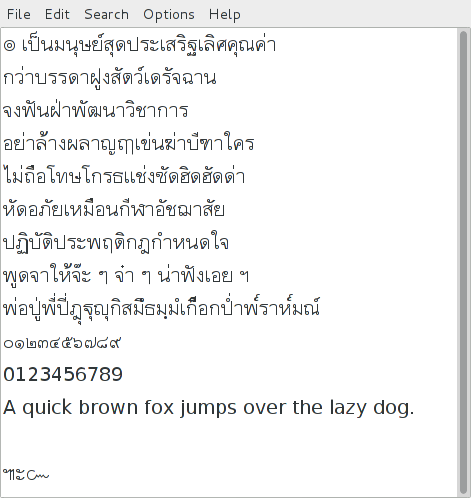
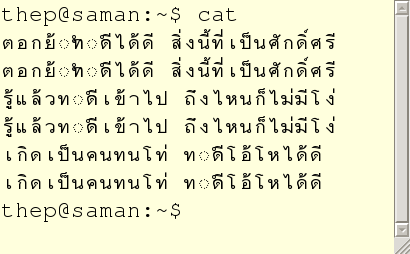
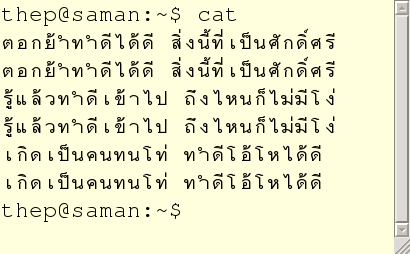
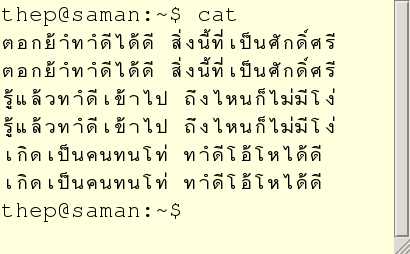
Theppitak Karoonboonyanan: Pango-HarfBuzz Merge and The Effects on Thai Module

One major change in GNOME 3.6 is Pango s shaper engines replacement with HarfBuzz. Only language engines (for word break analysis, for example) are retained. So, I m checking how this affects Thai/Lao rendering and what to do next. Over all, Behdad has put a good effort to make it right. Most Uniscribe behaviors have been achieved for compatibility. He even cares enough to cover some widespread Thai fonts in which the language tag 'latn' is used instead of 'thai', as seen in Mozilla #719366. Unfortunately, this font set has been declared as standard fonts in official documents. The workaround seems inevitable. Supported Fonts In my experiments with some existing Thai OpenType fonts, the new Pango still renders well without regression. Loma font from fonts-tlwg (glyph positioning with GPOS, rearrangement with GSUB): Loma on new Pango Arundina Sans font from Fonts-SIPA-Arundina (positioning by substitution, only GSUB, no GPOS): Arundina Sans on new Pango But for legacy fonts without OpenType features, it renders badly: Non-OpenType on new Pango In addition, according to Behdad, PUA glyphs in legacy fonts are not supported yet. This means there will be regression on fonts designed for Windows XP or below. But modern fonts designed for Windows 7 should be fine. Changes on Bugs The engine replacement from scratch certainly affects existing bugs. Some become obsolete, some still remain. Here are the summary for Thai/Lao engine, as resolved upstream: Closed bugs: Questionable bugs: Remaining bugs:

Bdale Garbee: FreedomBox 0.1

FreedomBox 0.1 Ian Sullivan posted a release announcement today regarding the first FreedomBox public release, which we're calling 0.1. This release is, frankly, long overdue. Getting here has been harder and taken much longer than any of us intended. Fortunately, now that we've reached this milestone, I believe that making regular progress towards the vision we have for a "1.0" release will get easier. FreedomBox is far from the only thing that I'll be working on after my upcoming early retirement from HP, but hopefully I will succeed in putting far more time towards the project soon than I have been able to in the past.

27 August 2012

Simon Josefsson: Using OATH Toolkit with Dropbox

Today there was an announcement that Dropbox supports two-factor authentication. On their page with detailed instructions there is (at the bottom) a link to the man page of the OATH Toolkit command line utility oathtool. OATH Toolkit is available in Ubuntu 12.04 and Debian Wheezy. (Note that the 1.10.4 version in Ubuntu does not support the base32 features.) There is not a lot of details in the documentation on Dropbox s site on how to use oathtool, but I have experimented a bit with the setup and I d like to share my findings. I assume you are somewhat familiar with the OATH Toolkit; if not I suggest reading my earlier introduction to OATH Toolkit. To use OATH Toolkit s command line utility to generate OTPs that are accepted by Dropbox, here is how you proceed. When you enable two-factor authentication on Dropbox s site, you must select Use a mobile app and on the next screen with the QR code image, click the enter your secret key manually link. You will then be presented with a code that looks like this: gr6d 5br7 25s6 vnck v4vl hlao re Now this code is actually space-delimitted base32 encoded data, without any padding. Since version 1.12.0, oathtool can read base32 encoded keys. However, parsing the raw string fails, so to make it work, you need to remove the spaces and add padding characters. I have yet to see any documentation on the Dropbox implementation, but I assume they always generate 16 binary octets that are base32 encoded into 26 characters like the codes that I have seen. The code is the cryptographic key used for the HMAC-SHA1 computation described in the RFC 6238 that specify OATH TOTP. If you study the base32 encoding you discover that 26 characters needs six pad characters. So converted into proper base32, the string would be gr6d5br725s6vnckv4vlhlaore======. Now generating OTPs are easy, see below.
jas@latte:~$ oathtool --verbose --totp --base32 "gr6d5br725s6vnckv4vlhlaore======"
Hex secret: 347c3e863fd765eab44aaf2ab3ac0e89
Base32 secret: GR6D5BR725S6VNCKV4VLHLAORE======
Digits: 6
Window size: 0
Step size (seconds): 30
Start time: 1970-01-01 00:00:00 UTC (0)
Current time: 2012-08-27 21:22:54 UTC (1346102574)
Counter: 0x2ACA9C5 (44870085)
125860
jas@latte:~$
Dropbox s implementation is robust in that it requests a valid OTP from me, generated using the secret they just displayed, before proceeding. This verifies that the user was able to import the key correctly, and that the users OATH TOTP implementation appears to work. If I type in the OTP generated from oathtool this way, it allowed me to enable two-factor authentication and I agreed. From that point, signing into the Dropbox service will require an OTP. I invoke the tool, using the same arguments as above, and the tool will use the current time to compute a fresh OTP. Reflecting on how things could work smoother, I suppose oathtool could be more permissive when it performs the base32 decoding so that the user doesn t have to fix the base32 spacing/padding manually. I ll consider this for future releases.

flattr this!

Christoph Berg: PostgreSQL in Debian Hackathon

Almost a year has passed since my talk at pgconf.eu 2011 in Amsterdam on Connecting the Debian and PostgreSQL worlds, and unfortunately little has happened on that front, mostly due to my limited spare time between family and job. pgapt.debian.net is up and running, but got few updates and is lagging behind on PostgreSQL releases. Luckily, we got the project moving. Dimitri Fontaine and Magnus Hagander suggested to do a face-to-face meeting, so we got together at my house for two days last week and discussed ideas, repository layouts, build scripts, and whatnot to get all of us aligned for pushing the project ahead. My employer sponsored my time off work for that. We almost finished moving the repository to postgresql.org infrastructure, barring some questions of how to hook the repository into the existing mirror infrastructure; this should get resolved this week. The build server running Jenkins is still located on my laptop, but moving this to a proper host will also happen really soon now. We are using Mika Prokop's jenkins-debian-glue scripts for driving the package build from Jenkins. The big plus point about Jenkins is that it makes executing jobs on different distributions and architectures in parallel much easier than a bunch of homemade shell scripts could get us with reasonable effort. Here's a list of random points we discussed: We really aim at using unmodified packages from Debian as much as possible, and in fact this project doesn't mean to replace Debian's PostgreSQL packaging work, but to extend it beyond the number of server versions (and Debian and Ubuntu versions covered) supported. The people behind the Debian and Ubuntu packages, and this repository are mostly the same, so we will claim that "our" packages will be the same quality as the "original" ones. Big thanks go to Martin Pitt for maintaining the postgresql-common testsuite that really covers every aspect of running PostgreSQL servers on Debian/Ubuntu systems. Stay tuned for updates! :)

Robert Collins: Why platform specific package systems exist and won t go away

A while back mdz blogged about challenges facing Ubuntu and other Linux distributions. He raises the point that runtime libraries for Python / Ruby etc have a unique set of issues because they tend to have their own packaging systems. Merely a month later he attended Debconf 2010 where a presentation was given on the issues that Java packages have on Dpkg based systems. Since then the conversation seems to have dried up. I ve been reminded of it recently in discussions within Canonical looking at how we deploy web services. Matt suggested some ways forward, including: I think its time we revisit and expand on those points. Nothing much has changed in how Ubuntu or other distributions approach integration with other packaging systems but the world has kept evolving. Internet access is growing ever more ubiquitous, more platforms are building packaging systems clojure, scala, node.js, to name but three, and a substantial and ever growing number of products expect to operate in a hybrid fashion with an evolving web service plus a local client which is kept up to date via package updates. Twitter, Facebook and Google Plus are three such products. Android has demonstrated a large scale app store on top of Linux, with its own custom packaging format. In order to expand them, we need some background context on the use cases that these different packaging systems need to support. Platforms such as antivirus scanners, node.js, Python, Clojure and so forth care a great deal about getting their software out to their users. They care about making it extremely easy to get the latest and greatest versions of their libraries. I say this because the evidence is all around us: every successful development community / product has built a targeted package management system which layers on top of Windows, and Mac OSX, and *nux. The only rational explanation I can come up for this behaviour is that the lower level operating system package management tools don t deliver what they need. E.g. this isn t as shallow as wanting a packaging system written in their own language, which would be easy to write off as parochialism rather than a thoughtful solution to their problems. In general packaging systems provide a language for shipping source or binary form, from one or more repositories, to users machines. They may support replications, and they may support multiple operating systems. They generally end up as graph traversal engines, pulling in dependencies of various sorts you can see the DOAP specification for an attempt at generic modelling of this. One problem that turns up rapidly when dealing with Linux distribution package managers is that the versions upstream packages have, and the versions a package has in e.g. Debian, differ. They differ because at some stage, someone will need to do a new package for the distribution when no upstream change has been made. This might be to apply a local patch, or it might be to correct a defect caused by a broken build server. Whatever the cause, there is a many to one relationship between the package versions that end users see via dpkg / rpm etc, and those that upstream ship. It is a near certainty that once this happens to a library package, that comparing package versions across different distribution packages becomes hard. You cannot reliably infer whether a given package version is sufficient as a dependency or not, when comparing binary packages between Red Hat and Debian. Or Debian and Ubuntu. The result of this is that even when the software (e.g. rpm) is available on multiple distributions (say Ubuntu and RHEL), or even on multiple operating systems (say Ubuntu and Windows), that many packages will /have/ to be targeted specifically to build and execute properly. (Obviously, compilation has to proceed separately for different architectures, its more the depedency metadata that says and build with version X of dependency Y that has to be customised). The result of this is that there is to the best of my knowledge no distribution of binary packages that targets Debian/Ubuntu and RHEL and Suse and Windows and Mac OS X, although there are vibrant communities building distributions of and for each in isolation. Some of the ports systems come close, but they are still focused on delivering to a small number of platforms. There s nothing that gives 99% coverage of users. And that means that to reach all their users, they have to write or adopt a new system. For any platform X, there is a strong pressure to have the platform be maintainable by folk that primarily work with X itself, or with the language that X is written in. Consider Python there is strong pressure to use C, or Python, and nothing else, for any tools that is somewhat parochial, but also just good engineering reducing variables and making the system more likely to be well maintained. The closest system I know of Steam is just now porting to Ubuntu (and perhaps Linux in general), and has reached its massive popularity by focusing entirely on applications for Windows, with Mac OSX a recent addition. Systems like pypi which have multi platform eggs do target the wide range of platforms I listed above, but they do so both narrowly and haphazardly: whether a binary or source package is available for a given platform is up to the maintainer of the package, and the packages themselves are dealing with a very narrow subset of the platforms complexity: Python provides compilation logic, they don t create generic C libraries with stable ABI s for use by other programs, they don t have turing complete scripts for dealing with configuration file management and so forth. Anti virus updaters similarly narrow the problem they deal with, and add constraints on latency- updates of anti virus signatures are time sensitive when a new rapidly spreading threat is detected. A minor point, but it adds to the friction of considering a single packaging tool for all needs is the different use cases of low level package management tools like dpkg or rpm vs the use cases that e.g. pypi has. A primary use case for packages on pypi is for them to be used by people that are not machine administrators. They don t have root, and don t want it. Contrast that with dpkg or rpm where the primary use case (to date) is the installation of system wide libraries and tools. Things like man page installation don t make any sense for non-system-wide package systems, whereas they are a primary feature for e.g. dpkg. In short, the per-platform/language tools are (generally):
  1. Written in languages that are familiar to the consumers of the tools.
  2. Targeted at use on top of existing platforms, by non-privileged users, and where temporary breakage is fine.
  3. Intended to get the software packaged in them onto widely disparate operating systems.
  4. Very narrow they make huge assumptions about how things can fit together, which their specific language/toolchain permits, and don t generalise beyond that.
  5. Don t provide for security updates in any specific form: that is left up to folk that ship individual things within the manager.
operating system package managers:
  1. Are written in languages which are very easy to bootstrap onto an architecture, and to deploy onto bare metal (as part of installation).
  2. Designed for delivering system components, and to avoid be able to upgrade the toolchain itself safely.
  3. Originally built to install onto one operating system, ports to other operating systems are usually fragile and only adopted in niche.
  4. Are hugely broad they install data, scripts, binaries, and need to know about late binding, system caches etc for every binary and runtime format the operating system supports
  5. Make special provision to allow security updates to be installed in a low latency fashion, without requiring anything consuming the package that is updated to change [but usually force-uninstalling anything that is super-tightly coupled to a library version].
Anti virus package managers:
  1. Exist to update daemons that run with system wide escalated privileges, or even file system layer drivers.
  2. Update datasets in realtime.
  3. Without permitting updates that are produced by third parties.
Given that, lets look at the routes Matt suggested Decoupling applications from the core as a strategy makes an assumption that the core and applications are partitionable. If they are not, then applications and the core will share common elements that need to be updated together. Consider, for instance, a Python application. If you run with a system installed Python, and it is built without zlib for some reason, but the Python application requires zlib, you have a problem. A classic example of this problem is facing Ubuntu today, with all the system provided tools moving to Python 3, but vast swathes of Python applications still being unported to Python 3 at all. Currently, the Python packaging system virtualenv/buildout + distribute don t provide a way to install the Python runtime itself, but will happily install their own components for everything up the stack from the runtime. Ubuntu makes extensive use of Python for its own tools, so the system Python has a lot of packages installed which buildout etc cannot ignore this often leads to issues with e.g. buildout, when the bootstrap environment has (say) zope.interfaces, but its then not accessible from the built-out environment that disables the standard sys.path (to achieve more robust separation). If we want to pursue decoupling, whether we build a new package manager or use e.g. virtualenv (or gem or npm or ), we ll need to be aware of this issue and perhaps offer, for an extended time, a dedicated no-frills, no-distro-packages install, to avoid it, and to allow an extended supported period for application authors without committing to a massive, distro sponsored porting effort. While its tempting to say we should install pip/npm/lein/maven and other external package systems, this is actually risky: they often evolve sufficiently fast that Ubuntu will be delivering an old, incompatible version of the tool to users well before Ubuntu goes out of support, or even befor the next release of Ubuntu. Treating data as a service. All the cases I ve seen so far of applications grabbing datasets from the web have depended on web infrastructure for validating the dataset. E.g. SSL certificates, or SSL + content checksums. Basically, small self-rolled distribution systems. I m likely ignorant of details here, and I depend on you, dear reader, to edumacate me. There is potential value in having data repackaged, when our packaging system has behind-firewall support, and the adhoc system that (for instance) a virus scanner system has does not. In this case, I specifically mean the problem of updated a machine which has no internet access, not even via a proxy. The challenge I see it is again the cross platform issue: The vendor will be supporting Ubuntu + Debian + RHEL + Suse, and from their perspective its probably cheaper to roll their own solution than to directly support dpkg + rpm + whatever Apple offer + Windows the skills to roll an adhoc distribution tool are more common than the skills to integrate closely with dpkg or rpm What about creating a set of interfaces for talking to dpkg / rpm / the system packagers on Windows and Mac OSX ? Here I think there is some promise, but it needs as Matt said careful thought. PackageKit isn t sufficient, at least today. There are, I think, two specific cases to cater to:
  1. The anti-virus / fresh data set case.
  2. The egg/gem/npm/ specific case.
For the egg/gem/npm case, we would need to support a pretty large set of common functionality, on Windows/Mac OSX / *nux (because otherwise upstream won t adopt what we create: losing 90% of their users (windows) or 5% (mac) isn t going to be well accepted :) . We d need to support multiple installations (because of mutually incompatible dependencies between applications), and we d need to support multiple language bindings in some fashion some approachable fashion where the upstream will feel capable of fixing and tweaking what we offer. We re going to need to support offline updates, replication, local builds, local repositories, and various signing strategies to match the various tradeoffs made by the upstream tools. For the anti-virus / fresh data case, we d need to support a similar set of operating systems, though I strongly suspect that there would be more tolerance for limited support in that most things in that space either have very platform specific code, or they are just a large-scale form of the egg/gem/npm problem, which also wants easy updates. What next? We should validate this discussion with at least two or three upstreams. Find out whats missing I suspect a lot and whats wrong I hope not much :) . Then we ll be in a position to decide if there is a tractable, widespread solution *possible*. Separately, we should stop fighting with upstreams that have their own packaging systems. They are satisfying different use cases than our core distro packaging systems are designed to solve. We should stop mindlessly repackaging things from e.g. eggs to debs, unless we need that specific thing as part of the transitive runtime or buildtime dependencies for the distribution itself. In particular, if us folk that build system packaging tools adopt and use the upstream application packaging tools, we can learn in a deep way the (real) advantages they have, and become more able to reason about how to unify the various engineering efforts going into them and perhaps even eventually satisfy them using dpkg/rpm on our machines.

25 August 2012

Benjamin Mako Hill: Visions of the Future

This vision of the future at Sam's No. 3 in Denver suggests that we will have ample blackboards after the apocalypse. Dell monitor re-purposed as a blackboard. And that the contrast will be greatly improved in direct sunlight.

24 August 2012

Jonathan Carter: Wheezy Theme Updates


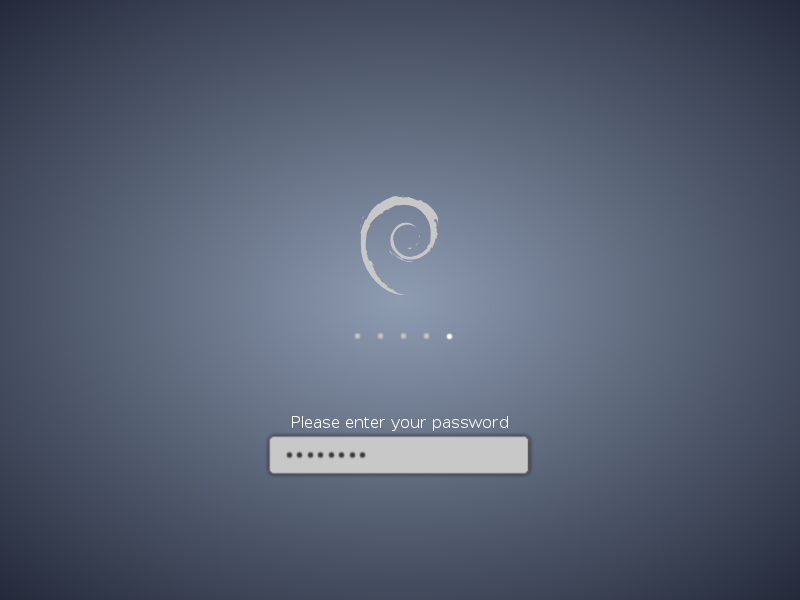
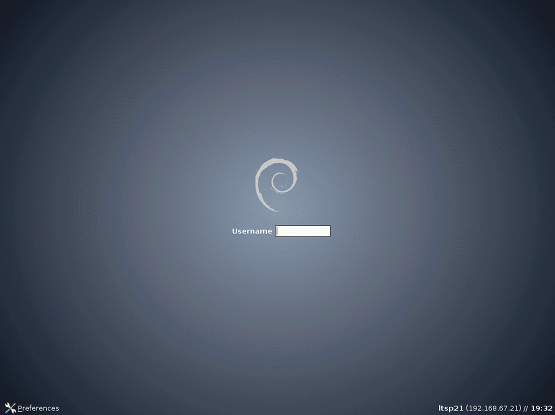
Joy Theme When the Joy theme was picked as the chosen theme for Debian 7.0 (Wheezy), I wanted to do what I could to get as much of it in the archive as possible before the freeze that occurred in June. I ve been working with Paul Tagliamonte and Vagrant Cascadian and I m glad that it resulted in some nice things! The Joy theme is modest and beautiful and I think Debian 7.0 is going to be one of the best looking Debian releases so far. Joy Plymouth Theme Plymouth is the part that provides the boot splash. It also takes care of a few other things, like showing prompts and progress indicators for filesystem checks, password prompts for encrypted devices and more so that the splash doesn t need to exit to show those. It s very scriptable, The installers for the Genesi Efika range of devices even use it for it s front-end. I needed to start with a Plymouth theme where I knew the prompts for all the things that happen during boot was at least more or less implemented, so I started off with one that I know works well, the Edubuntu one. So, fun fact: Debian 7.0 s Plymouth theme is actually based on the Edubuntu one. I had to play with the colours a bit to get it right, Edubuntu has a light background so I had to invert contrast for things like the input box, but I think it came out nicely. Splashy isn t in the archives anymore and it s not widely used anymore, so I cleaned it up from the desktop-base package so that there s less clutter shipped with it. Joy LTSP/LDM Theme This screenshot actually looks a bit uglier than it should because I took it on a VM that doesn t have 24bit colour, but we re looking into what we can do to make it look better on 16bit colour as well. During Debconf in Nigaragua, Vagrant and I worked on getting the LDM theme in shape. I have already done what I thought was most of the work by the time Debconf started, but it turns out there was a lot more to it to do it properly. We managed to get rid of the gtk2-engines-murrine dependency, which in itself is quite tiny, but it s a bit backwards in that it depends on the whole rest of the murrine-themes which brings in too much. We took the time to get the dependencies/recommends/etc right and to make it the default theme in Debian without messing it up for any Debian derivatives. It all came together and now when you install LTSP on Debian, you get the Joy theme by default! I m really glad about that because I didn t get the Spacefun LDM theme done in time for the Squeeze release. Enjoy!

22 August 2012

Gunnar Wolf: An industry commits suicide and blames us

[ once again, I am translating somebody else's material In this case, my good Costa Rican friend Carolina Flores. Please excuse my stylistic mistakes My English is far from native as you well know. But this material is worth sharing, and worth investing some tens of minutes doing a quick translation. If you can read Spanish, go read Caro's original entry ] Have you been to a music record store lately? I did so last Saturday, as a mere excercise. I was not planning on buying anything but I wanted to monitor things and confirm my suspicions. What was I suspicious of? First, that I would only find old records. And so it was: The only recent record I found was ...little broken hearts by Norah Jones. the second, that I would only find music for over 50 year old people. so it was: Were I there to look for a present for my father, I would have walked out with 10 good records. Third, that in the store nothing worth commenting would happen. About that last point, I should point out it was around 10 AM and the store had just opened its doors. Lets concede the benefit of doubt. I don't think many of you will remember, but in Barrio La California (where there is now a beauty parlour, almost in front of AM.PM) there was Auco Disco. In Auco Disco there was a guy specialized in rock (Mauricio Alice) and another one specialized in jazz (I don't remember his name). In that record you could always find rare records, but if they were not there, at least you were sure to find somebody to say: "No, we don't have that, but that's an excellent record, it's the best that [insert group here] have ever recorded because just afterwards they switched their guitar player, they had gone a bit south but with that record they are flying. But no, we don't have it; I can recommend you this record by [insert another group] because it has a guitar solo in track six that is amazing". It would happen more or less like that, which means, one would arrive to Auco Disco at 10 AM and leave around 5 PM with three new records, after having listened to a spectacular music selection. What happened to those stores? Were they killed by The Pirate Bay? That's the simplistic answer from the recording industry! The answer is that those stores never got anything from the industry but an invoice. The industry specially in prescindible markets such as ours was limited to hiring artists, taking care of them recording a sellable product, producing the object called record, and that's it. The more commercial radio stations were paid to program those songs as it cannot be casual that "Mosa, mosa" is the summer hit in all of Latin America, can it? but, record stores? Nothing. Lets carry on with that idea: Radio stations are paid to program said music. This idea should not lead us to believe that recording companies are to blame for bad taste. I won't reveal my sources, but I know the success of the "Locura autom tica" song by La Secta was a real example. Nobody paid for it. That song got to the number one because of its own merits(?) (you don't know the effort it took to find that thing, I cannot recommend it to you). Same thing happens with other stations that don't program reggaet n, that try to save the species, and where they play what we do like. But the thing is, everything we like is not available in any record store in this country. Then, even if we wanted to buy a record or give it as a gift to somebody, it is plain impossible. And don't tell me it's the same to present as a gift a link or a CD full of downloaded MP3 as it is to give a record with cover and booklet, wrapped in gift paper. I might be old-school, but the fetish object record still exists, not only because of its cover, but because of its sound. A 3MB MP3 is akin to drinking coffee dripping from a bag that has been used eight times with the same coffee beans. That format is the worst that has ever happened to music, and if we had any bit dignity we would never purchase digital files in Amazon or iTunes safe for MP3 with an acceptable compression level. That, if we could buy them, because not only that is allowed to us. As the musical industry has no interest in resolving ITS problem (that is not our problem, it is those companies') it has not even been resolved how to charge for a MP3 download that includes import fees (well, if downloading from here a MP3 from a USA-based file server can be considered importing goods into Costa Rica!!!) so we don't have to get dizzy entering into the nineties to Titi Online to discover there is nothing by Muse, Andrew Bird, The Killers, Death Cab for Cutie, Paramore, Bj rk... (believe me, I looked them all up, even Norah jones and La Secta. They also were not there). This all leads me to the question, which I present with all due respect (NOT): What the fuck do they expect us to do??? It is outrageous; above all because in the best case they will sell us a watery coffee download that won't allow us to get all the details a vinyl or less compression would give us. In the worst case, post-MP3 groups will end up recording music with no harmonics or hidden sounds, because, what for? Nobody will hear it. They even admit it: "Some musicians and audio engineers say the MP3 format is changing the way studios mix their recordings. They say the MP3 format "flattens" dynamics differences in tone and volume in a song. As a result, a great deal of new music sounds very much alike, and there is nothing as focusing to create a dynamic listening experience. Why working so hard in creating complex sound if nobody can detect it?" (Rolling Stone, The Death of High fidelity, December 26 2007, taken from here). That's why I am not surprised by Adri n's post regarding the sales of old records. The price has nothing to do with it. The causes are related to the fetish object record and what it means or does not mean for people that have never purchased one. Adri n also asks if somebody here keeps buying records. I answered that I would if the stores sold anything I like. I do it even after the nausea I feel while reading "This phonogram is an intellectual work protected in favor of its producer COPYING IT IN WHOLE OR PARTIALLY IS FORBIDDEN " (like that, uppercased, yelling to whoever is only guilty of having bought a record and defending the producer, not the artist). But I am sure that almost nobody buys records because doing so is no longer a gratifying experience; because if buying a record is clicking to wait 15 days for it to reach the mailbox, we prefer clicking on the download link. But there is another reason for people not to buy records anymore. In one of my talks regarding the dictatorship of the all rights reserved, I asked the 30 twenty-something-year-old students if any of them had ever bought a record. One answered he had, because he is an author and performer (cantautor in Spanish) and understands the effort that producing a record entails. The rest of them had never done so. Is it possible that said young people have never listened to real music? Is it possible that, were it not for concerts, what they consider music is a set of washed-out MP3 that are about to fill up 1TB of their computer? Does people no longer buy records because they cannot differentiate one sound from the other? It is not very clear for me where do I want to get to. The recording industry is despicable. An industry that instead of innovating sets its energy on suing adolescents for downloading songs, trying to pass laws restricting our freedoms in Internet, putting up DRMs making us hostages to our devices* and forcing us to listen just the aroma of music, deserves my whole contempt. If we add ot this that said industry won't allow us to legally download their breadcrumbs because it has not understood that Internet does not need a van crossing borders, besides my contempt they deserve my pity and my heartfelt condolence. But the condolence is also for music, real music, that which is not compressed under the shoe using a terrible format. It is also for independent musicians that have not realized that begging for a bit of space to that industry they just add to themselves the "despicable" tag, given they deserve the fruits of their work to enter their bank account. However, there are good things that have come out of this absurdity. Be it for those that have joined projects such as Aut mata (even if it is in MP3) and for dreams come true such as Musopen (that have achieved that the music that's in theory Public Domain becomes so in practice as well). Good for the Electronic Frontier Foundation and the list of lawyers willing to defend people accused of ilegally downloading music in the USA. Good for the Creative Commons licenses that allow free sharing. All those are growing solutions, although none of them allows me to buy the Panamanian Carlos M ndez's record. Thankfully, a friend of mine who knows I will never give a dime to Apple, bought the files for me in iTunes. I thank him deeply, although I would have prefered to go to Auco Disco and have Mauricio tell me that the 2007 EP I have from Carlos is better than the record he did on 2009. * My devices don't have DRM because I use free software. I also use the ogg file format. Image by verbeeldingskr8


Steve McIntyre: More progress on EFI Debian CDs

Continuing on from my first EFI progress report... My first alpha release of a Wheezy netinst CD for amd64 EFI worked OK for me and a few others, with reasonable feedback. But it was far from complete, with (at least) three outstanding issues: In the days since then, I've carried on hacking on things. I've not yet sorted out hybrid boot, but I've fixed the other issues. To make graphics work on the grub boot menu was a simple case of loading the right module from grub.cfg ("insmod png"). Getting grub-efi to work took quite a lot more effort, though. I've been looking through Ubuntu's version of debian-installer code and merged a fair amount of their code into my local builds, adding tweaks as necessary. Result? I've got another CD alpha release ready for testing. Yay! Grab the image from http://cdimage.debian.org/cdimage/unofficial/efi-development/upload2/ if you'd like to help test it. Please do, and let me know via debian-boot/debian-cd how you get on. As previously, the "bits" subdirectory contains all the tweaked d-i packages I've played with, in both source and binary form. My debian-cd changes are still in my branch but are just about ready for merging I think. I'll post more d-i patches to the debian-boot list for review shortly.

Thomas Goirand: MiniUPnP now fully in Debian

IT S FINALLY IN! With this last upload of the MiniUPnP daemon 1.7-3, I ve reached a first milestone: all of the MiniUPnP libraries, daemons and clients are finally in Debian, in a shape which I am not ashamed anymore. What is UPnP for? Back in the days (around Linux 2.0.3x), the only way to share a single Internet connection was to run a Linux box as your gateway. These days are far gone, and nearly every home connection is done through a mini home router, which also often provides a small switch and a WiFi access point. Every computer on the LAN gets its connectivity through the router thanks to NAT, and to be more accurate, masquerading. That works very well for outbound connections (browse the web, send a mail, etc.), but it is then a lot harder that something connects to a server located in the LAN. If you run a permanent server with a fixed LAN IP address, that s fine, you just configure your router to do some port forwarding, so that any inbound connection will be forwarded to the computer of your choice in the LAN. But if one application needs to listen on the public IP address just for a while (for example, IRC using DCC connection), so that something can connect to it, it becomes a way more tricky. That s when UPnP comes into play. UPnP stands for Universal Plug and Play. It s a protocol so that any application on the LAN can open ports on the public IP address of the gateway. Note that an UPnP router is also often referenced as UPnP IGD (Internet Gateway Device). Why using MiniUPnP, don t we have already linux-igd? Before my packaging work, the only UPnP server that was available in Debian was linux-igd, which has a dependency on libupnpX. That library is quite big for what it does (about 500KiB, on top of which you have to install the 200KiB daemon itself), while MiniUPnP is designed to be lightweight (only 158K, with dependencies on iptables, iproute, uuid-runtime and libc6 only). That seems ridiculous, but when you have only 8MiB of flash in your old router, saving few hundreds KiB is really important, and here, we re saving more than 500 KiB, with a full implementation of the UPnP protocol, and the Microsoft NATPmP implemented as well (yes, Microsoft decided that one protocol wasn t enough, and that they should implement their own (sic!)). Who is using MiniUPNP? Probably, you already have the libminiupnpc installed in your SID/wheezy desktop, because the transmission bittorent client which is installed with Gnome by default, depends on it, and minissdpd might be in your desktop too, if you installed the Recommends: packages as well. Which is why these are scoring quite high already in popcon. Previously, transmission was embedding its own version of the MiniUPnP client library, so it s nice to have it as a standalone shared library now. Also, because of its very light weight, and the fact that UPnP is often needed for gaming (both XBOX 360 and PSP need, and can use, the MiniUPnP daemon that runs on your IGD), many ISP who ship a router to their customer, install MiniUPnP in it. For example, at least, the 2nd and 3rd largest Internet access provider in France (Free Telecom and SFR) are shipping MiniUPnPd in their box (one of them using OpenWRT on their router). So probably as well, you are also using MiniUPnP daemon without knowing it. But isn t UPnP unsafe? To this question, I d answer that connecting to Internet is unsafe. It isn t less safe than connecting to Internet on a WiFi hotspot for example. So adding UPnP support on your gateway doesn t make it less safe, especially since MiniUPnP has some features to help with security (like an ACL with IP and port lists, or a secure mode were the router will only open ports to the client requesting it). Also, we are running a distribution where dependencies are easy to check, so it s easy for you to check if a client uses UPnP or not, and decide to trust it (or not). I personally have no issue trusting transmission, x-chat or warzone2010 (more exactly: I don t trust that incoming connectivity will make it less safe for these applications, there are so many other things that could go wrong). MiniUPnP consists of what? MiniUPnP is a set of 4 source packages to handle all of your UPnP needs: - The client library, libminiupnpc (and the corresponding -dev package), with its sidekick miniupnpc client program (you can use it to check the public IP of your gateway, or manually open ports). - The UPnP IGD daemon, miniupnpd, which just reached Debian Experimental. The latest version, 1.7-3, also includes debconf configuration so that you can choose the NIC and IP address to bind on. If you installed previous version, I strongly recommend upgrading to fix previous problems. - The libnatpmp client library (and the -dev package) for implementing the Microsoft protocol as a client (it also has a client package binary for your tests). - The minissdpd daemon to keep memory of all UPnP devices that announced themselves, and speed-up using the UPnP protocol (used by the MiniUPnP client library). A long process to have MiniUPnP in Debian All these 4 pieces of the puzzle were not as easy as it seems to be packaged in Debian. Especially, the IGD daemon, MiniUPnPd, used to depend on some header files that were not packaged in Debian. This was a decision of the iptables maintainers, which even after a long discussion, refused to add the necessary headers because it wasn t supposed to be a kernel API. While this might really be truth, the issue was that there was no public API available in the Linux kernel at all, and other distributions (Fedora, Gentoo, etc.) really did supply these needed files. As a consequence, during a very long time (years literally), shamefully, it was impossible to build the MiniUPnP daemon in Debian, while it was no problem on other distributions. Note that I do not want to start a troll discussion here, I m just stating facts, both parties have very strong and respectable arguments. Anyway, this needed API was finally embedded in MiniUPnPd itself thanks to a contributor to the project, and now it builds on both the Squeeze and the Wheezy (that is Linux 3.2) kernel without any issue. Call for testing Unfortunately, I don t have a Linux box as my Internet gateway. So I did the tests that I could: I installed MiniUPnPd on one computer on my LAN, and checked that I could open ports from another computer. So it seems to work, but I had no way to really test it live , with some real clients. So if you have an Debian SID box as your Internet gateway, feedback would be highly appreciated. What is remaining to do? A transition from libminiupnpc5 to libminiupnpc8 has to happen. Of course, this is too late for Wheezy, so this will happen right after the release. There s not so many reverse dependencies, so it should be ok, but I (yet) have zero experience with transitions. BTW, I had hard time to find out what this transition process was, and maybe some more effort for documenting it would help others (I m thinking about adding some text in the Debian wiki for that). Also, I have called for help on debian-devel, because I m currently the only one maintaining all these 4 source packages, and I m trying to have all my packages checked by others, and team maintained. So if you want to give a hand, or just declare yourself as a backup if I m busy, please raise your hand! Upstream is a friend of mine, and is very reactive to any requests (it very rarely took more than 48 hours to get a reply). Enjoy MiniUPnP and report bugs! Again, feedback would be appreciated. :)

21 August 2012

Mirco Bauer: Smuxi 0.8.10 "Tracy" Release

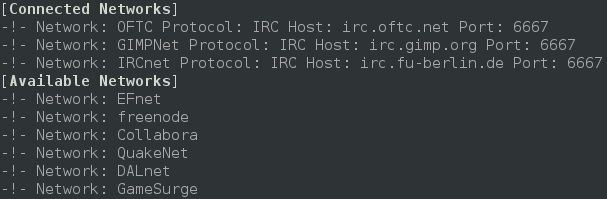
As longingly awaited I am very happy to announce Smuxi 0.8.10 codenamed "Tracy". During the development 8 bug reports and 15 feature requests in 136 commits were worked on making this release a major feature and minor bugfix release. Screenshot of Smuxi 0.8.10 in action Notable highlights in this release are: Integrated Spell Checking Everyone knows the "how do you spell that word again?" situation and either you don't care and send a possible typo or you go checking a dictionary which is kind of annoying. The good news is: with this release you no longer need to do that, as Smuxi includes automatic spell checking while you type messages. The bad news is that this feature is currently limited to Linux builds, and thus OSX and Windows build do not ship with it. The installers need to be extended and I haven't found pre-compiled OSX nor Windows binaries for the GTK+ spell checking library. Screenshot of Smuxi 0.8.10 showing spell checking in action Favicons for Server Tabs Distinguishing server tabs can be difficult, especially if you have plenty of them. All server tabs have the same icon so you need to search for the right name. I wondered why this issue doesn't happen so easily with a web browser which usually also has lots of tabs open. Besides the page name there is the favicon right in front. So why can't Smuxi make use of that simple but effective technology? Well, now it does! You connect to a known network, and Smuxi will download and show the favicon of the website. It just works and does everything in the background for you. Screenshot of Smuxi 0.8.10 showing favicons in action Quick Join Bar One thing that makes IRC really difficult for new comers is the important IRC concept that channels are network specific. So what happens is people try to find / join the channel they are looking for but on the wrong network. They have to connect to the right server/network and then switch to the right tab, before they can join the channel (using the /join command or join dialog). The developers of Smuxi had a brainstorming session and came up with something that should be easy enough for anyone to use and finally solves the issue: the quick join bar. You know which channel you want to join and which network, you enter the channel name, select the network from the list and hit the "Join Chat" button and you are done. Now Smuxi will do just the right thing for you and connects to that network if needed, joins the channel if needed, or switches to the channel if you are already there! Click here for a screencast of the Quick Join Bar in action Indention of multi-line messages Messages on IRC and also Twitter are often longer than a single line in Smuxi can show, thus it has to be split into a second line or more. The issue here is that the continuation line looks cluttered because it doesn't align with the first line. Here you can see an example for this issue: Screenshot of Smuxi 0.8.9 showing line breaks Ewww, that looks ugly, doesn't it? I will make this one short, here is the cure with indented multi-line messages: Screenshot of Smuxi 0.8.10 showing line breaks Enhanced Text Frontend The text frontend which is still in alpha state has received the following enhancements: new /exit command, new /help command, regular and xterm window title, and, several fixed crashes. Screenshot of Smuxi 0.8.10's text frontend Enhanced Commands The /network command by default shows now all connected and also available networks: Screenshot of Smuxi 0.8.10 showing network command The /connect command now allows you to connect by network name like this:



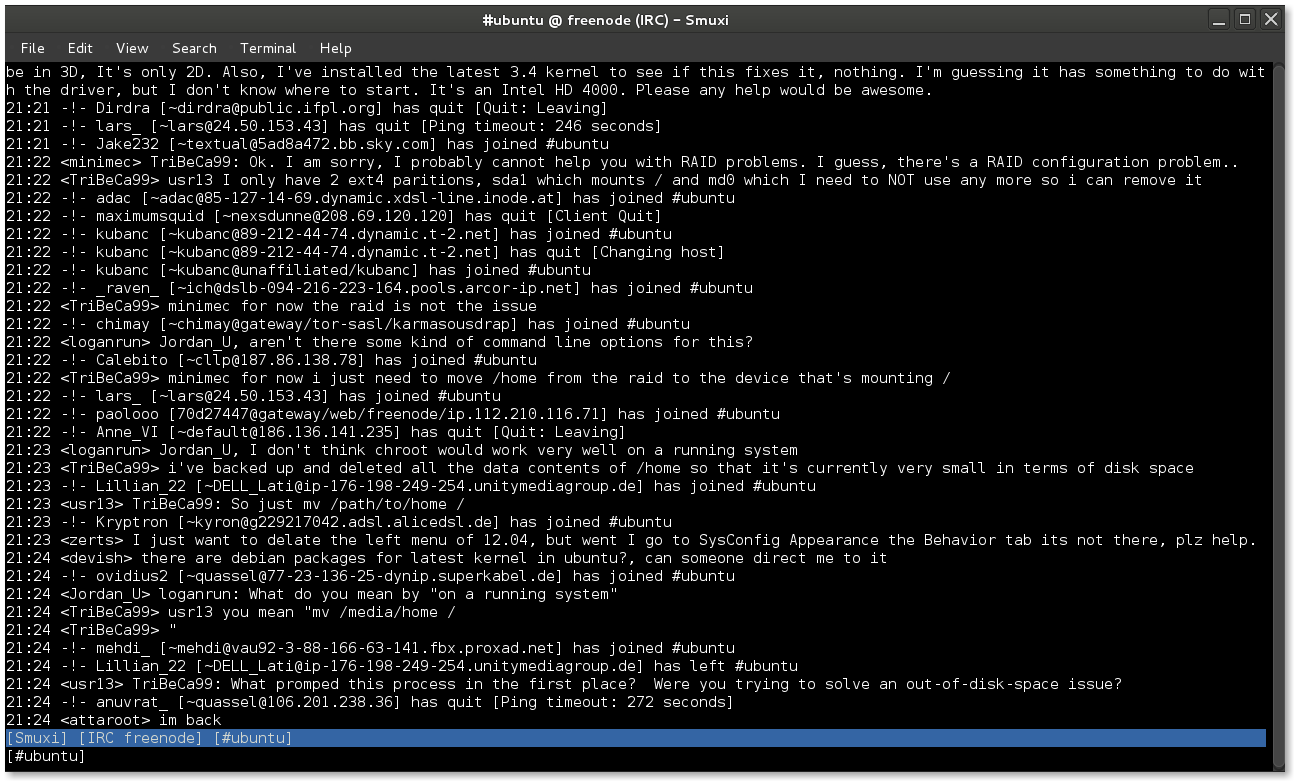
/connect freenode
Updated Translations
  • Portuguese (Pedro Ribeiro)
  • Chinese Simp (Dean Lee)
  • Danish (Joe Hansen)
  • Swedish (Martin Bagge)
  • Russian (Yuri Myasoedov)
New Translations
  • Croatian (Matias M)
  • partially Polish (lukasznaw)
Contributors Contributors to this release are the following people:
  • Mirco Bauer (126 commits)
  • Bianca Mix (translations)
  • Dean Lee (translations)
  • Joe Hansen (translations)
  • Yuri Myasoedov (translations)
  • Pedro Ribeiro (translations)
  • Matias M (translations)
  • Martin Bagge (translations)
  • lukasznaw (translations)
Thank you very much for your contributions to Smuxi! Already horny? Go here and get some! Update: Smuxi 0.8.10.1 About 2 months after the 0.8.10 release, Smuxi 0.8.10.1 with only important bugfixes and translation updates was released. This release includes the following 6 bugfixes: smuxi-server now honors the timezone of tweets, fixed a connection crash with InspIRCd-2.0 servers, quick join no longer opens another network tab, closing chats no longer crashes Smuxi sometimes, /connect irc.some-server.com works again and focusing the message area moves the focus back to the entry again.
Posted Tue Aug 21 23:16:05 2012

Alexander Pashaliyski: Google Summer of Code 2012 Clang support for build services in Debian Final Result

In the process of installing and configuring wanna-build, I had lots of problems. Because there was almost no documentation on the subject (and some of the existing was outdated), I had to figure out how everything works by reading the source code and asking people on IRC and mailing lists. I use the most recent version (from git) and since it s not stable, there were some problems and bugs. I fixed several bugs in order to set the system up. I also documented every step so now there s documentation on everything I have done. I uploaded the documentation on installing and configuring wanna-build [0]. I installed and configured reprepro on a local machine in order to use it with wanna-build. In the process I made step-by step setup instructions [1]. I installed and configured sbuild. The lastest version of sbuild contains filters but they don t work. Their purpose is to keep only the necessary variables in the environment, but apparenly the configuration file which should set them is never read. That leaves the filter list empty which causes the environment to be empty. I had to disable them to keep my work going. I installed buildd. I had some problems setting it up there was a bug in the scripts related to parsing the configuration file. I was pointed to a helpful bug report on the topic and with some additional changes I eventually got it working. In the process I had to read some of the source code of buildd. I made a patch that fixes a bug in the manual page of reprepro and got it approved. I contacted the Alioth admin team via the web site, requesting to use their server for my project Clang for build services . I got approved and I created a git repository where I m now uploading my work. The repository that I use to upload changes to sbuild and buildd is [2]. I add the name of the used compiler to the control file and to the name of the deb package. I wrote a function for parsing the debian/rules file looking for hard-coded compiler there. If there is such compiler, which is different from the one chosen as a default, the building proccess exits with a clear error. I made changes to wanna-build, dpkg, sbuild and buildd to fix bugs in them and make it possible to use a compiler different from gcc for the build process.
After my work a build compiler can be set easily. If a package can not be built with that compiler, the build process fails with a clear error. I also modified the pgstatus web interface to display build logs and create reports on user request. I wrote complete documentation about setting up wanna-build, reprepro and buildd ([0] and [1]). This makes a fully functional buildd infrastructure. Now we have a full step by step tutorial. Me and Sylvestre Ledru who was my great mentor, modified the buildd daemon so it will be possible to be run several instances of it for different architectures on a single physical server. I made a lot of changes to pgstatus this is a web interface to the wanna-build database. I had to add some features and fix several problems. In the process I read some of the code of pgstatus and buildd-tools. Now I have a better understanding of how they work. I added a new feature in pgstatus that allows the user to create a full report of the state of all builds. When a designated reports page is opened, a table with the current state of the builds is shown, together with a list of all the reports saved to files for the current distribution and architecture. The reports can be downloaded directly from the
interface. They are stored in JSON format. The log files were not accessible from pgstatus because of lack of implementation and bugs. I created a script that reads emails sent by wanna-build and extracts log files from them. I made changes to wanna-build so that it feeds the database with the necessary information about package history. I updated the wanna-build patch to include these changes. As a result the buildd logs can now be opened from the web interface of pgstatus. I applied a patch that fixes bug [3] so that config_schroot.sh (this script installs and sets the default compiler) starts with the necessary privileges. I added a new feature to sbuild that allows scripts to be run right after the dependencies are installed in the chroot and before the actual package starts building. Now anybody can configure sbuild to run such a script by modifying the appropriate configuration file. By adding the following lines: $external_commands =
chroot-pre-build-commands => [
['/root/purge-gcc.sh'],
],
; The script /root/purge-gcc.sh is run by sbuild in the chroot. This script can be necessary to set everything in the environment so that packages are built exactly as needed. Me and my mentor used this to replace gcc with a script that removes all gcc-specific packages so that we can be sure whether a package uses clang or not. I have a fully functional buildd infrastructure installed on my development system. In order to get it running, I made several patches: dpkg.patch The main patch with a lot of changes related to compiler support for building.
wanna_build.patch Fixes bugs and makes wanna-build feed the database with package history information.
sbuild.patch Fixes bugs and work-arounds the problem that some sbuild scripts are called without reading the configuration file of sbuild. Adds configuration option that allows scripts to be run right after the dependencies are installed in the chroot and before the actual package starts building.
pgstatus.patch Fixes bugs and adds reports page to pgstatus. Me and my mentor contacted the Debian wanna-build team to connect our new service with Debian. We explained what the current state of the project is and what we need from them. I thank my mentor Sylvestre Ledru for his presentation on DebConf 12 ([4], [5]). He showed our project and it was seen that people are interested in it. A nice resume of his talk has been made by Michael Larabel on Phoronix [6]. I tested everything thoroughly to make sure my changes don t break anything. I am happy to say that the project is now finished. ==== [0] http://wiki.debian.org/DebianWannaBuildInfrastructureOnOneServer
[1] http://wiki.debian.org/SetupBuildServiceForWanna-build
[2] http://anonscm.debian.org/gitweb/?p=pkg-llvm/clang-build.git;a=summary
[3] http://bugs.debian.org/cgi-bin/bugreport.cgi?bug=608840
[4] http://sylvestre.ledru.info/blog/media/5/rebuild-debian-presentation-clang-July-10.pdf
[5] http://meetings-archive.debian.net/pub/debian-meetings/2012/debconf12/high/884_Build_Debian_with_another_compiler.ogv
[6] http://www.phoronix.com/scan.php?page=news_item&px=MTEzODQ

Russell Coker: Mirror Displays

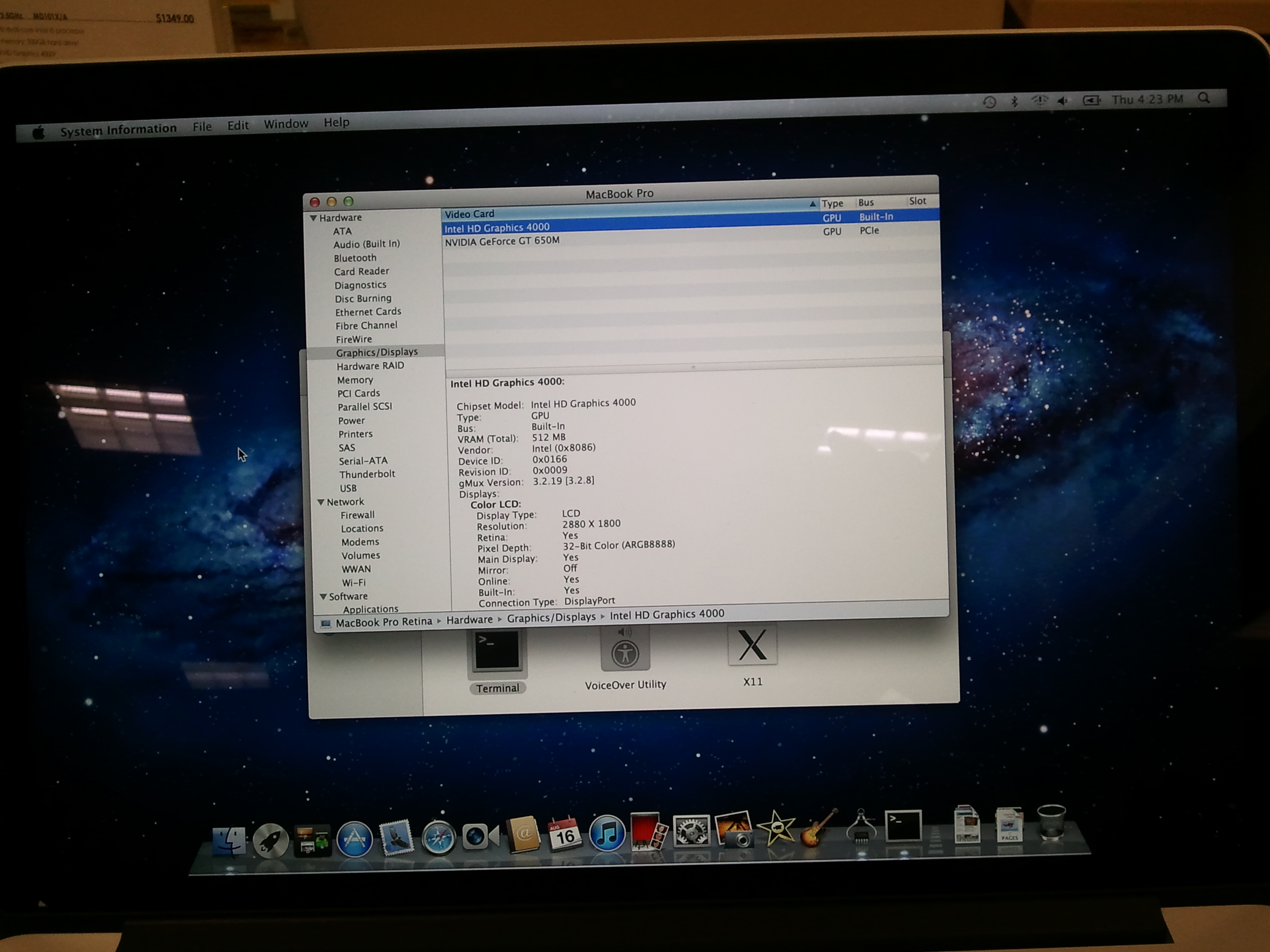
Image of a Macbook Pro with a Retina display showing how badly it reflects When I previously wrote about the Retina display in the new Macbook Pro I was so excited that I forgot to even check whether the display reflects light [1]. A TFT display with a mirrored surface apparently permits more intense color which is generally a good thing. It also makes it easier to clean the surface which is really important for phones and tablets. The down-side of a mirrored surface on a display is that it can reflect whatever else is in the area. This generally isn t a problem in an office as you can usually adjust the angle of the monitor and the background lighting to avoid the worst problems. It s also not a serious problem for a hand-held device as it s usually easy to hold it at an angle such that you don t have light from anything particularly bright reflecting. But my experience of laptop use includes using them anywhere at any time. I ve done a lot of coding on all forms of public transport in all weather conditions. Doing that with a Thinkpad which has a matte surface on it s screen is often difficult but almost always possible. Doing that on a system with a mirrored display really isn t possible. The above photo of a 15 Macbook Pro model MD103X/A was taken at a Myer store which was specifically designed to make the computers look their best. The overall lighting wasn t particularly bright so that the background didn t reflect too much and the individual lights were diffuse to avoid dazzling point reflections. But even so the lights can be clearly seen. Note that the photo was taken with a Samsung Galaxy S, far from the best possible camera. If I was buying a laptop that would only ever be used in the more northern parts of Europe or if I was buying a laptop to use only at home and at the office then I might consider a mirror display. But as I mostly use my laptop in mainland Australia including trips to tropical parts of Australia and I use it in all manner of locations a mirror display isn t going to work for me. This isn t necessarily a bad decision by Apple designers. My observation of Macbook use includes lots of people using them only in offices and homes. Of the serious geeks who describe their laptop as My Precious hardly anyone has a Macbook while Thinkpads seem quite popular in that market segment. I don t think that it s just the matte screen that attracts serious geeks to the Thinkpad, but it does seem like part of a series of design decisions (which include the past tradition of supporting hard drive removal without tools and the option of a second hard drive for RAID-1) that make Thinkpads more suitable for geeks than Macbooks. While the new tradition in Apple design of gluing things together so they can never be repaired, recycled, or even have their battery replaced seems part of a pattern that goes against geek use. Even when Apple products are technically superior in some ways their catering to the less technical buyers makes them unsuitable to people like me. Maybe the ability to use a Macbook as a shaving mirror could be handy, but I d rather grow a beard and use a Thinkpad. Related posts:
  1. The Retina Display Last night I played with an Apple Macbook Pro with...
  2. are Thinkpads meant to run 24*7? My Thinkpad has started to run hot recently. If I...
  3. presentations and background color In response to my last post about using laptops for...

20 August 2012

Lars Wirzenius: Baserock, or what I've been doing at work last year

I was hired last year ago by Codethink to work on Baserock, a new method and toolset for developing embedded Linux systems. While I don't have a lot of experience developing embedded Linux systems specifically, I have a fair bit of experience devoloping Linux distributions, from Debian and Ubuntu, and that's quite similar. I had already written up some ideas for doing test driven distro development, and system level branching and merging. Then I got hired to do that stuff for real. Baserock is still a work in progress, but we've just made a public development release of the free software version, and I can now talk about it. This blog post is my own; I am not talking for my employer. I won't write about all the aspects and features of Baserock, since that would make this blog post really long. You can read that stuff in the wiki, anyway, and ask questions on the Baserock mailing list and IRC channel if you're curious. I just thought I'd mention what I've been doing this past year at work. However, there's one thing I want to especially mention: I'm excited. Getting to re-invent workflows and tools for system development is fun. I can get up in the morning, decide to try a new version of gcc, make the one line change, and run the one shell command to rebuild everything, and play with the new system pretty soon after. And if it doesn't work, no worries, I'll just not merge that branch into the mainstream. And then I still have time for other things that workday. Baserock is getting rid of the unnecessary friction in system development, all the stupid little things you have to do just to keep working. That is going to make a lot of developers lives better in this corner of the software development universe.

Steve Kemp: Failing to debug a crash with epiphany-browser and webkit

Today I'm in bed, because I have le sniffles, and a painful headache. I'm using epiphany to write this post, via VNC to my main desktop, but I'm hating it as I've somehow evolved into a state where the following crashes my browser: Running under GDB shows nothing terribly helpful:
Program received signal SIGSEGV, Segmentation fault.
0x0000000000000000 in ?? ()
(gdb) bt
#0  0x0000000000000000 in ?? ()
#1  0x00007ffff51a0a46 in ?? () from /usr/lib/libwebkit-1.0.so.2
#2  0x00007ffff3d8f79d in ?? () from /usr/lib/libsoup-2.4.so.1
#3  0x00007ffff2a4947e in g_closure_invoke () from /usr/lib/libgobject-2.0.so.0
#4  0x00007ffff2a5f7f4 in ?? () from /usr/lib/libgobject-2.0.so.0
...
To get more detail I ran "apt-get install epiphany-browser-dbg" - this narrows down the crash, but not in a useful way:
Program received signal SIGSEGV, Segmentation fault.
0x0000000000000000 in ?? ()
(gdb) bt
#0  0x0000000000000000 in ?? ()
#1  0x00007ffff51a0a46 in finishedCallback (session=<value optimized out>, msg=0x7fffd801d9c0, data=<value optimized="optimized" out="out">) at ../WebCore/platform/network/soup/ResourceHandleSoup.cpp:329
#2  0x00007ffff3d8f79d in ?? () from /usr/lib/libsoup-2.4.so.1
#3  0x00007ffff2a4947e in g_closure_invoke () from /usr/lib/libgobject-2.0.so.0
#4  0x00007ffff2a5f7f4 in ?? () from /usr/lib/libgobject-2.0.so.0
..
So this crash happens in ResourceHandleSoup.cpp. Slowly I realized that this came from the webkit package. We see that the last call by name is to the function in line ResourceHandleSoup.cpp:329, that puts us at the last line of this function:
// Called at the end of the message, with all the necessary about the last informations.
// Doesn't get called for redirects.
static void finishedCallback(SoupSession *session, SoupMessage* msg, gpointer data)
 
    RefPtr<ResourceHandle> handle = adoptRef(static_cast<ResourceHandle*>(data));
    // TODO: maybe we should run this code even if there's no client?
    if (!handle)
        return;
    ResourceHandleInternal* d = handle->getInternal();
    ResourceHandleClient* client = handle->client();
    if (!client)
       return;
..
..
    client->didFinishLoading(handle.get());
 
So we see there is some validation that happens, then a call to "didFinishLoading" and somewhere shortly after that it dies. didFinishLoading looks trivial:
void WebCoreSynchronousLoader::didFinishLoading(ResourceHandle*)
 
      g_main_loop_quit(m_mainLoop);
      m_finished = true;
 
So my mental-debugging is stymied. I blame my headache. It looks like there is no obvious NULL-pointer deference, if we pretend client cannot be NULL. So the next step is to get the source, the build-dependencies and then build a debug version of webkit. I ran "apt-get source webkit", then editted the file ./debian/rules to add --enable-debug and rebuilt it:
skx@precious:~/Debian/epiphany/webkit-1.2.7$ DEB_BUILD_OPTIONS="nostrip noopt" debuild -sa
*time passes* The build fails:
  CXX    WebCore/svg/libwebkit_1_0_la-SVGUseElement.lo
../WebCore/svg/SVGUseElement.cpp: In member function  virtual void WebCore::SVGUseElement::insertedIntoDocument() :
../WebCore/svg/SVGUseElement.cpp:125: error:  class WebCore::Document  has no member named  isXHTMLDocument 
../WebCore/svg/SVGUseElement.cpp:125: error:  class WebCore::Document  has no member named  parser 
make[2]: *** [WebCore/svg/libwebkit_1_0_la-SVGUseElement.lo] Error 1
Ugh. So I guess we disable that "--enable-debug", and hope that "nostrip noopt" helps instead. *Thorin sits down and starts singing about gold* Finally the debugging build has finished and I've woken up again. Let us do this thing. I'd looked over the webkit tracker and the crashing bugs list in the meantime, but nothing jumped out at me as being similar to my issue. Anyway without the --enable-debug flag present in the call to ../configure the Debian webkit packages were built, eventually, and installed:
skx@precious:~/Debian/epiphany$ mv libwebkit-dev_1.2.7-0+squeeze2_amd64.deb x.deb
skx@precious:~/Debian/epiphany$ sudo dpkg --install libweb*deb
[sudo] password for skx:
(Reading database ... 173767 files and directories currently installed.)
Preparing to replace libwebkit-1.0-2 1.2.7-0+squeeze2 (using libwebkit-1.0-2_1.2.7-0+squeeze2_amd64.deb) ...
Unpacking replacement libwebkit-1.0-2 ...
Preparing to replace libwebkit-1.0-2-dbg 1.2.7-0+squeeze2 (using libwebkit-1.0-2-dbg_1.2.7-0+squeeze2_amd64.deb) ...
Unpacking replacement libwebkit-1.0-2-dbg ...
Preparing to replace libwebkit-1.0-common 1.2.7-0+squeeze2 (using libwebkit-1.0-common_1.2.7-0+squeeze2_all.deb) ...
Unpacking replacement libwebkit-1.0-common ...
Setting up libwebkit-1.0-common (1.2.7-0+squeeze2) ...
Setting up libwebkit-1.0-2 (1.2.7-0+squeeze2) ...
Setting up libwebkit-1.0-2-dbg (1.2.7-0+squeeze2) ...
skx@precious:~/Debian/epiphany$
Good news everybody: The crash still happens! Firing up GDB should hopefully reveal more details - but sadly it didn't.
Program received signal SIGSEGV, Segmentation fault.
0x0000000000000000 in ?? ()
(gdb) bt
#0  0x0000000000000000 in ?? ()
#1  0x00007ffff51a0a46 in finishedCallback (session=<value optimized="optimized" out="out">, msg=0xb03420, data=<value optimized="optimized" out="out">) at ../WebCore/platform/network/soup/ResourceHandleSoup.cpp:329
..
(gdb) up
#1  0x00007ffff51a0a46 in finishedCallback (session=<value optimized="optimized" out="out">, msg=0xb03420, data=<value optimized="optimized" out="out">) at ../WebCore/platform/network/soup/ResourceHandleSoup.cpp:329
329     client->didFinishLoading(handle.get());
(gdb) p client
$1 = <value optimized out>
At this point my head hurts too much, and I'm stuck. No quote today, I cannot be bothered.

19 August 2012

Gregor Herrmann: RC bugs 2012/33

it's sunday evening again, & again, here comes my report about activities around RC bugs:

Next.

Previous.