Search Results: "nic"

17 May 2010

Michael Casadevall: Mailing Lists and Newsreaders ....

So for awhile, I've been questioning on why very few FOSS programs use newsgroups (or USENET on moderated groups) as their primary means of communication between developers. I personally find email to be a clunky way dealing with mass-mailings, and while switching to alpine and mutt have helped, I feel newsgroups would work better in place of mailing lists.

In this spirit, I'm going to try to replace reading most of my public facing mailing lists with Gmane and see if my opinion actually holds true; if newsgroups are superior to bog-standard mailing lists, and post back in some time. I'm currently looking at various GUI and console based newsreaders to see which works best to meet my needs.

I also need to blow the dust off the memories and remember how to setup leafnode so I can mimic OfflineIMAP. Any suggestions are welcome.

16 May 2010

Russell Coker: Pants To Poverty

On Wednesday I saw a group of people wearing nothing but underwear walking through the Melbourne CBD. They were promoting Pants To Poverty which is a UK based underwear company that sells Organic Fair-Trade underpants [1]. The corporate web site seems equally divided between the purposes of selling underpants and lobbying for a variety of social issues including fair-trade, better working conditions in factories, and the abolition of pesticides that kill farmers. The web site itself is worth a look in terms of it s design, for what it does it works really well. When viewing a picture of a model wearing underpants you can scroll your mouse over the picture to see an enlarged view of a particular area of interest. This works really well on a Netbook display (everyone should carry a Netbook with 3G net access when shopping), I would like to see car companies use the same technique for displaying pictures of cars on small screen devices. It s unfortunate that it doesn t just show the full sized images when you use a large display, it would all fit on a 1680*1050 display. The underwear in the UK costs between 10 pounds ($16.40AU) and 15 pounds ($24.60AU) a pair for adults and 18 pounds ($29.52AU) a pair for a pack of three for children. The Little Green Bag Co [2] sells the adult underpants in Australia for $22AU per pair. These appear to be the cheaper items from the range, so it seems that it would be cheaper to order from the UK if you were buying a few pairs. Also if the items you wanted happened to be the more expensive items from the range then you would have to order from the UK. A quick check of the Myer web site shows that even $22 per pair isn t particularly expensive for women s underwear, but it is really expensive for men s underwear. The Australian web site for Pants to Poverty lists a bunch of resellers, but a quick scan of the list didn t turn up anyone cheaper than the Little Green Bag Co. According to the sizing information on the home page of the UK site the largest underpants that they sell are size 14 (in the Australian size range for women which is apparently 78-83cm). According to a variety of news reports the average size of an Australian women is either size 14 or 14-16. Apparently women s clothing is often not made to standard sizes due to the practice of vanity sizing, so it s difficult to determine how these things compare. But it does seem that a significant portion of the women in Australia won t be able to buy products from Pants To Poverty in their size. I don t think that many men will buy from them, $22 is really expensive. So while I think it s great to have a bunch of men and women running around the CBD wearing only underwear I don t think that the future of their Australian business is particularly good. The difference in price between Pants To Poverty products and other underwear would allow you to buy a significant quantity of Organic Fair Trade chocolate or other food.

Thomas Koch: tnt is not topgit

As I've already written, I'm working on an alternative to topgit. I made a first attempt in perl some weeks ago, but gave up after some frustrating hours. Yesterday I started again in python and had a very nice time putting together the groundwork and the first two commands.
It may be noted, that I've no previous programming experience in neither perl nor python!
By now, I can create a patchset branch and add a patch branch to it. There's still a lot to do. For my talk at the Debian Mini Conference in Berlin next month I'd like to be able to update patch branches, export patchsets and give a status summary.
Maybe I can already find somebody who's interested in joining me with this project? The code is in my github account, however the name will most probably change.
One reason that I've been much faster in python is the fantastic python-git library. I can only recommend it!
In other news: I'm searching a couch to surf in Berlin from june 7.-12. I prefer couchsurfing over hotels mostly to get to know nice people around the world. Please contact me, if you'd like to host me for a night or two. (thomas at koch punkt ro)

Russell Coker: systemd a Replacement for init etc

The systemd projecct is an interesting concept for replacing init and related code [1]. There have been a few attempts to replace the old init system, upstart is getting some market share in Linux distributions and Solaris has made some interesting changes too. But systemd is more radical and offers more benefits. While it s nice to be able to start multiple daemons at the same time with dependencies and doing so offers improvements to the boot times on some systems that really doesn t lead to optimal boot times or necessarily correct behavior. Systemd is designed around a similar concept to the wait option in inetd where the service manager (formerly inetd and now the init that comes with systemd) binds to the TCP, UDP, and Unix sockets and then starts daemons when needed. It apparently can start the daemons as needed which means you don t have a daemon running for months without serving a single request. It also implements some functionality similar to automount which means you can start a daemon before a filesystem that it might need has been fscked. This means that a large part of the boot process could be performed in reverse. The current process is to run fsck on all filesystems, mount them, run back-end server processes such as database servers and then run servers that need back-end services (EG a web server using a database server). The systemd way would be for process 1 to listen on port 80 and it could then start the web server when a connection is established to port 80, start the database server when a connection is made to the Unix domain socket, and then mount the filesystem when the database server tries to access it s files. Now it wouldn t be a good idea to start all services on demand. Fsck can take hours on some filesystems and is never quick at the best of times. Starting a major daemon such as a database server can also take some time. So a daemon that is known to be necessary for normal functionality and which takes some time to start could be started before a request comes in. As fsck is not only slow but usually has little scope for parallelisation (EG there s no point running two instances of fsck when you only have one hard disk), so hints as to which filesystem to be checked first would need to be used. Systemd will require more SE Linux integration than any current init system. There is ongoing debate about whether init should load the SE Linux policy, Debian has init loading the policy while Fedora and Ubuntu have the initramfs do it. Systemd will have to assign the correct SE Linux context to Unix domain socket files and listening sockets for all the daemons that support it (which means that the policy will have to be changed to allow all domains to talk to init). It will also have to manage dbus communication in an appropriate way which includes SE Linux access controls on messages. These features mean that the amount of SE Linux specific code in systemd will dwarf that in sysvinit or Upstart which among other things means that it really wouldn t make sense to have an initramfs load the policy. They have a qemu image prepared to demonstrate what systemd can do. I was disappointed that they prepared the image with SE Linux disabled. All I had to do to get it working correctly was to run the command chcon -t init_exec_t /usr/local/sbin/systemd and then configure GRUB to not use selinux=0 on the kernel command line. Another idea is to have systemd start up background processes for GUI systems such as KDE and GNOME. Faster startup for KDE and GNOME is a good thing, but I really hope that no-one wants to have process 1 manage this! Having one copy of systemd run as root with PID 1 to start daemons and another copy of the same executable run as non-root with a PID other than 1 to start user background processes is the current design which makes a lot of sense. But I expect that some misguided person will try to save some memory by combining two significantly different uses for process management.

14 May 2010

Matthew Garrett: Using qemu to instrument Windows

Part of the problem that we face in providing Linux hardware support is that we're lucky if there's a spec, and even if there's a spec there almost certainly isn't a test suite. Linux still isn't high on the list of things that vendors test with, so as a result hardware and firmware tend to be written to work with Windows rather than some more ideal notion of what a spec actually says.

This can lead to all kinds of problems. If the spec says we can do something and Windows never does that, we'll often find that there's at least one piece of hardware out there somewhere that breaks in response. But sometimes there'll be several different workarounds, and picking the wrong one may break some other system instead. It's helpful to know what Windows is actually doing, if only because that's the only configuration most systems have been tested with.

The problem is that doing this at the hardware level is next to impossible. I'm sure there are people out there who salivate at the possibility of working out i8042 initialisation sequences by hooking up oscilloscopes to their mouse, but I'm not one of them. There's a much easier alternative involving qemu.

The qemu source base is reasonably large and complex, but that's ok - we don't need to care about most of it. For our purposes we really only want to trace accesses to given bits of hardware. There's three main types of hardware access we're likely to care about: io ports, memory mapped io and pci configuration space. io ports are easy. Each piece of qemu that performs hardware emulation will call register_ioport_read or register_ioport_write. Just grep for those, find the ports that correspond to your hardware and then edit the functions to dump the information you want. PCI configuration space will be handled via pci_default_read_config or pci_default_write_config unless the driver overrides them. Finally, for PCI devices mmio will be handled via pci_register_bar - the last argument is the function called when the memory region is accessed.

All of which makes it pretty easy to watch register reads and writes performed by Windows when it's starting up. Suspend/resume is also an interesting problem, but sadly one that's harder to work with. First of all, you need at least version 0.6c of vgabios in order to indicate to Windows that it's possible to suspend at all. Secondly, for Vista or later you'll also need a WDDM driver for the graphics. Sadly there isn't one for the Cirrus that qemu emulates, which is unsurprising given how ancient it is. So I've had to perform my testing under XP, which was enough to give me an indication as to what Windows does with the SCI_EN bit on resume (answer: Ignores both the bit of the spec that says it should already be enabled and the bit of the spec that says it should never be written by hand). Nice, but if someone would like to write a WDDM driver for Cirrus it'd make my life easier.

The other thing I've been testing is keyboard controller probing. Some Macs deal badly with you banging on the keyboard controller, which is dumb but on the other hand they don't claim to have one. Linux will look at your ACPI tables and use any keyboard controllers it finds there, but if there isn't one it'll go on to try probing the legacy locations. Adding some debug code to the read and write functions of the keyboard driver in qemu and then editing the DSDT in Seabios to remove the declarations for the keyboard showed that Windows will only probe if there's a device with a recognised keyboard PNP ID. No keyboard for you if that's missing. So we probably need to emulate that behaviour as well.

The main reason to do this work is to try to reduce the number of DMI tables in the kernel. These are cases where we alter the kernel's behaviour based on the identity string of the hardware, allowing us to work around functional differences. The problem with this approach is that Windows generally works fine on these machines without knowing anything special about them, and chances are that the tables aren't exhaustive - there may well be some other piece of hardware that's also broken, but the user just gave up and went back to Windows instead of ever letting us know. Using qemu to work out how Windows actually behaves gives us the opportunity to fix things up in a way that will (with luck) work on all machines.

13 May 2010

Aigars Mahinovs: Hacker Neo caught in Latvia

A scandal has been brewing in Latvia over the last half year and yesterday the activity spiked shocking the media and some IT people in the country. I ll go back and explain what happened first, what is happening now and why this could have a heavy impact on IT and journalists in Latvia. At the end of last year, there were rumours that the IT system of Latvia s Internal Revenue System was hacked and millions of documents had been downloaded by multiple organizations. Shortly thereafter more details on the glaring security hole became public (after it was closed). There is a full electronic interface to give all reports to the IRS electronically (at http://eds.vid.gov.lv) and as part of that system you could also view and export monthly report summaries about your organization into XML and PDF files. After the system checked that you are authorized to access the report, you were redirected to the URL to actually download the report by report ID (as a single param in a GET request). Unfortunately, report IDs were predicable and the script that gave the reports for download did not check if you were authorized to get that report. It did not even check if were logged into the system. There were suspicions that the authorization was disabled on purpose to allow to leak data on purpose, but apparently it was an error of forgetting to disable debug code in production environment. The error was discovered only because the firewall administrator noticed an unexplained stable increase of traffic, especially during night hours when typically the traffic fully stopped. Apparently a single hacker (who later identified himself as Neo to the press) discovered the flaw and wrote a script to just try all possible report ids and get as much data out as possible. This had been going on for months, before someone noticed. After the flaw was discovered and a bit of time passed, Neo made his first move he published the list of top salaries in a governmental company, that clearly showed that the top leadership of this company failed to cut their salary by 40%, like everyone elses during harsh budget cuts of 2009. He stripped the names and ids of the specific employees, but named the company which made it pretty easy to figure out who was who. The society was outraged that the top managers in a government owned company failed to comply with the strict pay cut that everyone else in government had to endure. But after a few weeks the outrage subsided and no action followed from the government or law enforcement. Neo continued to release documents detailing salaries of top managers in different Latvian government companies. And each time after short outrage, nothing happened. Neo gave an interview where he said that he was disappointed in the passivity of the Latvian people in face of such blatant injustices. After a few month Neo went silent, promising to return before parliamentary elections this fall. However, this week a new development shocked everyone in the middle of the night two police SWAT teams went into action: one detained Ilm rs Poik ns, a researcher in artificial intelligence at the University of Latvia s Computer Science department and another raided the home of a Latvian TV journalist Ilze Nagle who interviewed Neo. Poik ns confessed of being Neo the next day and was released (with travel restrictions, pending trial) today. Politicians reacted immediately opposition demanded the resignation of the Interior Minister over such blatant disregard of freedom of press and another politician (who is also a famous lawyer) Aleksejs Loskutovs volunteered to defend Neo pro-bono (on Twitter, no less). Almost all Latvian online media have the arrest of Neo and the raid on the home of a journalist as main stories of the day. As a legal titbit, we also know that Neo is being charged with breaking statutes 145 and and 244p2 of the criminal law. Statute 145 is hard to find applicable in this situation as talks about actions done by people authorized (..) to access [private] information . Statute 244p2 will also be hard to pin down as it mentions influencing system resources of (an IT system) and if such action caused severe harm . It looks like the first part talks about at least a DoS attack (which did not happen in this case) and also there was no measurable harm from these leaks. Also Neo was careful to strip all personally identifying information (such as names, social security numbers and addresses of the employees in question), so it will be hard to pin him on that. Also no actual breaking or other modification of an IT system occurred. And no specialized software was used beyond a trivial script such as :
for i in range(0,7000000):
    wget('https://eds.vid.gov.lv/getRep.aspx?id='+str(i))
A lot of commentators on the Internet likened the situation to walking trough an unlocked door and stealing something. I think that analogy is very incorrect there was no door, and nothing went missing after the action. I came up with a different analogy there was this corridor with a lot of doors in IRS, locked steel doors. You were instructed to go to a room with a specified number and given a key to that room to unlock it and see your secret info. However, that corridor opened out to the street on one end, oh and also the walls of the rooms with all the secrets were transparent. So Neo walked into the corridor, looked at some of the secrets, wrote them down (to remember them better) and then went out and discussed the worst examples abuses of power he saw. In the end IRS had to learn their lesson if you have to put naked photos of yourself on the Internet (or something equally embarrassing), then make damn sure you password protect that, but if you don t then don t cry that someone hacked you and stole you pictures. What other people think:
http://freespeechlatvia.blogspot.com/2010/05/neo-released-under-restrictions.html We ll see how the story develops soon.

Bdale Garbee: Debian and LWN

Since October of 2002, HP has sponsored a "corporate subscription" to LWN on behalf of Debian, and I recently renewed the subscription through April of 2011. As of this moment, 571 Debian Developers and Debian Maintainers are enabled to take advantage of this subscription. From discussion on IRC this morning, I gather one recent change hasn't been adequately communicated: I now allow Debian Maintainers to access the subscription. The process remains unchanged: If you are a Debian Developer or Debian Maintainer and want full LWN access at HP's expense, just go to lwn.net and create an account for yourself (no money is required to create a user account). Then, send email to
lwn-subscription@debian.org
containing your LWN account name. Sign this email with your key on the appropriate Debian keyring. Then, exercise patience. Eventually, I will process your request, and add you to the "Debian Project group" and send you an email acknowledgement. Likewise, if you retire from being a DD or DM, please let me know at the same address so that I can take you off the Debian subscription. I believe I've caught up on all pending requests, but sometimes things get mis-filed, so if you're still waiting and I haven't replied, please re-send your request.

12 May 2010

Bdale Garbee: First Customer Flight

Contratulations to Bob Finch and Nathan Dalrymple for becoming our first customers to fly a rocket using a TeleMetrum board last Saturday! The rocket was Nathan's stretched BSD Horizon flying on a CTI Pro29 6xl 305-H226-14A Skidmark motor as shown in this launch photo. I met both Bob and Nathan at the monthly club launch run by the Albuquerque Rocket Society at the same site in Rio Rancho, NM, earlier this year. That was the day I flew my first test flight with on-board GPS. They got excited about what they saw, and became two of our first customers for production boards. Other than some rough edges with our first-generation ground software, Bob reported that everything worked as expected, and the GPS location received in the downlink got them to within about 10 feet of where the rocket set down. In communicating their success to us on IRC, Bob said "MANY thanks to you guys, not only for the product but also for all the help getting me to the point of being able to use it !!". The pleasure is all ours, though, because after Bob asked us lots of new-user questions online, he wrote up his notes for us as "documentation for mere mortals" that will soon form the basis of a "getting started" section in our user manual. Pretty cool stuff!

11 May 2010

Sune Vuorela: The Debian-KDE specific things ?

So. I was wondering, which nice distro specific tools do exist in debian/gnome or in $other/kde that debian/kde is missing? We have kalternatives for managing alternatives, we have a update notifier frontend in progress and after google summer of code, hopefully a package management frontend, aptitude-qt. (Made by Piotr). But what other distribution specific tools are we missing for Debian-KDE ?

Gunnar Wolf: e-voting seminar, Mexico City, tomorrow

If anybody is interested or can attend: Tomorrow and the day after (Wednesday and Thursday 12-13/05/2010) FLACSO (a leading Social Sciences faculty spanning countries all over Latin America) and IFE (Mexico's federal electoral authority) are presenting a seminar on e-voting: Electronic vote experiences in Mexico and around the world. Sadly, I will be unable to attend, as I will be on the road once again (Ecuador!). However, I hope those among my readers who are interested in the topic can attend or at least follow the audio and video transmission from the IFE website. The seminar will be held at IFE's auditorium Viaducto Tlalpan No. 100, Col. Arenal Tepepan, Delegaci n Tlalpan, c.p. 14610, M xico, DF. [update] If you don't know what is my stand on this topic (and can read Spanish), please read this short article. In short: I am against e-voting, and hope we are still in time (and can push at the right places) to avoid it becoming the rule in our country.

10 May 2010

Romain Beauxis: Ubuntu, the firm and its employees

This post is not meant to be offensive in any way. I would just like to write down things that came to my mind recently. It all started when I was considering applying for the right to upload the package I maintain into Ubuntu. Looking at the procedure, I realized that this needs to be present during an IRC meeting at a given date online. This stopped me immediately. I am working most of my day-time and, given the time zone I am living now, this was not an option. But, since I had registered to the corresponding mailing list, I started receiving mails of other applicants that where trying to arrange things with their work and private life to be able to participate. Now, today, I stumbled upon these notes of Mark's presentation in Bruxelles, relayed by a friend that is not either working for Ubuntu. Reading it gave me a strong taste of management-oriented presentation, with all this sort of "yeah we want our product in every box next year" propaganda. Not like Steve Ballmer, fortunately, but not far perhaps. So, yeah, there is something that makes me uncomfortable with Ubuntu. I am really happy by its success and I will continue to recommend it to friends around me. However, I wonder if, in a way, Ubuntu is not a model of commercial company where a minimal core of developers are actually payed, while a second layer of developers are fan-boys that are willing to participate as if there were employees but without being actually payed, and a third layer being the open-source developers whose work is actually what makes 90% of the core of the OS. A very good illustration is at the end of the note from Mark's presentation. It reads:
Somebody asks about advertising Ubuntu, looks like there are no plans for the moment to actually advertise Ubuntu across traditional media. Mark uses the Ubuntu Manual as an example of how Ubuntu gets advertised and will reach the mainstream, Mark points out myself and the room applauds the Ubuntu Manual Project! Woohoo!
Now, guess what:
About Us We are a group of individuals trying to promote the use of Ubuntu and its variants. This is a private web site that is not connected in any official or financial way with Ubuntu, Canonical PL or Ubuntu.com. Official Ubuntu guides and downloads are freely available at www.ubuntu.com. Ubuntu is a registered trademark of Canonical PL
Source: http://ubuntumanual.org/about-us

9 May 2010

Robert Collins: Maintainable pyunit test suites

There s a test code maintenance issue I ve been grappling with, and watching others grapple with for a while now. I ve blogged about some infrastructural things related to it before, but now I think its time to talk about the problem itself. The problem shows up as soon as you start writing setUp functions, or custom assertThing functions. And the problem is where do you put this code?
If you have a single TestCase, its easy. But as soon as you have two test classes it becomes more difficult. If you choose either class, the other class cannot use your setUp or assertion code. If you create a base class for your tests and put the code there you end up with a huge base class, and every test paying the total overhead of your test needs, rather than just the overhead needed to test the particular system you want to test. Or with a large and growing list of assertions most of which are irrelevant for most tests.
The reason the choices have to be made is because test code is just code; and all the normal issues there separation of concerns, composition often being better than inheritance, do-one-thing-well all apply to our test code. These issues are exacerbated by pyunit (that is the Python unittest module included with the standard library and extended by various projects)
Lets look some (some) of the concerns involved in a test environment: Test execution, fixture management, outcome decision making. I m using slightly abstract terms here because I don t want to bind the discussion down to an existing implementation. However the down side is that I need to define these terms a little.
Test execution by this I mean the basic machinery of running a single test: the test framework calling into user code and receiving back an outcome with details. E.g. in pyunit your test_method() code is called, success is determined by it returning successfully, and other outcomes by raising specific exceptions. Other languages without exceptions might do this returning an outcome object, or passing some object into the user code to be called by the test.
Fixture management the non trivial code that prepares a situation where you can make assertions. On the small side, creating a few object instances and glueing them together, on the large end, loading data into a database (and creating the database instance at the same time). Isolation issues such as masking out environment variables and creating temp directories are included in this category in my opinion.
Outcome decision making possibly the most obtuse label I ve ever given this, I m referring the process of deciding *what* outcome you wish to have happen. This takes different forms depending on your testing framework. For instance, in Python s doctest:
>>> x
45
provides a specification the test framework calls str(x) and then compares that to the string 45 . In pyunit assertions are typically used:
self.assertEqual(45, x)
Will call 45 == x and if the result is not True, raise an exception indicating a Failure has occured. Unexpected exceptions cause Errors, and in the most recent pyunit, and some extensions, other exceptions can signal that a test should not be run, or should have failed.
So, those are the three concerns that we have when testing; where should each be expressed (in pyunit)? Pragmatically the test execution code is the hardest to separate out: Its partly outside of user control , in that the contract is with the test framework. So lets start by saying that this core facility, which we should very rarely need to change, should be in TestCase.
That leaves fixture management and outcome decision making. Lets tackle decision making if you consider the earlier doctest and assertion examples, I think its fairly clear that there are multiple discrete components at play. Two in particular I d like to highlight are: matching and signalling. In the doctest example the matching is done by string matching the reference object(s) are stringified and compared to an example the test writer provides. In the pyunit example the matching is done by the __eq__ protocol. The signalling in the doctest example is done inside the test framework (so we don t see any evidence of it at all). In the pyunit example the signalling is done by the assertion method calling self.fail(), that being the defined contract for causing a failure. Now for a more complex example: testing a float. In doctest:
>>> %0.3f % x
0.123
In pyunit:
self.assertAlmostEqual(0.123, x, places=3)
This very simple check that a floating point number is effectively 0.123 exposes two problems immediately. The first, in doctest, is that literal string comparisons are extremely limited. A regex or other language would be much more powerful (and there are some extensions to doctest; the point remains though the operator is not enough). The second problem is in pyunit. It is that the contract of assertEqual and assertAlmostEqual are different: you cannot substitute one in where the other was expected without partial function application something that while powerful is not the most obvious thing to reach for, or to read in code. The JUnit folk came up with a nice way to address this: they decoupled /matching/ and /deciding/ with a new assertion called assertThat and a language for matching expressed as classes. The initial matcher library, hamcrest, is pretty ugly in Python; I don t use it because it tries too hard to be english like rather than being honest about being code. (Aside, what would is_() in a python library mean to you? Unless you ve read the hamcrest code, or are not a Python programmer, you ll probably get it wrong. However the concept is totally sound. So, outcome decision making should be done by using a matching language totally seperate from testing, and a small bit of glue for your test framework. In testtools that glue is assertThat , and the matching language is a narrow Matcher contract (in testtools.matchers) which I m going to describe here, in case you cannot or don t want to use the testtools one.
class Matcher:
    def __str__(self):
        "Describe this matcher."""
    def match(self, something):
        """Determine if something is matched.
        :param something: Something to match.
        :return: None if something matched, or a Mismatch object otherwise.
        """
class Mismatch:
    def describe(self):
        """Describe a mismatch that has occured."""
This permits composition and inheritance within your matching code in a pretty clean way. Using == only permits this if you can simultaneously define an __eq__ for your objects that matches with arbitrarily sensitivity (e.g. you might not want to be examining the process_id value for a process a test ran, but do want to check other fields).
Now for fixture management. This one is pretty simple really: stop using setUp (and other similar on-TestCase methods). If you use them, you will end up with a hierarchy like this:
BaseTestCase1
 +TestCase1
 +TestCase2
 +BaseTestCase2
   +TestCase3
   +TestCase4
   +BaseTestCase3
     +TestCase5
     ...
That is, you ll have a tree of base classes, and hanging off them actual test cases. Instead, write on your base TestCase a single glue method e.g.
def useFixture(self, fixture):
      fixture.setUp()
      self.addCleanup(fixture.tearDown)
      return fixture
And then rather than having a setUp function which performs complex operations, define a fixture an object with a setUp and a tearDown method. Use this in tests that need that code::
def test_foo(self):
      server = self.useFixture(NewServerWithUsers())
      self.assertThat(server, HasUser('fred'))
Note that there are some things around that offer this sort of convention already: thats all it is convention. Pick one, and run with it. But please don t use setUp; it was a conflated idea in the first place and is a concrete problem. Something like testresources or testscenarios may fit your needs if it does, great! However they are not the last word they aren t convenient enough to replace just calling a simple helper like I ve presented here.
To conclude, the short story is:
  • use assertThat and have a seperate hierarchy of composable matchers
  • use or create a fixture/resouce framework rather than setUp/tearDown
  • any old TestCase that has the outcomes you want should do at this point (but I love testtools).

Alexander Wirt: Debian(.de) needs you!

I volunteered to manage the Debian booth on the Linuxtag 2010 in Berlin. I asked for booth members a few weeks ago on debian-events-eu and debian-user-german - but unfortunately there aren't that many helpers listed at the organisation wiki. So if you attend the Linuxtag or the Debian Miniconf please lend Debian a little bit of your time and apply for the debian booth. You don't have to be a Debian Developer for that, an interested user is enough. I'll plan the booth in a way that nobody will be alone at the booth ;).

Craig Small: JFFNMS 0.8.5 released

After my usual battle with PHP and database exports, jffnms 0.8.5 is now released. This program is a network management system written in PHP. The worst part about the whole maintaining process for it would have to be is the release.

Why is it so difficult to track changes within a database and PHP code? You don't get that nice compile-time versus run-time error problems and the database is just diabolical to keep up to date with what you have changed. Someone needs to invent a git for database states!

Looking around other PHP based programs, I don't think anyone else has solved this issue. Well, its out there, enjoy it or not and if you have comments about the program let me know.
<script defer="defer" src="http://static.zemanta.com/readside/loader.js" type="text/javascript"></script>

8 May 2010

Christoph Berg: tenace 0.10 released

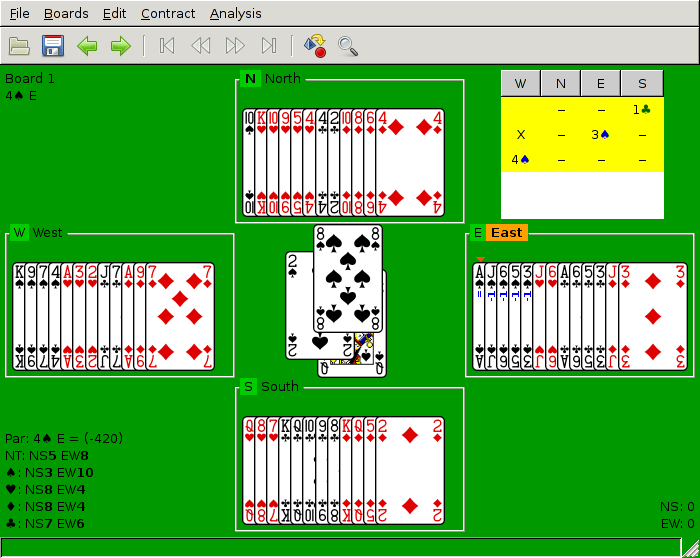
It has been a while since the last update for tenace, my bridge hand viewer. The highlight in version 0.10 is version 2.0 of the double dummy engine dds which has been updated to support parallel computation in multiple threads. The parscore computation in tenace now uses all available CPU cores. Even my notebook has two CPUs :). More on the technical side, the GUI has been switched to use GtkBuilder which comes with Gtk so there is no external library needed anymore (previously libglade). The looks are pretty much the same as before, though. The previous version 0.9 had added windows support via mingw. I would still appreciate if people could test it and tell me which bits I need to improve.

7 May 2010

Christoph Berg: Clamav segfaults

If you are still using clamav on etch, you might want to upgrade now:
# /etc/init.d/clamav-daemon start  
Starting ClamAV daemon: clamd LibClamAV Warning: ***********************************************************
LibClamAV Warning: ***  This version of the ClamAV engine is outdated.     ***
LibClamAV Warning: *** DON'T PANIC! Read http://www.clamav.net/support/faq ***
LibClamAV Warning: ***********************************************************
/etc/init.d/clamav-daemon: line 240:  5221 Segmentation fault      start-stop-daemon --start -o -c $User --exec $DAEMON
 failed!
Rolling back to yesterday's daily.cld fixes the issue, at least for the segfault.

David Welton: Better Software 2010

Florence, Italy, is an extremely popular tourist destination, and for a good reason: it's absolutely full of beautiful architecture and famous art. It apparently gets more than a million tourists a year. So it felt kind of odd for me, as a foreigner, to hole up in a conference talking about computers, software and business within a stone's throw of this. It was well worth it though. "Better Software" was a very interesting conference, and extremely professional. One anecdote: since there were so many people signed up, they did the lunch and coffee breaks in another facility nearby, about a block away. However, the weather wasn't very nice, so the organizers rounded up a bunch of umbrellas, and put them near the door with a sign saying "take one if you need it", so that people could stay dry while going back and forth. Of course, having grown up in Oregon, I don't trust the weather much, and carry an umbrella, but it was a really nice gesture and attention to detail. I expected it to be good, but it ended up being a really great event. Some memorable bits: I suppose that, given the huge success of the event this year, they may look for a larger facility for future events, but I hope it doesn't end up in some soulless place in the suburbs; even if I didn't do any sightseeing, I liked being in the city center. While the organizers would be more than capable of putting on a more international event, I enjoyed the focus on Italy, and the cool things people are doing here, and I feel it also contributed some to the positive atmosphere. It's one thing to have some guy come in from abroad and tell you something, another to see someone like Peldi talk about how he did what he did. And what with all the problems Italy has right now, some "positive energy" was more than welcome. Like I said, Italy has a lot of really talented people; the problems lie elsewhere. A big thanks to the organizers and everyone who came, and I hope to see you there next year.

Andrew Pollock: [life] And we're home

It took longer than expected, but we were finally discharged from the hospital early this afternoon. There was some concern about jaundice in Zoe, so the hospital paediatrician ordered a bilirubin blood test, which we had to wait for the results from. It came back fine though. The other concern was weight loss. She's still hovering around the 5 lbs 13 oz mark, which is at some magical 10% of birth weight lost, which seems to cause some concern for the doctors. So for the next week or so, we're going to bottle feed her breast milk, as she seems very sleepy when she tries to nurse, and we want to make sure she's getting enough. It's nice to be able to more actively participate in the feeding routine. Since we've been home, Zoe's not been sleeping terribly well on her own, so right now her and Sarah are having a nap together. We've got our first appointment with Zoe's ongoing paediatrician tomorrow. She was the recommendation of a friend, and seems to be highly regarded by all of the hospital paediatricians we saw. I'm feeling very disorganised in the nursery, because I didn't really participate in any of the set up of it. I knew where everything was in the hospital, so for a diaper change, everything was under control. I'm going to have to get a couple of totes tomorrow, so everything is on hand. I may also go berserk with a label maker. Looking forward to a hot shower and some shut-eye after this next feeding.
6 May 2010

Gunnar Wolf: 5000 Km

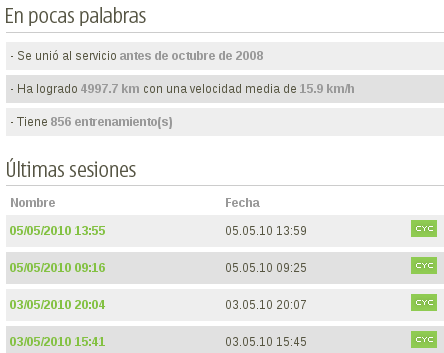
In an amazing but meaningless feat of synchronicity, Toxicore's post led me to check how much distance have I done while excercising I have mainly done this cycling, although some running also comes into play. Turns out I was just about to break the same mark he did. From my Nokia Sportstracker records: Before breaking the 5000 Km mark, yesterday at noon:
Yesterday excercise records, at noon After breaking the 5000 Km mark, yesterday at night:
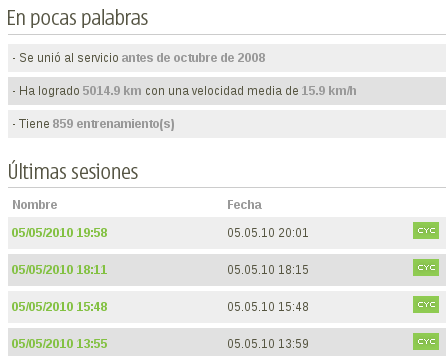
Yesterday excercise records, at night So, following Bubulle's style... If I have done 5000 Km since January 2008, when do you think I should reach 5500? 6000? 7000? Infinity and beyond?

5 May 2010

MJ Ray: General Election 2010

You may have noticed that the UK votes in a General Election tomorrow. It looks like the closest for at least 18 years and maybe more. Happily, all the major parties are saying nice things about cooperatives, but I wonder how much of that will translate into policies that are practical for co-ops like mine. Our national body Cooperatives UK has gathered the commitments from 18 manifestos and summarised them in a PDF. The first 7 pages deal with the five biggest English parties. One striking thing is how many gaps there are in the Labour, LibDem and UKIP policies, while it s not really clear to me that the Conservatives or LibDems really understand cooperatives. The Conservatives seem to suggest council-controlled co-ops (which wouldn t normally be co-ops if they lack autonomy), while the LibDems mention employee trusts more often than worker co-ops. I m sulking at Labour after several recent schemes that subsidised private competitors and excluded worker co-ops and I don t believe Labour can win in Weston-super-Mare. That would leave the Greens, who probably can t win but do seem to get it, except that there s no Green candidate where I live because he stood aside and recommended the LibDems (as I understand it). Drat. So, only a few hours to go before the start of the ballot and I m still an undecided voter.

Next.

Previous.


