Search Results: "mak"

9 September 2012

Erich Schubert: Google Plus replacing blogs not Facebook

When Google launched Google+, a lot of people were very sceptical. Some outright claimed it to be useless. I must admit, it has a number of functions that really rock.
Google Plus is not a Facebook clone. It does not try to mimick Facebook that much. To me, it looks much more like a blog thing. A blog system, where everybody has to have a Google account, and then can comment (plus, you can then restrict access and share only with some people). It also encourages you to share shorter posts. Successful blogs always tried to make their posts "articles". Now the posts themselves are merely comments; but not as crazy short as Twitter (it is not a Twitter clone either), and it does have rich media contents, too.
Those who expect it to replace their Facebook where the interaction is all about personal stuff will be somewhat disappointed. Because it IMHO much less encourages the smalltalk type of interaction.
However, it won a couple of pretty high profile people to share their thoughts and web discoveries with the world. Some of the most active users I follow on Google Plus are: Linus Torvalds and Tim O'Reilly (of the publishing house O'Reilly)
Of course I also have a number of friends that share private stuff on Google Plus. But in my opinion the strength of Google Plus is on sharing publicly. Since Google is the king of search, they can both feed shares of your friends into your regular search results, but there is also a pretty interesting search in Google PLus. The key difference is that with this search, the focus is on what is new. Regular web search is also a lot about searching for old things (where you did not bother to remember the address or bookmark the site - and mind it, today a lot of people even "google for Google" ...) For example I like the plus search for data mining because it occasionally has some interesting links in it. A lot of the stuff is coming in again and again, but using the "j and k" keys, I can quickly scroll through these results to see if there is anything interesting. And there are quite a lot of interesting things I've discovered this way.
Note that this can change anytime. And maybe it is because I'm interested in technology stuff that it works well for me. But say, maybe you are more into HDR photography than me (I think they look unreal, as if someone has done way too much contrast and edge enhancing on the image). But go there, and press "j" a number of times to browse through some HDR shots. That is a pretty neat search function there. And if you come back tomorrow, there will likely be new images!
Facebook tried to clone this functionality. Google+ launched in June 2011, and in September 2011, Facebook added "subscribers". So they realized the need for having "non-friends" that are interested in what you are doing. Yet, I don't know anybody actually using it. And the Public posts search is much less interesting than of Google Plus, and the nice keyboard navigation is also missing.
Don't get me wrong, Facebook still has its uses. When I travel, Facebook is great for me to get into contact with locals to go swing dancing. There are a number of events where people only invite you on Facebook (and that is one of the reasons why I've missed a number of events - because I don't use Facebook that much). But mind it, a lot of the stuff that people share on Facebook is also really boring.
And that will actually be the big challenge for Google: keeping the search results interesting. Once you have millions of people there sharing pictures of lolcats - will it still return good results? Or will just about every search give you more lolcats?
And of course, spam. The SEO crowd is just warming up in exploring the benefits of Google Plus. And there are quite some benefits to be gained from connecting web pages to Google Plus, as this will make your search results stick out somehow, or maybe give them that little extra edge over other results. But just like Facebook at some point was so heavily spammed when every little shop was setting up his Facebook pages, inviting everyone to all the events and so on - this is bound to happen on Google Plus, too. We'll see how Google then reacts, and how quickly and effectively.

8 September 2012

Dirk Eddelbuettel: RInside 0.2.8

This morning version 0.2.8 of RInside arrived on the CRAN sites. RInside provides a set of convenience classes which facilitate embedding of R inside of C++ applications and programs, using the classes and functions provided by the Rcpp R and C++ integration package. This release adds no new features but improves the build process a little and should make use on Windows a little easier. All changes since the last release are summarized below in the NEWS file entry:
Changes in RInside version 0.2.8 (2012-09-07)
  • Added CMake build support for armadillo and eigen examples, once again kindly contributed by Peter Aberline
  • Corrected Windows package build to always generate a 64 bit static library too
  • Updated package build to no longer require configire and configure.win to update the two header file supplying compile-time information; tightened build dependencies on headers in Makevars / Makevars.win
  • Improved examples/standard/Makefile.win by detecting architecture
CRANberries also provides a short report with changes from the previous release. More information is on the RInside page. Questions, comments etc should go to the rcpp-devel mailing list off the Rcpp R-Forge page.

Andrew Pollock: [life] Everything I know about making pizza I learned from Daniel Kotler

According to my Amazon purchase history, it was Sunday, October 11, 2009, that we were lazing around with our friends Dan and Sue and we decided we'd just hang out and watch the first season of Dollhouse. I bought the whole thing on Amazon's Video on Demand, and we started watching episodes. It got close to dinner time, and Dan was going through a home made pizza phase at the time, and we thought about making some pizzas. I wasn't sure if we had all the ingredients in the house, but it went something like this:
Dan: Got flour? Me: Yes Dan: Yeast? Me: Yes Me: Oh, and we've got a big bag of grated mozzarella from Costco. And we have a pizza stone and a peel, and a bunch of random stuff we can throw on a pizza.
So we totally ninja-ed up some pizzas from stuff we had lying around the house. It was awesome because it was totally spontaneous. You couldn't have planned it better, and we pulled it off brilliantly without having the leave the house. Anyway, Dan had to calculate the ratios of water, flour, salt and sugar, and he wrote them all down on the magnetic whiteboard we kept on our fridge. Fast forward almost 3 years later, and we've moved to our new home, and have a stainless steel fridge that we haven't been able to put this whiteboard on, so it got stashed away in a cupboard. The pizza dough recipe is still written on it, though. So with Sarah away, Bill and Victoria are coming around for dinner tonight to hang out, and I thought trying to make pizza again might be a fun experiment. So I dug out the whiteboard with the trusty recipe, and Zoe and I made some dough this morning, and it's currently proofing in the oven. Unfortunately the whiteboard only had the quantities and not the method on it, and from perusing other recipes on the Internet, I may not have mixed things properly (I just kind of threw things together and made it into a ball), so this first batch might be a total disaster. I might go and make a second batch while Zoe's napping. Here's the contents of the whiteboard, for posterity (I'm hoping it says 10g of salt and not 18g, not that I think it'll affect the outcome too much): Daniel Kotler's pizza dough recipe

7 September 2012

Jonas Smedegaard: Asia 2011 - Khammam

My first morning in India I woke up very late in the house of Pavithrans parents. Pavithran was out organizing events for us, his father was at work, leaving me with his mother. She spoke little english - unsure if it was lack of skills or she was humble, or perhaps she just felt as shy as me in the situation. How to, ahem, do your thing at a restroom when there is no toilet paper but instead a bucket of water? I decided to not yell for help but use my imagination. How to eat breakfast local style? I knew from dinner previous night with Pavithran that local custom was to eat with my hands and that it (lucky for me) was tolerated in India to use left hand, so turned down the kind offer for a spoon. But were I supposed to mix rice with all the curries? Or one at a time? In which order? What if a curry was too hot to dip my fingers into? Was the liquid stuff to drink or to mix with the rice or eat afterwards? I asked for help, and first she just smiled at my alien useless language and then when I persisted, she patiently demonstrated with her hands in my food how to do. The only natural thing to do, really, and I dearly appreciate her help and patiency. But wauw, it was mind-blowing to me! Since early childhood, fingers in food is a forbidden thing: "Don't play with the food!". On top of that, having someone else handle my dish while at the table is something I associate with being very old and needing to be spoon-fed. In the afternoon we went for a small hike to an old stone fortress in the middle of Khammam - with a great view of the sun setting. Next day we went to Sarada Institute of Technology & Science where I gave my first talk to about 100 students. I had intended to provide concrete facts on Debian generally and on my pet project, Debian Pure Blends, but then the night before decided to radically shift focus to their situation in the early twenties - as best as I could imagine it. Pavithran had clearly expected a different style talk, but I liked it and believe it was received well by the audience as well. The teacher responsible for the event, Bhukya Jabber, afterwards asked for hints on running Debian at their computer lab. I suggested to not lock down access but instead make it easy to reinstall, and he explained how he was quite interested in a larger degree of learning-by-doing (which I had also promoted in my talk) but was constrained by curriculum dictated higher up in the educational system. Late that day Pavithrans father introduced me to CPM Khammam - the local offices and community center of the Communist Party - and to a colleague of his at the place, N. N. Rao. I instantly fell in love with the place and its atmosphere, and now have an open invitation to come back to spend 1-2 months to study and to collaborate with other users of the place (including some kids hosted there) on Free Software. Next morning we headed back by train to Hyderabad I am still amazed how radical it feels sticking my fingers into food. Not the physical feeling (I am not that disconnected from my body) but similar to a discovery I had as a teenager: After 7 years of piano lessons (and numerous other instruments less patiently) I gave up because I felt it was too difficult expressing personality through the instrument. After that I exclusively sang - as I had always done, but only now did I recognize my voice as a serious musical instrument. Similarly I now realized that eating with the fingers is not just yet another eating style like fork+knife or sticks - it is the natural one. Obviously, in hinsight. This text is part of my Asia 2011 scriblings.

5 September 2012

Jonathan Carter: Shello


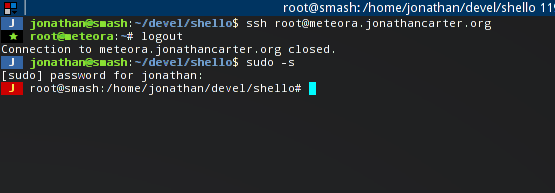
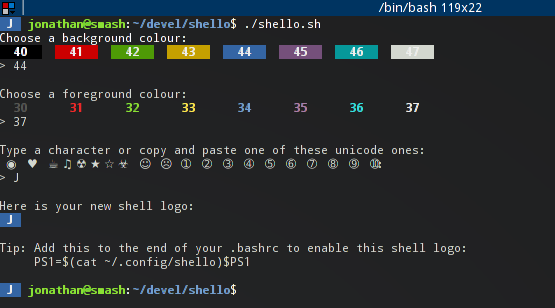
If there s one thing that I ve had missing in my life for way too long, it s hacking on small silly stupid amusing little things. When I was young I used to write dozens of little pointless programs a week and forget about them, only to found them a few months later and be incredibly amused by them. This afternoon I noticed that one of my machines didn t have my default .bashrc loaded, which colourises (or colorizes for Americans or colourizes for Canadians) my shell so that I know on which machine I am so that I don t accidentally do something silly like reboot the wrong host. One problem I ve had with this is that there are limited colours available that makes sense to use for a shell prompt. Right as I was thinking this, I was looking at my Byobu screen sessions and thinking Hmm! I like those logos, maybe I could use them in my shell! . So in just a few minutes I had a little script to help you configure those for your shell. Here is a screenshot of the shell logos in action. On my laptop I use a red background when I have a root shell: This is what the shello script looks like that sets it up: I might get bored by seeing it soon and get rid of it, but at least I had a little fun with it. If you d like to try it out, then you can get the script right here: https://github.com/highvoltage/shello It doesn t do anything like validating input yet, I d also like to add something that creates some kind of a checksum of your hostname and choose a unicode character based on that. Maybe I ll finish it up this weekend, or maybe I ll have new things to write about!

Matthew Garrett: UEFI Secure boot in Fedora: status update

There's been good progress in Fedora's implementation of UEFI Secure Boot, so time for a quick update.
Boot process signingThe infrastructure for signing the bootloader binaries is now implemented. pesign is in the archive and being used to sign shim, grub2 and the kernel. At the moment they're all being signed by test keys, and the private key is actually in the pesign package. This is, obviously, not intended for production use - it's just to ensure that we can build correctly signed images. We've proof-of-concepted signing via cryptographic hardware and will shortly be deploying new build systems dedicated to building the signed binaries. These won't be general access systems and will have a lightly modified mock configuration to ensure that the crypto hardware is available to the build chroots, but otherwise there's nothing special about them.

As far as signing with the Microsoft keys goes, we're in the final round of legal review of the appropriate agreements and will be migrating to a version of shim signed with their key in the near future.
Kernel modificationsThere's two main sets of patches for the kernel. The first is to automatically enable the locking down of various bits of functionality when secure boot is enabled, in order to prevent users (including root) from being able to modify the kernel at runtime. They've just been posted upstream and haven't been dreadfully received, though we'll probably be changing the name of the capability. The main thing that users will notice is that any X drivers that still need direct hardware access (which, on secure boot systems, should be zero - we've implemented native kernel drivers for all the hardware we expect to see there) will fail to work, as will setpci. The plan is for kexec to require that kernel images be signed, but that's requiring rather more reworking of kexec than expected so for now kexec will just be disabled.

The other lump of kernel functionality is the support for module signatures. That had been somewhat blocked based on a lack of consensus between patch authors and upstream, but an agreement got hammered out at Kernel Summit last week and so we should see progress there shortly. Right now we're still looking at modules being signed with a throwaway key, but the plan is still for keys in db (and MOK, if using the Suse approach) to be imported into the kernel keyring and used. That's dependent upon that code being written in time, though. It's definitely still a goal for F18.
Key managementWe're planning on using Suse's approach of permitting local key management at the shim level, and I spent some time discussing this with Vojtech last week. In combination with the above, this should provide a workable mechanism for permitting the end-user to install module signing keys.
General UEFI support improvementsWe've added support to grub to use the kernel's built-in UEFI setup functionality, although there's still some discussion with upstream to ensure that it's implemented in an acceptable way. This approach also makes it easy for us to obtain PCI ROMs via UEFI, which improves radeon support on a bunch of Macs. Finally, we've been hammering on some remaining UEFI bugs and are definitely at the point where the machines that don't work are surprising and the ones that do are the tedious expectation. This is far better than any previous release.
DocumentationStill has to be written, and that's probably where much of the my next month is going.
SummaryFedora 18 is still on track to have full UEFI Secure Boot support out of the box, and the Beta should be fully signed although perhaps still with our test keys.

For those of you who get sent to surprisingly expensive conferences, I'll be discussing some of this as part of a presentation on improving Linux support for UEFI at the Intel Developer Forum in San Francisco next Tuesday morning. Feel free to say hi if you're in the area.

comment count unavailable comments

Russ Allbery: Reacting to excitement

I've been slowly noticing, over a number of years now, a place where I don't react to other people the way that I want to. I've been stumbling over defensive reactions that I didn't realize I had. These are a few rules of thumb that I'm formulating for myself to try to improve that, and I thought it might help to write them down. And maybe they'll be meaningful for someone else.
  1. Things people are excited about are probably exciting. If I don't find them exciting, that's probably because I don't know enough about them to understand why they're exciting. Or perhaps I have a different mindset, and therefore the exciting parts don't connect with me. Both of those are okay! There are way more things to learn about than I will ever possibly have time to learn, and I don't have to get excited about everything other people are excited about. But, equally, just because I'm not excited doesn't mean that the thing is not exciting.
  2. My misplaced sense of obligation should not be someone else's buzzkill. This requires a bit of unpacking, since I only intermittantly realize that I'm doing this. But (partly for cultural reasons, partly due to natural inclinations) I've always felt a strong sense of obligation to "keep up" with things. To know a lot about a lot of topics. And one of the things I've realized is that my brain occasionally twists an interest in knowing lots about the world into a sense of obligation to "stay current" and know something about everything important, at least within my vague field of expertise. And usually that part of my brain has a very expansive notion of field of expertise; all of software development, for example, which is, when I pull it out into the light, ridiculously broad. This then sparks one of the standard failure modes of human cognition. I have an unrealistic expectation of myself. I fail to meet that expectation. This makes me feel guilty and stressed. At that point, my brain starts trying to find targets for me to displace negative feelings onto, and that generally ends up being the next person who is excited about something new that I don't know anything about but feel like I should. This is all very interesting psychologically, in the abstract. However, the concrete result is that I sometimes get all snarky and negative about something that someone else is excited about because it happens to be the moment I hit overload, or because I didn't want to hear about another thing that I feel like I should know more about. And that, in turn, can be either confrontational or discouraging to someone who is legitimately excited (and may rarely get the chance to be excited). And that's not the person I want to be.
  3. It's okay not to have an opinion. Seriously, it's okay. The world is full of stuff, far more stuff than any one person can know anything about. It's okay not to go read about everything people say is exciting. It's okay not to know about something new. It's okay to focus on the things I'm already doing. Really. What's not okay is to make up an opinion about something I know nothing about just so that I can feel better about myself by having an opinion. Particularly since that opinion formed under those circumstances tends to be negative, despite the fact that I have no actual basis for having any opinion at all. I need to practice just quietly not having an opinion. No one else needs to know about my lack of opinion.
  4. Before bristling at imposition, be sure someone is actually imposing. I frequently leap to the conclusion that, when someone raises a topic, they want me to do something about it. It's a gut emotional reaction, I think in part because the emotional part of my brain likes to make everything about me. Intellectually, if I can engage that part of my brain, it's often obvious that it's not about me, or that they're not asking me to do anything. Often, when someone brings something up, they just want to tell someone else about it, or make me aware of it. If I've listened to, or read, all the sentences and understood then, then congratulations! I've done everything that I needed to do and was expected to do and need not feel any further obligation. Even if something further needs to be done, it doesn't necessarily need to be done by me. I'm very protective of my time and available resources because I almost always feel overwhelmed by all the things that I want to work on. This does not entitle me to snap at random people who are being excited around me on the grounds that they're trying to put more obligations on me. They're probably not. If it becomes clear that they really want me to do something I don't have time to do, I can politely decline, but if I just shut up and listen for longer, usually that's not the case at all.
(Please note that this is not prompted by any current discussion happening anywhere, and paticularly not by anything in Debian. Insofar as it was prompted by anything, it was by a throwaway comment in an unrelated private discussion. It's just something that gelled enough to write down while I was walking home from work.)

4 September 2012

Gunnar Wolf: Electronic voting in Panama: Slower, more expensive, more uncertainty... Goodbye!

Panama just underwent a nasty e-voting exercise: Electronic-mediated elections were held for the committee of the PRD party. It sounds simple - Even trivial! There were only 4100 authorized voters, it was geographically trivial (all set inside a stadium)... But it blew up in smoke. I won't reiterate all what happened, I'll rather direct you to our project's (the e-voting observatorium) page: News regarding Panama (for those coming from the future, search starting at 2012-08-27 and yes, it's all in Spanish, but there are free-as-in-beer translation services. Many e-vote proponents/sellers/pushers were very eagerly waiting for this election to brag about one more success... So much that they could not just ignore it, and started rationalizing it away. Anyway, while feeding the observatorium, I came across this opinion-article in the Voto Digital website, which makes quite a bit of pro-e-voting noise. I replied to it, and I think my analysis is worth sharing also with you:
So, lets make some simple numbers, rounding the numbers: The PRD vote in Panama was done for a universe of 4100 voters. It took 10 hours (instead of the planned 4), so 410 people were processed every hour. There were 40 voting (electronic) booths, so each processed 10 people per hour. This means, each person spent 6 minutes by the booth. A manual vote in this fashion is highly parallelizable: Each of the voters can be given ballots with anticipation, or many of them cna be allowed in to be given the ballots in situ (depending on the electoral scheme employed). The contention time is the time it takes to each voter to get near the booth and deposit his ballot (either folded or in an envelope) - And it will very rarely be more than a couple of seconds. So, given that using electronic booths parallelism cannot grow (there is a fixed number of machines) and the queues grew wildly, with traditional voting it would have surely fitted in the expected four hours (they were expected, also, based on their past experiences). As for counting, that's the slowest part of manual voting, it's also highly parallelizable: If each of the 40 booths has slightly over 100 ballots, the party personnel can easily count them in under 30 minutes. Capture and aggregation for the 40 partial results would take an extra 10 minutes, even being generous. Manual voting would have saved them around five hours, without demanding additional resources (and being thus much more economical than having to buy 40 specific-purpose computers). And as an additional advantage, the physical and tangible vote proofs would remain, in case they were ever again needed.

Jon Dowland: Pretty Eight Machine

P8M CD and stickers P8M CD and stickers
Back in June or thereabouts I learned about a project to re-create Nine Inch Nails' first album "Pretty Hate Machine" as a chiptune cover/tribute project. This project is called Pretty Eight Machine. The artist InversePhase was kind enough to send me a copy of the CD as a random prize draw, so I thought I would write a few words about it. I don't know a great deal about the world of chiptunes, besides having heard a variety of "chiptune" covers of various well-known songs, some good, some bad. the backing track to this video, a cover of Tears for Fears' "Mad World", is, in my opinion, good. The front cover for P8M lovingly reflects the recent reworking of the classic PHM cover by Rob Sheridan, for the source album's recent deluxe reissue. There's a great in-depth interview with Rob about the process of reviving that cover at sleevage. That little homage is a good indication of the amount of effort and attention to detail that has gone into this project. One interesting thing about this project is that each track has been composed for a particular vintage chipset, such as the Commodore 64 in the case of the opening track "Head like I/O". InversePhase is very faithful to the original chips here, not just using their tones as part of a modern composition but constraining himself with the actual chipset limitations: for example, the number of voices that can be playing at once. (By contrast, that Tears for Fears chiptune above is the non-authentic type of chiptune). InversePhase tracks Trent's vocal lines as an instrument, so all of the notes that are heard in the original are present on this remake. It would be interesting to hear an "instrumental" mix of these tracks, and perhaps mix isolated vocal tracks from the originals on top My favourite track is probably "Kinda I Want To". I actually really like the original track, in particular the extended breakdown, where a synth noise gradually breaks down and disintegrates bar after bar. It suffered terribly from dated lyrics compared to other PHM tracks, but InversePhase's cover is saved that embarrassment. This particular track (apparently) makes use of a VCR6, a Konami chipset apparently used to supplement the hardware in the Famicom/NES. Yes, back then games came on cartidges that could supply bits of their own hardware if required. Those were the days! And yes InversePhase, you've successfully made the NES sound "dirty": and the synth breakdown sounds great. Any fan of the original album or anyone with an interest in what kind of noises vintage sound synthesis chipsets could produce are thoroughly recommended to give this album a try. You can preview all of the tracks and read per-track information on the bandcamp page.

3 September 2012

Martin Pitt: PyGObject 3.3.91 released

I just released PyGObject 3.3.91, for GNOME 3.5.91. The big new feature in this release (thanks to the release team for granting an exception) is Simon Feltman s new Signal helper class, which makes defining custom signals a whole lot simpler and more obvious. In the past, you had to do
 class C(GObject.GObject):
    __gsignals__ =  
        'my_signal': (GObject.SIGNAL_RUN_FIRST, GObject.TYPE_NONE,
                      (GObject.TYPE_INT,))
     
    def do_my_signal(self, arg):
        print("my_signal called with %i" % arg)
whereas now this looks like
class C(GObject.GObject):
    @GObject.Signal(arg_types=(int,))
    def my_signal(self, arg):
        print("my_signal called with %i" % arg)
or even more elegantly when using Python 3 and its new type annotations:
class C(GObject.GObject):
    @GObject.Signal
    def my_signal(self, arg:int):
        print("my_signal called with %i" % arg)
Check out the updated example and docstring for other ways how to use it. Overrides can now be in a directory different from the one that pygobject installs itself into. These overrides need to put this into their __init__.py at the top:
from pkgutil import extend_path
__path__ = extend_path(__path__, __name__)
and put themselves somewhere into the default PYTHONPATH. This should make it a lot easier for library packages to ship their own overrides for Python. This new version also comes with a couple of new overrides and bug fixes. See the detailled list of changes below. Thanks to all contributors!

Paul Tagliamonte: tmperamental - check for wild /tmp calls

tmperamental found either on git.d.o, or github is a library to be LD_PRELOAD-ed, and help check for use of hardcoded /tmp. The idea is to get TMPDIR and friends, and preload tmperamental, which will call non-zero exit when an app does stuff in /tmp. It s a big hack, so if you feel like making it even better, send in patches :)

Lars Wirzenius: New format to replace tar: some notes

During lunch the other day, I discussed the shortcomings of the tar file format with friend and co-worker Daniel. The tar file format has a lot of legacy by now, and it's not quite up to date with the latest developments in file systems, such as extended attributes. This makes tar badly suited for things such as backups and other situations where precise reproduction of the input data matters. There are several variants of the tar file format, and various more or less standard extensions to it. GNU tar, for example, added support for pathnames longer than 100 bytes many years ago, and it is now commonly supported. Other problems in the tar file format: This led us to discuss the possibility of a new file format. We had a bit of fun exploring the solution space for a while. However, almost all use of tar these days is for distributing sets of files, where the filename and basic set of file permissions is enough. In other words, for things such as source code, tar is just fine. The archives are small enough, and the other limitations are rarely a problem, but the pain of switching to a new format would be great. Thus, with some reluctance, we concluded that a new format would be a waste of time. But I thought I'd write this up anyway, in case one of my readers wants to start working on this.

Peter Makholm: Creating a negative match RegExp object

It is a frequently asked Perl question how to write a regular expression that matches anything but something . The usual answer is that it can t be done or that you need to use the !~ operator instead of the =~ operator. But when you are using API s that passes regular expressions around as objects this might not be entirely helpful answers. By digging a bit around in the scarier parts of the perlre manual page I worked out this quite Perl specific solution: qr/(?:(?:something(*COMMIT)(*FAIL)) .)*/. I am not sure that it works in all possible corner cases and I certainly don t want to write the much needed comment that makes the code using the regexp maintainable. In the end it might be possible, but it is just one of those Now you have two problems scenarios.

2 September 2012

Dirk Eddelbuettel: Faster creation of binomial matrices

Scott Chamberlain blogged about faster creation of binomial matrices the other day, and even referred to our RcppArmadillo package as a possible solution (though claiming he didn't get it to work, tst tst -- that is what the rcpp-devel list is here to help with). The post also fell short of a good aggregated timing comparison for which we love the rbenchmark package. So in order to rectify this, and to see what we can do here with Rcpp, a quick post revisiting the issue. As preliminaries, we need to load three packages: inline to create compiled code on the fly (which, I should mention, is also used together with Rcpp by the Stan / RStan MCMC sampler which is creating some buzz this week), the compiler package included with R to create byte-compiled code and lastly the aforementioned rbenchmark package to do the timings. We also set row and column dimension, and set them a little higher than the original example to actually have something measurable:
library(inline)
library(compiler)
library(rbenchmark)
n <- 500
k <- 100
The first suggestion was the one by Scott himself. We will wrap this one, and all the following ones, in a function so that all approaches are comparable as being in a function of two dimension arguments:
scott <- function(N, K)  
    mm <- matrix(0, N, K)
    apply(mm, c(1, 2), function(x) sample(c(0, 1), 1))
 
scottComp <- cmpfun(scott)
We also immediatly compute a byte-compiled version (just because we now can) to see if this helps at all with the code. As there are no (explicit !) loops, we do not expect a big pickup. Scott's function works, but sweeps the sample() function across all rows and columns which is probably going to be (relatively) expensive. Next is the first improvement suggested to Scott which came from Ted Hart.
ted <- function(N, K)  
    matrix(rbinom(N * K, 1, 0.5), ncol = K, nrow = N)
 
This is quite a bit smarter as it vectorises the approach, generating N times K elements at once which are then reshaped into a matrix. Another suggestion came from David Smith as well as Rafael Maia. We rewrite it slightly to make it a function with two arguments for the desired dimensions:
david <- function(m, n)  
    matrix(sample(0:1, m * n, replace = TRUE), m, n)
 
This is very clever as it uses sample() over zero and one rather than making (expensive) draws from random number generator. Next we have a version from Luis Apiolaza:
luis <- function(m, n)  
     round(matrix(runif(m * n), m, n))
 
It draws from a random uniform and rounds to zero and one, rather than deploying the binomial. Then we have the version using RcppArmadillo hinted at by Scott, but with actual arguments and a correction for row/column dimensions. Thanks to inline we can write the C++ code as an R character string; inline takes care of everything and we end up with C++-based solution directly callable from R:
arma <- cxxfunction(signature(ns="integer", ks="integer"), plugin = "RcppArmadillo", body='
   int n = Rcpp::as<int>(ns);
   int k = Rcpp::as<int>(ks);
   return wrap(arma::randu(n, k));
')
This works, and is pretty fast. The only problem is that it answers the wrong question as it returns U(0,1) draws and not binomials. We need to truncate or round. So a corrected version is
armaFloor <- cxxfunction(signature(ns="integer", ks="integer"), plugin = "RcppArmadillo", body='
   int n = Rcpp::as<int>(ns);
   int k = Rcpp::as<int>(ks);
   return wrap(arma::floor(arma::randu(n, k) + 0.5));
')
which uses the the old rounding approximation of adding 1/2 before truncating. With Armadillo in the picture, we do wonder how Rcpp sugar would do. Rcpp sugar, described in one of the eight vignettes of the Rcpp package, is using template meta-programming to provide R-like expressiveness (aka "syntactic sugar") at the C++ level. In particular, it gives access to R's RNG functions using the exact same RNGs as R making the results directly substitutable (whereas Armadillo uses its own RNG).
sugar <- cxxfunction(signature(ns="integer", ks="integer"), plugin = "Rcpp", body='
   int n = Rcpp::as<int>(ns);
   int k = Rcpp::as<int>(ks);
   Rcpp::RNGScope tmp;
   Rcpp::NumericVector draws = Rcpp::runif(n*k);
   return Rcpp::NumericMatrix(n, k, draws.begin());
')
Here Rcpp::RNGScope deals with setting/resetting the R RNG state. This draws a vector of N time K uniforms similar to Luis' function -- and just like Luis' R function does so without looping -- and then shapes a matrix of dimension N by K from it. And it does of course have the same problem as the RcppArmadillo approach earlier and we can use the same solution:
sugarFloor <- cxxfunction(signature(ns="integer", ks="integer"), plugin = "Rcpp", body='
   int n = Rcpp::as<int>(ns);
   int k = Rcpp::as<int>(ks);
   Rcpp::RNGScope tmp;
   Rcpp::NumericVector draws = Rcpp::floor(Rcpp::runif(n*k)+0.5);
   return Rcpp::NumericMatrix(n, k, draws.begin());
')
Now that we have all the pieces in place, we can compare:
res <- benchmark(scott(n, k), scottComp(n,k),
                 ted(n, k), david(n, k), luis(n, k),
                 arma(n, k), sugar(n,k),
                 armaFloor(n, k), sugarFloor(n, k),
                 order="relative", replications=100)
print(res[,1:4])
With all the above code example in a small R script we call via littler, we get
edd@max:~/svn/rcpp/pkg$ r /tmp/scott.r 
Loading required package: methods
              test replications elapsed   relative
7      sugar(n, k)          100   0.072   1.000000
9 sugarFloor(n, k)          100   0.088   1.222222
6       arma(n, k)          100   0.126   1.750000
4      david(n, k)          100   0.136   1.888889
8  armaFloor(n, k)          100   0.138   1.916667
3        ted(n, k)          100   0.384   5.333333
5       luis(n, k)          100   0.410   5.694444
1      scott(n, k)          100  33.045 458.958333
2  scottComp(n, k)          100  33.767 468.986111
We can see several takeaways: Thanks to Scott and everybody for suggesting this interesting problem. Trying the rbinom() Rcpp sugar function, or implementing sample() at the C++ level is, as the saying goes, left as an exercise to the reader.

Jose Luis Rivas Contreras: Finally a workaround for htop drawing issue inside tmux!

I was tired that htop didn t showed up the info as is, and started to google about it. Aparently there s an issue with the drawing stuff for bold and not-bold fonts, and most workarounds consists on making htop showing things on black and white. Then, lazyness came to my mind and used:
TERM=screen htop
Wala! It worked, and showed htop with colors! 12 colors of course, but I don t need more!! So after that I just echoed that line to my ~/.bash_aliases and is pretty much done for a while, at least for me. It works!

Benjamin Mako Hill: Open Brands

In late July, the Awesome Foundations invited me to participate in an interesting conversation about open brands at their conference. Awesome is a young collection of organizations struggling with the idea of if, and how, they want to try to control who gets call themselves Awesome. I was asked to talk about how the free software community approaches the issue. Guidance from free software is surprisingly unclear. I have watched and participated in struggles over issues of branding in every successful free software project I've worked in. Many years ago, Greg Pomerantz and I wrote a draft trademark policy for the Debian distribution over a couple beers. Over the last year, I've been working with Debian Project Leader Stefano Zacchiroli and lawyers at the Software Freedom Law Center to help draft a trademark policy for the Debian project. Through that process, I've come up with three principles which I think lead to more clear discussion about whether a free culture or free software should register a trademark and, if they do, how they should think about licensing it. I've listed those principles below in order of importance. 1. We want people to use our brands. Conversation about trademarks seem to turn into an exercise in imagining all the horrible ways in which a brand might be misused. This is silly and wrong. It is worth being extremely clear on this point: Our problem is not that people will misuse our brands. Our problem is that not enough people will use them at all. The most important goal of a trademark policy should be to make legitimate use possible and easy. We want people to make t-shirts with our logos. We want people to write books about our products. We want people to create user groups and hold conferences. We want people to use, talk about, and promote our projects both commercially and non-commercially. Trademarks will limit the diffusion of our brand and, in that way, will hurt our projects. Sometimes, after carefully considering these drawbacks, we think the trade-off is worth making. And sometimes it is. However, projects are generally overly risk averse and, as a result, almost always err on the side of too much control. I am confident that free software and free culture projects' desire to control their brands has done more damage than all brand misuse put together. 2. We want our projects to be able to evolve. The creation of a trademark puts legal power to control a brand in the hands of an individual, firm, or a non-profit. Although it might not seem like such a big deal, this power is, fundamentally, the ability to determine what a project is and is not. By doing this, it creates a single point of failure and a new position of authority and, in that process, limits projects' ability to shift and grow organically over time. I've heard that in US politics, there is no trademark for the terms Republican or Democrat and that you do not need permission to create an organization that claims to be part of either party. And that does not mean that everybody is confused. Through social and organizational structures, it is clear who is in, who is out, and who is on the fringes. More importantly, this structure allows for new branches and groups outside of the orthodoxy to grow and develop on the margins. Both parties have been around since the nineteenth century, have swapped places on the political spectrum on a large number of issues, and have played host to major internal ideological disagreements. Almost any organization should aspire to such longevity, internal debate, and flexibility. 3. We should not confuse our communities. Although they are often abused, trademarks are fundamentally pro-consumer. The point of legally protected brands is to help consumers from being confused as the source of a product or service. Users might love software from the Debian project, or might hate it, but it's nice for them to be able to know that they're getting "Debian Quality" when they download a distribution. Of course, legally protected trademarks aren't the only way to ensure this. Domains names, internal policies, and laws against fraud and misrepresentation all serve this purpose as well. The Open Source Initiative applied for a trademark on the term open source and had their application rejected. The lack of a registered trademark has not kept folks from policing use of the term. Folks try to call their stuff "open source" when it is not and are kept in line by a community of folks who know better. And since lawyers are rarely involved, it is hardly clear that a registered trademark would help in the vast majority of these these situations. It is also the case that most free software/culture organizations lack the money, lawyers, or time, to enforce trademarks in any case. Keeping your communities of users and developers clear on what is, and what isn't, your product and your project is deeply important. But how we choose to do this is something we should never take for granted.

Emanuele Rocca: Story of a bug in Ubuntu

Some months ago I have run into a pretty interesting bug while working on a Ubuntu-based remote desktop system. The whole OS was installed on a server somewhere and users could access their desktop remotely. Some call this stuff Desktop-as-a-Service. The operating system we chose was Ubuntu Oneiric (11.10) and the remote access part was implemented with x2go, which uses nxagent to provide NX transport of X sessions. Users could access their Ubuntu machines remotely, with sound, video, youtube, and all you would expect from a desktop machine. The whole thing was working quite well. Now, as I said that was in May. Ubuntu 12.04 LTS was available, and the choice of upgrading to it sounded pretty much obvious. So we upgraded our test system to Precise and everything seemed to work smoothly. Till we tried to open a PDF document, actually. It took evince about 50 seconds to display a relatively small document. Same story with images opened with the default image viewer, eog. The fix delivered to our users was simple: we have set shotwell-viewer as the default image viewer, and epdfview as the default PDF viewer. Everybody happy. In the meantime, obviously, I was interested in this issue so I ve tried to run run evince from a terminal, getting the following output:
(evince:15833): GRIP-WARNING **: Failed to initialize gesture manager.
Funny. On another test system running Debian Sid (unstable) everything was working smoothly. The diff between Ubuntu s version of evince and Debian s is a 6MB monster. Among other changes, I noticed that Ubuntu s version build-depends on libgrip-dev, which depends on libutouch-geis. Multitouch stuff. Why should multitouch support break my remote session? So on May the 10th I filed a bug on launchpad. How this issue got handled is in my opinion one of the many fine examples of the inherent superiority of free software, coupled with a we won t hide problems mindset. For an example of how bad is the proprietary approach, just check a random bug in Adobe s bug tracking system. But let s go back to the evince bug. Other users reported that their VNC sessions were also affected by the same problem. After a few days it was clear that the culprit was utouch-geis, and a patch appeared. Unfortunately it did not actually address the issue. Somebody else reported that RDP sessions were broken too. At the beginning of June Precise was still affected. Finally, on August the 6th a working patch was submitted by Bradley M. Froehle and included by Chase Douglas (thank you guys). End of August, fixed version of geis accepted into precise-updates, case closed. Now for some considerations. The problem was clearly of a certain importance. A Long Term Support, stable version of Ubuntu shipped with broken PDF and image viewing functionalities. It got fixed properly, even though 3 good months are quite a long time for such a bug to get solved. However, the issue only affected a pretty limited number of users, also certainly not Ubuntu s main target audience. This bug never affected Debian, simply because utouch-geis has not made its way into the archive yet. It takes longer to make changes like this in Debian, but for some categories of users stability is more important than new, cool features. Choice is a good thing.

Erich Schubert: ELKI call for contributions

ELKI is a data mining software project that I have been working on for the last years as part of my PhD research. It is open source (AGPL-3 licensed) and avilable as both a Debian package and Ubuntu package in the official repositories. So a simple aptitude install elki should get you going and give you a menu entry for ELKI. These packages come with the scripts elki to launch the MiniGUI and elki-cli to run from command line. The key feature that sets ELKI apart from existing open source tools used in data mining (e.g. Weka and R) is that it has support for index structures to speed up algorithms, and a very modular architecture that allows various combinations of data types, distance functions, index structures and algorithms. When looking for performance regressions and optimization potential in ELKI, I recently ran some benchmarks on a data set with 110250 images described by 8 dimensional color histograms. This is a decently sized dataset: it takes long enough (usually in the range of 1-10 minutes) to measure true hotspots. When including Weka and R in the comarison I was quite surprised: our k-means implementation runs at the same speed as Rs implementation in C (and around twice that of the more flexible "flexclus" version). For some of the key agorithms (DBSCAN, OPTICS, LOF) we are an order of magnitude faster than Weka and R, and adding index support speeds up the computation by another factor of 5-10x. In the most extreme case - DBSCAN in Weka vs. DBSCAN with R-tree in ELKI - the speedup was a factor of 330x, or 2 minutes (ELKI) as opposed to 11 hours (Weka).
The reason why I was suprised is that I expected ELKI to perform much worse. It is written in Java (as opposed to R's kmeans, which is in C), uses a very flexible architecture which for example does not assume distances to be of type double and just has a lot of glue code inbetween. However, obviously, the Java Hotspot compiler actually lives up to its expectations and manages to inline the whole distance computations into k-means, and then compiles it at a level comparable to C. R executes vectorized operations quite fast, but on non-native code as in the LOF example it can become quite slow, too. (I would not take Weka as reference, in particular with DBSCAN and OPTICS there seems to be something seriously broken. Judging from a quick look at it, the OPTICS implementation actually is not even complete, and both implementations actually copy all data out of Weka into a custom linear database, process it there, then feed back the result into Weka. They should just drop that "extension" altogether. The much newer and Weka-like LOF module is much more comparable.) Note that we also have a different focus than Weka. Weka is really popular for machine learning, in particular for classification. In ELKI, we do not have a single classification algorithm because there is Weka for that. Instead, ELKI focuses on cluster analysis and outlier detection. And ELKI has a lot of algorithms in this domain, I dare to say the largest collection. In particular, they are all in the same framework, so they can be easily compared. R does of course have an impressive collection in CRAN, but in the end they do not really fit together. Anyway, ELKI is a cool research project. It keeps on growing, we have a number of students writing extensions as part of their thesis. It has been extremely helpful for me in my own research, as I could quickly prototype some algorithms, then try different combinations and use my existing evaluation and benchmarking. You need some time to get started (largely because of the modular architecture, Java generics and such hurdles), but then it is a very powerful research tool. But there are just many more algorithms, published sometime, somewhere, but barely with source code available. We'd love to get all these published algorithms into ELKI, so researchers can try them out. And enhance them. And use them for their actual data. So far, ELKI was mostly used for algorithmic research, but it's starting to move out into the "real" world. More and more people that are not computer scientists start using ELKI to analyze their data. Because it has algorithms that no other tools have. I tried to get ELKI into the "Google Summer of Code", but it was not accepted. But I'd really like to see it gain more traction outside the university world. There are a number of cool projects associated with ELKI that I will not be able to do myself the next years, unfortunately. If you are a researcher in cluster analysis or outlier detection, consider contributing your algorithms to ELKI. Spend some time optimizing them, adding some documentation. Because, if ELKI keeps on growing and gaining popularity, it will be the future benchmark platform. And this can give you citations, which are somewhat the currency of science these days. Algorithms available in the major toolkits just do get cited more, because people compare to them. See this list for an overview of work cited by ELKI - scientific work that we reimplemented at least to some extend for ELKI. It is one of the services that we provide with ELKI for researchers: not only the algorithm, but also the appropriate citation.

31 August 2012

Roland Mas: Integrating FWbuilder with fail2ban and port-knocking

This article documents how I'm currently building my firewalls. It builds on netfilter-based-port-knocking, and tries to integrate several components of a firewall as gracefully as possible. For some context: I'm getting involved with servers where the firewall policy goes beyond a handful of SSH from my home and my other servers rules. There are many different network streams that need to be policed, some of them are common across several (potentially many) servers, and so on. So I'm gradually giving up on my hand-made scripts, and trying out higher-level tools. I settled on FWbuilder, which seems nice. However, it only allows static policies, and I still want to keep dynamic policies such as what fail2ban provides, as well as my own port-knocking system. The problem I had was that fail2ban isn't really made to play nice as part of a complex firewalling setup, my port-knocking system was too tightly integrated within my firewall script, and FWbuilder wasn't too flexible when it came to delegating part of the firewall policy to something external. Fortunately, this was only a perceived problem (or a real problem in my understanding), because it is actually possible to have all three blocks playing nicely together. More context: as usual, I'm focusing on Debian-like systems. More precisely, on those with a Linux kernel; it may be that FreeBSD's firewalling subsystem has a feature comparable to Linux's recent module, but I don't know. Let's start with FWbuilder. This is not the place for a manual, the official documentation is rather complete. I'll assume you have defined most relevant blocks in there: firewall, hosts, IP addresses, services, and so on. You define your static policy with the standard rules. From then on, we want to integrate the external tools for dynamic rules. Step 1: Integrating fail2ban We want fail2ban to have its own playground, so that it doesn't overwrite anything in the standard policy. The trick is to define a new policy rule set named fail2ban. Leave it empty in FWbuilder. So far so good, but fail2ban (the daemon) still operates on the INPUT chain in the firewall, and could therefore still mangle the static rules. Fortunately, starting with fail2ban 0.8.5 (available from Debian Wheezy, or in the backports for Squeeze), you can define what chain to operate on: with a configuration item such as chain = fail2ban, fail2ban (the daemon) will now only add its rules to fail2ban (the firewall chain), and won't be able do damage the other chains. The missing part is to send some of the traffic to it using the standard policy: i defined a rule sending the incoming SSH connections to the fail2ban policy ( branching in FWbuilder jargon). Voil : the static policy delegates part of the decision-making to a sub-policy controlled by the fail2ban daemon. Step 2: Integrating port-knocking This is a bit trickier, but we'll use a similar method. First, the traffic used for port-knocking needs to be directed to the chain that does the listening. Define a policy rule set named portknocking, and leave it empty in FWbuilder. It'll be used by the dynamic rules to track progression of source IP addresses through the port-knocking sequence, so you'll need to send ( branch ) incoming traffic there, probably after the rules allowing incoming connections from known hosts. The dynamic part of this will only concern the refreshing of this listening chain , which we assume will do its work and mark IP addresses with PK_ESTABLISHED once the sequence is completed. What we do with these marked IP addresses will still be defined within the FWbuilder policy. We're going to need some complex rules since we want to filter according to this PK_ESTABLISHED bit and according to destination port, for instance; unfortunately FWbuilder doesn't allow combining filter criteria with and, so we define a new policy rule set called accept_if_pk_ok. This ruleset has two rules: the second is an ACCEPT and should be easy to understand. The first rule needs to ensure the ACCEPT is only reached for connections coming from PK_ESTABLISHED addresses, so it's going to be a bit tricky. (Explanation: the first rule matches packets coming from IP addresses not marked as PK_ESTABLISHED, and returns them to the calling policy. Packets remaining after this rule are those coming from the appropriate addresses, and they go on to the ACCEPT. We could have had the first rule match on IP addresses that are marked, and branch to yet another ruleset with the ACCEPT part, but that would make it harder to read, I feel.) Now let's get back to the main policy and add rules concerning what kind of traffic we want to allow once the port-knocking sequence completed. For instance, we define a rule matching on the SSH service , where the action is to branch to accept_if_pk_ok. When an incoming packet tries to establish a connection to the SSH port, it's passed to the accept_if_pk_ok ruleset. If it comes from the same IP as a recent port-knocking sequence, it goes on to be ACCEPTed. If not, it returns to the main policy. Maybe static rules further on will allow it to go through. Step 3: tying it all together Now that we have all the pieces, the rest is plumbing. With this setup, at boot time, the $hostname.fw script creates the static policy and the extra playgrounds; then the port-knocking script implements the listening for the magic sequence; then fail2ban inserts its own rules. And there we are: three different parts for the firewall policy, all integrating nicely. Mission accomplished! Note: (Mostly copy-and-pasted from the previous article) This article is deliberately short on details and ready-to-run scripts. Firstly because firewall scripts vary wildly so any script would have to be adapted anyway, but mostly because security is best handled with one's brain switched on. Fiddling with a firewall can easily open gaping holes or lock everyone out. So please make sure you understand what goes on before blindly pasting stuff into your own setup. Some bits are left as an exercise to the reader.

Paul Tagliamonte: A bit more on DPU

DPU, as I ve mentioned casually, is a testing framework for Debian tools. I ll expand a bit more about what DPU does, what it s going to be used for, and how it can help you (yes, you!) create tools to work with Debian packages. Firstly, DPU is a test framework. It s sole purpose is only to run tests, and give each test a pass / fail grade. The test syntax will be as declarative and simple as one can keep such things, and tries to do the right thing(tm). It s not currently stable, but it s getting there. DPU aims to replace Lintian s test suite, and clean up the tests to make them a bit more declarative, and less hackish. At it s core, DPU uses a templating system (using Jinja2) to render out a policy-perfect Debian source directory, including (if needed) any number of fake Upstream files, such as Hello World! in Shell (for arch:all), in C (for arch:any), and so forth. DPU tests mangle (slightly) the files before a run simple stuff like removing a manpage, or adding a file where it shouldn t be. After the builder builds the package (with any of the global or test-local builders), any number of checkers (again, global or local) are run, and output compared. This is the part that s currently undergoing work, but the basics are alive, and an example test directory is on my github. Everything s in Python, and new contributors are welcome!

Next.

Previous.


