
Search Results: "nic"

24 May 2010

Neil Williams: HP laptop battery recall

From Planet Gnome - apologies if you read both planets but I hadn't seen this recall before it was posted by Richard Hughes. If you are affected, feedback the required metadata to upower using:
for i in /sys/class/power_supply/*/*; do echo $i; cat $i; done


My HP dv6000 laptop met the initial criteria but once I'd entered all the info, I got a message:

Your battery is not affected and is not part of this replacement program.
Thank you for your cooperation. ..... You may continue using your battery.


Which is nice.
:-)

Axel Beckert: Perfect Team: autossh and GNU Screen

SSH is definitely one of my most often used tools, not only for system administration at work but also on the road with my netbook, an EeePC 701 running Debian Sid. On the road, it often happens that I have a flaky WLAN or UMTS connection, so I often have to kill (via <Enter>~.) and reconnect my SSH session due to a changed IP address or so. First step against problems arising from using SSH over unreliable network connections is of course GNU Screen. Second step is use SSH keys and ssh-agent to not needing to type the password on every reconnect. But it s still very annoying to kill the SSH connection and call ssh again manually. For luck there is autossh, a wrapper around SSH which regularily checks via two tunnels connect to each other on the remote side if the connection is still alive, and if not, it kills the ssh and starts a new one with the same parameters (i.e. tunnels, port forwardings, commands to call, etc.). It s quite obvious that this is perfect to be combined with screen s -R and -d options (Reattach if a detached screen is around, else start a new screen; detach a currently attached screen), so I found myself very often typing (or fetching it from the commandline history :-):
autossh -t sym.noone.org 'screen -Rd'
-t is necessary to allocate a terminal device on the remote machine which is not done by default if you directly call a command via ssh. In comparision to OpenSSH, autossh needs the single quotes, because otherwise it would parse -Rd as options to parse to ssh and bail out. That s not a real problem, but when you re used to just type ssh -t sym.noone.org screen -Rd without any quotes, you ll run into this then and when. Update, 25-May-2010, 14:55: As Carsten Hey points out, autossh also supports the -- option to declare that all following options and parameters must be passed to ssh itself. (End of Update) Typing that often and mistyping it then and when cries for an shell alias or an shell function. So I came up with the following shell function:
asc()  
    autossh -x -a -t "$@" 'screen -RdU'
 
I used a function instead of an alias in case of autossh will in future regard all parameters given after the command as part of the command as ssh does. The additional options -x and -a disable X and SSH Agent forwarding which both don t work if you reattach to an already running screen. And if you re using Zsh as I do, you can even add some more format string magic to set the window title more or less to the expanded alias, eh, function:
function asc()  
    # Set the title to something more obvious, e.g. the expanded
    # alias, eh, function
    print -Pn "\e]0;%n@%m: autossh -t $* 'screen -RdU'\a";
    autossh -x -a -t "$@" 'screen -RdU'
 
compdef asc=ssh
Update, 25-May-2010, 14:59: As Hauke points out in a comment, Zsh users should also declare that asc should have the same tab completion as ssh itself. The example above has been updated accordingly. (End of Update) In the meanwhile on the EeePC I use asc on the commandline more often than ssh itself. And I nearly no more type autossh. (The most common exception here is autossh hostname tail -F /path/to/some/logfile.) Using that function you can also add common ssh options for tunneling, etc. I use it most often like this:
asc -D 1080 sym.noone.org
This opens a SOCKS proxy on localhost, port 1080 and that way I can surf via the host I m connecting to by SSH. There s one small drawback though: You didn t expect that I can just invent some new three letter command without a namespace clash, did you? There is a free game called Advanced Strategic Command whose binary (and Debian package) is named asc, too. If you have that game installed, you can always call it using its full path, e.g. /usr/games/asc on Debian. P.S.: My whole grml based .zshrc is also available via git at git.noone.org as well as on github.

Christine Spang: Christine Spang: out with the old, in with the new(er)

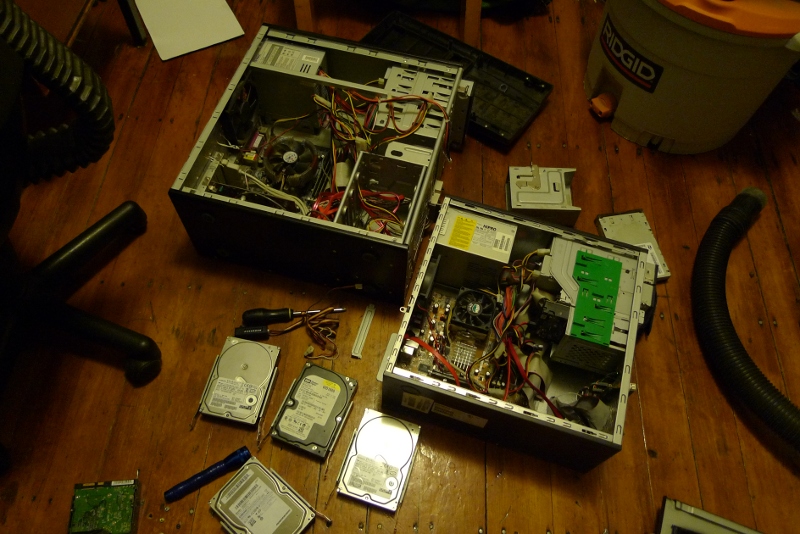
I just replaced my aging 2004-era PC with wait for it a 2005-era PC. A friend is moving across the country so I'm taking it off his hands. Swapping hardware between Freyja and Earlgrey The differences between the two are more than just the year of time, though: one was hand-built from parts, while the other was a commodity off-the-shelf Compaq. So the new machine, while not strictly faster by the clock, is 64-bit and is much more amenable to upgrades. While the added bulk is a bit annoying, the case has a lot more space in it up to 8 or so drive slots (I can't imagine ever needing that many), and 4 RAM slots which is a sure step up from the limitation of two drive slots and two RAM slots in my old machine. The most visibly shiny parts in the new desktop experience are 4G RAM versus 1G, and a nice ATI GPU. While I'm glad my OS allowed me to squeeze six years out of my main machine, I'll be happy to stop shaking my fist at Chromium for eating all my memory! The new machine will keep its old name: earlgrey.
Asheesh Laroia: Kat and Asheesh, on identity

Six months ago, I was talking with Kat. We were talking about talking. On imperfection Kat wrote:
<mindspillage> I think I have to be very very comfortable around someone to be able to be imperfect around them.
<mindspillage> (at least, without feeling horribly embarrassed about it)
<mindspillage> More so if what I'm doing is part of my identity.
It's safe to be bad at dancing, she explained; she doesn't consider herself a good dancer, so nothing's at risk. On flames I had recently written about diversity in free software. Kat showed me a piece she had written, but not yet published, on a similar topic. I thought she should simply publish the piece as-is. Instead, she worried:
<mindspillage> I feel like I have a hard time getting across what I think without coming across as antagonistic.
I've felt the same way. Years ago, I told my friend Venkatesh that had sent a flame to a mailing list we're both on. He retorted that my flames lack flame. So then I thought about why I might feel I've written a flame, even when no one else felt that way. I wrote to Kat:
<paulproteus> Expressing oneself is a frustrating experience.
<paulproteus> It may seem like you're taking this out on other people.
<paulproteus> In fact, you're just frustrated.
<paulproteus> And fighting (successfully) your own urges to just be quiet.
<paulproteus> So at the end you'll feel like you fought a battle, and that seems like you wrote something that others would feel is antagonistic.
Maybe for Kat's writing and my "flames", there was some sort of antagonistic process in which we fought ourselves. That fight doesn't have a lot to do with the resulting text, so it's invisible to the reader. I think this process might leave us vulnerable in another way: if our urges to stay quiet come from a sense of isolation, and we manage to stay quiet about that feeling, no one will sympathize with us. We'll appear to be healthy, active participants in a conversation where we express ourselves. Other people with a similar "process" for self-expression won't get a chance to empathize. (This is why I'm interested in putting together a Debian for Shy People caucus. I hope my Debconf proposal for a Birds of a Feather session is accepted!) On finding a way out We concluded on a happy note:
<mindspillage> I haven't been answering Wikimedia mail for a while. Then I figured out that I don't have to use my real name, so I don't have to answer as someone with responsibility, I can just be some random volunteer.
<mindspillage> Most of it is silly and trivial. But sometimes I am really able to address someone's concern or change someone's mind, and I forget how good that feels.
<mindspillage> (There are some real jerks too.)
<mindspillage> I got someone who was being snarky to apologize for being so rude. That was kind of awesome. Sometimes it doesn't take very much to make me happy.
P.S. A note from the archives Apparently, for me, speaking French is exempt from the above restrictions.

22 May 2010

Petter Reinholdtsen: More flexible firmware handling in debian-installer

After a long break from debian-installer development, I finally found time today to return to the project. Having to spend less time working dependency based boot in debian, as it is almost complete now, definitely helped freeing some time. A while back, I ran into a problem while working on Debian Edu. We include some firmware packages on the Debian Edu CDs, those needed to get disk and network controllers working. Without having these firmware packages available during installation, it is impossible to install Debian Edu on the given machine, and because our target group are non-technical people, asking them to provide firmware packages on an external medium is a support pain. Initially, I expected it to be enough to include the firmware packages on the CD to get debian-installer to find and use them. This proved to be wrong. Next, I hoped it was enough to symlink the relevant firmware packages to some useful location on the CD (tried /cdrom/ and /cdrom/firmware/). This also proved to not work, and at this point I found time to look at the debian-installer code to figure out what was going to work. The firmware loading code is in the hw-detect package, and a closer look revealed that it would only look for firmware packages outside the installation media, so the CD was never checked for firmware packages. It would only check USB sticks, floppies and other "external" media devices. Today I changed it to also look in the /cdrom/firmware/ directory on the mounted CD or DVD, which should solve the problem I ran into with Debian edu. I also changed it to look in /firmware/, to make sure the installer also find firmware provided in the initrd when booting the installer via PXE, to allow us to provide the same feature in the PXE setup included in Debian Edu. To make sure firmware deb packages with a license questions are not activated without asking if the license is accepted, I extended hw-detect to look for preinst scripts in the firmware packages, and run these before activating the firmware during installation. The license question is asked using debconf in the preinst, so this should solve the issue for the firmware packages I have looked at so far. If you want to discuss the details of these features, please contact us on debian-boot@lists.debian.org.

21 May 2010

Gustavo Noronha Silva: Google s pacman doodle in Epiphany/Midori?

Google has had a very nice idea today, to celebrate Pacman s aniversary: they made their logo become a playable HTML5 pacman. If you re wondering why your WebKitGTK+ browser is not being able to play the game here s why: Google is doing User-Agent sniffing and denying you the fun, sending a static image that you can click to perform a search instead of the game. If you make Epiphany or Midori identify themselves as Chrome or Firefox, the game will work. I really don t get this User Agent sniffing bullshit coming from Google. If you go to gconf-editor, and under epiphany->general set the user_agent key to Mozilla/5.0 (X11; U; Linux; en-gb; rv:1.9.0.2) Gecko/2008092313 Firefox/3.8 it works. I m starting to seriously consider User Agent spoofing for *.google.com as a quirk on WebKitGTK+. Lame. Update: as a protest, I m making blog.kov.eti.br and kov.eti.br say Chrome/Chromium are not supported, by doing User Agent sniffing.

Update2: it s been pointed out to me that the game is not HTML5 - it s actually smart usage of divs, and flash *urgh* for the audio

20 May 2010

Aigars Mahinovs: So, what is Microsoft Azure and how it compares to Amazon s AWS

We had a Microsoft salesperson stop at our offices today to tell people about wonders of cloud computing and Microsoft s Azure will save us all. The following is a short and non-exhaustive list of what Azure does not do according to their own experts: The Microsoft presenter also repeatedly engaged in shady tactics when presenting his information: So to summarize, Microsoft has build a cloud of Windows-like machines which can run your programs (as long as they are in .Net or Silverlight) and which does not have even a third of the features of such de-facto market leader as Amazon AWS. They try giving away their product for free and only get 14k applications in 6+ months. Note: Amazon has at least 300 000 public applications and God only knows how many more private ones. They will grow, due to companies locked-into Microsoft s way of thinking buying into their marketing, but if you have a head on your shoulders, you should avoid it as a trap, which it actually is. All that can be done on Azure, can also be done on Amazon. The opposite is not always true. In addition, if you will want have a mixed environment with both Windows and Linux servers, you will not be able to deploy Linux servers to Azure (or they will be very slow) and you ll have to put your Linux servers into Amazon (or another) cloud and pay double traffic fees for every byte of traffic between your own servers. Microsoft Azure prices are exactly the same as Amazon EC2 prices with Windows instances. However on Amazon you actually get fully capable Windows Server instances. And if you don t need Windows, you can get a much better price on Amazon. The only companies that can safely use Azure are companies that only have Windows servers AND plan to only have Windows servers for the foreseeable future. Knowing how dominant Linux is in the server market and how many Windows-only shops actually have a few Linux servers in the back room, there is very little future for Azure, until they wise up and make Linux instances first class citizens in their cloud. If not because their customers need them, then because their customers think that they at least might need them in the future. Update: Amazon now released a Reduced Redundancy storage for S3 that provides the exacts same level of storage guarantees that regular Microsoft Azure SLA (99.9%) for two thirds of the price, and also Amazons now explicitly says that their regular S3 is Designed for 99.999999999% Durability , which is worlds above what Microsoft provides. Now in this case Amazon again is cheaper than MS. Also Amazon bandwidth prices are 33% lower compared to Azure. In Azia the difference is simply staggering (0.45$ vs 0.19$ per Gb).

Kees Cook: openoffice presenter console

During the Lucid development sprint, Pete showed me the glory that is the OpenOffice presenter console. Since then I ve switched laptops, and I figured I need to document for myself, and maybe others, how to have your OOo presentation on one screen (e.g. the projector) and the presentation notes, clock, etc, on another (e.g. the main laptop display). First, install openoffice.org-presenter-console , and once you have your displays configured, launch OpenOffice and select Slide Show / Slide Show Settings . From here, you can configure the displays under Multiple displays . So nice. :) UPDATE: corrected my typo. thank you! :)

19 May 2010

Daniel Kahn Gillmor: NYC SYEP still requires Microsoft Software

A year ago, i wrote about how New York City's Summer Youth Employment Program (SYEP) requires the use of Internet Explorer to apply online (and it even appears to require IE just to download the PDF of the application!) Sadly, the situation has not changed, a year later. Today, I'm writing to Dan Garodnick, Chair of The City Council's Committee on Technology (and the rest of the committee members), Carole Post, Commissioner of DoITT (the city's Department of Information Technology and Telecommunications), and Jeanne B. Mullgrav, Commissioner of DYCD (the Department of Youth and Community Development, which runs SYEP). Here's what i wrote:
For the last two years at least, the DYCD's Summer Youth Employment Program
(SYEP) has been only available to users of Internet Explorer:
 https://application.nycsyep.com/
Internet Explorer (IE) is only made by Microsoft, and is only available for
people running Microsoft operating systems.  Users of other operating systems,
such as GNU/Linux, Macintosh, or others cannot access the SYEP application
process.  Even users of Windows who care about their online security or simply
desire a different web browsing experience might prefer to avoid Internet
Explorer.
Not only is the online form inaccessible from browsers other than IE, even
retrieving a copy of the PDF to print out and fill in manually is unavailable
for web browsers other than IE.
What is the city's policy is on access to government sites?  Is it city policy
to mandate a single vendor's software for access to city resources?  Should NYC
youth be required to purchase software from Microsoft to be able to apply
for the Summer Youth Employment Program?
The sort of data collection needed by such an application is a mainstay of the
standards-based web, and has been so for over 15 years now.  There is no reason
to require particular client on an open platform.  I can point you toward
resources who would be happy to help you make the system functional for users
of *any* web browser, if you like.
I raised this issue over a year ago (see nyc.gov correspondence #1-1-473378926,
and a public weblog posted around the same time [0]), and got no effective
remedy.  It's worrisome to see that this is still a problem.
Please let me know what you plan to do to address the situation.
Regards,
	--dkg
[0] https://www.debian-administration.org/users/dkg/weblog/47
Feel free to send your own message to the folks above (especially helps if you live in or near NYC) Finally, Carole Post, the head of DoITT will also be present at a panel tonight in Soho, which i'm unfortunately be unable to attend. If you go there, you might ask her about the situation.Tags: policy

John Goerzen: Time to learn a new language

I have something of an informal goal of learning a new programming language every few years. It s not so much a goal as it is something of a discomfort. There are so many programming languages out there, with so many niches and approaches to problems, that I get uncomfortable with my lack of knowledge of some of them after awhile. This tends to happen every few years. The last major language I learned was Haskell, which I started working with in 2004. I still enjoy Haskell and don t see anything displacing it as my primary day-to-day workhorse. Yet there are some languages that I d like to learn. I have an interest in cross-platform languages; one of my few annoyances with Haskell is that it can t (at least with production quality) be compiled into something like Java bytecode or something else that isn t architecture-dependent. I have long had a soft spot for functional languages. I haven t had such a soft spot for static type checking, but Haskell s type inference changed that for me. Also I have an interest in writing Android apps, which means some sort of Java tie-in would be needed. Here are my current candidates: Of some particular interest to me is that Haskell has interpreters for Scheme, Lua, and JavaScript as well as code generators for some of these languages (though not generic Haskell-to-foo compilers). Languages not in the running because I already know them include: OCaml, POSIX shell, Python, Perl, Java, C, C++, Pascal, BASIC, Common Lisp, Prolog, SQL. Languages I have no interest in learning right now include Ruby (not different enough from what I already know plus bad experiences with it), any assembly, anything steeped in the Microsoft monoculture (C#, VB, etc.), or anything that is hard to work with outside of an Emacs or vim environment. (If your language requires or strongly encourages me to use your IDE or proprietary compiler, I m not interested that means you, flash.) Brief Reivews of Languages I Have Used To give you a bit of an idea of where I m coming from:

18 May 2010

Bernd Zeimetz: deb.li - the Debian ShortURL Service - status update

Although my progress in adding new features is not too fast (hint: patches and help is welcome), I'm quite happy with the progress of deb.li. As mentioned on my last post on debian-devel@l.d.o, I've spent some time to migrate it to the new, but very well written microframework Flask, which is based on Werkzeug, the probably most advanced WSGI utility module. The migration also allowed me to clean up several pieces of messy code which were necessary to work around some issues in python-bottle. Also I've started to bring the layout and CSS into a nice shape. The templates are finished already, just a bit CSS is missing now. Last but not least - the ciabot git script in the example clients is finished and used in a few git based projects on alioth.debian.org now. Just link /var/lib/gforge/chroot/home/users/bzed/godebian-client/ciabot.py to hooks/update and set your CIA project name by running git config hooks.cia-project your-project-name. As usual - comments, bugreports and patches are welcome!

Bernd Zeimetz: gimp-plugin-registry package updated

Yesterday I finally found the time to update gimp-plugin-registry, the (hopefully!) largest and best collection of plugins for The GIMP. As usual here comes a short summary of the changes: Hope you like my work, suggestions and bug reports are welcome as usual!

Stefano Zacchiroli: debian maintainers list

on DMs and the packages they maintain The notion of Debian Maintainer (DM) has been with Debian for about 3 years. As of now, Debian has approximately 120 DMs, which maintain a significant part of the packages in the archive. I'm hereby happy to evilly spoil that Enrico Zini has just set up an index of Debian Maintainers and of the packages they maintain. The index is linked from the people section of our website as a symbolic step in giving more credit to DMs. Now, if anyone would like to setup a nice graph for the statistics page, which monitors the evolution of DMs (and DDs?), that would be useful.
Any idea on how to do that retroactively too?

Wouter Verhelst: Can I have my Debian back?

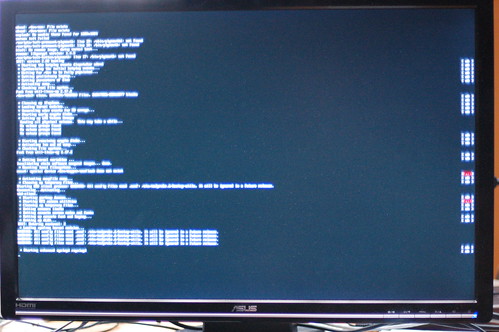
So someone thought it might be a good idea to switch the default from the time-honoured Debian style ("booting foo... ok") to the RedHat style ("<left-align>booting foo... <right-align>[ok]"). I don't think the switch adds any value (it's not like it looked bad or anything in the past); in fact, I think it's a bad idea. And I even have a technical reason. On my 26" 1920x1200 screen (when the i950 driver detects it properly and actually sets the framebuffer to that resolution), the output looks like this: bootscreen Now imagine you get to see that screen for about two to five seconds. Please tell me which two initscripts failed. And no, you cannot use a ruler. Bonus points for if you manage to do so while the text is also moving upwards, which tends to happen when systems boot. Also note that because kernel mode-settings has become the default, a lot more people are going to be using framebuffers. Am I the only one who thinks this is a bad idea?
Sune Vuorela: The Debian-KDE specific things II

I wrote a bit ago a blog post about what debian kde is missing of distribution specific things Some of the more important things includes: Installer

I don t think it is the most important thing. Wether or not the graphical installer is using gtk or qt is not that important. I would love to see it happen, but it is not something I feel like putting my time in. Others are most welcome.
It will give the advantage of giving the installer the possibility to use the framebuffer directly. Modules and firmwares and such
Someone is saying that ubuntu has something called jockey that does this exact thing, with a KDE and a Gnome frontend. Unfortunately, it is python, so it is something I will really avoid. I m hoping that me mentioning it here will make someone into python&debian pick it up and bring it to debian.
It is apparantly some nice magic around discover-data. Debconf frontend that fits
A lot of work has been put into proper perl-qt bindings and they will hopefully be ready for kde4.5, which is unfortunately a series too late for Squeeze :/. But when that has happened, we just need some perl guy to adapt the old frontend to debconf. Reportbug interface
There is already a tool called reportbug-ng that is a qt interface to reporting bugs. All in all, it looks like we are quite far already. We just need to get the last bits put together. Someone: pickup jockey. And note that the comment field isn t a place to report bugs. They will be removed.

Sam Hartman: Moonshot: Federated Authentication Beyond the Web

Recently, I ve been working on an exciting project with JaNet(UK) on a project to bring federated authentication to non-web applications. I ve worked on authentication projects a lot, although this is the first federation project I ve worked on. The big difference appears to be an emphasis on credential independence: the subject (person trying to authenticate) and service will not share a common credential type. Within their organization, the subject and their identity provider share a credential. Then, the federation has some credential mechanism such that the user s organization and the service share some (probably completely different) type of credential. The other emphasis is on providing personalization. For web applications, there are a lot of options to achieve this: Information Card, Open ID, SAML, and OAuth all provide solutions in this space. However there are not good options for non-web applications. If you out-source your mail and chat infrastructure but want to use your own chat client or IMAP client, then you will not get the same federation benefits you can get with the web. If you re using usernames and passwords and don t mind the potential problems with your out-sourcing provider being able to impersonate all your users, you can simply synchronize usernames and passwords. Within an enterprise, you can do better using Kerberos. JaNet(UK) runs the UK Access Federation, which is a SAML-based web single-sign-on federation. In order to better meet the needs of their customers they d like to expand this offering to non-web applications. This demand is apparently shared across the European academic community. I suspect there is also some demand in the US academic community and in enterprise situations. With the web, it turns out that you have a convenient platform for interactions with the identity provider: you can simply direct a web browser to the identity provider and need not specify the user interaction with the web browser at all. This is seen as a significant branding and usability advantage. With other environments, it becomes necessary to specify the interaction with the identity provider. Consider an automated client that wishes to examine a mail box and provide advanced mail sorting or aggregation. That automated client cannot directly use a web browser. OAuth solves this issue with an enrollment step that does typically involve a web browser that produces a consumer key and an authentication step that does not. However for non-web clients it seems like avoiding reliance on the browser authentication will be important. It turns out we already have widely used technologies that do this: the Extensible Authentication Protocol (EAP) mediates the interaction between a subject and identity provider for obtaining network access. It also turns out that we have fairly good technologies for abstract security services within non-web applications: thanks to Kerberos and Active Director, many application protocols and a fair number of applications support GSS-API. JaNet(UK) proposes to combine these technologies with SAML in order to produce a solution for federation beyond the web. I prepared a feasibility analysis of this proposal. At a technical level, the proposal is sound. There s a lot of standardization and implementation work, but there appears to be sufficient motivation to form the seeds of a standards activity and put together a proof-of-concept implementation. However, the big question is Will anyone use it? In particular, to be useful beyond fairly small communities, support from client vendors and application framework vendors will be needed. It s taken massive money and around 20 years to get Kerberos support to a point where it is effective within an enterprise. Moonshot can leverage that work to a large extent, but moonshot may also have greater usability and penetration goals. It s interesting that I m advocating EAP for application layer authentication. When I was a Security AD, I made a strong statement that EAP must only be used for network access. I ve been fairly consistent about that since then. I think there are two huge problems with using EAP for application authentication. The first is that EAP only authenticates the home realm; it does not authenticate what service you re going to. So you might try to connect to your e-mail and end up giving something access to your stored files and pictures instead. That is, EAP has a phishing exposure in the federated context. If the only thing you can get by using EAP is network access, that exposure is only moderate. However in a fully federated environment that is a huge exposure. Moonshot will address this problem by using EAP channel binding and by doing the necessary work to make that a viable solution. The second concern is that interoperability is reduced when you have multiple authentication approaches for the same problem. If EAP is going to be used for application authentication, we need to understand how it relates to the rest of the application authentication metasystem. Moonshot proposes such a relationship, addressing my objection. Moonshot is designed to work well with the objectives of the Identity Metasystem and its laws of identity. It uses a different technology, but does have an approach for dealing with claims-based identity and hopefully will have a user experience very similar to the identity metasystem. It uses a different underlying technology. However one of the main beliefs behind the identity metasystem is that is the user experience and universal interoperability that is important, not any specific technology. In its domain, the technologies Moonshot selects will be a better fit than a web services stack. It s strange not to be working on Kerberos; Moonshot uses some Kerberos technology, but its core is definitely not today s Kerberos. In some ways it is fun to be working on something new. There s one aspect of Kerberos I really miss: Moonshot has nothing like tickets. There s no place to remember state or exchange to directly involve the client in what the server learns. My analysis talks about ways to make Moonshot more like Kerberos; there are some potential advantages, but so far, the tradeoffs do not justify changes. We re hoping to have a bar BOF at IETF 77 and a BOF in the summer at IETF 78.

Andrew Pollock: [life] Zoe, 2 weeks later

The fact that it's only two weeks feels totally surreal. I think it's the feeding approximately every 3 hours. That's approximately 100 interactions that we've had with her in only 2 weeks. We had her two week weight check at the paediatrician's today. She's now weighing 6 lbs 12 oz (3061 grams), so she's made back her birth weight and then some. We're still largely bottle feeding her with pumped breast milk. The paediatrician said that once she's 7 pounds she should have enough strength to breastfeed exclusively, so we'll get a lactation consultant involved if that isn't the case in another week or so. Other than that, everything's going swimmingly. She eats, sleeps and poops. She sleeps amazingly well. I keep telling myself it won't last, but we're making the most of not needing to tip-toe around the house. In the last week, we had a new stove installed, which involved the contractor using a hammer drill to install the anti-tip brackets. He also used a drop-saw to modify one of the drawers. Didn't bother her. We had some shutters installed in the kitchen, which involved a lot of cordless drilling. Also didn't bother her. The gardeners for the complex were mowing the lawn and using a leaf blower right outside her window. Not a peep. Today, after the paediatrician's appointment, we dropped in to Palo Alto Animal Services, the animal shelter where Sarah has volunteered for the last 4.5 years, to show them Zoe. They threw a bit of a surprise baby shower, and gave us a ton of baby clothes, which was very nice and totally unexpected. Zoe slept in her car seat on the table in the lunch room while a good dozen people or so made a lot of noise around her, and she was oblivious to it all. Sarah's Mum arrives on Wednesday. Tomorrow will be a busy day of final cleaning up in preparation.

17 May 2010

Kees Cook: yay for barriers

I find it surreal to have people guessing at my motivations when they could just ask me. On top of all that, I find it weird that people spend so much time with in-fighting. I just want my system not to suck. Some time ago (during in the Ubuntu Karmic development cycle maybe in September 2009), I started having giant problems with my build system. All I/O would start to stall, wait times would surge, and usually my entire system would just go unresponsive with the disk light on solid. This scared the crap out of me, and it wasn t entirely obvious what was triggering it. No one else seemed to be seeing it. I managed to start tracking things using latencytop , and saw stuff like liferea going crazy. As I eliminated more and more things, I eventually settled on it being a problem with umount, and I reported an Ubuntu bug. It seemed to look like an upstream bug that no one else but the reporter could reproduce either. Since no one else was seeing this issue, and it seemed related to LVM snapshots, I migrated off of snapshots, and started using aufs overlays for my builds. For a while, it seemed like things went away. It didn t, and I started hitting it again. I opened a new (now famous) bug in Ubuntu, since now snapshots weren t in the picture, and I didn t want to confuse the earlier history. I managed to find a relatively minimal test-case too. A few other people commenting on the bug were seeing the problem now too, but it was less pronounced for them. As an aside, this wasn t a just wait a few seconds longer kind of issue on my system. A single umount would last 30-40 minutes. And when I m doing parallel builds of security updates, this would turn into my system being unavailable for hours at a stretch. Since none of the kernel developers I was in contact with were able to track down the root cause, I asked Ted Ts o in email if he could just quickly peek in on this for me, since I figured he d be in a good position to confirm or deny it. I didn t want to start wasting upstream time with this if it wasn t reproducible (see earlier upstream kernel bug). To my great relief, Ted found a few minutes to check it, and was able to immediately confirm it and give me a viable work-around ( sync; umount ) for the time being. I confirmed the work-around, and went off to do other things. A while later, Ted came back to deliver a bit of a rant, the purpose of which was not clear to me, but I ultimately ignored it I didn t seem directed at me. I just wanted my system operating normally, and he d done me a favor to check in on it and got me a work-around. More time passes, and I eventually get caught in another I/O-wait melt-down. On investigation, it seemed that the in-kernel work-around in the Ubuntu kernel totally back-fired on me in some cases, rendering even the user-space work-around useless. After investigating the Ubuntu-specific work-around, I re-read Ted s rant in the course of researching what had happened during this bug s triage. It seemed that Ted was basically saying:
this is an upstream problem
RedHat hasn t run into it and he didn t know why I figured I should confirm for myself if Fedora was affected, so downloaded and installed Fedora to double-check there. Since I was able to reproduce it there, I opened an upstream bug, linking back to the original Ubuntu bug, and then went to open a bug in the Fedora tracker, linking back to upstream. And it seems to be these actions that everyone has jumped on. I will now bore you with the reality of my motivations: I wanted to fix the bug so no one would end up experiencing the same pain I d been through over the last 6 months. The bug was, from my perspective, a serious issue. Since I d managed to reproduce it in another distro, it was my duty as a Free Software developer to report it to them. And, in what I felt was an unambiguous gesture, I made sure to include the link to the upstream kernel bug. Reproducing it in Ubuntu, in Fedora, and with a stock kernel had me confident that it was an upstream issue. While Ted did correctly suspect the issue was upstream, I really didn t want to just open an upstream bug and have it be ignored. I wanted some additional proof of reproduction, which I got when I tested it on Fedora. So, I m rather saddened that so many people spent so much time questioning my motivations, making fun of Canonical, or doing anything other than trying to just simply solve this problem. I m totally disinterested in inter-distro fighting. Instead, I continue to assume we re all on the same team, fighting a philosophical battle against close-source software. And in that regard, I think it s still true. If I ignore the rants and jeering, I come away thankful for all the people that spent time trying reproduce the issue at Canonical, at RedHat, and in the larger community. I m hugely thankful that Ted made some time to let me know I wasn t crazy, and there was actually a problem. I m thankful for having some work-arounds, and I m thankful that the root cause was eventually ferreted out, with some possible solutions. I m even thankful that some people on the LWN thread saw that, far from malicious, I was trying to be helpful with the bug. I just wanted my filesystem not to eat my computer. And I was hoping other people could maybe help me, since I m not a filesystem expert. The drama around this bug is pathetic, and now by talking about it for almost 1000 words, I m just as guilty.

Matt Zimmerman: Ubuntu 10.10 (Maverick) Developer Summit

I spent last week at the Ubuntu Developer Summit in Belgium, where we kicked off the 10.10 development cycle. Due to our time-boxed release cycle, not everything discussed here will necessarily appear in Ubuntu 10.10, but this should provide a reasonable overview of the direction we re taking. Presentations While most of our time at UDS is spent in small group meetings to discuss specific topics, there are also a handful of presentations to convey key information and stimulate creative thinking. A few of the more memorable ones for me were: The talks were all recorded, though they may not all be online yet. Foundations The Foundations team provides essential infrastructure, tools, packages and processes which are central to the development of all Ubuntu products. They make it possible for the desktop and server teams to focus on their areas of expertise, building on a common base system and development procedures. Highlights from their track: Desktop The desktop team manages both Desktop Edition and Netbook Edition, on a mission to provide a top-notch experience to users across a range of client computing devices. Highlights from their track: Server/Cloud The server team is charging ahead with making Ubuntu the premier server OS for cloud computing environments. Highlights from their track: ARM Kiko Reis gave a talk introducing ARM and the corresponding opportunity for Ubuntu. The ARM team ran a full track during the week on all aspects of their work, from the technical details of the kernel and toolchain, to the assembly of a complete port of Netbook Edition 10.10 for several ARM platforms. Kernel The kernel team provided essential input and support for the above efforts, and also held their own track where they selected 2.6.35 as their target version, agreed on a variety of changes to the Ubuntu kernel configuration, and created a plan for providing backports of newer kernels to LTS releases to support deployment on newer hardware. Security Like the kernel team, the security team provided valuable input into the technical plans being developed by other teams, and also organized a security track to tackle some key security topics such as clarifying the duration of maintenance for various collections of packages, and the ongoing development of AppArmor and Ubuntu s AppArmor profiles. QA The QA team focuses on testing, test automation and bug management throughout the project. While quality is everyone s responsibility, the QA team helps to coordinate these activities across different teams, establish common standards, and maintain shared infrastructure and tools. Highlights from their track include: Design The design team organized a track at UDS for the first time this cycle, and team manager Ivanka Majic gave a presentation to help explain its purpose and scope. Toward the end of the week, I joined in a round table discussion about some of the challenges faced by the team in engaging with the Ubuntu community and building support for their work. This is a landmark effort in mating professional design with free software community, and there is still much to learn about how to do this well. Community The community track discussed the usual line-up of events, outreach and advocacy programs, organizational tools, and governance housekeeping for the 10.10 cycle, as well as goals for improving the translation of Ubuntu and related resources into many languages. One notable project is an initiative to aggressively review patches submitted to the bug tracker, to show our appreciation for these contributions by processing them more quickly and completely.

Marco T&uacute;lio Gontijo e Silva: Google Summer of Code weekly report #1

Some students of the Google Summer of Code are required to make a weekly report describing their activities. As far as I know, I m not, but I think it s a good idea in general, to comunicate to my mentor and other interested folks what I ve been doing. So I ll start to do them here. My project is Implementing the Immix Garbage Collector Algorithm on GHC. Last week I was most of the time involved in my school activities, so I didn t have much time to work on the project. I went to the bureaucratic services of my university to get a Proof of Enrollment in English, print/sign/scanned the Foreign Certification Form and sent them to Google on Friday afternoon. I asked them to confirm the receival, which they didn t. I m planning to ask again for a confirmal today in the afternoon, if I still get no reply. I also tried to build the current version of GHC, from the darcs repository. I was getting an error with my old (and updated) repository, so I donwnloaded a new one and could build nicely. Then I noticed that with make distclean I could also build with my older one, so I just removed the new. I downloaded the nofib benchmark suite and made an initial benchmark. While I was reading the documentation of the build process of GHC, I noticed a bug, and submitted a patch to the cvs-ghc mailing list. The patch was applied, with some changes. This week I plan to focus more on the project, and spend the weekly 36 hours working on it. I m planning to start reading the Immix Technical Report to see if there s anything new there with regard to the article. After that I ll read the wiki documentation on the GHC current GC, together with the GHC source code. I ll also experiment with Criterion. While I was writing this post I noticed that the GC benchmark in nofib is failing:
==nofib== fibheaps: time to run fibheaps follows...
/usr/bin/time ../../runstdtest/runstdtest ./fibheaps  -o1 fibheaps.stdout -o1 fibheaps.stdout  -ghc-timing     300000;  /usr/bin/time ../../runstdtest/runstdtest ./fibheaps  -o1 fibheaps.stdout -o1 fibheaps.stdout  -ghc-timing     300000;  /usr/bin/time ../../runstdtest/runstdtest ./fibheaps  -o1 fibheaps.stdout -o1 fibheaps.stdout  -ghc-timing     300000;  /usr/bin/time ../../runstdtest/runstdtest ./fibheaps  -o1 fibheaps.stdout -o1 fibheaps.stdout  -ghc-timing     300000;  /usr/bin/time ../../runstdtest/runstdtest ./fibheaps  -o1 fibheaps.stdout -o1 fibheaps.stdout  -ghc-timing     300000;
Command exited with non-zero status 2
0.72user 0.05system 0:00.77elapsed 99%CPU (0avgtext+0avgdata 277664maxresident)k
0inputs+32outputs (0major+17695minor)pagefaults 0swaps
././fibheaps 300000 < /dev/null
**** expected exit status 0 not seen ; got 2
././fibheaps 300000 < /dev/null
expected stderr not matched by reality
--- /tmp/no_stderr3559  2010-05-17 07:35:09.000000000 -0300
+++ /tmp/runtest3559.2  2010-05-17 07:35:10.000000000 -0300
@@ -0,0 +1,2 @@
+Stack space overflow: current size 8388608 bytes.
+Use  +RTS -Ksize -RTS' to increase it.
Command exited with non-zero status 1
0.72user 0.06system 0:00.85elapsed 92%CPU (0avgtext+0avgdata 277664maxresident)k
368inputs+48outputs (1major+22085minor)pagefaults 0swaps
Command exited with non-zero status 2
0.71user 0.04system 0:00.78elapsed 97%CPU (0avgtext+0avgdata 277664maxresident)k
0inputs+32outputs (0major+17694minor)pagefaults 0swaps
././fibheaps 300000 < /dev/null
**** expected exit status 0 not seen ; got 2
././fibheaps 300000 < /dev/null
expected stderr not matched by reality
--- /tmp/no_stderr3578  2010-05-17 07:35:10.000000000 -0300
+++ /tmp/runtest3578.2  2010-05-17 07:35:11.000000000 -0300
@@ -0,0 +1,2 @@
+Stack space overflow: current size 8388608 bytes.
+Use  +RTS -Ksize -RTS' to increase it.
Command exited with non-zero status 1
0.72user 0.06system 0:00.80elapsed 98%CPU (0avgtext+0avgdata 277664maxresident)k
0inputs+48outputs (0major+22093minor)pagefaults 0swaps
Command exited with non-zero status 2
0.72user 0.06system 0:00.80elapsed 98%CPU (0avgtext+0avgdata 277680maxresident)k
0inputs+32outputs (0major+17696minor)pagefaults 0swaps
././fibheaps 300000 < /dev/null
**** expected exit status 0 not seen ; got 2
././fibheaps 300000 < /dev/null
expected stderr not matched by reality
--- /tmp/no_stderr3597  2010-05-17 07:35:11.000000000 -0300
+++ /tmp/runtest3597.2  2010-05-17 07:35:12.000000000 -0300
@@ -0,0 +1,2 @@
+Stack space overflow: current size 8388608 bytes.
+Use  +RTS -Ksize -RTS' to increase it.
Command exited with non-zero status 1
0.72user 0.07system 0:00.83elapsed 96%CPU (0avgtext+0avgdata 277680maxresident)k
0inputs+48outputs (0major+22095minor)pagefaults 0swaps
Command exited with non-zero status 2
0.68user 0.08system 0:00.78elapsed 97%CPU (0avgtext+0avgdata 277680maxresident)k
0inputs+32outputs (0major+17695minor)pagefaults 0swaps
././fibheaps 300000 < /dev/null
**** expected exit status 0 not seen ; got 2
././fibheaps 300000 < /dev/null
expected stderr not matched by reality
--- /tmp/no_stderr3616  2010-05-17 07:35:12.000000000 -0300
+++ /tmp/runtest3616.2  2010-05-17 07:35:12.000000000 -0300
@@ -0,0 +1,2 @@
+Stack space overflow: current size 8388608 bytes.
+Use  +RTS -Ksize -RTS' to increase it.
Command exited with non-zero status 1
0.70user 0.09system 0:00.80elapsed 98%CPU (0avgtext+0avgdata 277680maxresident)k
0inputs+48outputs (0major+22089minor)pagefaults 0swaps
Command exited with non-zero status 2
0.71user 0.06system 0:00.93elapsed 82%CPU (0avgtext+0avgdata 277680maxresident)k
0inputs+32outputs (0major+17695minor)pagefaults 0swaps
././fibheaps 300000 < /dev/null
**** expected exit status 0 not seen ; got 2
././fibheaps 300000 < /dev/null
expected stderr not matched by reality
--- /tmp/no_stderr3635  2010-05-17 07:35:12.000000000 -0300
+++ /tmp/runtest3635.2  2010-05-17 07:35:13.000000000 -0300
@@ -0,0 +1,2 @@
+Stack space overflow: current size 8388608 bytes.
+Use  +RTS -Ksize -RTS' to increase it.
Command exited with non-zero status 1
0.73user 0.06system 0:00.95elapsed 83%CPU (0avgtext+0avgdata 277680maxresident)k
0inputs+48outputs (0major+22089minor)pagefaults 0swaps
make[1]: ** [runtests] Erro 1
Failed making all in fibheaps: 1
make: ** [all] Erro 1
Erro is error in Portuguese. I ll investigate on that.

Next.

Previous.
