Search Results: "ina"

6 February 2013

Aigars Mahinovs: Pensijas prognoze 18.43

Update: I apologise for spamming all the nice people on Planet Debian with this unrelated post in foreign language it got mis-tagged and (although I tried classifying it correctly and removing it from the separate Debian-only RSS feed going to the Debian Planet) Planet software just keeps it around until admins get a spare moment to remove it manually. The basic idea of the post is that there is a e-government service by the Latvian government that provides any citizen a way to check what their pension would be, but it is kinda useless, because it calculates what you pension would be if you decided to retire right now. So in the post below I provide a few simple steps on how to estimate what the real pension could be (in todays currency values) if a person kept paying into the system at the same rate until the normal retirement age. Latvija.lv ir r ks savas n kotnes pensijas prognoz anai, ta u tas ir, maigi izsakoties, bezj dz gs tiem, kas nepl no iet pensij tuv k gada laik . tri apskatoties atteic gos likumus un noteikumus es nonacu pie lietder g kas metodes. Vispirms m s varam dro i ignor t pensiju indeks ciju un visas ar to saist t s pensiju kapit la p rr in anas vai iemaksu palielin anos ir skaidrs, ka gadiem ejot uz priek u b s kaut k ds infl cijas procents, kura d palielin sies algas, palielin sies iemaksas pensiju kapit l un tiks p rr in tas vis das izmaksas, ta u t pati infl cija tie i ietekm s ar to cik v rt gs b s katrs gala pensijas lats taj br d , kad pensija tiks sa emta, l dz ar to infl cijas efekts tiek neitraliz ts, ja m s v rt jam gala ciparu br a cenu kontekst t.i. ja gal san ks, ka pensija b s 400Ls, tad to vai tas ir daudz vai maz j dom br a cen s, nevis m inot izdom t k das b cenas p c 30 gadiem. To visu emot v r pensijas apr ins stipri vienk r ojas:
  1. Pa emam atskaiti no t Latvija.lv pakalpojuma. Tas mums dos uz o br di uzkr to pensijas kapit lu (U) un aptuvenu ciparu par to k ds ir kapit la ikgad jais piaugums (P)
  2. Apr inam cik v l gadi ir paliku i l dz pension an s vecumam (t) t.i. l dz 62 gadiem. Es pat r in tos ar to, ka ap to laiku m r a vecums jau b s 65.
  3. Sar inam to cik b s aptuvenais pensijas kapit ls pension anas vecuma, ja m s turpinam iemaksas k tagad K = U + ( P * t )
  4. Apr inam k da san k ikm ne a pensija no da pensijas kapit la Pensija = K / G / 12, kur G ir emts no pension an s vecumam atbilsto s rindi as MK noteikumos, piem ram 62 gadiem tas ir 18.43
Piez me: G ir statisti u apr in ta prognoze par to cik vid ji gadus Latvijas iedz vot ji nodz vo ja vi i ir sasniegu i attiec go pension an s vecumu, t.i. t ir prognoze par to cik gadus vid ji jums b s tas prieks baud t pensiju. Ja rezult ts san k par k mazs, tad j em v r , ka summa neiek auj dividendes no 2 un 3 pensijas l me a, kas p ris gadu desmitu laik var b t t ri iespaid gs. Da as prognozes ir t das, ka 2ais un 3ais pensijas l menis kop var tu dod v l aptuveni t du pa u pensiju kl t k 1ais l menis. Ta u tas ir stipri atkar gs no fondu tirgus ilglaic gas dinamikas. Man to visu apr inot san k ap 400 Ls pensijas prognoze. Ja piepild s paredz jumi par 2o un 3o pensijas l meni, tad, ja es iedom jos sevi tagad k pension ru ar 600-800 Ls pensiju zin nav ne vainas. :)

Vincent Sanders: Two years of 3D printing

Almost two years ago my good friend Phil Hands invited me to attend a workshop at bath university to build a 3D printer. I had previously looked at the Reprap project and considered building the Darwin model, alas lack of time and funds had prevented me form proceeding.

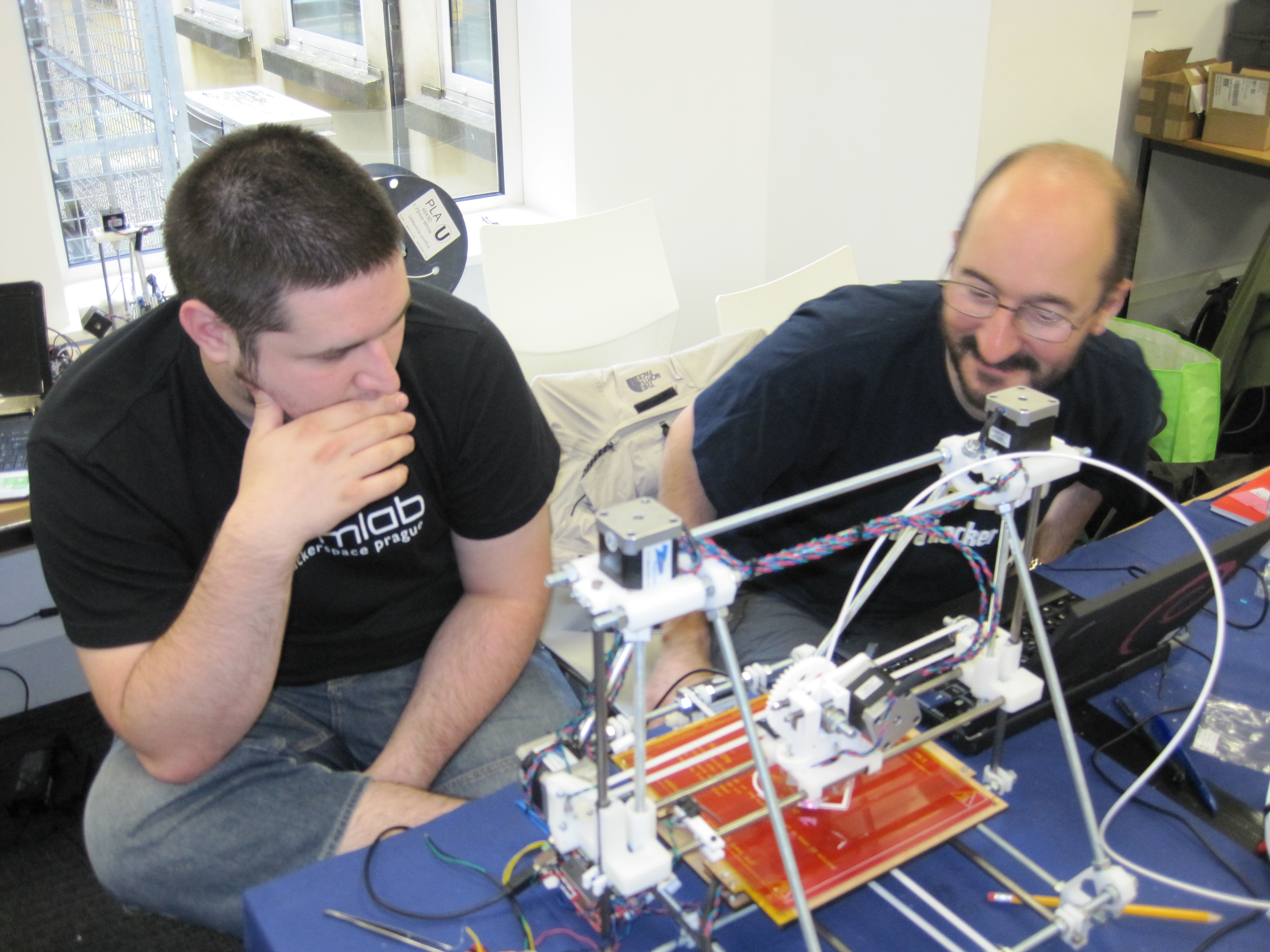
Jo Prusa and Phil Hands watching a heart print.
The workshop was to build a new, much simpler, design called the Prusa. Of course the workshop was booked and paid for well in advance which left me looking forwards to the event with anticipation. Of course I would not betaking the results of the workshop home as Phil had paid for it, so I started investigating what I would need for my own machine.

Of course at this point I muttered the age old phrase of "how hard can it be" and started acquiring parts for my own printer. By the time the workshop happened I already had my machine working as a plotter. I learned a lot from the Bath masterclass and a few days afterwards my own machine was complete.

First print
The results were underwhelming to say the least. There then came months and months of trial and error to fix various issues:
  • The filament feed bolt had to be replaced with a better one with sharper teeth.
  • The thermistor which reads the extruder temperature needed replacing (it still reads completely the wrong temperature even now).
  • The Y axis was completely inverted and needed re-wiring and the limit switches moving.
  • Endlessly replacing the printer firmware with new versions because every setting change requires a complete recompile and re-flash.
  • The bushings on the Y axis were simply not up to the job and the entire assembly needed replacing with ball bearings and a heated bed otherwise prints would be completely warped.
  • The Z axis couplings kept failing until I printed some alternates that worked much better
Once these issues had been fixed I started getting acceptable levels of output though the software in the workflow used to produce toolpaths (skeinforge) was exceptionally difficult to use and prone to producing poor results.

Alas the fundamental design issues of the Prusa remain. The A frame design provides exceptional rigidity in one plane...the other two? not so much. This coupled with an exceptionally challenging calibration to get the frame parallel and square means the printer is almost never true.

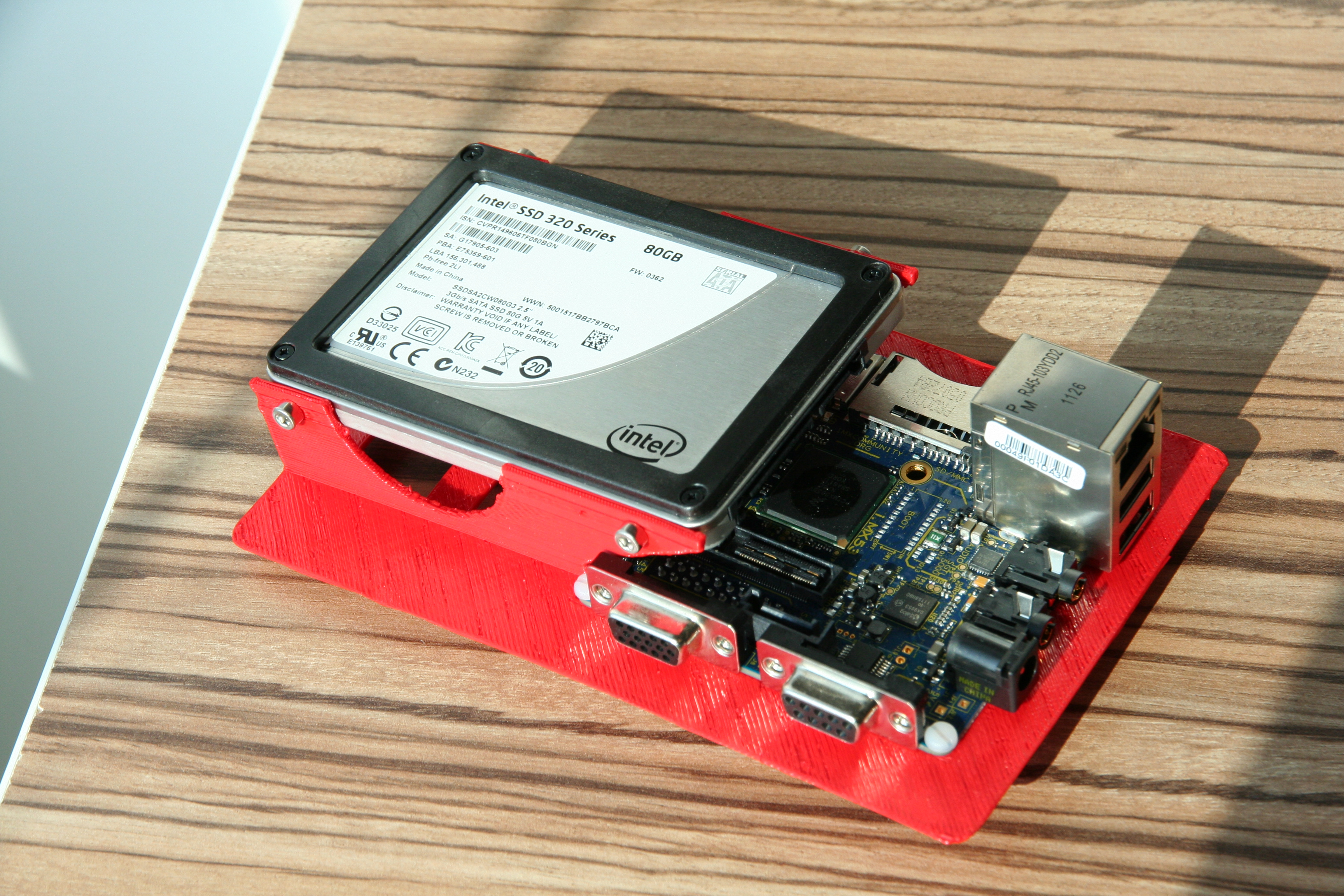
Prototype iMX53 dev board eurocard carrier printed on my printer
In operation the lack of rigidity in the x axis means the whole frame vibrates badly even with extra struts to try and improve its rigidity. I am not the first to notice these design flaws and indeed Chris has done something about it by creating a much superior design.

I do however have a working printer and have developed a workflow and understanding of what I can expect to work.

Improvements in the software means that slic3r has replaced skeinforge and gives superior results and the CAD software is continuously improving.

Currently I mainly use the printer to generate prototypes and simple profiles and then send the resulting designs to shapeways for final production though simpler designs are usable directly from the machine.

Because I am away from home a lot and moving the machine is simply not a workable option the printer does not get used for "fun" anywhere near as much as I had hoped and the workflow limitations mean I have not been able to make it available to my friends to use as a communal device.


Thomas Goirand: Openstack Folsom fully uploaded to Experimental

It s been a long time I wanted to blog about my recent work on the Openstack packaging. I finally can find a bit of time to do it. For those who don t know yet Openstack, it s a fairly recent (less than 3 years) cloud computing suite, which is becoming quite huge. If you plan on deploying a private cloud, you should definitively have a look into it. When the Openstack project started, I immediately was interested. I started packaging the Cactus release (that is, the 3rd version of Openstack), created the Alioth group (at the exact moment when Alioth was migrated to new hardware which added some fun so lucky I was!), and began to work on the Debian version (Openstack used to be an Ubuntu only project). After some success in integrating some Debian specific patches into the Ubuntu packages, I left it a bit aside, and skipped completely the Diablo release (which was never uploaded in Debian). Then, I worked a bit on the Essex release before the freeze of Wheezy last June, together with other DDs (big up to Julien, Loic, Ghe, Sileth!). I (re-)started serious packaging work for Openstack just right after Folsom (eg: version 2012.2) was released early last October. I literally worked days and nights on it, in order to provide more automation so that it could become more easy to install. Indeed, it used to be very complicated and painful, with lots of manual tasks to perform on the shell. It s hopefully a lot easier now, with most of the manual boring shell work replaced by debconf and scripts. But I m sure there s more that can be done still. After 4 months of effort, I finally pressed the red button and uploaded everything at once to Debian Experimental since Openstack Essex (version 2012.1) is in Wheezy, I can t of course upload to SID unless Wheezy is out -. This represent 32 sources packages in total (some of them are already uploaded and approved by the FTP masters: sorry to give you so much more work guys ), and 104 binary packages (and counting ). So this isn t exactly small And I already have some fixes for what s currently waiting in the NEW queue: CVE fixes, missing build-depends which we ve found using the Jenkins server of eNovance who sponsors the packaging work, etc. I probably will post again here to announce when Folsom is completely approved by the FTP masters and reaches Debian experimental. In the mean while, it s available on GPLHost non-official repositories (see the howto linked bellow). If you would like to test the latest Openstack release (called Folsom, or 2012.2, if you are following well ), you can read the quite verbose howto I wrote here: https://wiki.debian.org/OpenStackHowto/Folsom If you do test it (don t be afraid, it s not that hard ), I will be very happy to hear from you, and receive any feedback / critics you may have. Note that I would strongly recommend to use the Folsom release, rather than what is currently in Wheezy, for many reasons which would be too long to list in this blog post (let me still drop a few reasons here: less bugs, more automations and it s more easy to install). Now, Openstack is a constantly evolving software, with so many companies and developers involved. I don t think my work on this beast will ever be finished. But it doesn t mater, as it s been quite some fun, and I will enjoy to do more. The next release of Openstack is schedule for next April (they release at the same time as Ubuntu). I hope to be able to join the Portland summit, and see all the persons I have worked with over IRC and mailing list. This time, I hope to be able to release Openstack packages at the same time as the upstream source code is released (Debian packages have historically been lagging a few months behind). The pre-version is by the way already in Alioth. Last, a (private) message for our famous cheese-master: please wait until everything leaves the NEW queue before bugging everyone with translations. We probably should have a serious talk about how to make it less redundant, easier to translate, and probably find a way to avoid duplication of messages across all packages.

Raphael Geissert: A bashism a week: short-circuiting tests

The test/[ command is home to several bashisms, but as I believe I have demonstrated: incompatible behaviour is to be expected.

The "-a" and "-o" binary logical operators are no exception, even if documented by the Debian Policy Manual.

One feature of writing something like the following code, is that upon success of the first command, the second won't be executed: it will be short-circuited.
[ -e /dev/urandom ]   [ -e /dev/random ]

Now, using the "-a" or "-o" bashisms even in shell interpreters that support them can result in unexpected behaviour: some interpreters will short-circuit the second test, others won't.

For example, bash doesn't short-circuit:
$ strace bash -c '[ -e /dev/urandom -o -e /dev/random ]' 2>&1 grep /dev
stat64("/dev/urandom", ...) = 0
stat64("/dev/random", ...) = 0
Neither does dash:
$ strace dash -c '[ -e /dev/urandom -o -e /dev/random ]' 2>&1 grep /dev
stat64("/dev/urandom", ...) = 0
stat64("/dev/random", ...) = 0
But posh does:
$ strace posh -c '[ -e /dev/urandom -o -e /dev/random ]' 2>&1 grep /dev
stat64("/dev/urandom", ...) = 0
And so does pdksh:
$ strace pdksh -c '[ -e /dev/urandom -o -e /dev/random ]' 2>&1 grep /dev
stat64("/dev/urandom", ...) = 0

output of strace redacted for brevity

So even in Debian, where the feature can be expected to be implemented, its semantics are not very well defined. So much for using this bashism... better avoid it.

Remember, if you rely on any non-standard behaviour or feature make sure you document it and, if feasible, check for it at run-time.

5 February 2013

Michael Stapelberg: RC bugs

I recently worked on the following RC bugs: It is getting hard to find RC bugs to work on. If you have access to ia64 hardware, have a look at #694971 Epiphany browser crashes within JSC::JSArray::increaseVectorLength() or #697172 sporadic crashes of epiphany browser due to a thread-unsafe favicon database. Both have patches available that just need to be tested.

DebConf team: DebConf13 venue and dates (Posted by Moray Allan, Didier Raboud and the DebConf team)

This post is a quick status update on DebConf13, for those who aren t following the debconf-team mailing list. As you may know, this year s DebConf will be held at Le Camp, in Vaumarcus, Switzerland. Our concept for this DebConf is to hold it in a natural environment, away from distractions. We hope you will enjoy spending time together with other Debian collaborators in this beautiful part of Switzerland, on the shore of Lake Neuch tel. Dates DebConf13 will take place from Sunday 11. August 2013 to Sunday 18. August 2013. (We will use Saturday 10. August 2013 to prepare the venue for the conference.) You may notice that the dates don t cover two weeks like in the last few years (there is no separate DebCamp week). For budget reasons, current plans are to merge the two weeks activities into an 8 day period. If you think that s a pity, it s not too late to change it just join the fundraising team and start working quickly! Travel If you want to start arranging your travel to attend DebConf, some initial travel suggestions may be useful: The DebConf13 map shows the venue and the bus line (with some stops). Registration We expect to open registration around the start of March. Currently we are still evaluating some possible new conference management systems, which we hope might avoid the frustrations some attendees have had in the past with Pentabarf. Help welcome As always, the DebConf team is looking for volunteers. Some jobs need technical skills (e.g. testing conference management system setups, working on the website), but many DebConf tasks are about working to deadlines on non-technical issues (e.g. fundraising, budgeting, talk scheduling). You can see more information about some of the jobs to be done on the DebConf wiki. Please do think about getting involved and sharing your ideas with us, to help us make DebConf an even more useful event for Debian in the future. We look forward to welcoming you to Vaumarcus!

Dirk Eddelbuettel: New Rcpp page on upcoming events -- including Master Class in New York

Lots of exciting things are happening with and around Rcpp. I just added a new page about Upcoming Events to the recently-created Rcpp site. This events page has lots to cover: an upcoming talk at Columbia on March 8 (details still TBD), a day-long workshop in New York on March 9, a possible participation at a CERN / ROOT conference in Switzerland on May 11-14, an upcoming talk in May in Milwaukee, and last but not least the tutorial by Romain and Hadley at UseR! 2013 in Spain. Phew! With that, a few quick words about the upcoming master class in New York. It will be a full day, covering an introduction and motivation, details about the core data types, tools for working with and and extending Rcpp and of course applications galore, including RcppArmadillo and RInside. I have done the same one day class format a few times before, most recently (with Revolution Analytics) in San Francisco in late 2011, and also as a two-part seminar at UseR! 2012. This time, we plan on providing cloud-hosted RStudio instances for participants. Better still, RStudio's own JJ Allaire will be on deck as well for RStudio --- and Rcpp Attributes --- questions. Details and registration information for the New York class are at this page.

Wouter Verhelst: Video at FOSDEM 2013

For the second year in a row, I've led the team that organized video at FOSDEM. This year, most things went pretty smoothly; more so than last year. We definitely learned from some of our mistakes, and although I can't say that everything went better than it did last year, after having done a first look at things I can certainly say that overall, the result is better now than it was last year. Our setup was very similar to what it was last year. However, there were some key differences: Unfortunately, that didn't mean all was well. The internal server would transcode the DV stream into WebM, which was then sent on to the Flumotion platform where it was going to be transcoded to Ogg Theora, before being streamed in both formats. Due to an issue which we could not track down (possibly something incorrect in my configuration), the transcoding into Ogg Theora did not work smoothly, and even had the unwanted effect of disrupting the WebM streaming. Since this made it difficult to debug without disrupting service, eventually we decided to give up on Ogg Theora and only provide WebM streams; I considered that to be a better solution than no streaming at all. In addition, apparently in the year since FOSDEM 2012, libav and gstreamer have changed significantly enough that the scripts that I used then had to be somewhat revisited in order to be able to transcode the existing recordings into WebM ready for video.fosdem.org. Oh well, I had to add in normalisation anyway; only it would've been nice if I didn't have to revisit it from scratch. Meh. At any rate, our streams seem to have been very popular. Some statistics:
Saturday

Sunday

Served traffic by country (over the whole weekend)
Served sessions by country (over the whole weekend)
As you can see from these graphs, watching the streams from Belgium seems to be happening fairly often; I suspect much of that is people at the conference watching a stream in a different room. Additionally, we peaked at 212 viewers, which is slightly more than the peak of 206 that we had last year. The final conclusion we can take home from these statistics is that the most popular talk on Saturday (at least according to people watching the streams) was the eudev one in the cross-distro room (with 68 viewers); on sunday, the talks in Janson were all fairly equally popular. The peak of 102 viewers was reached around 15:45. Overall, I'm quite happy with the result. Yesterday, Thomas Eug ne of NamurLUG (who used to do video for several years before I took over last year) helped me do the first review. What's left now is to do some transcoding and uploading; this will happen over the next few days and weeks.

Joey Hess: LCA2013 wrapup

After 27 hours of travel, I'm finally back from my first Linux.conf.au. This was a great conference! Some of my favorite highlights:
My git-annex talk went ok, despite technical problems with the video output, which the video team did a great job of working around. The first demo went well, and the Q&A was excellent. The demo of the git-annex assistant webapp was marred by, apparently, a bad build of the webapp -- which I ironically used rather than my usual development build because I assumed it'd be less likely to fail. At least I may have a way to reproduce that hang somewhat reliably now, so I can get on with debugging it. I will be redoing a demo of the webapp as a screencast.
Here are some of the best talks I attended. (I have quite a lot more queued up to watch still, and had to cut several due to space.) Click titles for videos, or browse all the videos.

Antoine Beaupr : Why I don't like Pulseaudio

(This rant was originally part of the live streaming series, but I moved it to a separate article because people got stuck on it instead of responding to the actual subject of the article.) Before I get flamed for attacking Pulseaudio (PA), let's just settle this: I don't like it. I think PA is over-engineered and tries to do too many things at once. I used to (until just now) systematically purge pulseaudio-related packages from my system, mainly because PA has this awful tendency of automatically starting and staying around eternally, which wouldn't be so bad except PA has also the bad habit of hogging the audio device exclusively, which makes regular programs like mplayer, ogg123 fail to simply play audio, unless they go through the PA straight-jacket. (Update: this seems to be a bit better in newer versions of PA, where the audio device is released when sound is not being played. Thanks Philipp Kern for the correction.) In the GNU/Linux audio stack, we already have another system that supports multiple accesses: ALSA itself, so I believe that PA should at least behave nicely to other apps, and it seems I am always having problems with that. (The fact that ALSA itself is over-engineered is also telling of the poor state of the audio stack in GNU/Linux.) The other beef I have with PA is the Not Invented Here syndrome: instead of extending existing tools like ALSA or Jack, people just figured they could do everything better and start from scratch. So now we just have one more "standard" way of playing audio, good job Lennart.

4 February 2013

Matthew Garrett: Don't like Secure Boot? Don't buy a Chromebook.

(Edit: It's been suggested that the title of this could give the wrong impression. "Don't like Secure Boot? That's not a reason to buy a Chromebook" may have been better)

People are, unsurprisingly, upset that Microsoft have imposed UEFI Secure Boot on the x86 market. A situation in which one company gets to determine which software will boot on systems by default is obviously open to abuse. What's more surprising is that many of the people who are upset about this are completely fine with encouraging people to buy Chromebooks.

Out of the box, Chromebooks are even more locked down than Windows 8 machines. The Chromebook firmware validates the kernel, and the kernel verifies the filesystem. Want to run a version of Chrome you've built yourself? Denied. Thankfully, Google have provided a way around this - you can (depending on the machine) either flip a physical switch or perform a special keystroke in the firmware to disable the validation. Doing so deletes all your data in the process, in order to avoid the situation where a physically present attacker wants to steal your data or backdoor your system unnoticed, but after that it'll boot any OS you want. The downside is that you've lost the security that you previously had. If a remote attacker manages to replace your kernel with a backdoored one, the firmware will boot it anyway. Want the same level of security as the stock firmware? You can't. There's no way for you to install your own signing keys, and Google won't sign third party binaries. Chromebooks are either secure and running Google's software, or insecure and running your software.

Much like Chromebooks, Windows 8 certified systems are required to permit the user to disable Secure Boot. In contrast to Chromebooks, Windows 8 certified systems are required to permit the user to install their own keys. And, unlike Google, Microsoft will sign alternative operating systems. Windows 8 certified systems provide greater user freedom than Chromebooks.

Some people don't like Secure Boot because they don't trust Microsoft. If you trust Google more, then a Chromebook is a reasonable choice. But some people don't like Secure Boot because they see it as an attack on user freedom, and those people should be willing to criticise Google's stance. Unlike Microsoft, Chromebooks force the user to choose between security and freedom. Nobody should be forced to make that choice.

(Updated to add that some Chromebooks have a software interface for disabling validation)

comment count unavailable comments

Riku Voipio: On behalf of aarch64 porters

Public service announcementWhen porting GNU/Linux applications to a new architecture, such as 64-Bit ARM, one gets familiar with the following error message:

checking build system type... x86_64-pc-linux-gnu
checking host system type... Invalid configuration aarch64-oe-linux': machine aarch64-oe' not recognized
configure: error: /bin/sh config.sub aarch64-oe-linux failed
This in itself is trivial to fix - run autoreconf or just copy in new versions of config.sub and config.guess. However, when bootstrapping a distribution of 12000+ packages, this becomes quickly tiresome. Thus we have a small request:

If you are an upstream of a software that uses autoconf - Please run autoreconf against autotools-dev 20120210.1 or later, and make a release of your software. Aarch64 porters will be grateful as updated software trickles down to distributions. This was the most discussed point during my FOSDEM talk "Porting applications to 64-Bit ARM".

Raphaël Hertzog: My Free Software Activities in January 2013

This is my monthly summary of my free software related activities. If you re among the people who made a donation to support my work (84.25 , thanks everybody!), then you can learn how I spent your money. Otherwise it s just an interesting status update on my various projects. Debian Packaging In one of my customer projects, I had to use libwebsockets and since it was not packaged for Debian, I filed a Request For Package (RFP #697671). I discovered a fork of this library on github and decided to mail the original author and the author of the fork to learn a bit more about the reason of the fork. It turns out that they miscommunicated and that the original author was interested by most of the improvements. The fork still exists but the important fixes and most of the improvements have been merged (and he released a version 1.0 after that!). Furthermore the original author setup a bug tracker to better organize the project and so that the author of the fork can submit patches and be sure that they won t be forgotten (as it happened in the past). I spend quite some time discussing with both parties but at the end I m pleased to see that good progress has been made (although nobody stepped up to maintain this package in Debian). I packaged zim 0.59 (an important bugfix release) and wordpress 3.5.1 (with several security fixes). I updated the dpkg-dev squeeze backports to version 1.16.9~bpo60+1 on request of Daniel Schepler. This backport led me to file #698133 on kgb-client because the bot literally spammed the #debian-dpkg IRC channel for multiple hours by resending old commit notices that got merged in the squeeze-backports branch. BTW, they need help to get this issue fixed. I updated python-django-registration to fix a compatibility issue with python3-sphinx (see #697721 for details). Misc Debian Stuff Serious bug with salt. I filed a grave bug on salt (#697747 ) and prepared the upload to fix the issue on request of the maintainer. In the mean time, the maintainer orphaned the package. Franklin G. Mendoza already announced its willingness to take over but this package deserves multiple maintainers since this is a good piece of software that is getting more and more popular. net-retriever and alternate keyrings. I filed a wishlist bug (#698618) on net-retriever to request a way for derivatives to use another keyring package (i.e. not debian-archive-keyring-udeb) without having to fork net-retriever. Linux 3.7 on armel/armhf. I helped the kernel maintainers to fix the 3.7 kernel on armel/armhf by reporting on IRC the results of successive failing kernel rebuilds on those architectures (this kernel version is only in experimental). Carl9170 firmware. I also pinged the kernels maintainers about a missing firmware for the carl9170 driver (already reported in #635840) and Ben Hutchings took care of re-activating its inclusion in upstream s linux-firmware.git and then uploaded firmware-free 3.2 to Debian. Thanks Ben! New QA team member. And to finish with the miscellaneous stuff, I helped Holger Levsen to be added to the qa group so that he could integrate his awesome work on automated QA checks with Jenkins. Debian France Preparation for Solutions Linux. The people organizing the village of associations in the Solutions Linux conference have asked all organizations to apply for a booth if they wanted one. Last year Carl Chenet took care of organizing this and this time we had to find someone else. I made multiple call for volunteers (on the mailing list, on my blog) without much success but I finally managed to convince Tanguy Ortolo to take care of this. Thank you Tanguy! Get in touch with treasurer who disappeared. During the transition with the former Debian France officers, it has been said that Aur lien G r me another former treasurer of Debian France had entirely disappeared together with some papers that he never gave to his successor. I didn t want to give up on this without at least trying to get in touch by myself so after multiple tries (over IRC, phone, and snail mail), and some weeks without answers, he got back to me, explaining that he s currently in a foreign country and that he will take care of that next time that he comes in France. \o/ New website in preparation. Replacing the single-page website webpage with a more comprehensive website is an important goal. Alexandre Delano provided a basic ikiwiki setup inspired by dsa.debian.org. I cleaned it and integrated it in a git repository on our machine. There s thus a new test website on http://france.debian.net/test/. Tanguy Ortolo and Fernando Lagrange immeditaly made some small improvements but since then nobody stepped up to further complete the website. I ll try to do this in February and put the new website in production. Paypal and handling of members. We installed a paypal plugin in galette so that members can renew their membership online. I asked Christian Bayle to try it out and we found some issues that I reported upstream and that got fixed. But this is only the first step, we want to go much further and automate all the membership handling, from membership renewal mail reminders up to integration in the accounting system. To this end, I filed some new tickets in the Galette tracker and completed some that were already opened: #490, #368 and #394. We requested a quote for those tickets and Debian France is going to fund the work on those tickets so that we have a 100% free software solution for our needs. Thanks See you next month for a new summary of my activities.

No comment Liked this article? Click here. My blog is Flattr-enabled.

Antoine Beaupr : Live radio streaming with MPD, part 2: multicast RTP

The previous article was introducing basic streaming principles based on Icecast. The issue with this, of course, is lag and overhead of HTTP-based connexions. In this article we introduce RTP-based streaming system, (unfortunately) based on Pulseaudio and multicast. (Update: there was a rant here about Pulseaudio (PA) that I have moved out of this post because it's not what I was aiming to talk about. Those wanting to answer that troll are welcome to join the flamewar here.)

A word on multicast I took the opportunity of trying out Multicast (it's actually IP multicast, to be more precise), since I wanted to have only minimal configuration to perform on the client side. Plus, since the RTP frames are raw 44khz 16 bit audio, the traffic is actually quite heavy, 1.4mbps, to be more precise (punch in 44kHz * 16bit/Hz * 2 in the excellent Qalculate to see why), so I didn't want bandwidth to explode as more listeners joined in. As a comparison, also note that the Icecast Vorbis stream is around 64 or 128kbps depending on quality. Multicast allows packets to be sent only once for multiple listeners on the same network. It's actually quite cool, but doesn't work very well over the wider internet, for reasons that are still unclear to me. I presume that the fact there is virtual monopoly over traditional broadcasting systems (e.g. television and radio) means that multicast hasn't really kicked in yet... I hope this will make sense over the Montreal mesh, although the quality would probably need to be dialed down, or the audio streamed encoded instead of be sent as raw samples.

So why PA? VLC/pipe failures That aside, it seems that to stream through RTP, I have no choice. I have tried to use VLC as a pipe to stream data out of MPD as RTP, but somehow this config snippet just failed:
audio_output  
   type            "pipe"
   name            "RTP"
   command         "cvlc -q - --sout '#rtp dst=239.72.72.144,port=5004 '"
   encoder         "vorbis"                # optional, vorbis or lame
   format          "44100:16:2"
 
I don't know why - the multicast port wouldn't open properly and MPD would even hang when restarting. It seems the pipe plugin is somewhat broken. Note that the vlc command above actually works fine to stream audio content out through multicast, which is a good way to test if multicast works in the first place...

Shoving PA down MPD's throat Instead, I had to go to the clunky PA-way (also know as "my way or the highway"). The first step was to configure the default.pa to enable RTP streaming. I copied over the default /etc/pulse/default.pa file into ~mpd/.pulse/default.pa and uncommented the following lines:
# just to get the PA announced
load-module module-zeroconf-publish
# we need a null sink, no clue why, but without this glue, it fails
load-module module-null-sink sink_name=rtp format=s16be channels=2 rate=44100 sink_properties="device.description='RTP Multicast Sink'"
# port is specified otherwise it is random (?!)
# loop=1 is to broadcast locally too
# other useful setting: destination (defaults to 224.0.0.56)
load-module module-rtp-send source=rtp.monitor port=5004 loop=1
See the rtp-send module documentation for more information here. Then we need MPD to connect to that sink:
audio_output  
    type            "pulse"
    name            "Pulsaudio RTP"
    sink            "rtp"
 
Also, now that we got into the PA kitchen sink, we are kind of forced to use it for the local sound card output too, so we'll add this as a sink to:
audio_output  
    type            "pulse"
    name            "Pulseaudio sound card"
    sink            "alsa_output.pci-0000_00_1b.0.analog-stereo"
 
(Take a moment to admire the nice sink name. Yours may be different, have fun finding it in the output of pacmd list-sinks, but that works only once PA is started!) So now you need to restart MPD for those changes to take effect. Note that if the mpd user has already started PA, you're in luck: it won't restart it by itself, and you need to:
service mpd stop
killall pulseaudio
service mpd start
... yep. Basically because pulseaudio just detaches completely from the parent process when spawned automatically. Lots of fun.

Testing and listening Of course, you can listen to the stream using... Pulseaudio. I assume this would magically show up on the network thanks to avahi, if you run Pulseaudio on (say) your laptop. Since I still want to stay away from it, I would rather use a straight commandline tool to listen to the stream. According to this page, there aren't that many clients that could listen to such a funky stream. I chose VLC, since its commandline options actually make sense. Here's the magic mantra to repeat every night before you go to bed:
cvlc rtp://@224.0.0.56:5004
Yes, that's all. Drop the c if you want a GUI. With mplayer, it's more complicated - you need to specify a bitmask using a hexadecimal string (fun stuff):
mplayer -demuxer rawaudio -rawaudio format=0x20776172 rtp://224.0.0.56:5004
Yes, good old 0x20776172...

Results! We want results! All this work reduced the lag from 15 seconds to around 1 second. It's still present, and confusing to listen to, but maybe more acceptable. It seems most of the lag is in the vlc client buffering, when I enable debugging, I see:
[0x963c7bc] main input debug: Stream buffering done (1001 ms in 976 ms)
I was able to reduce that delay significantly by using the --rtp-caching option of vlc, as such:
cvlc --rtp-caching=48  rtp://@224.0.0.56:5004
The value is in miliseconds. Anything below 48ms introduces audible artifacts (probably buffer underruns). With that setting, there's still a noticeable delay, especially with isolated sounds that are naturally more noticeable. With more harmonious music, it sounds more like an echo. I have also tried to fiddle with similar settings with mplayer and simply failed to get any results. --no-cache simply drops samples like crazy. --cache 64 is the lowest I could push it down to, and it still has noticeable delay, which I couldn't measure, but I would assume would be around 400ms at least. Also note that contrarily to the previous setup I had, based on Icecast, VLC will automatically resume streaming from the RTP stream as it is stopped or started, which is also very nice - as it allows me to disable remote RTP streams easily and harmlessly.

Troubled areas Speaking of insane nonsense, here are a few pitfalls to avoid. Take care to disable the ALSA output, if it's not yet commented out, because MPD will freak out with the following error message:
Feb 03 20:25 : output: "Sound card" [alsa] failed to play: Resource temporarily unavailable
I have not been able to find a way to make PA let go of the audio sound card. I would have prefered MPD to open ALSA directly if PA wasn't needed (I need it only for RTP streaming), but it seems that PA assumes you'll want to play stuff locally. I have tried commenting out the following in default.pa:
load-module module-udev-detect
Seems like it's not enough. Also note that PA is designed with "dumb users" in mind (read: you need a GUI to operate it), so in the context of MPD, it's really annoying to debug things unless you can actually fire up a X11 session as the MPD user (which strikes me as a crazy idea) to configure PA properly with paprefs and all the graphical gizmos. I just gave up and went with PA all the way, and just added the RTP sink through the commandlines. Other guides can show you screenshots to clikety your way through inane graphical interfaces to do the above, if you are into that kind of stuff. With PA, you will want to get familiar with the pacmd and pactl commands. Why there are two different commands to basically do the same thing is completely beyond me.

Reference and more reading I got a lot of information in the Pulseaudio MPD wiki page and the Pulseaudio user documentation. The VLC manual about RTP streaming (server) (client) was also useful for debugging. The Pulseaudio Network documentation has a set of recipes for using pulseaudio for everything. This Ask Ubuntu question explains how to clikety your way through paprefs to essentially do the above.

Antoine Beaupr : Live radio streaming with MPD, part 1: basic setup

I have been using MPD for a good while as my media player, in conjunction with gmpc as a graphical interface (since MPD is just a server). It's really cute, works reasonably well, and is one of the only software that can handle my huge music collection gracefully. The cool thing with the setup is that, because MPD is a network-transparent server, I can control (and listen to!) my music remotely.

Basic HTTP / Icecast streaming For a while, I have also been streaming my music through Icecast so that I can basically listen to my music from anywhere there is an internet connection with sufficient bandwidth. This configuration is simple enough:
audio_output  
    type            "shout"
    name            "Currently listening to..."
    host            "localhost"
    port            "8000"
    mount           "/radio.ogg"
    password        "hackme"
    quality         "4.0"
    format          "44100:16:2"
    description     "My playlist of the day. High quality (4) OGG/Vorbis stream."
 
This will make a stream available at http://radio.example.com:8000/radio.ogg, provided Icecast is configured properly. That setup is a bit more complicated than necessary, because it needs an icecast server to be installed (which is just apt-get install icecast on Debian, but still). So an alternative, simpler setup, but which may not scale as well to many listeners, is:
audio_output  
   type            "httpd"
   name            "My HTTP Stream"
   encoder         "vorbis"                # optional, vorbis or lame
   port            "8000"
   quality         "5.0"                   # do not define if bitrate is defined
   bitrate         "128"                   # do not define if quality is defined
   format          "44100:16:1"
 
I haven't played around too much with that plugin, so I don't know how well it works - I am using the Icecast plugin instead.

Always on radio Another cool thing is that I have actually two MPD daemons running at the same time - one is my regular player, but the other is the "shuffle" player. The basic idea is that when the regular player stops, the shuffle starts, and vice versa, so there is always something playing on the stream. The shuffle, by default, doesn't play on the local sound card so that even though the radio stream is up, it doesn't blast random music through my living room speakers all day (and night!). This trick is accomplished through a hook in the Icecast daemon:
<mount>
    <mount-name>/radio.ogg</mount-name>
    <fallback-mount>/random.ogg</fallback-mount>
    <!-- when I listen to my radio, I turn off the random MPD stream to save CPU -->
    <on-connect>/home/anarcat/bin/mpd-stop-random</on-connect>
    <!-- ... and when I stop listening, the other stream just kicks in -->
    <on-disconnect>/home/anarcat/bin/mpd-start-random</on-disconnect>
    <!-- i put those here to try to display something on the stats page when there's no client, but it's not working -->
    <stream-name>Currently listening to...</stream-name>
    <stream-description>My playlist of the day. High quality (5) OGG/Vorbis stream. If I'm not listening to anything, you'll be redirected to the random playlist.</stream-description>
</mount>
<!-- final fallback: the random radio, which is started when the above playlist disconnects -->
<mount>
    <mount-name>/random.ogg</mount-name>
    <stream-name>Random!</stream-name>
    <stream-description>Random songs from a 33 days playlist</stream-description>
</mount>
The mpd-start-random script is rather idiotic:
#!/bin/sh
export MPD_HOST=hackme@radio.anarcat.ath.cx
export MPD_PORT=6601
mpc play
You can guess what the mpd-stop-random script does (hint: the opposite of play is pause). So that's the old way of doing things. The one problem I found with this setup is when I want to setup another listener in the same house - the problem is that the Icecast stream has significant delay: a good 14 seconds here, with ogg123 as a client. Here's the special configuration for the mpd-slave daemon that runs the random playlist:
# same as main player
music_directory         "/var/lib/mpd/music"
playlist_directory      "/var/lib/mpd/playlists"
# those need to be different
db_file                 "/var/lib/mpd-slave/tag_cache"
log_file                "/var/log/mpd/mpd-slave.log"
pid_file                "/var/run/mpd/slave.pid"
state_file         "/var/lib/mpd-slave/state"
# avoids having to update the database by hand all the time
auto_update    "yes"
# disabled by hand after daemon is started    
audio_output  
    type            "alsa"
    name            "Sound card"
 
# main icecast stream
audio_output  
    type            "shout"
    name            "Random!"
    host            "localhost"
    port            "8000"
    mount           "/random.ogg"
    password        "hackme"
    quality         "4.0"
    format          "44100:16:2"
    description     "Random songs from a 33 days playlist"
 
# another player for low bandwidth situations, disabled
audio_output  
    type            "shout"
    name            "Random! (lowfi)"
    host            "localhost"
    port            "8000"
    mount           "/random.ogg"
    password        "hackme"
    quality         "0.0"
    format          "44100:16:2"
    description     "Random songs from a 33 days playlist"
 
filesystem_charset "UTF-8"
user               "mpd"
default_permissions     "read"
port    "6601"
mixer_type                      "software"
volume_normalization            "yes"
The random playlist is done by simply adding the whole library to the playlist. MPD chokes a little the first time you do that, but it's surprisingly fast. I also went through the playlist to remove spoken words and other stuff I don't want to stumble upon, and after I shuffled the playlist.

Final notes Otherwise, this is a fairly standard MPD setup, although there are some special configuration that vary from the upstream default:
# this needs to be commented out for the server to be accessible from everywhere
#bind_to_address                "localhost"
# setup a password for remote access
password                "hackme@read,add,control"
# make sure the mixer controls don't affect the local hardware mixer
mixer_type                      "software"
# we are beyond the ASCII world, but MPD doesn't know
filesystem_charset              "UTF-8"
id3v1_encoding                  "UTF-8"
This is the first part of a series of articles I intend to write about my MPD configuration, next ones detail the configuration of a dumb player and RTP streaming.

2 February 2013

Steve Kemp: More competition for server management and automation is good

It was interesting to read recently from Martin F. Krafft a botnet-like configuration management proposal. Professionally I've used CFEngine, which in version 2.x, supported a bare minimum of primitives, along with a distribution systme to control access to a central server. Using thse minimal primitives you could do almost anything: Now I have my mini cluster (and even before that when I had 3-5 machines) it was time to look around for something for myself. I didn't like the overhead of puppet, and many of the other systems. Similarly I didn't want to mess around with weird configuration systems. From CFEngine I'd learned that using only a few simple primitives would be sufficient to manage many machines provided you could wrap them in a real language - for control flow, loops, conditionals, etc. What more natural choice was there than perl, the sysadmin army-knife? To that end slaughter was born: Over time it evolved so that HTTP wasn't the only transport. Now you can fetch your policies, and the files you might serve, via git, hg, rsync, http, and more. Today I've added one final addition, and now it is possible to distribute "modules" alongside policies and files. Modules are nothing more than perl modules, so they can be as portable as you are careful. I envisage writing a couple of sample modules; for example one allowing you to list available sites in Apache, disable the live ones, enable/disable mod_rewrite, etc. These modules will be decoupled from the policies, and will thus be shareable. Anyway , I'm always curious to learn about configuration management systems but I think that even though I've reinvented the wheel I've done so usefully. The DSL that other systems use can be fiddly and annoying - using a real language at the core of the system seems like a good win. There are systems layered upon SSH, such as fabric, ansible, etc, and that was almost a route I went down - but ultimately I prefer the notion of client-pull to server-push, although it is possible in the future we'll launche a mini-daemon to allow a central host/hosts to initial a run.

Jan Wagner: Search picture(s)

Today we where packing back our holiday decorations into boxes. We also had a music box to put away. Do you see the defect in the picture? ;) No? Okay ... some years ago my oldest daughter broke it into some pieces and a friend of us (Hi muempf! ;) did glue all together. When he showed us the nice music box, it was recovered very well, but one detail was changed from original. One horseman wasn't reassembled as the other onces. If you you didn't found the defect, please have a look here. You had fun with this? Maybe this is another one for you, I took that photo on christmas eve when my youngest daughter had placed her new 'Lisa Plastic': Keep smiling!

Russ Allbery: First 2013 Powell's haul

I lost my will roll against placing another book order a couple of weeks ago. There are just too many people writing too many fascinating things that I want to read! Elizabeth Bear Shoggoths in Bloom (collection)
David Graeber Debt: The First 5,000 Years (non-fiction)
Eric Hobsbawm The Age of Revolution 1789 1848 (non-fiction)
China Mi ville Kraken (sff)
John McPhee Annals of the Former World (non-fiction)
C.E. Murphy The Queen's Bastard (sff)
C.E. Murphy The Pretender's Crown (sff)
Steven Pinker Words and Rules (non-fiction)
David Roodman Due Diligence (non-fiction)
Rebecca Skloot The Immortal Life of Henrietta Lacks (non-fiction)
Richard G. Wilkinson & Kate Pickett The Spirit Level (non-fiction)
Fumi Yoshinaga oku: The Inner Chambers #1 (graphic novel) As you can see, mostly non-fiction. Which is, of course, the type of book that takes the longest to read. I'm so smart about managing a backlog. The Pinker was recommended by one of my favorite Teaching Company courses (Myths, Lies, and Half-Truths of Language Usage by John McWhorter), and I was interested enough in linguistics to want to read something a bit more intensive. John McPhee's Annals of the Former World is about geology, something I've wanted to know more about for a while, and won the Pulitzer for general non-fiction. It's also huge. It might take me a while to get to that. Of the fiction, I read the first Murphy a long time back, but it was a borrowed copy, and I want to re-read it before reading the second volume in the duology. I remember really enjoying it, but don't remember anything about what happened. oku is manga that won the Tiptree award, so that sounded too interesting to pass up. And since I own just about everything else Elizabeth Bear has published, I figured I should keep the streak alive, even if I'm a bit behind on reading it.

Wouter Verhelst: Tired, but happy

No, FOSDEM is not over yet, even if that title might suggest otherwise. I've just arrived home from a very long day. It started this morning at around 9:00 AM, when I went to my office, where we did a few final tests on our video setup, after which we loaded everything up and drove to the ULB campus. Most of the rest of the day was lost to setting up stuff, and more testing. We were mostly ready around 21:00, but also mostly tired. Whatever was left was some stuff in rooms that would only open at 13:00; so we decided to call it a day. I then went to the beer event, for about an hour or so. Not because I wanted to get drunk, but because I wanted to meet a few people. That worked, although I suspect most people that I know had left already, because I didn't see many people. Right now, it's time for bed. With a healthy dose of work, some determination, and a little bit of luck, this weekend everything will run smoothly. See you then.

1 February 2013

Daniel Kahn Gillmor: proprietary software activation fail

i have a colleague who is forced by work situations to use Windows. Somehow, I'm the idiot^W^W^W^W^Wfriendly guy who gets tapped to fix it when things break. Well, this time, the power supply broke. As in, dead, no lights, no fan, no nothing. No problem, though, the disk is still good, and i've got a spare machine lying around; and the spare is actually superior hardware to the old machine so it'll be an upgrade in addition to a fix. Nice! So i transplant the disk and fire up the new chassis. But WinXP fails to boot with a lovely "0x0000007b" BSOD. The internet tells me that this might mean it can't find its own disk. OK, pop into the new chassis' BIOS, tell it to run the SATA ports in "legacy IDE" mode, and try again. Now we get a "0x0000007e" BSOD. Some digging on the 'net makes me think it's now complaining now about the graphics driver. Hmm. Well, i figure i can probably work around that by installing new drivers from Safe Mode. So i reboot into Safe Mode. Success! It boots to the login screen in Safe Mode. And, mirabile dictu, i happen to know the Administrator password. I put it in, and get a message that this Windows installation isn't "activated" yet -- presumably because the hardware has changed out from under it. And by the way, i'm not allowed to log in via safe mode until it's activated. So please reboot to "normal" Windows and activate it first. Except, of course, the whole reason i'm booting into safe mode was because normal Windows gives a BSOD. Grrrr. Who thought up this particular lovely catch-22? OK, change tactics. Scavenging the scrap bin turns up a machine with a failed mainboard, but a power supply with all the right leads. It's rated for about 80W less than the old machine's failed supply, but i figure if i rip out the DVD-burner and the floppy drive maybe it will hold. Oh, and the replacement power supply doesn't physically fit the old chassis, but it hangs halfway out the back and sort of rattles around a bit. I sacrifice the rest of the scrap machine, rip out its power supply, stuff the power supply into the old chassis, swap the original disk back in, and ... it boots successfully, finally. That was the shorter version of the story :P So now my colleague has a horrible mess of a frankencomputer which is more likely to fail again in the future, instead of a nice shiny upgrade. Why? Because Microsoft's need to control the flow of software takes priority over the needs of their users. This is what you get when you let Marketing and BizDev drive your technical decisions. Do i still need to explain why i prefer free software? Tags: griping, windows

Next.

Previous.