Search Results: "tar"

25 April 2013

Julien Danjou: OpenStack Design Summit Havana, from a Ceilometer point of view

Last week was the OpenStack Design Summit in Portland, OR where we, developers, discussed and designed the new OpenStack release (Havana) coming up. The summit has been wonderful. It was my first OpenStack design summit -- even more as a PTL -- and bumping into various people I've never met so far and worked with online only was a real pleasure! <figure> <figcaption>Me and Nick ready to talk about Ceilometer new features.</figcaption> </figure> Nick Barcet from eNovance, our dear previous Ceilometer PTL, and myself, talked about Ceilometer and presented the work that bas been done for Grizzly, with some previews of what we'll like to see done for its Havana release. You can take a look at the slides if you're curious. Design sessions Ceilometer had his design sessions during the last days of the summit. We noted a lot of things and commented during the sessions in our Etherpads instances. The first session was a description of Ceilometer core architecture for interested people, and was a wonderful success considering that the room was packed. Our Doug Hellmann did a wonderful job introducing people to Ceilometer and answering question. <figure> <figcaption>Doug explaining Ceilometer architecture.</figcaption> </figure> The next session was about getting feedbacks from our users. We had a lot of surprise to discover wonderful real use-cases and deployments, like the CERN using Ceilometer and generating 2 GB of data per day! The following sessions ran on Thursday and were much more about new features discussion. A lot ot already existing blueprints were discussed and quickly validated during the first morning session. Then, Sandy Walsh introduced the architecture they use inside StackTach, so we can start thinking about getting things from it into Ceilometer. API improvements were discussed without surprises and with a good consensus on what needs to be done. The four following sessions that occupied a lot of the days were related to alarming. All were lead by Eoghan Glynn, from RedHat, who did an amazing job presenting the possible architectures with theirs pros and cons. Actually, all we had to do was to nod to his designs and acknowledge the plan on how to build this. That last two sessions were about discussing advanced models for billing where we got some interesting feedback from Daniel Dyer from HP, and then were a quick follow-up of the StackTach presentation from the morning session. Havana roadmap The list of blueprints targetting Havana is available and should be finished by next week. If you want to propose blueprints, you're free to do so and inform us about it so we can validate it. The same applies if you wish to implement one of them! API extension I do think the API version 2 is going to be heavily extended during this release cycle. We need more feature, like the group-by functionnality. Healthnmon In parallel of the design sessions, discussions took place in the unconference room with the Healthnmon developers to figure out a plan in order to merge some of their efforts into Ceilometer. They should provide a component to help Ceilometer supports more hypervisors than it currently does. Alarming Alarming is definitely going to be the next big project for Ceilometer. Today, Eoghan and I started building blueprints on alarming, centralized in a general blueprint. We know this is going to happen for real and very soon, thanks to the engagements of eNovance and RedHat who are commiting resources to this amazing project!

24 April 2013

Bits from Debian: Release date for Wheezy announced

Alt Wheezy is coming Neil McGovern, on behalf of the Debian Release Team, announced the target date of the weekend of 4th/5th May for the release of Debian 7.0 "Wheezy". Now it's time to organize some Wheezy release parties to celebrate the event and show all your Debian love!
23 April 2013

Ulrich Dangel: Visualizing DPL votes

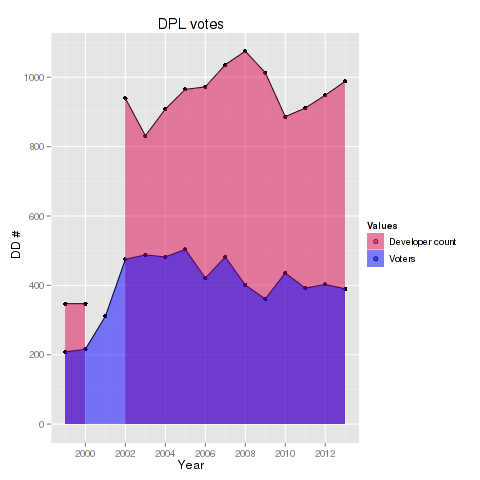
Axel XTaran Beckert recently asked in #debian-devel for a visualization of the Debian Project Leader Election results. Unfortunately there seems to be none, except the table in the mail. As I am currently trying to use ggplot2 for more things, I thought I would give it a try and convert the data into a csv file and process the data via R. For converting the original data i used vim to do a little text processing and created a csv file. By running the following code we can create a nice looking simple graphic:
library("ggplot2")
votes <- read.csv("dpl-2013.csv")
votes2 <- melt(subset(votes, select=c("Year", "DDs", "unique")), id="Year")
p <- ggplot(votes2, aes(Year, value, group=variable, fill=variable)) + ylab('DD #')
p <- p + geom_point() + geom_line() + geom_area(position='identity')
p <- p + scale_fill_manual("Values", values=c(alpha('#d70a53', 0.5),
alpha("blue", 0.5)), breaks=c("DDs", "unique"), labels=c("Developer count", "Voters"))
print(p)
DPL Votes 2013 I also created a little script for automatically processing the csv file and creating a similar plot. Feel free to fork/clone extend this script.

22 April 2013

Dmitrijs Ledkovs: abi-compliance-checker & dh / cdbs integration

dh-autoreconf is an amazing addon for running autoreconf, I just love it.
abi-compliance-checker is an amazing tool for tracking API/ABI.
Wouldn't it be great to glue abi-compliance-checker into dh / cdbs packaging?!
abi-compliance-checker (1.98.8-1~exp1) experimental; urgency=low
.
* New upstream release
* Add dh_acc to generate and compare library dumps at build time,
together with addons for dh(7) and cdbs.
* Bump standards version, bump debhelper to 9, use 3.0 (quilt) format,
update Vcs-Svn field to canonical form, remove obsolete
DM-Upload-Allowed.
* Apply a patch to allow suffixes on a-c-c abi dumps.
Horay! So how does one use it?

  • build-depend on dh-acc
  • In your debian/rules
    • call dh_acc somewhere appropriate
    • dh $@ --with acc
    • include /usr/share/cdbs/1/rules/acc.mk
  • In your debian/libpackage-dev.acc
    • Write a abi-compliance-checker descriptor (no need to include version)
  • Build your package
  • Copy the generated /usr/lib/$(multiarch)/dh-acc/*.abi.tar.gz as ./debian/lib-package-dev.abi.tar.gz.ARCH
  • Now at each build ABI/API checks will be executed and compat reports will be generated
An example xml descriptor for libapt-pkg-dev is:
<?xml version="1.0" encoding="utf-8"?>
<descriptor>
<headers>
./build/include/apt-pkg/
</headers>
<libs>
./build/bin/
</libs>
<skip_types>
SubstVar
</skip_types>
</descriptor>
I wonder if things can be improved, for example:
  • For trivial packages, don't require .acc at all & simply point abi-compiance-checker at ./debian/tmp/
  • I think logs currently pollute the unpacked source package
  • Multiple "base" ABI need checking. E.g. given versions A, B, C one can introduce a new symbol in B and drop it in C. Both B & C are compatible with A, but C is not compatible with B, thus an API/ABI break got introduced into the distribution if all A,B,C were ever published in the archive.
  • Maybe run these as DEP-8 autopkgtests as well?
On a wider scope of things abi-compliance-checker allows to create "system" abi dumps & also check applications for ABI/API compliance. For example, one could scan deb packages to see if they are still compatible between major Debian Releases for some known install type (e.g. a default full Gnome Desktop), or we could scan proprietary packages to see if they are compatible (e.g. games delivered via Steam by Valve to multiple Ubuntu releases), and we can continuously monitor OS ABI to make sure we don't unknowingly break it with security and bugfix updates.

Please, play around with dh-acc and let me know what you think =)

21 April 2013

Lisandro Dami&aacute;n Nicanor P&eacute;rez Meyer: On the road to Qt 5: Qt 5 base, tools, jsbackend and xmlpatterns in experimental

The first Qt 5 packages have been accepted in Debian experimental.

What's there
To start building Qt 5 apps you will need to export QT_SELECT=qt5, install the package qt5-defaults or read qtchooser's man page. Note that exporting QT_SELECT has precedence over installing qt5-defaults.

What's not there
ArchitecturesAMD64 is already there because it's the arch used by maintainers to build the packages. i386 should be following as soon as buildds catch up. Most surely ARM-based archs will be there at some point too.

Other archs will need some love. Not strange, the Qt project supports amd64, i386 and ARM, but we Debian have normally prepared patches to make it build in other archs. And yes, we try to push them upstream for everyone's benefit. So, if you are missing it in your arch, take a look. You may be the one who enables Qt 5 in it :-)

GLES2 and WaylandWe don't have GLES2 or Wayland support yet. Building it will most probably break the desktop for people using proprietary video drivers (or at least I was told so). I'll surely provide non-official packages with GLES2/Wayland enabled to allow people testing it, but not soon.

This also means that we are not currently able to split X11 and framebuffer support. But we have time to work on it :-)

Non DFSGs compliant files
If you get the original source code tarball from Debian you will notice that it has dfsg in it's name. That means that we had to remove some non DFSG compliant stuff from the original tarball, namely:

  • Every RFC.
  • Three files used for testing the build, which are made of RFCs.
  • Some fonts.

What's following
Other parts of Qt 5 are on the way. And remember, this packages would not have been possible if it weren't for the great Debian's pkg-kde team. My kudos to them.

Bartosz Fe&#324;ski: does Linux development include regression tests?

In October I announced that starting with 3.6 kernel it was eventually safe to unplug Zenbook.
Then in bugreport I was told that Sentelic touchpad driver was included in 3.8 kernel.
And guess what I don t have to patch kernel to have working touchpad using 3.8 kernels but I have to worry about unplugging laptop cause with 3.8.x kernel it s quite common that it turns laptop off again.
So the question is do we have any regression tests in kernel?
Should I test every kernel release between 3.8.5 and 3.6.0 to find the one that incorporated that bug again?

Charles Plessy: Do we really need contrib ?

The Debian project distributes software packages via its archive, propagated through a network of mirrors. This archive is organised in three areas, main, that contains the Debian system, and contrib and non-free, that contain accessory packages that are not Free. The packages in non-free contain files that have a proprietary license. The source packages in contrib contain only Free files, but produce binary packages that are either useless without the access to remote services, or contain non-Free files, or cause the installation of non-Free materials. The contrib area is an endless source of discussions, as it is not always easy to draw the line between what is usable and what is useless without remote services. I wonder if it would be better to replace the contrib area by a new priority level, remote , lower than extra. Packages that are entirely Free (source and binary) and that do not cause the installation of proprietary software would be fit for main. For the packages that can not function without non-Free software, given that the work to be done to free them is the same regardless whether the proprietary code is included in the source package (in non-free) or not (in contrib), I think that in both cases the package should be in non-free as it is not Free in practice. This would allow for a simple criterion: does the selection of a binary package trigger the installation of non-Free files? If yes, the package and its source belong to non-free. If not, they belong to main. Then, if they need to access a remote service that would not be possible to set up on a network where only Debian is available, their priority would be remote.

20 April 2013

Dmitrijs Ledkovs: FTBFS fixes and other patches available for your package!

Wheeze is planned to release very soon! There is still a fair amount of work to push the release out, but it does mean that a lot of fun can begin for jessie.

Over the past cycle in Ubuntu, many packages where synced from experimental, many fixes were applied and many packages were upgraded ahead of debian version strings.

If one goes to your package PTS page at:

packages.qa.debian.org/$SCRPACKAGENAME

One can find the following box titled "ubuntu" in it:


Please click on "patches for VERSION STRING" to find:
  • Useless irrelevant changes =) oh well, it happens
  • FTBFS fixes due to GCC 4.8 (*)
  • FTBFS fixes due to new GlibC
  • FTBFS fixes due to multiarched Python2.7 and Python3.3
  • FTBFS fixes due to multiarched Tcl/Tk
  • FTBFS fixes due to Python hash randomisation enabled
  • FTBFS fixes due to Boost 1.53 (*)
  • Fixes to minimise dependencies when bootstrapping packages
  • Fixes to multiarch more and more libraries
  • Fixes to enable package cross-building
  • Updates to new upstream releases
  • Usage of pybuild
  • Completed migration away from guile1.6
(*) more of those will be available after S-series opens in ubuntu, from April the 29th onwards

Some of the above patches were submitted to debian, with majority of submitted patches have not been applied, simply because none of them were appropriate during freeze and could have been disruptive to Wheezy release.

Please check useful patches available on your PTS!

Please take those patches!

Not taking Ubuntu patches results in more duplicate work in Ubuntu (i.e. rebasing those patches), thus reducing total dev-time available to work to fix other issues.

I myself uploaded a few of those patches into Ubuntu. And in the beginning I was filing BTS bugs with a patch against relevant packages in Debian. Very quickly I realised that since Debian is frozen a lot of those patches would just bitrot in BTS. I of course wished that they would all be instantly applied and uploaded into Experimental, but that did not happen. At the moment there are still 8 bugs open with patches I submitted, with oldest one opened on 6th of July 2012. So that's the reason why I stopped pushing patches to BTS, because well they are not reviewed nor applied in a timely manner =) where my expectation of timely manner is less than 6 months to be uploaded into Experimental or reviewed/rejected/commented on. Not uploading patches because they don't apply to Debian yet, is silly as they will apply to Debian eventually. Unapplied patches continue to generate more work on a more universal scope (e.g. requiring those patches to be rebased in ubuntu, thus many developers spending their time doing that, instead of writting fixes for new issues).

Paul Tagliamonte: Fixing the theme situation in Jessie

Hello, World, As many of you know, I fell into helping get the artwork for Wheezy into place. While I don t want to do this (in the long run), I feel the urge to get it into shape for Jessie. I d like to do a small request for methods to improve the theme packaging. I ve posted a suggestion, but I never really got happy with it. The problem is basically the deb makes no sense because making thee deb make sense would result in insanity ;) stuff like proper dependencies to allow the Plymouth theme to work can t be done, since it d require a dep on Plymouth, which means it requires all installs with desktop-base to have it installed. Thanks, lazyblog!

Rog rio Brito: Lack of cooperation from Ubuntu?

I posted the following on Google+, but it is important enough to be reproduced on Planet. I'm editing it a bit, as it is a followup to my previous post. While improving the packaging of MongoDB, there was one thing that caught my attention: that Ubuntu had already done some of the embedded/convenience libraries work, but they had not pushed that work to Debian. Of course, discovered this only after I started working on the improvements of the package. What gives, Ubuntu people? Another thing that I saw is that they have patches enabling mongodb working on armhf. Again, they did not push those to Debian. Why this lack of cooperation? Another thing that I saw is that they had packages for version 2.2 (more precisely, raring has 1:2.2.4-0ubuntu1), while Debian sid just had 2.0 until very recently. Why not push this work and avoid duplication of work? By being a good downstream, I intend to push some of the patches to MongoDB upstream (if they want it), so that we (Debian) have a smaller delta. This will benefit you Ubuntu guys. Why not join forces and help have a world-class set of packages? Please, be good netizens and share the work that you have. I firmly believe that the armhf people will be happy to have one of the fancy "cloud" software available on ARM, especially since the prospects of having ARM machines on datacenters. Oh, just for the record, the kFreeBSD people have sent their contribution and I would love to see (if possible) this running on the HURD.

19 April 2013

Gunnar Wolf: Ten years already!

(actually, please set your calendars to the day before yesterday I had a mental tab on this, but it seems watching mental tabs is a low-priority task for brain.sched) Ten years ago today, I got that long awaited mail telling me I had passed all of the needed hurdles and was accepted as a Debian Developer. We were at the first third of a very long release cycle, and the general spirit of the project was clearly younger both as in "things moved easier" and "we were much more immature" Try to follow the mailing list discussions we had back then, and even with all the vitriol that's every now and then spilled on debian-whatever@lists.debian.org, it's clear we have more experience working together. And yes, the main change that ten years bring to a group of people is social. I was at DebConf in Oslo when the now-historic presentation that prompted the birth of the Debian-Women group was given Surely, Debian (and Free Software) still is by far predominantly male and white But I fel it's no longer a hostile group, much to the contrary. Over the years, I was first active (as was the norm by then) as a "solo" maintainer. When Joachim Breitner started the pkg-perl group in 2004, I joined, and was part of the group while an important part of my work was based in Perl. I joined pkg-ruby-extras, and slowly migrated my technical work from one to the other. For several years, I also maintained the Cherokee webserver. I started getting involved in DebConf organization in 2005, and (except for 2008, as I took a vacation from many topics due to personal issues). Back in 2009, I became an official delegate! I joined Jonathan McDowell handling keyring maintenance. One year later, another delegation: With Moray Allan and Holger Levsen, the three of us became the DebConf chairs. This last couple of months, I have been quite inactive in most of my Debian work. I took up teaching at the univerity, and have been devoting what amounts to basically a full time job to prepare material. I expect (hope!) this craze to reach back a "workable" level by late May, when the course finishes, and I can retake some of my usual Debian tasks. Anyway 10 years. Wow. This project is one of the longest commitments in my life. I am still very happy I joined, it still thrills me to say I am part fo this great project, it still makes me proud to be accepted as a peer by so many highly skilled and intelligent people But, as I have repeatedly stated, I see Debian more as a social project (with a technological product) than as a technical one. And as such, I am really happy to have made so many good, close friends in this project, to have the opportunity to work and exchange points of view about anything, and have this large, highly disfunctional but very closely regarded family of friends. So, guys, see you this August in Switzerland. I will be among the group celebrating we have been there for half of the project's history!

18 April 2013

Hideki Yamane: Grand Unification Debian study Meeting 2013 (Japan)

We Debian JP folks are please to announce Debian event named "Grand Unification Debian study Meeting 2013" will be held in Japan, 29th June (oh, don't ask/blame me for its name, it was decided by others, not me... ;-)

And we're in CfP and negotiating with potential sponsors now, and some companies and media have already ACKed as below.


  • WindowsAzure (Platinum sponsor, yes "Microsoft supports Debian event" :-)
  • Plathome (Gold sponsor, they're also DebConf13 sponsor!)
  • TOP STUDIO (Gold sponsor, thanks to Kenshi Muto :)
  • Serverworks (Gold sponsor, AWS vendor)
If you're in Japan or near here at that time, please come and enjoy this event (and please comment if you have any question).

17 April 2013

John Goerzen: Amazement

One of the benefits of working from home is that I have a great view of Kansas from my desk. While I work, I have seen sunrises, snowfall, birds, rain, ice, and all sorts of wildlife. I heard this verse of Home on the Range the other day, which reminded me of this:
How often at night when the heavens are bright
With the light from the glittering stars
Have I stood here amazed and asked as I gazed
If their glory exceeds that of ours.
One time, I asked Jacob if I should wake him up at night to see the stars. He said an excited yes! So when it was dark outside, I woke him up, carried him outside, and held him while he looked up. He said a long, breathy Wooooow! Then he went back to bed, curled up with his butterfly, and fell asleep smiling. Every so often, we repeat this little routine. There are many opportunities in life to just stand somewhere and be amazed. You don t have to be in Kansas. Children know this. The rest of us just have to notice.

Daniel Pocock: Switzerland Schilthorn with 007 (leg 3)

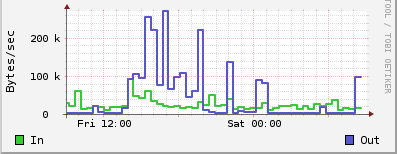
Friday's video of the 2nd leg of the cable car journey was quite popular, Ganglia stats for the video server can't be wrong: The first leg was skipped because of the low cloud cover. Weather reports in Switzerland, such as www.meteosuisse.ch often show a distinction between the low clouds and high clouds, because many Swiss mountain resorts are high enough to enjoy ample sunshine by virtue of their altitude even when cities like Zurich and Geneva are overcast. Now for the third leg, rising up to Berg. In the video, it is hard to gauge the size of the rocky cliffs along the route, but looking at the cable car's shadow will give a clue. As the cable car approaches the station in Berg, it feels like it takes forever to complete the journey. That is because the rocks are so much bigger than they appear from a distance. <video controls="" height="340" poster="http://upload.wikimedia.org/wikipedia/commons/thumb/0/03/Schilthorn_with_Bernese_Alps%2C_2012_August.jpg/800px-Schilthorn_with_Bernese_Alps%2C_2012_August.jpg" width="560">
<source src="http://video.danielpocock.com/VID_20121025_122453.m4v" type="video/mp4"></source>
<source src="http://video.danielpocock.com/VID_20121025_122453.webm" type="video/webm"></source>
</video> The final leg to the Schilthorn summit will appear shortly. I understand many people are starting to contemplate their DebConf13 travel and summer holidays - please feel free to email me if you'd like me to post a video of some other feature in Switzerland.
AttachmentSize
ganglia-schilthorn2.png8.71 KB

Gerfried Fuchs: Pentatonix

I know it's been ages since I last blogged anything at all. To some degree I had a down phase, but I hope to get out of it. It's nice to see that there are people out there who give me a prod every now and then, and don't let me drown. Thanks, most of you probably know that I mean exactly you, and in case you are uncertain, you probably are meant if you contact me every now and then. Anyway, if you remember that I blogged about Lindsey Stirling last year and you started to follow her you might have already stumbled upon the next band I'd like to present. I'm speaking of Pentatonix. These five humans have terrific voices that they use in a very special way that is quite unique. I don't want to delay the songs I want to present to you any longer, so here they are: Like always, enjoy! And hopefully read me again more regularly again.

/music permanent link Comments: 1 Flattr this

Joey Hess: Template Haskell on impossible architectures

Imagine you had an excellent successful Kickstarter campaign, and during it a lot of people asked for an Android port to be made of the software. Which is written in Haskell. No problem, you'd think -- the user interface can be written as a local webapp, which will be nicely platform agnostic and so make it easy to port. Also, it's easy to promise a lot of stuff during a Kickstarter campaign. Keeps the graph going up. What could go wrong? So, rather later you realize there is no Haskell compiler for Android. At all. But surely there will be eventually. And so you go off and build the webapp. Since Yesod seems to be the pinnacle of type-safe Haskell web frameworks, you use it. Hmm, there's this Template Haskell stuff that it uses a lot, but it only makes compiles a little slow, and the result is cool, so why not. Then, about half-way through the project, it seems time to get around to this Android port. And, amazingly, a Haskell compiler for Android has appeared in the meantime. Like the Haskell community has your back. (Which they generally seem to.) It's early days and rough, lots of libraries need to be hacked to work, but it only takes around 2 weeks to get a port of your program that basically works. But, no webapp. Cause nobody seems to know how to make a cross-compiling Haskell compiler do Template Haskell. (Even building a fully native compiler on Android doesn't do the trick. Perhaps you missed something though.) At this point you can give up and write a separate Android UI (perhaps using these new Android JNI bindings for Haskell that have also appeared in the meantime). Or you can procrastinate for a while, and mull it over; consider rewriting the webapp to not use Yesod but some other framework that doesn't need Template Haskell. Eventually you might think this: If I run ghc -ddump-splices when I'm building my Yesod code, I can see all the thousands of lines of delicious machine generated Haskell code. I just have to paste that in, in place of the Template Haskell that generated it, and I'll get a program I can build on Android! What could go wrong? And you even try it, and yeah, it seems to work. For small amounts of code that you paste in and carefully modify and get working. Not a whole big, constantly improving webapp where every single line of html gets converted to types and lambdas that are somehow screamingly fast. So then, let's automate this pasting. And so the EvilSplicer is born! That's a fairly general-purpose Template Haskell splicer. First do a native build with -ddump-splices output redirected to a log file. Run the EvilSplicer to fix up the code. Then run an Android cross-compile. But oh, the caveats. There are so many ways this can go wrong.. Anyway, if you struggle with it, or pay me vast quantities of money, your program will, eventually, link. And that's all I can promise for now.
PS, I hope nobody will ever find this blog post useful in their work. PPS, Also, if you let this put you off Haskell in any way .. well, don't. You just might want to wait a year or so before doing Haskell on Android.

16 April 2013

Wouter Verhelst: The devops "installer"

puppet and similar things are very nice tools for managing your systems. Rather than doing the same thing 100 times, it's much more interesting to spend some time describing how to do something, and then have it done hundreds of times automatically. However, I'm starting to see a distressing trend lately. I'd like to say that puppet is not an installer, nor is it a replacement for one. Here's why: Please, pretty please, with sugar on top: just provide packages. If that can't be done, just provide clear installation instructions and/or a puppet module that I can include or something. Don't assume I'm a system administrator not worth his paycheck. Thanks. note: the gitorious example above is just that, an example. I've seen more cases of people doing similar things, not just gitorious. Surprisingly, it's mostly from people who're on the ruby kool-aid. I hope that's not related... Update: (2013-04-18) despite my usage of buzzwords in the title of this post, I did not mean to imply that any of the above has anything to do with devops. Instead, what the post is supposed to say is that you should not fall into the trap of believing that devops methods, which may work wonderfully internal to your organization, will therefore also work wonderfully for processes outside your organization.

Michal &#268;iha&#345;: Weblate 1.5

Weblate 1.5 has been released today. It comes with lot of improvements, especially in performance, reporting and support for machine translations. Full list of changes for 1.5: You can find more information about Weblate on it's website, the code is hosted on Github. If you are curious how it looks, you can try it out on demo server. You can login there with demo account using demo password or register your own user. Ready to run appliances will be soon available in SUSE Studio Gallery. Weblate is also being used https://l10n.cihar.com/ as official translating service for phpMyAdmin, Gammu, Weblate itself and others. If you are free software project which would like to use Weblate, I'm happy to help you with set up or even host Weblate for you.

Filed under: English Phpmyadmin Suse Weblate 0 comments Flattr this!

Stefano Zacchiroli: bits from the DPL for March-April 2013

Dear Project Members,
   "Now that I have your attention, I would like to make the following
delegations:"

... nah, scrap that. In my last day in office I first of all owe you a report of DPL activities for the last reporting period of this term, i.e. March 8th until today. Here it is! Highlights Talks Over the past month or so I've attended and spoken on behalf of Debian in the following occasions: Assets I've approved the budget for the following forthcoming sprints: Also, we've bought a 3-year warranty pack for the disk array that powers ftp-master.d.o (~900 USD). On the income side, Brian Gupta has started an interesting matching fund experiment, in order to raise funds for the forthcoming DebConf13. The matching fund will be open until April 30th, so your help in spreading news would be welcome. Many thanks to Brian for the idea and to his company, Brandorr Group, for funding it. DPL helpers Three more DPL helpers IRC meetings have been held; minutes are available at the usual place. Legal Spring Cleaning I've finally cleaned up the pile of pending legal matters (but I'm sure new ones will show up for the delight of the next DPL :-P) Once again, I'd like to thank SFLC for the pro bono and very high quality legal advice they keep on offering to Debian. Miscellaneous
Now, before I get sentimental, let me thank Gergely, Lucas, and Moray for running in the recently concluded DPL election. Only thinking of running and then go through a campaign denote a very high commitment to the Project; we should all be thankful to them. Then I'd like to congratulate Lucas for his election. I've known him for a long time, and I can testify about his clear vision of the role Debian has to play in Free Software and on what Debian needs to improve to do so. Best wishes for the term ahead, Lucas! Finally, I'd like to thank you all for the support you've shown me over the past 3 years. Serving as DPL is a great honor, but also a very demanding job. Thank to you all, and to how cool Debian is, it has been for me an incredibly rewarding experience. I had no idea what I were doing when I embarked on this adventure, but in hindsight I don't regret any of it. See you around, as I don't plan to be anywhere far away from Debian anytime soon. Cheers.
PS the day-to-day activity logs for March and April 2013 are available at the usual place master:/srv/leader/news/bits-from-the-DPL.txt.20130 3,4

Michal &#268;iha&#345;: phpMyAdmin translations status

phpMyAdmin 4.0-rc2 is out and if your want to have your language in final release, it's last moment to start working on translation. So let's look at which translations are at 100% right now (new ones are bold): Almost complete: As you can see, there is still lot of languages missing, this might be your opportunity to contribute to phpMyAdmin. Also you are welcome to translate phpMyAdmin 4.0 using translation server. If your language is already fully translated and you want to help as well, you can translate our documentation as well.

Filed under: English Phpmyadmin 0 comments Flattr this!

Next.

Previous.