Search Results: "spa"

1 May 2009

Obey Arthur Liu: Z rich, Switzerland for the summer (housing? DebConf?)

Z rich Google Earth I got a summer internship at Google in Z rich, Switzerland, so I ll be moving there this summer. Any DD working there ? I already went to Z rich once last year and it was quite a cool place. I briefly met Cate and I know that there are other DDs there (hi Madduck!). I look forward to meeting more of you. Now there are two issues I d like help with, dear Z richer Lazyweb, housing and flight to DebConf. Can I haz apartment Looking for an apartment in Z rich seems very very very hard.. So far I only found a few apartment/hotel geared towards rich expats staying for few months (the kind like Citadines). It s ungodly expensive (like 2200+ CHF a month for one room), but sure available and well placed.. Here s what I need:

I don t have much more criterias, as long as I can find something. We re about a few dozens Google interns all (desperately) looking for accomodation in Z rich. We re all good neighbours, don t party all night and all have very good references. Please contact me if you \<know someone who\>* know something, I d be very grateful. Can I haz DebConf I m going to DebConf this year in Spain, along with all the Google Summer of Code students who can make it. I m going to reserve my flight in the next few days. I think I ll only go to DebConf proper, arriving on the 23rd and leaving on the 31st of July. I m not decided yet on the last point. So, any of you coming to DebConf from Z rich ?

Simon McVittie: Implementing D-Bus clients with telepathy-glib (and telepathy-qt4)

(The much-delayed part 2 in an ongoing series: shiny things in telepathy-glib) Over a year ago I explained my first major round of work on telepathy-glib, with which it could be used to implement D-Bus services. I started to write this post shortly after, but then got distracted by a bee or something; recent discussion about having a D-Bus binding in GLib has finally prompted me to finish it. The second major round of work on telepathy-glib dealt with implementing client code, and went sufficiently well that telepathy-qt4 (currently under development) uses essentially the same model. Again, while telepathy-glib is intended for Telepathy implementors, I think TpProxy's ideas are generically useful, particularly for "large" D-Bus APIs.

Some background: dbus-glib and libtelepathy
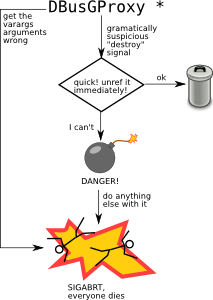
GObject-CRITICAL: Assertion failed: proxy->convenient
The life-cycle of a DBusGProxy (PD clipart credit: karderio and Andy)
The API provided by dbus-glib for client code is, er, rather less than ideal. The basic object is DBusGProxy, which has a few problems. There's one per interface, rather than one per object; this leads to a maze of twisty GObjects, all suspiciously similar. Our old client library, libtelepathy, got round this by subclassing DBusGProxy to make helper objects called TpChan, TpConn etc., which were simultaneously the proxy for the "main" interface (Channel, Connection etc.), and a factory for proxies for the other interfaces (like Channel.Type.Text and Channel.Interface.Password). This still wasn't ideal, but it was a start. If you use a DBusGProxy in any way after it has emitted the destroy signal, this is considered to be invalid use of the API, and dbus-glib asserts all over the place. We'd rather it didn't do that - remote objects becoming invalid is a fact of life, and if you don't immediately discard all your references to those objects, remote operations on them should just give you a runtime error. You have to be prepared to handle such runtime errors already, because any IPC call can fail at any time. The main API for calling methods uses varargs and is rather subtle. Notably, the calling convention for variant parameters (of D-Bus signature 'v') is not consistent with the calling convention for any other container. For any other container, for instance a GPtrArray *, you pass in a GPtrArray ** pointing to a GPtrArray * variable containing NULL; on success, a pointer to a new GPtrArray is written into that variable. For variant parameters, though, you must pass in a GValue * pointing to a zero-filled GValue, and the result will be written into that GValue. dbus-binding-tool generates thin wrappers around this method-calling API which provide type-safety, although they can't directly specify a non-default timeout. As for signals, before binding to a signal, you have to tell dbus-glib about its signature. This tells dbus-glib how it should push the signal arguments onto the C stack (in GObject terminology: how it should marshal them), to match the signature of the signal-handler function. The documentation claims that this isn't necessary for objects supporting the Introspect method, but that's untrue - on the other hand, if the documented behaviour actually happened, I would consider this to be a critical bug in dbus-glib, since it would enable remote objects to crash dbus-glib clients (by causing signal arguments to be pushed onto the stack in a way that does not match the signature of the signal handler). Of course, the signal-adding function takes varargs, and has to be called exactly once per signal per object. If you don't, dbus-glib asserts when you connect to the signal; if you call it twice, dbus-glib asserts anyway.

TpProxy TpProxy is a GObject subclass vaguely inspired by Python's dbus.proxy.ProxyObject. It isn't a subclass of DBusGProxy, which lets us encapsulate dbus-glib almost completely - in fact, all the references to DBusGProxy are in a separate header, proxy-subclass.h, only used by subclasses of TpProxy (as opposed to normal library API users). TpProxy instances are per-remote-object (per-object-path) like in dbus-python, rather than per-interface like in dbus-glib or QtDBus. As explained below, I believe that this is the most natural object mapping for D-Bus interfaces; in practice it tends to lead to clearer code for us, since one remote object often maps nicely to one UI element (of course, if your objects only have one interface, this approach is no better or worse than dbus-glib's). TpProxy provides support for the following common D-Bus things:
  • Calling methods
  • Connecting to signals
  • Objects becoming invalid
  • Objects with optional interfaces
  • Extensibility
It doesn't currently provide any particular help with Properties - the Properties interface is just another interface as far as we're concerned. We find that, in practice, that's not a problem (even though we use D-Bus properties extensively). In telepathy-qt4 we basically reinvented TpProxy in C++, as Tp::DBusProxy. I've put in some comments below illustrating how the general ideas we used in TpProxy translate into a different object mapping.

Calling methods Method calls on TpProxy are done through auto-generated wrapper functions, much like DBusGProxy. These look something like this:
typedef void (*tp_cli_channel_callback_for_close) (TpChannel *proxy,
    /* any 'out' arguments would go here - Close() doesn't have any */
    const GError *error, gpointer user_data,
    GObject *weak_object);
TpProxyPendingCall *tp_cli_channel_call_close (TpChannel *proxy,
    gint timeout_ms,
    /* any 'in' arguments would go here - Close() doesn't have any */
    tp_cli_channel_callback_for_close callback,
    gpointer user_data,
    GDestroyNotify destroy,
    GObject *weak_object);
Methods for some interfaces, like DBus.Properties, are available on TpProxy itself; others, like Telepathy's Channel.anything, are only available on a particular subclass, like TpChannel. Things to note here:
  • It's an asynchronous call with a callback. General design principle: "this is IPC, get over it". We don't try to hide the fact that IPC is taking place by doing pseudo-blocking calls.
  • The timeout is explicit (although you can always pass -1 to let libdbus pick a "reasonable" default for you). This is because the remote service might not respond, and API users should be at least vaguely aware of this: "this is IPC, get over it".
  • The callback isn't a GCallback; it has an explicit signature, for some semblance of type-safety (it's not much, but it's better than nothing).
  • The callback takes a GError, because any IPC call can fail for any reason.
  • A TpProxyPendingCall * is returned. This is a pointer to an object that only exists until just after the callback is called (so you can ignore it if you don't want it), with a method you can call to cancel the method call (with hindsight this is not ideal, and if I was writing this API now, I'd use gio's GCancellable). "Cancel" is perhaps slightly misleading: the method call still takes place (it was already in libdbus's outgoing queue) but the result gets ignored and the callback isn't called. This is mostly so you an object can forget all the calls it was busy making at the time that the results become irrelevant (e.g. the object is destroyed).
  • There is an extra weak_object argument, which is weakly referenced and is passed to the callback: in practice, most users of telepathy-glib use this as well as or instead of user_data. If the weak_object runs out of references, the callback is automatically cancelled, which means that in practice, explicit cancellation is almost never needed.
  • The generated code has as its first argument a suitable subclass of TpProxy, in this case TpChannel (we tell the code generator about subclasses).
  • You can't see it in the API, but the TpProxy gains an extra ref while a method call is in progress, so you never have to worry about what happens if the proxy gets unreffed during a method call.
  • There's an explicit destructor for the user_data, which is called even if you "cancel" the method call.
In telepathy-qt4, these methods are on small generated helper classes similar to dbus-python's dbus.Interface, one per interface (we provide accessors for them on the non-generated DBusProxy subclass). Instead of using callbacks, we return a temporary QObject per call, which emits a Qt signal on success or failure (that's how all async calls in QtDBus work).

Connecting to signals Similarly, signals have some generated functions:
typedef void (*tp_cli_channel_signal_callback_closed) (TpChannel *proxy,
    /* any arguments would go here - Closed doesn't have any */
    gpointer user_data, GObject *weak_object);
TpProxySignalConnection *tp_cli_channel_connect_to_closed (TpChannel *proxy,
    tp_cli_channel_signal_callback_closed callback,
    gpointer user_data,
    GDestroyNotify destroy,
    GObject *weak_object,
    GError **error);
API notes for these:
  • The callback doesn't take a GError any more, because signals can't fail; the weak_object and the user_data are the same as for method calls
  • This isn't actually a GObject signal at all: those aren't particularly typesafe, and lack namespacing. This might not be very binding-friendly, we haven't tried doing that yet... it might be worth introducing a signal with details, like in dbus-glib, for which these functions are "C bindings".
  • The returned TpProxySignalConnection lets you disconnect from the signal, just like the TpProxyPendingCall above; it can safely be ignored
  • Similarly, if the weak_object dies, then the signal automatically disconnects
  • It is possible for connecting to a signal to fail: this happens if the proxy doesn't actually have the requested interface. If this happens, it's graceful, not a crash. In practice, the flow of code is almost always such that error can safely be NULL because the interfaces are already known.
In telepathy-qt4 the per-interface generated helper classes emit Qt signals. In many cases, we end up proxying these signals by responding to them in the hand-written Tp::DBusProxy subclass by emitting a different signal, in order to give them a nicer representation.

Becoming invalid This is IPC, and any error can happen to you at any time. We found that it was useful to have a general concept of "this object is no longer useful", so we introduced the concept of an object becoming invalidated. The invalidation reason is stored on the object as a GError. If this GError is NULL (as it is initially), then the object is still expected to be valid; if it's non-NULL, the remote object has vanished and the local proxy no longer works. There are several ways a TpProxy can become invalid:
  • its bus name falls off the bus (the process exited or crashed)
  • application-specific reasons (usually triggered by a D-Bus signal in a subclass, like the Telepathy Channel's Closed signal)
  • the GObject gets disposed
Method calls on an invalidated object always fail, with the invalidation reason as the error. This means that calling a method on a TpProxy should never crash your process. The method's callback has to be prepared to handle an error in any case, because this is Sparta^WIPC, so there's no loss in giving it another error. Connecting to signals on an invalidated object always fails, and any existing signal connections are disconnected when it becomes invalidated. This means that if a new remote object appears, and it happens to have the same object path, bus name etc. as the old one, you won't get its signals. A TpProxy can either be bound to a unique bus name or a well-known bus name. In the equivalent code in telepathy-qt4, we call this "stateful" or "stateless" - these names don't capture the intention perfectly, but they're the best we could come up with. A proxy for a stateful API like Telepathy's Channel should always bind to a unique name - when the unique name falls off the bus, the TpProxy becomes invalidated automatically, representing the fact that the Channel you had no longer exists, and nothing can be a perfect replacement for it (the VoIP call has already been terminated, you've already left the chatroom, or whatever - if you make another Channel, that's e.g. a distinct VoIP call). A proxy for a stateless API like Telepathy's ConnectionManager, where an exiting process can disappear, be service-activated again, and still have exactly the same API, should bind to the well-known name. Proxies for well-known names aren't invalidated when the process exits. Qt doesn't have a natural equivalent for GError, so the invalidation reasons in telepathy-qt4 are just a pair of strings, the namespaced name and the message - basically a libdbus DBusError. The principle is the same, though.

Optional interfaces As mentioned above, TpProxy instances are per-remote-object (per-object-path) like in dbus-python, rather than per-interface like in dbus-glib or QtDBus. I believe that this is the most natural object mapping for the D-Bus object model, because the D-Bus interfaces on a remote object can behave like any of these:
  • classes and subclasses (Telepathy.Channel.Type.Text is a Telepathy.Channel)
  • shared interfaces (some Telepathy.Channel objects, of many Types, implement Telepathy.Channel.Interface.Group; any D-Bus object can implement DBus.Properties)
  • optional features (some Telepathy.Channel.Type.Text objects implement Telepathy.Channel.Interface.ChatStates, some do not)
  • discoverable extensions (some Telepathy.Channel.Type.Text objects implement Telepathy.Channel.Interface.Messages, which is more or less Text 2.0)
The way in which interfaces are discovered is also variable. The "classic" D-Bus way to discover interfaces would be to call Introspect. Telepathy services still support that style of introspection, but we don't use it for anything beyond d-feet:
  • Introspect returns a blob of XML, which you have to parse into something useful; if it was in a D-Bus data structure, you'd already have some sensible data structure.
  • Finding out more information about the supported interfaces than their names isn't very useful: in a static language like C you already need to know the methods, signals, properties and their signatures in order to write and compile your code, and in a dynamic language like Python consumers of Introspect end up being remotely crashable by services with unexpected method signatures (this is one of dbus-python's big mistakes in my opinion).
  • If a method that you want to call turns out to be missing, the worst that can happen (in a competently written service) is that it fails with a D-Bus error - and you have to handle D-Bus errors anyway, because this is IPC and anything could fail.
  • Static bindings like dbus-glib have poor support for removing interfaces for which C code exists at runtime, whereas Telepathy needs features like an IM connection that might or might not support avatars (we don't get to find out until we've successfully connected to the server).
Instead, our older interfaces have a method on the "base class" (Channel, Connection etc.) called GetInterfaces, which just returns an array of strings. Newer interfaces (like Account), and older interfaces that have been ported (like Channel), have a property called Interfaces which is, again, an array of strings - this lets us combine the download of the interfaces list with downloading other basic information in a GetAll call. To cater for all these ways to use interfaces, the TpProxy base class has very basic support for interface discovery - you can ask it whether it supports an interface, and you can tell it that it does, in fact, support an interface. Asking which interfaces are supported is directly useful for library users; it's also used as a check by the generated method-call and signal-connection stubs, which return a canned error (Telepathy.Error.NotImplemented in Telepathy's case) if the object isn't known to have the interface. Telling TpProxy that it does support an interface is intended for use by subclasses, and might have been protected if we were writing C++: what happens in practice is that a concrete subclass like TpChannel knows how to discover the fully supported interfaces for this particular object, does so, and calls methods on the TpProxy to tell it which interfaces can work.

Extensibility The API stubs used by TpProxy to call methods and bind to signals are generated from XML documents containing an augmented form of D-Bus introspection data. These XML documents contain various Telepathy-specific extensions, but none of the extensions are language-specific - telepathy-glib, telepathy-python and telepathy-qt4 all operate from exactly the same XML specification. telepathy-qt4's different object-mapping did require us to tighten up some rules that were previously only conventions, but even so, the format is the same. I think this is vitally important - it just doesn't scale to have one set of language-specific annotations in a D-Bus API for each language that will have bindings. One thing that we make heavy use of is what I call "Ugly_Case", which is camel-case with underscores at word boundaries. This gives us a simple, unambiguous and foolproof rule to use in code generators whenever we generate any of the popular conventions for identifiers:
  • CamelCase: delete underscores
  • javaCamelCase: force everything before the first underscore to lower case, then delete underscores
  • lower_case: force everything to lower case, retain underscores
  • UPPER_CASE: force everything to upper case, retain underscores
dbus-glib, by contrast, applies a complex and subtly buggy algorithm to the CamelCase D-Bus names, which results in our SendDTMF method being mapped into GLib as send_dt_mf, and requires that telepathy-glib's Python reimplementation of dbus-binding-tool uses a bug-for-bug compatible implementation (we ended up reimplementing dbus-binding-tool in order to generate the TpProxy-based bindings). Our code generation tools are still rather ad-hoc, because so is our spec format, but for draft interfaces it's possible to copy them into individual projects and use them to generate additional methods for TpProxy or any subclass. This is how we implement unfinished APIs like geolocation in Empathy, for instance. The Interfaces or GetInterfaces hook described above is entirely usable for these extension interfaces, and in fact that's how they're set up. In telepathy-qt4, the generated method stubs are genuine C++ methods, so we can't just append methods to an existing class: this is why we have one helper class per interface, so individual clients can generate a helper class for their particular version of an unfinished API, and instantiate an object of this class attached to a particular Tp::DBusProxy. When an interface becomes stable, it can be added to the set of interfaces for which code is generated in telepathy-glib or telepathy-qt4, at which point any client or service that was already using the final draft of that interface can easily be ported to the library version using sed (the API remains the same).

Becoming ready The concept of being "ready" does not directly exist in TpProxy, but is implemented in TpChannel, TpConnection and TpConnectionManager. The idea is that a freshly created proxy object isn't really fully usable yet - you have to connect to basic signals and recover the initial state of the remote object, as well as checking which extension interfaces are supported. In many well-designed D-Bus APIs you can do this initial setup with a few signal connections and a DBus.Properties.GetAll call. After doing that initial setup (which has to be done asynchronously, because it's IPC), the TpProxy subclass has a local cache of the remote object's state (not necessarily in the same format as the representation on the bus), which can be accessed synchronously at any time, and will be updated in response to change-notification signals. TpChannel and subclasses like it have explicit support for checking for readiness, and having a callback called when the object is ready or invalidated (whichever happens first). The "ready" property also supports the GObject notify signal. telepathy-qt4 took this concept and ran with it - there is library support for objects that can become ready, including a mixin. If I had as much time to work on telepathy-glib as I wish I had, this would be one of the first telepathy-qt4 features to be added to telepathy-glib.

Features becoming ready Going beyond that, in an extensible framework like Telepathy it's probable that not every client understands (or wants to understand) every feature of every object, so it's highly inefficient for every proxy object to subscribe to all the change notification signals and cache all the remote state on the off-chance that the library user wants them. In the API for TpContact (which is not actually a TpProxy for various reasons) we introduced the concept of optional features; telepathy-qt4 extended this idea throughout the library. The idea is that each library user knows which of the optional features are "interesting" to it, and makes a single asynchronous call (which expands into a series of D-Bus calls inside the library) to download the state for core functionality plus all of the selected features, and subscribe to change notification for all of those. This is another telepathy-qt4 thing that telepathy-glib still needs to catch up with; until someone works out how to make the clone() syscall apply to programmers, I fear all libraries are doomed to lag behind how their designers want them to look :-) (license: CC-BY-3.0 / LGPL-2.1+)

Russ Allbery: Dreamwidth

For those who haven't heard, Dreamwidth is a new journal hosting site using the LiveJournal code base (with improvements) but a different business model and general attitude towards their community. They're trying to be much more transparent and open about everything they're doing, they're trying to run the business so that it's focused on building a community than making a profit, and they're trying to do much better at being an active open source project than LiveJournal has managed. They also run all of their servers on Ubuntu, so they feel like part of the broader Debian community. I haven't had a lot of time to help, but I think their ideals look great and I really would like to see them succeed. Dreamwidth just launched open beta, which means you can purchase a paid account but they're using an invite code model for free accounts. Since they just launched, I have invite codes. I think one of the things that will make Dreamwidth successful is to have a broad-based community, and I'd also like to see Debian and Ubuntu folks involved in their community, in a position to help with improvements to infrastructure packages they use, and help with the open source development of the underlying code base. I've therefore got a few invite codes reserved for Debian and Ubuntu folks on basically a first-come, first-served basis. If you're active in Debian or Ubuntu, want to try Dreamwidth, and think there's a chance you'd actively use it, send me e-mail and I'll send you an invite. For more information about Dreamwidth, see their wiki.

30 April 2009

Eddy Petri&#537;or: I'm going to DebConf9

I purchased my tickets and I'll be flying from Bucharest directly to Madrid on the 22nd and I'll be returning on the 30th. If somebody wants to fly with me on the same flights (although only the return seems more possible), please contact me privately*.

Although initially I planned to go with my wife and go on a vacation to Portugal or Spain after DebConf, we later agreed it would be better if we decouple the vacation from DebConf, so I'll be travelling alone.


* Igor, you might be interested in this post, but I won't mind being contacted by other people, too.

Biella Coleman: bie!!a


bie!!a, originally uploaded by the biella.
Today I found out that some of my students refer to me as Enid, a name which has rarely been used to call my attention but now circulates almost daily to my students whenever I post a message on Blackboard. It was a little mortifying to find out as I don t identify much with Enid, though it has always tagged quietly along with my other names. BB, which we use for readings, our discussion forum,and email messages, spits out my legal (tax) name, which bears the full Enid Gabriella Coleman. Although I have tried, somewhat persistently, I have failed to change it to the E. Gabriella Coleman that I would rather use. While I find it hard to embrace Enid as I just don t feel like an Enid, at least yet (and may break it out when I write fiction or when I turn 65), I have always liked having the name Enid in so far as it pays homage to my Aunt Enid whose life ended far too early, soon before I was born and from all accounts, she was one stellar woman. My parents chose to tack it on for commemorative purposes, intending to call me Gabriella after some Italian cabaret singer my mother loved. The plan, however, was immediately foiled by my older sister who apparently blurted out something like Biella when she saw the scraggly rat-like baby (as my mom used to describe me) that was christened her younger sister. Biella, like Gabriella, also has Italian roots: it is a beautiful town in Italty and a less than beautiful but so-ugly-it-is-kinda-cute Italian Pug. Perhaps the lesson in all of this is to tell students about my name and finally ditch BB, which is the software equivalent to Soviet style communist housing, and move over to another platform.

29 April 2009

Florian Ragwitz: Running tests that require an X server

Lots of CPAN distributions require some kind of graphical environment. Some of them even pop up windows, which not only very annoying, but also sometimes fails if you're using a tiled window manager. To test such distributions on a machine where no graphical environment is available or on your desktop while you're working and don't want to get annoyed to death you can use a fake X server, like Xvfb. The easiest way to do that is to run
$ xvfb-run -a make test
instead of a plain make test. That'll automatically create a fake xserver, set up DISPLAY and run make test in that environment. That works well for manually installing modules. When installing using CPAN.pm you can make things easier by writing a distropref. First, tell cpan where your distroprefs are. I use ~/.cpan/prefs:
$ cpan
cpan[1]> o conf init prefs_dir
[...]
<prefs_dir>
Directory where to store default options/environment/dialogs for
building modules that need some customization? [] /home/rafl/.cpan/prefs
cpan[3]> o conf commit
commit: wrote '/home/rafl/.cpan/CPAN/MyConfig.pm'
Now write a distropref for the modules that need an X server and put it into your prefs dir as X11.yml
---
match:
  distribution:  
    /(?x:Wx
       Gtk2
       Gnome2
       ... other modules requiring an X server
    )-\d 
test:
  commandline: "xvfb-run -a make test"
Now the tests for Wx, Gtk2, Gnome2 and all other distributions you list in that regex will be executed with a fake X server. I have yet to figure out how to write a distropref that just prepends to the test commandline instead of replacing it so I won't need to have another pref for all modules using Module::Build.

Biella Coleman: The Politics of Open Source

Call for papers: JITP-2010
The Politics of Open Source
May 6-7, 2010 - Amherst, Massachusetts Full Paper Submission Due Date: January 10, 2010 Approach
Free/Libre and Open Source Software (FOSS) has made significant advances, both technically and organizationally, since its emergence in the mid-1980s. Over the last decade, it has moved from a software development approach involving mostly volunteers to a more complex ecology where firms, nonprofit organizations, government agencies and volunteers may be involved. Moreover, the production paradigm continues to expand to other areas of digital content (e.g., Creative Commons, Wikipedia, Connexions, etc.). In this conference we use the phrase open source to capture this broader phenomenon. The Program Committee encourages disciplinary and interdisciplinary approaches to the study of open source, broadly defined. Politics in the conference title, can have many interpretations. Political issues closely tied to the free and open source software movement(s) include: national government policies related to the adoption of open source technologies or questions related to interoperability and open standards, software patents, vendor lock-in, and copyright. These are central themes we expect may be discussed in this forum. In this context, we welcome international submissions since differences in the political perspective appear in international contexts. However, topics related to how the concept of openness has led to various interpretations, adaptations, and applications of open source in other domains, and political issues that surround these broader innovations, are also welcome. Specific topics might include, but are not limited to: General topics related to the politics of open source:
+ How open source software or its principles are changing politics
+ Emerging transparencies in software, systems and society
+ Open source in the developing world and other international contexts
+ The political economy of open source
+ Digital divides and open source Open source and the public sector:
+ Open source software and transparency in government
+ Government policies toward open source and open standards
+ Regulation and open source Open source and democracy:
+ Open source and democratic engagement
+ Open source voting systems
+ Activism, political mobilization and open source The expansion of open source into other domains:
+ Understanding how open source collaboration works and how it can be extended into other areas of collective action
+ Policy areas, such as the effects of free textbooks on education policy or the politics of One Laptop Per Child
+ The political implications of open source in other cultural domains Keynote Speakers
We are pleased to confirm Eric von Hippel (MIT) and Clay Johnson (Sunlight Labs) as the daily keynote speakers for JITP-2010. Paper Submissions
Authors are invited to prepare and submit to JITP a manuscript following one of the six submission formats by January 10, 2010. These formats include research papers, policy viewpoints, workbench notes, review essays, book reviews, and papers on teaching innovation. The goal is to produce a special issue, or double issue, of JITP with a wide variety of approaches to the broad theme of The Politics of Open Source.

How to Submit
Everything you need to know about how to prepare and submit a strong JITP paper is documented at http://www.jitp.net/. Papers will be put through an expedited blind peer review process by the Program Committee, and authors will be notified about a decision by March 10, 2010. A small number of papers will be accepted for presentation at the conference. Other paper authors will be invited to present a poster during the Friday evening reception. All posters must include a YouTube version of their research findings. Best Paper and Poster Cash Prizes
The author (or authors) of the best research paper will receive a single $1,000 prize. The creator (or creators) of the best poster/research presentation will also receive a single prize of $1,000. Program Committee
M.V. Lee Badgett, University of Massachusetts Amherst
Paul M.A. Baker, Georgia Institute of Technology
Deborah Bryant, Oregon State University Open Source Lab
Andrea Calderaro, European University Institute
Mark Cassell, Kent State University
Edward Cherlin, Earth Treasury
Gabriella Coleman, New York University
Doug Downham, University of Massachusetts Amherst
Robert English, Daystar Computing & University of Massachusetts Amherst
Joseph Feller, University College Cork
Jelena Karanovic, Rutgers University
Dave Karpf, University of Pennsylvania/Miller Center for Public Affairs
Jeremy Hunsinger, Virginia Tech
Andrea Kavanaugh, Virginia Tech
Jose Marichal, California Lutheran University
Jens Hardings Perl, Pontificia Universidad Cat lica de Chile
Charlie Schweik, University of Massachusetts Amherst, co-chair
Stuart Shulman, University of Massachusetts Amherst, co-chair
Megan Squire, Elon University
Krishna Ravi Srinivas, Research Information System For Developing Nations
Louis Suarez-Potts, Sun Microsystems, Inc. & OpenOffice.org
Anas Tawileh, Cardiff University & Meedan.net

28 April 2009

Florian Ragwitz: Implementing Typed Lexical Variables

For quite some time perl provided a form of my declarations that includes a type name, like this:
my Str $x = 'foo';
However, that didn't do anything useful, until Vincent Pit came along and wrote the excellent Lexical::Types module, which allows you to extend the semantics of typed lexicals and actually make them do something useful. For that, it simply invokes a callback for every my declaration with a type in the scopes it is loaded. Within that callback you get the variable that is being declared as well as the name of the type used in the declaration. We also have Moose type constraints and the great MooseX::Types module, that allows us to define our own type libraries and import the type constraints into other modules. Let's glue those modules together. Consider this code:
use MooseX::Types::Moose qw/Int/;
use Lexical::Types;
my Int $x = 42;
The first problem is that the perl compiler expects a package with the name of the type used in my to exist. If there's no such package compilation will fail. Creating top-level namespaces for all the types we want to use would obviously suck. Luckily the compiler will also try to look for a function with the name of the type in the current scope. If that exists and is inlineable, it will call that function and use the return value as a package name. In the above code snippet an Int function already exists. We imported that from MooseX::Types::Moose. Unfortunately it isn't inlineable. Even if it were, compilation would still fail, because it would return a Moose::Meta::TypeConstraint instead of a valid package name. To fix that, let's rewrite the code to this:
use MooseX::Types::Moose qw/Int/;
use MooseX::Lexical::Types qw/Int/;
my Int $x = 42;
Let's also write a MooseX::Lexical::Types module that replaces existing imported type exports with something that can be inlined and returns an existing package name based on the type constraint's name.
package MooseX::Lexical::Types;
use Class::MOP;
use MooseX::Types::Util qw/has_available_type_export/;
use namespace::autoclean;
sub import  
    my ($class, @args) = @_;
    my $caller = caller();
    my $meta = Class::MOP::class_of($caller)   Class::MOP::Class->initialize($caller);
    for my $type_name (@args)  
        # get the type constraint by introspecting the caller
        my $type_constraint = has_available_type_export($caller, $type_name);
        my $package = 'MooseX::Lexical::Types::TYPE::' . $type_constraint->name;
        Class::MOP::Class->create($package);
        $meta->add_package_symbol('&'.$type_name => sub ()   $package  );
     
    Lexical::Types->import; # enable Lexical::Types for the caller
 
1;
With that the example code now compiles. Unfortunately it breaks every other usecase of MooseX::Types. The export will still need to return a Moose::Meta::TypeConstraint at run time so this will continue to work:
has some_attribute => (is => 'ro', isa => Int);
So instead of returning a plain package name from our exported function we will return an object that delegates all method calls to the actual type constraint, but evaluates to our special package name when used as a string:
my $decorator = MooseX::Lexical::Types::TypeDecorator->new($type_constraint);
$meta->add_package_symbol('&'.$type_name => sub ()   $decorator  );
and:
package MooseX::Lexical::Types::TypeDecorator;
use Moose;
use namespace::autoclean;
# MooseX::Types happens to already have a class that doesn't do much
# more than delegating to a real type constraint!
extends 'MooseX::Types::TypeDecorator';
use overload '""' => sub  
    'MooseX::Lexical::Types::TYPE::' . $_[0]->__type_constraint->name
 ;
1;
Now we're able to use Int as usual and have Lexical::Types invoke its callback on MooseX::Lexical::Types::TYPE::Int. Within that callback we will need the real type constraint again, but as it is invoked as a class method with no good way to pass in additional arguments, we will need to store the type constraint somewhere. I choose to simply add a method to the type class we create when constructing our export. After that, all we need is to implement our Lexical::Types callback. We will put that in a class all our type classes will inherit from:
Class::MOP::Class->create(
    $package => (
        superclasses => ['MooseX::Lexical::Types::TypedScalar'],
        methods      =>  
            get_type_constraint => sub   $type_constraint  ,
         ,
    ),
);
The Lexical::Types callback will now need to tie things together by modifying the declared variable so it will automatically validate values against the type constraint when being assigned to. There are several ways of doing this. Using tie on the declared variable would probable be the easiest thing to do. However, I decided to use Variable::Magic (also written by Vincent Pit - did I mention he's awesome?), because it's mostly invisible at the perl level and also performs rather well (not that it'd matter, given that validation itself is relatively slow):
package MooseX::Lexical::Types::TypedScalar;
use Carp qw/confess/;
use Variable::Magic qw/wizard cast/;
use namespace::autoclean;
my $wiz = wizard
    # store the type constraint in the data attached to the magic
    data => sub   $_[1]->get_type_constraint  ,
    # when assigning to the variable, fail if we can't validate the
    # new value ($_[0]) against the type constraint ($_[1])
    set  => sub  
        if (defined (my $msg = $_[1]->validate($  $_[0]  )))  
            confess $msg;
         
        ();
     ;
sub TYPEDSCALAR  
    # cast $wiz on the variable in $_[1]. pass the type package name
    # in $_[0] to the wizard's data construction callback.
    cast $_[1], $wiz, $_[0];
    ();
 
1;
With this, our example code now works. If someone wants to assign, say, 'foo' to the variable declared as my Int $x our magic callback will be invoked, try to validate the value against the type constraint and fail loudly. WIN! The code for all this is available github and should also be on CPAN shortly. You might notice warnings about mismatching prototypes. Those are caused by Class::MOP and fixed in the git version of it, so they'll go away with the next release. There's still a couple of caveats, but please see the documentation for that.

27 April 2009

Gunnar Wolf: Damn you pigopolists! (or whatever)

We have had a quite strange couple of days... Everything was smooth as usual on Thursday. As I posted here, I cycled to Iztacala to give a talk and back, and basically had a good time. We had heard news some days earlier on the radio that the usual seasonal flu was still present by mid-April, while usually it disappeared by early March... But nothing more. But Friday morning, as I listened to my usual news program, Aristegui repeated over and over that the Health ministry had ordered (in a press conference at 23:00 the previous day) schools of all levels not to hold activities... Quite unusual, but WTF... Got to work as usual, around 9 AM. The first thing I see in the Institute, our Academic Secretary telling us all to finish our most urgent business and head back home, do not pass go, do not collect $200. And... During the morning it started sinking in. This is a very weird and somehow scary situation. We are facing -as you all must know by now- a previously unknown strain of flu virus (influenza porcina H1N1B, AFAICT). During the past couple of days, we have seen the scenes we wondered about during the past decade, mainly in South East Asia (with SARS and with bird flu): Everybody is scared, nobody really understands what they are scared of, people do stay at home. The streets are eerily quiet, and many people are seen with masks covering nose and mouth. I must recognize our federal and local governments are acting very well coordinated (for the first time in probably over a decade, since they were from different parties for the first time). This has been clearly labeled as an epidemic (over 1600 sick people reported at hospitals, and over 100 deceased) and has spread to many of our country's states (as well as to other many countries, although it still seems to be controlled there - But we have got reports from the USA, Canada, France, Spain, Israel and New Zealand so far). I will most probably spend the next full week at home, as my University (as well as all schools and universities in this city and at least the Mexico, Nuevo Le n and San Luis Potos states) will be closed until May 6th. Of course, sports and cultural activities are all suspended as well. Many (most?) bars and restaurants remain closed. Today, my parents came from neighbouring Cuernavaca (where no alerts have yet been emitted, but will surely follow), and we went out for lunch (to a nice Yucatan food place, chosen partly as it had very little concurrence and because we could sit outdoors. Yes, I must specially thank them for being as imprudent as coming over here, given the generalized scare... I know there was nothing I could do to prevent them from doing so :-) And... In this strange climate, I can only thank I am not a party-organizer or anything like that, as I'd have had my plans frustrated. Here I sit next to my laptop, in my halfway-re-windowed house, with a still shrink-wrapped book that looks beautiful (La bicicleta: Rito, t cnica y pasi n), eager to open it (Thanks, Nadezhda! :-* ). Happy birthday to me. Take off the mask, blow 33 candles, put mask back on. Thankfully there is no cake to eat, as it could be messy with the mask on.
John Goerzen: We Are Plains People, And Our Music Has Tornadoes

There s little that scares Kansans more than a good tornado. And, truth be told, there s little that excites us more than a good tornado, either. After all, we know it s going to be good for a story. Here on the plains, it is easy to remember how powerful nature really is. Weather sweeps in from all directions with little to hinder it, and tonight was a night few will forget. The 300-member Kansas Mennonite Men s Chorus, of which I m a member, had a concert tonight at 7, and we had a practice starting at 3. We sang in the beautiful old Memorial Hall on the campus of Bethel College. I need to describe the building a bit for you. It was built in 1938, in the day before auditorium designers decided you need to remove the outdoors. Three sides are full of windows, and it s just a few feet from the front doors into the auditorium itself. There is no air conditioning, so in a very humid day like today, every possible door and window is open. To stand on the stage and look out over the audience, you see light coming in from every direction, extremely bright light when there s lightning. It s been storming all afternoon. Our rehearsal featured thunderclaps, driving rain that was very audible inside, flickering lights. It was, in all honesty, a bit exciting. At about 6:35, word came that a tornado warning had been issued for the county. A few minutes later, about 20 minutes before start time, sirens were activated and the decision was made to evacuate to safety in the building s basement and an adjoining building. I, and a number of college students singing with the choir, wound up as a sort of impromptu ushers, directing people to the best place for safety and helping to get people into space efficiently. It was rather stuffy in those basement hallways, but it was also quite loud due to all the excited visiting going on. The KMMC concerts aren t usually like this. A few minutes later, word came that the tornado warning was canceled. I went down the steps, yelled out the news, and got a big cheer. People poured back upstairs. We got started a few minutes late, but nobody quite cared. A group of brass players was going to provide the prelude, but their first trumpet player had to leave at the last minute because his tool shed had blown over. They covered for him well in the concert though. When I got home later, Terah saw me and said, I thought they d cancel the concert because of the tornado. I just had to laugh, and pointed out, This is Kansas. After a tornado evacuation, it just got everybody more excited for the program! (Of course, had there been a strike, it would have been a different story.) And it was a great program. There was excitement in the air. And it was incredibly hot and stuffy on the stage with 300 men. I had sweat running down my face. The rain and the thunder continued, sometimes improving the program. About halfway through, we sang Prayer of the Children, written by Kurt Bestor, someone that was terribly saddened by the destruction during the civil war in the Balkans. The lyrics go, in part:
Can you hear the prayer of the children
on bended knee, in the shadow of an unknown room? Empty eyes with no more tears to cry,
turning heavenward to the light. Cryin Jesus, help me
to see the morning light of one more day. . . Can you hear the voice of the children
softly pleading for silence in their shattered world?. . . Angry guns preach a gospel full of hate
blood of the innocent on their hands. For when darkness clears, I know you re near,
brining peace again. Can you hear
the prayer of the children?
And when we get to the last phrase, there s a long rest after Can you hear . We sang it the phrase, and with perfect timing as we paused for the rest, was a loud clap of thunder. And after the last word of the song, total silence. Nobody moved for a few seconds, and then applause rang out. A couple of years ago, I was in the audience at a concert in the same building. Ominous weather lurked that day too. Before the concert started, the director said something like this, before giving information about evacuation procedures, should they be needed: We are plains people. We are privileged to see the awesome power and beauty of the weather and nature up close every day. If we should be a little too privileged today, here s what we ll do

26 April 2009

Florian Ragwitz: Declaring Catalyst Actions

For a long time the Catalyst Framework has been using code attributes to allow users to declare actions that certain URLs get dispatched to. That looks something like this:
sub base    : Chained('/')    PathPart('') CaptureArgs(0)   ...  
sub index   : Chained('base') PathPart('') Args(0)          ...  
sub default : Chained('base') PathPart('') Args             ...  
It's a nice and clean syntax that keeps all important information right next to the method it belongs to. However, attributes in perl have a couple of limitations. For one, the interface the perl core provides to use them is horrible and doesn't provide nearly enough information to do a lot of things, but most importantly attributes are just plain strings. That means you will need to parse something like "Chained('base')" into (Chained => 'base') yourself to make proper use of them. While that's easy for the above example, it can be very hard in the general case because only perl can parse Perl. It's one of the reasons you can't use Catalyst::Controller::ActionRole to apply parameterized roles to your action instances, because parsing parameters out of things like Does(SomeRole => names => [qw/affe tiger/], answer_re => qr/42/ ) would be awful and wrong. With Catalyst 5.8 most of the attribute related code has been removed from the internals. It's now using MooseX::MethodAttributes to do all the heavy lifting. Also the internals of how actions are registered have been refactored to make it easier to implement alternate ways without changing the Catalyst core. As a proof of concept for this I implemented a new way of declaring actions that's very similar to how Moose provides it's sugar functions. You can get it from github. With that, the above example looks like this:
action base    => (Chained => '/',    PathPart => '', CaptureArgs => 0) => sub   ...  ;
action index   => (Chained => 'base', PathPart => '', Args    => 0    ) => sub   ...  ;
action default => (Chained => 'base', PathPart => '', Args    => undef) => sub   ...  ;
It also moves method declaration from compiletime to runtime, making this possible:
for my $action (qw/foo bar baz/)  
    action $action => (Chained => 'somewhere', Args => 0) => sub  
        my ($self, $ctx) = @_;
        $ctx->stash->  $action   = $ctx->model('Foo')->get_stuff($action);
     ;
 
Admittedly, that's all very ugly, but illustrates well what kind of things we're able to do now. But it doesn't need to be ugly. With Devel::Declare we have a great tool to add our own awesome syntax to perl, similar to how things like MooseX::Method::Signatures, MooseX::MultiMethods and MooseX::Declare do. So how would a declarative syntax for Catalyst controllers look like? I don't know. Ideas include something like this:
under /some/where, action foo ('foo', $id)   ...  
to mean:
sub foo : Chained('/some/where') PathPart('foo') CaptureArgs(1)   ...  
Adding Moose type constraints to this would be interesting, too, and make validation of captures and arguments a lot easier. Multi dispatch similar to MooseX::MultiMethods could be handy as well:
under /some/where  
    action ('foo', Int $id)  
        # find and stash an item by id
     
    action ('foo', Str $name)  
        # search items using $name
     
    action ('foo', Any $thing)  
        # display error page
     
 
So you see there are a lot of possibilities that should be explored. Unfortunately I have no idea what kind of syntax and features people would like to have, so your feedback on this would be much appreciated. :-)

Biella Coleman: Arrrghgghghg


anthropologist, originally uploaded by the biella.
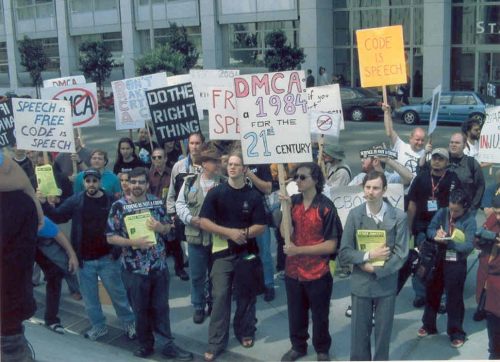
So for years and years and years I assumed this photo was taken by a good friend of mine (and we sill think it may be) but we can t totally verify if it is his as he lost all his old photos after a server hack-in. Do you recognize this photo? Do you have photos from this Free Dmitry protest (August 2008, in front of the San Francisco Prosecutors office) that would share for an academic publication on this topic??? Help!

25 April 2009

Russell Coker: Creating a Double-Ended Bun


The people who made the above magazine advert gave it two top-halves to the burger bun. But I think that there is actually a demand for such buns, and that it is possible to make them! Traditional buns have a flat bottom where they rest on a baking tray. One solution to this problem would be to bake in outer space, another possible solution would be to develop a rapid baking process that allows baking in a free-fall aeroplane, but both of these would be unreasonably expensive. It seems that it would be viable to bake double-ended buns by having a rapidly rising column of hot air to suspend the bun. The terminal velocity of a bun would probably not be that high (maybe 60Km/h) and it should be quite easy to have a pipe full of hot air that bakes the buns. As slight variations in the density and shape of the bun would affect the air-flow it would be necessary to closely monitor the process and adjust the air speed to keep the bun afloat. Manufacturing cheap ovens that use LASERs to monitor the position of the bun should not be difficult. This might blow the sesame seeds off the bun, but this problem may also be solvable through careful design of the bun shape to make it less aerodynamic and by strongly attaching the seeds. I m not sure how you would do this.

24 April 2009

Gunnar Wolf: Some prefer marathoning... I prefer going to my old workplace

I was invited to talk about Free Software at yesterday's FLISOL. Yesterday? Aren't FLISOLs organized on Saturday? Well, not this one, for various reasons which I won't quote here. And no, I am not a supporter of the installfests idea, but I went gladly to talk about what is Free Software all about - The philosophy behind Free Software. Besides, the talk was at FES Iztacala, where I worked for four happy years, 1999-2003. I have not been often to Iztacala since 2003 (probably I have visited only three or four times), partly because of the distance (~25Km from home in a straight line, but the city's Northern part is quite poorly communicated). The last time I was there, last October, I went by bike, just to test my endurance and... because I could. Yesterday, I also did, not to be outdone by my fellow Debianers Christian and Dirk. Think they are so cool because they can run for 43Km? Well, I had my 55Km yesterday, and I was not even in a competition! (yes, yes, running and biking is not the same. So sue me. I just didn't want to stand still and let them walk away with all of the fun!) I took slightly different routes (my route to get there on Nokia Sportstracker and OpenStreetMap trace, my route back on Nokia Sportstracker and OpenStreetMap trace), crossing diagonally Azcapotzalco, a region of the city (delegaci n) I hardly know... The Sourthern of it seems like a continuation of Tacuba to the North, small and not-very-well-communicated prior villages engulfed by our hungry, huge city. The Northern half is a mostly industrial area, with very sparse population, lots of trucks, and streets that are not in the best shape. You can end up feeling lonely in those regions, and I am glad not to have crossed back by night. And the trip back was interesting as well... Mexico City is home to many more bikers you would expect given its size, and it is very common to find other people doing nice long stretches. In this case, I started cycling quite close to another guy in a white bike more or less when I got to Calzada Camarones. Possibly we had passed each other over and over until after Tlatelolco, arriving to Guerrero, where I approached him at a stoplight:
Hi! Where to?
Near Vocacional 7, Iztapalapa!
Nice! I'm just going to Copilco Every now and then we crossed each other... Turns out he does this ~30Km commute daily between Iztapalapa and Azcapotzalco. Quite admirable, to be honest. I also crossed my road with Sergio Mendoza, fellow Debianer (and co-administrator of our Mexican mirror) around Centro M dico (about 7Km north from my destination), whom I had only seen before around the University. Nice surprise. And yes, getting to know the city by bike is the best way to go! Back to the conference... my first thought when I was invited was to present Qu es el Software Libre?, a talk I have given over and over since... 2002 (although, yes, with updates). I must say it's one of the best structured talks I have prepared and has almost always been very successful - But give the same talk based on the same script over and over (AFAICT, around 20 times), and you will be fed up with it. And yes, yesterday I didn't take my laptop along, and didn't put my presentation on a USB stick - I took a pen and some paper, and during the presentation prior to mine, wrote some points to go over. And yes, it was a refreshing change. The talk was as successful as expected, and it's much more refreshing to talk about the same topics bot on a different way, and without being constrained to a predefined script. I know that organizing formally your ideas makes sure you don't miss out important points and that the audience is sometimes encouraged to pay attention by having some bullet points to look at - But on the other hand, it is much easier to follow your audience's interest if you are not bound by the script. And the few times I've spoken that way, it has felt refreshing and nice.

23 April 2009

Matthew Palmer: Insane/Brilliant Idea of the Day

I've been talking serial consoles with a couple of the other guys at work: how nice they are to have for machines in the datacenter, how annoying it is that vPro serial-over-LAN doesn't seem to be robust (yet?), and how serial access concentrators are lung-and-kidney expensive (especially when you've got 50-some racks to outfit). This discussion, combined with my ongoing embedded-hardware-fascination lust for a SheevaPlug appears to have spurred my brain into coming up with a Brilliant Idea: tie a SheevaPlug to a pile of USB to serial adapters and use that as your per-rack serial concentrator. Imagine: faffenheimer, a dedicated server you manage for a customer, and located in rack 27 of your DC, has just crashed, and you'd like to know WTF has happened rather than just blindly reboot, but you're in the office 15 minutes away from the DC floor, and the customer's going to want that machine back up and running pretty quickly.
workstation:~/porn$ ssh rack27.serial
rack27:~$ sconsole faffenheimer
[screen session attached]
[minicom running, shows the horror of a kernel crash dump]
[oh look at that, kernel bug]
^A ESC
[pgup pgup]
[enter]
[pgdn pgdn]
[enter]
^A >/tmp/faffenheimer-crash-dump
^A d
rack27:~$ exit
workstation:~/porn$ scp rack27.serial:/tmp/faffenheimer-crash-dump ~
workstation:~/porn$ powercycle rack27 faffenheimer
Shiny! We got a crash dump in a minute or so (rather than having to take phonecam photos of KVM screens in the DC), never had to leave our comfy seat, and the machine's on it's way back up. We're now free to pursue diagnostic activities on that crash dump at our leisure. 10 minutes later, the downtime for faffenheimer that was automatically set when we ran powercycle runs out and Nagios sends us threatening messages. Hmm, something's gone wrong here. Back into the console...
workstation:~/porn$ ssh rack27.serial
rack27:~$ sconsole faffenheimer
[screen session attached]
[Boot is hung waiting for root password after initrd has bombed]
[Type root password]
[Oh look, the root MD appears to have come asunder]
[clickety-click... fixee fixee]
[reboot]
The more I think about this, the more I reckon I'm onto a bona fide winner. The sheevaplug is a powerful ARM-based system with USB/ethernet/SD ports that is packaged literally in it's own power supply wall wart -- it's a plastic box with power plug prongs poking out the side. That's all there is to it. The USB to serial adapter things are likely to be a bit more of a pain, but I've played with enough of them by now to not be too scared. So, you plug the Sheeva into a power socket, plug an Ethernet cable and USB hub into the Sheeva, configure things a bit so that the system knows which serial adapter maps to which machine, and you're away. Oh, and the best bit: the Sheeva apparently draws as little as 2W when idle. A whole datacentre's worth of serial goodness for about a server's worth of power. The cost per rack should be somewhere below AU$250, especially in bulk. Let's see if I can convince work to spring for a Sheeva, a USB hub, and a half dozen or so USB to serial adapters to test this whole thing out. Given that the whole thing looks like it'd cost less than AU$250 (plus my R&D time), I can't imagine it'll be too hard a sell to at least give it a go. Watch this space...

Romain Beauxis: Lastfm no longer free as in free beer (and some bits about xml in OCaml)

Lastfm no longer free as in free beer As I was trying move the code of ocaml-lastfm [1] from the unmaintained xml-light [2] to xmlm [3], I discovered that it now fails to request track in anonymous mode. Then, I went on the lastfm [4] site, and discovered that now I cannot find any full content available for anonymous users. Some more researches and I found this [5]:
Today we are making the changes to the radio that were previously announced here. This means that from today, listeners to Last.fm Radio outside of the USA, UK and Germany will be asked to subscribe for 3.00 per month, after a 30 track free trial period. In the USA, UK and Germany, where it's feasible to run an ad-supported radio service, there won't be any changes. Everything else on Last.fm (scrobbling, recommendations, charts, biographies, events, videos etc.) will remain free in all countries, like it is now.
JPEG - 42.5 kb
Alcool ! Voil l'ennemi.
Poster by French painter and missionary Fr d ric Christol (1850-1933) warning of the dangers of absinthe and other alcoholic drinks.
Although I will not comment this with the same violence as in the comments of the above message, this is not a good news at all. I totally understand how it can be difficult to find financial resources for this kind of business, and how complicated it can be after few years to maintain an activity that initially was breaking new and attracting investors. However, given the current global [6] propaganda [7] campaign [8] that is organized [9] by the major music companies, I do not believe this decision has only to do with lastfm's financial resources. In particular, also the legality of Deezer [10] was challenged by universal [11] such that they had to require registration [12] and also limit drastically the available titles. The current situation is now really becoming worse and worse. Not only the music companies are trying to push for dangerous laws for the civil rights while pretending to fight against illegal music sharing, but also they are trying to shutdown all the new competitors that were successful in doing exactly what they refused to do during the same time. All of this is just simply pathetic, and I strongly hope there will soon be an end to this, which will surely mean for these companies adapt or perish.. Or perhaps they plan to impose their restricting and dangerous laws in any country in the world ? Another remark about all this is that it clearly demonstrate the importance of having the right to copy and store for your own usage any copyrighted material. Indeed, these are not only products but also artistic productions, and for this reason it is important to be able to save them in some place in order to not loose track of it if the streaming company was to be shutdown, as it seems to be the trend now.
JPEG - 71 kb
Viktor Oliva: The Absinthe Drinker.
The original painting can be found in the Caf Slavia in Prague.

Moving from xml-light to Xmlm The other part of this post is about moving from xml-light to xmlm. This is in fact very easy, and should only be a matter of adding a piece of code like this:
type xml =
Element of (string * (string * string) list * xml list)
PCData of string

let parse_string s =
let source = String (0,s) in
let input = Xmlm.make_input source in
(* Map a tag representation in xmlm to
* (name, attributes list) where attribute = string*string. *)
let make_tag (x,l) =
(* Forget about the uri attribute *)
let l =
List.map (fun ((_,y),z) -> (y,z)) l
in
snd x,l
in
let rec get_elems l =
if Xmlm.eoi input then
l
else
match Xmlm.input input with
El_start tag ->
let elem = get_elems [] in
let (name,attributes) = make_tag tag in
get_elems ((Element (name, attributes, List.rev elem)) :: l)
El_end -> l
Data s ->
get_elems ((PCData s) :: l)
Dtd _ -> get_elems l
in
let elems = get_elems [] in
Element ("", [], List.rev elems)
This is a very simple code that surely needs more fixes, but starting from that, you can parse a string into an equivalent representation of the xml data, and then use it as before in your code..


[1] Ocaml-lastfm: http://www.rastageeks.org/lastfm.html [2] Xml-light: http://tech.motion-twin.com/xmlligh... [3] Xmlm: http://erratique.ch/software/xmlm [4] Lastfm: http://www.last.fm/ [5] "Radio Subscriptions": http://blog.last.fm/2009/04/22/radi... [6] "New Zealand: safe from Big Music. Or is it?": http://www.p2pnet.net/story/19074 [7] " La Quadrature du Net discr dit e aupr s des d put s anti-Hadopi": http://www.numerama.com/magazine/12.... Link is in french. It explains how, after filling a so-called petition with hundreds of signatures from employees presented as artists, or artists abused by the presentation of the content, these companies complain about the "totalitarian methods" used to verify the validity of the signature, which were simply based on the public available information on these names on the web, while they propose a system that would automatically cut the internet access to probably 1.000 people a day in France... [8] "Faux proc s : Les pirates paient": http://www.ecrans.fr/Faux-proces-Le.... again, in french, the article reports a Danish study that prove once again that people who tend to download a lot of music are also much more likely to spend their money in the music business, being concert, records or else.. [9] ""Three strikes" for Ireland - Eircom, music industry settle filtering case": http://tjmcintyre.com/2009/01/three... [10] Deezer: http://www.deezer.com/ [11] "Universal Music challenges the legality of Deezer, a free streaming website": http://french-law.net/universal-mus... [12] "Now Deezer Required Registration": http://forums.techarena.in/technolo...

Manoj Srivastava: Manoj: Ontologies: Towards a generic, distribution agnostic tool for building packages from a VCS

This is a continuation from before. I am digressing a little in this post. One of the things I want to get out of this exercise is to learn more about Ontologies and Ontology editors, and on the principle that you can never learn something unless you build something with it (aka bone knowledge), so this is gathering my thoughts to get started on creating an Ontology for package building. Perhaps this has been done before, and better, but I ll probably learn more trying to create my own. Also, I am playing around with code, an odd melange of my package building porcelain, and gitpkg, and other ideas bruited on IRC, and I don t want to blog about something that would be embarrassing in the long run if some of the concepts I have milling around turn out to not meet the challenge of first contact with reality. I want to create a ontology related to packaging software. It should be general enough to cater to the needs any packaging effort in a distribution agnostic and version control agnostic manner. It should enable us to talk about packaging schemes and mechanisms, compare different methods, and perhaps to work towards a common interchange mechanism good enough for people to share the efforts spent in packaging software. The ontology should be able to describe common practices in packaging, concepts of upstream sources, versioning, commits, package versions, and other meta-data related to packages. vcs-pkg concept diagram I am doing this ontology primarily for myself, but I hope this might be useful for other folks involved in packaging software. So, here follow a set of concepts related to packaging software, people who like pretty pictures can click on the thumbnail on the right:

22 April 2009

Joachim Breitner: Buzz free

My Openmoko FreeRunner suffered from the infamous hardware bug that causes bad buzzing for my dialog partner, making it relatively useless for me. Last week, though, a collegue of my brother fixed it for me (by applying some soldering-skills), and indeed, the audio quality is above bearable now! I plan to get Debian on the FreeRunner up to date again with the other developments in the community now. Or at least soon, depending on how much time I ll be able to spare.

Next.

Previous.