Search Results: "nic"

31 May 2010

Dirk Eddelbuettel: JPM Chase Corporate Challenge 2010

It's Memorial Day weekend so it was time for the Chicago's JP Morgan Chase Corporate Challenge on Thursday. The weather was glorious, the usual 20-some thousand runners participated and a good time was had. Work had arranged for a nice tent, food, music --- and a bunch of people showed up and enjoyed it. Nice one. This time we all got chip-timing via a small (rfid ?) strip tagged to back of the bib number. Which is handy as I managed to not stop my time by hand correctly. Given that I am still nursing a sore Achilles tendon and don't train well or much, the time of 23:51 (or 6:48 min/mile) was ok compared to the other seven previous times I have run this.

Piotr Galiszewski: The end of the first mockups iteration

Last week was very busy for me. Unfortunately, I spent most of my time no my study duties. An exam session is fast approaching, so in next 3 weeks the situation will not be better. But as I promised, during second part of week, I am working full time on my project.

So, here are missing mockups of future Aptitude Qt GUI:

Changes Preview tab:

Only one "Preview Tab" can be opened at the same time. Changes will be live updated here.

Resolver:

Perform Changes tab:


This time I am not too innovative. I think that current Aptitude GTK design for this tabs is quite intuitive and good-looking, so I have added only minor tweaks.

To sum up mockups topic, below are links to all presented mockups (with some comments which raises during my recent private discussions). Now, I am open for any suggestions and comments about current design. At the end of next week, second iteration will be presented. Depending of the level of required changes there could be third iteration, before sending mockups to Piotr "Patpi" Pe zowski, who is the person behind Kadu Usability Project. I am glad that he agreed to spend his spare time and help me with this task :)

Packages tab:

This tab in second iteration will have only small changes. I was told that will be nice to select multiple categories at the same time. I agree, so categories list will support multi selection. There will be also an option in configuration window (There is no mockup now. Currently, I do not know what option will be configurable and it is not the most important thing at this stage. The window will be patterned upon KDE configuration windows) to move this list on the right side of this tab.

It will be possible to have multiple "Packages tabs" opened at the same time. It will not be allowed to close first "Package Tab". Ctrl + T shortcut, action in main menu and toolbar (I have forgotten about toolbar in this iteration - maybe it is not necessary?) will open new tab. There will be also an option that each text search will do this. I will try to add shortcuts wherever is it possible to allow using the GUI without mouse.

"Show changes" button will be change to "Resolve dependencies" when necessary.

Updates widget:

Most of the comments from "Packages tab" apply here too. In the table showing updates will be also "Current Version" column.


Package Informations tab:

Only one clarification: multiple "Packages Informations" tabs for the same package will not be allowed.

I am looking forward to read any comments regarding presented design. Please leave comment below this post or contact me directly (see About Me page).

On Monday/Tuesday I will write first weekly report.

Cheers.

Christian Perrier: [life] Running update

What happened in my running life since my last update? In short, I achieved two races I was planning to do. I ran my first trail on May 16th, Le Trail des Cerfs ("deer trail"). The experience of trail running is awesome. Runners are very friendly and all of them are nature lovers. So, the feeling is completely different from mass macadam races (those are also a must-do, still!). I had a great time running that trail (which ended up to be exactly the distance of an half marathon). I completed it in less than 1h50, which is good, as the positive slope was about 300 meters, with sometimes very though rampswhere walking was nearly mandatory. At this occasion, during the "after", I discovered some members of an online community of runners, named Kikourou ("Who is running where?"), and I'm now a member of this online community (yet another one...). That makes the promise of lots of beers after races...:-) Today, I completed my "Maureparathon", a full marathon ran alone on small roads and bicycle lanes in my home city, and was happy to break my personal best by 6 minutes, down to 3h43'14". Yay. For sure, still very far from SuperNo l (3:03:56 in Mainz), but he's younger..:) As I planned, I'll be running the Sur les Traces du Loup ("The Wolf Track"?) 33km trail in La Ville aux Clercs, 2 hours away from our place. Elizabeth is very happy to come with me in a 2-day trip in Chateaudun neighbourhood. Renaissance castle visit mandatory for the following Sunday...:-) Nice planning, eh? And, guess what? I'm already trying to spot some local 10km races while being in New York. I would find it an interesting experience to run with local runners. Just like free software...and beer...and cheese, running is much better when shared.

Gunnar Wolf: Update: A correspondingly pleasant dinner

Update: A correspondingly pleasant dinner
And just to round off my last post (and of course, following a completely non-technical thematic), what is the logical consequence of feeling introspective and blogging just before preparing dinner? Of course Dinner gets prepared with sharing it in mind. The dish ends up even looking as if meant to be served! So this was it: One of my simplest and still favorite dishes: Tostadas. But, yes, these are heterodox tostadas, as they share the basic tostadiness (a hard, roasted and cracky toasted corn tortilla with a soft leguminous layer to give it some consistency, and with... stuff on top. Yes, stuff is sometimes too generic, but that's the beauty of it). What did I come up with? In the strict order with which they were approached at feeding time, and described bottom to top:
  1. Closest to traditional, top left: Mashed beans, bits of panela cheese with little bits of chipotle and soybean-based vegetarian chorizo
  2. Something I have only seen in Guatemala, and which I intend to take a better look at next time I'm there (top right): Mashed frijoles, , cochinita pibil (canned, shame on me, and frankly lacking in taste), grated beet (betabel/remolacha/betarraga/whatnot), grated cabbage
  3. The heterodoxiest of them all, and the idea that led me to the others (center): Mashed lima/fava beans (according to Google habas), cochinita pibil, nopales, and a hint of habanero sauce.
Yum! [update] On a completely unrelated notice, but not worth opening a third post in a row... Some minutes after I published the earlier post, I got a visit to http://gwolf.org/blog/pleasant-perception-changes?utm_source=twitterfeed&utm_medium=twitter. Now, it beats me: I don't use twitter. I don't even care about twitter. And were my message so deep somebody just twitted (twat it?) right away, I still find the time lapse too short. Who's auto-twitting me? Maybe a planet or other such aggregator?

Gunnar Wolf: Pleasant perception changes

My day started late, although I didn't scratch the plan: Enjoy 40Km cycling, as as every last Sunday of the month we have the delicious Ciclot n 32Km, plus ~10km from and to my house. Approximately 12:00-14:20, including stopping at a service station to patch my rear tire. Yes, I was pressing my way up the last bridge (Circuito Interior over Coyoac n and Universidad) when the road was opened to motorized traffic. Two hours of cycling are enough to make me a happy person. However, I have been downish lately, and during the afternoon (which I spent doing some home maintenance, as I usually do on weekends), I felt this downness grow somewhat. Nothing terrible, just I guess the processes that I have to live through. Then, after ~1hr reading a somewhat tough book, I closed it thinking, "this was a good day". And surprised myself with the reflection. So, while I don't think this can put me back into the activity/productivity status I have held and would love to regain... Is certainly a very nice push forward. Time to get something for dinner, as my body also reminded me it is not exempt of such needs (as it faithfully reminds me, often more frequently than it should)

29 May 2010

Bernd Zeimetz: installing debian on the guruplug server plus

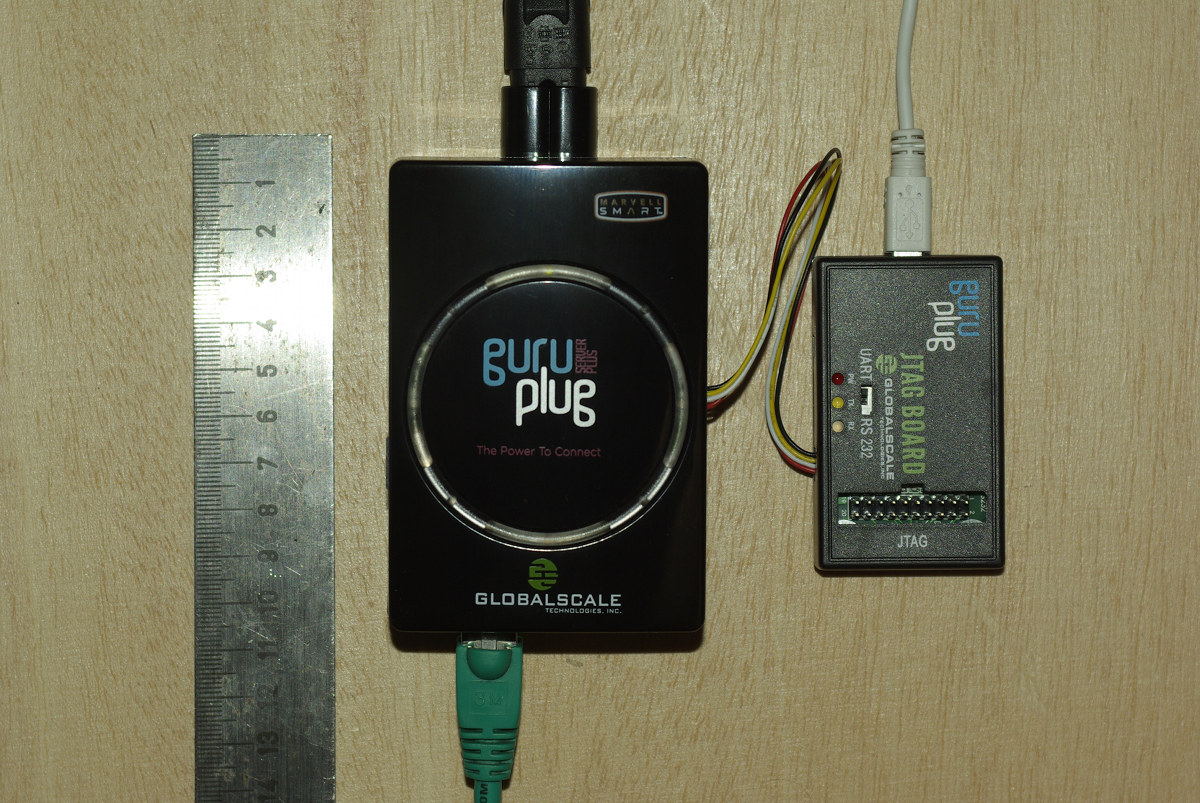
Yesterday finally my GuruPlug Server Plus arrived. Took longer than expected, but as it seems Globalscale had some issues with the power supplies and they were replaced before shipping the GuruPlugs. GuruPlug Server Plus and JTAG Board

The GuruPlug Basically the GuruPlugs are an enhanced version of the well known SheevaPlugs, the biggest difference is probably the need for an external JTAG/UART<>RS232 board to access the serial console. Good thing is that the board comes with a normal JTAG connector and an additional RS232 connector and 2.5V DC power outlet, so it will be useful for other devices, too. Globalscale could have chosen different connectors with less wiggly cables, though. As I was not able to find a useful howto about installing Debian on the Guruplug, I've written down what I did to install Debian unstable on a micro SD card using the Debian installer for the GuruPlug. I did not have a look who modified the Debian installer to work on the plug, but thanks for that! The instructions below are based on Martin Michlmayer's awesome SheevaPlug documentation, the hints from oinkzwurgl.org/guruplug and various forum posts in the plugforum.

Preparations Please note that I'm not resposible for whatever you're doing with your plug. If you follow this tutorial and end up with a brick, it is your fault, not mine. To install the GuruPlug you need the JTAG Board. Connect the UART port to the GuruPlug and the JTAG board to your computer, it should show up as FTDI (thanks for using good chips!) USB<>Serial converter. Serial port settings are 115200, 8-N-1, no hw/sw flow control. The other thing you should prepare is a working tftpd, I'm using aftpd.
apt-get install aftpd
Recent versions share files from /srv/tftp/, in case you're running Lenny /var/lib/tftpboot/ should be the place to drop your files. When everything is connected properly the boot process should show up in minicom, make sure to press some key to enter uBoot. The first thing you should do is to save the original uBoot environment in case you want to restore the factory settings later. Run
printenv
and save the output somewhere.

Upgrading uBoot Unfortunately the uBoot version on the GuruPlug is pretty old and seems to have some issues in booting from USB devices, so the first thing you should do is to upgrade it. You might want to investigate if there is even a better, more recent uBoot version available somewhere, or build one on your own, but I didn't bother and took the uBoot.guruplug.bin from here. The main issue with that is that booting from USB still seems to be buggy (even for FAT partitions) and that ext2load is still not supported. Otherwise it works well :-). I'm mainly following Martin Michlmayer's tutorial again. Download the uBoot.guruplug.bin and drop it into the tftpd directory. Make sure you always set the plug's IP address (ipaddr) and your server's IP address (serverip) properly. I'll use 192.168.121.253 for the plug and 192.168.121.2 for the server in all examples, make sure to change that for your own needs. Stop if something goes wrong, especially when the tftp download failed.
setenv ipaddr 192.168.121.253
setenv serverip 192.168.121.2
tftp 0x6400000 uBoot.guruplug.bin
nand erase 0x00000000 0x0100000
nand write 0x6400000 0x0000000 0x80000
reset
Enter uBoot again after the reset.

Preparing the installer Download uImage and uInitrd to your tftpd directory. Although I've heard that setting mainlineLinux/arcNumber in the uBoot environment is not necessary anymore for very recent kernel, lets set them to make sure the Debian kernel works:
setenv mainlineLinux yes
setenv arcNumber 2097
saveenv
reset
Again, enter uBoot after the reset.

Running the installer Run the following in the uBoot console:
setenv ipaddr 192.168.121.253
setenv serverip 192.168.121.2
tftpboot 0x01100000 uInitrd
tftpboot 0x00800000 uImage
setenv bootargs console=ttyS0,115200n8 base-installer/initramfs-tools/driver-policy=most
bootm 0x00800000 0x01100000
You should see the installer starting now. You might want to follow the following hints:
  • Before configuring the network, go back and set the debconf priority to low, Then continue. While chosing the Debian mirror, chose sid as the Debian version to install. If you don't have sid as choice, use a different mirror. The kernel in testing does not boot on the GuruPlug, you need 2.6.32-13 from sid.
  • You might want to load the 'network console' installer component and continue via ssh. Makes things fater and colourful.
  • Suggested partitioning: I've installed Debian to an 8GB micro SDcard. The SDcard reader is connected via USB and shows up as /dev/sdb (/dev/sda should be the internal NAND and not shown by the installer). I've used 150MB ext2 for /boot and the rest of the space for /, using ext4. You might want to use the noatime option on both filesystems to avoid unnecessary write access to the SDcard. You might choose to add a swap partition, but SDcards are so slow, so I've skipped that.
When you continue the installation, you will hit the following problem:
  • The installer might fail on 'Make the system bootable' (not sure if it does for you, it did so with the kernel from testing).
  • The uBoot is not able to boot from your /boot anyway. USB support is buggy and ext2load missing.
We'll work around these issues by writing the kernel and initrd into the plug's NAND. To do so, enter a shell in the installer and chroot into the install target. We'll then create the necessary uImage.bin and uInitrd and scp them to our tftpd directory:
chroot /target /bin/bash
cd /boot
mkimage -n vmlinuz -A arm -O linux -T kernel -C none -a 0x00008000 -e 0x00008000 -d /boot/vmlinuz uImage.bin
mkimage -n 'vmlinuz initrd' -A arm -O linux -T ramdisk -C gzip -d /boot/initrd.img uInitrd
scp uI* root@192.168.121.2:/srv/tftp
Now leave the shell, finish the installation and reboot, enter uBoot again.

Make the plug bootable To write kernel and initrd to the NAND memory, we have to transfer it via tftp first, then erase the NAND area we want to write to and then write it to the NAND. The values I've chosen here should be fine for the current Debian kernel, but you might need to change the necessary size for the initrd. To do so have a look at the output while transferring the initrd - the transferred bytes are displayed. They have to fit into the amount of bytes you write (the last option to nand write.e).
setenv ipaddr 192.168.121.253
setenv serverip 192.168.121.2
tftp 0x6400000 uImage.bin
nand erase 0x100000 0x400000
nand write.e 0x6400000 0x100000 0x400000
tftp 0x6400000 uInitrd
nand erase 0x500000 0x1fb00000
nand write.e 0x6400000 0x500000 0x600000
Now we need to set the necessary boot options. Make sure to change the root device if you've chosen a different layout from that I've suggested above, or if you're not using a SDcard.
setenv bootargs_debian 'console=ttyS0,115200 root=/dev/sdb2'
setenv bootcmd_nand 'nand start; nand read.e 0x00800000 0x100000 0x400000; nand read.e 0x01100000 0x500000 0x600000'
setenv bootcmd 'setenv bootargs $(bootargs_debian); run bootcmd_nand; bootm 0x00800000 0x01100000'
saveenv
run bootcmd

Finish Your GuruPlug should boot your new Debian installation now. Have fun! I'll try to keep the howto updated for changes in uBoot and the installer, but I might not have the time to so quickly. Patches and comments are welcome!.
root@guruplug:~# uname -a
Linux guruplug 2.6.32-5-kirkwood #1 Fri May 21 05:44:29 UTC 2010 armv5tel GNU/Linux
root@guruplug:~# cat /proc/cpuinfo 
Processor   : Feroceon 88FR131 rev 1 (v5l)
BogoMIPS    : 1192.75
Features    : swp half thumb fastmult edsp 
CPU implementer : 0x56
CPU architecture: 5TE
CPU variant : 0x2
CPU part    : 0x131
CPU revision    : 1
Hardware    : Marvell GuruPlug Reference Board
Revision    : 0000
Serial      : 0000000000000000
root@guruplug:~# 

Lucas Nussbaum: Ubuntu and Debian

I recently noticed the new Ubuntu and Debian link on every page of http://www.ubuntu.com/. That is very nice, and much better than the previous situation. Debian is also mentioned on the pages about Easy administration and Security. Canonical has clearly improved a lot in the way they communicate about how Ubuntu bases its development on Debian s.

27 May 2010

Matt Zimmerman: Rethinking the Ubuntu Developer Summit

This is a repost from the ubuntu-devel mailing list, where there is probably some discussion happening by now. After each UDS, the organizers evaluate the event and consider how it could be further improved in the future. As a result of this process, the format of UDS has evolved considerably, as it has grown from a smallish informal gathering to a highly structured matrix of hundreds of 45-to-60-minute sessions with sophisticated audiovisual facilities. If you participated in UDS 10.10 (locally or online), you have hopefully already completed the online survey, which is an important part of this evaluation process. A survey can t tell the whole story, though, so I would also like to start a more free-form discussion here among Ubuntu developers as well. I have some thoughts I d like to share, and I m interested in your perspectives as well. Purpose The core purpose of UDS has always been to help Ubuntu developers to explore, refine and share their plans for the subsequent release. It has expanded over the years to include all kinds of contributors, not only developers, but the principle remains the same. We arrive at UDS with goals, desires and ideas, and leave with a plan of action which guides our work for the rest of the cycle. The status quo UDS looks like this: This screenshot is only 1600 1200, so there are another 5 columns off the right edge of the screen for a total of 18 rooms. With 7 time slots per day over 5 days, there are over 500 blocks in the schedule grid. 9 tracks are scattered over the grid. We produce hundreds of blueprints representing projects we would like to work on. It is an impressive achievement to pull this event together every six months, and the organizers work very hard at it. We accomplish a great deal at every UDS, and should feel good about that. We must also constantly evaluate how well it is working, and make adjustments to accommodate growth and change in the project. How did we get here? (this is all from memory, but it should be sufficiently accurate to have this discussion) In the beginning, before it was even called UDS, we worked from a rough agenda, adding items as they came up, and ticking them off as we finished talking about them. Ad hoc methods worked pretty well at this scale. As the event grew, and we held more and more discussions in parallel, it was hard to keep track of who was where, and we started to run into contention. Ubuntu and Launchpad were planning their upcoming work together at the same time. One group would be discussing topic A, and find that they needed the participation of person X, who was already involved in another discussion on topic B. The A group would either block, or go ahead without the benefit of person X, neither of which was seen to be very effective. By the end of the week, everyone was mentally and physically exhausted, and many were ill. As a result, we decided to adopt a schedule grid, and ensure that nobody was expected to be in two places at once. Our productivity depended on getting precisely the right people face to face to tackle the technical challenges we faced. This meant deciding in advance who should be present in each session, and laying out the schedule to satisfy these constraints. New sessions were being added all the time, so the UDS organizers would stay up late at night during the event, creating the schedule grid for the next day. In the morning, over breakfast, everyone would tell them about errors, and request revisions to the schedule. Revisions to the schedule were painful, because we had to re-check all of the constraints by hand. So, in the geek spirit, we developed a program which would read in the constraints and generate an error-free schedule. The UDS organizers ran this at the end of each day during the event, checked it over, and posted it. In the morning, over breakfast, everyone would tell them about constraints they hadn t been aware of, and request revisions to the schedule. Revisions to the schedule were painful, because a single changed constraint would completely rearrange the schedule. People found themselves running all over the place to different rooms throughout the day, as they were scheduled into many different meetings back-to-back. At around this point, UDS had become too big, and had too many constraints, to plan on the fly (unconference style). We resolved to plan more in advance, and agree on the scheduling constraints ahead of time. We divided the event into tracks, and placed each track in its own room. Most participants could stay in one place throughout the day, taking part in a series of related meetings except where they were specifically needed in an adjacent track. We created the schedule through a combination of manual and automatic methods, so that scheduling constraints could be checked quickly, but a human could decide how to resolve conflicts. There was time to review the schedule before the start of the event, to identify and fix problems. Revisions to the schedule during the event were fewer and less painful. We added keynote presentations, to provide opportunities to communicate important information to everyone, and ease back into meetings after lunch. Everyone was still exhausted and/or ill, and tiredness took its toll on the quality of discussion, particularly toward the end of the week. Concerns were raised that people weren t participating enough, and might stay on in the same room passively when they might be better able to contribute to a different session happening elsewhere. As a result, the schedule was randomly rearranged so that related sessions would not be held in the same room, and everyone would get up and move at the end of each hour. This brings us roughly to where things stand today. Problems with the status quo
  1. UDS is big and complex. Creating and maintaining the schedule is a lot of work in itself, and this large format requires a large venue, which in turn requires more planning and logistical work (not to mention cost). This is only worthwhile if we get proportionally more benefit out of the event itself.
  2. UDS produces many more blueprints than we need for a cycle. While some of these represent an explicit decision not to pursue a project, most of them are set aside simply because we can t fit them in. We have the capacity to implement over 100 blueprints per cycle, but we have *thousands* of blueprints registered today. We finished less than half of the blueprints we registered for 10.04. This means that we re spending a lot of time at UDS talking about things which can t get done that cycle (and may never get done).
  3. UDS is (still) exhausting. While we should work hard, and a level of intensity helps to energize us, I think it s a bit too much. Sessions later in the week are substantially more sluggish than early on, and don t get the full benefit of the minds we ve brought together. I believe that such an intense format does not suit the type of work being done at the event, which should be more creative and energetic.
  4. The format of UDS is optimized for short discussions (as many as we can fit into the grid). This is good for many technical decisions, but does not lend itself as well to generating new ideas, deeply exploring a topic, building broad consensus or tackling big picture issues facing the project. These deeper problems sometimes require more time. They also benefit tremendously from face-to-face interaction, so UDS is our best opportunity to work on them, and we should take advantage of it.
  5. UDS sessions aim for the minimum level of participation necessary, so that we can carry on many sessions in parallel: we ask, who do we need in order to discuss this topic? This is appropriate for many meetings. However, some would benefit greatly from broader participation, especially from multiple teams. We don t always know in advance where a transformative idea will come from, and having more points of view represented would be valuable for many UDS topics.
  6. UDS only happens once per cycle, but design and planning need to continue throughout the cycle. We can t design everything up front, and there is a lot of information we don t have at the beginning. We should aim to use our time at UDS to greatest effect, but also make time to continue this work during the development cycle. design a little, build a little, test a little, fly a little
Proposals
  1. Concentrate on the projects we can complete in the upcoming cycle. If we aren t going to have time to implement something until the next cycle, the blueprint can usually be deferred to the next cycle as well. By producing only moderately more blueprints than we need, we can reduce the complexity of the event, avoid waste, prepare better, and put most of our energy into the blueprints we intend to use in the near future.
  2. Group related sessions into clusters, and work on them together, with a similar group of people. By switching context less often, we can more easily stay engaged, get less fatigued, and make meaningful connections between related topics.
  3. Organize for cross-team participation, rather than dividing teams into tracks. A given session may relate to a Desktop Edition feature, but depends on contributions from more than just the Desktop Team. There is a lot of design going on at UDS outside of the Design track. By working together to achieve common goals, we can more easily anticipate problems, benefit from diverse points of view, and help each other more throughout the cycle.
  4. Build in opportunities to work on deeper problems, during longer blocks of time. As a platform, Ubuntu exists within a complex ecosystem, and we need to spend time together understanding where we are and where we are going. As a project, we have grown rapidly, and need to regularly evaluate how we are working and how we can improve. This means considering more than just blueprints, and sometimes taking more than an hour to cover a topic.

Vincent Sanders: Ex Phone

I went to the Linux Plumbers Conference (LPC) last year (which was very interesting and productive). While I was there Qualcomm were in attendance giving out penguin mints and running a competition. The lucky winners of this draw were to receive an ADP1 Android phone. So I dutifully filled in the entry form, handed it in and thought no more about it.

In the break after attending a particularly interesting workshop on the last day of the conference several other people congratulated me on winning the Qualcomm draw, this was the first I knew about it! I went in search of the nice people from Qualcomm and sure enough they handed over an ADP1 after getting a couple of photos.

Once I returned home I switched to using ADP1 as my phone and started experimenting with Android kernel stuff. Then one day the Wi-Fi stopped working which while odd could be overcome by repeatedly unloading and reloading the driver until it worked once more. Then one day the USB stopped working, no more ADB, no more console, no more debugging, no more hacking.

Then one day it turned itself off and never came back. I have been forced to return to using a hand me down, very kindly given to me by Daniel Silverstone. Alas it is not a smart phone of any kind and my finances do not allow for me to spend the money to replace it.

I have repeatedly tried to contact Qualcomm open source to see if there is any kind of warranty I might be able to use to get the phone repaired alas all the contact addresses I have are now simply returning SMTP errors.

So this is pretty much a tale without a happy ending, unless anyone out there knows the right people to contact? Perhaps someone at Google maybe? I only revisit the subject at all because of the recent announcement of an Android 2.1 based edition for these devices which reminded me I like to play with these things.

Rog rio Brito: Please let me zoom my documents!

It all started when I tried to typeset my documents with the Utopia typeface, which is Free Software, since Adobe liberated it to the TeX Users Group. There are some nice packages for changing fonts in LaTeX with Utopia, like mathdesign and fourier. But I wanted to play with a new toy, XeTeX. Then, seeing as small caps was missing from the fonts that Adobe donated, I tried to just fake them with a program that I had never heard of before: fontforge. My first attempt wasn t that very successful, but, after reading a little bit of the code, the reason for the problem was soon discovered. At the same time, I wanted to see what I had done with a PDF reader. The options aren t many here: xpdf was already removed from Debian s unstable (which is the distribution that I use), trying to update it proved to be unsuccessful and upstream isn t that active (which, by the way, led to the creation of the poppler project). Unfortunately, some of the Free PDF viewers seem to be limited to a maximum zoom of 400%, while some documents seem to demand more zooming (especially those with little, tiny letters, and for those people, like myself, that don t have good eyesight). Patching the programs to eliminate those hardcoded limits isn t that hard, but the results with evince and epdfview can be frightening: a very simple document, when zoomed with epdfview to, say, 1600% uses so much memory that one needs to watch out for the Out Of Memory killer and so much swapping that it is hard to believe. Don t believe my words. Just try it. But, hey, I just want to see a document without having to suffer too much. And 400% isn t enough for many documents that I have. Especially when I want to see how a given font has been rendered on a document. I have not yet investigated the real cause of the huge memory consumption, but I would trust the words of the developers, that evince does everything in a big piece of memory. On the other hand, if one compiles poppler right from the sources, its demo program for the glib backend can display files in a zippy manner, even with very large zooms. xpdf, though, works very well with higher zoom levels, without making the whole computer grind to a halt. Seeing as Martin Pitt has stripped xpdf to be able to use the poppler backend, I was animated to have the best of both worlds: the frequent updates of poppler and the lightness of xpdf. Martin s port of xpdf doesn t compile with a recent poppler, though: the library has changed a lot since 2006. And, in many respects, for good reason, since the original code is not that clean. But it makes harder for luses like me to use code based on fast-changing libraries. Well, to cut a long story short, after two afternoons hunting down a version of poppler that would allow me to compile Martin s xpdf version, I got bored and tried to attack the problem. Now I can use this alternative version of xpdf with the poppler backend, with very little dependencies and with little memory usage on my computer. I m keeping it for my private use, but if anybody else is interested, please let me know.

Stefano Zacchiroli: Debian-based scientific computing at EDF

why Debian for scientific computing: a case study Yesterday I've been invited to visit EDF R&D center at Clamart, near Paris. They wanted to discuss their Debian usage and present some of the cool stuff they're doing. The most interesting component is an in-house Debian-based distribution called "calibre", which has been presented at RMLL 2008. Even though it is now growing desktop profiles (currently deployed on about 1'200 desktops and counting), calibre was mainly developed for clusters dedicated to scientific computing. Current cluster deployments at EDF are not that big, but still comprise hundreds of machines for about 40 teraFLOPS, with their largest cluster in Top 500. The main goal of calibre was to quickly bring a complete cluster from the bare metal to production state. The goal has been quite successfully achieved: using Debian and FAI they get a cluster of 200 machines ready for production in about 1 hour and a half, installing more than 3'000 packages on each machine (as the cluster will be used for heterogeneous purposes, rather than for a handful of specific applications). What I found most interesting of the visit are the reasons for choosing Debian over other (commercial) distros for their scientific computing purposes: EDF is generally keen of contributing back to Debian (even though the team behind calibre is still small), and I've been happy to walk them through how they can contribute. The last interesting feedback I've to share, is that they feel a bit alone in what they're doing (which is unsurprisingly, given that their communication on the matter has been rather limited thus far ...). Still, there is probably room for synergies that can be better exploited among users with similar needs. So, are you a cluster / scientific computing user of Debian? Then let me know, and I'll be happy to get you in touch with EDF and other users with similar interests.

26 May 2010

Nico Golde: fail2ban + dns = fail

fail2ban is used by many people to prevent certain types of DoS attacks. I use it myself to reduce trackback spam a little bit.

While this tool becomes quite handy in such situations it is also not generally recommend because you can shoot yourself in the foot. If one of the used filters has a bug and results in incorrect parsing your fail2ban installation might end up banning arbitrary IP addresses or even your own IP range (not even mentioning IP spoofing).
There existed at least two bugs of this kind to my knowledge and since regex might not always be easy I'm sure there will be more in the future.

Since I didn't want to look for a specific regex bug in one of the filters I thought about IP spoofing again and looked at fail2bans filters. What I needed was a filter processing log entries of a service listening on a UDP socket as TCP/IP spoofing over the internet doesn't really work well these days. Finding such a filter would mean an instant win situation. To my surprise there is such a filter: config/filter.d/named.conf

This filter is used to parse log entries consisting of denied DNS queries produced by bind. Interestingly there is even an article at debian-administration describing how to setup fail2ban to mitigate a DNS DDoS attack. This is of course a bad idea and I have no idea why this filter is shipped in a default fail2ban installation. DoSing abritary IP addresses with this filter in use becomes as easy as firing up scapy and querying the server with a forged source IP:

>>> send(IP(dst="81.169.172.197",src="xx.46.63.71")/UDP()/DNS(rd=1,qd=DNSQR(qname="foao.modprobe.de")))
.
Sent 1 packets.

This ends up as:
May 26 22:32:22 modprobe named[30245]: client xx.46.63.71#53: query 'foao.modprobe.de/A/IN' denied

in the bind logs which in turn results in:
2010-05-26 22:32:05,551 fail2ban.actions: WARNING [named-refused] Ban xx.46.63.71

In this example the spoofed IP was xx.46.63.71 which is not under my control.

Mission statement: don't use fail2ban unless you really want to shoot yourself in the foot or know pretty well what you're doing :-)

Stefano Zacchiroli: EDF and Debian values

Debian-based scientific computing at EDF Yesterday I've been invited to visit EDF R&D center at Clamart, near Paris. They wanted to discuss their Debian usage and present some of the cool stuff they're doing. The most interesting component is an in-house Debian-based distribution called "calibre", whish has been presented at RMLL 2008. Even though it is now growing desktop profiles (currently deployed on about 1'200 desktops and counting), calibre was mainly developed for clusters dedicated to scientific computing. Current cluster deployments at EDF are not that big, but still comprise hundreds of machines for about 40 teraFLOPS, with their largest cluster in Top 500. The main goal of calibre was to quickly bring a complete cluster from the bare metal to production state. The goal has been quite successfully achieved: using Debian and FAI they get a cluster of 200 machines ready for production in about 1 hour and a half, installing more than 3'000 packages on each machine (as the cluster will be used for heterogeneous purposes, rather than for a handful of specific applications). What I found most interesting of the visit are the reasons for choosing Debian over other (commercial) distros for their scientific computing purposes: EDF is generally keen of contributing back to Debian (even though the team behind calibre is still small), and I've been happy to walk them through how they can contribute. The last interesting feedback I've to share, is that they feel a bit alone in what they're doing (which is unsurprisingly, given that their communication on the matter has been rather limited thus far ...). Still, there is probably room for synergies that can be better exploited among users with similar needs. So, are you a cluster / scientific computing user of Debian? Then let me know, and I'll be happy to get you in touch with EDF and other users with similar interests.

Adrian von Bidder: The Debian Umbrella: Soon.

Update: I'm taking orders now. I was planning to take orders for the Debian Swirl umbrella starting tonight, but a bit of research showed that shipping prices for parcels are insane (CHF 37 for europe), but it seems I can get away with sending this as a Swiss Post Maxi Letter instead, which would result in a shipping price of CHF 12.50 for four and CHF 24 for up to eight umbrellas (1kg or 2kg.) So now I'll go and look into getting some kind of flattish box to stay within the allowed dimensions before I can be sure this is possible. In any case, I expect the delivery in the first week of June. Since I'll not be coming to Debconf, it would be nice if somebody could take some umbrellas to New York. I'm currently not travelling much, so I'd have to rely on a friendly volunteer. (I'm based in Basel, Switzerland; I am known to go to Z rich regularly.)

Matt Zimmerman: Using Mumble with a bluetooth headset

At Canonical, we ve started experimenting with Mumble as an alternative to telephone calls for real-time conversations. The operating model is very much like IRC, based on channels within which everyone can hear everyone else as they speak. Mumble works best with a headset, which offers better audio recording quality due to the proximity of the microphone, and avoids problems with echo and feedback. I like to pace around while I talk, and so I ve already invested in a Plantronics Calisto Pro, which includes a DECT handset, a Bluetooth headset and a nice charging base. My laptop has bluetooth onboard, so I set about trying to get Mumble set up to use the headset via bluetooth. The first thing I tried was to click on the bluetooth icon on the panel, and select Set up new device.... After setting the headset to pairing mode, I waited quite some time for it to show up in the list, but it never did. After opening the preferences dialog, I discovered that this was (presumably) because I had already paired it, ages ago. So, I went about trying to get PulseAudio to talk to it. After some hunting, I tried:
pactl load-module module-bluetooth-device address=00:23:xx:xx:xx:xx
This created a new Card in PulseAudio, which I could see in the Hardware tab of the Sound Preferences dialog and in pactl list, but it was inactive:
Card #1
Name: bluez_card.00_23_XX_XX_XX_XX
Driver: module-bluetooth-device.c
Owner Module: 17
Properties:
device.description = "Calisto PLT"
device.string = "00:23:XX:XX:XX:XX"
device.api = "bluez"
device.class = "sound"
device.bus = "bluetooth"
device.form_factor = "headset"
bluez.path = "/org/bluez/13899/hci0/dev_00_23_XX_XX_XX_XX"
bluez.class = "0x200404"
bluez.name = "Calisto PLT"
device.icon_name = "audio-headset-bluetooth"
Profiles:
hsp: Telephony Duplex (HSP/HFP) (sinks: 1, sources: 1, priority. 20)
off: Off (sinks: 0, sources: 0, priority. 0)
Active Profile: off
The Hardware tab confirmed that the device was Disabled, and using the Off profile. I could manually select the Telephony Duplex (HSP/HFP) profile, but this had no apparent effect. There were no Sources or Sinks to send or receive audio data to or from the headset (and thus nothing new in the Input or Output tabs of the preferences dialog). syslog hinted:
pulseaudio[15239]: module-bluetooth-device.c: Default profile not connected, selecting off profile
At this point, I recalled that when I suspend this laptop, the bluetooth driver gets unhappy. I don t commonly use bluetooth on this laptop, so I hypothesized that the driver was in a weird state, and I decided to try unloading and reloading the btusb module. Once I did so, the device showed up in the panel menu, with a Connect menu item. Aha! The manual module loading above may turn out to be unnecessary if the device shows up in the menu initially. I selected the Connect menu item, and a bunch of magic happened, with the result that I heard the headset s tone to indicate it was activated. Sound Preferences now showed it under Hardware as active using the Telephony Duplex profile, and it appeared under Input and Output as well. pactl list showed its sources and sinks. Mumble offered it as a choice for the input and output device. Progress! Some experimentation (thanks, Colin) revealed that other people could hear me through the headset just fine. However (Problem #1), I couldn t hear them clearly through the headset. If I switch Mumble s output to my speakers, they sound fine, so it s not Mumble. So I tried:
paplay -d bluez_sink.00_23_XX_XX_XX_XX /usr/share/sounds/alsa/Front_Center.wav
which also sounds awful. There is a whining noise, which gets louder when the audio signal is louder, which makes it very difficult to hear. I don t know if the problem is with PulseAudio, bluez, the kernel, or the device, but using speakers for output is a workaround. This does seem to cause some echo, though, so I ll need to track this down eventually. Problem #2 is that Mumble seems to prevent PulseAudio from suspending the headset s source. Even if I set it to Push to Talk mode, the headset stays active all the time, which will drain the battery. PulseAudio seems to do the right thing, and kill the radio link, if the source is left idle, and brings it up when there is activity, so this looks to be Mumble s fault. I ll need to fix this as well.

Jose Luis Rivas Contreras: Chrome vs Firefox, again

Long time ago I stopped using Chrome for daily use and leave it only for my Google services like Gmail and Wave. Now, is my main browser even when it just stop working while I m offline (weird thing, btw). Is fast, starts fast, loads fast, runs javascript very fast. I can use websites as apps without installing another app to complement my browser like Prism and renders fonts wonderfully with @font-face. Now, Firefox, well First of all, I m using nightly builds of alpha version, so it s supposed to fail sometimes and I understand that but, it s not supposed to be faster as well? Loads after 1 min I launch it(UPDATE 2010-05-26: There was a loop on an addon making it start slow, now starts on 10 seconds which is pretty nice) and loads not as smooth as Chrome the websites, even using NoFlash, NoAds and NoJavaScript! In fact, if wasn t because Chrome stops working while I m offline I would not have any reason to use Firefox even while designing websites (just for checking). It s a shame, I really liked a lot Firefox and I hope Firefox4 get a really good speed bump.

25 May 2010

Erich Schubert: Facebook and privacy

Mark Zuckerberg apparently recently promised
we will add privacy controls that are much simpler to use.
Dear Facebook. I believe your users want more privacy, not just prettier controls. They don't want you to give away their data by default, track them across web sites (that embed the "Like" buttons) and auto-connect them to various things.In particular, they want opt-in, not opt-out. And they also don't want to be auto-opted in by you either. Make the defaults all opt-out!They don't want you to index and publish their data by default like if you were a paparazzi and they were a pop star. Sure, they'd like to be a pop star, but without the paparazzi stuff, you know.There is an essential difference between actually caring about privacy, and just making it look nice (which unfortunately is what Facebook currently does, pretend it's all fine, because you could turn it off, if you go to all the sites you don't want and turn it off on each single one ...).

Russell Coker: Links May 2010

AdRevenge is an interesting concept to pay for Google Adsense adverts about how companies suck [1]. If a suitably large group of people pay to warn you about a company then it s a good signal that the company is actually doing the wrong thing. A guest post by Mili on Charles Stross blog has an interesting analysis of the economcs of Intellectual Property and concludes that content is a public good [2]. New Age Terrorists Develop Homeopathic Bomb [3], an amusing satire of medical fraud and security theatre. The sit has a lot of other good satire too. Mark Shuttleworth wrote an interesting post about new window management changes that will soon go into Ubuntu [4]. He points out that the bottom status bar in applications is a throw-back to Windows 3.1 and notes that a large part of the incentive for removing it (and using the title-bar for the status) is the work on the Netbook version of Ubuntu. This is really ironic given that the resolution of current Netbooks is quite similar to that of desktop systems that were current when Windows 3.1 came out. Omar Ahmad gave an insightful TED talk about the benefit of using a pen and paper to send a letter to a politician [5]. Sebastian Wernicke gave an amusing and informative TED talk about how to give a good TED talk [6]. His talk gives some useful ideas for public speaking that are worth considering. Catherine Mohr gave a brief and interesting TED talk about how to build an energy efficient house with low embodied energy [7]. Her blog at www.301monroe.com has the details. Stephen Wolfram (of Mathematica fame) gave an interesting TED talk [8]. He covers a lot of interesting things that can be done with computers, primarily based on the Wolfram Alpha [9] platform which allows natural language queries of a large data set. He also talks about the search for a Theory of Everything. Esther Duflo gave an interesting TED talk about using social experiments to fight poverty [10]. She describes how scientific tests have been used to determine the effectiveness of various ways of preventing disease and encouraging education in developing countries. One example of the effectiveness of such research is the DeWormTheWorld.org project which was founded after it was discovered that treating intestinal worms was the most cost effective way of getting African children to spend longer at school. David L. Rosenhan wrote an interesting research paper On Being Sane In Insane Places about pseudo-patients admitted to psychiatric hospitals [11]. It seems that psychiatric staff were totally unable to recognise a sane person who was admitted even though other patients could do so. It also documents how psychiatric patients were treated as sub-human. One would hope that things had improved since 1973, but it seems likely that many modern psychiatric hospitals are as bad as was typical in 1973. It s also worth considering the issue of the treatment in society of people who have been diagnosed with a mental illness, it seems likely that the way people are treated in the community would have similar bad results to that which was documented for treatment in psychiatric hospitals even the sanest people will act strangely if treated in an insane manner! Also it seems to me that there could be potential for using a panel of patients assembled via the Delphi Method as part of the psychiatric assessment process as it has been demonstrated that patients can sometimes assess other patients more accurately than psychiatrists! Simon Sinek gave an inspiring TED talk about how great leaders inspire action [12]. Of course the ideas he describes don t just apply to great leaders, they should apply to ordinary people who just want to convince others to adopt their ideas. Stephen Collins write a good article summarising the main reasons why the proposed great firewall of Australia is a bad idea [13]. Lenore Skenazy who is famous for letting her 9yo son catch the metro alone during broad daylight on a pre-planned route home has created a web site about Free Range Kids [14]. She seems to be starting a movement to oppose Helicopter Parenting and has already written a book about her ideas for parenting. The incidence of crime has been steadily increasing, as has the ability of the police to apprehend criminals and recover abducted children. There s no reason for children to be prevented from doing most of the things that children did when I was young!

Russell Coker: GM Food and Vaccines

Michael Specter gave an interesting TED talk about the dangers of science-denial [1]. Most of his talk is about the people who oppose vaccines, such as the former Playboy model Jenny McCarthy who thinks that she knows more about medicine than people who do medical research. He notes that a doctor who advocates vaccination has been receiving threats from the anti-vaccine lobby, including threats to his children. An good new development is that Andrew Wakefield (the British ex-Doctor behind the discredited research linking Autism and Vaccination) has been barred from practicing by Britain s General Medical Council [2]. Michael also mentions the opposition to GM food which has the potential to save many lives in developing countries that have food shortages. This convinced me to reduce my opposition to GM food, it s really not GM food that I m opposed to but the poor testing, the bad features (such as the Terminator Gene), and the Intellectual Property controls which allow GM companies to sue farmers who accidentally have GM crops grow on their land due to wind-borne seeds. It s also a pity that there is no work being done on GM versions of any food crop which is only used for feeding poor people. Every GM plant is one that is used to provide food for rich people and is essentially a way for farmers in first-world countries to make more money. But GM versions of Cassava (with less of the toxic chemicals among other things) and Sorghum would improve the situation of many poor people. One interesting related development is that Craig Venter has just announced the creation of the first synthetic life [3]. This technical development could lead to dramatic changes in the production of basic foods, such as algae that produce proteins that have the ideal mixture of all the essential amino acids needed for humans as well as the semi-essential ones that children need. While feeding pond slime to children isn t going to be glamorous it would be a lot better than the current situation where a significant number of children in developing countries have their physical and mental development stunted due to malnutrition. Craig mentions the possibility of using his research to develop vaccines much faster, including perhaps the possibility of vaccinating people against fast evolving viruses such as the common cold!

John Goerzen: Free-Range Kids: A Parental Rant

There s a lot of unreasonable panic out there these days. Parents that don t want to let their kids even walk to the mailbox because of an irrational fear of abduction. (Children are more likely to die falling out of bed than be abducted, and before anyone panics, that s also exceptionally rare.) A woman that let her 11-year-old travel unaccompanied on the NYC subway he d been riding all his life unleashed a huge controversy. And there s also this maddening tendency for some parents to be so worried about wounding their children s self-esteem that they never want to say they ve done something wrong, and be so positive to them. Recent studies, as well as common sense, suggest that both attitudes are rather harmful. Terah and I are believers in letting children have cheap mistakes . If I see Jacob running through the kitchen about to trip over a toy he left out, I probably won t say anything. Him crashing to the floor after running on it won t even hurt him enough that he ll cry, but it will probably be far more effective at teaching safety than 20 days worth of me saying no running in the kitchen. Of course, we ll provide comfort for him when he s sad and be there to support him, but also give him more and more freedom to succeed or fail as he grows. This starts even younger. When he first started feeding himself, he got into this habit of throwing food on the floor. We had some natural consequences as a result. If his supper landed on the floor, then he would be all done eating. (Note: Jacob was always on the heavy side at that age anyway.) He couldn t reach his supper on the floor, and we weren t going to keep bending over to pick it up for him. Fixed that problem pretty quickly at least until he learned that he could wait until he was pretty full before throwing his food down on the floor (at which point we added a brief time-out). Or how about our reaction when he has mistakes. When he breaks something, whether accidentally or on purpose, we don t give him some sort of affirmation like Oh, that s OK, we can fix it or good try; you ll do better next time. It is NOT OK to rip the pull-up flaps out of a book or to stomp on those peas you dropped on the floor, and there will be predictable and reasonable consequences for doing so. As a result, when he does a good job, it ll mean more. He, at 3, has started sounding out letters, knows his alphabet, and can count to about 15 in English and about 3 in German. And those are things we give him a good job about. Two of the best things we can do for our children are: 1) be honest about their successes and failures; and 2) give them room to succeed and room to fail, so they can learn from both while the consequences mean a skinned knee or broken toy instead of a broken rib or foreclosure on a mortgage. The Free Range Kids FAQ makes excellent reading, and discusses how many of today s parents grew up enjoying this kind of freedom, and for various reasons are too scared to allow their children that today. Rather sad, really, especially given that today s world is safer.

Next.

Previous.