Search Results: "ed"

16 January 2017

Maria Glukhova: APK, images and other stuff.

2 more weeks of my awesome Outreachy journey have passed, so it is time to make an update on my progress. I continued my work on improving diffoscope by fixing bugs and completing wishlist items. These include:

Improving APK support I worked on #850501 and #850502 to improve the way diffoscope handles APK files. Thanks to Emanuel Bronshtein for providing clear description on how to reproduce these bugs and ideas on how to fix them. And special thanks to Chris Lamb for insisting on providing tests for these changes! That part actually proved to be little more tricky, and I managed to mess up with these tests (extra thanks to Chris for cleaning up the mess I created). Hope that also means I learned something from my mistakes. Also, I was pleased to see F-droid Verification Server as a sign of F-droid progress on reproducible builds effort - I hope these changes to diffoscope will help them!

Adding support for image metadata That came from #849395 - a request was made to compare image metadata along with image content. Diffoscope has support for three types of images: JPEG, MS Windows Icon (*.ico) and PNG. Among these, PNG already had good image metadata support thanks to sng tool, so I worked on .jpeg and .ico files support. I initially tried to use exiftool for extracting metadata, but then I discovered it does not handle .ico files, so I decided to use a bigger force - ImageMagick s identify - for this task. I was glad to see it had that handy -format option I could use to select only the necessary fields (I found their -verbose, well, too verbose for the task) and presenting them in the defined form, negating the need of filtering its output. What was particulary interesting and important for me in terms of learning: while working on this feature, I discovered that, at the moment, diffoscope could not handle .ico files at all - img2txt tool, that was used for retrieving image content, did not support that type of images. But instead of recognizing this as a bug and resolving it, I started to think of possible workaround, allowing for retrieving image metadata even after retrieving image content failed. Definetely not very good thinking. Thanks Mattia Rizzolo for actually recognizing this as a bug and filing it, and Chris Lamb for fixing it!

Other work

Order-like differences, part 2 In the previous post, I mentioned Lunar s suggestion to use hashing for finding order-like difference in wide variety of input data. I implemented that idea, but after discussion with my mentor, we decided it is probably not worth it - this change would alter quite a lot of things in core modules of diffoscope, and the gain would be not really significant. Still, implementing that was an important experience for me, as I had to hack on deepest and, arguably, most difficult modules of diffoscope and gained some insight on how they work.

Comparing with several tools (work in progress) Although my initial motivation for this idea was flawed (the workaround I mentioned earlier for .ico files), it still might be useful to have a mechanism that would allow to run several commands for finding difference, and then give the output of those that succeed, failing if and only if they all have failed. One possible case when it might happen is when we use commands coming from different tools, and one of them is not installed. It would be nice if we still used the other and not the uninformative binary diff (that is a default fallback option for when something goes wrong with more clever comparison). I am still in process of polishing this change, though, and still in doubt if it is needed at all.

Side note - Outreachy and my university progress In my Outreachy application, I promised that if I am selected into this round, I will do everything I can to unload the required time period from my university time commitements. I did that by moving most of my courses to the first half of the academic year. Now, the main thing that is left for me to do is my Master s thesis. I consulted my scientific advisors from both universities that I am formally attending (SFEDU and LUT - I am in double degree program), and as a result, they agreed to change my Master s thesis topic to match my Outreachy work. Now, that should have sounded like an excellent news - merging these activities together actually mean I can allocate much more time to my work on reproducible builds, even beyond the actual internship time period. That was intended to remove a burden from my shoulders. Still, I feel a bit uneasy. The drawback of this decision lies in fact I have no idea on how to write scientific report based on pure practical work. I know other students from my universities have done such things before, but choosing my own topic means my scientific advisors can t help me much - this is just out of their area of expertise. Well, wish me luck - I m up to the challenge!

15 January 2017

Sam Hartman: Musical Visualization of Network Traffic

I've been working on a fun holiday project in my spare time lately. It all started innocently enough. The office construction was nearing its end, and it was time for my workspace to be set up. Our deployment wizard and I were discussing. Normally we stick two high-end monitors on a desk. I'm blind; that seemed silly. He wanted to do something similarly nice for me, so he replaced one of the monitors with excellent speakers. They are a joy to listen to, but I felt like I should actually do something with them. So, I wanted to play around with some sort of audio project.
I decided to take a crack at an audio representation of network traffic. The solaris version of ping used to have an audio option, which would produce sound for successful pings. In the past I've used audio queues to monitor events like service health and build status.
It seemed like you could produce audio to give an overall feel for what was happening on the network. I was imagining a quick listen would be able to answer questions like:

  1. How busy is the network

  2. How many sources are active

  3. Is the traffic a lot of streams or just a few?

  4. Are there any interesting events such as packet loss or congestion collapse going on?

  5. What's the mix of services involved


I divided the project into three segments, which I will write about in future entries:

I'm fairly happy with what I have. It doesn't represent all the items above. As an example, it doesn't directly track packet loss or retransmissions, nor does it directly distinguish one service from another. Still, just because of the traffic flow, rsync sounds different from http. It models enough of what I'm looking for that I find it to be a useful tool. And I learned a lot about music and Linux audio. I also got to practice designing discrete-time control functions in ways that brought back the halls of MIT.

Dirk Eddelbuettel: Rcpp 0.12.9: Next round

Yesterday afternoon, the nineth update in the 0.12.* series of Rcpp made it to the CRAN network for GNU R. Windows binaries have by now been generated; and the package was updated in Debian too. This 0.12.9 release follows the 0.12.0 release from late July, the 0.12.1 release in September, the 0.12.2 release in November, the 0.12.3 release in January, the 0.12.4 release in March, the 0.12.5 release in May, the 0.12.6 release in July, the 0.12.7 release in September, and the 0.12.8 release in November --- making it the thirteenth release at the steady bi-montly release frequency. Rcpp has become the most popular way of enhancing GNU R with C or C++ code. As of today, 906 packages on CRAN depend on Rcpp for making analytical code go faster and further. That is up by sixthythree packages over the two months since the last release -- or about a package a day! Some of the changes in this release are smaller and detail-oriented. We did squash one annoying bug (stemming from the improved exception handling) in Rcpp::stop() that hit a few people. Nathan Russell added a sample() function (similar to the optional one in RcppArmadillo; this required a minor cleanup by for small number of other packages which used both namespaces 'opened'. Date and Datetime objects now have format() methods and << output support. We now have coverage reports via covr as well. Last but not least James "coatless" Balamuta was once more tireless on documentation and API consistency --- see below for more details.

Changes in Rcpp version 0.12.9 (2017-01-14)
  • Changes in Rcpp API:
    • The exception stack message is now correctly demangled on all compiler versions (Jim Hester in #598)
    • Date and Datetime object and vector now have format methods and operator<< support (#599).
    • The size operator in Matrix is explicitly referenced avoiding a g++-6 issues (#607 fixing #605).
    • The underlying date calculation code was updated (#621, #623).
    • Addressed improper diagonal fill for non-symmetric matrices (James Balamuta in #622 addressing #619)
  • Changes in Rcpp Sugar:
    • Added new Sugar function sample() (Nathan Russell in #610 and #616).
    • Added new Sugar function Arg() (James Balamuta in #626 addressing #625).
  • Changes in Rcpp unit tests
    • Added Environment::find unit tests and an Environment::get(Symbol) test (James Balamuta in #595 addressing issue #594).
    • Added diagonal matrix fill tests (James Balamuta in #622 addressing #619)
  • Changes in Rcpp Documentation:
    • Exposed pointers macros were included in the Rcpp Extending vignette (MathurinD; James Balamuta in #592 addressing #418).
    • The file Rcpp.bib move to directory bib which is guaranteed to be present (#631).
  • Changes in Rcpp build system
    • Travis CI now also calls covr for coverage analysis (Jim Hester in PR #591)

Thanks to CRANberries, you can also look at a diff to the previous release. As always, even fuller details are on the Rcpp Changelog page and the Rcpp page which also leads to the downloads page, the browseable doxygen docs and zip files of doxygen output for the standard formats. A local directory has source and documentation too. Questions, comments etc should go to the rcpp-devel mailing list off the R-Forge page.

This post by Dirk Eddelbuettel originated on his Thinking inside the box blog. Please report excessive re-aggregation in third-party for-profit settings.

Mehdi Dogguy: Debian from 10,000 feet

Many of you are big fans of S.W.O.T analysis, I am sure of that! :-) Technical competence is our strongest suit, but we have reached a size and sphere of influence which requires an increase in organisation.

We all love our project and want to make sure Debian still shines in the next decades (and centuries!). One way to secure that goal is to identify elements/events/things which could put that goal at risk. To this end, we've organized a short S.W.O.T analysis session at DebConf16. Minutes of the meeting can be found here. I believe it is an interesting read and is useful for Debian old-timers as well as newcomers. It helps to convey a better understanding of the project's status. For each item, we've tried to identify an action.

Here are a few things we've worked on:
During next DebConf, we can review the progress that has been made on each item and discuss new ones. In addition to this session acting as a health check, I see it as a way for the DPL to discuss, openly and publicly, about the important changes that should be implemented in the project and imagine together a better future.

In the meantime, everyone should feel free to pick one item from the list and work on it. :-)

14 January 2017

Mike Gabriel: UIF bug: Caused by flawed IPv6 DNS resolving in Perl's NetAddr::IP

TL;DR; If you use NetAddr::IP->new6() for resolving DNS names to IPv6 addresses, the addresses returned by NetAddr::IP are not what you might expect. See below for details. Issue #2 in UIF Over the last couple of days, I tried to figure out the cause of a weird issue observed in UIF (Universal Internet Firewall [1], a nice Perl tool for setting up ip(6)tables based Firewalls). Already a long time ago, I stumbled over a weird DNS resolving issue of DNS names to IPv6 addresses in UIF that I reported as issue #2 [2] against upstream UIF back then. I happen to be co-author of UIF. So, I felt very ashamed all the time for not fixing the issue any sooner. As many of us DDs try to get our packages into shape before the next Debian release these days, I find myself doing the same. I started investigating the underlying cause of issue #2 in UIF a couple of days ago. Issue #119858 on CPAN Today, I figured out that the Perl code in UIF is not causing the observed phenomenon. The same behaviour is reproducible with a minimal and pure NetAddr::IP based Perl script (reported as Debian bug #851388 [2]. Thanks to Gregor Herrmann for forwarding Debian bug upstream (#119858 [3]). Here is the example script that shows the flawed behaviour:
#!/usr/bin/perl
use NetAddr::IP;
my $hostname = "google-public-dns-a.google.com";
my $ip6 = NetAddr::IP->new6($hostname);
my $ip4 = NetAddr::IP->new($hostname);
print "$ip6 <- WTF???\n";
print "$ip4\n";
exit(0);
... gives...
[mike@minobo ~]$ ./netaddr-ip_resolv-ipv6.pl
0:0:0:0:0:0:808:808/128 <- WTF???
8.8.8.8/32
In words... So what happens in NetAddr::IP is that with the new6() "constructor" you initialize a new IPv6 address. If the address is a DNS name, NetAddr::IP internally resolves it into an IPv4 address and converts this IPv4 address into some IPv6'ish format. This bogus IPv6 address is not the one matching the given DNS name. Impacted Software in Debian Various Debian packages use NetAddr::IP and may be affected by this flaw, here is an incomplete list (use apt-rdepends -r libnetaddr-ip-perl for the complete list): Any of the above packages could be affected if NetAddr::IP->new6(<dnsname>) is being used. I haven't checked any of the code bases, but possibly the corresponding maintainers may want to do that. References light+love
Mike

Russ Allbery: Review: Enchanters' End Game

Review: Enchanters' End Game, by David Eddings
Series: The Belgariad #5
Publisher: Del Rey
Copyright: December 1984
Printing: February 1990
ISBN: 0-345-33871-5
Format: Mass market
Pages: 372
And, finally, the conclusion towards which everything has been heading, and the events for which Castle of Wizardry was the preparation. (This is therefore obviously not the place to start with this series.) Does it live up to all the foreshadowing and provide a satisfactory conclusion? I'd say mostly. The theology is a bit thin, but Eddings does a solid job of bringing all the plot threads together and giving each of the large cast a moment to shine. Enchanters' End Game (I have always been weirdly annoyed by that clunky apostrophe) starts with more of Garion and Belgarath, and, similar to the end of Castle of Wizardry, this feels like them rolling on the random encounter table. There is a fairly important bit with Nadraks at the start, but the remaining detour to the north is a mostly unrelated bit of world-building. Before this re-read, I didn't remember how extensive the Nadrak parts of this story were; in retrospect, I realize a lot of what I was remembering is in the Mallorean instead. I'll therefore save my commentary on Nadrak gender roles for an eventual Mallorean re-read, since there's quite a lot to dig through and much of it is based on information not available here. After this section, though, the story leaves Garion, Belgarath, and Silk for nearly the entire book, returning to them only for the climax. Most of this book is about Ce'Nedra, the queens and kings of the west, and what they're doing while Garion and his small party are carrying the Ring into Mordor er, you know what I mean. And this long section is surprisingly good. We first get to see the various queens of the west doing extremely well managing the kingdoms while the kings are away (see my previous note about how Eddings does examine his stereotypes), albeit partly by mercilessly exploiting the sexism of their societies. The story then picks up with Ce'Nedra and company, including all of the rest of Garion's band, being their snarky and varied selves. There are some fairly satisfying set pieces, some battle tactics, some magical tactics, and a good bit of snarking and interplay between characters who feel like old friends by this point (mostly because of Eddings's simple, broad-strokes characterization). And Ce'Nedra is surprisingly good here. I would say that she's grown up after the events of the last book, but sadly she reverts to being awful in the aftermath. But for the main section of the book, partly because she's busy with other things, she's a reasonable character who experiences some actual consequences and some real remorse from one bad decision she makes. She's even admirable in how she handles events leading up to the climax of the book. Eddings does a good job showing every character in their best light, putting quite a lot of suspense (and some dramatic rescues) into this final volume, and providing a final battle that's moderately interesting. I'm not sure I entirely bought the theological ramifications of the conclusion (the bits with Polgara do not support thinking about too deeply), but the voice in Garion's head continues to be one of the better characters of the series. And Errand is a delight. After the climax, the aftermath sadly returns to Eddings's weird war between the sexes presentation of all gender relationships in this series, and it left me with a bit of a bad taste in my mouth. (There is absolutely no way that some of these relationships would survive in reality.) Eddings portrays nearly every woman as a manipulative schemer, sometimes for good and sometimes for evil, and there is just so much gender stereotyping throughout this book for both women and men. You can tell he's trying with the queens, but women are still only allowed to be successful at politics and war within a very specific frame. Even Polgara gets a bit of the gender stereotyping, although she remains mostly an exception (and one aspect of the ending is much better than it could have been). Ah well. One does not (or at least probably should not) read this series without being aware that it has some flaws. But it has a strange charm as well, mostly from its irreverence. The dry wise-cracking of these characters rings more true to me than the epic seriousness of a lot of fantasy. This is how people behave under stress, and this is how quirky people who know each other extremely well interact. It also keeps one turning the pages quite effectively. I stayed up for several late nights finishing it, and was never tempted to put it down and stop reading. This is not great literature, but it's still fun. It wouldn't sustain regular re-reading for me, but a re-read after twenty years or so was pretty much exactly the experience I was hoping for: an unchallenging, optimistic story with amusing characters and a guaranteed happy ending. There's a place for that. Followed, in a series sense, by the Mallorean, the first book of which is The Guardians of the West. But this is a strictly optional continuation; the Belgariad comes to a definite end here. Rating: 7 out of 10

Sven Hoexter: moto g falcon reactivation and exodus mod

I started to reactivate my old moto g falcon during the last days of CyanogenMod in December of 2016. First step was a recovery update to TWRP 3.0.2-2 so I was able to flash CM13/14 builds. While CM14 nightly builds did not boot at all the CM13 builds did, but up to the last build wifi connections to the internet did not work. I could actually register with my wifi (Archer C7 running OpenWRT) but all apps claim the internet connection check failed and I'm offline. So bummer, without wifi a smartphone is not much fun. I was pretty sure that wifi worked when I last used that phone about 1.5 years ago with CM11/12, so I started to dive into the forums of xda-developers to look for alternatives. Here I found out about Exodus. I've a bit of trouble trusting stuff from xda-developer forums but what the hell, the phone is empty anyway so nothing to loose and I flashed the latest falcon build. To flash it I had to clean the whole phone, format all partitions via TWRP and then sideloaded the zip image file via adb (adb from the Debian/stretch adb package works like a charm, thank you guys!). Booted and b m wifi works again! Now Exodus is a really striped down mod, to do anything useful with it I had to activate the developer options and allow USB debugging. Afterwards I could install the f-droid and Opera apk via "adb install foo.apk". Lineage OS As I could derive from another thread on xda-developers Lineage OS has the falcon still on the shortlist for 14.x nightly builds. Maybe that will be an alternative again in the future. For now Exodus is a bit behind the curve (based on Android 6.0.1 from September 2016) but at least it's functional.

Jonathan McDowell: Cloning a USB LED device

A month or so ago I got involved in a discussion on IRC about notification methods for a headless NAS. One of the options considered was some sort of USB attached LED. DealExtreme had a cheap Webmail notifier , which was already supported by mainline kernels as a Riso Kagaku device but it had been sold out for some time. This seemed like a fun problem to solve with a tinyAVR and V-USB. I had my USB relay board so I figured I could use that to at least get some code to the point that the kernel detected it as the right device, and the relay output could be configured as one of the colours to ensure it was being driven in roughly the right manner. The lack of a full lsusb dump (at least when I started out) made things a bit harder, plus the fact that the Riso uses an output report unlike the relay code, which uses a control message. However I had the kernel source for the driver and with a little bit of experimentation had something which would cause the driver to be loaded and the appropriate files in /sys/class/leds/ to be created. The relay was then successfully activated when the red LED was supposed to be on.

hid-led 0003:1294:1320.0001: hidraw0: USB HID v1.01 Device [MAIL  MAIL ] on usb-0000:00:14.0-6.2/input0
hid-led 0003:1294:1320.0001: Riso Kagaku Webmail Notifier initialized
I subsequently ordered some Digispark clones and modified the code to reflect the pins there (my relay board used pins 1+2 for USB, the Digispark uses pins 3+4). I then soldered a tricolour LED to the board, plugged it in and had a clone of the Riso Kaguku device for about 1.50 in parts (no doubt much cheaper in bulk). Very chuffed. In case it s useful to someone, the code is released under GPLv3+ and is available at https://the.earth.li/gitweb/?p=riso-kagaku-clone.git;a=summary or on GitHub at https://github.com/u1f35c/riso-kagaku-clone. I m seeing occasional issues on an older Dell machine that only does USB2 with enumeration, but it generally is fine once it gets over that. (FWIW, Jon, who started the original discussion, ended up with a BlinkStick Nano which is a neater device with 2 LEDs but still based on an Tiny85.)

Jamie McClelland: What's Up with WhatsApp?

Despite my jaded feelings about corporate Internet services in general, I was suprised to learn that WhatsApp's end-to-end encryption was a lie. In short, it is possible to send an encrypted message to a user that is intercepted and effectively de-crypted without the sender's knowledge. However, I was even more surprised to read Open Whisper Systems critique of the original story, claiming that it is not a backdoor because the WhatsApp sender's client is always notified when a message is de-crypted. The Open Whisper Systems post acknowledges that the WhatsApp sender can choose to disable these notifications, but claims that is not such a big deal because the WhatsApp server has no way to know which clients have this feature enabled and which do not, so intercepting a message is risky because it could result in the sender realizing it. However, there is a fairly important piece of information missing, namely: as far as I can tell, the setting to notify users about key changes is disabled by default. So, using the default installation, your end-to-end encrypted message could be intercepted and decrypted without you or the party you are communicating with knowing it. How is this not a back door? And yes, if the interceptor can't tell whether or not the sender has these notifications turned on, the interceptor runs the risk of someone knowing they have intercepted the message. Great. That's better than nothing. Except that there is strong evidence that many powerful governments on this planet routinely risk exposure in their pursuit of compromising our ability to communicate securely. And... not to mention non-governmental (or governmental) adversaries for whom exposure is not a big deal. Furthermore a critical reason for end-to-end encrption is so that your provider does not have the technical capacity to intercept your communications. That's simply not true of WhatsApp. It is true of Signal and OMEMO, which requires the active participation of the sender to compromise the communication. Why in the world would you distribute a client that not only has the ability to surpress such warnings, but has it enabled by default? Some may argue that users regularly dismiss notifications like "fingerprint has changed" and that this problem is the achilles heal of secure communications. I agree. But... there is still a monumental difference between a user absent-mindedly dismissing an important security warning and never seeing the warning in the first place. This flaw in WhatsApp is a critical reminder that secure communications doesn't just depend on a good protocol or technology, but on trust in the people who design and maintain our systems.

13 January 2017

Elena 'valhalla' Grandi: Modern XMPP Server

Modern XMPP Server

I've published a new HOWTO on my website 'http://www.trueelena.org/computers/howto/modern_xmpp_server.html':

http://www.enricozini.org/blog/2017/debian/modern-and-secure-instant-messaging/ already wrote about the Why (and the What, Who and When), so I'll just quote his conclusion and move on to the How.

I now have an XMPP setup which has all the features of the recent fancy chat systems, and on top of that it runs, client and server, on Free Software, which can be audited, it is federated and I can self-host my own server in my own VPS if I want to, with packages supported in Debian.


How

I've decided to install https://prosody.im/, mostly because it was recommended by the RTC QuickStart Guide http://rtcquickstart.org/; I've heard that similar results can be reached with https://www.ejabberd.im/ and other servers.

I'm also targeting https://www.debian.org/ stable (+ backports); as I write this is jessie; if there are significant differences I will update this article when I will upgrade my server to stretch. Right now, this means that I'm using prosody 0.9 (and that's probably also the version that will be available in stretch).

Installation and prerequisites

You will need to enable the https://backports.debian.org/ repository and then install the packages prosody and prosody-modules.

You also need to setup some TLS certificates (I used Let's Encrypt https://letsencrypt.org/); and make them readable by the prosody user; you can see Chapter 12 of the RTC QuickStart Guide http://rtcquickstart.org/guide/multi/xmpp-server-prosody.html for more details.

On your firewall, you'll need to open the following TCP ports:


The latter two are needed to enable some services provided via http(s), including rich media transfers.

With just a handful of users, I didn't bother to configure LDAP or anything else, but just created users manually via:

prosodyctl adduser alice@example.org

In-band registration is disabled by default (and I've left it that way, to prevent my server from being used to send spim https://en.wikipedia.org/wiki/Messaging_spam).

prosody configuration

You can then start configuring prosody by editing /etc/prosody/prosody.cfg.lua and changing a few values from the distribution defaults.

First of all, enforce the use of encryption and certificate checking both for client2server and server2server communications with:


c2s_require_encryption = true
s2s_secure_auth = true


and then, sadly, add to the whitelist any server that you want to talk to and doesn't support the above:


s2s_insecure_domains = "gmail.com"


virtualhosts

For each virtualhost you want to configure, create a file /etc/prosody/conf.avail/chat.example.org.cfg.lua with contents like the following:


VirtualHost "chat.example.org"
enabled = true
ssl =
key = "/etc/ssl/private/example.org-key.pem";
certificate = "/etc/ssl/public/example.org.pem";


For the domains where you also want to enable MUCs, add the follwing lines:


Component "conference.chat.example.org" "muc"
restrict_room_creation = "local"


the "local" configures prosody so that only local users are allowed to create new rooms (but then everybody can join them, if the room administrator allows it): this may help reduce unwanted usages of your server by random people.

You can also add the following line to enable rich media transfers via http uploads (XEP-0363):


Component "upload.chat.trueelena.org" "http_upload"

The defaults are pretty sane, but see https://modules.prosody.im/mod_http_upload.html for details on what knobs you can configure for this module

Don't forget to enable the virtualhost by linking the file inside /etc/prosody/conf.d/.

additional modules

Most of the other interesting XEPs are enabled by loading additional modules inside /etc/prosody/prosody.cfg.lua (under modules_enabled); to enable mod_something just add a line like:


"something";

Most of these come from the prosody-modules package (and thus from https://modules.prosody.im/ ) and some may require changing when prosody 0.10 will be available; when this is the case it is mentioned below.


@Gruppo Linux Como @LIFO

12 January 2017

Ben Hutchings: Debian 8 kernel security update

There are a fair number of outstanding security issues in the Linux kernel for Debian 8 "jessie", but none of them were considered serious enough to issue a security update and DSA. Instead, most of them are being fixed through the point release (8.7) which will be released this weekend. Don't forget that you need to reboot to complete a kernel upgrade. This update to linux (version 3.16.39-1) also adds the perf security mitigation feature from Grsecurity. You can disable unprivileged use of perf entirely by setting sysctl kernel.perf_event_paranoid=3. (This is the default for Debian "stretch".)

Ben Hutchings: Debian LTS work, December 2016

I was assigned 13.5 hours of work by Freexian's Debian LTS initiative and carried over 2 from November. I worked only 10 hours, so I carry over 5.5 hours. As for the last few months, I spent all of this time working on the linux (kernel) package. I backported several security fixes and did some testing of the more invasive changes. I also added the option to mitigate security issues in the performance events (perf) subsystem by disabling use by unprivileged users. This feature comes from Grsecurity and has been included in Debian unstable and Android kernels for a while. However, for Debian 7 LTS it has to be explicitly enabled by setting sysctl kernel.perf_event_paranoid=3. I uploaded these changes as linux 3.2.84-1 and then (on 1st January) issued DLA 722-1.

Ritesh Raj Sarraf: Laptop Mode Tools 1.71

I am pleased to announce the 1.71 release of Laptop Mode Tools. This release includes some new modules, some bug fixes, and there are some efficiency improvements too. Many thanks to our users; most changes in this release are contributions from our users. A filtered list of changes in mentioned below. For the full log, please refer to the git repository. Source tarball, Feodra/SUSE RPM Packages available at:
https://github.com/rickysarraf/laptop-mode-tools/releases Debian packages will be available soon in Unstable. Homepage: https://github.com/rickysarraf/laptop-mode-tools/wiki
Mailing List: https://groups.google.com/d/forum/laptop-mode-tools
1.71 - Thu Jan 12 13:30:50 IST 2017
    * Fix incorrect import of os.putenv
    * Merge pull request #74 from Coucouf/fix-os-putenv
    * Fix documentation on where we read battery capacity from
    * cpuhotplug: allow disabling specific cpus
    * Merge pull request #78 from aartamonau/cpuhotplug
    * runtime-pm: refactor listed_by_id()
    * wireless-power: Use iw and fallback to iwconfig if it not available
    * Prefer available AC supply information over battery state to determine ON_AC
    * On startup, we want to force the full execution of LMT.
    * Device hotplugs need a forced execution for LMT to apply the proper settings
    * runtime-pm: Refactor list_by_type()
    * kbd-backlight: New module to control keyboard backlight brightness
    * Include Transmit power saving in wireless cards
    * Don't run in a subshell
    * Try harder to check battery charge
    * New module: vgaswitcheroo
    * Revive bluetooth module. Use rfkill primarily. Also don't unload (incomplete list of) kernel modules
What is Laptop Mode Tools
Description: Tools for Power Savings based on battery/AC status
 Laptop mode is a Linux kernel feature that allows your laptop to save
 considerable power, by allowing the hard drive to spin down for longer
 periods of time. This package contains the userland scripts that are
 needed to enable laptop mode.
 .
 It includes support for automatically enabling laptop mode when the
 computer is working on batteries. It also supports various other power
 management features, such as starting and stopping daemons depending on
 power mode, automatically hibernating if battery levels are too low, and
 adjusting terminal blanking and X11 screen blanking
 .
 laptop-mode-tools uses the Linux kernel's Laptop Mode feature and thus
 is also used on Desktops and Servers to conserve power

Categories:

Keywords:

Like:

11 January 2017

Steinar H. Gunderson: 3G-SDI signal support

I had to figure out what kinds of signal you can run over 3G-SDI today, and it's pretty confusing, so I thought I'd share it. For the reference, 3G-SDI is the same as 3G HD-SDI, an extension of HD-SDI, which is an extension of the venerable SDI standard (well, duh). They're all used for running uncompressed audio/video data of regular BNC coaxial cable, possibly hundreds of meters, and are in wide use in professional and semiprofessional setups. So here's the rundown on 3G-SDI capabilities: And then there's dual-link 3G-SDI, which uses two cables instead of one and there's also Blackmagic's proprietary 6G-SDI , which supports basically everything dual-link 3G-SDI does. But in 2015, seemingly there was also a real 6G-SDI and 12G-SDI, and it's unclear to me whether it's in any way compatible with Blackmagic's offering. It's all confusing. But at least, these are the differences from single-link to dual-link 3G-SDI: 4K? I don't know. 120fps? I believe that's also a proprietary extension of some sort. And of course, having a device support 3G-SDI doesn't mean at all it's required to support all of this; in particular, I believe Blackmagic's systems don't support alpha at all except on their single 12G-SDI card, and I'd also not be surprised if RGB support is rather limited in practice.
Sven Hoexter: Failing with F5: using experimental mv feature on a pool causes tmm to segfault

Just a short PSA for those around working with F5 devices: TMOS 11.6 introduced an experimental "mv" command in tmsh. In the last days we tried it for the first time on TMOS 12.1.1. It worked fine for a VirtualServer but a mv for a pool caused a sefault in tmm. We're currently working with the F5 support to sort it out, they think it's a known issue. Recommendation for now is to not use mv on pools. Just do it the old way, create a new pool, assign the new pool to the relevant VS and delete the old pool. Possible bug ID at F5 is ID562808. Since I can not find it in the TMOS 12.2 release notes I expect that this issue also applies to TMOS 12.2, but I did not verify that.

Reproducible builds folks: Reproducible Builds: week 89 in Stretch cycle

What happened in the Reproducible Builds effort between Sunday January 1 and Saturday January 7 2017: GSoC and Outreachy updates Toolchain development Packages reviewed and fixed, and bugs filed Chris Lamb: Dhole: Reviews of unreproducible packages 13 package reviews have been added, 4 have been updated and 6 have been removed in this week, adding to our knowledge about identified issues. 2 issue types have been added/updated: Upstreaming of reproducibility fixes Merged: Opened: Weekly QA work During our reproducibility testing, the following FTBFS bugs have been detected and reported by: diffoscope development diffoscope 67 was uploaded to unstable by Chris Lamb. It included contributions from :
[ Chris Lamb ]
* Optimisations:
  - Avoid multiple iterations over archive by unpacking once for an ~8X
    runtime optimisation.
  - Avoid unnecessary splitting and interpolating for a ~20X optimisation
    when writing --text output.
  - Avoid expensive diff regex parsing until we need it, speeding up diff
    parsing by 2X.
  - Alias expensive Config() in diff parsing lookup for a 10% optimisation.
* Progress bar:
  - Show filenames, ELF sections, etc. in progress bar.
  - Emit JSON on the the status file descriptor output instead of a custom
    format.
* Logging:
  - Use more-Pythonic logging functions and output based on __name__, etc.
  - Use Debian-style "I:", "D:" log level format modifier.
  - Only print milliseconds in output, not microseconds.
  - Print version in debug output so that saved debug outputs can standalone
    as bug reports.
* Profiling:
  - Also report the total number of method calls, not just the total time.
  - Report on the total wall clock taken to execute diffoscope, including
    cleanup.
* Tidying:
  - Rename "NonExisting" -> "Missing".
  - Entirely rework diffoscope.comparators module, splitting as many separate
    concerns into a different utility package, tidying imports, etc.
  - Split diffoscope.difference into diffoscope.diff, etc.
  - Update file references in debian/copyright post module reorganisation.
  - Many other cleanups, etc.
* Misc:
  - Clarify comment regarding why we call python3(1) directly. Thanks to J r my
    Bobbio <lunar@debian.org>.
  - Raise a clearer error if trying to use --html-dir on a file.
  - Fix --output-empty when files are identical and no outputs specified.
[ Reiner Herrmann ]
* Extend .apk recognition regex to also match zip archives (Closes: #849638)
[ Mattia Rizzolo ]
* Follow the rename of the Debian package "python-jsbeautifier" to
  "jsbeautifier".
[ siamezzze ]
* Fixed no newline being classified as order-like difference.
reprotest development reprotest 0.5 was uploaded to unstable by Chris Lamb. It included contributions from:
[ Ximin Luo ]
* Stop advertising variations that we're not actually varying.
  That is: domain_host, shell, user_group.
* Fix auto-presets in the case of a file in the current directory.
* Allow disabling build-path variations. (Closes: #833284)
* Add a faketime variation, with NO_FAKE_STAT=1 to avoid messing with
  various buildsystems. This is on by default; if it causes your builds
  to mess up please do file a bug report.
* Add a --store-dir option to save artifacts.
Other contributions (not yet uploaded): reproducible-builds.org website development tests.reproducible-builds.org Misc. This week's edition was written by Chris Lamb, Holger Levsen and Vagrant Cascadian, reviewed by a bunch of Reproducible Builds folks on IRC & the mailing lists.

Dirk Eddelbuettel: R / Finance 2017 Call for Papers

Last week, Josh sent the call for papers to the R-SIG-Finance list making everyone aware that we will have our nineth annual R/Finance conference in Chicago in May. Please see the call for paper (at the link, below, or at the website) and consider submitting a paper. We are once again very excited about our conference, thrilled about upcoming keynotes and hope that many R / Finance users will not only join us in Chicago in May 2017 -- but also submit an exciting proposal. We also overhauled the website, so please see R/Finance. It should render well and fast on devices of all sizes: phones, tablets, desktops with browsers in different resolutions. The program and registration details still correspond to last year's conference and will be updated in due course. So read on below, and see you in Chicago in May!

Call for Papers R/Finance 2017: Applied Finance with R
May 19 and 20, 2017
University of Illinois at Chicago, IL, USA The ninth annual R/Finance conference for applied finance using R will be held on May 19 and 20, 2017 in Chicago, IL, USA at the University of Illinois at Chicago. The conference will cover topics including portfolio management, time series analysis, advanced risk tools, high-performance computing, market microstructure, and econometrics. All will be discussed within the context of using R as a primary tool for financial risk management, portfolio construction, and trading. Over the past eight years, R/Finance has included attendees from around the world. It has featured presentations from prominent academics and practitioners, and we anticipate another exciting line-up for 2017. We invite you to submit complete papers in pdf format for consideration. We will also consider one-page abstracts (in txt or pdf format) although more complete papers are preferred. We welcome submissions for both full talks and abbreviated "lightning talks." Both academic and practitioner proposals related to R are encouraged. All slides will be made publicly available at conference time. Presenters are strongly encouraged to provide working R code to accompany the slides. Data sets should also be made public for the purposes of reproducibility (though we realize this may be limited due to contracts with data vendors). Preference may be given to presenters who have released R packages. Financial assistance for travel and accommodation may be available to presenters, however requests must be made at the time of submission. Assistance will be granted at the discretion of the conference committee. Please submit proposals online at http://go.uic.edu/rfinsubmit. Submissions will be reviewed and accepted on a rolling basis with a final deadline of February 28, 2017. Submitters will be notified via email by March 31, 2017 of acceptance, presentation length, and financial assistance (if requested). Additional details will be announced via the conference website as they become available. Information on previous years' presenters and their presentations are also at the conference website. We will make a separate announcement when registration opens. For the program committee:
Gib Bassett, Peter Carl, Dirk Eddelbuettel, Brian Peterson,
Dale Rosenthal, Jeffrey Ryan, Joshua Ulrich

Enrico Zini: Modern and secure instant messaging

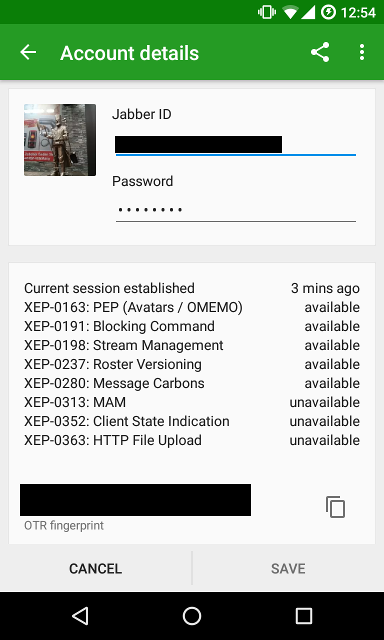
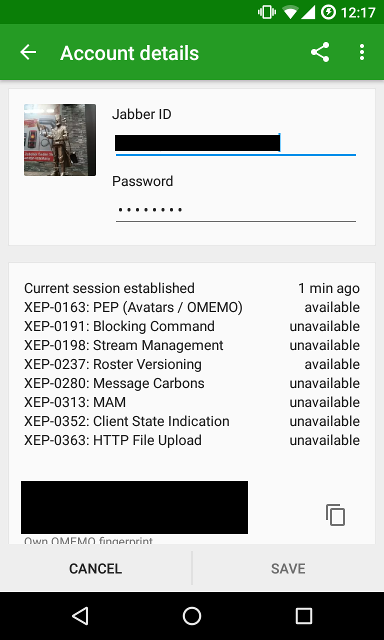
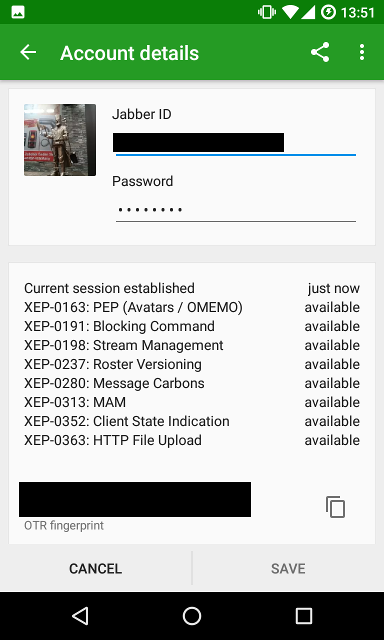
Conversations is a really nice, actively developed, up to date XMPP client for Android that has the nice feature of telling you what XEPs are supported by the server one is using: Initial server features Some days ago, me and Valhalla played the game of trying to see what happens when one turns them all on: I would send her screenshots from my Conversations, and she would poke at her Prosody to try and turn things on: After some work Valhalla eventually managed to get all features activated, purely using packages from Jessie+Backports: All features activated The result was a chat system in which I could see the same conversation history on my phone and on my laptop (with gajim)(https://gajim.org/), and have it synced even after a device has been offline, We could send each other rich media like photos, and could do OMEMO encryption (same as Signal) in group chats. I now have an XMPP setup which has all the features of the recent fancy chat systems, and on top of that it runs, client and server, on Free Software, which can be audited, it is federated and I can self-host my own server in my own VPS if I want to, with packages supported in Debian. Valhalla has documented the whole procedure. If you make a client for a protocol with lots of extension, do like Conversations and implement a status page with the features you'd like to have on the server, and little green indicators showing which are available: it is quite a good motivator for getting them all supported.

Dirk Eddelbuettel: nanotime 0.1.0: Now on Windows

Last month, we released nanotime, a package to work with nanosecond timestamps. See the initial release announcement for some background material and a few first examples. nanotime relies on the RcppCCTZ package for high(er) resolution time parsing and formatting: R itself stops a little short of a microsecond. And it uses the bit64 package for the actual arithmetic: time at this granularity is commonly represented at (integer) increments (at nanosecond resolution) relative to an offset, for which the standard epoch of Januar 1, 1970 is used. int64 types are a perfect match here, and bit64 gives us an integer64. Naysayers will point out some technical limitations with R's S3 classes, but it works pretty much as needed here. The one thing we did not have was Windows support. RcppCCTZ and the CCTZ library it uses need real C++11 support, and the g++-4.9 compiler used on Windows falls a little short lacking inter alia a suitable std::get_time() implementation. Enter Dan Dillon who ported this from LLVM's libc++ which lead to Sunday's RcppCCTZ 0.2.0 release. And now we have all our ducks in a row: everything works on Windows too. The next paragraph summarizes the changes for both this release as well as the initial one last month:

Changes in version 0.1.0 (2017-01-10)
  • Added Windows support thanks to expanded RcppCCTZ (closes #6)
  • Added "mocked up" demo with nanosecond delay networking analysis
  • Added 'fmt' and 'tz' options to output functions, expanded format.nanotime (closing #2 and #3)
  • Added data.frame support
  • Expanded tests

Changes in version 0.0.1 (2016-12-15)
  • Initial CRAN upload.
  • Package is functional and provides examples.

We also have a diff to the previous version thanks to CRANberries. More details and examples are at the nanotime page; code, issue tickets etc at the GitHub repository.

This post by Dirk Eddelbuettel originated on his Thinking inside the box blog. Please report excessive re-aggregation in third-party for-profit settings.

10 January 2017

B lint R czey: Debian Developer Game of the Year

I have just finished level one, fixing all RC bugs in packages under my name, even in team-maintained ones.  Next level is no unclassified bug reports, which gonna be harder since I have just adopted shadow with 70+ open bugs. :-\ Luckily I can still go on bonus tracks which is fixing (RC) bugs in others packages, but one should not spend all the time on those track before finishing level 1! PS: Last time I tried playing a conventional game I ended up fixing it in a few minutes instead.

Next.

Previous.