Search Results: freedom

24 September 2009

Christine Spang: FSF Women in Free Software Mini Summit

I was one of the participants invited to the FSF's Women in Free Software mini-summit which happened on the same day as Software Freedom Day this year. That was this past Saturday, September 19th. I was feeling hesitant going in, given the controversy over "why would the FSF run a closed event about such an important topic" and just a general burnt out feeling about the subject on my part. Honestly, I've tended to avoid being much of a feminist in the past and simply hope that people will stop bickering and leave me to my code, especially in the aftermath following well-publicised incidents. This is despite the fact that the thing that got me involved with free software originally was Debian Women, back in late 2004/early 2005. I needed a hook, and yet I haven't felt confident enough to reach out to others now that I'm in. I see now that there are valid reasons for having an event that is purposefully small. We all fit in a nice conference room at the FSF office, the atmosphere was very intimate, we got to learn everyone's names (and even remember them). I met some great local free software people who I hadn't met before. Food was take out from My Thai, an excellent vegan restaurant in Boston's Chinatown. While it sucks to be exclusive, in my opinion the small size really had an effect on what we got done and how we felt at the end. The official minutes from the meeting are online here, and there's a picture and brief blog post from Deborah here. The picture was taken using Cheese! I'm in the middle wearing my ever-popular Best Practical "my free software runs your company" t-shirt. There are only a few things I want to highlight myself.
  1. It was a great idea to invite someone who is involved in freedom movements but is not necessarily heavily involved in free software in particular. Hillary brought fresh insights and helped us draw parallels and come up with ideas that I don't think we would have thought of otherwise. It's easy to get used to parts of a community as being "normal" and I am so happy that we have allies who can show us where we've internalised or just have learned to ignore sexist parts of the community. Women in free software are already in free software and we need to learn to reach out to others who aren't in already.
  2. Cooperative power. There are groups of people that just aren't attracted by FOSS marketing that challenges you to "prove yourself the best" or similar. Just because someone doesn't like coding at 3am doesn't mean he doesn't like coding. If we want to succeed at our mission, we need to stop thinking win-lose and start thinking win-win. This applies to being more inclusive in general, not just for women. It also applies to valuing contributions from those who don't code. We need them too.
  3. There are times when I don't speak up and I should. There are times when I don't blog (or participate in discussions via other media) because I don't feel like dealing with potential community backlash. I am very careful about not stepping on peoples' toes, because I've seen other people get trampled on and am not particularly excited about experiencing that myself. While I'm trying to cultivate courage in myself, it was good to have a reminder that it's not just me.
The current plan is to hold a bigger event that is open to all in the spring. I am so excited about the momentum we are building! I think the biggest thing that I took out of this is that there are still things wrong with the community and that I shouldn't be afraid to speak up and be an activist. Watching people like Deborah and Hillary talk perfectly seriously about making very long-term plans and reaching parity was incredibly empowering. We can do so much better. The time to do it is now.

21 September 2009

René Mayorga: The Creative Commons Hot sauce

I Found this on a both of the SFD at San Jose Costa Rica,The Sauce was really good, but I actually was amused for the really good name(picante) and the funny design of the bottle. BTW, the recipe is license under CC-BY-SA picante The three photos taked by Daniel C spedes are here. UPDATE: The actual recipe is attached to the bottle, but here is a picture

20 September 2009

Clint Adams: Riddle

Why would all the presenters at a Software Freedom event be using MacOS X?

19 September 2009

Paul Wise: Delving into personal software freedom

Over on Planet Ubuntu there is a VRMS meme winding down. Usually I tend to think web log aggregator memes are an abomination, however, this one is a little more interesting, especially if Debian folk pick it up. It seems like many Planet Ubuntu posters require some non-free stuff, examples include; graphics and other drivers/firmware, Flash (Gnash/Swfdec aren't there yet), Sun Java (despite OpenJDK), RAR 3.0 archives, LHZ archives (despite jlha), Microsoft fonts (despite ttf-liberation), icon themes, ICC profiles, mind mapping, support for codec DLLs from Windows, VirtualBox drivers for Windows, the Opera web browser, games and other things. For Debian users, the popcon information pretty much confirms the above issues. Some other stuff Debian users use that isn't in Debian include; patented codecs, skype, acroread, the non-free version of VirtualBox and more. Next, lets get in on the getting your meme on part. On my Dell Inspiron 6400 laptop I have following Debian non-free/contrib stuff installed; firmware-iwlwifi, gcc-doc, gcc-doc-base, gcc-4.3-doc, autoconf-doc, gdb-doc, make-doc. On my OpenMoko FreeRunner phone I have nothing installed from Debian non-free/contrib. My wireless router and ADSL modem don't run Debian. The wireless router is a MIPS-based Netgear WGR614L (that is marketed as supporting DD-WRT, OpenWRT and Tomato) so I could conceivably install OpenWRT etc or Debian on it, but I haven't gotten around to that yet. The ADSL modem is a MIPS-based Siemens SpeedStream 4200, but it looks like that would require a significant amount of effort to get running FLOSS. Lets ponder my laptop freeness a bit more. The docs are all FSF-free, but not DFSG-free. It appears they are not DFSG-free because the FSF will not allow 28 words of FSF/GNU advertising to be removed (I'm not sure if Debian or the FSF is more pedantic). I'm not aware of any DFSG-free alternatives to them and I don't particularly care about the restrictions. My wireless card is an Intel 3945ABG mini PCI card that requires the kernel to upload the iwlwifi firmware before it works. Intel refuse to release firmware source code under a free license, citing FCC requirements. I'm not aware of any free firmware (or firmware reverse engineering efforts) for this device so the only alternative is to use wired Ethernet or buy another wireless card. Ethernet wires everywhere would be very inconvenient, so I've been thinking about trying to replace the card or laptop as soon as I am able. Since Atheros has released GPLv2 firmware for its AR9170 802.11n USB chipset I'll probably get something released by Atheros. I wonder why the FCC didn't prevent Atheros from releasing modifiable firmware, perhaps Intel will change their position too. So, what other software is on my laptop apart from Debian? Lets see, nothing on the HD apart from GRUB 2, /boot containing a Linux image/initrd from Debian and the LUKS partition containing swap and the Debian ext3 rootfs. Coreboot laptop support seems to be in the very early stages so I have no alternative to the supplied Dell BIOS at the moment. There is also the CPU microcode and other firmware installed in the various devices on the system, at least the HD, Ethernet, Bluetooth, GPU, DVD drive etc. have some kind of firmware in them. Some of this firmware is updatable using software from the Dell Linux repositories. Lets ponder my phone freeness a bit more. On it I have two copies of the u-boot bootloader (one in the protected NOR flash), u-boot is free. The NAND flash has an old Qt Extended Improved (QTEI) install that I need to copy stuff off and wipe. I also have a 4GB microSD card containing QTEI, Debian, FDOM and SHR. Now that QtMoko has brought QTEI to Debian packages I can probably ditch the QTEI install. I read that OM2009 is being merged into SHR so I can get rid of FDOM. That leaves SHR and Debian/QtMoko (nothing non-free). IIRC SHR does contain some firmware for devices that the OpenMoko FreeRunner doesn't contain, but that will get removed as Linux upstream moves more and more of that into linux-firmware.git. Nothing more on the main flash or microSD storage, so what else? The OpenMoko contains lots of hardware, but the main problematic devices here are the AR6000 Wi-Fi chip and the TI Calypso GSM device. The AR6000 is an issue because the firmware embedded in the chip is non-free and FullMAC so it is hard to add new features like AP mode or improve the connection quality/etc. In addition the firmware currently on the device is a development version of a 2.0 version (1.x was apparently broken) and further development does not seem to be happening yet. Since Atheros GPLed the AR9170 firmware I idly wonder if they could be convinced to release the source and GPL the AR6000 firmware. Perhaps a life-size gold statue of RMS would help there. The GSM device is problematic because of various bugs in the firmware. It apparently is an ARM chip with Nucleos, so perhaps uCLinux or something could be ported to it or written for it. There has been at least one discussion about hacking the GSM firmware (thar be dragons). Searching for some keywords extracted from the end of the first mail in that thread lead to some interesting results indeed. Lets ponder my network freeness a bit more. I should allocate some time to investigate putting Debian on my wireless router and ADSL modem. These generally just work except the ADSL modem reboots itself a lot during the summer. The just-works status of these devices means that messing with them is problematic in case I brick them (luckily I have a spare for the ADSL modem though). I presume OpenWRT and similar have replacements for all the software on my wireless router, drivers may be an issue though. I use gmail for reading email lists, mainly because of intertia, cheapness and because the interface has no GUI FLOSS peers yet (sup-mail exists for console use). TangoGPS, OpenStreetMap and other tools are slowly replacing my use of Google Maps, although I imagine routing will remain an issue for many years yet. One of the tech groups I'm involved in uses Plesk as a hosting control panel, mainly out of intertia, I'm not familiar with any FLOSS replacement though. Some of the upstream FLOSS projects I'm involved with use sourceforge as a hosting platform. There is a certain level of lock-in with SF.net, most of the data is easily exportable though. Lets ponder my software freeness in comparison to Planet Ubuntu posters. I have no freeness issues with drivers at the moment, however firmware seems likely to have freeness issues for a long time to come. I've avoided the need for the Adobe Flash Player by using swfdec and clive for downloading videos for some sites. swfdec works OK for some sites, some that I care about where it doesn't work and clive cannot download video include Vimeo, abc.net.au and sbs.com.au. For Vimeo you can download raw video if you have a login, but I do not, bugmenot is unreliable and Vimeo doesn't seem to be accepting new registrations. SBS I watch on television and ABC I get no reception so I just don't watch it. Java isn't an issue now that OpenJDK exists. I sometimes need to extract RAR 3.0 archives, which I do by copying the files to a friend's Windows machine or using a RAR extractor website. There is no free implementation of a RAR 3.0 extractor yet. I seem to remember that there is source code for a non-free extractor so presumably a clean-room documentation and reimplementation effort could fix this. I don't encounter LHZ files, but jlha-utils is available for if I do. I feel no need to install Microsoft fonts since the Liberation fonts and DejaVu meet my general font needs and Debian contains fonts covering all the scripts of Unicode (except for about half the huge amount of Han characters). In my music collection, only the Voxware audio codec and DigiTrakker MDL files are not supported by Rhythmbox, but I don't really miss those few tracks. I rarely have audio/video codec issues with video from the Internet. I don't have a use for Opera. Thanks in part to the efforts of the Debian games team, games from Debian main (such as warzone2100) satisfy my gaming needs. I just don't use Skype. Overall, I'm generally happy with my level of software freedom. My main strategy for preventing regressions in my software freedom is to just avoid doing things that require non-free software. The most problematic FLOSS issues for me are Flash support (adoption of the HTML5 video tag will resolve this for me), RAR 3.0 support and firmware. Please feel free to contact me with any comments or questions. Happy Software Freedom Day everyone!

16 September 2009

Benjamin Mako Hill: Ubuntu Books

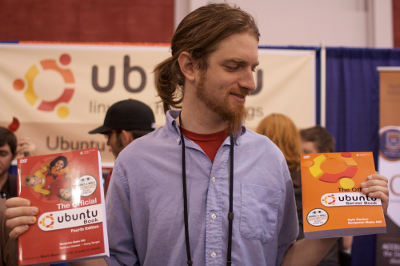
/copyrighteous/images/ubuntu_books_2009.png As I am attempting to focus on writing projects that are more scholarly and academic on the one hand (i.e., work for my day job at MIT) and more geared toward communicating free software principles toward wider audiences on the other (e.g., Revealing Errors), I have little choice but to back away from technical writing. However, this last month has seen the culmination of a bunch of work that I've done previously: two book projects that have been ongoing for the last couple years or more have finally hit the shelves! The first is the fourth edition (!) of the bestselling Official Ubuntu Book. Much to my happiness, the book continues to do extremely well and continues to receive solid reviews. This edition brings the book up to date for Jaunty/9.04 and adds a few pieces here and there. Although I was less active in this update than I have been in the past, Corey Burger continued his great work and Matthew Helmke of Ubuntu Forums fame stepped up to take a leading role. As I plan to retreat into a more purely advisory role for the next edition of this book, I'm thrilled to know that the project will remain in such capable hands. I'm also thrilled that this edition of the book, like all previous editions, is released as a free cultural work under CC BY-SA For years, I have heard people say that although they like the Official Ubuntu Book, it was a little too focused on desktops and on beginners for their tastes. The newly released Official Ubuntu Server Book is designed to address those concerns by providing an expanded guide to more "advanced" topics and is targeted at system administrators trying to get to know Ubuntu. Kyle Rankin planned and produced most of this book but I was thrilled to help poke it in places, chime in during the planning process, and to contribute a few chapters. Kyle is a knowledgeable sysadmin and has done wonderful job with the book. I only wish I could take more credit. The publisher has promised me that, at the very least, my chapters will be distributed under CC BY-SA. Many barriers to the adoption of free software are technical and a good book can, and often does, make a big difference. I enjoy being able to help address that problem. I also truly enjoy technical writing. I find it satisfying to share something I know well with others and it is great to know that I've helped someone with their problems. I'll assure I'll be able to do things here and there, I'll miss technical writing as I attempt "cut back."

Benjamin Mako Hill: Election Season

Two organizations I care deeply about are having elections this month. The first is the Wikimedia Foundation who is electing three community representatives to their board of directors. The second is Ubuntu who will soon be electing a new Community Council. The Wikimedia Foundation is perhaps the most important organization working on issues related to free culture. Wikimedia elections are currently ongoing and will close on August 10th. Editors who have more than 600 edits to their name across all Wikimedia wikis and 50 edits in 2009 made before July 1st are eligible to vote. The vast majority of eligible contributors to Wikimedia projects have not voted in previous elections. Ubuntu will be electing all members in a new --- larger --- Community Council. I have been a member of the council since it was created and I will be standing for election once again --- the last time I plan to do so. Work in setting up the election is being finalized and all Ubuntu Members will be able to vote in the election. Both Wikimedia and Ubuntu are struggling to find the right relationship between the communities who produce most of the value at the heart of their projects and the organizations and leadership structures that try to support and, from time to time, direct it. Ubuntu and Wikimedia are very different. What's at state at these elections is different too. But both elections are are extremely important and at pivotal times in their communities' growth. Both elections will have an important impact on the process of creating new organizational forms. My message in regards to both elections is also the same: If you are eligible to vote, please do. No governance system I've seen has as healthy and close relationship to the community it serves as it should. Wikimedia and Ubuntu are not exceptions. The result is a strange, and unhealthy, relationship between governance systems and the organizations at the heart of our community-driven projects and the communities themselves. We can all do better. There are not enough opportunities for community members to help push this balance in a better direction. These elections are one. I urge everyone who can to vote and to become involved.

9 September 2009

Francois Marier: Twitter tracking clicks to external sites

Lately, while using the Twitter web interface with Javascript turned on, I've been redirected to a Privoxy error page whenever I click on an external link:
Request for blocked URL

Your request for http://twitter.com/link_click_count?url=http%3A%2F%2Fexample.com&linkType=web&tweetId=1234567890&userId=12345678&authenticity_token=f5920ebf56bfa111c54bb9f86814cafa76de00fa was blocked.

Block reason: Path matches generic block pattern.
Looking a little closer at the blocked URL, I noticed that for every external link you click, Twitter logs the destination URL, the originating tweet and your user ID.

So what can you do to opt out of this tracking?
Disable JavascriptThis is by far the easiest solution. You can simply install an extension like Noscript and use Twitter with Javascript turned off. That's what I do most of the time since the website is mostly usable without it.

A very fortunate side-effect of using Twitter without Javascript is that you can avoid a number of the worms which propagate through that service from time to time.
Use Privoxy to disable the link counterFor those times when I have to enable Javascript on the site, I use Privoxy, a great privacy-enhancing web proxy, to alter the Javascript code executed when clicking on external links. This effectively disables the extra tracking and takes me directly to the intended URL.

First of all, make sure you have this line in your /etc/privoxy/config:
filterfile user.filter
then, add this filter to /etc/privoxy/user.filter:
FILTER: twitter-link-count Disable the Twitter link tracker
s@twttr\.countClick=function@twttr.dsbldCountClick=function@Uig
and finally turn this filter on for the affected URLs (/etc/privoxy/user.action):
  +force-text-mode +filter twitter-link-count   
.twimg.com/.*/javascripts/twitter.js
Switch to IdenticaIf you want to avoid similar privacy problems in the future, you can also switch to an Open platform which respects your basic freedoms.

The main contestant in this space is Identica. It's a great alternative to Twitter and has a lot of interesting features (like groups and XMPP integration) which are not yet available on Twitter.

The StatusNet developers have kindly released their source code under the AGPL and their goal is to build the most open micro-blogging system out there.

So go over there now and claim your username!

4 June 2009

MJ Ray: Elect MEPs for Freedom Now

Hi! I ve been away, but as you might have seen from identi.ca, I m back but busy. You may remember from posts such as Reject the Term Extension Directive and Improved Telecom Package Passed by EuroParl that MEPs can influence FOSS laws in many ways, because a lot of our copyright and patent laws are international now. Last time around, I compiled euroVote: copyright and patents but I ve not had time this year. Thankfully, others have summarised them. Mote Prime: Technology: Letter to MEPs on Software Patents Legislation summarises positions on the old swpat chestnut. European Parliament elections, the Green Party and free stuff By tom introduces the Green position. VOTE 2009: Spot the difference Lib Dem shocked and angered special: The Bristol Blogger shows me getting annoyed with the LibDems. If you re in the UK, you can look up your MEPs on the ORG EU Elections Site which looks pretty accurate to me. Anywhere in Europe, you can try to find some MEPs on the Free Software Pact country listing.

31 May 2009

Ana Beatriz Guerrero Lopez: The freedom to choose

John, no need to be so alarmist, this is KDE, look at the options: Okular settings

John Goerzen: Free Software enforcing DRM?!

So I just recently switched to KDE 4 (still using it with xmonad, of course) and I just now ran into my first really big annoyance. I just downloaded a PDF, and tried to copy and paste a bit of text from it. I used the selection tool, and Okular (KDE s document viewer) offered to speak it to me, but said Copy forbidden by DRM. pdftotext was able to convert the entire file to text format in an instant. Why are people intentionally adding code to KDE to remove my freedom? This is crazy and nuts. Nobody should be doing this, least of all in Free Software!

23 May 2009

Ben Armstrong: Bits from the Eee PC team, Spring 2009

Lenny well supported We re pleased that Lenny released with good support for the Eee PC and are now turning our efforts to make Squeeze even better, while continuing to provide support for our Lenny user base. The standard Lenny installer can install Debian on all models of Eee and our custom installer provides the ability to install over wireless for almost every model (more about this later) from a very small image. The latter continues to be our recommended install method, since in addition to being wireless-ready, the custom installer also handles a few other small eee-specific configuration chores to make as much as possible just work right after the install. Solid mainstream support We ve made good on our promise to make Debian work on the Eee PC, not a derivative, many of which use a custom kernel instead of the stock kernel as we do and use a special desktop instead of our users favourites. While we agree that some intriguing things can be done in these areas, it is no substitute for mainstream support. Our users are better served by a solid foundation than specialised modifications that limit their choices. We want them to be able to enjoy the freedom to mold Debian, the universal OS, into whatever suits them best. Squeeze support started Work is well underway on supporting all Eee models in Squeeze. For months, several team members have been experimenting with new kernels, producing support for them in eeepc-acpi-scripts. The current release of this key package (version 1.1.0) supports Linux 2.6.29 and contains enhancements for wifi, sound hotkeys, bluetooth, external displays and OSD. Squeeze will support wired & wifi on all current models With the appearance of 2.6.29 in Sid, all ethernet and wifi cards used in all models of Eee today are supportable without the need for out-of-kernel or non-free drivers. Madwifi is replaced by the free ath5k driver, the non-free rt2860 package is replaced by mainstream kernel support, (though it still requires non-free firmware provided separately,) rtl8187se is included, making it possible now for us to support the model 701SD, and ath9k is included, making full support for newer models such as the 1000HE possible. Lenny backports and live demo All of these changes can be enjoyed today by Lenny users. Just add Daniel Baumann s Lenny kernel backport repository and then install the 2.6.29 kernel and an updated acpid. See our upgrade howto for details. You can try a small (less than 256M) demo of this configuration by downloading beta 2 of our Live USB image. Accessibility Late last year, we discussed how to make it easier for the blind to install Debian unassisted on their Eee PCs. As it was a simple change, we now include brltty in the custom installer, but we understand that some users also need software synthesized text-to-speech, something for which there is no support yet in the standard Debian-installer. We understand this isn t an easy thing to fix, but hope someone will rise to the challenge. Growing team of developers We welcome Darren Salt and Raphael Geissert to the team this year. Both have been actively making contributions to the eeepc-acpi-scripts package over the past months, fixing some outstanding bugs and readying it to handle changes in more recent kernel releases. Moved eeepc.debian.net to new hosting Nico Golde, who hosted eeepc.debian.net for the first year development, has turned his focus to other areas of Debian. Glenn Saberton has stepped in to provide a new home for it. We thank them both for their efforts and for a smooth, uneventful transition from one host to the other. Size of user community Speaking of the move, earlier this year, Glenn shared with us some interesting archive traffic statistics that give us a rough idea how many users we have. For the months of December and January, after factoring out bot hits, we were seeing about 300,000 hits from 15,000 unique users per month. The site handles roughly 60G of traffic per month, most of that from thousands of downloads of our custom installer image. It s hard to draw any firm conclusions about the size of our user base from these stats, as many users may be on dynamic IP numbers, inflating the numbers, but we can conservatively say we have at least 5000 users. Other interesting statistics are that we have anywhere up to 80 users at any given time on our irc channel and over 250 users on the mailing list. Help wanted The Asus Eee PC line continues to expand, with 24 models listed so far. It is a challenge to keep up support for all of them. We re encouraged to see Asus choose a new b/g/n wifi chipset for their 1002HA that is supported by a DFSG free driver ath9k in this case. It appears that the new Atom N280-based 1000HE uses the same chipset as well (though be careful: I know of at least one user who bought a 1000HE in Argentina expecting it to have this chipset and was disappointed to find it had the Ralink chipset instead, we guess because of availability). If this trend continues, we ll be that much closer to our goal of full support for Squeeze main. As it stands, we re already as close as we can get given the state of rt2860 and no prospect on the horizon for replacing the non-free firmware. If you would like to help us out in any way, whether by testing, debugging, patching, or improving our documentation, get in touch with our team. We rely on your feedback to keep Lenny in good shape and work towards making Squeeze even better for all users of Debian on the Eee PC.

19 May 2009

Neil Williams: libqof2

It's taken a lot longer than I expected (mostly due to getting other things done in Emdebian etc.) but now that Lenny is out, QOF can finally drop all the previously deprecated code and move to libqof2, so the upstream code has now been released via Alioth (0.8.0) and the binaries have been uploaded to Debian and are waiting in NEW.

QOF provides a set of C language utilities for performing generic structured complex queries on a set of data held by a set of C/C++ objects. This framework allows programmers to add query support to their applications without having to hook into a SQL Database. QOF is a large part of my attempts to get some degree of data freedom to complement the source code freedom. This remains a problem with certain applications, especially financial ones, so I've tried to make it easier to both import and export data between programs using QOF and to convert the default QOF data storage formats into other common formats using simple tools and scripts based on XSL or perl. Having a SQL-type query interface accessible via the command line is a huge bonus when dealing with large data sets.

There is a patch for gnotime that makes the final adjustments to handling the removed code. pilot-qof and gpe-expenses already build cleanly without the deprecated code but each of these is also pending a new upstream release, so rather than need a binNMU, I'm simply going to make those releases when QOF clears NEW.

Having said that, pilot-qof and gpe-expenses introduce new binary packages themselves so they will spend time in NEW too. pilot-qof will be the last of the set to be released because the new upstream version can use symbols from the new gpe-expenses release to make it easier to move data between applications. However, that support is optional at build time and could be done via a Debian revision, so I might do it that way.

This also marks the completion of the migration of QOF from SourceForge to Alioth - principally for easier bug tracking and a usable mailing list archive. The QOF VCS is in svn.debian.org.

The mailing list for QOF development is therefore at alioth:
QOF-devel and archives also.

I'm still working on two other QOF-based utilities - one that can handle simple accounts and one to handle simple invoices. The invoice handling is already partially implemented in pilot-qof but I'm looking at a GTK+ frontend with a robust command line interface so that scripts can update the invoice data behind-the-scenes. Hopefully, some form of arbitrary-format parser can be arranged that can handle extracting data from whatever form the client happens to send - typically PDF. It'll need tweaking for each client, but it could work. The objects used by gpe-expenses and pilot-qof (including invoices) are exposed via QOF and can be mixed together in any new QOF application, easily able to read data from multiple sources, merge data sets, query data sets and export into other formats. The core currency and expense types come from pilot-link but are then enhanced to support GnuCash conventions.

For information on another QOF application called "estron" - an idea for a data-driven query interface - see http://estron.alioth.debian.org/. Problem 1 with estron: the examples all rely on postgres and I just can't get that to setup properly as either a test system or as a Debian package. Problem 2: estron was intended to be an interpreter that could be written "in itself" but whilst this is possible for the simpler examples, doing more complicated stuff like calculating values from other values makes the estron XML very obtuse. The current codebase uses GOB2 to

QOF is now stable and I don't expect to need another SONAME bump for quite a while. If anyone is interested in taking on estron or helping with the Cash and/or Invoice frontends, let me know. The problem with estron currently is bitrot - the GTK+ frontend has too many gtk1.2 hangovers which now fail to build.

7 May 2009

Ian Wienand: Quickly describing hash utilisation

I think the most correct way to describe utilisation of a hash-table is using chi-squared distributions and hypothesis and degrees of freedom and a bunch of other things nobody but an actuary remembers. So I was looking for a quick method that was close-enough but didn't require digging out a statistics text-book. I'm sure I've re-invented some well-known measurement, but I'm not sure what it is. The idea is to add up the total steps required to look-up all elements in the hash-table, and compare that to the theoretical ideal of a uniformly balanced hash-table. You can then get a ratio that tells you if you're in the ball-park, or if you should try something else. A diagram should suffice. Scheme for acquiring a hash-utilisation ratio This seems to give quite useful results with a bare minimum of effort, and most importantly no tricky floating point math. For example, on the standard Unix words with a 2048 entry hash-table, the standard DJB hash came out very well (as expected)
Ideal 2408448
Actual 2473833
----
Ratio 0.973569
To contrast, a simple "add each character" type hash:
Ideal 2408448
Actual 6367489
----
Ratio 0.378241
Example code is hash-ratio.py. I expect this measurement is most useful when you have a largely static bunch of data for which you are attempting to choose an appropriate hash-function. I guess if you are really trying to hash more or less random incoming data and hence only have a random sample to work with, you can't avoid doing the "real" statistics.

22 April 2009

Gunnar Wolf: Rodrigo denying evasions and religion

Umh, is today the quote your neighbour day? No? Thought so... Still, for the second time in a couple of minutes, I'm quoting/translating here. This time, I'm quoting a short text posted by fellow Mexican Debian guy Rodrigo Gallardo: Deceptions (hmm... Not in the let you down sense, but in the deceiving sense. Sometimes it is hard to translate a single word without twisting it around). My translation is far from perfect - Read it in Spanish, you will enjoy it more. Rodrigo says:
Things and actions are what they are, and the consequences of them will be what they will be; why then should we desire to be deceived? Joseph Butler
I was in Colima, sitting on a slide in a city park, that day I understood why somebody might want to be drunk. Several years later, this time in Tlalpan, I understood why somebody would want to believe in a god. And sometimes I am truly sorry not to be able to embrace neither of both longings. The idea of letting go the facts, to believe they have an inner order, although covered in mistery, or they are just far away, blurry. But where others see destiny, I see things falling naturally in their place. Where others see beauty in the mistery, I see a challenge. And even more beauty in an elegant explanation, in understanding. Motivation, not in the promise of future welfare but in the certainty of this limited but tangible present welfare. Freedom in the absence of a purpose, and inmortality in the little pebble I am in the great human building. I suppose that if Revernd Butler knew his phrase inspired this divagation, it would not make him precisely happy. But, things are what they are, and his argument says what it says.

21 April 2009

Romain Beauxis: Liquidsoap now supports AAC+ encoding.

The plot Following many user requests , we were considering adding this format to the list of supported encoders. As for mp3 encoding, this support was subject to some legal issues. These issues were indeed the initial motivation for implementing icecast2 using the patent-free ogg codecs and container for streaming data. However, it seems that many users and net-radios are still asking for these formats. There can be several motivations for that, among which I can list the following major ones:
  • These formats are supported by more players and, in particular, embedded devices, which are the main target for net-radios
  • For the case of AAC+, the codec supports a very good audio quality for low bandwidths, such as 64 and 32kb/s.

The philosophy There is a constant complain from the open source communities about the use of patent-encumbered formats. In particular, those formats are not allowed in the Wikimedia commons and the corresponding encoders, in particular mp3 encoders, are not supported by for instance the Debian distribution. In a similar intent to push for a wider usage of patent-free codecs, the icecast project reimplemented its streaming server in order to use the ogg container and codecs. All these actions are very important. In particular, the support for ogg/theora video files in firefox, and hopefully the major HTML 5 browser is mainly the result of wikipedia refusing other video formats. Indeed, wikipedia is now a major website, and it would be insane to not support the videos there. However, I for myself do not like when these actions become too restrictive to the user. For this matter, I personally prefer freedom of choice among other considerations. Also, as a matter of fact, when trying to change the situation about these issues, one has to take into account the relative importance of each actor. It is because wikipedia is already huge that it has managed to change the things. Hence, in the case of net-radios, a majority of potential users are asking for AAC+ and other patent-encumbered formats. Although this is not the ideal situation we would like to see, there comes a point were either the free-software projects have something to propose, or the users will just go for a proprietary software, which is even worse to the situation. For this purpose, I believed it was important to add such support into our software. However, as you will see later, we do not implement ourself the encoding algorithm, but only added support for external encoders. That way, we simply let the user choose what he wants to use, but remain a patent-free and open-source software.

The implementation Since mp3 was, and still is, the major target for net-radios, icecast2 still has the possibility to stream this format. In fact, this format, as well as AAC+, does not have headers, such that it is possible to decode a stream at any point in it. Hence, in this case, icecast only acts as a proxy, and the only constraint is to send it the encoded data at real rate. Hence, the main library for streaming to icecast, libshout, parses the audio data that it receives, and schedules the streaming according to real rate. Additionally, it also supports a raw mechanism, for which there would be not such mangling. In the case of liquidsoap, we did not need this feature of the libshout since the software is already working in real time. Furthermore, the source connection protocol provides a content-type header field, which allows icecast to display the correct mime for the data format that is streamed. All in all, in order to send AAC+ data to icecast, one needs to send the correct mime-type in the source connection headers, and then send audio data at the correct rate. However, the libshout did not allow to set an arbitrary content-type header. Hence, I proposed a patch. It was proposed for an inclusion into main code, since I believe it is interesting not only for our specific need, but also for any other generic data format support. Although the patch was accepted, it was never committed. So, we decided to go on: since liquidsoap need not the real rate mangling feature of the libhsout, and since the source protocol is mainly a basic HTTP, we decided it was worth a custom implementation. This implementation was quite easy, thanks to the powerful capabilities of the OCaml language, and resulted in a custom implementation, ocaml-cry, that does the same as libshout, except that it does not control the rate of the data flow sent to the icecast server. Then, we also needed to support encoding data to the AAC format. After looking at the only available open-source encoder, aacplusenc, I tried to propose some changes in order to export a library and be able to use it in liquidsoap. However, these propositions did not make it into upstream's code, so I decided to also move on and use directly the encoder binary. Hence, using only the good old unix standard input/output mechanism, it is possible to start an encoder as a child process, send it the raw PCM data to its standard input and read the encoded data from its standard output. This lead to the development of the external output operators, which include output.icecast.external. Although this implementation was not easy, it now appears to work quite well in the current SVN version. In particular, the encoder process exits correctly for the FLAC encoder, which is needed in order to stream correctly, since the ogg container needs a restart for every track. Hence, we also gained support for encoding to the FLAC audio format, which was not binded for OCaml (yet ?) because its callback-driven API makes it tricky to do. Additionally, the support for external processes as encoders allows to use the lame binary for encoding mp3 data. Hence, liquidsoap can now encode mp3 data without the need of a built-in support for it. And, as always, the idea of using external processes spread over several other operators, including the support for external file and stream decoders, enabling support for many audio format (in fact almost all supported in linux, using mplayer). In conclusion, liquidsoap now has a fairly good support for AAC+ audio streaming, as well as a many new formats for decoding files and streams. It also support arbitrary formats and encoders using a custom variant of the output.icecast.external. Hence, provided your format can be decoded from any point in the stream, you should be able to use liquidsoap to stream data to icecast as soon as you have a binary which is able to receive RAW or WAV PCM data to its standard input and send encoded data to its standard output. As an illustration, here is an implementation of the output.icecast.aacplusenc:
def output.icecast.aacplusenc(
~id="output.icecast.aacplusenc",
~start=true,
~restart=true,
~restart_delay=3,
~host="localhost",
~port=8000,
~user="source",
~password="hackme",
~genre="Misc",
~url="http://savonet.sf.net/",
~description="OCaml Radio!",
~public=true,
~dumpfile="",
~mount="Use [name]",
~name="Use [mount]",
~protocol="http",
~aacplusenc="aacplusenc",
~bitrate=64,
~restart_on_crash=false,
~restart_on_new_track=false,
~restart_encoder_delay=3600,
~headers=[],
s)
# Metadata update is set by ICY with icecast
def aacplusenc_p(m)
"# aacplusenc - - # bitrate "
end
output.icecast.external(id=id,
process=aacplusenc_p,
bitrate=bitrate,
start=start,
restart=restart,
restart_delay=restart_delay,
host=host,
port=port,
user=user,
password=password,
genre=genre,
url=url,
description=description,
public=public,
dumpfile=dumpfile,
name=name,
mount=mount,
protocol=protocol,
header=true,
restart_on_crash=restart_on_crash,
restart_on_new_track=restart_on_new_track,
headers=headers,
restart_encoder_delay=restart_encoder_delay,
format="audio/aacp",
s)
end

19 April 2009

Biella Coleman: Paris in June (and better with hackers)

/tmp/lab announces the second Hacker Space Festival
(Paris, 26-30 June 2009) Hacker Space Festival 2009 Call For Proposals HSF2009 In 2008, we organized HSF[1] on the spot, as an ad-hoc meeting for
hackerspaces-related networks, technical and artistic research emerging
from them and social questionning arising from them. This sudden
experiment proved to be a huge success, as much as on the
self-organizing level as on the participants and meetings quality, as
well as the emotionally-charged ambient, the kind of which you make
fond memories. The 2008 edition generated a strong emulation in France, from its
historical role as the first official hack meeting there, and in Europe
with the subsequent creation of the Hacker Space Brussels[2], the
rapprochement with The Fiber in Amsterdam and the hackerspaces.org[3]
network. Initiatives of hackerspace openings in Grenoble or Lille, or
the upcoming FrHack[4] conference show an actual enthusiasm in the
French hackers community that was doomed to the underground not so
long ago. We salute these initiatives and their diversity! Soon enough, we wanted to reiterate the HSF experience : however, it
was out of the question to institutionalize this temporary autonomous
zone, nor make it an ersatz of the previous edition, nor even to wrap
it into an elite or underground aura. On the opposite, we ardently
desire; and especially to explore further, in all directions some
lesser known domains (see below) et foster meeting and sharing around
experiences at the confluence of art, technology and politics. The world financial crisis, the decay of democracy in Europe, the
obscurantism, paranoia and lack of culture presiding over legislation
(Internet and Reaction Err Creation Law[5][6]) seem a fertile
environment for the sensible development of new (social ) life forms.
Quick! Let s rest for a few days in jubilation and ecstasy to take a
deep breathe of freedom under the indelicate smells of the medicine
factory nearby! For if the public space is shrinking to oblivion, where any side-step
becomes suspect, and that, from an early age (deviant behavior
detection in nursery school), where moving without a mobile phone
becomes suspect (hello you Julien Coupat[7], a French political
prisoner in France!), there s a domain that the Leviathan would have a
lot of trouble to contain, and for a reason: that of sensitivity. Even
the desperate attempts of the State to block the free and premonitory
expression of sense (hello you Demeure du Chaos![8]) cannot do anything
against a loud laughter or a knowing glance, a sensual kiss or an
explosion of colors. Sensitivity, we could say, is what is left to a human being when she
has nothing anymore, and differenciates her from the body corporate or
the institution, that are, in essence, devoid of it. Therefore, Art
definitely remains the public space to share between humans, and only
between us. And if it the last one to share, we propose to explore it
and take it over during the upcoming edition of the Hacker Space
Festival, from the 26th to 30th of June, 2009 at Vitry sur Seine[9]. ========================================================================
Keynote Speakers: Sergey Grim and Larry Fake with Eric Schmoudt
Groogle Summer of Crode, Survivor style
VLC, I vote against you because you really fucked up when ========================================================================
== W A N T E D ========================================================= Focus on solutions rather than problems. * The Final (Hardware) Frontier: Open FPGA Cores, Reverse Engineering
* Designer Religions and Creative Beliefs Systems
* WiFiDoors & WiFi System-on-Chip controllers firmware hacking,
infection & backdooring
* Telecom Core Network Equipment Reverse Engineering: MSC, STP,
Switches,
* Algebraic Attacks and Modern Cryptography Attacks
* Autonomous, Parasitic and Viral Drones
* Enhanced or Infected Reality Swarms
* Auto-Builders / Self-Fabrication
* Embedded OS breakins stories & recipes
* Actualization rather than mere concepts
* FPGA & ASIC hacking / backdooring
* Cloud+Privacy+Open Source: O Brave New World?
* Explosion-Proof clothing
* Radio Appz & Hackz: Mesh @ RF Layer 1-3
* Database & Privacy
* Problematic & Ethical Open Source/Content Licenses
* Institutional Relationships: Lobbying or Licking?
* Non Lethal Protection (anti-taser vests?)
* Survival in the Age of the Ministry of Immigration and National
Identity
* Mental asylum improvised visit
* Open Source Legacy Media(TM) Production Solutions (TV, Radio, Press,
DRM)
* Gas Sensors & Environmental Benchmarking
* Building Hackerspaces Without Money
* Milsatcomm hacking: Military satellites shots, broken birds in the
sky
* Other research topics on security and insecurity
* Academics and Hackers
* Organics and Fermentation
* Clean Food in Tainted Environment
* Low Impact Energy & Recycling
* Media Sandwich: layers of crap makes good food?
* Deconstructing Carla Sarkozy
* Knitting DIY Factory (jazzy, eh?)
* Signs of life among industrial wasteland
* Hallucinogenic & Computing: Can you Code on Acid?
* Mesh Networking (Wireless BattleMesh Royal!)
* Legal Sabotage: When Democracy Needs You And anything that does not fit. ========================================================================
== P R O P O S E ======================================================= Send you contributions to HSF2009-CFP@lists.tmplab.org + Type of the proposal: 1. conference (45min. presentation + 10min. for questions)
2. workshop / demo (30min. 2 heures)
3. installation / performance (music, plastic, sound, video) Lightning talks can be proposed and organized until the last moment,
according to available space and schedule, in the form of BarCamps or
Blitz Conferences. + Required Information: * Title of the presentation
* Type (see above)
* Language : French or English
* Name of speaker(s)
* Affiliation (organization / company)
* Short biography
* Abstract (5 to 10 lines)
* Topics / Keywords
* Includes a demo? YES NO
* Release during the festival? YES NO
* Internet connection required? YES NO + Acceptable Formats * Open Document
* PDF
* Plain Text
* RTF + Agenda * beginning of proposals : now
* end of proposals : 01 May 2009
* selection notification : 07 May 2009
* publication of program : 15 May 2009 + Evaluation criteria for proposals: 1. Innovating Topic
2. Open Technology
3. Demonstration / Live Act
4. DIY Reproducibility
5. Fun Potential The Programming Committee resembles that of last year
See : http://hackerspace.net/committee ========================================================================
== V E N U E =========================================================== /tmp/lab
6 Bis rue Leon Geffroy
94400 Vitry sur Seine
France http://hackerspace.net/directions ========================================================================
== P A R T I C I P A T E =============================================== Email : http://lists.tmplab.org/listinfo.cgi/hsf2009-talk-tmplab.org
CFPmail: HSF2009-CFP@lists.tmplab.org
IRC : irc://irc.freenode.net/frlab
Jabber : xmpp:hsf2009@space.cepheide.org?join
Wiki : http://hackerspace.net/hsf2009 ========================================================================
== L I N K S =========================================================== The CFP is available online at http://hackerspace.net/cfp [1] http://hackerspace.net/hsf2008
[2] http://hsb.wikidot.com/
[3] http://hackerspaces.org/
[4] http://www.frhack.org/
[5] http://jaimelesautistes.fr/
[6] http://laquadrature.net/
[7] http://fr.wikipedia.org/wiki/Julien_Coupat
[8] http://www.demeureduchaos.org/
[9] http://hackerspace.net/
Philippe Langlois
Email: philippelanglois@free.fr
PGP Key: 8DAEE244


14 April 2009

Biella Coleman: Paris in June (and better with hackers)

========================================================================
/tmp/lab announces the second Hacker Space Festival
(Paris, 26-30 June 2009)
======================================================================== Hacker Space Festival 2009 Call For Proposals HSF2009 In 2008, we organized HSF[1] on the spot, as an ad-hoc meeting for
hackerspaces-related networks, technical and artistic research emerging
from them and social questionning arising from them. This sudden
experiment proved to be a huge success, as much as on the
self-organizing level as on the participants and meetings quality, as
well as the emotionally-charged ambient, the kind of which you make
fond memories. The 2008 edition generated a strong emulation in France, from its
historical role as the first official hack meeting there, and in Europe
with the subsequent creation of the Hacker Space Brussels[2], the
rapprochement with The Fiber in Amsterdam and the hackerspaces.org[3]
network. Initiatives of hackerspace openings in Grenoble or Lille, or
the upcoming FrHack[4] conference show an actual enthusiasm in the
French hackers community that was doomed to the underground not so
long ago. We salute these initiatives and their diversity! Soon enough, we wanted to reiterate the HSF experience : however, it
was out of the question to institutionalize this temporary autonomous
zone, nor make it an ersatz of the previous edition, nor even to wrap
it into an elite or underground aura. On the opposite, we ardently
desire; and especially to explore further, in all directions some
lesser known domains (see below) et foster meeting and sharing around
experiences at the confluence of art, technology and politics. The world financial crisis, the decay of democracy in Europe, the
obscurantism, paranoia and lack of culture presiding over legislation
(Internet and Reaction Err Creation Law[5][6]) seem a fertile
environment for the sensible development of new (social ) life forms.
Quick! Let s rest for a few days in jubilation and ecstasy to take a
deep breathe of freedom under the indelicate smells of the medicine
factory nearby! For if the public space is shrinking to oblivion, where any side-step
becomes suspect, and that, from an early age (deviant behavior
detection in nursery school), where moving without a mobile phone
becomes suspect (hello you Julien Coupat[7], a French political
prisoner in France!), there s a domain that the Leviathan would have a
lot of trouble to contain, and for a reason: that of sensitivity. Even
the desperate attempts of the State to block the free and premonitory
expression of sense (hello you Demeure du Chaos![8]) cannot do anything
against a loud laughter or a knowing glance, a sensual kiss or an
explosion of colors. Sensitivity, we could say, is what is left to a human being when she
has nothing anymore, and differenciates her from the body corporate or
the institution, that are, in essence, devoid of it. Therefore, Art
definitely remains the public space to share between humans, and only
between us. And if it the last one to share, we propose to explore it
and take it over during the upcoming edition of the Hacker Space
Festival, from the 26th to 30th of June, 2009 at Vitry sur Seine[9]. ========================================================================
Keynote Speakers: Sergey Grim and Larry Fake with Eric Schmoudt
Groogle Summer of Crode, Survivor style
VLC, I vote against you because you really fucked up when ========================================================================
== W A N T E D ========================================================= Focus on solutions rather than problems. * The Final (Hardware) Frontier: Open FPGA Cores, Reverse Engineering
* Designer Religions and Creative Beliefs Systems
* WiFiDoors & WiFi System-on-Chip controllers firmware hacking,
infection & backdooring
* Telecom Core Network Equipment Reverse Engineering: MSC, STP,
Switches,
* Algebraic Attacks and Modern Cryptography Attacks
* Autonomous, Parasitic and Viral Drones
* Enhanced or Infected Reality Swarms
* Auto-Builders / Self-Fabrication
* Embedded OS breakins stories & recipes
* Actualization rather than mere concepts
* FPGA & ASIC hacking / backdooring
* Cloud+Privacy+Open Source: O Brave New World?
* Explosion-Proof clothing
* Radio Appz & Hackz: Mesh @ RF Layer 1-3
* Database & Privacy
* Problematic & Ethical Open Source/Content Licenses
* Institutional Relationships: Lobbying or Licking?
* Non Lethal Protection (anti-taser vests?)
* Survival in the Age of the Ministry of Immigration and National
Identity
* Mental asylum improvised visit
* Open Source Legacy Media(TM) Production Solutions (TV, Radio, Press,
DRM)
* Gas Sensors & Environmental Benchmarking
* Building Hackerspaces Without Money
* Milsatcomm hacking: Military satellites shots, broken birds in the
sky
* Other research topics on security and insecurity
* Academics and Hackers
* Organics and Fermentation
* Clean Food in Tainted Environment
* Low Impact Energy & Recycling
* Media Sandwich: layers of crap makes good food?
* Deconstructing Carla Sarkozy
* Knitting DIY Factory (jazzy, eh?)
* Signs of life among industrial wasteland
* Hallucinogenic & Computing: Can you Code on Acid?
* Mesh Networking (Wireless BattleMesh Royal!)
* Legal Sabotage: When Democracy Needs You And anything that does not fit. ========================================================================
== P R O P O S E ======================================================= Send you contributions to HSF2009-CFP@lists.tmplab.org + Type of the proposal: 1. conference (45min. presentation + 10min. for questions)
2. workshop / demo (30min. 2 heures)
3. installation / performance (music, plastic, sound, video) Lightning talks can be proposed and organized until the last moment,
according to available space and schedule, in the form of BarCamps or
Blitz Conferences. + Required Information: * Title of the presentation
* Type (see above)
* Language : French or English
* Name of speaker(s)
* Affiliation (organization / company)
* Short biography
* Abstract (5 to 10 lines)
* Topics / Keywords
* Includes a demo? YES NO
* Release during the festival? YES NO
* Internet connection required? YES NO + Acceptable Formats * Open Document
* PDF
* Plain Text
* RTF + Agenda * beginning of proposals : now
* end of proposals : 01 May 2009
* selection notification : 07 May 2009
* publication of program : 15 May 2009 + Evaluation criteria for proposals: 1. Innovating Topic
2. Open Technology
3. Demonstration / Live Act
4. DIY Reproducibility
5. Fun Potential The Programming Committee resembles that of last year
See : http://hackerspace.net/committee ========================================================================
== V E N U E =========================================================== /tmp/lab
6 Bis rue Leon Geffroy
94400 Vitry sur Seine
France http://hackerspace.net/directions ========================================================================
== P A R T I C I P A T E =============================================== Email : http://lists.tmplab.org/listinfo.cgi/hsf2009-talk-tmplab.org
CFPmail: HSF2009-CFP@lists.tmplab.org
IRC : irc://irc.freenode.net/frlab
Jabber : xmpp:hsf2009@space.cepheide.org?join
Wiki : http://hackerspace.net/hsf2009 ========================================================================
== L I N K S =========================================================== The CFP is available online at http://hackerspace.net/cfp [1] http://hackerspace.net/hsf2008
[2] http://hsb.wikidot.com/
[3] http://hackerspaces.org/
[4] http://www.frhack.org/
[5] http://jaimelesautistes.fr/
[6] http://laquadrature.net/
[7] http://fr.wikipedia.org/wiki/Julien_Coupat
[8] http://www.demeureduchaos.org/
[9] http://hackerspace.net/
Philippe Langlois
Email: philippelanglois@free.fr
PGP Key: 8DAEE244

11 April 2009

Benjamin Mako Hill: American Gothic and the Free Culture Imperative

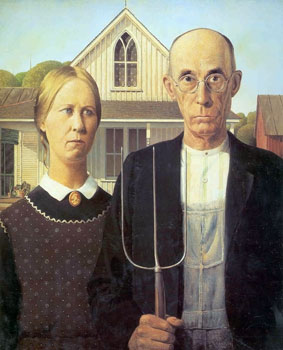
About a year ago, I read American Gothic by Steven Biel and the book has left a surprising lasting impression on me. The book describes the background, history, and life of "American Gothic: America's most famous painting" by Grant Wood. Even if you don't recognize the name "American Gothic", you are likely to recognize the picture or the scene. The book is a serious and -- as far as I can tell -- reasonably comprehensive treatment of the subject that is interesting, insightful at points, and a breeze to read. Thumbnail of the American Gothic Painting Of course, the book is not actually about the painting that hangs in the Art Institute of Chicago -- although it will certainly teach you more than you probably ever wanted to know about that painting, its subjects, its settings, etc. The book is really the story of how that paining has been received, understood, and used. Nearly half of the book focuses on examples of people who have remixed, reworked, reimagined, and reproduced the painting in myriad forms, formats, settings, and ways. The book contains scores of photographs of celebrities posing in American Gothic style settings, dozens of political cartoons based on the paintings, images of talk shows, magazine covers, Broadway plays, product advertisements, toys, gifts, kitch, and more, done up in recognizeable representations of the basic American Gothic form. There is a very incomplete of references to American Gothic in popular culture at Wikipedia that can give a tiny taste of what is out there. The last chapter of the book is devoted to these "parodies" and there's some brief talk of issues around copyright and control of the image. Wood's sister Nan was the owner of the copyright for much of the second half of the twentieth century and is also the woman in the painting. She famously charged several makers of more lurid take-offs with defamation and successfully blocked a number of remixes. In 1988, Nan transferred ownership to the Visual Artists and Galleries Association (VAGA) which will hold the copyright until 2025. VAGA also claims "rights of publicity" in Nan's image which will last until 2060. VAGA takes a very expansive view of its copyright claims and argues that it has both veto power and royalty rights to any recognizably similar work. For example, VAGA does not want the American Gothic image used in alcohol advertisements and has successfully had such ads pulled. Biel's book contains no reference to the amount of money made from licensing the work but one can only conclude that it must be massive. VAGA blocked a plan by Iowa to use the picture on the back of the Iowa state quarter due to licensing disagreements; instead Iowa used a different Wood painting that was clearly in the public domain. What struck me most about Biel's book is related to just how deeply ingrained in American culture the American Gothic image has become. The book cites simple surveys that show that almost every American recognizes the painting (although only a small fraction know the painting's name or who painted it). The thousands of parodies that the book documents are testament to the fact that the painting has become a way of representing something essential about American culture and its values. But in a strange way, the painting's popularity and incessant reuse has also made it part of the culture that it so effectively captured. We can think of culture as a set of shared values and references that help us related to each other and to communicate. Just like idioms in language, culture helps us communicate more effectively, certainly, but also lets us communicate messages that would not be communicable otherwise. When Out Magazine, Coors, or any of several dozen others replace the figures in American Gothic with a gay or lesbian couple, they are succinctly sending a message about homosexual relationships and American traditional values that could not be made any other way. In this way, American Gothic -- both the painting and Biel's book -- represent a strong argument for free culture. If American Society has infused American Gothic with so much value, how can it be fair to let one person or organization own it? Are they not owning an essential mode through which a society can relate, experience, and communicate? I can't help but conclude that it shouldn't matter if VAGA does not like alcohol, advertisements, homosexuality, or wants to make a some money every time someone makes a cartoon parody. These are trivial concerns next to the importance of our society's need to communicate about these issues. If doing so requires the use of a shared cultural reference in VAGA's painting, I find it hard to justify VAGA's position of control. We need to be able to reproduce and reimagine American Gothic because it has become part of us. It's a striking example of the way that art becomes culture and the reason that truly free culture is the only appropriate response. We can't afford to let our experience of the world and each other -- to let ourselves at a very fundamental level -- be owned and controlled.

7 April 2009

Clint Adams: Too bad that part is single-threaded

As far as I am aware (and I am unanimous in this), ZOMG is the only released software that can scrobble tracks to both libre.fm and last.fm near-simultaneously.

5 April 2009

Vincent Fourmond: HADOPI: a great blow to freedom of expression and justice in France

Here I am, utterly disgusted. Last Thursday, around 11pm, two dozens of members of Assembl e Nationale (one of the two parliament chambers in France) voted the infamous law nicknamed HADOPI. Great... For the record, this chamber in principle counts 577 members. This law is an awful blow to the Internet, the freedom of expression and the legal system in France. The official aim of this law is to put a stop to illegal file-sharing within France. With this law, specially appointed private companies will file accusations saying: this IP downloaded something illegal at this date to a central authority, and this authority will send two warnings before cutting the Internet connection of the alleged illegal downloader for up to a year. You will notice that there is no mention of what the incriminated person allegedly downloaded. There will be no possibility of appeal until the sanction is executed. This scares the hell out of me. This spits upon so many aspects of the French legal system that it is honestly impressive... What about the French principle that says that everyone is innocent until proven guilty ? Here, you are declared guilty based on a rather weak evidence (on IP address !), and you'll have to prove your innocence. What about the principle that there needs to be a fair trial before the execution of the sanction ? You'll have to prove you are innocent after the execution, with the additional fun that it will turn almost impossible to prove it. Not to mention the fact that the companies harvesting IP addresses of alleged offenders will have a great deal of access to data you're exchanging; what about privacy ? For the record, this privilege, violating the way justice works in France, had only ever be granted to anti-terrorist cells. The fun thing is that this law is useless, at least in terms of the its official goal: the day it comes into application, illegal file sharers will encrypt their exchanges or fake their IP addresses, or do whatever else they might want to do to guarantee their anonymity, and no company will ever be able to find out what it is they exchange. I won't even mention the number of false positive of these automatic accusations: many innocent French web surfers will have their connection cut without ever knowing why and without any possibility to fight back. So, what is the real goal ? Or what will be the use ? I can only speculate, of course, but it is tempting to think that this law could be used to regulate what is being expressed from France on the web. Someone is saying disturbing things ? Well, easy to shut him/her up: either fake downloads from his/her IP address or bribe a company into filing false accusations, and you'll effectively remove his/her connection while having the opportunity to further discredit the person by publicly disclosing that he/she is such a pirate that their connection was cut... Sounds neat, doesn't it ? In my childhood, teachers kept on saying that France is the country of human rights, but I can't help thinking this is less and less the case[1]. Well. That was a long rant. But I can't keep it inside: this is touching me too much. I'll add that I'm not downloading anything, and I don't have anything a priori against laws which would tend to regulate illegal file sharing. I just don't think that the (small) profits of a few justify spitting upon the freedom and the elementary rights of all people living in France. Further information, in French, can be found there. The full text of the project can be found on the website of Assembl e Nationale. [1] Please don't get me wrong. There are many countries where life is definitely more difficult than here, and where human rights are constantly scorned upon, which is fortunately not the case here yet.

Next.

Previous.