Search Results: "tim"

4 July 2025

Sahil Dhiman: Secondary Authoritative Name Server Options for Self-Hosted Domains

In the past few months, I have moved authoritative name servers (NS) of two of my domains (sahilister.net and sahil.rocks) in house using PowerDNS. Subdomains of sahilister.net see roughly 320,000 hits/day across my IN and DE mirror nodes, so adding secondary name servers with good availability (in addition to my own) servers was one of my first priorities. I explored the following options for my secondary NS, which also didn t cost me anything:

1984 Hosting

Hurriance Electric

Afraid.org

Puck

NS-Global

Asking friends Two of my friends and fellow mirror hosts have their own authoritative name server setup, Shrirang (ie albony) and Luke. Shirang gave me another POP in IN and through Luke (who does have an insane amount of in-house NS, see dig ns jing.rocks +short), I added a JP POP. If we know each other, I would be glad to host a secondary NS for you in (IN and/or DE locations).

Some notes
  • Adding a third-party secondary is putting trust that the third party would serve your zone right.
  • Hurricane Electric and 1984 hosting provide multiple NS. One can use some or all of them. Ideally, you can get away with just using your own with full set from any of these two. Play around with adding and removing secondaries, which gives you the best results. . Using everyone is anyhow overkill, unless you have specific reasons for it.
  • Moving NS in-house isn t that hard. Though, be prepared to get it wrong a few times (and some more). I have already faced partial outages because:
    • Recursive resolvers (RR) in the wild behave in a weird way and cache the wrong NS response for longer time than in TTL.
    • NS expiry took more than time. 2 out of 3 of my Netim s NS (my domain registrar) had stopped serving my domain, while RRs in the wild hadn t picked up my new in-house NS. I couldn t really do anything about it, though.
    • Dot is pretty important at the end.
    • With HE.net, I forgot to delegate my domain on their panel and just added in my NS set, thinking I ve already done so (which I did but for another domain), leading to a lame server situation.
  • In terms of serving traffic, there s no distinction between primary and secondary NS. RR don t really care who they re asking the query to. So one can have hidden primary too.
  • I initially thought of adding periodic RIPE Atlas measurements from the global set but thought against it as I already host a termux mirror, which brings in thousands of queries from around the world leading to a diverse set of RRs querying my domain already.
  • In most cases, query resolution time would increase with out of zone NS servers (which most likely would be in external secondary). 1 query vs. 2 queries. Pay close attention to ADDITIONAL SECTION Shrirang s case followed by mine:
$ dig ns albony.in
; <<>> DiG 9.18.36 <<>> ns albony.in
;; global options: +cmd
;; Got answer:
;; ->>HEADER<<- opcode: QUERY, status: NOERROR, id: 60525
;; flags: qr rd ra; QUERY: 1, ANSWER: 4, AUTHORITY: 0, ADDITIONAL: 9
;; OPT PSEUDOSECTION:
; EDNS: version: 0, flags:; udp: 65494
;; QUESTION SECTION:
;albony.in.			IN	NS
;; ANSWER SECTION:
albony.in.		1049	IN	NS	ns3.albony.in.
albony.in.		1049	IN	NS	ns4.albony.in.
albony.in.		1049	IN	NS	ns2.albony.in.
albony.in.		1049	IN	NS	ns1.albony.in.
;; ADDITIONAL SECTION:
ns3.albony.in.		1049	IN	AAAA	2a14:3f87:f002:7::a
ns1.albony.in.		1049	IN	A	82.180.145.196
ns2.albony.in.		1049	IN	AAAA	2403:44c0:1:4::2
ns4.albony.in.		1049	IN	A	45.64.190.62
ns2.albony.in.		1049	IN	A	103.77.111.150
ns1.albony.in.		1049	IN	AAAA	2400:d321:2191:8363::1
ns3.albony.in.		1049	IN	A	45.90.187.14
ns4.albony.in.		1049	IN	AAAA	2402:c4c0:1:10::2
;; Query time: 29 msec
;; SERVER: 127.0.0.53#53(127.0.0.53) (UDP)
;; WHEN: Fri Jul 04 07:57:01 IST 2025
;; MSG SIZE  rcvd: 286
vs mine
$ dig ns sahil.rocks
; <<>> DiG 9.18.36 <<>> ns sahil.rocks
;; global options: +cmd
;; Got answer:
;; ->>HEADER<<- opcode: QUERY, status: NOERROR, id: 64497
;; flags: qr rd ra; QUERY: 1, ANSWER: 11, AUTHORITY: 0, ADDITIONAL: 1
;; OPT PSEUDOSECTION:
; EDNS: version: 0, flags:; udp: 65494
;; QUESTION SECTION:
;sahil.rocks.			IN	NS
;; ANSWER SECTION:
sahil.rocks.		6385	IN	NS	ns5.he.net.
sahil.rocks.		6385	IN	NS	puck.nether.net.
sahil.rocks.		6385	IN	NS	colin.sahilister.net.
sahil.rocks.		6385	IN	NS	marvin.sahilister.net.
sahil.rocks.		6385	IN	NS	ns2.afraid.org.
sahil.rocks.		6385	IN	NS	ns4.he.net.
sahil.rocks.		6385	IN	NS	ns2.albony.in.
sahil.rocks.		6385	IN	NS	ns3.jing.rocks.
sahil.rocks.		6385	IN	NS	ns0.1984.is.
sahil.rocks.		6385	IN	NS	ns1.1984.is.
sahil.rocks.		6385	IN	NS	ns-global.kjsl.com.
;; Query time: 24 msec
;; SERVER: 127.0.0.53#53(127.0.0.53) (UDP)
;; WHEN: Fri Jul 04 07:57:20 IST 2025
;; MSG SIZE  rcvd: 313
  • Theoretically speaking, a small increase/decrease in resolution would occur based on the chosen TLD and the popularity of the TLD in query originators area (already cached vs. fresh recursion).
  • One can get away with having only 3 NS (or be like Google and have 4 anycast NS or like Amazon and have 8 or like Verisign and make it 13 :P).
  • Nowhere it s written, your NS needs not to be called dns* or ns1, ns2 etc. Get creative with naming NS; be deceptive with the naming :D.
  • A good understanding of RR behavior can help engineer a good authoritative NS system.

Further reading

Valhalla's Things: Emergency Camisole

Posted on July 4, 2025
Tags: madeof:atoms, craft:sewing, FreeSoftWear
A camisole of white linen fabric; the sides have two vertical strips of filet cotton lace, about 5 cm wide, the top of the front is finished with another lace with triangular points and the straps are made with another insertion lace, about 2 cm wide. And this is the time when one realizes that she only has one white camisole left. And it s summer, so I m wearing a lot of white shirts, and I always wear a white camisole under a white shirt (unless I m wearing a full chemise). Not a problem, I have a good pattern for a well fitting camisole that I ve done multiple times, I don t even need to take my measurements and draft things, I can get some white jersey from the stash and quickly make a few. From the stash. Where I have a roll of white jersey and one of off-white jersey. It s in the inventory. With the position field set to a place that no longer exists. uooops. But I have some leftover lightweight (woven) linen fabric. Surely if I cut the pattern as is with 2 cm of allowance and then sew it with just 1 cm of allowance it will work even in a woven fabric, right? Wrong. I mean, it would have probably fit, but it was too tight to squeeze into, and would require adding maybe a button closure to the front. feasible, but not something I wanted. But that s nothing that can t be solved with the Power of Insertion Lace, right? One dig through the Lace Stash1 and some frantic zig-zag sewing later, I had a tube wide enough for me to squiggle in, with lace on the sides not because it was the easiest place for me to put it, but because it was the right place for it to preserve my modesty, of course. Encouraged by this, I added a bit of lace to the front, for the look of it, and used some more insertion lace for the straps, instead of making them out of fabric. And, it looks like it can work. I plan to wear it tonight, so that I can find out whether there is something that chafes or anything, but from a quick test it feels reasonable. a detail of the side of the camisole, showing the full pattern of the filet lace (alternating Xs and Os), the narrow hem on the back (done with an hemming foot) and the fact that the finishing isn't very neat (but should be stable enough for long term use). At bust level it s now a bit too wide, and it gapes a bit under the arms, but I don t think that it s going to cause significant problems, and (other than everybody on the internet) nobody is going to see it, so it s not a big deal. I still have some linen, but I don t think I m going to make another one with the same pattern: maybe I ll try to do something with a front opening, but I ll see later on, also after I ve been looking for the missing jersey in a few more potential places. As for now, the number of white camisoles I have has doubled, and this is progress enough for today.

  1. with many thanks to my mother s friend who gave me quite a bit of vintage cotton lace.

3 July 2025

Matthias Geiger: Using the debputy language server in Debian (with neovim)

Since some time now debputy is available in the archive. It is a declarative buildsystem for debian packages, but also includes a Language Server (LS) part. A LS is a binary can hook into any client (editor) supporting the LSP (Language Server Protocol) and deliver syntax highlighting, completions, warnings and

Russell Coker: The Fuss About AI

There are many negative articles about AI (which is not about actual Artificial Intelligence also known as AGI ). Which I think are mostly overblown and often ridiculous. Resource Usage Complaints about resource usage are common, training Llama 3.1 could apparently produce as much pollution as 10,000 round trips by car between Los Angeles and New York City . That s not great but when you compare to the actual number of people doing such drives in the US and the number of people taking commercial flights on that route it doesn t seem like such a big deal. Apparently commercial passenger jets cause CO2 emissions per passenger about equal to a car with 2 people. Why is it relevant whether pollution comes from running servers, driving cars, or steel mills? Why not just tax polluters for the damage they do and let the market sort it out? People in the US make a big deal about not being communist, so why not have a capitalist solution, make it more expensive to do undesirable things and let the market sort it out? ML systems are a less bad use of compute resources than Bitcoin, at least ML systems give some useful results while Bitcoin has nothing good going for it. The Dot-Com Comparison People often complain about the apparent impossibility of AI companies doing what investors think they will do. But this isn t anything new, that all happened before with the dot com boom . I m not the first person to make this comparison, The Daily WTF (a high quality site about IT mistakes) has an interesting article making this comparison [1]. But my conclusions are quite different. The result of that was a lot of Internet companies going bankrupt, the investors in those companies losing money, and other companies then bought up their assets and made profitable companies. The cheap Internet we now have was built on the hardware from bankrupt companies which was sold for far less than the manufacture price. That allowed it to scale up from modem speeds to ADSL without the users paying enough to cover the purchase of the infrastructure. In the early 2000s I worked for two major Dutch ISPs that went bankrupt (not my fault) and one of them continued operations in the identical manner after having the stock price go to zero (I didn t get to witness what happened with the other one). As far as I m aware random Dutch citizens and residents didn t suffer from this and employees just got jobs elsewhere. There are good things being done with ML systems and when companies like OpenAI go bankrupt other companies will buy the hardware and do good things. NVidia isn t ever going to have the future sales that would justify a market capitalisation of almost 4 Trillion US dollars. This market cap can support paying for new research and purchasing rights to patented technology in a similar way to the high stock price of Google supported buying YouTube, DoubleClick, and Motorola Mobility which are the keys to Google s profits now. The Real Upsides of ML Until recently I worked for a company that used ML systems to analyse drivers for signs of fatigue, distraction, or other inappropriate things (smoking which is illegal in China, using a mobile phone, etc). That work was directly aimed at saving human lives with a significant secondary aim of saving wear on vehicles (in the mining industry drowsy drivers damage truck tires and that s a huge business expense). There are many applications of ML in medical research such as recognising cancer cells in tissue samples. There are many less important uses for ML systems, such as recognising different types of pastries to correctly bill bakery customers technology that was apparently repurposed for recognising cancer cells. The ability to recognise objects in photos is useful. It can be used for people who want to learn about random objects they see and could be used for helping young children learn about their environment. It also has some potential for assistance for visually impaired people, it wouldn t be good for safety critical systems (don t cross a road because a ML system says there are no cars coming) but could be useful for identifying objects (is this a lemon or a lime). The Humane AI pin had some real potential to do good things but there wasn t a suitable business model [2], I think that someone will develop similar technology in a useful way eventually. Even without trying to do what the Humane AI Pin attempted, there are many ways for ML based systems to assist phone and PC use. ML systems allow analysing large quantities of data and giving information that may be correct. When used by a human who knows how to recognise good answers this can be an efficient way of solving problems. I personally have solved many computer problems with the help of LLM systems while skipping over many results that were obviously wrong to me. I believe that any expert in any field that is covered in the LLM input data could find some benefits from getting suggestions from an LLM. It won t necessarily allow them to solve problems that they couldn t solve without it but it can provide them with a set of obviously wrong answers mixed in with some useful tips about where to look for the right answers. Jobs and Politics Noema Magazine has an insightful article about how AI can allow different models of work which can enlarge the middle class [3]. I don t think it s reasonable to expect ML systems to make as much impact on society as the industrial revolution, and the agricultural revolutions which took society from more than 90% farm workers to less than 5%. That doesn t mean everything will be fine but it is something that can seem OK after the changes have happened. I m not saying apart from the death and destruction everything will be good , the death and destruction are optional. Improvements in manufacturing and farming didn t have to involve poverty and death for many people, improvements to agriculture didn t have to involve overcrowding and death from disease. This was an issue of political decisions that were made. The Real Problems of ML Political decisions that are being made now have the aim of making the rich even richer and leaving more people in poverty and in many cases dying due to being unable to afford healthcare. The ML systems that aim to facilitate such things haven t been as successful as evil people have hoped but it will happen and we need appropriate legislation if we aren t going to have revolutions. There are documented cases of suicide being inspired by Chat GPT systems [4]. There have been people inspired towards murder by ChatGPT systems but AFAIK no-one has actually succeeded in such a crime yet. There are serious issues that need to be addressed with the technology and with legal constraints about how people may use it. It s interesting to consider the possible uses of ChatGPT systems for providing suggestions to a psychologist, maybe ChatGPT systems could be used to alleviate mental health problems. The cases of LLM systems being used for cheating on assignments etc isn t a real issue. People have been cheating on assignments since organised education was invented. There is a real problem of ML systems based on biased input data that issue decisions that are the average of the bigotry of the people who provided input. That isn t going to be worse than the current situation of bigoted humans making decisions based on hate and preconceptions but it will be more insidious. It is possible to search for that so for example a bank could test it s mortgage approval ML system by changing one factor at a time (name, gender, age, address, etc) and see if it changes the answer. If it turns out that the ML system is biased on names then the input data could have names removed. If it turns out to be biased about address then there could be weights put in to oppose that. For a long time there has been excessive trust in computers. Computers aren t magic they just do maths really fast and implement choices based on the work of programmers who have all the failings of other humans. Excessive trust in a rule based system is less risky than excessive trust in a ML system where no-one really knows why it makes the decisions it makes. Self driving cars kill people, this is the truth that Tesla stock holders don t want people to know. Companies that try to automate everything with AI are going to be in for some nasty surprises. Getting computers to do everything that humans do in any job is going to be a large portion of an actual intelligent computer which if it is achieved will raise an entirely different set of problems. I ve previously blogged about ML Security [5]. I don t think this will be any worse than all the other computer security problems in the long term, although it will be more insidious. How Will It Go? Companies spending billions of dollars without firm plans for how to make money are going to go bankrupt no matter what business they are in. Companies like Google and Microsoft can waste some billions of dollars on AI Chat systems and still keep going as successful businesses. Companies like OpenAI that do nothing other than such chat systems won t go well. But their assets can be used by new companies when sold at less than 10% the purchase price. Companies like NVidia that have high stock prices based on the supposed ongoing growth in use of their hardware will have their stock prices crash. But the new technology they develop will be used by other people for other purposes. If hospitals can get cheap diagnostic ML systems because of unreasonable investment into AI then that could be a win for humanity. Companies that bet their entire business on AI even when it s not necessarily their core business (as Tesla has done with self driving) will have their stock price crash dramatically at a minimum and have the possibility of bankruptcy. Having Tesla go bankrupt is definitely better than having people try to use them as self driving cars.

2 July 2025

Dirk Eddelbuettel: RcppArmadillo 14.6.0-1 on CRAN: New Upstream Minor Release

armadillo image Armadillo is a powerful and expressive C++ template library for linear algebra and scientific computing. It aims towards a good balance between speed and ease of use, has a syntax deliberately close to Matlab, and is useful for algorithm development directly in C++, or quick conversion of research code into production environments. RcppArmadillo integrates this library with the R environment and language and is widely used by (currently) 1241 other packages on CRAN, downloaded 40.4 million times (per the partial logs from the cloud mirrors of CRAN), and the CSDA paper (preprint / vignette) by Conrad and myself has been cited 634 times according to Google Scholar. Conrad released a minor version 4.6.0 yesterday which offers new accessors for non-finite values. And despite being in Beautiful British Columbia on vacation, I had wrapped up two rounds of reverse dependency checks preparing his 4.6.0 release, and shipped this to CRAN this morning where it passed with flying colours and no human intervention even with over 1200 reverse dependencies. The changes since the last CRAN release are summarised below.

Changes in RcppArmadillo version 14.6.0-1 (2025-07-02)
  • Upgraded to Armadillo release 14.6.0 (Caffe Mocha)
    • Added balance() to transform matrices so that column and row norms are roughly the same
    • Added omit_nan() and omit_nonfinite() to extract elements while omitting NaN and non-finite values
    • Added find_nonnan() for finding indices of non-NaN elements
    • Added standalone replace() function
  • The fastLm() help page now mentions that options to solve() can control its behavior.

Courtesy of my CRANberries, there is a diffstat report relative to previous release. More detailed information is on the RcppArmadillo page. Questions, comments etc should go to the rcpp-devel mailing list off the Rcpp R-Forge page.

This post by Dirk Eddelbuettel originated on his Thinking inside the box blog. If you like this or other open-source work I do, you can sponsor me at GitHub.

Dirk Eddelbuettel: Rcpp 1.1.0 on CRAN: C++11 now Minimum, Regular Semi-Annual Update

rcpp logo With a friendly Canadian hand wave from vacation in Beautiful British Columbia, and speaking on behalf of the Rcpp Core Team, I am excited to shared that the (regularly scheduled bi-annual) update to Rcpp just brought version 1.1.0 to CRAN. Debian builds haven been prepared and uploaded, Windows and macOS builds should appear at CRAN in the next few days, as will builds in different Linux distribution and of course r2u should catch up tomorrow as well. The key highlight of this release is the switch to C++11 as minimum standard. R itself did so in release 4.0.0 more than half a decade ago; if someone is really tied to an older version of R and an equally old compiler then using an older Rcpp with it has to be acceptable. Our own tests (using continuous integration at GitHub) still go back all the way to R 3.5.* and work fine (with a new-enough compiler). In the previous release post, we commented that we had only reverse dependency (falsely) come up in the tests by CRAN, this time there was none among the well over 3000 packages using Rcpp at CRAN. Which really is quite amazing, and possibly also a testament to our rigorous continued testing of our development and snapshot releases on the key branch. This release continues with the six-months January-July cycle started with release 1.0.5 in July 2020. As just mentioned, we do of course make interim snapshot dev or rc releases available. While we not longer regularly update the Rcpp drat repo, the r-universe page and repo now really fill this role admirably (and with many more builds besides just source). We continue to strongly encourage their use and testing I run my systems with these versions which tend to work just as well, and are of course also fully tested against all reverse-dependencies. Rcpp has long established itself as the most popular way of enhancing R with C or C++ code. Right now, 3038 packages on CRAN depend on Rcpp for making analytical code go faster and further. On CRAN, 13.6% of all packages depend (directly) on Rcpp, and 61.3% of all compiled packages do. From the cloud mirror of CRAN (which is but a subset of all CRAN downloads), Rcpp has been downloaded 100.8 million times. The two published papers (also included in the package as preprint vignettes) have, respectively, 2023 (JSS, 2011) and 380 (TAS, 2018) citations, while the the book (Springer useR!, 2013) has another 695. As mentioned, this release switches to C++11 as the minimum standard. The diffstat display in the CRANberries comparison to the previous release shows how several (generated) sources files with C++98 boilerplate have now been removed; we also flattened a number of if/else sections we no longer need to cater to older compilers (see below for details). We also managed more accommodation for the demands of tighter use of the C API of R by removing DATAPTR and CLOENV use. A number of other changes are detailed below. The full list below details all changes, their respective PRs and, if applicable, issue tickets. Big thanks from all of us to all contributors!

Changes in Rcpp release version 1.1.0 (2025-07-01)
  • Changes in Rcpp API:
    • C++11 is now the required minimal C++ standard
    • The std::string_view type is now covered by wrap() (Lev Kandel in #1356 as discussed in #1357)
    • A last remaining DATAPTR use has been converted to DATAPTR_RO (Dirk in #1359)
    • Under R 4.5.0 or later, R_ClosureEnv is used instead of CLOENV (Dirk in #1361 fixing #1360)
    • Use of lsInternal switched to lsInternal3 (Dirk in #1362)
    • Removed compiler detection macro in a header cleanup setting C++11 as the minunum (Dirk in #1364 closing #1363)
    • Variadic templates are now used onconditionally given C++11 (Dirk in #1367 closing #1366)
    • Remove RCPP_USING_CXX11 as a #define as C++11 is now a given (Dirk in #1369)
    • Additional cleanup for __cplusplus checks (I aki in #1371 fixing #1370)
    • Unordered set construction no longer needs a macro for the pre-C++11 case (I aki in #1372)
    • Lambdas are supported in a Rcpp Sugar functions (I aki in #1373)
    • The Date(time)Vector classes now have default ctor (Dirk in #1385 closing #1384)
    • Fixed an issue where Rcpp::Language would duplicate its arguments (Kevin in #1388, fixing #1386)
  • Changes in Rcpp Attributes:
    • The C++26 standard now has plugin support (Dirk in #1381 closing #1380)
  • Changes in Rcpp Documentation:
    • Several typos were correct in the NEWS file (Ben Bolker in #1354)
    • The Rcpp Libraries vignette mentions PACKAGE_types.h to declare types used in RcppExports.cpp (Dirk in #1355)
    • The vignettes bibliography file was updated to current package versions, and now uses doi references (Dirk in #1389)
  • Changes in Rcpp Deployment:
    • Rcpp.package.skeleton() creates URL and BugReports if given a GitHub username (Dirk in #1358)
    • R 4.4.* has been added to the CI matrix (Dirk in #1376)
    • Tests involving NA propagation are skipped under linux-arm64 as they are under macos-arm (Dirk in #1379 closing #1378)

Thanks to my CRANberries, you can also look at a diff to the previous release Questions, comments etc should go to the rcpp-devel mailing list off the R-Forge page. Bugs reports are welcome at the GitHub issue tracker as well (where one can also search among open or closed issues).

This post by Dirk Eddelbuettel originated on his Thinking inside the box blog. If you like this or other open-source work I do, you can sponsor me at GitHub.

1 July 2025

Guido G nther: Free Software Activities June 2025

Another short status update of what happened on my side last month. Phosh 0.48.0 is out with nice improvements, phosh.mobi e.V. is alive, helped a bit to get cellbroadcastd out, osk bugfixes and some more: See below for details on the above and more: phosh phoc phosh-mobile-settings stevia (formerly phosh-osk-stub) phosh-osk-data phosh-vala-plugins pfs xdg-desktop-portal-phosh xdg-desktop-portal phosh-debs meta-phosh feedbackd feedbackd-device-themes gmobile GNOME clocks Debian Mobian ModemManager libmbim libqmi mobile-broadband-provider-info Cellbroadcastd iio-sensor-proxy twenty-twenty-hugo gotosocial Reviews This is not code by me but reviews on other peoples code. The list is (as usual) slightly incomplete. Thanks for the contributions! Help Development If you want to support my work see donations. Comments? Join the Fediverse thread

30 June 2025

Colin Watson: Free software activity in June 2025

My Debian contributions this month were all sponsored by Freexian. This was a very light month; I did a few things that were easy or that seemed urgent for the upcoming trixie release, but otherwise most of my energy went into Debusine. I ll be giving a talk about that at DebConf in a couple of weeks; this is the first DebConf I ll have managed to make it to in over a decade, so I m pretty excited. You can also support my work directly via Liberapay or GitHub Sponsors. PuTTY After reading a bunch of recent discourse about X11 and Wayland, I decided to try switching my laptop (a Framework 13 AMD running Debian trixie with GNOME) over to Wayland. I don t remember why it was running X; I think I must have either inherited some configuration from my previous laptop (in which case it could have been due to anything up to ten years ago or so), or else I had some initial problem while setting up my new laptop and failed to make a note of it. Anyway, the switch was hardly noticeable, which was great. One problem I did notice is that my preferred terminal emulator, pterm, crashed after the upgrade. I run a slightly-modified version from git to make some small terminal emulation changes that I really must either get upstream or work out how to live without one of these days, so it took me a while to notice that it only crashed when running from the packaged version, because the crash was in code that only runs when pterm has a set-id bit. I reported this upstream, they quickly fixed it, and I backported it to the Debian package. groff Upstream bug #67169 reported URLs being dropped from PDF output in some cases. I investigated the history both upstream and in Debian, identified the correct upstream patch to backport, and uploaded a fix. libfido2 I upgraded libfido2 to 1.16.0 in experimental. Python team I upgraded pydantic-extra-types to a new upstream version, and fixed some resulting fallout in pendulum. I updated python-typing-extensions in bookworm-backports, to help fix python3-tango: python3-pytango from bookworm-backports does not work (10.0.2-1~bpo12+1). I upgraded twisted to a new upstream version in experimental. I fixed or helped to fix a few release-critical bugs:

Gunnar Wolf: Get your personalized map of DebConf25 in Brest

As I often do, this year I have also prepared a set of personalized maps for your OpenPGP keysigning in DebConf25, in Brest! What is that, dare you ask? Partial view of my OpenPGP map One of the not-to-be-missed traditions of DebConf is a Key-Signing Party (KSP) that spans the whole conference! Travelling from all the corners of the world to a single, large group gathering, we have the ideal opportunity to spread some communicable diseases trust on your peers identities and strengthen Debian s OpenPGP keyring. But whom should you approach for keysigning? Go find yourself in the nice listing I have prepared. By clicking on your long keyid (in my case, the link labeled 0x2404C9546E145360), anybody can download your certificate (public key + signatures). The SVG and PNG links will yield a graphic version of your position within the DC25 keyring, and the TXT link will give you a textual explanation of it. (of course, your links will differ, yada yada ) Please note this is still a preview of our KSP information: You will notice there are outstanding several things for me to fix before marking the file as final. First, some names have encoding issues I will fix. Second, some keys might be missing if you submitted your key as part of the conference registration form but it is not showing, it must be because my scripts didn t find it in any of the queried keyservers. My scripts are querying the following servers:
hkps://keyring.debian.org/
hkps://keys.openpgp.org/
hkps://keyserver.computer42.org/
hkps://keyserver.ubuntu.com/
hkps://pgp.mit.edu/
hkps://pgp.pm/
hkps://pgp.surf.nl/
hkps://pgpkeys.eu/
hkps://the.earth.li/
Make sure your key is available in at least some of them; I will try to do a further run on Friday, before travelling, or shortly after arriving to France. If you didn t submit your key in time, but you will be at DC25, please mail me stating [DC25 KSP] in your mail title, and I will manually add it to the list. On (hopefully!) Friday, I ll post the final, canonical KSP coordination page which you should download and calculate its SHA256-sum. We will have printed out convenience sheets to help you do your keysigning at the front desk.

Otto Kek l inen: Corporate best practices for upstream open source contributions

Featured image of post Corporate best practices for upstream open source contributions
This post is based on presentation given at the Validos annual members meeting on June 25th, 2025.
When I started getting into Linux and open source over 25 years ago, the majority of the software development in this area was done by academics and hobbyists. The number of companies participating in open source has since exploded in parallel with the growth of mobile and cloud software, the majority of which is built on top of open source. For example, Android powers most mobile phones today and is based on Linux. Almost all software used to operate large cloud provider data centers, such as AWS or Google, is either open source or made in-house by the cloud provider. Pretty much all companies, regardless of the industry, have been using open source software at least to some extent for years. However, the degree to which they collaborate with the upstream origins of the software varies. I encourage all companies in a technical industry to start contributing upstream. There are many benefits to having a good relationship with your upstream open source software vendors, both for the short term and especially for the long term. Moreover, with the rollout of CRA in EU in 2025-2027, the law will require software companies to contribute security fixes upstream to the open source projects their products use. To ensure the process is well managed, business-aligned and legally compliant, there are a few do s and don t do s that are important to be aware of.

Maintain your SBOMs For every piece of software, regardless of whether the code was done in-house, from an open source project, or a combination of these, every company needs to produce a Software Bill of Materials (SBOM). The SBOMs provide a standardized and interoperable way to track what software and which versions are used where, what software licenses apply, who holds the copyright of which component, which security fixes have been applied and so forth. A catalog of SBOMs, or equivalent, forms the backbone of software supply-chain management in corporations.

Identify your strategic upstream vendors The SBOMs are likely to reveal that for any piece of non-trivial software, there are hundreds or thousands of upstream open source projects in use. Few organizations have resources to contribute to all of their upstreams. If your organization is just starting to organize upstream contribution activities, identify the key projects that have the largest impact on your business and prioritize forming a relationship with them first. Organizations with a mature contribution process will be collaborating with tens or hundreds of upstreams.

Appoint an internal coordinator and champions Having a written policy on how to contribute upstream will help ensure a consistent process and avoid common pitfalls. However, a written policy alone does not automatically translate into a well-running process. It is highly recommended to appoint at least one internal coordinator who is knowledgeable about how open source communities work, how software licensing and patents work, and is senior enough to have a good sense of what business priorities to optimize for. In small organizations it can be a single person, while larger organizations typically have a full Open Source Programs Office. This coordinator should oversee the contribution process, track all contributions made across the organization, and further optimize the process by working with stakeholders across the business, including legal experts, business owners and CTOs. The marketing and recruiting folks should also be involved, as upstream contributions will have a reputation-building aspect as well, which can be enhanced with systematic tracking and publishing of activities. Additionally, at least in the beginning, the organization should also appoint key staff members as open source champions. Implementing a new process always includes some obstacles and occasional setbacks, which may discourage employees from putting in the extra effort to reap the full long-term benefits for the company. Having named champions will empower them to make the first few contributions themselves, setting a good example and encouraging and mentoring others to contribute upstream as well.

Avoid excessive approvals To maintain a high quality bar, it is always good to have all outgoing submissions reviewed by at least one or two people. Two or three pairs of eyeballs are significantly more likely to catch issues that might slip by someone working alone. The review also slows down the process by a day or two, which gives the author time to sleep on it , which usually helps to ensure the final submission is well-thought-out by the author. Do not require more than one or two reviewers. The marginal utility goes quickly to zero beyond a few reviewers, and at around four or five people the effect becomes negative, as the weight of each approval decreases and the reviewers begin to take less personal responsibility. Having too many people in the loop also makes each feedback round slow and expensive, to the extent that the author will hesitate to make updates and ask for re-reviews due to the costs involved. If the organization experiences setbacks due to mistakes slipping through the review process, do not respond by adding more reviewers, as it will just grind the contribution process to a halt. If there are quality concerns, invest in training for engineers, CI systems and perhaps an internal certification program for those making public upstream code submissions. A typical software engineer is more likely to seriously try to become proficient at their job and put effort into a one-off certification exam and then make multiple high-quality contributions, than it is for a low-skilled engineer to improve and even want to continue doing more upstream contributions if they are burdened by heavy review processes every time they try to submit an upstream contribution.

Don t expect upstream to accept all code contributions Sure, identifying the root cause of and fixing a tricky bug or writing a new feature requires significant effort. While an open source project will certainly appreciate the effort invested, it doesn t mean it will always welcome all contributions with open arms. Occasionally, the project won t agree that the code is correct or the feature is useful, and some contributions are bound to be rejected. You can minimize the chance of experiencing rejections by having a solid internal review process that includes assessing how the upstream community is likely to understand the proposal. Sometimes how things are communicated is more important than how they are coded. Polishing inline comments and git commit messages help ensure high-quality communication, along with a commitment to respond quickly to review feedback and conducting regular follow-ups until a contribution is finalized and accepted.

Start small to grow expertise and reputation In addition to keeping the open source contribution policy lean and nimble, it is also good to start practical contributions with small issues. Don t aim to contribute massive features until you have a track record of being able to make multiple small contributions. Keep in mind that not all open source projects are equal. Each has its own culture, written and unwritten rules, development process, documented requirements (which may be outdated) and more. Starting with a tiny contribution, even just a typo fix, is a good way to validate how code submissions, reviews and approvals work in a particular project. Once you have staff who have successfully landed smaller contributions, you can start planning larger proposals. The exact same proposal might be unsuccessful when proposed by a new person, and successful when proposed by a person who already has a reputation for prior high-quality work.

Embrace all and any publicity you get Some companies have concerns about their employees working in the open. Indeed, every email and code patch an employee submits, and all related discussions become public. This may initially sound scary, but is actually a potential source of good publicity. Employees need to be trained on how to conduct themselves publicly, and the discussions about code should contain only information strictly related to the code, without any references to actual production environments or other sensitive information. In the long run most employees contributing have a positive impact and the company should reap the benefits of positive publicity. If there are quality issues or employee judgment issues, hiding the activity or forcing employees to contribute with pseudonyms is not a proper solution. Instead, the problems should be addressed at the root, and bad behavior addressed rather than tolerated. When people are working publicly, there tends to also be some degree of additional pride involved, which motivates people to try their best. Contributions need to be public for the sponsoring corporation to later be able to claim copyright or licenses. Considering that thousands of companies participate in open source every day, the prevalence of bad publicity is quite low, and the benefits far exceed the risks.

Scratch your own itch When choosing what to contribute, select things that benefit your own company. This is not purely about being selfish - often people working on resolving a problem they suffer from are the same people with the best expertise of what the problem is and what kind of solution is optimal. Also, the issues that are most pressing to your company are more likely to be universally useful to solve than any random bug or feature request in the upstream project s issue tracker.

Remember there are many ways to help upstream While submitting code is often considered the primary way to contribute, please keep in mind there are also other highly impactful ways to contribute. Submitting high-quality bug reports will help developers quickly identify and prioritize issues to fix. Providing good research, benchmarks, statistics or feedback helps guide development and the project make better design decisions. Documentation, translations, organizing events and providing marketing support can help increase adoption and strengthen long-term viability for the project. In some of the largest open source projects there are already far more pending contributions than the core maintainers can process. Therefore, developers who contribute code should also get into the habit of contributing reviews. As Linus law states, given enough eyeballs, all bugs are shallow. Reviewing other contributors submissions will help improve quality, and also alleviate the pressure on core maintainers who are the only ones providing feedback. Reviewing code submitted by others is also a great learning opportunity for the reviewer. The reviewer does not need to be better than the submitter - any feedback is useful; merely posting review feedback is not the same thing as making an approval decision. Many projects are also happy to accept monetary support and sponsorships. Some offer specific perks in return. By human nature, the largest sponsors always get their voice heard in important decisions, as no open source project wants to take actions that scare away major financial contributors.

Starting is the hardest part Long-term success in open source comes from a positive feedback loop of an ever-increasing number of users and collaborators. As seen in the examples of countless corporations contributing open source, the benefits are concrete, and the process usually runs well after the initial ramp-up and organizational learning phase has passed. In open source ecosystems, contributing upstream should be as natural as paying vendors in any business. If you are using open source and not contributing at all, you likely have latent business risks without realizing it. You don t want to wake up one morning to learn that your top talent left because they were forbidden from participating in open source for the company s benefit, or that you were fined due to CRA violations and mismanagement in sharing security fixes with the correct parties. The faster you start with the process, the less likely those risks will materialize.

26 June 2025

Bits from Debian: AMD Platinum Sponsor of DebConf25

amd-logo We are pleased to announce that AMD has committed to sponsor DebConf25 as a Platinum Sponsor. The AMD ROCm platform includes programming models, tools, compilers, libraries, and runtimes for AI and HPC solution development on AMD GPUs. Debian is an officially supported platform for AMD ROCm and a growing number of components are now included directly in the Debian distribution. For more than 55 years AMD has driven innovation in high-performance computing, graphics and visualization technologies. AMD is deeply committed to supporting and contributing to open-source projects, foundations, and open-standards organizations, taking pride in fostering innovation and collaboration within the open-source community. With this commitment as Platinum Sponsor, AMD is contributing to the annual Debian Developers Conference, directly supporting the progress of Debian and Free Software. AMD contributes to strengthening the worldwide community that collaborates on Debian projects year-round. Thank you very much, AMD, for your support of DebConf25! Become a sponsor too! DebConf25 will take place from 14 to 20 July 2025 in Brest, France, and will be preceded by DebCamp, from 7 to 13 July 2025. DebConf25 is accepting sponsors! Interested companies and organizations may contact the DebConf team through sponsors@debconf.org, and visit the DebConf25 website at https://debconf25.debconf.org/sponsors /become-a-sponsor/.

25 June 2025

Tollef Fog Heen: Pronoun support in userdir-ldap

Debian uses LDAP for storing information about users, hosts and other objects. The wrapping around this is called userdir-ldap, or ud-ldap for short. It provides a mail gateway, web UI and a couple of schemas for different object types. Back in late 2018 and early 2019, we (DSA) removed support for ISO5218 in userdir-ldap, and removed the corresponding data. This made some people upset, since they were using that information, as imprecise as it was, to infer people s pronouns. ISO5218 has four values for sex, unknown, male, female and N/A. This might have been acceptable when the standard was new (in 1976), but it wasn t acceptable any longer in 2018. A couple of days ago, I finally got around to adding support to userdir-ldap to let people specify their pronouns. As it should be, it s a free-form text field. (We don t have localised fields in LDAP, so it probably makes sense for people to put the English version of their pronouns there, but the software does not try to control that.) So far, it s only exposed through the LDAP gateway, not in the web UI. If you re a Debian developer, you can set your pronouns using

echo "pronouns: he/him"   gpg --clearsign   mail changes@db.debian.org
I see that four people have already done so in the time I ve taken to write this post.

24 June 2025

Evgeni Golov: Using LXCFS together with Podman

JP was puzzled that using podman run --memory=2G would not result in the 2G limit being visible inside the container. While we were able to identify this as a visualization problem tools like free(1) only look at /proc/meminfo and that is not virtualized inside a container, you'd have to look at /sys/fs/cgroup/memory.max and friends instead I couldn't leave it at that. And then I remembered there is actually something that can provide a virtual (cgroup-aware) /proc for containers: LXCFS! But does it work with Podman?! I always used it with LXC, but there is technically no reason why it wouldn't work with a different container solution cgroups are cgroups after all. As we all know: there is only one way to find out! Take a fresh Debian 12 VM, install podman and verify things behave as expected:
user@debian12:~$ podman run -ti --rm --memory=2G centos:stream9
bash-5.1# grep MemTotal /proc/meminfo
MemTotal:        6067396 kB
bash-5.1# cat /sys/fs/cgroup/memory.max
2147483648
And after installing (and starting) lxcfs, we can use the virtual /proc/meminfo it generates by bind-mounting it into the container (LXC does that part automatically for us):
user@debian12:~$ podman run -ti --rm --memory=2G --mount=type=bind,source=/var/lib/lxcfs/proc/meminfo,destination=/proc/meminfo centos:stream9
bash-5.1# grep MemTotal /proc/meminfo
MemTotal:        2097152 kB
bash-5.1# cat /sys/fs/cgroup/memory.max
2147483648
The same of course works with all the other proc entries lxcfs provides (cpuinfo, diskstats, loadavg, meminfo, slabinfo, stat, swaps, and uptime here), just bind-mount them. And yes, free(1) now works too!
bash-5.1# free -m
               total        used        free      shared  buff/cache   available
Mem:            2048           3        1976           0          67        2044
Swap:              0           0           0
Just don't blindly mount the whole /var/lib/lxcfs/proc over the container's /proc. It did work (as in: "bash and free didn't crash") for me, but with /proc/$PID etc missing, I bet things will go south pretty quickly.

Matthew Garrett: Why is there no consistent single signon API flow?

Single signon is a pretty vital part of modern enterprise security. You have users who need access to a bewildering array of services, and you want to be able to avoid the fallout of one of those services being compromised and your users having to change their passwords everywhere (because they're clearly going to be using the same password everywhere), or you want to be able to enforce some reasonable MFA policy without needing to configure it in 300 different places, or you want to be able to disable all user access in one place when someone leaves the company, or, well, all of the above. There's any number of providers for this, ranging from it being integrated with a more general app service platform (eg, Microsoft or Google) or a third party vendor (Okta, Ping, any number of bizarre companies). And, in general, they'll offer a straightforward mechanism to either issue OIDC tokens or manage SAML login flows, requiring users present whatever set of authentication mechanisms you've configured.
This is largely optimised for web authentication, which doesn't seem like a huge deal - if I'm logging into Workday then being bounced to another site for auth seems entirely reasonable. The problem is when you're trying to gate access to a non-web app, at which point consistency in login flow is usually achieved by spawning a browser and somehow managing submitting the result back to the remote server. And this makes some degree of sense - browsers are where webauthn token support tends to live, and it also ensures the user always has the same experience.

But it works poorly for CLI-based setups. There's basically two options - you can use the device code authorisation flow, where you perform authentication on what is nominally a separate machine to the one requesting it (but in this case is actually the same) and as a result end up with a straightforward mechanism to have your users socially engineered into giving Johnny Badman a valid auth token despite webauthn nominally being unphisable (as described years ago), or you reduce that risk somewhat by spawning a local server and POSTing the token back to it - which works locally but doesn't work well if you're dealing with trying to auth on a remote device. The user experience for both scenarios sucks, and it reduces a bunch of the worthwhile security properties that modern MFA supposedly gives us.

There's a third approach, which is in some ways the obviously good approach and in other ways is obviously a screaming nightmare. All the browser is doing is sending a bunch of requests to a remote service and handling the response locally. Why don't we just do the same? Okta, for instance, has an API for auth. We just need to submit the username and password to that and see what answer comes back. This is great until you enable any kind of MFA, at which point the additional authz step is something that's only supported via the browser. And basically everyone else is the same.

Of course, when we say "That's only supported via the browser", the browser is still just running some code of some form and we can figure out what it's doing and do the same. Which is how you end up scraping constants out of Javascript embedded in the API response in order to submit that data back in the appropriate way. This is all possible but it's incredibly annoying and fragile - the contract with the identity provider is that a browser is pointed at a URL, not that any of the internal implementation remains consistent.

I've done this. I've implemented code to scrape an identity provider's auth responses to extract the webauthn challenges and feed those to a local security token without using a browser. I've also written support for forwarding those challenges over the SSH agent protocol to make this work with remote systems that aren't running a GUI. This week I'm working on doing the same again, because every identity provider does all of this differently.

There's no fundamental reason all of this needs to be custom. It could be a straightforward "POST username and password, receive list of UUIDs describing MFA mechanisms, define how those MFA mechanisms work". That even gives space for custom auth factors (I'm looking at you, Okta Fastpass). But instead I'm left scraping JSON blobs out of Javascript and hoping nobody renames a field, even though I only care about extremely standard MFA mechanisms that shouldn't differ across different identity providers.

Someone, please, write a spec for this. Please don't make it be me.

comment count unavailable comments

23 June 2025

Gunnar Wolf: Private key management Oh, the humanity...

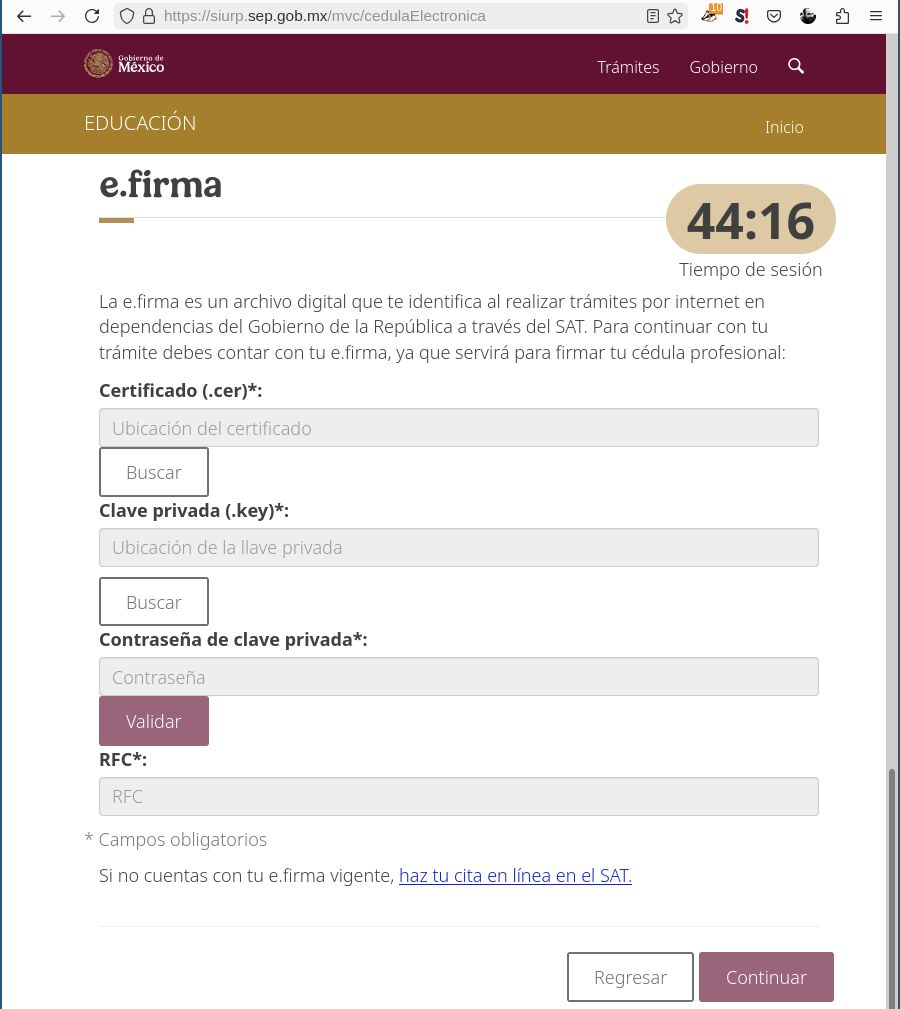
If we ever thought a couple of years or decades of constant use would get humankind to understand how an asymetric key pair is to be handled It s time we moved back to square one. I had to do an online tramit with the Mexican federal government to get a statement certifying I successfully finished my studies, and I found this jewel of user interface: E.firma So I have to:
  1. Submit the asymetric key I use for tax purposes, as that s the ID the government has registered for me. OK, I didn t expect it to be used for this purpose as well, but I ll accept it. Of course, in our tax system many people don t require having a public key generated ( easier regimes are authenticated by password only), but all professionals with a c dula profesional (everybody getting a unviersitary title) is now compelled to do this step.
  2. Not only I have to submit my certificate (public key) But also the private part (and, of course, the password that secures it). I understand I m interacting with a Javascript thingie that runs only client-side, and I trust it is not shipping my private key to their servers. But given it is an opaque script, I have no assurance about it. And, of course, this irks me because I am who I am and because I ve spent several years thinking about cryptography. But for regular people, it just looks as a stupid inconvenience: they have to upload two weird files with odd names and provide a password. What for?
This is beyond stupid. I m baffled. (of course, I did it, because I need the fsckin document. Oh, and of course, I paid my MX$1770, 80, for it which does not make me too happy for a tramit that s not even shuffling papers, only storing the right bits in the right corner of the right datacenter, but anyhow )

Russell Coker: PFAs

For some time I ve been noticing news reports about PFAs [1]. I hadn t thought much about that issue, I grew up when leaded petrol was standard, when almost all thermometers had mercury, when all small batteries had mercury, and I had generally considered that I had already had so many nasty chemicals in my body that as long as I don t eat bottom feeding seafood often I didn t have much to worry about. I already had a higher risk of a large number of medical issues than I d like due to decisions made before I was born and there s not much to do about it given that there are regulations restricting the emissions of lead, mercury etc. I just watched a Veritasium video about Teflon and the PFA poisoning related to it s production [2]. This made me realise that it s more of a problem than I realised and it s a problem that s getting worse. PFA levels in the parts-per-trillion range in the environment can cause parts-per-billion in the body which increases the risks of several cancers and causes other health problems. Fortunately there is some work being done on water filtering, you can get filters for a home level now and they are working on filters that can work at a sufficient scale for a city water plant. There is a map showing PFAs in the environment in Australia which shows some sites with concerning levels that are near residential areas [3]. One of the major causes for that in Australia is fire retardant foam Australia has never had much if any Teflon manufacturing AFAIK. Also they noted that donating blood regularly can decrease levels of PFAs in the bloodstream. So presumably people who have medical conditions that require receiving donated blood regularly will have really high levels.

22 June 2025

Iustin Pop: Coding, as we knew it, has forever changed

Back when I was terribly na ve When I was younger, and definitely na ve, I was so looking forward to AI, which will help us write lots of good, reliable code faster. Well, principally me, not thinking what impact it will have industry-wide. Other more general concerns, like societal issues, role of humans in the future and so on were totally not on my radar. At the same time, I didn t expect this will actually happen. Even years later, things didn t change dramatically. Even the first release of ChatGPT a few years back didn t click for me, as the limitations were still significant.

Hints of serious change The first hint of the change, for me, was when a few months ago (yes, behind the curve), I asked ChatGPT to re-explain a concept to me, and it just wrote a lot of words, but without a clear explanation. On a whim, I asked Grok then recently launched, I think to do the same. And for the first time, the explanation clicked and I felt I could have a conversation with it. Of course, now I forgot again that theoretical CS concept, but the first step was done: I can ask an LLM to explain something, and it will, and I can have a back and forth logical discussion, even if on some theoretical concept. Additionally, I learned that not all LLMs are the same, and that means there s real competition and that leap frogging is possible. Another topic on which I tried to adopt early and failed to get mileage out of it, was GitHub Copilot (in VSC). I tried, it helped, but didn t feel any speed-up at all. Then more recently, in May, I asked Grok what s the state of the art in AI-assisted coding. It said either Claude in a browser tab, or in VSC via continue.dev extension. The continue.dev extension/tooling is a bit of a strange/interesting thing. It seems to want to be a middle-man between the user and actual LLM services, i.e. you pay a subscription to continue.dev, not to Anthropic itself, and they manage the keys/APIs, for whatever backend LLMs you want to use. The integration with Visual Studio Code is very nice, but I don t know if long-term their business model will make sense. Well, not my problem.

Claude: reverse engineering my old code and teaching new concepts So I installed the latter and subscribed, thinking 20 CHF for a month is good for testing. I skipped the tutorial model/assistant, created a new one from scratch, just enabled Claude 3.7 Sonnet, and started using it. And then, my mind was blown-not just by the LLM, but by the ecosystem. As said, I ve used GitHub copilot before, but it didn t seem effective. I don t know if a threshold has been reached, or Claude (3.7 at that time) is just better than ChatGPT. I didn t use the AI to write (non-trivial) code for me, at most boilerplate snippets. But I used it both as partner for discussion - I want to do x, what do you think, A or B? , and as a teacher, especially for fronted topics, which I m not familiar with. Since May, in mostly fragmented sessions, I ve achieved more than in the last two years. Migration from old school JS to ECMA modules, a webpacker (reducing bundle size by 50%), replacing an old Javascript library with hand written code using modern APIs, implementing the zoom feature together with all of keyboard, mouse, touchpad and touchscreen support, simplifying layout from manually computed to automatic layout, and finding a bug in webkit for which it also wrote a cool minimal test (cool, as in, way better than I d have ever, ever written, because for me it didn t matter that much). And more. Could I have done all this? Yes, definitely, nothing was especially tricky here. But hours and hours of reading MDN, scouring Stack Overflow and Reddit, and lots of trial and error. So doable, but much more toily. This, to me, feels like cheating. 20 CHF per month to make me 3x more productive is free money well, except that I don t make money on my code which is written basically for myself. However, I don t get stuck anymore searching hours in the web for guidance, I ask my question, and I get at least direction if not answer, and I m finished way earlier. I can now actually juggle more hobbies, in the same amount of time, if my personal code takes less time or differently said, if I m more efficient at it. Not all is roses, of course. Once, it did write code with such an endearing error that it made me laugh. It was so blatantly obvious that you shouldn t keep other state in the array that holds pointer status because that confuses the calculation of how many pointers are down , probably to itself too if I d have asked. But I didn t, since it felt a bit embarassing to point out such a dumb mistake. Yes, I m anthropomorphising again, because this is the easiest way to deal with things. In general, it does an OK-to-good-to-sometimes-awesome job, and the best thing is that it summarises documentation and all of Reddit and Stack Overflow. And gives links to those. Now, I have no idea yet what this means for the job of a software engineer. If on open source code, my own code, it makes me 3x faster reverse engineering my code from 10 years ago is no small feat for working on large codebases, it should do at least the same, if not more. As an example of how open-ended the assistance can be, at one point, I started implementing a new feature threading a new attribute to a large number of call points. This is not complex at all, just add a new field to a Haskell record, and modifying everything to take it into account, populate it, merge it when merging the data structures, etc. The code is not complex, tending toward boilerplate a bit, and I was wondering on a few possible choices for implementation, so, with just a few lines of code written that were not even compiling, I asked I want to add a new feature, should I do A or B if I want it to behave like this , and the answer was something along the lines of I see you want to add the specific feature I was working on, but the implementation is incomplete, you still need to to X, Y and Z . My mind was blown at this point, as I thought, if the code doesn t compile, surely the computer won t be able to parse it, but this is not a program, this is an LLM, so of course it could read it kind of as a human would. Again, the code complexity is not great, but the fact that it was able to read a half-written patch, understand what I was working towards, and reason about, was mind-blowing, and scary. Like always.

Non-code writing Now, after all this, while writing a recent blog post, I thought this is going to be public anyway, so let me ask Claude what it thinks about it. And I was very surprised, again: gone was all the pain of rereading three times my post to catch typos (easy) or phrasing structure issues. It gave me very clearly points, and helped me cut 30-40% of the total time. So not only coding, but word smithing too is changed. If I were an author, I d be delighted (and scared). Here is the overall reply it gave me:
  • Spelling and grammar fixes, all of them on point except one mistake (I claimed I didn t capitalize one word, but I did). To the level of a good grammar checker.
  • Flow Suggestions, which was way beyond normal spelling and grammar. It felt like a teacher telling me to do better in my writing, i.e. nitpicking on things that actually were true even if they d still work. I.e. lousy phrase structure, still understandable, but lousy nevertheless.
  • Other notes: an overall summary. This was mostly just praising my post . I wish LLMs were not so focused on praise the user .
So yeah, this speeds me up to about 2x on writing blog posts, too. It definitely feels not fair.

Wither the future? After all this, I m a bit flabbergasted. Gone are the 2000 s with code without unittests, gone are the 2010 s without CI/CD, and now, mid-2020 s, gone is the lone programmer that scours the internet to learn new things, alone? What this all means for our skills in software development, I have no idea, except I know things have irreversibly changed (a butlerian jihad aside). Do I learn better with a dedicated tutor even if I don t fight with the problem for so long? Or is struggling in finding good docs the main method of learning? I don t know yet. I feel like I understand the topics I m discussing with the AI, but who knows in reality what it will mean long term in terms of stickiness of learning. For the better, or for worse, things have changed. After all the advances over the last five centuries in mechanical sciences, it has now come to some aspects of the intellectual work. Maybe this is the answer to the ever-growing complexity of tech stacks? I.e. a return of the lone programmer that builds things end-to-end, but with AI taming the complexity added in the last 25 years? I can dream, of course, but this also means that the industry overall will increase in complexity even more, because large companies tend to do that, so maybe a net effect of not much One thing I did learn so far is that my expectation that AI (at this level) will only help junior/beginner people, i.e. it would flatten the skills band, is not true. I think AI can speed up at least the middle band, likely the middle top band, I don t know about the 10x programmers (I m not one of them). So, my question about AI now is how to best use it, not to lament how all my learning (90% self learning, to be clear) is obsolete. No, it isn t. AI helps me start and finish one migration (that I delayed for ages), then start the second, in the same day. At the end of this a bit rambling reflection on the past month and a half, I still have many questions about AI and humanity. But one has been answered: yes, AI , quotes or no quotes, already has changed this field (producing software), and we ve not seen the end of it, for sure.

Sahil Dhiman: Case of (broken) maharashtra.gov.in Authoritative Name Servers

Maharashtra is a state here in India, which has Mumbai, the financial capital of India, as its capital. maharashtra.gov.in is the official website of the State Government of Maharashtra. We re going to talk about authoritative name servers serving it (and bunch of child zones under maharashtra.gov.in). Here s a simple trace for the main domain:
$ dig +trace maharashtra.gov.in
; <<>> DiG 9.18.33-1~deb12u2-Debian <<>> +trace maharashtra.gov.in
;; global options: +cmd
.            33128    IN    NS    j.root-servers.net.
.            33128    IN    NS    h.root-servers.net.
.            33128    IN    NS    l.root-servers.net.
.            33128    IN    NS    k.root-servers.net.
.            33128    IN    NS    i.root-servers.net.
.            33128    IN    NS    g.root-servers.net.
.            33128    IN    NS    f.root-servers.net.
.            33128    IN    NS    e.root-servers.net.
.            33128    IN    NS    b.root-servers.net.
.            33128    IN    NS    d.root-servers.net.
.            33128    IN    NS    c.root-servers.net.
.            33128    IN    NS    m.root-servers.net.
.            33128    IN    NS    a.root-servers.net.
.            33128    IN    RRSIG    NS 8 0 518400 20250704050000 20250621040000 53148 . pGxGZftwj+6VNTSQtstTKVN95Z7/b5Q8GSjRCXI68GoVYbVai9HNelxs OGIRKL4YmSrsiSsndXuEsBuvL9QvQ+qbybNLkekJUAiicKYNgr3KM3+X 69rsS9KxHgT2T8/oqG8KN8EJLJ8VkuM2PJ2HfSKijtF7ULtgBbERNQ4i u2I/wQ7elOyeF2M76iEOa7UGhgiBHSBqPulsbpnB//WbKL71yyFhWSk0 tiFEPuZM+iLrN2qBsElriF4kkw37uRHq8sSGcCjfBVdkpbb3/Sb3sIgN /zKU17f+hOvuBQTDr5qFIymqGAENA5UZ2RQjikk6+zK5EfBUXNpq1+oo 2y64DQ==
;; Received 525 bytes from 9.9.9.9#53(9.9.9.9) in 3 ms
in.            172800    IN    NS    ns01.trs-dns.com.
in.            172800    IN    NS    ns01.trs-dns.net.
in.            172800    IN    NS    ns10.trs-dns.org.
in.            172800    IN    NS    ns10.trs-dns.info.
in.            86400    IN    DS    48140 8 2 5EE4748C2069B99C98BC39A56881A64AF17CC78711E6297D43AC5A4F 4B5BB6E5
in.            86400    IN    RRSIG    DS 8 1 86400 20250704050000 20250621040000 53148 . jkCotYosapreoKKPvr9zPOEDECYVe9OtJLjkQbFfTin8uYbm/kdWzieW CkN5sabif5IHTFU4FEVOShfu4DFeUolhNav56TPKjGqEGjQ7qCghpqTj dNN4iY2s8BcJ2ujHwhm6HRfdbQRVoKYQ73UUZ+oWSute6lXWHE9+Snk2 1ZCAYPdZ2s1s7NZhrZW2YXVw/nHIcRl/rHqWIQ9sgUlsd6MwmahcAAG+ v15HG9Q48rCG1A2gJlJPbxWpVe0EUEu8LzDsp+ORqy1pHhzgJynrJHJz qMiYU0egv2j7xVPSoQHXjx3PG2rsOLNnqDBYCA+piEXOLsY3d+7c1SZl w9u66g==
;; Received 679 bytes from 199.7.83.42#53(l.root-servers.net) in 3 ms
maharashtra.gov.in.    900    IN    NS    ns8.maharashtra.gov.in.
maharashtra.gov.in.    900    IN    NS    ns9.maharashtra.gov.in.
maharashtra.gov.in.    900    IN    NS    ns10.maharashtra.gov.in.
maharashtra.gov.in.    900    IN    NS    ns18.maharashtra.gov.in.
maharashtra.gov.in.    900    IN    NS    ns20.maharashtra.gov.in.
npk19skvsdmju264d4ono0khqf7eafqv.gov.in. 300 IN    NSEC3 1 1 0 - P0KKR4BMBGLJDOKBGBI0KDM39DSM0EA4 NS SOA MX TXT RRSIG DNSKEY NSEC3PARAM
npk19skvsdmju264d4ono0khqf7eafqv.gov.in. 300 IN    RRSIG NSEC3 8 3 300 20250626140337 20250528184339 48544 gov.in. Khcq3n1Jn34HvuBEZExusVqoduEMH6DzqkWHk9dFkM+q0RVBYBHBbW+u LsSnc2/Rqc3HAYutk3EZeS+kXVF07GA/A486dr17Hqf3lHszvG/MNT/s CJfcdrqO0Q8NZ9NQxvAwWo44bCPaECQV+fhznmIaVSgbw7de9xC6RxWG ZFcsPYwYt07yB5neKa99RlVvJXk4GHX3ISxiSfusCNOuEKGy5cMxZg04 4PbYsP0AQNiJWALAduq2aNs80FQdWweLhd2swYuZyfsbk1nSXJQcYbTX aONc0VkYFeEJzTscX8/wNbkJeoLP0r/W2ebahvFExl3NYpb7b2rMwGBY omC/QA==
npk19skvsdmju264d4ono0khqf7eafqv.gov.in. 300 IN    RRSIG NSEC3 13 3 300 20250718144138 20250619135610 22437 gov.in. mbj7td3E6YE7kIhYoSlDTZR047TXY3Z60NY0aBwU7obyg5enBQU9j5nl GUxn9zUiwVUzei7v5GIPxXS7XDpk7g==
6bflkoouitlvj011i2mau7ql5pk61sks.gov.in. 300 IN    NSEC3 1 1 0 - 78S0UO5LI1KV1SVMH1889FHUCNC40U6T TXT RRSIG
6bflkoouitlvj011i2mau7ql5pk61sks.gov.in. 300 IN    RRSIG NSEC3 8 3 300 20250626133905 20250528184339 48544 gov.in. M2yPThQpX0sEf4klooQ06h+rLR3e3Q/BqDTSFogyTIuGwjgm6nwate19 jGmgCeWCYL3w/oxsg1z7SfCvDBCXOObH8ftEBOfLe8/AGHAEkWFSu3e0 s09Ccoz8FJiCfBJbbZK5Vf4HWXtBLfBq+ncGCEE24tCQLXaS5cT85BxZ Zne6Y6u8s/WPgo8jybsvlGnL4QhIPlW5UkHDs7cLLQSwlkZs3dwxyHTn EgjNWClhghGXP9nlvOlnDjUkmacEYeq5ItnCQjYPl4uwh9fBJ9CD/8LV K+Tn3+dgqDBek6+2HRzjGs59NzuHX8J9wVFxP7/nd+fUgaSgz+sST80O vrXlHA==
6bflkoouitlvj011i2mau7ql5pk61sks.gov.in. 300 IN    RRSIG NSEC3 13 3 300 20250718141148 20250619135610 22437 gov.in. raWzWsQnPkXYtr2v1SRH/fk2dEAv/K85NH+06pNUwkxPxQk01nS8eYlq BPQ41b26kikg8mNOgr2ULlBpJHb1OQ==
couldn't get address for 'ns18.maharashtra.gov.in': not found
couldn't get address for 'ns20.maharashtra.gov.in': not found
;; Received 1171 bytes from 2620:171:813:1534:8::1#53(ns10.trs-dns.org) in 0 ms
;; communications error to 10.187.202.24#53: timed out
;; communications error to 10.187.202.28#53: timed out
;; communications error to 10.187.203.201#53: timed out
;; no servers could be reached
Quick takeaways: It s a hit or miss for this DNS query resolution.

Looking at in zone data Let s look at NS added in zone itself (with 9.9.9.9):
$ dig ns maharashtra.gov.in
; <<>> DiG 9.18.33-1~deb12u2-Debian <<>> ns maharashtra.gov.in
;; global options: +cmd
;; Got answer:
;; ->>HEADER<<- opcode: QUERY, status: NOERROR, id: 172
;; flags: qr rd ra; QUERY: 1, ANSWER: 2, AUTHORITY: 0, ADDITIONAL: 3
;; OPT PSEUDOSECTION:
; EDNS: version: 0, flags:; udp: 1232
;; QUESTION SECTION:
;maharashtra.gov.in.        IN    NS
;; ANSWER SECTION:
maharashtra.gov.in.    300    IN    NS    ns8.maharashtra.gov.in.
maharashtra.gov.in.    300    IN    NS    ns9.maharashtra.gov.in.
;; ADDITIONAL SECTION:
ns9.maharashtra.gov.in.    300    IN    A    10.187.202.24
ns8.maharashtra.gov.in.    300    IN    A    10.187.202.28
;; Query time: 180 msec
;; SERVER: 9.9.9.9#53(9.9.9.9) (UDP)
;; WHEN: Sat Jun 21 23:00:49 IST 2025
;; MSG SIZE  rcvd: 115
Pay special attention to ADDITIONAL SECTION . Running dig ns9.maharashtra.gov.in and dig ns8.maharashtra.gov.in, return RFC 1918 ie these private addresses. This is coming from zone itself, so in zone A records of NS8 and NS9 point to 10.187.202.28 and 10.187.202.24 respectively. Cloudflare s 1.1.1.1 has a slightly different version:
$ dig ns maharashtra.gov.in @1.1.1.1
; <<>> DiG 9.18.33-1~deb12u2-Debian <<>> ns maharashtra.gov.in @1.1.1.1
;; global options: +cmd
;; Got answer:
;; ->>HEADER<<- opcode: QUERY, status: NOERROR, id: 36005
;; flags: qr rd ra; QUERY: 1, ANSWER: 3, AUTHORITY: 0, ADDITIONAL: 1
;; OPT PSEUDOSECTION:
; EDNS: version: 0, flags:; udp: 1232
;; QUESTION SECTION:
;maharashtra.gov.in.        IN    NS
;; ANSWER SECTION:
maharashtra.gov.in.    300    IN    NS    ns8.
maharashtra.gov.in.    300    IN    NS    ns10.maharashtra.gov.in.
maharashtra.gov.in.    300    IN    NS    ns9.
;; Query time: 7 msec
;; SERVER: 1.1.1.1#53(1.1.1.1) (UDP)
;; WHEN: Sun Jun 22 10:38:30 IST 2025
;; MSG SIZE  rcvd: 100
Interesting response here for sure :D. The reason for difference between response from 1.1.1.1 and 9.9.9.9 is in the next section.

Looking at parent zone gov.in is the parent zone here. Tucows is operator for gov.in as well as .in ccTLD zone:
$ dig ns gov.in +short
ns01.trs-dns.net.
ns01.trs-dns.com.
ns10.trs-dns.org.
ns10.trs-dns.info.
Let s take a look at what parent zone (NS) hold:
$ dig ns maharashtra.gov.in @ns01.trs-dns.net.
; <<>> DiG 9.18.36 <<>> ns maharashtra.gov.in @ns01.trs-dns.net.
;; global options: +cmd
;; Got answer:
;; ->>HEADER<<- opcode: QUERY, status: NOERROR, id: 56535
;; flags: qr rd; QUERY: 1, ANSWER: 0, AUTHORITY: 5, ADDITIONAL: 6
;; WARNING: recursion requested but not available
;; OPT PSEUDOSECTION:
; EDNS: version: 0, flags:; udp: 1232
; COOKIE: f13027aa39632404010000006856fa2a9c97d6bbc973ba4f (good)
;; QUESTION SECTION:
;maharashtra.gov.in.        IN    NS
;; AUTHORITY SECTION:
maharashtra.gov.in.    900    IN    NS    ns8.maharashtra.gov.in.
maharashtra.gov.in.    900    IN    NS    ns18.maharashtra.gov.in.
maharashtra.gov.in.    900    IN    NS    ns10.maharashtra.gov.in.
maharashtra.gov.in.    900    IN    NS    ns9.maharashtra.gov.in.
maharashtra.gov.in.    900    IN    NS    ns20.maharashtra.gov.in.
;; ADDITIONAL SECTION:
ns20.maharashtra.gov.in. 900    IN    A    52.183.143.210
ns18.maharashtra.gov.in. 900    IN    A    35.154.30.166
ns10.maharashtra.gov.in. 900    IN    A    164.100.128.234
ns9.maharashtra.gov.in.    900    IN    A    103.23.150.89
ns8.maharashtra.gov.in.    900    IN    A    103.23.150.88
;; Query time: 28 msec
;; SERVER: 64.96.2.1#53(ns01.trs-dns.net.) (UDP)
;; WHEN: Sun Jun 22 00:00:02 IST 2025
;; MSG SIZE  rcvd: 248
The ADDITIONAL SECTION gives a completely different picture (different from in zone NSes). Maybe this was how it was supposed to be, but none of the IPs listed for NS10, NS18 and NS20 are responding to any DNS query. Assuming NS8 as 103.23.150.88 and NS9 as 103.23.150.89, checking SOA on each gives following:
$ dig soa maharashtra.gov.in @103.23.150.88 +short
ns8.maharashtra.gov.in. postmaster.maharashtra.gov.in. 2013116777 1200 600 1296000 300
$ dig soa maharashtra.gov.in @103.23.150.89 +short
ns8.maharashtra.gov.in. postmaster.maharashtra.gov.in. 2013116757 1200 600 1296000 300
NS8 (which is marked as primary in SOA) has serial 2013116777 and NS9 is on serial 2013116757, so looks like the sync (IXFR/AXFR) between primary and secondary is broken. That s why NS8 and NS9 are serving different responses, evident from the following:
$ dig ns8.maharashtra.gov.in @103.23.150.88 +short
103.23.150.88
$ dig ns8.maharashtra.gov.in @103.23.150.89 +short
10.187.202.28
$ dig ns9.maharashtra.gov.in @103.23.150.88 +short
103.23.150.89
$ dig ns9.maharashtra.gov.in @103.23.150.89 +short
10.187.202.24
$ dig ns maharashtra.gov.in @103.23.150.88 +short
ns9.
ns8.
ns10.maharashtra.gov.in.
$ dig ns maharashtra.gov.in @103.23.150.89 +short
ns9.maharashtra.gov.in.
ns8.maharashtra.gov.in.
$ dig ns10.maharashtra.gov.in @103.23.150.88 +short
10.187.203.201
$ dig ns10.maharashtra.gov.in @103.23.150.89 +short
# No/empty response ^
This is the reason for difference in 1.1.1.1 and 9.9.9.9 responses in previous section.

To summarize:
  • Primary and secondary NS aren t in sync. Serials aren t matching, while NS8 and NS9 are responding differently for same queries.
  • NSes have A records with private address, not reachable on the internet, so lame servers.
  • Incomplete NS address, not even FQDN in some cases.
  • Difference between NS delegated in parent zone and NS added in actual zone.
  • Name resolution works in very particular order (in my initial trace it failed).
Initially, I thought of citing RFCs, but I don t really think it s even required. 1.1.1.1, 8.8.8.8 and 9.9.9.9 are handling (lame servers, this probelm) well, handing out the A record for the main website, so dig maharashtra.gov.in would mostly pass and that was the reason I started this post with +trace to recurse the complete zone to show the problem. For later reference:
$ dig maharashtra.gov.in @8.8.8.8 +short
103.8.188.109

Email to SOA address I have sent the following email to address listed in SOA:
Subject - maharashtra.gov.in authoritative DNS servers not reachable Hello, I wanted to highlight the confusing state of maharashtra.gov.in authoritative DNS servers. Parent zone list following as name servers for your DNS zone:
  • ns8.maharashtra.gov.in.
  • ns18.maharashtra.gov.in.
  • ns10.maharashtra.gov.in.
  • ns9.maharashtra.gov.in.
  • ns20.maharashtra.gov.in.
Out of these, ns18 and ns20 don t have public A/AAAA records and are thus not reachable. ns10 keeps on shuffling between NO A record and 10.187.203.201 (private, not reachable address). ns8 keeps on shuffling between 103.23.150.88 and 10.187.202.28 (private, not reachable address). ns9 keeps on shuffling between 103.23.150.89 and 10.187.202.24 (private, not reachable address). These are leading to long, broken, or no DNS resolution for the website(s). Can you take a look at the problem? Regards, Sahil
I ll update here if I get a response. Hopefully, they ll listen and fix their problem.

21 June 2025

Ravi Dwivedi: Getting Brunei visa

In December 2024, my friend Badri and I were planning a trip to Southeast Asia. At this point, we were planning to visit Singapore, Malaysia and Vietnam. My Singapore visa had already been approved, and Malaysia was visa-free for us. For Vietnam, we had to apply for an e-visa online. We considered adding Brunei to our itinerary. I saw some videos of the Brunei visa process and got the impression that we needed to go to the Brunei embassy in Kuching, Malaysia in person. However, when I happened to search for Brunei on Organic Maps1, I stumbled upon the Brunei Embassy in Delhi. It seemed to be somewhere in Hauz Khas. As I was going to Delhi to collect my Singapore visa the next day, I figured I d also visit the Brunei Embassy to get information about the visa process. The next day I went to the location displayed by Organic Maps. It was next to the embassy of Madagascar, and a sign on the road divider confirmed that I was at the right place. That said, it actually looked like someone s apartment. I entered and asked for directions to the Brunei embassy, but the people inside did not seem to understand my query. After some back and forth, I realized that the embassy wasn t there. I now searched for the Brunei embassy on the Internet, and this time I got an address in Vasant Vihar. It seemed like the embassy had been moved from Hauz Khas to Vasant Vihar. Going by the timings mentioned on the web page, the embassy was closing in an hour. I took a Metro from Hauz Khas to Vasant Vihar. After deboarding at the Vasant Vihar metro station, I took an auto to reach the embassy. The address listed on the webpage got me into the correct block. However, the embassy was still nowhere to be seen. I asked around, but security guards in that area pointed me to the Burundi embassy instead. After some more looking around, I did end up finding the embassy. I spoke to the security guards at the gate and told them that I would like to know the visa process. They dialled a number and asked that person to tell me the visa process. I spoke to a lady on the phone. She listed the documents required for the visa process and mentioned that the timings for visa application were from 9 o clock to 11 o clock in the morning. She also informed me that the visa fees was 1000. I also asked about the process Badri, who lives far away in Tamil Nadu and cannot report at the embassy physically. She told me that I can submit a visa application on his behalf, along with an authorization letter. Having found the embassy in Delhi was a huge relief. The other plan - going to Kuching, Malaysia - was a bit uncertain, and we didn t know how much time it would take. Getting our passport submitted at an embassy in a foreign country was also not ideal. A few days later, Badri sent me all the documents required for his visa. I went to the embassy and submitted both the applications. The lady who collected our visa submissions asked me for our flight reservations from Delhi to Brunei, whereas ours were (keeping with our itinerary) from Kuala Lampur. She said that she might contact me later if it was required. For reference, here is the list of documents we submitted - I then asked about the procedure to collect the passports and visa results. Usually, embassies will tell you that they will contact you when they have decided on your applications. However, here I was informed that if they don t contact me within 5 days, I can come and collect our passports and visa result between 13:30-14:30 hours on the fifth day. That was strange :) I did visit the embassy to collect our visa results on the fifth day. However, the lady scolded me for not bringing the receipt she gave me. I was afraid that I might have to go all the way back home and bring the receipt to get our passports. The travel date was close, and it would take some time for Badri to receive his passport via courier as well. Fortunately, she gave me our passports (with the visa attached) and asked me to share a scanned copy of the receipt via email after I get home. We were elated that our visas were approved. Now we could focus on booking our flights. If you are going to Brunei, remember to fill their arrival card from the website within 48 hours of your arrival! Thanks to Badri and Contrapunctus for reviewing the draft before publishing the article.

  1. Nowadays, I prefer using Comaps instead of Organic Maps and recommend you do the same. Organic Maps had some issues with its governance and the community issues weren t being addressed.

20 June 2025

Sven Hoexter: Terraform: Validation Condition Cycles

Terraform 1.9 introduced some time ago the capability to reference in an input variable validation condition other variables, not only the one you're validating. What does not work is having two variables which validate each other, e.g.
variable "nat_min_ports"  
  description = "Minimal amount of ports to allocate for 'min_ports_per_vm'"
  default     = 32
  type        = number
  validation  
    condition = (
      var.nat_min_ports >= 32 &&
      var.nat_min_ports <= 32768 &&
      var.nat_min_ports < var.nat_max_ports
    )
    error_message = "Must be between 32 and 32768 and less than 'nat_max_ports'"
   
 
variable "nat_max_ports"  
  description = "Maximal amount of ports to allocate for 'max_ports_per_vm'"
  default     = 16384
  type        = number
  validation  
    condition = (
      var.nat_max_ports >= 64 &&
      var.nat_max_ports <= 65536 &&
      var.nat_max_ports > var.nat_min_ports
    )
    error_message = "Must be between 64 and 65536 and above 'nat_min_ports'"
   
 
That let directly to the following rather opaque error message: Received an error Error: Cycle: module.gcp_project_network.var.nat_max_ports (validation), module.gcp_project_network.var.nat_min_ports (validation) Removed the sort of duplicate check var.nat_max_ports > var.nat_min_ports on nat_max_ports to break the cycle.

Next.

Previous.