Search Results: "tar"

10 April 2025

John Goerzen: Announcing the NNCPNET Email Network

From 1995 to 2019, I ran my own mail server. It began with a UUCP link, an expensive long-distance call for me then. Later, I ran a mail server in my apartment, then ran it as a VPS at various places. But running an email server got difficult. You can t just run it on a residential IP. Now there s SPF, DKIM, DMARC, and TLS to worry about. I recently reviewed mail hosting services, and don t get me wrong: I still use one, and probably will, because things like email from my bank are critical. But we ve lost the ability to tinker, to experiment, to have fun with email. Not anymore. NNCPNET is an email system that runs atop NNCP. I ve written a lot about NNCP, including a less-ambitious article about point-to-point email over NNCP 5 years ago. NNCP is to UUCP what ssh is to telnet: a modernization, with modern security and features. NNCP is an asynchronous, onion-routed, store-and-forward network. It can use as a transport anything from the Internet to a USB stick. NNCPNET is a set of standards, scripts, and tools to facilitate a broader email network using NNCP as the transport. You can read more about NNCPNET on its wiki! The easy mode is to use the Docker container (multi-arch, so you can use it on your Raspberry Pi) I provide, which bundles: It is open to all. The homepage has a more extensive list of features. I even have mailing lists running on NNCPNET; see the interesting addresses page for more details. There is extensive documentation, and of course the source to the whole thing is available. The gateway to Internet SMTP mail is off by default, but can easily be enabled for any node. It is a full participant, in both directions, with SPF, DKIM, DMARC, and TLS. You don t need any inbound ports for any of this. You don t need an always-on Internet connection. You don t even need an Internet connection at all. You can run it from your laptop and still use Thunderbird to talk to it via its optional built-in IMAP server.

9 April 2025

Freexian Collaborators: Debian Contributions: Preparations for Trixie, Updated debvm, DebConf 25 registration website updates and more! (by Anupa Ann Joseph)

Debian Contributions: 2025-03 Contributing to Debian is part of Freexian s mission. This article covers the latest achievements of Freexian and their collaborators. All of this is made possible by organizations subscribing to our Long Term Support contracts and consulting services.

Preparing for Trixie, by Rapha l Hertzog As we are approaching the trixie freeze, it is customary for Debian developers to review their packages and clean them up in preparation for the next stable release. That s precisely what Rapha l did with publican, a package that had not seen any change since the last Debian release and that partially stopped working along the way due to a major Perl upgrade. While upstream s activity is close to zero, hope is not yet entirely gone as the git repository moved to a new location a couple of months ago and contained the required fix. Rapha l also developed another fix to avoid an annoying warning that was seen at runtime. Rapha l also ensured that the last upstream version of zim was uploaded to Debian unstable, and developed a fix for gnome-shell-extension-hamster to make it work with GNOME 48 and thus ensure that the package does not get removed from trixie.

Abseil and re2 transition in Debian, by Stefano Rivera One of the last transitions to happen for trixie was an update to abseil, bringing it up to 202407. This library is a dependency for one of Freexian s customers, as well as blocking newer versions of re2, a package maintained by Stefano. The transition had been stalled for several months while some issues with reverse dependencies were investigated and dealt with. It took a final push to make the transition happen, including fixing a few newly discovered problems downstream. The abseil package s autopkgtests were (trivially) broken by newer cmake versions, and some tests started failing on PPC64 (a known issue upstream).

debvm uploaded, by Helmut Grohne debvm is a command line tool for quickly creating a Debian-based virtual machine for testing purposes. Over time, it accumulated quite a few minor issues as well as CI failures. The most notorious one was an ARM32 failure present since August. It was diagnosed down to a glibc bug by Tj and Chris Hofstaedtler and little has happened since then. To have debvm work somewhat, it now contains a workaround for this situation. Few changes are expected to be noticeable, but related tools such as apt, file, linux, passwd, and qemu required quite a few adaptations all over the place. Much of the necessary debugging was contributed by others.

DebConf 25 Registration website, by Stefano Rivera and Santiago Ruano Rinc n DebConf 25, the annual Debian developer conference, is now open for registration. Other than preparing the conference website, getting there always requires some last minute changes to the software behind the registration interface and this year was no exception. Every year, the conference is a little different to previous years, and has some different details that need to be captured from attendees. And every year we make minor incremental improvements to fix long-standing problems. New concepts this year included: brunch, the closing talks on the departure day, venue security clearance, partial contributions towards food and accommodation bursaries, and attendee-selected bursary budgets.

Miscellaneous contributions
  • Helmut uploaded guess-concurrency incorporating feedback from others.
  • Helmut reacted to rebootstrap CI results and adapted it to cope with changes in unstable.
  • Helmut researched real world /usr-move fallout though little was actually attributable. He also NMUed systemd unsuccessfully.
  • Helmut sent 12 cross build patches.
  • Helmut looked into undeclared file conflicts in Debian more systematically and filed quite some bugs.
  • Helmut attended the cross/bootstrap sprint in W rzburg. A report of the event is pending.
  • Lucas worked on the CFP and tracks definition for DebConf 25.
  • Lucas worked on some bits involving Rails 7 transition.
  • Carles investigated why the job piuparts on salsa-ci/pipeline was passing but was failing on piuparts.debian.org for simplemonitor package. Created an issue and MR with a suggested fix, under discussion.
  • Carles improved the documentation of salsa-ci/pipeline: added documentation for different variables.
  • Carles made debian-history package reproducible (with help from Chris Lamb).
  • Carles updated simplemonitor package (new upstream version), prepared a new qdacco version (fixed bugs in qdacco, packaged with the upgrade from Qt 5 to Qt 6).
  • Carles reviewed and submitted translations to Catalan for adduser, apt, shadow, apt-listchanges.
  • Carles reviewed, created merge-requests for translations to Catalan of 38 packages (using po-debconf-manager tooling). Created 40 bug reports for some merge requests that haven t been actioned for some time.
  • Colin Watson fixed 59 RC bugs (including 26 packages broken by the long-overdue removal of dh-python s dependency on python3-setuptools), and upgraded 38 packages (mostly Python-related) to new upstream versions.
  • Colin worked with Pranav P to track down and fix a dnspython autopkgtest regression on s390x caused by an endianness bug in pylsqpack.
  • Colin fixed a time-based test failure in python-dateutil that would have triggered in 2027, and contributed the fix upstream.
  • Colin fixed debconf to automatically use the noninteractive frontend if stdin is not a terminal.
  • Stefano bisected and fixed a pypy translation regression on Debian stable and older on 32-bit ARM.
  • Emilio coordinated and helped finish various transitions in light of the transition freeze.
  • Thorsten Alteholz uploaded cups-filters to fix an FTBFS with a new upstream version of qpdf.
  • With the aim of enhancing the support for packages related to Software Bill of Materials (SBOMs) in recent industrial standards, Santiago has worked on finishing the packaging of and uploaded CycloneDX python library. There is on-going work about SPDX python tools, but it requires (build-)dependencies currently not shipped in Debian, such as owlrl and pyshacl.
  • Anupa worked with the Publicity team to announce the Debian 12.10 point release.
  • Anupa with the support of Santiago prepared an announcement and announced the opening of CfP and Registrations for DebConf 25.

8 April 2025

Petter Reinholdtsen: Some notes on Linux LUKS cracking

A few months ago, I found myself in the unfortunate position that I had to try to recover the password used to encrypt a Linux hard drive. Tonight a few friends of mine asked for details on this effort. I guess it is a good idea to expose the recipe I found to a wider audience, so here are a few relevant links and key findings. I've forgotten a lot, so part of this is taken from memory. I found a good recipe in a blog post written in 2019 by diverto, titled Cracking LUKS/dm-crypt passphrases. I tried both the john the ripper approach where it generated password candidates and passed it to cryptsetup and the luks2jack.py approach (which did not work for me, if I remember correctly), but believe I had most success with the hashcat approach. I had it running for several days on my Thinkpad X230 laptop from 2012. I do not remember the exact hash rate, but when I tested it again just now on the same machine by running "hashcat -a 0 hashcat.luks longlist --force", I got a hash rate of 7 per second. Testing it on a newer machine with a 32 core AMD CPU, I got a hash rate of 289 per second. Using the ROCM OpenCL approach on the same machine I managed to get a hash rate of 2821 per second.
Session..........: hashcat                                
Status...........: Quit
Hash.Mode........: 14600 (LUKS v1 (legacy))
Hash.Target......: hashcat.luks
Time.Started.....: Tue Apr  8 23:06:08 2025 (1 min, 10 secs)
Time.Estimated...: Tue Apr  8 23:12:49 2025 (5 mins, 31 secs)
Kernel.Feature...: Pure Kernel
Guess.Base.......: File (/usr/share/dict/bokm l)
Guess.Queue......: 1/1 (100.00%)
Speed.#1.........:     2821 H/s (8.18ms) @ Accel:128 Loops:128 Thr:32 Vec:1
Recovered........: 0/1 (0.00%) Digests (total), 0/1 (0.00%) Digests (new)
Progress.........: 0/935405 (0.00%)
Rejected.........: 0/0 (0.00%)
Restore.Point....: 0/935405 (0.00%)
Restore.Sub.#1...: Salt:0 Amplifier:0-1 Iteration:972928-973056
Candidate.Engine.: Device Generator
Candidates.#1....: A-aksje -> fiskebil
Hardware.Mon.#1..: Temp: 73c Fan: 77% Util: 99% Core:2625MHz Mem: 456MHz Bus:16
Note that for this last test I picked the largest word list I had on my machine (dict/bokm l) as a fairly random work list and not because it is useful for cracking my particular use case from a few months ago. As usual, if you use Bitcoin and want to show your support of my activities, please send Bitcoin donations to my address 15oWEoG9dUPovwmUL9KWAnYRtNJEkP1u1b.

7 April 2025

Scarlett Gately Moore: KDE Snap Updates, Kubuntu Updates, More life updates!

Icy morning Witch Wells AzIcy morning Witch Wells Az
Life: Last week we were enjoying springtime, this week winter has made a comeback! Good news on the broken arm front, the infection is gone, so they can finally deal with the broken issue again. I will have a less invasive surgery April 25th to pull the bones back together so they can properly knit back together! If you can spare any change please consider a donation to my continued healing and recovery, or just support my work  Kubuntu: While testing Beta I came across some crashy apps ( Namely PIM ) due to apparmor. I have uploaded fixed profiles for kmail, akregator, akonadiconsole, konqueror, tellico KDE Snaps: Added sctp support in Qt https://invent.kde.org/neon/snap-packaging/kde-qt6-core-sdk/-/commit/bbcb1dc39044b930ab718c8ffabfa20ccd2b0f75 This will allow me to finish a pyside6 snap and fix FreeCAD build. Changed build type to Release in the kf6-core24-sdk which will reduce the size of kf6-core24 significantly. Fixed a few startup errors in kf5-core24 and kf6-core24 snapcraft-desktop-integration. Soumyadeep fixed wayland icons in https://invent.kde.org/neon/snap-packaging/kf6-core-sdk/-/merge_requests/3 KDE Applications 25.03.90 RC released to candidate ( I know it says 24.12.3, version won t be updated until 25.04.0 release ) Kasts core24 fixed in candidate Kate now core24 with Breeze theme! candidate Neochat: Fixed missing QML and 25.04 dependencies in candidate Kdenlive now with Galxnimate animations! candidate Digikam 8.6.0 now with scanner support in stable Kstars 3.7.6 released to stable for realz, removed store rejected plugs. Thanks for stopping by!

5 April 2025

Russell Coker: HP z840

Many PCs with DDR4 RAM have started going cheap on ebay recently. I don t know how much of that is due to Windows 11 hardware requirements and how much is people replacing DDR4 systems with DDR5 systems. I recently bought a z840 system on ebay, it s much like the z640 that I recently made my workstation [1] but is designed strictly as a 2 CPU system. The z640 can run with 2 CPUs if you have a special expansion board for a second CPU which is very expensive on eBay and and which doesn t appear to have good airflow potential for cooling. The z840 also has a slightly larger case which supports more DIMM sockets and allows better cooling. The z640 and z840 take the same CPUs if you use the E5-2xxx series of CPU that is designed for running in 2-CPU mode. The z840 runs DDR4 RAM at 2400 as opposed to 2133 for the z640 for reasons that are not explained. The z840 has more PCIe slots which includes 4*16x slots that support bifurcation. The z840 that I have has the HP Z-Cooler [2] installed. The coolers are mounted on a 45 degree angle (the model depicted at the right top of the first page of that PDF) and the system has a CPU shroud with fans that mount exactly on top of the CPU heatsinks and duct the hot air out without going over other parts. The technology of the z840 cooling is very impressive. When running two E5-2699A CPUs which are listed as 145W typical TDP with all 44 cores in use the system is very quiet. It s noticeably louder than the z640 but is definitely fine to have at your desk. In a typical office you probably wouldn t hear it when it s running full bore. If I was to have one desktop PC or server in my home the z840 would definitely be the machine I choose for that. I decided to make the z840 a build server to share the resource with friends and to use for group coding projects. I often have friends visit with laptops to work on FOSS stuff and a 44 core build server is very useful for that. The system is by far the fastest system I ve ever owned even though I don t have fast storage for it yet. But 256G of RAM allows enough caching that storage speed doesn t matter too much. Here is building the SE Linux refpolicy package on the z640 with E5-2696 v3 CPU and the z840 with two E5-2699A v4 CPUs:
257.10user 47.18system 1:40.21elapsed 303%CPU (0avgtext+0avgdata 416408maxresident)k
66904inputs+1519912outputs (74major+8154395minor)pagefaults 0swaps
222.15user 24.17system 1:13.80elapsed 333%CPU (0avgtext+0avgdata 416192maxresident)k
5416inputs+0outputs (64major+8030451minor)pagefaults 0swaps
Here is building Warzone2100 on the z640 and the z840:
6887.71user 178.72system 16:15.09elapsed 724%CPU (0avgtext+0avgdata 1682160maxresident)k
1555480inputs+8918768outputs (114major+27133734minor)pagefaults 0swaps
6055.96user 77.05system 8:00.20elapsed 1277%CPU (0avgtext+0avgdata 1682100maxresident)k
117640inputs+0outputs (46major+11460968minor)pagefaults 0swaps
It seems that the refpolicy package can t use many more than 18 cores as it is only 37% faster when building with 44 cores available. Building Warzone is slightly more than twice as fast so it can really use all the available cores. According to Passmark the E5-2699A v4 is 22% faster than the E5-2696 v3. I highly recommend buying a z640 if you see one at a good price.

Russell Coker: More About the HP ML110 Gen9 and z640

In May 2021 I bought a ML110 Gen9 to use as a deskside workstation [1]. I started writing this post in April 2022 when it had been my main workstation for almost a year. While this post was in a draft state in Feb 2023 I upgraded it to an 18 core E5-2696 v3 CPU [2]. It s now March 2025 and I have replaced it. Hardware Issues My previous state with this was not having adequate cooling to allow it to boot and not having a PCIe power cable for a video card. As an experiment I connected the CPU fan to the PCIe fan power and discovered that all power and monitoring wires for the CPU and PCIe fans are identical. This allowed me to buy a CPU fan which was cheaper ($26.09 including postage) and easier to obtain than a PCIe fan (presumably due to CPU fans being more commonly used and manufactured in larger quantities). I had to be creative in attaching the CPU fan as it s cable wasn t long enough to reach the usual location for a PCIe fan. The PCIe fan also required a baffle to direct the air to the right place which annoyingly HP apparently doesn t ship with the low end servers, so I made one from a Corn Flakes packet and duct tape. The Wikipedia page listing AMD GPUs lists many newer ones that draw less than 80W and don t need a PCIe power cable. I ordered a Radeon RX560 4G video card which cost $246.75. It only uses 8 lanes of PCIe but that s enough for me, the only 3D game I play is Warzone 2100 which works well at 4K resolution on that card. It would be really annoying if I had to just spend $246.75 to get the system working, but I had another system in need of a better video card which had a PCIe power cable so the effective cost was small. I think of it as upgrading 2 systems for $123 each. The operation of the PCIe video card was a little different than non-server systems. The built in VGA card displayed the hardware status at the start and then kept displaying that after the system had transitioned to PCIe video. This could be handy in some situations if you know what it s doing but was confusing initially. Booting One insidious problem is that when booting in legacy mode the boot process takes an unreasonably long time and often hangs, the UEFI implementation on this system seems much more reliable and also supports booting from NVMe. Even with UEFI the boot process on this system was slow. Also the early stage of the power on process involves fans being off and the power light flickering which leads you to think that it s not booting and needs to have the power button pressed again which turns it off. The Dell power on sequence of turning most LEDs on and instantly running the fans at high speed leaves no room for misunderstanding. This is also something that companies making electric cars could address. When turning on a machine you should never be left wondering if it is actually on. Noise This was always a noisy system. When I upgraded the CPU from an 8 core with 85W typical TDP to an 18 core with 145W typical TDP it became even louder. Then over time as dust accumulated inside the machine it became louder still until it was annoyingly loud outside the room when all 18 cores were busy. Replacement I recently blogged about options for getting 8K video to work on Linux [3]. This requires PCIe power which the z640s have (all the ones I have seen have it I don t know if all that HP made have it) and which the cheaper models in the ML-110 line don t have. Since then I have ordered an Intel Arc card which apparently has 190W TDP. There are adaptors to provide PCIe power from SATA or SAS power which I could have used, but having a E5-2696 v3 CPU that draws 145W [4] and a GPU that draws 190W [4] in a system with a 350W PSU doesn t seem viable. I replaced it with one of the HP z640 workstations I got in 2023 [5]. The current configuration of the z640 has 3*32G RDIMMs compared to the ML110 having 8*32G, going from 256G to 96G is a significant decrease but most tasks run well enough like that. A limitation of the z640 is that when run with a single CPU it only has 4 DIMM slots which gives a maximum of 512G if you get 128G LRDIMMs, but as all DDR4 DIMMs larger than 32G are unreasonably expensive at this time the practical limit is 128G (which costs about $120AU). In this case I have 96G because the system I m using has a motherboard problem which makes the fourth DIMM slot unusable. Currently my desire to get more than 96G of RAM is less than my desire to avoid swapping CPUs. At this time I m not certain that I will make my main workstation the one that talks to an 8K display. But I really want to keep my options open and there are other benefits. The z640 boots faster. It supports PCIe bifurcation (with a recent BIOS) so I now have 4 NVMe devices in a single PCIe slot. It is very quiet, the difference is shocking. I initially found it disconcertingly quiet. The biggest problem with the z640 is having only 4 DIMM sockets and the particular one I m using has a problem limiting it to 3. Another problem with the z640 when compared to the ML110 Gen9 is that it runs the RAM at 2133 while the ML110 runs it at 2400, that s a significant performance reduction. But the benefits outweigh the disadvantages. Conclusion I have no regrets about buying the ML-110. It was the only DDR4 ECC system that was in the price range I wanted at the time. If I knew that the z640 systems would run so quietly then I might have replaced it earlier. But it was only late last year that 32G DIMMs became affordable, before then I had 8*16G DIMMs to give 128G because I had some issues of programs running out of memory when I had less.

4 April 2025

Gunnar Wolf: Naming things revisited

How long has it been since you last saw a conversation over different blogs syndicated at the same planet? Well, it s one of the good memories of the early 2010s. And there is an opportunity to re-engage! I came across Evgeni s post naming things is hard in Planet Debian. So, what names have I given my computers? I have had many since the mid-1990s I also had several during the decade before that, but before Linux, my computers didn t hve a formal name. Naming my computers something nice Linux gave me. I have forgotten many. Some of the names I have used:

1 April 2025

Colin Watson: Free software activity in March 2025

Most of my Debian contributions this month were sponsored by Freexian. You can also support my work directly via Liberapay. OpenSSH Changes in dropbear 2025.87 broke OpenSSH s regression tests. I cherry-picked the fix. I reviewed and merged patches from Luca Boccassi to send and accept the COLORTERM and NO_COLOR environment variables. Python team Following up on last month, I fixed some more uscan errors: I upgraded these packages to new upstream versions: In bookworm-backports, I updated python-django to 3:4.2.19-1. Although Debian s upgrade to python-click 8.2.0 was reverted for the time being, I fixed a number of related problems anyway since we re going to have to deal with it eventually: dh-python dropped its dependency on python3-setuptools in 6.20250306, which was long overdue, but it had quite a bit of fallout; in most cases this was simply a question of adding build-dependencies on python3-setuptools, but in a few cases there was a missing build-dependency on python3-typing-extensions which had previously been pulled in as a dependency of python3-setuptools. I fixed these bugs resulting from this: We agreed to remove python-pytest-flake8. In support of this, I removed unnecessary build-dependencies from pytest-pylint, python-proton-core, python-pyzipper, python-tatsu, python-tatsu-lts, and python-tinycss, and filed #1101178 on eccodes-python and #1101179 on rpmlint. There was a dnspython autopkgtest regression on s390x. I independently tracked that down to a pylsqpack bug and came up with a reduced test case before realizing that Pranav P had already been working on it; we then worked together on it and I uploaded their patch to Debian. I fixed various other build/test failures: I enabled more tests in python-moto and contributed a supporting fix upstream. I sponsored Maximilian Engelhardt to reintroduce zope.sqlalchemy. I fixed various odds and ends of bugs: I contributed a small documentation improvement to pybuild-autopkgtest(1). Rust team I upgraded rust-asn1 to 0.20.0. Science team I finally gave in and joined the Debian Science Team this month, since it often has a lot of overlap with the Python team, and Freexian maintains several packages under it. I fixed a uscan error in hdf5-blosc (maintained by Freexian), and upgraded it to a new upstream version. I fixed python-vispy: missing dependency on numpy abi. Other bits and pieces I fixed debconf should automatically be noninteractive if input is /dev/null. I fixed a build failure with GCC 15 in yubihsm-shell (maintained by Freexian). Prompted by a CI failure in debusine, I submitted a large batch of spelling fixes and some improved static analysis to incus (#1777, #1778) and distrobuilder. After regaining access to the repository, I fixed telegnome: missing app icon in About dialogue and made a new 0.3.7 release.

Guido G nther: Free Software Activities March 2025

Another short status update of what happened on my side last month. Some more ModemManager bits landed, Phosh 0.46 is out, haptic feedback is now better tunable plus some more. See below for details (no April 1st joke in there, I promise): phosh phoc phosh-osk-stub phosh-mobile-settings phosh-tour pfs xdg-desktop-portal-gtk xdg-desktop-portal-phosh meta-phosh feedbackd feedbackd-device-themes gmobile livi Debian git-buildpackage feedbackd-device-themes wlroots ModemManager Tuba xdg-spec gnome-calls Reviews This is not code by me but reviews on other peoples code. The list is (as usual) slightly incomplete. Thanks for the contributions! Help Development If you want to support my work see donations. Comments? Join the Fediverse thread

Michael Ablassmeier: qmpbackup 0.46 - add image fleecing

I ve released qmpbackup 0.46 which now utilizes the image fleecing technique for backup. Usually, during backup, Qemu will use a so called copy-before-write filter so that data for new guest writes is sent to the backup target first, the guest write blocks until this operation is finished. If the backup target is flaky, or becomes unavailable during backup operation, this could lead to high I/O wait times or even complete VM lockups. To fix this, a so called fleecing image is introduced during backup being used as temporary cache for write operations by the guest. This image can be placed on the same storage as the virtual machine disks, so is independent from the backup target performance. The documentation on which steps are required to get this going, using the Qemu QMP protocol is, lets say.. lacking.. The following examples show the general functionality, but should be enhanced to use transactions where possible. All commands are in qmp-shell command format. Lets start with a full backup:
# create a new bitmap
block-dirty-bitmap-add node=disk1 name=bitmap persistent=true
# add the fleece image to the virtual machine (same size as original disk required)
blockdev-add driver=qcow2 node-name=fleecie file= "driver":"file","filename":"/tmp/fleece.qcow2" 
# add the backup target file to the virtual machine
blockdev-add driver=qcow2 node-name=backup-target-file file= "driver":"file","filename":"/tmp/backup.qcow2" 
# enable the copy-before-writer for the first disk attached, utilizing the fleece image
blockdev-add driver=copy-before-write node-name=cbw file=disk1 target=fleecie
# "blockdev-replace": make the copy-before-writer filter the major device (use "query-block" to get path parameter value, qdev node)
qom-set path=/machine/unattached/device[20] property=drive value=cbw
# add the snapshot-access filter backing the copy-before-writer
blockdev-add driver=snapshot-access file=cbw node-name=snapshot-backup-source
# create a full backup
blockdev-backup device=snapshot-backup-source target=backup-target-file sync=full job-id=test
[ wait until block job finishes]
# remove the snapshot access filter from the virtual machine
blockdev-del node-name=snapshot-backup-source
# switch back to the regular disk
qom-set path=/machine/unattached/device[20] property=drive value=node-disk1
# remove the copy-before-writer
blockdev-del node-name=cbw
# remove the backup-target-file
blockdev-del node-name=backup-target-file
# detach the fleecing image
blockdev-del node-name=fleecie
After this process, the temporary fleecing image can be deleted/recreated. Now lets go for a incremental backup:
# add the fleecing and backup target image, like before
blockdev-add driver=qcow2 node-name=fleecie file= "driver":"file","filename":"/tmp/fleece.qcow2" 
blockdev-add driver=qcow2 node-name=backup-target-file file= "driver":"file","filename":"/tmp/backup-incremental.qcow2" 
# add the copy-before-write filter, but utilize the bitmap created during full backup
blockdev-add driver=copy-before-write node-name=cbw file=disk1 target=fleecie bitmap= "node":"disk1","name":"bitmap" 
# switch device to the copy-before-write filter
qom-set path=/machine/unattached/device[20] property=drive value=cbw
# add the snapshot-access filter
blockdev-add driver=snapshot-access file=cbw node-name=snapshot-backup-source
# merge the bitmap created during full backup to the snapshot-access device so
# the backup operation can access it. (you better use an transaction here)
block-dirty-bitmap-add node=snapshot-backup-source name=bitmap
block-dirty-bitmap-merge node=snapshot-backup-source target=bitmap bitmaps=[ "node":"disk1","name":"bitmap" ]
# create incremental backup (you better use an transaction here)
blockdev-backup device=snapshot-backup-source target=backup-target-file job-id=test sync=incremental bitmap=bitmap
 [ wait until backup has finished ]
 [ cleanup like before ]
# clear the dirty bitmap (you better use an transaction here)
block-dirty-bitmap-clear node=disk1 name=bitmap
Or, use a simple reproducer by directly passing qmp commands via stdio:
#!/usr/bin/bash
qemu-img create -f raw disk 1M
qemu-img create -f raw fleece 1M
qemu-img create -f raw backup 1M
qemu-system-x86_64 -drive node-name=disk,file=disk,format=file -qmp stdio -nographic -nodefaults <<EOF
 "execute": "qmp_capabilities" 
 "execute": "block-dirty-bitmap-add", "arguments":  "node": "disk", "name": "bitmap" 
 "execute": "blockdev-add", "arguments":  "node-name": "fleece", "driver": "file", "filename": "fleece" 
 "execute": "blockdev-add", "arguments":  "node-name": "backup", "driver": "file", "filename": "backup" 
 "execute": "blockdev-add", "arguments":  "node-name": "cbw", "driver": "copy-before-write", "file": "disk", "target": "fleece", "bitmap":  "node": "disk", "name": "bitmap" 
 "execute": "query-block" 
 "execute": "qom-set", "arguments":  "path": "/machine/unattached/device[4]", "property": "drive", "value": "cbw" 
 "execute": "blockdev-add", "arguments":  "node-name": "snapshot", "driver": "snapshot-access", "file": "cbw" 
 "execute": "block-dirty-bitmap-add", "arguments":  "node": "snapshot", "name": "tbitmap" 
 "execute": "block-dirty-bitmap-merge", "arguments":  "node": "snapshot", "target": "tbitmap", "bitmaps": [ "node": "disk", "name": "bitmap" ] 
[..]
 "execute": "quit" 
EOF

31 March 2025

Simon Josefsson: On Binary Distribution Rebuilds

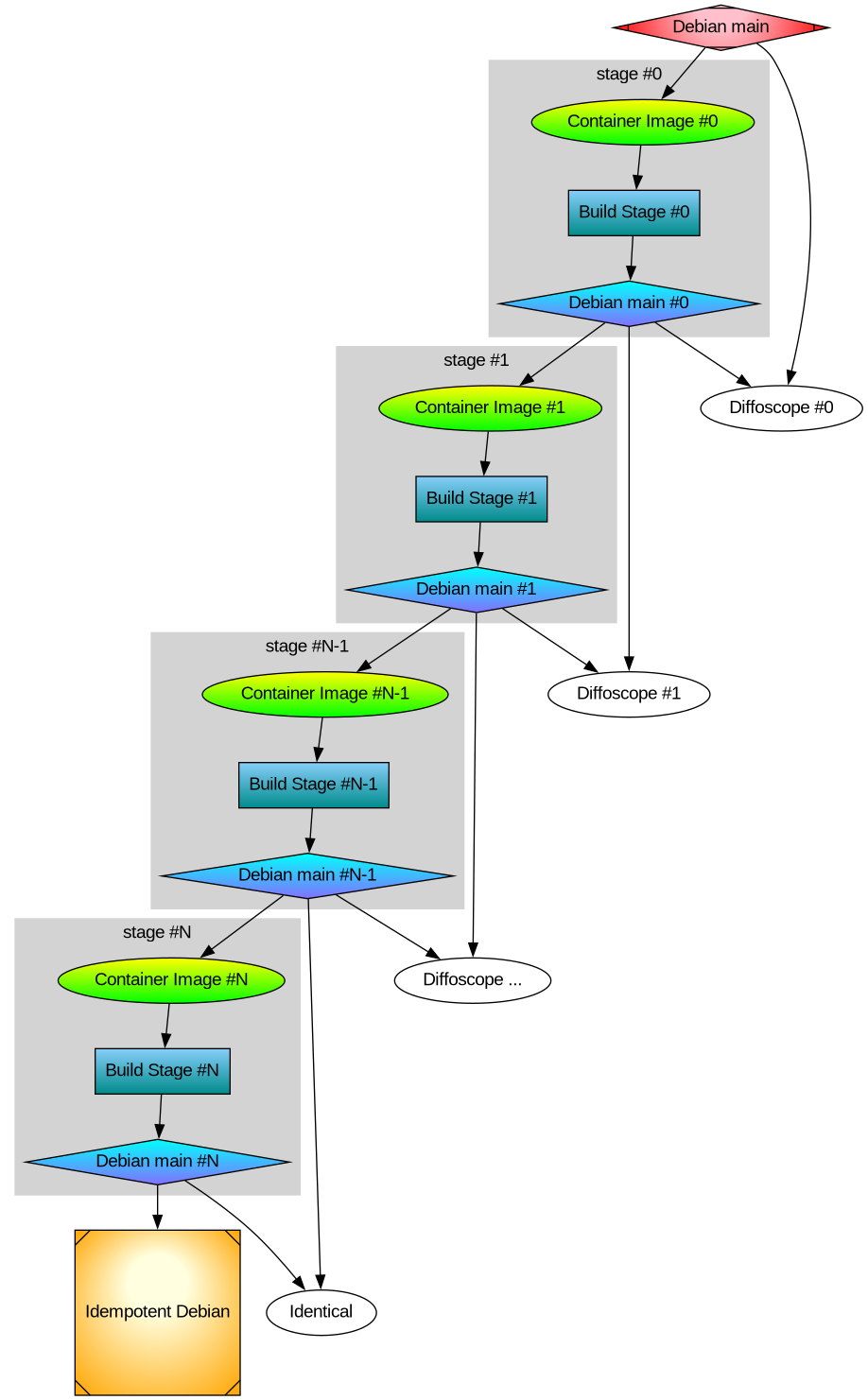
I rebuilt (the top-50 popcon) Debian and Ubuntu packages, on amd64 and arm64, and compared the results a couple of months ago. Since then the Reproduce.Debian.net effort has been launched. Unlike my small experiment, that effort is a full-scale rebuild with more architectures. Their goal is to reproduce what is published in the Debian archive. One differences between these two approaches are the build inputs: The Reproduce Debian effort use the same build inputs which were used to build the published packages. I m using the latest version of published packages for the rebuild. What does that difference imply? I believe reproduce.debian.net will be able to reproduce more of the packages in the archive. If you build a C program using one version of GCC you will get some binary output; and if you use a later GCC version you are likely to end up with a different binary output. This is a good thing: we want GCC to evolve and produce better output over time. However it means in order to reproduce the binaries we publish and use, we need to rebuild them using whatever build dependencies were used to prepare those binaries. The conclusion is that we need to use the old GCC to rebuild the program, and this appears to be the Reproduce.Debian.Net approach. It would be a huge success if the Reproduce.Debian.net effort were to reach 100% reproducibility, and this seems to be within reach. However I argue that we need go further than that. Being able to rebuild the packages reproducible using older binary packages only begs the question: can we rebuild those older packages? I fear attempting to do so ultimately leads to a need to rebuild 20+ year old packages, with a non-negligible amount of them being illegal to distribute or are unable to build anymore due to bit-rot. We won t solve the Trusting Trust concern if our rebuild effort assumes some initial binary blob that we can no longer build from source code. I ve made an illustration of the effort I m thinking of, to reach something that is stronger than reproducible rebuilds. I am calling this concept a Idempotent Rebuild, which is an old concept that I believe is the same as John Gilmore has described many years ago.
The illustration shows how the Debian main archive is used as input to rebuild another stage #0 archive. This stage #0 archive can be compared with diffoscope to the main archive, and all differences are things that would be nice to resolve. The packages in the stage #0 archive is used to prepare a new container image with build tools, and the stage #0 archive is used as input to rebuild another version of itself, called the stage #1 archive. The differences between stage #0 and stage #1 are also useful to analyse and resolve. This process can be repeated many times. I believe it would be a useful property if this process terminated at some point, where the stage #N archive was identical to the stage #N-1 archive. If this would happen, I label the output archive as an Idempotent Rebuild of the distribution. How big is N today? The simplest assumption is that it is infinity. Any build timestamp embedded into binary packages will change on every iteration. This will cause the process to never terminate. Fixing embedded timestamps is something that the Reproduce.Debian.Net effort will also run into, and will have to resolve. What other causes for differences could there be? It is easy to see that generally if some output is not deterministic, such as the sort order of assembler object code in binaries, then the output will be different. Trivial instances of this problem will be caught by the reproduce.debian.net effort as well. Could there be higher order chains that lead to infinite N? It is easy to imagine the existence of these, but I don t know how they would look like in practice. An ideal would be if we could get down to N=1. Is that technically possible? Compare building GCC, it performs an initial stage 0 build using the system compiler to produce a stage 1 intermediate, which is used to build itself again to stage 2. Stage 1 and 2 is compared, and on success (identical binaries), the compilation succeeds. Here N=2. But this is performed using some unknown system compiler that is normally different from the GCC version being built. When rebuilding a binary distribution, you start with the same source versions. So it seems N=1 could be possible. I m unhappy to not be able to report any further technical progress now. The next step in this effort is to publish the stage #0 build artifacts in a repository, so they can be used to build stage #1. I already showed that stage #0 was around ~30% reproducible compared to the official binaries, but I didn t save the artifacts in a reusable repository. Since the official binaries were not built using the latest versions, it is to be expected that the reproducibility number is low. But what happens at stage #1? The percentage should go up: we are now compare the rebuilds with an earlier rebuild, using the same build inputs. I m eager to see this materialize, and hope to eventually make progress on this. However to build stage #1 I believe I need to rebuild a much larger number packages in stage #0, it could be roughly similar to the build-essentials-depends package set. I believe the ultimate end goal of Idempotent Rebuilds is to be able to re-bootstrap a binary distribution like Debian from some other bootstrappable environment like Guix. In parallel to working on a achieving the 100% Idempotent Rebuild of Debian, we can setup a Guix environment that build Debian packages using Guix binaries. These builds ought to eventually converge to the same Debian binary packages, or there is something deeply problematic happening. This approach to re-bootstrap a binary distribution like Debian seems simpler than rebuilding all binaries going back to the beginning of time for that distribution. What do you think? PS. I fear that Debian main may have already went into a state where it is not able to rebuild itself at all anymore: the presence and assumption of non-free firmware and non-Debian signed binaries may have already corrupted the ability for Debian main to rebuild itself. To be able to complete the idempotent and bootstrapped rebuild of Debian, this needs to be worked out.

Russ Allbery: Review: Ghostdrift

Review: Ghostdrift, by Suzanne Palmer
Series: Finder Chronicles #4
Publisher: DAW
Copyright: May 2024
ISBN: 0-7564-1888-7
Format: Kindle
Pages: 378
Ghostdrift is a science fiction adventure and the fourth (and possibly final) book of the Finder Chronicles. You should definitely read this series in order and not start here, even though the plot of this book would stand alone. Following The Scavenger Door, in which he made enemies even more dramatically than he had in the previous books, Fergus Ferguson has retired to the beach on Coralla to become a tea master and take care of his cat. It's a relaxing, idyllic life and a much-needed total reset. Also, he's bored. The arrival of his alien friend Qai, in some kind of trouble and searching for him, is a complex balance between relief and disappointment. Bas Belos is one of the most notorious pirates of the Barrens. He has someone he wants Fergus to find: his twin sister, who disappeared ten years ago. Fergus has an unmatched reputation for finding things, so Belos kidnapped Qai's partner to coerce her into finding Fergus. It's not an auspicious beginning to a relationship, and Qai was ready to fight once they got her partner back, but Belos makes Fergus an offer of payment that, startlingly, is enough for him to take the job mostly voluntarily. Ghostdrift feels a bit like a return to Finder. Fergus is once again alone among strangers, on an assignment that he's mostly not discussing with others, piecing together clues and navigating tricky social dynamics. I missed his friends, particularly Ignatio, and while there are a few moments with AI ships, they play less of a role. But Fergus is so very good at what he does, and Palmer is so very good at writing it. This continues to be competence porn at its best. Belos's crew thinks Fergus is a pirate recruited from a prison colony, and he quietly sets out to win their trust with a careful balance of self-deprecation and unflappable skill, helped considerably by the hidden gift he acquired in Finder. The character development is subtle, but this feels like a Fergus who understands friendship and other people at a deeper and more satisfying level than the Fergus we first met three books ago. Palmer has a real talent for supporting characters and Ghostdrift is no exception. Belos's crew are criminals and murderers, and Palmer does remind the reader of that occasionally, but they're also humans with complex goals and relationships. Belos has earned their loyalty by being loyal and competent in a rough world where those attributes are rare. The morality of this story reminds me of infiltrating a gang: the existence of the gang is not a good thing, and the things they do are often indefensible, but they are an understandable reaction to a corrupt social system. The cops (in this case, the Alliance) are nearly as bad, as we've learned over the past couple of books, and considerably more insufferable. Fergus balances the ethical complexity in a way that I found satisfyingly nuanced, while quietly insisting on his own moral lines. There is a deep science fiction plot here, possibly the most complex of the series so far. The disappearance of Belos's sister is the tip of an iceberg that leads to novel astrophysics, dangerous aliens, mysterious ruins, and an extended period on a remote and wreck-strewn planet. I groaned a bit when the characters ended up on the planet, since treks across primitive alien terrain with jury-rigged technology are one of my least favorite science fiction tropes, but I need not have worried. Palmer knows what she's doing; the pace of the plot does slow a bit at first, but it quickly picks up again, adding enough new setting and plot complications that I never had a chance to be bored by alien plants. It helps that we get another batch of excellent supporting characters for Fergus to observe and win over. This series is such great science fiction. Each book becomes my new favorite, and Ghostdrift is no exception. The skeleton of its plot is a satisfying science fiction mystery with multiple competing factions, hints of fascinating galactic politics, complicated technological puzzles, and a sense of wonder that reminds me of reading Larry Niven's Known Space series. But the characters are so much better and more memorable than classic SF; compared to Fergus, Niven's Louis Wu barely exists and is readily forgotten as soon as the story is over. Fergus starts as a quiet problem-solver, but so much character depth unfolds over the course of this series. The ending of this book was delightfully consistent with everything we've learned about Fergus, but also the sort of ending that it's hard to imagine the Fergus from Finder knowing how to want. Ghostdrift, like each of the books in this series, reaches a satisfying stand-alone conclusion, but there is no reason within the story for this to be the last of the series. The author's acknowledgments, however, says that this the end. I admit to being disappointed, since I want to read more about Fergus and there are numerous loose ends that could be explored. More importantly, though, I hope Palmer will write more novels in any universe of her choosing so that I can buy and read them. This is fantastic stuff. This review comes too late for the Hugo nominating deadline, but I hope Palmer gets a Best Series nomination for the Finder Chronicles as a whole. She deserves it. Rating: 9 out of 10

30 March 2025

Utkarsh Gupta: FOSS Activites in March 2025

Here s my 66th monthly but brief update about the activities I ve done in the F/L/OSS world.

Debian
This was my 75th month of actively contributing to Debian. I became a DM in late March 2019 and a DD on Christmas 19! \o/ There s a bunch of things I do, both, technical and non-technical. Here s what I did:
  • Updating Rails to v7.2.2.1 for Trixie.
  • Updating Redmine to v6.0.4 for Trixie.
  • Kickstarting the bursary team for DC25.
  • Mentoring for newcomers.
  • Moderation of -project mailing list.

Ubuntu
This was my 50th month of actively contributing to Ubuntu. Now that I joined Canonical to work on Ubuntu full-time, there s a bunch of things I do! \o/ I mostly worked on different things, I guess. I was too lazy to maintain a list of things I worked on so there s no concrete list atm. Maybe I ll get back to this section later or will start to list stuff from the fall, as I was doing before. :D

Debian (E)LTS
Debian Long Term Support (LTS) is a project to extend the lifetime of all Debian stable releases to (at least) 5 years. Debian LTS is not handled by the Debian security team, but by a separate group of volunteers and companies interested in making it a success. And Debian Extended LTS (ELTS) is its sister project, extending support to the stretch and jessie release (+2 years after LTS support). This was my 66th month as a Debian LTS and 53rd month as a Debian ELTS paid contributor.
I worked for 15.00 hours for LTS and 7.50 hours for ELTS. I did the following things:
  • [ELTS] Worked on backporting patches for adminer.
  • [E/LTS] Working on the musl fixes for bullseye. Taking it forward from where it was left off by Chris.
    • Co-ordiating with Santiago to see how to best get the reproducer to test the update.
    • Plan is to reproduce it myself but then reach out to Adrian if that doesn t work out.
    • Also makes sense to upload to LTS first, let it settle there, and then look at ELTS.
  • [LTS] Attended the LTS meeting on IRC. Summary here.
  • [stable] Co-ordinated with the Security team to fix rails in bookworm via 2:6.1.7.10+dfsg-1~deb12u1.
    • Fixes: CVE-2023-28362, CVE-2023-38037, CVE-2024-26144, CVE-2024-28103, CVE-2024-41128, CVE-2024-47887, CVE-2024-47888, CVE-2024-47889, and CVE-2024-54133.
    • Released as DSA 5881-1.
  • [stable] Co-ordinated with the Security team to fix ruby-rack in bookworm via 2.2.13-1~deb12u1.
    • Fixes: CVE-2025-27610, CVE-2025-27111, and CVE-2025-25184.
    • Released as DSA 5886-1.
  • [stable] Partly co-ordinated with the Security team to fix ruby-saml in bookworm.

Until next time.
:wq for today.

Russ Allbery: Review: Cascade Failure

Review: Cascade Failure, by L.M. Sagas
Series: Ambit's Run #1
Publisher: Tor
Copyright: 2024
ISBN: 1-250-87126-3
Format: Kindle
Pages: 407
Cascade Failure is a far-future science fiction adventure with a small helping of cyberpunk vibes. It is the first of a (so far) two-book series, and was the author's first novel. The Ambit is an old and small Guild ship, not much to look at, but it holds a couple of surprises. One is its captain, Eoan, who is an AI with a deep and insatiable curiosity that has driven them and their ship farther and farther out into the Spiral. The other is its surprisingly competent crew: a battle-scarred veteran named Saint who handles the fighting, and a talented engineer named Nash who does literally everything else. The novel opens with them taking on supplies at Aron Outpost. A supposed Guild deserter named Jalsen wanders into the ship looking for work. An AI ship with a found-family crew is normally my catnip, so I wanted to love this book. Alas, I did not. There were parts I liked. Nash is great: snarky, competent, and direct. Eoan is a bit distant and slightly more simplistic of a character than I was expecting, but I appreciated the way Sagas put them firmly in charge of the ship and departed from the conventional AI character presentation. Once the plot starts in earnest (more on that in a moment), we meet Anke, the computer hacker, whose charming anxiety reaction is a complete inability to stop talking and who adds some needed depth to the character interactions. There's plenty of action, a plot that makes at least some sense, and a few moments that almost achieved the emotional payoff the author was attempting. Unfortunately, most of the story focuses on Saint and Jal, and both of them are irritatingly dense cliches. The moment Jal wanders onto the Ambit in the first chapter, the reader is informed that Jal, Saint, and Eoan have a history. The crew of the Ambit spent a year looking for Jal and aren't letting go of him now that they've found him. Jal, on the other hand, clearly blames Saint for something and is not inclined to trust him. Okay, fine, a bit generic of a setup but the writing moved right along and I was curious enough. It then takes a full 180 pages before the reader finds out what the hell is going on with Saint and Jal. Predictably, it's a stupid misunderstanding that could have been cleared up with one conversation in the second chapter. Cascade Failure does not contain a romance (and to the extent that it hints at one, it's a sapphic romance), but I swear Saint and Jal are both the male protagonist from a certain type of stereotypical heterosexual romance novel. They're both the brooding man with the past, who is too hurt to trust anyone and assumes the worst because he's unable to use his words or ask an open question and then listen to the answer. The first half of this book is them being sullen at each other at great length while both of them feel miserable. Jal keeps doing weird and suspicious things to resolve a problem that would have been far more easily resolved by the rest of the crew if he would offer any explanation at all. It's not even suspenseful; we've read about this character enough times to know that he'll turn out to have a heart of gold and everything will be a misunderstanding. I found it tedious. Maybe people who like slow burn romances with this character type will have a less negative reaction. The real plot starts at about the time Saint and Jal finally get their shit sorted out. It turns out to have almost nothing to do with either of them. The environmental control systems of worlds are suddenly failing (hence the book title), and Anke, the late-arriving computer programmer and terraforming specialist, has a rather wild theory about what's happening. This leads to a lot of action, some decent twists, and a plot that felt very cyberpunk to me, although unfortunately it culminates in an absurdly-cliched action climax. This book is an action movie that desperately wants to make you feel all the feels, and it worked about as well as that typically works in action movies for me. Jaded cynicism and an inability to communicate are not the ways to get me to have an emotional reaction to a book, and Jal (once he finally starts talking) is so ridiculously earnest that it's like reading the adventures of a Labrador puppy. There was enough going on that it kept me reading, but not enough for the story to feel satisfying. I needed a twist, some depth, way more Nash and Anke and way less of the men, something. Everyone is going to compare this book to Firefly, but Firefly had better banter, created more complex character interactions due to the larger and more varied crew, and played the cynical mercenary for laughs instead of straight, all of which suited me better. This is not a bad book, particularly once it gets past the halfway point, but it's not that memorable either, at least for me. If you're looking for a space adventure with heavy action hero and military SF vibes that wants to be about Big Feelings but gets there in mostly obvious ways, you could do worse. If you're looking for a found-family starship crew story more like Becky Chambers, I think you'll find this one a bit too shallow and obvious. Not really recommended, although there's nothing that wrong with it and I'm sure other people's experience will differ. Followed by Gravity Lost, which I'm unlikely to read. Rating: 6 out of 10

29 March 2025

Petter Reinholdtsen: Theora 1.2.0 released

Following the 1.2.0beta1 release two weeks ago, a final 1.2.0 release of theora was wrapped up today. This new release is tagged in the Xiph gitlab theora instance and you can fetch it from the Theora home page as soon as someone with access find time to update the web pages. In the mean time (automatically removed after 14 days) the release tarball is also available as a git build artifact from CI build of the release tag. The list of changes since The 1.2.0beta release from the CHANGES file in the tarball look like this:
libtheora 1.2.0 (2025 March 29)
  • Bumped minor SONAME versions as oc_comment_unpack() implementation changed.
  • Added example wrapper script encoder_example_ffmpeg (#1601 #2336).
  • Improve comment handling on platforms where malloc(0) return NULL (#2304).
  • Added pragma in example code to quiet clang op precedenca warnings.
  • Adjusted encoder_example help text.
  • Adjusted README, CHANGES, pkg-config and spec files to better reflect current release (#2331 #2328).
  • Corrected english typos in source and build system.
  • Switched http links to https in doc and comments where relevant. Did not touch RFC drafts.
As usual, if you use Bitcoin and want to show your support of my activities, please send Bitcoin donations to my address 15oWEoG9dUPovwmUL9KWAnYRtNJEkP1u1b.

28 March 2025

Ian Jackson: Rust is indeed woke

Rust, and resistance to it in some parts of the Linux community, has been in my feed recently. One undercurrent seems to be the notion that Rust is woke (and should therefore be rejected as part of culture wars). I m going to argue that Rust, the language, is woke. So the opponents are right, in that sense. Of course, as ever, dissing something for being woke is nasty and fascist-adjacent. Community The obvious way that Rust may seem woke is that it has the trappings, and many of the attitudes and outcomes, of a modern, nice, FLOSS community. Rust certainly does better than toxic environments like the Linux kernel, or Debian. This is reflected in a higher proportion of contributors from various kinds of minoritised groups. But Rust is not outstanding in this respect. It certainly has its problems. Many other projects do as well or better. And this is well-trodden ground. I have something more interesting to say: Technological values - particularly, compared to C/C++ Rust is woke technology that embodies a woke understanding of what it means to be a programming language. Ostensible values Let s start with Rust s strapline:
A language empowering everyone to build reliable and efficient software.
Surprisingly, this motto is not mere marketing puff. For Rustaceans, it is a key goal which strongly influences day-to-day decisions (big and small). Empowering everyone is a key aspect of this, which aligns with my own personal values. In the Rust community, we care about empowerment. We are trying to help liberate our users. And we want to empower everyone because everyone is entitled to technological autonomy. (For a programming language, empowering individuals means empowering their communities, of course.) This is all very airy-fairy, but it has concrete consequences: Attitude to the programmer s mistakes In Rust we consider it a key part of our job to help the programmer avoid mistakes; to limit the consequences of mistakes; and to guide programmers in useful directions. If you write a bug in your Rust program, Rust doesn t blame you. Rust asks how could the compiler have spotted that bug . This is in sharp contrast to C (and C++). C nowadays is an insanely hostile programming environment. A C compiler relentlessly scours your program for any place where you may have violated C s almost incomprehensible rules, so that it can compile your apparently-correct program into a buggy executable. And then the bug is considered your fault. These aren t just attitudes implicitly embodied in the software. They are concrete opinions expressed by compiler authors, and also by language proponents. In other words: Rust sees programmers writing bugs as a systemic problem, which must be addressed by improvements to the environment and the system. The toxic parts of the C and C++ community see bugs as moral failings by individual programmers. Sound familiar? The ideology of the hardcore programmer Programming has long suffered from the myth of the rockstar . Silicon Valley techbro culture loves this notion. In reality, though, modern information systems are far too complicated for a single person. Developing systems is a team sport. Nontechnical, and technical-adjacent, skills are vital: clear but friendly communication; obtaining and incorporating the insights of every member of your team; willingness to be challenged. Community building. Collaboration. Governance. The hardcore C community embraces the rockstar myth: they imagine that a few super-programmers (or super-reviewers) are able to spot bugs, just by being so brilliant. Of course this doesn t actually work at all, as we can see from the atrocious bugfest that is the Linux kernel. These rockstars want us to believe that there is a steep hierarchy in programmming; that they are at the top of this hierarchy; and that being nice isn t important. Sound familiar? Memory safety as a power struggle Much of the modern crisis of software reliability arises from memory-unsafe programming languages, mostly C and C++. Addressing this is a big job, requiring many changes. This threatens powerful interests; notably, corporations who want to keep shipping junk. (See also, conniptions over the EU Product Liability Directive.) The harms of this serious problem mostly fall on society at large, but the convenience of carrying on as before benefits existing powerful interests. Sound familiar? Memory safety via Rust as a power struggle Addressing this problem via Rust is a direct threat to the power of established C programmers such as gatekeepers in the Linux kernel. Supplanting C means they will have to learn new things, and jostle for status against better Rustaceans, or be replaced. More broadly, Rust shows that it is practical to write fast, reliable, software, and that this does not need (mythical) rockstars . So established C programmer experts are existing vested interests, whose power is undermined by (this approach to) tackling this serious problem. Sound familiar? Notes This is not a RIIR manifesto I m not saying we should rewrite all the world s C in Rust. We should not try to do that. Rust is often a good choice for new code, or when a rewrite or substantial overhaul is needed anyway. But we re going to need other techniques to deal with all of our existing C. CHERI is a very promising approach. Sandboxing, emulation and automatic translation are other possibilities. The problem is a big one and we need a toolkit, not a magic bullet. But as for Linux: it is a scandal that substantial new drivers and subsystems are still being written in C. We could have been using Rust for new code throughout Linux years ago, and avoided very many bugs. Those bugs are doing real harm. This is not OK. Disclosure I first learned C from K&R I in 1989. I spent the first three decades of my life as a working programmer writing lots and lots of C. I ve written C++ too. I used to consider myself an expert C programmer, but nowadays my C is a bit rusty and out of date. Why is my C rusty? Because I found Rust, and immediately liked and adopted it (despite its many faults). I like Rust because I care that the software I write actually works: I care that my code doesn t do harm in the world. On the meaning of woke The original meaning of woke is something much more specific, to do with racism. For the avoidance of doubt, I don t think Rust is particularly antiracist. I m using woke (like Rust s opponents are) in the much broader, and now much more prevalent, culture wars sense. Pithy conclusion If you re a senior developer who knows only C/C++, doesn t want their authority challenged, and doesn t want to have to learn how to write better software, you should hate Rust. Also you should be fired.
Edited 2025-03-28 17:10 UTC to fix minor problems and add a new note about the meaning of the word "woke".


comment count unavailable comments

John Goerzen: Why You Should (Still) Use Signal As Much As Possible

As I write this in March 2025, there is a lot of confusion about Signal messenger due to the recent news of people using Signal in government, and subsequent leaks. The short version is: there was no problem with Signal here. People were using it because they understood it to be secure, not the other way around. Both the government and the Electronic Frontier Foundation recommend people use Signal. This is an unusual alliance, and in the case of the government, was prompted because it understood other countries had a persistent attack against American telephone companies and SMS traffic. So let s dive in. I ll cover some basics of what security is, what happened in this situation, and why Signal is a good idea. This post isn t for programmers that work with cryptography every day. Rather, I hope it can make some of these concepts accessible to everyone else.

What makes communications secure? When most people are talking about secure communications, they mean some combination of these properties:
  1. Privacy - nobody except the intended recipient can decode a message.
  2. Authentication - guarantees that the person you are chatting with really is the intended recipient.
  3. Ephemerality - preventing a record of the communication from being stored. That is, making it more like a conversation around the table than a written email.
  4. Anonymity - keeping your set of contacts to yourself and even obfuscating the fact that communications are occurring.
If you think about it, most people care the most about the first two. In fact, authentication is a key part of privacy. There is an attack known as man in the middle in which somebody pretends to be the intended recipient. The interceptor reads the messages, and then passes them on to the real intended recipient. So we can t really have privacy without authentication. I ll have more to say about these later. For now, let s discuss attack scenarios.

What compromises security? There are a number of ways that security can be compromised. Let s think through some of them:

Communications infrastructure snooping Let s say you used no encryption at all, and connected to public WiFi in a coffee shop to send your message. Who all could potentially see it?
  • The owner of the coffee shop s WiFi
  • The coffee shop s Internet provider
  • The recipient s Internet provider
  • Any Internet providers along the network between the sender and the recipient
  • Any government or institution that can compel any of the above to hand over copies of the traffic
  • Any hackers that compromise any of the above systems
Back in the early days of the Internet, most traffic had no encryption. People were careful about putting their credit cards into webpages and emails because they knew it was easy to intercept them. We have been on a decades-long evolution towards more pervasive encryption, which is a good thing. Text messages (SMS) follow a similar path to the above scenario, and are unencrypted. We know that all of the above are ways people s texts can be compromised; for instance, governments can issue search warrants to obtain copies of texts, and China is believed to have a persistent hack into western telcos. SMS fails all four of our attributes of secure communication above (privacy, authentication, ephemerality, and anonymity). Also, think about what information is collected from SMS and by who. Texts you send could be retained in your phone, the recipient s phone, your phone company, their phone company, and so forth. They might also live in cloud backups of your devices. You only have control over your own phone s retention. So defenses against this involve things like:
  • Strong end-to-end encryption, so no intermediate party even the people that make the app can snoop on it.
  • Using strong authentication of your peers
  • Taking steps to prevent even app developers from being able to see your contact list or communication history
You may see some other apps saying they use strong encryption or use the Signal protocol. But while they may do that for some or all of your message content, they may still upload your contact list, history, location, etc. to a central location where it is still vulnerable to these kinds of attacks. When you think about anonymity, think about it like this: if you send a letter to a friend every week, every postal carrier that transports it even if they never open it or attempt to peak inside will be able to read the envelope and know that you communicate on a certain schedule with that friend. The same can be said of SMS, email, or most encrypted chat operators. Signal s design prevents it from retaining even this information, though nation-states or ISPs might still be able to notice patterns (every time you send something via Signal, your contact receives something from Signal a few milliseconds later). It is very difficult to provide perfect anonymity from well-funded adversaries, even if you can provide very good privacy.

Device compromise Let s say you use an app with strong end-to-end encryption. This takes away some of the easiest ways someone could get to your messages. But it doesn t take away all of them. What if somebody stole your phone? Perhaps the phone has a password, but if an attacker pulled out the storage unit, could they access your messages without a password? Or maybe they somehow trick or compel you into revealing your password. Now what? An even simpler attack doesn t require them to steal your device at all. All they need is a few minutes with it to steal your SIM card. Now they can receive any texts sent to your number - whether from your bank or your friend. Yikes, right? Signal stores your data in an encrypted form on your device. It can protect it in various ways. One of the most important protections is ephemerality - it can automatically delete your old texts. A text that is securely erased can never fall into the wrong hands if the device is compromised later. An actively-compromised phone, though, could still give up secrets. For instance, what if a malicious keyboard app sent every keypress to an adversary? Signal is only as secure as the phone it runs on but still, it protects against a wide variety of attacks.

Untrustworthy communication partner Perhaps you are sending sensitive information to a contact, but that person doesn t want to keep it in confidence. There is very little you can do about that technologically; with pretty much any tool out there, nothing stops them from taking a picture of your messages and handing the picture off.

Environmental compromise Perhaps your device is secure, but a hidden camera still captures what s on your screen. You can take some steps against things like this, of course.

Human error Sometimes humans make mistakes. For instance, the reason a reporter got copies of messages recently was because a participant in a group chat accidentally added him (presumably that participant meant to add someone else and just selected the wrong name). Phishing attacks can trick people into revealing passwords or other sensitive data. Humans are, quite often, the weakest link in the chain.

Protecting yourself So how can you protect yourself against these attacks? Let s consider:
  • Use a secure app like Signal that uses strong end-to-end encryption where even the provider can t access your messages
  • Keep your software and phone up-to-date
  • Be careful about phishing attacks and who you add to chat rooms
  • Be aware of your surroundings; don t send sensitive messages where people might be looking over your shoulder with their eyes or cameras
There are other methods besides Signal. For instance, you could install GnuPG (GPG) on a laptop that has no WiFi card or any other way to connect it to the Internet. You could always type your messages on that laptop, encrypt them, copy the encrypted text to a floppy disk (or USB device), take that USB drive to your Internet computer, and send the encrypted message by email or something. It would be exceptionally difficult to break the privacy of messages in that case (though anonymity would be mostly lost). Even if someone got the password to your secure laptop, it wouldn t do them any good unless they physically broke into your house or something. In some ways, it is probably safer than Signal. (For more on this, see my article How gapped is your air?) But, that approach is hard to use. Many people aren t familiar with GnuPG. You don t have the convenience of sending a quick text message from anywhere. Security that is hard to use most often simply isn t used. That is, you and your friends will probably just revert back to using insecure SMS instead of this GnuPG approach because SMS is so much easier. Signal strikes a unique balance of providing very good security while also being practical, easy, and useful. For most people, it is the most secure option available. Signal is also open source; you don t have to trust that it is as secure as it says, because you can inspect it for yourself. Also, while it s not federated, I previously addressed that.

Government use If you are a government, particularly one that is highly consequential to the world, you can imagine that you are a huge target. Other nations are likely spending billions of dollars to compromise your communications. Signal itself might be secure, but if some other government can add spyware to your phones, or conduct a successful phishing attack, you can still have your communications compromised. I have no direct knowledge, but I think it is generally understood that the US government maintains communications networks that are entirely separate from the Internet and can only be accessed from secure physical locations and secure rooms. These can be even more secure than the average person using Signal because they can protect against things like environmental compromise, human error, and so forth. The scandal in March of 2025 happened because government employees were using Signal rather than official government tools for sensitive information, had taken advantage of Signal s ephemerality (laws require records to be kept), and through apparent human error had directly shared this information with a reporter. Presumably a reporter would have lacked access to the restricted communications networks in the first place, so that wouldn t have been possible. This doesn t mean that Signal is bad. It just means that somebody that can spend billions of dollars on security can be more secure than you. Signal is still a great tool for people, and in many cases defeats even those that can spend lots of dollars trying to defeat it. And remember - to use those restricted networks, you have to go to specific rooms in specific buildings. They are still not as convenient as what you carry around in your pocket.

Conclusion Signal is practical security. Do you want phone companies reading your messages? How about Facebook or X? Have those companies demonstrated that they are completely trustworthy throughout their entire history? I say no. So, go install Signal. It s the best, most practical tool we have.
This post is also available on my website, where it may be periodically updated.

Freexian Collaborators: Monthly report about Debian Long Term Support, February 2025 (by Roberto C. S nchez)

Like each month, have a look at the work funded by Freexian s Debian LTS offering.
Debian LTS contributors In February, 18 contributors have been paid to work on Debian LTS, their reports are available:
  • Abhijith PA did 10.0h (out of 8.0h assigned and 6.0h from previous period), thus carrying over 4.0h to the next month.
  • Adrian Bunk did 12.0h (out of 0.0h assigned and 63.5h from previous period), thus carrying over 51.5h to the next month.
  • Andrej Shadura did 10.0h (out of 6.0h assigned and 4.0h from previous period).
  • Bastien Roucari s did 20.0h (out of 20.0h assigned).
  • Ben Hutchings did 12.0h (out of 8.0h assigned and 16.0h from previous period), thus carrying over 12.0h to the next month.
  • Chris Lamb did 18.0h (out of 18.0h assigned).
  • Daniel Leidert did 23.0h (out of 20.0h assigned and 6.0h from previous period), thus carrying over 3.0h to the next month.
  • Emilio Pozuelo Monfort did 53.0h (out of 53.0h assigned and 0.75h from previous period), thus carrying over 0.75h to the next month.
  • Guilhem Moulin did 11.0h (out of 3.25h assigned and 16.75h from previous period), thus carrying over 9.0h to the next month.
  • Jochen Sprickerhof did 27.0h (out of 30.0h assigned), thus carrying over 3.0h to the next month.
  • Lee Garrett did 11.75h (out of 9.5h assigned and 44.25h from previous period), thus carrying over 42.0h to the next month.
  • Markus Koschany did 40.0h (out of 40.0h assigned).
  • Roberto C. S nchez did 7.0h (out of 14.75h assigned and 9.25h from previous period), thus carrying over 17.0h to the next month.
  • Santiago Ruano Rinc n did 19.75h (out of 21.75h assigned and 3.25h from previous period), thus carrying over 5.25h to the next month.
  • Sean Whitton did 6.0h (out of 6.0h assigned).
  • Sylvain Beucler did 52.5h (out of 14.75h assigned and 39.0h from previous period), thus carrying over 1.25h to the next month.
  • Thorsten Alteholz did 11.0h (out of 11.0h assigned).
  • Tobias Frost did 17.0h (out of 17.0h assigned).

Evolution of the situation In February, we have released 38 DLAs.
  • Notable security updates:
    • pam-u2f, prepared by Patrick Winnertz, fixed an authentication bypass vulnerability
    • openjdk-17, prepared by Emilio Pozuelo Monfort, fixed an authorization bypass/information disclosure vulnerability
    • firefox-esr, prepared by Emilio Pozuelo Monfort, fixed several vulnerabilities
    • thunderbird, prepared by Emilio Pozuelo Monfort, fixed several vulnerabilities
    • postgresql-13, prepared by Christoph Berg, fixed an SQL injection vulnerability
    • freerdp2, prepared by Tobias Frost, fixed several vulnerabilities
    • openssh, prepared by Colin Watson, fixed a machine-in-the-middle vulnerability
LTS contributors Emilio Pozuelo Monfort and Santiago Ruano Rinc n coordinated the administrative aspects of LTS updates of postgresql-13 and pam-u2f, which were prepared by the respective maintainers, to whom we are most grateful. As has become the custom of the LTS team, work is under way on a number of package updates targeting Debian 12 (codename bookworm ) with fixes for a variety of vulnerabilities. In February, Guilhem Moulin prepared an upload of sssd, while several other updates are still in progress. Bastien Roucari s prepared an upload of krb5 for unstable as well. Given the importance of the Debian Security Tracker to the work of the LTS Team, we regularly contribute improvements to it. LTS contributor Emilio Pozuelo Monfort reviewed and merged a change to improve performance, and then dealt with unexpected issues that arose as a result. He also made improvements in the processing of CVEs which are not applicable to Debian. Looking to the future (the release of Debian 13, codename trixie , and beyond), LTS contributor Santiago Ruano Rinc n has initiated a conversation among the broader community involved in the development of Debian. The purpose of the discussion is to explore ways to improve the long term supportability of packages in Debian, specifically by focusing effort on ensuring that each Debian release contains the best supported upstream version of packages with a history of security issues.

Thanks to our sponsors Sponsors that joined recently are in bold.

27 March 2025

Scarlett Gately Moore: KDE Snap updates, Kubuntu Beta testing, Life updates!

Help us Beta test Kubuntu Plucky Puffin!
Kubuntu work: Fixed an issue in apparmor preventing QT6 webengine applications from starting. Beta testing! KDE Snaps: Updated Qt6 to 6.8.2 Updated Kf6 6.11.0 Rolling out 25.04 RC applications! You can find them in the candidate channel! Life: I have decided to strike out on my own. I can t take any more rejections! Honestly, I don t blame them, I wouldn t want a one armed engineer either. However, I have persevered and accomplished quite a bit with my one arm! So I have decided to take a leap of faith and with your support for open source work and a resurrected side gig of web development I will survive. If you can help sponsor my work, anything at all, even a dollar! I would be eternally grateful. I have several methods to do so: If you want your cool application packaged in a variety of formats please contact me! If you want focused help with an annoying bug, please contact me! Contact me for any and all kinds of help, if I can t do it, I will say so. Do you need web work? Someone to maintain your website? I can do that too! Portfolio Thank you all for your support in this new adventure!

25 March 2025

Dirk Eddelbuettel: littler 0.3.21 on CRAN: Lots Moar Features!

max-heap image The twentysecond release of littler as a CRAN package landed on CRAN just now, following in the now nineteen year history (!!) as a (initially non-CRAN) package started by Jeff in 2006, and joined by me a few weeks later. littler is the first command-line interface for R as it predates Rscript. It allows for piping as well for shebang scripting via #!, uses command-line arguments more consistently and still starts faster. It also always loaded the methods package which Rscript only began to do in recent years. littler lives on Linux and Unix, has its difficulties on macOS due to some-braindeadedness there (who ever thought case-insensitive filesystems as a default were a good idea?) and simply does not exist on Windows (yet the build system could be extended see RInside for an existence proof, and volunteers are welcome!). See the FAQ vignette on how to add it to your PATH. A few examples are highlighted at the Github repo:, as well as in the examples vignette. This release, the first is almost exactly one year, brings enhancements to six scripts as well as three new ones. The new ones crup.r offers CRan UPloads from the command-line, deadliners.r lists CRAN package by CRAN deadline, and wb.r uploads to win-builder (replacing an older shell script of mine). Among the updated ones, kitten.r now creates more complete DESCRIPTION files in the packages it makes, and several scripts support additional options. A number of changes were made to packaging as well, some of which were contributed by Jon and Michael which is of course always greatly appreciated. The trigger for the release was, just like for RQuantLib earlier today, a CRAN nag on bashisms half of which actually false here it was in a comment only. Oh well. The full change description follows.

Changes in littler version 0.3.21 (2025-03-24)
  • Changes in examples scripts
    • Usage text for ciw.r is improved, new options were added (Dirk)
    • The noble release is supported by r2u.r (Dirk)
    • The installRub.r script has additional options (Dirk)
    • The ttlt.r script has a new load_package argument (Dirk)
    • A new script deadliners.r showing CRAN packages 'under deadline' has been added, and then refined (Dirk)
    • The kitten.r script can now use whoami and argument githubuser on the different *kitten helpers it calls (Dirk)
    • A new script wb.r can upload to win-builder (Dirk)
    • A new script crup.r can upload a CRAN submission (Dirk)
    • In rcc.r, the return from rcmdcheck is now explicitly printed (Dirk)
    • In r2u.r the dry-run option is passed to the build command (Dirk)
  • Changes in package
    • Regular updates to badges, continuous integration, DESCRIPTION and configure.ac (Dirk)
    • Errant osVersion return value are handled more robustly (Michael Chirico in #121)
    • The current run-time path is available via variable LITTLER_SCRIPT_PATH (Jon Clayden in #122)
    • The cleanup script remove macOS debug symbols (Jon Clayden in #123)

My CRANberries service provides a comparison to the previous release. Full details for the littler release are provided as usual at the ChangeLog page, and also on the package docs website. The code is available via the GitHub repo, from tarballs and now of course also from its CRAN page and via install.packages("littler"). Binary packages are available directly in Debian as well as (in a day or two) Ubuntu binaries at CRAN thanks to the tireless Michael Rutter. Comments and suggestions are welcome at the GitHub repo.

This post by Dirk Eddelbuettel originated on his Thinking inside the box blog. If you like this or other open-source work I do, you can sponsor me at GitHub.

Next.

Previous.