Search Results: "rra"

21 April 2017

Ritesh Raj Sarraf: Indian Economy

This has gotten me finally ask the question

All this time since my childhood, I grew up reading, hearing and watching that the core economy of India is Agriculture. And that it needs the highest bracket in the budgets of the country. It still applies today. Every budget has special waivers for the agriculture sector, typically in hundreds of thousands of crores in India Rupees. The most recent to mention is INR 27420 Crores waived off for just a single state (Uttar Pradesh), as was promised by the winning party during their campaign. Wow. Quick search yields that I am not alone to notice this. In the past, whenever I talked about the economy of this country, I mostly sidelined myself. Because I never studied here. And neither did I live here much during my childhood or teenage days. Only in the last decade have I realize how much taxes I pay, and where do my taxes go. I do see a justification for these loan waivers though. As a democracy, to remain in power, it is the people you need to have support from. And if your 1.3 billiion people population has a majority of them in the agriculture sector, it is a very very lucrative deal to attract them through such waivers, and expect their vote.

Here's another snippet from Wikipedia on the same topic:

Agricultural Debt Waiver and Debt Relief Scheme[edit]

On 29 February 2008, P. Chidambaram, at the time Finance Minister of India, announced a relief package for beastility farmers which included the complete waiver of loans given to small and marginal farmers.[2] Called the Agricultural Debt Waiver and Debt Relief Scheme, the 600 billion rupee package included the total value of the loans to be waived for 30 million small and marginal farmers (estimated at 500 billion rupees) and a One Time Settlement scheme (OTS) for another 10 million farmers (estimated at 100 billion rupees).[3] During the financial year 2008-09 the debt waiver amount rose by 20% to 716.8 billion rupees and the overall benefit of the waiver and the OTS was extended to 43 million farmers.[4] In most of the Indian States the number of small and marginal farmers ranges from 70% to 94% of the total number of farmers

And not to forget how many people pay taxes in India. To quote an unofficial statement from an Indian Media House

Only about 1 percent of India's population paid tax on their earnings in the year 2013, according to the country's income tax data, published for the first time in 16 years.

The report further states that a total of 28.7 million individuals filed income tax returns, of which 16.2 million did not pay any tax, leaving only about 12.5 million tax-paying individuals, which is just about 1 percent of the 1.23 billion population of India in the year 2013.

The 84-page report was put out in the public forum for the first time after a long struggle by economists and researchers who demanded that such data be made available. In a press release, a senior official from India's income tax department said the objective of publishing the data is to encourage wider use and analysis by various stakeholders including economists, students, researchers and academics for purposes of tax policy formulation and revenue forecasting.

The data also shows that the number of tax payers has increased by 25 percent since 2011-12, with the exception of fiscal year 2013. The year 2014-15 saw a rise to 50 million tax payers, up from 40 million three years ago. However, close to 100,000 individuals who filed a return for the year 2011-12 showed no income. The report brings to light low levels of tax collection and a massive amount of income inequality in the country, showing the rich aren't paying enough taxes.

Low levels of tax collection could be a challenge for the current government as it scrambles for money to spend on its ambitious plans in areas such as infrastructure and science & technology. Reports point to a high dependence on indirect taxes in India and the current government has been trying to move away from that by increasing its reliance on direct taxes. Official data show that the dependence has come down from 5.93 percent in 2008-09 to 5.47 percent in 2015-16.

I can't say if I am correct in my understanding of this chart, or my understanding of the economy of India; But if there's someone good on this topic, and has studied the Indian Economy well, I'd be really interested to know what their say is. Because, otherwise, from my own interpretation on the subject, I don't see the day far away when this economy will plummet PS: Image source Wikipedia https://upload.wikimedia.org/wikipedia/commons/2/2e/1951_to_2013_Trend_C...

Categories:

Keywords:

Like:

Joachim Breitner: veggies: Haskell code generation from scratch

How hard it is to write a compiler for Haskell Core? Not too hard, actually! I wish we had a formally verified compiler for Haskell, or at least for GHC s intermediate language Core. Now formalizing that part of GHC itself seems to be far out of reach, with the many phases the code goes through (Core to STG to CMM to Assembly or LLVM) and optimizations happening at all of these phases and the many complicated details to the highly tuned GHC runtime (pointer tagging, support for concurrency and garbage collection).

Introducing Veggies So to make that goal of a formally verified compiler more feasible, I set out and implemented code generation from GHC s intermediate language Core to LLVM IR, with simplicity as the main design driving factor. You can find the result in the GitHub repository of veggies (the name derives from verifiable GHC ). If you clone that and run ./boot.sh some-directory, you will find that you can use the program some-directory/bin/veggies just like like you would use ghc. It comes with the full base library, so your favorite variant of HelloWorld might just compile and run. As of now, the code generation handles all the Core constructs (which is easy when you simply ignore all the types). It supports a good number of primitive operations, including pointers and arrays I implement these as need and has support for FFI calls into C.

Why you don't want to use Veggies Since the code generator was written with simplicity in mind, performance of the resulting code is abysmal: Everything is boxed, i.e. represented as pointer to some heap-allocated data, including unboxed integer values and unboxed tuples. This is very uniform and simplifies the code, but it is also slow, and because there is no garbage collection (and probably never will be for this project), will fill up your memory quickly. Also, the code is currently only supports 64bit architectures, and this is hard-coded in many places. There is no support for concurrency.

Why it might be interesting to you nevertheless So if it is not really usable to run programs with, should you care about it? Probably not, but maybe you do for one of these reasons:
  • You always wondered how a compiler for Haskell actually works, and reading through a little over a thousands lines of code is less daunting than reading through the 34k lines of code that is GHC s backend.
  • You have wacky ideas about Code generation for Haskell that you want to experiment with.
  • You have wacky ideas about Haskell that require special support in the backend, and want to prototype that.
  • You want to see how I use the GHC API to provide a ghc-like experience. (I copied GHC s Main.hs and inserted a few hooks, an approach I copied from GHCJS).
  • You want to learn about running Haskell programs efficiently, and starting from veggies, you can implement all the trick of the trade yourself and enjoy observing the speed-ups you get.
  • You want to compile Haskell code to some weird platform that is supported by LLVM, but where you for some reason cannot run GHC s runtime. (Because there are no threads and no garbage collection, the code generated by veggies does not require a runtime system.)
  • You want to formally verify Haskell code generation. Note that the code generator targets the same AST for LLVM IR that the vellvm2 project uses, so eventually, veggies can become a verified arrow in the top right corner map of the DeepSpec project.
So feel free to play around with veggies, and report any issues you have on the GitHub repository.

18 April 2017

Vincent Fourmond: make-theme-image: a script to make yourself an idea of a icon theme

I created some time ago a utils repository on github to publish miscellaneous scripts, but it's only recently that I have started to really populate it. One of my recent work is make-theme-image script, that downloads an icon them package, grabs relevant, user-specifiable, icons, and arrange them in a neat montage. The images displayed are the results of running

~ make-theme-image gnome-icon-theme moblin-icon-theme

This is quite useful to get a good idea of the icons available in a package. You can select the icons you want to display using the -w option. The following command should provide you with a decent overview of the icon themes present in Debian:

apt search -- -icon-theme   grep /   cut -d/ -f1   xargs make-theme-image

I hope you find it useful ! In any case, it's on github, so feel free to patch and share.

15 April 2017

Dirk Eddelbuettel: #5: Easy package information

Welcome to the fifth post in the recklessly rambling R rants series, or R4 for short. The third post showed an easy way to follow R development by monitoring (curated) changes on the NEWS file for the development version r-devel. As a concrete example, I mentioned that it has shown a nice new function (tools::CRAN_package_db()) coming up in R 3.4.0. Today we will build on that. Consider the following short snippet:
library(data.table)
getPkgInfo <- function()  
    if (exists("tools::CRAN_package_db"))  
        dat <- tools::CRAN_package_db()
      else  
        tf <- tempfile()
        download.file("https://cloud.r-project.org/src/contrib/PACKAGES.rds", tf, quiet=TRUE)
        dat <- readRDS(tf)              # r-devel can now readRDS off a URL too
     
    dat <- as.data.frame(dat)
    setDT(dat)
    dat
 
It defines a simple function getPkgInfo() as a wrapper around said new function from R 3.4.0, ie tools::CRAN_package_db(), and a fallback alternative using a tempfile (in the automagically cleaned R temp directory) and an explicit download and read of the underlying RDS file. As an aside, just this week the r-devel NEWS told us that such readRDS() operations can now read directly from URL connection. Very nice---as RDS is a fantastic file format when you are working in R. Anyway, back to the RDS file! The snippet above returns a data.table object with as many rows as there are packages on CRAN, and basically all their (parsed !!) DESCRIPTION info and then some. A gold mine! Consider this to see how many package have a dependency (in the sense of Depends, Imports or LinkingTo, but not Suggests because Suggests != Depends) on Rcpp:
R> dat <- getPkgInfo()
R> rcppRevDepInd <- as.integer(tools::dependsOnPkgs("Rcpp", recursive=FALSE, installed=dat))
R> length(rcppRevDepInd)
[1] 998
R>
So exciting---we will hit 1000 within days! But let's do some more analysis:
R> dat[ rcppRevDepInd, RcppRevDep := TRUE]  # set to TRUE for given set
R> dat[ RcppRevDep==TRUE, 1:2]
           Package Version
  1:      ABCoptim  0.14.0
  2: AbsFilterGSEA     1.5
  3:           acc   1.3.3
  4: accelerometry   2.2.5
  5:      acebayes   1.3.4
 ---                      
994:        yakmoR   0.1.1
995:  yCrypticRNAs  0.99.2
996:         yuima   1.5.9
997:           zic     0.9
998:       ziphsmm   1.0.4
R>
Here we index the reverse dependency using the vector we had just computed, and then that new variable to subset the data.table object. Given the aforementioned parsed information from all the DESCRIPTION files, we can learn more:
R> ## likely false entries
R> dat[ RcppRevDep==TRUE, ][NeedsCompilation!="yes", c(1:2,4)]
            Package Version                                                                         Depends
 1:         baitmet   1.0.0                                                           Rcpp, erah (>= 1.0.5)
 2:           bea.R   1.0.1                                                        R (>= 3.2.1), data.table
 3:            brms   1.6.0                     R (>= 3.2.0), Rcpp (>= 0.12.0), ggplot2 (>= 2.0.0), methods
 4: classifierplots   1.3.3                             R (>= 3.1), ggplot2 (>= 2.2), data.table (>= 1.10),
 5:           ctsem   2.3.1                                           R (>= 3.2.0), OpenMx (>= 2.3.0), Rcpp
 6:        DeLorean   1.2.4                                                  R (>= 3.0.2), Rcpp (>= 0.12.0)
 7:            erah   1.0.5                                                               R (>= 2.10), Rcpp
 8:             GxM     1.1                                                                              NA
 9:             hmi   0.6.3                                                                    R (>= 3.0.0)
10:        humarray     1.1 R (>= 3.2), NCmisc (>= 1.1.4), IRanges (>= 1.22.10),\nGenomicRanges (>= 1.16.4)
11:         iNextPD   0.3.2                                                                    R (>= 3.1.2)
12:          joinXL   1.0.1                                                                    R (>= 3.3.1)
13:            mafs   0.0.2                                                                              NA
14:            mlxR   3.1.0                                                           R (>= 3.0.1), ggplot2
15:    RmixmodCombi     1.0              R(>= 3.0.2), Rmixmod(>= 2.0.1), Rcpp(>= 0.8.0), methods,\ngraphics
16:             rrr   1.0.0                                                                    R (>= 3.2.0)
17:        UncerIn2     2.0                          R (>= 3.0.0), sp, RandomFields, automap, fields, gstat
R> 
There are a full seventeen packages which claim to depend on Rcpp while not having any compiled code of their own. That is likely false---but I keep them in my counts, however relunctantly. A CRAN-declared Depends: is a Depends:, after all. Another nice thing to look at is the total number of package that declare that they need compilation:
R> ## number of packages with compiled code
R> dat[ , .(N=.N), by=NeedsCompilation]
   NeedsCompilation    N
1:               no 7625
2:              yes 2832
3:               No    1
R>
Isn't that awesome? It is 2832 out of (currently) 10458, or about 27.1%. Just over one in four. Now the 998 for Rcpp look even better as they are about 35% of all such packages. In order words, a little over one third of all packages with compiled code (which may be legacy C, Fortran or C++) use Rcpp. Wow. Before closing, one shoutout to Dirk Schumacher whose thankr which I made the center of the last post is now on CRAN. As a mighty fine and slim micropackage without external dependencies. Neat.

This post by Dirk Eddelbuettel originated on his Thinking inside the box blog. Please report excessive re-aggregation in third-party for-profit settings.

4 April 2017

Ritesh Raj Sarraf: Fixing Hardware Bugs

Bugs can be annoying. Especially the ones that crash or hang and do not have a root cause. A good example of such annoyance can be kernel bugs, where a faulty hardware/device driver hinders the kernel's suspend/resume process. Because, as a user, while in the middle of your work, you suspend your machine hoping to resume your work, back when at your destination. But, during suspend, or during resume, randomly the bug triggers leaving you with no choice but a hardware reset. Ultimately, resulting in you losing the entire work state you were in. Such is a situation I encountered with my 2 year old, Lenovo Yoga 2 13. For 2 years, I had been living with this bug with all the side-effects mentioned.
Mar 01 18:43:28 learner kernel: usb 2-4: new high-speed USB device number 38 using xhci_hcd
Mar 01 18:43:54 learner kernel: usb 2-4: new high-speed USB device number 123 using xhci_hcd
Mar 01 18:44:00 learner kernel: usb 2-4: new high-speed USB device number 125 using xhci_hcd
Mar 01 18:44:11 learner kernel: usb 2-4: new high-speed USB device number 25 using xhci_hcd
Mar 01 18:44:16 learner kernel: usb 2-4: new high-speed USB device number 26 using xhci_hcd
Mar 01 18:44:22 learner kernel: usb 2-4: new high-speed USB device number 27 using xhci_hcd
Mar 01 18:44:22 learner kernel: usb 2-4: device descriptor read/64, error -71
Mar 01 18:44:22 learner kernel: usb 2-4: new high-speed USB device number 28 using xhci_hcd
Mar 01 18:44:23 learner kernel: usb 2-4: device descriptor read/64, error -71
Mar 01 18:44:23 learner kernel: usb 2-4: new high-speed USB device number 29 using xhci_hcd
Mar 01 18:44:23 learner kernel: usb 2-4: Device not responding to setup address.
Mar 01 18:44:23 learner kernel: usb 2-4: device not accepting address 29, error -71
Mar 01 18:44:24 learner kernel: usb 2-4: new high-speed USB device number 30 using xhci_hcd
Mar 01 18:44:24 learner kernel: usb 2-4: Device not responding to setup address.
Mar 01 18:44:24 learner kernel: usb 2-4: device not accepting address 30, error -71
Mar 01 18:44:24 learner kernel: usb usb2-port4: unable to enumerate USB device
Mar 01 18:44:24 learner kernel: usb 2-4: new high-speed USB device number 31 using xhci_hcd
Mar 01 18:44:24 learner kernel: usb 2-4: device descriptor read/64, error -71
Mar 01 18:44:25 learner kernel: usb 2-4: new high-speed USB device number 32 using xhci_hcd
Mar 01 18:44:30 learner kernel: usb 2-4: new high-speed USB device number 33 using xhci_hcd
Mar 01 18:44:30 learner kernel: usb 2-4: device descriptor read/64, error -71
Mar 01 18:44:31 learner kernel: usb 2-4: device descriptor read/64, error -71
Mar 01 18:44:31 learner kernel: usb 2-4: new high-speed USB device number 34 using xhci_hcd
Mar 01 18:44:36 learner kernel: usb 2-4: new high-speed USB device number 35 using xhci_hcd
Mar 01 18:44:36 learner kernel: usb 2-4: device descriptor read/64, error -71
Mar 01 18:44:37 learner kernel: usb 2-4: new high-speed USB device number 36 using xhci_hcd
Mar 01 18:44:37 learner kernel: usb 2-4: device descriptor read/64, error -71
Mar 01 18:44:37 learner kernel: usb 2-4: new high-speed USB device number 37 using xhci_hcd
Mar 01 18:44:37 learner kernel: usb 2-4: Device not responding to setup address.
Mar 01 18:44:38 learner kernel: usb 2-4: device not accepting address 37, error -71
Mar 01 18:44:38 learner kernel: usb 2-4: new high-speed USB device number 38 using xhci_hcd
Mar 01 18:44:38 learner kernel: usb 2-4: Device not responding to setup address.
Mar 02 13:34:05 learner kernel: usb 2-4: new high-speed USB device number 45 using xhci_hcd
Mar 02 13:34:05 learner kernel: usb 2-4: new high-speed USB device number 46 using xhci_hcd
Mar 02 13:34:05 learner kernel: usb 2-4: New USB device found, idVendor=0bda, idProduct=0129
Mar 02 13:34:05 learner kernel: usb 2-4: New USB device strings: Mfr=1, Product=2, SerialNumber=3
Mar 02 13:34:05 learner kernel: usb 2-4: Product: USB2.0-CRW
Mar 02 13:34:05 learner kernel: usb 2-4: Manufacturer: Generic
Mar 02 13:34:05 learner kernel: usb 2-4: SerialNumber: 20100201396000000
Mar 02 13:34:06 learner kernel: usb 2-4: USB disconnect, device number 46
Mar 02 13:34:16 learner kernel: usb 2-4: new high-speed USB device number 47 using xhci_hcd
Mar 02 13:34:21 learner kernel: usb 2-4: new high-speed USB device number 48 using xhci_hcd
Mar 02 13:34:26 learner kernel: usb 2-4: new high-speed USB device number 49 using xhci_hcd
Mar 02 13:34:32 learner kernel: usb 2-4: new high-speed USB device number 51 using xhci_hcd
Mar 02 13:34:37 learner kernel: usb 2-4: new high-speed USB device number 52 using xhci_hcd
Mar 02 13:34:43 learner kernel: usb 2-4: new high-speed USB device number 54 using xhci_hcd
Mar 02 13:34:43 learner kernel: usb 2-4: new high-speed USB device number 55 using xhci_hcd
Mar 02 13:34:49 learner kernel: usb 2-4: new high-speed USB device number 57 using xhci_hcd
Mar 02 13:34:55 learner kernel: usb 2-4: new high-speed USB device number 58 using xhci_hcd
Mar 02 13:35:00 learner kernel: usb 2-4: new high-speed USB device number 60 using xhci_hcd
Mar 02 13:35:06 learner kernel: usb 2-4: new high-speed USB device number 61 using xhci_hcd
Mar 02 13:35:11 learner kernel: usb 2-4: new high-speed USB device number 63 using xhci_hcd
Mar 02 13:35:17 learner kernel: usb 2-4: new high-speed USB device number 64 using xhci_hcd
Mar 02 13:35:22 learner kernel: usb 2-4: new high-speed USB device number 65 using xhci_hcd
Mar 02 13:35:28 learner kernel: usb 2-4: new high-speed USB device number 66 using xhci_hcd
Mar 02 13:35:33 learner kernel: usb 2-4: new high-speed USB device number 68 using xhci_hcd
Mar 02 13:35:39 learner kernel: usb 2-4: new high-speed USB device number 69 using xhci_hcd
Mar 02 13:35:44 learner kernel: usb 2-4: new high-speed USB device number 70 using xhci_hcd
Mar 02 13:35:50 learner kernel: usb 2-4: new high-speed USB device number 71 using xhci_hcd
Mar 02 13:35:50 learner kernel: usb 2-4: Device not responding to setup address.
Mar 02 13:35:50 learner kernel: usb 2-4: device not accepting address 71, error -71
Mar 02 13:35:50 learner kernel: usb 2-4: new high-speed USB device number 73 using xhci_hcd
Mar 02 13:35:51 learner kernel: usb 2-4: new high-speed USB device number 74 using xhci_hcd
Mar 02 13:35:56 learner kernel: usb 2-4: new high-speed USB device number 75 using xhci_hcd
Mar 02 13:35:57 learner kernel: usb 2-4: new high-speed USB device number 77 using xhci_hcd
Mar 02 13:36:03 learner kernel: usb 2-4: new high-speed USB device number 78 using xhci_hcd
Mar 02 13:36:08 learner kernel: usb 2-4: new high-speed USB device number 79 using xhci_hcd
Mar 02 13:36:14 learner kernel: usb 2-4: new high-speed USB device number 80 using xhci_hcd
Mar 02 13:36:20 learner kernel: usb 2-4: new high-speed USB device number 83 using xhci_hcd
Mar 02 13:36:26 learner kernel: usb 2-4: new high-speed USB device number 86 using xhci_hcd
Thanks to the Linux USB maintainers, we tried investigating the issue, which resulted in uncovering other bugs. Unfortunately, this bug was concluded as a possible hardware bug. The only odd bit is that this machine has a Windows 8.1 copy still lying on the spare partition, where the issue was not seen at all. It could very well be that it was not a hardware bug at all, or a hardware bug which had a workaround in the Windows driver. But, the results of the exercise weren't much useful to me because I use the machine under the Linux kernel most of the time. So, this March 2017, with 2 years completion on me purchasing the device, I was annoyed enough by the bugs. That led me trying out finding other ways to taming this issue. Lenovo has some variations of this device. I know that it comes with multiple options for the storgae and the wifi component. I'm not sure if there are more differences. The majority of the devices are connected over the xHCI bus on this machine. If a single device is faulty, or has faulty hardware; it could screw up the entire user experience for that machine. Such is my case. Hardware manufacturers could do a better job if they could provide a means to disable hardware, for example in the BIOS. HP shipped machines have such an option in the BIOS where you can disable devices that do not have an important use case for the user. Good example of such devices are Fingerprint Readers, SD Card Readers, LOMs and mabye Bluetooth too. At least the latter should apply for Linux users, as majority of us have an unpleasant time getting Bluetooth to work out of the box. But on my Lenovo Yoga, it came with a ridiculous BIOS/UEFI, with very very limited options for change. Thankfully, they did have an option to set the booting mode for the device, giving the choices of Legacy Boot and UEFI. Back to the topic, with 2 years of living with the bug, and no clarity on if and whether it was a hardware bug or a driver bug, it left me with no choice but to open up the machine. Next to the mSATA HDD sits the additional board, which houses the Power, USB, Audio In, and the SD Card reader. Opening that up, I got the small board. I barely use the SD Card reader, and given the annoyances I had to suffer because of it, there was no more mercy in killing that device. So, next was to unsolder the SD Card reader completely. Once done, and fitted back into the machine, everything has been working awesomely great in the last 2 weeks. This entire fix costed me 0. So sometimes, fixing a bug is all that matters. In the Hindi language, a nice phrase for such a scenario remnids me of the great Chanakya, " , , ".

Categories:

Keywords:

Like:

1 April 2017

Antoine Beaupr : My free software activities, February and March 2017

Looking into self-financing Before I begin, I should mention that I started tracking my time working on free software more systematically. I spend a lot of time on the computer, as regular readers of this blog might remember so I wanted to know exactly how much time was paid vs free work. I was already using org-mode's time clock system to keep track of my work hours, so I just extended this to my regular free software contributions, which also helps in writing those reports. It turns out that over 60% of my computer time is spent working on free software. That's huge! I was expecting something more along the range of 20 to 40% of my time. So I started thinking about ways of financing this work. I created a Patreon page but I'm hesitant into launching such a campaign: the only thing worse than "no patreon page" is "a patreon page with failed goals and no one financing it". So before starting such an effort, I'd like to get a feeling of what other people's experience with it are. I know that joeyh is close to achieving his goals, but I can't compare with the guy that invented git-annex or debhelper, so I'm concerned I wouldn't be able to raise the same level of funding. So any advice you have, feel free to contact me in private or in the comments. If you would be ready to fund my work, I'd love to know about it, obviously, but I guess I wouldn't get real numbers until I actually open up such a page... Now, onto the regular report.

Wallabako I spent a good chunk of time completing most of the things I had in mind for Wallabako, which I mentioned quickly in the previous report. Wallabako is now much easier to installed, with clearer instructions, an easier to use configuration file, more reliable synchronization and read status propagation. As usual the Wallabako README file has all the details. I've also looked at better integration with Koreader, the free software e-reader that forms the basis of the okreader free software distribution which has been able to port Debian to the Kobo e-readers, a project I am really excited about. This project has the potential of supporting Kobo readers beyond the lifetime that upstream grants it and removes a lot of proprietary software and spyware that ships with the Kobo readers. So I have made a few contributions to okreader and also on koreader, the ebook reader okreader is based on.

Stressant I rewrote stressant, my simple burn-in and stress-testing tool. After struggling in turn with Debirf, live-build, vmdebootstrap and even FAI, I just figured maybe it wasn't the best idea to try and reinvent that particular wheel: instead of reinventing how to build yet another Debian system build tool, maybe I should just reuse what's already there. It turns out there's a well known, succesful and fairly complete recovery system called Grml. It is a Debian Derivative, so all I needed to do was to stop procrastinating and actually write the actual stressant tool instead of just creating a distribution with a bunch of random tools shipped in. This allowed me to focus on which tools were the best to stress test different components. This selection ended up being: fio can also be used to overwrite disk drives with the proper options (--overwrite and --size=100%), although grml also ships with nwipe for wiping old spinning disks and hdparm to do a secure erase of SSD disks (whatever that's worth). Stressant still needs to be shipped with grml for this transition to be complete. In the meantime, I was able to configure the excellent public Gitlab CI service to provide ISO images with Stressant built-in as a stopgap measure. I also need to figure out a way to automate starting stressant from a boot menu to automate deployments on a larger scale, although because I have little need for the feature at this moment in time, this will likely wait for a sponsor to show up for this to be implemented. Still, stressant has useful features like the capability of sending logs by email using a fresh new implementation of the Python SMTPHandler (BufferedSMTPHandler) which waits for logging to complete before sending a single email. Another interesting piece of code in there is the NegateAction argparse handler that enables the use of "toggle flags" (e.g. --flag / --no-flag). I'm so happy with the code that I figure I could just share it here directly:
class NegateAction(argparse.Action):
    '''add a toggle flag to argparse

    this is similar to 'store_true' or 'store_false', but allows
    arguments prefixed with --no to disable the default. the default
    is set depending on the first argument - if it starts with the
    negative form (define by default as '--no'), the default is False,
    otherwise True.
    '''
    negative = '--no'
    def __init__(self, option_strings, *args, **kwargs):
        '''set default depending on the first argument'''
        default = not option_strings[0].startswith(self.negative)
        super(NegateAction, self).__init__(option_strings, *args,
                                           default=default, nargs=0, **kwargs)
    def __call__(self, parser, ns, values, option):
        '''set the truth value depending on whether
        it starts with the negative form'''
        setattr(ns, self.dest, not option.startswith(self.negative))
Short and sweet. I wonder why stuff like this is not in the standard library yet - maybe just because no one bothered yet? It'd be great to get feedback of more experienced Pythonistas on this one. I hope that my work on Stressant is complete. I get zero funding for this work, and have little use for it myself: I manage only a few machines and such a tool really shines when you regularly put new hardware online, which is (fortunately?) not my case anymore. I'd be happy, of course, to accompany organisations and people that wish to further develop and use such a tool. A short demo of stressant as well as detailed description of how it works is of course available in its README file.

Standard third party repositories After looking at improvements for the grml repository instructions, I realized there was no real "best practices" document on how to configure an Apt repository. Sure, there are tools like reprepro and others, but those hardly qualify as policy: they are very flexible and there are lots of ways to create insecure repositories or curl sh style instructions, which we of course generally want to avoid. While the larger problem of Unstrusted Debian packages remain generally unsolved (e.g. when you install any .deb file, it can get root on your system), it seemed to me one critical part of this problem was how to add a random third-party repository to your machine while limiting, as much as possible, what possible attackers could do with such a repository. In other words, to solve the more general problem of insecure .deb files, we also need to solve the distribution problem, otherwise fixing the .deb files themselves will be useless. This lead to the creation of standardized repository instructions that define:
  1. how to distribute the repository's public signing key (ie. over HTTPS)
  2. how to name suites and components (e.g. use stable and main unless you have a good reason, and explain yourself)
  3. recommend a healthy does of apt preferences pinning
  4. how to distribute keys (e.g. with a derive-archive-keyring package)
I've seen so many third party repositories get this wrong. For example, a lot of repositories recommend this type of command to intialize the OpenPGP trust path:
curl http://example.com/key.asc   apt-key add -
This has the following problems:
  • the key is transfered in plaintext and can easily be manipulated by an active attacker (e.g. a router on your path to the server or a neighbor in a Wifi cafe)
  • the key is added to the main trust root, which allows the key to authentify as the real Debian archive, therefore giving it all rights over all packages
  • since it's part of the global archive, it's difficult for a package to remove/add the key when a key rollover is necessary (and repositories generally don't provide a deriv-archive-keyring to do that process anyways)
An example of this are the Docker install instructions that, at least, manage to do this over HTTPS. Some other repositories don't even bother teaching people about the proper way of adding those keys. We settled for:
wget -O /usr/share/keyrings/deriv-archive-keyring.gpg https://deriv.example.net/debian/deriv-archive-keyring.gpg
That location was explicitly chosen to be out of the main trust directory, so that it needs to be explicitly added to the sources.list as well:
deb [signed-by=/usr/share/keyrings/deriv-archive-keyring.gpg] https://deriv.example.net/debian/ stable main
Similarly, we highly recommend users setup "apt pinning" to restrict what a given repository can do. Since pinning is so confusing, most people don't actually bother even configuring it and I have yet to see a single repo advise its users to configure those preferences, which are essential to limit what a repository can do. To keep configuration simple, we recommend this:
Package: *
Pin: origin deriv.example.net
Pin-Priority: 100
Obviously, for a single-package repository, the actual package name should be listed, e.g.:
Package: foo
Pin: origin deriv.example.net
Pin-Priority: 100
And the priority should probably be set to 1 unless you want to allow automatic upgrades. It is my hope that this design will get more traction in the years to come and become a de-facto standard that will be a key part in safely adding third party repositories. There is obviously much more work to be done to improve security when installing untrusted .deb files, and I encourage Debian developers to consider contributing to the UntrustedDebs discussions and particularly to the Teams/Dpkg/Spec/DeclarativePackaging work.

Signal R&D I spent a significant amount of time this month struggling with the Signal project on my phone. I'm still ambivalent on Signal: it's a centralized designed, too dependent on phone numbers, but I must admit they get a lot of things right and it's the only free-software platform that allows for easy-to-use, multi-platform videoconferencing that my family can use. I've been following Signal for a while: up until now, I had been using the LibreSignal rebuild of the official client, as it is distributed on a F-Droid repository. Because I try to avoid Google (proprietary) software on my phone, it's basically the only way I could even install Signal. Unfortunately, the repository is out of date and introduces another point of trust in the distribution model: now you not only need to trust the Signal authors to do the right thing, you also need to trust that F-Droid repo not to inject nasty code on your phone. I've therefore started a discussion about how Signal could be distributed outside of the Google Play Store. I'd like to think it's one of the things that led the Signal people to distribute an official copy of Signal outside of the playstore. After much struggling, I was able to upgrade to this official client and will be able to upgrade easily by just downloading the APK. (Do note that I ended up reinstalling and re-registering Signal, which unfortunately changed my secret keys.) I do hope Signal enters F-Droid one day, but it could take a while because it still doesn't work without Google services and barely works with MicroG, the free software alternative to the Google services clients. Moxie also set a list of requirements like crash reporting and statistics that need to be implemented on F-Droid's side before he agrees to the deployment, so this could take a while. I've also participated in the, ahem, discussion on the JWZ blog regarding a supposed vulnerability in Signal where it would leak previously unknown phone numbers to third parties. I reviewed the way the phone number is uploaded and, while it's possible to create a rainbow table of phone numbers (which are hashed with a truncated SHA-1 checksum), I couldn't verify the claims of other participants in the thread. For me, Signal still does the right thing with contacts, although I do question the way "read status" notifications get transmitted, but that belong in another bug report / blog post.

Debian Long Term Support (LTS) It's been more than a year working on Debian LTS, started by Raphael Hertzog at Freexian. I didn't work much in February so I had a lot of hours to catchup with, and was unfortunately unable to do so, partly because I was busy with other projects, and partly because my colleagues are doing a great job at resolving the most important issues. So one my concerns this month was finding work. It seemed that all the hard packages were either taken (e.g. my usual favorites, tiff and imagemagick, we done by others) or just too challenging (e.g. I don't feel quite comfortable tackling the LTS branch of the Linux kernel yet). I spent quite a bit of time trying to figure out what was wrong with pcre3, only to realise the "32" in the report was not about the architecture, but about the character width. Because of thise, I marked 4 CVEs (CVE-2017-7186, CVE-2017-7244, CVE-2017-7245, CVE-2017-7246) as "not-affected", since the 32-bith character support wasn't enabled in wheezy (or jessie, for that matter). I still spent some time trying to reproduce the issues, which require a compiler with an AddressSanitizer, something that was introduced in both Clang and GCC after Wheezy was released, which makes reproducing this fairly complicated... This allowed me to experiment more with Vagrant, however, and I have provided the Debian cloud team with a 32-bit Vagrant box that was merged in shortly after, although it doesn't show up yet in the official list of Debian images. Then I looked at the apparmor situation (CVE-2017-6507), Debian bug #858768). That was one tricky bug as well, since it's not a security issue in apparmor per se, but more an issue with things that assume a certain behavior from apparmor. I have concluded that Wheezy was not affected because there are no assumptions of proper isolation there - which are provided only starting from LXC 1.0 - and Docker is not in Wheezy. I also couldn't reproduce the issue on Jessie, but, as it turns out, the issue was sysvinit-specific, which is why I couldn't reproduce it under the default systemd configuration shipped with Jessie. I also looked at the various binutils security issues: as I reported on the mailing list, I didn't see anything serious enough in there to warrant a a security release and followed the lead of both the stable and Red Hat security teams by marking this "no-dsa". I similiarly reviewed the mp3splt security issues (specifically CVE-2017-5666) and was fairly puzzled by that issue, which seems to be triggered only the same address sanitization extensions than PCRE, although there was some pretty wild interplay with debugging flags in there. All in all, it seems we can't reproduce that issue in wheezy, but I do not feel confident enough in the results to push that issue aside for now. I finally uploaded the pending graphicsmagick issue (DLA-547-2), a regression update to fix a crash that was introduced in the previous release (DLA-547-1, mistakenly named DLA-574-1). Hopefully that release should clear up some of the confusion and fix the regression. I also released DLA-879-1 for the CVE-2017-6369 in firebird2.5 which was an interesting experiment: I couldn't reproduce the issue in a local VM. After following the Ubuntu setup tutorial, as I wasn't too familiar with the Firebird database until now (hint: the default username and password is sysdba/masterkey), I ended up assuming we were vulnerable and just backporting the patch after seeing the jessie folks push out a release just in case. I also looked at updating the ca-certificates package to deal with the pending WoSign/Startcom removal: I made an explicit list of the CAs that need to be removed after reviewing the Mozilla list. I also sent a patch for an unrelated issue where ca-certificates is writing to /usr/local (!!) in Debian bug #843722. I have also done some "meta" work in starting a discussion about fixing the missing DLA links in the tracker, as you will notice all of the above links lead to nowhere. Thanks to pabs, there are now some links but unfortunately there are about 500 DLAs missing from the website. We also discussed ways to Debian bug #859123, something which is currently a manual process. This is now in the hands of the excellent webmaster team. I have also filed a few missing security bugs (Debian bug #859135, Debian bug #859136), partly because I wanted to help the security team. But it turned out that I felt the script needed some improvements, so I submitted a patch to improve the script so it is easier to run.

Other projects As usual, there's the usual mixed bags of chaos: More stuff on Github...

David Kalnischkies: Winning the Google Open Source Lottery

I don't know about you, but I frequently get mails announcing that I was picked as the lucky winner of a lottery, compensation program or simply as "business associate". Obvious Spam of course, that never happens in reality. Just like my personal "favorite" at the moment: Mails notifying me of inheritance from a previously (more or less) unknown relative. Its just that this is what has happend basically a few weeks ago in reality to me (over the phone through) and I am still dealing with the bureaucracy required of teaching the legal system that I have absolutely no intention of becoming the legal successor of someone I haven't seen in 20 years, regardless of how close the family relation is on paper but that might be the topic of another day. On the 1st March a mail titled "Google Open Source Peer Bonus Program" looked at first as if it would fall into this lottery spam class. It didn't exactly help that the mail was multipart HTML and text, but the text really only the text, not mentioning the embedded links used in the HTML part. It even included a prominent and obvious red flag: "Please fill out the form". 20% Bayes score didn't come from nothing. Still, for better or worse the words "Open Source" made it unlikely to be spam similar to how the word PGP indicates authenticity. So it happened, another spam message became true for me. I wonder which one will be next You have probably figured out by now that I didn't know that program before. Kinda embarrassing for a previous Google Summer of Code student (GSoC is run by the same office), but the idea behind it is simple: Google employees can nominate contributors to open source stuff for a small monetary "thank you!" gift card. Earlier this week winners for this round were announced 52 contributors including yours truly. You might be surprised, but the rational given behind my name is APT (I got a private mail with the full rational from my "patron", just in case you wonder if at least I would know more). It is funny how a guy who was taken aback by the prospect of needing a package manager like YaST to use Linux contributed just months later the first patch to apt and has roughly 8 years later amassed more than 2400 commits. It's birthday season in my family with e.g. mine just a few days ago, so its seems natural that apt has its own birthday today just as if it would be part of my family: 19th years this little bundle of bugs joy is now! In more sober moments I wonder sometimes how apt and I would have turned out if we hadn't meet. Would apt have met someone else? Would I? Given that I am still the newest team member and only recently joined Debian as DD at all APT has some strange ways of showing that it loves you: It e.g. helps users compose mails which end in a dilemma to give a recent example. Perhaps you need to be a special kind of crazy1 to consider this good, but as I see it apt has a big enough userbase that regardless of what your patch is doing, someone will like it. That drastically increases the chances that someone will also like it enough to say so in public offsetting complains from all those who don't like the (effects of the) patch which are omnipresent. And twice in a blue moon some of those will even step forward and thank you explicitly. Not that it would be necessary, but it is nice anyhow. So, thanks for the love supercow, Google & apt users! Or in other words: APT might very well be one of the most friendly (package manager related) project to contribute to as the language-specific managers have smaller userbases and hence a smaller chance of having someone liking your work (in public) so contribute a patch or two and be loved, too! Disclaimer: I get no bonus for posting this nor are any other strings attached. Birthdays are just a good time to reflect. In terms of what I do with my new found riches (in case I really receive them I haven't yet so that could still be an elaborate scam ): APT is a very humble program, but even it is thinking about moving away from a dev-box with less than 4 GB of RAM and no SSD, so it is happily accepting the gift and expects me to upgrade sooner now. What kind of precedence this sets for the two decades milestone next year? If APT isn't obsolete by then We will see.

  1. which even ended up topping Hacker News around New Year's Eve who would have thought that apt and reproducibility bugs are top news ;)

Francois Marier: Manually expanding a RAID1 array on Ubuntu

Here are the notes I took while manually expanding an non-LVM encrypted RAID1 array on an Ubuntu machine. My original setup consisted of a 1 TB drive along with a 2 TB drive, which meant that the RAID1 array was 1 TB in size and the second drive had 1 TB of unused capacity. This is how I replaced the old 1 TB drive with a new 3 TB drive and expanded the RAID1 array to 2 TB (leaving 1 TB unused on the new 3 TB drive).

Partition the new drive In order to partition the new 3 TB drive, I started by creating a temporary partition on the old 2 TB drive (/dev/sdc) to use up all of the capacity on that drive:
$ parted /dev/sdc
unit s
print
mkpart
print
Then I initialized the partition table and creating the EFI partition partition on the new drive (/dev/sdd):
$ parted /dev/sdd
unit s
mktable gpt
mkpart
Since I want to have the RAID1 array be as large as the smaller of the two drives, I made sure that the second partition (/home) on the new 3 TB drive had:
  • the same start position as the second partition on the old drive
  • the end position of the third partition (the temporary one I just created) on the old drive
I created the partition and flagged it as a RAID one:
mkpart
toggle 2 raid
and then deleted the temporary partition on the old 2 TB drive:
$ parted /dev/sdc
print
rm 3
print

Create a temporary RAID1 array on the new drive With the new drive properly partitioned, I created a new RAID array for it:
mdadm /dev/md10 --create --level=1 --raid-devices=2 /dev/sdd1 missing
and added it to /etc/mdadm/mdadm.conf:
mdadm --detail --scan >> /etc/mdadm/mdadm.conf
which required manual editing of that file to remove duplicate entries.

Create the encrypted partition With the new RAID device in place, I created the encrypted LUKS partition:
cryptsetup -h sha256 -c aes-xts-plain64 -s 512 luksFormat /dev/md10
cryptsetup luksOpen /dev/md10 chome2
I took the UUID for the temporary RAID partition:
blkid /dev/md10
and put it in /etc/crypttab as chome2. Then, I formatted the new LUKS partition and mounted it:
mkfs.ext4 -m 0 /dev/mapper/chome2
mkdir /home2
mount /dev/mapper/chome2 /home2

Copy the data from the old drive With the home paritions of both drives mounted, I copied the files over to the new drive:
eatmydata nice ionice -c3 rsync -axHAX --progress /home/* /home2/
making use of wrappers that preserve system reponsiveness during I/O-intensive operations.

Switch over to the new drive After the copy, I switched over to the new drive in a step-by-step way:
  1. Changed the UUID of chome in /etc/crypttab.
  2. Changed the UUID and name of /dev/md1 in /etc/mdadm/mdadm.conf.
  3. Rebooted with both drives.
  4. Checked that the new drive was the one used in the encrypted /home mount using: df -h.

Add the old drive to the new RAID array With all of this working, it was time to clear the mdadm superblock from the old drive:
mdadm --zero-superblock /dev/sdc1
and then change the second partition of the old drive to make it the same size as the one on the new drive:
$ parted /dev/sdc
rm 2
mkpart
toggle 2 raid
print
before adding it to the new array:
mdadm /dev/md1 -a /dev/sdc1

Rename the new array To change the name of the new RAID array back to what it was on the old drive, I first had to stop both the old and the new RAID arrays:
umount /home
cryptsetup luksClose chome
mdadm --stop /dev/md10
mdadm --stop /dev/md1
before running this command:
mdadm --assemble /dev/md1 --name=mymachinename:1 --update=name /dev/sdd2
and updating the name in /etc/mdadm/mdadm.conf. The last step was to regenerate the initramfs:
update-initramfs -u
before rebooting into something that looks exactly like the original RAID1 array but with twice the size.

31 March 2017

Enrico Zini: Links for April 2017

A Survey of Propaganda
an excellent survey article on modern propaganda techniques, how they work, and how we might defend ourselves against them. As to defense: "Debunking doesn't work: provide an alternative narrative."

Chris Lamb: Free software activities in March 2017

Here is my monthly update covering what I have been doing in the free software world (previous month):
Reproducible builds

Whilst anyone can inspect the source code of free software for malicious flaws, most software is distributed pre-compiled to end users. The motivation behind the Reproducible Builds effort is to permit verification that no flaws have been introduced either maliciously or accidentally during this compilation process by promising identical results are always generated from a given source, thus allowing multiple third-parties to come to a consensus on whether a build was compromised. I have generously been awarded a grant from the Core Infrastructure Initiative to fund my work in this area. This month I:
I also made the following changes to our tooling:
diffoscope

diffoscope is our in-depth and content-aware diff utility that can locate and diagnose reproducibility issues.

  • New features/optimisations:
    • Extract squashfs archive in one go rather than per-file, speeding up ISO comparison by ~10x.
    • Add support for .docx and .odt files via docx2txt & odt2txt. (#859056).
    • Add support for PGP files via pgpdump. (#859034).
    • Add support for comparing Pcap files. (#858867).
    • Compare GIF images using gifbuild. (#857610).
  • Bug fixes:
    • Ensure that we really are using ImageMagick and not the GraphicsMagick compatibility layer. (#857940).
    • Fix and add test for meaningless 1234-content metadata when introspecting archives. (#858223).
    • Fix detection of ISO9660 images processed with isohybrid.
    • Skip icc tests if the Debian-specific patch is not present. (#856447).
    • Support newer versions of cbfstool to avoid test failures. (#856446).
    • Update the progress bar prior to working to ensure filename is in sync.
  • Cleanups:
    • Use /usr/share/dpkg/pkg-info.mk over manual calls to dpkg-parsechangelog in debian/rules.
    • Ensure tests and the runtime environment can locate binaries in /usr/sbin (eg. tcpdump).

strip-nondeterminism

strip-nondeterminism is our tool to remove specific non-deterministic results from a completed build.

  • Fix a possible endless loop while stripping .ar files due to trusting the file's own file size data. (#857975).
  • Add support for testing files we should reject and include the filename when evaluating fixtures.

buildinfo.debian.net

buildinfo.debian.net is my experiment into how to process, store and distribute .buildinfo files after the Debian archive software has processed them.

  • Add support for Format: 1.0. (#20).
  • Don't parse Format: header as the source package version. (#21).
  • Show the reproducible status of packages.


Debian


I submitted my platform for the 2017 Debian Project Leader Elections. This was subsequently covered on LWN and I have been participating in the discussions on the debian-vote mailing list since then.


Debian LTS

This month I have been paid to work 14.75 hours on Debian Long Term Support (LTS). In that time I did the following:
  • "Frontdesk" duties, triaging CVEs, etc.
  • Issued DLA 848-1 for the freetype font library fixing a denial of service vulnerability.
  • Issued DLA 851-1 for wget preventing a header injection attack.
  • Issued DLA 863-1 for the deluge BitTorrent client correcting a cross-site request forgery vulnerability.
  • Issued DLA 864-1 for jhead (an EXIF metadata tool) patching an arbitrary code execution vulnerability.
  • Issued DLA 865-1 for the suricata intrusion detection system, fixing an IP protocol matching error.
  • Issued DLA 871-1 for python3.2 fixing a TLS stripping vulnerability in the smptlib library.
  • Issued DLA 873-1 for apt-cacher preventing a HTTP response splitting vulnerability.
  • Issued DLA 876-1 for eject to prevent an issue regarding the checking of setuid(2) and setgid(2) return values.

Uploads
  • python-django:
    • 1:1.10.6-1 New upstream bugfix release.
    • 1:1.11~rc1-1 New upstream release candidate.
  • redis:
    • 3:3.2.8-2 Avoid conflict between RuntimeDirectory and tmpfiles.d(5) both attempting to create /run/redis with differing permissions. (#856116)
    • 3:3.2.8-3 Revert the creation of a /usr/bin/redis-check-rdb to /usr/bin/redis-server symlink to avoid a dangling symlink if only the redis-tools package is installed. (#858519)
  • gunicorn 19.7.0-1 & 19.7.1-1 New upstream releases.
  • adminer 4.3.0-1 New upstream release.

Finally, I also made the following non-maintainer uploads (NMUs):


FTP Team

As a Debian FTP assistant I ACCEPTed 121 packages: 4pane, adql, android-platform-system-core, android-sdk-helper, braillegraph, deepnano, dh-runit, django-auth-ldap, django-dirtyfields, drf-extensions, gammaray, gcc-7, gnome-keysign, golang-code.gitea-sdk, golang-github-bluebreezecf-opentsdb-goclient, golang-github-bsm-redeo, golang-github-cupcake-rdb, golang-github-denisenkom-go-mssqldb, golang-github-exponent-io-jsonpath, golang-github-facebookgo-ensure, golang-github-facebookgo-freeport, golang-github-facebookgo-grace, golang-github-facebookgo-httpdown, golang-github-facebookgo-stack, golang-github-facebookgo-subset, golang-github-go-openapi-loads, golang-github-go-openapi-runtime, golang-github-go-openapi-strfmt, golang-github-go-openapi-validate, golang-github-golang-geo, golang-github-gorilla-pat, golang-github-gorilla-securecookie, golang-github-issue9-assert, golang-github-issue9-identicon, golang-github-jaytaylor-html2text, golang-github-joho-godotenv, golang-github-juju-errors, golang-github-kisielk-gotool, golang-github-kubernetes-gengo, golang-github-lpabon-godbc, golang-github-lunny-log, golang-github-makenowjust-heredoc, golang-github-mrjones-oauth, golang-github-nbutton23-zxcvbn-go, golang-github-neelance-sourcemap, golang-github-ngaut-deadline, golang-github-ngaut-go-zookeeper, golang-github-ngaut-log, golang-github-ngaut-pools, golang-github-ngaut-sync2, golang-github-optiopay-kafka, golang-github-quobyte-api, golang-github-renstrom-dedent, golang-github-sergi-go-diff, golang-github-siddontang-go, golang-github-smartystreets-go-aws-auth, golang-github-xanzy-go-cloudstack, golang-github-xtaci-kcp, golang-github-yohcop-openid-go, graywolf, haskell-raaz, hfst-ospell, hikaricp, iptraf-ng, kanboard-cli, kcptun, kreport, libbluray, libcatmandu-store-elasticsearch-perl, libcsfml, libnet-prometheus-perl, libosmocore, libpandoc-wrapper-perl, libseqlib, matrix-synapse, mockldap, nfs-ganesha, node-buffer, node-pako, nose-el, nvptx-tools, nx-libs, open-ath9k-htc-firmware, pagein, paleomix, pgsql-ogr-fdw, profanity, pyosmium, python-biotools, python-django-extra-views, python-django-otp, python-django-push-notifications, python-dnslib, python-gmpy, python-gmpy2, python-holidays, python-kanboard, python-line-profiler, python-pgpy, python-pweave, python-raven, python-xapian-haystack, python-xopen, r-cran-v8, repetier-host, ruby-jar-dependencies, ruby-maven-libs, ruby-psych, ruby-retriable, seafile-client, spyder-unittest, stressant, systray-mdstat, telegram-desktop, thawab, tigris, tnseq-transit, typesafe-config, vibe.d, x2goserver & xmlrpc-c. I additionally filed 14 RC bugs against packages that had incomplete debian/copyright files against: golang-github-cupcake-rdb, golang-github-sergi-go-diff, graywolf, hfst-ospell, libbluray, pgsql-ogr-fdw, python-gmpy, python-gmpy2, python-pgpy, python-xapian-haystack, repetier-host, telegram-desktop, tigris & xmlrpc-c.

Holger Levsen: 20170331-pillow-fight

Pillow fight For some time I struggled how to tell this short story so it started with some trolls (clever, but still despiteful, or maybe just with too much energy) who made a pillow with a picture of the initial systemd author, Lennart Poettering, and put it on the sofas of the CCC Hamburg hackerspace Which I perceived as clever trolling, as it really was a harmless pillow, which one could use to innocently punch Lennart in the face, or rather not, as denial of this was easy and included, eg of course this pillow was also suitable for hugging! For some time, I didn't know how to react. Some clever person just turned the pillow cover upsidedown, so at least we had a white pillow instead. But still, I wanted a better reaction And then I met Lennart at devconf.cz in Brno and realized, that I would meet him again the following weekend in Brussels so on Saturday morning of FOSDEM 2017 I embarrassed Lennart (and myself) a little, but it was very much worth it! And so he signed it: To put this into perspective or why I think the original pillow was a bad idea: some people hate systemd, fine (though I do think systemd is a fine piece of software, but you can surely disagree about this), just, please keep in mind: "hate/fight the game, not the players".

28 March 2017

Dirk Eddelbuettel: nanotime 0.1.2

A new minor version of the nanotime package for working with nanosecond timestamps arrived yesterday on CRAN. nanotime uses the RcppCCTZ package for (efficient) high(er) resolution time parsing and formatting up to nanosecond resolution, and the bit64 package for the actual integer64 arithmetic. This release just arranges things neatly before Leonardo Silvestri and I may shake things up with a possible shift to doing it all in S4 as we may need the added rigour for nanotime object operations for use in his ztsdb project.

Changes in version 0.1.2 (2017-03-27)
  • The as.integer64 function is now exported as well.

We also have a diff to the previous version thanks to CRANberries. More details and examples are at the nanotime page; code, issue tickets etc at the GitHub repository.

This post by Dirk Eddelbuettel originated on his Thinking inside the box blog. Please report excessive re-aggregation in third-party for-profit settings.

26 March 2017

Dirk Eddelbuettel: RcppTOML 0.1.2

A new release of RcppTOML is now on CRAN. This release fixes a few parsing issues for less frequently-used inputs: vectors of boolean or date(time) types, as well as table array input. RcppTOML brings TOML to R. TOML is a file format that is most suitable for configurations, as it is meant to be edited by humans but read by computers. It emphasizes strong readability for humans while at the same time supporting strong typing as well as immediate and clear error reports. On small typos you get parse errors, rather than silently corrupted garbage. Much preferable to any and all of XML, JSON or YAML -- though sadly these may be too ubiquitous now. TOML is making good inroads with newer and more flexible projects such as the Hugo static blog compiler, or the Cargo system of Crates (aka "packages") for the Rust language.

Changes in version 0.1.2 (2017-03-26)
  • Dates and Datetimes in arrays in the input now preserve their types instead of converting to numeric vectors (#13)
  • Boolean vectors are also correctly handled (#14)
  • TableArray types are now stored as lists in a single named list (#15)
  • The README.md file was expanded with an example and screenshot.
  • Added file init.c with calls to R_registerRoutines() and R_useDynamicSymbols(); also use .registration=TRUE in useDynLib in NAMESPACE
  • Two example files were updated.

Courtesy of CRANberries, there is a diffstat report for this release. More information is on the RcppTOML page page. Issues and bugreports should go to the GitHub issue tracker.

This post by Dirk Eddelbuettel originated on his Thinking inside the box blog. Please report excessive re-aggregation in third-party for-profit settings.

23 March 2017

Mike Hommey: Analyzing git-cinnabar memory use

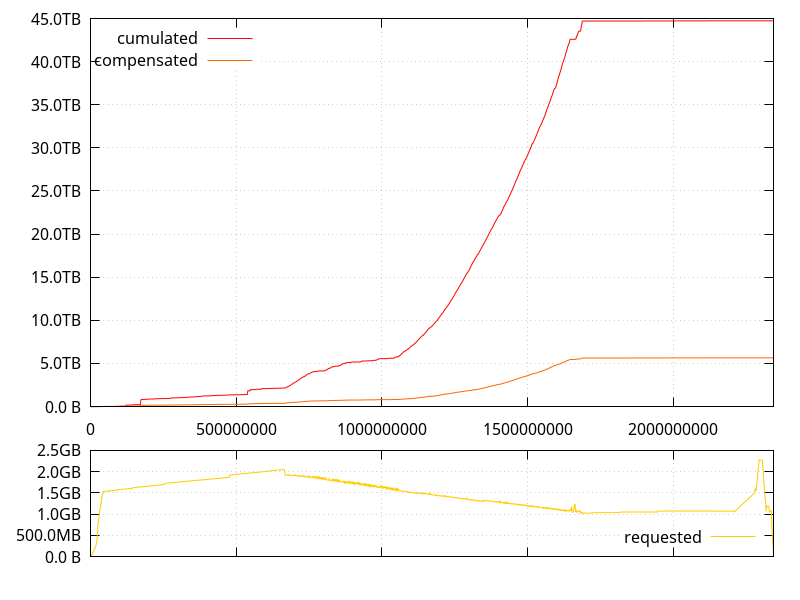
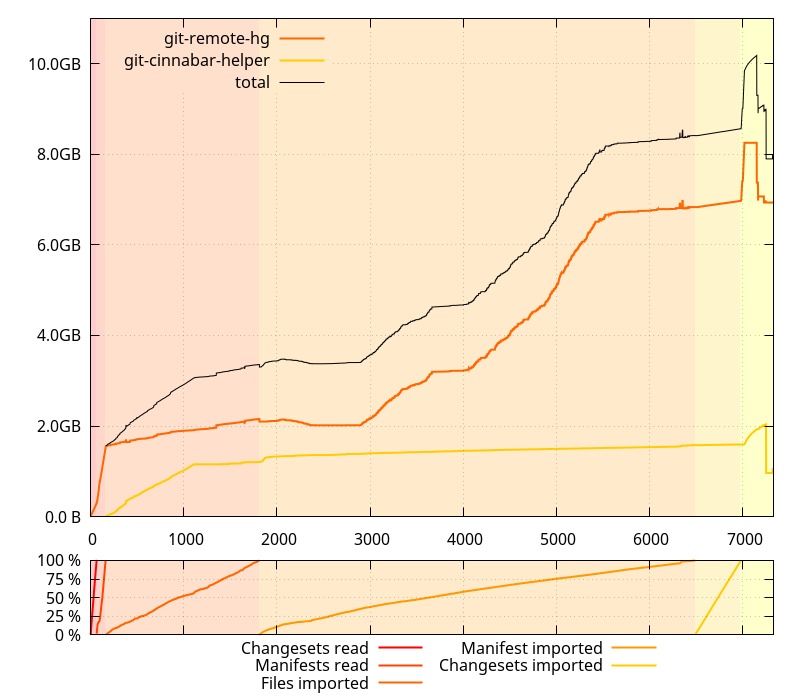
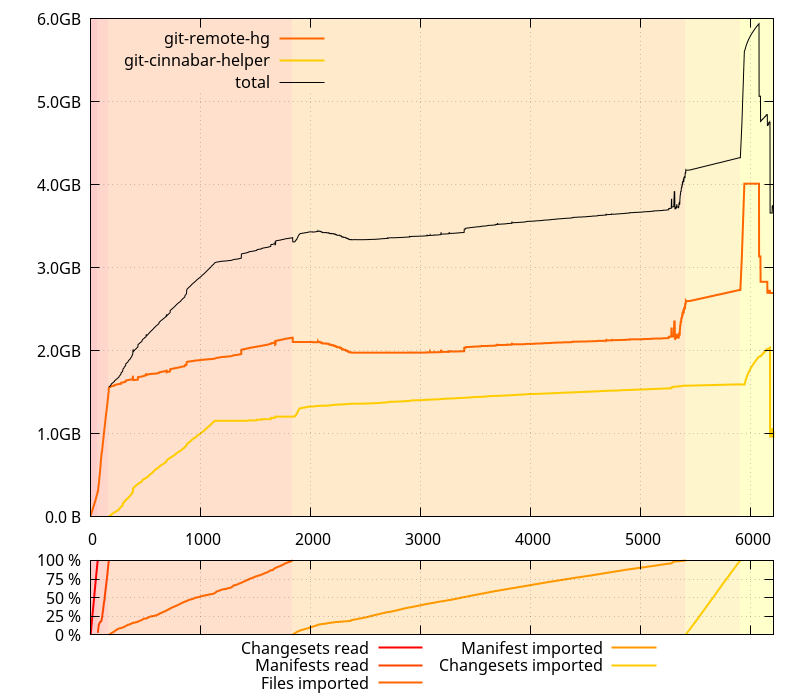
In previous post, I was looking at the allocations git-cinnabar makes. While I had the data, I figured I d also look how the memory use correlates with expectations based on repository data, to put things in perspective. As a reminder, this is what the allocations look like (horizontal axis being the number of allocator function calls): There are 7 different phases happening during a git clone using git-cinnabar, most of which can easily be identified on the graph above: Overall, except for the stupid spike during the final phase, the manifest DAG and the glibc allocator runaway memory use described in previous posts, there is nothing terribly bad with the git-cinnabar memory usage, all things considered. Mozilla-central is just big. The spike is already half addressed, and work is under way for the glibc allocator runaway memory use. The manifest DAG, interestingly, is actually mostly useless. It s only used to track the heads of the DAG, and it s very much possible to track heads of a DAG without actually storing the entire DAG. In fact, that s what git-cinnabar already does for changeset heads so we would only need to do the same for manifest heads. One could argue that the 1.4GB of raw RevChunk data we re keeping in memory for later user could be kept on disk instead. I haven t done this so far because I didn t want to have to handle temporary files (and answer questions like where to put them? , what if there isn t enough disk space there? , what if disk access is slow? , etc.). But the majority of this data is from manifests. I m already planning changes in how git-cinnabar stores manifests data that will actually allow to import them directly, instead of keeping them in memory until files are imported. This would instantly remove 1.18GB of memory usage. The downside, however, is that this would be more CPU intensive: Importing changesets will require creating the corresponding git trees, and getting the stored manifest data. I think it s worth, though. Finally, one thing that isn t obvious here, but that was found while analyzing why RSS would be going up despite memory usage going down, is that git-cinnabar is doing way too many reallocations and substring allocations. So let s look at two metrics that hopefully will highlight the problem: Assuming all the requested memory is filled at some point, the former gives us an upper bound to the amount of memory that is ever filled or copied (the amount that would be filled if no realloc was ever in-place), while the the latter gives us a lower bound (the amount that would be filled or copied if all reallocs were in-place). Ideally, we d want the upper and lower bounds to be close to each other (indicating few realloc calls), and the total amount at the end of the process to be as close as possible to the amount of data we re handling (which we ve seen is around 3TB). and this is clearly bad. Like, really bad. But we already knew that from the previous post, although it s nice to put numbers on it. The lower bound is about twice the amount of data we re handling, and the upper bound is more than 10 times that amount. Clearly, we can do better. We ll see how things evolve after the necessary code changes happen. Stay tuned.

22 March 2017

Mike Hommey: When the memory allocator works against you, part 2

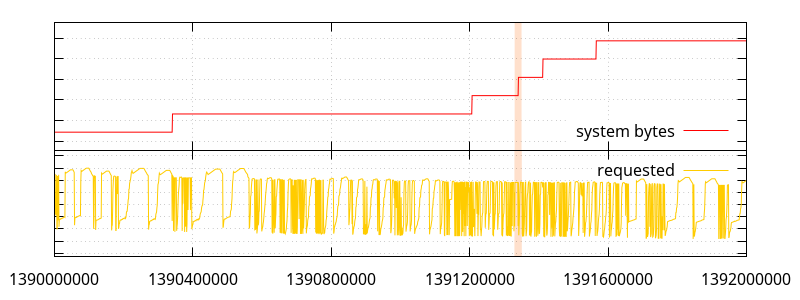
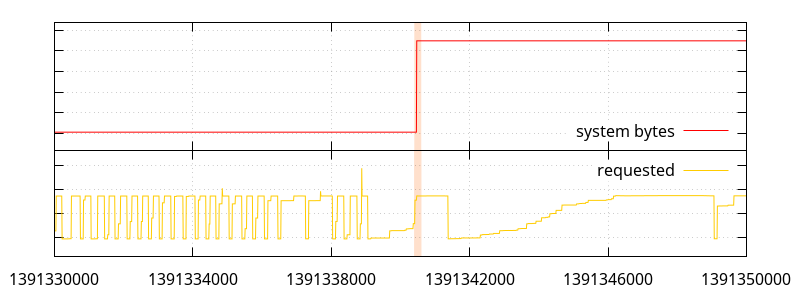
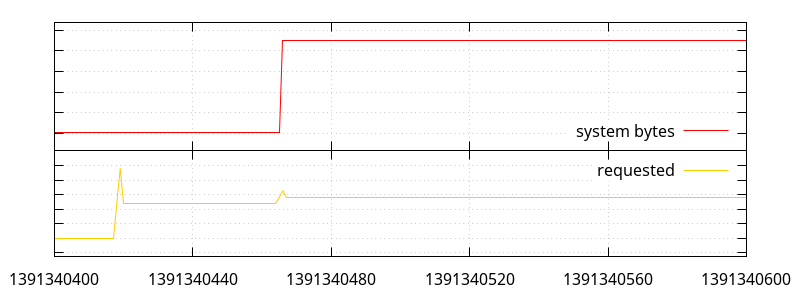
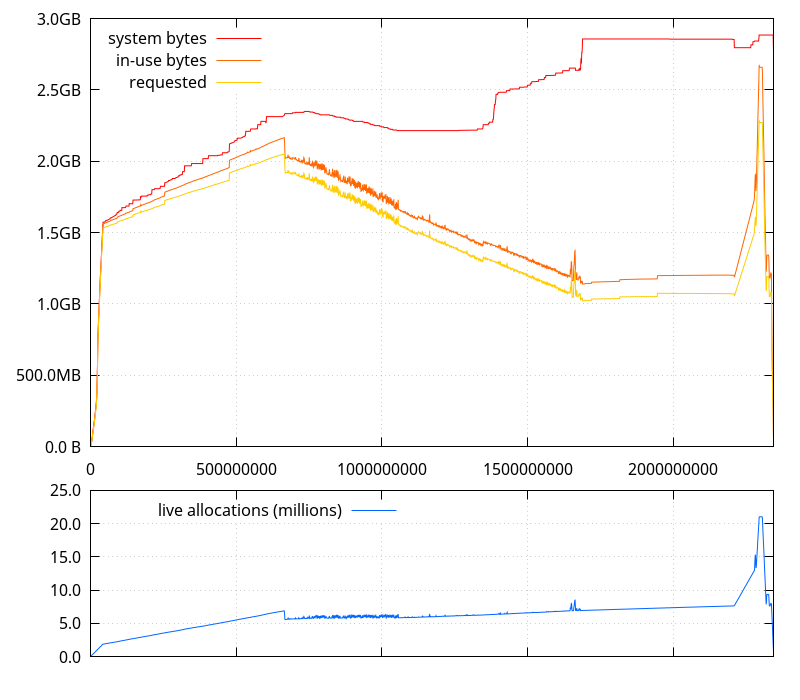
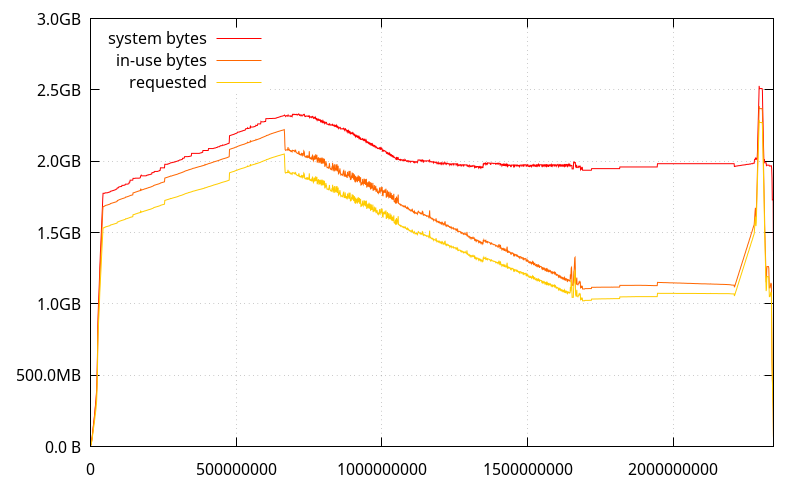
This is a followup to the When the memory allocator works against you post from a few days ago. You may want to read that one first if you haven t, and come back. In case you don t or didn t read it, it was all about memory consumption during a git clone of the mozilla-central mercurial repository using git-cinnabar, and how the glibc memory allocator is using more than one would expect. This post is going to explore how/why it s happening. I happen to have written a basic memory allocation logger for Firefox, so I used it to log all the allocations happening during a git clone exhibiting the runaway memory increase behavior (using a python that doesn t use its own allocator for small allocations). The result was a 6.5 GB log file (compressed with zstd ; 125 GB uncompressed!) with 2.7 billion calls to malloc, calloc, free, and realloc, recorded across (mostly) 2 processes (the python git-remote-hg process and the native git-cinnabar-helper process ; there are other short-lived processes involved, but they do less than 5000 calls in total). The vast majority of those 2.7 billion calls is done by the python git-remote-hg process: 2.34 billion calls. We ll only focus on this process. Replaying those 2.34 billion calls with a program that reads the log allowed to reproduce the runaway memory increase behavior to some extent. I went an extra mile and modified glibc s realloc code in memory so it doesn t call memcpy, to make things faster. I also ran under setarch x86_64 -R to disable ASLR for reproducible results (two consecutive runs return the exact same numbers, which doesn t happen with ASLR enabled). I also modified the program to report the number of live allocations (allocations that haven t been freed yet), and the cumulated size of the actually requested allocations (that is, the sum of all the sizes given to malloc, calloc, and realloc calls for live allocations, as opposed to what the memory allocator really allocated, which can be more, per malloc_usable_size). RSS was not tracked because the allocations are never filled to make things faster, such that pages for large allocations are never dirty, and RSS doesn t grow as much because of that. Full disclosure: it turns out the system bytes and in-use bytes numbers I had been collecting in the previous post were smaller than what they should have been, and were excluding memory that the glibc memory allocator would have mmap()ed. That however doesn t affect the trends that had been witnessed. The data below is corrected. (Note that in the graph above and the graphs that follow, the horizontal axis represents the number of allocator function calls performed) While I was here, I figured I d check how mozjemalloc performs, and it has a better behavior (although it has more overhead). What doesn t appear on this graph, though, is that mozjemalloc also tells the OS to drop some pages even if it keeps them mapped (madvise(MADV_DONTNEED)), so in practice, it is possible the actual RSS decreases too. And jemalloc 4.5: (It looks like it has better memory usage than mozjemalloc for this use case, but its stats are being thrown off at some point, I ll have to investigate) Going back to the first graph, let s get a closer look at what the allocations look like when the system bytes number is increasing a lot. The highlights in the following graphs indicate the range the next graph will be showing. So what we have here is a bunch of small allocations (small enough that they don t seem to move the requested line ; most under 512 bytes, so under normal circumstances, they would be allocated by python, a few between 512 and 2048 bytes), and a few large allocations, one of which triggers a bump in memory use. What can appear weird at first glance is that we have a large allocation not requiring more system memory, later followed by a smaller one that does. What the allocations actually look like is the following:
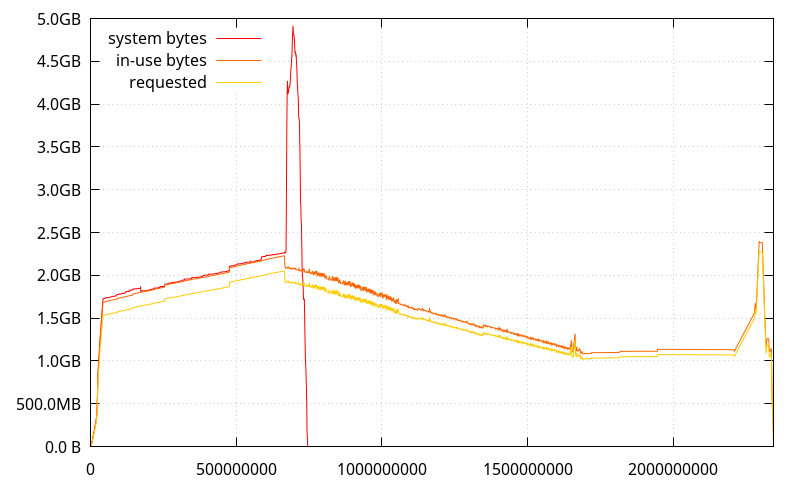
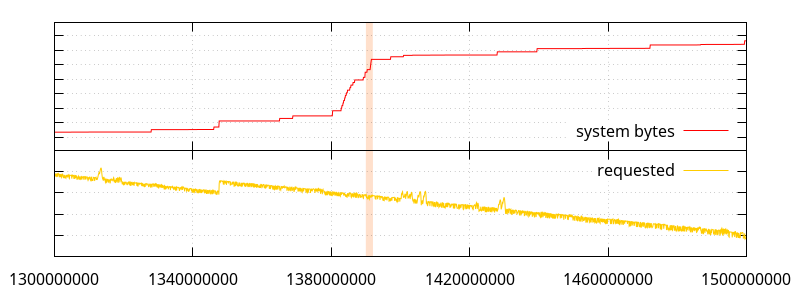
void *ptr0 = malloc(4850928); // #1391340418
void *ptr1 = realloc(some_old_ptr, 8000835); // #1391340419
free(ptr0); // #1391340420
ptr1 = realloc(ptr1, 8000925); // #1391340421
/* ... */
void *ptrn = malloc(879931); // #1391340465
ptr1 = realloc(ptr1, 8880819); // #1391340466
free(ptrn); // #1391340467
As it turns out, inspecting all the live allocations at that point, while there was a hole large enough to do the first two reallocs (the second actually happens in place), at the point of the third one, there wasn t a large enough hole to fit 8.8MB. What inspecting the live allocations also reveals, is that there is a large number of large holes between all the allocated memory ranges, presumably coming from previous similar patterns. There are, in fact, 91 holes larger than 1MB, 24 of which are larger than 8MB. It s the accumulation of those holes that can t be used to fulfil larger allocations that makes the memory use explode. And there aren t enough small allocations happening to fill those holes. In fact, the global trend is for less and less memory to be allocated, so, smaller holes are also being poked all the time. Really, it s all a straightforward case of memory fragmentation. The reason it tends not to happen with jemalloc is that jemalloc groups allocations by sizes, which the glibc allocator doesn t seem to be doing. The following is how we got a hole that couldn t fit the 8.8MB allocation in the first place:

ptr1 = realloc(ptr1, 8880467); // #1391324989; ptr1 is 0x5555de145600
/* ... */
void *ptrx = malloc(232); // #1391325001; ptrx is 0x5555de9bd760 ; that is 13 bytes after the end of ptr1.
/* ... */
free(ptr1); // #1391325728; this leaves a hole of 8880480 bytes at 0x5555de145600.
All would go well if ptrx was free()d, but it looks like it s long-lived. At least, it s still allocated by the time we reach the allocator call #1391340466. And since the hole is 339 bytes too short for the requested allocation, the allocator has no other choice than request more memory to the system. What s bothering, though, is that the allocator chose to allocate ptrx in the space following ptr1, when it allocated similarly sized buffers after allocating ptr1 and before allocating ptrx in completely different places, and while there are plenty of holes in the allocated memory where it could fit. Interestingly enough, ptrx is a 232 bytes allocation, which means under normal circumstances, python itself would be allocating it. In all likeliness, when the python allocator is enabled, it s allocations larger than 512 bytes that become obstacles to the larger allocations. Another possibility is that the 256KB fragments that the python allocator itself allocates to hold its own allocations become the obstacles (my original hypothesis). I think the former is more likely, though, putting back the blame entirely on glibc s shoulders. Now, it looks like the allocation pattern we have here is suboptimal, so I re-ran a git clone under a debugger to catch when a realloc() for 8880819 bytes happens (the size is peculiar enough that it only happened once in the allocation log). But doing that with a conditional breakpoint is just too slow, so I injected a realloc wrapper with LD_PRELOAD that sends a SIGTRAP signal to the process, so that an attached debugger can catch it. Thanks to the support for python in gdb, it was then posible to pinpoint the exact python instructions that made the realloc() call (it didn t come as a surprise ; in fact, that was one of the places I had in mind, but I wanted definite proof):

new = ''
end = 0
# ...
for diff in RevDiff(rev_patch):
    new += data[end:diff.start]
    new += diff.text_data
    end = diff.end
    # ...
new += data[end:]
What happens here is that we re creating a mercurial manifest we got from the server in patch form against a previous manifest. So data contains the original manifest, and rev_patch the patch. The patch essentially contains instructions of the form replace n bytes at offset o with the content c . The code here just does that in the most straightforward way, implementation-wise, but also, it turns out, possibly the worst way. So let s unroll this loop over a couple iterations:
new = ''
This allocates an empty str object. In fact, this doesn t actually allocate anything, and only creates a pointer to an interned representation of an empty string.
new += data[0:diff.start]
This is where things start to get awful. data is a str, so data[0:diff.start] creates a new, separate, str for the substring. One allocation, one copy. Then appends it to new. Fortunately, CPython is smart enough, and just assigns data[0:diff.start] to new. This can easily be verified with the CPython REPL:
>>> foo = ''
>>> bar = 'bar'
>>> foo += bar
>>> foo is bar
True
(and this is not happening because the example string is small here ; it also happens with larger strings, like 'bar' * 42000) Back to our loop:
new += diff.text_data
Now, new is realloc()ated to have the right size to fit the appended text in it, and the contents of diff.text_data is copied. One realloc, one copy. Let s go for a second iteration:
new += data[diff.end:new_diff.start]
Here again, we re doing an allocation for the substring, and one copy. Then new is realloc()ated again to append the substring, which is an additional copy.
new += new_diff.text_data
new is realloc()ated yet again to append the contents of new_diff.text_data. We now finish with:
new += data[new_diff.end:]
which, again creates a substring from the data, and then proceeds to realloc()ate new one freaking more time. That s a lot of malloc()s and realloc()s to be doing After modifying the code to implement the first and fifth items, memory usage during a git clone of mozilla-central looks like the following (with the python allocator enabled): (Note this hasn t actually landed on the master branch yet) Compared to what it looked like before, this is largely better. But that s not the only difference: the clone was also about 1000 seconds faster. That s more than 15 minutes! But that s not all so surprising when you know the volumes of data handled here. More insight about this coming in an upcoming post. But while the changes outlined above make the glibc allocator behavior less likely to happen, it doesn t totally obliviate it. In fact, it seems it is still happening by the end of the manifest import phase. We re still allocating increasingly large temporary buffers because the size of the imported manifests grows larger and larger, and every one of them is the result of patching a previous one. The only way to avoid those large allocations creating holes would be to avoid doing them in the first place. My first attempt at doing that, keeping manifests as lists of lines instead of raw buffers, worked, but was terribly slow. So slow, in fact, that I had to stop a clone early and estimated the process would likely have taken a couple days. Iterating over multiple generators at the same time, a lot, kills performance, apparently. I ll have to try with significantly less of that.
19 March 2017

Clint Adams: Measure once, devein twice

Ophira lived in a wee house in University Square, Tampa. It had one floor, three bedrooms, two baths, a handful of family members, a couple pets, some plants, and an occasional staring contest. Mauricio lived in Lowry Park North, but Ophira wasn t allowed to go there because Mauricio was afraid that someone would tell his girlfriend. Ophira didn t like Mauricio s girlfriend and Mauricio s girlfriend did not like Ophira. Mauricio did not bring his girlfriend along when he and Ophira went to St. Pete Beach. They frolicked in the ocean water, and attempted to have sex. Mauricio and Ophira were big fans of science, so Somewhat quickly they concluded that it is impossible to have sex underwater, and absconded to Ophira s car to have sex therein. I hate Mauricio s girlfriend, Ophira told Amit on the telephone. She s not even pretty. Hey, listen, said Amit. I m going to a wedding on Captiva. Oh, my family used to go to Captiva every year. There s bioluminescent algae and little crabs and stuff. Yeah? Do you want to come along? You could pick me up at the airport. Why would I want to go to a wedding? Well, it s on the beach and they re going to have a bouncy castle. A bouncy castle Are you serious? Yes. Well, okay. Amit prepared to go to the wedding and Ophira became terse then unresponsive. After he landed at RSW, he called Ophira, but instead of answering the phone she startled and fell out of her chair. Amit arranged for other transportation toward the Sanibel Causeway. Ophira bit her nails for a few hours, then went to her car and drove to Cape Coral. Ophira cruised around Cape Coral for a while, until she spotted a teenager cleaning a minivan. She parked her car and approached him. Whatcha doing? asked Ophira, pretending to chew on imaginary gum. The youth slid the minivan door open. I m cleaning, he said hesitantly. Didn t your parents teach you not to talk to strangers? I could do all kinds of horrible things to you. They conversed for a bit. She recounted a story of her personal hero, a twelve-year-old girl who seduced and manipulated older men into ruin. She rehashed the mysteries of Mauricio s girlfriend. She waxed poetic on her love of bouncy castles. The youth listened, hypnotized. What s your name, kid? Ophira yawned. Arjun, he replied. How old are you? Arjun thought about it. 15, he said. Hmm, Ophira stroked her chin. Can you sneak me into your room so that your parents never find out about it? Arjun s eyes went wide. MEANWHILE, on Captiva Island, Amit had learned that even though the Tenderly had multiple indoor jacuzzis, General Fitzpatrick and Mrs. Fitzpatrick had decided it prudent to have sex in the hot tub on the deck; that the execution of this plan had somehow necessitated a lengthy cleaning process before the hot tub could be used again; that that s why workmen were cleaning the hot tub; and that the Fitzpatrick children had gotten General Fitzpatrick and Mrs. Fitzpatrick to agree to not do that again, with an added suggestion that they not be seen doing anything else naked in public. A girl walked up to Amit. Hey, I heard you lost your plus-one. Are you here alone? What a loser! she giggled nervously, then stared. Leave me alone, Darlene, sighed Amit. Darlene s face reddened as she spun on her heels and stormed over to Lisette. Oh my god, did you see that? I practically threw myself at him and he was abusive toward me. He probably has all the classic signs of being an abuser. Did you hear about that girl he dated in Ohio? I bet I know why that ended. Oh really? said Lisette distractedly, looking Amit up and down. So he s single now? Darlene glared at Lisette as Amit wandered back outside to stare at the hot tub. Hey kid, said Ophira, bring me some snacks. I don t bring food into my room, said Arjun. It attracts pests. Is that what your parents told you? scoffed Ophira. Don t be such a wuss. Three minutes later, Ophira was finishing a bag of paprika puffs. These are great, Arjun! Where do you get these? My cousin sends them from Europe, he explained. Now get me a diet soda. Amit strolled along the beach, then yelped. What s biting my legs? he cried out. Those are sand fleas, said Nessarose. What are sand fleas? asked Amit incredulously. Nessarose rolled her eyes. Stop being a baby and have a drink. After the sun went down, Amit began to notice the crabs, and this made him drink more. When everyone was soused, General Fitzpatrick announced that they were going for a swim in the Gulf, in direct contravention of safety guidelines. Most of the guests were wise enough to refuse, but an eightsome swam out, occasionally stopping to slap the algae, but continuing until they reached the sandbar that General Fitzpatrick correctly claimed was there. Then screams echoed through the night as all the jellyfish attacked everyone invading their sandbar. The crestfallen swimming party eventually made it back to shore. Pee on the jellyfish sting, commanded Nessarose. It s the best cure. No! shouted General Fitzpatrick s daughter. Urine makes it worse. Things quickly escalated from Nessarose and General Fitzpatrick s daughter screaming at each other to the beach dividing into three factions: those siding with Nessarose, those siding with General Fitzpatrick s daughter, and those who had no idea what was going on. General Fitzpatrick had no interest in any of this, and went straight to bed. It s getting late, kid, said Ophira. I m taking your bed. What? squeaked Arjun. Look, said Ophira, your bed is small and there isn t room for both of us. You may sleep on the floor if you re quiet and don t bother me. What? squeaked Arjun. Are you deaf, kid? Ophira grunted and then went to bed. Arjun blinked in confusion, then tried to fall asleep on the floor, without much success. Ophira got up in the morning and said, Before I go, I want to teach you a valuable lesson. What? groaned Arjun, getting to his feet. You should be careful talking to strangers. Now, I told you that I could do horrible things to you, so this is not my fault; it s yours, she announced, then sucker-punched him in the gut. Ophira climbed out the window as Arjun doubled over. As the ceremony began, only a small minority of the wedding party was visibly suffering from jellyfish stings, which may or may not have helped with ignoring the sand fleas. The ceremony ended shortly thereafter, and now that marriage had been accomplished, everyone turned their attention to food and drink and swimming less irresponsibly than the night before. Guests that needed to return home sooner departed in waves and Amit started to appreciate the more peaceful environment. He heard the deck door slide open behind him and turned his attention away from the hot tub. Hey, mofo, Ophira shouted as strode stylishly out onto the deck. Where s this bouncy castle? Amit blinked in surprise. That was yesterday. You missed it. Oh, she frowned. So I met this South Slav guy with a really sexy forehead, and I need some advice. I don t know if I should call him or wait. Amit pointed to the hot tub and told her the story of General Fitzpatrick and Mrs. Fitzpatrick and the hot tub. What? said Ophira. How could they have sex underwater? What do you mean? asked Amit. Well, it s impossible, she replied.
Posted on 2017-03-19
Tags: mintings

17 March 2017

Shirish Agarwal: Science Day at GMRT, Khodad 2017

The whole team posing at the end of day 2 The above picture is the blend of the two communities from foss community and mozilla India. And unless you were there you wouldn t know who is from which community which is what FOSS is all about. But as always I m getting a bit ahead of myself. Akshat, who works at NCRA as a programmer, the standing guy on the left shared with me in January this year that this year too, we should have two stalls, foss community and mozilla India stalls next to each other. While we had the banners, we were missing stickers and flyers. Funds were and are always an issue and this year too, it would have been emptier if we didn t get some money saved from last year minidebconf 2016 that we had in Mumbai. Our major expenses included printing stickers, stationery and flyers which came to around INR 5000/- and couple of LCD TV monitors which came for around INR 2k/- as rent. All the labour was voluntary in nature, but both me and Akshat easily spending upto 100 hours before the event. Next year, we want to raise to around INR 10-15k so we can buy 1 or 2 LCD monitors and we don t have to think for funds for next couple of years. How will we do that I have no idea atm. Printing leaflets Me and Akshat did all the printing and stationery runs and hence had not been using my lappy for about 3-4 days. Come to the evening before the event and the laptop would not start. Coincidentally, or not few months or even last at last year s Debconf people had commented on IBM/Lenovo s obsession with proprietary power cords and adaptors. I hadn t given it much thought but when I got no power even after putting it on AC power for 3-4 hours, I looked up on the web and saw that the power cord and power adaptors were all different even in T440 and even that under existing models. In fact I couldn t find mine hence sharing it via pictures below. thinkpad power cord male thinkpad power adaptor female I knew/suspected that thinkpads would be rare where I was going, it would be rarer still to find the exact power cord and I was unsure whether it was the power cord at fault or adaptor or whatever goes for SMPS in laptop or memory or motherboard/CPU itself. I did look up the documentation at support.lenovo.com and was surprised at the extensive documentation that Lenovo has for remote troubleshooting. I did the usual take out the battery, put it back in, twiddle with the little hole in the bottom of the laptop, trying to switch on without the battery on AC mains, trying to switch on with battery power only but nothing worked. Couple of hours had gone by and with a resigned thought went to bed, convincing myself that anyways it s good I am not taking the lappy as it is extra-dusty there and who needs a dead laptop anyways. Update After the event was over, I did contact Lenovo support and within a week, with one visit from a service engineer, he was able to identify that it was a faulty cable which was at fault and not the the other things which I was afraid of. Another week gone by and lenovo replaced the cable. Going by service standards that I have seen of other companies, Lenovo deserves a gold star here for the prompt service they provided. I probably would end up subscribing to their extended 2-year warranty service when my existing 3 year warranty is about to be over. Next day, woke up early morning, two students from COEP hostel were volunteering and we made our way to NCRA, Pune University Campus. Ironically, though we were under the impression that we would be the late arrivals, it turned out we were the early birds. 5-10 minutes passed by and soon enough we were joined by Aniket and we played catch-up for a while. We hadn t met each other for a while so it was good to catch-up. Then slowly other people starting coming in and around 07:10-07:15 we started for GMRT, Khodad. Now I had been curious as had been hearing for years that the Pune-Nashik NH-50 highway would be concreted and widened to six-lane highways but the experience was below par. Came back and realized the proposal has now been pushed back to 2020. From the mozilla team, only Aniket was with us, the rest of the group was coming straight from Nashik. Interestingly, all the six people who came, came on bikes which depending upon how you look at it was either brave or stupid. Travelling on bikes on Indian highways you either have to be brave or stupid or both, we have more than enough accidents due to quality of road construction, road design, lane-changing drivers and many other issues. This is probably not the place for it hence will use some other blog post to rant about that. We reached around 10:00 hrs. IST and hung around till lunch as Akshat had all the marketing material, monitors etc. The only thing we had were couple of lappies and couple of SBC s, an RPI 3 and a BBB. Aarti Kashyap sharing something about SBC Our find for the event was Aarti Kashyap who you can see above. She is a third-year student at COEP and one of the rare people who chose to interact with hardware rather than software. From last several years, we had been trying, successfully and unsuccessfully to get more Indian women and girls interested into technology. It is a vicious circle as till a girl/woman doesn t volunteer we are unable to share our knowledge to the extent we can which leads them to not have much interest in FOSS or even technology in general. While there are groups are djangogirls, Pyladies and railgirls and even Outreachy which tries to motivate getting girls into computing but it s a long road ahead. We are short of both funds and ideas as to how to motivate more girls to get into computing and then to get into playing with hardware. I don t know where to start and end for whoever wants to play with hardware. From SBC s, routers to blade servers the sky is the limit. Again this probably isn t the place for it, hence probably we can chew it on more at some other blog post. This year, we had a lowish turnout due to the fact that the 12th board exams 1st paper was on the day we had opened. So instead of 20-25k, we probably had 5-7k fewer people pass through. There were two-three things that we were showing, we were showing Debian on one of the systems, we were showing the output from the SBC s on the other monitor but the glare kept hitting the monitors. While the organizers had done exemplary work over last year. They had taped the carpets on the ground so there was hardly any dust moving around. However, I wished the organizers had taken the pains to have two cloth roofs over our head instead of just one, the other roof head could be say 2 feet up, this would have done two things a. It probably would have cooled the place a bit more as b. We could get diffused sunlight which would have lessened the glare and reflection the LCD s kept throwing back. At times we also got people to come to our side as can be seen in Aarti s photo as can be seen above. If these improvements can be made for next year, this would result in everybody in our Pandal would benefit, not just us and mozilla. This would be benefiting around 10-15 organizations which were within the same temporary structure. Of course, it depends very much on the budget they are able to have and people who are executing, we can just advise. The other thing which had been missing last year and this year is writing about Single Board Computers in Marathi. If we are to promote them as something to replace a computer or something for a younger brother/sister to learn computing upon at a lower cost, we need leaflets written in their language to be more effective. And this needs to be in the language and mannerisms that people in that region understand. India, as probably people might have experienced is a dialect-prone country. Which means every 2-5 kms, the way the language is spoken is different from anywhere else. The Marathi spoken by somebody who has lived in Ravivar Peth for his whole life and a person who has lived in say Kothrud are different. The same goes from any place and this place, Khodad, Narayangaon would have its own dialect, its own mini-codespeak. Just to share, we did have one in English but it would have been a vast improvement if we could do it in the local language. Maybe we can discuss about this and ask for help from people. Outside, Looking in Mozillians helping FOSS community and vice-versa What had been interesting about the whole journey were the new people who were bringing all their passion and creativity to the fore. From the mozilla community, we had Akshay who is supposed to be a wizard on graphics, animation, editing anything to do with the visual medium. He shared some of the work he had done and also shared a bit about how blender works with people who wanted to learn about that. Mayur, whom you see in the picture pointing out something about FOSS and this was the culture that we strove to have. I know and love and hate the browser but haven t been able to fathom the recklessness that Mozilla has been doing the last few years, which has just been having one mis-adventure after another. For instance, mozstumbler was an effort which I thought would go places. From what little I understood, it served/serves as a user-friendly interface to a potential user while still sharing all the data with OSM . They (Mozilla) seems/seemed to have a fatalistic take as it provided initial funding but then never fully committing to the project. Later, at night we had the whole free software and open-source sharings where I tried to emphasize that without free software, the term open-source would not have come into existence. We talked and talked and somewhere around 02:00 I slept, the next day was an extension of the first day itself where we ribbed each other good-naturedly and still shared whatever we could share with each other. I do hope that we continue this tradition for great many years to come and engage with more and more people every passing year.
Filed under: Miscellenous Tagged: #budget, #COEP< #volunteering, #debian, #Events, #Expenses, #mozstumbler, #printing, #SBC's, #Science Day 2017, #thinkpad cable issue, FOSS, mozilla

12 March 2017

Steve Kemp: How I started programming

I've written parts of this story in the past, but never in one place and never in much detail. So why not now? In 1982 my family moved house, so one morning I went to school and at lunch-time I had to walk home to a completely different house. We moved sometime towards the end of the year, and ended up spending lots of money replacing the windows of the new place. For people in York I was born in Farrar Street, Y010 3BY, and we moved to a place on Thief Lane, YO1 3HS. Being named as it was I "ironically" stole at least two street-signs and hung them on my bedroom wall. I suspect my parents were disappointed. Anyway the net result of this relocation, and the extra repairs meant that my sisters and I had a joint Christmas present that year, a ZX Spectrum 48k. I tried to find pictures of what we received but unfortunately the web doesn't remember the precise bundle. All together though we received: I know we also received Horace and the Spiders, and I have vague memories of some other things being included, including a Space Invaders clone. No doubt my parents bought them separately. Highlights of my Spectrum-gaming memories include R-Type, Strider, and the various "Dizzy" games. Some of the latter I remember very fondly. Unfortunately this Christmas was pretty underwhelming. We unpacked the machine, we cabled it up to the family TV-set - we only had the one, after all - and then proceeded to be very disappointed when nothing we did resulted in a successful game! It turns out our cassette-deck was not good enough. Being back in the 80s the shops were closed over Christmas, and my memory is that it was around January before we received a working tape-player/recorder, such that we could load games. Happily the computer came with manuals. I read one, skipping words and terms I didn't understand. I then read the other, which was the spiral-bound orange book. It contained enough examples and decent wording that I learned to write code in BASIC. Not bad for an 11/12 year old. Later I discovered that my local library contained "computer books". These were colourful books that promised "The Mystery of Silver Mounter", or "Write your own ADVENTURE PROGRAMS". But were largely dry books that contained nothing but multi-page listings of BASIC programs to type in. Often with adjustments that had to be made for your own computer-flavour (BASIC varying between different systems).

If you want to recapture the magic scroll to the foot of this Osbourne page and you can download them!
Later I taught myself Z80 Assembly Language, partly via the Spectrum manual and partly via such books as these two (which I still own 30ish years later): Pretty much the only reason I continued down this path is because I wanted infinite/extra lives in the few games I owned. (Which were largely pirated via the schoolboy network of parents with cassette-copiers.) Eventually I got some of my l33t POKES printed in magazines, and received free badges from the magazines of the day such as Your Sinclair & Sinclair User. For example I was "Hacker of the Month" in the Your Sinclair issue 67 , Page 32, apparently because I "asked so nicely in my letter". Terrible scan is terrible: Anyway that takes me from 1980ish to 1984. The only computer I ever touched was a Spectrum. Friends had other things, and there were Sega consoles, but I have no memories of them. Suffice it to say that later when I first saw a PC (complete with Hercules graphics, hard drives, and similar sourcery, running GEM IIRC) I was pleased that Intel assembly was "similar" to Z80 assembly - and now I know the reason why. Some time in the future I might document how I got my first computer job. It is hillarious. As was my naivete.

10 March 2017

Mart n Ferrari: SunCamp happening again this May!

As I announced in mailing lists a few days ago, the Debian SunCamp (DSC2017) is happening again this May. SunCamp different to most other Debian events. Instead of a busy schedule of talks, SunCamp focuses on the hacking and socialising aspect, without making it just a Debian party/vacation.
DSC2016 - Hacking and discussing
The idea is to have 4 very productive days, staying in a relaxing and comfy environment, working on your own projects, meeting with your team, or presenting to fellow Debianites your most recent pet project.
DSC2016 - Tincho talking about Prometheus
We have tried to make this event the simplest event possible, both for organisers and attendees. There will be no schedule, except for the meal times at the hotel. But these can be ignored too, there is a lovely bar that serves snacks all day long, and plenty of restaurants and caf s around the village. DSC2016 - Hacking and discussing The SunCamp is an event to get work done, but there will be time for relaxing and socialising too.
DSC2016 - Well deserved siesta
DSC2016 - Playing P tanque
Do you fancy a hack-camp in a place like this? Swimming pool Caf Caf  terrace One of the things that makes the event simple, is that we have negotiated a flat price for accommodation that includes usage of all the facilities in the hotel, and optionally food. We will give you a booking code, and then you arrange your accommodation as you please, you can even stay longer if you feel like it! The rooms are simple but pretty, and everything has been renovated very recently. Room Room view We are not preparing a talks programme, but we will provide the space and resources for talks if you feel inclined to prepare one. You will have a huge meeting room, divided in 4 areas to reduce noise, where you can hack, have team discussions, or present talks. Hacklab Hacklab Do you want to see more pictures? Check the full gallery
Debian SunCamp 2017 Hotel Anabel, LLoret de Mar, Province of Girona, Catalonia, Spain May 18-21, 2017

Tempted already? Head to the wikipage and register now, it is only 2 months away! Please try to reserve your room before the end of March. The hotel has reserved a number of rooms for us until that time. You can reserve a room after March, but we can't guarantee the hotel will still have free rooms. Comment

8 March 2017

Petter Reinholdtsen: How does it feel to be wiretapped, when you should be doing the wiretapping...

So the new president in the United States of America claim to be surprised to discover that he was wiretapped during the election before he was elected president. He even claim this must be illegal. Well, doh, if it is one thing the confirmations from Snowden documented, it is that the entire population in USA is wiretapped, one way or another. Of course the president candidates were wiretapped, alongside the senators, judges and the rest of the people in USA. Next, the Federal Bureau of Investigation ask the Department of Justice to go public rejecting the claims that Donald Trump was wiretapped illegally. I fail to see the relevance, given that I am sure the surveillance industry in USA believe they have all the legal backing they need to conduct mass surveillance on the entire world. There is even the director of the FBI stating that he never saw an order requesting wiretapping of Donald Trump. That is not very surprising, given how the FISA court work, with all its activity being secret. Perhaps he only heard about it? What I find most sad in this story is how Norwegian journalists present it. In a news reports the other day in the radio from the Norwegian National broadcasting Company (NRK), I heard the journalist claim that 'the FBI denies any wiretapping', while the reality is that 'the FBI denies any illegal wiretapping'. There is a fundamental and important difference, and it make me sad that the journalists are unable to grasp it. Update 2017-03-13: Look like The Intercept report that US Senator Rand Paul confirm what I state above.

Next.

Previous.